EP0808504B1 - Procede et dispositif pour traiter des huiles et solvants contamines par des substances radioactives - Google Patents
Procede et dispositif pour traiter des huiles et solvants contamines par des substances radioactives Download PDFInfo
- Publication number
- EP0808504B1 EP0808504B1 EP96904124A EP96904124A EP0808504B1 EP 0808504 B1 EP0808504 B1 EP 0808504B1 EP 96904124 A EP96904124 A EP 96904124A EP 96904124 A EP96904124 A EP 96904124A EP 0808504 B1 EP0808504 B1 EP 0808504B1
- Authority
- EP
- European Patent Office
- Prior art keywords
- water
- effluent
- microorganisms
- oils
- solvents
- Prior art date
- Legal status (The legal status is an assumption and is not a legal conclusion. Google has not performed a legal analysis and makes no representation as to the accuracy of the status listed.)
- Expired - Lifetime
Links
- 239000003921 oil Substances 0.000 title claims description 54
- 239000002904 solvent Substances 0.000 title claims description 51
- 238000000034 method Methods 0.000 title claims description 33
- 239000000941 radioactive substance Substances 0.000 title claims description 20
- 238000012545 processing Methods 0.000 title description 7
- XLYOFNOQVPJJNP-UHFFFAOYSA-N water Substances O XLYOFNOQVPJJNP-UHFFFAOYSA-N 0.000 claims description 100
- 244000005700 microbiome Species 0.000 claims description 60
- 239000000463 material Substances 0.000 claims description 26
- 239000000203 mixture Substances 0.000 claims description 23
- 230000008569 process Effects 0.000 claims description 22
- 230000009471 action Effects 0.000 claims description 14
- 229910052760 oxygen Inorganic materials 0.000 claims description 12
- QVGXLLKOCUKJST-UHFFFAOYSA-N atomic oxygen Chemical compound [O] QVGXLLKOCUKJST-UHFFFAOYSA-N 0.000 claims description 11
- 239000001301 oxygen Substances 0.000 claims description 11
- 230000002285 radioactive effect Effects 0.000 claims description 11
- 238000001704 evaporation Methods 0.000 claims description 9
- 238000001035 drying Methods 0.000 claims description 8
- 230000008020 evaporation Effects 0.000 claims description 8
- 229910052751 metal Inorganic materials 0.000 claims description 8
- 239000002184 metal Substances 0.000 claims description 8
- 150000002739 metals Chemical class 0.000 claims description 8
- 238000004064 recycling Methods 0.000 claims description 8
- 235000015097 nutrients Nutrition 0.000 claims description 7
- 230000001172 regenerating effect Effects 0.000 claims description 7
- GNFTZDOKVXKIBK-UHFFFAOYSA-N 3-(2-methoxyethoxy)benzohydrazide Chemical compound COCCOC1=CC=CC(C(=O)NN)=C1 GNFTZDOKVXKIBK-UHFFFAOYSA-N 0.000 claims description 5
- VTYYLEPIZMXCLO-UHFFFAOYSA-L Calcium carbonate Chemical compound [Ca+2].[O-]C([O-])=O VTYYLEPIZMXCLO-UHFFFAOYSA-L 0.000 claims description 5
- 238000005352 clarification Methods 0.000 claims description 4
- 239000000470 constituent Substances 0.000 claims description 4
- 238000010908 decantation Methods 0.000 claims description 4
- 238000009833 condensation Methods 0.000 claims description 3
- 230000005494 condensation Effects 0.000 claims description 3
- 229910000019 calcium carbonate Inorganic materials 0.000 claims description 2
- 238000001914 filtration Methods 0.000 claims description 2
- 238000005189 flocculation Methods 0.000 claims description 2
- 230000016615 flocculation Effects 0.000 claims description 2
- 238000005342 ion exchange Methods 0.000 claims description 2
- 239000010457 zeolite Substances 0.000 claims description 2
- 229910000323 aluminium silicate Inorganic materials 0.000 claims 1
- 230000001419 dependent effect Effects 0.000 claims 1
- HNPSIPDUKPIQMN-UHFFFAOYSA-N dioxosilane;oxo(oxoalumanyloxy)alumane Chemical compound O=[Si]=O.O=[Al]O[Al]=O HNPSIPDUKPIQMN-UHFFFAOYSA-N 0.000 claims 1
- 230000007420 reactivation Effects 0.000 claims 1
- 239000006227 byproduct Substances 0.000 description 11
- 239000000047 product Substances 0.000 description 11
- 230000015556 catabolic process Effects 0.000 description 9
- 238000006731 degradation reaction Methods 0.000 description 9
- OKTJSMMVPCPJKN-UHFFFAOYSA-N Carbon Chemical compound [C] OKTJSMMVPCPJKN-UHFFFAOYSA-N 0.000 description 8
- 229910052500 inorganic mineral Inorganic materials 0.000 description 8
- 125000002496 methyl group Chemical group [H]C([H])([H])* 0.000 description 8
- 239000011707 mineral Substances 0.000 description 8
- 235000010755 mineral Nutrition 0.000 description 8
- 230000033228 biological regulation Effects 0.000 description 7
- 239000002699 waste material Substances 0.000 description 7
- BPQQTUXANYXVAA-UHFFFAOYSA-N Orthosilicate Chemical compound [O-][Si]([O-])([O-])[O-] BPQQTUXANYXVAA-UHFFFAOYSA-N 0.000 description 6
- 238000006243 chemical reaction Methods 0.000 description 6
- 238000009826 distribution Methods 0.000 description 6
- VKOBVWXKNCXXDE-UHFFFAOYSA-N icosanoic acid Chemical compound CCCCCCCCCCCCCCCCCCCC(O)=O VKOBVWXKNCXXDE-UHFFFAOYSA-N 0.000 description 6
- 238000009434 installation Methods 0.000 description 6
- 238000007254 oxidation reaction Methods 0.000 description 6
- 238000011161 development Methods 0.000 description 5
- 230000018109 developmental process Effects 0.000 description 5
- 239000012530 fluid Substances 0.000 description 5
- 238000002156 mixing Methods 0.000 description 5
- 230000003647 oxidation Effects 0.000 description 5
- 239000010802 sludge Substances 0.000 description 5
- 239000000126 substance Substances 0.000 description 5
- MHAJPDPJQMAIIY-UHFFFAOYSA-N Hydrogen peroxide Chemical compound OO MHAJPDPJQMAIIY-UHFFFAOYSA-N 0.000 description 4
- 239000002202 Polyethylene glycol Substances 0.000 description 4
- 230000015572 biosynthetic process Effects 0.000 description 4
- 239000007788 liquid Substances 0.000 description 4
- 229920001223 polyethylene glycol Polymers 0.000 description 4
- CRWNQZTZTZWPOF-UHFFFAOYSA-N 2-methyl-4-phenylpyridine Chemical compound C1=NC(C)=CC(C=2C=CC=CC=2)=C1 CRWNQZTZTZWPOF-UHFFFAOYSA-N 0.000 description 3
- 208000031968 Cadaver Diseases 0.000 description 3
- 150000001338 aliphatic hydrocarbons Chemical class 0.000 description 3
- HIGRAKVNKLCVCA-UHFFFAOYSA-N alumine Chemical compound C1=CC=[Al]C=C1 HIGRAKVNKLCVCA-UHFFFAOYSA-N 0.000 description 3
- PNEYBMLMFCGWSK-UHFFFAOYSA-N aluminium oxide Inorganic materials [O-2].[O-2].[O-2].[Al+3].[Al+3] PNEYBMLMFCGWSK-UHFFFAOYSA-N 0.000 description 3
- 229910052799 carbon Inorganic materials 0.000 description 3
- 238000011109 contamination Methods 0.000 description 3
- 230000000694 effects Effects 0.000 description 3
- 238000001879 gelation Methods 0.000 description 3
- 229930195733 hydrocarbon Natural products 0.000 description 3
- 150000002430 hydrocarbons Chemical group 0.000 description 3
- 238000002347 injection Methods 0.000 description 3
- 239000007924 injection Substances 0.000 description 3
- 230000007246 mechanism Effects 0.000 description 3
- 235000013619 trace mineral Nutrition 0.000 description 3
- 239000011573 trace mineral Substances 0.000 description 3
- 238000012546 transfer Methods 0.000 description 3
- XNWFRZJHXBZDAG-UHFFFAOYSA-N 2-METHOXYETHANOL Chemical compound COCCO XNWFRZJHXBZDAG-UHFFFAOYSA-N 0.000 description 2
- IKCLCGXPQILATA-UHFFFAOYSA-N 2-chlorobenzoic acid Chemical class OC(=O)C1=CC=CC=C1Cl IKCLCGXPQILATA-UHFFFAOYSA-N 0.000 description 2
- IJGRMHOSHXDMSA-UHFFFAOYSA-N Atomic nitrogen Chemical compound N#N IJGRMHOSHXDMSA-UHFFFAOYSA-N 0.000 description 2
- 239000002028 Biomass Substances 0.000 description 2
- 241000195940 Bryophyta Species 0.000 description 2
- LYCAIKOWRPUZTN-UHFFFAOYSA-N Ethylene glycol Chemical compound OCCO LYCAIKOWRPUZTN-UHFFFAOYSA-N 0.000 description 2
- 241001465754 Metazoa Species 0.000 description 2
- 239000002253 acid Substances 0.000 description 2
- 150000001335 aliphatic alkanes Chemical class 0.000 description 2
- 150000001491 aromatic compounds Chemical class 0.000 description 2
- 239000012298 atmosphere Substances 0.000 description 2
- 230000008901 benefit Effects 0.000 description 2
- WPYMKLBDIGXBTP-UHFFFAOYSA-N benzoic acid Chemical compound OC(=O)C1=CC=CC=C1 WPYMKLBDIGXBTP-UHFFFAOYSA-N 0.000 description 2
- 238000006065 biodegradation reaction Methods 0.000 description 2
- 238000000354 decomposition reaction Methods 0.000 description 2
- 239000003925 fat Substances 0.000 description 2
- 235000019197 fats Nutrition 0.000 description 2
- 239000007789 gas Substances 0.000 description 2
- 230000014759 maintenance of location Effects 0.000 description 2
- 239000002207 metabolite Substances 0.000 description 2
- 235000011929 mousse Nutrition 0.000 description 2
- 239000005416 organic matter Substances 0.000 description 2
- 239000003209 petroleum derivative Substances 0.000 description 2
- 239000012429 reaction media Substances 0.000 description 2
- UIIMBOGNXHQVGW-UHFFFAOYSA-N sodium;hydron;carbonate Chemical compound [Na+].OC(O)=O UIIMBOGNXHQVGW-UHFFFAOYSA-N 0.000 description 2
- 239000000243 solution Substances 0.000 description 2
- 238000003860 storage Methods 0.000 description 2
- 239000006228 supernatant Substances 0.000 description 2
- DURPTKYDGMDSBL-UHFFFAOYSA-N 1-butoxybutane Chemical compound CCCCOCCCC DURPTKYDGMDSBL-UHFFFAOYSA-N 0.000 description 1
- 239000005711 Benzoic acid Substances 0.000 description 1
- FGUUSXIOTUKUDN-IBGZPJMESA-N C1(=CC=CC=C1)N1C2=C(NC([C@H](C1)NC=1OC(=NN=1)C1=CC=CC=C1)=O)C=CC=C2 Chemical compound C1(=CC=CC=C1)N1C2=C(NC([C@H](C1)NC=1OC(=NN=1)C1=CC=CC=C1)=O)C=CC=C2 FGUUSXIOTUKUDN-IBGZPJMESA-N 0.000 description 1
- 239000004215 Carbon black (E152) Substances 0.000 description 1
- GUTLYIVDDKVIGB-OUBTZVSYSA-N Cobalt-60 Chemical compound [60Co] GUTLYIVDDKVIGB-OUBTZVSYSA-N 0.000 description 1
- VGGSQFUCUMXWEO-UHFFFAOYSA-N Ethene Chemical compound C=C VGGSQFUCUMXWEO-UHFFFAOYSA-N 0.000 description 1
- UFHFLCQGNIYNRP-UHFFFAOYSA-N Hydrogen Chemical compound [H][H] UFHFLCQGNIYNRP-UHFFFAOYSA-N 0.000 description 1
- OAICVXFJPJFONN-UHFFFAOYSA-N Phosphorus Chemical compound [P] OAICVXFJPJFONN-UHFFFAOYSA-N 0.000 description 1
- 241000209504 Poaceae Species 0.000 description 1
- ZLMJMSJWJFRBEC-UHFFFAOYSA-N Potassium Chemical compound [K] ZLMJMSJWJFRBEC-UHFFFAOYSA-N 0.000 description 1
- HCHKCACWOHOZIP-IGMARMGPSA-N Zinc-65 Chemical compound [65Zn] HCHKCACWOHOZIP-IGMARMGPSA-N 0.000 description 1
- 239000012190 activator Substances 0.000 description 1
- -1 acyclic hydrocarbons Chemical class 0.000 description 1
- 238000005273 aeration Methods 0.000 description 1
- 150000001336 alkenes Chemical class 0.000 description 1
- WATWJIUSRGPENY-NJFSPNSNSA-N antimony-124 Chemical compound [124Sb] WATWJIUSRGPENY-NJFSPNSNSA-N 0.000 description 1
- WATWJIUSRGPENY-AKLPVKDBSA-N antimony-125 Chemical compound [125Sb] WATWJIUSRGPENY-AKLPVKDBSA-N 0.000 description 1
- 235000010233 benzoic acid Nutrition 0.000 description 1
- 230000005587 bubbling Effects 0.000 description 1
- 150000001728 carbonyl compounds Chemical class 0.000 description 1
- 239000000969 carrier Substances 0.000 description 1
- TVFDJXOCXUVLDH-OUBTZVSYSA-N cesium-134 Chemical compound [134Cs] TVFDJXOCXUVLDH-OUBTZVSYSA-N 0.000 description 1
- TVFDJXOCXUVLDH-RNFDNDRNSA-N cesium-137 Chemical compound [137Cs] TVFDJXOCXUVLDH-RNFDNDRNSA-N 0.000 description 1
- 239000003795 chemical substances by application Substances 0.000 description 1
- GUTLYIVDDKVIGB-BJUDXGSMSA-N cobalt-58 Chemical compound [58Co] GUTLYIVDDKVIGB-BJUDXGSMSA-N 0.000 description 1
- GUTLYIVDDKVIGB-AKLPVKDBSA-N cobalt-62 Chemical compound [62Co] GUTLYIVDDKVIGB-AKLPVKDBSA-N 0.000 description 1
- 150000001875 compounds Chemical class 0.000 description 1
- 239000013078 crystal Substances 0.000 description 1
- 230000000593 degrading effect Effects 0.000 description 1
- 230000000994 depressogenic effect Effects 0.000 description 1
- 238000010586 diagram Methods 0.000 description 1
- 235000014113 dietary fatty acids Nutrition 0.000 description 1
- 239000003995 emulsifying agent Substances 0.000 description 1
- 230000007613 environmental effect Effects 0.000 description 1
- 229930195729 fatty acid Natural products 0.000 description 1
- 239000000194 fatty acid Substances 0.000 description 1
- 150000004665 fatty acids Chemical class 0.000 description 1
- 238000005243 fluidization Methods 0.000 description 1
- 230000004907 flux Effects 0.000 description 1
- 239000006260 foam Substances 0.000 description 1
- 238000005187 foaming Methods 0.000 description 1
- 230000005484 gravity Effects 0.000 description 1
- 150000008282 halocarbons Chemical class 0.000 description 1
- 229910001385 heavy metal Inorganic materials 0.000 description 1
- 239000001257 hydrogen Substances 0.000 description 1
- 229910052739 hydrogen Inorganic materials 0.000 description 1
- WGCNASOHLSPBMP-UHFFFAOYSA-N hydroxyacetaldehyde Natural products OCC=O WGCNASOHLSPBMP-UHFFFAOYSA-N 0.000 description 1
- 238000005805 hydroxylation reaction Methods 0.000 description 1
- 239000008235 industrial water Substances 0.000 description 1
- 239000011261 inert gas Substances 0.000 description 1
- 239000013067 intermediate product Substances 0.000 description 1
- 150000002500 ions Chemical class 0.000 description 1
- 150000002576 ketones Chemical class 0.000 description 1
- 229920001427 mPEG Polymers 0.000 description 1
- 238000012423 maintenance Methods 0.000 description 1
- PWHULOQIROXLJO-BJUDXGSMSA-N manganese-54 Chemical compound [54Mn] PWHULOQIROXLJO-BJUDXGSMSA-N 0.000 description 1
- 238000004519 manufacturing process Methods 0.000 description 1
- 230000037353 metabolic pathway Effects 0.000 description 1
- 238000012986 modification Methods 0.000 description 1
- 230000004048 modification Effects 0.000 description 1
- 239000000178 monomer Substances 0.000 description 1
- 230000007935 neutral effect Effects 0.000 description 1
- GUCVJGMIXFAOAE-NJFSPNSNSA-N niobium-95 Chemical compound [95Nb] GUCVJGMIXFAOAE-NJFSPNSNSA-N 0.000 description 1
- 229910052757 nitrogen Inorganic materials 0.000 description 1
- 238000010899 nucleation Methods 0.000 description 1
- 235000016709 nutrition Nutrition 0.000 description 1
- 239000003305 oil spill Substances 0.000 description 1
- 210000000056 organ Anatomy 0.000 description 1
- 230000001706 oxygenating effect Effects 0.000 description 1
- IWDCLRJOBJJRNH-UHFFFAOYSA-N para-hydroxytoluene Natural products CC1=CC=C(O)C=C1 IWDCLRJOBJJRNH-UHFFFAOYSA-N 0.000 description 1
- 239000002245 particle Substances 0.000 description 1
- 230000002093 peripheral effect Effects 0.000 description 1
- 150000002978 peroxides Chemical class 0.000 description 1
- 229910052698 phosphorus Inorganic materials 0.000 description 1
- 239000011574 phosphorus Substances 0.000 description 1
- 238000011020 pilot scale process Methods 0.000 description 1
- 238000006116 polymerization reaction Methods 0.000 description 1
- 239000011591 potassium Substances 0.000 description 1
- 229910052700 potassium Inorganic materials 0.000 description 1
- 238000002360 preparation method Methods 0.000 description 1
- 150000003138 primary alcohols Chemical class 0.000 description 1
- 238000005086 pumping Methods 0.000 description 1
- 238000011084 recovery Methods 0.000 description 1
- 238000007670 refining Methods 0.000 description 1
- 238000005057 refrigeration Methods 0.000 description 1
- 230000008929 regeneration Effects 0.000 description 1
- 238000011069 regeneration method Methods 0.000 description 1
- 230000001105 regulatory effect Effects 0.000 description 1
- 229930195734 saturated hydrocarbon Natural products 0.000 description 1
- BQCADISMDOOEFD-NJFSPNSNSA-N silver-110 Chemical compound [110Ag] BQCADISMDOOEFD-NJFSPNSNSA-N 0.000 description 1
- 239000007787 solid Substances 0.000 description 1
- 230000003068 static effect Effects 0.000 description 1
- 239000013589 supplement Substances 0.000 description 1
- 239000000725 suspension Substances 0.000 description 1
- 239000010913 used oil Substances 0.000 description 1
- 238000007738 vacuum evaporation Methods 0.000 description 1
- 235000019871 vegetable fat Nutrition 0.000 description 1
- 238000009423 ventilation Methods 0.000 description 1
- 239000002351 wastewater Substances 0.000 description 1
- 239000003643 water by type Substances 0.000 description 1
Images

Classifications
-
- G—PHYSICS
- G21—NUCLEAR PHYSICS; NUCLEAR ENGINEERING
- G21F—PROTECTION AGAINST X-RADIATION, GAMMA RADIATION, CORPUSCULAR RADIATION OR PARTICLE BOMBARDMENT; TREATING RADIOACTIVELY CONTAMINATED MATERIAL; DECONTAMINATION ARRANGEMENTS THEREFOR
- G21F9/00—Treating radioactively contaminated material; Decontamination arrangements therefor
- G21F9/04—Treating liquids
- G21F9/06—Processing
- G21F9/18—Processing by biological processes
-
- Y—GENERAL TAGGING OF NEW TECHNOLOGICAL DEVELOPMENTS; GENERAL TAGGING OF CROSS-SECTIONAL TECHNOLOGIES SPANNING OVER SEVERAL SECTIONS OF THE IPC; TECHNICAL SUBJECTS COVERED BY FORMER USPC CROSS-REFERENCE ART COLLECTIONS [XRACs] AND DIGESTS
- Y10—TECHNICAL SUBJECTS COVERED BY FORMER USPC
- Y10S—TECHNICAL SUBJECTS COVERED BY FORMER USPC CROSS-REFERENCE ART COLLECTIONS [XRACs] AND DIGESTS
- Y10S210/00—Liquid purification or separation
- Y10S210/902—Materials removed
- Y10S210/911—Cumulative poison
- Y10S210/912—Heavy metal
Definitions
- the invention relates to a method and a device for treating oils and solvents contaminated with radioactive substances.
- these microorganisms act in the presence of a very large amount of water and in the presence of oxygen, the ratio between respective volumes of water and oil being about 100/5 or 20/1.
- oils and solvents contaminated by substances radioactive are subject to increasingly stringent regulations which prohibit the contamination of the atmosphere or wastewater drainage systems, in order to do not disperse the radioactive substances contained in these oils into nature and solvents.
- the object of the present invention is to remedy the drawbacks of known methods and devices, and to provide a method and a device for treat oils and solvents contaminated with radioactive substances, this process and this device being adapted to allow discharge into the atmosphere or the networks of air and water collection, the characteristics of which comply with the requirements of regulations in force, the radioactive substances being collected in a very small volume. waste that is easy to process and store to avoid environmental contamination.
- the process aimed by the invention for treating oils and solvents contaminated by radioactive substances comprises the step which consists in subjecting these oils and solvents to the action of micro-organisms preselected in the presence air and a very large volume of water compared to the volume of oils and solvents to be treated, these microorganisms being adapted to destroy organic molecules to transform them in particular into CO 2 and H 2 O.
- the merit of the present inventor is that he was able, on a pilot scale, to cope with the increase in the content of treatment residues, due to the recycling of the effluents collected, so as to find himself permanently in conditions close to the initial conditions under which it is known that microorganisms are capable of degrading and breaking down oils and solvents. It is thus possible to transform the organic molecules substantially completely into CO 2 and H 2 O.
- radioactive substances and other materials contained in the collected effluent are separated from the water in step e) and recycled or treated in step f) to constitute only a small volume of residues much easier to process and store than the initial volume of oils and solvents contaminated.
- a volume is removed predetermined regenerated water corresponding substantially to the volume of a new load of oils and solvents contaminated with radioactive substances. This allows to check the correct operation of the operation.
- the volume of liquid discharges from the implementation of the process according to the present invention is thus substantially equal to the volume of oils and degraded solvents, regardless of whether these liquid discharges meet completely the prescriptions of the regulations in force.
- pre-selected mineral supports of microorganisms to fix by exchange ions at least part of the metals present in the charge.
- a clarification of the effluent by decantation, and the sludge thus obtained is recycled to step c).
- a evaporation of the effluent water under vacuum and the collected water is used for step g) after evaporation and condensation, while recovering the residues from this vacuum evaporation operation and subjecting them to drying in a fluidized bed.
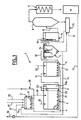
- the device according to the invention also comprises means, for gravity or by pumping, shown schematically at 10, to transfer to the first reactor 3 the liquid medium contained in the premixer 2, similar means shown diagrammatically in 11, to transfer the mixture leaving the first reactor 3, similar means shown diagrammatically at 12, for transferring into the clarifier 7, the mixture leaving the second reactor 5, similar means shown schematically in 13 to introduce water supernatant into a buffer tank 16 the clarifier 7, similar means 14 for recycling in the premixer 2 the sludge which accumulates at the bottom of the clarifier 7, similar means shown in 15 to send the water stored in the tank to evaporator 8 buffer 16, as well as similar means shown diagrammatically in 17, for recycling to the premixer 2 and possibly to an external network shown diagrammatically at 18, water evaporated and condensed collected in a tank 19 in which it is regenerated.
- the means 6 for injecting air include a network, shown schematically in 20, of compressed air distribution and ramps shown diagrammatically at 21, for injecting compressed air into the lower part of the premixer 2, first reactor 3 and second reactor 5.
- This air injection constitutes an oxygen supply in the bath of each container and ensures at the same time time for mixing said bath.
- the first reactor 3 is equipped with a device mixer which includes a pump 22 which sends the reaction medium to the reactor 3 in a mixing tank 22a, the overflow of which, shown diagrammatically at 23, falls back into the reactor 3.
- a device mixer which includes a pump 22 which sends the reaction medium to the reactor 3 in a mixing tank 22a, the overflow of which, shown diagrammatically at 23, falls back into the reactor 3.
- the clarifier 7 is a clarifier of any known type that it needless to describe in detail here.
- the clarification is carried out by decantation, the mixture coming from the second reactor 5 entering the clarifier 7 via a axial tubular column 24 and coming into contact, if necessary, with flocculation which are introduced in a manner that is not shown.
- the residues collected at the bottom of the evaporator 8 are sent to a processing unit 25 in which they are, for example, dried and packaged for storage, since these residues include radioactive substances. If necessary, the sludge collected at the bottom of the clarifier 7 can also be sent to processing unit 25.
- the reservoir 19 for collecting and regenerating condensed water is equipped with means known in themselves for regenerating this water.
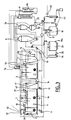
- the following processing device the invention is, in a preferred embodiment, installed on a platform 26 likely to be transported on the platform of a truck or trailer.
- This platform has a peripheral side wall 27.
- the assembly formed by the platform 26 and the wall 27 constitutes a retention tank 28 which prevents the discharge to the outside of all radioactive fluids in the event of an incident.
- the retention tank 28 is itself covered by a substantially sealed cabin 29 maintained slightly depressed by a ventilation and air filtering system 30, of a any known type that need not be described here.
- the method implemented in the device 1 according to the invention for treating oils and solvents contaminated by radioactive substances, comprises the conventional step which consists in subjecting these oils and solvents to the action of micro-organisms preselected in the presence air and a very large volume of water compared to the volume of oils and solvents to be treated, these microorganisms being adapted to destroy organic molecules to transform them in particular into CO 2 and H 2 O.
- This process was developed to treat oils and solvents contaminated with radio elements and produced by mechanical maintenance activities equipment located in controlled areas of nuclear power plants and other facilities and nuclear reactors.
- oils and solvents which are stored in containers, are radioactive and contaminated in particular by long-lived radio-elements following: cobalt 58, 60 and 62, manganese 54, silver 110, cesium 134 and 137, zinc 65, niobium 95, antimony 124 and 125.
- the average activity rate of contaminated products is around 700 Becquerels per liter, with varying rates depending on the container, from 50 to 9,000 Becquerels per liter.
- Oils and solvents are composed, more than 98%, of an apolar fraction essentially containing saturated hydrocarbons C n H 2n + 2, with a predominance of alkanes nC 20 and nC 21 which correspond to branched aliphatic hydrocarbons.
- the merit of the present inventor has been to solve this problem of gelling whose formation from metabolites may be faster than degradation of these same metabolites, by developing a method allowing avoid this gelation.
- the most important and representative mechanism is the degradation of alkanes by oxidation of the methyl terminal group.
- the carbon of the terminal methyl group -CH 3 is oxidized to primary alcohol -CH 2 OH, then to aldehyde-CHO then to primary acid -CH 2 OH. This acid is then metabolized by ⁇ -oxidation directly or via the formation of diacid ( ⁇ -hydroxylation).
- the oxidation of the methyl group is considered the main metabolic pathway.
- the mechanism oxidation of the methyl group is no different from the oxidation mechanism of n-alkanes.
- polyethylene glycol gives compounds which, according to the number of monomers, can be liquid or solid and the mixture of which can give a viscous product close to gelation.
- the free water produced represents approximately 80% of the weight oils and solvents treated if natural evaporation is not taken into account and of the addition of water necessary for the seeding and life of microorganisms (development and reproduction).
- the temperature, 30 to 35 ° C, and the pH, from 6.5 to 7.5, have the values recommended for the development and action of microorganisms.
- microorganisms are chosen from microorganisms industrial products available on the market. They are for example chosen from the range "BIO ACTIV 200" from TBA (TECHNIQUES AND BIOCHEMISTRY) APPLIED). These microorganisms can be conventionally attached to mineral carriers and are conventionally used with nutrients suitable, as well as with emulsifying agents.
- microorganisms used are therefore mixtures of strains known and substantially specialized in attacking specific products. These mixtures are conventionally prepared to be effective for decompose the main constituents of the oils and solvents to be degraded, but also the aforementioned intermediate by-products of decomposition of these constituents.
- the nutritional balance of the bath must be constantly maintained in the report CARBON / NITROGEN / PHOSPHORUS little different from 100/5/1.
- the contents of the reaction bath in microorganisms and nutrients are the usual ones for these materials.
- pre-selected digital media are used on which are fixed the micro-organisms and which will fix by ion exchange the radioactive heavy metals present in the charge.
- microorganisms without supports minerals and available in solutions.
- the mixture is clarified coming from the second reactor 5 by decantation, adding, if necessary, a flocculant which does not interfere with the smooth running of the process, and the sludge is recycled thus obtained towards step c).
- Evaporation of the effluent from the water is carried out under vacuum.
- the clarification and the water collected after evaporation is used for step g) and condensation.
- This regeneration can be done for example by adding peroxide hydrogen and soda.
- waste includes the two aforementioned by-products as well as polyethylene glycol.
- the proportion of this waste is around 3 per thousand by weight: this means that we will find around 3Kg of final waste for around 1000 Kg degraded oils or solvents.
- the device according to the invention which is in the form of an installation mounted on at least one platform transportable by road, can be easily moved from one site to another to treat in each site the contaminated oils and solvents and decompose them essentially into CO 2 and H 2 O, with a very low quantity of releases containing radioactive substances, of the order of 3 per thousand by weight of the oils and solvents treated.
- This device also has the advantage of eliminating any transport of radioactive oils and solvents to a site for processing these oils and solvents.
- the mixture resulting from biodegradation in reactor 3 is transferred by the pump 37 into a primary decanter 41 at a rate largely higher than the nominal installation flow.
- the biomass recovered from the bottom of the primary settling tank 41 is returned in the premixer 2 by the pump 14.
- the mixture thus freed from most of the materials suspension and incompletely degraded fat is transferred to the reactor 5 by means of pump 11.
- the COD at this time is of the order of 40,000 ppm.
- the mixture thus transferred to reactor 5 is again subjected to the action of new microorganisms that destroy fatty acids. This done drop the COD to a rate close to 300 ppm.
- the mixture treated in reactor 5 is sent by means of the pump 54 in the clarifier 7 at a flow slightly higher than the nominal flow so that on the other hand, the last fatty elements which could have escaped the action of micro-organisms, pour into a recovery tank 52 from where they are taken up by means of the pump 12 to be sent to the premixer 2.
- Clarified water which contains some miscible products, biodegradation byproducts such as Diethylene glycol dibutyl ether, Polyethylene glycol Methyl Ether and Ditertiobuthyl-4-methyl phenol plus residues of carbon chains (n-alkanes C 11 to C 21 ), is sent to the vacuum evaporator 8.
- biodegradation byproducts such as Diethylene glycol dibutyl ether, Polyethylene glycol Methyl Ether and Ditertiobuthyl-4-methyl phenol plus residues of carbon chains (n-alkanes C 11 to C 21 ).
- the demineralized water produced by the condenser 9 of the evaporator 8 is sent to container 19 where it is regenerated by means of system 40 in REDOX potential with hydrogen peroxide, pH with soda and aerated by forced recirculation through a microporous sprayer.
- This water as well reconstituted with the characteristics of industrial water is returned to the premixer 2 where it participates in a new degradation cycle.
- Such treatment is known in itself.
- the condenser 9 is associated with a group of classic 9a refrigeration.
- the ultimate waste recovered at the bottom of the evaporator 8 is sent to a buffer tank 24 whose volume corresponds to three days of walking the installation.
- the product is homogenized by adding water and air, then it is sent under pressure through an atomizer in the drying unit 25 in bed fluidized.
- Activated carbon filter virtually eliminates the last materials organic matter contained in this regenerated condensed water.
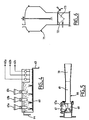
- a reservoir 60 is used to reactivate and develop microorganisms and nutrients that are fed by three metering devices 61a, 61b, 61c.
- Three feeders 62a, 62b, 62c with adjustable flow are intended to supply micro-organisms to the premixer 2 and to the reactors 3 and 5. It a supply 63 of air or oxygen is provided.
- the water taken from premixer 2 arrives at 64. It is kept at the temperature of 35 ° C by means of a circulating fluid heater operating in such a way that microorganisms never pass into the circulating fluid heater, the internal temperature of which would be fatal to microorganisms.
- the distributor with three compartments 61a, 61b, 61c, sends microorganisms, trace elements and nutrients.
- Microorganisms wake up, then develop to form a biomass whose composition will be thousands of times greater than that which found in the installation, thereby increasing the speed of degradation of the chains carbon, resulting COD.
- This preparation method allows increase the capacity of the processing unit by around 50%.
- the hydro-ejector 66 represented in FIG. 5, of conventional structure, includes a centrifugal pump, not shown, feeding a calibrated nozzle 67 located in the center and in the axis of an annular chamber 68, an air / water mixing tube 69 and a diffuser 70.
- the assembly is completed by an air inlet pipe atmospheric, an oximeter and a valve for regulating the water supply (not represented).
Landscapes
- Engineering & Computer Science (AREA)
- Physics & Mathematics (AREA)
- Life Sciences & Earth Sciences (AREA)
- Biomedical Technology (AREA)
- General Health & Medical Sciences (AREA)
- Molecular Biology (AREA)
- Health & Medical Sciences (AREA)
- General Engineering & Computer Science (AREA)
- High Energy & Nuclear Physics (AREA)
- Heat Treatment Of Water, Waste Water Or Sewage (AREA)
- Purification Treatments By Anaerobic Or Anaerobic And Aerobic Bacteria Or Animals (AREA)
- Production Of Liquid Hydrocarbon Mixture For Refining Petroleum (AREA)
- Physical Water Treatments (AREA)
- Preparation Of Compounds By Using Micro-Organisms (AREA)
Description
- des moyens formant réservoir pour recevoir et contenir un volume d'eau prédéterminé et une charge prédéterminée d'huiles et de solvants contaminés par des substances radioactives, et des moyens pour injecter de l'air dans les moyens formant réservoir ;
- des moyens pour prélever et recevoir au moins une partie de l'effluent obtenu;
- des moyens pour séparer l'eau des matières contenues dans cet effluent ;
- des moyens pour recycler ou évacuer les matières contenues dans cet effluent ;
- des moyens pour régénérer cette eau débarrassée des matières contenues dans l'effluent, de façon à lui redonner lesdites caractéristiques de l'eau utilisée dans l'étape a), et pour recycler une partie de cette eau.
- la figure 1 est un schéma fonctionnel d'un mode de réalisation du dispositif selon la présente invention ;
- la figure 2 est une vue en perspective avec arrachement, du dispositif schématisé à la figure 1 ;
- la figure 3 est une vue semblable à la figure 1 d'un autre mode de réalisation du dispositif de l'invention ;
- la figure 4 est une vue schématique en élévation d'un appareil pour réactiver et développer les micro-organismes ;
- la figure 5 est une vue schématique en coupe d'un hydro-éjecteur ;
- la figure 6 est une vue schématique en coupe d'un sécheur en lit fluidisé.
- un prémélangeur 2 adapté à recevoir un volume prédéterminé d'eau et une charge prédéterminée d'huiles et de solvants contaminés, ainsi que des micro-organismes qui seront précisés plus loin ;
- un premier réacteur 3 adapté à recevoir au moins une partie du mélange provenant du prémélangeur 2, des micro-organismes et des supports minéraux schématisés en 4, qui seront précisés plus loin ;
- un second réacteur 5 adapté à recevoir du mélange sortant du premier réacteur 3, et des micro-organismes ;
- des moyens schématisés en 6 pour injecter de l'air dans le prémélangeur 2 et dans chacun des deux réacteurs 3 et 5 ;
- un clarificateur 7 pour séparer l'eau des matières contenues dans le mélange sortant du second réacteur 5 ;
- un évaporateur 8 sous vide et un condenseur 9 pour séparer l'eau des matières contenues dans l'effluent sortant du clarificateur 7, et condenser cette eau qui est très pure.
- Acide benzoïque ;
- n-alcanes à chaínes courtes (C9 à C12);
- acide arachidique CH3 (CH2) 18COOH ;
- composés carbonylés (cétones) ;
- hydrocarbures acycliques à double liaison (alcènes).

- diéthylèneglycol dibutyl-éther [CH3 (CH2)3 - OCH2 - CH2 - CH2]2 O
- poly-éthylène glycol méhyl-éther CH3 (OCH2 CH2)n OH
- 2,6 Ditertiobutyl - 4 méthyl - phénol.
- 201, adaptée au traitement des hydrocarbures aliphatiques légers halogénés et non halogénés ;
- 202, adaptée au traitement des composés aromatiques simples non halogénés;
- 203, adaptée au traitement des graisses industrielles animales et végétales,
- 206, adaptée au traitement des polychlorobiphényls et chlorobenzoates ;
- 208, adaptée au traitement des hydrocarbures et dérivés du pétrole non halogénés.
- du silicate d'alumine, en particulier du silicate d'alumine potassique ;
- du carbonate de calcium poreux ;
- du silicate d'alumine anamorphosée ;
- des zéolithes.
- oxygène dissous: 3 mg/l environ
- pH : entre 6,9 et 7,1 environ
- potentiel REDOX : supérieur à -150 mv et de préférence positif (jusqu'à 70 mv).
- demande chimique en oxygène (DCO) inférieure à 125 mg/l,
- pH neutre,
- potentiel REDOX légèrement positif autour de 70 à 80 mv,
- indice d'hydrocarbures < 10 mg/l,
- métaux < 15 mg/l.
- maintenir une teneur en O2 dans le milieu convenable (2,5 à 3mg/l d'eau) ;
- supprimer la formation de mousse et le bouchage des orifices ;
- maintenir la stabilité du potentiel REDOX à une tension convenable positive de l'ordre de 70 mv environ.
- le débit d'eau engendré par la pompe est dirigé vers l'hydro-éjecteur 66. Ce flux pénètre dans le corps de l'éjecteur, par l'intermédiaire de la buse 67 ;
- à ce niveau, la vitesse d'écoulement est augmentée de façon à créer une très forte dépression ;
- à l'aide du tube d'aspiration 67a, l'air est introduit dans la chambre 68 déprimogène à une vitesse suffisante pour être mélangé à l'eau envoyée dans le tube mélangeur 69 ;
- le diffuseur 70 renforce cet effet par un ralentissement de la vitesse d'écoulement de l'ensemble eau/air ;
- la pompe à eau est alimentée par surverse de manière à aspirer légèrement en dessous du niveau du bain de sorte qu'elle aspire les mousses qui auraient pu se former en surface, les matières grasses, et renvoie le tout au fond du réacteur en assurant un brassage permanent du bain ;
- l'oxymètre assure le débit d'aspiration d'air de manière à maintenir stable la teneur en O2 du bain.
- le sécheur proprement dit 71 constitué d'un corps cylindrique fermé à sa base par une sole perforée dans laquelle sont installées des tuyères permettant une distribution homogène de l'air nécessaire au séchage ;
- sous la sole 72, on trouve une boíte à vent 73 de forme conique comportant une arrivée d'air chaud à 250°C. C'est cet air qui passe au travers des tuyères et qui va sécher le produit ;
- au dessus du corps cylindrique dans lequel s'effectue le séchage du produit, on trouve un tronc de cône renversé raccordé lui-même à une virole cylindrique d'un diamètre double de celui du compartiment de séchage, permettant d'éviter le départ des très petites particules séchées, en réduisant fortement la vitesse des gaz air-vapeur ;
- le compartiment d'expansion est fermé à sa partie supérieure par un fond bombé formant le toit du sécheur dans lequel des orifices équipés de manchettes et de brides permettent l'un d'évacuer les gaz et l'autre de permettre le montage d'une canne d'injection du produit à sécher ;
- l'air nécessaire au fonctionnement provient d'un surpresseur et parvient dans la boíte à vent du sécheur après avoir été réchauffé à 250°C dans un réchauffeur de fluide en circulation ;
- des prises de pression de même que des prises de température, sont installées dans la boíte à vent dans le compartiment de séchage et dans le free-board.
Claims (17)
- Procédé pour traiter des huiles et solvants contaminés par des substances radioactives, ce procédé comportant l'étape qui consiste à soumettre ces huiles et solvants à l'action de micro-organismes présélectionnés en présence d'air et d'un volume d'eau très grand par rapport au volume des huiles et solvants à traiter, ces micro-organismes étant adaptés à détruire les molécules organiques pour les transformer notamment en CO2 et H2O, caractérisé en ce qu'il comporte en outre les étapes suivantes :a) on prépare un volume prédéterminé d'eau ayant des caractéristiques prédéterminées en matière de teneur en oxygène dissous, pH et potentiel REDOX ;b) on ajoute dans ce volume d'eau une charge prédéterminée d'huiles et de solvants contaminés par des substances radioactives, ladite charge correspondant à un volume d'huiles et de solvants qui est une fraction prédéterminée du volume d'eau prédéterminé ;c) on soumet cette charge à l'action des micro-organismes à une température et pendant une durée prédéterminées ;d) on prélève au moins une partie de l'effluent obtenu ;e) on sépare l'eau des matières contenues dans cet effluent ;f) on recycle ou on évacue lesdites matières séparées de cette eau ;g) on régénère cette eau débarrassée des matières contenues dans l'effluent, de façon à lui redonner lesdites caractéristiques prédéterminées;h) on recycle au moins une partie de cette eau régénérée ;i) on recommence le cycle à partir de l'étape a).
- Procédé selon la revendication 1, caractérisé en ce qu'on évacue un volume prédéterminé d'eau régénérée correspondant sensiblement au volume d'une nouvelle charge d'huiles et de solvants contaminés par des substances radioactives.
- Procédé selon la revendication 1 ou 2, caractérisé en ce qu'on utilise des supports minéraux (4) présélectionnés des micro-organismes pour fixer par échange d'ions une partie au moins des métaux présents dans la charge.
- Procédé selon la revendication 3, caractérisé en ce que les supports minéraux comprennent comme constituants du silicate d'alumine, des zéolithes, du carbonate de calcium.
- Procédé selon l'une des revendications 1 à 4, caractérisé en ce que, dans l'étape e), on procède à une clarification de l'effluent par décantation, et on recycle les boues ainsi obtenues vers l'étape c).
- Procédé selon l'une des revendications 1 à 5, caractérisé en ce qu'on procède à une évaporation de l'eau de l'effluent, et on utilise, pour l'étape g), l'eau recueillie après évaporation et condensation.
- Procédé selon la revendication 6, caractérisé en ce qu'on récupère les résidus issus de l'opération d'évaporation, et en ce qu'on les soumet à un séchage en lit fluidisé.
- Procédé selon la revendication 3 ou l'une des revendications qui en dépendent, caractérisé en ce qu'on récupère en fin de campagne les supports minéraux (4) chargés de métaux radioactifs.
- Procédé selon l'une quelconque des revendications 1 à 8, caractérisé en ce qu'on introduit les micro-organismes et les éléments nutritifs qui leur sont nécessaires dans une eau ayant une température et des caractéristiques prédéterminées pour permettre la réactivation et le développement desdits micro-organismes dans ladite eau, et en ce qu'on introduit cette eau dans laquelle les micro-organismes se sont développés dans l'étape c).
- Procédé selon l'une quelconque des revendications 1 à 9, caractérisé en ce que, dans l'étape g), on régénère l'eau débarrassée des matières contenues dans l'effluent, de façon à lui redonner les caractéristiques suivantes :oxygène dissous = 3 mg/l environpH = entre 6,9 et 7,1 environpotentiel REDOX = supérieur à -150 mv et de préférence positif (jusqu'à 70 mv).
- Dispositif (1) pour la mise en oeuvre du procédé selon l'une des revendications 1 à 10, caractérisé en ce qu'il comporte :des moyens formant réservoir (3) pour recevoir et contenir un volume d'eau prédéterminé et une charge prédéterminée d'huiles et de solvants contaminés par des substances radioactives, et des moyens pour injecter de l'air dans les moyens formant réservoir (3) ;des moyens (11, 5) pour prélever et recevoir au moins une partie de l'effluent obtenu ;des moyens (7) pour séparer l'eau des matières contenues dans cet effluent ;des moyens (14, 25) pour recycler ou évacuer les matières contenues dans cet effluent ;des moyens (19) pour régénérer cette eau débarrassée des matières contenues dans ledit effluent, de façon à lui redonner lesdites caractéristiques prédéterminées ;des moyens pour recycler au moins une partie de cette eau régénérée.
- Dispositif selon la revendication 11, caractérisé en ce que les moyens pour séparer l'eau des matières contenues dans l'effluent comprennent des moyens (7) pour clarifier l'effluent par floculation.
- Dispositif selon la revendication 11 ou 12, caractérisé en ce qu'il comporte des moyens (8) pour évaporer sous vide l'eau de l'effluent.
- Dispositif selon l'une des revendications 11 à 13, caractérisé en ce qu'il comporte :un prémélangeur (2) adapté à recevoir un volume prédéterminé d'eau et une charge prédéterminée d'huiles et de solvants contaminés, ainsi que des micro-organismes ;un premier réacteur (3) adapté à recevoir au moins une partie du mélange provenant du prémélangeur (2), ainsi que des micro-organismes ;un second réacteur (5) adapté à recevoir le mélange sortant du premier réacteur (3) ;des moyens (6 ; 20, 21) pour injecter de l'air dans le prémélangeur (2) et chacun des réacteurs (3, 5) ;un clarificateur (7) pour séparer les matières contenues dans le mélange sortant du second réacteur (5) ;un évaporateur (8) et un condenseur (9) pour récupérer l'eau de l'effluent sortant du clarificateur.
- Dispositif selon l'une des revendications 11 à 14, caractérisé en ce qu'il comporte des moyens pour sécher en lit fluidisé les matières séparées de l'eau.
- Dispositif selon l'une des revendications 11 à 15, caractérisé en ce que tous les constituants sont installés dans une cuve de rétention (28).
- Dispositif selon la revendication 16, caractérisé en ce que la cuve de rétention (28) est recouverte d'une cabine (29) sensiblement étanche maintenue légèrement en dépression par un système (30) de ventilation et de filtrage de l'air extrait.
Applications Claiming Priority (3)
| Application Number | Priority Date | Filing Date | Title |
|---|---|---|---|
| FR9501581A FR2730584B1 (fr) | 1995-02-10 | 1995-02-10 | Procede et dispositif pour traiter des huiles et solvants contamines par des substances radioactives |
| FR9501581 | 1995-02-10 | ||
| PCT/FR1996/000225 WO1996024937A1 (fr) | 1995-02-10 | 1996-02-12 | Procede et dispositif pour traiter des huiles et solvants contamines par des substances radioactives |
Publications (2)
| Publication Number | Publication Date |
|---|---|
| EP0808504A1 EP0808504A1 (fr) | 1997-11-26 |
| EP0808504B1 true EP0808504B1 (fr) | 1999-05-19 |
Family
ID=9476048
Family Applications (1)
| Application Number | Title | Priority Date | Filing Date |
|---|---|---|---|
| EP96904124A Expired - Lifetime EP0808504B1 (fr) | 1995-02-10 | 1996-02-12 | Procede et dispositif pour traiter des huiles et solvants contamines par des substances radioactives |
Country Status (19)
| Country | Link |
|---|---|
| US (1) | US5948259A (fr) |
| EP (1) | EP0808504B1 (fr) |
| JP (1) | JP3256240B2 (fr) |
| KR (1) | KR100301228B1 (fr) |
| CN (1) | CN1173946A (fr) |
| AU (1) | AU4833896A (fr) |
| BG (1) | BG63354B1 (fr) |
| BR (1) | BR9607727A (fr) |
| CA (1) | CA2211104C (fr) |
| CZ (1) | CZ293133B6 (fr) |
| DE (1) | DE69602520T2 (fr) |
| EA (1) | EA000170B1 (fr) |
| ES (1) | ES2134593T3 (fr) |
| FI (1) | FI973070A7 (fr) |
| FR (1) | FR2730584B1 (fr) |
| HU (1) | HUP9801212A3 (fr) |
| SK (1) | SK283180B6 (fr) |
| UA (1) | UA41438C2 (fr) |
| WO (1) | WO1996024937A1 (fr) |
Families Citing this family (21)
| Publication number | Priority date | Publication date | Assignee | Title |
|---|---|---|---|---|
| US6614529B1 (en) * | 1992-12-28 | 2003-09-02 | Applied Materials, Inc. | In-situ real-time monitoring technique and apparatus for endpoint detection of thin films during chemical/mechanical polishing planarization |
| US7037403B1 (en) * | 1992-12-28 | 2006-05-02 | Applied Materials Inc. | In-situ real-time monitoring technique and apparatus for detection of thin films during chemical/mechanical polishing planarization |
| JP3736165B2 (ja) | 1998-12-28 | 2006-01-18 | 株式会社日立製作所 | 界面活性剤を含む放射性廃液の処理方法及びその処理装置 |
| ES2190758B8 (es) * | 2002-01-02 | 2014-06-05 | Universidad Politécnica de Madrid | Procedimiento de biorremediación para la concentración y eliminación de radionúclidos en las aguas radiactivas de las piscinas nucleares. |
| CN101002286B (zh) * | 2004-05-30 | 2011-06-15 | 卵石床模块反应器控股有限公司 | 处理放射性废料的方法 |
| GB0506041D0 (en) * | 2005-03-24 | 2005-04-27 | Ge Healthcare Ltd | Stripping method |
| DE102005036470B4 (de) * | 2005-08-03 | 2011-07-14 | Messerschmidt, Peter, 23552 | Verfahren und Abwasseraufbereitungsanlage zur Reinigung radioaktiv belasteter Abwässer |
| JP4631007B2 (ja) * | 2005-09-09 | 2011-02-16 | 独立行政法人 日本原子力研究開発機構 | 微生物による有機系液体廃棄物の分解・処理方法 |
| RU2356852C2 (ru) * | 2007-07-18 | 2009-05-27 | Федеральное государственное унитарное предприятие "РОССИЙСКИЙ ФЕДЕРАЛЬНЫЙ ЯДЕРНЫЙ ЦЕНТР-ВСЕРОССИЙСКИЙ НАУЧНО-ИССЛЕДОВАТЕЛЬСКИЙ ИНСТИТУТ ТЕХНИЧЕСКОЙ ФИЗИКИ ИМЕНИ АКАДЕМИКА Е.И. ЗАБАБАХИНА" (ФГУП "РФЯЦ-ВНИИТФ имени академика Е.И. Забабахина") | Способ очистки сточных вод |
| KR100837177B1 (ko) * | 2007-11-30 | 2008-06-11 | 권오경 | 방사성 폐기물 건조기 |
| EP2242060B1 (fr) * | 2008-02-08 | 2015-07-08 | Mitsubishi Heavy Industries, Ltd. | Procédé et appareil pour traiter un liquide résiduaire nitré radioactif |
| KR100884004B1 (ko) * | 2008-08-18 | 2009-02-17 | 테크밸리 주식회사 | 폐 방사능 유기용매 처리장치 |
| FR2937646B1 (fr) * | 2008-10-27 | 2011-07-29 | Dewdrops | Procede et dispositif de traitement par voie biologique d'une charge liquide contaminee comprenant une phase liquide organique dispersible et digestible telle qu'une huile ou solvant toxique |
| RU2442237C1 (ru) * | 2010-06-15 | 2012-02-10 | Федеральное государственное унитарное предприятие "Российский федеральный ядерный центр-Всероссийский научно-исследовательский институт технической физики имени академика Е.И. Забабахина" | Способ очистки сточных вод |
| FR2963846B1 (fr) | 2010-08-13 | 2012-08-17 | Dominique Deguitre | Procede et dispositif pour traiter des huiles, graisses, solvants, eaux ou boues huileuses contamines par des radionucleides |
| KR101306052B1 (ko) * | 2011-05-17 | 2013-09-09 | 한국수력원자력 주식회사 | 방사성 폐유 처리장치 및 이를 이용한 방사성 폐유 처리방법 |
| US9896351B2 (en) * | 2013-03-15 | 2018-02-20 | Avantech, Inc. | Method for removal of radionuclides in liquids |
| CN108428485B (zh) * | 2018-03-23 | 2019-09-17 | 岭东核电有限公司 | 百万千瓦级核电厂放射性废油的再生方法 |
| CN108511100B (zh) * | 2018-03-23 | 2019-11-05 | 岭东核电有限公司 | 压水堆核电厂放射性废油的处理方法 |
| CN108597637B (zh) * | 2018-03-23 | 2020-10-27 | 岭东核电有限公司 | 百万千瓦级核电厂放射性废油的处理方法 |
| CN108565037B (zh) * | 2018-03-23 | 2020-10-27 | 岭东核电有限公司 | 压水堆核电厂放射性废油的催化再生方法 |
Family Cites Families (11)
| Publication number | Priority date | Publication date | Assignee | Title |
|---|---|---|---|---|
| GB1385319A (en) * | 1971-09-22 | 1975-02-26 | Nat Res Dev | Enzyme preparations |
| US4569787A (en) * | 1982-06-23 | 1986-02-11 | Hitachi, Ltd. | Process and apparatus for treating radioactive waste |
| US4800024A (en) * | 1986-04-07 | 1989-01-24 | Iso-Clear Systems Corporation | Removal of heavy metals and heavy metal radioactive isotopes from liquids |
| DE3632337C2 (de) * | 1986-09-24 | 1995-12-07 | Boelsing Friedrich | Mit biologisch abbaubaren Substanzen hydrophobiertes Calciumoxid und dessen Verwendung |
| DE3733341A1 (de) * | 1987-10-02 | 1989-04-13 | Wintershall Ag | Verfahren zur verbesserung der mikrobiellen reinigung von mit kohlenwasserstoffen, insbesondere mit mineraloelen kontaminierten boeden, durch mikrobielle oxidation |
| ATE128880T1 (de) * | 1988-01-27 | 1995-10-15 | Norbert Plambeck | Anlage und verfahren zur reinigung kontaminierter böden. |
| DE3935039A1 (de) * | 1988-11-18 | 1991-04-25 | Bauer Spezialtiefbau | Verfahren zur dekontamination von boeden |
| US5196113A (en) * | 1990-02-21 | 1993-03-23 | Southern California Edison Co. | Processing mixed waste |
| FR2694441B1 (fr) * | 1992-07-29 | 1994-09-09 | Commissariat Energie Atomique | Procédé de décontamination par voie biologique d'effluents aqueux radioactifs de moyenne activité. |
| US5403809A (en) * | 1992-12-21 | 1995-04-04 | W. R. Grace & Co.-Conn. | Composite inorganic supports containing carbon for bioremediation |
| US5494580A (en) * | 1993-09-30 | 1996-02-27 | Baltic General Investment Corporation | Method of decontamination of a hydrocarbon-polluted environment by the use of bacterial compositions |
-
1995
- 1995-02-10 FR FR9501581A patent/FR2730584B1/fr not_active Expired - Fee Related
-
1996
- 1996-02-12 KR KR1019970705491A patent/KR100301228B1/ko not_active Expired - Fee Related
- 1996-02-12 BR BR9607727A patent/BR9607727A/pt not_active IP Right Cessation
- 1996-02-12 EA EA199700094A patent/EA000170B1/ru not_active IP Right Cessation
- 1996-02-12 WO PCT/FR1996/000225 patent/WO1996024937A1/fr not_active Ceased
- 1996-02-12 SK SK1044-97A patent/SK283180B6/sk unknown
- 1996-02-12 DE DE69602520T patent/DE69602520T2/de not_active Expired - Fee Related
- 1996-02-12 UA UA97084143A patent/UA41438C2/uk unknown
- 1996-02-12 US US08/875,792 patent/US5948259A/en not_active Expired - Fee Related
- 1996-02-12 CZ CZ19972432A patent/CZ293133B6/cs not_active IP Right Cessation
- 1996-02-12 CN CN96191883A patent/CN1173946A/zh active Pending
- 1996-02-12 ES ES96904124T patent/ES2134593T3/es not_active Expired - Lifetime
- 1996-02-12 CA CA002211104A patent/CA2211104C/fr not_active Expired - Fee Related
- 1996-02-12 HU HU9801212A patent/HUP9801212A3/hu unknown
- 1996-02-12 JP JP52404996A patent/JP3256240B2/ja not_active Expired - Fee Related
- 1996-02-12 EP EP96904124A patent/EP0808504B1/fr not_active Expired - Lifetime
- 1996-02-12 AU AU48338/96A patent/AU4833896A/en not_active Abandoned
-
1997
- 1997-07-18 FI FI973070A patent/FI973070A7/fi unknown
- 1997-08-06 BG BG101819A patent/BG63354B1/bg unknown
Also Published As
| Publication number | Publication date |
|---|---|
| CZ243297A3 (cs) | 1998-01-14 |
| WO1996024937A1 (fr) | 1996-08-15 |
| BG63354B1 (bg) | 2001-10-31 |
| CN1173946A (zh) | 1998-02-18 |
| FR2730584A1 (fr) | 1996-08-14 |
| JP2000515622A (ja) | 2000-11-21 |
| CA2211104A1 (fr) | 1996-08-15 |
| AU4833896A (en) | 1996-08-27 |
| ES2134593T3 (es) | 1999-10-01 |
| BR9607727A (pt) | 1998-07-14 |
| DE69602520T2 (de) | 1999-10-07 |
| HUP9801212A2 (hu) | 1998-09-28 |
| CZ293133B6 (cs) | 2004-02-18 |
| EA199700094A1 (ru) | 1998-02-26 |
| FI973070A0 (fi) | 1997-07-18 |
| BG101819A (en) | 1998-07-31 |
| CA2211104C (fr) | 2001-10-09 |
| EP0808504A1 (fr) | 1997-11-26 |
| FR2730584B1 (fr) | 1997-04-25 |
| SK104497A3 (en) | 1998-03-04 |
| KR19980702096A (ko) | 1998-07-15 |
| KR100301228B1 (ko) | 2001-09-03 |
| HUP9801212A3 (en) | 2001-10-29 |
| MX9706099A (es) | 1997-10-31 |
| FI973070A7 (fi) | 1997-10-10 |
| JP3256240B2 (ja) | 2002-02-12 |
| DE69602520D1 (de) | 1999-06-24 |
| US5948259A (en) | 1999-09-07 |
| EA000170B1 (ru) | 1998-10-29 |
| UA41438C2 (uk) | 2001-09-17 |
| SK283180B6 (sk) | 2003-03-04 |
Similar Documents
| Publication | Publication Date | Title |
|---|---|---|
| EP0808504B1 (fr) | Procede et dispositif pour traiter des huiles et solvants contamines par des substances radioactives | |
| FR2701704A1 (fr) | Procédé de traitement des déchets organiques par oxydation. | |
| EP1562867B1 (fr) | Prodede de traitement des eaux a l'aide d'un reactif pulverulent inorganique a forte surface specifique incluant une etape de recyclage dudit reactif | |
| WO2001009045A1 (fr) | Procede hybride chimique et biologique de decontamination de boues d'epuration municipales | |
| FR2503690A1 (fr) | Procede pour eliminer le phosphore contenu dans des liquides organiques residuaires | |
| DK159498B (da) | Fremgangsmaade til frembringelse af anaerob bakteriel nedbrydning af organisk materiale i et vandholdigt fluidum | |
| EP0751914B1 (fr) | Procede et installation de traitement d'effluents charges en matiere organique, notamment par oxydation en milieu humide, avec recyclage interne des residus solides, et station d'epuration correspondante | |
| EP1086052B1 (fr) | Traitement de residues humides contenant une matiere organique oxydable | |
| CA2394359C (fr) | Procede et installation de traitement d'eaux residuaires comprenant un traitement additionnel des boues par ozonation | |
| EP0968045B1 (fr) | Procede et dispositif de recuperation du gaz d'event provenant d'un reacteur d'ozonation | |
| EP0564386B1 (fr) | Procédé de traitement des boues par oxydation combinée chimique et biologique et installations pour la mise en oeuvre d'un tel procédé | |
| FR2864069A1 (fr) | Procede de reduction de boues issues du traitement d'eaux usees par oxygenation et action mecanique | |
| FR2670868A1 (fr) | Procede de destruction d'effluents organiques toxiques par incineration en phase aqueuse et installation en faisant application. | |
| MXPA97006099A (en) | Procedure and apparatus for treating oils and solvents contaminated by radioacti substances | |
| FR2770227A1 (fr) | Composition biologique pour epurer des effluents aqueux et des boues et son procede de mise en oeuvre et d'ensemencement | |
| EP1301440A1 (fr) | Reacteur biologique a lit fixe immerge et procede de traitement d'effluents liquides | |
| FR2774980A1 (fr) | Procede de traitement d'effluents par voie biologique et oxydation ne produisant pas ou de boues en exces | |
| JPH01115486A (ja) | 有機性産業廃棄物の処理方法とその装置 | |
| WO2012020207A1 (fr) | Procédé et dispositif pour traiter des huiles, graisses, solvants, eaux ou boues huileuses contaminés par des radionucléides | |
| BE832298A (fr) | Degradation microbienne de petrole. | |
| JPH07303893A (ja) | 廃液の連続的処理方法 | |
| EP1319631A1 (fr) | Procédé de traítement d'effluents contenant des métaux, par oxydation en milieu humide en présence de boues | |
| BE691902A (fr) | ||
| FR2580619A1 (fr) | Procede de traitement d'eaux usees par adsorption colloidale et installation pour la mise en oeuvre de ce procede |
Legal Events
| Date | Code | Title | Description |
|---|---|---|---|
| PUAI | Public reference made under article 153(3) epc to a published international application that has entered the european phase |
Free format text: ORIGINAL CODE: 0009012 |
|
| 17P | Request for examination filed |
Effective date: 19970812 |
|
| AK | Designated contracting states |
Kind code of ref document: A1 Designated state(s): BE CH DE ES FR GB LI NL SE |
|
| AX | Request for extension of the european patent |
Free format text: LT PAYMENT 970812;SI PAYMENT 970812 |
|
| RAP1 | Party data changed (applicant data changed or rights of an application transferred) |
Owner name: RICHMOND AGENCY LIMITED |
|
| RIN1 | Information on inventor provided before grant (corrected) |
Inventor name: STINGRE, MAURICE Inventor name: DEGUITRE, JOANES PIERRE |
|
| GRAG | Despatch of communication of intention to grant |
Free format text: ORIGINAL CODE: EPIDOS AGRA |
|
| 17Q | First examination report despatched |
Effective date: 19980520 |
|
| GRAG | Despatch of communication of intention to grant |
Free format text: ORIGINAL CODE: EPIDOS AGRA |
|
| GRAH | Despatch of communication of intention to grant a patent |
Free format text: ORIGINAL CODE: EPIDOS IGRA |
|
| GRAH | Despatch of communication of intention to grant a patent |
Free format text: ORIGINAL CODE: EPIDOS IGRA |
|
| GRAA | (expected) grant |
Free format text: ORIGINAL CODE: 0009210 |
|
| AK | Designated contracting states |
Kind code of ref document: B1 Designated state(s): BE CH DE ES FR GB LI NL SE |
|
| AX | Request for extension of the european patent |
Free format text: LT PAYMENT 19970812;SI PAYMENT 19970812 |
|
| LTIE | Lt: invalidation of european patent or patent extension | ||
| REG | Reference to a national code |
Ref country code: CH Ref legal event code: EP |
|
| GBT | Gb: translation of ep patent filed (gb section 77(6)(a)/1977) |
Effective date: 19990519 |
|
| REG | Reference to a national code |
Ref country code: CH Ref legal event code: NV Representative=s name: NOVAPAT INTERNATIONAL S.A. |
|
| REF | Corresponds to: |
Ref document number: 69602520 Country of ref document: DE Date of ref document: 19990624 |
|
| REG | Reference to a national code |
Ref country code: ES Ref legal event code: FG2A Ref document number: 2134593 Country of ref document: ES Kind code of ref document: T3 |
|
| PLBE | No opposition filed within time limit |
Free format text: ORIGINAL CODE: 0009261 |
|
| STAA | Information on the status of an ep patent application or granted ep patent |
Free format text: STATUS: NO OPPOSITION FILED WITHIN TIME LIMIT |
|
| 26N | No opposition filed | ||
| REG | Reference to a national code |
Ref country code: GB Ref legal event code: IF02 |
|
| PGFP | Annual fee paid to national office [announced via postgrant information from national office to epo] |
Ref country code: NL Payment date: 20050731 Year of fee payment: 10 |
|
| PGFP | Annual fee paid to national office [announced via postgrant information from national office to epo] |
Ref country code: CH Payment date: 20050809 Year of fee payment: 10 Ref country code: BE Payment date: 20050809 Year of fee payment: 10 |
|
| PGFP | Annual fee paid to national office [announced via postgrant information from national office to epo] |
Ref country code: ES Payment date: 20050817 Year of fee payment: 10 |
|
| PG25 | Lapsed in a contracting state [announced via postgrant information from national office to epo] |
Ref country code: ES Free format text: LAPSE BECAUSE OF NON-PAYMENT OF DUE FEES Effective date: 20060213 |
|
| PG25 | Lapsed in a contracting state [announced via postgrant information from national office to epo] |
Ref country code: LI Free format text: LAPSE BECAUSE OF NON-PAYMENT OF DUE FEES Effective date: 20060228 Ref country code: CH Free format text: LAPSE BECAUSE OF NON-PAYMENT OF DUE FEES Effective date: 20060228 Ref country code: BE Free format text: LAPSE BECAUSE OF NON-PAYMENT OF DUE FEES Effective date: 20060228 |
|
| PG25 | Lapsed in a contracting state [announced via postgrant information from national office to epo] |
Ref country code: NL Free format text: LAPSE BECAUSE OF NON-PAYMENT OF DUE FEES Effective date: 20060901 |
|
| REG | Reference to a national code |
Ref country code: CH Ref legal event code: PL |
|
| NLV4 | Nl: lapsed or anulled due to non-payment of the annual fee |
Effective date: 20060901 |
|
| REG | Reference to a national code |
Ref country code: ES Ref legal event code: FD2A Effective date: 20060213 |
|
| BERE | Be: lapsed |
Owner name: *RICHMOND AGENCY LTD Effective date: 20060228 |
|
| PGFP | Annual fee paid to national office [announced via postgrant information from national office to epo] |
Ref country code: DE Payment date: 20090313 Year of fee payment: 14 |
|
| PGFP | Annual fee paid to national office [announced via postgrant information from national office to epo] |
Ref country code: GB Payment date: 20090304 Year of fee payment: 14 |
|
| PGFP | Annual fee paid to national office [announced via postgrant information from national office to epo] |
Ref country code: SE Payment date: 20090330 Year of fee payment: 14 |
|
| EUG | Se: european patent has lapsed | ||
| GBPC | Gb: european patent ceased through non-payment of renewal fee |
Effective date: 20100212 |
|
| PGFP | Annual fee paid to national office [announced via postgrant information from national office to epo] |
Ref country code: FR Payment date: 20100915 Year of fee payment: 15 |
|
| PG25 | Lapsed in a contracting state [announced via postgrant information from national office to epo] |
Ref country code: DE Free format text: LAPSE BECAUSE OF NON-PAYMENT OF DUE FEES Effective date: 20100901 |
|
| PG25 | Lapsed in a contracting state [announced via postgrant information from national office to epo] |
Ref country code: GB Free format text: LAPSE BECAUSE OF NON-PAYMENT OF DUE FEES Effective date: 20100212 |
|
| REG | Reference to a national code |
Ref country code: FR Ref legal event code: ST Effective date: 20111102 |
|
| PG25 | Lapsed in a contracting state [announced via postgrant information from national office to epo] |
Ref country code: FR Free format text: LAPSE BECAUSE OF NON-PAYMENT OF DUE FEES Effective date: 20110228 |
|
| PG25 | Lapsed in a contracting state [announced via postgrant information from national office to epo] |
Ref country code: SE Free format text: LAPSE BECAUSE OF NON-PAYMENT OF DUE FEES Effective date: 20100213 |