EP0808867A1 - Borverbindungen als Flammschutzmittel in vernetzbaren Organopolysiloxan-Massen - Google Patents
Borverbindungen als Flammschutzmittel in vernetzbaren Organopolysiloxan-Massen Download PDFInfo
- Publication number
- EP0808867A1 EP0808867A1 EP97108281A EP97108281A EP0808867A1 EP 0808867 A1 EP0808867 A1 EP 0808867A1 EP 97108281 A EP97108281 A EP 97108281A EP 97108281 A EP97108281 A EP 97108281A EP 0808867 A1 EP0808867 A1 EP 0808867A1
- Authority
- EP
- European Patent Office
- Prior art keywords
- groups
- weight
- bis
- organopolysiloxane compositions
- radicals
- Prior art date
- Legal status (The legal status is an assumption and is not a legal conclusion. Google has not performed a legal analysis and makes no representation as to the accuracy of the status listed.)
- Withdrawn
Links
- 229920001296 polysiloxane Polymers 0.000 title claims abstract description 40
- 239000000203 mixture Substances 0.000 title claims abstract description 37
- 239000003063 flame retardant Substances 0.000 title claims abstract description 15
- 150000001639 boron compounds Chemical class 0.000 title claims abstract description 11
- 239000012763 reinforcing filler Substances 0.000 claims abstract description 19
- 229910052580 B4C Inorganic materials 0.000 claims abstract description 13
- INAHAJYZKVIDIZ-UHFFFAOYSA-N boron carbide Chemical compound B12B3B4C32B41 INAHAJYZKVIDIZ-UHFFFAOYSA-N 0.000 claims abstract description 13
- 229920001971 elastomer Polymers 0.000 claims abstract description 12
- 239000000806 elastomer Substances 0.000 claims abstract description 12
- 229910052751 metal Inorganic materials 0.000 claims abstract description 4
- 239000002184 metal Substances 0.000 claims abstract description 4
- RNFJDJUURJAICM-UHFFFAOYSA-N 2,2,4,4,6,6-hexaphenoxy-1,3,5-triaza-2$l^{5},4$l^{5},6$l^{5}-triphosphacyclohexa-1,3,5-triene Chemical compound N=1P(OC=2C=CC=CC=2)(OC=2C=CC=CC=2)=NP(OC=2C=CC=CC=2)(OC=2C=CC=CC=2)=NP=1(OC=1C=CC=CC=1)OC1=CC=CC=C1 RNFJDJUURJAICM-UHFFFAOYSA-N 0.000 claims description 11
- 239000000945 filler Substances 0.000 claims description 9
- VYPSYNLAJGMNEJ-UHFFFAOYSA-N silicon dioxide Inorganic materials O=[Si]=O VYPSYNLAJGMNEJ-UHFFFAOYSA-N 0.000 claims description 9
- OYPRJOBELJOOCE-UHFFFAOYSA-N Calcium Chemical compound [Ca] OYPRJOBELJOOCE-UHFFFAOYSA-N 0.000 claims description 4
- 229910052791 calcium Inorganic materials 0.000 claims description 4
- 239000011575 calcium Substances 0.000 claims description 4
- 239000010453 quartz Substances 0.000 claims description 3
- BPQQTUXANYXVAA-UHFFFAOYSA-N Orthosilicate Chemical compound [O-][Si]([O-])([O-])[O-] BPQQTUXANYXVAA-UHFFFAOYSA-N 0.000 claims description 2
- RTAQQCXQSZGOHL-UHFFFAOYSA-N Titanium Chemical compound [Ti] RTAQQCXQSZGOHL-UHFFFAOYSA-N 0.000 claims description 2
- HCHKCACWOHOZIP-UHFFFAOYSA-N Zinc Chemical compound [Zn] HCHKCACWOHOZIP-UHFFFAOYSA-N 0.000 claims description 2
- JXOOCQBAIRXOGG-UHFFFAOYSA-N [B].[B].[B].[B].[B].[B].[B].[B].[B].[B].[B].[B].[Al] Chemical compound [B].[B].[B].[B].[B].[B].[B].[B].[B].[B].[B].[B].[Al] JXOOCQBAIRXOGG-UHFFFAOYSA-N 0.000 claims description 2
- TZCXTZWJZNENPQ-UHFFFAOYSA-L barium sulfate Chemical class [Ba+2].[O-]S([O-])(=O)=O TZCXTZWJZNENPQ-UHFFFAOYSA-L 0.000 claims description 2
- 229910052799 carbon Inorganic materials 0.000 claims description 2
- 150000004760 silicates Chemical class 0.000 claims description 2
- 239000010936 titanium Substances 0.000 claims description 2
- 229910052719 titanium Inorganic materials 0.000 claims description 2
- 229910052725 zinc Inorganic materials 0.000 claims description 2
- 239000011701 zinc Substances 0.000 claims description 2
- -1 metal oxide hydrates Chemical class 0.000 description 61
- 238000004132 cross linking Methods 0.000 description 16
- 150000003254 radicals Chemical class 0.000 description 14
- 238000012360 testing method Methods 0.000 description 13
- 239000003054 catalyst Substances 0.000 description 10
- 150000001875 compounds Chemical class 0.000 description 10
- BASFCYQUMIYNBI-UHFFFAOYSA-N platinum Chemical compound [Pt] BASFCYQUMIYNBI-UHFFFAOYSA-N 0.000 description 10
- 239000004215 Carbon black (E152) Substances 0.000 description 9
- 229930195733 hydrocarbon Natural products 0.000 description 9
- 239000000654 additive Substances 0.000 description 8
- 125000004432 carbon atom Chemical group C* 0.000 description 8
- 239000007795 chemical reaction product Substances 0.000 description 8
- 230000000052 comparative effect Effects 0.000 description 8
- 238000002474 experimental method Methods 0.000 description 8
- OKTJSMMVPCPJKN-UHFFFAOYSA-N Carbon Chemical compound [C] OKTJSMMVPCPJKN-UHFFFAOYSA-N 0.000 description 6
- 229910052697 platinum Inorganic materials 0.000 description 6
- 239000000047 product Substances 0.000 description 6
- 239000005995 Aluminium silicate Substances 0.000 description 5
- 235000012211 aluminium silicate Nutrition 0.000 description 5
- 238000000354 decomposition reaction Methods 0.000 description 5
- 230000000694 effects Effects 0.000 description 5
- NLYAJNPCOHFWQQ-UHFFFAOYSA-N kaolin Chemical compound O.O.O=[Al]O[Si](=O)O[Si](=O)O[Al]=O NLYAJNPCOHFWQQ-UHFFFAOYSA-N 0.000 description 5
- 239000000463 material Substances 0.000 description 5
- 229910044991 metal oxide Inorganic materials 0.000 description 5
- 239000000049 pigment Substances 0.000 description 5
- 239000000470 constituent Substances 0.000 description 4
- 239000003431 cross linking reagent Substances 0.000 description 4
- 150000004706 metal oxides Chemical class 0.000 description 4
- 229920000435 poly(dimethylsiloxane) Polymers 0.000 description 4
- 238000007789 sealing Methods 0.000 description 4
- 235000012239 silicon dioxide Nutrition 0.000 description 4
- 239000002318 adhesion promoter Substances 0.000 description 3
- 125000001931 aliphatic group Chemical group 0.000 description 3
- 125000003545 alkoxy group Chemical group 0.000 description 3
- 239000003086 colorant Substances 0.000 description 3
- 238000009833 condensation Methods 0.000 description 3
- 230000005494 condensation Effects 0.000 description 3
- 235000013870 dimethyl polysiloxane Nutrition 0.000 description 3
- 238000005187 foaming Methods 0.000 description 3
- 239000010439 graphite Substances 0.000 description 3
- 229910002804 graphite Inorganic materials 0.000 description 3
- 150000004677 hydrates Chemical class 0.000 description 3
- 125000004435 hydrogen atom Chemical group [H]* 0.000 description 3
- 239000004014 plasticizer Substances 0.000 description 3
- 239000004848 polyfunctional curative Substances 0.000 description 3
- 150000004756 silanes Chemical class 0.000 description 3
- WYTZZXDRDKSJID-UHFFFAOYSA-N (3-aminopropyl)triethoxysilane Chemical compound CCO[Si](OCC)(OCC)CCCN WYTZZXDRDKSJID-UHFFFAOYSA-N 0.000 description 2
- KWKAKUADMBZCLK-UHFFFAOYSA-N 1-octene Chemical compound CCCCCCC=C KWKAKUADMBZCLK-UHFFFAOYSA-N 0.000 description 2
- 239000004604 Blowing Agent Substances 0.000 description 2
- VTYYLEPIZMXCLO-UHFFFAOYSA-L Calcium carbonate Chemical compound [Ca+2].[O-]C([O-])=O VTYYLEPIZMXCLO-UHFFFAOYSA-L 0.000 description 2
- CURLTUGMZLYLDI-UHFFFAOYSA-N Carbon dioxide Chemical compound O=C=O CURLTUGMZLYLDI-UHFFFAOYSA-N 0.000 description 2
- UFHFLCQGNIYNRP-UHFFFAOYSA-N Hydrogen Chemical compound [H][H] UFHFLCQGNIYNRP-UHFFFAOYSA-N 0.000 description 2
- XUIMIQQOPSSXEZ-UHFFFAOYSA-N Silicon Chemical group [Si] XUIMIQQOPSSXEZ-UHFFFAOYSA-N 0.000 description 2
- BOTDANWDWHJENH-UHFFFAOYSA-N Tetraethyl orthosilicate Chemical group CCO[Si](OCC)(OCC)OCC BOTDANWDWHJENH-UHFFFAOYSA-N 0.000 description 2
- YKTSYUJCYHOUJP-UHFFFAOYSA-N [O--].[Al+3].[Al+3].[O-][Si]([O-])([O-])[O-] Chemical compound [O--].[Al+3].[Al+3].[O-][Si]([O-])([O-])[O-] YKTSYUJCYHOUJP-UHFFFAOYSA-N 0.000 description 2
- 125000004423 acyloxy group Chemical group 0.000 description 2
- 125000003368 amide group Chemical group 0.000 description 2
- 125000003277 amino group Chemical group 0.000 description 2
- 125000002344 aminooxy group Chemical group [H]N([H])O[*] 0.000 description 2
- 230000015572 biosynthetic process Effects 0.000 description 2
- OSGAYBCDTDRGGQ-UHFFFAOYSA-L calcium sulfate Chemical compound [Ca+2].[O-]S([O-])(=O)=O OSGAYBCDTDRGGQ-UHFFFAOYSA-L 0.000 description 2
- QXJJQWWVWRCVQT-UHFFFAOYSA-K calcium;sodium;phosphate Chemical compound [Na+].[Ca+2].[O-]P([O-])([O-])=O QXJJQWWVWRCVQT-UHFFFAOYSA-K 0.000 description 2
- CREMABGTGYGIQB-UHFFFAOYSA-N carbon carbon Chemical compound C.C CREMABGTGYGIQB-UHFFFAOYSA-N 0.000 description 2
- 239000011203 carbon fibre reinforced carbon Substances 0.000 description 2
- JHIVVAPYMSGYDF-UHFFFAOYSA-N cyclohexanone Chemical compound O=C1CCCCC1 JHIVVAPYMSGYDF-UHFFFAOYSA-N 0.000 description 2
- 230000001687 destabilization Effects 0.000 description 2
- WMWXXXSCZVGQAR-UHFFFAOYSA-N dialuminum;oxygen(2-);hydrate Chemical compound O.[O-2].[O-2].[O-2].[Al+3].[Al+3] WMWXXXSCZVGQAR-UHFFFAOYSA-N 0.000 description 2
- 239000004205 dimethyl polysiloxane Substances 0.000 description 2
- 230000009969 flowable effect Effects 0.000 description 2
- 239000006260 foam Substances 0.000 description 2
- 125000002887 hydroxy group Chemical group [H]O* 0.000 description 2
- 238000009413 insulation Methods 0.000 description 2
- 239000011499 joint compound Substances 0.000 description 2
- 125000002496 methyl group Chemical group [H]C([H])([H])* 0.000 description 2
- 150000001282 organosilanes Chemical class 0.000 description 2
- 125000003544 oxime group Chemical group 0.000 description 2
- TWNQGVIAIRXVLR-UHFFFAOYSA-N oxo(oxoalumanyloxy)alumane Chemical compound O=[Al]O[Al]=O TWNQGVIAIRXVLR-UHFFFAOYSA-N 0.000 description 2
- 229910052760 oxygen Inorganic materials 0.000 description 2
- 150000003141 primary amines Chemical class 0.000 description 2
- 125000000467 secondary amino group Chemical class [H]N([*:1])[*:2] 0.000 description 2
- 239000000377 silicon dioxide Substances 0.000 description 2
- 229920002379 silicone rubber Polymers 0.000 description 2
- FBEIPJNQGITEBL-UHFFFAOYSA-J tetrachloroplatinum Chemical compound Cl[Pt](Cl)(Cl)Cl FBEIPJNQGITEBL-UHFFFAOYSA-J 0.000 description 2
- 238000005979 thermal decomposition reaction Methods 0.000 description 2
- 125000000391 vinyl group Chemical group [H]C([*])=C([H])[H] 0.000 description 2
- 229920002554 vinyl polymer Polymers 0.000 description 2
- XLYOFNOQVPJJNP-UHFFFAOYSA-N water Substances O XLYOFNOQVPJJNP-UHFFFAOYSA-N 0.000 description 2
- ZKALVNREMFLWAN-VOTSOKGWSA-N (ne)-n-(4-methylpentan-2-ylidene)hydroxylamine Chemical group CC(C)C\C(C)=N\O ZKALVNREMFLWAN-VOTSOKGWSA-N 0.000 description 1
- FKTXDTWDCPTPHK-UHFFFAOYSA-N 1,1,1,2,3,3,3-heptafluoropropane Chemical compound FC(F)(F)[C](F)C(F)(F)F FKTXDTWDCPTPHK-UHFFFAOYSA-N 0.000 description 1
- ORYGKUIDIMIRNN-UHFFFAOYSA-N 1,2,3,4-tetrabromo-5-(2,3,4,5-tetrabromophenoxy)benzene Chemical compound BrC1=C(Br)C(Br)=CC(OC=2C(=C(Br)C(Br)=C(Br)C=2)Br)=C1Br ORYGKUIDIMIRNN-UHFFFAOYSA-N 0.000 description 1
- 125000004182 2-chlorophenyl group Chemical group [H]C1=C([H])C(Cl)=C(*)C([H])=C1[H] 0.000 description 1
- 125000003903 2-propenyl group Chemical group [H]C([*])([H])C([H])=C([H])[H] 0.000 description 1
- 125000004179 3-chlorophenyl group Chemical group [H]C1=C([H])C(*)=C([H])C(Cl)=C1[H] 0.000 description 1
- 239000004971 Cross linker Substances 0.000 description 1
- SNRUBQQJIBEYMU-UHFFFAOYSA-N Dodecane Natural products CCCCCCCCCCCC SNRUBQQJIBEYMU-UHFFFAOYSA-N 0.000 description 1
- 239000005909 Kieselgur Substances 0.000 description 1
- FYYHWMGAXLPEAU-UHFFFAOYSA-N Magnesium Chemical compound [Mg] FYYHWMGAXLPEAU-UHFFFAOYSA-N 0.000 description 1
- 239000004698 Polyethylene Substances 0.000 description 1
- 229920000388 Polyphosphate Polymers 0.000 description 1
- 229910004283 SiO 4 Inorganic materials 0.000 description 1
- BLRPTPMANUNPDV-UHFFFAOYSA-N Silane Chemical compound [SiH4] BLRPTPMANUNPDV-UHFFFAOYSA-N 0.000 description 1
- 235000021355 Stearic acid Nutrition 0.000 description 1
- ATJFFYVFTNAWJD-UHFFFAOYSA-N Tin Chemical group [Sn] ATJFFYVFTNAWJD-UHFFFAOYSA-N 0.000 description 1
- QCWXUUIWCKQGHC-UHFFFAOYSA-N Zirconium Chemical compound [Zr] QCWXUUIWCKQGHC-UHFFFAOYSA-N 0.000 description 1
- JJLKTTCRRLHVGL-UHFFFAOYSA-L [acetyloxy(dibutyl)stannyl] acetate Chemical compound CC([O-])=O.CC([O-])=O.CCCC[Sn+2]CCCC JJLKTTCRRLHVGL-UHFFFAOYSA-L 0.000 description 1
- UKLDJPRMSDWDSL-UHFFFAOYSA-L [dibutyl(dodecanoyloxy)stannyl] dodecanoate Chemical compound CCCCCCCCCCCC(=O)O[Sn](CCCC)(CCCC)OC(=O)CCCCCCCCCCC UKLDJPRMSDWDSL-UHFFFAOYSA-L 0.000 description 1
- PXAJQJMDEXJWFB-UHFFFAOYSA-N acetone oxime Chemical group CC(C)=NO PXAJQJMDEXJWFB-UHFFFAOYSA-N 0.000 description 1
- 125000003668 acetyloxy group Chemical group [H]C([H])([H])C(=O)O[*] 0.000 description 1
- 230000000996 additive effect Effects 0.000 description 1
- 150000001336 alkenes Chemical class 0.000 description 1
- 125000003342 alkenyl group Chemical group 0.000 description 1
- 125000002877 alkyl aryl group Chemical group 0.000 description 1
- 229910052782 aluminium Inorganic materials 0.000 description 1
- XAGFODPZIPBFFR-UHFFFAOYSA-N aluminium Chemical compound [Al] XAGFODPZIPBFFR-UHFFFAOYSA-N 0.000 description 1
- 125000005428 anthryl group Chemical group [H]C1=C([H])C([H])=C2C([H])=C3C(*)=C([H])C([H])=C([H])C3=C([H])C2=C1[H] 0.000 description 1
- 125000003710 aryl alkyl group Chemical group 0.000 description 1
- 150000005840 aryl radicals Chemical class 0.000 description 1
- 125000004429 atom Chemical group 0.000 description 1
- QVGXLLKOCUKJST-UHFFFAOYSA-N atomic oxygen Chemical compound [O] QVGXLLKOCUKJST-UHFFFAOYSA-N 0.000 description 1
- QSKKXNSTGHZSQB-UHFFFAOYSA-N azane;platinum(2+) Chemical class N.[Pt+2] QSKKXNSTGHZSQB-UHFFFAOYSA-N 0.000 description 1
- WPYMKLBDIGXBTP-UHFFFAOYSA-N benzoic acid Chemical compound OC(=O)C1=CC=CC=C1 WPYMKLBDIGXBTP-UHFFFAOYSA-N 0.000 description 1
- 125000001797 benzyl group Chemical group [H]C1=C([H])C([H])=C(C([H])=C1[H])C([H])([H])* 0.000 description 1
- 125000006267 biphenyl group Chemical group 0.000 description 1
- DSVRVHYFPPQFTI-UHFFFAOYSA-N bis(ethenyl)-methyl-trimethylsilyloxysilane;platinum Chemical class [Pt].C[Si](C)(C)O[Si](C)(C=C)C=C DSVRVHYFPPQFTI-UHFFFAOYSA-N 0.000 description 1
- 239000004566 building material Substances 0.000 description 1
- 125000000484 butyl group Chemical group [H]C([*])([H])C([H])([H])C([H])([H])C([H])([H])[H] 0.000 description 1
- 229910000019 calcium carbonate Inorganic materials 0.000 description 1
- HHSPVTKDOHQBKF-UHFFFAOYSA-J calcium;magnesium;dicarbonate Chemical class [Mg+2].[Ca+2].[O-]C([O-])=O.[O-]C([O-])=O HHSPVTKDOHQBKF-UHFFFAOYSA-J 0.000 description 1
- 239000006229 carbon black Substances 0.000 description 1
- 239000001569 carbon dioxide Substances 0.000 description 1
- 229910002092 carbon dioxide Inorganic materials 0.000 description 1
- 238000005266 casting Methods 0.000 description 1
- 239000000919 ceramic Substances 0.000 description 1
- 235000013339 cereals Nutrition 0.000 description 1
- 239000004567 concrete Substances 0.000 description 1
- 238000005336 cracking Methods 0.000 description 1
- 125000000753 cycloalkyl group Chemical group 0.000 description 1
- 125000000582 cycloheptyl group Chemical group [H]C1([H])C([H])([H])C([H])([H])C([H])([H])C([H])(*)C([H])([H])C1([H])[H] 0.000 description 1
- 125000000113 cyclohexyl group Chemical group [H]C1([H])C([H])([H])C([H])([H])C([H])(*)C([H])([H])C1([H])[H] 0.000 description 1
- 125000001511 cyclopentyl group Chemical group [H]C1([H])C([H])([H])C([H])([H])C([H])(*)C1([H])[H] 0.000 description 1
- 150000004826 dibenzofurans Polymers 0.000 description 1
- QSELGNNRTDVSCR-UHFFFAOYSA-L dichloroplatinum;4-methylpyridine Chemical compound Cl[Pt]Cl.CC1=CC=NC=C1.CC1=CC=NC=C1 QSELGNNRTDVSCR-UHFFFAOYSA-L 0.000 description 1
- 239000002270 dispersing agent Substances 0.000 description 1
- 125000001495 ethyl group Chemical group [H]C([H])([H])C([H])([H])* 0.000 description 1
- 239000000835 fiber Substances 0.000 description 1
- 235000013312 flour Nutrition 0.000 description 1
- 229910021485 fumed silica Inorganic materials 0.000 description 1
- 239000000417 fungicide Substances 0.000 description 1
- 239000007789 gas Substances 0.000 description 1
- 229910052736 halogen Inorganic materials 0.000 description 1
- 150000002367 halogens Chemical class 0.000 description 1
- 125000003187 heptyl group Chemical group [H]C([*])([H])C([H])([H])C([H])([H])C([H])([H])C([H])([H])C([H])([H])C([H])([H])[H] 0.000 description 1
- 239000001257 hydrogen Substances 0.000 description 1
- 229910052739 hydrogen Inorganic materials 0.000 description 1
- 230000007062 hydrolysis Effects 0.000 description 1
- 238000006460 hydrolysis reaction Methods 0.000 description 1
- 239000004569 hydrophobicizing agent Substances 0.000 description 1
- AVXURJPOCDRRFD-UHFFFAOYSA-N hydroxylamine group Chemical group NO AVXURJPOCDRRFD-UHFFFAOYSA-N 0.000 description 1
- 239000012535 impurity Substances 0.000 description 1
- 125000000959 isobutyl group Chemical group [H]C([H])([H])C([H])(C([H])([H])[H])C([H])([H])* 0.000 description 1
- 125000001972 isopentyl group Chemical group [H]C([H])([H])C([H])(C([H])([H])[H])C([H])([H])C([H])([H])* 0.000 description 1
- 125000001449 isopropyl group Chemical group [H]C([H])([H])C([H])(*)C([H])([H])[H] 0.000 description 1
- 229910052749 magnesium Inorganic materials 0.000 description 1
- 239000011777 magnesium Substances 0.000 description 1
- 239000000395 magnesium oxide Substances 0.000 description 1
- CPLXHLVBOLITMK-UHFFFAOYSA-N magnesium oxide Inorganic materials [Mg]=O CPLXHLVBOLITMK-UHFFFAOYSA-N 0.000 description 1
- AXZKOIWUVFPNLO-UHFFFAOYSA-N magnesium;oxygen(2-) Chemical compound [O-2].[Mg+2] AXZKOIWUVFPNLO-UHFFFAOYSA-N 0.000 description 1
- 239000011159 matrix material Substances 0.000 description 1
- 238000000034 method Methods 0.000 description 1
- 239000010445 mica Substances 0.000 description 1
- 229910052618 mica group Inorganic materials 0.000 description 1
- TVMXDCGIABBOFY-UHFFFAOYSA-N n-Octanol Natural products CCCCCCCC TVMXDCGIABBOFY-UHFFFAOYSA-N 0.000 description 1
- WHIVNJATOVLWBW-UHFFFAOYSA-N n-butan-2-ylidenehydroxylamine Chemical group CCC(C)=NO WHIVNJATOVLWBW-UHFFFAOYSA-N 0.000 description 1
- 125000004108 n-butyl group Chemical group [H]C([H])([H])C([H])([H])C([H])([H])C([H])([H])* 0.000 description 1
- 125000002004 n-butylamino group Chemical group [H]N(*)C([H])([H])C([H])([H])C([H])([H])C([H])([H])[H] 0.000 description 1
- 125000003136 n-heptyl group Chemical group [H]C([H])([H])C([H])([H])C([H])([H])C([H])([H])C([H])([H])C([H])([H])C([H])([H])* 0.000 description 1
- 125000001280 n-hexyl group Chemical group C(CCCCC)* 0.000 description 1
- 125000000740 n-pentyl group Chemical group [H]C([H])([H])C([H])([H])C([H])([H])C([H])([H])C([H])([H])* 0.000 description 1
- 125000004123 n-propyl group Chemical group [H]C([H])([H])C([H])([H])C([H])([H])* 0.000 description 1
- 125000001624 naphthyl group Chemical group 0.000 description 1
- 125000001971 neopentyl group Chemical group [H]C([*])([H])C(C([H])([H])[H])(C([H])([H])[H])C([H])([H])[H] 0.000 description 1
- QJGQUHMNIGDVPM-UHFFFAOYSA-N nitrogen group Chemical group [N] QJGQUHMNIGDVPM-UHFFFAOYSA-N 0.000 description 1
- QIQXTHQIDYTFRH-UHFFFAOYSA-N octadecanoic acid Chemical compound CCCCCCCCCCCCCCCCCC(O)=O QIQXTHQIDYTFRH-UHFFFAOYSA-N 0.000 description 1
- OQCDKBAXFALNLD-UHFFFAOYSA-N octadecanoic acid Natural products CCCCCCCC(C)CCCCCCCCC(O)=O OQCDKBAXFALNLD-UHFFFAOYSA-N 0.000 description 1
- JRZJOMJEPLMPRA-UHFFFAOYSA-N olefin Natural products CCCCCCCC=C JRZJOMJEPLMPRA-UHFFFAOYSA-N 0.000 description 1
- 150000003961 organosilicon compounds Chemical class 0.000 description 1
- 239000001301 oxygen Substances 0.000 description 1
- 125000004430 oxygen atom Chemical group O* 0.000 description 1
- 125000001037 p-tolyl group Chemical group [H]C1=C([H])C(=C([H])C([H])=C1*)C([H])([H])[H] 0.000 description 1
- 230000035515 penetration Effects 0.000 description 1
- 239000010451 perlite Substances 0.000 description 1
- 235000019362 perlite Nutrition 0.000 description 1
- 125000001997 phenyl group Chemical group [H]C1=C([H])C([H])=C(*)C([H])=C1[H] 0.000 description 1
- 229920000573 polyethylene Polymers 0.000 description 1
- 239000001205 polyphosphate Substances 0.000 description 1
- 235000011176 polyphosphates Nutrition 0.000 description 1
- 238000004382 potting Methods 0.000 description 1
- 238000002360 preparation method Methods 0.000 description 1
- 230000003014 reinforcing effect Effects 0.000 description 1
- 239000006254 rheological additive Substances 0.000 description 1
- 229920006395 saturated elastomer Polymers 0.000 description 1
- 239000000565 sealant Substances 0.000 description 1
- BHRZNVHARXXAHW-UHFFFAOYSA-N sec-butylamine Chemical compound CCC(C)N BHRZNVHARXXAHW-UHFFFAOYSA-N 0.000 description 1
- 229910000077 silane Inorganic materials 0.000 description 1
- 229910052710 silicon Inorganic materials 0.000 description 1
- 239000010703 silicon Substances 0.000 description 1
- 150000003384 small molecules Chemical class 0.000 description 1
- 239000007787 solid Substances 0.000 description 1
- 239000008117 stearic acid Substances 0.000 description 1
- 238000003860 storage Methods 0.000 description 1
- 239000000126 substance Substances 0.000 description 1
- 238000012353 t test Methods 0.000 description 1
- 239000000454 talc Substances 0.000 description 1
- 235000012222 talc Nutrition 0.000 description 1
- 229910052623 talc Inorganic materials 0.000 description 1
- 125000000999 tert-butyl group Chemical group [H]C([H])([H])C(*)(C([H])([H])[H])C([H])([H])[H] 0.000 description 1
- 125000001973 tert-pentyl group Chemical group [H]C([H])([H])C([H])([H])C(*)(C([H])([H])[H])C([H])([H])[H] 0.000 description 1
- ZQZCOBSUOFHDEE-UHFFFAOYSA-N tetrapropyl silicate Chemical compound CCCO[Si](OCCC)(OCCC)OCCC ZQZCOBSUOFHDEE-UHFFFAOYSA-N 0.000 description 1
- 150000003606 tin compounds Chemical class 0.000 description 1
- 230000002110 toxicologic effect Effects 0.000 description 1
- 231100000027 toxicology Toxicity 0.000 description 1
- 125000003258 trimethylene group Chemical group [H]C([H])([*:2])C([H])([H])C([H])([H])[*:1] 0.000 description 1
- 125000005023 xylyl group Chemical group 0.000 description 1
- 229910052726 zirconium Inorganic materials 0.000 description 1
Images
Classifications
-
- C—CHEMISTRY; METALLURGY
- C08—ORGANIC MACROMOLECULAR COMPOUNDS; THEIR PREPARATION OR CHEMICAL WORKING-UP; COMPOSITIONS BASED THEREON
- C08K—Use of inorganic or non-macromolecular organic substances as compounding ingredients
- C08K3/00—Use of inorganic substances as compounding ingredients
- C08K3/34—Silicon-containing compounds
-
- C—CHEMISTRY; METALLURGY
- C08—ORGANIC MACROMOLECULAR COMPOUNDS; THEIR PREPARATION OR CHEMICAL WORKING-UP; COMPOSITIONS BASED THEREON
- C08K—Use of inorganic or non-macromolecular organic substances as compounding ingredients
- C08K3/00—Use of inorganic substances as compounding ingredients
- C08K3/01—Use of inorganic substances as compounding ingredients characterized by their specific function
- C08K3/016—Flame-proofing or flame-retarding additives
-
- C—CHEMISTRY; METALLURGY
- C08—ORGANIC MACROMOLECULAR COMPOUNDS; THEIR PREPARATION OR CHEMICAL WORKING-UP; COMPOSITIONS BASED THEREON
- C08K—Use of inorganic or non-macromolecular organic substances as compounding ingredients
- C08K3/00—Use of inorganic substances as compounding ingredients
- C08K3/30—Sulfur-, selenium- or tellurium-containing compounds
-
- C—CHEMISTRY; METALLURGY
- C08—ORGANIC MACROMOLECULAR COMPOUNDS; THEIR PREPARATION OR CHEMICAL WORKING-UP; COMPOSITIONS BASED THEREON
- C08K—Use of inorganic or non-macromolecular organic substances as compounding ingredients
- C08K3/00—Use of inorganic substances as compounding ingredients
- C08K3/38—Boron-containing compounds
Definitions
- halogenated diphenyl compounds e.g. Octabromodiphenyl ether, flame-retardant polysiloxane compositions.
- these products form polyhalogenated dibenzofurans or dibenzodioxins, which are undesirable due to the known toxicological problems.
- the use of these products should therefore only be possible to a limited extent in the future.
- Boron compounds are used in silicone materials because of their neutron-absorbing effect.
- the use of boron carbide for this purpose is known from US Pat. No. 4,176,093.
- the object was to provide crosslinkable organopolysiloxane compositions to be flame-retardant elastomers, with which the disadvantages occurring in the prior art are avoided in the event of fire. Furthermore, there was the task of providing crosslinkable organopolysiloxane compositions to be flame-retardant elastomers, their inherent color should be as light as possible and with which elastomers are obtained which increase their volume by foaming in the event of a fire, the foam being mechanically as stable as possible, the joints being sealed as tightly as possible and having a thermal insulation effect which increases the temperature on the component side, who is facing away from the fire should delay as long as possible.
- the object is achieved by the invention.
- the invention relates to the use of boron compounds selected from the group of boron carbide and metal borides in a mixture with non-reinforcing fillers, with the proviso that at least 75% by weight of the non-reinforcing fillers are thermally stable up to 1200 ° C. as flame retardants flame-retardant elastomers crosslinkable organopolysiloxane compositions.
- boron compounds are boron carbide, zinc boride, aluminum boride, titanium boride and calcium boride.
- a type of boron compound can be used, but a mixture of at least two boron compounds can also be used.
- non-reinforcing fillers i.e. fillers with a specific BET surface area of less than 50 m 2 / g, must be stable at the fire temperatures that usually occur, so that no decomposition occurs with loss of volume or destabilization of the organopolysiloxane skeleton due to the formation of undesired reaction products .
- Unsuitable fillers are calcium sulfate, oxide hydrates of aluminum or magnesium, in which case undesired reaction products are vaporous water or are also alkaline oxides which are formed during the decomposition.
- a proportion of calcium or calcium magnesium carbonates, which release carbon dioxide with loss of volume, up to 25% by weight of the total amount of non-reinforcing fillers is possible.
- non-reinforcing fillers which are thermally stable up to 1200 ° C are natural and synthetic silicas, such as diatomaceous earth, amorphous and crystalline quartz, silicates, such as mica, kaolin, talc and perlite, silicate fillers and natural and precipitated barium sulphate.
- natural and synthetic silicas such as diatomaceous earth, amorphous and crystalline quartz, silicates, such as mica, kaolin, talc and perlite, silicate fillers and natural and precipitated barium sulphate.
- a type of filler can be used, but a mixture of at least two fillers can also be used.
- organopolysiloxane compositions above a temperature of around 400 ° C forms gaseous, low molecular weight organosilicon compounds, which cause the silicone elastomers to expand when they escape. Without the additives according to the invention, the organopolysiloxane skeleton would decompose completely in the course of the fire.
- the additives according to the invention surprisingly lead to the formation of a solid, foam-like residue.
- the silicon dioxide formed during the thermal decomposition of the organopolysiloxane and the additives according to the invention sinter to form a mechanically firm foam.
- the low molecular weight compounds that form during the decomposition of the organopolysiloxane act as blowing agents.
- this foam-like residue also shows an improved insulating effect compared to non-foaming jointing compounds and is mechanically resilient in contrast to non-foaming jointing compounds that decompose to a mechanically unstable, powdery residue. Loss of volume and cracking in the remaining jointing compounds are avoided, so that no fire gases get to the back of the sealed components and thus a spread of fire is avoided.
- organopolysiloxane compositions which contain the additives according to the invention include so-called condensation-crosslinking 1-component compositions and 2-component compositions and addition-crosslinking 2-component compositions based on organopolysiloxanes.
- organopolysiloxane compositions without the additives according to the invention are the same organopolysiloxane compositions which could also be used for the organopolysiloxane compositions which have been crosslinkable to date with flame-resistant elastomers.
- organopolysiloxanes in the compositions according to the invention can be any organopolysiloxanes which could also be present in the previously known organopolysiloxane compositions which can be crosslinked to form flame-retardant elastomers.
- hydroxyl groups X in the formula (I) given above can, if desired, be completely or partially replaced by other condensable groups, such as alkoxy groups having 1 to 4 carbon atoms per group.
- siloxane units in addition to the diorganosiloxane units R 2 SiO.
- siloxane units which are usually only present as impurities, are those of the formulas RSiO 3/2 , R3SiO 1/2 and SiO 4/2 , where R has the meaning given above.
- organopolysiloxane or several types of organopolysiloxanes can be used.
- the organopolysiloxanes have a viscosity of preferably 1,000 to 300,000 mPa ⁇ s at 25 ° C, preferably 6000 to 300,000 mPa ⁇ s at 25 ° C and particularly preferably 20,000 to 300,000 mPa ⁇ s at 25 ° C.
- radicals R are alkyl radicals, such as methyl, ethyl, n-propyl, iso-propyl, n-butyl, iso-butyl, tert-butyl, n-pentyl, iso-pentyl , neo-pentyl, tert-pentyl; Hexyl radicals, such as the n-hexyl radical; Heptyl residues, such as the n-heptyl residue; Octyl radicals, such as the n-octyl radical and iso-octyl radicals, such as the 2,2,4-trimethylpentyl radical; Nonyl radicals, such as the n-nonyl radical; Decyl radicals, such as the n-decyl radical, dodecyl radicals, such as the n-dodecyl radical; Octadecyl radicals, such as the n-octa
- substituted radicals R are cyanoalkyl radicals, such as the ⁇ -cyanoethyl radical, and halogenated hydrocarbon radicals, for example haloalkyl radicals, such as the 3,3,3-trifluoro-n-propyl radical, the 2,2,2,2 ', 2', 2 ' -Hexafluoroisopropyl radical, the heptafluoroisopropyl radical, and haloaryl radicals, such as the o-, m- and p-chlorophenyl radical.
- haloalkyl radicals such as the 3,3,3-trifluoro-n-propyl radical, the 2,2,2,2 ', 2', 2 ' -Hexafluoroisopropyl radical, the heptafluoroisopropyl radical
- haloaryl radicals such as the o-, m- and p-chlorophenyl radical.
- radicals R apply to the radicals R 1 .
- substituted radicals R apply fully to substituted radicals R 1 .
- At least 50%, preferably at least 90%, of the number of R and R 1 radicals in the organopolysiloxanes are methyl radicals.
- acyloxy groups are acetoxy and formyloxy groups and 2-ethylhexanoxy groups.
- hydrocarbonoxy groups are methoxy, ethoxy, n-propyloxy, isopropyloxy, n-butyloxy groups.
- substituted hydrocarbonoxy groups are hydrocarbonoxy groups substituted by alkoxy groups, such as methoxyethyleneoxy, ethoxyethyleneoxy and methoxyisopropyleneoxy groups.
- amino groups are n-butylamino, sec.-butylamino, cyclohexylamino groups.
- oxime groups are methyl ethyl ketoxime groups, methyl isobutyl ketoxime groups, methyl n-amyl ketoxime groups and dimethyl ketoxime groups.
- amide groups are n-methylbenzamido groups and n-methylacetamido groups.
- aminoxy group is the hydroxylamine group.
- An example of an enoxy group is the isoprenoxy group.
- the hardener component is added immediately before use.
- This hardener component is preferably a tetraalkoxysilane, preferably tetraethyl or tetrapropyl silicate.
- condensation catalysts known to the person skilled in the art are used as crosslinking catalysts in the 1 and 2-component compositions which crosslink by condensation.
- condensation catalysts are butyl titanates and organic tin compounds such as di-n-butyltin diacetate, di-n-butyltin dilaurate and reaction products of at least two monovalent hydrocarbon radicals which are bonded via silicon to oxygen and optionally substituted by an alkoxy group and which have hydrolysable groups as the hydrolyzable silane or its oligomer with diorganotin diacylate, where in these reaction products all valences of the tin atoms by oxygen atoms of the group ⁇ SiOSn ⁇ or are saturated by SnC-bonded, monovalent organic radicals.
- the preparation of such reaction products is described in detail in US 4,460,761 (issued July 17, 1984, A. Schiller et al., Wacker-Chemie GmbH).
- the crosslinking to silicone elastomers takes place through the entry of atmospheric moisture.
- the hardener component is only mixed in immediately before use.
- platinum metals and / or their compounds preferably platinum and / or their compounds
- All catalysts can be used here which have also been used to date for the addition of hydrogen atoms bonded directly to Si atoms to aliphatic unsaturated compounds.
- examples of such catalysts are metallic and finely divided platinum, which can be on supports such as silicon dioxide, aluminum oxide or activated carbon, compounds or complexes of platinum, such as platinum halides, e.g. B.
- PtCl 4 H 2 PtCl 6 * 6H 2 O, Na 2 PtCl 4 * 4H 2 O, platinum-olefin complexes, platinum-alcohol complexes, platinum-alcoholate complexes, platinum-ether complexes, platinum-aldehyde -Complexes, platinum-ketone complexes, including reaction products of H 2 PtCl 6 * 6H 2 O and cyclohexanone, platinum-vinylsiloxane complexes, in particular platinum-divinyltetramethyldisiloxane complexes with or without content of detectable inorganic halogen, bis- (gamma-picolin) platinum dichloride , Trimethylene dipyridineplatinum dichloride, dicyclopentadieneplatinum dichloride, dimethylsulfoxydethyleneplatinum (II) dichloride and reaction products of platinum tetrachloride with olefin and primary amine or secondary amine or primary and secondary
- compositions according to the invention may optionally contain further substances, such as reinforcing fillers, plasticizers, such as dimethylpolysiloxanes or methylphenylpolysiloxanes end-blocked by trimethylsiloxy groups, which have a viscosity of preferably 10 to 5,000 mPa.s at 25 ° C., preferably 35 up to 1000 mPa ⁇ s at 25 ° C, have adhesion promoters, such as organofunctional silanes or siloxanes, for example amino-functional silanes or siloxanes, dispersants, pigments, fungicides and rheological additives.
- plasticizers such as dimethylpolysiloxanes or methylphenylpolysiloxanes end-blocked by trimethylsiloxy groups, which have a viscosity of preferably 10 to 5,000 mPa.s at 25 ° C., preferably 35 up to 1000 mPa ⁇ s at 25 ° C,
- reinforcing fillers examples are pyrogenically produced silicas and precipitated silicas.
- the reinforcing and non-reinforcing fillers can be hydrophobicized by treatment with hydrophobicizing agents, such as by treatment with stearic acid or by treatment with organosilanes, -silazanes or -siloxanes.
- a type of filler can be used, but a mixture of at least two fillers can also be used.
- organopolysiloxane compositions which can be crosslinked to form flame-retardant elastomers according to the invention can be used for all purposes for which organopolysiloxanes which can be crosslinked to form flame-retardant elastomers can be used, for example as joint sealing compounds between structural and civil engineering components, as sealing compounds for glazing and as sealing and casting compounds for cables or pipe penetrations through non-combustible building materials.
- the finished mass is light gray and can be colored with suitable pigments in various desired colors if required.
- This stable mixture is stored in the absence of moisture in commercially available cartridges.
- the preferred application is the sealing of vertical building joints or ceiling joints where the material is applied overhead.
- the mass is introduced as a 12 x 12 mm wide and 500 mm long joint between 2 blocks of lightweight concrete with a round cord made of a suitable material (e.g. closed-cell, foamed polyethylene, ceramic fibers, etc.) as backfill material and cured in a standard climate.
- a suitable material e.g. closed-cell, foamed polyethylene, ceramic fibers, etc.
- the samples are subjected to a fire test according to the standard fire curve according to DIN 4102, part 2 in a small fire furnace, as described in DIN 4102, part 8.
- the temperature curve in the fire room and on the back of the joint is recorded with 3 thermocouples.
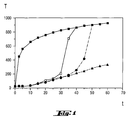
- the temperatures on the back of the joint which are given in Table 1 or the values on which FIG. 1 is based, are mean values from two measuring elements.
- a temperature difference between the target temperature of the furnace chamber and the back of the joint is a measure of the thermal insulation effect of the decomposed joint compound.
- the appearance of the joint and the consistency of the joint compound are assessed after a fire test of 60 minutes. The results are shown in Table 1 and Fig. 1.
- Example 2 The same components as in Example 1, but without boron carbide, are mixed and subjected to the test.
- Example 2 The same constituents as in Example 1, but with natural, ground calcium carbonate (Omya BLR3 from Omya, Cologne) instead of the aluminum silicate (calcined kaolin) are mixed and subjected to the test.
- natural, ground calcium carbonate Omya BLR3 from Omya, Cologne
- aluminum silicate calcined kaolin
- Example 2 The same constituents as in Example 1, but with aluminum oxide hydrate treated with organosilane (Martinal OL from Martinswerke, Bergheim) instead of the aluminum silicate (calcined kaolin), are mixed and subjected to the test.
- organosilane Martinal OL from Martinswerke, Bergheim
- This mixture is flowable and storable under normal conditions. Before use, 3% of a mixture of tetraethoxysilane and organotin catalyst is added for crosslinking and mixed intensively. Flowable mixtures are preferred for potting horizontal wall openings.
- the test specimens are prepared for the fire test and the fire test is carried out analogously to Example 1.
- Example 2 The same constituents as in Example 2, but instead of boron carbide, zirconium boride from Elektroschmelzwerke Kempten GmbH, Kunststoff, is used, mixed and subjected to the test.
- Example 2 The same constituents as in Example 2, but instead of boron carbide, calcium boride ground from Elektroschmelzwerke Kempten GmbH, Kunststoff, is used, mixed and subjected to the test.
- Example 2 The same components as in Example 2, but without boron carbide, are mixed and subjected to the test.
- Fig. 1 means T temperature in ° C t Test duration in minutes - ⁇ - Set temperature of the furnace chamber - ⁇ - Example 1, 2, 3 and 4 - ⁇ - Comparative experiment 1, 2, 3 and 5 Comparative experiment 4
Landscapes
- Chemical & Material Sciences (AREA)
- Health & Medical Sciences (AREA)
- Chemical Kinetics & Catalysis (AREA)
- Medicinal Chemistry (AREA)
- Polymers & Plastics (AREA)
- Organic Chemistry (AREA)
- Compositions Of Macromolecular Compounds (AREA)
Abstract
Die Verwendung von Borverbindungen ausgewählt aus der Gruppe von Borcarbid und Metallboriden im Gemisch mit nicht verstärkenden Füllstoffen, mit der Maßgabe, daß mindestens 75 Gew.-% der nicht verstärkenden Füllstoffe bis 1200°C thermisch stabil sind, als Flammschutzmittel in zu flammabweisenden Elastomeren vernetzbaren Organopolysiloxanmassen wird beschrieben.
Description
- Gemäß US-A 3,652,488 bzw. der korrespondierenden DE-C 20 34 919 wird eine Flammabweisung durch Platinzusatz erhalten und durch Zugabe von Ruß verstärkt. Dadurch sind diese Massen naturgemäß schwarz. Die bei Fugendichtungsmassen öfters erwünschten hellen Farbtöne sind nicht darstellbar.
- In US-A 3,821,140 bzw. der korrespondierenden DE-C 23 00 504 und US-A 3,677,999 sind flammabweisende oder selbstverlöschende Massen beschrieben, die durch Zugabe von Metalloxiden oder Hydraten von Metalloxiden, wie Aluminiumoxidhydrat, hergestellt werden. Bei erhöhten Temperaturen im Verlauf eines Brandes wird aus diesen Produkten Wasser abgespalten, das zwar kurzfristig die Entflammbarkeit verringert, unter den erhöhten Temperaturen, die bei längerer Branddauer auftreten, aber zu einer Destabilisierung des Dimethylpolysiloxans durch Hydrolyse beiträgt. Aus diesen Hydraten von Metalloxiden bilden sich beim Zerfall meist basische Oxide, wie Magnesiumoxid oder Aluminiumoxid, die die Zersetzung unter diesen Bedingungen weiter verstärken. Die Siliconmatrix zerfällt dann völlig durch Depolymerisation. Auch Kombinationen von Metalloxiden/Metalloxidhydraten mit Graphit sind aus US-A 4,405,425 bzw. der korrespondierenden EP-B 40 750 bekannt.
- Gemäß DE-B 29 09 462 und DE-A 30 41 031 werden durch Zugabe von halogenierten Diphenylverbindungen, z.B. Octabromdiphenylether, flammfeste Polysiloxanmassen hergestellt. Im Brandfall entstehen allerdings aus diesen Produkten polyhalogenierte Dibenzofurane oder Dibenzodioxine, die aufgrund der bekannten toxikologischen Problematik unerwünscht sind. Die Anwendung dieser Produkte dürfte in Zukunft daher nur noch eingeschränkt möglich sein.
- Keine der oben genannten Methoden führt zu Produkten, die im Brandfall ihr Volumen vergrößern und damit einen sogenannten Intumeszenzeffekt zeigen. Dies kann nach US-A 5,262,454 bzw. der korrespondierenden DE-A 40 13 161 und US-A 4,694,030 bzw. der korrespondierenden DE-A 36 02 888 durch die Zugabe von blähfähigen Graphitverbindungen sowie weiterer Additive, wie stickstoffhaltiger Polyphosphate oder auch durch Glashohlkugeln erreicht werden. Aber auch hier zeigt sich wieder, daß durch die Anwesenheit von Graphit die Produkte schwarz sind und daher keine hellen Farbtöne hergestellt werden können. Außerdem sind die Oberflächen der Siliconmassen durch die Zugabe des Blähgraphites oder der Glashohlkugeln rauh und unansehnlich, weil diese Produkte nicht in den notwendigen kleinen Korngrößen (<20µm) verfügbar sind.
- Borverbindungen werden in Siliconmassen wegen ihrer neutronenabsorbierender Wirkung eingesetzt. So ist die Verwendung von Borcarbid zu diesem Zweck aus US-A 4,176,093 bekannt.
- Es bestand die Aufgabe, zu flammabweisende Elastomere vernetzbare Organopolysiloxanmassen bereitzustellen, mit denen im Brandfall die im Stand der Technik auftretenden Nachteile vermieden werden. Weiterhin bestand die Aufgabe, zu flammabweisende Elastomere vernetzbare Organopolysiloxanmassen bereitzustellen deren Eigenfarbe möglichst hell sein soll und womit Elastomere erhalten werden, die im Brandfall ihr Volumen durch Aufschäumen vergrößeren, wobei der Schaum mechanisch möglichst stabil sein soll, die Fugen möglichst dicht verschließen soll und eine thermische Isolierwirkung haben soll, die einen Temperaturanstieg auf der Seite des Bauteiles, der dem Feuer abgewandt ist, möglichst lange verzögern soll. Die Aufgabe wird durch die Erfindung gelöst.
- Gegenstand der Erfindung ist die Verwendung von Borverbindungen ausgewählt aus der Gruppe von Borcarbid und Metallboriden im Gemisch mit nicht verstärkenden Füllstoffen, mit der Maßgabe, daß mindestens 75 Gew.-% der nicht verstärkenden Füllstofe bis 1200°C thermisch stabil sind, als Flammschutzmittel in zu flammabweisenden Elastomeren vernetzbaren Organopolysiloxanmassen.
- Beispiele für Borverbindungen sind Borcarbid, Zinkborid, Aluminiumborid, Titanborid und Calciumborid.
- Es kann eine Art von Borverbindung, es kann aber auch ein Gemisch aus mindestens zwei Borverbindungen eingesetzt werden.
- Der überwiegende Anteil der nicht verstärkendenen Füllstoffe, also Füllstoffe mit einer spezifischen BET-Oberfläche von weniger als 50 m2/g, muß bei den überlicherweise auftretenden Brandtemperaturen stabil sein, damit keine Zersetzung unter Volumenverlust oder eine Destabilisierung des Organopolysiloxangerüstes durch Bildung von unerwünschten Reaktionsprodukten eintritt. Ungeeignete Füllstoffe sind Calciumsulfat, Oxidhydrate des Aluminiums oder Magnesiums, wobei dann unerwünschte Reaktionsprodukte dampfförmiges Wasser sind bzw. auch alkalische Oxide sind, die bei der Zersetzung entstehen.
- Ein Anteil von Calcium- oder Calcium-Magnesiumcarbonaten, die unter Volumenverlust Kohlendioxid abspalten, bis zu 25 Gew.-% der Gesamtmenge an nicht verstärkenden Füllstoffen ist möglich.
- Bevorzugt werden als nicht verstärkende Füllstoffe nur solche verwendet, die bis 1200°C thermisch stabil sind.
- Beispiele für nicht verstärkende Füllstoff, die bis 1200°C thermisch stabil sind, sind natürliche und synthetische Siliciumdioxide, wie Diatomeenerde, amorphe und kristalline Quarze, Silikate, wie Glimmer, Kaolin, Talke und Perlite, silikatische Füllstoffe und natürliches und gefälltes Bariumsulfat.
- Es kann eine Art von Füllstoff, es kann aber auch ein Gemisch aus mindestens zwei Füllstoffen eingesetzt werden.
- Durch die thermische Zersetzung von Organopolysiloxanmassen ab einer Temperatur von etwa 400°C bilden sich gasförmige, niedermolekulare Organosiliciumverbindungen, die zu einem Aufblähen der Siliconelastomere beim Entweichen führen. Ohne die erfindungsgemäßen Zusätze würde sich das Organopolysiloxangerüst im Verlauf des Brandes völlig zersetzen. Durch die erfindungsgemäßen Zusätze kommt es überraschend zur Bildung eines festen, schaumartigen Rückstandes. Das bei der thermischen Zersetzung des Organopolysiloxans entstehende Siliciumdioxid und die erfindungsgemäßen Zusätze versintern zu einem mechanisch festen Schaum. Als Treibmittel wirken dabei die niedermolekularen Verbindungen, die sich bei der Zersetzung des Organopolysiloxans bilden. Zusätzliche Treibmittel sind nicht nötig. Dieser schaumartige Rückstand zeigt im Brandfall auch eine verbesserte Isolierwirkung gegenüber nicht aufschäumenden Fugenmassen und ist mechanisch belastbar im Gegensatz zu nicht aufschäumenden Fugenmassen, die sich zu einem mechanisch nicht belastbaren, pulverförmigen Rückstand zersetzen. Volumenverlust und Rißbildung in den verbleibenden Fugenmassen werden vermieden, so daß keine Brandgase auf die Rückseite der abgedichteten Bauteile gelangen und eine Brandausbreitung damit vermieden wird.
- Die Organopolysiloxanmassen, die die erfindungsgemäßen Zusätze enthalten, umfassen sogenannte kondensationsvernetzende 1-Komponentenmassen und 2-Komponentenmassen und additionsvernetzende 2-Komponentenmassen auf Grundlage von Organopolysiloxanen.
- Bei den Organopolysiloxanmassen ohne die erfindungsgemäßen Zusätze handelt es sich um dieselben Organopolysiloxanmassen, die auch für die bisher bekannten zu flammabweisenden Elastomeren vernetzbaren Organopolysiloxanmassen verwendet werden konnten.
- Die Organopolysiloxane in den erfindungsgemäßen Massen können beliebige Organopolysiloxane sein, die auch in den bisher bekannten, zu flammabweisenden Elastomeren vernetzbaren Organopolysiloxanmassen vorliegen konnten.
- Es handelt sich bei den kondensationsvernetzenden Massen vorzugsweise um kondensationsfähige Endgruppen aufweisende Organopolysiloxane der allgemeinen Formel
XR2SiO(R2SiO)nSiR2X (I)
wobei - R gleiche oder verschiedene, einwertige, gegebenenfalls substituierte Kohlenwasserstoffreste mit 1 bis 18 Kohlenstoffatomen je Rest,
- X eine Hydroxylgruppe und
- n eine ganze Zahl von mindestens 10 bedeutet.
- Die Hydroxylgruppen X in der oben angegebenen Formel (I) können, falls erwünscht, vollständig oder teilweise durch andere kondensationsfähige Gruppen, wie Alkoxygruppen mit 1 bis 4 Kohlenstoffatomen je Gruppe, ersetzt sein.
- Es handelt sich bei den additionsvernetzenden Massen vorzugsweise um aliphatische Kohlenstoff-Kohlenstoff Mehrfachbindungen aufweisende Organopolysiloxane der allgemeinen Formel

- R1 gleiche oder verschiedene, einwertige, gegebenenfalls substituierte Kohlenwasserstoffreste mit 1 bis 18 Kohlenstoffatomen je Rest,
- Y einen einwertigen Kohlenwasserstoffrest mit aliphatischer Kohlenstoff-Kohlenstoff Mehrfachbindung, bevorzugt Alkenylrest, besonders bevorzugt Vinyl- oder Hexenylrest und
- a 0 oder 1,
- b eine ganze Zahl im Wert von 20 bis 10000 und
- c 0 oder eine ganze Zahl im Wert von 1 bis 300 bedeutet.
- Innerhalb bzw. entlang der Siloxankette der Organopolysiloxane der oben angegebenen Formeln (I) und (II) können, was durch derartige Formeln üblicherweise nicht dargestellt wird, zusätzlich zu den Diorganosiloxaneinheiten R2SiO noch andere Siloxaneinheiten vorliegen. Beispiele für solche anderen, meist nur als Verunreinigung vorliegenden Siloxaneinheiten sind solche der Formeln RSiO3/2, R3SiO1/2 und SiO4/2, wobei R die oben dafür angegebene Bedeutung hat.
- Es kann eine Art von Organopolysiloxan oder mehrere Arten von Organopolysiloxane eingesetzt werden.
- Die Organopolysiloxane weisen eine Viskosität von vorzugsweise 1 000 bis 300 000 mPa·s bei 25°C, bevorzugt 6000 bis 300000 mPa·s bei 25°C und besonders bevorzugt 20000 bis 300000 mPa·s bei 25°C auf.
- Beispiele für Reste R sind Alkylreste, wie der Methyl-, Ethyl-, n-Propyl-, iso-Propyl-, n-Butyl-, iso-Butyl-, tert.-Butyl-, n-Pentyl-, iso-Pentyl-, neo-Pentyl-, tert.-Pentylrest; Hexylreste, wie der n-Hexylrest; Heptylreste, wie der n-Heptylrest; Octylreste, wie der n-Octylrest und iso-Octylreste, wie der 2,2,4-Trimethylpentylrest; Nonylreste, wie der n-Nonylrest; Decylreste, wie der n-Decylrest, Dodecylreste, wie der n-Dodecylrest; Octadecylreste, wie der n-Octadecylrest; Alkenylreste, wie der Vinyl- und der Allylrest; Cycloalkylreste, wie Cyclopentyl-, Cyclohexyl-, Cycloheptylreste und Methylcyclohexylreste; Arylreste, wie der Phenyl-, Naphthyl-, Anthryl- und Phenanthrylrest; Alkarylreste, wie o-, m-, p-Tolylreste, Xylylreste und Ethylphenylreste; und Aralkylreste, wie der Benzylrest, der α- und der β-Phenylethylrest.
- Beispiele für substituierte Reste R sind Cyanalkylreste, wie der β-Cyanethylrest, und halogenierte Kohlenwasserstoffreste, beispielsweise Halogenalkylreste, wie der 3,3,3-Trifluor-n-propylrest, der 2,2,2,2',2',2'-Hexafluorisopropylrest, der Heptafluorisopropylrest, und Halogenarylreste, wie der o-, m-, und p-Chlorphenylrest.
- Die Beispiele für Reste R gelten mit Ausnahme der Alkenylreste für die Reste R1. Beispiele für substituierte Reste R gelten im vollen Umfang für substituierte Reste R1.
- Schon wegen der leichteren Zugänglichkeit sind vorzugsweise mindestens 50 %, bevorzugt mindestens 90 %, der Anzahl der Reste R bzw. R1 in den Organopolysiloxanen Methylreste.
- Als Vernetzungsmittel für die Vernetzung der kondensationsvernetzenden Organopolysiloxane werden vorzugsweise feuchtigkeitsempfindliche Silane der allgemeinen Formel
RxSiZ4-x (III)
und/oder deren Teilhydrolysate, die bevorzugt 2 bis 10 Siliciumatome aufweisen,
wobei - R die oben dafür angegebene Bedeutung hat,
- x 0 oder 1 ist und
- Z gleiche oder verschiedene hydrolysierbare Gruppen ausgewählt aus der Gruppe von
- Acyloxygruppen
- -OCOR2
- Kohlenwasserstoffoxygruppen
- -OR3
- Aminogruppen
- -NR

- Oximgruppen
- -ON=A
- Amidgruppen
-

- Aminoxygruppen
- -O-NR

- Enoxygruppen
-

- R2 einen einwertigen Kohlenwasserstoffrest mit 1 bis 12 Kohlenstoffatomen,
- R3 einen einwertigen Kohlenwasserstoffrest mit 1 bis 4 Kohlenstoffatomen,
- R4 Wasserstoff oder gleiche oder verschiedene, einwertige Kohlenwasserstoffreste mit 1 bis 12 Kohlenstoffatomen und
- A gleiche oder verschiedene Reste der Formel

- Beispiele für Acyloxygruppen sind Acetoxy- und Formyloxygruppen und 2-Ethylhexanoxygruppen.
- Beispiele für Kohlenwasserstoffoxygruppen sind Methoxy-, Ethoxy-, n-Propyloxy-, Isopropyloxy-, n-Butyloxygruppen.
- Beispiele für substituierte Kohlenwasserstoffoxygruppen sind durch Alkoxygruppen substituierte Kohlenwasserstoffoxygruppen, wie Methoxyethylenoxy-, Ethoxyethylenoxy- und Methoxyisopropylenoxygruppen.
- Beispiele für Aminogruppen sind n-Butylamino-, sec.-Butylamino-, Cyclohexylaminogruppen.
- Beispiele für Oximgruppen sind Methylethylketoximgruppen Methylisobutylketoximgruppen, Methyl n-amylketoximgruppen und Dimethylketoximgruppen.
- Beispiele für Amidgruppen sind n-Methylbenzamidogruppen und n-Methylacetamidogruppen.
- Ein Beispiel für eine Aminoxygruppe ist die Hydroxylamingruppe.
- Ein Beispiel für eine Enoxygruppe ist die Isoprenoxygruppe.
- Für die Vernetzung von kondensationsvernetzenden 2-Komponentenmassen wird unmittelbar vor der Anwendung die Härterkomponente zugemischt. Diese Härterkomponente ist vorzugsweise ein Tetraalkoxysilan, bevorzugt Tetraethyl- oder Tetrapropylsilicat.
- Als Vernetzungskatalysatoren werden bei den kondensationsvernetzenden 1- und 2-Komponentenmassen die dem Fachmann bekannten Kondensationskatalysatoren verwendet.
- Beispiele für Kondensationskatalysatoren sind Butyltitanate und organische Zinnverbindungen, wie Di-n-butylzinndiacetat, Di-n-butylzinndilaurat und Umsetzungsprodukte von je Molekül mindestens zwei über Sauerstoff an Silicium gebundene, gegebenenfalls durch eine Alkoxygruppe substituierte, einwertige Kohlenwasserstoffreste als hydrolysierbare Gruppen aufweisendem Silan oder dessen Oligomer mit Diorganozinndiacylat, wobei in diesen Umsetzungsprodukten alle Valenzen der Zinnatome durch Sauerstoffatome der Gruppierung
≡SiOSn≡
bzw. durch SnC-gebundene, einwertige organische Reste abgesättigt sind. Die Herstellung derartiger Umsetzungsprodukte ist in US 4 460 761 (ausgegeben 17. Juli 1984, A. Schiller et al., Wacker-Chemie GmbH) eingehend beschrieben. - Nach der Applikation der Organopolysiloxanmassen erfolgt die Vernetzung zu Siliconelastomeren durch Zutritt von Luftfeuchtigkeit.
- Bei additionsvernetzenden 2-Komponentenmassen werden als Vernetzungsmittel Si-gebundene Wasserstoffatome aufweisende Organopolysiloxane verwendet. Es handelt sich dabei vorzugsweise um solche der allgemeinen Formel

- R1 die oben dafür angegebene Bedeutung hat,
- d 0 oder 1,
- e 0 oder eine ganze Zahl im Wert von 1 bis 500 und
- f eine ganze Zahl im Wert von 1 bis 200 ist,
- mit der Maßgabe, daß durchschnittlich je Molekül mindestens 3 Si-gebundene Wasserstoffatome enthalten sind.
- Die Härterkomponente wird erst unmittelbar vor der Anwendung zugemischt.
- Als Vernetzungskatalysatoren werden im Falle der Additionsvernetzung vorzugsweise Platinmetalle und/oder deren Verbindungen, bevorzugt Platin und/oder dessen Verbindungen eingesetzt. Es können hier alle Katalysatoren eingesetzt werden, die auch bisher zur Addition von direkt an Si-Atome gebundenen Wasserstoffatomen an aliphatisch ungesättigte Verbindungen eingesetzt wurden. Beispiele für solche Katalysatoren sind metallisches und feinverteiltes Platin, das sich auf Trägern, wie Siliciumdioxyd, Aluminiumoxyd oder Aktivkohle befinden kann, Verbindungen oder Komplexe von Platin, wie Platinhalogenide, z. B. PtCl4, H2PtCl6*6H2O, Na2PtCl4*4H2O, Platin-Olefin-Komplexe, Platin-Alkohol-Komplexe, Platin-Alkoholat-Komplexe, Platin-Ether-Komplexe, Platin-Aldehyd-Komplexe, Platin-Keton-Komplexe, einschließlich Umsetzungsprodukten aus H2PtCl6*6H2O und Cyclohexanon, Platin-Vinylsiloxankomplexe, insbesondere Platin-Divinyltetramethyldisiloxankomplexe mit oder ohne Gehalt an nachweisbarem anorganisch gebundenem Halogen, Bis-(gamma-picolin)-platindichlorid, Trimethylendipyridinplatindichlorid, Dicyclopentadienplatindichlorid, Dimethylsulfoxydethylenplatin-(II)-dichlorid sowie Umsetzungsprodukte von Platintetrachlorid mit Olefin und primärem Amin oder sekundärem Amin oder primärem und sekundärem Amin, wie das Umsetzungsprodukt aus in 1-Octen gelöstem Platintetrachlorid mit sec.-Butylamin, oder Ammonium-Platinkomplexe gemäß EP-B 110 370.
- Zusätzlich zu den Organopolysiloxanen, Vernetzungsmitteln und Vernetzungskatalysatoren können die erfindungsgemäßen Massen gegebenenfalls weitere Stoffe enthalten, wie verstärkende Füllstoffe, Weichmacher, wie durch Trimethylsiloxygruppen endblockierte Dimethylpolysiloxane oder Methylphenylpolysiloxane, die eine Viskosität von vorzugsweise 10 bis 5 000 mPa·s bei 25°C, bevorzugt 35 bis 1000 mPa·s bei 25°C, aufweisen, Haftvermittler, wie organofunktionelle Silan oder Siloxane, beispielsweise aminofunktionelle Silane oder Siloxane, Dispergierhilfsmittel, Pigmente, Fungizide und rheologische Additive.
- Beispiele für verstärkende Füllstoffe, also Füllstoffe mit einer spezifischen BET-Oberfläche von mindestens 50 m2/g sind pyrogen erzeugte Siliciumdioxide und gefällte Siliciumdioxide. Die verstärkenden, wie die nicht verstärkenden Füllstoffe, können hydrophobiert sein durch die Behandlung mit hydrophob machenden Mitteln, wie durch die Behandlung mit Stearinsäure oder durch die Behandlung mit Organosilanen, -silazanen oder -siloxanen. Es kann eine Art von Füllstoff, es kann aber auch ein Gemisch von mindestens zwei Füllstoffen eingesetzt werden.
- Die Organopolysiloxanmassen, die die erfindungsgemäßen Zusätze enthalten, sind vorzugsweise folgendermaßen aufgebaut:
- (a) 10 bis 80 Gew.-%, bevorzugt 20 bis 70 Gew.-%, vernetzungsfähiges Organopolsiloxan
- (b) 0 bis 40 Gew.-%, bevorzugt 10 bis 30 Gew.-%, nicht vernetzungsfähiger Weichmacher
- (c) 0,5 bis 15 Gew.-%, bevorzugt 3 bis 10 Gew.-%, Vernetzungsmittel
- (d) 0 bis 50 Gew.-%, bevorzugt 3 bis 10 Gew.-%, verstärkender Füllstoff
- (e) 10 bis 50 Gew.-%, bevorzugt 20 bis 40 Gew.-%, nicht verstärkender Füllstoff
- (f) 0 bis 10 Gew.-%, bevorzugt 1 bis 3 Gew.-%, Pigmente
- (g) 0 bis 2 Gew.-%, bevorzugt 0,01 bis 1,0 Gew.-%, Katalysator
- (h) 0 bis 10 Gew.-%, bevorzugt 0,1 bis 3 Gew.-%, Haftvermittler und
- (i) 0,1 bis 20 Gew.-%, bevorzugt 0,1 bis 3 Gew.-%, Borverbindung,
- Die erfindungsgemäßen zu flammabweisenden Elastomeren vernetzbaren Organopolysiloxanmassen können für alle Zwecke verwendet werden, für die zu flammabweisenden Elastomeren vernetzbaren Organopolysiloxane verwendet werden können, beispielsweise als Fugendichtungsmassen zwischen Bauteilen im Hoch- und Tiefbau, als Abdichtungsmasse bei Verglasungen und als Abdichtungs- und Vergußmassen bei Kabel oder Rohrdurchführungen durch nichtbrennbare Baustoffe.
- In den folgenden Beispielen beziehen sich alle Angaben von Prozentsätzen auf das Gewicht, soweit nichts anderes angegeben ist.
- Folgende Rezepturbestandteile werden nacheinander in einem geeigneten Mischer zusammengebracht:
- 30%
- α,ω-Dihydroxydimethylpolysiloxan, vernetzungsfähig, Viskosität von 80.000 mPa·s bei 25°C
- 19,9%
- Weichmacher, Trimethylsiloxygruppen aufweisendes Dimethylpolysiloxan, nicht vernetzungsfähig, Viskosität von 100 mPa·s bei 25°C
- 6%
- Methyltrisbutanonoximosilan als Vernetzer
- 3%
- pyrogene Kieselsäure mit einer spezifischen Oberfläche von etwa 150 m2/g, z.B. HDK V 15 der Wacker-Chemie GmbH, München, als verstärkender Füllstoff
- 38%
- Kalzinierter Kaolin, z.B. Icecap K der Fa. Burgess Pigment Company, USA, als nicht verstärkender Füllstoff
- 2%
- γ-Aminopropyltriethoxysilan als Haftvermittler
- 1%
- Borcarbid gemahlen der Elektroschmelzwerke Kempten GmbH, München, als erfindungsgemäßes Additiv
- 0,1%
- Organozinnkatalysator zur Vernetzung.
- Die fertige Masse ist hellgrau und kann bei Bedarf durch geeignete Pigmente in verschiedenen erwünschten Farbtönen eingefärbt werden. Dieses standfeste Gemisch wird unter Ausschluß von Feuchtigkeit in handelsüblichen Kartuschen gelagert. Bevorzugte Anwendung ist die Abdichtung von vertikalen Bauwerksfugen oder Deckenfugen, bei denen das Material über Kopf appliziert wird.
- Für die Brandprüfung wird die Masse als 12 x 12 mm breite und 500 mm lange Fuge zwischen 2 Blöcke aus Leichtbeton mit einer Rundschnur aus geeignetem Material (z.B. geschlossenzelliges, geschäumtes Polyethylen, Keramikfasern o.ä.) als Hinterfüllmaterial eingebracht und bei Normklima ausgehärtet. Nach 4 Wochen Vorlagerung werden die Proben in einem Kleinbrandofen, wie er in DIN 4102, Teil 8 beschrieben wird, einem Brandtest nach der Einheitsbrandkurve nach DIN 4102, Teil 2 unterworfen. Der Temperaturverlauf im Brandraum und auf der Rückseite der Fuge wird mit 3 Thermoelementen aufgezeichnet. Die Temperaturen auf der Rückseite der Fuge, die in der Tabelle 1 angegeben sind bzw. die Werte, die der Fig. 1 zugrundeliegen, sind Mittelwerte aus 2 Meßelementen.
- Eine Temperaturdifferenz zwischen Solltemperatur des Ofenraums und Fugenrückseite ist ein Maß für die thermische Isolierwirkung der zersetzten Fugenmasse. Das Aussehen der Fuge und die Konsistenz der Fugenmasse werden nach 60 Minuten Brandversuch beurteilt. Die Ergebnisse sind in Tabelle 1 und Fig. 1 angegeben.
- Dieselben Bestandteile wie in Beispiel 1, aber ohne Borcarbid, werden gemischt und der Prüfung unterzogen.
- Dieselben Bestandteile wie in Beispiel 1, aber mit natürlichem, gemahlenen Calciumcarbonat (Omya BLR3 der Fa. Omya, Köln) anstelle des Aluminiumsilikates (Kalzinierter Kaolin), werden gemischt und der Prüfung unterzogen.
- Dieselben Bestandteile wie in Vergleichsversuch 2, aber ohne Borcarbid, werden gemischt und der Prüfung unterzogen.
- Dieselben Bestandteile wie in Beispiel 1, aber mit organosilanoberflächenbehandeltem Aluminiumoxidhydrat (Martinal OL der Fa. Martinswerke, Bergheim) anstelle des Aluminiumsilikates (Kalzinierter Kaolin), werden gemischt und der Prüfung unterzogen.
- Folgende Rezepturbestandteile werden nacheinander in einem geeigneten Mischer zusammengebracht:
- 66%
- α,ω-Dihydroxydimethylsiloxan, vernetzungsfähig, Viskosität von 12.000 mPa·s bei 25°C
- 33%
- Quarzmehl, gemahlen, z.B. Sicron SF 600 der Fa. Quarzwerke GmbH, Frechen als nicht verstärkender Füllstoff
- 1%
- Borcarbid analog Beispiel 1.
- Dieses Gemisch ist fließfähig und bei Normalbedingungen lagerfähig. Vor der Anwendung wird zur Vernetzung 3% eines Gemisch aus Tetraethoxysilan und Organozinnkatalysator zugegeben und intensiv vermischt. Fließfähige Mischungen werden zum Verguß von horizontalen Maueröffnungen bevorzugt. Die Vorbereitung der Prüfkörper für den Brandversuch und der Brandtest erfolgt analog zu Beispiel 1.
- Dieselben Bestandteile wie in Beispiel 2, aber anstelle von Borcarbid wird Zirkonborid gemahlen der Elektroschmelzwerke Kempten GmbH, München, verwendet, werden gemischt und der Prüfung unterzogen.
- Dieselben Bestandteile wie in Beispiel 2, aber anstelle von Borcarbid wird Calciumborid gemahlen der Elektroschmelzwerke Kempten GmbH, München, verwendet, werden gemischt und der Prüfung unterzogen.
- Dieselben Bestandteile wie in Beispiel 2, aber ohne Borcarbid, werden gemischt und der Prüfung unterzogen.

- In Fig. 1 bedeutet
T Temperatur in °C
t Versuchsdauer in Minuten
―■― Solltemperatur Ofenraum
―▲― Beispiel 1, 2, 3 und 4
―●― Vergleichsversuch 1, 2, 3 und 5
Vergleichsversuch 4
Claims (5)
- Verwendung von Borverbindungen ausgewählt aus der Gruppe von Borcarbid und Metallboriden im Gemisch mit nicht verstärkenden Füllstoffen, mit der Maßgabe, daß mindestens 75 Gew.-% der nicht verstärkenden Füllstoffe bis 1200°C thermisch stabil sind, als Flammschutzmittel in zu flammabweisenden Elastomeren vernetzbaren Organopolysiloxanmassen.
- Verwendung nach Anspruch 1, dadurch gekennzeichnet, daß als Borverbindungen solche ausgewählt aus der Gruppe von Borcarbid, Zinkborid, Aluminiumborid, Titanborid und Calciumborid eingesetzt werden.
- Verwendung nach Anspruch 1 oder 2, dadurch gekennzeichnet, daß als nicht verstärkende Füllstoffe, die bis 1200°C stabil sind, solche ausgewählt aus der Gruppe von natürlichen und synthetischen Siliciumdioxiden, amorphe und kristalline Quarze, Silikate, silikatische Füllstoffe und natürliche und gefällte Bariumsulfate eingesetzt werden.
- Verwendung nach Anspruch 1, 2 oder 3, dadurch gekennzeichnet, daß Borverbindungen in Mengen von 0,1 bis 20 Gew.-%, bezogen auf das Gesamtgewicht der zu flammabweisenden Elastomeren vernetzbaren Organopolysiloxanmassen, eingesetzt werden.
- Verwendung nach einem der Ansprüche 1 bis 4, dadurch gekennzeichnet, daß nicht verstärkende Füllstoffe in Mengen von 10 bis 50 Gew.-%, bezogen auf das Gesamtgewicht der zu flammabweisenden Elastomeren vernetzbaren Organopolysiloxanmassen, eingesetzt werden.
Applications Claiming Priority (2)
| Application Number | Priority Date | Filing Date | Title |
|---|---|---|---|
| DE19620816 | 1996-05-23 | ||
| DE19620816A DE19620816A1 (de) | 1996-05-23 | 1996-05-23 | Zu flammabweisende Elastomere vernetzbare Organopolysiloxanmassen |
Publications (1)
| Publication Number | Publication Date |
|---|---|
| EP0808867A1 true EP0808867A1 (de) | 1997-11-26 |
Family
ID=7795144
Family Applications (1)
| Application Number | Title | Priority Date | Filing Date |
|---|---|---|---|
| EP97108281A Withdrawn EP0808867A1 (de) | 1996-05-23 | 1997-05-22 | Borverbindungen als Flammschutzmittel in vernetzbaren Organopolysiloxan-Massen |
Country Status (6)
| Country | Link |
|---|---|
| US (1) | US5922799A (de) |
| EP (1) | EP0808867A1 (de) |
| JP (1) | JPH1081823A (de) |
| KR (1) | KR100235543B1 (de) |
| CA (1) | CA2200942C (de) |
| DE (1) | DE19620816A1 (de) |
Cited By (2)
| Publication number | Priority date | Publication date | Assignee | Title |
|---|---|---|---|---|
| FR2899905A1 (fr) * | 2006-04-12 | 2007-10-19 | Rhodia Recherches & Tech | Compositions polyorganosiloxanes vulcanisables a chaud utilisables notamment pour la fabrication de fils ou cables electriques |
| FR2907787A1 (fr) * | 2006-10-31 | 2008-05-02 | Sncf | Mousse silicone additionnee d'un agent thermique et utilisations de la mousse |
Families Citing this family (7)
| Publication number | Priority date | Publication date | Assignee | Title |
|---|---|---|---|---|
| JP2000309708A (ja) * | 1999-04-26 | 2000-11-07 | Kanegafuchi Chem Ind Co Ltd | 硬化性樹脂組成物および発泡性樹脂組成物 |
| EP1113048A3 (de) | 1999-12-27 | 2002-01-30 | General Electric Company | Hydrophobmachendes partikulares Material |
| US20070190872A1 (en) * | 2006-02-16 | 2007-08-16 | Weber Robert F | Fire retardant silicone textile coating |
| CN102220008B (zh) * | 2011-05-10 | 2012-08-15 | 嘉兴多角电线电缆有限公司 | 高强度耐火电缆绝缘材料及其制备方法 |
| FR2987367B1 (fr) * | 2012-02-28 | 2015-03-06 | Commissariat Energie Atomique | Materiau de protection au feu, reservoir de stockage haute pression revetu d'un tel materiau, leurs procedes de preparation et leurs utilisations |
| WO2020231603A1 (en) | 2019-05-16 | 2020-11-19 | Dow Global Technologies Llc | Compatibilized blends of terephalate ester polyols and hydrocarbon blowing agents |
| EP4448278A1 (de) * | 2021-12-16 | 2024-10-23 | Dow Silicones Corporation | Laminatbarriere mit silikonschaumschicht zur definition von hohlräumen mit endothermem material |
Citations (2)
| Publication number | Priority date | Publication date | Assignee | Title |
|---|---|---|---|---|
| JPS5145145A (en) * | 1974-10-16 | 1976-04-17 | Ig Gijutsu Kenkyusho Kk | Taika tainetsusei ojusuru goseijushi |
| EP0505940A1 (de) * | 1991-03-20 | 1992-09-30 | Dainippon Ink And Chemicals, Inc. | Intumeszierende, feuerfeste Beschichtung, feuerfestes Material und Verfahren zu dessen Herstellung |
Family Cites Families (14)
| Publication number | Priority date | Publication date | Assignee | Title |
|---|---|---|---|---|
| US3652488A (en) * | 1969-07-16 | 1972-03-28 | Dow Corning | Flame resistant silicone elastomers containing carbon black and platinum |
| DE1955524C2 (de) * | 1969-11-05 | 1980-10-02 | Siemens Ag, Berlin Und Muenchen, 8000 Muenchen | GieDharzformmassen zur Herstellung von nichtbrennbaren elektrischen Bauteilen |
| BE793729A (fr) * | 1972-01-07 | 1973-07-05 | Rhone Poulenc Sa | Compositions organopolysiloxaniques |
| US4176093A (en) * | 1977-02-22 | 1979-11-27 | Zoch Harold L | Neutron absorbing room temperature vulcanizable silicone rubber compositions |
| DE2909462C3 (de) * | 1979-03-10 | 1982-04-15 | Perennatorwerk Alfred Hagen Gmbh, 6200 Wiesbaden | Flammfestmachen von Polyorganosiloxanmassen |
| DE3018549A1 (de) * | 1980-05-14 | 1981-11-19 | Wacker-Chemie GmbH, 8000 München | Zu flammabweisenden elastomeren, ggf. nach zusatz von vernetzungsmittel, vernetzbare massen auf grundlage von organopolysiloxan |
| DE3041031A1 (de) * | 1980-10-31 | 1982-06-09 | Perennatorwerk Alfred Hagen Gmbh, 6200 Wiesbaden | Flammfestmachen von unter erhoehter temperatur und bzw. oder unter einwirkung ionisierender strahlen haertbaren polyorganosiloxanmassen bzw. derart gehaerteter (vulkanisierter) gummielastischer produkte aus polyorganosiloxan |
| DE3212008A1 (de) * | 1982-03-31 | 1983-10-06 | Wacker Chemie Gmbh | Unter ausschluss von wasser lagerfaehige, bei zutritt von wasser bei raumtemperatur zu elastomeren vernetzende massen |
| AU1910783A (en) * | 1982-11-29 | 1984-06-07 | Sws Silicones Corp. | Organopolysiloxane composition |
| US4433069A (en) * | 1983-01-03 | 1984-02-21 | Dow Corning Corporation | Method for preparing flame resistant polysiloxane foams and foams prepared thereby |
| DE3602888A1 (de) * | 1986-01-31 | 1987-08-06 | Bayer Ag | Intumeszierende polysiloxan-formmassen |
| DE4013161A1 (de) * | 1990-04-25 | 1991-11-07 | Schott Glaswerke | Flammfeste polyorganosiloxanmasse |
| US5262454A (en) * | 1990-04-25 | 1993-11-16 | Down Corning Gmbh | Flame-resistant polyorganosiloxane compound containing hollow glass balls and intumescent compound |
| DE69223550T2 (de) * | 1991-05-28 | 1998-04-16 | Denki Kagaku Kogyo Kk | Flammhemmende Harzzusammensetzung |
-
1996
- 1996-05-23 DE DE19620816A patent/DE19620816A1/de not_active Withdrawn
-
1997
- 1997-02-24 US US08/805,088 patent/US5922799A/en not_active Expired - Fee Related
- 1997-03-25 CA CA002200942A patent/CA2200942C/en not_active Expired - Fee Related
- 1997-05-22 JP JP9132222A patent/JPH1081823A/ja active Pending
- 1997-05-22 EP EP97108281A patent/EP0808867A1/de not_active Withdrawn
- 1997-05-22 KR KR1019970020105A patent/KR100235543B1/ko not_active Expired - Fee Related
Patent Citations (2)
| Publication number | Priority date | Publication date | Assignee | Title |
|---|---|---|---|---|
| JPS5145145A (en) * | 1974-10-16 | 1976-04-17 | Ig Gijutsu Kenkyusho Kk | Taika tainetsusei ojusuru goseijushi |
| EP0505940A1 (de) * | 1991-03-20 | 1992-09-30 | Dainippon Ink And Chemicals, Inc. | Intumeszierende, feuerfeste Beschichtung, feuerfestes Material und Verfahren zu dessen Herstellung |
Non-Patent Citations (1)
| Title |
|---|
| DATABASE WPI Section Ch Week 7622, Derwent World Patents Index; Class A25, AN 76-41127X, XP002037346 * |
Cited By (5)
| Publication number | Priority date | Publication date | Assignee | Title |
|---|---|---|---|---|
| FR2899905A1 (fr) * | 2006-04-12 | 2007-10-19 | Rhodia Recherches & Tech | Compositions polyorganosiloxanes vulcanisables a chaud utilisables notamment pour la fabrication de fils ou cables electriques |
| WO2007115834A3 (fr) * | 2006-04-12 | 2007-12-21 | Rhodia Recherches & Tech | Compositions polyorganosiloxanes vulcanisables a chaud utilisables notamment pour la fabrication de fils ou cables electriques |
| US8193268B2 (en) | 2006-04-12 | 2012-06-05 | Bluestar Silicones France Sas | Hot-vulcanizable polyorganosiloxane compositions useful particularly for manufacturing electrical cables or wires |
| FR2907787A1 (fr) * | 2006-10-31 | 2008-05-02 | Sncf | Mousse silicone additionnee d'un agent thermique et utilisations de la mousse |
| WO2008059142A3 (fr) * | 2006-10-31 | 2008-08-07 | Sncf | Mousse silicone additionnée d'un agent thermique et utilisations de la mousse |
Also Published As
| Publication number | Publication date |
|---|---|
| KR970074841A (ko) | 1997-12-10 |
| KR100235543B1 (ko) | 1999-12-15 |
| JPH1081823A (ja) | 1998-03-31 |
| CA2200942C (en) | 2002-06-18 |
| CA2200942A1 (en) | 1997-11-23 |
| US5922799A (en) | 1999-07-13 |
| DE19620816A1 (de) | 1997-11-27 |
Similar Documents
| Publication | Publication Date | Title |
|---|---|---|
| US3821140A (en) | Organopolysiloxane compositions | |
| US4405425A (en) | Flame-retardant polysiloxane elastomers | |
| CA1152244A (en) | Flame resistant silicone rubber compositions and methods | |
| DE69201372T2 (de) | Flammhemmende elastomere Zusammensetzung. | |
| EP0649885A1 (de) | Übergangsmetallhaltige hydrophobe Kieselsäure | |
| EP0544674B1 (de) | Organo(poly)siloxane mit organyloxy- und hydrogengruppen aufweisenden, endständigen siloxaneinheiten | |
| DE10259613A1 (de) | Organopolysiloxanzusammensetzungen und deren Einsatz in bei Raumtemperatur vernetzbaren niedermoduligen Massen | |
| EP1006146B1 (de) | Unter Abspaltung von Alkoholen zu Elastomeren vernetzbare Organopolysiloxanmassen | |
| EP0544318B1 (de) | Einkomponenten-RTV-Massen | |
| KR100618102B1 (ko) | 오르가노실리콘 화합물을 기재로 한 가교제의 제조 방법 | |
| DE2259802A1 (de) | Verfahren zum herstellen von plastischen, rueckprallelastizitaet aufweisenden massen aus organopolysiloxanen | |
| US3996188A (en) | Flame-retardant silicone compositions | |
| EP1000121A1 (de) | Unter abspaltung von alkoholen zu elastomeren vernetzbare organopolysiloxanmassen | |
| EP1042400B1 (de) | Unter abspaltung von alkoholen zu elastomeren vernetzbare organopolysiloxanmassen | |
| DE19620816A1 (de) | Zu flammabweisende Elastomere vernetzbare Organopolysiloxanmassen | |
| EP0090409B1 (de) | Unter Ausschluss von Wasser lagerfähige, bei Zutritt von Wasser bei Raumtemperatur zu Elastomeren vernetzende Massen | |
| EP1674516B1 (de) | Schwerbrennbare Siliconkautschukszusammensetzung | |
| DE2229560C3 (de) | Hitzehärtbare Organopolysiloxanformmassen | |
| DE4336345A1 (de) | Übergangsmetallhaltige hydrophobe Kieselsäure | |
| CA1138143A (en) | Siloxane elastomers containing manganous oxide | |
| DE2501441B2 (de) | Zusatz von Siliciumverbindungen für zu Elastomeren vernetzbare Massen | |
| DE4029481A1 (de) | Unter abspaltung von alkoholen zu elastomeren vernetzbare organo(poly)siloxanmassen | |
| WO2009043808A2 (de) | Schwerentflammbares dichtungsmittel | |
| EP0814120A1 (de) | Unter Abspaltung von Alkoholen zu Elastomeren vernetzbare Organopolysiloxanmassen | |
| DE4401598A1 (de) | Übergangsmetallhaltige hydrophobe Kieselsäure |
Legal Events
| Date | Code | Title | Description |
|---|---|---|---|
| PUAI | Public reference made under article 153(3) epc to a published international application that has entered the european phase |
Free format text: ORIGINAL CODE: 0009012 |
|
| 17P | Request for examination filed |
Effective date: 19970522 |
|
| AK | Designated contracting states |
Kind code of ref document: A1 Designated state(s): AT BE CH DE ES FI FR GB IT LI NL SE |
|
| STAA | Information on the status of an ep patent application or granted ep patent |
Free format text: STATUS: THE APPLICATION IS DEEMED TO BE WITHDRAWN |
|
| 18D | Application deemed to be withdrawn |
Effective date: 20031201 |