EP0809128B1 - Commutateur optique - Google Patents
Commutateur optique Download PDFInfo
- Publication number
- EP0809128B1 EP0809128B1 EP19960303692 EP96303692A EP0809128B1 EP 0809128 B1 EP0809128 B1 EP 0809128B1 EP 19960303692 EP19960303692 EP 19960303692 EP 96303692 A EP96303692 A EP 96303692A EP 0809128 B1 EP0809128 B1 EP 0809128B1
- Authority
- EP
- European Patent Office
- Prior art keywords
- pulse
- pulses
- optical
- medium
- switch according
- Prior art date
- Legal status (The legal status is an assumption and is not a legal conclusion. Google has not performed a legal analysis and makes no representation as to the accuracy of the status listed.)
- Expired - Lifetime
Links
Images





Classifications
-
- B—PERFORMING OPERATIONS; TRANSPORTING
- B82—NANOTECHNOLOGY
- B82Y—SPECIFIC USES OR APPLICATIONS OF NANOSTRUCTURES; MEASUREMENT OR ANALYSIS OF NANOSTRUCTURES; MANUFACTURE OR TREATMENT OF NANOSTRUCTURES
- B82Y20/00—Nanooptics, e.g. quantum optics or photonic crystals
-
- G—PHYSICS
- G02—OPTICS
- G02F—OPTICAL DEVICES OR ARRANGEMENTS FOR THE CONTROL OF LIGHT BY MODIFICATION OF THE OPTICAL PROPERTIES OF THE MEDIA OF THE ELEMENTS INVOLVED THEREIN; NON-LINEAR OPTICS; FREQUENCY-CHANGING OF LIGHT; OPTICAL LOGIC ELEMENTS; OPTICAL ANALOGUE/DIGITAL CONVERTERS
- G02F1/00—Devices or arrangements for the control of the intensity, colour, phase, polarisation or direction of light arriving from an independent light source, e.g. switching, gating or modulating; Non-linear optics
- G02F1/01—Devices or arrangements for the control of the intensity, colour, phase, polarisation or direction of light arriving from an independent light source, e.g. switching, gating or modulating; Non-linear optics for the control of the intensity, phase, polarisation or colour
- G02F1/015—Devices or arrangements for the control of the intensity, colour, phase, polarisation or direction of light arriving from an independent light source, e.g. switching, gating or modulating; Non-linear optics for the control of the intensity, phase, polarisation or colour based on semiconductor elements having potential barriers, e.g. having a PN or PIN junction
- G02F1/017—Structures with periodic or quasi periodic potential variation, e.g. superlattices, quantum wells
- G02F1/01716—Optically controlled superlattice or quantum well devices
-
- G—PHYSICS
- G02—OPTICS
- G02F—OPTICAL DEVICES OR ARRANGEMENTS FOR THE CONTROL OF LIGHT BY MODIFICATION OF THE OPTICAL PROPERTIES OF THE MEDIA OF THE ELEMENTS INVOLVED THEREIN; NON-LINEAR OPTICS; FREQUENCY-CHANGING OF LIGHT; OPTICAL LOGIC ELEMENTS; OPTICAL ANALOGUE/DIGITAL CONVERTERS
- G02F1/00—Devices or arrangements for the control of the intensity, colour, phase, polarisation or direction of light arriving from an independent light source, e.g. switching, gating or modulating; Non-linear optics
- G02F1/35—Non-linear optics
- G02F1/3515—All-optical modulation, gating, switching, e.g. control of a light beam by another light beam
Definitions
- This invention relates to an optical switch operable at ultra-fast switching rates.
- EP-A-0744648 (Art. 54(3) EPC], an optical switch is described in which first and second coherent pulses are used to switch an optical medium between different excited states so as to change its optical transmission characteristics. This concept is also described in Physical Review Letters, 25 Sept. 1995. USA, vol 75 no 13, pp 2598-2601, Herbele. A.P. et al "Ultrafast coherent control and destruction of excitons in quantum wells.”
- the resulting spin state is detected with a pulse of plane polarised optical probe radiation and it has been found that the plane of polarisation is rotated during the occurrence of the elevated electron spin state.
- the plane of polarisation of the probe pulse is thus detected in order to provide an output for the optical switch.
- the spin state switch thus relies on the natural spin relaxation of the electrons in the quantum well structure, which limits the speed of switching operation that can be achieved.
- this in practice does not give a good control over the switching characteristics.
- an optical spin switch is positively switched between two different spin states.
- an optical switch comprising an optical switching medium, a pulse source to direct a first pulse of optical radiation with a first polarisation characteristic into the switching medium so as to produce a first charge carrier spin state condition, a pulse source to thereafter direct a second pulse of optical radiation with a different polarisation characteristic into the switching medium, prior to relaxation of the first charge carrier spin state condition, so as to produce a second charge carrier spin state condition, and a probe radiation source for directing optical probe radiation into the medium for determining the spin state condition of the medium.
- the first pulse may have a polarisation which rotates with time in a first direction and a second pulse may have a polarisation which rotates in a second opposite direction.
- the first and second pulses may be circularly polarised.
- the switch may include detector means responsive to polarisation characteristics of the probe radiation after its passage into the switching medium, for detecting the spin state of the medium.
- the probe radiation may be pulsed and may be plane polarised so that changes in its polarisation direction are a function of the spin state of the switching medium.
- Trains of the first and second pulses and the probe radiation may be directed into the medium, and the switch may be then operated so that the detector means provides an output as a function of the repetition frequencies and relative phases of the pulse trains.
- the switch can thus be used in a phase sensitive detector arrangement in which the output of the detector means is used to control the phase of the probe pulses relative to the phase of the first and second pulses.
- a magnetic field may be applied to the switching medium to cause the charge carrier spins induced by the first pulse to precess towards alignment with the charge carrier spins induced by the second pulse. This may be used to determine the degree of correlation between the pulse trains.
- the magnetic field may be varied in strength with time in order to produce a peak in the output of the detector and the field strength of the peak thereby provides a measure of the pulse train correlation.
- the detector means may be operative to provide an output as a function of a time delay between the first and second pulses, which may alternatively be considered as an integral of the spin state with time, occurring in the switching medium.
- the probe radiation used in this example may have a pulse duration significantly longer than the pulse duration for the first and second pulses.
- the probe radiation may comprise continuous radiation, for example from a laser source.
- Such an arrangement may be used for data transmission, in which data encoding means encodes data by controlling the delay between the first and second pulses.
- the switching medium may be included in an optical resonant cavity.
- the switching medium may include a quantum well structure, which may include a first well for charge carriers in the first spin state condition, and a second well separated from the first well by barrier means through which charge carriers can tunnel from the first well, in order to avoid long lived charge carrier build up in the first well.
- the quantum well structure may include a periodic structure of layers of GaAs and AlGaAs material, although other material systems may be used as will become apparent from the detailed examples described hereinafter.
- the switching device consists of an optical switching medium 1 in the form of a semiconductor quantum well structure, to which control pulses from a control pulse source 2 are directed on path 3.
- the control pulses switch the spin state of charge carriers in the optical switching medium 1, and the resulting spin state of the medium is detected by means of a probe pulse P from a probe radiation source 4 directed into the medium 1 along path 5.
- the probe pulses from source 4 are plane polarised and pass through a polarisation beam splitter 6 as a they pass to the optical switching medium 1.
- the plane of polarisation of the probe pulse is rotated depending on the spin state of the optical switching medium, so that probe pulses reflected from the medium 1 are reflected by the beam splitter with an amplitude dependent upon the amount of rotation of the plane of polarisation, along path 7 to a detector 8 which produces an electrical signal of an amplitude dependent on the degree of rotation of the plane of polarisation of the probe pulse by the semiconductor medium.
- the output of the detector 8 is fed to an electric amplifier 9 to provide an output signal on line 10.
- the control pulse source 2 produces first and second optical pulses CP1, CP2 separated in time by a delay T.
- the control pulses CP1, CP2 are circularly polarised in opposite directions.
- pulse CP1 is right-hand circular polarised (rcp) whereas the second control pulse CP2 is left-hand circular polarised (lcp).
- the first control pulse CP1 switches the optical switching medium to a first spin state and the second pulse CP2 subsequently switches the medium 1 to a second, different spin state as will be explained in more detail hereinafter.
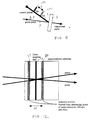
- the optical switching medium 1 comprises in this example a multiple layer quantum well structure shown in more detail in Figure 2, which comprises a substrate of GaAs material 11 on which layers of AlGaAs and GaAs are formed by molecular beam epitaxy (MBE) or other suitable techniques, to form a periodic well structure.
- MBE molecular beam epitaxy
- five GaAs quantum wells were grown from layers 12, 13 of GaAs and AlGaAs material.
- the GaAs quantum wells have a thickness of 25 nm.
- the effect of the control pulses CP1, CP2 on the optical medium can be seen from the spin-energy diagram of Figure 3.
- the right-hand circularly polarised pulse CP1 produces an exciton in which an electron is raised to an energy level E1 in the conductance band, leaving a hole in the valance band, as shown by arrow 14.
- the electron in energy state E1 has a spin of -1/2 and the corresponding hole has a spin of -3/2.
- the optical medium 1 is raised to a first spin state with electrons at energy E1, with a spin -1/2.
- the medium can be switched to a second spin state by means of the second control pulse CP2 of opposite circular polarisation to the first pulse.
- the pulse CP2 produces transition 15 in which an electron is raised to energy E1 with a spin + 1/2 with a hole of spin + 3/2 being formed in the valance band.
- the time delay T between the first and second pulses CP1, CP2 is less than the relaxation time ⁇ of the electrons at energy E1, so that the combined effect of the electrons with spin -1/2 and + 1/2, produced by the pulses CP1 and CP2, is an overall spin state of 0.
- the optical switching medium is initially switched by pulse CP1 to a first spin state of + 1/2 and thereafter, in a time less than the relaxation time ⁇ of the energy state, is switched by pulse CP2 to a second condition of zero net spin.
- the spin state of the optical switching medium controls the polarisation of the probe pulse from the source 4 ( Figure 1).
- the probe pulse P is plane polarised as shown at 16 and it can be considered that the plane polarisation is made up of two circular polarisations of opposite hand as illustrated by vectors C1 and C2. These circular polarisations couple with the spin states shown in Figure 3.
- the transition 14 between spin + 3/2 holes and spin + 1/2 electrons induces an optical non-linearity predominantly for left circularly polarised light.
- the transition 15 of Figure 3 causes a non-linearity predominantly for right circularly polarised light.
- the pulse P' is reflected back to the polarisation beam splitter 6 and the orthogonal component that is produced by the rotation of polarisation, is directed on path 7 to the detector 8.
- the amplitude of the electrical signal produced by detector 8 is a function of the angle of rotation of the polarisation vector, and thus is a function of the spin state of the optical medium.
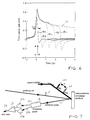
- FIG. 6 is a graph of the spin measured by the probe pulse as a function of time for different values of delay T between the first and second control pulses CP1, CP2. The effect of a single control pulse CP1 (without CP2) is shown as trace 17.
- Trace 18a shows the effect of the second control pulse CP2, applied with a delay T ⁇ 2.2 ps.
- the traces 18b-18d illustrate the effect of progressively shorter delay times T.
- the shortest switching time is shown as a solid trace 18e, in which the medium was switched from the first spin condition to a second (substantially zero) spin condition in a time of the order to 200 fs. This switching was performed with a sample composed of five, 25 nm GaAs quantum wells at a temperature of 4K.
- the wavelength of the control pulses was 810 nm and the wavelength of the probe pulse was also 810 nm.
- the duration of the probe pulse was 80 fs and it was scanned in time to trace out the evolving spin state of the device.
- GaAs material systems were used in the described example, the scheme will work for any semiconductor with spin selection rules around the bandgap energy that allow preferential spin excitation, notably the zinc blend semiconductor crystal structures.
- this includes AlGaAs, InGaAsP, GaN, GaP, InSb and similar III-V and II-VI alloys.
- Heterostructures, whilst not essential, are preferred in order to optimise device performance in terms of contrast ratio and spin scattering times.
- the switching energy of the described example of the invention was found to be 5 nJ cm -2 , which is extremely low in comparison to the previously described prior art devices.
- FIG. 7 An alternative configuration for detecting the spin state of the optical medium is shown in Figure 7.
- a Wollaston prism is used to split the probe pulse polarisation into two orthogonal components.
- the configuration is initially set up so that the Wollaston prism produces substantially equal amplitude outputs 20a, 20b, in response to the two orthogonal polarisation directions.
- the equal amplitude components are detected are by detectors 21a, 21b which provide electrical inputs to a comparator 22.
- the outputs of detectors 21a, 21b are balanced so that no output occurs on line 23 from the comparator 22.
- the outputs of detectors 21a, 21b become unbalanced so that a signal is produced on line 23.
- the probe pulse P is reflected from the optical medium 1.
- the probe pulse may be transmitted through the medium so that if desired, the probe pulse can interrogate more than one optical medium prior to detection.
- Figure 9 illustrates an example of apparatus for producing the first and second control pulses CP1, CP2 of opposite circular polarisations, from a single input optical pulse.
- a femtosecond laser 24 such as a mode locked diode laser or a mode-locked solid state laser such as a Ti-doped sapphire, or other, produces a plane polarised pulse at a wavelength appropriate for the bandgap of the semiconductor used in the device with a duration of typically 100 fs - 1ps which is fed to a pulse doubler 25.
- the pulse from the laser 24 passes through a ⁇ /2 plate 26 to a polarisation beam splitter 27 that produces first and second split pulses that pass along paths 28a, 28b respectively.
- the split pulses are plane polarised at 90° to one another.
- the effect of the ⁇ /2 plate 26 is to rotate the plane of polarisation of the input pulse through 45° to ensure that the two split pulses are of substantially equal amplitude.
- the paths 28a, 28b extend to a second beam splitter 29 which acts to direct the split pulses onto a common optical output path 3 through a quarter wave plate 30.
- the path 28a is longer than the path 28b and includes a movable mirror arrangement M1, M2 movable in the direction of arrow 31 in order to adjust the time delay T between the split pulses. It will be understood that the time delay T corresponds to L/c where L is the difference in path length and c is the velocity of light.
- the second split pulse arrives via path 28a with a time delay T selected by adjustment of the path length L. Due to the fact that there is a 90° difference between the polarisation directions of the first and second split pulses, the quarter wave plate 30 produces right circular polarisation of the second split pulse so as to form the second control pulse CP2.
- the arrangement shown in Figure 9 comprises a number of discrete components, it will be appreciated that the arrangement could be integrated into a semiconductor chip.
- the time delay in this integrated arrangement may be fixed or alternatively may be tunable by electrically altering the refractive index of the path 28a and/or 28b.
- Figure 10 illustrates an example of the optical switching medium configured for this purpose.
- the structure is similar to that shown in Figure 2 but the wells are of different widths.
- a first relatively narrow well comprises a GaAs layer 31 disposed between the AlGaAs layers 32, 33 which act as tunnelling barriers into second and third wells of GaAs material 34, 35.
- the second and third wells 34, 35 are wider than the first well 31.
- FIG. 11 illustrates the various energy levels and tunnelling paths associated with the structure of Figure 10.
- the incident pulses CP1, CP2 produce charge carrier transitions between energy level E0 and E1, with associated spins as previously described with reference to Figure 3. This occurs in well 31.
- the wavelength of the pulses CP1, CP2 is tuned to the width of the well 31.
- the charge carriers that accumulate in the well 31, at level E0 and E1 can tunnel through the barriers 32, 33 into the wells 34, 35, prior to expiry of their relaxation time, and recombination can occur in the wells 34, 35.
- the carrier density in the well 31 is reduced, thereby improving the contrast ratio of the detected spin switching with the probe pulse P, which is tuned to detect transitions in the well 31 only.
- This configuration allows the switching device to operate reliably with pulse repetition rates in excess of 1THz.
- the quantum well structure shown generally at 36 is sandwiched between dielectric mirrors 37, 38 formed of alternating layers of semiconductor material.
- the alternating layers are formed of AlGaAs and AlAs material and are spaced apart by an effective wavelength of ⁇ /2 in respect of the control pulse and probe radiation.
- An additional coupling can be induced by applying a magnetic field with an axial direction parallel to the plane of the quantum wells.
- a stream of pulses of one circular polarisation can couple in a time-delayed manner into a stream of pulses of the opposite circular polarisation.
- a stream of pulses CP1a, CP1b, CP1c that are right circularly polarised together with a stream of left circularly polarised pulses CP2a, CP2b, CP2c are directed to the optical switching medium 1, which is subjected to a magnetic field B shown by arrow 39 produced by a coil C, or other means.
- the charge carrier spin induced by pulse CP1a is initially in the direction shown by arrow 41.
- the spin direction precesses in the direction of arrow 41 around the axis 39 of the field B, to the position 42.
- the pulse CP2a which induces charge carriers of an opposite spin direction, in combination with the precessed spin from pulse CP1a, results in a net residual spin.
- the probe pulses (P1, P2%) used for detection are derived from the train of second pulses (CP2a, CP2b%) by means of a beam splitter 43, fractionally delayed over a path 44 that includes a mirror 45, selected by means of a polarisation beam splitter 46, and directed into the sample on path 5.
- the probe pulses then integrate the total spin remaining in the optical switching medium after the application of a pair of rcp and lcp pulses such as CP1 and CP2. In the absence of a magnetic field, the net spin is zero.
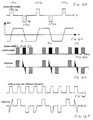
- a first pulse CP1 applied to the optical switching medium produces a first overall spin state at time t1.
- the spin then precesses, but only by a small amount due to the weak field.
- a second, opposite circularly polarised pulse CP2 is applied, which reduces the overall spin state only incompletely.
- the probe pulse P1 arrives at time t3, shortly after the pulse CP2, and sees a net spin S.
- Figure 15b the corresponding result when a high field is applied, is shown.
- the high field produces a rapid precession of the spin induced by the first pulse CP1 at time t1 so that, at time t2, it has returned to its original spin direction and is cancelled out by the spin produced by the second pulse CP2.
- the pulse P of probe radiation see zero net spin. It will thus be understood that the field strength can be swept with time so that when a zero occurs in the detector's output, the field strength provides a measure of the correlation time between the pulses.
- This optical correlation can be used for phase sensitive detection relative to the spin precession phase.
- the net spin induced by an input signal I(t) (where positive and negative amplitudes of I(t) correspond to left and right circular polarised light respectively) is where ⁇ is the spin relaxation time.
- the spin precession therefore acts as a phase sensitive detector with integration time ⁇ .
- An advantageous feature of the detector is the absence of response to higher even harmonics of ⁇ .
- This phase sensitive detector can also be used in phase locked loop arrangements for synchronisation of optical signals.
- Figure 16e illustrates a train of probe pulses of a different frequency from the control pulses CP1, CP2.
- the corresponding response is shown in Figure 16f.
- the average response is 0 when the probe pulses have no frequency component which is a multiple of the frequency of the control pulses CP1, CP2.
- the output of the detector can be used to lock on to the frequency of the control pulses and then to maintain the probe pulses in phase with the control pulses.
- a mode locked ring laser 47 shown schematically includes an optical resonant ring 48 and an electro-optical switch and polarisation converter 49 responsive to input electrical data in order to produce successive right-hand and left-hand circularly polarised pulses CP1, CP2 for transmission over an optical path 50, such as an optical fibre, to a remote detector 51, that includes the optical switching medium 1 and a laser 52 which produces a continuous (cw) beam of probe radiation 53.
- the probe radiation is directed to a Wollaston prism 19 with associated detectors 21a, 21b and an amplifier 22, in the manner described with reference to Figure 7.
- the data coding is shown in Figure 18.
- Each time frame includes a pair of the pulses CP1, CP2 of opposite circular polarisation.
- the delay between the pulses is indicative of the numerical value of the data for the time frame.
- the spin state of the switching medium 1 is firstly switched to a first spin state by the first pulse CP1 and thereafter switched to the second spin state by pulse CP2.
- the delay between the pulses is a function of the numerical value of the data.
- the plane of polarisation of the probe radiation is thus switched between two different values by the successive pulses CP1, CP2 so as to provide electrical output pulses on line 23 that have a width dependent on the value of the data transmitted for each time frame.
- the transmission scheme has the advantage that the average optical power transmitted is constant as compared with conventional data streams which vary the number of optical pulses transmitted.
- any heating effect on the optical system is kept to a low level and in any event is constant, thereby avoiding non-linearities that can be produced as a result of heating by the optical pulses.
- the switching device according to the invention described with reference to Figure 1 has an excellent on-off contrast ratio because the intensity of light transmitted in the off state is only limited by the polarisation ratio of the polarising beam splitter 6, which can be 10 -6 .
- linearly polarised orthogonal control pulses can be used, together with a probe pulse at 45° relative thereto, in order to detect induced linear birefringence arising from a coherent superposition of the spin states.
- switches in accordance with the invention may be used in optical fibre communication systems with appropriate engineered InGaAsP devices in the 1.3 ⁇ m and 1.5 ⁇ m wavelength bands.
- the switch may also be used in optical interconnects between electronic devices and in optical computing.
Landscapes
- Physics & Mathematics (AREA)
- Nonlinear Science (AREA)
- Optics & Photonics (AREA)
- General Physics & Mathematics (AREA)
- Chemical & Material Sciences (AREA)
- Engineering & Computer Science (AREA)
- Nanotechnology (AREA)
- Life Sciences & Earth Sciences (AREA)
- Biophysics (AREA)
- Crystallography & Structural Chemistry (AREA)
- Optical Modulation, Optical Deflection, Nonlinear Optics, Optical Demodulation, Optical Logic Elements (AREA)
Claims (20)
- Commutateur optique comprenant :un milieu de commutation optique (1) ;une source d'impulsions (2) destinée à diriger une première impulsion (CP1) de rayonnement optique, avec une première caractéristique de polarisation, vers le milieu de commutation afin de produire une première situation d'état de spin des porteurs de charge ;une source d'impulsions (2) destinée à ensuite diriger une seconde impulsion (CP2) de rayonnement optique, avec une seconde caractéristique de polarisation, vers le milieu de commutation, avant la relaxation de la première situation d'état de spin des porteurs de charge, afin de produire une seconde situation d'état de spin des porteurs de charge ; etune source de rayonnement de sondage (4) afin de diriger un rayonnement optique de sondage dans le milieu afin de déterminer la situation d'état de spin du milieu.
- Commutateur selon la revendication 1, dans lequel la première impulsion (CP1) a une polarisation qui tourne avec le temps dans une première direction et la seconde impulsion (CP2) a une polarisation qui tourne avec le temps dans une seconde direction opposée.
- Commutateur selon la revendication 2, dans lequel la première et la seconde impulsions sont polarisées circulairement dans des directions opposées.
- Commutateur selon l'une quelconque des revendications précédentes, comprenant un moyen détecteur (6, 7, 8 ; 19, 20, 22) répondant à une caractéristique de polarisation du rayonnement de sondage après son passage dans le milieu de commutation, afin de détecter l'état de spin du milieu.
- Commutateur selon la revendication 4, dans lequel le rayonnement de sondage (P1) est pulsé.
- Commutateur selon la revendication 4 ou 5, dans lequel le rayonnement de sondage (P1) a une polarisation plane et change de direction de polarisation en fonction de l'état de spin du milieu de commutation.
- Commutateur selon l'une quelconque des revendications précédentes, comprenant un moyen d'appliquer un champ magnétique (B) au milieu de commutation afin d'amener les spins des porteurs de charge induits par la première impulsion (CP1) à tendre à s'aligner avec les spins des porteurs de charge induits par la seconde impulsion.
- Commutateur selon la revendication 7, comprenant un moyen pour diriger des trains desdites première et seconde impulsions (CP1a, b, c, CP2a, b, c) dans le milieu et un moyen pour varier l'intensité du champ magnétique appliqué afin de déterminer la corrélation entre les trains d'impulsions.
- Commutateur selon la revendication 4, comprenant un moyen pour diriger des trains desdites première et seconde impulsions et des impulsions du rayonnement de sondage (CP1a, b ; CP2a, b ; P1, P2) dans le milieu, le commutateur fonctionnant de manière à ce que le moyen détecteur fournisse une sortie qui est une fonction des phases relatives des trains d'impulsions.
- Commutateur selon la revendication 9, comprenant un moyen répondant à la sortie du moyen détecteur pour commander la phase des impulsions de sondage par rapport à la phase des première et seconde impulsions.
- Commutateur selon la revendication 4, dans lequel le moyen détecteur fonctionne de manière à fournir une sortie (23) en fonction d'un retard entre les première et seconde impulsions.
- Commutateur selon la revendication 11, comprenant un moyen d'encodage de données (44) pour encoder des données en commandant le retard entre les première et seconde impulsions.
- Commutateur selon l'une quelconque des revendications précédentes, dans lequel le milieu de commutation est inclus dans une cavité optique (37, 38).
- Commutateur selon l'une quelconque des revendications précédentes, dans lequel le milieu de commutation comprend une structure à puits quantiques (12, 13).
- Commutateur selon la revendication 14, dans lequel la structure à puits quantiques comprend un premier puits (31) pour des porteurs de charge dans le premier état de spin et un second puits (34, 35), séparé du premier puits par un moyen de barrière au travers duquel des porteurs de charge peuvent tunneler à partir du premier puits.
- Commutateur selon la revendication 15, dans lequel les première et seconde impulsions stimulent chacune des paires électron-trou à spins différents.
- Commutateur selon les revendications 14 à 16, dans lequel la structure à puits quantiques comprend une structure périodique de couches (11, 12) de GaAs et d'AlGaAs.
- Commutateur selon l'une quelconque des revendications précédentes, dans lequel le moyen de production des première et seconde impulsions comprend un moyen diviseur de faisceau (27) pour former, à partir d'une impulsion d'entrée à polarisation plane, une première et une seconde impulsions dédoublées qui ont des directions de polarisation substantiellement orthogonales, des moyens de retard (M1, M2) pour retarder l'une des impulsions dédoublées par rapport à l'autre, un moyen de combinaison de faisceaux (28) pour envoyer les impulsions dédoublées vers un chemin de sortie optique commun et un moyen de polarisation circulaire pour polariser circulairement les impulsions dédoublées dans des sens de rotation opposés.
- Commutateur selon la revendication 18, dans lequel le moyen de polarisation circulaire (30) comprend une lame quart d'onde dans le chemin de sortie commun.
- Procédé de commutation d'un moyen de commutation optique, comprenant le fait de diriger une première impulsion de rayonnement optique, avec une première caractéristique de polarisation, vers le milieu de commutation, afin de produire une première situation d'état de spin des porteurs de charge, de diriger une seconde impulsion de rayonnement optique, avec une caractéristique de polarisation différente, vers le milieu de commutation, avant la relaxation de la première situation d'état de spin des porteurs de charge, afin de produire une seconde situation d'état de spin des porteurs de charge, d'envoyer un rayonnement optique de sondage, avec une situation prédéterminée de polarisation, dans le milieu et de déterminer la situation d'état de spin du milieu en surveillant la situation de polarisation du rayonnement de sondage.
Priority Applications (3)
| Application Number | Priority Date | Filing Date | Title |
|---|---|---|---|
| EP19960303692 EP0809128B1 (fr) | 1996-05-23 | 1996-05-23 | Commutateur optique |
| DE1996633499 DE69633499T2 (de) | 1996-05-23 | 1996-05-23 | Optischer Schalter |
| JP9018465A JPH103099A (ja) | 1996-05-23 | 1997-01-31 | 光スイッチ |
Applications Claiming Priority (1)
| Application Number | Priority Date | Filing Date | Title |
|---|---|---|---|
| EP19960303692 EP0809128B1 (fr) | 1996-05-23 | 1996-05-23 | Commutateur optique |
Publications (2)
| Publication Number | Publication Date |
|---|---|
| EP0809128A1 EP0809128A1 (fr) | 1997-11-26 |
| EP0809128B1 true EP0809128B1 (fr) | 2004-09-29 |
Family
ID=8224951
Family Applications (1)
| Application Number | Title | Priority Date | Filing Date |
|---|---|---|---|
| EP19960303692 Expired - Lifetime EP0809128B1 (fr) | 1996-05-23 | 1996-05-23 | Commutateur optique |
Country Status (3)
| Country | Link |
|---|---|
| EP (1) | EP0809128B1 (fr) |
| JP (1) | JPH103099A (fr) |
| DE (1) | DE69633499T2 (fr) |
Families Citing this family (5)
| Publication number | Priority date | Publication date | Assignee | Title |
|---|---|---|---|---|
| EP1128203A1 (fr) * | 2000-02-28 | 2001-08-29 | Hitachi Europe Limited | Appareil de commutation optique |
| EP1128204A1 (fr) * | 2000-02-28 | 2001-08-29 | Hitachi Europe Limited | Appareil de commutation optique |
| GB2439595B (en) * | 2006-06-28 | 2008-11-05 | Toshiba Res Europ Ltd | A quantum memory device |
| JP5979757B2 (ja) * | 2012-09-14 | 2016-08-31 | 国立大学法人 東京大学 | 波動の誘起・伝播制御システム及び波動の誘起・伝播制御方法 |
| JP6116053B2 (ja) * | 2013-07-04 | 2017-04-19 | 国立大学法人 東京大学 | スピン波の誘起・初期位相制御システム及び方法、スピン波の誘起・伝播制御システム及び方法 |
Family Cites Families (1)
| Publication number | Priority date | Publication date | Assignee | Title |
|---|---|---|---|---|
| US5151589A (en) * | 1989-12-15 | 1992-09-29 | Fujitsu Limited | Optical system using spin-dependent optical nonlinearity |
-
1996
- 1996-05-23 EP EP19960303692 patent/EP0809128B1/fr not_active Expired - Lifetime
- 1996-05-23 DE DE1996633499 patent/DE69633499T2/de not_active Expired - Fee Related
-
1997
- 1997-01-31 JP JP9018465A patent/JPH103099A/ja active Pending
Also Published As
| Publication number | Publication date |
|---|---|
| DE69633499D1 (de) | 2004-11-04 |
| EP0809128A1 (fr) | 1997-11-26 |
| DE69633499T2 (de) | 2005-09-22 |
| JPH103099A (ja) | 1998-01-06 |
Similar Documents
| Publication | Publication Date | Title |
|---|---|---|
| Hansch et al. | Laser frequency stabilization by polarization spectroscopy of a reflecting reference cavity | |
| Tatham et al. | 20-nm optical wavelength conversion using nondegenerate four-wave mixing | |
| Nishikawa et al. | All‐optical picosecond switching of a quantum well etalon using spin‐polarization relaxation | |
| JP3598375B2 (ja) | テラヘルツ電磁波時間分解分光装置 | |
| Takahashi et al. | Ultrafast high-contrast all-optical switching using spin polarization in low-temperature-grown multiple quantum wells | |
| Takahashi | Low-temperature-grown surface-reflection all-optical switch (LOTOS) | |
| EP0809128B1 (fr) | Commutateur optique | |
| US4910454A (en) | System for electrical signal sampling with ultrashort optical pulses | |
| US10931370B2 (en) | Quantum interference detection of optical frequency comb offset frequency | |
| Sermage et al. | Lifetime of excitons in GaAs quantum wells | |
| Vickers et al. | Fabry–Pe´ rot enhancement of external electro-optic sampling | |
| Albrecht et al. | Design and application of a femtosecond optical parametric oscillator for time-resolved spectroscopy of semiconductor heterostructures | |
| US20020044353A1 (en) | Spintronic optical shutter | |
| US5309473A (en) | Pulsed, frequency stable, narrow linewidth master oscillator and phase conjugation mirror therefor with semiconductor material having bandgap for nonlinear resonance | |
| CA2040936C (fr) | Modulateur de polarisation optique a structures interferometriques | |
| Lee et al. | Nondegenerate Coherent Control of Polariton Modes in a Quantum‐Well Semiconductor Microcavity | |
| Qian et al. | An ultrafast all-optical asymmetric Fabry-Perot switch based on bulk Be-doped InGaAsP grown by He-plasma-assisted epitaxy | |
| Schmidt et al. | Mode-locked semiconductor lasers and their applications for optical signal processing | |
| Arahira et al. | Polarization-, wavelength-, and filter-free all-optical clock recovery in a passively mode-locked laser diode with orthogonally pumped polarization-diversity configuration | |
| Slekys et al. | Optical pattern formation in passive semiconductor microresonators | |
| Laurand et al. | Index and gain dynamics of optically pumped GaInNAs vertical-cavity semiconductor optical amplifiers | |
| KR100516780B1 (ko) | 아연-카드늄-텔레늄계 결정을 이용한 초고속 테라헤르쯔 전자파의 에미터. | |
| Li et al. | Novel schemes for laser diode frequency stabilization onto atomic references | |
| Turchinovich et al. | Ultrafast polarization dynamics in optically excited biased quantum wells | |
| Asghar et al. | A novel symmetric dual loop feedback scheme insensitive to phase tuning using self-mode-locked two-section quantum dash laser |
Legal Events
| Date | Code | Title | Description |
|---|---|---|---|
| PUAI | Public reference made under article 153(3) epc to a published international application that has entered the european phase |
Free format text: ORIGINAL CODE: 0009012 |
|
| AK | Designated contracting states |
Kind code of ref document: A1 Designated state(s): DE FR GB NL SE |
|
| 17P | Request for examination filed |
Effective date: 19980512 |
|
| 17Q | First examination report despatched |
Effective date: 19991108 |
|
| GRAP | Despatch of communication of intention to grant a patent |
Free format text: ORIGINAL CODE: EPIDOSNIGR1 |
|
| GRAS | Grant fee paid |
Free format text: ORIGINAL CODE: EPIDOSNIGR3 |
|
| GRAA | (expected) grant |
Free format text: ORIGINAL CODE: 0009210 |
|
| AK | Designated contracting states |
Kind code of ref document: B1 Designated state(s): DE FR GB NL SE |
|
| PG25 | Lapsed in a contracting state [announced via postgrant information from national office to epo] |
Ref country code: NL Free format text: LAPSE BECAUSE OF FAILURE TO SUBMIT A TRANSLATION OF THE DESCRIPTION OR TO PAY THE FEE WITHIN THE PRESCRIBED TIME-LIMIT Effective date: 20040929 |
|
| REG | Reference to a national code |
Ref country code: GB Ref legal event code: FG4D |
|
| REF | Corresponds to: |
Ref document number: 69633499 Country of ref document: DE Date of ref document: 20041104 Kind code of ref document: P |
|
| PG25 | Lapsed in a contracting state [announced via postgrant information from national office to epo] |
Ref country code: SE Free format text: LAPSE BECAUSE OF FAILURE TO SUBMIT A TRANSLATION OF THE DESCRIPTION OR TO PAY THE FEE WITHIN THE PRESCRIBED TIME-LIMIT Effective date: 20041229 |
|
| NLV1 | Nl: lapsed or annulled due to failure to fulfill the requirements of art. 29p and 29m of the patents act | ||
| PGFP | Annual fee paid to national office [announced via postgrant information from national office to epo] |
Ref country code: FR Payment date: 20050429 Year of fee payment: 10 |
|
| PGFP | Annual fee paid to national office [announced via postgrant information from national office to epo] |
Ref country code: GB Payment date: 20050510 Year of fee payment: 10 |
|
| ET | Fr: translation filed | ||
| PGFP | Annual fee paid to national office [announced via postgrant information from national office to epo] |
Ref country code: DE Payment date: 20050729 Year of fee payment: 10 |
|
| PLBE | No opposition filed within time limit |
Free format text: ORIGINAL CODE: 0009261 |
|
| STAA | Information on the status of an ep patent application or granted ep patent |
Free format text: STATUS: NO OPPOSITION FILED WITHIN TIME LIMIT |
|
| 26N | No opposition filed |
Effective date: 20050630 |
|
| PG25 | Lapsed in a contracting state [announced via postgrant information from national office to epo] |
Ref country code: GB Free format text: LAPSE BECAUSE OF NON-PAYMENT OF DUE FEES Effective date: 20060523 |
|
| PG25 | Lapsed in a contracting state [announced via postgrant information from national office to epo] |
Ref country code: DE Free format text: LAPSE BECAUSE OF NON-PAYMENT OF DUE FEES Effective date: 20061201 |
|
| GBPC | Gb: european patent ceased through non-payment of renewal fee |
Effective date: 20060523 |
|
| REG | Reference to a national code |
Ref country code: FR Ref legal event code: ST Effective date: 20070131 |
|
| PG25 | Lapsed in a contracting state [announced via postgrant information from national office to epo] |
Ref country code: FR Free format text: LAPSE BECAUSE OF NON-PAYMENT OF DUE FEES Effective date: 20060531 |