EP0810265A1 - Substantive Stilbenazofarbstoffe - Google Patents
Substantive Stilbenazofarbstoffe Download PDFInfo
- Publication number
- EP0810265A1 EP0810265A1 EP97106529A EP97106529A EP0810265A1 EP 0810265 A1 EP0810265 A1 EP 0810265A1 EP 97106529 A EP97106529 A EP 97106529A EP 97106529 A EP97106529 A EP 97106529A EP 0810265 A1 EP0810265 A1 EP 0810265A1
- Authority
- EP
- European Patent Office
- Prior art keywords
- formula
- alkyl
- hydroxy
- independently
- dye
- Prior art date
- Legal status (The legal status is an assumption and is not a legal conclusion. Google has not performed a legal analysis and makes no representation as to the accuracy of the status listed.)
- Granted
Links
- PJANXHGTPQOBST-VAWYXSNFSA-N Stilbene Natural products C=1C=CC=CC=1/C=C/C1=CC=CC=C1 PJANXHGTPQOBST-VAWYXSNFSA-N 0.000 title abstract description 4
- 235000021286 stilbenes Nutrition 0.000 title abstract description 4
- -1 amino-hydroxy-sulpho-naphthyl-azo group Chemical group 0.000 claims abstract description 81
- 238000000034 method Methods 0.000 claims abstract description 32
- 125000001997 phenyl group Chemical group [H]C1=C([H])C([H])=C(*)C([H])=C1[H] 0.000 claims abstract description 25
- 229910052739 hydrogen Inorganic materials 0.000 claims abstract description 22
- 239000001257 hydrogen Substances 0.000 claims abstract description 22
- 125000004093 cyano group Chemical group *C#N 0.000 claims abstract description 19
- 125000000020 sulfo group Chemical group O=S(=O)([*])O[H] 0.000 claims abstract description 18
- 125000003236 benzoyl group Chemical group [H]C1=C([H])C([H])=C(C([H])=C1[H])C(*)=O 0.000 claims abstract description 17
- 238000004043 dyeing Methods 0.000 claims abstract description 15
- 125000001495 ethyl group Chemical group [H]C([H])([H])C([H])([H])* 0.000 claims abstract description 14
- 125000002496 methyl group Chemical group [H]C([H])([H])* 0.000 claims abstract description 13
- 125000003178 carboxy group Chemical group [H]OC(*)=O 0.000 claims abstract description 12
- 239000000460 chlorine Substances 0.000 claims abstract description 11
- 125000002485 formyl group Chemical group [H]C(*)=O 0.000 claims abstract description 11
- 229910052794 bromium Inorganic materials 0.000 claims abstract description 10
- 229910052801 chlorine Inorganic materials 0.000 claims abstract description 10
- WKBOTKDWSSQWDR-UHFFFAOYSA-N Bromine atom Chemical compound [Br] WKBOTKDWSSQWDR-UHFFFAOYSA-N 0.000 claims abstract description 8
- ZAMOUSCENKQFHK-UHFFFAOYSA-N Chlorine atom Chemical compound [Cl] ZAMOUSCENKQFHK-UHFFFAOYSA-N 0.000 claims abstract description 8
- GDTBXPJZTBHREO-UHFFFAOYSA-N bromine Substances BrBr GDTBXPJZTBHREO-UHFFFAOYSA-N 0.000 claims abstract description 8
- 239000000463 material Substances 0.000 claims abstract description 6
- 125000000449 nitro group Chemical group [O-][N+](*)=O 0.000 claims abstract description 6
- 125000003368 amide group Chemical group 0.000 claims abstract description 5
- 125000000217 alkyl group Chemical group 0.000 claims abstract description 4
- 125000003854 p-chlorophenyl group Chemical group [H]C1=C([H])C(*)=C([H])C([H])=C1Cl 0.000 claims abstract description 3
- 239000000975 dye Substances 0.000 claims description 79
- XLYOFNOQVPJJNP-UHFFFAOYSA-N water Substances O XLYOFNOQVPJJNP-UHFFFAOYSA-N 0.000 claims description 30
- 238000002360 preparation method Methods 0.000 claims description 23
- 230000008569 process Effects 0.000 claims description 21
- PIGFYZPCRLYGLF-UHFFFAOYSA-N Aluminum nitride Chemical compound [Al]#N PIGFYZPCRLYGLF-UHFFFAOYSA-N 0.000 claims description 15
- 239000002253 acid Substances 0.000 claims description 15
- 229910052736 halogen Inorganic materials 0.000 claims description 14
- 150000002367 halogens Chemical class 0.000 claims description 14
- 239000007788 liquid Substances 0.000 claims description 9
- 125000002887 hydroxy group Chemical group [H]O* 0.000 claims description 8
- 229920000742 Cotton Polymers 0.000 claims description 6
- 125000002777 acetyl group Chemical group [H]C([H])([H])C(*)=O 0.000 claims description 6
- LNQUWGZAZIOHMM-UHFFFAOYSA-N ethoxy-hydroxy-methoxy-lambda3-chlorane Chemical group CCOCl(O)OC LNQUWGZAZIOHMM-UHFFFAOYSA-N 0.000 claims description 6
- 239000010985 leather Substances 0.000 claims description 6
- 125000004433 nitrogen atom Chemical group N* 0.000 claims description 6
- 239000003960 organic solvent Substances 0.000 claims description 6
- 125000002924 primary amino group Chemical group [H]N([H])* 0.000 claims description 5
- DIDKQVSNYGHFSZ-UHFFFAOYSA-N (2-hydroxy-2-methoxyethyl) hypofluorite Chemical group COC(O)COF DIDKQVSNYGHFSZ-UHFFFAOYSA-N 0.000 claims description 4
- 229910005965 SO 2 Inorganic materials 0.000 claims description 4
- 125000001624 naphthyl group Chemical group 0.000 claims description 4
- 229920000297 Rayon Polymers 0.000 claims description 3
- 125000003118 aryl group Chemical group 0.000 claims description 3
- 125000003917 carbamoyl group Chemical group [H]N([H])C(*)=O 0.000 claims description 3
- 125000000113 cyclohexyl group Chemical group [H]C1([H])C([H])([H])C([H])([H])C([H])(*)C([H])([H])C1([H])[H] 0.000 claims description 3
- 125000001511 cyclopentyl group Chemical group [H]C1([H])C([H])([H])C([H])([H])C([H])(*)C1([H])[H] 0.000 claims description 3
- 125000005185 naphthylcarbonyl group Chemical group C1(=CC=CC2=CC=CC=C12)C(=O)* 0.000 claims description 3
- 229910052760 oxygen Inorganic materials 0.000 claims description 3
- 229910052717 sulfur Inorganic materials 0.000 claims description 3
- AZFWVVRSAHAZEV-UHFFFAOYSA-N 2-(4-fluoropiperazin-1-yl)ethanamine Chemical compound NCCN1CCN(CC1)F AZFWVVRSAHAZEV-UHFFFAOYSA-N 0.000 claims description 2
- 125000005129 aryl carbonyl group Chemical group 0.000 claims description 2
- 125000004391 aryl sulfonyl group Chemical group 0.000 claims description 2
- 125000005842 heteroatom Chemical group 0.000 claims description 2
- 125000000623 heterocyclic group Chemical group 0.000 claims description 2
- 125000003170 phenylsulfonyl group Chemical group C1(=CC=CC=C1)S(=O)(=O)* 0.000 claims description 2
- 125000004435 hydrogen atom Chemical class [H]* 0.000 claims 6
- UFHFLCQGNIYNRP-UHFFFAOYSA-N Hydrogen Chemical compound [H][H] UFHFLCQGNIYNRP-UHFFFAOYSA-N 0.000 abstract description 11
- 229910006069 SO3H Inorganic materials 0.000 abstract description 4
- 150000001875 compounds Chemical class 0.000 abstract description 4
- 125000004448 alkyl carbonyl group Chemical group 0.000 abstract description 3
- 229920002678 cellulose Polymers 0.000 abstract description 3
- 239000001913 cellulose Substances 0.000 abstract description 3
- PJANXHGTPQOBST-UHFFFAOYSA-N stilbene Chemical compound C=1C=CC=CC=1C=CC1=CC=CC=C1 PJANXHGTPQOBST-UHFFFAOYSA-N 0.000 abstract description 3
- 229910052799 carbon Inorganic materials 0.000 abstract description 2
- 125000000956 methoxy group Chemical group [H]C([H])([H])O* 0.000 abstract 4
- XFXPMWWXUTWYJX-UHFFFAOYSA-N Cyanide Chemical compound N#[C-] XFXPMWWXUTWYJX-UHFFFAOYSA-N 0.000 abstract 3
- JCXJVPUVTGWSNB-UHFFFAOYSA-N Nitrogen dioxide Chemical compound O=[N]=O JCXJVPUVTGWSNB-UHFFFAOYSA-N 0.000 abstract 3
- 239000000987 azo dye Substances 0.000 abstract 2
- 125000001424 substituent group Chemical group 0.000 abstract 2
- OKTJSMMVPCPJKN-UHFFFAOYSA-N Carbon Chemical compound [C] OKTJSMMVPCPJKN-UHFFFAOYSA-N 0.000 abstract 1
- 125000000218 acetic acid group Chemical group C(C)(=O)* 0.000 abstract 1
- 239000013011 aqueous formulation Substances 0.000 abstract 1
- 125000001301 ethoxy group Chemical group [H]C([H])([H])C([H])([H])O* 0.000 abstract 1
- 239000000243 solution Substances 0.000 description 33
- 239000000203 mixture Substances 0.000 description 24
- WMFOQBRAJBCJND-UHFFFAOYSA-M lithium hydroxide Inorganic materials [Li+].[OH-] WMFOQBRAJBCJND-UHFFFAOYSA-M 0.000 description 20
- 239000000976 ink Substances 0.000 description 18
- VEXZGXHMUGYJMC-UHFFFAOYSA-N Hydrochloric acid Chemical compound Cl VEXZGXHMUGYJMC-UHFFFAOYSA-N 0.000 description 16
- 150000003254 radicals Chemical class 0.000 description 12
- LPXPTNMVRIOKMN-UHFFFAOYSA-M sodium nitrite Chemical compound [Na+].[O-]N=O LPXPTNMVRIOKMN-UHFFFAOYSA-M 0.000 description 12
- 150000002431 hydrogen Chemical class 0.000 description 11
- CDBYLPFSWZWCQE-UHFFFAOYSA-L sodium carbonate Substances [Na+].[Na+].[O-]C([O-])=O CDBYLPFSWZWCQE-UHFFFAOYSA-L 0.000 description 8
- FAPWRFPIFSIZLT-UHFFFAOYSA-M Sodium chloride Chemical compound [Na+].[Cl-] FAPWRFPIFSIZLT-UHFFFAOYSA-M 0.000 description 6
- 235000010288 sodium nitrite Nutrition 0.000 description 6
- 239000007787 solid Substances 0.000 description 6
- 0 *Nc1ccc(cc(c(N=N)c2O)S(O)(=O)=O)c2c1 Chemical compound *Nc1ccc(cc(c(N=N)c2O)S(O)(=O)=O)c2c1 0.000 description 5
- XSQUKJJJFZCRTK-UHFFFAOYSA-N Urea Chemical compound NC(N)=O XSQUKJJJFZCRTK-UHFFFAOYSA-N 0.000 description 5
- 239000007864 aqueous solution Substances 0.000 description 5
- 239000005457 ice water Substances 0.000 description 5
- HEMHJVSKTPXQMS-UHFFFAOYSA-M sodium hydroxide Inorganic materials [OH-].[Na+] HEMHJVSKTPXQMS-UHFFFAOYSA-M 0.000 description 5
- VTYYLEPIZMXCLO-UHFFFAOYSA-L Calcium carbonate Chemical compound [Ca+2].[O-]C([O-])=O VTYYLEPIZMXCLO-UHFFFAOYSA-L 0.000 description 4
- 238000007792 addition Methods 0.000 description 4
- 235000013877 carbamide Nutrition 0.000 description 4
- 238000006193 diazotization reaction Methods 0.000 description 4
- LYCAIKOWRPUZTN-UHFFFAOYSA-N ethylene glycol Natural products OCCO LYCAIKOWRPUZTN-UHFFFAOYSA-N 0.000 description 4
- 125000004051 hexyl group Chemical group [H]C([H])([H])C([H])([H])C([H])([H])C([H])([H])C([H])([H])C([H])([H])* 0.000 description 4
- 150000003839 salts Chemical class 0.000 description 4
- 229910000029 sodium carbonate Inorganic materials 0.000 description 4
- QTBSBXVTEAMEQO-UHFFFAOYSA-N Acetic acid Natural products CC(O)=O QTBSBXVTEAMEQO-UHFFFAOYSA-N 0.000 description 3
- LFQSCWFLJHTTHZ-UHFFFAOYSA-N Ethanol Chemical compound CCO LFQSCWFLJHTTHZ-UHFFFAOYSA-N 0.000 description 3
- XEKOWRVHYACXOJ-UHFFFAOYSA-N Ethyl acetate Chemical compound CCOC(C)=O XEKOWRVHYACXOJ-UHFFFAOYSA-N 0.000 description 3
- OKKJLVBELUTLKV-UHFFFAOYSA-N Methanol Chemical compound OC OKKJLVBELUTLKV-UHFFFAOYSA-N 0.000 description 3
- ZMXDDKWLCZADIW-UHFFFAOYSA-N N,N-Dimethylformamide Chemical compound CN(C)C=O ZMXDDKWLCZADIW-UHFFFAOYSA-N 0.000 description 3
- ALQSHHUCVQOPAS-UHFFFAOYSA-N Pentane-1,5-diol Chemical compound OCCCCCO ALQSHHUCVQOPAS-UHFFFAOYSA-N 0.000 description 3
- KWYUFKZDYYNOTN-UHFFFAOYSA-M Potassium hydroxide Chemical compound [OH-].[K+] KWYUFKZDYYNOTN-UHFFFAOYSA-M 0.000 description 3
- 241000872198 Serjania polyphylla Species 0.000 description 3
- 239000000654 additive Substances 0.000 description 3
- DIZPMCHEQGEION-UHFFFAOYSA-H aluminium sulfate (anhydrous) Chemical compound [Al+3].[Al+3].[O-]S([O-])(=O)=O.[O-]S([O-])(=O)=O.[O-]S([O-])(=O)=O DIZPMCHEQGEION-UHFFFAOYSA-H 0.000 description 3
- 125000000129 anionic group Chemical group 0.000 description 3
- 239000004202 carbamide Substances 0.000 description 3
- 150000007529 inorganic bases Chemical class 0.000 description 3
- 238000004519 manufacturing process Methods 0.000 description 3
- 229910052757 nitrogen Inorganic materials 0.000 description 3
- 150000007530 organic bases Chemical class 0.000 description 3
- 239000004810 polytetrafluoroethylene Substances 0.000 description 3
- 229920001343 polytetrafluoroethylene Polymers 0.000 description 3
- HNJBEVLQSNELDL-UHFFFAOYSA-N pyrrolidin-2-one Chemical compound O=C1CCCN1 HNJBEVLQSNELDL-UHFFFAOYSA-N 0.000 description 3
- 239000011780 sodium chloride Substances 0.000 description 3
- 125000003944 tolyl group Chemical group 0.000 description 3
- 239000002351 wastewater Substances 0.000 description 3
- 125000004178 (C1-C4) alkyl group Chemical group 0.000 description 2
- 125000004169 (C1-C6) alkyl group Chemical group 0.000 description 2
- ARXJGSRGQADJSQ-UHFFFAOYSA-N 1-methoxypropan-2-ol Chemical compound COCC(C)O ARXJGSRGQADJSQ-UHFFFAOYSA-N 0.000 description 2
- HZAXFHJVJLSVMW-UHFFFAOYSA-N 2-Aminoethan-1-ol Chemical compound NCCO HZAXFHJVJLSVMW-UHFFFAOYSA-N 0.000 description 2
- HPCLEGOUETYZIX-UHFFFAOYSA-N 3-[(8-hydroxy-6-sulfonaphthalen-2-yl)amino]benzoic acid Chemical compound OC(=O)C1=CC=CC(NC=2C=C3C(O)=CC(=CC3=CC=2)S(O)(=O)=O)=C1 HPCLEGOUETYZIX-UHFFFAOYSA-N 0.000 description 2
- YEJRWHAVMIAJKC-UHFFFAOYSA-N 4-Butyrolactone Chemical compound O=C1CCCO1 YEJRWHAVMIAJKC-UHFFFAOYSA-N 0.000 description 2
- SZLHQHZVDSXZDG-UHFFFAOYSA-N 5-amino-2-[2-(4-aminophenyl)ethenyl]benzenesulfonic acid Chemical compound C1=CC(N)=CC=C1C=CC1=CC=C(N)C=C1S(O)(=O)=O SZLHQHZVDSXZDG-UHFFFAOYSA-N 0.000 description 2
- 239000005995 Aluminium silicate Substances 0.000 description 2
- IAZDPXIOMUYVGZ-UHFFFAOYSA-N Dimethylsulphoxide Chemical compound CS(C)=O IAZDPXIOMUYVGZ-UHFFFAOYSA-N 0.000 description 2
- ZHNUHDYFZUAESO-UHFFFAOYSA-N Formamide Chemical compound NC=O ZHNUHDYFZUAESO-UHFFFAOYSA-N 0.000 description 2
- PEDCQBHIVMGVHV-UHFFFAOYSA-N Glycerine Chemical compound OCC(O)CO PEDCQBHIVMGVHV-UHFFFAOYSA-N 0.000 description 2
- DGAQECJNVWCQMB-PUAWFVPOSA-M Ilexoside XXIX Chemical compound C[C@@H]1CC[C@@]2(CC[C@@]3(C(=CC[C@H]4[C@]3(CC[C@@H]5[C@@]4(CC[C@@H](C5(C)C)OS(=O)(=O)[O-])C)C)[C@@H]2[C@]1(C)O)C)C(=O)O[C@H]6[C@@H]([C@H]([C@@H]([C@H](O6)CO)O)O)O.[Na+] DGAQECJNVWCQMB-PUAWFVPOSA-M 0.000 description 2
- KFZMGEQAYNKOFK-UHFFFAOYSA-N Isopropanol Chemical compound CC(C)O KFZMGEQAYNKOFK-UHFFFAOYSA-N 0.000 description 2
- WHXSMMKQMYFTQS-UHFFFAOYSA-N Lithium Chemical compound [Li] WHXSMMKQMYFTQS-UHFFFAOYSA-N 0.000 description 2
- 229910004727 OSO3H Inorganic materials 0.000 description 2
- DNIAPMSPPWPWGF-UHFFFAOYSA-N Propylene glycol Chemical compound CC(O)CO DNIAPMSPPWPWGF-UHFFFAOYSA-N 0.000 description 2
- WQDUMFSSJAZKTM-UHFFFAOYSA-N Sodium methoxide Chemical compound [Na+].[O-]C WQDUMFSSJAZKTM-UHFFFAOYSA-N 0.000 description 2
- QAOWNCQODCNURD-UHFFFAOYSA-L Sulfate Chemical compound [O-]S([O-])(=O)=O QAOWNCQODCNURD-UHFFFAOYSA-L 0.000 description 2
- QAOWNCQODCNURD-UHFFFAOYSA-N Sulfuric acid Chemical compound OS(O)(=O)=O QAOWNCQODCNURD-UHFFFAOYSA-N 0.000 description 2
- 230000002378 acidificating effect Effects 0.000 description 2
- 150000007513 acids Chemical class 0.000 description 2
- 235000012211 aluminium silicate Nutrition 0.000 description 2
- 230000015572 biosynthetic process Effects 0.000 description 2
- 229910000019 calcium carbonate Inorganic materials 0.000 description 2
- 238000004040 coloring Methods 0.000 description 2
- 238000010924 continuous production Methods 0.000 description 2
- 230000008878 coupling Effects 0.000 description 2
- 238000010168 coupling process Methods 0.000 description 2
- 238000005859 coupling reaction Methods 0.000 description 2
- JBKVHLHDHHXQEQ-UHFFFAOYSA-N epsilon-caprolactam Chemical compound O=C1CCCCCN1 JBKVHLHDHHXQEQ-UHFFFAOYSA-N 0.000 description 2
- 239000000945 filler Substances 0.000 description 2
- 230000003165 hydrotropic effect Effects 0.000 description 2
- NLYAJNPCOHFWQQ-UHFFFAOYSA-N kaolin Chemical compound O.O.O=[Al]O[Si](=O)O[Si](=O)O[Al]=O NLYAJNPCOHFWQQ-UHFFFAOYSA-N 0.000 description 2
- JVTAAEKCZFNVCJ-UHFFFAOYSA-N lactic acid Chemical compound CC(O)C(O)=O JVTAAEKCZFNVCJ-UHFFFAOYSA-N 0.000 description 2
- 239000012528 membrane Substances 0.000 description 2
- BDAGIHXWWSANSR-UHFFFAOYSA-N methanoic acid Natural products OC=O BDAGIHXWWSANSR-UHFFFAOYSA-N 0.000 description 2
- 150000002790 naphthalenes Chemical class 0.000 description 2
- 230000000704 physical effect Effects 0.000 description 2
- BWHMMNNQKKPAPP-UHFFFAOYSA-L potassium carbonate Chemical compound [K+].[K+].[O-]C([O-])=O BWHMMNNQKKPAPP-UHFFFAOYSA-L 0.000 description 2
- 239000011347 resin Substances 0.000 description 2
- 229920005989 resin Polymers 0.000 description 2
- 239000002002 slurry Substances 0.000 description 2
- 159000000000 sodium salts Chemical class 0.000 description 2
- 239000002904 solvent Substances 0.000 description 2
- 239000003381 stabilizer Substances 0.000 description 2
- 238000003756 stirring Methods 0.000 description 2
- 239000000758 substrate Substances 0.000 description 2
- HHVIBTZHLRERCL-UHFFFAOYSA-N sulfonyldimethane Chemical compound CS(C)(=O)=O HHVIBTZHLRERCL-UHFFFAOYSA-N 0.000 description 2
- 239000000725 suspension Substances 0.000 description 2
- 238000003786 synthesis reaction Methods 0.000 description 2
- WGTYBPLFGIVFAS-UHFFFAOYSA-M tetramethylammonium hydroxide Chemical compound [OH-].C[N+](C)(C)C WGTYBPLFGIVFAS-UHFFFAOYSA-M 0.000 description 2
- 239000002023 wood Substances 0.000 description 2
- 125000000229 (C1-C4)alkoxy group Chemical group 0.000 description 1
- AVQQQNCBBIEMEU-UHFFFAOYSA-N 1,1,3,3-tetramethylurea Chemical compound CN(C)C(=O)N(C)C AVQQQNCBBIEMEU-UHFFFAOYSA-N 0.000 description 1
- CYSGHNMQYZDMIA-UHFFFAOYSA-N 1,3-Dimethyl-2-imidazolidinon Chemical compound CN1CCN(C)C1=O CYSGHNMQYZDMIA-UHFFFAOYSA-N 0.000 description 1
- HXKKHQJGJAFBHI-UHFFFAOYSA-N 1-aminopropan-2-ol Chemical compound CC(O)CN HXKKHQJGJAFBHI-UHFFFAOYSA-N 0.000 description 1
- COBPKKZHLDDMTB-UHFFFAOYSA-N 2-[2-(2-butoxyethoxy)ethoxy]ethanol Chemical compound CCCCOCCOCCOCCO COBPKKZHLDDMTB-UHFFFAOYSA-N 0.000 description 1
- XDHKBXVKWSARCJ-UHFFFAOYSA-N 2-[2-(4-acetamidophenyl)ethenyl]-5-aminobenzenesulfonic acid Chemical compound C1=CC(NC(=O)C)=CC=C1C=CC1=CC=C(N)C=C1S(O)(=O)=O XDHKBXVKWSARCJ-UHFFFAOYSA-N 0.000 description 1
- BKMMTJMQCTUHRP-UHFFFAOYSA-N 2-aminopropan-1-ol Chemical compound CC(N)CO BKMMTJMQCTUHRP-UHFFFAOYSA-N 0.000 description 1
- HXDLWJWIAHWIKI-UHFFFAOYSA-N 2-hydroxyethyl acetate Chemical compound CC(=O)OCCO HXDLWJWIAHWIKI-UHFFFAOYSA-N 0.000 description 1
- YTTFFPATQICAQN-UHFFFAOYSA-N 2-methoxypropan-1-ol Chemical compound COC(C)CO YTTFFPATQICAQN-UHFFFAOYSA-N 0.000 description 1
- VNWVMZDJPMCAKD-UHFFFAOYSA-N 3-amino-5-hydroxynaphthalene-2,7-disulfonic acid Chemical compound C1=C(S(O)(=O)=O)C=C2C=C(S(O)(=O)=O)C(N)=CC2=C1O VNWVMZDJPMCAKD-UHFFFAOYSA-N 0.000 description 1
- WSGYTJNNHPZFKR-UHFFFAOYSA-N 3-hydroxypropanenitrile Chemical compound OCCC#N WSGYTJNNHPZFKR-UHFFFAOYSA-N 0.000 description 1
- OSWFIVFLDKOXQC-UHFFFAOYSA-N 4-(3-methoxyphenyl)aniline Chemical compound COC1=CC=CC(C=2C=CC(N)=CC=2)=C1 OSWFIVFLDKOXQC-UHFFFAOYSA-N 0.000 description 1
- LXGSMTAOXORMQX-UHFFFAOYSA-N 4-hydroxy-6-(4-methoxyanilino)naphthalene-2-sulfonic acid Chemical compound C1=CC(OC)=CC=C1NC1=CC=C(C=C(C=C2O)S(O)(=O)=O)C2=C1 LXGSMTAOXORMQX-UHFFFAOYSA-N 0.000 description 1
- 125000004172 4-methoxyphenyl group Chemical group [H]C1=C([H])C(OC([H])([H])[H])=C([H])C([H])=C1* 0.000 description 1
- HBZVNWNSRNTWPS-UHFFFAOYSA-N 6-amino-4-hydroxynaphthalene-2-sulfonic acid Chemical compound C1=C(S(O)(=O)=O)C=C(O)C2=CC(N)=CC=C21 HBZVNWNSRNTWPS-UHFFFAOYSA-N 0.000 description 1
- QTBSBXVTEAMEQO-UHFFFAOYSA-M Acetate Chemical compound CC([O-])=O QTBSBXVTEAMEQO-UHFFFAOYSA-M 0.000 description 1
- NPDLYUOYAGBHFB-WDSKDSINSA-N Asn-Arg Chemical compound NC(=O)C[C@H](N)C(=O)N[C@H](C(O)=O)CCCN=C(N)N NPDLYUOYAGBHFB-WDSKDSINSA-N 0.000 description 1
- 235000018185 Betula X alpestris Nutrition 0.000 description 1
- 235000018212 Betula X uliginosa Nutrition 0.000 description 1
- PXGOKWXKJXAPGV-UHFFFAOYSA-N Fluorine Chemical compound FF PXGOKWXKJXAPGV-UHFFFAOYSA-N 0.000 description 1
- UEEJHVSXFDXPFK-UHFFFAOYSA-N N-dimethylaminoethanol Chemical compound CN(C)CCO UEEJHVSXFDXPFK-UHFFFAOYSA-N 0.000 description 1
- ZWXPDGCFMMFNRW-UHFFFAOYSA-N N-methylcaprolactam Chemical compound CN1CCCCCC1=O ZWXPDGCFMMFNRW-UHFFFAOYSA-N 0.000 description 1
- OPKOKAMJFNKNAS-UHFFFAOYSA-N N-methylethanolamine Chemical compound CNCCO OPKOKAMJFNKNAS-UHFFFAOYSA-N 0.000 description 1
- 235000008331 Pinus X rigitaeda Nutrition 0.000 description 1
- 235000011613 Pinus brutia Nutrition 0.000 description 1
- 241000018646 Pinus brutia Species 0.000 description 1
- 239000002202 Polyethylene glycol Substances 0.000 description 1
- 229920001131 Pulp (paper) Polymers 0.000 description 1
- PMZURENOXWZQFD-UHFFFAOYSA-L Sodium Sulfate Chemical compound [Na+].[Na+].[O-]S([O-])(=O)=O PMZURENOXWZQFD-UHFFFAOYSA-L 0.000 description 1
- LSNNMFCWUKXFEE-UHFFFAOYSA-N Sulfurous acid Chemical compound OS(O)=O LSNNMFCWUKXFEE-UHFFFAOYSA-N 0.000 description 1
- GWEVSGVZZGPLCZ-UHFFFAOYSA-N Titan oxide Chemical compound O=[Ti]=O GWEVSGVZZGPLCZ-UHFFFAOYSA-N 0.000 description 1
- GSEJCLTVZPLZKY-UHFFFAOYSA-N Triethanolamine Chemical compound OCCN(CCO)CCO GSEJCLTVZPLZKY-UHFFFAOYSA-N 0.000 description 1
- 238000005299 abrasion Methods 0.000 description 1
- 150000001298 alcohols Chemical class 0.000 description 1
- 125000003545 alkoxy group Chemical group 0.000 description 1
- 125000004453 alkoxycarbonyl group Chemical group 0.000 description 1
- 125000004457 alkyl amino carbonyl group Chemical group 0.000 description 1
- 125000003282 alkyl amino group Chemical group 0.000 description 1
- 125000004390 alkyl sulfonyl group Chemical group 0.000 description 1
- 229940037003 alum Drugs 0.000 description 1
- 150000001412 amines Chemical class 0.000 description 1
- 239000002585 base Substances 0.000 description 1
- 239000011230 binding agent Substances 0.000 description 1
- CDQSJQSWAWPGKG-UHFFFAOYSA-N butane-1,1-diol Chemical compound CCCC(O)O CDQSJQSWAWPGKG-UHFFFAOYSA-N 0.000 description 1
- 125000000484 butyl group Chemical group [H]C([*])([H])C([H])([H])C([H])([H])C([H])([H])[H] 0.000 description 1
- 229930188620 butyrolactone Natural products 0.000 description 1
- 150000003857 carboxamides Chemical class 0.000 description 1
- 125000002091 cationic group Chemical group 0.000 description 1
- 230000008859 change Effects 0.000 description 1
- 239000003795 chemical substances by application Substances 0.000 description 1
- 239000008199 coating composition Substances 0.000 description 1
- 239000000470 constituent Substances 0.000 description 1
- 238000001816 cooling Methods 0.000 description 1
- 125000000753 cycloalkyl group Chemical group 0.000 description 1
- 230000008021 deposition Effects 0.000 description 1
- 238000010612 desalination reaction Methods 0.000 description 1
- 239000003599 detergent Substances 0.000 description 1
- 125000004473 dialkylaminocarbonyl group Chemical group 0.000 description 1
- ZBCBWPMODOFKDW-UHFFFAOYSA-N diethanolamine Chemical compound OCCNCCO ZBCBWPMODOFKDW-UHFFFAOYSA-N 0.000 description 1
- XXJWXESWEXIICW-UHFFFAOYSA-N diethylene glycol monoethyl ether Chemical compound CCOCCOCCO XXJWXESWEXIICW-UHFFFAOYSA-N 0.000 description 1
- LVTYICIALWPMFW-UHFFFAOYSA-N diisopropanolamine Chemical compound CC(O)CNCC(C)O LVTYICIALWPMFW-UHFFFAOYSA-N 0.000 description 1
- POLCUAVZOMRGSN-UHFFFAOYSA-N dipropyl ether Chemical compound CCCOCCC POLCUAVZOMRGSN-UHFFFAOYSA-N 0.000 description 1
- 239000000982 direct dye Substances 0.000 description 1
- 239000002270 dispersing agent Substances 0.000 description 1
- 150000002148 esters Chemical class 0.000 description 1
- 150000002170 ethers Chemical class 0.000 description 1
- 239000004744 fabric Substances 0.000 description 1
- 239000000835 fiber Substances 0.000 description 1
- 239000002657 fibrous material Substances 0.000 description 1
- 229910052731 fluorine Inorganic materials 0.000 description 1
- 239000011737 fluorine Substances 0.000 description 1
- 239000011888 foil Substances 0.000 description 1
- 239000003292 glue Substances 0.000 description 1
- 235000011187 glycerol Nutrition 0.000 description 1
- 239000011121 hardwood Substances 0.000 description 1
- AAYGSSGHJGVNSK-UHFFFAOYSA-N hexane-1,3,6-triol Chemical compound OCCCC(O)CCO AAYGSSGHJGVNSK-UHFFFAOYSA-N 0.000 description 1
- WGCNASOHLSPBMP-UHFFFAOYSA-N hydroxyacetaldehyde Natural products OCC=O WGCNASOHLSPBMP-UHFFFAOYSA-N 0.000 description 1
- 239000004615 ingredient Substances 0.000 description 1
- 238000005342 ion exchange Methods 0.000 description 1
- 238000002955 isolation Methods 0.000 description 1
- 239000004310 lactic acid Substances 0.000 description 1
- 235000014655 lactic acid Nutrition 0.000 description 1
- 229910052808 lithium carbonate Inorganic materials 0.000 description 1
- JILPJDVXYVTZDQ-UHFFFAOYSA-N lithium methoxide Chemical compound [Li+].[O-]C JILPJDVXYVTZDQ-UHFFFAOYSA-N 0.000 description 1
- CRVGTESFCCXCTH-UHFFFAOYSA-N methyl diethanolamine Chemical compound OCCN(C)CCO CRVGTESFCCXCTH-UHFFFAOYSA-N 0.000 description 1
- UFWIBTONFRDIAS-UHFFFAOYSA-N naphthalene-acid Natural products C1=CC=CC2=CC=CC=C21 UFWIBTONFRDIAS-UHFFFAOYSA-N 0.000 description 1
- 230000007935 neutral effect Effects 0.000 description 1
- 230000003287 optical effect Effects 0.000 description 1
- 239000006259 organic additive Substances 0.000 description 1
- RGSFGYAAUTVSQA-UHFFFAOYSA-N pentamethylene Natural products C1CCCC1 RGSFGYAAUTVSQA-UHFFFAOYSA-N 0.000 description 1
- 125000004817 pentamethylene group Chemical group [H]C([H])([*:2])C([H])([H])C([H])([H])C([H])([H])C([H])([H])[*:1] 0.000 description 1
- 238000009971 piece dyeing Methods 0.000 description 1
- 229920001223 polyethylene glycol Polymers 0.000 description 1
- 239000010695 polyglycol Substances 0.000 description 1
- 229920000151 polyglycol Polymers 0.000 description 1
- 239000011148 porous material Substances 0.000 description 1
- 229910000027 potassium carbonate Inorganic materials 0.000 description 1
- LPNYRYFBWFDTMA-UHFFFAOYSA-N potassium tert-butoxide Chemical compound [K+].CC(C)(C)[O-] LPNYRYFBWFDTMA-UHFFFAOYSA-N 0.000 description 1
- BDERNNFJNOPAEC-UHFFFAOYSA-N propan-1-ol Chemical compound CCCO BDERNNFJNOPAEC-UHFFFAOYSA-N 0.000 description 1
- 235000013772 propylene glycol Nutrition 0.000 description 1
- 230000009467 reduction Effects 0.000 description 1
- 238000007127 saponification reaction Methods 0.000 description 1
- 238000000926 separation method Methods 0.000 description 1
- 238000004513 sizing Methods 0.000 description 1
- HYHCSLBZRBJJCH-UHFFFAOYSA-M sodium hydrosulfide Chemical compound [Na+].[SH-] HYHCSLBZRBJJCH-UHFFFAOYSA-M 0.000 description 1
- 229910052938 sodium sulfate Inorganic materials 0.000 description 1
- 235000011152 sodium sulphate Nutrition 0.000 description 1
- RPACBEVZENYWOL-XFULWGLBSA-M sodium;(2r)-2-[6-(4-chlorophenoxy)hexyl]oxirane-2-carboxylate Chemical compound [Na+].C=1C=C(Cl)C=CC=1OCCCCCC[C@]1(C(=O)[O-])CO1 RPACBEVZENYWOL-XFULWGLBSA-M 0.000 description 1
- 238000010186 staining Methods 0.000 description 1
- 238000003860 storage Methods 0.000 description 1
- 239000000126 substance Substances 0.000 description 1
- HXJUTPCZVOIRIF-UHFFFAOYSA-N sulfolane Chemical compound O=S1(=O)CCCC1 HXJUTPCZVOIRIF-UHFFFAOYSA-N 0.000 description 1
- 150000003457 sulfones Chemical class 0.000 description 1
- 150000003462 sulfoxides Chemical class 0.000 description 1
- RAHZWNYVWXNFOC-UHFFFAOYSA-N sulfur dioxide Inorganic materials O=S=O RAHZWNYVWXNFOC-UHFFFAOYSA-N 0.000 description 1
- 239000004094 surface-active agent Substances 0.000 description 1
- 239000004753 textile Substances 0.000 description 1
- OGIDPMRJRNCKJF-UHFFFAOYSA-N titanium oxide Inorganic materials [Ti]=O OGIDPMRJRNCKJF-UHFFFAOYSA-N 0.000 description 1
- 150000003672 ureas Chemical class 0.000 description 1
- UIYCHXAGWOYNNA-UHFFFAOYSA-N vinyl sulfide Chemical group C=CSC=C UIYCHXAGWOYNNA-UHFFFAOYSA-N 0.000 description 1
- 238000009970 yarn dyeing Methods 0.000 description 1
- PAPBSGBWRJIAAV-UHFFFAOYSA-N ε-Caprolactone Chemical compound O=C1CCCCCO1 PAPBSGBWRJIAAV-UHFFFAOYSA-N 0.000 description 1
Classifications
-
- C—CHEMISTRY; METALLURGY
- C09—DYES; PAINTS; POLISHES; NATURAL RESINS; ADHESIVES; COMPOSITIONS NOT OTHERWISE PROVIDED FOR; APPLICATIONS OF MATERIALS NOT OTHERWISE PROVIDED FOR
- C09D—COATING COMPOSITIONS, e.g. PAINTS, VARNISHES OR LACQUERS; FILLING PASTES; CHEMICAL PAINT OR INK REMOVERS; INKS; CORRECTING FLUIDS; WOODSTAINS; PASTES OR SOLIDS FOR COLOURING OR PRINTING; USE OF MATERIALS THEREFOR
- C09D11/00—Inks
- C09D11/30—Inkjet printing inks
- C09D11/32—Inkjet printing inks characterised by colouring agents
- C09D11/328—Inkjet printing inks characterised by colouring agents characterised by dyes
-
- C—CHEMISTRY; METALLURGY
- C09—DYES; PAINTS; POLISHES; NATURAL RESINS; ADHESIVES; COMPOSITIONS NOT OTHERWISE PROVIDED FOR; APPLICATIONS OF MATERIALS NOT OTHERWISE PROVIDED FOR
- C09B—ORGANIC DYES OR CLOSELY-RELATED COMPOUNDS FOR PRODUCING DYES, e.g. PIGMENTS; MORDANTS; LAKES
- C09B56/00—Azo dyes containing other chromophoric systems
- C09B56/04—Stilbene-azo dyes
Definitions
- the present invention relates to new stilbenzo dyes, processes for their preparation and processes for dyeing and printing material containing cellulose and / or amide groups, and furthermore processes for the production of liquid dye preparations, in particular inks, using new and / or known stilbenzo dyes.
- Stilbene dyes are already known from EP-A 376 032, where they are used for the production of light-polarizing films or foils.
- the stilbenzo dyes of the formula (I) can be used individually or in any mixture with one another in the process according to the invention.
- the color shade can easily be adjusted in the desired manner.
- such mixtures generally have better solubilities, which facilitate the preparation of stable dye solutions or inks.
- alkyl groups mentioned can be straight-chain or branched and optionally be substituted by radicals such as, for example, hydroxy, C 1 -C 4 -alkoxy, halogen, cyano, carboxy, sulfo, OSO 3 H and / or NR 1 R 2 .
- Aryl is preferably phenyl or naphthyl.
- Halogen is to be understood in particular as fluorine, chlorine or bromine.
- the new stilbenzo dyes can be prepared analogously to the procedure described in EP-A 0 376 032.
- the preparation is carried out by tetrazotation of the 4,4'-diaminostilbene-2-sulfonic acid of the formula and couple on naphthalene compounds of the formulas where R 15 , R 15 ' , R 16 , R 17 , R 18 and R 19 have the meanings given above, or mixture thereof.
- the preparation can also be carried out by diazotization of 4-amino-stilbene-2- or -2'-sulfonic acids of the formula and couple to naphthalene compounds of the formulas (XIVa-c), (XV), (XVI) or (XVII), subsequent saponification of the acetamino group, for example in aqueous hydrochloric acid or reduction of the nitro group, for example with NaHS in water, again diazotization and coupling to a naphthalene compound of the formula (XIVa-c to XVII).
- Diazotization or tetrazotization takes place, for example, in water in the presence of hydrochloric or sulfuric acid and sodium nitrite at 0-10 ° C.
- the stilbenzo dyes of the formula (I) are used according to the invention for dyeing and / or printing substrates containing hydroxyl and / or amide groups, and dye cellulosic materials, in particular paper, cotton and viscose and leather in black, green, blue or red shades with good wetness. and light fastness.
- the dyestuffs (I) can be used according to the invention by all processes customary in the paper and textile industry for substantive dyestuffs, in particular in the pulp and surface coloring of paper for sized or unsized types, starting from bleached or unbleached pulp of different provenances, such as needles - or hardwood sulfite and / or - sulfate pulp. They can also be used in the yarn and piece dyeing of cotton, viscose and linen after the pull-out process from a long liquor or in the continuous process, and for dyeing leather, for example in the barrel process.
- the procedure is generally such that the dye is added to an aqueous slurry of the fibrous materials (about 0.3% strength, wood pulp or preferably cellulose) in solid form or as an aqueous solution (for example 0.05 to 3%) ig, based on fibers).
- the following are usually added to this slurry: fillers such as calcium carbonate, kaolin; Sizing agents such as resins, aluminum sulfate or alum; Aid to accelerate drainage, improve wet strength.
- this pulp is sucked off through a sieve and then dried.
- the surface coloring of paper is usually done in the size press.
- the aqueous coating composition which may contain fillers such as calcium carbonate, kaolin, titanium oxide; Contains binders and other auxiliaries, the dye added.
- the paper is coated with it in the size press, dried and possibly smoothed between rollers.
- leather is dyed using the barrel dyeing process in barrels or rotating kettles. Based on the leather, dyeing liquors are dyed in a 1 to 3-fold amount at temperatures up to 60 ° C. In addition to the dyes, the liquor can also contain anionic auxiliaries to improve levelness, nonionic detergents, acids or bases to control the absorptivity and possibly other additives. After staining, acidify, e.g. with 1-2% formic, acetic or lactic acid, and dried.
- Cotton is usually dyed using the exhaust process.
- the aqueous dye liquor generally contains salts such as sodium chloride or sodium sulfate.
- salts such as sodium chloride or sodium sulfate.
- dyeing takes place in the weakly acidic pH range at temperatures of 80-95 ° C or under pressure at 130 ° C. It is then cooled in stages and washed with cold water.
- cotton can be dyed using the continuous process, the fabric being soaked with a dye solution, pressed and then fixed, for example in a steam stream or in a hot salt bath (80-90 ° C).
- the stilbenzo dyes of the formula (I) can be used according to the invention as solid or liquid dye preparations for the respective dyeing processes. They are preferably used in the form of aqueous preparations, especially solutions. These aqueous dye preparations generally contain one or more dyes of the formula (I), optionally further anionic substantive dyes to adjust the shade, optionally suitable organic solvents, which may also include hydrotropic compounds, and further auxiliaries and / or stabilizers. It is advantageous to prepare the aqueous dye solutions in the course of the dye synthesis itself, without intermediate isolation of the dye.
- a stable, aqueous, concentrated dyeing preparation can be prepared in a customary manner, for example by dissolving the dye in water, if appropriate with addition one or more auxiliaries, for example a hydrotropic compound or a stabilizer.
- the aqueous dye preparations generally contain about 0.5 to 20% by weight of one or more dyes of the formula (I) and 80 to 99.5% by weight of water and / or solvent and, if appropriate, other customary constituents.
- Preferred organic solvents are alcohols and their ethers or esters, carboxamides, ureas, sulfoxides and sulfones, especially those with molecular weights ⁇ 200.
- Particularly suitable solvents are, for example, methanol, ethanol, propanol, isopropanol; Ethylene, propylene, diethylene, thiodiethylene, dipropylene, pentamethylene, triethylene and polyethylene glycol; Butanediol, 1,5-pentanediol, 1,2-dihydroxypropane; Glycerin, 1,3,6-hexanetriol; ⁇ -hydroxypropionitrile; Ethylene glycol monoethyl and propyl ether, ethylene diglycol monoethyl ether, triethylene glycol butyl ether, butyl polyglycol, 1-methoxy-2-propanol, 2-methoxy-1-propanol; Formamide, N, N-dimethylform
- Suitable additives for aqueous dye preparations are those ionic or nonionic substances with which the viscosity and / or surface tension can be adjusted to the ranges required for the application, such as anionic, cationic or neutral surfactants such as dispersants and Viscosity regulators.
- anionic, cationic or neutral surfactants such as dispersants and Viscosity regulators.
- Viscosity regulators The function of viscosity regulators can, for example, be taken over by the organic solvents.
- the dye preparations according to the invention can also contain other dyes which do not correspond to the formula (I).
- the aqueous dye preparations can be prepared by dissolving the dye salts of formula (I) in water or by directly using the synthesis solutions, which may have previously been subjected to an ion exchange process and / or a membrane separation process, e.g. desalination by pressure permeation, and / or by adding one or more of the above-mentioned organic solvents and / or additives at a temperature of, for example, 20 to 100 ° C, optionally at elevated temperatures of 30 to 100 ° C, in particular 30 to 50 ° C, and with the addition of inorganic and / or organic bases.
- the corresponding free acids can also be used in combination with at least equimolar amounts of the corresponding organic and / or inorganic bases.
- inorganic bases e.g. Lithium, sodium or potassium hydroxide, lithium, sodium or potassium carbonate can be used.
- organic bases e.g. Ethanolamine, diethanolamine, triethanolamine, N-methylethanolamine, N, N-dimethylethanolamine, N-methyldiethanolamine, 1-amino-2-propanol, 2-amino-1-propanol, di-isopropanolamine, N-2-hydroxyethyldiisopropanolamine, N, N, N-tris- [2- (2'-hydroxyethoxy) ethyl] amine, tetramethylammonium hydroxide or sodium methylate, lithium methylate, potassium tert-butoxide are used.
- organic bases e.g. Ethanolamine, diethanolamine, triethanolamine, N-methylethanolamine, N, N-dimethylethanolamine, N-methyldiethanolamine, 1-amino-2-propanol, 2-amino-1-propanol, di-isopropanolamine, N-2-hydroxyethyldiisopropanolamine, N
- aqueous dye preparations according to the invention are furthermore suitable for the production of printing inks, which can in particular also be used as recording liquids by the ink-jet method.
- Another object of the invention is therefore printing inks containing at least one stilbenzo dye of the formula (I) and their use as recording liquids for ink-jet recording systems.
- a preferred form contains such dyes of the formula (I), mixtures of such dyes of the formula (I) or mixtures of dyes of the formula (I) with other dyes which are suitable for producing black prints.
- the ink jet method of the method according to the invention is understood to mean an ink jet recording method in which the ink drops are sprayed onto the substrate.
- the fine ink droplets can be produced by different methods. They are preferably produced by the generally known thermal jet, bubble jet, piezo jet or valve ink jet processes. These methods are known, for example, from TL Dawson, Rev. Prog. Coloration 22 , 22 (1992).
- the physical properties such as viscosity, surface tension and the like are in the appropriate ranges; the recording liquid does not cause clogging in the fine discharge ports of ink jet recording devices; it provides images of high optical density; during storage there is no change in the physical properties and / or the deposition of solid components in the recording liquid; the recording liquid is suitable for recording on various recording media without restrictions on the type of recording media; the recording liquid fixes quickly and gives images with recorded waterfastness, lightfastness, abrasion resistance and resolution.
- This paste was dissolved in 500 ml of water and filtered three times through a "blue ribbon 589 3 " filter from Schleicher and Schuell.
- Lignin-free paper was dyed in a bluish-black color in bulk with excellent wastewater values and wet fastness properties.
- the above solution was then filtered twice through a microfilter, first through a 1.2 ⁇ m PTFE filter, then through a 0.2 ⁇ m PTFE filter in a Sartorius pressure filter device at 8 bar.
- This solution was placed in an empty and ultrasonically cleaned ink cartridge of a Hewlett-Packard-Deskjet-plus printer filled. The printing on various commercial papers was jet black with very good water fastness.
Landscapes
- Chemical & Material Sciences (AREA)
- Organic Chemistry (AREA)
- Life Sciences & Earth Sciences (AREA)
- Engineering & Computer Science (AREA)
- Materials Engineering (AREA)
- Wood Science & Technology (AREA)
- Coloring (AREA)
- Inks, Pencil-Leads, Or Crayons (AREA)
- Paper (AREA)
- Ink Jet (AREA)
- Ink Jet Recording Methods And Recording Media Thereof (AREA)
Abstract
Description
- Die vorliegende Erfindung betrifft neue Stilbenazofarbstoffe, Verfahren zu deren Herstellung sowie Verfahren zum Färben und Bedrucken von cellulose- und/oder amidgruppenhaltigem Material sowie weiterhin Verfahren zur Herstellung von flüssigen Farbstoffpräparationen, insbesondere von Tinten unter Einsatz neuer und/oder bekannter Stilbenazofarbstoffe.
- Stilbenfarbstoffe sind bereits aus EP-A 376 032 bekannt, wo sie zur Herstellung von lichtpolarisierenden Filmen oder Folien Verwendung finden.
- Es wurde nun ein Verfahren zum Färben und/oder Bedrucken von cellulose- und/oder amidgruppenhaltigen Materialien gefunden, dadurch gekennzeichnet, daß als Farbstoff mindestens ein Stilbenazofarbstoff, der in Form der freien Säure der Formel (I)

- X und Y
- unabhängig voneinander für -CF3, Halogen, -CONR1R2, -COOH, -COOR3, -CN, -NO2, NR1R2, -OH, -OR3, -NHCOR3, -NHCOOR3, -NHCONHR3 oder -N=N-R stehen, wobei mindestens einer der Reste X oder Y für -N=N-R steht, und
- R
- für einen Rest der Formel

worin - R4, R5, R6, R7, R8, R9, R10 und R11
- unabhängig voneinander für H, Halogen, -OH, -OR3, -NR1R2, R3, -SO3H, -SO2NR1R2, -O-COR3, -NHCOR3 stehen und
- R1 und R2
- unabhängig voneinander für Wasserstoff, für Formyl, für jeweils gegebenenfalls durch C1-C4-Alkyl, Hydroxy, C1- bis C4-Alkoxy, Amino, C1- bis C4-Mono- oder -Dialkylamino, Morpholino, Piperidino, N-R12-Piperazino, Halogen, Cyano, Nitro, Phenyl, Carboxy, C1- bis C4-Alkoxycarbonyl, Aminocarbonyl, C1- bis C4-Mono- oder -Dialkylaminocarbonyl, Sulfo oder OSO3H substituiertes C1- bis C6-Alkyl, C1- bis C6-Alkylcarbonyl, C1- bis C6-Alkylsulfonyl, C1- bis C6-Alkoxycarbonyl, C1- bis C6-Mono- oder -Dialkylaminocarbonyl, C5- bis C7-Cycloalkyl, C6- bis C10-Aryl, C6- bis C10-Arylcarbonyl oder C6- bis C10-Arylsulfonyl stehen,
oder - R1 und R2
- gemeinsam mit dem N-Atom an welches sie gebunden sind, für einen 5- bis 7-gliedrigen gesättigten heterocyclischen Ring stehen, der zusätzlich weitere Heteroatome aus der Reihe O, S, SO2 oder NR12 enthalten kann, wobei
- R12
- die Bedeutung von R1 oder R2 hat und
- R3
- für jeweils gegebenenfalls durch C1-C4-Alkyl, Hydroxy, C1-C4-Alkoxy, Halogen, Cyano oder Nitro substituiertes C1- bis C6-Alkyl, C6- bis C10-Aryl oder C6- bis C10-Aryl-C1-C6-alkyl steht,
- Von den Stilbenazofarbstoffen der Formel (I) eignen sich bevorzugt diejenigen zur Durchführung des erfindungsgemäßen Verfahrens, worin
- X und Y
- unabhängig voneinander für -CN, -NO2, -NH2, -NHCOR3, -NHCOOR3, -NHCONHR3 oder -N=N-R stehen, wobei mindestens einer der Reste X oder Y für -N=N-R steht,
- R
- für einen Rest

wobei - R1, R2, R4, R5, R8, R9, R10 und R11
- die oben angegebene Bedeutung haben.
- Besonders bevorzugt sind diejenigen Stilbenazofarbstoffe der Formel (I) zur Durchführung des erfindungsgemäßen Verfahrens, worin
- X und Y
- unabhängig voneinander für -N=N-R stehen,
wobei - R
- für einen Rest der Formel
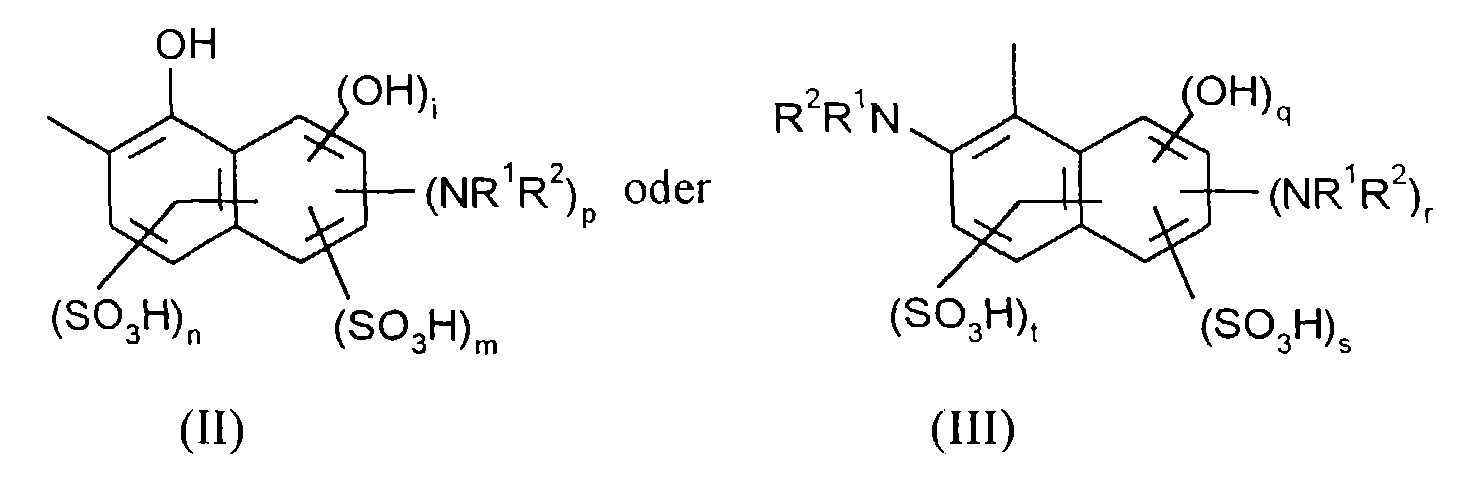
- i, m, n, p, q, r, s und t
- unabhängig voneinander für 0 oder 1 stehen,
wobei die Summen

und - R1 und R2
- die oben angegebene Bedeutung haben,
- Ganz besonders bevorzugt sind Silbenazofarbstoffe der Formel (I)
worin - X und Y
- unabhängig voneinander für -N=N-R stehen,
wobei - R
- für einen Rest der Formel (II) oder (III) steht,
worin - R1 und R2
- unabhängig voneinander für Wasserstoff, für gegebenenfalls durch Hydroxy, Methoxy, Ethoxy, Amino, Methylamino, Ethylamino, Dimethylamino, Diethylamino, Morpholino, Piperazino, N-Ethylpiperazino, N-Hydroxyethylpiperazino, N-Aminoethylpiperazino, Fluor, Chlor, Carboxy oder OSO3H substituiertes C1- bis C6-Alkyl, für jeweils gegebenenfalls durch Hydroxy, Methoxy, Ethoxy, Fluor, Chlor oder Phenyl substituiertes C1- bis C6-Alkylcarbonyl, C1- bis C6-Alkylsulfonyl, C1- bis C6-Alkoxycarbonyl oder C1- bis C6-Mono- oder -Dialkylaminocarbonyl, für Cyclopentyl oder Cyclohexyl, oder für jeweils gegebenenfalls durch Methyl, Ethyl, Hydroxy, Methoxy, Ethoxy, Fluor, Chlor, Amino, Cyano, Nitro, Carboxy, Aminocarbonyl oder Sulfo substituiertes Phenyl, Naphthyl, Benzoyl, Naphthylcarbonyl, Benzolsulfonyl oder Naphthalinsulfonyl stehen
oder - R1 und R2
- gemeinsam mit dem N-Atom, an welches sie gebunden sind, für Morpholino, Piperazino, N-Ethylpiperazino, N-Hydroxyethylpiperazino, N-Aminoethylpiperazino oder

- n, p, q und s
- für 1 stehen und
- m, i, r und t
- unabhängig voneinander für 0 oder 1 stehen.
- Insbesondere bevorzugt ist die erfindungsgemäße Verwendung von Stilbenazofarbstoffen der Formel (I), worin
- X und Y
- gleich sind und vorzugsweise für -N=N-R stehen, wobei R die oben angegebene Bedeutung hat.
- Weiterhin besonders bevorzugt zur Durchführung des erfindungsgemäßen Verfahrens sind Stilbenazofarbstoffe der Formel (I), worin
- X
- für einen Rest der Formel (IV) steht, welcher in Form seiner freien Säure der Formel

worin - R1
- für Wasserstoff, Phenyl, Methoxyphenyl, Hydroxyethoxyphenyl, Carboxyphenyl, Dicarboxyphenyl oder Sulfophenyl steht,
und - Y
- für einen Rest der Formel (IVa), (V), (VI) oder (VII) steht, welcher in Form der freien Säure der Formel

- Die Stilbenazofarbstoffe der Formel (I) können einzeln oder in beliebiger Mischung untereinander im erfindungsgemäßen Verfahren zum Einsatz kommen.
- So läßt sich durch die Wahl einer geeigneten Farbstoffmischung die Farbnuance leicht in gewünschter Weise einstellen. Außerdem weisen solche Mischungen in der Regel bessere Löslichkeiten auf, die die Herstellung stabiler Farbstofflösungen oder Tinten erleichtern.
- Stilbenazofarbstoffe, die in Form ihrer freien Säure der Formel (I) entsprechen, worin
- X
- für einen Rest der Formel (VIII) oder (IX), wiedergegeben in Form ihrer freien Säure

und - Y
- für einen Rest der Formel (VIIIa), (X), (XI) oder (XII), wiedergegeben in Form ihrer freien Säure
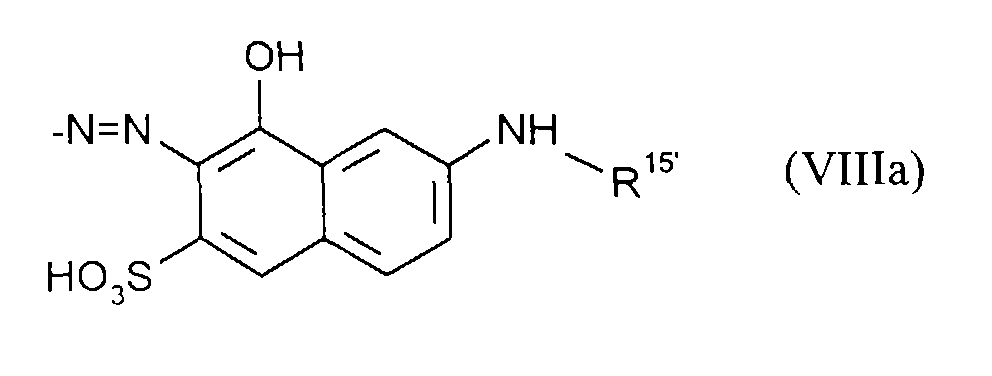
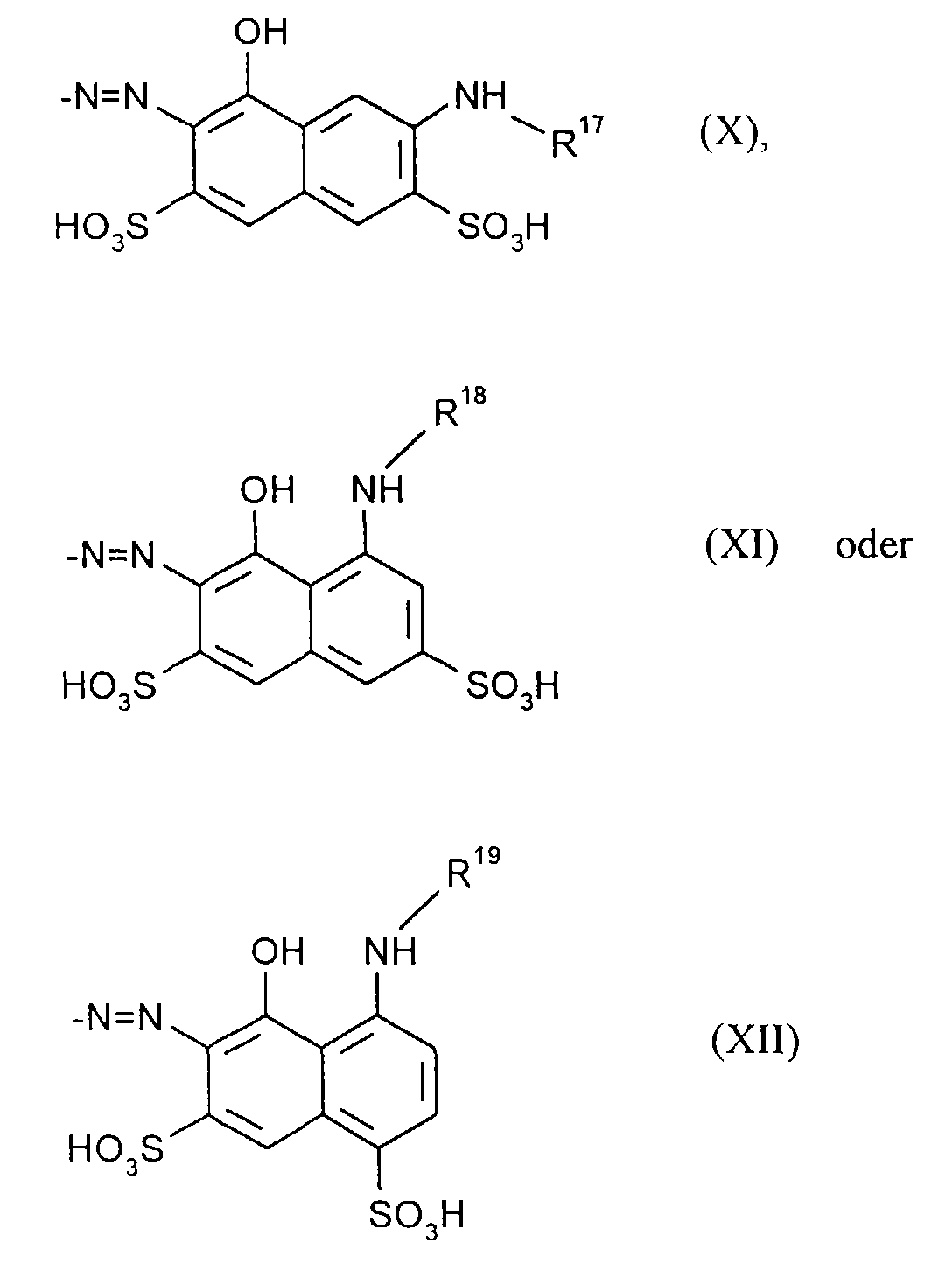
worin - R15, R15' und R17
- unabhängig voneinander für Wasserstoff, C1- bis C6-Alkyl, ω-Dimethyl- oder Diethylamino-C3- bis C5-alkyl, ω-Carboxy-C2- bis C15-alkyl, Formyl, C1- bis C6-Alkylcarbonyl oder für jeweils gegebenenfalls durch Methyl, Ethyl, Hydroxy, Methoxy, Ethoxy, Chlor, Brom, Cyano, Nitro, Carboxy oder Sulfo substituiertes Phenyl oder Benzoyl stehen,
- R16
- für Wasserstoff, C1-C6-Alkyl oder gegebenenfalls durch Methyl, Ethyl, Hydroxy, Methoxy, Ethoxy, Chlor, Brom, Cyano, Nitro, Carboxy oder Sulfo substituiertes Phenyl steht und
- R18 und R19
- unabhängig voneinander für Wasserstoff, Formyl, C1- bis C6-Alkylcarbonyl oder gegebenenfalls durch Methyl, Ethyl, Hydroxy, Methoxy, Ethoxy, Chlor, Brom, Cyano, Nitro, Carboxy oder Sulfo substituiertes Benzoyl stehen,
- Hervorgehoben sind solche Stilbenazofarbstoffe der Formel (I), worin X der Formel (VIII) entspricht mit R15 = Wasserstoff, Phenyl, Methylphenyl, Methoxyphenyl, Carboxyphenyl oder Sulfophenyl und Y einer der Formeln (X) bis (XII) entspricht mit R17 = Wasserstoff, Acetyl, Phenyl oder Benzoyl und R18 = R19 = Wasserstoff, Acetyl oder Benzoyl.
- Bevorzugt sind weiterhin Stilbenazofarbstoffe der Formel (Ia)

- Besonders hervorgehoben sind solche Stilbenazofarbstoffe der Formel (Ia), worin R15' und R15 gleich sind und für Wasserstoff, Methylphenyl, Methoxyphenyl, Carboxyphenyl oder Sulfophenyl stehen.
- Ebenfalls hervorgehoben sind solche Stilbenazofarbstoffe der Formel (Ia), worin R15 für Wasserstoff, Phenyl, Methylphenyl oder Methoxyphenyl und R15' für Carboxyphenyl oder Sulfophenyl steht.
- Die genannten Alkylgruppen, auch solche in abgeleiteten oder zusammengesetzen Begriffen wie Alkoxy, Alkylamino, Alkoxycarbonyl, Alkylaminocarbonyl, Alkylcarbonyl oder Alkylsulfonyl können geradkettig oder verzweigt und gegebenenfalls durch Reste wie z.B. Hydroxy, C1- bis C4-Alkoxy, Halogen, Cyano, Carboxy, Sulfo, OSO3H und/oder NR1R2 substituiert sein.
- Aryl bedeutet vorzugsweise Phenyl oder Naphthyl.
- Unter Halogen soll insbesondere Fluor, Chlor oder Brom verstanden werden.
- Die neuen Stilbenazofarbstoffe lassen sich analog zu der in EP-A 0 376 032 beschriebenen Verfahrensweise herstellen.
- So erfolgt die Herstellung beispielsweise durch Tetrazotierung der 4,4'-Diaminostilben-2-sulfonsäure der Formel


oder Mischung davon. - Die Herstellung kann aber auch erfolgen durch Diazotierung von 4-Amino-stilben-2- oder -2'-sulfonsäuren der Formel

- Die Diazotierung oder Tetrazotierung erfolgt beispielsweise in Wasser in Gegenwart von Salz- oder Schwefelsäure und Natriumnitrit bei 0-10°C. Die Kupplung erfolgt normalerweise im sodaalkalischen Milieu, bei (XIVc) im sauren Milieu bei pH = 1 - 4 in Wasser.
- Die Stilbenazofarbstoffe der Formel (I) werden erfindungsgemäß zum Färben und/oder Bedrucken von hydroxyl- und/oder amidgruppenhaltigen Substraten eingesetzt und färben cellulosehaltige Materialien, insbesondere Papier, Baumwolle und Viskose sowie Leder in schwarzen, grünen, blauen oder roten Farbtönen mit guten Naß- und Lichtechtheiten.
- Die Farbstoffe (I) können erfindungsgemäß nach allen in der Papier- und Textilindustrie für substantive Farbstoffe gebräuchlichen Verfahren verwendet werden, insbesondere in der Masse- wie in der Oberflächenfärbung von Papier für geleimte oder ungeleimte Sorten, ausgehend von gebleichtem oder ungebleichtem Zellstoff verschiedener Provenienz wie Nadel- oder Laubholz-sulfit- und/oder - sulfat-Zellstoff. Sie können auch in der Garn- und Stückfärberei von Baumwolle, Viskose und Leinen nach dem Ausziehverfahren aus langer Flotte oder im Kontinueverfahren angewandt werden sowie zum Färben von Leder beispielsweise im Faßverfahren.
- Solche Färbeverfahren sind bekannt aus beispielsweise Ullmann's Encyclopedia of Industrial Chemistry, VCH Verlagsgesellschaft mbH, 5thedition, Vol. A15, p. 259 (1990); Vol. A18, p. 545 (1991) und Vol. A26, p. 351 (1995).
- Bei der Massefärbung von Papier wird im allgemeinen so vorgegangen, daß einer wäßrigen Aufschlämmung der Faserstoffe (ca. 0,3-%ig, Holzschliff oder bevorzugt Zellstoff) der Farbstoff fest oder als wäßrige Lösung zugesetzt wird (beispielsweise 0,05 bis 3-%ig, bezogen auf Fasern). Dieser Aufschlämmung werden in der Regel zugesetzt: Füllstoffe wie Calciumcarbonat, Kaolin; Leimungsmittel wie Harze, Aluminiumsulfat oder Alaun; Hilfsmittel zur Beschleunigung der Entwässerung, zur Verbesserung der Naßfestigkeit. Auf der Papiermaschine wird dieser Stoffbrei über ein Sieb abgesaugt und anschließend getrocknet.
- Die Oberflächenfärbung von Papier erfolgt üblicherweise in der Leimpresse. Der wäßrigen Beschichtungsmasse, die gegebenenfalls Füllstoffe, wie Calciumcarbonat, Kaolin, Titanoxid; Bindemittel und andere Hilfsmittel enthält, wird der Farbstoff zugesetzt. Das Papier wird in der Leimpresse damit beschichtet, getrocknet und eventuell zwischen Walzen geglättet.
- Die Färbung von Leder nach dem Faßfärbeverfahren erfolgt in Fässern oder rotierenden Kesseln. Bezogen auf das Leder wird in der 1- bis 3-fachen Menge Färbeflotte bei Temperaturen bis 60°C gefärbt. Die Flotte kann neben den Farbstoffen auch anionische Hilfsmittel zur Verbesserung der Egalität, nichtionische Detergentien, Säuren oder Basen zur Steuerung des Aufziehvermögens und eventuell weitere Zusätze enthalten. Nach der Färbung wird abgesäuert, z.B. mit 1-2 % Ameisen-, Essig- oder Milchsäure, und getrocknet.
- Die Färbung von Baumwolle erfolgt üblicherweise nach dem Ausziehverfahren. Die wäßrige Färbeflotte enthält neben dem Farbstoff im allgemeinen Salze wie Natriumchlorid oder Natriumsulfat. Gefärbt wird in der Regel im schwach sauren pH-Bereich bei Temperaturen von 80-95°C oder unter Druck bei 130°C. Anschließend wird in Stufen abgekühlt und mit kaltem Wasser gewaschen.
- Alternativ kann Baumwolle nach dem Kontinueverfahren gefärbt werden, wobei das Gewebe mit einer Farbstofflösung getränkt, abgepreßt und anschließend beispielsweise im Dampfstrom oder in einem heißen Salzbad (80-90°C) fixiert wird.
- Die Stilbenazofarbstoffe der Formel (I) können als feste oder flüssige Farbstoffpräparationen erfindungsgemäß für die jeweiligen Färbeverfahren eingesetzt werden. Sie werden vorzugsweise in Form von wäßrigen Präparationen, insbesondere von Lösungen eingesetzt. Diese wäßrigen Farbstoffpräparationen enthalten im allgemeinen einen oder mehrere Farbstoffe der Formel (I), gegebenenfalls weitere anionische substantive Farbstoffe zur Einstellung der Nuance, gegebenenfalls geeignete organische Lösungsmittel, wozu auch hydrotrope Verbindungen zählen können, sowie weitere Hilfsmittel und/oder Stabilisatoren. Es ist vorteilhaft, die wäßrigen Farbstofflösungen im Zuge der Farbstoffsynthese selbst, ohne Zwischenisolierung des Farbstoffs, herzustellen.
- Die Anwendung in Form der wäßrigen Farbstoffpräparationen ist insbesondere beim Färben oder Bedrucken von Papier bevorzugt. Die Herstellung einer stabilen, wäßrig konzentrierten Färbepräparation kann auf allgemein übliche Weise erfolgen, z.B. durch Lösen des Farbstoffs in Wasser gegebenenfalls unter Zugabe eines oder mehrerer Hilfsmittel, z.B. einer hydrotropen Verbindung oder eines Stabilisators.
- Die wäßrigen Farbstoffpräparationen enthalten im allgemeinen etwa 0,5 bis 20 Gew.-% eines oder mehrerer Farbstoffe der Formel (I) und 80 bis 99,5 Gew.-% Wasser und/oder Lösungsmittel sowie gegebenenfalls weitere übliche Bestandteile.
- Bevorzugte organische Lösungsmittel sind dabei Alkohole und deren Ether oder Ester, Carbonsäureamide, Harnstoffe, Sulfoxide und Sulfone, insbesondere solche mit Molekulargewichten <200. Besonders geeignete Lösungsmittel sind beispielsweise Methanol, Ethanol, Propanol, Isopropanol; Ethylen-, Propylen-, Diethylen-, Thiodiethylen-, Dipropylen-, Pentamethylen-, Triethylen- und Polyethylenglykol; Butandiol, 1,5-Pentandiol, 1,2-Dihydroxypropan; Glycerin, 1,3,6-Hexantriol; β-Hydroxypropionitril; Ethylenglykolmonoethyl- und -propylether, Ethylendiglykolmonoethylether, Triethylenglykolbutylether, Butylpolyglykol, 1-Methoxy-2-propanol, 2-Methoxy-1-propanol; Formamid, N,N-Dimethylformamid, Pyrrolidon, ε-Caprolactam, N-Methyl-caprolactam, Butyrolacton, Caprolacton; Essigsäure-2-hydroxyethylester, Essigsäure-2-(2'-hydroxy)-ethylester, Glycolacetat; Harnstoff, Tetramethylharnstoff, 1,3-Dimethyl-2-imidazolidinon, N,N-Dimethylolpropylenharnstoff; Dimethylsulfoxid, Dimethylsulfon, Sulfolan.
- Als weitere für wäßrige Farbstoffpräparationen, insbesondere für Drucktinten übliche Zusätze kommen solche ionischen oder nichtionischen Stoffe in Frage, mit denen die Viskosität und/oder Oberflächenspannung in die für die Anwendung erforderlichen Bereiche eingestellt werden kann, wie beispielsweise anionische, kationische oder neutrale Tenside wie Dispergiermittel und Viskositätsregulatoren. Die Funktion von Viskositätsregulatoren kann beispielsweise von den organischen Lösungsmitteln übernommen werden.
- Die erfindungsgemäßen Farbstoffpräparationen können auch weitere Farbstoffe enthalten, die nicht der Formel (I) entsprechen.
- Bevorzugt sind wäßrige Farbstoffpräparationen, insbesondere Farbstofflösungen, enthaltend
- 0,5 bis 20 Gew.-%, insbesondere 1 bis 15 Gew.-% eines oder mehrerer Farbstoffe, wobei mindestens einer der Formel (I) entspricht,
- 50 bis 99,5 Gew.-%, insbesondere 85 bis 99 Gew.-% Wasser,
- 0 bis 30 Gew.-%, insbesondere 0 bis 20 Gew.-% eines oder mehrerer organischer Lösungsmittel,
- 0 bis 30 Gew.-%, insbesondere 0 bis 10 Gew.-% die Viskosität und/oder die Oberflächenspannung beeinflussende Zusätze,
- Die wäßrigen Farbstoffpräparationen können durch Auflösen der Farbstoffsalze der Formel (I) in Wasser oder durch direkten Einsatz der Syntheselösungen, die gegebenenfalls zuvor einem Ionenaustauschverfahren und/oder einem Membrantrennverfahren, z.B. einer Entsalzung durch Druckpermeation, unterworfen wurden, und/oder durch Zusatz eines oder mehrerer der obengenannten organischen Lösungsmittel und/oder Zusätze bei einer Temperatur von beispielsweise 20 bis 100°C, gegebenenfalls bei erhöhten Temperaturen von 30 bis 100°C, insbesondere 30 bis 50°C, und unter Zusatz von anorganischen und/oder organischen Basen hergestellt werden.
- Anstelle der Salze der Farbstoffe (I) können auch die entsprechenden freien Säuren in Kombination mit mindestens äquimolaren Mengen der entsprechenden organischen und/oder anorganischen Basen eingesetzt werden.
- Als anorganische Basen können z.B. Lithium-, Natrium- oder Kaliumhydroxid, Lithium-, Natrium- oder Kaliumcarbonat eingesetzt werden.
- Als organische Basen können z.B. Ethanolamin, Diethanolamin, Triethanolamin, N-Methylethanolamin, N,N-Dimethylethanolamin, N-Methyldiethanolamin, 1-Amino-2-propanol, 2-Amino-1-propanol, Di-isopropanolamin, N-2-Hydroxyethyldiisopropanolamin, N,N,N-Tris-[2-(2'-hydroxyethoxy)-ethyl]-amin, Tetramethylammoniumhydroxid oder Natriummethylat, Lithiummethlyat, Kalium-tert.-butylat dienen.
- Die erfindungsgemäßen wäßrigen Farbstoffpräparationen eignen sich weiterhin zur Herstellung von Drucktinten, die insbesondere auch als Aufzeichnungsflüssigkeiten nach der Ink-jet-Methode eingesetzt werden können.
- Ein weiterer Gegenstand der Erfindung sind daher Drucktinten enthaltend mindestens einen Stilbenazofarbstoff der Formel (I) sowie deren Verwendung als Aufzeichnungsflüssigkeiten für Ink-jet-Aufzeichnungssysteme. Eine bevorzugte Form enthält solche Farbstoffe der Formel (I), Mischungen solcher Farbstoffe der Formel (I) oder Mischungen von Farbstoffen der Formel (I) mit anderen Farbstoffen, die geeignet sind, schwarze Drucke zu erzeugen.
- Unter der Ink-jet-Methode des erfindungsgemäßen Verfahrens wird ein Tintenstrahlaufzeichnungsverfahren verstanden, bei dem die Tintentropfen auf das Substrat gespritzt werden. Die feinen Tintentröpfchen können durch unterschiedliche Verfahren erzeugt werden. Bevorzugt werden sie nach den allgemein bekannten Thermal-Jet-, Bubble-Jet-, Piezo-Jet- oder Ventil-Ink-Jet-Verfahren erzeugt. Diese Verfahren sind beispielsweise von T.L. Dawson, Rev. Prog. Coloration 22, 22 (1992) bekannt.
- Bei der Verwendung der erfindungsgemäßen Farbstoffe in Form ihrer wäßrigen Präparationen, wie sie oben detailliert beschrieben sind, als Drucktinten für Ink-jet-Aufzeichnungssysteme ergeben sich folgende Vorteile: Die physikalischen Eigenschaften wie Viskosität, Oberflächenspannung und dergleichen liegen in den geeigneten Bereichen; die Aufzeichnungsflüssigkeit verursacht keine Verstopfungen in den feinen Abgabeöffnungen von Tintenstrahl-Aufzeichnungs-Vorrichtungen; sie liefert Bilder von hoher optischer Dichte; bei der Lagerung kommt es in der Aufzeichnungsflüssigkeit nicht zu einer Veränderung der physikalischen Eigenschaften und/oder zur Ablagerung von festen Bestandteilen; die Aufzeichnungsflüssigkeit eignet sich zur Aufzeichnung auf verschiedenen Aufzeichnungsmedien ohne Beschränkungen hinsichtlich der Art der Aufzeichnungsmedien; die Aufzeichnungsflüssigkeit fixiert rasch und ergibt Bilder mit aufgezeichneter Wasserfestigkeit, Lichtechtheit, Abriebfestigkeit und Auflösung.
- Das in den Beispielen eingesetzt Wasser war in jedem Fall komplett entionisiert.
- 6,45 g 4,4'-Diamino-stilben-2-sulfonsäure als Dihydrochlorid (Herstellung siehe EP-A 0 376 032) wurden in 500 ml Wasser mit 40 gew.-%iger Natronlauge bei pH = 12,5 in Lösung gebracht und mit 8,5 ml Natriumnitritlösung (30 g NaNO2 in 100 ml Lösung) versetzt. Diese Mischung dosierte man während 2 h bei 2 bis 5°C in eine Mischung aus 62 ml 32 gew.-%iger Salzsäure, 50 g Eis und 0,1 ml Natriumnitritlösung (10 g in 100 ml). 1 h wurde nachgerührt.
- 13,9 g 1-Hydroxy-7-(3-carboxyanilino)-naphthalin-3-sulfonsäure (91,6 %ig) wurden in einer Mischung aus 265 ml 20 gew.-%iger Sodalösung und 115 ml Wasser gelöst. Hierzu wurde obige Tetrazotierung während 2 h getropft. Zum Schluß war ein pH von 9,8 erreicht. Nach 1 h Nachrühren wurde abgesaugt. Man erhielt 52,5 g einer feuchten Paste des Farbstoffs der Formel (I) als Natriumsalz mit X = Y = Formel (IV) und

- Diese Paste wurde in 500 ml Wasser gelöst und dreimal über ein Filter "blue ribbon 5893" der Fa. Schleicher und Schüll filtriert.
- Diese Lösung zeigte einen λmax-Wert von 581 nm.
- Ligninfreies Papier wurde in einem bläuchlichschwarzen Farbton in der Masse gefärbt mit ausgezeichneten Abwasserwerten und Naßechtheiten.
- Anschließend wurde obige Lösung zweimal über ein Mikrofilter, zuerst über ein 1,2 µm-PTFE-Filter, dann über ein 0,2 µm-PTFE-Filter in einem Sartorius-Druckfiltergerät bei 8 bar filtriert. Diese Lösung wurde in eine leere und im Ultraschallbad gereinigte Tintenpatrone eines Hewlett-Packard-Deskjet-plus-Druckers gefüllt. Der Druck auf verschiedene kommerzielle Papiere war tiefschwarz mit sehr guten Wasserechtheiten.
-
- a) 32,0 g 4-Amino-4'-acetylaminostilben-2-sulfonsäure (Herstellung siehe EP-A 0 376 032) wurden in 1 l Wasser bei 80°C durch Zusatz von 3 g Lithiumhydroxid gelöst und filtriert. Bei 80°C wurden 17 ml Natriumnitritlösung (30 g NaNO2 in 100 ml wäßriger Lösung) zugesetzt. Diese Lösung wurde während 1 h in eine Mischung aus 100 ml 33 gew.-%ige Salzsäure, 1 l Eiswasser und 2 Tropfen obiger Natriumnitritlösung eingepumpt. Durch Zugabe von insgesamt 500 g Eis wurde die Temperatur bei 2 bis 5°C gehalten. Die Suspension wurde 1 h bei dieser Temperatur nachgerührt und anschließend während 2 h in eine Lösung von 26,6 g 1-Hydroxy-7-(4-methoxyanilino)-naphthalin-3-sulfonsäure-Na-Salz in einer Mischung aus 300 ml 20 gew.-%iger Sodalösung und 640 ml Eiswasser bei 2 bis 5°C eingepumpt. Über Nacht wurde nachgerührt, wobei die Temperatur allmählich auf Raumtemperatur anstieg. Die braunschwarze Suspension wurde abgesaugt. Man erhielt 125 g Paste der Formel (XX) (dargestellt in Form der freien Säure)

- b) 125 g der unter a) erhaltenen Paste wurden in einer Mischung aus 250 ml Wasser und 50 ml 33 gew.-%iger Salzsäure 8 h bei 95°C gerührt. Anschließend wurde abgesaugt. Man erhielt 102 g einer Paste der Formel (XX) mit R20 = Wasserstoff.
- c) 102 g der unter b) erhaltenen Paste wurden in 500 ml Wasser durch Zusatz von festem Lithiumhydroxid in Lösung gebracht und auf pH = 10,5 gestellt. 1 l Eiswasser und 16,7 ml Natriumnitritlösung (30 g NaNO2 in 100 ml wäßriger Lösung) wurden zugesetzt. Während 2 h wurde in eine Mischung aus 200 ml Eiswasser und 30 ml 33 gew.-%iger Salzsäure bei 2 bis 5°C gepumpt und 1 h bei dieser Temperatur gehalten. Diese Diazotierung wurde während 1,5 h zu einer Lösung von 31,7 g 7-Amino-1-hydroxynaphthalin-3,6-disulfonsäure (58 gew.-%ig) in 300 ml 20 gew.-%ige Sodalösung bei 2 bis 5°C gepumpt. Es wurde über Nacht gerührt und dabei die Temperatur auf Raumtemperatur kommen lassen. Die schwarze Lösung wurde mit 350 g Natriumchlorid versetzt und 1 h bei 70°C getempert. Nach Abkühlen auf Raumtemperatur wurde abgesaugt. Man erhielt 116 g Paste. Diese wurde in 700 ml Wasser bei 50°C gelöst und mit 160 g Natriumchlorid ausgesalzen. Nach dem Absaugen erhielt man 99 g Paste der Formel (I) mit X = Rest der Formel (IV), R1 = 4-Methoxyphenyl und Y = Rest der Formel (V).
Diese Paste wurde in 400 ml Wasser gelöst. Da über Nacht gallertartiges Produkt ausfiel, wurde mit 33 gew.-%iger Salzsäure auf pH = 1,0 eingestellt und abgesaugt. Man erhielt 96 g Paste, die erneut in 400 ml Wasser angeteigt und mittels festem Lithiumhydroxid durch Einstellen von pH = 8,0 in Lösung gebracht wurde. Die Lösung war stabil.
Diese Lösung zeigte einen λmax-Wert von 574 nm.
Ligninfreies Papier wurde in der Masse in einem scharzen Farbton gefärbt mit ausgezeichneten Abwasserwerten und Naßechtheiten.
100 g der obigen Lösung wurden mit einer Mischung aus 9,5 g 2-Pyrrolidon und 9,5 g 1,5-Pentandiol versetzt. Diese Lösung wurde über ein Filter "blue ribbon 5893" filtriert und anschließend mit einem Sartorius-Druckfiltergerät bei einem Druck von 8 bar nacheinander über PTFE-Mikrofilter-Membranen mit 5,0, 1,2, 0,54 und 0,2 µm Porengröße filtriert. Der pH-Wert wurde durch Zusatz von festem Lithiumhydroxid auf 8,0 eingestellt.
Diese Lösung wurde in eine leere und in einem Ultraschallbad gereinigte Tintenpatrone eines Hewlett-Packard-Deskjet-plus-Druckers gefüllt. Der Druck auf verschiedene kommerzielle Papiere war tiefschwarz mit sehr guten Wasserechtheiten. -
- a) Es wurde wie in Beispiel 1 unter a) beschrieben tetrazotiert.
- b) 7,1 g 1-Hydroxy-7-(3-carboxyanilino)-naphthalin-3-sulfonsäure und 4,7 g 1-Hydroxy-7-amino-naphthalin-3-sulfonsäure wurden in einer Mischung aus 160 ml 20 gew.-%iger Sodalösung und 300 ml Eiswasser gelöst. Hierzu tropfte während 2 h bei 0 bis 5°C obige Tetrazotierung, wobei am Schluß ein pH von 8,7 erreicht wurde. Es wurde abgesaugt. Man erhielt 37,5 g einer feuchten Paste einer Mischung von vier Farbstoffen der Formel (I) als Natriumsalz
- Farbstoff 1) X = Formel (IV) mit
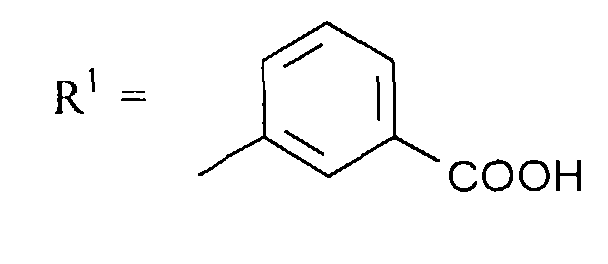
- Farbstoff 2) X = Formel (IV) mit R1 = Wasserstoff und Y = Formel (IVa) mit

- Farbstoff 3) X = Y = Formel (IV) mit

- Farbstoff 4) X = Y = Formel (IV) mit R1 = Wasserstoff.
Diese Paste wurde in 400 ml Wasser angeschlagen und mit 20 ml 33 gew.-%iger Salzsäure auf pH = 0,8 gestellt. Nach 2 h bei Raumtemperatur wurde erneut abgesaugt. Man erhielt 76,2 g feuchte Paste. Diese Paste wurde in 200 ml Wasser unter Zusatz von Lithiumhydroxid bei pH = 9,5 bis 10 gelöst und mit einer Mischung aus 19 g 2-Pyrrolidon, 19 g 1,5-Pentandiol und 10 g Harnstoff versetzt. Diese Lösung wurde wie in Beispiel 1 beschrieben filtriert, mit Lithiumhydroxid auf pH = 9 eingestellt und verdruckt. Der Druck auf verschiedenen kommerziellen Papieren war leicht blaustichig schwarz mit sehr guten Wasserechtheiten.
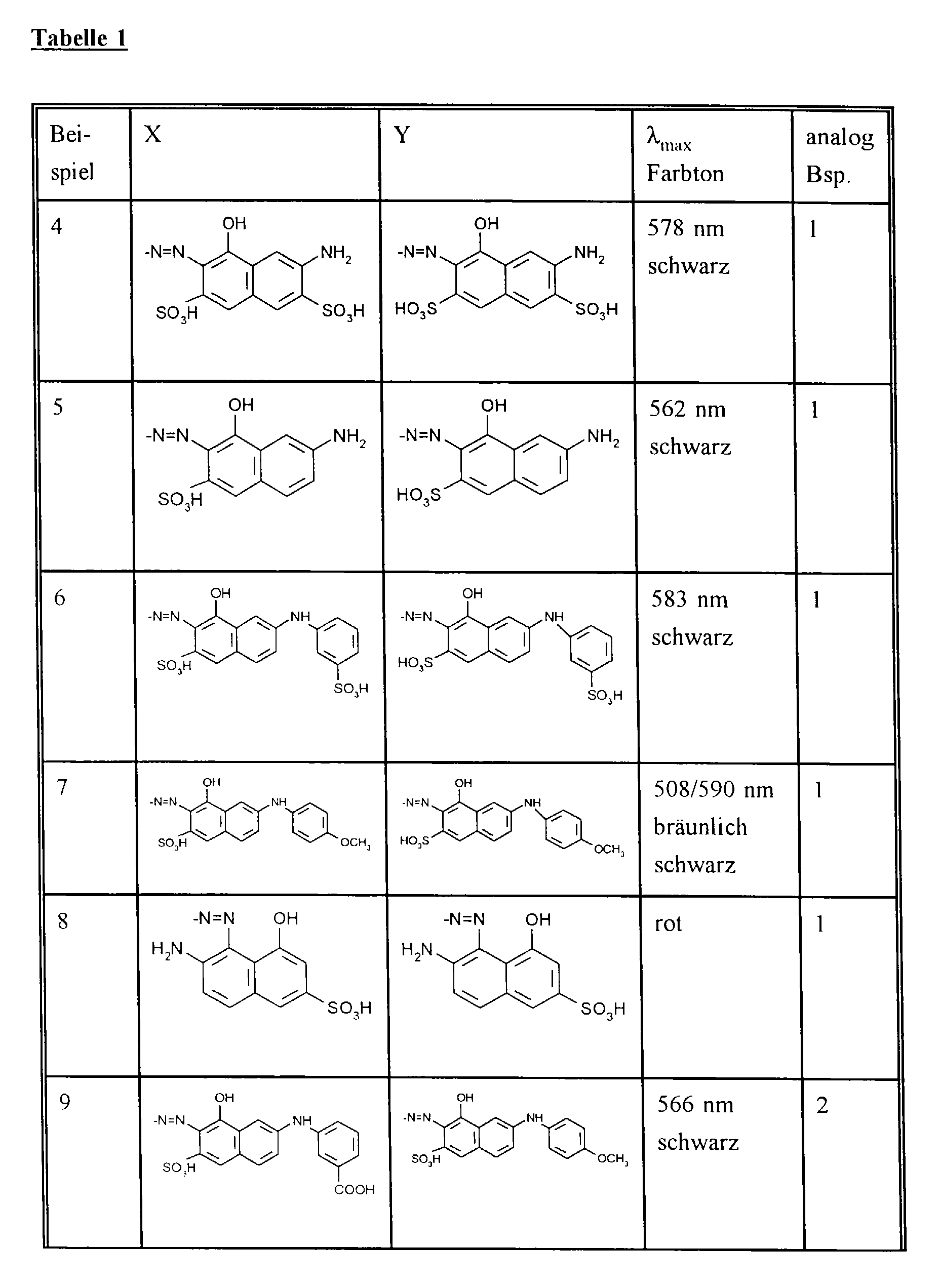
Ganz analog wurden die folgenden in Tabelle 1 aufgeführten Farbstoffe hergestellt. - Farbstoff 1) X = Formel (IV) mit
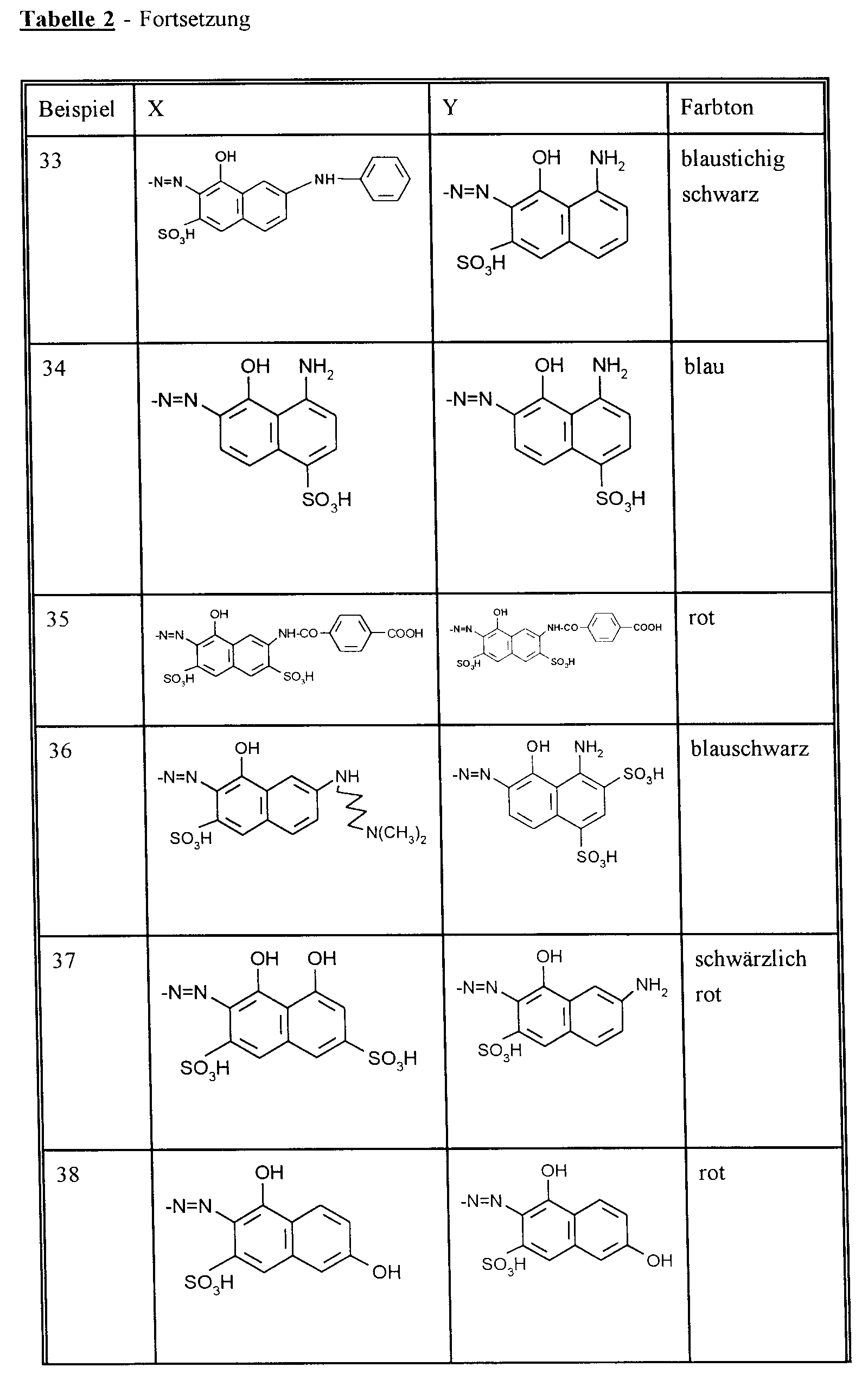
- Analog zu Beispiel 1 wurde von diesen Farbstoffen der Beispiele 4 bis 26 eine Tinte hergestellt und verdruckt. Die Drucke waren in der Regel intensiv und wiesen gute Wasserechtheiten auf.
- In der gleichen Weise konnte aus den in Tabelle 2 folgenden Farbstoffen eine Tinte hergestellt und verdruckt werden:


- 5 g einer Mischung aus 70 Gew.-% Birkenholzsulfat-Zellstoff und 30 Gew.-% Kiefernholzsulfat-Zellstoff wurden in einem Laborholländer auf 30 bis 40° SR gemahlen. Diese Mischung wurde auf 1 l mit Wasser aufgefüllt. Hierzu wurde eine Lösung von 25 mg des Farbstoffs des Beispiels 1 in 2,5 ml Wasser, 10 ml einer 1 gew.-%igen wäßrigen Lösung von Harzleim Dynacoll VS 50 der Fa. Akzo Chemie, Düren, und 15 ml einer 1 gew.-%igen wäßrigen Lösung von Aluminiumsulfat gegeben, wobei zwischen den Zugaben 8 Minuten gerührt wurde. Die gefärbte und geleimte Papiermasse wurde auf einen Laborblattbildner gegeben, gleichmäßig verteilt und abgesaugt. Anschließend wurde das schwarz gefärbte Papierblatt zwischen Filterpapier gepreßt und getrocknet. Im Abwasser der Färbung befand sich 1 % der eingesetzten Farbstoffmenge.
- Ganz analog konnten die Farbstoffe der Beispiele 2 bis 42 eingesetzt werden.
wobei R1' die gleiche Bedeutung wie R1 hat, vorzugsweise R1 und R1' aber nicht gleich sind, falls X für einen Rest (IV) und Y für einen Rest (IVa) steht.
sind neu und ebenfalls Gegenstand der Erfindung.


Claims (10)
- Verfahren zum Färben und/oder Bedrucken von cellulose- und/oder amidgruppenhaltigen Materialien, dadurch gekennzeichnet, daß als Farbstoff mindestens ein Stilbenazofarbstoff, der in Form der freien Säure der Formel (I)
 X und Y unabhängig voneinander für -CF3, Halogen, -CONR1R2, -COOH, -COOR3, -CN, -NO2, NR1R2, -OH, -OR3, -NHCOR3, -NHCOOR3, -NHCONHR3 oder -N=N-R stehen, wobei mindestens einer der Reste X oder Y für -N=N-R steht, undR für einen Rest der Formel

worinR4, R5, R6, R7, R8, R9, R10 und R11 unabhängig voneinander für H, Halogen, -OH, -OR3, -NR1R2, R3, -SO3H, -SO2NR1R2, -O-COR3, -NHCOR3 stehen undR1 und R2 unabhängig voneinander für Wasserstoff, Formyl, für jeweils gegebenenfalls durch C1-C4-Alkyl, Hydroxy, C1- bis C4-Alkoxy, Amino, C1- bis C4-Mono- oder -Dialkylamino, Morpholino, Piperidino, N-R12-Piperazino, Halogen, Cyano, Nitro, Phenyl, Carboxy, C1- bis C4-Alkoxycarbonyl, Aminocarbonyl, C1- bis C4-Mono- oder -Dialkylaminocarbonyl, Sulfo oder OSO3H substituiertes C1- bis C6-Alkyl, C1- bis C6-Alkylcarbonyl, C1- bis C6-Alkylsulfonyl, C1- bis C6-Alkoxycarbonyl, C1- bis C6-Mono- oder -Dialkylaminocarbonyl, C5- bis C7-Cycloalkyl, C6- bis C10-Aryl, C6- bis C10-Arylcarbonyl oder C6- bis C10-Arylsulfonyl stehen,
oderR1 und R2 gemeinsam mit dem N-Atom, an welches sie gebunden sind, für einen 5- bis 7-gliedrigen gesättigten heterocyclischen Ring stehen, der zusätzlich weitere Heteroatome aus der Reihe O, S, SO2 oder NR12 enthalten kann, wobeiR12 die Bedeutung von R1 oder R2 hat undR3 für jeweils gegebenenfalls durch C1-C4-Alkyl, Hydroxy, C1-C4-Alkoxy, Halogen, Cyano oder Nitro, substituiertes C1- bis C6-Alkyl, C6- bis C10-Aryl oder C6- bis C10-Aryl-C1-C6-alkyl steht,eingesetzt wird. - Verfahren gemäß Anspruch 1, dadurch gekennzeichnet, daß mindestens ein Stilbenazofarbstoff der Formel (I),
worinX und Y unabhängig voneinander für -CN, -NO2, -NH2, -NHCOR3, -NHCOOR3, -NHCONHR3 oder -N=N-R stehen, wobei mindestens einer der Reste X oder Y für -N=N-R steht,R für einen Rest
wobeiR1, R2, R4, R5, R8, R9, R10 und R11 die in Anspruch 1 angegebene Bedeutung haben,eingesetzt wird. - Verfahren gemäß Ansprüchen 1 und 2, dadurch gekennzeichnet, daß mindestens ein Stilbenazofarbstoff der Formel (I), worinX und Y unabhängig voneinander für -N=N-R stehen,
wobeiR für einen Rest der Formel i, m, n, p, q, r, s und t unabhängig voneinander für 0 oder 1 stehen,
wobei die Summen von

undR1 und R2 die in Anspruch 1 angegebene Bedeutung haben,eingesetzt wird.
steht, - Verfahren gemäß Ansprüchen 1 bis 3, dadurch gekennzeichnet, daß mindestens ein Stilbenazofarbstoff der Formel (I), worinX und Y unabhängig voneinander für -N=N-R stehen,
wobeiR für einen Nest der Formel (II) oder (III) steht,
worinR1 und R2 unabhängig voneinander für Wasserstoff, für gegebenenfalls durch Hydroxy, Methoxy, Ethoxy, Amino, Methylamino, Ethylamino, Dimethylamino, Diethylamino, Morpholino, Piperazino, N-Ethylpiperazino, N-Hydroxyethylpiperazino, N-Aminoethylpiperazino, Fluor, Chlor, Carboxy oder OSO3H substituiertes C1- bis C6-Alkyl, für jeweils gegebenenfalls durch Hydroxy, Methoxy, Ethoxy, Fluor, Chlor oder Phenyl substituiertes C1- bis C6-Alkylcarbonyl, C1- bis C6-Alkylsulfonyl, C1- bis C6-Alkoxycarbonyl- oder C1- bis C6-Mono- oder -Dialkylaminocarbonyl, für Cyclopentyl oder Cyclohexyl, oder für jeweils gegebenenfalls durch Methyl, Ethyl, Hydroxy, Methoxy, Ethoxy, Fluor, Chlor, Amino, Cyano, Nitro, Carboxy, Aminocarbonyl oder Sulfo substituiertes Phenyl, Naphthyl, Benzoyl, Naphthylcarbonyl, Benzolsulfonyl oder Naphthalinsulfonyl stehen
oderR1 und R2 gemeinsam mit dem N-Atom, an welches sie gebunden sind, für Morpholino, Piperazino, N-Ethylpiperazino, N-Hydroxyethylpiperazino, N-Aminoethylpiperazino oder n, p, q und s für 1 stehen undm, i, r und t unabhängig voneinander für 0 oder 1 stehen,eingesetzt wird.
- Verfahren gemäß Ansprüchen 1 bis 4, dadurch gekennzeichnet, daß mindestens ein Stilbenazofarbstoff der Formel (I), worinX für einen Rest der Formel (IV) steht, welcher in Form seiner freien Säure der Formel

worinR1 für Wasserstoff, Phenyl, Methoxyphenyl, Hydroxyethoxyphenyl, Carboxyphenyl, Dicarboxyphenyl oder Sulfophenyl steht,
undY für einen Rest der Formel (IVa), (V), (VI) oder (VII) steht, welcher in Form der freien Säure der Formelwobei R1' die gleiche Bedeutung wie R1 hat, vorzugsweise R1 und R1' aber nicht gleich sind, falls X für einen Rest (IV) und Y für einen Rest (IVa) steht, eingesetzt wird.
- Verfahren gemäß Ansprüchen 1 bis 5, dadurch gekennzeichnet, daß es sich bei den zu färbenden Materialien um Papier, Baumwolle, Viskose oder Leder handelt.
- Stilbenazofarbstoffe, die in Form ihrer freien Säure der Formel (I) entsprechen, worinX für einen Rest der Formel (VIII) oder (IX), wiedergegeben in Form ihrer freien Säure

undY für einen Rest der Formeln (VIIIa), (X), (XI) oder (XII), wiedergegeben in Form ihrer freien Säure

worinR15, R15' und R17 unabhängig voneinander für Wasserstoff, C1- bis C6-Alkyl, ω-Dimethyl- oder Diethylamino-C3- bis C5-alkyl, ω-Carboxy-C2- bis C15-alkyl, Formyl, C1- bis C6-Alkylcarbonyl oder für jeweils gegebenenfalls durch Methyl, Ethyl, Hydroxy, Methoxy, Ethoxy, Chlor, Brom, Cyano, Nitro, Carboxy oder Sulfo substituiertes Phenyl oder Benzoyl stehen,R16 für Wasserstoff, C1-C6-Alkyl oder gegebenenfalls durch Methyl, Ethyl, Hydroxy, Methoxy, Ethoxy, Chlor, Brom, Cyano, Nitro, Carboxy oder Sulfo substituiertes Phenyl steht undR18 und R19 unabhängig voneinander für Wasserstoff, Formyl, C1- bis C6-Alkylcarbonyl oder gegebenenfalls durch Methyl, Ethyl, Hydroxy, Methoxy, Ethoxy, Chlor, Brom, Cyano, Nitro, Carboxy oder Sulfo substituiertes Benzoyl stehen,wobei im Falle, daß X für einen Rest der Formel (VIII) und Y für einen Rest der Formel (VIIIa) steht und R15' und R15 gleich, sind diese nicht gleichzeitig für Acetyl, Phenyl, Benzoyl oder 4-Chlorphenyl stehen. - Wäßrige Farbstoffpräparation enthaltend mindestens einen Stilbenazofarbstoff der Formel (I) gemäß Anspruch 1.
- Wäßrige Farbstoffpräparation enthaltend 0,5 bis 20 Gew.-% mindestens eines Stilbenazofarbstoffs der Formel (I) gemäß Anspruch 1 und 80 bis 99,5 Gew.-% Wasser und/oder organisches Lösungsmittel.
- Verwendung einer wäßrigen Farbstoffpräparation gemäß Ansprüchen 8 und 9 als Aufzeichnungsflüssigkeit für Tintenstrahlaufzeichnungsgeräte.
Applications Claiming Priority (2)
| Application Number | Priority Date | Filing Date | Title |
|---|---|---|---|
| DE19621865A DE19621865A1 (de) | 1996-05-31 | 1996-05-31 | Substantive Stilbenazofarbstoffe |
| DE19621865 | 1996-05-31 |
Publications (2)
| Publication Number | Publication Date |
|---|---|
| EP0810265A1 true EP0810265A1 (de) | 1997-12-03 |
| EP0810265B1 EP0810265B1 (de) | 2001-11-21 |
Family
ID=7795779
Family Applications (1)
| Application Number | Title | Priority Date | Filing Date |
|---|---|---|---|
| EP97106529A Expired - Lifetime EP0810265B1 (de) | 1996-05-31 | 1997-04-21 | Substantive Stilbenazofarbstoffe |
Country Status (4)
| Country | Link |
|---|---|
| US (1) | US5785718A (de) |
| EP (1) | EP0810265B1 (de) |
| JP (1) | JPH10259312A (de) |
| DE (2) | DE19621865A1 (de) |
Families Citing this family (6)
| Publication number | Priority date | Publication date | Assignee | Title |
|---|---|---|---|---|
| DE19750404C2 (de) | 1997-11-14 | 1999-10-07 | Bayer Ag | Flachkammer zur Befüllung mit fluiden Medien |
| CA2442714C (en) * | 2001-04-04 | 2008-06-03 | Nippon Kayaku Kabushiki Kaisha | Aqueous ink composition, water-soluble dye composition and ink-jet recording method |
| JP4547946B2 (ja) * | 2004-03-11 | 2010-09-22 | 三菱化学株式会社 | アゾ色素、異方性色素膜用二色性アゾ色素並びにこれを用いた異方性色素膜形成用組成物、異方性色素膜および偏光素子 |
| WO2013008201A2 (en) | 2011-07-12 | 2013-01-17 | Colourtex Industries Limited | Novel reactive dyes, there mixtures and processes thereof |
| JP6682384B2 (ja) * | 2016-06-29 | 2020-04-15 | 株式会社リコー | インクジェットインク |
| JP6869683B2 (ja) * | 2016-10-04 | 2021-05-12 | 株式会社リコー | 着色組成物 |
Citations (9)
| Publication number | Priority date | Publication date | Assignee | Title |
|---|---|---|---|---|
| DE593144C (de) * | 1932-03-01 | 1934-02-22 | I G Farbenindustrie Akt Ges | Verfahren zur Herstellung von Stilbenazofarbstoffen |
| DE741469C (de) * | 1940-04-30 | 1943-11-11 | Ig Farbenindustrie Ag | Verfahren zur Herstellung von Stilbenazoverbindungen |
| CH346309A (de) * | 1955-11-11 | 1960-05-15 | Ciba Geigy | Verfahren zur Herstellung von Azofarbstoffen |
| EP0035152A1 (de) * | 1980-02-26 | 1981-09-09 | Bayer Ag | Polyazofarbstoffe und deren konzentrierte wässrige Lösungen sowie ihre Verwendung zum Färben cellulosehaltiger Materialien und Leder |
| DE3512836A1 (de) * | 1984-04-10 | 1985-10-24 | Ricoh Co., Ltd., Tokio/Tokyo | Waessrige tinte |
| EP0306452A2 (de) * | 1987-09-03 | 1989-03-08 | Ciba-Geigy Ag | Kationische Stilben-disazofarbstoffe |
| EP0352229A2 (de) * | 1988-07-22 | 1990-01-24 | Ciba-Geigy Ag | Verfahren zum Färben von Papier |
| EP0374655A1 (de) * | 1988-12-23 | 1990-06-27 | Bayer Ag | Lichtpolarisierende Filme oder Folien enthaltende Stilbenfarbstoffe |
| EP0376032A2 (de) * | 1988-12-23 | 1990-07-04 | Bayer Ag | Stilbenfarbstoffe und lichtpolarisierende Filme oder Folien enthaltend Stilbenfarbstoffe |
Family Cites Families (4)
| Publication number | Priority date | Publication date | Assignee | Title |
|---|---|---|---|---|
| JPS6348906A (ja) * | 1986-08-18 | 1988-03-01 | Matsushima Kogyo Co Ltd | ガラス封止圧電振動子の製造方法 |
| US5203876A (en) * | 1988-07-22 | 1993-04-20 | Ciba-Geigy Corporation | Process for dyeing paper |
| US5272259A (en) * | 1988-12-23 | 1993-12-21 | Bayer Aktiengesellschaft | Stilbene dyestuffs and light-polarizing films or sheets containing stilbene |
| DE4103346A1 (de) * | 1991-02-05 | 1992-08-06 | Bayer Ag | Neue polfolienfarbstoffe und daraus hergestellte polfolien |
-
1996
- 1996-05-31 DE DE19621865A patent/DE19621865A1/de not_active Withdrawn
-
1997
- 1997-04-21 EP EP97106529A patent/EP0810265B1/de not_active Expired - Lifetime
- 1997-04-21 DE DE59705443T patent/DE59705443D1/de not_active Expired - Fee Related
- 1997-05-27 US US08/863,316 patent/US5785718A/en not_active Expired - Fee Related
- 1997-05-28 JP JP9153071A patent/JPH10259312A/ja active Pending
Patent Citations (9)
| Publication number | Priority date | Publication date | Assignee | Title |
|---|---|---|---|---|
| DE593144C (de) * | 1932-03-01 | 1934-02-22 | I G Farbenindustrie Akt Ges | Verfahren zur Herstellung von Stilbenazofarbstoffen |
| DE741469C (de) * | 1940-04-30 | 1943-11-11 | Ig Farbenindustrie Ag | Verfahren zur Herstellung von Stilbenazoverbindungen |
| CH346309A (de) * | 1955-11-11 | 1960-05-15 | Ciba Geigy | Verfahren zur Herstellung von Azofarbstoffen |
| EP0035152A1 (de) * | 1980-02-26 | 1981-09-09 | Bayer Ag | Polyazofarbstoffe und deren konzentrierte wässrige Lösungen sowie ihre Verwendung zum Färben cellulosehaltiger Materialien und Leder |
| DE3512836A1 (de) * | 1984-04-10 | 1985-10-24 | Ricoh Co., Ltd., Tokio/Tokyo | Waessrige tinte |
| EP0306452A2 (de) * | 1987-09-03 | 1989-03-08 | Ciba-Geigy Ag | Kationische Stilben-disazofarbstoffe |
| EP0352229A2 (de) * | 1988-07-22 | 1990-01-24 | Ciba-Geigy Ag | Verfahren zum Färben von Papier |
| EP0374655A1 (de) * | 1988-12-23 | 1990-06-27 | Bayer Ag | Lichtpolarisierende Filme oder Folien enthaltende Stilbenfarbstoffe |
| EP0376032A2 (de) * | 1988-12-23 | 1990-07-04 | Bayer Ag | Stilbenfarbstoffe und lichtpolarisierende Filme oder Folien enthaltend Stilbenfarbstoffe |
Also Published As
| Publication number | Publication date |
|---|---|
| DE19621865A1 (de) | 1997-12-04 |
| DE59705443D1 (de) | 2002-01-03 |
| US5785718A (en) | 1998-07-28 |
| JPH10259312A (ja) | 1998-09-29 |
| EP0810265B1 (de) | 2001-11-21 |
Similar Documents
| Publication | Publication Date | Title |
|---|---|---|
| EP1368432B1 (de) | Farbmittelkomposition | |
| DE69001489T2 (de) | Tinte und Aufzeichnungsverfahren unter Verwendung derselben. | |
| DE3512836C2 (de) | ||
| EP1268674B1 (de) | Schwarze tris-azo-metall-komplex-farbstoffe | |
| DE60226346T2 (de) | Verwendung von farbstoffen für tintentstrahldruckmaterialien | |
| DE19634354A1 (de) | Wasserlösliche Kupferphtalocyanin-Farbstoffe, ihre Herstellung und Verwendung | |
| EP0810265B1 (de) | Substantive Stilbenazofarbstoffe | |
| EP0649881B1 (de) | Neue Kupferphthalocyanin-Farbstoffe und deren Verwendung | |
| EP0919596A1 (de) | Disazofarbstoffe | |
| DE3434379A1 (de) | Pigmentzubereitungen | |
| EP2468822B1 (de) | Schwarze Trisazofarbstoffe, ihre Herstellung und Verwendung | |
| DE19845640A1 (de) | Azofarbstoffe | |
| EP1476506A2 (de) | Wasserlösliche gelbe azo-farbstoffe | |
| EP0753542B1 (de) | Polyazofarbstoffe | |
| DE19734387A1 (de) | Substantive Disazofarbstoffe | |
| DE4424484A1 (de) | Azofarbstoffe, deren Herstellung und Verwendung | |
| EP0753543B1 (de) | Substantive Disazofarbstoffe | |
| EP0851004B1 (de) | Disazofarbstoffe zum Färben von cellulosehaltigen Materialien | |
| EP0657506A1 (de) | Neue Azofarbstoffe, deren Herstellung und Verwendung | |
| DE19511228A1 (de) | Disazofarbstoffe | |
| DE3234785C2 (de) | ||
| DE10316402A1 (de) | Methansulfonamid-Azofarbstoffe | |
| DE4327257A1 (de) | Farbstoffe für Drucktinten | |
| DE19530202A1 (de) | Polyazofarbstoffe | |
| WO2000037567A1 (de) | Azofarbstoffe |
Legal Events
| Date | Code | Title | Description |
|---|---|---|---|
| PUAI | Public reference made under article 153(3) epc to a published international application that has entered the european phase |
Free format text: ORIGINAL CODE: 0009012 |
|
| AK | Designated contracting states |
Kind code of ref document: A1 Designated state(s): CH DE FR GB IT LI |
|
| 17P | Request for examination filed |
Effective date: 19980603 |
|
| 17Q | First examination report despatched |
Effective date: 19981109 |
|
| GRAG | Despatch of communication of intention to grant |
Free format text: ORIGINAL CODE: EPIDOS AGRA |
|
| GRAG | Despatch of communication of intention to grant |
Free format text: ORIGINAL CODE: EPIDOS AGRA |
|
| GRAH | Despatch of communication of intention to grant a patent |
Free format text: ORIGINAL CODE: EPIDOS IGRA |
|
| GRAH | Despatch of communication of intention to grant a patent |
Free format text: ORIGINAL CODE: EPIDOS IGRA |
|
| GRAA | (expected) grant |
Free format text: ORIGINAL CODE: 0009210 |
|
| AK | Designated contracting states |
Kind code of ref document: B1 Designated state(s): CH DE FR GB IT LI |
|
| PG25 | Lapsed in a contracting state [announced via postgrant information from national office to epo] |
Ref country code: IT Free format text: LAPSE BECAUSE OF FAILURE TO SUBMIT A TRANSLATION OF THE DESCRIPTION OR TO PAY THE FEE WITHIN THE PRESCRIBED TIME-LIMIT;WARNING: LAPSES OF ITALIAN PATENTS WITH EFFECTIVE DATE BEFORE 2007 MAY HAVE OCCURRED AT ANY TIME BEFORE 2007. THE CORRECT EFFECTIVE DATE MAY BE DIFFERENT FROM THE ONE RECORDED. Effective date: 20011121 Ref country code: FR Free format text: LAPSE BECAUSE OF FAILURE TO SUBMIT A TRANSLATION OF THE DESCRIPTION OR TO PAY THE FEE WITHIN THE PRESCRIBED TIME-LIMIT Effective date: 20011121 |
|
| REG | Reference to a national code |
Ref country code: CH Ref legal event code: EP |
|
| GBT | Gb: translation of ep patent filed (gb section 77(6)(a)/1977) |
Effective date: 20011121 |
|
| REG | Reference to a national code |
Ref country code: GB Ref legal event code: IF02 |
|
| REF | Corresponds to: |
Ref document number: 59705443 Country of ref document: DE Date of ref document: 20020103 |
|
| PG25 | Lapsed in a contracting state [announced via postgrant information from national office to epo] |
Ref country code: GB Free format text: LAPSE BECAUSE OF NON-PAYMENT OF DUE FEES Effective date: 20020421 |
|
| PG25 | Lapsed in a contracting state [announced via postgrant information from national office to epo] |
Ref country code: LI Free format text: LAPSE BECAUSE OF NON-PAYMENT OF DUE FEES Effective date: 20020430 Ref country code: CH Free format text: LAPSE BECAUSE OF NON-PAYMENT OF DUE FEES Effective date: 20020430 |
|
| PLBE | No opposition filed within time limit |
Free format text: ORIGINAL CODE: 0009261 |
|
| STAA | Information on the status of an ep patent application or granted ep patent |
Free format text: STATUS: NO OPPOSITION FILED WITHIN TIME LIMIT |
|
| EN | Fr: translation not filed | ||
| PG25 | Lapsed in a contracting state [announced via postgrant information from national office to epo] |
Ref country code: DE Free format text: LAPSE BECAUSE OF NON-PAYMENT OF DUE FEES Effective date: 20021101 |
|
| 26N | No opposition filed | ||
| GBPC | Gb: european patent ceased through non-payment of renewal fee |
Effective date: 20020421 |
|
| REG | Reference to a national code |
Ref country code: CH Ref legal event code: PL |