EP0811023B1 - Verfahren zur herstellung von polymerisaten von vinylaromatischen verbindungen unter verwendung von polymere enthaltenden katalysatorsystemen - Google Patents
Verfahren zur herstellung von polymerisaten von vinylaromatischen verbindungen unter verwendung von polymere enthaltenden katalysatorsystemen Download PDFInfo
- Publication number
- EP0811023B1 EP0811023B1 EP96904072A EP96904072A EP0811023B1 EP 0811023 B1 EP0811023 B1 EP 0811023B1 EP 96904072 A EP96904072 A EP 96904072A EP 96904072 A EP96904072 A EP 96904072A EP 0811023 B1 EP0811023 B1 EP 0811023B1
- Authority
- EP
- European Patent Office
- Prior art keywords
- compounds
- alkyl
- hydrogen
- formula
- aryl
- Prior art date
- Legal status (The legal status is an assumption and is not a legal conclusion. Google has not performed a legal analysis and makes no representation as to the accuracy of the status listed.)
- Expired - Lifetime
Links
- -1 vinyl aromatic compounds Chemical class 0.000 title claims description 52
- 229920000642 polymer Polymers 0.000 title claims description 32
- 238000000034 method Methods 0.000 title claims description 15
- 239000003054 catalyst Substances 0.000 title claims description 9
- 229920002554 vinyl polymer Polymers 0.000 title description 22
- 150000001875 compounds Chemical class 0.000 claims description 54
- 239000001257 hydrogen Substances 0.000 claims description 21
- 229910052739 hydrogen Inorganic materials 0.000 claims description 21
- 125000004432 carbon atom Chemical group C* 0.000 claims description 18
- 239000000203 mixture Substances 0.000 claims description 16
- 125000004122 cyclic group Chemical group 0.000 claims description 15
- 150000002367 halogens Chemical group 0.000 claims description 14
- 229910052736 halogen Inorganic materials 0.000 claims description 13
- 150000003254 radicals Chemical group 0.000 claims description 11
- 229910052751 metal Inorganic materials 0.000 claims description 10
- 239000002184 metal Substances 0.000 claims description 10
- 125000000008 (C1-C10) alkyl group Chemical group 0.000 claims description 9
- ZAMOUSCENKQFHK-UHFFFAOYSA-N Chlorine atom Chemical compound [Cl] ZAMOUSCENKQFHK-UHFFFAOYSA-N 0.000 claims description 9
- 239000002841 Lewis acid Substances 0.000 claims description 9
- 238000004519 manufacturing process Methods 0.000 claims description 9
- 125000001424 substituent group Chemical group 0.000 claims description 9
- 125000003710 aryl alkyl group Chemical group 0.000 claims description 8
- 239000000460 chlorine Substances 0.000 claims description 8
- 229910052801 chlorine Inorganic materials 0.000 claims description 8
- 125000000753 cycloalkyl group Chemical group 0.000 claims description 8
- 150000008040 ionic compounds Chemical class 0.000 claims description 8
- 230000000737 periodic effect Effects 0.000 claims description 7
- 150000001768 cations Chemical class 0.000 claims description 6
- 125000001997 phenyl group Chemical group [H]C1=C([H])C([H])=C(*)C([H])=C1[H] 0.000 claims description 6
- PXGOKWXKJXAPGV-UHFFFAOYSA-N Fluorine Chemical compound FF PXGOKWXKJXAPGV-UHFFFAOYSA-N 0.000 claims description 5
- 150000001252 acrylic acid derivatives Chemical class 0.000 claims description 5
- 125000002877 alkyl aryl group Chemical group 0.000 claims description 5
- 125000001188 haloalkyl group Chemical group 0.000 claims description 5
- 150000007517 lewis acids Chemical class 0.000 claims description 5
- WKBOTKDWSSQWDR-UHFFFAOYSA-N Bromine atom Chemical compound [Br] WKBOTKDWSSQWDR-UHFFFAOYSA-N 0.000 claims description 4
- 239000002253 acid Substances 0.000 claims description 4
- GDTBXPJZTBHREO-UHFFFAOYSA-N bromine Substances BrBr GDTBXPJZTBHREO-UHFFFAOYSA-N 0.000 claims description 4
- 229910052794 bromium Inorganic materials 0.000 claims description 4
- 150000001993 dienes Chemical class 0.000 claims description 4
- 125000003106 haloaryl group Chemical group 0.000 claims description 4
- 229910052740 iodine Inorganic materials 0.000 claims description 4
- 238000000465 moulding Methods 0.000 claims description 4
- 239000000470 constituent Substances 0.000 claims description 3
- 229910052731 fluorine Inorganic materials 0.000 claims description 3
- 239000011737 fluorine Substances 0.000 claims description 3
- 150000002500 ions Chemical class 0.000 claims description 3
- 125000004169 (C1-C6) alkyl group Chemical group 0.000 claims description 2
- ZCYVEMRRCGMTRW-UHFFFAOYSA-N 7553-56-2 Chemical compound [I] ZCYVEMRRCGMTRW-UHFFFAOYSA-N 0.000 claims description 2
- 150000005840 aryl radicals Chemical class 0.000 claims description 2
- 239000011630 iodine Substances 0.000 claims description 2
- 125000004435 hydrogen atom Chemical class [H]* 0.000 claims 9
- 125000004178 (C1-C4) alkyl group Chemical group 0.000 claims 4
- 125000000027 (C1-C10) alkoxy group Chemical group 0.000 claims 2
- 125000004400 (C1-C12) alkyl group Chemical group 0.000 claims 2
- 230000007704 transition Effects 0.000 claims 2
- SYGWYBOJXOGMRU-UHFFFAOYSA-N chembl233051 Chemical group C1=CC=C2C3=CC(C(N(CCN(C)C)C4=O)=O)=C5C4=CC=CC5=C3SC2=C1 SYGWYBOJXOGMRU-UHFFFAOYSA-N 0.000 claims 1
- OKKJLVBELUTLKV-UHFFFAOYSA-N Methanol Chemical compound OC OKKJLVBELUTLKV-UHFFFAOYSA-N 0.000 description 18
- PPBRXRYQALVLMV-UHFFFAOYSA-N Styrene Chemical compound C=CC1=CC=CC=C1 PPBRXRYQALVLMV-UHFFFAOYSA-N 0.000 description 18
- UFHFLCQGNIYNRP-UHFFFAOYSA-N Hydrogen Chemical compound [H][H] UFHFLCQGNIYNRP-UHFFFAOYSA-N 0.000 description 15
- YXFVVABEGXRONW-UHFFFAOYSA-N Toluene Chemical compound CC1=CC=CC=C1 YXFVVABEGXRONW-UHFFFAOYSA-N 0.000 description 12
- 239000004793 Polystyrene Substances 0.000 description 9
- 229920002223 polystyrene Polymers 0.000 description 9
- 239000002904 solvent Substances 0.000 description 9
- 150000002431 hydrogen Chemical class 0.000 description 8
- 238000006116 polymerization reaction Methods 0.000 description 8
- VLKZOEOYAKHREP-UHFFFAOYSA-N n-Hexane Chemical compound CCCCCC VLKZOEOYAKHREP-UHFFFAOYSA-N 0.000 description 7
- PBKONEOXTCPAFI-UHFFFAOYSA-N 1,2,4-trichlorobenzene Chemical compound ClC1=CC=C(Cl)C(Cl)=C1 PBKONEOXTCPAFI-UHFFFAOYSA-N 0.000 description 6
- UHOVQNZJYSORNB-UHFFFAOYSA-N Benzene Chemical compound C1=CC=CC=C1 UHOVQNZJYSORNB-UHFFFAOYSA-N 0.000 description 6
- RTZKZFJDLAIYFH-UHFFFAOYSA-N Diethyl ether Chemical compound CCOCC RTZKZFJDLAIYFH-UHFFFAOYSA-N 0.000 description 6
- 229910052723 transition metal Inorganic materials 0.000 description 6
- VYPSYNLAJGMNEJ-UHFFFAOYSA-N Silicium dioxide Chemical compound O=[Si]=O VYPSYNLAJGMNEJ-UHFFFAOYSA-N 0.000 description 5
- 238000002360 preparation method Methods 0.000 description 5
- JLBJTVDPSNHSKJ-UHFFFAOYSA-N 4-Methylstyrene Chemical compound CC1=CC=C(C=C)C=C1 JLBJTVDPSNHSKJ-UHFFFAOYSA-N 0.000 description 4
- IJGRMHOSHXDMSA-UHFFFAOYSA-N Atomic nitrogen Chemical compound N#N IJGRMHOSHXDMSA-UHFFFAOYSA-N 0.000 description 4
- YNQLUTRBYVCPMQ-UHFFFAOYSA-N Ethylbenzene Chemical compound CCC1=CC=CC=C1 YNQLUTRBYVCPMQ-UHFFFAOYSA-N 0.000 description 4
- 229920010524 Syndiotactic polystyrene Polymers 0.000 description 4
- WYURNTSHIVDZCO-UHFFFAOYSA-N Tetrahydrofuran Chemical compound C1CCOC1 WYURNTSHIVDZCO-UHFFFAOYSA-N 0.000 description 4
- RTAQQCXQSZGOHL-UHFFFAOYSA-N Titanium Chemical compound [Ti] RTAQQCXQSZGOHL-UHFFFAOYSA-N 0.000 description 4
- 229910052782 aluminium Inorganic materials 0.000 description 4
- 238000010539 anionic addition polymerization reaction Methods 0.000 description 4
- 125000002704 decyl group Chemical group [H]C([H])([H])C([H])([H])C([H])([H])C([H])([H])C([H])([H])C([H])([H])C([H])([H])C([H])([H])C([H])([H])C([H])([H])* 0.000 description 4
- 238000009826 distribution Methods 0.000 description 4
- OFBQJSOFQDEBGM-UHFFFAOYSA-N Pentane Chemical compound CCCCC OFBQJSOFQDEBGM-UHFFFAOYSA-N 0.000 description 3
- 239000011261 inert gas Substances 0.000 description 3
- PNDPGZBMCMUPRI-UHFFFAOYSA-N iodine Chemical compound II PNDPGZBMCMUPRI-UHFFFAOYSA-N 0.000 description 3
- 125000002496 methyl group Chemical group [H]C([H])([H])* 0.000 description 3
- CPOFMOWDMVWCLF-UHFFFAOYSA-N methyl(oxo)alumane Chemical compound C[Al]=O CPOFMOWDMVWCLF-UHFFFAOYSA-N 0.000 description 3
- 230000007935 neutral effect Effects 0.000 description 3
- 125000002097 pentamethylcyclopentadienyl group Chemical group 0.000 description 3
- 239000000243 solution Substances 0.000 description 3
- 229910052719 titanium Inorganic materials 0.000 description 3
- 239000010936 titanium Substances 0.000 description 3
- 239000008096 xylene Substances 0.000 description 3
- 150000003738 xylenes Chemical class 0.000 description 3
- KTZVZZJJVJQZHV-UHFFFAOYSA-N 1-chloro-4-ethenylbenzene Chemical compound ClC1=CC=C(C=C)C=C1 KTZVZZJJVJQZHV-UHFFFAOYSA-N 0.000 description 2
- OEVVKKAVYQFQNV-UHFFFAOYSA-N 1-ethenyl-2,4-dimethylbenzene Chemical compound CC1=CC=C(C=C)C(C)=C1 OEVVKKAVYQFQNV-UHFFFAOYSA-N 0.000 description 2
- 238000001644 13C nuclear magnetic resonance spectroscopy Methods 0.000 description 2
- KXYAVSFOJVUIHT-UHFFFAOYSA-N 2-vinylnaphthalene Chemical compound C1=CC=CC2=CC(C=C)=CC=C21 KXYAVSFOJVUIHT-UHFFFAOYSA-N 0.000 description 2
- OGOYZCQQQFAGRI-UHFFFAOYSA-N 9-ethenylanthracene Chemical compound C1=CC=C2C(C=C)=C(C=CC=C3)C3=CC2=C1 OGOYZCQQQFAGRI-UHFFFAOYSA-N 0.000 description 2
- 125000006539 C12 alkyl group Chemical group [H]C([H])([H])C([H])([H])C([H])([H])C([H])([H])C([H])([H])C([H])([H])C([H])([H])C([H])([H])C([H])([H])C([H])([H])C([H])([H])C([H])([H])* 0.000 description 2
- XTHFKEDIFFGKHM-UHFFFAOYSA-N Dimethoxyethane Chemical compound COCCOC XTHFKEDIFFGKHM-UHFFFAOYSA-N 0.000 description 2
- RRHGJUQNOFWUDK-UHFFFAOYSA-N Isoprene Chemical compound CC(=C)C=C RRHGJUQNOFWUDK-UHFFFAOYSA-N 0.000 description 2
- MZRVEZGGRBJDDB-UHFFFAOYSA-N N-Butyllithium Chemical compound [Li]CCCC MZRVEZGGRBJDDB-UHFFFAOYSA-N 0.000 description 2
- ATUOYWHBWRKTHZ-UHFFFAOYSA-N Propane Chemical compound CCC ATUOYWHBWRKTHZ-UHFFFAOYSA-N 0.000 description 2
- WQDUMFSSJAZKTM-UHFFFAOYSA-N Sodium methoxide Chemical compound [Na+].[O-]C WQDUMFSSJAZKTM-UHFFFAOYSA-N 0.000 description 2
- 150000001339 alkali metal compounds Chemical class 0.000 description 2
- 125000003545 alkoxy group Chemical group 0.000 description 2
- 150000001454 anthracenes Chemical class 0.000 description 2
- 150000004945 aromatic hydrocarbons Chemical class 0.000 description 2
- 229910052796 boron Inorganic materials 0.000 description 2
- CODNYICXDISAEA-UHFFFAOYSA-N bromine monochloride Chemical compound BrCl CODNYICXDISAEA-UHFFFAOYSA-N 0.000 description 2
- 239000000969 carrier Substances 0.000 description 2
- 238000006243 chemical reaction Methods 0.000 description 2
- 229920001577 copolymer Polymers 0.000 description 2
- ZUOUZKKEUPVFJK-UHFFFAOYSA-N diphenyl Chemical compound C1=CC=CC=C1C1=CC=CC=C1 ZUOUZKKEUPVFJK-UHFFFAOYSA-N 0.000 description 2
- 150000002170 ethers Chemical class 0.000 description 2
- 125000001495 ethyl group Chemical group [H]C([H])([H])C([H])([H])* 0.000 description 2
- NNPPMTNAJDCUHE-UHFFFAOYSA-N isobutane Chemical compound CC(C)C NNPPMTNAJDCUHE-UHFFFAOYSA-N 0.000 description 2
- WGOPGODQLGJZGL-UHFFFAOYSA-N lithium;butane Chemical compound [Li+].CC[CH-]C WGOPGODQLGJZGL-UHFFFAOYSA-N 0.000 description 2
- 150000002790 naphthalenes Chemical class 0.000 description 2
- 229910052757 nitrogen Inorganic materials 0.000 description 2
- HDBWAWNLGGMZRQ-UHFFFAOYSA-N p-Vinylbiphenyl Chemical group C1=CC(C=C)=CC=C1C1=CC=CC=C1 HDBWAWNLGGMZRQ-UHFFFAOYSA-N 0.000 description 2
- 230000000379 polymerizing effect Effects 0.000 description 2
- 230000001105 regulatory effect Effects 0.000 description 2
- 239000000377 silicon dioxide Substances 0.000 description 2
- YLQBMQCUIZJEEH-UHFFFAOYSA-N tetrahydrofuran Natural products C=1C=COC=1 YLQBMQCUIZJEEH-UHFFFAOYSA-N 0.000 description 2
- GBXQPDCOMJJCMJ-UHFFFAOYSA-M trimethyl-[6-(trimethylazaniumyl)hexyl]azanium;bromide Chemical compound [Br-].C[N+](C)(C)CCCCCC[N+](C)(C)C GBXQPDCOMJJCMJ-UHFFFAOYSA-M 0.000 description 2
- OBAJXDYVZBHCGT-UHFFFAOYSA-N tris(pentafluorophenyl)borane Chemical compound FC1=C(F)C(F)=C(F)C(F)=C1B(C=1C(=C(F)C(F)=C(F)C=1F)F)C1=C(F)C(F)=C(F)C(F)=C1F OBAJXDYVZBHCGT-UHFFFAOYSA-N 0.000 description 2
- LWNGJAHMBMVCJR-UHFFFAOYSA-N (2,3,4,5,6-pentafluorophenoxy)boronic acid Chemical compound OB(O)OC1=C(F)C(F)=C(F)C(F)=C1F LWNGJAHMBMVCJR-UHFFFAOYSA-N 0.000 description 1
- QCEOZLISXJGWSW-UHFFFAOYSA-K 1,2,3,4,5-pentamethylcyclopentane;trichlorotitanium Chemical compound [Cl-].[Cl-].[Cl-].CC1=C(C)C(C)([Ti+3])C(C)=C1C QCEOZLISXJGWSW-UHFFFAOYSA-K 0.000 description 1
- DURPTKYDGMDSBL-UHFFFAOYSA-N 1-butoxybutane Chemical compound CCCCOCCCC DURPTKYDGMDSBL-UHFFFAOYSA-N 0.000 description 1
- YBYIRNPNPLQARY-UHFFFAOYSA-N 1H-indene Natural products C1=CC=C2CC=CC2=C1 YBYIRNPNPLQARY-UHFFFAOYSA-N 0.000 description 1
- 0 CC(Cc1c(*)c(*)c(**)c(*)c1*)=C Chemical compound CC(Cc1c(*)c(*)c(**)c(*)c1*)=C 0.000 description 1
- VVNCNSJFMMFHPL-VKHMYHEASA-N D-penicillamine Chemical group CC(C)(S)[C@@H](N)C(O)=O VVNCNSJFMMFHPL-VKHMYHEASA-N 0.000 description 1
- 239000005062 Polybutadiene Substances 0.000 description 1
- 239000004698 Polyethylene Substances 0.000 description 1
- 239000002202 Polyethylene glycol Substances 0.000 description 1
- 239000004743 Polypropylene Substances 0.000 description 1
- 239000004372 Polyvinyl alcohol Substances 0.000 description 1
- 229910004298 SiO 2 Inorganic materials 0.000 description 1
- FOIXSVOLVBLSDH-UHFFFAOYSA-N Silver ion Chemical compound [Ag+] FOIXSVOLVBLSDH-UHFFFAOYSA-N 0.000 description 1
- 239000007983 Tris buffer Substances 0.000 description 1
- QCWXUUIWCKQGHC-UHFFFAOYSA-N Zirconium Chemical compound [Zr] QCWXUUIWCKQGHC-UHFFFAOYSA-N 0.000 description 1
- 150000007513 acids Chemical class 0.000 description 1
- 150000001338 aliphatic hydrocarbons Chemical class 0.000 description 1
- 125000000217 alkyl group Chemical group 0.000 description 1
- XAGFODPZIPBFFR-UHFFFAOYSA-N aluminium Chemical compound [Al] XAGFODPZIPBFFR-UHFFFAOYSA-N 0.000 description 1
- 229910000323 aluminium silicate Inorganic materials 0.000 description 1
- 229920006318 anionic polymer Polymers 0.000 description 1
- 125000003118 aryl group Chemical group 0.000 description 1
- 235000010290 biphenyl Nutrition 0.000 description 1
- 239000004305 biphenyl Substances 0.000 description 1
- 150000001639 boron compounds Chemical class 0.000 description 1
- KAKZBPTYRLMSJV-UHFFFAOYSA-N butadiene group Chemical group C=CC=C KAKZBPTYRLMSJV-UHFFFAOYSA-N 0.000 description 1
- CQEYYJKEWSMYFG-UHFFFAOYSA-N butyl acrylate Chemical compound CCCCOC(=O)C=C CQEYYJKEWSMYFG-UHFFFAOYSA-N 0.000 description 1
- 125000001309 chloro group Chemical group Cl* 0.000 description 1
- 238000000576 coating method Methods 0.000 description 1
- JLTDJTHDQAWBAV-UHFFFAOYSA-O dimethyl(phenyl)azanium Chemical compound C[NH+](C)C1=CC=CC=C1 JLTDJTHDQAWBAV-UHFFFAOYSA-O 0.000 description 1
- 125000003983 fluorenyl group Chemical group C1(=CC=CC=2C3=CC=CC=C3CC12)* 0.000 description 1
- 229910052733 gallium Inorganic materials 0.000 description 1
- 239000007789 gas Substances 0.000 description 1
- 239000000499 gel Substances 0.000 description 1
- 239000011521 glass Substances 0.000 description 1
- 229910052735 hafnium Inorganic materials 0.000 description 1
- VBJZVLUMGGDVMO-UHFFFAOYSA-N hafnium atom Chemical compound [Hf] VBJZVLUMGGDVMO-UHFFFAOYSA-N 0.000 description 1
- 229930195733 hydrocarbon Natural products 0.000 description 1
- 150000002430 hydrocarbons Chemical class 0.000 description 1
- 238000011065 in-situ storage Methods 0.000 description 1
- 125000003454 indenyl group Chemical group C1(C=CC2=CC=CC=C12)* 0.000 description 1
- 239000012442 inert solvent Substances 0.000 description 1
- 238000002347 injection Methods 0.000 description 1
- 239000007924 injection Substances 0.000 description 1
- 239000001282 iso-butane Substances 0.000 description 1
- 239000000463 material Substances 0.000 description 1
- 150000002739 metals Chemical class 0.000 description 1
- 239000000178 monomer Substances 0.000 description 1
- IJDNQMDRQITEOD-UHFFFAOYSA-N n-butane Chemical compound CCCC IJDNQMDRQITEOD-UHFFFAOYSA-N 0.000 description 1
- 125000001181 organosilyl group Chemical group [SiH3]* 0.000 description 1
- 239000005022 packaging material Substances 0.000 description 1
- NFHFRUOZVGFOOS-UHFFFAOYSA-N palladium;triphenylphosphane Chemical compound [Pd].C1=CC=CC=C1P(C=1C=CC=CC=1)C1=CC=CC=C1.C1=CC=CC=C1P(C=1C=CC=CC=1)C1=CC=CC=C1.C1=CC=CC=C1P(C=1C=CC=CC=1)C1=CC=CC=C1.C1=CC=CC=C1P(C=1C=CC=CC=1)C1=CC=CC=C1 NFHFRUOZVGFOOS-UHFFFAOYSA-N 0.000 description 1
- 239000002245 particle Substances 0.000 description 1
- 125000000538 pentafluorophenyl group Chemical group FC1=C(F)C(F)=C(*)C(F)=C1F 0.000 description 1
- NHKJPPKXDNZFBJ-UHFFFAOYSA-N phenyllithium Chemical compound [Li]C1=CC=CC=C1 NHKJPPKXDNZFBJ-UHFFFAOYSA-N 0.000 description 1
- 229920003023 plastic Polymers 0.000 description 1
- 239000004033 plastic Substances 0.000 description 1
- 229920002857 polybutadiene Polymers 0.000 description 1
- 229920001707 polybutylene terephthalate Polymers 0.000 description 1
- 229920000515 polycarbonate Polymers 0.000 description 1
- 239000004417 polycarbonate Substances 0.000 description 1
- 229920000573 polyethylene Polymers 0.000 description 1
- 229920001223 polyethylene glycol Polymers 0.000 description 1
- 229920000139 polyethylene terephthalate Polymers 0.000 description 1
- 239000005020 polyethylene terephthalate Substances 0.000 description 1
- 229920000098 polyolefin Polymers 0.000 description 1
- 229920001155 polypropylene Polymers 0.000 description 1
- 229920002451 polyvinyl alcohol Polymers 0.000 description 1
- 239000001294 propane Substances 0.000 description 1
- 239000011541 reaction mixture Substances 0.000 description 1
- 150000003839 salts Chemical class 0.000 description 1
- 239000000741 silica gel Substances 0.000 description 1
- 229910002027 silica gel Inorganic materials 0.000 description 1
- 235000012239 silicon dioxide Nutrition 0.000 description 1
- 229940054334 silver cation Drugs 0.000 description 1
- 239000000126 substance Substances 0.000 description 1
- 239000000725 suspension Substances 0.000 description 1
- 150000003624 transition metals Chemical class 0.000 description 1
- MCULRUJILOGHCJ-UHFFFAOYSA-N triisobutylaluminium Chemical compound CC(C)C[Al](CC(C)C)CC(C)C MCULRUJILOGHCJ-UHFFFAOYSA-N 0.000 description 1
- XLYOFNOQVPJJNP-UHFFFAOYSA-N water Substances O XLYOFNOQVPJJNP-UHFFFAOYSA-N 0.000 description 1
- 229910052726 zirconium Inorganic materials 0.000 description 1
Classifications
-
- C—CHEMISTRY; METALLURGY
- C08—ORGANIC MACROMOLECULAR COMPOUNDS; THEIR PREPARATION OR CHEMICAL WORKING-UP; COMPOSITIONS BASED THEREON
- C08F—MACROMOLECULAR COMPOUNDS OBTAINED BY REACTIONS ONLY INVOLVING CARBON-TO-CARBON UNSATURATED BONDS
- C08F12/00—Homopolymers and copolymers of compounds having one or more unsaturated aliphatic radicals, each having only one carbon-to-carbon double bond, and at least one being terminated by an aromatic carbocyclic ring
- C08F12/02—Monomers containing only one unsaturated aliphatic radical
- C08F12/04—Monomers containing only one unsaturated aliphatic radical containing one ring
-
- C—CHEMISTRY; METALLURGY
- C08—ORGANIC MACROMOLECULAR COMPOUNDS; THEIR PREPARATION OR CHEMICAL WORKING-UP; COMPOSITIONS BASED THEREON
- C08F—MACROMOLECULAR COMPOUNDS OBTAINED BY REACTIONS ONLY INVOLVING CARBON-TO-CARBON UNSATURATED BONDS
- C08F10/00—Homopolymers and copolymers of unsaturated aliphatic hydrocarbons having only one carbon-to-carbon double bond
-
- C—CHEMISTRY; METALLURGY
- C08—ORGANIC MACROMOLECULAR COMPOUNDS; THEIR PREPARATION OR CHEMICAL WORKING-UP; COMPOSITIONS BASED THEREON
- C08F—MACROMOLECULAR COMPOUNDS OBTAINED BY REACTIONS ONLY INVOLVING CARBON-TO-CARBON UNSATURATED BONDS
- C08F4/00—Polymerisation catalysts
- C08F4/42—Metals; Metal hydrides; Metallo-organic compounds; Use thereof as catalyst precursors
- C08F4/44—Metals; Metal hydrides; Metallo-organic compounds; Use thereof as catalyst precursors selected from light metals, zinc, cadmium, mercury, copper, silver, gold, boron, gallium, indium, thallium, rare earths or actinides
- C08F4/60—Metals; Metal hydrides; Metallo-organic compounds; Use thereof as catalyst precursors selected from light metals, zinc, cadmium, mercury, copper, silver, gold, boron, gallium, indium, thallium, rare earths or actinides together with refractory metals, iron group metals, platinum group metals, manganese, rhenium technetium or compounds thereof
- C08F4/619—Component covered by group C08F4/60 containing a transition metal-carbon bond
- C08F4/61908—Component covered by group C08F4/60 containing a transition metal-carbon bond in combination with an ionising compound other than alumoxane, e.g. (C6F5)4B-X+
-
- C—CHEMISTRY; METALLURGY
- C08—ORGANIC MACROMOLECULAR COMPOUNDS; THEIR PREPARATION OR CHEMICAL WORKING-UP; COMPOSITIONS BASED THEREON
- C08F—MACROMOLECULAR COMPOUNDS OBTAINED BY REACTIONS ONLY INVOLVING CARBON-TO-CARBON UNSATURATED BONDS
- C08F4/00—Polymerisation catalysts
- C08F4/42—Metals; Metal hydrides; Metallo-organic compounds; Use thereof as catalyst precursors
- C08F4/44—Metals; Metal hydrides; Metallo-organic compounds; Use thereof as catalyst precursors selected from light metals, zinc, cadmium, mercury, copper, silver, gold, boron, gallium, indium, thallium, rare earths or actinides
- C08F4/60—Metals; Metal hydrides; Metallo-organic compounds; Use thereof as catalyst precursors selected from light metals, zinc, cadmium, mercury, copper, silver, gold, boron, gallium, indium, thallium, rare earths or actinides together with refractory metals, iron group metals, platinum group metals, manganese, rhenium technetium or compounds thereof
- C08F4/619—Component covered by group C08F4/60 containing a transition metal-carbon bond
- C08F4/61912—Component covered by group C08F4/60 containing a transition metal-carbon bond in combination with an organoaluminium compound
-
- C—CHEMISTRY; METALLURGY
- C08—ORGANIC MACROMOLECULAR COMPOUNDS; THEIR PREPARATION OR CHEMICAL WORKING-UP; COMPOSITIONS BASED THEREON
- C08F—MACROMOLECULAR COMPOUNDS OBTAINED BY REACTIONS ONLY INVOLVING CARBON-TO-CARBON UNSATURATED BONDS
- C08F4/00—Polymerisation catalysts
- C08F4/42—Metals; Metal hydrides; Metallo-organic compounds; Use thereof as catalyst precursors
- C08F4/44—Metals; Metal hydrides; Metallo-organic compounds; Use thereof as catalyst precursors selected from light metals, zinc, cadmium, mercury, copper, silver, gold, boron, gallium, indium, thallium, rare earths or actinides
- C08F4/60—Metals; Metal hydrides; Metallo-organic compounds; Use thereof as catalyst precursors selected from light metals, zinc, cadmium, mercury, copper, silver, gold, boron, gallium, indium, thallium, rare earths or actinides together with refractory metals, iron group metals, platinum group metals, manganese, rhenium technetium or compounds thereof
- C08F4/619—Component covered by group C08F4/60 containing a transition metal-carbon bond
- C08F4/61916—Component covered by group C08F4/60 containing a transition metal-carbon bond supported on a carrier, e.g. silica, MgCl2, polymer
-
- C—CHEMISTRY; METALLURGY
- C08—ORGANIC MACROMOLECULAR COMPOUNDS; THEIR PREPARATION OR CHEMICAL WORKING-UP; COMPOSITIONS BASED THEREON
- C08F—MACROMOLECULAR COMPOUNDS OBTAINED BY REACTIONS ONLY INVOLVING CARBON-TO-CARBON UNSATURATED BONDS
- C08F4/00—Polymerisation catalysts
- C08F4/42—Metals; Metal hydrides; Metallo-organic compounds; Use thereof as catalyst precursors
- C08F4/44—Metals; Metal hydrides; Metallo-organic compounds; Use thereof as catalyst precursors selected from light metals, zinc, cadmium, mercury, copper, silver, gold, boron, gallium, indium, thallium, rare earths or actinides
- C08F4/60—Metals; Metal hydrides; Metallo-organic compounds; Use thereof as catalyst precursors selected from light metals, zinc, cadmium, mercury, copper, silver, gold, boron, gallium, indium, thallium, rare earths or actinides together with refractory metals, iron group metals, platinum group metals, manganese, rhenium technetium or compounds thereof
- C08F4/619—Component covered by group C08F4/60 containing a transition metal-carbon bond
- C08F4/6192—Component covered by group C08F4/60 containing a transition metal-carbon bond containing at least one cyclopentadienyl ring, condensed or not, e.g. an indenyl or a fluorenyl ring
-
- Y—GENERAL TAGGING OF NEW TECHNOLOGICAL DEVELOPMENTS; GENERAL TAGGING OF CROSS-SECTIONAL TECHNOLOGIES SPANNING OVER SEVERAL SECTIONS OF THE IPC; TECHNICAL SUBJECTS COVERED BY FORMER USPC CROSS-REFERENCE ART COLLECTIONS [XRACs] AND DIGESTS
- Y10—TECHNICAL SUBJECTS COVERED BY FORMER USPC
- Y10S—TECHNICAL SUBJECTS COVERED BY FORMER USPC CROSS-REFERENCE ART COLLECTIONS [XRACs] AND DIGESTS
- Y10S526/00—Synthetic resins or natural rubbers -- part of the class 520 series
- Y10S526/943—Polymerization with metallocene catalysts
Definitions
- the present invention relates to methods of making Polymers of vinyl aromatic compounds at temperatures in the range from 0 to 150 ° C in the presence of catalyst systems.
- the present invention further relates to the use of the here obtainable polymers for the production of moldings.
- Polymers of vinyl aromatic compounds in particular Polystyrenes are found in many because of their property profile Areas of use, for example as packaging materials or as insulating coatings for metals or plastics, especially in electrical applications.
- isotactic polystyrene One method of making isotactic polystyrene is described in GB-A 826 021. Isotactic polystyrene crystallizes but so slowly that it is insufficiently injection molded can be processed.
- Syndiotactic polystyrene by Implementation of styrene in the presence of a metallocene complex and a cocatalyst are for example in EP-A 535 582 and EP-A 584 646 described.
- Syndiotactic polystyrene has high chemical resistance, high rigidity, good dimensional stability and good dielectric properties.
- the above-mentioned documents have the method Disadvantage that the catalysts are not active immediately.
- the present invention was therefore based on the object of new Process for the preparation of polymers of vinyl aromatic To make connections available that have the disadvantages mentioned do not show that, in particular, technically not very complex are where the catalysts are immediately active and work well can be separated from the resulting polymer and become syndiotactic Lead polymers.
- Examples of such preferred compounds are: Styrene, p-methylstyrene, p-chlorostyrene, 2,4-dimethylstyrene, 4-vinylbiphenyl, 2-vinylnaphthalene or 9-vinylanthracene.
- Particularly preferred vinyl aromatic compounds are styrene and p-methylstyrene.
- compounds of the general formula I are used as component A).
- X is C 1 - to C 4 -alkyl, in particular methyl and ethyl, C 1 - to C 4 -alkoxy or particularly preferably for compounds of the general formula II stands.
- R 1 to R 5 is hydrogen, C 1 to C 4 alkyl, in particular methyl, C 6 to C 15 aryl, in particular phenyl and biphenyl, or where two adjacent radicals together represent cyclic groups containing 4 to 15 carbon atoms, for example X then represents indenyl, benzindenyl or fluorenyl, which in turn can be substituted by alkyl radicals.
- X is particularly preferably pentamethylcyclopentadienyl.
- the metal M preferably represents elements of IV. To VI. Subgroup of the periodic table, especially for elements of the IV. subgroup, i.e. for titanium, zirconium and hafnium, preferred for titanium.
- Z 1 to Z 3 stand for polymers of vinyl aromatic compounds, dienes such as butadienes or isoprene, acrylates, preferably with 1 to 6 carbon atoms in the ester radical, in particular butyl acrylate or mixtures thereof, so that Z 1 to Z 3 then represent copolymers.
- Styrene p-methylstyrene, p-chlorostyrene, 2,4-dimethylstyrene, 4-vinylbiphenyl, 2-vinylnaphthalene or 9-vinylanthracene.
- Particularly preferred vinyl aromatic compounds of the formula VI are styrene and p-methylstyrene.
- Z 1 to Z 3 are preferably polymers of the same compounds, particularly preferably polystyrenes.
- the molecular weights M n (number average values) of the respective Z 1 to Z 3 are generally in the range from 500 to 10 8 g / mol, preferably in the range from 10 3 to 10 6 g / mol.
- Z 1 to Z 3 are polymers of the same compounds, preferably polystyrenes, and the polymers prepared according to the invention are those in which the same compounds are used as vinyl aromatic compounds V as those used for Z 1 lead to Z 3 , also styrene.
- a particularly preferred compound of the formula I is that in which X is pentamethylcyclopentadienyl, M is titanium and Z 1 to Z 3 are polystyrenes.
- the number z 1 , z 2 , z 3 of the respective polymers Z 1 , Z 2 , Z 3 depends essentially on the metal M.
- M is a metal of subgroup IV of the Periodic Table of the Elements
- the sum z 1 + z 2 + z 3 is preferably 3.
- the polymers Z 1 to Z 3 are covalently bonded to the metal M in the compounds of the formula I.
- anionic polymerization of vinyl aromatic compounds Serves, acrylates or their mixtures are known per se and in Maurice Morton, Anionic Polymerization: Principles and Practice, Academic Press, 1983.
- alkali metal compounds for example phenyllithium, sodium methylate, n-butyllithium or sec-butyllithium
- Y is chlorine or bromine, in particular stands for chlorine.
- the reaction conditions for the preparation of the compounds of Formula I are not critical per se.
- the reaction temperature is generally in the range from -75 to 150 ° C, preferably from -10 to 100 ° C.
- the molar amount of the transition metal salt is preferably 0.001 to 2.0 molar equivalents based on the amount of alkali metal compounds in anionic polymerization.
- Component A) can either be prepared and isolated separately or in situ directly before the polymerization getting produced.
- open-chain or cyclic alumoxane compounds of the general formula III or IV can be used as component B) where R 8 is a C 1 to C 4 alkyl group, preferably a methyl or ethyl group, and m is an integer from 5 to 30, preferably 10 to 25, can be used.
- oligomeric alumoxane compounds are produced usually by reacting a solution of trialkylaluminum with water and is, inter alia, in EP-A 284 708 and the US-A 4,794,096.
- the oligomeric alumoxane compounds obtained are as mixtures of different lengths, both linear as well as cyclic chain molecules, so that m is the mean is to be seen.
- the alumoxane compounds can also be mixed with other metal alkyls, preferably with aluminum alkyls.
- component B) also metallocenium ion-forming compounds selected from Group consisting of strong, neutral Lewis acids, ionic Compounds with Lewis acid cation and ionic compounds be used with a Brönsted acid as a cation.
- Sulfonium cations are particularly suitable Sulfonium cations as well as cationic transition metal complexes.
- Non-coordinating counterions in particular Boron compounds, as also mentioned in WO 91/09882 are, preferably tetrakis (pentafluorophenyl) borate.
- Ionic compounds with Brönsted acids as cations and preferably also non-coordinating counterions are in the WO 91/09882 mentioned, the preferred cation is N, N-dimethylanilinium.
- the inventive polymerization of vinyl aromatic Compounds can be in solution, in bulk, in suspension or in the Gas phase take place. It is preferred to work in solution, with as Solvent, for example aromatic hydrocarbons such as Benzene, toluene, ethylbenzene or xylenes, as well as ethers such as diethyl ether, Dibutyl ether, ethylene glycol dimethyl ether or tetrahydrofuran, or aliphatic hydrocarbons such as propane, n-butane, isobutane or pentanes, as well as mixtures of the various Solvents can be used, or in bulk.
- Solvent for example aromatic hydrocarbons such as Benzene, toluene, ethylbenzene or xylenes, as well as ethers such as diethyl ether, Dibutyl ether, ethylene glycol dimethyl ether or tetrahydrofuran, or aliphatic hydrocarbons such as propane
- the polymerization conditions are not critical per se, and are suitable are temperatures in the range from 0 to 150 ° C, preferably from 10 to 100 ° C, pressures from 0.1 to 100 bar, preferably from 1 to 5 bar and polymerization times of 0.1 to 24 hours, preferably from 0.5 to 6 hours.
- the compounds of the general formula I are preferably unsupported used, but they can also be used supported will.
- Suitable support materials are, for example, silica gels, preferably those of the formula SiO 2 .aAl 2 O 3 , where a is a number in the range from 0 to 2, preferably from 0 to 0.5; essentially aluminosilicates or silicon dioxide.
- the carriers preferably have a particle diameter in the range from 1 to 200 ⁇ m, in particular from 30 to 80 ⁇ m.
- Silica Gel 332 Such products are commercially available, for example as Silica Gel 332 from Grace.
- Other carriers include finely divided polyolefins, for example finely divided polypropylene or polyethylene, but also polyethylene glycol, Polybutylene terephthalate, polyethylene terephthalate, Polyvinyl alcohol, polystyrene, polybutadiene, or polycarbonates their copolymers.
- component A) and the oligomeric alumoxane compound (component B)) in such amounts that the atomic ratio between aluminum from the oligomeric alumoxane compound and the transition metal from the compounds of formula I is in the range of 10: 1 to 10 6 : 1, in particular in the range from 10: 1 to 10 4 : 1.
- the solvents used for these catalyst systems are usually aromatic hydrocarbons used, preferably with 6 up to 20 carbon atoms, in particular xylenes and toluene and their Mixtures.
- component A) and component B) compound forming metallocenium ions
- Components A) and B) can be used separately from one another to form the reaction mixture given or before the polymerization reaction with each other be mixed.
- the method according to the invention is preferably used in this way before that the vinyl aromatic compound, optionally with mixed with a solvent, submitted to temperatures in the range heated from 40 to 80 ° and the open-chain or cyclic Alumoxane compound optionally mixed with a solvent, adds. Then you give the connection to the general formula I, optionally with a solvent, added. Preferably then over a period of 45 to Polymerized for 90 minutes and the polymerization by adding Methanol canceled. The polymer obtained is preferably washed with methanol and dried at 40 to 100 ° C.
- the inventive method is characterized in that it It is technically not very expensive that the catalysts are immediately active and can be easily separated from the resulting polymer, the resulting polymers are syndiotactic and are suitable especially for the use of molding compounds in electrical or high temperature resistant applications.
- the molar masses of the after polymers produced according to the invention are in the Range from 10,000 to 10,000,000 g / mol, preferably from 50,000 up to 1,000,000 g / mol.
- styrene 62.5 g were placed in a round bottom flask rendered inert with nitrogen, heated to 50 ° C. and treated with 3.0 ml of methylaluminoxane (MAO) from Witco (1.67 molar in toluene). The mixture was then mixed with 320 mg (16.65 10 -5 mol) and I1. A further 26.9 ml of the above-mentioned MAO were then added. The internal temperature was regulated to 50 ° C. and allowed to polymerize for 1 hour. The polymerization was then terminated by adding methanol. The polymer obtained was washed with methanol and dried at 50 ° C. in vacuo.
- MAO methylaluminoxane
- the molecular weight M W (weight average) and molecular weight distribution were determined by high temperature GPC (G el p ermeations hromatographie c) with 1,2,4-trichlorobenzene as the solvent at 135 ° C.
- the calibration was carried out with narrowly distributed polystyrene standards.
- the syndiotactic fraction determined by 13 C-NMR was> 96%.
- the polymerization was then terminated by adding methanol.
- the polymer obtained was washed with methanol and dried at 50 ° C. in vacuo.
- the molecular weight M W (weight average) and molecular weight distribution were determined by high temperature GPC (G el p ermeations hromatographie c) with 1,2,4-trichlorobenzene as the solvent at 135 ° C.
- the calibration was carried out with narrowly distributed polystyrene standards.
- the syndiotactic fraction determined by 13 C-NMR was> 96%.
Landscapes
- Chemical & Material Sciences (AREA)
- Health & Medical Sciences (AREA)
- Chemical Kinetics & Catalysis (AREA)
- Medicinal Chemistry (AREA)
- Polymers & Plastics (AREA)
- Organic Chemistry (AREA)
- Transition And Organic Metals Composition Catalysts For Addition Polymerization (AREA)
- Addition Polymer Or Copolymer, Post-Treatments, Or Chemical Modifications (AREA)
- Polymerization Catalysts (AREA)
Description
- X
- C1- bis C10-Alkyl, 5- bis 7-gliedriges Cycloalkyl, C1- bis
C10-Alkoxy, C6- bis C15-Aryl oder Verbindungen der allgemeinen
Formel II

- mit R1 bis R5
- Wasserstoff, C1- bis C10-Alkyl, das 1- bis 5fach mit Halogen substituiert sein kann, 5- bis 7-gliedriges Cycloalkyl, das seinerseits C1- bis C6-Alkylgruppen als Substituenten tragen kann, C6- bis C15-Aryl oder Arylalkyl und wobei gegebenenfalls auch zwei benachbarte Reste gemeinsam für 4 bis 15 C-Atome aufweisende cyclische Gruppen stehen können, oder Halogen, C1- bis C10-Alkoxy, NR6R7 oder Si(R6)3,
- mit R6 und R7
- Wasserstoff, C1- bis C10-Alkyl, C6- bis C15-Aryl oder C3-bis C10-Cycloalkyl,
- M
- ein Metall der II. bis VIII. Nebengruppe des Periodensystems der Elemente
- Z1 bis Z3
- Polymere von vinylaromatischen Verbindungen, Dienen, Acrylaten oder deren Mischungen
- z1 bis z3
- 0, 1, 2 oder 3, wobei 1 ≤ z1+z2+z3 ≤ 3 ist,


oder
metalloceniumionenbildende Verbindungen, ausgewählt aus der Gruppe bestehend aus starken, neutralen Lewissäuren, ionischen Verbindungen mit lewissaurem Kation und ionischen Verbindungen mit einer Brönsted-Saure als Kation

- R9
- Wasserstoff oder C1- bis C4-Alkyl,
- R10 bis R14
- unabhängig voneinander Wasserstoff, C1- bis C12-Alkyl, C6- bis C18-Aryl, Halogen oder wobei zwei benachbarte Reste gemeinsam für 4 bis 15 C-Atome aufweisende cyclische Gruppen stehen.
- R9
- Wasserstoff bedeutet
- R10 bis R14
- für Wasserstoff, C1- bis C4-Alkyl, Chlor oder Phenyl stehen oder wobei zwei benachbarte Reste gemeinsam für 4 bis 12 C-Atome aufweisende cyclische Gruppen stehen, so daß sich als Verbindungen der allgemeinen Formel V beispielsweise Naphthalinderivate oder Anthracenderivate ergeben.
Styrol, p-Methylstyrol, p-Chlorstyrol, 2,4-Dimethylstyrol, 4-Vinylbiphenyl, 2-Vinylnaphthalin oder 9-Vinylanthracen.

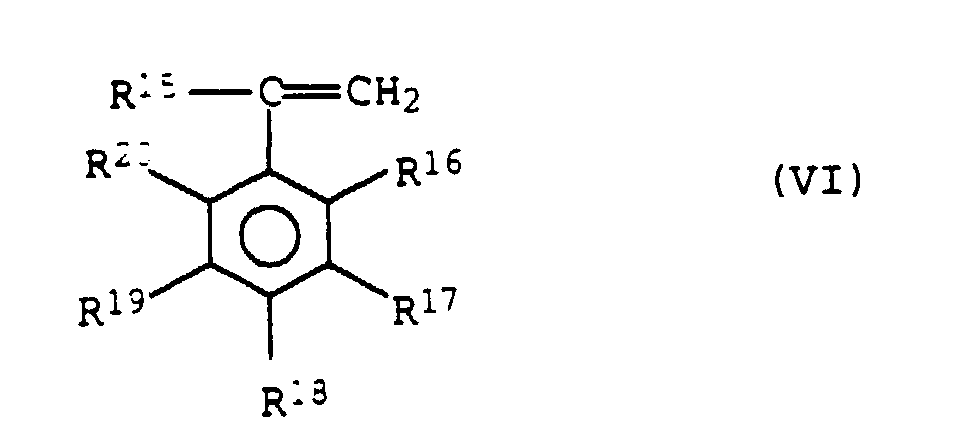
- R15
- Wasserstoff oder C1- bis C4-Alkyl,
- R16 bis R20
- unabhängig voneinander Wasserstoff, C1- bis C12-Alkyl, C6- bis C18-Aryl, Halogen oder wobei zwei benachbarte Reste gemeinsam für 4 bis 15 C-Atome aufweisende cyclische Gruppen stehen.
- R15
- Wasserstoff bedeutet
- R16 bis R20
- für Wasserstoff, C1- bis C4-Alkyl, Chlor oder Phenyl stehen oder wobei zwei benachbarte Reste gemeinsam für 4 bis 15 C-Atome aufweisende cyclische Gruppen stehen, so daß sich als Verbindungen der allgemeinen Formel VI beispielsweise Naphthalinderivate oder Anthracenderivate ergeben.
- mit Y
- Fluor, Chlor, Brom oder Jod
- und y
- 1, 2 oder 3


- M1
- ein Element der III. Hauptgruppe des Periodensystems bedeutet, insbesondere B, Al oder Ga, vorzugsweise B,
- X1, X2 und X3
- für Wasserstoff, C1- bis C10-Alkyl, C6- bis C15-Aryl, Alkylaryl, Arylalkyl, Halogenalkyl oder Halogenaryl mit jeweils 1 bis 10 C-Atomen im Alkylrest und 6 bis 20 C-Atome im Arylrest oder Fluor, Chlor, Brom oder Jod stehen, insbesondere für Halogenaryle, vorzugsweise für Pentafluorphenyl.
- A
- ein Element der I. bis VI. Hauptgruppe oder der I. bis VIII. Nebengruppe des Periodensystems bedeutet,
- Q1 bis Qz
- für einfach negativ geladene Reste wie C1- bis C28-Alkyl, C6- bis C15-Aryl, Alkylaryl, Arylalkyl, Halogenalkyl, Halogenaryl mit jeweils 6 bis 20 C-Atomen im Aryl- und 1 bis 28 C-Atome im Alkylrest, C1- bis C10-Cycloalkyl, welches gegebenenfalls mit C1- bis C10-Alkylgruppen substituiert sein kann, Halogen, C1-bis C28-Alkoxy, C6- bis C15-Aryloxy, Silyl- oder Mercaptylgruppen
- a
- für ganze Zahlen von 1 bis 6 steht,
- z
- für ganze Zahlen von 0 bis 5
- d
- der Differenz a - z entspricht, wobei d jedoch größer oder gleich 1 ist.
Claims (6)
- Verfahren zur Herstellung von Polymerisaten von vinylaromatischen Verbindungen bei Temperaturen im Bereich von 0 bis 150°C in Gegenwart von Katalysatorsystemen, dadurch gekennzeichnet, daß als Katalysatorsysteme solche verwendet werden, die als aktive Bestandteileenthalten.A) Verbindungen der allgemeinen Formel I
1 (Z2)z2 (Z3)z3 - X
- C1- bis C10-Alkyl, 5- bis 7-gliedriges Cycloalkyl,
C1- bis C10-Alkoxy, C6- bis C15-Aryl oder Verbindungen
der allgemeinen Formel II

- mit R1 bis R5
- Wasserstoff, C1- bis C10-Alkyl, das 1- bis 5fach mit Halogen substituiert sein kann, 5- bis 7-gliedriges Cycloalkyl, das seinerseits C1- bis C6-Alkylgruppen als Substituenten tragen kann, C6- bis C15-Aryl oder Arylalkyl und wobei gegebenenfalls auch zwei benachbarte Reste gemeinsam für 4 bis 15 C-Atome aufweisende cyclische Gruppen stehen können, oder Halogen, C1- bis C10-Alkoxy, NR6R7 oder Si(R6)3,
- mit R6 und R7
- Wasserstoff, C1- bis C10-Alkyl, C6- bis C15-Aryl oder C3- bis C10-Cycloalkyl,
- M
- ein Metall der II. bis VIII. Nebengruppe des Periodensystems der Elemente
- Z1 bis Z3
- Polymere von vinylaromatischen Verbindungen, Dienen, Acrylaten oder deren Mischungen
- z1 bis z3
- 0, 1, 2 oder 3, wobei 1 ≤ z1+z2+z3 ≤ 3 ist,
B) offenkettige oder cyclische Alumoxanverbindungen der allgemeinen Formel III oder IV wobei R8 eine C1- bis C4-Alkylgruppe bedeutet und m für eine ganze Zahl von 5 bis 30 steht,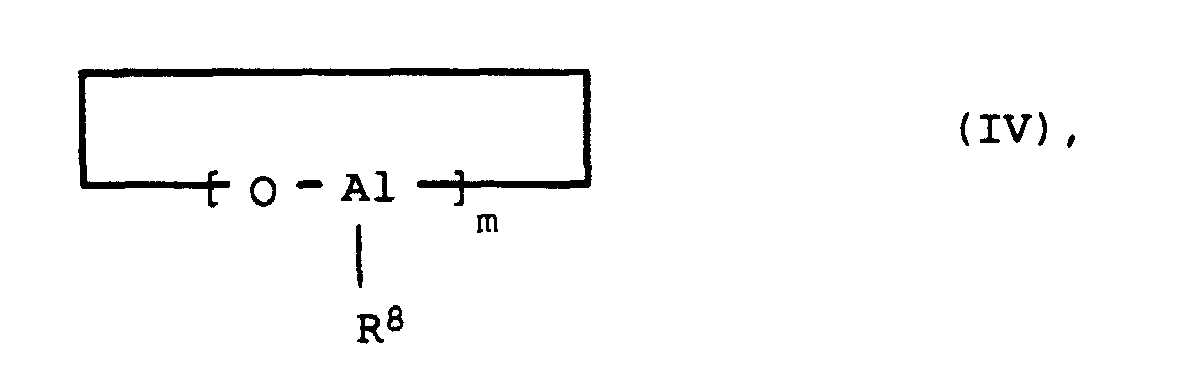
oder
metalloceniumionenbildende Verbindungen, ausgewählt aus der Gruppe bestehend aus starken, neutralen Lewissäuren, ionischen Verbindungen mit lewissaurem Kation und ionischen Verbindungen mit einer Brönsted-Säure als Kation - Verfahren nach Anspruch 1, dadurch gekennzeichnet, daß als vinylaromatische Verbindungen Verbindungen der allgemeinen Formel Vin der die Substituenten folgende Bedeutung haben:

- R9
- Wasserstoff oder C1- bis C4- Alkyl,
- R10 bis R14
- unabhängig voneinander Wasserstoff, C1- bis C12-Alkyl, C6- bis C18-Aryl, Halogen oder wobei zwei benachbarte Reste gemeinsam für 4 bis 15 C-Atome aufweisende cyclische Gruppen stehen
- Verfahren nach den Ansprüchen 1 bis 2, dadurch gekennzeichnet, daß als vinylaromatische Verbindungen der allgemeinen Formel V solche eingesetzt werden, in denen
- R9
- Wasserstoff bedeutet
- R10 bis R14
- für Wasserstoff, C1- bis C4- Alkyl, Chlor oder Phenyl stehen, oder wobei zwei benachbarte Reste gemeinsam für 4 bis 12 C-Atome aufweisende cyclische Gruppen stehen.
- Verfahren nach den Ansprüchen 1 bis 3, dadurch gekennzeichnet, daß als Komponente A) Verbindungen der allgemeinen Formel I eingesetzt werden, in denen
- X
- für Verbindungen der allgemeinen Formel II steht,
- M
- ein Metall der IV. bis VI. Nebengruppe bedeutet
- Z1 bis Z3
- für Polymere von vinylaromatischen Verbindungen
der allgemeinen Formel VI
in der die Substituenten folgende Bedeutung haben:

- R15
- Wasserstoff oder C1- bis C4-Alkyl,
- R16 bis R20
- unabhängig voneinander Wasserstoff, C1- bis C12-Alkyl, C6- bis C18-Aryl, Halogen oder wobei zwei benachbarte Reste gemeinsam für 4 bis 15 C-Atom C-Atome aufweisende cyclische Gruppen stehen,
- Verfahren nach den Ansprüchen 1 bis 4, dadurch gekennzeichnet, daß als Komponente B) starke, neutrale Lewissäuren der allgemeinen Formel
- M1
- ein Element der III. Hauptgruppe des Periodensystems bedeutet,
- X1, X2 und X3
- für Wasserstoff, C1- bis C10-Alkyl, C6- bis C15-Aryl, Alkylaryl, Arylalkyl, Halogenalkyl oder Halogenaryl mit jeweils 1 bis 10 C-Atomen im Alkylrest und 6 bis 20 C-Atome im Arylrest oder Fluor, Chlor, Brom oder Jod stehen
- Verwendung der gemäß den Ansprüchen 1 bis 4 hergestellten Polymerisate von vinylaromatischen Verbindungen zur Herstellung von Formkörpern.
Applications Claiming Priority (5)
| Application Number | Priority Date | Filing Date | Title |
|---|---|---|---|
| DE19506554 | 1995-02-24 | ||
| DE1995106556 DE19506556A1 (de) | 1995-02-24 | 1995-02-24 | Verfahren zur Herstellung von Polymerisaten von vinylaromatischen Verbindungen unter Verwendung von Polymere enthaltenden Katalysatorsystemen |
| DE1995106554 DE19506554A1 (de) | 1995-02-24 | 1995-02-24 | Verfahren zur Herstellung von Polymerisaten von vinylaromatischen Verbindungen unter Verwendung von Polymere enthaltenden Katalysatorsystemen |
| DE19506556 | 1995-02-24 | ||
| PCT/EP1996/000600 WO1996026227A2 (de) | 1995-02-24 | 1996-02-13 | Verfahren zur herstellung von polymerisaten von vinylaromatischen verbindungen unter verwendung von polymere enthaltenden katalysatorsystemen |
Publications (2)
| Publication Number | Publication Date |
|---|---|
| EP0811023A2 EP0811023A2 (de) | 1997-12-10 |
| EP0811023B1 true EP0811023B1 (de) | 1999-05-06 |
Family
ID=26012792
Family Applications (1)
| Application Number | Title | Priority Date | Filing Date |
|---|---|---|---|
| EP96904072A Expired - Lifetime EP0811023B1 (de) | 1995-02-24 | 1996-02-13 | Verfahren zur herstellung von polymerisaten von vinylaromatischen verbindungen unter verwendung von polymere enthaltenden katalysatorsystemen |
Country Status (7)
| Country | Link |
|---|---|
| US (1) | US5922819A (de) |
| EP (1) | EP0811023B1 (de) |
| JP (1) | JPH11500766A (de) |
| CN (1) | CN1175960A (de) |
| DE (1) | DE59601827D1 (de) |
| ES (1) | ES2131932T3 (de) |
| WO (1) | WO1996026227A2 (de) |
Families Citing this family (2)
| Publication number | Priority date | Publication date | Assignee | Title |
|---|---|---|---|---|
| DE19805118A1 (de) * | 1998-02-09 | 1999-09-09 | Bayer Ag | Neue polymerisationsinitiierende geträgerte Systeme zur ionischen Polymerisation von konjugierten Dienen und zur Copolymerisation dieser mit weiteren Monomeren in Suspensions- oder Gasphasenverfahren |
| TWI628035B (zh) | 2017-08-09 | 2018-07-01 | 財團法人工業技術研究院 | 熱穩定控制系統與方法 |
Family Cites Families (13)
| Publication number | Priority date | Publication date | Assignee | Title |
|---|---|---|---|---|
| LU34258A1 (de) * | 1955-03-21 | |||
| JPS5054589A (de) * | 1973-09-13 | 1975-05-14 | ||
| DE2835944A1 (de) * | 1978-08-17 | 1980-03-13 | Heyl & Co | Metallhaltige loesliche polymere katalysatoren fuer polymerisationen, verfahren zur herstellung derselben und ihre verwendung in polymerisationsverfahren |
| CA1268754A (en) * | 1985-06-21 | 1990-05-08 | Howard Curtis Welborn, Jr. | Supported polymerization catalyst |
| EP0284708B1 (de) * | 1987-04-03 | 1996-01-31 | Fina Technology, Inc. | Metallocen-katalysatorsysteme für die Polymersation von Olefinen, mit einer Silizium-Hydrocarbyl-Brücke. |
| US4794096A (en) * | 1987-04-03 | 1988-12-27 | Fina Technology, Inc. | Hafnium metallocene catalyst for the polymerization of olefins |
| IL96810A0 (en) * | 1990-01-02 | 1991-09-16 | Exxon Chemical Patents Inc | Supported ionic metallocene catalysts for olefin polymerization and methods for the preparation thereof |
| JP2923383B2 (ja) * | 1991-10-01 | 1999-07-26 | 出光石油化学株式会社 | スチレン系重合体の製造方法 |
| JP3216734B2 (ja) * | 1992-08-14 | 2001-10-09 | 出光石油化学株式会社 | スチレン系重合体の製造方法 |
| FR2725993B1 (fr) * | 1994-10-21 | 1996-11-29 | Atochem Elf Sa | Composante catalytique solide contenant du zirconium et des groupements cycloalcadienyles, son procede d'obtention et procede de polymerisation des olefines en sa presence |
| US5770755A (en) * | 1994-11-15 | 1998-06-23 | Phillips Petroleum Company | Process to prepare polymeric metallocenes |
| US5610115A (en) * | 1995-07-20 | 1997-03-11 | Samsung General Chemicals Co., Ltd. | Organic carrier supported metallocene catalyst for olefin polymerization |
| JPH0977819A (ja) * | 1995-09-11 | 1997-03-25 | Daicel Chem Ind Ltd | ポリオレフィン製造用触媒、およびポリオレフィンの製造方法 |
-
1996
- 1996-02-13 EP EP96904072A patent/EP0811023B1/de not_active Expired - Lifetime
- 1996-02-13 CN CN96192082A patent/CN1175960A/zh active Pending
- 1996-02-13 US US08/894,243 patent/US5922819A/en not_active Expired - Fee Related
- 1996-02-13 ES ES96904072T patent/ES2131932T3/es not_active Expired - Lifetime
- 1996-02-13 DE DE59601827T patent/DE59601827D1/de not_active Expired - Lifetime
- 1996-02-13 WO PCT/EP1996/000600 patent/WO1996026227A2/de not_active Ceased
- 1996-02-13 JP JP8525359A patent/JPH11500766A/ja active Pending
Also Published As
| Publication number | Publication date |
|---|---|
| WO1996026227A3 (de) | 1996-10-03 |
| US5922819A (en) | 1999-07-13 |
| DE59601827D1 (de) | 1999-06-10 |
| WO1996026227A2 (de) | 1996-08-29 |
| JPH11500766A (ja) | 1999-01-19 |
| EP0811023A2 (de) | 1997-12-10 |
| ES2131932T3 (es) | 1999-08-01 |
| CN1175960A (zh) | 1998-03-11 |
Similar Documents
| Publication | Publication Date | Title |
|---|---|---|
| DE19757563A1 (de) | Geträgertes Katalysatorsystem, Verfahren zur Herstellung und seine Verwendung zur Polymerisation von Olefinen | |
| EP0920463A1 (de) | Sternpolymere und verfahren zu deren herstellung | |
| DE69012183T2 (de) | Verfahren zur Herstellung eines Polymers auf der Basis von Styrol. | |
| DE19622272A1 (de) | Copolymere von Alk-1-enen und a,beta-Dienen mit erhöhtem Viskositätsindex | |
| EP0811023B1 (de) | Verfahren zur herstellung von polymerisaten von vinylaromatischen verbindungen unter verwendung von polymere enthaltenden katalysatorsystemen | |
| EP0866813B1 (de) | Verfahren zur herstellung von polymerisaten von vinylaromatischen verbindungen in einer stufe unter verwendung von doppelschneckenextrudern | |
| EP0861273B1 (de) | Verfahren zur herstellung von copolymerisaten aus vinylaromatischen und olefinischen verbindungen durch dispersionspolymerisation in gegenwart von metallocenkatalysatorsystemen | |
| DE19602543A1 (de) | Verfahren zur Herstellung von Polymerisaten von C¶2¶- bis C¶1¶¶0¶-Alkenen in Gegenwart von Metallocenkomplexen mit kationisch funktionalisierten Cyclopentadienylliganden | |
| EP0866812B1 (de) | Verfahren zur herstellung von copolymerisaten von vinylaromatischen verbindungen in einer stufe unter verwendung von doppelschneckenextrudern | |
| WO1996020226A1 (de) | Verfahren zur herstellung von polymerisaten von vinylaromatischen verbindungen unter verwendung von mischungen von metallocenkatalysatorsystemen | |
| EP0951490B1 (de) | Verfahren zur herstellung von polymerisaten aus vinylaromatischen verbindungen durch dispersionspolymerisation | |
| EP0815148B1 (de) | Verfahren zur herstellung von polymerisaten von vinylaromatischen verbindungen unter druck in gegenwart von leicht flüchtigen kohlenwasserstoffen | |
| EP0931100B1 (de) | Katalysatorsysteme, enthaltend metallkomplexe mit adamantanähnlicher struktur | |
| DE19506554A1 (de) | Verfahren zur Herstellung von Polymerisaten von vinylaromatischen Verbindungen unter Verwendung von Polymere enthaltenden Katalysatorsystemen | |
| EP0903358A1 (de) | Propfcopolymere | |
| EP0811022B1 (de) | Polymere enthaltende katalysatorsysteme | |
| DE19506556A1 (de) | Verfahren zur Herstellung von Polymerisaten von vinylaromatischen Verbindungen unter Verwendung von Polymere enthaltenden Katalysatorsystemen | |
| EP0991674B1 (de) | Cyclopenta[i]phenanthren-metallkomplex-katalysatorsysteme | |
| DE19714548A1 (de) | Thermoplastische Formmassen | |
| DE19500811A1 (de) | Verfahren zur Herstellung von Polymerisaten von vinylaromatischen Verbindungen unter Verwendung von Mischungen von Metallocenkatalysatorsystemen | |
| DE4446385A1 (de) | Verfahren zur Herstellung von Polymerisaten von vinylaromatischen Verbindungen unter Verwendung von Mischungen von Metallocenkatalysatorsystemen | |
| DE19509783A1 (de) | Verfahren zur Herstellung von Polymerisaten von vinylaromatischen Verbindungen unter Druck in Gegenwart von leicht flüchtigen Kohlenwasserstoffen |
Legal Events
| Date | Code | Title | Description |
|---|---|---|---|
| PUAI | Public reference made under article 153(3) epc to a published international application that has entered the european phase |
Free format text: ORIGINAL CODE: 0009012 |
|
| 17P | Request for examination filed |
Effective date: 19970725 |
|
| AK | Designated contracting states |
Kind code of ref document: A2 Designated state(s): BE DE ES FR GB NL |
|
| 17Q | First examination report despatched |
Effective date: 19971125 |
|
| GRAG | Despatch of communication of intention to grant |
Free format text: ORIGINAL CODE: EPIDOS AGRA |
|
| GRAG | Despatch of communication of intention to grant |
Free format text: ORIGINAL CODE: EPIDOS AGRA |
|
| GRAH | Despatch of communication of intention to grant a patent |
Free format text: ORIGINAL CODE: EPIDOS IGRA |
|
| GRAH | Despatch of communication of intention to grant a patent |
Free format text: ORIGINAL CODE: EPIDOS IGRA |
|
| GRAA | (expected) grant |
Free format text: ORIGINAL CODE: 0009210 |
|
| AK | Designated contracting states |
Kind code of ref document: B1 Designated state(s): BE DE ES FR GB NL |
|
| REF | Corresponds to: |
Ref document number: 59601827 Country of ref document: DE Date of ref document: 19990610 |
|
| GBT | Gb: translation of ep patent filed (gb section 77(6)(a)/1977) |
Effective date: 19990601 |
|
| REG | Reference to a national code |
Ref country code: ES Ref legal event code: FG2A Ref document number: 2131932 Country of ref document: ES Kind code of ref document: T3 |
|
| ET | Fr: translation filed | ||
| PLBE | No opposition filed within time limit |
Free format text: ORIGINAL CODE: 0009261 |
|
| STAA | Information on the status of an ep patent application or granted ep patent |
Free format text: STATUS: NO OPPOSITION FILED WITHIN TIME LIMIT |
|
| 26N | No opposition filed | ||
| REG | Reference to a national code |
Ref country code: GB Ref legal event code: IF02 |
|
| PGFP | Annual fee paid to national office [announced via postgrant information from national office to epo] |
Ref country code: FR Payment date: 20020117 Year of fee payment: 7 |
|
| PGFP | Annual fee paid to national office [announced via postgrant information from national office to epo] |
Ref country code: NL Payment date: 20020121 Year of fee payment: 7 |
|
| PGFP | Annual fee paid to national office [announced via postgrant information from national office to epo] |
Ref country code: GB Payment date: 20020201 Year of fee payment: 7 |
|
| PGFP | Annual fee paid to national office [announced via postgrant information from national office to epo] |
Ref country code: ES Payment date: 20020208 Year of fee payment: 7 |
|
| PGFP | Annual fee paid to national office [announced via postgrant information from national office to epo] |
Ref country code: DE Payment date: 20020215 Year of fee payment: 7 |
|
| PGFP | Annual fee paid to national office [announced via postgrant information from national office to epo] |
Ref country code: BE Payment date: 20020222 Year of fee payment: 7 |
|
| PG25 | Lapsed in a contracting state [announced via postgrant information from national office to epo] |
Ref country code: GB Free format text: LAPSE BECAUSE OF NON-PAYMENT OF DUE FEES Effective date: 20030213 |
|
| PG25 | Lapsed in a contracting state [announced via postgrant information from national office to epo] |
Ref country code: ES Free format text: LAPSE BECAUSE OF NON-PAYMENT OF DUE FEES Effective date: 20030214 |
|
| PG25 | Lapsed in a contracting state [announced via postgrant information from national office to epo] |
Ref country code: BE Free format text: LAPSE BECAUSE OF NON-PAYMENT OF DUE FEES Effective date: 20030228 |
|
| PG25 | Lapsed in a contracting state [announced via postgrant information from national office to epo] |
Ref country code: DE Free format text: LAPSE BECAUSE OF THE APPLICANT RENOUNCES Effective date: 20030325 |
|
| PG25 | Lapsed in a contracting state [announced via postgrant information from national office to epo] |
Ref country code: NL Free format text: LAPSE BECAUSE OF NON-PAYMENT OF DUE FEES Effective date: 20030901 |
|
| GBPC | Gb: european patent ceased through non-payment of renewal fee | ||
| PG25 | Lapsed in a contracting state [announced via postgrant information from national office to epo] |
Ref country code: FR Free format text: LAPSE BECAUSE OF NON-PAYMENT OF DUE FEES Effective date: 20031031 |
|
| NLV4 | Nl: lapsed or anulled due to non-payment of the annual fee |
Effective date: 20030901 |
|
| REG | Reference to a national code |
Ref country code: FR Ref legal event code: ST |
|
| REG | Reference to a national code |
Ref country code: ES Ref legal event code: FD2A Effective date: 20030214 |