EP0811046B1 - Procede de fabrication d'un filtre cholesterique commutable et d'un luminaire le comportant - Google Patents
Procede de fabrication d'un filtre cholesterique commutable et d'un luminaire le comportant Download PDFInfo
- Publication number
- EP0811046B1 EP0811046B1 EP96938422A EP96938422A EP0811046B1 EP 0811046 B1 EP0811046 B1 EP 0811046B1 EP 96938422 A EP96938422 A EP 96938422A EP 96938422 A EP96938422 A EP 96938422A EP 0811046 B1 EP0811046 B1 EP 0811046B1
- Authority
- EP
- European Patent Office
- Prior art keywords
- mixture
- filter
- polymerizable
- photo
- liquid
- Prior art date
- Legal status (The legal status is an assumption and is not a legal conclusion. Google has not performed a legal analysis and makes no representation as to the accuracy of the status listed.)
- Expired - Lifetime
Links
Images


Classifications
-
- C—CHEMISTRY; METALLURGY
- C09—DYES; PAINTS; POLISHES; NATURAL RESINS; ADHESIVES; COMPOSITIONS NOT OTHERWISE PROVIDED FOR; APPLICATIONS OF MATERIALS NOT OTHERWISE PROVIDED FOR
- C09K—MATERIALS FOR MISCELLANEOUS APPLICATIONS, NOT PROVIDED FOR ELSEWHERE
- C09K19/00—Liquid crystal materials
- C09K19/52—Liquid crystal materials characterised by components which are not liquid crystals, e.g. additives with special physical aspect: solvents, solid particles
- C09K19/54—Additives having no specific mesophase characterised by their chemical composition
- C09K19/542—Macromolecular compounds
-
- C—CHEMISTRY; METALLURGY
- C09—DYES; PAINTS; POLISHES; NATURAL RESINS; ADHESIVES; COMPOSITIONS NOT OTHERWISE PROVIDED FOR; APPLICATIONS OF MATERIALS NOT OTHERWISE PROVIDED FOR
- C09K—MATERIALS FOR MISCELLANEOUS APPLICATIONS, NOT PROVIDED FOR ELSEWHERE
- C09K19/00—Liquid crystal materials
- C09K19/04—Liquid crystal materials characterised by the chemical structure of the liquid crystal components, e.g. by a specific unit
- C09K19/38—Polymers
-
- F—MECHANICAL ENGINEERING; LIGHTING; HEATING; WEAPONS; BLASTING
- F21—LIGHTING
- F21V—FUNCTIONAL FEATURES OR DETAILS OF LIGHTING DEVICES OR SYSTEMS THEREOF; STRUCTURAL COMBINATIONS OF LIGHTING DEVICES WITH OTHER ARTICLES, NOT OTHERWISE PROVIDED FOR
- F21V9/00—Elements for modifying spectral properties, polarisation or intensity of the light emitted, e.g. filters
- F21V9/14—Elements for modifying spectral properties, polarisation or intensity of the light emitted, e.g. filters for producing polarised light
-
- G—PHYSICS
- G02—OPTICS
- G02F—OPTICAL DEVICES OR ARRANGEMENTS FOR THE CONTROL OF LIGHT BY MODIFICATION OF THE OPTICAL PROPERTIES OF THE MEDIA OF THE ELEMENTS INVOLVED THEREIN; NON-LINEAR OPTICS; FREQUENCY-CHANGING OF LIGHT; OPTICAL LOGIC ELEMENTS; OPTICAL ANALOGUE/DIGITAL CONVERTERS
- G02F1/00—Devices or arrangements for the control of the intensity, colour, phase, polarisation or direction of light arriving from an independent light source, e.g. switching, gating or modulating; Non-linear optics
- G02F1/01—Devices or arrangements for the control of the intensity, colour, phase, polarisation or direction of light arriving from an independent light source, e.g. switching, gating or modulating; Non-linear optics for the control of the intensity, phase, polarisation or colour
- G02F1/13—Devices or arrangements for the control of the intensity, colour, phase, polarisation or direction of light arriving from an independent light source, e.g. switching, gating or modulating; Non-linear optics for the control of the intensity, phase, polarisation or colour based on liquid crystals, e.g. single liquid crystal display cells
- G02F1/137—Devices or arrangements for the control of the intensity, colour, phase, polarisation or direction of light arriving from an independent light source, e.g. switching, gating or modulating; Non-linear optics for the control of the intensity, phase, polarisation or colour based on liquid crystals, e.g. single liquid crystal display cells characterised by the electro-optical or magneto-optical effect, e.g. field-induced phase transition, orientation effect, guest-host interaction or dynamic scattering
- G02F1/13718—Devices or arrangements for the control of the intensity, colour, phase, polarisation or direction of light arriving from an independent light source, e.g. switching, gating or modulating; Non-linear optics for the control of the intensity, phase, polarisation or colour based on liquid crystals, e.g. single liquid crystal display cells characterised by the electro-optical or magneto-optical effect, e.g. field-induced phase transition, orientation effect, guest-host interaction or dynamic scattering based on a change of the texture state of a cholesteric liquid crystal
-
- C—CHEMISTRY; METALLURGY
- C09—DYES; PAINTS; POLISHES; NATURAL RESINS; ADHESIVES; COMPOSITIONS NOT OTHERWISE PROVIDED FOR; APPLICATIONS OF MATERIALS NOT OTHERWISE PROVIDED FOR
- C09K—MATERIALS FOR MISCELLANEOUS APPLICATIONS, NOT PROVIDED FOR ELSEWHERE
- C09K2323/00—Functional layers of liquid crystal optical display excluding electroactive liquid crystal layer characterised by chemical composition
- C09K2323/05—Bonding or intermediate layer characterised by chemical composition, e.g. sealant or spacer
- C09K2323/057—Ester polymer, e.g. polycarbonate, polyacrylate or polyester
-
- G—PHYSICS
- G02—OPTICS
- G02F—OPTICAL DEVICES OR ARRANGEMENTS FOR THE CONTROL OF LIGHT BY MODIFICATION OF THE OPTICAL PROPERTIES OF THE MEDIA OF THE ELEMENTS INVOLVED THEREIN; NON-LINEAR OPTICS; FREQUENCY-CHANGING OF LIGHT; OPTICAL LOGIC ELEMENTS; OPTICAL ANALOGUE/DIGITAL CONVERTERS
- G02F1/00—Devices or arrangements for the control of the intensity, colour, phase, polarisation or direction of light arriving from an independent light source, e.g. switching, gating or modulating; Non-linear optics
- G02F1/01—Devices or arrangements for the control of the intensity, colour, phase, polarisation or direction of light arriving from an independent light source, e.g. switching, gating or modulating; Non-linear optics for the control of the intensity, phase, polarisation or colour
- G02F1/13—Devices or arrangements for the control of the intensity, colour, phase, polarisation or direction of light arriving from an independent light source, e.g. switching, gating or modulating; Non-linear optics for the control of the intensity, phase, polarisation or colour based on liquid crystals, e.g. single liquid crystal display cells
- G02F1/133—Constructional arrangements; Operation of liquid crystal cells; Circuit arrangements
- G02F1/1333—Constructional arrangements; Manufacturing methods
- G02F1/1334—Constructional arrangements; Manufacturing methods based on polymer dispersed liquid crystals, e.g. microencapsulated liquid crystals
- G02F1/13345—Network or three-dimensional gels
Definitions
- the invention relates to a method of manufacturing a switchable cholesteric filter comprising an optically active layer, in which a mixture of polymerizable, liquid-crystalline molecules is provided between two, substantially parallel substrates, which are each provided with an electrode for applying an electric field, said mixture subsequently being polymerized by means of UV light to form an optically active layer of cholesteric order comprising a three-dimensional polymeric network.
- the invention also relates to a luminaire which is provided with such a switchable cholesteric filter.
- a method of the type mentioned in the opening paragraph is known per se.
- Said filter is manufactured by providing a polymerizable mixture between two, substantially parallel transparent substrates which are each provided with a transparent electrode, for example, of ITO.
- the mixture used in said method contains various types of liquid-crystalline molecules, which comprise zero, one or two polymerizable groups.
- the composition of the mixture is chosen to be such that a cholesteric order occurs at a specific temperature.
- the polymerized, optically active layer comprises a slightly crosslinked polymeric network.
- the cholesteric filter has a satisfactory thermal stability as well as good switching properties. It is noted that the expression “switching of a cholesteric filter” is to be understood to mean herein "changing the reflection characteristic of the filter, such as in particular the intensity of the reflection band, under the influence of an electric field".
- the cholesteric filter obtained by means of the known method has an important disadvantage. It has been found that the bandwidth of the known filter is relatively small, i.e. in general approximately 70 nm. For a number of applications of the filter, this bandwidth is insufficient. This applies, in particular, if the reflection band of the filter should comprise the entire spectrum of visible light, or at least a substantial part thereof. In principle, this problem can be solved by using a stack of cholesteric filters whose reflection bands are in different positions relative to each other, so that the filters together cover a substantial part of the visible spectrum.
- the disadvantage of this solution is that a construction is obtained which has a relatively large overall thickness, that transmission losses occur as a result of the large number of electrode layers, and that losses occur due to light diffusion between the individual filters. It is noted that the term "bandwidth" is to be understood to mean the width of the reflection band or transmission band measured halfway the height of the band.
- the invention more particularly aims at a method of manufacturing a switchable, cholesteric filter whose bandwidth is considerably larger than 70 nm, preferably larger than 100 nm, and, in particular, larger than 150 nm.
- a method of manufacturing a switchable, cholesteric filter comprising an optically active layer, in which a mixture of polymerizable, liquid-crystalline molecules is provided between two, substantially parallel substrates, which are each provided with an electrode for applying an electric field, said mixture subsequently being polymerized by means of UV light to form an optically active layer of cholesteric order comprising a three-dimensional polymeric network, which method is characterized in accordance with the invention, in that a quantity of a photo-stabilizing compound is added to the mixture.
- the method in accordance with the invention enables switchable, cholesteric filters to be manufactured which have a relatively wide reflection band. For example, bandwidths of 100 nm and 150 nm have been achieved by means of the method in accordance with the invention. It has been found that filters having a bandwidth of 200 nm, and even 250 nm or more, can be manufactured by means of the inventive method.
- the invention is based on the experimentally gained insight that the presence of photo-stabilizing compounds in the polymerizable mixture gives rise to the formation of an inhomogeneous polymeric network.
- the exact working mechanism of the invention is not (yet) known. It is assumed that during the polymerization process domains are formed in the mixture to be polymerized around the molecules of the photo-stabilizing compounds, and that polymerization is retarded within said domains. As a result, small differences in concentration between the polymerizable molecules inside these domains and outside these domains occur, so that diffusion of these molecules takes place. As a result, the network eventually formed exhibits a more or less inhomogeneous structure in the optically active layer.
- This inhomogeneous structure of the network leads to a certain degree of variation in the pitch of the helix-like structure formed in the optically active layer, which structure is characteristic of the cholesteric order in the layer. Said variation in pitch is preserved, also after termination of the polymerization process, partly because (a part of) the molecules causing the cholesteric order are incorporated in the network. This possible working mechanism can explain why the cholesteric filter formed has such a relatively large bandwidth.
- photo-stabilizing compounds as well as their working mechanism are known per se, for example, from "Photochemistry of Man-Made Polymers", J.F. Mc, Kellar and N.S. Allen, Applied Science Publishers Ltd, London, 1979, pp. 216-255. Such compounds are customarily added to polymers which have already been formed, to preclude decomposition of said polymers under the influence of sunlight.
- the cholesteric filter manufactured in accordance with the invention exhibits a very rapid switching behavior. This occurs when an electric field is applied across the optically active layer or when the intensity of such an electric field is changed. It has been found that the intensity of the relatively wide reflection band decreases substantially if an electric field is applied across the optically active layer by means of the electrodes. If the electric field is removed, the original, relatively wide reflection band returns instantly.
- the switching behavior of the cholesteric filter in accordance with the invention is remarkably reproducible when said filter is used over a prolonged period of time.
- the wavelength and the intensity of the reflection band are unchanged after removal of the voltage.
- the reflection characteristic of the filter which is measured before and after the switching test, is substantially unchanged.
- the maximally required field strengths are of the order of 20 V/micron or less.
- a preferred embodiment of the method in accordance with the invention is characterized in that the quantity of the photo-stabilizing compound which is added to the mixture amounts maximally to 5 wt.%, calculated with respect to the overall volume of the mixture. It has been found that larger quantities may lead to relatively great disturbances in the formation of the polymeric network. This causes optical losses in the filter.
- the quantity of photo-stabilizing compound preferably amounts to 0.05-2.5 wt.% relative to the overall volume of the mixture.
- Another preferred embodiment of the method in accordance with the invention is characterized in that a compound of the "excited state quencher" type is added as the photo-stabilizing compound.
- a compound of the "excited state quencher” type is added as the photo-stabilizing compound.
- Such compounds are capable of deactivating "photo-excited” compounds before the latter can be converted to radicals which might go on reacting. It has been found that the necessary quantity of this type of photo-stabilizing compound is much smaller than that of other types of compounds, such as UV-absorbing compounds or free-radical scavenging compounds. If use is made of excited state quenchers, quantities of 0.02-1.5 wt.%, calculated with respect to the overall volume of the mixture, are sufficient.
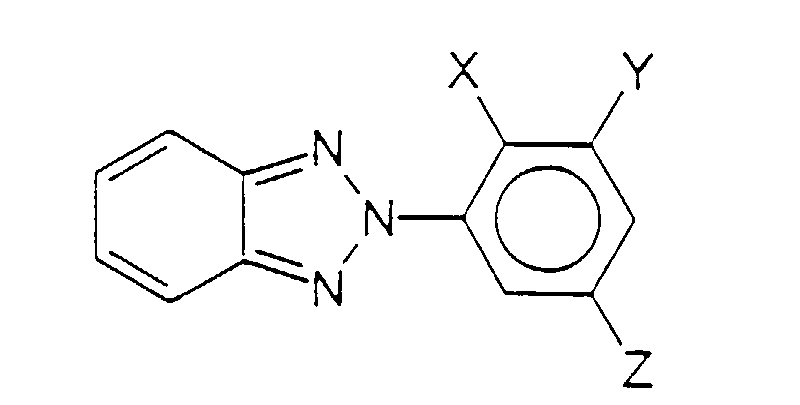
- Another interesting embodiment of the method in accordance with the invention is characterized in that for the photo-stabilizing compound use is made of a compound whose composition corresponds to the formula where X, Y and Z are groups selected from the series consisting of H, OH, CH 3 or C(CH 3 ) 3 .
- This class of compounds is marketed under the trade name TinuvinTM (Ciba Geigy).
- these compounds are readily miscible with customary liquid-crystalline monomers. By virtue thereof, polymerization of the mixture takes place very uniformly.
- Another interesting embodiment of the method in accordance with the invention is characterized in that for the photo-stabilizing compound use is made of a compound whose composition corresponds to the formula where X and Y are groups selected from the series consisting of H or an electron-accepting group such as CN or NO 2 , and where R and R' are groups selected from the series consisting of H, an electron-accepting group such as CN or NO 2 , an aliphatic group and an aromatic group.
- the quantity of monomers with two or more polymerizable groups is preferably maximally 2 wt.% relative to the overall volume of the polymerizable mixture. If a larger quantity of this type of monomers is used, the modulus of elasticity (E) of the polymerized layer becomes too large. This results in relatively high switching voltages and a slow and incomplete response of the liquid-crystalline material to the application or the change of an electric field. This adversely affects the switching behavior of a cholesteric filter. It has been found that the desired properties of the cholesteric filter are optimal if, during the manufacture of the optically active layer, a quantity of approximately 0.1-1 wt.% of monomers with two or more polymerizable groups is used.
- the quantity of monomers with one polymerizable group preferably amounts maximally to 90 wt.%, calculated with respect to the overall volume of the polymerizable mixture. If a larger quantity of this type of monomer is used, the viscosity of the polymerized, optically active layer becomes unacceptably high. This adversely affects the switching behavior of the optical layer. Switching of the filter at the operating temperature becomes practically impossible under these circumstances. It has been found that the desired properties of the cholesteric filter are optimal if, during the manufacture of the optically active layer, a quantity of 20-60 wt.% of monomers with one polymerizable group is used.
- the monomers with one polymerizable group can be chiral as well as achiral.
- the filter comprises liquid-crystalline groups which are linked as side groups to the chains of the network via a single chemical bond.
- This first type of liquid-crystalline groups originates from the liquid-crystalline monomers which were provided with one polymerizable group.
- the filter comprises liquid-crystalline groups which are not linked to the network via a chemical bond.
- This second type of liquid-crystalline groups originates from the liquid-crystalline compounds which are chemically inert. Since the first type of liquid-crystalline groups is linked to the chains of the network via a chemical bond, their mobility in the optically active layer is smaller than that of the second type of liquid-crystalline groups. Under these conditions, the first type of groups can function as a kind of switch between, on the one hand, the liquid-crystalline molecules which are freely incorporated in the network and, on the other hand, the relatively rigid network.
- a larger or smaller proportion of the free molecules is chiral, and the rest is achiral.
- These liquid-crystalline molecules do not comprise polymerizable groups and hence are considered “chemically inert” or "free". After the polymerization of the mixture, these chemically inert molecules form, as it were, a mobile phase between a stationary phase, which is formed by the chains of the three-dimensional polymeric network.
- the liquid-crystalline group(s) of the free molecules interact(s), such as "stacking", with the liquid-crystalline groups incorporated in the network.
- the ratio between the chiral and achiral molecules, as well as the exact chemical structure of these compounds determine to a substantial degree the reflection characteristic of the broadband, cholesteric filter.
- the polymerizable mixture also contains a small quantity of a photo-initiator.
- the monomers which comprise at least two polymerizable groups preferably include a liquid-crystalline group. After polymerization, this type of molecules is incorporated in the network via two chemical bonds at locations where the polymer chains are cross-linked. By using this type of monomers, it is achieved that the position and the shape of the reflection band of the cholesteric filter obtained in accordance with the inventive method is even less temperature-sensitive. By virtue thereof, the filter can be used in a relatively wider temperature range.
- UV-polymerizable groups of the monomers use can be made of all types of UV-curable groups, such as epoxy compounds, vinyl-ether compounds and/or thiolene systems.
- (meth)acrylate groups are used as the polymerizable groups of the monomers. It has been found that this type of polymerizable groups enables high-quality optically active layers to be obtained. In addition, (meth)acrylate is completely polymerized in a very efficient process.
- the invention also relates to a luminaire comprising a connection for a light source and a cholesteric filter.
- a broadband, switchable cholesteric filter is used, which is manufactured in accordance with the method described hereinabove.
- This type of luminaire in accordance with the invention enables the state of polarization of the emergent light to be influenced in a simple and reproducible manner.
- Switchable cholesteric filters manufactured in accordance with the inventive method can be used in circular polarizers and reflectors as well as in so-called "notch filters” and “bandpass filters". In said devices they are used as a shutter, dimmer or beam splitter. They can also be used in passive or active matrix displays as well as in datagraphic and after numeric displays. They can also suitably be used in fiber-optical systems and in gas-discharge lamps.
- Fig. 1 shows a broadband, switchable cholesteric filter which is manufactured in accordance with the invention.
- This filter comprises two flat, transparent substrates 1 and 2, for example, of glass or a flexible, transparent synthetic resin, which extend substantially parallel to each other and which are spaced some distance apart. The correct distance between the substrates is maintained by spacers (not shown). These spacers consist of balls or fibers of uniform diameter which are present between the substrates.
- Each of the substrates is provided with a transparent, electric electrode 3 and 4, for example of ITO, on the side facing the other substrate.
- the substrates are also provided with orientation layers 5 and 6, for example, of rubbed polyimide or obliquely sputtered SiO x .
- the edges of the substrates are provided with a packing strip 7.
- the substrates and the packing strip enclose a space which accommodates an optically active layer 8.
- This layer has a thickness of 6 microns.
- the layer thickness may range from 0.5 to 20 microns.
- the layer thickness ranges from 1 to 10 microns.
- a mixture of polymerizable, liquid-crystalline molecules is introduced into said space.
- the mixture typically comprises maximally 2 wt.% of monomers with at least two polymerizable groups, and maximally 30 wt.% of liquid-crystalline monomers with one polymerizable group, as well as a mixture of chiral and achiral liquid-crystalline molecules without polymerizable groups.
- the mixture also comprises a small quantity of a photo-stabilizing compound.
- a quantity of 2 wt.% of the photo-initiator Irgacure 651 (Ciba Geigy) was added to this mixture. After the mixture was provided between the substrates (spacing 6 microns), it was polymerized by exposing it to radiation from an UV source (wavelength 366 nm) for 20' at an intensity of 0.1 mW/cm 2 .
- Fig. 2 shows the transmission spectrum of the switchable cholesteric filter, (a) before and (b) after polymerization.
- the transmission T (%) is plotted as a function of the wavelength W (nm).
- W wavelength
- Fig. 3 shows further transmission spectra of the above-described broadband filter.
- the transmission T (%) is plotted as a function of the wavelength W (nm).
- the spectra are measured in the absence of a voltage (0 V) and in the presence of a voltage of 48, 49, 50, 51 and 52 V. When these voltages are applied, the transmission increases substantially in the range which is interesting for this application, i.e. from approximately 450 to 650 nm. After removal of the electric field, the original transmission band around 550 nm is immediately restored. Switching between both extreme states, i.e. between 50 V and 52 V, can be repeated many times without the occurrence of an important change in the spectra. All measurements are carried out at room temperature.
- Fig. 4 shows transmission spectra of another embodiment of a broadband, switchable cholesteric filter, which was manufactured in accordance with the invention.
- the optically active layer was manufactured from a polymerizable mixture containing 0.6 wt.% of the diacrylate C6M (formula 3), 19.4 wt.% of the monoacrylate in accordance with formula 4, 40 wt.% of the non-reactive chiral CB15 (formula 5), 40 wt.% of the non-reactive achiral B164 (formula 6) and 1 wt.% of the photo-stabilizing compound Tinuvin P (Ciba Geigy; formula 1). A quantity of 2 wt.% of the photo-initiator Irgacure 651 was added to this mixture.
- the transmission spectrum remains unchanged at voltages up to approximately 40 V.
- the intensity of the broadband around 550 nm decreases rapidly.
- the peak has disappeared substantially completely. Also in this case, it has been found that the switchability of this broadband, cholesteric filter is very reproducible.
- Fig. 5 shows the transmission spectrum of a third embodiment of a broadband, switchable cholesteric filter which was manufactured in accordance with the invention.
- the optically active layer was manufactured from a polymerizable mixture containing 0.4 wt.% of the diacrylate C6M (formula 3), 18.6 wt.% of the monoacrylate in accordance with formula 4, 40 wt.% of the non-reactive chiral CB15 (formula 5), 40 wt.% of the non-reactive achiral B164 (formula 6) and 1 wt.% of the photo-stabilizing cyano-stilbene in accordance with formula 2 of the formula sheet.
- a quantity of 0.5 wt.% of the photo-initiator Irgacure 651 was added to this mixture.
- the addition of the photo-stabilizing compound leads to a substantial widening of the transmission band of the filter after polymerization.
- the bandwidth obtained is approximately 300 nm.
- Fig. 6 shows a luminaire in accordance with the invention.
- Said luminaire comprises an envelope 11 which, if desired, may be provided with a reflector 12.
- Said envelope comprises a connection 13 for a light source 14, which is provided with electric connection wires (not shown).
- Said luminaire also comprises a broadband, switchable cholesteric filter 16 which can be switched by means of an electric device 17.
- the filter was manufactured as described hereinabove.
- the light generated by the light source 14 is directed to the filter 16, if desired via the reflector 12.
- the portion of the light corresponding to the helix of the cholesteric layer of the filter is reflected, whereas the rest of the light passes through the filter.
- the color and/or intensity of the reflected light can be changed by varying the voltage across the filter. This causes the characteristic of the transmitted light to be changed too.
- the invention provides a simple method of manufacturing a broadband, switchable cholesteric filter.
- a mixture of polymerizable, liquid-crystalline molecules is provided between two substrates, which are each provided with an electrode.
- This mixture is subsequently polymerized with UV light to form an optically active layer having a three-dimensional polymeric network. If a photo-stabilizing compound is present in the polymerizable mixture, a relatively broadband, cholesteric filter is obtained.
Landscapes
- Chemical & Material Sciences (AREA)
- Physics & Mathematics (AREA)
- Engineering & Computer Science (AREA)
- Crystallography & Structural Chemistry (AREA)
- Nonlinear Science (AREA)
- Materials Engineering (AREA)
- Organic Chemistry (AREA)
- Optics & Photonics (AREA)
- General Physics & Mathematics (AREA)
- Spectroscopy & Molecular Physics (AREA)
- General Engineering & Computer Science (AREA)
- Liquid Crystal Substances (AREA)
- Liquid Crystal (AREA)
- Compositions Of Macromolecular Compounds (AREA)
- Addition Polymer Or Copolymer, Post-Treatments, Or Chemical Modifications (AREA)
Abstract
Claims (10)
- Procédé pour fabriquer un filtre cholestérique commutable comportant une couche optiquement active où un mélange constitué de molécules à cristaux liquides polymérisables est prévu entre deux substrats sensiblement parallèles qui sont pourvus chacun d'une électrode pour appliquer un champ électrique, ledit mélange étant ensuite polymérisé au moyen de lumière UV pour constituer une couche optiquement active d'ordre cholestérique comportant un réseau polymère tridimensionnel, caractérisé en ce qu'une quantité d'un composé photostabilisateur est ajoutée au mélange.
- Procédé selon la revendication 1, caractérisé en ce que la quantité du composé photostabilisateur ajouté au mélange se monte à tout au plus 5% en poids, calculée par rapport au volume total du mélange.
- Procédé selon la revendication 1 ou 2, caractérisé en ce qu'un composé du type de "suppresseur d'état excité" est ajouté comme composé photostabilisateur.
- Procédé selon la revendication 3, caractérisé en ce que pour le composé photostabilisateur on fait usage d'un composé dont la composition correspond à la formuleoù X, Y et Z sont des groupes sélectionnés parmi la série constituée de H, de OH, de CH3 ou de C(CH3)3.
- Procédé selon la revendication 3, caractérisé en ce que pour le composé photostabilisateur on fait usage d'un composé dont la composition correspond à la formuleoù X et Y sont des groupes sélectionnés parmi la série constituée de H ou un groupe accepteur d'électrons, tel que CN ou NO2, et où R et R' sont des groupes sélectionnés parmi la série constituée de H, un groupe accepteur d'électrons, tel que CN ou NO2, un groupe aliphatique ou un groupe aromatique.

- Procédé selon l'une quelconque des revendications précédentes, caractérisé en ce que le mélange contient tout au plus 2% en poids de monomères ayant au moins deux groupes polymérisables, tout au plus 90% en poids de monomères à cristaux liquides ayant un seul groupe polymérisable ainsi qu'un mélange constitué de molécules à cristaux liquides chirales et/ou non chirales sans groupe polymérisable.
- Procédé selon l'une quelconque des revendications précédentes, caractérisé en ce que les monomères ayant au moins deux groupes polymérisables renferment également un groupe à cristaux liquides.
- Procédé selon l'une quelconque des revendications précédentes, caractérisé en ce que des groupes d'acrylate (de méthacrylate) sont utilisés comme groupes polymérisables des monomères.
- Luminaire pourvu d'une connexion pour une source de lumière et d'un filtre cholestérique, caractérisé en ce que l'on utilise un filtre cholestérique commutable comme fabriqué au moyen du procédé selon l'une quelconque des revendications précédentes.
- Monomère de la formulepour être utilisé suivant un procédé selon l'une quelconque des revendications précédentes 1 à 8.

Priority Applications (1)
| Application Number | Priority Date | Filing Date | Title |
|---|---|---|---|
| EP96938422A EP0811046B1 (fr) | 1995-12-21 | 1996-12-03 | Procede de fabrication d'un filtre cholesterique commutable et d'un luminaire le comportant |
Applications Claiming Priority (4)
| Application Number | Priority Date | Filing Date | Title |
|---|---|---|---|
| EP95203589 | 1995-12-21 | ||
| EP95203589 | 1995-12-21 | ||
| EP96938422A EP0811046B1 (fr) | 1995-12-21 | 1996-12-03 | Procede de fabrication d'un filtre cholesterique commutable et d'un luminaire le comportant |
| PCT/IB1996/001338 WO1997023580A1 (fr) | 1995-12-21 | 1996-12-03 | Procede de fabrication d'un filtre cholesterique commutable et d'un luminaire le comportant |
Publications (2)
| Publication Number | Publication Date |
|---|---|
| EP0811046A1 EP0811046A1 (fr) | 1997-12-10 |
| EP0811046B1 true EP0811046B1 (fr) | 2000-09-06 |
Family
ID=8220983
Family Applications (1)
| Application Number | Title | Priority Date | Filing Date |
|---|---|---|---|
| EP96938422A Expired - Lifetime EP0811046B1 (fr) | 1995-12-21 | 1996-12-03 | Procede de fabrication d'un filtre cholesterique commutable et d'un luminaire le comportant |
Country Status (5)
| Country | Link |
|---|---|
| US (1) | US5798057A (fr) |
| EP (1) | EP0811046B1 (fr) |
| JP (1) | JPH11501360A (fr) |
| DE (1) | DE69610193T2 (fr) |
| WO (1) | WO1997023580A1 (fr) |
Families Citing this family (62)
| Publication number | Priority date | Publication date | Assignee | Title |
|---|---|---|---|---|
| US6369868B1 (en) | 1998-06-05 | 2002-04-09 | Reveo, Inc. | Liquid crystal polarizer with electrically controllable bandwidth |
| US6633354B2 (en) * | 1991-11-27 | 2003-10-14 | Reveo, Inc. | Spectrum-controllable reflective polarizers having electrically-switchable modes of operation |
| US5910854A (en) | 1993-02-26 | 1999-06-08 | Donnelly Corporation | Electrochromic polymeric solid films, manufacturing electrochromic devices using such solid films, and processes for making such solid films and devices |
| US5668663A (en) | 1994-05-05 | 1997-09-16 | Donnelly Corporation | Electrochromic mirrors and devices |
| US6891563B2 (en) | 1996-05-22 | 2005-05-10 | Donnelly Corporation | Vehicular vision system |
| DE69739229D1 (de) * | 1996-03-19 | 2009-03-12 | Merck Patent Gmbh | Reflektiver Polarisator, damit ausgestattete Flüssigkristallanzeigevorrichtung und Materialzusammensetzung dafür |
| GB2315072B (en) * | 1996-07-04 | 2000-09-13 | Merck Patent Gmbh | Circular UV polariser |
| GB2321529A (en) * | 1997-01-24 | 1998-07-29 | Sharp Kk | Broadband cholesteric optical device |
| GB2321717A (en) | 1997-01-31 | 1998-08-05 | Sharp Kk | Cholesteric optical filters |
| US6977695B2 (en) * | 1997-02-26 | 2005-12-20 | Reveo, Inc. | Variable optical attenuator based on electrically switchable cholesteric liquid crystal reflective polarizers |
| DE19714119A1 (de) * | 1997-04-05 | 1998-10-08 | Daimler Benz Ag | Verbindungen, Verfahren zu deren Herstellung sowie Verfahren zur Herstellung flüssigkristalliner Polymere unter Verwendung dieser Verbindungen |
| US6014194A (en) * | 1997-08-01 | 2000-01-11 | Industrial Technology Research Institute | Forming polymer networks with red, green and blue sub-pixels by applying different bias voltages while exposed to a UV light |
| US6326613B1 (en) | 1998-01-07 | 2001-12-04 | Donnelly Corporation | Vehicle interior mirror assembly adapted for containing a rain sensor |
| US6124886A (en) | 1997-08-25 | 2000-09-26 | Donnelly Corporation | Modular rearview mirror assembly |
| US6172613B1 (en) | 1998-02-18 | 2001-01-09 | Donnelly Corporation | Rearview mirror assembly incorporating vehicle information display |
| US8294975B2 (en) | 1997-08-25 | 2012-10-23 | Donnelly Corporation | Automotive rearview mirror assembly |
| US8288711B2 (en) | 1998-01-07 | 2012-10-16 | Donnelly Corporation | Interior rearview mirror system with forwardly-viewing camera and a control |
| US6445287B1 (en) | 2000-02-28 | 2002-09-03 | Donnelly Corporation | Tire inflation assistance monitoring system |
| US6329925B1 (en) | 1999-11-24 | 2001-12-11 | Donnelly Corporation | Rearview mirror assembly with added feature modular display |
| US6693517B2 (en) | 2000-04-21 | 2004-02-17 | Donnelly Corporation | Vehicle mirror assembly communicating wirelessly with vehicle accessories and occupants |
| US6477464B2 (en) | 2000-03-09 | 2002-11-05 | Donnelly Corporation | Complete mirror-based global-positioning system (GPS) navigation solution |
| JP2002517784A (ja) * | 1998-06-05 | 2002-06-18 | レヴェオ・インコーポレーテッド | 電気的に切換え可能な操作モードを有するスペクトル制御が可能な反射偏光子 |
| JP2000336362A (ja) * | 1999-05-27 | 2000-12-05 | Nitto Denko Corp | 液晶ポリマー組成物、配向フィルム及びその製造方法 |
| AU2001243285A1 (en) | 2000-03-02 | 2001-09-12 | Donnelly Corporation | Video mirror systems incorporating an accessory module |
| US7370983B2 (en) | 2000-03-02 | 2008-05-13 | Donnelly Corporation | Interior mirror assembly with display |
| US7167796B2 (en) | 2000-03-09 | 2007-01-23 | Donnelly Corporation | Vehicle navigation system for use with a telematics system |
| WO2002062623A2 (fr) | 2001-01-23 | 2002-08-15 | Donnelly Corporation | Systeme d'eclairage ameliore destine a un vehicule |
| US7581859B2 (en) | 2005-09-14 | 2009-09-01 | Donnelly Corp. | Display device for exterior rearview mirror |
| US7255451B2 (en) | 2002-09-20 | 2007-08-14 | Donnelly Corporation | Electro-optic mirror cell |
| US20020115487A1 (en) * | 2001-02-16 | 2002-08-22 | Wells William R. | Gaming device network |
| US6844980B2 (en) * | 2001-04-23 | 2005-01-18 | Reveo, Inc. | Image display system and electrically actuatable image combiner therefor |
| JP2003082352A (ja) * | 2001-09-17 | 2003-03-19 | Fuji Photo Film Co Ltd | 液晶組成物、選択反射膜、及びその製造方法 |
| US6951692B1 (en) * | 2002-03-26 | 2005-10-04 | Council Of Scientific And Industrial Research | Non-visualized permanent information recording substrate for use as a security label for authentication |
| US6918674B2 (en) | 2002-05-03 | 2005-07-19 | Donnelly Corporation | Vehicle rearview mirror system |
| US7329013B2 (en) | 2002-06-06 | 2008-02-12 | Donnelly Corporation | Interior rearview mirror system with compass |
| AU2003237424A1 (en) | 2002-06-06 | 2003-12-22 | Donnelly Corporation | Interior rearview mirror system with compass |
| AU2003278863A1 (en) | 2002-09-20 | 2004-04-08 | Donnelly Corporation | Mirror reflective element assembly |
| WO2004103772A2 (fr) | 2003-05-19 | 2004-12-02 | Donnelly Corporation | Assemblage de retroviseur pour vehicule |
| US7310177B2 (en) | 2002-09-20 | 2007-12-18 | Donnelly Corporation | Electro-optic reflective element assembly |
| JP4608852B2 (ja) | 2002-10-15 | 2011-01-12 | チッソ株式会社 | 液晶性ビニルケトン誘導体およびその重合体 |
| DE10251861A1 (de) * | 2002-11-07 | 2004-05-19 | Consortium für elektrochemische Industrie GmbH | Polymerisierbare Mischungen |
| EP1582893A1 (fr) * | 2003-01-10 | 2005-10-05 | Nitto Denko Corporation | Film de cristaux liquides cholesteriques a bande large, procede de fabrication de celui-ci, plaque de polarisation circulaire, element de polarisation lineaire, illuminateur et affichage a cristaux liquides |
| US7446924B2 (en) | 2003-10-02 | 2008-11-04 | Donnelly Corporation | Mirror reflective element assembly including electronic component |
| US7308341B2 (en) | 2003-10-14 | 2007-12-11 | Donnelly Corporation | Vehicle communication system |
| US8545030B2 (en) * | 2004-07-12 | 2013-10-01 | Gentex Corporation | Rearview mirror assemblies with anisotropic polymer laminates |
| US7502156B2 (en) * | 2004-07-12 | 2009-03-10 | Gentex Corporation | Variable reflectance mirrors and windows |
| US8282224B2 (en) | 2004-07-12 | 2012-10-09 | Gentex Corporation | Rearview mirror assemblies with anisotropic polymer laminates |
| DE102004034715A1 (de) * | 2004-07-17 | 2006-02-16 | Basf Coatings Ag | Wässriges Mehrkomponentensysem, Verfahren zu seiner Herstellung und seine Verwendung |
| ATE517368T1 (de) | 2005-05-16 | 2011-08-15 | Donnelly Corp | Fahrzeugspiegelanordnung mit zeichen am reflektierenden teil |
| KR20080036190A (ko) * | 2005-07-08 | 2008-04-25 | 코닌클리즈케 필립스 일렉트로닉스 엔.브이. | 전기적으로 변경가능한 산란 패턴을 갖는 광을 생성하는라이트 모듈 및 이 모듈의 다목적 라이트로서의 용도 |
| EP1913303B1 (fr) | 2005-07-08 | 2016-06-22 | Philips Intellectual Property & Standards GmbH | Dispositif d'eclairage servant a eclairer un objet |
| CN101258050A (zh) * | 2005-09-05 | 2008-09-03 | 皇家飞利浦电子股份有限公司 | 带有可切换胆甾型滤光镜的镜设备 |
| CN101535087B (zh) | 2005-11-01 | 2013-05-15 | 唐纳利公司 | 具有显示装置的内部后视镜 |
| US8154418B2 (en) | 2008-03-31 | 2012-04-10 | Magna Mirrors Of America, Inc. | Interior rearview mirror system |
| US9254789B2 (en) * | 2008-07-10 | 2016-02-09 | Gentex Corporation | Rearview mirror assemblies with anisotropic polymer laminates |
| EP2338041A2 (fr) | 2008-10-02 | 2011-06-29 | Koninklijke Philips Electronics N.V. | Détecteur spectral comprenant un mélange de cristaux liquides cholestériques |
| US9487144B2 (en) | 2008-10-16 | 2016-11-08 | Magna Mirrors Of America, Inc. | Interior mirror assembly with display |
| KR20120089321A (ko) | 2009-10-16 | 2012-08-09 | 코닌클리즈케 필립스 일렉트로닉스 엔.브이. | 수신된 광의 스펙트럼 성분들을 검출하기 위한 튜너블 스펙트럼 검출 디바이스 |
| DE102010018498B4 (de) | 2010-04-22 | 2021-08-19 | Andreas Obrebski | Optische Anordnung und optische Vorrichtung oder Gerät |
| KR102216540B1 (ko) | 2014-04-16 | 2021-02-18 | 삼성전자주식회사 | 콜레스테릭 액정을 이용한 편광 독립적인 광학 셔터 및 이를 포함하는 3차원 영상 획득 장치 |
| JP6751438B2 (ja) * | 2016-05-24 | 2020-09-02 | 富士フイルム株式会社 | 積層体ならびにこれを有する画像表示装置の前面板、画像表示装置、画像表示機能付きミラ−、抵抗膜式タッチパネルおよび静電容量式タッチパネル |
| CN113646411B (zh) * | 2019-03-18 | 2024-10-11 | 默克专利股份有限公司 | 可聚合液晶材料及经聚合的液晶膜 |
Family Cites Families (6)
| Publication number | Priority date | Publication date | Assignee | Title |
|---|---|---|---|---|
| JPH01259327A (ja) * | 1988-04-08 | 1989-10-17 | Toyoda Gosei Co Ltd | エレクトロクロミック素子 |
| US5380461A (en) * | 1990-04-13 | 1995-01-10 | Seimi Chemical Co., Ltd. | Trans-dihalogenostilbene compounds and liquid crystal electro-optical devices using them |
| US5280380A (en) * | 1990-04-30 | 1994-01-18 | Gentex Corporation | UV-stabilized compositions and methods |
| US5467217A (en) * | 1991-11-01 | 1995-11-14 | Research Frontiers Incorporated | Light valve suspensions and films containing UV absorbers and light valves containing the same |
| SG50569A1 (en) * | 1993-02-17 | 2001-02-20 | Rolic Ag | Optical component |
| BE1007485A3 (nl) * | 1993-09-08 | 1995-07-11 | Philips Electronics Nv | Schakelbaar cholesterisch filter en verlichtingsarmatuur voorzien van een filter. |
-
1996
- 1996-12-03 DE DE69610193T patent/DE69610193T2/de not_active Expired - Fee Related
- 1996-12-03 WO PCT/IB1996/001338 patent/WO1997023580A1/fr not_active Ceased
- 1996-12-03 JP JP9523459A patent/JPH11501360A/ja not_active Ceased
- 1996-12-03 EP EP96938422A patent/EP0811046B1/fr not_active Expired - Lifetime
- 1996-12-18 US US08/768,476 patent/US5798057A/en not_active Expired - Fee Related
Also Published As
| Publication number | Publication date |
|---|---|
| DE69610193D1 (de) | 2000-10-12 |
| US5798057A (en) | 1998-08-25 |
| WO1997023580A1 (fr) | 1997-07-03 |
| DE69610193T2 (de) | 2001-04-12 |
| JPH11501360A (ja) | 1999-02-02 |
| EP0811046A1 (fr) | 1997-12-10 |
Similar Documents
| Publication | Publication Date | Title |
|---|---|---|
| EP0811046B1 (fr) | Procede de fabrication d'un filtre cholesterique commutable et d'un luminaire le comportant | |
| EP0643121B1 (fr) | Filtre cholestérique commutable et luminaire ayant un tel filtre | |
| US5384067A (en) | Grey scale liquid crystal material | |
| EP1428065B1 (fr) | Corps optiques a cristaux liquides cholesteriques et procedes de fabrication et d'utilisation | |
| NL9000808A (nl) | Vloeibaar kristallijn materiaal en beeldweergeefcel die dit materiaal bevat. | |
| KR930002224B1 (ko) | 광중합된 매트릭스 중의 액정 소적 분산물 및 이로부터 제조된 장치 | |
| US5096282A (en) | Polymer dispersed liquid crystal film devices | |
| US7277141B2 (en) | Optical bodies containing cholesteric liquid crystal material and methods of manufacture | |
| EP0563959B1 (fr) | Dispositif à cristal liquide, et appareil et méthode d'affichage utilisant un tel dispositif | |
| US5679414A (en) | Liquid crystal-polymer composite film, electro-optical element using the same, and process for producing electro-optical element | |
| EP0423881B1 (fr) | Dispositif de reproduction à cristaux liquides | |
| US4469408A (en) | Liquid-crystal display having orienting polymer with flexible bridges | |
| KR20010052753A (ko) | 광학 소자, 배향 층 및 적층 가능한 중합체성 혼합물 | |
| EP0819971B1 (fr) | Dispositif à cristal liquide commutable et son procédé de fabrication | |
| KR100728427B1 (ko) | 광학소자의 제조방법, 광학소자, 광학소자를 사용한광학필름, 및 광학소자 또는 광학필름을 사용한 조명장치및 액정표시장치 | |
| US6083575A (en) | Polymer dispersion type liquid crystal element and manufacturing method thereof | |
| KR20050065655A (ko) | 콜레스테릭 층 제조방법 | |
| JPH11237612A (ja) | 高分子分散液晶素子およびその製造方法 | |
| EP0540806A2 (fr) | Film à cristal liquide | |
| KR20020093795A (ko) | 액정광셔터 | |
| JP4033424B2 (ja) | 多色反射板の製造方法 | |
| JP2958411B2 (ja) | 液晶・高分子複合膜、それを用いた光学素子およびその製造方法 | |
| JPH11349949A (ja) | 高分子分散型液晶素子およびその製造方法 | |
| KR19980067504A (ko) | 고분자 분산형 액정표시소자 | |
| JPH06175112A (ja) | 電気光学素子およびその製造方法 |
Legal Events
| Date | Code | Title | Description |
|---|---|---|---|
| PUAI | Public reference made under article 153(3) epc to a published international application that has entered the european phase |
Free format text: ORIGINAL CODE: 0009012 |
|
| AK | Designated contracting states |
Kind code of ref document: A1 Designated state(s): DE FR GB NL |
|
| 17P | Request for examination filed |
Effective date: 19980105 |
|
| 17Q | First examination report despatched |
Effective date: 19990406 |
|
| GRAG | Despatch of communication of intention to grant |
Free format text: ORIGINAL CODE: EPIDOS AGRA |
|
| GRAG | Despatch of communication of intention to grant |
Free format text: ORIGINAL CODE: EPIDOS AGRA |
|
| GRAH | Despatch of communication of intention to grant a patent |
Free format text: ORIGINAL CODE: EPIDOS IGRA |
|
| GRAH | Despatch of communication of intention to grant a patent |
Free format text: ORIGINAL CODE: EPIDOS IGRA |
|
| GRAA | (expected) grant |
Free format text: ORIGINAL CODE: 0009210 |
|
| AK | Designated contracting states |
Kind code of ref document: B1 Designated state(s): DE FR GB NL |
|
| REF | Corresponds to: |
Ref document number: 69610193 Country of ref document: DE Date of ref document: 20001012 |
|
| ET | Fr: translation filed | ||
| PLBE | No opposition filed within time limit |
Free format text: ORIGINAL CODE: 0009261 |
|
| STAA | Information on the status of an ep patent application or granted ep patent |
Free format text: STATUS: NO OPPOSITION FILED WITHIN TIME LIMIT |
|
| 26N | No opposition filed | ||
| REG | Reference to a national code |
Ref country code: GB Ref legal event code: IF02 |
|
| PGFP | Annual fee paid to national office [announced via postgrant information from national office to epo] |
Ref country code: GB Payment date: 20051220 Year of fee payment: 10 |
|
| PGFP | Annual fee paid to national office [announced via postgrant information from national office to epo] |
Ref country code: NL Payment date: 20051223 Year of fee payment: 10 |
|
| PGFP | Annual fee paid to national office [announced via postgrant information from national office to epo] |
Ref country code: FR Payment date: 20051227 Year of fee payment: 10 |
|
| PGFP | Annual fee paid to national office [announced via postgrant information from national office to epo] |
Ref country code: DE Payment date: 20060214 Year of fee payment: 10 |
|
| PG25 | Lapsed in a contracting state [announced via postgrant information from national office to epo] |
Ref country code: NL Free format text: LAPSE BECAUSE OF NON-PAYMENT OF DUE FEES Effective date: 20070701 |
|
| PG25 | Lapsed in a contracting state [announced via postgrant information from national office to epo] |
Ref country code: DE Free format text: LAPSE BECAUSE OF NON-PAYMENT OF DUE FEES Effective date: 20070703 |
|
| GBPC | Gb: european patent ceased through non-payment of renewal fee |
Effective date: 20061203 |
|
| NLV4 | Nl: lapsed or anulled due to non-payment of the annual fee |
Effective date: 20070701 |
|
| REG | Reference to a national code |
Ref country code: FR Ref legal event code: ST Effective date: 20070831 |
|
| PG25 | Lapsed in a contracting state [announced via postgrant information from national office to epo] |
Ref country code: GB Free format text: LAPSE BECAUSE OF NON-PAYMENT OF DUE FEES Effective date: 20061203 |
|
| PG25 | Lapsed in a contracting state [announced via postgrant information from national office to epo] |
Ref country code: FR Free format text: LAPSE BECAUSE OF NON-PAYMENT OF DUE FEES Effective date: 20070102 |