EP0811687A2 - Polypeptides avec une activité de L-asparaginase - Google Patents
Polypeptides avec une activité de L-asparaginase Download PDFInfo
- Publication number
- EP0811687A2 EP0811687A2 EP97303896A EP97303896A EP0811687A2 EP 0811687 A2 EP0811687 A2 EP 0811687A2 EP 97303896 A EP97303896 A EP 97303896A EP 97303896 A EP97303896 A EP 97303896A EP 0811687 A2 EP0811687 A2 EP 0811687A2
- Authority
- EP
- European Patent Office
- Prior art keywords
- dna
- polypeptide
- transformant
- polypeptides
- group
- Prior art date
- Legal status (The legal status is an assumption and is not a legal conclusion. Google has not performed a legal analysis and makes no representation as to the accuracy of the status listed.)
- Granted
Links
- 229920001184 polypeptide Polymers 0.000 title claims abstract description 122
- 102000004196 processed proteins & peptides Human genes 0.000 title claims abstract description 122
- 108090000765 processed proteins & peptides Proteins 0.000 title claims abstract description 122
- 102100025573 1-alkyl-2-acetylglycerophosphocholine esterase Human genes 0.000 title claims abstract description 80
- 108010024976 Asparaginase Proteins 0.000 title claims abstract description 80
- 230000000694 effects Effects 0.000 title claims abstract description 59
- 238000000034 method Methods 0.000 claims abstract description 64
- 201000010099 disease Diseases 0.000 claims abstract description 24
- 208000037265 diseases, disorders, signs and symptoms Diseases 0.000 claims abstract description 24
- 241000124008 Mammalia Species 0.000 claims abstract description 13
- 210000004027 cell Anatomy 0.000 claims description 52
- 239000002773 nucleotide Substances 0.000 claims description 31
- 241000700199 Cavia porcellus Species 0.000 claims description 30
- 125000003729 nucleotide group Chemical group 0.000 claims description 29
- 230000014509 gene expression Effects 0.000 claims description 27
- 239000003795 chemical substances by application Substances 0.000 claims description 20
- 241000588724 Escherichia coli Species 0.000 claims description 16
- 239000013598 vector Substances 0.000 claims description 16
- 238000004587 chromatography analysis Methods 0.000 claims description 11
- 206010025323 Lymphomas Diseases 0.000 claims description 10
- PEDCQBHIVMGVHV-UHFFFAOYSA-N Glycerine Chemical compound OCC(O)CO PEDCQBHIVMGVHV-UHFFFAOYSA-N 0.000 claims description 9
- 201000011510 cancer Diseases 0.000 claims description 9
- 230000008569 process Effects 0.000 claims description 9
- 238000012258 culturing Methods 0.000 claims description 7
- 239000013600 plasmid vector Substances 0.000 claims description 6
- 239000003381 stabilizer Substances 0.000 claims description 6
- 238000004519 manufacturing process Methods 0.000 claims description 5
- 230000000295 complement effect Effects 0.000 claims description 4
- 238000001914 filtration Methods 0.000 claims description 4
- 239000004615 ingredient Substances 0.000 claims description 4
- 108090000623 proteins and genes Proteins 0.000 claims description 4
- 238000005185 salting out Methods 0.000 claims description 4
- 210000003527 eukaryotic cell Anatomy 0.000 claims description 3
- ZDXPYRJPNDTMRX-UHFFFAOYSA-N glutamine Natural products OC(=O)C(N)CCC(N)=O ZDXPYRJPNDTMRX-UHFFFAOYSA-N 0.000 claims description 3
- 208000032839 leukemia Diseases 0.000 claims description 3
- 210000001236 prokaryotic cell Anatomy 0.000 claims description 3
- HDTRYLNUVZCQOY-UHFFFAOYSA-N α-D-glucopyranosyl-α-D-glucopyranoside Natural products OC1C(O)C(O)C(CO)OC1OC1C(O)C(O)C(O)C(CO)O1 HDTRYLNUVZCQOY-UHFFFAOYSA-N 0.000 claims description 2
- 108010010803 Gelatin Proteins 0.000 claims description 2
- GUBGYTABKSRVRQ-PICCSMPSSA-N Maltose Natural products O[C@@H]1[C@@H](O)[C@H](O)[C@@H](CO)O[C@@H]1O[C@@H]1[C@@H](CO)OC(O)[C@H](O)[C@H]1O GUBGYTABKSRVRQ-PICCSMPSSA-N 0.000 claims description 2
- HDTRYLNUVZCQOY-WSWWMNSNSA-N Trehalose Natural products O[C@@H]1[C@@H](O)[C@@H](O)[C@@H](CO)O[C@@H]1O[C@@H]1[C@H](O)[C@@H](O)[C@@H](O)[C@@H](CO)O1 HDTRYLNUVZCQOY-WSWWMNSNSA-N 0.000 claims description 2
- 238000001042 affinity chromatography Methods 0.000 claims description 2
- HDTRYLNUVZCQOY-LIZSDCNHSA-N alpha,alpha-trehalose Chemical compound O[C@@H]1[C@@H](O)[C@H](O)[C@@H](CO)O[C@@H]1O[C@@H]1[C@H](O)[C@@H](O)[C@H](O)[C@@H](CO)O1 HDTRYLNUVZCQOY-LIZSDCNHSA-N 0.000 claims description 2
- 238000000502 dialysis Methods 0.000 claims description 2
- 238000001502 gel electrophoresis Methods 0.000 claims description 2
- 238000001641 gel filtration chromatography Methods 0.000 claims description 2
- 239000008273 gelatin Substances 0.000 claims description 2
- 229920000159 gelatin Polymers 0.000 claims description 2
- 235000019322 gelatine Nutrition 0.000 claims description 2
- 235000011852 gelatine desserts Nutrition 0.000 claims description 2
- 230000002209 hydrophobic effect Effects 0.000 claims description 2
- 238000004255 ion exchange chromatography Methods 0.000 claims description 2
- 238000001155 isoelectric focusing Methods 0.000 claims description 2
- 125000003275 alpha amino acid group Chemical group 0.000 claims 3
- 239000011369 resultant mixture Substances 0.000 claims 3
- DIGQNXIGRZPYDK-WKSCXVIASA-N (2R)-6-amino-2-[[2-[[(2S)-2-[[2-[[(2R)-2-[[(2S)-2-[[(2R,3S)-2-[[2-[[(2S)-2-[[2-[[(2S)-2-[[(2S)-2-[[(2R)-2-[[(2S,3S)-2-[[(2R)-2-[[(2S)-2-[[(2S)-2-[[(2S)-2-[[2-[[(2S)-2-[[(2R)-2-[[2-[[2-[[2-[(2-amino-1-hydroxyethylidene)amino]-3-carboxy-1-hydroxypropylidene]amino]-1-hydroxy-3-sulfanylpropylidene]amino]-1-hydroxyethylidene]amino]-1-hydroxy-3-sulfanylpropylidene]amino]-1,3-dihydroxypropylidene]amino]-1-hydroxyethylidene]amino]-1-hydroxypropylidene]amino]-1,3-dihydroxypropylidene]amino]-1,3-dihydroxypropylidene]amino]-1-hydroxy-3-sulfanylpropylidene]amino]-1,3-dihydroxybutylidene]amino]-1-hydroxy-3-sulfanylpropylidene]amino]-1-hydroxypropylidene]amino]-1,3-dihydroxypropylidene]amino]-1-hydroxyethylidene]amino]-1,5-dihydroxy-5-iminopentylidene]amino]-1-hydroxy-3-sulfanylpropylidene]amino]-1,3-dihydroxybutylidene]amino]-1-hydroxy-3-sulfanylpropylidene]amino]-1,3-dihydroxypropylidene]amino]-1-hydroxyethylidene]amino]-1-hydroxy-3-sulfanylpropylidene]amino]-1-hydroxyethylidene]amino]hexanoic acid Chemical compound C[C@@H]([C@@H](C(=N[C@@H](CS)C(=N[C@@H](C)C(=N[C@@H](CO)C(=NCC(=N[C@@H](CCC(=N)O)C(=NC(CS)C(=N[C@H]([C@H](C)O)C(=N[C@H](CS)C(=N[C@H](CO)C(=NCC(=N[C@H](CS)C(=NCC(=N[C@H](CCCCN)C(=O)O)O)O)O)O)O)O)O)O)O)O)O)O)O)N=C([C@H](CS)N=C([C@H](CO)N=C([C@H](CO)N=C([C@H](C)N=C(CN=C([C@H](CO)N=C([C@H](CS)N=C(CN=C(C(CS)N=C(C(CC(=O)O)N=C(CN)O)O)O)O)O)O)O)O)O)O)O)O DIGQNXIGRZPYDK-WKSCXVIASA-N 0.000 claims 1
- OWEGMIWEEQEYGQ-UHFFFAOYSA-N 100676-05-9 Natural products OC1C(O)C(O)C(CO)OC1OCC1C(O)C(O)C(O)C(OC2C(OC(O)C(O)C2O)CO)O1 OWEGMIWEEQEYGQ-UHFFFAOYSA-N 0.000 claims 1
- 108090000157 Metallothionein Proteins 0.000 claims 1
- 102000003792 Metallothionein Human genes 0.000 claims 1
- 108010071390 Serum Albumin Proteins 0.000 claims 1
- 102000007562 Serum Albumin Human genes 0.000 claims 1
- AYFVYJQAPQTCCC-UHFFFAOYSA-N Threonine Natural products CC(O)C(N)C(O)=O AYFVYJQAPQTCCC-UHFFFAOYSA-N 0.000 claims 1
- 239000004473 Threonine Substances 0.000 claims 1
- GUBGYTABKSRVRQ-QUYVBRFLSA-N beta-maltose Chemical compound OC[C@H]1O[C@H](O[C@H]2[C@H](O)[C@@H](O)[C@H](O)O[C@@H]2CO)[C@H](O)[C@@H](O)[C@@H]1O GUBGYTABKSRVRQ-QUYVBRFLSA-N 0.000 claims 1
- 108020004414 DNA Proteins 0.000 abstract description 146
- 108020004511 Recombinant DNA Proteins 0.000 abstract description 60
- DCXYFEDJOCDNAF-REOHCLBHSA-N L-asparagine Chemical compound OC(=O)[C@@H](N)CC(N)=O DCXYFEDJOCDNAF-REOHCLBHSA-N 0.000 abstract description 27
- 229960001230 asparagine Drugs 0.000 abstract description 12
- 230000002265 prevention Effects 0.000 abstract description 6
- 210000004881 tumor cell Anatomy 0.000 abstract description 6
- 230000001419 dependent effect Effects 0.000 abstract description 3
- 238000002474 experimental method Methods 0.000 description 53
- 150000001413 amino acids Chemical class 0.000 description 39
- 239000000243 solution Substances 0.000 description 18
- 239000000047 product Substances 0.000 description 17
- 108091028043 Nucleic acid sequence Proteins 0.000 description 16
- 229940024606 amino acid Drugs 0.000 description 16
- 239000000203 mixture Substances 0.000 description 16
- 239000000872 buffer Substances 0.000 description 14
- 108091008146 restriction endonucleases Proteins 0.000 description 14
- 239000002609 medium Substances 0.000 description 13
- FAPWRFPIFSIZLT-UHFFFAOYSA-M Sodium chloride Chemical compound [Na+].[Cl-] FAPWRFPIFSIZLT-UHFFFAOYSA-M 0.000 description 12
- 108020005038 Terminator Codon Proteins 0.000 description 11
- 239000012528 membrane Substances 0.000 description 10
- 238000002360 preparation method Methods 0.000 description 10
- 101100007328 Cocos nucifera COS-1 gene Proteins 0.000 description 9
- 108091034117 Oligonucleotide Proteins 0.000 description 9
- 238000003752 polymerase chain reaction Methods 0.000 description 8
- JLCPHMBAVCMARE-UHFFFAOYSA-N [3-[[3-[[3-[[3-[[3-[[3-[[3-[[3-[[3-[[3-[[3-[[5-(2-amino-6-oxo-1H-purin-9-yl)-3-[[3-[[3-[[3-[[3-[[3-[[5-(2-amino-6-oxo-1H-purin-9-yl)-3-[[5-(2-amino-6-oxo-1H-purin-9-yl)-3-hydroxyoxolan-2-yl]methoxy-hydroxyphosphoryl]oxyoxolan-2-yl]methoxy-hydroxyphosphoryl]oxy-5-(5-methyl-2,4-dioxopyrimidin-1-yl)oxolan-2-yl]methoxy-hydroxyphosphoryl]oxy-5-(6-aminopurin-9-yl)oxolan-2-yl]methoxy-hydroxyphosphoryl]oxy-5-(6-aminopurin-9-yl)oxolan-2-yl]methoxy-hydroxyphosphoryl]oxy-5-(6-aminopurin-9-yl)oxolan-2-yl]methoxy-hydroxyphosphoryl]oxy-5-(6-aminopurin-9-yl)oxolan-2-yl]methoxy-hydroxyphosphoryl]oxyoxolan-2-yl]methoxy-hydroxyphosphoryl]oxy-5-(5-methyl-2,4-dioxopyrimidin-1-yl)oxolan-2-yl]methoxy-hydroxyphosphoryl]oxy-5-(4-amino-2-oxopyrimidin-1-yl)oxolan-2-yl]methoxy-hydroxyphosphoryl]oxy-5-(5-methyl-2,4-dioxopyrimidin-1-yl)oxolan-2-yl]methoxy-hydroxyphosphoryl]oxy-5-(5-methyl-2,4-dioxopyrimidin-1-yl)oxolan-2-yl]methoxy-hydroxyphosphoryl]oxy-5-(6-aminopurin-9-yl)oxolan-2-yl]methoxy-hydroxyphosphoryl]oxy-5-(6-aminopurin-9-yl)oxolan-2-yl]methoxy-hydroxyphosphoryl]oxy-5-(4-amino-2-oxopyrimidin-1-yl)oxolan-2-yl]methoxy-hydroxyphosphoryl]oxy-5-(4-amino-2-oxopyrimidin-1-yl)oxolan-2-yl]methoxy-hydroxyphosphoryl]oxy-5-(4-amino-2-oxopyrimidin-1-yl)oxolan-2-yl]methoxy-hydroxyphosphoryl]oxy-5-(6-aminopurin-9-yl)oxolan-2-yl]methoxy-hydroxyphosphoryl]oxy-5-(4-amino-2-oxopyrimidin-1-yl)oxolan-2-yl]methyl [5-(6-aminopurin-9-yl)-2-(hydroxymethyl)oxolan-3-yl] hydrogen phosphate Polymers Cc1cn(C2CC(OP(O)(=O)OCC3OC(CC3OP(O)(=O)OCC3OC(CC3O)n3cnc4c3nc(N)[nH]c4=O)n3cnc4c3nc(N)[nH]c4=O)C(COP(O)(=O)OC3CC(OC3COP(O)(=O)OC3CC(OC3COP(O)(=O)OC3CC(OC3COP(O)(=O)OC3CC(OC3COP(O)(=O)OC3CC(OC3COP(O)(=O)OC3CC(OC3COP(O)(=O)OC3CC(OC3COP(O)(=O)OC3CC(OC3COP(O)(=O)OC3CC(OC3COP(O)(=O)OC3CC(OC3COP(O)(=O)OC3CC(OC3COP(O)(=O)OC3CC(OC3COP(O)(=O)OC3CC(OC3COP(O)(=O)OC3CC(OC3COP(O)(=O)OC3CC(OC3COP(O)(=O)OC3CC(OC3COP(O)(=O)OC3CC(OC3CO)n3cnc4c(N)ncnc34)n3ccc(N)nc3=O)n3cnc4c(N)ncnc34)n3ccc(N)nc3=O)n3ccc(N)nc3=O)n3ccc(N)nc3=O)n3cnc4c(N)ncnc34)n3cnc4c(N)ncnc34)n3cc(C)c(=O)[nH]c3=O)n3cc(C)c(=O)[nH]c3=O)n3ccc(N)nc3=O)n3cc(C)c(=O)[nH]c3=O)n3cnc4c3nc(N)[nH]c4=O)n3cnc4c(N)ncnc34)n3cnc4c(N)ncnc34)n3cnc4c(N)ncnc34)n3cnc4c(N)ncnc34)O2)c(=O)[nH]c1=O JLCPHMBAVCMARE-UHFFFAOYSA-N 0.000 description 7
- 239000012228 culture supernatant Substances 0.000 description 7
- QKNYBSVHEMOAJP-UHFFFAOYSA-N 2-amino-2-(hydroxymethyl)propane-1,3-diol;hydron;chloride Chemical compound Cl.OCC(N)(CO)CO QKNYBSVHEMOAJP-UHFFFAOYSA-N 0.000 description 6
- 206010000830 Acute leukaemia Diseases 0.000 description 6
- QGZKDVFQNNGYKY-UHFFFAOYSA-N Ammonia Chemical compound N QGZKDVFQNNGYKY-UHFFFAOYSA-N 0.000 description 6
- IJGRMHOSHXDMSA-UHFFFAOYSA-N Atomic nitrogen Chemical compound N#N IJGRMHOSHXDMSA-UHFFFAOYSA-N 0.000 description 6
- 108010054576 Deoxyribonuclease EcoRI Proteins 0.000 description 6
- 230000001154 acute effect Effects 0.000 description 6
- 238000005119 centrifugation Methods 0.000 description 6
- 208000024207 chronic leukemia Diseases 0.000 description 6
- 238000003776 cleavage reaction Methods 0.000 description 6
- 239000012634 fragment Substances 0.000 description 6
- 231100000219 mutagenic Toxicity 0.000 description 6
- 230000003505 mutagenic effect Effects 0.000 description 6
- 239000000546 pharmaceutical excipient Substances 0.000 description 6
- 230000007017 scission Effects 0.000 description 6
- 210000002966 serum Anatomy 0.000 description 6
- 239000011780 sodium chloride Substances 0.000 description 6
- 239000006228 supernatant Substances 0.000 description 6
- 230000009466 transformation Effects 0.000 description 6
- CKLJMWTZIZZHCS-UHFFFAOYSA-N D-OH-Asp Natural products OC(=O)C(N)CC(O)=O CKLJMWTZIZZHCS-UHFFFAOYSA-N 0.000 description 5
- CKLJMWTZIZZHCS-UWTATZPHSA-N L-Aspartic acid Natural products OC(=O)[C@H](N)CC(O)=O CKLJMWTZIZZHCS-UWTATZPHSA-N 0.000 description 5
- CKLJMWTZIZZHCS-REOHCLBHSA-N L-aspartic acid Chemical compound OC(=O)[C@@H](N)CC(O)=O CKLJMWTZIZZHCS-REOHCLBHSA-N 0.000 description 5
- 206010028980 Neoplasm Diseases 0.000 description 5
- 208000033759 Prolymphocytic T-Cell Leukemia Diseases 0.000 description 5
- 239000012505 Superdex™ Substances 0.000 description 5
- BFNBIHQBYMNNAN-UHFFFAOYSA-N ammonium sulfate Chemical compound N.N.OS(O)(=O)=O BFNBIHQBYMNNAN-UHFFFAOYSA-N 0.000 description 5
- 229910052921 ammonium sulfate Inorganic materials 0.000 description 5
- 235000011130 ammonium sulphate Nutrition 0.000 description 5
- AVKUERGKIZMTKX-NJBDSQKTSA-N ampicillin Chemical compound C1([C@@H](N)C(=O)N[C@H]2[C@H]3SC([C@@H](N3C2=O)C(O)=O)(C)C)=CC=CC=C1 AVKUERGKIZMTKX-NJBDSQKTSA-N 0.000 description 5
- 229960000723 ampicillin Drugs 0.000 description 5
- 230000000692 anti-sense effect Effects 0.000 description 5
- 229960005261 aspartic acid Drugs 0.000 description 5
- 238000006243 chemical reaction Methods 0.000 description 5
- 239000003814 drug Substances 0.000 description 5
- 238000002523 gelfiltration Methods 0.000 description 5
- 239000007924 injection Substances 0.000 description 5
- 238000002347 injection Methods 0.000 description 5
- 239000002953 phosphate buffered saline Substances 0.000 description 5
- 238000012163 sequencing technique Methods 0.000 description 5
- 229920000936 Agarose Polymers 0.000 description 4
- 108020004705 Codon Proteins 0.000 description 4
- 102000004190 Enzymes Human genes 0.000 description 4
- 108090000790 Enzymes Proteins 0.000 description 4
- 108091092195 Intron Proteins 0.000 description 4
- 241000699666 Mus <mouse, genus> Species 0.000 description 4
- 239000012564 Q sepharose fast flow resin Substances 0.000 description 4
- 229940088598 enzyme Drugs 0.000 description 4
- 238000011534 incubation Methods 0.000 description 4
- 239000007788 liquid Substances 0.000 description 4
- 230000004048 modification Effects 0.000 description 4
- 238000012986 modification Methods 0.000 description 4
- 229940124531 pharmaceutical excipient Drugs 0.000 description 4
- 239000013612 plasmid Substances 0.000 description 4
- 239000002244 precipitate Substances 0.000 description 4
- 239000000126 substance Substances 0.000 description 4
- 238000005406 washing Methods 0.000 description 4
- 238000001262 western blot Methods 0.000 description 4
- 241000194110 Bacillus sp. (in: Bacteria) Species 0.000 description 3
- 241000283690 Bos taurus Species 0.000 description 3
- 229920002307 Dextran Polymers 0.000 description 3
- IAZDPXIOMUYVGZ-UHFFFAOYSA-N Dimethylsulphoxide Chemical compound CS(C)=O IAZDPXIOMUYVGZ-UHFFFAOYSA-N 0.000 description 3
- 101001004358 Homo sapiens 1-alkyl-2-acetylglycerophosphocholine esterase Proteins 0.000 description 3
- 229910021529 ammonia Inorganic materials 0.000 description 3
- 238000004458 analytical method Methods 0.000 description 3
- 210000004102 animal cell Anatomy 0.000 description 3
- 230000000259 anti-tumor effect Effects 0.000 description 3
- 229960003272 asparaginase Drugs 0.000 description 3
- 238000003556 assay Methods 0.000 description 3
- 230000008901 benefit Effects 0.000 description 3
- 239000002299 complementary DNA Substances 0.000 description 3
- 238000007796 conventional method Methods 0.000 description 3
- 239000012153 distilled water Substances 0.000 description 3
- 230000001605 fetal effect Effects 0.000 description 3
- 238000001415 gene therapy Methods 0.000 description 3
- 230000002401 inhibitory effect Effects 0.000 description 3
- 210000004185 liver Anatomy 0.000 description 3
- 238000005259 measurement Methods 0.000 description 3
- 238000010172 mouse model Methods 0.000 description 3
- 229910052757 nitrogen Inorganic materials 0.000 description 3
- 239000002997 ophthalmic solution Substances 0.000 description 3
- 239000002504 physiological saline solution Substances 0.000 description 3
- 238000011218 seed culture Methods 0.000 description 3
- 238000002415 sodium dodecyl sulfate polyacrylamide gel electrophoresis Methods 0.000 description 3
- 239000007787 solid Substances 0.000 description 3
- 239000002904 solvent Substances 0.000 description 3
- 239000003826 tablet Substances 0.000 description 3
- 238000011144 upstream manufacturing Methods 0.000 description 3
- XLYOFNOQVPJJNP-UHFFFAOYSA-N water Chemical compound O XLYOFNOQVPJJNP-UHFFFAOYSA-N 0.000 description 3
- 239000004475 Arginine Substances 0.000 description 2
- 108091003079 Bovine Serum Albumin Proteins 0.000 description 2
- OKTJSMMVPCPJKN-UHFFFAOYSA-N Carbon Chemical compound [C] OKTJSMMVPCPJKN-UHFFFAOYSA-N 0.000 description 2
- 241000700198 Cavia Species 0.000 description 2
- 102000053602 DNA Human genes 0.000 description 2
- 102000016928 DNA-directed DNA polymerase Human genes 0.000 description 2
- 108010014303 DNA-directed DNA polymerase Proteins 0.000 description 2
- 101150007692 DOA4 gene Proteins 0.000 description 2
- AOJJSUZBOXZQNB-TZSSRYMLSA-N Doxorubicin Chemical compound O([C@H]1C[C@@](O)(CC=2C(O)=C3C(=O)C=4C=CC=C(C=4C(=O)C3=C(O)C=21)OC)C(=O)CO)[C@H]1C[C@H](N)[C@H](O)[C@H](C)O1 AOJJSUZBOXZQNB-TZSSRYMLSA-N 0.000 description 2
- 235000010469 Glycine max Nutrition 0.000 description 2
- 244000068988 Glycine max Species 0.000 description 2
- 208000017604 Hodgkin disease Diseases 0.000 description 2
- 208000010747 Hodgkins lymphoma Diseases 0.000 description 2
- 108060003951 Immunoglobulin Proteins 0.000 description 2
- 101000969137 Mus musculus Metallothionein-1 Proteins 0.000 description 2
- 241000699670 Mus sp. Species 0.000 description 2
- NWIBSHFKIJFRCO-WUDYKRTCSA-N Mytomycin Chemical compound C1N2C(C(C(C)=C(N)C3=O)=O)=C3[C@@H](COC(N)=O)[C@@]2(OC)[C@@H]2[C@H]1N2 NWIBSHFKIJFRCO-WUDYKRTCSA-N 0.000 description 2
- 108010038807 Oligopeptides Proteins 0.000 description 2
- 102000015636 Oligopeptides Human genes 0.000 description 2
- 241000283973 Oryctolagus cuniculus Species 0.000 description 2
- 108010058846 Ovalbumin Proteins 0.000 description 2
- 108010076504 Protein Sorting Signals Proteins 0.000 description 2
- 108091034057 RNA (poly(A)) Proteins 0.000 description 2
- 108020005091 Replication Origin Proteins 0.000 description 2
- 240000004808 Saccharomyces cerevisiae Species 0.000 description 2
- 206010039491 Sarcoma Diseases 0.000 description 2
- 229920002472 Starch Polymers 0.000 description 2
- XSQUKJJJFZCRTK-UHFFFAOYSA-N Urea Chemical compound NC(N)=O XSQUKJJJFZCRTK-UHFFFAOYSA-N 0.000 description 2
- 241000700605 Viruses Species 0.000 description 2
- RJURFGZVJUQBHK-UHFFFAOYSA-N actinomycin D Natural products CC1OC(=O)C(C(C)C)N(C)C(=O)CN(C)C(=O)C2CCCN2C(=O)C(C(C)C)NC(=O)C1NC(=O)C1=C(N)C(=O)C(C)=C2OC(C(C)=CC=C3C(=O)NC4C(=O)NC(C(N5CCCC5C(=O)N(C)CC(=O)N(C)C(C(C)C)C(=O)OC4C)=O)C(C)C)=C3N=C21 RJURFGZVJUQBHK-UHFFFAOYSA-N 0.000 description 2
- 239000013543 active substance Substances 0.000 description 2
- 230000007059 acute toxicity Effects 0.000 description 2
- 231100000403 acute toxicity Toxicity 0.000 description 2
- 238000013019 agitation Methods 0.000 description 2
- 239000002246 antineoplastic agent Substances 0.000 description 2
- ODKSFYDXXFIFQN-UHFFFAOYSA-N arginine Natural products OC(=O)C(N)CCCNC(N)=N ODKSFYDXXFIFQN-UHFFFAOYSA-N 0.000 description 2
- 230000004071 biological effect Effects 0.000 description 2
- 229940098773 bovine serum albumin Drugs 0.000 description 2
- 210000004899 c-terminal region Anatomy 0.000 description 2
- 238000011088 calibration curve Methods 0.000 description 2
- 229910052799 carbon Inorganic materials 0.000 description 2
- 239000000969 carrier Substances 0.000 description 2
- 230000002354 daily effect Effects 0.000 description 2
- 230000007547 defect Effects 0.000 description 2
- 230000018109 developmental process Effects 0.000 description 2
- 238000010790 dilution Methods 0.000 description 2
- 239000012895 dilution Substances 0.000 description 2
- 238000005516 engineering process Methods 0.000 description 2
- 239000003623 enhancer Substances 0.000 description 2
- 239000001963 growth medium Substances 0.000 description 2
- 238000009396 hybridization Methods 0.000 description 2
- 102000018358 immunoglobulin Human genes 0.000 description 2
- 235000015097 nutrients Nutrition 0.000 description 2
- 239000002674 ointment Substances 0.000 description 2
- 229940092253 ovalbumin Drugs 0.000 description 2
- 230000036961 partial effect Effects 0.000 description 2
- 239000004033 plastic Substances 0.000 description 2
- 229920003023 plastic Polymers 0.000 description 2
- -1 polyethylene Polymers 0.000 description 2
- 238000001556 precipitation Methods 0.000 description 2
- 238000011160 research Methods 0.000 description 2
- 239000000523 sample Substances 0.000 description 2
- 230000028327 secretion Effects 0.000 description 2
- 239000012064 sodium phosphate buffer Substances 0.000 description 2
- 239000008107 starch Substances 0.000 description 2
- 235000019698 starch Nutrition 0.000 description 2
- 230000004083 survival effect Effects 0.000 description 2
- QGKMIGUHVLGJBR-UHFFFAOYSA-M (4z)-1-(3-methylbutyl)-4-[[1-(3-methylbutyl)quinolin-1-ium-4-yl]methylidene]quinoline;iodide Chemical compound [I-].C12=CC=CC=C2N(CCC(C)C)C=CC1=CC1=CC=[N+](CCC(C)C)C2=CC=CC=C12 QGKMIGUHVLGJBR-UHFFFAOYSA-M 0.000 description 1
- WHTVZRBIWZFKQO-AWEZNQCLSA-N (S)-chloroquine Chemical compound ClC1=CC=C2C(N[C@@H](C)CCCN(CC)CC)=CC=NC2=C1 WHTVZRBIWZFKQO-AWEZNQCLSA-N 0.000 description 1
- 108091032973 (ribonucleotides)n+m Proteins 0.000 description 1
- 102000040650 (ribonucleotides)n+m Human genes 0.000 description 1
- STQGQHZAVUOBTE-UHFFFAOYSA-N 7-Cyan-hept-2t-en-4,6-diinsaeure Natural products C1=2C(O)=C3C(=O)C=4C(OC)=CC=CC=4C(=O)C3=C(O)C=2CC(O)(C(C)=O)CC1OC1CC(N)C(O)C(C)O1 STQGQHZAVUOBTE-UHFFFAOYSA-N 0.000 description 1
- 241000186361 Actinobacteria <class> Species 0.000 description 1
- 208000024893 Acute lymphoblastic leukemia Diseases 0.000 description 1
- 208000014697 Acute lymphocytic leukaemia Diseases 0.000 description 1
- 102000002260 Alkaline Phosphatase Human genes 0.000 description 1
- 108020004774 Alkaline Phosphatase Proteins 0.000 description 1
- 206010002198 Anaphylactic reaction Diseases 0.000 description 1
- 108010006654 Bleomycin Proteins 0.000 description 1
- 241000701822 Bovine papillomavirus Species 0.000 description 1
- COVZYZSDYWQREU-UHFFFAOYSA-N Busulfan Chemical compound CS(=O)(=O)OCCCCOS(C)(=O)=O COVZYZSDYWQREU-UHFFFAOYSA-N 0.000 description 1
- 238000011735 C3H mouse Methods 0.000 description 1
- 0 C[C@](CC1)(C11*=C(*)*C=C1)C=C Chemical compound C[C@](CC1)(C11*=C(*)*C=C1)C=C 0.000 description 1
- BHPQYMZQTOCNFJ-UHFFFAOYSA-N Calcium cation Chemical compound [Ca+2] BHPQYMZQTOCNFJ-UHFFFAOYSA-N 0.000 description 1
- SHHKQEUPHAENFK-UHFFFAOYSA-N Carboquone Chemical compound O=C1C(C)=C(N2CC2)C(=O)C(C(COC(N)=O)OC)=C1N1CC1 SHHKQEUPHAENFK-UHFFFAOYSA-N 0.000 description 1
- 102100035882 Catalase Human genes 0.000 description 1
- 108010053835 Catalase Proteins 0.000 description 1
- 241000282693 Cercopithecidae Species 0.000 description 1
- RURLVUZRUFHCJO-UHFFFAOYSA-N Chromomycin A3 Natural products COC(C1Cc2cc3cc(OC4CC(OC(=O)C)C(OC5CC(O)C(OC)C(C)O5)C(C)O4)c(C)c(O)c3c(O)c2C(=O)C1OC6CC(OC7CC(C)(O)C(OC(=O)C)C(C)O7)C(O)C(C)O6)C(=O)C(O)C(C)O RURLVUZRUFHCJO-UHFFFAOYSA-N 0.000 description 1
- 235000005956 Cosmos caudatus Nutrition 0.000 description 1
- CMSMOCZEIVJLDB-UHFFFAOYSA-N Cyclophosphamide Chemical compound ClCCN(CCCl)P1(=O)NCCCO1 CMSMOCZEIVJLDB-UHFFFAOYSA-N 0.000 description 1
- UHDGCWIWMRVCDJ-CCXZUQQUSA-N Cytarabine Chemical compound O=C1N=C(N)C=CN1[C@H]1[C@@H](O)[C@H](O)[C@@H](CO)O1 UHDGCWIWMRVCDJ-CCXZUQQUSA-N 0.000 description 1
- 102000012410 DNA Ligases Human genes 0.000 description 1
- 108010061982 DNA Ligases Proteins 0.000 description 1
- 108010092160 Dactinomycin Proteins 0.000 description 1
- 208000000059 Dyspnea Diseases 0.000 description 1
- 206010013975 Dyspnoeas Diseases 0.000 description 1
- 101100417563 Escherichia coli (strain K12) rpoH gene Proteins 0.000 description 1
- 241001131785 Escherichia coli HB101 Species 0.000 description 1
- 241001288713 Escherichia coli MC1061 Species 0.000 description 1
- 102100038195 Exonuclease mut-7 homolog Human genes 0.000 description 1
- 102000008857 Ferritin Human genes 0.000 description 1
- 108050000784 Ferritin Proteins 0.000 description 1
- 238000008416 Ferritin Methods 0.000 description 1
- GHASVSINZRGABV-UHFFFAOYSA-N Fluorouracil Chemical compound FC1=CNC(=O)NC1=O GHASVSINZRGABV-UHFFFAOYSA-N 0.000 description 1
- 229930091371 Fructose Natural products 0.000 description 1
- RFSUNEUAIZKAJO-ARQDHWQXSA-N Fructose Chemical compound OC[C@H]1O[C@](O)(CO)[C@@H](O)[C@@H]1O RFSUNEUAIZKAJO-ARQDHWQXSA-N 0.000 description 1
- 239000005715 Fructose Substances 0.000 description 1
- 102000001390 Fructose-Bisphosphate Aldolase Human genes 0.000 description 1
- 108010068561 Fructose-Bisphosphate Aldolase Proteins 0.000 description 1
- WQZGKKKJIJFFOK-GASJEMHNSA-N Glucose Natural products OC[C@H]1OC(O)[C@H](O)[C@@H](O)[C@@H]1O WQZGKKKJIJFFOK-GASJEMHNSA-N 0.000 description 1
- 108010017213 Granulocyte-Macrophage Colony-Stimulating Factor Proteins 0.000 description 1
- 102100039620 Granulocyte-macrophage colony-stimulating factor Human genes 0.000 description 1
- 101000958030 Homo sapiens Exonuclease mut-7 homolog Proteins 0.000 description 1
- 108091006905 Human Serum Albumin Proteins 0.000 description 1
- 102000008100 Human Serum Albumin Human genes 0.000 description 1
- 102000006992 Interferon-alpha Human genes 0.000 description 1
- 108010047761 Interferon-alpha Proteins 0.000 description 1
- 102000003996 Interferon-beta Human genes 0.000 description 1
- 108090000467 Interferon-beta Proteins 0.000 description 1
- 108010074328 Interferon-gamma Proteins 0.000 description 1
- 102000008070 Interferon-gamma Human genes 0.000 description 1
- 102000000589 Interleukin-1 Human genes 0.000 description 1
- 108010002352 Interleukin-1 Proteins 0.000 description 1
- 102000000588 Interleukin-2 Human genes 0.000 description 1
- 108010002350 Interleukin-2 Proteins 0.000 description 1
- 102000000646 Interleukin-3 Human genes 0.000 description 1
- 108010002386 Interleukin-3 Proteins 0.000 description 1
- FBOZXECLQNJBKD-ZDUSSCGKSA-N L-methotrexate Chemical compound C=1N=C2N=C(N)N=C(N)C2=NC=1CN(C)C1=CC=C(C(=O)N[C@@H](CCC(O)=O)C(O)=O)C=C1 FBOZXECLQNJBKD-ZDUSSCGKSA-N 0.000 description 1
- 102000004407 Lactalbumin Human genes 0.000 description 1
- 108090000942 Lactalbumin Proteins 0.000 description 1
- 229920001491 Lentinan Polymers 0.000 description 1
- 108090000364 Ligases Proteins 0.000 description 1
- 102000003960 Ligases Human genes 0.000 description 1
- 108090000542 Lymphotoxin-alpha Proteins 0.000 description 1
- 102000004083 Lymphotoxin-alpha Human genes 0.000 description 1
- 125000001429 N-terminal alpha-amino-acid group Chemical group 0.000 description 1
- 239000000020 Nitrocellulose Substances 0.000 description 1
- 206010030113 Oedema Diseases 0.000 description 1
- 239000001888 Peptone Substances 0.000 description 1
- 108010080698 Peptones Proteins 0.000 description 1
- 239000004698 Polyethylene Substances 0.000 description 1
- 108010021757 Polynucleotide 5'-Hydroxyl-Kinase Proteins 0.000 description 1
- 102000008422 Polynucleotide 5'-hydroxyl-kinase Human genes 0.000 description 1
- 208000006664 Precursor Cell Lymphoblastic Leukemia-Lymphoma Diseases 0.000 description 1
- 108010009736 Protein Hydrolysates Proteins 0.000 description 1
- 239000012980 RPMI-1640 medium Substances 0.000 description 1
- 108091081021 Sense strand Proteins 0.000 description 1
- 238000012300 Sequence Analysis Methods 0.000 description 1
- 229920002125 Sokalan® Polymers 0.000 description 1
- CZMRCDWAGMRECN-UGDNZRGBSA-N Sucrose Chemical compound O[C@H]1[C@H](O)[C@@H](CO)O[C@@]1(CO)O[C@@H]1[C@H](O)[C@@H](O)[C@H](O)[C@@H](CO)O1 CZMRCDWAGMRECN-UGDNZRGBSA-N 0.000 description 1
- 229930006000 Sucrose Natural products 0.000 description 1
- 208000000389 T-cell leukemia Diseases 0.000 description 1
- WFWLQNSHRPWKFK-UHFFFAOYSA-N Tegafur Chemical compound O=C1NC(=O)C(F)=CN1C1OCCC1 WFWLQNSHRPWKFK-UHFFFAOYSA-N 0.000 description 1
- 239000004098 Tetracycline Substances 0.000 description 1
- FOCVUCIESVLUNU-UHFFFAOYSA-N Thiotepa Chemical compound C1CN1P(N1CC1)(=S)N1CC1 FOCVUCIESVLUNU-UHFFFAOYSA-N 0.000 description 1
- 108010034949 Thyroglobulin Proteins 0.000 description 1
- 102000009843 Thyroglobulin Human genes 0.000 description 1
- GLNADSQYFUSGOU-GPTZEZBUSA-J Trypan blue Chemical compound [Na+].[Na+].[Na+].[Na+].C1=C(S([O-])(=O)=O)C=C2C=C(S([O-])(=O)=O)C(/N=N/C3=CC=C(C=C3C)C=3C=C(C(=CC=3)\N=N\C=3C(=CC4=CC(=CC(N)=C4C=3O)S([O-])(=O)=O)S([O-])(=O)=O)C)=C(O)C2=C1N GLNADSQYFUSGOU-GPTZEZBUSA-J 0.000 description 1
- 102000004142 Trypsin Human genes 0.000 description 1
- 108090000631 Trypsin Proteins 0.000 description 1
- 101710162629 Trypsin inhibitor Proteins 0.000 description 1
- 229940122618 Trypsin inhibitor Drugs 0.000 description 1
- 108060008682 Tumor Necrosis Factor Proteins 0.000 description 1
- 102100040247 Tumor necrosis factor Human genes 0.000 description 1
- 208000024780 Urticaria Diseases 0.000 description 1
- JXLYSJRDGCGARV-WWYNWVTFSA-N Vinblastine Natural products O=C(O[C@H]1[C@](O)(C(=O)OC)[C@@H]2N(C)c3c(cc(c(OC)c3)[C@]3(C(=O)OC)c4[nH]c5c(c4CCN4C[C@](O)(CC)C[C@H](C3)C4)cccc5)[C@@]32[C@H]2[C@@]1(CC)C=CCN2CC3)C JXLYSJRDGCGARV-WWYNWVTFSA-N 0.000 description 1
- 206010047924 Wheezing Diseases 0.000 description 1
- 240000008042 Zea mays Species 0.000 description 1
- 235000005824 Zea mays ssp. parviglumis Nutrition 0.000 description 1
- 235000002017 Zea mays subsp mays Nutrition 0.000 description 1
- HMNZFMSWFCAGGW-XPWSMXQVSA-N [3-[hydroxy(2-hydroxyethoxy)phosphoryl]oxy-2-[(e)-octadec-9-enoyl]oxypropyl] (e)-octadec-9-enoate Chemical compound CCCCCCCC\C=C\CCCCCCCC(=O)OCC(COP(O)(=O)OCCO)OC(=O)CCCCCCC\C=C\CCCCCCCC HMNZFMSWFCAGGW-XPWSMXQVSA-N 0.000 description 1
- 238000002835 absorbance Methods 0.000 description 1
- 239000002253 acid Substances 0.000 description 1
- RJURFGZVJUQBHK-IIXSONLDSA-N actinomycin D Chemical compound C[C@H]1OC(=O)[C@H](C(C)C)N(C)C(=O)CN(C)C(=O)[C@@H]2CCCN2C(=O)[C@@H](C(C)C)NC(=O)[C@H]1NC(=O)C1=C(N)C(=O)C(C)=C2OC(C(C)=CC=C3C(=O)N[C@@H]4C(=O)N[C@@H](C(N5CCC[C@H]5C(=O)N(C)CC(=O)N(C)[C@@H](C(C)C)C(=O)O[C@@H]4C)=O)C(C)C)=C3N=C21 RJURFGZVJUQBHK-IIXSONLDSA-N 0.000 description 1
- 230000009471 action Effects 0.000 description 1
- 230000003213 activating effect Effects 0.000 description 1
- 239000012190 activator Substances 0.000 description 1
- 238000007792 addition Methods 0.000 description 1
- 230000032683 aging Effects 0.000 description 1
- GUBGYTABKSRVRQ-ASMJPISFSA-N alpha-maltose Chemical compound O[C@@H]1[C@@H](O)[C@H](O)[C@@H](CO)O[C@@H]1O[C@@H]1[C@@H](CO)O[C@H](O)[C@H](O)[C@H]1O GUBGYTABKSRVRQ-ASMJPISFSA-N 0.000 description 1
- 150000001408 amides Chemical class 0.000 description 1
- 125000000539 amino acid group Chemical group 0.000 description 1
- 230000036783 anaphylactic response Effects 0.000 description 1
- 208000003455 anaphylaxis Diseases 0.000 description 1
- BBDAGFIXKZCXAH-CCXZUQQUSA-N ancitabine Chemical compound N=C1C=CN2[C@@H]3O[C@H](CO)[C@@H](O)[C@@H]3OC2=N1 BBDAGFIXKZCXAH-CCXZUQQUSA-N 0.000 description 1
- 229950000242 ancitabine Drugs 0.000 description 1
- 235000015278 beef Nutrition 0.000 description 1
- WQZGKKKJIJFFOK-VFUOTHLCSA-N beta-D-glucose Chemical compound OC[C@H]1O[C@@H](O)[C@H](O)[C@@H](O)[C@@H]1O WQZGKKKJIJFFOK-VFUOTHLCSA-N 0.000 description 1
- 229960001561 bleomycin Drugs 0.000 description 1
- OYVAGSVQBOHSSS-UAPAGMARSA-O bleomycin A2 Chemical compound N([C@H](C(=O)N[C@H](C)[C@@H](O)[C@H](C)C(=O)N[C@@H]([C@H](O)C)C(=O)NCCC=1SC=C(N=1)C=1SC=C(N=1)C(=O)NCCC[S+](C)C)[C@@H](O[C@H]1[C@H]([C@@H](O)[C@H](O)[C@H](CO)O1)O[C@@H]1[C@H]([C@@H](OC(N)=O)[C@H](O)[C@@H](CO)O1)O)C=1N=CNC=1)C(=O)C1=NC([C@H](CC(N)=O)NC[C@H](N)C(N)=O)=NC(N)=C1C OYVAGSVQBOHSSS-UAPAGMARSA-O 0.000 description 1
- 210000004369 blood Anatomy 0.000 description 1
- 239000008280 blood Substances 0.000 description 1
- 210000000481 breast Anatomy 0.000 description 1
- 229960002092 busulfan Drugs 0.000 description 1
- 229910001424 calcium ion Inorganic materials 0.000 description 1
- 229940041514 candida albicans extract Drugs 0.000 description 1
- 239000002775 capsule Substances 0.000 description 1
- 239000004202 carbamide Substances 0.000 description 1
- 150000001720 carbohydrates Chemical class 0.000 description 1
- 229960002115 carboquone Drugs 0.000 description 1
- 239000006285 cell suspension Substances 0.000 description 1
- 210000002421 cell wall Anatomy 0.000 description 1
- 230000008859 change Effects 0.000 description 1
- 239000003153 chemical reaction reagent Substances 0.000 description 1
- 229960003677 chloroquine Drugs 0.000 description 1
- WHTVZRBIWZFKQO-UHFFFAOYSA-N chloroquine Natural products ClC1=CC=C2C(NC(C)CCCN(CC)CC)=CC=NC2=C1 WHTVZRBIWZFKQO-UHFFFAOYSA-N 0.000 description 1
- ZYVSOIYQKUDENJ-WKSBCEQHSA-N chromomycin A3 Chemical compound O([C@@H]1C[C@@H](O[C@H](C)[C@@H]1OC(C)=O)OC=1C=C2C=C3C[C@H]([C@@H](C(=O)C3=C(O)C2=C(O)C=1C)O[C@@H]1O[C@H](C)[C@@H](O)[C@H](O[C@@H]2O[C@H](C)[C@@H](O)[C@H](O[C@@H]3O[C@@H](C)[C@H](OC(C)=O)[C@@](C)(O)C3)C2)C1)[C@H](OC)C(=O)[C@@H](O)[C@@H](C)O)[C@@H]1C[C@@H](O)[C@@H](OC)[C@@H](C)O1 ZYVSOIYQKUDENJ-WKSBCEQHSA-N 0.000 description 1
- 238000004440 column chromatography Methods 0.000 description 1
- 239000012141 concentrate Substances 0.000 description 1
- 235000005822 corn Nutrition 0.000 description 1
- 229960004397 cyclophosphamide Drugs 0.000 description 1
- 229960000684 cytarabine Drugs 0.000 description 1
- 230000003013 cytotoxicity Effects 0.000 description 1
- 231100000135 cytotoxicity Toxicity 0.000 description 1
- 229960000640 dactinomycin Drugs 0.000 description 1
- STQGQHZAVUOBTE-VGBVRHCVSA-N daunorubicin Chemical compound O([C@H]1C[C@@](O)(CC=2C(O)=C3C(=O)C=4C=CC=C(C=4C(=O)C3=C(O)C=21)OC)C(C)=O)[C@H]1C[C@H](N)[C@H](O)[C@H](C)O1 STQGQHZAVUOBTE-VGBVRHCVSA-N 0.000 description 1
- 229960000975 daunorubicin Drugs 0.000 description 1
- 230000002950 deficient Effects 0.000 description 1
- 238000012217 deletion Methods 0.000 description 1
- 230000037430 deletion Effects 0.000 description 1
- 238000000326 densiometry Methods 0.000 description 1
- 238000011161 development Methods 0.000 description 1
- 238000003113 dilution method Methods 0.000 description 1
- LOKCTEFSRHRXRJ-UHFFFAOYSA-I dipotassium trisodium dihydrogen phosphate hydrogen phosphate dichloride Chemical compound P(=O)(O)(O)[O-].[K+].P(=O)(O)([O-])[O-].[Na+].[Na+].[Cl-].[K+].[Cl-].[Na+] LOKCTEFSRHRXRJ-UHFFFAOYSA-I 0.000 description 1
- 230000008034 disappearance Effects 0.000 description 1
- BNIILDVGGAEEIG-UHFFFAOYSA-L disodium hydrogen phosphate Chemical compound [Na+].[Na+].OP([O-])([O-])=O BNIILDVGGAEEIG-UHFFFAOYSA-L 0.000 description 1
- 229910000397 disodium phosphate Inorganic materials 0.000 description 1
- 229960004679 doxorubicin Drugs 0.000 description 1
- 229940079593 drug Drugs 0.000 description 1
- 238000004520 electroporation Methods 0.000 description 1
- 238000010828 elution Methods 0.000 description 1
- 235000020774 essential nutrients Nutrition 0.000 description 1
- 238000012869 ethanol precipitation Methods 0.000 description 1
- 230000003203 everyday effect Effects 0.000 description 1
- 239000000284 extract Substances 0.000 description 1
- 229960002949 fluorouracil Drugs 0.000 description 1
- 238000007710 freezing Methods 0.000 description 1
- 230000008014 freezing Effects 0.000 description 1
- 230000002068 genetic effect Effects 0.000 description 1
- 238000010353 genetic engineering Methods 0.000 description 1
- 239000008103 glucose Substances 0.000 description 1
- 230000013595 glycosylation Effects 0.000 description 1
- 238000006206 glycosylation reaction Methods 0.000 description 1
- ZBKIUFWVEIBQRT-UHFFFAOYSA-N gold(1+) Chemical compound [Au+] ZBKIUFWVEIBQRT-UHFFFAOYSA-N 0.000 description 1
- 239000008187 granular material Substances 0.000 description 1
- 108060003552 hemocyanin Proteins 0.000 description 1
- 101150099475 hin gene Proteins 0.000 description 1
- 210000005260 human cell Anatomy 0.000 description 1
- 230000007062 hydrolysis Effects 0.000 description 1
- 238000006460 hydrolysis reaction Methods 0.000 description 1
- 230000003301 hydrolyzing effect Effects 0.000 description 1
- 238000000338 in vitro Methods 0.000 description 1
- 238000001727 in vivo Methods 0.000 description 1
- 150000002484 inorganic compounds Chemical class 0.000 description 1
- 229910010272 inorganic material Inorganic materials 0.000 description 1
- 229910052500 inorganic mineral Inorganic materials 0.000 description 1
- 229960003130 interferon gamma Drugs 0.000 description 1
- 229960001388 interferon-beta Drugs 0.000 description 1
- 229940076264 interleukin-3 Drugs 0.000 description 1
- BPHPUYQFMNQIOC-NXRLNHOXSA-N isopropyl beta-D-thiogalactopyranoside Chemical compound CC(C)S[C@@H]1O[C@H](CO)[C@H](O)[C@H](O)[C@H]1O BPHPUYQFMNQIOC-NXRLNHOXSA-N 0.000 description 1
- 210000003734 kidney Anatomy 0.000 description 1
- 229940115286 lentinan Drugs 0.000 description 1
- 230000000670 limiting effect Effects 0.000 description 1
- 230000002101 lytic effect Effects 0.000 description 1
- 210000004962 mammalian cell Anatomy 0.000 description 1
- 239000000463 material Substances 0.000 description 1
- GLVAUDGFNGKCSF-UHFFFAOYSA-N mercaptopurine Chemical compound S=C1NC=NC2=C1NC=N2 GLVAUDGFNGKCSF-UHFFFAOYSA-N 0.000 description 1
- 229960001428 mercaptopurine Drugs 0.000 description 1
- 229960000485 methotrexate Drugs 0.000 description 1
- 244000005700 microbiome Species 0.000 description 1
- 239000011785 micronutrient Substances 0.000 description 1
- 235000013369 micronutrients Nutrition 0.000 description 1
- 239000011707 mineral Substances 0.000 description 1
- 229960004857 mitomycin Drugs 0.000 description 1
- 238000002156 mixing Methods 0.000 description 1
- 238000010369 molecular cloning Methods 0.000 description 1
- 210000003205 muscle Anatomy 0.000 description 1
- 239000007923 nasal drop Substances 0.000 description 1
- 229940100662 nasal drops Drugs 0.000 description 1
- 239000006218 nasal suppository Substances 0.000 description 1
- 150000002823 nitrates Chemical class 0.000 description 1
- 229920001220 nitrocellulos Polymers 0.000 description 1
- 108020004707 nucleic acids Proteins 0.000 description 1
- 102000039446 nucleic acids Human genes 0.000 description 1
- 150000007523 nucleic acids Chemical class 0.000 description 1
- 150000002894 organic compounds Chemical class 0.000 description 1
- 206010033675 panniculitis Diseases 0.000 description 1
- 235000019319 peptone Nutrition 0.000 description 1
- 239000008363 phosphate buffer Substances 0.000 description 1
- 238000002264 polyacrylamide gel electrophoresis Methods 0.000 description 1
- 230000008488 polyadenylation Effects 0.000 description 1
- 229920000573 polyethylene Polymers 0.000 description 1
- 108010001062 polysaccharide-K Proteins 0.000 description 1
- 239000011148 porous material Substances 0.000 description 1
- 239000000843 powder Substances 0.000 description 1
- OIGNJSKKLXVSLS-VWUMJDOOSA-N prednisolone Chemical compound O=C1C=C[C@]2(C)[C@H]3[C@@H](O)C[C@](C)([C@@](CC4)(O)C(=O)CO)[C@@H]4[C@@H]3CCC2=C1 OIGNJSKKLXVSLS-VWUMJDOOSA-N 0.000 description 1
- 229960005205 prednisolone Drugs 0.000 description 1
- 230000003449 preventive effect Effects 0.000 description 1
- 238000001742 protein purification Methods 0.000 description 1
- 235000018102 proteins Nutrition 0.000 description 1
- 102000004169 proteins and genes Human genes 0.000 description 1
- 210000001938 protoplast Anatomy 0.000 description 1
- 238000000746 purification Methods 0.000 description 1
- 239000011541 reaction mixture Substances 0.000 description 1
- 230000022532 regulation of transcription, DNA-dependent Effects 0.000 description 1
- 230000003252 repetitive effect Effects 0.000 description 1
- 230000010076 replication Effects 0.000 description 1
- 108020004418 ribosomal RNA Proteins 0.000 description 1
- 150000003839 salts Chemical class 0.000 description 1
- 238000013341 scale-up Methods 0.000 description 1
- 238000012216 screening Methods 0.000 description 1
- 230000035945 sensitivity Effects 0.000 description 1
- 230000035939 shock Effects 0.000 description 1
- 238000002741 site-directed mutagenesis Methods 0.000 description 1
- AJPJDKMHJJGVTQ-UHFFFAOYSA-M sodium dihydrogen phosphate Chemical compound [Na+].OP(O)([O-])=O AJPJDKMHJJGVTQ-UHFFFAOYSA-M 0.000 description 1
- 229910000162 sodium phosphate Inorganic materials 0.000 description 1
- 235000015096 spirit Nutrition 0.000 description 1
- 239000007929 subcutaneous injection Substances 0.000 description 1
- 238000010254 subcutaneous injection Methods 0.000 description 1
- 210000004304 subcutaneous tissue Anatomy 0.000 description 1
- 239000005720 sucrose Substances 0.000 description 1
- 230000009747 swallowing Effects 0.000 description 1
- 208000024891 symptom Diseases 0.000 description 1
- 238000012360 testing method Methods 0.000 description 1
- 229960002180 tetracycline Drugs 0.000 description 1
- 229930101283 tetracycline Natural products 0.000 description 1
- 235000019364 tetracycline Nutrition 0.000 description 1
- 150000003522 tetracyclines Chemical class 0.000 description 1
- 238000010257 thawing Methods 0.000 description 1
- 229940124597 therapeutic agent Drugs 0.000 description 1
- 230000001225 therapeutic effect Effects 0.000 description 1
- 229960001196 thiotepa Drugs 0.000 description 1
- 229960002175 thyroglobulin Drugs 0.000 description 1
- 230000002103 transcriptional effect Effects 0.000 description 1
- 230000010474 transient expression Effects 0.000 description 1
- 238000002054 transplantation Methods 0.000 description 1
- 239000012588 trypsin Substances 0.000 description 1
- 239000002753 trypsin inhibitor Substances 0.000 description 1
- 238000002525 ultrasonication Methods 0.000 description 1
- 210000002700 urine Anatomy 0.000 description 1
- 229960005486 vaccine Drugs 0.000 description 1
- 210000003462 vein Anatomy 0.000 description 1
- 229960003048 vinblastine Drugs 0.000 description 1
- JXLYSJRDGCGARV-XQKSVPLYSA-N vincaleukoblastine Chemical compound C([C@@H](C[C@]1(C(=O)OC)C=2C(=CC3=C([C@]45[C@H]([C@@]([C@H](OC(C)=O)[C@]6(CC)C=CCN([C@H]56)CC4)(O)C(=O)OC)N3C)C=2)OC)C[C@@](C2)(O)CC)N2CCC2=C1NC1=CC=CC=C21 JXLYSJRDGCGARV-XQKSVPLYSA-N 0.000 description 1
- 229960004528 vincristine Drugs 0.000 description 1
- OGWKCGZFUXNPDA-XQKSVPLYSA-N vincristine Chemical compound C([N@]1C[C@@H](C[C@]2(C(=O)OC)C=3C(=CC4=C([C@]56[C@H]([C@@]([C@H](OC(C)=O)[C@]7(CC)C=CCN([C@H]67)CC5)(O)C(=O)OC)N4C=O)C=3)OC)C[C@@](C1)(O)CC)CC1=C2NC2=CC=CC=C12 OGWKCGZFUXNPDA-XQKSVPLYSA-N 0.000 description 1
- OGWKCGZFUXNPDA-UHFFFAOYSA-N vincristine Natural products C1C(CC)(O)CC(CC2(C(=O)OC)C=3C(=CC4=C(C56C(C(C(OC(C)=O)C7(CC)C=CCN(C67)CC5)(O)C(=O)OC)N4C=O)C=3)OC)CN1CCC1=C2NC2=CC=CC=C12 OGWKCGZFUXNPDA-UHFFFAOYSA-N 0.000 description 1
- 239000011782 vitamin Substances 0.000 description 1
- 235000013343 vitamin Nutrition 0.000 description 1
- 229940088594 vitamin Drugs 0.000 description 1
- 229930003231 vitamin Natural products 0.000 description 1
- 239000012138 yeast extract Substances 0.000 description 1
- 235000021241 α-lactalbumin Nutrition 0.000 description 1
- 229930010764 α-maltose Natural products 0.000 description 1
Images






Classifications
-
- C—CHEMISTRY; METALLURGY
- C12—BIOCHEMISTRY; BEER; SPIRITS; WINE; VINEGAR; MICROBIOLOGY; ENZYMOLOGY; MUTATION OR GENETIC ENGINEERING
- C12N—MICROORGANISMS OR ENZYMES; COMPOSITIONS THEREOF; PROPAGATING, PRESERVING, OR MAINTAINING MICROORGANISMS; MUTATION OR GENETIC ENGINEERING; CULTURE MEDIA
- C12N9/00—Enzymes; Proenzymes; Compositions thereof; Processes for preparing, activating, inhibiting, separating or purifying enzymes
- C12N9/14—Hydrolases (3)
- C12N9/78—Hydrolases (3) acting on carbon to nitrogen bonds other than peptide bonds (3.5)
- C12N9/80—Hydrolases (3) acting on carbon to nitrogen bonds other than peptide bonds (3.5) acting on amide bonds in linear amides (3.5.1)
- C12N9/82—Asparaginase (3.5.1.1)
-
- A—HUMAN NECESSITIES
- A61—MEDICAL OR VETERINARY SCIENCE; HYGIENE
- A61K—PREPARATIONS FOR MEDICAL, DENTAL OR TOILETRY PURPOSES
- A61K38/00—Medicinal preparations containing peptides
Definitions
- the present invention relates to L-asparagine amidohydrolytic enzymes, more particularly, to polypeptides which originate from mammal, having L-asparaginase activity.
- L-Asparaginase (EC 3.5.1.1) is an enzyme which catalyzes the hydrolytic reaction of L-asparagine into L-aspartic acid and ammonia.
- the studies on the antitumor activity of L-asparaginase started from the following reports: J. G. Kidd et al. described the inhibitory action of guinea pig sera on cells of lymphomas in "The Journal of Experimental Medicine", Vol.98, pp.565-582 (1953), and J. D. Broome et al. evidenced in "Nature”, Vol.191, pp.1,114-1,115 (1961), that the L-asparaginase activity of the guinea pig sera was responsible for the inhibitory action.
- L-asparagine an essential nutrient to proliferate and survive for some tumor cells which defect L-asparagine synthetase activity, such as acute lymphocytic leukemia, but not for normal cells.
- L-asparagine synthetase activity such as acute lymphocytic leukemia
- L-Asparaginase has been studied energetically for its actual use as an antitumor agent, and one derived from Escherichia coli is now in use as a therapeutic agent for leukemia and lymphoma.
- L-asparaginase from Escherichia coli is merely an external protein for human, and repetitive administration of conventional compositions with such L-asparaginase may cause serious side effects such as anaphylaxis shock, urticaria, edema, wheeze and dyspnea.
- These compositions are inevitably restricted with respect to administration dose and frequency. Therefore, some proposals to reduce or even diminish such side effects have been given.
- Japanese Patent Kokai No.119,082/79 discloses a chemically modified L-asparaginase from Escherichia coli, in which at least 65 % amino acids are blocked with 2-0- substituted polyethylene glycol-4,6-dichloro-S-triazine.
- human L-asparaginases are disclosed in Japanese Patent Kokai Nos.320,684/92 and 19,018/80, where the L-asparaginases are respectively obtained from cultures of human cell lines and human urine.
- the first proposal has an advantage of that the L-asparaginase from Escherichia coli is easily obtainable on an industrial scale, it has a disadvantage of that the modifying reaction is difficult to control and the side effects wouldn't be eliminated completely.
- the second proposal has an advantage of that unlike L-asparaginase from Escherichia coli, the L-asparaginases from human may not substantially induce antibodies even when administered to patients, it has a disadvantage of that it is not easy to obtain the L-asparaginases in a desired amount by the processes disclosed in Japanese Patent Kokai Nos.320,684/92 and 19,018/80.
- recombinant DNA technology has advanced remarkably. If a DNA which encodes a desired polypeptide is once isolated, it is relatively easy to obtain a transformant which produces the polypeptide by constructing a recombinant DNA, comprising the DNA and a self-replicable vector, followed by introducing the recombinant DNA into a host, such as a microorganism, animal- or plant-cell.
- the polypeptide is obtainable in a desired amount from the culture of the transformant.
- no DNA which encodes mammalian L-asparaginase was isolated, and no mammalian L-asparaginase was produced by recombinant DNA techniques.
- the first object of the present invention is to provide a polypeptide which originates from mamma, having L-asparaginase activity.
- the second object of the present invention is to provide a DNA which encodes the polypeptide.
- the third object of the present invention is to provide a recombinant DNA which containing a DNA which encodes the polypeptide and a self-replicable vector.
- the fourth object of the present invention is to provide a transformant obtainable by introducing a DNA which encodes the polypeptide into a host.
- the fifth object of the present invention is to provide a process to prepare the polypeptide by using the transformant.
- the sixth object of the present invention is to provide an agent for susceptive diseases, containing the polypeptide as an effective ingredient.
- the first object of the present invention is attained by polypeptides which originate from mammal, having L-asparaginase activity.
- the second object of the present invention is attained by DNAs which encode the polypeptides.
- the third object of the present invention is attained by recombinant DNAs containing DNA which encode the polypeptides and a self-replicable vector.
- the fourth object of the present invention is attained by transformants obtainable by introducing the DNAs into appropriate hosts.
- the fifth object of the present invention is attained by a process to prepare the polypeptides which comprises culturing the transformants and collecting the produced polypeptides from the resultant cultures.
- the sixth object of the present invention is attained by agents for susceptive diseases, containing the polypeptides as effective ingredients.
- FIG.1 is a scheme of the over lap extension method.
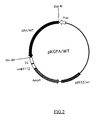
- FIG.2 is a restriction map of the present recombinant DNA pKGPA/WT.
- FIG.3 is a scheme of the preparation of the present recombinant DNA pBIgGPA/WT.
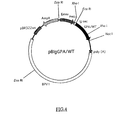
- FIG.4 is a restriction map of the present recombinant DNA pBIgGPA/WT.
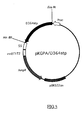
- FIG.5 is a restriction map of the present recombinant DNA pKGPA/D364stp.
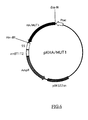
- FIG.6 is a restriction map of the present recombinant DNA pKHA/MUT1.
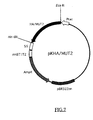
- FIG.7 is a restriction map of the present recombinant DNA pKHA/MUT2.
- FIG.8 is a restriction map of the present recombinant DNA pKHA/MUT3.
- FIG.9 is a restriction map of the present recombinant DNA pKHA/MUT3.
- FIG.9 is a restriction map of the present recombinant DNA pKHA/MUT5.
- FIG.10 is a restriction map of the present recombinant DNA pBIgGPA/D364stp.
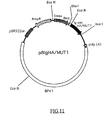
- FIG.11 is a restriction map of the present recombinant DNA pBIgHA/MUT1.
- FIG.12 is a restriction map of the present recombinant DNA pBIgHA/MUT2.
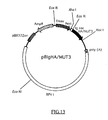
- FIG.13 is a restriction map of the present recombinant DNA pBIgHA/MUT3.
- FIG.14 is a restriction map of the present recombinant DNA pBIgHA/MUT4.
- Tac indicates a Tac promotor
- rrnBTlT2 indicates a region for transcriptional termination, derived from a ribosomal RNA operon.
- AmpR indicates an ampicillin resistant gene.
- pBR322ori indicates a replication origin in Escherichia coli.
- Ig sec indicates a DNA encoding a polypeptide with a signal sequence for secretion of immunoglobulin.
- Emsv indicates an enhancer from long terminal repeats of Moloney Mouse Sarcoma Virus.
- Pmti indicates a promotor for Mouse metallothionein I gene.
- Poly (A) indicates a polyadenylation signal derived from SV40 virus.
- BPVI indicates a genome of a bovine papillomavirus.
- the present inventors isolated mammalian DNAs encoding L-asparaginases firstly in the world, from guinea pig and human, and succeeded in elucidating their nucleotide sequences.
- the nucleotide sequences of the DNAs from a guinea pig and human are in SEQ ID NOs:15 and 16, respectively.
- This information is disclosed in Japanese Patent Application No.42,564/95 (Japanese Patent Kokai No.214,885/96) by the same applicant of this application.
- the present invention has been made based on the above information, and provides the polypeptides which originate from mammal, having L-asparaginase activity.
- polypeptides of the present invention are not restricted to their sources or origins so far as they originate from mammal and have an L-asparaginase activity.
- the polypeptides are usually obtainable by the expression of genes originating from mammal, and usually contain amino acid sequences of SEQ ID NOs:1 to 3, wherein the symbol "Xaa” in SEQ ID NO:3 means "glutamine” or "arginine".
- the polypeptides have any one of amino acid sequences of SEQ ID NOs:4 to 9.
- one or more amino acid residues in SEQ ID NOs:4 to 9 can be substituted relatively easily by different ones without substantial defects of the activity.
- polypeptides with an L-asparaginase activity may be obtained as a result of modifications by endogenous enzymes of the hosts after the DNA expression or modifications during purification of the polypeptides, depending on the types of vectors and hosts used to obtain transformants or culturing conditions of the transformants, such as ingredients, compositions, temperatures or pHs.
- the wording "a variety of polypeptides" includes the polypeptides with deletions and/or additions of one or more amino acids at the N- and/or C-termini thereof, or with glycosylations.
- the present polypeptides include not only the polypeptide with any amino acid sequence of SEQ ID NOs:4 to 9 but also their homologues so long as they have an L-asparaginase activity.
- the present polypeptides express the activity when exist in multiple forms, preferably, tetramers.
- the polypeptides of the present invention can be usually prepared by the recombinant DNA techniques.
- the polypeptides are obtainable by culturing transformants containing DNAs encoding the polypeptides and collecting the produced polypeptides from the resultant cultures.
- the transformants are obtainable by introducing such recombinant DNAs as contain any one of the nucleotide sequences of SEQ ID Nos:10 to 15 and a self-replicable vector into appropriate hosts.
- One or more nucleotides in SEQ ID NOs:10 to 15 can be substituted by different nucleotides without substantial changes of the encoding amino acid sequences with respect to degeneracy of genetic code.
- nucleotides in nucleotide sequences which encode the polypeptides or their homologues can be appropriately substituted by different ones.
- nucleotide sequences which encode and/or don't encode one or more amino acids can be added to the 5'- and/or 3'-termini of the nucleotide sequences.
- the DNAs encoding the polypeptides of this invention include those from natural sources and those by synthesized artificially so far as the polypeptides expressed by them have an L-asparaginase activity.
- the DNAs can be wild-type ones, containing the same nucleotide sequences as those from natural sources, and can be their homologues.
- wild-type DNAs examples include DNAs containing the nucleotide sequences of SEQ ID NOs:15.
- the wild-type DNA is obtainable from natural sources such as guinea pig livers, as disclosed in Japanese Patent Application No.42,564/95 (Japanese Patent Kokai No.214,885/96) by the same applicant of this invention: (a) constructing a cDNA library by applying usual methods to purified poly (A) + RNAs from a guinea pig or human liver as materials, (b) applying the plaque hybridization method to the cDNA library using oligonucleotides as probes synthesized chemically based on partial amino acid sequences of L-asparaginase purified from a guinea pig serum, (c) collecting phage clones containing the DNAs encoding the polypeptides of this invention, and (d) manipulating the collected phage clones in a conventional manner.
- the wild-type DNA can be synthesized
- DNA homologues to the wild-type ones include DNAs containing any nucleotide sequence of SEQ ID NOs:10 to 14.
- DNA homologues containing the nucleotide sequence of SEQ ID NO:10 are obtainable by applying conventional methods in this field, such as PCR method and methods for site-directed mutagenesis, to the wild-type DNA of SEQ ID NO:15 concerning the desired sequence.
- DNA homologues containing any nucleotide sequence of SEQ ID NOs:11 to 14 are obtainable by the methods such as follows: Firstly, A wild-type DNA with the nucleotide sequence of SEQ ID NO:16 is obtained by the methods as disclosed in Japanese Patent Application No.42,564/95 (Japanese Patent Kokai No.214,885/96) by the same applicant of this invention, i.e., screening a human liver cDNA library. Subsequently, the wild-type DNA is subjected to conventional methods as mentioned above concerning desired sequences to obtain the DNA homologues.
- the DNA homologues can be synthesized chemically based on the nucleotide sequences of SEQ ID NOs:10 to 14.
- each recombinant DNA comprises one of the present DNAs and a self-replicable vector.
- the recombinant DNAs can be easily prepared by general recombinant DNA techniques when the DNAs are available. Examples of such self-replicable vectors include pKK223-3, pGEX-2T, pRL- ⁇ , pBTrp2 DNA, pUB110, YEpl3, Ti plasmid, Ri plasmid, pBI121, pCDM8, pBPV and BCMGSneo.
- pKK223-3, pGEX-2T, pRL- ⁇ , pBTrp2 DNA pUB110 are suitably used to express the present DNAs in prokaryotic cells such as Escherichia coli and Bacillus sp.
- prokaryotic cells such as Escherichia coli and Bacillus sp.
- YEp13, Ti plasmid, Ri plasmid, pBI121, pCDM8, pBPV and BCMGSneo are suitably used to express the present DNAs in eukaryotic cells such as yeasts and animal- and plant-cells.
- the recombinant DNAs according to the present invention can be introduced into appropriate hosts such as Escherichia coli, Bacillus sp., actinomycetes, yeasts and plant- and animal-cells.
- Escherichia coli Bacillus sp., actinomycetes, yeasts and plant- and animal-cells.
- To introduce the DNAs into Escherichia coli it can be cultured in the presence of the recombinant DNAs and calcium ion.
- competent cell methods or protoplast methods can be used.
- DEAE-dextran methods or electroporation methods can be used. Desired transformants can be cloned by applying hybridization methods or by selecting L-asparaginase producing cells from the cultures.
- the transformants thus obtained produce the present polypeptides intracellularly or extracellularly when cultured in nutrient culture media.
- liquid nutrient culture media which generally contain carbon sources, nitrogen sources and minerals, and further contain micronutrients such as amino acids and/or vitamins on demand.
- the carbon sources usable in the present invention include saccharides such as starch, starch hydrolysates, glucose, fructose and sucrose.
- the nitrogen sources usable in the present invention include organic and inorganic compounds containing nitrogen, such as ammonia and their salts, urea, nitrates, peptone, yeast extract, defatted soy bean, corn steep liquor and beef extract.
- Cultures containing the present polypeptides can be obtained by inoculating the transformants into the above media, culturing them at temperatures of 25-65°C at pHs of 5-8 for about 1-10 days under aerobic conditions by aeration-agitation method, etc.
- the cultures can be used intact as agents for susceptive diseases.
- the cultures are usually treated with ultrasonication or cell wall lytic enzymes to disrupt cells, and the present polypeptides are separated by using techniques such as filtration and centrifugation from the cell-disruptants and purified.
- the polypeptides can be purified from the culture supernatants obtained by removing cells from the cultures by filtration or centrifugation, etc.
- the present polypeptides can be purified by applying techniques generally used in this field for protein purifications, such as salting out, dialysis, filtration, concentration, gel filtration chromatography, ion-exchange chromatography, affinity chromatography, hydrophobic chromatography, isoelectric focusing and gel electrophoresis, and if necessary, two or more of them can be applied combination to the supernatants which are separated from insoluble substances of cell-disruptants, or to the culture supernatants.
- the resultant purified solutions polypeptides can be concentrated and/or lyophilized into liquids or solids depending on their final uses.
- a guinea pig wild-type DNA encoding L-asparaginase was prepared by the method disclosed in Japanese Patent Kokai No.214,885/96 by the same applicant of this invention.
- the DNA had the nucleotide sequence of SEQ ID NO:15.
- a DNA having a polypeptide-encoding region in SEQ ID NO:15, i.e., a sequence of containing the nucleotides 20-1,714 in SEQ ID NO:15, is called "GPA/WT DNA” hereinafter, and the expression product thereof with the amino acid sequence of SEQ ID NO:15 is called "guinea pig wild-type L-asparaginase".
- SEQ ID NO:17 shows in parallel the nucleotide sequence of GPA/WT DNA and the amino acid sequence encoded thereby.
- the nucleotide sequence of the sense primer was 5'-AATCTCGAGCCACCATGGCGCGCGCATCA-3', a nucleotide sequence obtained by adding a common nucleotide sequence in animal cells, as shown by M. Kozak in "Nucleic Acid Research", Vol.15, pp.8,125-8,148 (1987), to the upstream of a region which encodes the N-terminal amino acid sequence of SEQ ID NO:15 and then adding to the further upstream a cleavage site by a restriction enzyme, Xho I.
- the nucleotide sequence of the anti-sense primer was 5'-CTGCGGCCGCTTATCAGATGGCAGGCGGCAC-3' as a complement to a nucleotide sequence obtained by adding two termination codons to the downstream of a region which encodes the C-terminus of the amino acid sequence of SEQ ID NO:15 and adding a cleavage site by a restriction enzyme, Not I, to the further downstream.
- the resulting mixture was successively incubated at 940C for one min, at 55°C for one min, and at 72°C for 3 min, and the series of incubation was repeated 40-times for PCR to amplify DNA.
- a DNA containing GPA/WT DNA was obtained and then cleaved by restriction enzymes of Xho I and Not I to obtain an about 1.7 kbp DNA fragment.
- Twenty-five ng of the DNA fragment was weighed and mixed with 10 ng of a plasmid vector, "pCDM8", commercialized by Invitrogen Corporation, San Diego, U.S.A., which had been cleaved by restriction enzymes of Xho I and Not I.
- the recombinant DNA pCGPA/WT was introduced into an Escherichia coli MC1061/P3 strain, commercialized by Invitrogen Corporation, San Diego, U.S.A., by competent cell method.
- the transformant thus obtained was inoculated into L broth medium (pH 7.2) containing 20 ⁇ g/ml ampicillin and 10 ⁇ g/ml tetracycline followed by cultivation at 37°C for 18 hours under shaking conditions.
- the transformants were collected from the culture by centrifugation and subjected to conventional alkali-SDS method to extract the recombinant DNA pCGPA/WT.
- COS-1 ATCC CRL-1650
- a host which is a cell line derived from a monkey kidney
- COS-1 ATCC CRL-1650
- the system Since the system is for a transient expression, it has a disadvantage that DNAs introduced into transformants could not be stable over several days, and the transformants do not produce the desired polypeptides repeatedly.
- the number of copies of the desired DNA per cell temporally increases to 10 5 when plasmid vectors having a replication origin derived from SV40 virus, such as the above mentioned pCDM8, are introduced into the COS-1 cells. With this point of view, the system has a merit that it quite easily analyzes the desired DNA-expression product.
- a plastic multiwell plate with 6 wells of 3.5 cm diameter, commercialized by Becton Dickinson Labware, New Jersey, U.S.A., was added 2.5 ml of DME medium, containing 10 v/v % bovine fetal serum and 1.8 x 10 5 COS-1 cells. The cells were cultured at 370C in a 5 v/v % CO 2 incubator overnight.
- each well was charged with 2.5 ml of DME medium containing 2.8 ⁇ g/ml PCGPA/WT, 50 Mm Tris-HCl (pH 7.4), 0.4 mg/ml DEAE-dextran and 0.1 mM chloroquine, and incubated at 37°C for 4 hours in a 5 v/v % CO 2 incubator.
- the multiwell plates with the cultures were subjected thrice to a treatment of freezing at -800C and thawing at ambient temperature to disrupt the cells.
- the whole cultures were transferred to centrifugal tubes and centrifuged to remove insoluble components after precipitated, followed by obtaining total soluble fractions, concentrating the fractions using membranes, and adjusting the volume of the total soluble fraction per well to give 0.5 ml for the following analyses.
- L-Asparaginase activity was expressed by the unit assayed as follows: Samples were placed in 1.5 ml-reaction tubes in 50 ⁇ l each and admixed with 200 ⁇ l of 50 mM phosphate buffer (pH 7.0) containing 1.4 mg/ml L-asparagine. After standing at 37°C for 0, 1, 2, 4, 6 and 16 hours, L-aspartic acid in the reaction mixtures was quantified by an amino acid analyzer.
- the total soluble fractions obtained in Experiment 1-1(c) were treated similarly as above, and expressed their activities as total L-asparaginase activities that were detected in the soluble fractions from 1.8 x 10 5 COS-1 cells. As a result, the activity of the total soluble fraction in Experiment 1-1(c) was 0.083 unit, and the control gave no activity.
- An anti-L-asparaginase antibody was prepared as follows: An oligopeptide of a sequence Gly-Ser-Gly-Asn-Gly-Pro-Thr-Lys-Pro-Asp-Leu-Leu-Gln-Glu-Leu-Arg-Cys was synthesized chemically in a usual manner. Keyhole Limped Hemocyanin was linked to the C-terminus of the oligopeptide. The resultant was purified and used to immunize rabbits in a usual manner. The rabbits were immunized 6 times 2 weeks about, then the whole blood was collected and subjected to salting out with 50 w/v % ammonium sulfate to obtain an anti-L-asparaginase anti-serum.
- the molecular weight markers used were thyroglobulin (699 kDa), ferritin (440 kDa), catalase (232 kDa), aldolase (158 kDa), bovine serum albumin (67 kDa) and ovalbumin (43 kDa).
- the peak of L-asparaginase activity in the eluted fractions was observed in a position corresponding to a molecular weight of about 300 kDa.
- the molecular weight of the wild-type L-asparaginase in a dissociated form could not be detected, while the molecular weight in a native form was estimated to be about 300 kDa based on the result of gel filtration.
- a human wild-type DNA encoding L-asparaginase was prepared according to the method in Japanese Patent Kokai No.214,855/96 by the same applicant of the present invention.
- the DNA had the nucleotide sequence of SEQ ID NO:16.
- a DNA having a polypeptide-encoding region in SEQ ID NO:16 i.e., a sequence of nucleotides 93-1,811 in SEQ ID NO:16
- HA/WT DNA a polypeptide, as the expression product of HA/WT DNA, having the amino acid sequence of SEQ ID NO:16, may be called "human wild-type L-asparaginase”.
- SEQ ID NO:18 shows the nucleotide sequence of GPA/WT DNA and the amino acid sequence encoded thereby.
- PCR was performed under the same conditions as used in Experiment 1-1(b).
- a template the human wild-type DNA in Experiment 1-2 was used.
- a sense- and anti-sense-primers oligonucleotides with sequences of 5'-AATCTCGAGCCACCATGGCGCGCGCG GTG-3' and 5'-CTGCGGCCGCTTATCAGACACCAGGCAGCAC-3' were respectively used.
- the DNA thus amplified was continuously treated with the same method as used in Experiment 1-1(b) to prepare a recombinant DNA, "pCHA/WT". After sequencing, the pCHA/WT was introduced into COS-1 cells and expressed followed by analyzing the expression product similarly as in Experiment 1-1.
- the experiment system could not detect the human wild-type L-asparaginase activity. It was presumably due to that the human wild-type L-asparaginase had a lower specific activity than that of the guinea pig wild-type one, and this forced to examine the properties of expression products by DNA homologues from human in Experiment 2-2.
- a termination codon was replaced for the nucleotide sequence in a specific position of the guinea pig wild-type DNA to obtain a DNA homologue: A DNA was obtained by PCR method by replacing a termination codon for a codon of the nucleotides 1,090-1,092 or 1,012-1,014 in SEQ ID NO:17. Except for the nucleotide sequence of anti-sense primer, PCR was performed under the same conditions as used in Experiment 1-1(b).
- an oligonucleotide with a sequence of 5'-CTGCGGCCGCTTATCATGCCGTGGGCAGTGT-3'or 5'-CTGCGGCCGCTTATCAGCCCAACACGTAGGA-3' was used to prepare the two-types of DNAs.
- the amplified DNAs were treated similarly as in Experiment 1-1(b) to obtain recombinant DNAs, "pCGPA/D364stp” and "pCGPA/L338stp".
- pCGPA/D364stp and pCGPA/L338stp had DNAs, encoding the sequences of amino acids 1-363 and 1-337 in the guinea pig wild-type L-asparaginase, respectively, and had a termination codon at their 3'-termini free of intervening sequences.
- the polypeptide-encoding regions of the DNAs are respectively named "GPA/D364stp DNA” and "GPA/L338stp DNA”.
- GPA/D364stp DNA and GPA/L338stp DNA were ligated in the downstream of a CMV promoter in the direction from the 5'- to 3'-termini.
- the DNAs expression products may be named "guinea pig L-asparaginase homologues".
- DNA homologues were prepared by replacing specific codons in the human wild-type DNA with termination codons or codons for different amino acids: The DNA homologues were prepared by replacing termination codons for the nucleotides 1096-1098 in SEQ ID NO:18 by applying PCR method. Except for the template and the sense- and anti-sense-primers, PCR was performed under the same conditions as used in Experiment 1-1(b). As a template, the human wild-type DNA in Experiment 1-2 was used.
- the oligonucleotides with sequences of 5'-AATCTCGAGCCACCATGGCGCGCGCGGTG-3' and 5'-CTGCGGCCGCTCATTACACCGAGGGTGGCGT-3' were respectively used.
- the amplified DNA was treated similarly as in Experiment 1-1 to obtain a recombinant DNA, "pCHA/E366stp", and sequenced. It was confirmed that pCHA/E366stp contained a DNA encoding amino acids 1-365 in SEQ ID NO:16 and a termination codon at the 3'-terminus free of intervening sequences.
- the polypeptide-encoding region was named "HA/E366stp DNA", hereinafter. HA/E366stp DNA was ligated to the downstream of a CMV promotor in the direction from the 5'- to 3'-termini.
- mutagenic primers A and B where the nucleotides to be mutagenized were substituted by desired different ones complementary to one another, were prepared.
- the mutagenic primer A was a sense strand
- the mutagenic primer B was an anti-sense strand.
- These two PCRs were named "first step PCRs”.
- the two DNA fragments amplified in the first step PCRs were used as primers and templates to generate mutagenized DNAs, while the 5'- and 3'-terminal primers were used as primers to amplify the mutagenized DNAs.
- DNAs into which were introduced 7 types nucleotide substituents i.e., 7 DNA homologues were prepared.
- the 7 types nucleotide substituents and consequent changes of the encoded amino acid sequences are summarized in Table 2.
- the template DNA and mutagenic primers A and B used to prepare the 7 DNA homologues were summarized in Table 3.
- the 5'- and 3'-terminal primers were respectively equal to the sense- and anti-sense-primers as used to prepare pCHA/E366stp in Experiment 2-2.
- the obtained DNA homologues from human were treated similarly as in Experiment 1-1 to obtain recombinant DNAs "pCHA/MUT1", “pCHA/MUT2", “pCHA/MUT3", “pCHA/MUT4", “pCHA/MUT5", “pCHA/MUT6” and “pCHA/MUT7".
- the expression products of the DNA homologues, obtained in Experiment 2-2 may be named "human L-asparaginase homologues", hereinafter. After sequencing, these DNA homologues were introduced into COS-1 cells, followed by expression and assay.
- pCHA/WT obtained in Experiment 1-2 and pCDM8 were treated and examined. Signal intensities of bands, detected by Western blotting, were evaluated by densitometry to compare quantitatively the expressed products. The results were in Table 4.
- the human DNA homologues such as HA/MUT1, HA/MUT2, HA/MUT3 and HA/MUT5, which the expression products gave a detectable level of activity, have SEQ ID NOs:11 to 14, respectively, and encoding SEQ ID NOs:6 to 9, respectively.
- polypeptides from mammal may require the amino acid sequence of SEQ ID NO:3 (where the symbol “Xaa” meant “glutamine” or “arginine”) to express a detectable level of L-asparaginase activity in the expression and assay systems in Experiments 1 and 2, in addition to conventionally known as such amino acid sequences of SEQ ID NOs:1 and 2.
- the animo acid sequence of the guinea pig wild-type L-asparaginase contains the SEQ ID NO:3 in the region the amino acids 298-302.
- Examples of such polypeptides, having all the amino acid sequences of SEQ ID NOs:1 to 3 include those having SEQ ID NOs:4 and 5 from guinea pigs and those having SEQ ID NOs:6 to 9 from human.
- Example A-1 Polypeptides having L-asparaginase activity
- Example A-1(a) Polypeptides having L-asparaginase activity
- the sequence of the sense primer was 5'-GCGAATTCATGGCGCGCGCATCA-3' which was a nucleotide sequence obtained by adding a cleavage site by a restriction enzyme, Eco RI, to the upstream of the 5'-terminus of GPA/WT DNA.
- the sequence of the anti-sense primer was 5'-GCAAGCTTTCAGATGGCAGGCGGCAC-3', which was complementary to a nucleotide sequence prepared by adding a termination codon to the 3'-terminus of GPA/WT DNA and then adding a cleavage site by a restriction enzyme, Hin dIII, to the downstream.
- the above mixture was subjected to 40 cycles of successive incubations at 940C for one min, at 55°C for one min, and 72°C for 3 min to perform PCR.
- restriction enzymes Eco RI and Hin dIII By cleaving the amplified DNA by restriction enzymes Eco RI and Hin dIII, a Eco RI- Hin -dIII fragment with a length of about 1.7 kbp was obtained.
- the recombinant DNA pKGPA/WT was introduced into an Escherichia coli strain "JM105" by the competent cell method.
- the resulting transformant "J-GPA/WT” was inoculated to L broth medium (pH 7.2) containing 50 ⁇ g/ml ampicillin and cultured at 37°C for 18 hours under shaking conditions.
- the transformants collected by centrifugation from the culture were subjected to a conventional alkali-SDS method to extract the recombinant DNA pKGPA/WT.
- the transformant J-GPA/WT was inoculated into L broth medium (pH 7.2), containing 50 ⁇ g/ml ampicillin, and cultured at 37°C for 18 hours under shaking conditions to obtain a seed culture.
- Eighteen L of a fresh preparation of the same medium was placed in a 30-L jar fermenter, inoculated with one v/v % of the seed culture, and cultured at 37°C under aeration-agitation conditions.
- a portion of the culture was placed in a cuvette with 1-cm in thickness, incubated until the absorbance at a wavelength of 650 nm reached to about 1.5, admixed with IPTG to give a final concentration of 0.1 mM, and incubated for 5 hours.
- the cells centrifugally collected from the culture were suspended in a mixture solution (pH 7.2) containing 139 mM NaCl, 7 mM Na 2 HPO 4 and 3 mM NaH 2 PO 4 , and supersonicated to disrupt the cells, followed by centrifuging the resultant to obtain a supernatant.
- a mixture solution pH 7.2
- Ammonium sulfate was added to the supernatant under ice-chilling conditions to give a concentration of 50 w/v % and then dissolved to homogeneity. After standing for several minutes, the precipitates were collected by centrifugation, dissolved in 20 mM Tris-HCl buffer (pH 8.0), and dialyzed against a fresh preparation of the same buffer followed by applying the dialyzed solution to "Q SEPHAROSE FF COLUMN", commercialized by Pharmacia LKB Biotechnology AB, Uppsala, Sweden, equilibrated with the same buffer.
- the eluted fractions were pooled and concentrated by using a membrane.
- the concentrate was applied to "HILOAD SUPERDEX 200 COLUMN", commercialized by Pharmacia LKB Biotechnology AB, Uppsala, Sweden, equilibrated with Tris-HCl buffer (pH 8.0) containing 10 v/v % glycerol, and eluted from the column.
- Tris-HCl buffer pH 8.0
- the purified polypeptide in the above was analyzed to determine the physicochemical properties:
- the molecular weight of the purified polypeptide in a native form was determined by gel filtration similarly as in Experiment 1-1(e). The peak for L-asparaginase activity of the eluted fractions was found at a position corresponding to a molecular weight of about 300 kDa.
- the molecular weight of the purified polypeptide in a dissociated form was determined by SDS-PAGE as used in Experiment 1-1(e). The main band was observed at a position corresponding to a molecular weight of about 50 ⁇ 10 kDa. The results indicate that the purified polypeptide exists in a multimer as a native form.
- FIG.3 summarizes the procedures to prepare transformants.
- PCR was performed under the same conditions as used in Example A-1(a) except for the nucleotide sequences of a sense- and anti-sense-primers.
- the sense- and anti-sense-primers oligonucleotides with the nucleotide sequences of 5'-GTGAATTCGGAGGTTCAGATGGCGCGCGCATCA-3' and 5'-CTGCGGCCGCTCAGATGGCAGGCGGCAC-3' were respectively used.
- the DNA thus amplified was cleaved by restriction enzymes Eco RI and Not I to obtain an about 1.7 kbp Eco RI-Not I fragment.
- telomere sequences 5'-TCGAGCCACCATGAAGTGTTCGTGGGTTATT-3', 5-TTCTTCCTGATGGCCGTAGTGACAGGAGTG-3', 5'-AATTCACTCCTGTCACTACGGCCATCAGGA-3',and 5'-AGAAAATAACCCACGAACACTTCATGGTGGC-3'.
- the oligonucleotides for linkers were synthesized in a usual manner and used after reacted with T4 polynucleotide kinase, commercialized by Pharmacia LKB Biotechnology AB, Uppsala, Sweden, and purified by ethanol-precipitation.
- T4 polynucleotide kinase commercialized by Pharmacia LKB Biotechnology AB, Uppsala, Sweden
- purified by ethanol-precipitation To the DNA mixture was added the solution I in "LIGATION KIT VERSION 2", commercialized by Takara Shuzo, Tokyo, Japan. The mixture was incubated at 16°C for 2 hours to obtain a replicable recombinant DNA "pBIgGPA/WT”.
- the recombinant DNA pBIgGPA/WT was introduced into an Escherichia coli HB101 strain by the competent cell method.
- the transformant thus obtained was inoculated into L broth medium (pH 7.2) containing 50 ⁇ g/ml ampicillin followed by cultivation at 370C for 18 hours under shaking conditions.
- the transformants, collected by centrifuging the resulting culture, were subjected to a conventional alkali-SDS method to extract the recombinant DNA pBIgGPA/WT.
- FIG.4 A DNA encoding a polypeptide containing a signal sequence for immunoglobulin secretion, as shown by D. F. Stern et al. in "Science", Vol.235, pp.321-324 (1984), i.e., "Ig sec DNA” was ligated to the downstream of a region for transcriptional regulation, comprising an enhancer derived from long terminal repeats of Moloney Mouse Sarcoma Virus (Emsv), and a promotor derived from Mouse metallothionein I gene (Pmti).
- Emsv Moloney Mouse Sarcoma Virus
- Pmti Mouse metallothionein I gene
- GPA/WT DNA was ligated in the same frame to the downstream of the Ig sec DNA in the direction from the 5'- to 3'-termini of GPA/WT DNA. It was also confirmed that a termination codon exists in the 3'-terminus of GPA/WT DNA without intervening sequences.
- the recombinant DNA pBIgGPA/WT was introduced into a cell line C127 (ATCC CRL-1616), derived from a mouse, by using a lipofectin® reagent commercialized by Life Technologies, Inc., Gaitherburg, U.S.A., according to the attached protocol.
- the transformants with the recombinant DNA were selected based on the lack of proliferation-regulatory ability, i.e., focus-forming ability, as a first selection.
- the cells around those containing foci were collected using sterilized filter papers and subjected to a conventional limiting dilution method to form single cells which were then selected depending on the productivity of L-asparaginase, as final selection.
- a transformant, "C-GPA/WT” was obtained.
- the transformant C-GPA/WT was inoculated into a well of "3046", a plastic multiwell plate with 6 wells, 3.5 cm in diameter, commercialized by Becton Dickinson Labware, New Jersey, U.S.A., with DME medium containing 10 v/v % bovine fetal serum, and cultured to be confluent as a seed culture. Some of the cells, scraped by treatment with trypsin, were inoculated as seed cells into each of the multiwell plates which were charged with the fresh preparation of the same medium and cultured. After repeating manipulations similarly as in the above and with scale up to increase the cell number, the cells were subjected to a conventional continuous culture using 50 of 150 cm 2 culture flasks.
- the resulting culture supernatants of a volume of 100 1 was collected and treated with similar methods for treating the supernatant from the cell-disruptants in Example A-1(b): salting out with ammonium sulfate, the chromatography of the solution of the precipitates using Q SEPHAROSE FF COLUMN, the chromatography of the eluted fractions using L-ASPARAGINE AGAROSE, and the chromatography of the eluted fractions using HILOAD SUPERDEX 200 COLUMN. Consequently, a purified polypeptide with a purity of 90 % or more was obtained in a yield of about one ⁇ g/ml-culture.
- Example A-1(c) By testing similarly as in Example A-1(c), it was confirmed that the purified polypeptide thus obtained had equivalent physicochemical properties with the that obtained in Example A-1(b).
- Example A-1(a) PCRs were performed under the same conditions in Example A-1(a) except for the template and the sense- and anti-sense-primers.
- the DNA thus obtained were treated similarly as in Example A-1(a) to prepare recombinant DNAs, "pKGPA/D364stp", “pKHA/MUT1", “pKHA/MUT2", “pKHA/MUT3” and "pKHA/MUT5".
- Table 5 summarizes template DNAs and nucleotide sequences of a sense- and anti-sense-primers which were used to prepare the each recombinant DNAs.
- Example A-3(a) The transformants obtained in Example A-3(a) were treated according to the methods similarly as in Example A-1(b): cultivation, disrupting the resulting cells, the precipitations of the cell-disruptants with ammonium sulfate, the chromatography of the precipitate solutions using Q SEPHAROSE FF COLUMN, and the chromatography of the eluted fractions using L-ASPARAGINE AGAROSE in that order.
- the eluted fractions thus obtained were concentrated using membranes similarly as in Example A-1(b) followed by subjecting the chromatography using HILOAD SUPERDEX 200 COLUMN to collect the eluted fractions with a molecular weight of about 140 kDa.
- Example A-1(c) Each system yielded the purified polypeptide with a purity of 90 % or more in a yield of about 0.1 mg/ml-culture.
- These purified polypeptides were analyzed by the methods as in Example A-1(c) to examine their physicochemical properties. Table 6 shows the results combined with those in Example A-1(c).
- Table 6 indicates that all of the present polypeptides, expressed in Escherichia coli and purified, expressed an L-asparaginase activity. Furthermore, table 6 indicates the that the polypeptides formed tetramers.
- Example A-1(a) PCRs were performed under the same conditions in Example A-1(a) except for the template and the sense- and anti-sense-primers.
- DNAs thus obtained were ligated with the same linkers as used in Example A-2(a) under the same conditions as in Example A-2(a) to obtain recombinant DNAs, "pBIgGPA/D364stp", “pBIgHA/MUT1", “pBIgHA/MUT2", “pBIgHA/MUT3" and "pBIgHA/MUT5".
- Table 7 summarizes template DNAs and nucleotide sequences of sense- and anti-sense-primers which were used to prepare the each recombinant DNAs. By sequencing similarly as in Example A-1(a), the structures of these recombinant DNAs were confirmed as shown in FIGs.10 to 14.
- Example A-4(a) The transformants obtained in Example A-4(a) were cultured according to the methods as in Example A-2(b), and the resulting culture supernatants were treated with similar methods for treating the supernatants from the cell-disruptants in Example A-1(b): the precipitations of culture supernatants with ammonium sulfate, the chromatography of the precipitate solutions using Q SEPHAROSE FF COLUMN, and the chromatography of the eluted fractions using L-ASPARAGINE AGAROSE in that order.
- Example A-1(b) The eluted fractions thus obtained were concentrated using membranes similarly as in Example A-1(b) followed by subjecting the chromatography using HILOAD SUPERDEX 200 COLUMN to collect the eluted fractions with a molecular weights of about 140 kDa.
- Each of these systems yielded the purified polypeptide with a purity of 90 % or more in a yield of about one ⁇ g/ml-culture.
- These purified polypeptides were analyzed by the methods as in Example A-1(c) to examine their physicochemical properties. Table 8 shows the results combined with those in Example A-3.
- Table 8 indicates that all of the present polypeptides, expressed in mammalian cells and purified, expressed an L-asparaginase activity. Furthermore, table 8 indicates the polypeptides formed tetramers.
- each of the polypeptides according to the present invention expresses an L-asparaginase activity. Therefore, the present agent for susceptive diseases hydrolyze L-asparagine in patients to exert therapeutic and preventive effects on L-asparaginase-susceptive diseases when administered to human.
- susceptive diseases means diseases in general which are caused by the existence of tumor cells dependent on L-asparagine: For example, leukemias such as acute leukemia, an acute transformation of chronic leukemia and T-lymphocytic leukemia, and malignant tumors such as Hodgkin's diseases and non-Hodgkin's diseases.
- the present agent for susceptive diseases possesses thus the uses as anti-tumor agents for treating and/or preventing such susceptive diseases as above.
- the present agent is generally processed into an agent in the form of a liquid, a paste or a solid which contains the polypeptides in an amount of 0.000001-100 w/w %, preferably, 0.0001-100 w/w %, on a dry solid basis.
- the present agent can be used intact or processed into compositions by mixing with one or more selected from the group consisting of physiologically-acceptable carriers, excipients, solvents, buffers and stabilizers, and further, if necessary, other biologically-active substances and other agents.
- Examples of such other biologically-active substances and other agents include interferon- ⁇ , interferon- ⁇ , interferon- ⁇ , interleukin 1, interleukin 2, interleukin 3, TNF-a, TNF- ⁇ , GM-CSF, carboquone, cyclophosphamide, aclarbicin, thiotepa, busulfan, ancitabine, cytarabine, fluorouracil, 5-fluoro-1-(tetrahydro-2-furyl)uracil, methotrexate, actinomycin D, chromomycin A3, daunorubicin, doxorubicin, bleomycin, mercaptopurine, prednisolone, mitomycin C, vincristine, vinblastine, radio gold colloidal, Krestin®, picibanil, lentinan and Maruyama vaccine.
- the present agent for susceptive diseases includes those in a unit dose form which means a physically separated and formed medicament suitable for administration, and contains the polypeptides in a daily dose or in a dose from 1/40 to several folds (up to 4 folds) of the daily dose.
- medicaments are injections, liquids, powders, granules, tablets, capsules, sublinguals, ophthalmic solutions, nasal drops and suppositories.
- the present agent can be administered to patients orally or parenterally. In both administrations, the agent exerts a satisfactory effect in the treatment and/or the prevention for the susceptive diseases. Although it varies dependently on the types of susceptive diseases and their symptoms, the agent can be orally administered to patients or parenterally administered to patients' intradermal tissues, subcutaneous tissues, muscles, and veins at a dose as amounts of the polypeptides in the range of about 0.1 ⁇ g - 500 mg/shot, preferably, about 0.1-100 mg/shot, 1-4 times/day or 1-7 times/week, for one day to one year.
- the present agent for susceptive diseases further includes the forms by applying gene therapy.
- mice For model mice were used C3H mice wherein a mouse lymphoma cell line 6C3HED, registered in Cell Resource Center for Biomedical Research, Institute of Development Aging and Cancer, Tohoku University, Sendai, Japan, was transplanted with passages by subcutaneous injections at their sides in a range of 1 x 10 7 cells/body every 8 days in usual manner.
- To the model mice were administered the purified polypeptides obtained in Example A-1 to A-4 in the range of 400 unit/body by venoclyses every day from fourth to seventh days after transplanted with the cells. Dimensions of the tumors were observed with naked eyes on fourth and eighth day after the transplantations.
- the purified polypeptides were administered after diluted with 0.15 M NaCl and filtrated with membrane filters, 0.45 ⁇ m in pore size, commercialized by Millipore Corp., Bedford, U.S.A. As a control, 0.15 M NaCl was treated correspondingly. While significant enlargements of the tumors were observed in the control, significant involutions or disappearances of the tumors were observed in mice administered with the polypeptides. These results indicates that all of the present polypeptides, obtained in Examples A-1 to A-4, are able to cure the tumors of model mice.
- the purified polypeptides obtained in Examples A-1 to A-4 were separately administered to 8-week-old mice percutaneously, perorally or intraperitoneally according to conventional manner.
- the LD 50 of all the polypeptides was about 100 mg/kg or higher independently of the administration routes.
- the purified polypeptides obtained in Examples A-1 to A-4 were separately dissolved to give a concentration of 0.1 mg/ml in physiological saline containing one w/v % human serum albumin as a stabilizer, and sterilized with membrane filters according to conventional manner to obtain solutions.
- All of the products have satisfactory stabilities and can be used as injections, ophthalmic solutions, collunarium in the treatment and/or the prevention of susceptive diseases including a malignant tumor, acute leukemia, malignant lymphoma, an acute transformation of chronic leukemia, T-lymphocytic leukemia.
- the purified polypeptides obtained in Examples A-1 to A-4 were separately dissolved to give a concentration of 0.1 mg/ml in physiological saline containing one w/v % glycerol as a stabilizer, and sterilized with membrane filters according to conventional manner to obtain solutions.
- All of the products have satisfactory stabilities and can be used as injections, ophthalmic solutions, collunarium for the treatment and/or the prevention of susceptive diseases including a malignant tumor, acute leukemia, malignant lymphoma, an acute transformation of chronic leukemia and T-lymphocytic leukemia.
- the purified polypeptides obtained in Examples A-1 to A-4 were separately dissolved to give a concentration of 50 mg/ml in physiological saline containing one w/v % purified gelatin as a stabilizer, and the solutions were sterilized with membrane filters according to conventional manner. One ml aliquots of the sterilized solutions were distributed to vials, lyophilized and cap sealed.
- All of the products have satisfactory stabilities and can be used as dry injections for the treatment and/or the prevention of susceptive diseases including a malignant tumor, acute leukemia, malignant lymphoma, an acute transformation of chronic leukemia and T-lymphocytic leukemia.
- HI-BIS-WAKO 104 a carboxyvinyl polymer commercialized by Wako Pure Chemicals, Tokyo, Japan, and a purified trehalose were dissolved in sterilized distilled water to give concentrations of 1.4 w/w % and 2.0 w/w %, respectively, and the purified polypeptides obtained in Examples A-1 to A-4 were separately mixed to homogeneity in the solutions followed by adjusting the pH of the resulting solutions to pH 7.2 to obtain pastes containing about one mg/g of the polypeptides.
- All of the products have satisfactory spreadabilities and stabilities, and can be used as ointments for treating and/or preventing susceptive diseases including a malignant tumor, acute leukemia, malignant lymphoma, an acute transformation of chronic leukemia and T-lymphocytic leukemia.
- any one of the purified polypeptides obtained in Examples A-1 to A-4 and LUMIN i.e. [bis-4-(1-ethylquinoline)][ ⁇ -4'-(1-ethylquinoline] pentamethionine cyanine, as a cell activator were mixed to homogeneity with "FINETOSE®” an hydrous crystalline ⁇ -maltose commercialized by Hayashibara Co.,Ltd., Okayama, Japan, and the mixtures were tabletted by tabletting machine to obtain tablets, about 200 mg weight each, containing the polypeptide and the LUMIN, about 5 mg each.
- FINETOSE® an hydrous crystalline ⁇ -maltose commercialized by Hayashibara Co.,Ltd., Okayama, Japan
- All of the products have satisfactory swallowing abilities, stabilities and cell activating activities, and can be used for treating and/or preventing susceptive diseases including a malignant tumor, acute leukemia, malignant lymphoma, an acute transformation of chronic leukemia and T-lymphocytic leukemia.
- the present invention is based on the findings of polypeptides which originate from mammal, having L-asparaginase activity.
- the polypeptides are substances which have revealed amino acid sequences totally, and stable activities to hydrolyze L-asparagine. Therefore, the polypeptides exert satisfactory effects in the treatment and/or the prevention for diseases caused by tumor cells dependent on L-asparagine.
- the polypeptides originate from mammal, so that they have low antigenicities to human and don't cause serious side effects even when administered in large amounts or continuously. Therefore, the polypeptides have the advantage that they can exert desired effects without restricted controls on patients' sensitivities.
- polypeptides thus valuable can be produced in desired amounts using the present DNAs encoding them.
- the present invention is a significant invention which has a remarkable effect and gives a great contribution to this field.
Landscapes
- Life Sciences & Earth Sciences (AREA)
- Chemical & Material Sciences (AREA)
- Health & Medical Sciences (AREA)
- Genetics & Genomics (AREA)
- Organic Chemistry (AREA)
- Engineering & Computer Science (AREA)
- Bioinformatics & Cheminformatics (AREA)
- Zoology (AREA)
- Wood Science & Technology (AREA)
- Molecular Biology (AREA)
- Microbiology (AREA)
- Biotechnology (AREA)
- Biomedical Technology (AREA)
- Biochemistry (AREA)
- General Engineering & Computer Science (AREA)
- General Health & Medical Sciences (AREA)
- Medicinal Chemistry (AREA)
- Medicines That Contain Protein Lipid Enzymes And Other Medicines (AREA)
- Micro-Organisms Or Cultivation Processes Thereof (AREA)
Priority Applications (1)
| Application Number | Priority Date | Filing Date | Title |
|---|---|---|---|
| EP03075636A EP1321519A1 (fr) | 1996-06-07 | 1997-06-06 | Polypeptide avec une activité de L-asparaginase |
Applications Claiming Priority (2)
| Application Number | Priority Date | Filing Date | Title |
|---|---|---|---|
| JP168172/96 | 1996-06-07 | ||
| JP16817296 | 1996-06-07 |
Related Child Applications (1)
| Application Number | Title | Priority Date | Filing Date |
|---|---|---|---|
| EP03075636A Division EP1321519A1 (fr) | 1996-06-07 | 1997-06-06 | Polypeptide avec une activité de L-asparaginase |
Publications (3)
| Publication Number | Publication Date |
|---|---|
| EP0811687A2 true EP0811687A2 (fr) | 1997-12-10 |
| EP0811687A3 EP0811687A3 (fr) | 1998-10-28 |
| EP0811687B1 EP0811687B1 (fr) | 2006-04-19 |
Family
ID=15863141
Family Applications (2)
| Application Number | Title | Priority Date | Filing Date |
|---|---|---|---|
| EP03075636A Withdrawn EP1321519A1 (fr) | 1996-06-07 | 1997-06-06 | Polypeptide avec une activité de L-asparaginase |
| EP97303896A Expired - Lifetime EP0811687B1 (fr) | 1996-06-07 | 1997-06-06 | Polypeptides avec une activité de L-asparaginase |
Family Applications Before (1)
| Application Number | Title | Priority Date | Filing Date |
|---|---|---|---|
| EP03075636A Withdrawn EP1321519A1 (fr) | 1996-06-07 | 1997-06-06 | Polypeptide avec une activité de L-asparaginase |
Country Status (3)
| Country | Link |
|---|---|
| US (4) | US6537547B1 (fr) |
| EP (2) | EP1321519A1 (fr) |
| DE (1) | DE69735694T2 (fr) |
Cited By (5)
| Publication number | Priority date | Publication date | Assignee | Title |
|---|---|---|---|---|
| WO1999061626A3 (fr) * | 1998-05-29 | 2000-04-06 | Incyte Pharma Inc | Homologues de l'hydrolase humaine, asparagine amidohydrolase n-terminale, glycosylhydrolase, glucohydrolase, biotinidase, et n-acetylglucosamine 6-p-deacetylase |
| WO2000028045A3 (fr) * | 1998-11-12 | 2000-10-26 | Incyte Pharma Inc | Hydrolases humaines |
| WO2008148932A3 (fr) * | 2007-06-08 | 2009-02-19 | Reagena Ltd Oy | Procédé pour le traitement de cancers ou de maladies inflammatoires |
| WO2015033344A1 (fr) * | 2013-09-05 | 2015-03-12 | Yissum Research Development Company Of The Hebrew University Of Jerusalem Ltd. | Procédés et nécessaires permettant d'inhiber la pathogénicité d'un streptocoque du groupe a (sga) ou d'un streptocoque du groupe g (sgg) |
| WO2019032952A1 (fr) * | 2017-08-11 | 2019-02-14 | The Board Of Trustees Of The University Of Illinois | Variantes tronquées de la l-asparaginase de cochon d'inde et procédés d'utilisation |
Families Citing this family (8)
| Publication number | Priority date | Publication date | Assignee | Title |
|---|---|---|---|---|
| US6930709B1 (en) * | 1997-12-04 | 2005-08-16 | Pentax Of America, Inc. | Integrated internet/intranet camera |
| RU2221868C2 (ru) * | 2001-08-22 | 2004-01-20 | Эльдаров Михаил Анатольевич | Ген l-аспарагиназы erwinia carotovora и штамм escherichia coli вкпм № в-8174 - продуцент l-аспарагиназы erwinia carotovora |
| US8301108B2 (en) * | 2002-11-04 | 2012-10-30 | Naboulsi Mouhamad A | Safety control system for vehicles |
| CA2480178A1 (fr) * | 2002-04-01 | 2003-10-09 | Novozymes Biotech, Inc. | Procedes de production de polypeptides secretes a activite l-asparaginase |
| WO2015038639A1 (fr) * | 2013-09-10 | 2015-03-19 | Sandia Corporation | Asparaginases thérapeutiques |
| CN109640961B (zh) | 2016-06-01 | 2021-11-02 | 施维雅知识产权英国有限公司 | 聚亚烷基氧化物-天冬酰胺酶制剂及其制备和使用方法 |
| US20210299233A1 (en) | 2018-07-12 | 2021-09-30 | The Children's Medical Center Corporation | Method for treating cancer |
| WO2024254543A2 (fr) * | 2023-06-09 | 2024-12-12 | Emory University | Variants d'asparaginases ancestraux recombinantes et leurs utilisations dans le traitement du cancer |
Family Cites Families (4)
| Publication number | Priority date | Publication date | Assignee | Title |
|---|---|---|---|---|
| JPS54119082A (en) | 1978-03-08 | 1979-09-14 | Mihama Hisaharu | Modified asparagenase deactivated antibody property thereof and production |
| JPS5519018A (en) | 1978-07-26 | 1980-02-09 | Toubishi Yakuhin Kogyo Kk | L-asparaginase originated from human urine, and its preparation |
| JPH04320684A (ja) | 1991-04-18 | 1992-11-11 | Japan Synthetic Rubber Co Ltd | ヒトアスパラギナーゼの製造法 |
| JP3721210B2 (ja) | 1995-02-08 | 2005-11-30 | 株式会社林原生物化学研究所 | 哺乳類のl−アスパラギナーゼをコードするdna |
-
1997
- 1997-06-05 US US08/869,927 patent/US6537547B1/en not_active Expired - Fee Related
- 1997-06-06 EP EP03075636A patent/EP1321519A1/fr not_active Withdrawn
- 1997-06-06 EP EP97303896A patent/EP0811687B1/fr not_active Expired - Lifetime
- 1997-06-06 DE DE69735694T patent/DE69735694T2/de not_active Expired - Fee Related
-
1998
- 1998-11-19 US US09/195,666 patent/US6140101A/en not_active Expired - Fee Related
-
2000
- 2000-08-08 US US09/634,858 patent/US6436396B1/en not_active Expired - Fee Related
- 2000-08-09 US US09/635,705 patent/US6368845B1/en not_active Expired - Fee Related
Cited By (9)
| Publication number | Priority date | Publication date | Assignee | Title |
|---|---|---|---|---|
| WO1999061626A3 (fr) * | 1998-05-29 | 2000-04-06 | Incyte Pharma Inc | Homologues de l'hydrolase humaine, asparagine amidohydrolase n-terminale, glycosylhydrolase, glucohydrolase, biotinidase, et n-acetylglucosamine 6-p-deacetylase |
| WO2000028045A3 (fr) * | 1998-11-12 | 2000-10-26 | Incyte Pharma Inc | Hydrolases humaines |
| WO2008148932A3 (fr) * | 2007-06-08 | 2009-02-19 | Reagena Ltd Oy | Procédé pour le traitement de cancers ou de maladies inflammatoires |
| WO2015033344A1 (fr) * | 2013-09-05 | 2015-03-12 | Yissum Research Development Company Of The Hebrew University Of Jerusalem Ltd. | Procédés et nécessaires permettant d'inhiber la pathogénicité d'un streptocoque du groupe a (sga) ou d'un streptocoque du groupe g (sgg) |
| WO2019032952A1 (fr) * | 2017-08-11 | 2019-02-14 | The Board Of Trustees Of The University Of Illinois | Variantes tronquées de la l-asparaginase de cochon d'inde et procédés d'utilisation |
| CN111050784A (zh) * | 2017-08-11 | 2020-04-21 | 伊利诺伊大学理事会 | 截短的豚鼠l-天冬酰胺酶变体及其使用方法 |
| US11578315B2 (en) | 2017-08-11 | 2023-02-14 | The Board Of Trustees Of The University Of Illinois | Truncated guinea pig L-asparaginase variants and methods of use |
| CN111050784B (zh) * | 2017-08-11 | 2024-03-19 | 伊利诺伊大学理事会 | 截短的豚鼠l-天冬酰胺酶变体及其使用方法 |
| AU2018313253B2 (en) * | 2017-08-11 | 2024-09-26 | The Board Of Trustees Of The University Of Illinois | Truncated guinea pig L-asparaginase variants and methods of use |
Also Published As
| Publication number | Publication date |
|---|---|
| US6368845B1 (en) | 2002-04-09 |
| EP1321519A1 (fr) | 2003-06-25 |
| DE69735694D1 (de) | 2006-05-24 |
| US6436396B1 (en) | 2002-08-20 |
| EP0811687B1 (fr) | 2006-04-19 |
| US6537547B1 (en) | 2003-03-25 |
| DE69735694T2 (de) | 2006-09-14 |
| EP0811687A3 (fr) | 1998-10-28 |
| US6140101A (en) | 2000-10-31 |
Similar Documents
| Publication | Publication Date | Title |
|---|---|---|
| JP2755394B2 (ja) | 腫瘍壊死因子抑性蛋白質及びその精製 | |
| US6368845B1 (en) | Polypeptides having L-asparaginase activity | |
| JP2000506017A (ja) | α―ガラクトシダーゼ | |
| JP2900279B2 (ja) | 新規なアルギニンデイミナーゼ、その製造法及び該酵素を有効成分とする制癌剤 | |
| Moore et al. | Possible origin of a minor virus specific protein (A1) in Qβ particles | |
| WO1995008573A1 (fr) | Peptide a action inhibant l'agregation plaquettaire et procede de production de ce compose | |
| CN113383015A (zh) | 重组蛋白变体 | |
| Campion et al. | Biochemical properties of site-directed mutants of human epidermal growth factor: the importance of solvent-exposed hydrophobic residues of the amino-terminal domain in receptor binding | |
| WO2012028945A2 (fr) | Mutants de l-asparagine | |
| Schocher et al. | Composition of purified mucopeptide from the wall of Aerobacter cloacae | |
| RU2246539C2 (ru) | Полипептид, расщепляющий полисахарид, содержащий сульфатированную фукозу, кодирующая его днк, способ его получения, экспрессирующий вектор, способ получения трансформированной e.coli | |
| EP0352089B1 (fr) | PSTI humain modifié | |
| Kim et al. | Mutational analysis of the two ATP-binding sites in ClpB, a heat shock protein with protein-activated ATPase activity in Escherichia coli | |
| JP3819540B2 (ja) | L−アスパラギナーゼ活性を有する哺乳類由来のポリペプチド | |
| US6337388B1 (en) | Aspergillus fumigatus auxotrophs, auxotrophic markers and polynucleotides encoding same | |
| EP4509601A1 (fr) | Enzyme d'activation du facteur de coagulation x et son utilisation | |
| Rutherford et al. | Cloning, structural analysis, and expression of the glycogen phosphorylase-2 gene in Dictyostelium. | |
| AU750914B2 (en) | Polypeptide having antihuman immunodeficiency virus activity, gene encoding the polypeptide and process for producing the polypeptide | |
| EP1111054B1 (fr) | Gene de lysozyme humain, polypeptide code par celui-ci et leur procede de preparation | |
| EP0721339A1 (fr) | ENZYME $(g)-GALACTOSIDASE RECOMBINANTE ET ADN c? CODANT CETTE ENZYME | |
| EP0753304A1 (fr) | Enzyme thrombolytique et son procede d'obtention | |
| JPWO2000052043A1 (ja) | 抗ヒト免疫不全ウイルス活性を有するポリペプチド、ポリペプチドをコード化する遺伝子、ポリペプチドの製造方法 | |
| EP1325929B1 (fr) | Cyplasin cytotoxique du lièvre du mer, Aplysia punctata, clonage du cDNA et expression des composants bioréactives | |
| EP0726313A2 (fr) | ADN codant pour la L-asparaginase de mammifères | |
| JP2850132B2 (ja) | 抗腫瘍性抗生物質ケダルシジン |
Legal Events
| Date | Code | Title | Description |
|---|---|---|---|
| PUAI | Public reference made under article 153(3) epc to a published international application that has entered the european phase |
Free format text: ORIGINAL CODE: 0009012 |
|
| AK | Designated contracting states |
Kind code of ref document: A2 Designated state(s): DE FR GB |
|
| PUAL | Search report despatched |
Free format text: ORIGINAL CODE: 0009013 |
|
| AK | Designated contracting states |
Kind code of ref document: A3 Designated state(s): AT BE CH DE FR GB LI |
|
| AX | Request for extension of the european patent |
Free format text: AL;LT;LV;RO;SI |
|
| 17P | Request for examination filed |
Effective date: 19981127 |
|
| AKX | Designation fees paid |
Free format text: DE FR GB |
|
| 17Q | First examination report despatched |
Effective date: 20020809 |
|
| GRAP | Despatch of communication of intention to grant a patent |
Free format text: ORIGINAL CODE: EPIDOSNIGR1 |
|
| GRAS | Grant fee paid |
Free format text: ORIGINAL CODE: EPIDOSNIGR3 |
|
| GRAA | (expected) grant |
Free format text: ORIGINAL CODE: 0009210 |
|
| AK | Designated contracting states |
Kind code of ref document: B1 Designated state(s): DE FR GB |
|
| REG | Reference to a national code |
Ref country code: GB Ref legal event code: FG4D |
|
| REF | Corresponds to: |
Ref document number: 69735694 Country of ref document: DE Date of ref document: 20060524 Kind code of ref document: P |
|
| ET | Fr: translation filed | ||
| PLBE | No opposition filed within time limit |
Free format text: ORIGINAL CODE: 0009261 |
|
| STAA | Information on the status of an ep patent application or granted ep patent |
Free format text: STATUS: NO OPPOSITION FILED WITHIN TIME LIMIT |
|
| 26N | No opposition filed |
Effective date: 20070122 |
|
| PGFP | Annual fee paid to national office [announced via postgrant information from national office to epo] |
Ref country code: DE Payment date: 20080726 Year of fee payment: 12 |
|
| PGFP | Annual fee paid to national office [announced via postgrant information from national office to epo] |
Ref country code: GB Payment date: 20080501 Year of fee payment: 12 |
|
| PG25 | Lapsed in a contracting state [announced via postgrant information from national office to epo] |
Ref country code: FR Free format text: LAPSE BECAUSE OF NON-PAYMENT OF DUE FEES Effective date: 20060630 |
|
| GBPC | Gb: european patent ceased through non-payment of renewal fee |
Effective date: 20090606 |
|
| REG | Reference to a national code |
Ref country code: FR Ref legal event code: ST Effective date: 20100226 |
|
| PGFP | Annual fee paid to national office [announced via postgrant information from national office to epo] |
Ref country code: FR Payment date: 20080516 Year of fee payment: 12 |
|
| PG25 | Lapsed in a contracting state [announced via postgrant information from national office to epo] |
Ref country code: GB Free format text: LAPSE BECAUSE OF NON-PAYMENT OF DUE FEES Effective date: 20090606 |
|
| PG25 | Lapsed in a contracting state [announced via postgrant information from national office to epo] |
Ref country code: DE Free format text: LAPSE BECAUSE OF NON-PAYMENT OF DUE FEES Effective date: 20100101 |