EP0812809A2 - Procédé de réduction d'émission toxique d'un four de verre par utilisation de l'eau pour le procédé d'affinage - Google Patents
Procédé de réduction d'émission toxique d'un four de verre par utilisation de l'eau pour le procédé d'affinage Download PDFInfo
- Publication number
- EP0812809A2 EP0812809A2 EP97109509A EP97109509A EP0812809A2 EP 0812809 A2 EP0812809 A2 EP 0812809A2 EP 97109509 A EP97109509 A EP 97109509A EP 97109509 A EP97109509 A EP 97109509A EP 0812809 A2 EP0812809 A2 EP 0812809A2
- Authority
- EP
- European Patent Office
- Prior art keywords
- glass
- fining
- batch
- glassmelt
- amount
- Prior art date
- Legal status (The legal status is an assumption and is not a legal conclusion. Google has not performed a legal analysis and makes no representation as to the accuracy of the status listed.)
- Withdrawn
Links
- 229910001868 water Inorganic materials 0.000 title claims abstract description 96
- 239000011521 glass Substances 0.000 title claims abstract description 95
- XLYOFNOQVPJJNP-UHFFFAOYSA-N water Substances O XLYOFNOQVPJJNP-UHFFFAOYSA-N 0.000 title claims abstract description 92
- 238000000034 method Methods 0.000 title claims abstract description 33
- 231100000331 toxic Toxicity 0.000 title claims abstract description 9
- 230000002588 toxic effect Effects 0.000 title claims abstract description 9
- 238000002844 melting Methods 0.000 title claims description 17
- 230000008018 melting Effects 0.000 title claims description 17
- 239000000156 glass melt Substances 0.000 claims abstract description 46
- 239000006025 fining agent Substances 0.000 claims abstract description 28
- 230000002829 reductive effect Effects 0.000 claims abstract description 20
- 238000002485 combustion reaction Methods 0.000 claims abstract description 18
- 238000005816 glass manufacturing process Methods 0.000 claims abstract description 10
- 239000004215 Carbon black (E152) Substances 0.000 claims abstract description 4
- 229930195733 hydrocarbon Natural products 0.000 claims abstract description 4
- 150000002430 hydrocarbons Chemical class 0.000 claims abstract description 4
- 239000007789 gas Substances 0.000 claims description 42
- VYPSYNLAJGMNEJ-UHFFFAOYSA-N Silicium dioxide Chemical compound O=[Si]=O VYPSYNLAJGMNEJ-UHFFFAOYSA-N 0.000 claims description 24
- 239000000203 mixture Substances 0.000 claims description 17
- 239000000463 material Substances 0.000 claims description 16
- FAPWRFPIFSIZLT-UHFFFAOYSA-M Sodium chloride Chemical compound [Na+].[Cl-] FAPWRFPIFSIZLT-UHFFFAOYSA-M 0.000 claims description 14
- KKCBUQHMOMHUOY-UHFFFAOYSA-N Na2O Inorganic materials [O-2].[Na+].[Na+] KKCBUQHMOMHUOY-UHFFFAOYSA-N 0.000 claims description 12
- PNEYBMLMFCGWSK-UHFFFAOYSA-N aluminium oxide Inorganic materials [O-2].[O-2].[O-2].[Al+3].[Al+3] PNEYBMLMFCGWSK-UHFFFAOYSA-N 0.000 claims description 12
- 229910052681 coesite Inorganic materials 0.000 claims description 11
- 229910052593 corundum Inorganic materials 0.000 claims description 11
- 229910052906 cristobalite Inorganic materials 0.000 claims description 11
- 239000000377 silicon dioxide Substances 0.000 claims description 11
- 229910052682 stishovite Inorganic materials 0.000 claims description 11
- 229910052905 tridymite Inorganic materials 0.000 claims description 11
- 229910001845 yogo sapphire Inorganic materials 0.000 claims description 11
- 239000000446 fuel Substances 0.000 claims description 9
- 125000002887 hydroxy group Chemical group [H]O* 0.000 claims description 9
- 239000005329 float glass Substances 0.000 claims description 7
- 239000011780 sodium chloride Substances 0.000 claims description 7
- QVGXLLKOCUKJST-UHFFFAOYSA-N atomic oxygen Chemical compound [O] QVGXLLKOCUKJST-UHFFFAOYSA-N 0.000 claims description 6
- 238000007496 glass forming Methods 0.000 claims description 6
- 229910052760 oxygen Inorganic materials 0.000 claims description 6
- 239000001301 oxygen Substances 0.000 claims description 6
- 230000036961 partial effect Effects 0.000 claims description 6
- 150000003467 sulfuric acid derivatives Chemical class 0.000 claims description 6
- 229910000410 antimony oxide Inorganic materials 0.000 claims description 4
- 229910000413 arsenic oxide Inorganic materials 0.000 claims description 4
- 238000010438 heat treatment Methods 0.000 claims description 4
- VTRUBDSFZJNXHI-UHFFFAOYSA-N oxoantimony Chemical class [Sb]=O VTRUBDSFZJNXHI-UHFFFAOYSA-N 0.000 claims description 4
- 239000005368 silicate glass Substances 0.000 claims description 4
- 239000011152 fibreglass Substances 0.000 claims description 3
- 239000005357 flat glass Substances 0.000 claims description 3
- 229910000000 metal hydroxide Inorganic materials 0.000 claims description 3
- 150000004692 metal hydroxides Chemical class 0.000 claims description 3
- 239000004753 textile Substances 0.000 claims description 3
- 238000001816 cooling Methods 0.000 claims description 2
- 235000012239 silicon dioxide Nutrition 0.000 claims description 2
- HUAUNKAZQWMVFY-UHFFFAOYSA-M sodium;oxocalcium;hydroxide Chemical compound [OH-].[Na+].[Ca]=O HUAUNKAZQWMVFY-UHFFFAOYSA-M 0.000 claims description 2
- NINIDFKCEFEMDL-UHFFFAOYSA-N Sulfur Chemical compound [S] NINIDFKCEFEMDL-UHFFFAOYSA-N 0.000 claims 2
- 229910052717 sulfur Inorganic materials 0.000 claims 2
- 239000011593 sulfur Substances 0.000 claims 2
- ODINCKMPIJJUCX-UHFFFAOYSA-N calcium oxide Inorganic materials [Ca]=O ODINCKMPIJJUCX-UHFFFAOYSA-N 0.000 claims 1
- CPLXHLVBOLITMK-UHFFFAOYSA-N magnesium oxide Inorganic materials [Mg]=O CPLXHLVBOLITMK-UHFFFAOYSA-N 0.000 claims 1
- NOTVAPJNGZMVSD-UHFFFAOYSA-N potassium monoxide Inorganic materials [K]O[K] NOTVAPJNGZMVSD-UHFFFAOYSA-N 0.000 claims 1
- AKEJUJNQAAGONA-UHFFFAOYSA-N sulfur trioxide Inorganic materials O=S(=O)=O AKEJUJNQAAGONA-UHFFFAOYSA-N 0.000 claims 1
- PMZURENOXWZQFD-UHFFFAOYSA-L Sodium Sulfate Chemical compound [Na+].[Na+].[O-]S([O-])(=O)=O PMZURENOXWZQFD-UHFFFAOYSA-L 0.000 abstract description 9
- 229910052938 sodium sulfate Inorganic materials 0.000 abstract description 9
- COHDHYZHOPQOFD-UHFFFAOYSA-N arsenic pentoxide Chemical compound O=[As](=O)O[As](=O)=O COHDHYZHOPQOFD-UHFFFAOYSA-N 0.000 abstract description 4
- 239000007832 Na2SO4 Substances 0.000 abstract description 3
- 230000015572 biosynthetic process Effects 0.000 abstract description 3
- 239000006060 molten glass Substances 0.000 abstract description 3
- LJCFOYOSGPHIOO-UHFFFAOYSA-N antimony pentoxide Inorganic materials O=[Sb](=O)O[Sb](=O)=O LJCFOYOSGPHIOO-UHFFFAOYSA-N 0.000 abstract description 2
- 150000008044 alkali metal hydroxides Chemical class 0.000 abstract 1
- 230000001010 compromised effect Effects 0.000 abstract 1
- QAOWNCQODCNURD-UHFFFAOYSA-L Sulfate Chemical compound [O-]S([O-])(=O)=O QAOWNCQODCNURD-UHFFFAOYSA-L 0.000 description 53
- HEMHJVSKTPXQMS-UHFFFAOYSA-M Sodium hydroxide Chemical compound [OH-].[Na+] HEMHJVSKTPXQMS-UHFFFAOYSA-M 0.000 description 9
- 230000000694 effects Effects 0.000 description 9
- WMFOQBRAJBCJND-UHFFFAOYSA-M Lithium hydroxide Chemical compound [Li+].[OH-] WMFOQBRAJBCJND-UHFFFAOYSA-M 0.000 description 7
- 239000006066 glass batch Substances 0.000 description 7
- KWYUFKZDYYNOTN-UHFFFAOYSA-M Potassium hydroxide Chemical compound [OH-].[K+] KWYUFKZDYYNOTN-UHFFFAOYSA-M 0.000 description 6
- 235000011152 sodium sulphate Nutrition 0.000 description 6
- 238000006243 chemical reaction Methods 0.000 description 5
- 238000009792 diffusion process Methods 0.000 description 5
- UFHFLCQGNIYNRP-UHFFFAOYSA-N Hydrogen Chemical compound [H][H] UFHFLCQGNIYNRP-UHFFFAOYSA-N 0.000 description 4
- TZCXTZWJZNENPQ-UHFFFAOYSA-L barium sulfate Chemical compound [Ba+2].[O-]S([O-])(=O)=O TZCXTZWJZNENPQ-UHFFFAOYSA-L 0.000 description 4
- OSGAYBCDTDRGGQ-UHFFFAOYSA-L calcium sulfate Chemical compound [Ca+2].[O-]S([O-])(=O)=O OSGAYBCDTDRGGQ-UHFFFAOYSA-L 0.000 description 4
- 239000001257 hydrogen Substances 0.000 description 4
- 229910052739 hydrogen Inorganic materials 0.000 description 4
- 238000004519 manufacturing process Methods 0.000 description 4
- 239000000047 product Substances 0.000 description 4
- 241000920471 Lucilia caesar Species 0.000 description 3
- 230000002411 adverse Effects 0.000 description 3
- 229910052787 antimony Inorganic materials 0.000 description 3
- WATWJIUSRGPENY-UHFFFAOYSA-N antimony atom Chemical compound [Sb] WATWJIUSRGPENY-UHFFFAOYSA-N 0.000 description 3
- 229910052785 arsenic Inorganic materials 0.000 description 3
- RQNWIZPPADIBDY-UHFFFAOYSA-N arsenic atom Chemical compound [As] RQNWIZPPADIBDY-UHFFFAOYSA-N 0.000 description 3
- 230000008901 benefit Effects 0.000 description 3
- 230000005587 bubbling Effects 0.000 description 3
- 239000006063 cullet Substances 0.000 description 3
- 238000010304 firing Methods 0.000 description 3
- 230000014759 maintenance of location Effects 0.000 description 3
- 239000000155 melt Substances 0.000 description 3
- OKTJSMMVPCPJKN-UHFFFAOYSA-N Carbon Chemical compound [C] OKTJSMMVPCPJKN-UHFFFAOYSA-N 0.000 description 2
- 235000008733 Citrus aurantifolia Nutrition 0.000 description 2
- DGAQECJNVWCQMB-PUAWFVPOSA-M Ilexoside XXIX Chemical compound C[C@@H]1CC[C@@]2(CC[C@@]3(C(=CC[C@H]4[C@]3(CC[C@@H]5[C@@]4(CC[C@@H](C5(C)C)OS(=O)(=O)[O-])C)C)[C@@H]2[C@]1(C)O)C)C(=O)O[C@H]6[C@@H]([C@H]([C@@H]([C@H](O6)CO)O)O)O.[Na+] DGAQECJNVWCQMB-PUAWFVPOSA-M 0.000 description 2
- XEEYBQQBJWHFJM-UHFFFAOYSA-N Iron Chemical compound [Fe] XEEYBQQBJWHFJM-UHFFFAOYSA-N 0.000 description 2
- CDBYLPFSWZWCQE-UHFFFAOYSA-L Sodium Carbonate Chemical compound [Na+].[Na+].[O-]C([O-])=O CDBYLPFSWZWCQE-UHFFFAOYSA-L 0.000 description 2
- 235000011941 Tilia x europaea Nutrition 0.000 description 2
- 239000003513 alkali Substances 0.000 description 2
- 229910052799 carbon Inorganic materials 0.000 description 2
- 239000003795 chemical substances by application Substances 0.000 description 2
- 150000001875 compounds Chemical class 0.000 description 2
- 229910000514 dolomite Inorganic materials 0.000 description 2
- 239000010459 dolomite Substances 0.000 description 2
- 239000010433 feldspar Substances 0.000 description 2
- 239000012535 impurity Substances 0.000 description 2
- 238000009434 installation Methods 0.000 description 2
- 239000004571 lime Substances 0.000 description 2
- VNWKTOKETHGBQD-UHFFFAOYSA-N methane Chemical compound C VNWKTOKETHGBQD-UHFFFAOYSA-N 0.000 description 2
- 230000000717 retained effect Effects 0.000 description 2
- 239000004576 sand Substances 0.000 description 2
- 239000011734 sodium Substances 0.000 description 2
- 229910052708 sodium Inorganic materials 0.000 description 2
- UGFAIRIUMAVXCW-UHFFFAOYSA-N Carbon monoxide Chemical compound [O+]#[C-] UGFAIRIUMAVXCW-UHFFFAOYSA-N 0.000 description 1
- MYMOFIZGZYHOMD-UHFFFAOYSA-N Dioxygen Chemical compound O=O MYMOFIZGZYHOMD-UHFFFAOYSA-N 0.000 description 1
- 229910008556 Li2O—Al2O3—SiO2 Inorganic materials 0.000 description 1
- BUGBHKTXTAQXES-UHFFFAOYSA-N Selenium Chemical compound [Se] BUGBHKTXTAQXES-UHFFFAOYSA-N 0.000 description 1
- WNROFYMDJYEPJX-UHFFFAOYSA-K aluminium hydroxide Chemical compound [OH-].[OH-].[OH-].[Al+3] WNROFYMDJYEPJX-UHFFFAOYSA-K 0.000 description 1
- 229910021502 aluminium hydroxide Inorganic materials 0.000 description 1
- 238000000137 annealing Methods 0.000 description 1
- AXCZMVOFGPJBDE-UHFFFAOYSA-L calcium dihydroxide Chemical compound [OH-].[OH-].[Ca+2] AXCZMVOFGPJBDE-UHFFFAOYSA-L 0.000 description 1
- 239000000920 calcium hydroxide Substances 0.000 description 1
- 229910001861 calcium hydroxide Inorganic materials 0.000 description 1
- 239000000919 ceramic Substances 0.000 description 1
- 238000001311 chemical methods and process Methods 0.000 description 1
- 239000007795 chemical reaction product Substances 0.000 description 1
- 230000000052 comparative effect Effects 0.000 description 1
- 238000005094 computer simulation Methods 0.000 description 1
- 230000003750 conditioning effect Effects 0.000 description 1
- 239000000470 constituent Substances 0.000 description 1
- 230000007797 corrosion Effects 0.000 description 1
- 238000005260 corrosion Methods 0.000 description 1
- 230000003247 decreasing effect Effects 0.000 description 1
- 230000007547 defect Effects 0.000 description 1
- 230000001419 dependent effect Effects 0.000 description 1
- 238000010586 diagram Methods 0.000 description 1
- 229910001882 dioxygen Inorganic materials 0.000 description 1
- 239000000428 dust Substances 0.000 description 1
- 239000012717 electrostatic precipitator Substances 0.000 description 1
- 230000007613 environmental effect Effects 0.000 description 1
- 238000002474 experimental method Methods 0.000 description 1
- 239000005308 flint glass Substances 0.000 description 1
- 239000003546 flue gas Substances 0.000 description 1
- 229910001679 gibbsite Inorganic materials 0.000 description 1
- 229910052742 iron Inorganic materials 0.000 description 1
- JEIPFZHSYJVQDO-UHFFFAOYSA-N iron(III) oxide Inorganic materials O=[Fe]O[Fe]=O JEIPFZHSYJVQDO-UHFFFAOYSA-N 0.000 description 1
- 238000009533 lab test Methods 0.000 description 1
- 230000000670 limiting effect Effects 0.000 description 1
- VTHJTEIRLNZDEV-UHFFFAOYSA-L magnesium dihydroxide Chemical compound [OH-].[OH-].[Mg+2] VTHJTEIRLNZDEV-UHFFFAOYSA-L 0.000 description 1
- 239000000347 magnesium hydroxide Substances 0.000 description 1
- 229910001862 magnesium hydroxide Inorganic materials 0.000 description 1
- 238000013178 mathematical model Methods 0.000 description 1
- 238000002156 mixing Methods 0.000 description 1
- 229940110728 nitrogen / oxygen Drugs 0.000 description 1
- 231100000252 nontoxic Toxicity 0.000 description 1
- 230000003000 nontoxic effect Effects 0.000 description 1
- 230000003647 oxidation Effects 0.000 description 1
- 238000007254 oxidation reaction Methods 0.000 description 1
- 239000002245 particle Substances 0.000 description 1
- 230000002028 premature Effects 0.000 description 1
- 239000002994 raw material Substances 0.000 description 1
- 229910052711 selenium Inorganic materials 0.000 description 1
- 239000011669 selenium Substances 0.000 description 1
- 238000004088 simulation Methods 0.000 description 1
- 239000002893 slag Substances 0.000 description 1
- 229910001948 sodium oxide Inorganic materials 0.000 description 1
- 241000894007 species Species 0.000 description 1
- 239000000126 substance Substances 0.000 description 1
- 238000006467 substitution reaction Methods 0.000 description 1
Images



Classifications
-
- C—CHEMISTRY; METALLURGY
- C03—GLASS; MINERAL OR SLAG WOOL
- C03B—MANUFACTURE, SHAPING, OR SUPPLEMENTARY PROCESSES
- C03B5/00—Melting in furnaces; Furnaces so far as specially adapted for glass manufacture
- C03B5/16—Special features of the melting process; Auxiliary means specially adapted for glass-melting furnaces
- C03B5/235—Heating the glass
- C03B5/2353—Heating the glass by combustion with pure oxygen or oxygen-enriched air, e.g. using oxy-fuel burners or oxygen lances
-
- C—CHEMISTRY; METALLURGY
- C03—GLASS; MINERAL OR SLAG WOOL
- C03B—MANUFACTURE, SHAPING, OR SUPPLEMENTARY PROCESSES
- C03B5/00—Melting in furnaces; Furnaces so far as specially adapted for glass manufacture
- C03B5/16—Special features of the melting process; Auxiliary means specially adapted for glass-melting furnaces
- C03B5/225—Refining
-
- C—CHEMISTRY; METALLURGY
- C03—GLASS; MINERAL OR SLAG WOOL
- C03B—MANUFACTURE, SHAPING, OR SUPPLEMENTARY PROCESSES
- C03B5/00—Melting in furnaces; Furnaces so far as specially adapted for glass manufacture
- C03B5/16—Special features of the melting process; Auxiliary means specially adapted for glass-melting furnaces
- C03B5/18—Stirring devices; Homogenisation
- C03B5/187—Stirring devices; Homogenisation with moving elements
-
- C—CHEMISTRY; METALLURGY
- C03—GLASS; MINERAL OR SLAG WOOL
- C03B—MANUFACTURE, SHAPING, OR SUPPLEMENTARY PROCESSES
- C03B5/00—Melting in furnaces; Furnaces so far as specially adapted for glass manufacture
- C03B5/16—Special features of the melting process; Auxiliary means specially adapted for glass-melting furnaces
- C03B5/18—Stirring devices; Homogenisation
- C03B5/193—Stirring devices; Homogenisation using gas, e.g. bubblers
-
- C—CHEMISTRY; METALLURGY
- C03—GLASS; MINERAL OR SLAG WOOL
- C03B—MANUFACTURE, SHAPING, OR SUPPLEMENTARY PROCESSES
- C03B5/00—Melting in furnaces; Furnaces so far as specially adapted for glass manufacture
- C03B5/16—Special features of the melting process; Auxiliary means specially adapted for glass-melting furnaces
- C03B5/235—Heating the glass
-
- C—CHEMISTRY; METALLURGY
- C03—GLASS; MINERAL OR SLAG WOOL
- C03B—MANUFACTURE, SHAPING, OR SUPPLEMENTARY PROCESSES
- C03B5/00—Melting in furnaces; Furnaces so far as specially adapted for glass manufacture
- C03B5/16—Special features of the melting process; Auxiliary means specially adapted for glass-melting furnaces
- C03B5/235—Heating the glass
- C03B5/2356—Submerged heating, e.g. by using heat pipes, hot gas or submerged combustion burners
-
- C—CHEMISTRY; METALLURGY
- C03—GLASS; MINERAL OR SLAG WOOL
- C03C—CHEMICAL COMPOSITION OF GLASSES, GLAZES OR VITREOUS ENAMELS; SURFACE TREATMENT OF GLASS; SURFACE TREATMENT OF FIBRES OR FILAMENTS MADE FROM GLASS, MINERALS OR SLAGS; JOINING GLASS TO GLASS OR OTHER MATERIALS
- C03C1/00—Ingredients generally applicable to manufacture of glasses, glazes, or vitreous enamels
- C03C1/004—Refining agents
-
- C—CHEMISTRY; METALLURGY
- C03—GLASS; MINERAL OR SLAG WOOL
- C03C—CHEMICAL COMPOSITION OF GLASSES, GLAZES OR VITREOUS ENAMELS; SURFACE TREATMENT OF GLASS; SURFACE TREATMENT OF FIBRES OR FILAMENTS MADE FROM GLASS, MINERALS OR SLAGS; JOINING GLASS TO GLASS OR OTHER MATERIALS
- C03C13/00—Fibre or filament compositions
-
- C—CHEMISTRY; METALLURGY
- C03—GLASS; MINERAL OR SLAG WOOL
- C03C—CHEMICAL COMPOSITION OF GLASSES, GLAZES OR VITREOUS ENAMELS; SURFACE TREATMENT OF GLASS; SURFACE TREATMENT OF FIBRES OR FILAMENTS MADE FROM GLASS, MINERALS OR SLAGS; JOINING GLASS TO GLASS OR OTHER MATERIALS
- C03C3/00—Glass compositions
- C03C3/04—Glass compositions containing silica
- C03C3/076—Glass compositions containing silica with 40% to 90% silica, by weight
- C03C3/083—Glass compositions containing silica with 40% to 90% silica, by weight containing aluminium oxide or an iron compound
- C03C3/085—Glass compositions containing silica with 40% to 90% silica, by weight containing aluminium oxide or an iron compound containing an oxide of a divalent metal
- C03C3/087—Glass compositions containing silica with 40% to 90% silica, by weight containing aluminium oxide or an iron compound containing an oxide of a divalent metal containing calcium oxide, e.g. common sheet or container glass
-
- Y—GENERAL TAGGING OF NEW TECHNOLOGICAL DEVELOPMENTS; GENERAL TAGGING OF CROSS-SECTIONAL TECHNOLOGIES SPANNING OVER SEVERAL SECTIONS OF THE IPC; TECHNICAL SUBJECTS COVERED BY FORMER USPC CROSS-REFERENCE ART COLLECTIONS [XRACs] AND DIGESTS
- Y02—TECHNOLOGIES OR APPLICATIONS FOR MITIGATION OR ADAPTATION AGAINST CLIMATE CHANGE
- Y02P—CLIMATE CHANGE MITIGATION TECHNOLOGIES IN THE PRODUCTION OR PROCESSING OF GOODS
- Y02P40/00—Technologies relating to the processing of minerals
- Y02P40/50—Glass production, e.g. reusing waste heat during processing or shaping
-
- Y—GENERAL TAGGING OF NEW TECHNOLOGICAL DEVELOPMENTS; GENERAL TAGGING OF CROSS-SECTIONAL TECHNOLOGIES SPANNING OVER SEVERAL SECTIONS OF THE IPC; TECHNICAL SUBJECTS COVERED BY FORMER USPC CROSS-REFERENCE ART COLLECTIONS [XRACs] AND DIGESTS
- Y02—TECHNOLOGIES OR APPLICATIONS FOR MITIGATION OR ADAPTATION AGAINST CLIMATE CHANGE
- Y02P—CLIMATE CHANGE MITIGATION TECHNOLOGIES IN THE PRODUCTION OR PROCESSING OF GOODS
- Y02P40/00—Technologies relating to the processing of minerals
- Y02P40/50—Glass production, e.g. reusing waste heat during processing or shaping
- Y02P40/57—Improving the yield, e-g- reduction of reject rates
Definitions
- This invention relates to a method of reducing toxic emissions from glass melting furnaces.
- glass forming materials such as sand, soda, lime, feldspar, dolomite and recycled glass (commonly referred to as cullet) are mixed into a batch which is melted and fined in a furnace at temperatures of about 800-1300°C and of about 1300-1500°C, respectively.
- the glass material is then cooled for conditioning, forming and annealing.
- gases such as CO 2 and N 2 are formed due to various well known reactions. These gases form bubbles or imperfections in the melt which must be eliminated. Fining is the physical and chemical process by which these gases are removed from the glassmelt. As part of this process, various materials known as fining agents are added to the batch glass prior to mixing. The primary role of these agents is to release gases in the glassmelt at proper fining temperatures which then diffuse into gas bubbles in the glassmelt. As the bubbles become larger their relative buoyancy increases and they rise to the surface of the glassmelt where the gases are released. According to stokes' law, the speed at which the bubbles move through the glassmelt may be increased by reducing the viscosity of the glassmelt. By increasing glassmelt temperature, more fining gases are released and the viscosity of the glassmelt is reduced. This is why the fining process takes place in the hottest zone in the furnace.
- Other sulfate compounds include calcium sulfate and barium sulfate, as well as sulfate containing materials such as filter dust and slags are also used in the batch materials to provide sulfate in glass.
- the amount of sulfate used in glass batch depends on the type of glass melted. Typical ranges of sodium sulfate used per metric ton of glass product are 6 to 12kg (3.4 to 6.7kg as SO 3 ) for float and oxidized plate glass, 5 to 8kg (2.8 to 4.5kg as SO 3 ) for flint bottle glass, 4 to 7kg (2.2 to 3.9kg as SO 3 ) for green bottle glass, and 5 to 10kg for textile fiber glass (E-glass). When a large fraction of the charge materials consists of cullet, the requirement for sodium sulfate may be reduced below the ranges shown above since cullet already contains sulfate.
- SO 2 gas evolves during batch melting by reacting with carbon and other compounds, including reducing gases in the furnace atmosphere, if present.
- SO 2 as well as other toxic and particulate emissions from glass furnaces are of serious environmental concern.
- One possible solution to this problem is the use of oxy-fuel combustion, which uses commercial grade oxygen in place of air. While oxy-fuel combustion has been demonstrated to reduce NO x emissions from gas furnaces by 80 to 99%, methods to reduce other toxic and particulate emissions are still being sought.
- a major source of these emissions is fining agent reaction products such as SO 2 which are released during the melting and fining processes.
- gaseous SO 2 plays a role in the formation of particulate emissions in the following manner.
- NaOH which has formed at the glassmelt surface, by the reaction of water vapor and sodium oxide in glassmelt, reacts with SO 2 and O 2 in the regenerator and flue duct to form Na 2 SO 4 as well as other sulfate compounds. These compounds condense to form sub-micron sized particles.
- the amount of sulfate in the glass batch has been adjusted to a lowest acceptable level to operate the furnace properly and to achieve good glass quality. So a further reduction in sulfate would result in poor glass quality.
- the "theoretical minimum limit of sulfate requirement" for float glass is defined as the amount of sulfate retained in glass plus 0.05 wt.% as SO 3 evolved at the fining zone (W.R.Gibbs and W. Turner, "Sulfate Utilization in Float Glass Production", 54th Conference in Glass Problems, The Ohio State University, Nov. 1994).
- the minimum sulfate requirement is equivalent to 5.3 kg of sodium sulfate per metric ton of float glass.
- the actual amount of sulfate mixed in the batch materials is typically much greater.
- the invention comprises a method of glass formation which provides for reduced levels of toxic emissions, wherein conventional batch fining agents are used in combination with dissolved water in the glass making process.
- the batch fining agent is selected from the group consisting of sulfate compounds, arsenic oxides, antimony oxides and sodium chloride.
- the batch fining agent is selected from the group consisting of arsenic oxides, antimony oxides and sodium chloride.
- a source of the dissolved water is at least one of metal hydroxides, submerged combustion of the glassmelt with H 2 and O 2 ; heating the glassmelt via oxygen combustion of hydrogen or a hydrocarbon either above the glass surface or by submerged combustion and bubbling steam into the glassmelt.
- the glass making furnace is either an oxy-fuel fired furnace or an air fired furnace.
- Another aspect of the invention is glass compositions which are obtained through the above processes.
- the invention may be accomplished by a glassmaking process wherein a first amount of fining agent effective to remove a quantity of undissolved gases from a glassmelt formed from a batch of glass forming materials is determined; a second, lesser amount of said fining agent is added to said batch; the batch is heated to form a glassmelt, and fined to remove all or substantially all of said quantity of undissolved gases.
- dissolved water is added in an amount, when combined with said second amount of fining agent, effective to remove all or substantially all of said quantity of undissolved gases from said glassmelt and cooling said glassmelt.
- the invention was derived through the following analytical model and demonstrated in laboratory tests.
- the volume of SO 2 required for fining can be potentially reduced, if (a) fewer impurity bubbles are formed initially, (b) other gases replace SO 2 , or (c) glass viscosity is reduced by a higher peak fining temperature and/or by higher OH concentration.
- Water has a very high solubility in glass (about 150 gram mole per m 3 of glass or about 1080 wt.ppm at 1 atm for common soda-lime-silicate glasses.) and is non-toxic when emitted into the atmosphere.
- Other common gases such as CO 2 and N 2 have one to three orders of magnitude lower molar solubilities than that of H 2 O and as such could not replace fining gases significantly.
- the approximate amount of sulfate replaced with additional dissolved water can be estimated by assuming a constant gas volume.
- One mole of sulfate results in 1.5 moles of fining gas according to the chemical equation set forth above.
- 1.5 moles of dissolved H 2 O in addition to the H 2 O already present in glassmelt: typically 35-50 mol/m 3 in an air-fuel fired glass furnace
- On a weight basis it corresponds to a replacement ratio of 2.9 SO3 : 1 water .
- 0.01 wt.% as SO 3 in glass is replaced with 0.0034 wt.% (34 wt. ppm) of dissolved H 2 O.
- sulfate with water at a mole ratio, measured as mol/m 3 SO 3 divided by H 2 O mol/m 3 , of preferably 0.25:1 to 10:1, more preferably 0.5:1 to 5:1 and most preferably 0.5:1 to 2:1.
- Common commercial soda-lime-silicate glasses have a composition, expressed in weight %, of SiO 2 : 71 to 74 %, Na 2 O plus K 2 O: 12 to 15%, CaO plus MgO: 12 to 14%, Al 2 O 3 : 0.1 to 3.0 %, and other minor constituents or impurities such as selenium and iron.
- the following ranges of sulfate and dissolved water are recommended, assuming that the dissolved water in glassmelt prior to fining in the current practice is 35 to 50 mol/m 3 .
- the amount of dissolved water is increased by 20 to 100 mol/m 3 and the amount of sulfate is reduced by 10 to 100 mol/m 3 (0.3 to 3.0 kg as SO 3 per metric ton of glass).
- the amount of sulfate as SO 3 should be 0.05 to 0.2 wt.%, preferably 0.10 to 0.20 wt.% and the amount of water should be 0.04 to 0.1 wt.% (400 to 1000 wt.ppm) of water. This may be produced with 1.0 to 3.0 kg of sulfate as SO 3 per metric ton of glass.
- the amount of sulfate as SO 3 should be 0.05 to 0.2 wt.%, preferably 0.10 to 0.20 wt.% and the amount of water should be 0.04 to 0.1 wt.% (400 to 1000 wt.ppm). This may be produced with 1.0 to 3.0 kg of sulfate as SO 3 per metric ton of glass.
- a mildly oxidized (green bottle) glass comprised of a composition, expressed in weight %, of SiO 2 : 71 to 74%, Na 2 O plus K 2 O: 12 to 15%, CaO plus MgO: 10 to 14% and Al 2 O 3 : 1.0 to 3%
- the amount of sulfate as SO 3 should be 0.02 to 0.1%, preferably 0.05 to 0.09 wt.% and the amount of water should be 0.04 to 0.1 wt.% (400 to 1000 wt.ppm). This may be produced with 0.3 to 2.0 kg of sulfate as SO 3 per metric ton of glass.
- the term "mildly oxidized” we mean a glass, such as a green bottle glass, which has been oxidized to a lesser extent than float or flint glasses.
- the amount of sulfate as SO3 should be 0.01 to 0.03%, preferably 0.01 to 0.02 wt.% and the amount of water should be 0.06 to 0.1 wt.% (600 to 1000 wt.ppm). This may be produced with 1 to 5kg of sulfate as SO 3 per metric ton of glass.
- Other sulfate compounds such as calcium sulfate and barium sulfate may be used to partially replace sodium sulfate.
- typical float and flint soda-lime-silicate glasses are produced in air fired furnaces from 3.0 to 6.0 kg of sulfate as SO 3 per metric ton of glass and comprise between 250-350 wt.ppm water and more than 0.20 wt.% as SO 3 .
- the product glass manufactured by the method of this invention will contain a reduced concentration of fining product and an increased water content.
- Glass batch test samples were prepared from raw materials such as sand, soda, lime, feldspar, dolomite and sodium sulfate typically used in the glass industry. About 90 to 100 grams of batch materials were used for each laboratory melt. Table 1 summarizes calculated compositions of typical test samples in wt.%. The accuracy of calculated values for major components are within +/- 0.3 wt.%. TABLE 1 SiO 2 72.3 wt.% Na 2 O 14.0 CaO 10.5 MgO 1.4 Al 2 O 3 1.5 SO 3 0.3 to 0.6 (varied) K 2 O 0.2 Fe 2 O 3 0.03
- batch compositions are representative of oxidized glasses used for the production of flint bottle glasses, tablewares and float glass.
- Batch materials were well mixed in an alumina crucible and placed in an electrically heated laboratory furnace. Within 50 minutes the furnace was heated up to 1250°C to form molten glass. After reaching this temperature, a gas mixture was introduced to the furnace and the same mixture was bubbled through the melt for 30 minutes.
- This furnace atmosphere was synthesized by bubbling a nitrogen/oxygen gas mixture (98 vol.% N 2 and 2 vol.% O 2 ) through a water bath maintained at a constant temperature so as to saturate it with water vapor. The moisture content of the atmosphere was varied by selecting different water bath temperatures.
- Table 5 shows the effects of dissolved water concentration and sulfate concentration on bubble growth time, which was calculated using a mathematical model for bubble growth. This is graphically represented in Figure 1, wherein the Y axis shows the time (in seconds) for a 200 micron initial diameter air bubble to rise from a glass depth of one meter to the free glass surface. This is a good indicator of fining efficiency, as the faster the bubble rises to the surface, the better the fining process. TABLE 5 Time (sec) for a 200 micron diameter air bubble to rise from a glass depth of one meter to the glass surface.
- Point A shows that the fining time (bubble growth time) is about 10,000 seconds, or 2.78 hours, when the sulfate and dissolved water concentrations in glassmelt are 0.30 wt.% as SO 3 and 62 gm ⁇ mol/m 3 respectively, and the fining temperature is 1475°C. This is a baseline condition.
- the fining time is reduced to about 7,300 seconds at 75 gm ⁇ mol/m 3 water and to 5,157 seconds at 90 gm ⁇ mol/m 3 water.
- Curve 3 shows the effects of sulfate reduction at the same temperature.
- the fining time is increased to about 22,000 seconds at 62 gm ⁇ mol/m 3 water, when the amount of sulfate is reduced to 0.25 wt.% as SO 3 (point A').
- the fining time is reduced to 10,000 seconds, or to the baseline condition, at about 78 gm ⁇ mol/m 3 water.
- This example shows that by increasing the dissolved water content from 62 to 78 gm ⁇ mol/m 3 , the sulfate concentration to achieve the same fining time is reduced from 0.30 wt.% SO 3 to 0.25 wt.% SO 3 . It corresponds to an incremental molar replacement ratio of 1.0 sulfate to 1 water.
- Curve 4 shows that by further decreasing the sulfate concentration to 0.20 wt.%, the dissolved water content required to achieve the same fining time is increased to about 92 gm ⁇ mol/m 3 (Point C). It corresponds to an incremental molar replacement ratio of 1.1 sulfate to 1 water.
- Points A (Curve 2) and A' (Curve 1) show that a temperature increase of 25°C from 1475°C to 1500°C at a dissolved water content of 62 gm ⁇ mol/m 3 reduces the fining time from 10,000 seconds at the baseline to about 4000 seconds.
- Curve 3 shows the effects of a 25°C temperature decrease as compared to Curve 2. Note that the fining time is substantially increased. Again, it is possible to achieve the same fining time as the baseline by increasing the dissolved water content to 95 gm ⁇ mol/m 3 .
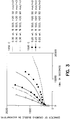
- Tables 7 and 8 show calculated bubble growth in soda lime glassmelt during sulfate fining in water containing glassmelt at 1450°C and 1500°C, respectively. These tables are graphically represented in Figure 3, which shows that an air bubble with an initial 200 micrometer diameter will grow much faster in a melt with higher water content and also at higher temperature.
- the fining temperature and SO 3 may be reduced by about 12°C and 0.05 wt.% respectively by increasing the water content by about 30 mol/m 3 .
- the fining temperature may be reduced by up to 50°C.
- the above disclosed invention may be practiced with any effective glassmaking furnace arrangement including, but not limited to oxy-fuel or air-fuel furnaces.
Landscapes
- Chemical & Material Sciences (AREA)
- Engineering & Computer Science (AREA)
- Materials Engineering (AREA)
- Organic Chemistry (AREA)
- Life Sciences & Earth Sciences (AREA)
- Chemical Kinetics & Catalysis (AREA)
- General Chemical & Material Sciences (AREA)
- Geochemistry & Mineralogy (AREA)
- Combustion & Propulsion (AREA)
- Glass Compositions (AREA)
Applications Claiming Priority (2)
| Application Number | Priority Date | Filing Date | Title |
|---|---|---|---|
| US66283496A | 1996-06-12 | 1996-06-12 | |
| US662834 | 1996-06-12 |
Publications (2)
| Publication Number | Publication Date |
|---|---|
| EP0812809A2 true EP0812809A2 (fr) | 1997-12-17 |
| EP0812809A3 EP0812809A3 (fr) | 1998-11-25 |
Family
ID=24659408
Family Applications (1)
| Application Number | Title | Priority Date | Filing Date |
|---|---|---|---|
| EP97109509A Withdrawn EP0812809A3 (fr) | 1996-06-12 | 1997-06-11 | Procédé de réduction d'émission toxique d'un four de verre par utilisation de l'eau pour le procédé d'affinage |
Country Status (6)
| Country | Link |
|---|---|
| EP (1) | EP0812809A3 (fr) |
| JP (1) | JPH10114529A (fr) |
| KR (1) | KR100319438B1 (fr) |
| CN (1) | CN1169965A (fr) |
| BR (1) | BR9703522A (fr) |
| CA (1) | CA2207509A1 (fr) |
Cited By (17)
| Publication number | Priority date | Publication date | Assignee | Title |
|---|---|---|---|---|
| EP0884287A1 (fr) * | 1997-06-09 | 1998-12-16 | Praxair Technology, Inc. | Utilisation de l'eau pour le procédé d'affinage, procédé de réduction d'émission toxique d'un four de verre |
| WO2000046161A1 (fr) * | 1999-02-05 | 2000-08-10 | Saint-Gobain Glass France | Procede de preparation de matieres premieres pour la fabrication de verre |
| FR2789384A1 (fr) * | 1999-02-05 | 2000-08-11 | Saint Gobain Vitrage | Procede de preparation de matieres premieres pour la fabrication de verre |
| FR2830528A1 (fr) * | 2001-10-08 | 2003-04-11 | Saint Gobain | Procede de preparation de matieres premieres pour la fabrication de verre |
| WO2003059836A1 (fr) * | 2002-01-17 | 2003-07-24 | Glaverbel | Vitrage a couches transforme thermiquement |
| WO2004028987A1 (fr) * | 2002-09-27 | 2004-04-08 | Ppg Industries Ohio, Inc. | Appareil et procede de production de verre flotte presentant une densite reduite de defauts |
| US6883349B1 (en) | 1999-02-05 | 2005-04-26 | Saint-Gobain Glass France | Method for preparing raw materials for glass-making |
| RU2255908C2 (ru) * | 2003-05-27 | 2005-07-10 | Кондрашов Дмитрий Валерьевич | Способ производства стекла |
| WO2005110933A1 (fr) | 2004-05-10 | 2005-11-24 | Linde Aktiengesellschaft | Procede pour purifier du verre |
| FR2899577A1 (fr) * | 2006-04-07 | 2007-10-12 | Saint Gobain | Four de fusion du verre comprenant un barrage de bruleurs immerges aux matieres vitrifiables |
| EP1990321A1 (fr) * | 2007-05-11 | 2008-11-12 | Johns Manville | Combustion immergée pour la fusion d'un verre à haute température |
| RU2597008C1 (ru) * | 2015-08-24 | 2016-09-10 | Роман Владимирович Лавров | Сырьевой концентрат и шихта для производства силикатного стекла |
| WO2017063666A1 (fr) * | 2015-10-12 | 2017-04-20 | Emp-Glass Gmbh | Dispositif de génération d'une atmosphère gazeuse contenant de la vapeur et composant d'installation comportant d'un tel dispositif |
| US11919799B2 (en) | 2019-10-01 | 2024-03-05 | Owens-Brockway Glass Container Inc. | Fining submerged combustion glass |
| EP4530261A1 (fr) * | 2023-09-29 | 2025-04-02 | Schott Ag | Procédé et appareil de fabrication d'un produit en verre |
| EP4570764A1 (fr) * | 2023-12-12 | 2025-06-18 | Schott Ag | Procédé et appareil de fabrication d'un produit en verre |
| WO2025125352A1 (fr) * | 2023-12-12 | 2025-06-19 | Schott Ag | Procédé et appareil de fabrication d'un produit en verre |
Families Citing this family (8)
| Publication number | Priority date | Publication date | Assignee | Title |
|---|---|---|---|---|
| JP2005041704A (ja) * | 2003-07-22 | 2005-02-17 | Nippon Electric Glass Co Ltd | 無アルカリガラス基板 |
| JP4941872B2 (ja) * | 2003-09-02 | 2012-05-30 | 日本電気硝子株式会社 | 液晶ディスプレイ用透明無アルカリガラス基板 |
| DE202009018732U1 (de) | 2008-02-26 | 2013-01-17 | Corning Inc. | Läutermittel für Silikatgläser |
| JP5862566B2 (ja) * | 2010-08-03 | 2016-02-16 | 旭硝子株式会社 | 近赤外線カットフィルタガラスおよびその製造方法 |
| CN105254176A (zh) * | 2015-10-30 | 2016-01-20 | 太仓市双凤镇薄彩工艺品厂 | 一种光洁度高的琉璃 |
| CN105541109B (zh) * | 2015-12-22 | 2017-10-17 | 巨石集团成都有限公司 | 一种玻璃生产中提高配合料均匀性及降低废气中氮氧化合物的方法 |
| CN110550862A (zh) * | 2019-08-30 | 2019-12-10 | 广东华兴玻璃股份有限公司 | 一种低硫玻璃及其制备方法 |
| CN113845291B (zh) * | 2021-10-25 | 2023-04-07 | 北京工业大学 | 一种消除中硼硅药用玻璃浮渣的方法及玻璃熔窑结构 |
Family Cites Families (9)
| Publication number | Priority date | Publication date | Assignee | Title |
|---|---|---|---|---|
| US2331052A (en) * | 1941-11-27 | 1943-10-05 | Owens Illinois Glass Co | Method of refining molten glass |
| US3617231A (en) * | 1968-06-10 | 1971-11-02 | Brockway Glass Co Inc | Method of controlling the softening point and working temperature of soda-lime glass by regulating the water content of the glass melt |
| US3960532A (en) * | 1974-03-04 | 1976-06-01 | Philadelphia Quartz Company | Preparing alkali metal silicate glass with bubbles |
| US4919700A (en) * | 1989-01-03 | 1990-04-24 | Ppg Industries, Inc. | Vacuum refining of glassy materials with selected water content |
| US5116399A (en) * | 1991-04-11 | 1992-05-26 | Union Carbide Industrial Gases Technology Corporation | Glass melter with front-wall oxygen-fired burner process |
| US5139558A (en) * | 1991-11-20 | 1992-08-18 | Union Carbide Industrial Gases Technology Corporation | Roof-mounted auxiliary oxygen-fired burner in glass melting furnace |
| BR9302204A (pt) * | 1992-06-05 | 1993-12-14 | Praxair Technology Inc | Processo para producao de vidro |
| US5713977A (en) * | 1994-09-12 | 1998-02-03 | Praxair Technology, Inc. | Fixed bed filtering preheater process for high temperature process furnaces |
| US5628809A (en) * | 1995-06-13 | 1997-05-13 | Praxair Technology, Inc. | Glassmelting method with reduced volatilization of alkali species |
-
1997
- 1997-06-11 CN CN97112749A patent/CN1169965A/zh active Pending
- 1997-06-11 BR BR9703522A patent/BR9703522A/pt not_active Application Discontinuation
- 1997-06-11 EP EP97109509A patent/EP0812809A3/fr not_active Withdrawn
- 1997-06-11 CA CA002207509A patent/CA2207509A1/fr not_active Abandoned
- 1997-06-11 JP JP9167881A patent/JPH10114529A/ja active Pending
- 1997-06-11 KR KR1019970023970A patent/KR100319438B1/ko not_active Expired - Fee Related
Cited By (28)
| Publication number | Priority date | Publication date | Assignee | Title |
|---|---|---|---|---|
| EP0884287A1 (fr) * | 1997-06-09 | 1998-12-16 | Praxair Technology, Inc. | Utilisation de l'eau pour le procédé d'affinage, procédé de réduction d'émission toxique d'un four de verre |
| US6883349B1 (en) | 1999-02-05 | 2005-04-26 | Saint-Gobain Glass France | Method for preparing raw materials for glass-making |
| WO2000046161A1 (fr) * | 1999-02-05 | 2000-08-10 | Saint-Gobain Glass France | Procede de preparation de matieres premieres pour la fabrication de verre |
| FR2789384A1 (fr) * | 1999-02-05 | 2000-08-11 | Saint Gobain Vitrage | Procede de preparation de matieres premieres pour la fabrication de verre |
| CZ301512B6 (cs) * | 1999-02-05 | 2010-03-31 | Saint-Gobain Glass France | Zpusob výroby sloucenin na bázi jednoho kremicitanu nebo více kremicitanu alkalických kovu, zarízení k provádení tohoto zpusobu, použití tohoto zpusobu nebo zarízení a zpusob získávání skla |
| KR100715767B1 (ko) * | 1999-02-05 | 2007-05-08 | 쌩-고벵 글래스 프랑스 | 유리제조용 원료를 생산하는 방법 |
| RU2266259C2 (ru) * | 1999-02-05 | 2005-12-20 | Сэн-Гобэн Гласс Франс | Способ подготовки шихтовых материалов для варки стекла и устройство для его осуществления (варианты) |
| AU770901B2 (en) * | 1999-02-05 | 2004-03-04 | Saint-Gobain Glass France | Method for preparing raw materials for glass-making |
| WO2003031357A1 (fr) * | 2001-10-08 | 2003-04-17 | Saint-Gobain Glass France | Procede de preparation de matieres premieres pour la fabrication de verre |
| FR2830528A1 (fr) * | 2001-10-08 | 2003-04-11 | Saint Gobain | Procede de preparation de matieres premieres pour la fabrication de verre |
| AU2002356211B2 (en) * | 2001-10-08 | 2007-12-13 | Saint-Gobain Glass France | Method for preparing raw materials for glass production |
| US7448231B2 (en) | 2001-10-08 | 2008-11-11 | Saint-Gobain Glass France | Process for preparing batch materials for the manufacture of glass |
| US8621889B2 (en) | 2001-10-08 | 2014-01-07 | Saint-Gobain Glass France | Process for preparing batch materials for the manufacture of glass |
| KR100884020B1 (ko) * | 2001-10-08 | 2009-02-17 | 쌩-고벵 글래스 프랑스 | 유리 생산용 원료를 제조하는 방법 |
| BE1014579A3 (fr) * | 2002-01-17 | 2004-01-13 | Glaverbel | Vitrage a couches transforme thermiquement. |
| WO2003059836A1 (fr) * | 2002-01-17 | 2003-07-24 | Glaverbel | Vitrage a couches transforme thermiquement |
| WO2004028987A1 (fr) * | 2002-09-27 | 2004-04-08 | Ppg Industries Ohio, Inc. | Appareil et procede de production de verre flotte presentant une densite reduite de defauts |
| RU2255908C2 (ru) * | 2003-05-27 | 2005-07-10 | Кондрашов Дмитрий Валерьевич | Способ производства стекла |
| WO2005110933A1 (fr) | 2004-05-10 | 2005-11-24 | Linde Aktiengesellschaft | Procede pour purifier du verre |
| FR2899577A1 (fr) * | 2006-04-07 | 2007-10-12 | Saint Gobain | Four de fusion du verre comprenant un barrage de bruleurs immerges aux matieres vitrifiables |
| EP1990321A1 (fr) * | 2007-05-11 | 2008-11-12 | Johns Manville | Combustion immergée pour la fusion d'un verre à haute température |
| RU2597008C1 (ru) * | 2015-08-24 | 2016-09-10 | Роман Владимирович Лавров | Сырьевой концентрат и шихта для производства силикатного стекла |
| WO2017063666A1 (fr) * | 2015-10-12 | 2017-04-20 | Emp-Glass Gmbh | Dispositif de génération d'une atmosphère gazeuse contenant de la vapeur et composant d'installation comportant d'un tel dispositif |
| US11919799B2 (en) | 2019-10-01 | 2024-03-05 | Owens-Brockway Glass Container Inc. | Fining submerged combustion glass |
| EP4530261A1 (fr) * | 2023-09-29 | 2025-04-02 | Schott Ag | Procédé et appareil de fabrication d'un produit en verre |
| WO2025068382A1 (fr) * | 2023-09-29 | 2025-04-03 | Schott Ag | Procédé et appareil de fabrication d'un produit en verre |
| EP4570764A1 (fr) * | 2023-12-12 | 2025-06-18 | Schott Ag | Procédé et appareil de fabrication d'un produit en verre |
| WO2025125352A1 (fr) * | 2023-12-12 | 2025-06-19 | Schott Ag | Procédé et appareil de fabrication d'un produit en verre |
Also Published As
| Publication number | Publication date |
|---|---|
| BR9703522A (pt) | 1999-05-25 |
| KR980001880A (ko) | 1998-03-30 |
| JPH10114529A (ja) | 1998-05-06 |
| CA2207509A1 (fr) | 1997-12-11 |
| EP0812809A3 (fr) | 1998-11-25 |
| KR100319438B1 (ko) | 2002-02-19 |
| CN1169965A (zh) | 1998-01-14 |
Similar Documents
| Publication | Publication Date | Title |
|---|---|---|
| US5922097A (en) | Water enhanced fining process a method to reduce toxic emissions from glass melting furnaces | |
| KR100319438B1 (ko) | 유리용융로로부터의독성물방출량을감소시키기위한물증강된황산염정련방법 | |
| US9133049B2 (en) | Method of reducing redox ratio of molten glass and the glass made thereby | |
| KR0160313B1 (ko) | 저알칼리 함량을 가지는 유리 생산방법 | |
| EP2000440A9 (fr) | Procede de fabrication de verre | |
| CA2446251A1 (fr) | Fusion ou fusion preliminaire rapide du verre | |
| JP2008105860A (ja) | ガラスの製造方法 | |
| EP4103522B1 (fr) | Matière première pour la production de verre incolore par mise en oeuvre d'une fusion par combustion avec immersion | |
| CA2178863C (fr) | Procede de fusion du verre reduisant la volatilisation des especes alcalines | |
| JP2023039441A (ja) | ガラスまたはガラスセラミック、ならびにガラスまたはガラスセラミックの溶融および清澄方法 | |
| EP2698354B1 (fr) | Procédé de dégazage sous vide de verre fondu, procédé de fabrication de verre fondu, procédé de fabrication d'un article constitué de verre | |
| CN109336380A (zh) | 一种超白玻璃及其生产方法与专用设备 | |
| EP4103523A1 (fr) | Production de verre incolore par fusion par combustion en immersion | |
| US4138235A (en) | Method of making flat glass with lower sulfur-containing emissions | |
| US6596660B1 (en) | Amber-free reduced blue glass composition | |
| US4270945A (en) | Method of melting flat glass using nitrates to suppress sulfurous emissions | |
| WO1996007621A1 (fr) | Materiaux volatils de composition du verre incorpores dans des frittes | |
| JP2015509476A (ja) | ガラス、ガラスセラミックスを生成するための方法、およびその使用 | |
| Swarts | Gases in glass | |
| CA3167720C (fr) | Matiere premiere pour la production de verre incolore par mise en oeuvre d'une fusion par combustion avec immersion | |
| Swarts | The melting of glass | |
| JP2004010476A (ja) | 鉛および砒素を含有しない硼珪酸塩ガラス | |
| ter Beek et al. | Chloride emission from glass melting furnaces |
Legal Events
| Date | Code | Title | Description |
|---|---|---|---|
| PUAI | Public reference made under article 153(3) epc to a published international application that has entered the european phase |
Free format text: ORIGINAL CODE: 0009012 |
|
| AK | Designated contracting states |
Kind code of ref document: A2 Designated state(s): DE ES FR IT |
|
| PUAL | Search report despatched |
Free format text: ORIGINAL CODE: 0009013 |
|
| AK | Designated contracting states |
Kind code of ref document: A3 Designated state(s): AT BE CH DE DK ES FI FR GB GR IE IT LI LU MC NL PT SE |
|
| 17P | Request for examination filed |
Effective date: 19981130 |
|
| AKX | Designation fees paid |
Free format text: DE ES FR IT |
|
| 17Q | First examination report despatched |
Effective date: 20020702 |
|
| STAA | Information on the status of an ep patent application or granted ep patent |
Free format text: STATUS: THE APPLICATION IS DEEMED TO BE WITHDRAWN |
|
| 18D | Application deemed to be withdrawn |
Effective date: 20021113 |