EP0813244A2 - Semisolide, thermische Zwischenlage mit geringem Flusswiderstand - Google Patents
Semisolide, thermische Zwischenlage mit geringem Flusswiderstand Download PDFInfo
- Publication number
- EP0813244A2 EP0813244A2 EP97304104A EP97304104A EP0813244A2 EP 0813244 A2 EP0813244 A2 EP 0813244A2 EP 97304104 A EP97304104 A EP 97304104A EP 97304104 A EP97304104 A EP 97304104A EP 0813244 A2 EP0813244 A2 EP 0813244A2
- Authority
- EP
- European Patent Office
- Prior art keywords
- graft polymer
- degrees
- thermally conductive
- solid state
- interface material
- Prior art date
- Legal status (The legal status is an assumption and is not a legal conclusion. Google has not performed a legal analysis and makes no representation as to the accuracy of the status listed.)
- Granted
Links
Images


Classifications
-
- H—ELECTRICITY
- H10—SEMICONDUCTOR DEVICES; ELECTRIC SOLID-STATE DEVICES NOT OTHERWISE PROVIDED FOR
- H10W—GENERIC PACKAGES, INTERCONNECTIONS, CONNECTORS OR OTHER CONSTRUCTIONAL DETAILS OF DEVICES COVERED BY CLASS H10
- H10W40/00—Arrangements for thermal protection or thermal control
- H10W40/20—Arrangements for cooling
- H10W40/25—Arrangements for cooling characterised by their materials
- H10W40/251—Organics
-
- Y—GENERAL TAGGING OF NEW TECHNOLOGICAL DEVELOPMENTS; GENERAL TAGGING OF CROSS-SECTIONAL TECHNOLOGIES SPANNING OVER SEVERAL SECTIONS OF THE IPC; TECHNICAL SUBJECTS COVERED BY FORMER USPC CROSS-REFERENCE ART COLLECTIONS [XRACs] AND DIGESTS
- Y10—TECHNICAL SUBJECTS COVERED BY FORMER USPC
- Y10T—TECHNICAL SUBJECTS COVERED BY FORMER US CLASSIFICATION
- Y10T428/00—Stock material or miscellaneous articles
- Y10T428/12—All metal or with adjacent metals
- Y10T428/12014—All metal or with adjacent metals having metal particles
- Y10T428/12028—Composite; i.e., plural, adjacent, spatially distinct metal components [e.g., layers, etc.]
- Y10T428/12049—Nonmetal component
-
- Y—GENERAL TAGGING OF NEW TECHNOLOGICAL DEVELOPMENTS; GENERAL TAGGING OF CROSS-SECTIONAL TECHNOLOGIES SPANNING OVER SEVERAL SECTIONS OF THE IPC; TECHNICAL SUBJECTS COVERED BY FORMER USPC CROSS-REFERENCE ART COLLECTIONS [XRACs] AND DIGESTS
- Y10—TECHNICAL SUBJECTS COVERED BY FORMER USPC
- Y10T—TECHNICAL SUBJECTS COVERED BY FORMER US CLASSIFICATION
- Y10T428/00—Stock material or miscellaneous articles
- Y10T428/12—All metal or with adjacent metals
- Y10T428/12493—Composite; i.e., plural, adjacent, spatially distinct metal components [e.g., layers, joint, etc.]
- Y10T428/125—Deflectable by temperature change [e.g., thermostat element]
- Y10T428/12507—More than two components
-
- Y—GENERAL TAGGING OF NEW TECHNOLOGICAL DEVELOPMENTS; GENERAL TAGGING OF CROSS-SECTIONAL TECHNOLOGIES SPANNING OVER SEVERAL SECTIONS OF THE IPC; TECHNICAL SUBJECTS COVERED BY FORMER USPC CROSS-REFERENCE ART COLLECTIONS [XRACs] AND DIGESTS
- Y10—TECHNICAL SUBJECTS COVERED BY FORMER USPC
- Y10T—TECHNICAL SUBJECTS COVERED BY FORMER US CLASSIFICATION
- Y10T428/00—Stock material or miscellaneous articles
- Y10T428/12—All metal or with adjacent metals
- Y10T428/12493—Composite; i.e., plural, adjacent, spatially distinct metal components [e.g., layers, joint, etc.]
- Y10T428/12528—Semiconductor component
-
- Y—GENERAL TAGGING OF NEW TECHNOLOGICAL DEVELOPMENTS; GENERAL TAGGING OF CROSS-SECTIONAL TECHNOLOGIES SPANNING OVER SEVERAL SECTIONS OF THE IPC; TECHNICAL SUBJECTS COVERED BY FORMER USPC CROSS-REFERENCE ART COLLECTIONS [XRACs] AND DIGESTS
- Y10—TECHNICAL SUBJECTS COVERED BY FORMER USPC
- Y10T—TECHNICAL SUBJECTS COVERED BY FORMER US CLASSIFICATION
- Y10T428/00—Stock material or miscellaneous articles
- Y10T428/12—All metal or with adjacent metals
- Y10T428/12493—Composite; i.e., plural, adjacent, spatially distinct metal components [e.g., layers, joint, etc.]
- Y10T428/12535—Composite; i.e., plural, adjacent, spatially distinct metal components [e.g., layers, joint, etc.] with additional, spatially distinct nonmetal component
- Y10T428/12542—More than one such component
- Y10T428/12549—Adjacent to each other
-
- Y—GENERAL TAGGING OF NEW TECHNOLOGICAL DEVELOPMENTS; GENERAL TAGGING OF CROSS-SECTIONAL TECHNOLOGIES SPANNING OVER SEVERAL SECTIONS OF THE IPC; TECHNICAL SUBJECTS COVERED BY FORMER USPC CROSS-REFERENCE ART COLLECTIONS [XRACs] AND DIGESTS
- Y10—TECHNICAL SUBJECTS COVERED BY FORMER USPC
- Y10T—TECHNICAL SUBJECTS COVERED BY FORMER US CLASSIFICATION
- Y10T428/00—Stock material or miscellaneous articles
- Y10T428/12—All metal or with adjacent metals
- Y10T428/12493—Composite; i.e., plural, adjacent, spatially distinct metal components [e.g., layers, joint, etc.]
- Y10T428/12535—Composite; i.e., plural, adjacent, spatially distinct metal components [e.g., layers, joint, etc.] with additional, spatially distinct nonmetal component
- Y10T428/12556—Organic component
- Y10T428/12569—Synthetic resin
-
- Y—GENERAL TAGGING OF NEW TECHNOLOGICAL DEVELOPMENTS; GENERAL TAGGING OF CROSS-SECTIONAL TECHNOLOGIES SPANNING OVER SEVERAL SECTIONS OF THE IPC; TECHNICAL SUBJECTS COVERED BY FORMER USPC CROSS-REFERENCE ART COLLECTIONS [XRACs] AND DIGESTS
- Y10—TECHNICAL SUBJECTS COVERED BY FORMER USPC
- Y10T—TECHNICAL SUBJECTS COVERED BY FORMER US CLASSIFICATION
- Y10T428/00—Stock material or miscellaneous articles
- Y10T428/12—All metal or with adjacent metals
- Y10T428/12493—Composite; i.e., plural, adjacent, spatially distinct metal components [e.g., layers, joint, etc.]
- Y10T428/12535—Composite; i.e., plural, adjacent, spatially distinct metal components [e.g., layers, joint, etc.] with additional, spatially distinct nonmetal component
- Y10T428/12576—Boride, carbide or nitride component
Definitions
- the present invention relates generally to an interface coating for use in combination with solid state electronic components or devices, and more particularly to a semisolid interface coating which is adapted to be interposed along a heat dissipating path between a solid state electronic device and a mounting surface.
- the interface coating of the present invention comprises, in admixture, a polyorganosiloxane graft polymer with a methylsiloxane host together with a linear hydrocarbon having a single terminally positioned unsaturated linkage in the carbon chain, and with a chain length preferably between 16 and 19 carbon atoms.
- the graft polymer is advantageously prepared from octadecene and a methylsiloxane host, with the graft polymer thereafter being blended with a particulate solid.
- the particulate solid or filler functions as a thermally conductive component for the blend, and with its small particulate size and high surface area, functions also as a viscosity stabilizer for the polymer component.
- the polyorganosiloxane graft polymers utilized in the formulations of the present invention may have a melting point ranging from between about 30 degrees C. and 90 degrees C., and preferably having a melting point ranging from between about 30 degrees and 60 degrees C. The melting point range of an individual polymer is relatively narrow and sharply defined, thereby contributing to the consistency of performance.
- the polyorganosiloxane graft polymer portion of the interface coating changes phase and becomes at least partially liquid during normal operation of the solid state electronic device with which it is operatively thermally coupled.
- the interface when even only partially molten, provides a highly thermally conductive path substantially free of entrapped air so as to facilitate and enhance heat dissipation from the solid state device.
- the coatings of the present invention may be applied onto the surfaces upon which the solid state electronic device is either being directly mounted, or alternatively, to which the device is being operatively thermally coupled.
- the coatings of the present invention may be applied as required onto either surfaces of metallic or polymeric materials. These coatings may be applied as continuous layers or may be applied on an intermittent or segmented pattern basis in the form of strips or dots. The coatings may also be die cut and applied to the appropriate surface.
- Solid state electronic devices or components are in wide use and application, being incorporated in electronic systems generally, including systems used in the fields of data processing, communications, power supply systems, among others.
- Solid state electronic devices including power transistors, power modules including converters such as AC-to-DC and DC-to-DC and other similar components.
- the term "solid state electronic devices” is being used herein in a comprehensive sense, and is intended to include solid state circuits wherein a complete circuit is formed from a single block or chip of semiconductor material, solid state circuit elements such as Zener diodes, silicone controlled rectifiers, as well as other solid state components such as transistors and diodes.
- thermoelectric devices as well as lasers, each of which typically require contact with a heat exchanger or a thermally conductive path for heat dissipation.
- These devices are typically incorporated in packages designed for mounting on a chassis in accordance with the individual requirements of the specific circuit. As power and frequency requirements increase, and as the space available for these devices or components shrink, these packages typically require highly efficient, effective, and reliable means for dissipating heat created by the solid state electronic devices during periods of normal operation, with the heat typically being transferred by thermal conduction from the package to a mounting surface. This thermal conduction may be undertaken either directly, as occurs when the device is mounted upon the heat dissipating surface, or indirectly as occurs when the device is mounted to a surface which is arranged along a thermal path to a heat dissipating member.
- a layer of grease typically a silicone grease, or a layer of an organic wax to aid in creating a low thermal resistance path between the opposed mating surfaces of the package and the mounting surface.
- a layer of such grease is typically applied between these mating surfaces in order to facilitate and enhance thermal conductivity.
- heat spreaders may be employed along the thermal path to achieve certain heat dissipating objectives, and the interface coatings of the present invention may be employed along the surfaces of heat spreaders as well. In each of these instances, the quantity of entrained air is reduced and thermal conductivity is improved in order to increase thermal energy flow from the electronic device.
- silicone grease for example, was applied liberally to the surfaces so as to assure its presence in all of those locations where it is reasonably expected to be needed or required.
- the assembly operations utilizing grease typically over-apply the material, and the products become messy, with the grease in certain instances, interfering with subsequent assembly operations and also with subsequent operation of the solid state device.
- the features of the present invention provide a highly thermally conductive coating which may be applied to surfaces along a thermal path, with the coating having a consistent and uniform thickness which contributes to consistency in performance. Given this property in the thermally conductive coating, greater predictability of performance is available from the semiconductor devices utilized in combination with the coating, with these advantages being obtained without experiencing the problems inherent in applications of silicone grease.
- an interface for mounting solid state electronic devices is provided in the form of a material in dry film coating form with the coating functioning to enhance thermal transfer from the device or its heat sink to a chassis or the like.
- the dry film coating form provides advantages over the normally employed grease form. When employed in an actual circuit arrangement, assembly time is shortened, the operation is rendered clean, with ease of application and assembly being provided along with improvements in stability of operation.
- the polyorganosiloxane graft polymer becomes molten, thereby enhancing the ability of the interface to effectively transfer thermal energy from the device to its mounting chassis.
- the interface coatings of the present invention also provide for high conformability and flow in response to application of exceptionally low forces and resultant low unit forces and pressures.
- Interfaces of the present invention may be employed wherever typical solid state electronic mounting packages are utilized. Because of their property of low resistance to flow, the interfaces are highly useful and effective when the nature of the package permits only extremely small external forces to be utilized. Some of these products typically tolerate only low or modest forces and/or unit pressures during application of the normally encountered mounting forces, and the coatings of the present invention will flow to conform to the configuration of the surfaces involved.
- the formulation of the present invention provide a coating in dry film form wherein a significant portion of the polyorganosiloxane component of the formulation is solid at normal room temperatures, but becomes molten or otherwise undergoes a change of phase from solid to liquid at a low temperature such as between about 30 degrees C. and 90 degrees C., and preferably between about 30 degrees C and 60 degrees C. In one preferred embodiment, a melting range of between about 40 degrees C. and 45 degrees C. is achieved.
- the interface accommodates and conforms to the configurations of the opposed surfaces with which it is in contact, thereby increasing the area of contact between the interfaces and eliminating air, and thus increasing the rate of thermal transfer through conduction from the heat generating solid state electronic device to its mounting surface.
- the interface material of the present invention comprises a polyorganosiloxane graft polymer of a methylsiloxane host and a linear hydrocarbon of from 16 up to about 19 carbon atoms with a single terminally positioned unsaturated linkage present in its carbon chain.
- a linear hydrocarbon is 1-octadecene.
- the graft polymer is in admixture with a thermally conductive viscosity stabilizer in particulate form.
- 1-octadecene for example, is grafted onto the polyorganosiloxane through a vinyl addition reaction.
- the resultant wax product is treated for removal of organic volatiles and/or hydrocarbons through stripping, with this operation also achieving separation and removal of residual stearyl components.
- Those reactant products falling within the density range of between about 0.8 and 0.9 and a preferred melting point range between 40 degrees C. and 45 degrees C. have a preferred average molecular weight of approximately 12,000.
- reactant products having an average molecular weight of between about 10,000 and 20,000 are useful, with average molecular weights ranging up to about 200,000 being acceptable in certain situations.
- these higher molecular weight products may be employed wherever the application permits use of a coating with high viscosity at a low shear rate.
- Reactant products useful in accordance with the present invention are semisolid waxy materials at normal ambient conditions, and remain so when the graft polymer component is blended with particulate solids in the range set forth.
- the resultant composition or product is conveniently formed as a dry cohesive coating.
- the coating is highly compliant with a low resistance to flow. Compositions with a melting point ranging from between about 30 degrees C. and 90 degrees C. are useful, and those with a melting point of below about 60 degrees C. are generally preferred.
- the graft polymer is treated to remove impurities or unreacted components so as to yield a substantially purified reactant product with a relatively narrow and sharply defined melting point.
- the particulate viscosity stabilizer is preferably highly thermally conductive, and is generally selected from the group consisting of alumina, boron nitride, graphite, silicon carbide, diamond, metal powders as well as mixtures thereof.
- the interface material of the present invention preferably contains from between about 15% and 25% by weight polyorganosiloxane graft polymer, balance thermally conductive viscosity stabilizer in particulate form.
- a preferred formulation range is between 20% and 25% by weight graft polymer, balance thermally conductive viscosity stabilizing particulate.
- the average particle size of the viscosity stabilizer is less than about 25 microns, it being noted that fillers having small particle size and high surface area are generally preferred.
- Graft polymers of octadecene and methylsiloxane are commercially available, as are the various particulate solids including alumina, boron nitride, graphite, diamond, metal powder, and silicon carbide.
- a polyorganosiloxane graft polymer of octadecene on a methylsiloxane host was prepared in accordance with the procedure of Synthesis I below:
- the reaction was undertaken at 100 degrees C. at ambient pressure, and continued for 30 minutes for a batch size of 30 grams.
- the melting point of the reactant product was 43.8 degrees C. The melting point is subject to adjustment as desired by changing either the organic group or the silicone/organic content ratio.
- organic groups which may be utilized in lieu of 1-octadecene include, 1-hexadecene, 1-heptadecene, 1-nonadecene, or like materials.
- Such linear hydrocarbons are, of course, commercially available, including, in particular, 1-octadecene, it being noted that 1-heptadecene, 1-nonadecene and eicosene may also be employed. These linear hydrocarbons are all commercially available.
- the silicone/organic content may also be adjusted by utilizing hydromethylsiloxane-dimethylsiloxane copolymers such as: wherein “k” and “l” are integers wherein “k” has a value ranging from 19 to 39, and wherein “l” has a value equal to the remainder of (40 - k).
- the siloxane component employs higher quantities of the methylsiloxane radical, it has been found that the melting point drops below acceptable levels.
- the percentage of the methylsiloxane component exceeds about 50% by weight, the melting point falls below about 30 degrees C.
- the reactant product was further treated through a stripping operation to separate the graft polymer from solvents as well as non-reacted materials.
- This stripping operation was undertaken at 99 degrees C. at a pressure of 0.2 Torr until the volatiles are substantially removed.
- Such separation techniques are, of course, known by those skilled in the art.
- silicone-organic polymers may be utilized in formation of the polyorganosiloxane graft polymer.
- polydiethylsiloxane may be employed as well as certain aryl alkyl siloxanes such as phenylmethylsiloxane.
- halogenated alkyl siloxanes such as trifluoropropylsiloxane may be found suitable in certain applications as well.
- the reaction was undertaken at 100 degrees C. at ambient pressure, and continued for 30 minutes for a batch size of 30 grams.
- the melting point of the reactant product was 35 degrees C, this melting point being subject to adjustment as desired by changing the silicone/organic content ratio.
- the reaction was undertaken at 100 degrees C. at ambient pressure, and continued for 30 minutes for a batch size of 30 grams.
- the melting point of the reactant product was 55 degrees C, this melting point being subject to adjustment as desired by changing the silicone/organic content ratio.
- the reaction was undertaken at 100 degrees C. at ambient pressure, and continued for 30 minutes for a batch size of 30 grams.
- the melting point of the reactant product was 65 degrees C., this melting point being subject to adjustment as desired by changing the silicone/organic content ratio.
- Viscosity control particulate 200 - 350 Viscosity control particulate 200 - 350.
- PHR parts per hundred weight resin
- the viscosity becomes excessive and the flow resistance increases, particularly when employed at exceptionally low and/or modest mounting pressures while at the same time it remains necessary to force or exclude entrapped air out of the interface zone.
- Table I below indicates the change in thermal resistance versus filler in PHR: TABLE I Alumina PHR Thermal Test Die ⁇ cS °C./watt 200 0.2 250 0.2 300 0.2 400 0.5 500 0.8.
- the alumina content must be present in the ranges specified herein, since when the alumina content is too high, the ability to flow is sacrificed. When too low, flow may become excessive.
- the test employed is known in the art as the Pentium Test.
- One hundred parts of polyorganosiloxane graft polymer prepared in accordance with the General Formulation hereinabove was blended with 350 parts of alumina powder having an average particle size of about 3 microns, and with a particle size ranging from between about 1 micron and 10 microns.
- alumina powder having an average particle size of about 3 microns, and with a particle size ranging from between about 1 micron and 10 microns.
- Such alumina particulate is commercially available.
- the resultant material was a dry film having a melting point of 43 degrees C., and was capable of being handled and/or coated for use as an interface in the thermal path between a solid state electronic device package and a chassis.
- the thermal resistance was measured pursuant to test method of Table I and found to be 0.2 °C./watt.
- the polyorganosiloxane graft polymer of Example I was blended with 400 parts of alumina powder having an average particle size of about 3 microns, and with a particle size ranging from between 1 micron and 10 microns. Such alumina particulate is commercially available.
- the resultant material was a dry film or coating having a melting point of 43 degrees C., and was capable of being handled and/or cut into strips for use as an interface between a solid state electronic device package and a chassis.
- the thermal resistance was measured pursuant to the method of Table I and found to be 0.5 °C./watt.
- the dielectric constant of the resultant products from Examples I and II was measured and found to be 5 at 1kHz, with the volume resistivity being 10 10 ohm-meters.
- Certain polyorganosiloxane graft polymers are commercially available from a variety of sources. When a commercially available graft polymer having either unreacted or stray components present, it may be helpful to treat the material to reduce or eliminate the presence of unreacted components or impurities. Treatment in a vacuum still may be found helpful for removal of certain unreacted components and/or impurities.
- a mounting surface or chassis generally designated 10 includes a metallic support plate 11 functioning as a heat spreader or heat sink and upon which an interface coating 12 has been applied.
- the coating is substantially continuous and is arranged and designed for placement of a solid state electronic device upon the upper surface of the coating.
- the partial assembly generally designated 15 includes, as was present in Figure 1A, a metallic support plate 11 upon which is disposed a geometric pattern, including the pattern of dots, such as dots 16-16 in a reticulated coating arrangement.
- a geometric pattern including the pattern of dots, such as dots 16-16 in a reticulated coating arrangement.
- dots 16-16 in a reticulated coating arrangement.
- one arrangement of reticulated dots which has been found useful employs dots formed of the composition of the present invention having a diameter of 120 mils, with the dots being arranged on 150-mil centers.
- the dots may typically have a thickness of between 2 mils and 6 mils, although other thicknesses and physical patterns may be employed as well.
- a packaged solid state electronic device generally designated 20 having an interface coating 21 applied to an outer major surface thereof.
- the coating 21 is both adherent and coherent, and is formulated in accordance with the present invention.
- the coating 21 may provide an interface directly between the device and a heat sink, or alternatively between the device and a heat spreader. See, for example, the arrangement in the configuration set forth in Figure 5.
- the assembly generally designated 30 comprises a power device 31 arranged at the upper surface of conductive circuit layer 32, with dielectic layer 33 supporting conductive layer 32.
- a metal heat spreader is interposed along the thermal path as at 34, with the thermal path ultimately leading to heat sink 35.
- the coating material of the present invention is shown at 36, interposed between the surfaces of heat spreader 34 and heat sink 35.
- dielectic layer 33 is fabricated from a suitable thermally conducting dielectic, such as, for example, any of the well-known thermally conductive ceramic dielectics.
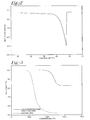
- Figure 2 is a plot demonstrating the thermal ramp plot of temperature in degrees C. versus heat flow in milliwatts per milligram, and demonstrating the melting characteristics of a polyorganosiloxane graft polymer prepared in accordance with the present invention. The plot demonstrates that a substantially completely molten state is achieved at about 46 degrees C.
- Figure 3 is a graph illustrating a comparison between the weight loss in percent of a polyorganosiloxane graft polymer prepared in accordance with the present invention compared with an organic wax of the type typically employed in mounting of solid state electronic semiconductor devices.
- the plot or graph illustrates the weight loss achieved at various temperatures shown in degrees C.
- Table II below represents the performance of an interface coating prepared in accordance with the present invention upon exposure to elevated temperatures for extended periods of time, with the lifetime in hours being determined upon the determination of a 1% weight loss.
- a reactant mixture for the creation of a polyorganosiloxane graft polymer reactant product was prepared in accordance with Example II and applied as a coating on the surface of an aluminum plate, with the coating having a thickness of 5 mils.
- Standard kinetics analysis of thermal weight loss data with the analysis being undertaken utilizing standardized kinetics of thermal weight loss data from thermal gravimetric analysis of the type shown in Figure 3, and showing that the organic wax thermally decomposes at a lower temperature than the graft polymer.
- three different ramp rates were employed varying from between 5 degrees C. per minute to 20 degrees C. per minute, with the specific rates being 5 degrees C. per minute, 10 degrees C. per minute, and 20 degrees C. per minute.
- thermal performance indicating the estimated lifetime versus temperature is set forth in Table III below: TABLE III ESTIMATED LIFETIME vs. TEMPERATURE Temperature °C. Lifetime Hour based on 1% weight loss 50.0 0.461 100.0 0.199 150.0 0.105 200.0 0.0633.
- the stability of the material of the present invention is believed to be demonstrated by the data contained in Tables II and III herein.
- thermal stability may be enhanced through the use of an antioxidant such as tetrakis [methylene (3,5-di-tert-butyl-4 hydroxyhydrocinnamate)].
- antioxidants are commercially available under the code designation "Irganox 1010" from Ciba Geigy Corp. of Ardsley, NY.
Landscapes
- Compositions Of Macromolecular Compounds (AREA)
- Paints Or Removers (AREA)
- Silicon Polymers (AREA)
- Organic Insulating Materials (AREA)
- Insulated Conductors (AREA)
Applications Claiming Priority (2)
| Application Number | Priority Date | Filing Date | Title |
|---|---|---|---|
| US663800 | 1984-10-23 | ||
| US08/663,800 US5950066A (en) | 1996-06-14 | 1996-06-14 | Semisolid thermal interface with low flow resistance |
Publications (3)
| Publication Number | Publication Date |
|---|---|
| EP0813244A2 true EP0813244A2 (de) | 1997-12-17 |
| EP0813244A3 EP0813244A3 (de) | 1998-07-08 |
| EP0813244B1 EP0813244B1 (de) | 2004-08-18 |
Family
ID=24663308
Family Applications (1)
| Application Number | Title | Priority Date | Filing Date |
|---|---|---|---|
| EP97304104A Expired - Lifetime EP0813244B1 (de) | 1996-06-14 | 1997-06-12 | Semisolide, thermische Zwischenlage mit geringem Flusswiderstand |
Country Status (6)
| Country | Link |
|---|---|
| US (1) | US5950066A (de) |
| EP (1) | EP0813244B1 (de) |
| JP (1) | JP3663032B2 (de) |
| CA (1) | CA2207114C (de) |
| DE (1) | DE69730271T2 (de) |
| TW (1) | TW360906B (de) |
Cited By (9)
| Publication number | Priority date | Publication date | Assignee | Title |
|---|---|---|---|---|
| EP0878499A1 (de) * | 1997-05-13 | 1998-11-18 | Lexmark International, Inc. | Dichtstoffe für Tonerkassetten |
| EP1067164A1 (de) * | 1999-07-08 | 2001-01-10 | Saint-Gobain Performance Plastics Corporation | Phasenveränderliches, thermisches Zwischenlagermaterial |
| WO2003027207A1 (en) * | 2001-09-21 | 2003-04-03 | 3M Innovative Properties Company | Thermoconductive composition |
| FR2840732A1 (fr) * | 2002-06-11 | 2003-12-12 | Saint Gobain Performance Plast | Materiau d'interface thermique renfermant un alliage a bas point de fusion |
| EP1143512A3 (de) * | 2000-04-05 | 2004-10-06 | The Bergquist Company | Preparation thermisch leitender Stoffe durch flüssigmetallüberbrückte Teilchengruppen |
| EP1143511A3 (de) * | 2000-04-05 | 2004-10-06 | The Bergquist Company | Preparation thermisch leitender Stoffe durch flüssigmetallüberbrückte Teilchengruppen |
| EP1600494A1 (de) * | 2004-05-21 | 2005-11-30 | Shin-Etsu Chemical Co., Ltd. | Silikonfett-Zusammensetzung |
| EP1783169A2 (de) | 2002-04-12 | 2007-05-09 | Dow Corning Corporation | Thermischleitende phasenveränderliche Materialien |
| CN102190802A (zh) * | 2011-03-23 | 2011-09-21 | 南京天诗实验微粉有限公司 | 交联聚合物蜡微粉的制备方法 |
Families Citing this family (51)
| Publication number | Priority date | Publication date | Assignee | Title |
|---|---|---|---|---|
| ES2171403T3 (es) * | 1992-06-10 | 2002-09-16 | Cfph Llc | Procesador de datos de cartera de renta fija y metodo de utilizacion del mismo. |
| JP2941801B1 (ja) * | 1998-09-17 | 1999-08-30 | 北川工業株式会社 | 熱伝導材 |
| US6399209B1 (en) | 1999-04-16 | 2002-06-04 | The Bergquist Company | Integrated release films for phase-change interfaces |
| JP3504882B2 (ja) * | 1999-05-24 | 2004-03-08 | 富士高分子工業株式会社 | 熱伝導性・電気絶縁性シリコーン組成物及びこれを用いたシリコーン成形物 |
| DE19924289A1 (de) * | 1999-05-27 | 2000-12-07 | Siemens Ag | Elektronisches Schaltungsmodul mit flexibler Zwischenschicht zwischen elektronischen Bauelementen und einem Kühlkörper |
| US20040009353A1 (en) * | 1999-06-14 | 2004-01-15 | Knowles Timothy R. | PCM/aligned fiber composite thermal interface |
| US6457086B1 (en) * | 1999-11-16 | 2002-09-24 | Apple Computers, Inc. | Method and apparatus for accelerating detection of serial bus device speed signals |
| US6984685B2 (en) * | 2000-04-05 | 2006-01-10 | The Bergquist Company | Thermal interface pad utilizing low melting metal with retention matrix |
| US6618785B1 (en) | 2000-04-21 | 2003-09-09 | Apple Computer, Inc. | Method and apparatus for automatic detection and healing of signal pair crossover on a high performance serial bus |
| US6660241B2 (en) * | 2000-05-01 | 2003-12-09 | Saint-Gobain Ceramics & Plastics, Inc. | Highly delaminated hexagonal boron nitride powders, process for making, and uses thereof |
| US6794435B2 (en) | 2000-05-18 | 2004-09-21 | Saint Gobain Ceramics & Plastics, Inc. | Agglomerated hexagonal boron nitride powders, method of making, and uses thereof |
| US6764975B1 (en) * | 2000-11-28 | 2004-07-20 | Saint-Gobain Ceramics & Plastics, Inc. | Method for making high thermal diffusivity boron nitride powders |
| JP4459470B2 (ja) * | 2001-04-06 | 2010-04-28 | 信越化学工業株式会社 | 電子部品の放熱構造体及びそれに用いる放熱シート |
| WO2002088234A1 (en) * | 2001-04-30 | 2002-11-07 | Saint-Gobain Ceramics And Plastics , Inc. | Polymer processing aid and method for processing polymers |
| US6645612B2 (en) | 2001-08-07 | 2003-11-11 | Saint-Gobain Ceramics & Plastics, Inc. | High solids hBN slurry, hBN paste, spherical hBN powder, and methods of making and using them |
| JP3938681B2 (ja) * | 2001-11-21 | 2007-06-27 | 信越化学工業株式会社 | 放熱構造体 |
| US6620515B2 (en) * | 2001-12-14 | 2003-09-16 | Dow Corning Corporation | Thermally conductive phase change materials |
| DE60229072D1 (de) * | 2002-02-06 | 2008-11-06 | Parker Hannifin Corp | Wärmesteuerungsmaterialien mit phasenumwandlungsdispersion |
| US6946190B2 (en) * | 2002-02-06 | 2005-09-20 | Parker-Hannifin Corporation | Thermal management materials |
| AU2003228495A1 (en) * | 2002-04-11 | 2003-10-27 | Honeywell International Inc. | Thermally conductive coating compositions, methods of production and uses thereof |
| US6657297B1 (en) | 2002-08-15 | 2003-12-02 | The Bergquist Company | Flexible surface layer film for delivery of highly filled or low cross-linked thermally conductive interface pads |
| US6783692B2 (en) | 2002-10-17 | 2004-08-31 | Dow Corning Corporation | Heat softening thermally conductive compositions and methods for their preparation |
| US6919504B2 (en) * | 2002-12-19 | 2005-07-19 | 3M Innovative Properties Company | Flexible heat sink |
| US20040120129A1 (en) * | 2002-12-24 | 2004-06-24 | Louis Soto | Multi-layer laminated structures for mounting electrical devices and method for fabricating such structures |
| US6831835B2 (en) * | 2002-12-24 | 2004-12-14 | Ault, Inc. | Multi-layer laminated structures, method for fabricating such structures, and power supply including such structures |
| US7861768B1 (en) | 2003-06-11 | 2011-01-04 | Apple Inc. | Heat sink |
| US20050016714A1 (en) * | 2003-07-09 | 2005-01-27 | Chung Deborah D.L. | Thermal paste for improving thermal contacts |
| US7494635B2 (en) | 2003-08-21 | 2009-02-24 | Saint-Gobain Ceramics & Plastics, Inc. | Boron nitride agglomerated powder |
| US20050049350A1 (en) * | 2003-08-25 | 2005-03-03 | Sandeep Tonapi | Thin bond-line silicone adhesive composition and method for preparing the same |
| US7193307B2 (en) * | 2004-03-25 | 2007-03-20 | Ault Incorporated | Multi-layer FET array and method of fabricating |
| JP2005330426A (ja) * | 2004-05-21 | 2005-12-02 | Shin Etsu Chem Co Ltd | 放熱用シリコーングリース組成物 |
| KR101164438B1 (ko) * | 2004-12-16 | 2012-07-13 | 다우 코닝 코포레이션 | 아미드 치환된 실리콘, 이의 제조방법 및 이의 용도 |
| TWI291480B (en) * | 2005-12-20 | 2007-12-21 | Ind Tech Res Inst | Composition for thermal interface materials |
| US20080166552A1 (en) * | 2006-11-06 | 2008-07-10 | Arlon, Inc. | Silicone based compositions for thermal interface materials |
| US8545987B2 (en) * | 2007-11-05 | 2013-10-01 | Laird Technologies, Inc. | Thermal interface material with thin transfer film or metallization |
| US8445102B2 (en) * | 2007-11-05 | 2013-05-21 | Laird Technologies, Inc. | Thermal interface material with thin transfer film or metallization |
| US9795059B2 (en) | 2007-11-05 | 2017-10-17 | Laird Technologies, Inc. | Thermal interface materials with thin film or metallization |
| US8076773B2 (en) | 2007-12-26 | 2011-12-13 | The Bergquist Company | Thermal interface with non-tacky surface |
| KR20160122172A (ko) | 2014-02-13 | 2016-10-21 | 허니웰 인터내셔날 인코포레이티드 | 압축성 열전도 재료 |
| CN105170542A (zh) * | 2015-09-25 | 2015-12-23 | 无锡市博阳超声电器有限公司 | 一种可加热的超声波清洗槽 |
| EP3426746B1 (de) | 2016-03-08 | 2021-07-14 | Honeywell International Inc. | Phasenwechselmaterial |
| US11041103B2 (en) | 2017-09-08 | 2021-06-22 | Honeywell International Inc. | Silicone-free thermal gel |
| US11072706B2 (en) | 2018-02-15 | 2021-07-27 | Honeywell International Inc. | Gel-type thermal interface material |
| US11373921B2 (en) | 2019-04-23 | 2022-06-28 | Honeywell International Inc. | Gel-type thermal interface material with low pre-curing viscosity and elastic properties post-curing |
| TWI896542B (zh) | 2019-07-23 | 2025-09-11 | 德商漢高股份有限及兩合公司 | 高熱通量多元件總成之熱管理 |
| WO2022210780A1 (ja) * | 2021-03-31 | 2022-10-06 | 積水化学工業株式会社 | 側鎖型アルキル変性シリコーン樹脂 |
| JPWO2022210782A1 (de) * | 2021-03-31 | 2022-10-06 | ||
| JPWO2022210781A1 (de) * | 2021-03-31 | 2022-10-06 | ||
| CN116814081B (zh) * | 2023-03-20 | 2024-03-29 | 深圳市雷兹盾新材料有限公司 | 一种超高导热低介电的界面材料及其制备方法 |
| WO2024254755A1 (zh) * | 2023-06-13 | 2024-12-19 | 深圳先进电子材料国际创新研究院 | 一种相变热界面材料及其制备方法 |
| CN116622239A (zh) * | 2023-06-13 | 2023-08-22 | 深圳先进电子材料国际创新研究院 | 一种相变热界面材料及其制备方法 |
Family Cites Families (7)
| Publication number | Priority date | Publication date | Assignee | Title |
|---|---|---|---|---|
| US3882033A (en) * | 1971-07-06 | 1975-05-06 | Gen Electric | Silicone grease for semiconductors |
| US4265775A (en) * | 1979-08-16 | 1981-05-05 | International Business Machines Corporation | Non-bleeding thixotropic thermally conductive material |
| US4842911A (en) * | 1983-09-02 | 1989-06-27 | The Bergquist Company | Interfacing for heat sinks |
| US4604424A (en) * | 1986-01-29 | 1986-08-05 | Dow Corning Corporation | Thermally conductive polyorganosiloxane elastomer composition |
| US4810563A (en) * | 1986-03-14 | 1989-03-07 | The Bergquist Company | Thermally conductive, electrically insulative laminate |
| JPS63183958A (ja) * | 1986-09-04 | 1988-07-29 | Toray Silicone Co Ltd | 熱硬化性樹脂組成物 |
| US5011870A (en) * | 1989-02-08 | 1991-04-30 | Dow Corning Corporation | Thermally conductive organosiloxane compositions |
-
1996
- 1996-06-14 US US08/663,800 patent/US5950066A/en not_active Expired - Fee Related
-
1997
- 1997-06-06 CA CA002207114A patent/CA2207114C/en not_active Expired - Fee Related
- 1997-06-12 EP EP97304104A patent/EP0813244B1/de not_active Expired - Lifetime
- 1997-06-12 DE DE69730271T patent/DE69730271T2/de not_active Expired - Lifetime
- 1997-06-14 TW TW086108395A patent/TW360906B/zh not_active IP Right Cessation
- 1997-06-16 JP JP19471997A patent/JP3663032B2/ja not_active Expired - Fee Related
Cited By (18)
| Publication number | Priority date | Publication date | Assignee | Title |
|---|---|---|---|---|
| US5880244A (en) * | 1997-05-13 | 1999-03-09 | Lexmark International, Inc. | Sealant materials for toner cartridges |
| US5952442A (en) * | 1997-05-13 | 1999-09-14 | Lexmark International, Inc. | Sealant materials for toner cartridges |
| EP0878499A1 (de) * | 1997-05-13 | 1998-11-18 | Lexmark International, Inc. | Dichtstoffe für Tonerkassetten |
| EP1067164A1 (de) * | 1999-07-08 | 2001-01-10 | Saint-Gobain Performance Plastics Corporation | Phasenveränderliches, thermisches Zwischenlagermaterial |
| US6764759B2 (en) | 1999-07-08 | 2004-07-20 | Saint-Gobain Performance Plastics Corporation | Method of forming a phase change thermal interface |
| EP1143511A3 (de) * | 2000-04-05 | 2004-10-06 | The Bergquist Company | Preparation thermisch leitender Stoffe durch flüssigmetallüberbrückte Teilchengruppen |
| USRE39992E1 (en) | 2000-04-05 | 2008-01-01 | The Bergquist Company | Morphing fillers and thermal interface materials |
| EP1143512A3 (de) * | 2000-04-05 | 2004-10-06 | The Bergquist Company | Preparation thermisch leitender Stoffe durch flüssigmetallüberbrückte Teilchengruppen |
| WO2003027207A1 (en) * | 2001-09-21 | 2003-04-03 | 3M Innovative Properties Company | Thermoconductive composition |
| EP1783169A2 (de) | 2002-04-12 | 2007-05-09 | Dow Corning Corporation | Thermischleitende phasenveränderliche Materialien |
| EP1783169A3 (de) * | 2002-04-12 | 2007-08-15 | Dow Corning Corporation | Thermischleitende phasenveränderliche Materialien |
| US7147367B2 (en) | 2002-06-11 | 2006-12-12 | Saint-Gobain Performance Plastics Corporation | Thermal interface material with low melting alloy |
| FR2840732A1 (fr) * | 2002-06-11 | 2003-12-12 | Saint Gobain Performance Plast | Materiau d'interface thermique renfermant un alliage a bas point de fusion |
| EP1600494A1 (de) * | 2004-05-21 | 2005-11-30 | Shin-Etsu Chemical Co., Ltd. | Silikonfett-Zusammensetzung |
| US7510998B2 (en) | 2004-05-21 | 2009-03-31 | Shin-Etsu Chemical Co., Ltd. | Silicon grease compositions |
| KR101125811B1 (ko) * | 2004-05-21 | 2012-03-28 | 신에쓰 가가꾸 고교 가부시끼가이샤 | 실리콘 그리스 조성물 |
| CN102190802A (zh) * | 2011-03-23 | 2011-09-21 | 南京天诗实验微粉有限公司 | 交联聚合物蜡微粉的制备方法 |
| CN102190802B (zh) * | 2011-03-23 | 2013-06-26 | 南京天诗新材料科技有限公司 | 交联聚合物蜡微粉的制备方法 |
Also Published As
| Publication number | Publication date |
|---|---|
| CA2207114A1 (en) | 1997-12-14 |
| TW360906B (en) | 1999-06-11 |
| CA2207114C (en) | 2004-03-30 |
| EP0813244B1 (de) | 2004-08-18 |
| US5950066A (en) | 1999-09-07 |
| EP0813244A3 (de) | 1998-07-08 |
| DE69730271D1 (de) | 2004-09-23 |
| JP3663032B2 (ja) | 2005-06-22 |
| JPH1067910A (ja) | 1998-03-10 |
| DE69730271T2 (de) | 2005-09-15 |
Similar Documents
| Publication | Publication Date | Title |
|---|---|---|
| EP0813244B1 (de) | Semisolide, thermische Zwischenlage mit geringem Flusswiderstand | |
| US6197859B1 (en) | Thermally conductive interface pads for electronic devices | |
| US5781412A (en) | Conductive cooling of a heat-generating electronic component using a cured-in-place, thermally-conductive interlayer having a filler of controlled particle size | |
| EP1356477B1 (de) | Nachgiebige und vernetzbare thermische grenzflächenmaterialien | |
| USRE41576E1 (en) | Conformal thermal interface material for electronic components | |
| EP1983568B1 (de) | Wärmeableitglied und halbleiteranordnung damit | |
| EP3354707B1 (de) | Wärmeerweichbare und wärmeleitende silikonfettzusammensetzung, herstellungsverfahren für wärmeleitende folie, wärmeableitungsstruktur und leistungsmodulvorrichtung | |
| EP1797155B1 (de) | Thermisch leitende zusammensetzung und herstellungsverfahren dafür | |
| CA2355171C (en) | Method of applying a phase change thermal interface material | |
| JP4546086B2 (ja) | 乾燥熱界面材料 | |
| EP3533837A1 (de) | Einkomponentige härtbare wärmeleitende silikonschmierzusammensetzung und elektronische/elektrische komponente | |
| KR101164438B1 (ko) | 아미드 치환된 실리콘, 이의 제조방법 및 이의 용도 | |
| US20030158294A1 (en) | Thermally-conductive electrically-insulating polymer-base material | |
| JPH0218953A (ja) | 伝熱性化合物及びその製造方法 | |
| WO2004001844A2 (en) | Thermal interface materials and methods for their preparation and use | |
| EP4050068B1 (de) | Wärmeleitende silikonzusammensetzung und verfahren zu ihrer herstellung | |
| EP0790762B1 (de) | Kühlung durch Wärmeableitung für einen wärmeerzeugenden elektronischen Teil | |
| KR102416096B1 (ko) | 열전도성 시트 | |
| EP0322165B1 (de) | Thermisch leitfähige Keramik-Polymer-Zusammensetzungen | |
| JP2002138205A (ja) | 熱伝導性成形体 | |
| EP4474429A1 (de) | Wärmeleitfähige silikonzusammensetzung und herstellungsverfahren dafür | |
| WO2025080439A1 (en) | Thermally conductive silicone adhesive | |
| WO2026059784A1 (en) | Dispensable thermally conductive gap filler | |
| KR20260060293A (ko) | 열전도성 실리콘 그리스 조성물 및 그 제조 방법 | |
| HK1002309A (en) | Conductive cooling of a heat-generating electronic component |
Legal Events
| Date | Code | Title | Description |
|---|---|---|---|
| PUAI | Public reference made under article 153(3) epc to a published international application that has entered the european phase |
Free format text: ORIGINAL CODE: 0009012 |
|
| AK | Designated contracting states |
Kind code of ref document: A2 Designated state(s): DE ES FR GB IE IT NL |
|
| PUAL | Search report despatched |
Free format text: ORIGINAL CODE: 0009013 |
|
| AK | Designated contracting states |
Kind code of ref document: A3 Designated state(s): AT BE CH DE DK ES FI FR GB GR IE IT LI LU MC NL PT SE |
|
| 17P | Request for examination filed |
Effective date: 19980731 |
|
| AKX | Designation fees paid |
Free format text: DE ES FR GB IE IT NL |
|
| RBV | Designated contracting states (corrected) |
Designated state(s): DE ES FR GB IE IT NL |
|
| GRAP | Despatch of communication of intention to grant a patent |
Free format text: ORIGINAL CODE: EPIDOSNIGR1 |
|
| GRAS | Grant fee paid |
Free format text: ORIGINAL CODE: EPIDOSNIGR3 |
|
| GRAA | (expected) grant |
Free format text: ORIGINAL CODE: 0009210 |
|
| AK | Designated contracting states |
Kind code of ref document: B1 Designated state(s): DE ES FR GB IE IT NL |
|
| PG25 | Lapsed in a contracting state [announced via postgrant information from national office to epo] |
Ref country code: IT Free format text: LAPSE BECAUSE OF FAILURE TO SUBMIT A TRANSLATION OF THE DESCRIPTION OR TO PAY THE FEE WITHIN THE PRESCRIBED TIME-LIMIT;WARNING: LAPSES OF ITALIAN PATENTS WITH EFFECTIVE DATE BEFORE 2007 MAY HAVE OCCURRED AT ANY TIME BEFORE 2007. THE CORRECT EFFECTIVE DATE MAY BE DIFFERENT FROM THE ONE RECORDED. Effective date: 20040818 |
|
| REG | Reference to a national code |
Ref country code: GB Ref legal event code: FG4D |
|
| REG | Reference to a national code |
Ref country code: IE Ref legal event code: FG4D |
|
| REF | Corresponds to: |
Ref document number: 69730271 Country of ref document: DE Date of ref document: 20040923 Kind code of ref document: P |
|
| PG25 | Lapsed in a contracting state [announced via postgrant information from national office to epo] |
Ref country code: ES Free format text: LAPSE BECAUSE OF FAILURE TO SUBMIT A TRANSLATION OF THE DESCRIPTION OR TO PAY THE FEE WITHIN THE PRESCRIBED TIME-LIMIT Effective date: 20041129 |
|
| PG25 | Lapsed in a contracting state [announced via postgrant information from national office to epo] |
Ref country code: IE Free format text: LAPSE BECAUSE OF NON-PAYMENT OF DUE FEES Effective date: 20050613 |
|
| ET | Fr: translation filed | ||
| PLBE | No opposition filed within time limit |
Free format text: ORIGINAL CODE: 0009261 |
|
| STAA | Information on the status of an ep patent application or granted ep patent |
Free format text: STATUS: NO OPPOSITION FILED WITHIN TIME LIMIT |
|
| 26N | No opposition filed |
Effective date: 20050519 |
|
| REG | Reference to a national code |
Ref country code: IE Ref legal event code: MM4A |
|
| PGFP | Annual fee paid to national office [announced via postgrant information from national office to epo] |
Ref country code: NL Payment date: 20120614 Year of fee payment: 16 Ref country code: DE Payment date: 20120607 Year of fee payment: 16 |
|
| PGFP | Annual fee paid to national office [announced via postgrant information from national office to epo] |
Ref country code: FR Payment date: 20120619 Year of fee payment: 16 Ref country code: GB Payment date: 20120606 Year of fee payment: 16 |
|
| REG | Reference to a national code |
Ref country code: NL Ref legal event code: V1 Effective date: 20140101 |
|
| GBPC | Gb: european patent ceased through non-payment of renewal fee |
Effective date: 20130612 |
|
| REG | Reference to a national code |
Ref country code: DE Ref legal event code: R119 Ref document number: 69730271 Country of ref document: DE Effective date: 20140101 |
|
| REG | Reference to a national code |
Ref country code: FR Ref legal event code: ST Effective date: 20140228 |
|
| PG25 | Lapsed in a contracting state [announced via postgrant information from national office to epo] |
Ref country code: GB Free format text: LAPSE BECAUSE OF NON-PAYMENT OF DUE FEES Effective date: 20130612 Ref country code: DE Free format text: LAPSE BECAUSE OF NON-PAYMENT OF DUE FEES Effective date: 20140101 Ref country code: NL Free format text: LAPSE BECAUSE OF NON-PAYMENT OF DUE FEES Effective date: 20140101 |
|
| PG25 | Lapsed in a contracting state [announced via postgrant information from national office to epo] |
Ref country code: FR Free format text: LAPSE BECAUSE OF NON-PAYMENT OF DUE FEES Effective date: 20130701 |