EP0814557A1 - Dispositif pour recharger les batteries d'accumulateurs d'un véhicule électrique - Google Patents
Dispositif pour recharger les batteries d'accumulateurs d'un véhicule électrique Download PDFInfo
- Publication number
- EP0814557A1 EP0814557A1 EP97401386A EP97401386A EP0814557A1 EP 0814557 A1 EP0814557 A1 EP 0814557A1 EP 97401386 A EP97401386 A EP 97401386A EP 97401386 A EP97401386 A EP 97401386A EP 0814557 A1 EP0814557 A1 EP 0814557A1
- Authority
- EP
- European Patent Office
- Prior art keywords
- inductor
- housing
- vehicle
- enclosing
- batteries
- Prior art date
- Legal status (The legal status is an assumption and is not a legal conclusion. Google has not performed a legal analysis and makes no representation as to the accuracy of the status listed.)
- Granted
Links
Images

Classifications
-
- B—PERFORMING OPERATIONS; TRANSPORTING
- B60—VEHICLES IN GENERAL
- B60L—PROPULSION OF ELECTRICALLY-PROPELLED VEHICLES; SUPPLYING ELECTRIC POWER FOR AUXILIARY EQUIPMENT OF ELECTRICALLY-PROPELLED VEHICLES; ELECTRODYNAMIC BRAKE SYSTEMS FOR VEHICLES IN GENERAL; MAGNETIC SUSPENSION OR LEVITATION FOR VEHICLES; MONITORING OPERATING VARIABLES OF ELECTRICALLY-PROPELLED VEHICLES; ELECTRIC SAFETY DEVICES FOR ELECTRICALLY-PROPELLED VEHICLES
- B60L53/00—Methods of charging batteries, specially adapted for electric vehicles; Charging stations or on-board charging equipment therefor; Exchange of energy storage elements in electric vehicles
- B60L53/30—Constructional details of charging stations
- B60L53/302—Cooling of charging equipment
-
- B—PERFORMING OPERATIONS; TRANSPORTING
- B60—VEHICLES IN GENERAL
- B60L—PROPULSION OF ELECTRICALLY-PROPELLED VEHICLES; SUPPLYING ELECTRIC POWER FOR AUXILIARY EQUIPMENT OF ELECTRICALLY-PROPELLED VEHICLES; ELECTRODYNAMIC BRAKE SYSTEMS FOR VEHICLES IN GENERAL; MAGNETIC SUSPENSION OR LEVITATION FOR VEHICLES; MONITORING OPERATING VARIABLES OF ELECTRICALLY-PROPELLED VEHICLES; ELECTRIC SAFETY DEVICES FOR ELECTRICALLY-PROPELLED VEHICLES
- B60L1/00—Supplying electric power to auxiliary equipment of vehicles
- B60L1/02—Supplying electric power to auxiliary equipment of vehicles to electric heating circuits
- B60L1/04—Supplying electric power to auxiliary equipment of vehicles to electric heating circuits fed by the power supply line
- B60L1/06—Supplying electric power to auxiliary equipment of vehicles to electric heating circuits fed by the power supply line using only one supply
-
- B—PERFORMING OPERATIONS; TRANSPORTING
- B60—VEHICLES IN GENERAL
- B60L—PROPULSION OF ELECTRICALLY-PROPELLED VEHICLES; SUPPLYING ELECTRIC POWER FOR AUXILIARY EQUIPMENT OF ELECTRICALLY-PROPELLED VEHICLES; ELECTRODYNAMIC BRAKE SYSTEMS FOR VEHICLES IN GENERAL; MAGNETIC SUSPENSION OR LEVITATION FOR VEHICLES; MONITORING OPERATING VARIABLES OF ELECTRICALLY-PROPELLED VEHICLES; ELECTRIC SAFETY DEVICES FOR ELECTRICALLY-PROPELLED VEHICLES
- B60L53/00—Methods of charging batteries, specially adapted for electric vehicles; Charging stations or on-board charging equipment therefor; Exchange of energy storage elements in electric vehicles
- B60L53/10—Methods of charging batteries, specially adapted for electric vehicles; Charging stations or on-board charging equipment therefor; Exchange of energy storage elements in electric vehicles characterised by the energy transfer between the charging station and the vehicle
- B60L53/12—Inductive energy transfer
-
- B—PERFORMING OPERATIONS; TRANSPORTING
- B60—VEHICLES IN GENERAL
- B60L—PROPULSION OF ELECTRICALLY-PROPELLED VEHICLES; SUPPLYING ELECTRIC POWER FOR AUXILIARY EQUIPMENT OF ELECTRICALLY-PROPELLED VEHICLES; ELECTRODYNAMIC BRAKE SYSTEMS FOR VEHICLES IN GENERAL; MAGNETIC SUSPENSION OR LEVITATION FOR VEHICLES; MONITORING OPERATING VARIABLES OF ELECTRICALLY-PROPELLED VEHICLES; ELECTRIC SAFETY DEVICES FOR ELECTRICALLY-PROPELLED VEHICLES
- B60L53/00—Methods of charging batteries, specially adapted for electric vehicles; Charging stations or on-board charging equipment therefor; Exchange of energy storage elements in electric vehicles
- B60L53/30—Constructional details of charging stations
- B60L53/35—Means for automatic or assisted adjustment of the relative position of charging devices and vehicles
- B60L53/36—Means for automatic or assisted adjustment of the relative position of charging devices and vehicles by positioning the vehicle
-
- B—PERFORMING OPERATIONS; TRANSPORTING
- B60—VEHICLES IN GENERAL
- B60L—PROPULSION OF ELECTRICALLY-PROPELLED VEHICLES; SUPPLYING ELECTRIC POWER FOR AUXILIARY EQUIPMENT OF ELECTRICALLY-PROPELLED VEHICLES; ELECTRODYNAMIC BRAKE SYSTEMS FOR VEHICLES IN GENERAL; MAGNETIC SUSPENSION OR LEVITATION FOR VEHICLES; MONITORING OPERATING VARIABLES OF ELECTRICALLY-PROPELLED VEHICLES; ELECTRIC SAFETY DEVICES FOR ELECTRICALLY-PROPELLED VEHICLES
- B60L53/00—Methods of charging batteries, specially adapted for electric vehicles; Charging stations or on-board charging equipment therefor; Exchange of energy storage elements in electric vehicles
- B60L53/30—Constructional details of charging stations
- B60L53/35—Means for automatic or assisted adjustment of the relative position of charging devices and vehicles
- B60L53/37—Means for automatic or assisted adjustment of the relative position of charging devices and vehicles using optical position determination, e.g. using cameras
-
- B—PERFORMING OPERATIONS; TRANSPORTING
- B60—VEHICLES IN GENERAL
- B60L—PROPULSION OF ELECTRICALLY-PROPELLED VEHICLES; SUPPLYING ELECTRIC POWER FOR AUXILIARY EQUIPMENT OF ELECTRICALLY-PROPELLED VEHICLES; ELECTRODYNAMIC BRAKE SYSTEMS FOR VEHICLES IN GENERAL; MAGNETIC SUSPENSION OR LEVITATION FOR VEHICLES; MONITORING OPERATING VARIABLES OF ELECTRICALLY-PROPELLED VEHICLES; ELECTRIC SAFETY DEVICES FOR ELECTRICALLY-PROPELLED VEHICLES
- B60L53/00—Methods of charging batteries, specially adapted for electric vehicles; Charging stations or on-board charging equipment therefor; Exchange of energy storage elements in electric vehicles
- B60L53/30—Constructional details of charging stations
- B60L53/35—Means for automatic or assisted adjustment of the relative position of charging devices and vehicles
- B60L53/38—Means for automatic or assisted adjustment of the relative position of charging devices and vehicles specially adapted for charging by inductive energy transfer
-
- H—ELECTRICITY
- H02—GENERATION; CONVERSION OR DISTRIBUTION OF ELECTRIC POWER
- H02J—ELECTRIC POWER NETWORKS; CIRCUIT ARRANGEMENTS OR SYSTEMS FOR SUPPLYING OR DISTRIBUTING ELECTRIC POWER; SYSTEMS FOR STORING ELECTRIC ENERGY
- H02J50/00—Circuit arrangements or systems for wireless supply or distribution of electric power
- H02J50/10—Circuit arrangements or systems for wireless supply or distribution of electric power using inductive coupling
-
- H—ELECTRICITY
- H02—GENERATION; CONVERSION OR DISTRIBUTION OF ELECTRIC POWER
- H02J—ELECTRIC POWER NETWORKS; CIRCUIT ARRANGEMENTS OR SYSTEMS FOR SUPPLYING OR DISTRIBUTING ELECTRIC POWER; SYSTEMS FOR STORING ELECTRIC ENERGY
- H02J50/00—Circuit arrangements or systems for wireless supply or distribution of electric power
- H02J50/90—Circuit arrangements or systems for wireless supply or distribution of electric power involving detection or optimisation of position, e.g. alignment
-
- H—ELECTRICITY
- H02—GENERATION; CONVERSION OR DISTRIBUTION OF ELECTRIC POWER
- H02J—ELECTRIC POWER NETWORKS; CIRCUIT ARRANGEMENTS OR SYSTEMS FOR SUPPLYING OR DISTRIBUTING ELECTRIC POWER; SYSTEMS FOR STORING ELECTRIC ENERGY
- H02J7/00—Circuit arrangements for charging or discharging batteries or for supplying loads from batteries
- H02J7/70—Circuit arrangements for charging or discharging batteries or for supplying loads from batteries characterised by the mechanical construction
-
- B—PERFORMING OPERATIONS; TRANSPORTING
- B60—VEHICLES IN GENERAL
- B60L—PROPULSION OF ELECTRICALLY-PROPELLED VEHICLES; SUPPLYING ELECTRIC POWER FOR AUXILIARY EQUIPMENT OF ELECTRICALLY-PROPELLED VEHICLES; ELECTRODYNAMIC BRAKE SYSTEMS FOR VEHICLES IN GENERAL; MAGNETIC SUSPENSION OR LEVITATION FOR VEHICLES; MONITORING OPERATING VARIABLES OF ELECTRICALLY-PROPELLED VEHICLES; ELECTRIC SAFETY DEVICES FOR ELECTRICALLY-PROPELLED VEHICLES
- B60L2240/00—Control parameters of input or output; Target parameters
- B60L2240/10—Vehicle control parameters
- B60L2240/34—Cabin temperature
-
- B—PERFORMING OPERATIONS; TRANSPORTING
- B60—VEHICLES IN GENERAL
- B60L—PROPULSION OF ELECTRICALLY-PROPELLED VEHICLES; SUPPLYING ELECTRIC POWER FOR AUXILIARY EQUIPMENT OF ELECTRICALLY-PROPELLED VEHICLES; ELECTRODYNAMIC BRAKE SYSTEMS FOR VEHICLES IN GENERAL; MAGNETIC SUSPENSION OR LEVITATION FOR VEHICLES; MONITORING OPERATING VARIABLES OF ELECTRICALLY-PROPELLED VEHICLES; ELECTRIC SAFETY DEVICES FOR ELECTRICALLY-PROPELLED VEHICLES
- B60L2250/00—Driver interactions
- B60L2250/16—Driver interactions by display
-
- Y—GENERAL TAGGING OF NEW TECHNOLOGICAL DEVELOPMENTS; GENERAL TAGGING OF CROSS-SECTIONAL TECHNOLOGIES SPANNING OVER SEVERAL SECTIONS OF THE IPC; TECHNICAL SUBJECTS COVERED BY FORMER USPC CROSS-REFERENCE ART COLLECTIONS [XRACs] AND DIGESTS
- Y02—TECHNOLOGIES OR APPLICATIONS FOR MITIGATION OR ADAPTATION AGAINST CLIMATE CHANGE
- Y02T—CLIMATE CHANGE MITIGATION TECHNOLOGIES RELATED TO TRANSPORTATION
- Y02T10/00—Road transport of goods or passengers
- Y02T10/60—Other road transportation technologies with climate change mitigation effect
- Y02T10/70—Energy storage systems for electromobility, e.g. batteries
-
- Y—GENERAL TAGGING OF NEW TECHNOLOGICAL DEVELOPMENTS; GENERAL TAGGING OF CROSS-SECTIONAL TECHNOLOGIES SPANNING OVER SEVERAL SECTIONS OF THE IPC; TECHNICAL SUBJECTS COVERED BY FORMER USPC CROSS-REFERENCE ART COLLECTIONS [XRACs] AND DIGESTS
- Y02—TECHNOLOGIES OR APPLICATIONS FOR MITIGATION OR ADAPTATION AGAINST CLIMATE CHANGE
- Y02T—CLIMATE CHANGE MITIGATION TECHNOLOGIES RELATED TO TRANSPORTATION
- Y02T10/00—Road transport of goods or passengers
- Y02T10/60—Other road transportation technologies with climate change mitigation effect
- Y02T10/7072—Electromobility specific charging systems or methods for batteries, ultracapacitors, supercapacitors or double-layer capacitors
-
- Y—GENERAL TAGGING OF NEW TECHNOLOGICAL DEVELOPMENTS; GENERAL TAGGING OF CROSS-SECTIONAL TECHNOLOGIES SPANNING OVER SEVERAL SECTIONS OF THE IPC; TECHNICAL SUBJECTS COVERED BY FORMER USPC CROSS-REFERENCE ART COLLECTIONS [XRACs] AND DIGESTS
- Y02—TECHNOLOGIES OR APPLICATIONS FOR MITIGATION OR ADAPTATION AGAINST CLIMATE CHANGE
- Y02T—CLIMATE CHANGE MITIGATION TECHNOLOGIES RELATED TO TRANSPORTATION
- Y02T90/00—Enabling technologies or technologies with a potential or indirect contribution to GHG emissions mitigation
- Y02T90/10—Technologies relating to charging of electric vehicles
- Y02T90/12—Electric charging stations
-
- Y—GENERAL TAGGING OF NEW TECHNOLOGICAL DEVELOPMENTS; GENERAL TAGGING OF CROSS-SECTIONAL TECHNOLOGIES SPANNING OVER SEVERAL SECTIONS OF THE IPC; TECHNICAL SUBJECTS COVERED BY FORMER USPC CROSS-REFERENCE ART COLLECTIONS [XRACs] AND DIGESTS
- Y02—TECHNOLOGIES OR APPLICATIONS FOR MITIGATION OR ADAPTATION AGAINST CLIMATE CHANGE
- Y02T—CLIMATE CHANGE MITIGATION TECHNOLOGIES RELATED TO TRANSPORTATION
- Y02T90/00—Enabling technologies or technologies with a potential or indirect contribution to GHG emissions mitigation
- Y02T90/10—Technologies relating to charging of electric vehicles
- Y02T90/14—Plug-in electric vehicles
Definitions
- the present invention relates to a device for recharging the storage batteries of an electric vehicle.
- Such a device comprising a fixed box of a fixed station with several fixed boxes, the fixed box enclosing an inductor connected to a high frequency generator supplied by the sector, and a box fixed to the vehicle containing an energy receiver which can be placed above the inductor so as to allow an inductive energy transfer between the inductor and the receiver and thus allow recharging of the vehicle batteries.
- this type of known device involves the use of fixed inductors from a fixed station, which involves a certain number of constraints, and essentially the obligation to go to certain very precise places to recharge the batteries of a electric vehicle.
- this known recharging device is especially valid in the case of a fleet of vehicles or a vehicle rental system.
- the invention aims to solve the above problem by providing a device for recharging the storage batteries of an electric vehicle, comprising a box placed on the ground enclosing an inductor connected to a high frequency generator and a receiver d energy attached to the vehicle and can be placed above the inductor to allow energy transfer inductive therebetween, and which is characterized in that the box enclosing the inductor is portable.
- the box enclosing the inductor comprises means for guiding the vehicle to place the receiver above the inductor.
- the guide means comprise a tilting pole visible by the driver, connected to a switch of the housing enclosing the inductor and movable, under the thrust of the vehicle, between a first position in which the switch cuts the transfer of energy inductive necessary to recharge the batteries and a second position in which the switch allows the transfer of inductive energy to recharge the batteries.
- the pole is equipped at its upper free end with an indicator light, such as a diode, which can light up when the switch switches from the first position to the second position to facilitate guiding the vehicle.
- an indicator light such as a diode
- the pole is removable.
- the guide means also comprise at least one guide light fixed to the housing enclosing the inductor, in front of the guide pole.
- the electric vehicle includes a warning light, such as an indicator light, indicating that the degree of overlap of the inductor and the receiver is sufficient.
- the box enclosing the inductor is removably fixed on the ground and, preferably, the means for fixing this box comprise a screw engaging in a dowel placed in the ground and possibly an anti-theft cover secured to the housing and covering the fixing screw.
- the box enclosing the inductor is equipped with an electric power cable connecting the high frequency generator to the power sector and includes a space for storing the power cable.
- the housing includes cooling means, such as fins.
- Figure 1 is an exploded view of the portable housing of the invention forming part of a device for recharging the storage batteries of an electric vehicle.
- Figure 2 is a perspective view of the portable housing in the assembled position.
- Figure 3 is a view showing the transport of the portable housing by a person.
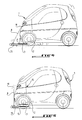
- Figure 4 is a side view showing the guidance of the electric vehicle relative to the portable housing placed on the ground.
- FIG. 5 shows the electric vehicle, the energy receiver of which is correctly placed above the inductor of the portable box placed on the ground.
- the reference 1 designates an electric vehicle on which is permanently mounted an energy receiver 2 preferably produced in the form of a flat spiral winding and which can be electromagnetically coupled to an inductor 3 preferably produced in the form of a flat spiral winding enclosed in a box 4 placed on the ground, to allow recharging of the storage batteries of the vehicle 1.
- the energy receiver 2 is at least partially housed in a dielectric box secured to the structure of the vehicle 1 and is connected to the batteries thereof by means of a rectifier circuit housed in the vehicle.
- the inductor 3 is connected to a high frequency generator housed in the housing 4 as will be seen later and to the electrical supply sector via a supply cable 5.
- the receiver 2 When the receiver 2 correctly covers the inductor 3 by being separated from each other by a relatively short distance of the order of a few centimeters, the receiver 2 is electromagnetically coupled in air to the inductor 3 of so that it intercepts the electromagnetic field emitted by the inductor 3 and the electromotive force thus induced in the receiver 2 makes it possible to establish a charging current of the accumulator batteries by means of a charge regulator (not shown ) connected between the rectifier circuit and the storage batteries.
- a charge regulator not shown
- the box 4 enclosing the inductor 3 is portable and can be optionally fixed to the ground, at the parking location of the electric vehicle 1, using a central fixing screw 6 engaging in an anti-traction anchor 7 implanted in the ground so as to secure to the ground a plate 4a constituting the bottom of the housing 4.
- the box 4 comprises means for guiding the vehicle 1 to facilitate the placement of the receiver 2 above the inductor 3.
- These guide means comprise a tilting pole 8 visible to the driver of the vehicle 1, removably attached to a switch 9 fixed to the cover 4b of the housing 4 and capable of occupying either a position for deactivation of an electronic unit 10 comprising the generator high frequency, so that no electromagnetic field is emitted by the inductor 3, or a position for commissioning the electronic unit 10 so that the inductor 3 can emit the electromagnetic field allowing recharging of storage batteries of the vehicle 1.
- the electronic unit 10 and the inductor 3 are housed in the casing 4c of the unit 4.
- the pole 8 is equipped at its upper free end with a light indicator 11, such as a light-emitting diode, which can light up when the switch 9 switches from its position for deactivation of the electronic unit 10 to its position of commissioning of it.
- a light indicator 11 such as a light-emitting diode
- the guide means may also include at least one guide light 12 fixed to the casing 4c of the housing 4 in front of the latter, in any case opposite to the switch 9, so as to be visible to the driver of the electric vehicle 1 during his approach to the housing 4.
- the power cable 5 for connecting the high frequency generator to the power sector is housed in an appropriate storage space of the housing 4 which also includes cooling means, such as fins 13 for cooling by natural convection.
- an anti-theft cover 14 is fixed in an opening of conjugate shape 15 of the cover 4b so as to prevent access to the fixing screw 6.
- the driver of the vehicle 1 installs the portable box 4 on the parking space of the vehicle and, optionally, fixes this box on the ground using the central screw 6, then then fixes the anti-theft cover 14 to the cover 4b of the housing 4.
- the conductor then connects the power cable 5 to the mains and installs the pole 8 on the switch 9 embedded in the cover 4b.
- the driver advances his vehicle slowly towards the recharging unit 4, already positioning the vehicle 1 relative to the unit 4 using the guide light 12.
- the vehicle 1 moves above the unit 4, he pushes the pole 8 so as to switch the switch 9 from its position in which it cuts off the transfer of inductive energy necessary to recharge the vehicle storage batteries in its position in which it authorizes this transfer of inductive energy recharging the storage batteries.
- the light-emitting diode for example of red color, lights up to facilitate the guiding of the vehicle.
- the high frequency generator being then started, creates the electromagnetic field emitted by the inductor 3 and intercepted by the receiver 2.
- a warning light 15 of the vehicle 1 such as for example an indicator light, comes on.
- the driver stops his vehicle and, at this instant, the pole 8 is vertical.
- the storage batteries of vehicle 1 start to recharge.
- the red diode at the end of the pole 8 goes out and the high frequency generator is put on standby.
- the pole 8 is returned to its initial position to cut the high frequency generator. If necessary, the driver can separate the box 4 from the ground and take the latter with him using the handling handle 4d as is apparent in particular from FIG. 3 in order to allow the vehicle's storage batteries to be recharged. another place.
- the device of the invention also makes it possible to recharge the vehicle's accumulator batteries which have self-discharged during a long period of non-use.
- the device of the invention can be used to heat the passenger compartment of the vehicle without using its storage batteries.
Landscapes
- Engineering & Computer Science (AREA)
- Power Engineering (AREA)
- Transportation (AREA)
- Mechanical Engineering (AREA)
- Computer Networks & Wireless Communication (AREA)
- Charge And Discharge Circuits For Batteries Or The Like (AREA)
- Electric Propulsion And Braking For Vehicles (AREA)
Abstract
Description
- La présente invention concerne un dispositif pour recharger les batteries d'accumulateurs d'un véhicule électrique.
- On connaît un tel dispositif comprenant un boîtier fixe d'une station fixe à plusieurs boîtiers fixes, le boîtier fixe enfermant un inducteur relié à un générateur haute fréquence alimenté par le secteur, et un boîtier fixé sur le véhicule contenant un récepteur d'énergie pouvant être placé au-dessus de l'inducteur de façon à permettre un transfert d'énergie inductive entre l'inducteur et le récepteur et à permettre ainsi la recharge des batteries du véhicule.
- Cependant, ce genre de dispositif connu implique l'utilisation d'inducteurs fixes d'une station fixe, ce qui entraîne un certain nombre de contraintes, et essentiellement l'obligation de se rendre à certains endroits bien précis pour recharger les batteries d'un véhicule électrique. En fait, ce dispositif de rechargement connu est surtout valable dans le cas d'une flotte de véhicules ou d'un système de location de véhicules.
- Dans le cadre d'une utilisation privée, il est nécessaire de recharger les batteries du véhicule électrique en de nombreux endroits, selon les parcours effectués par le véhicule.
- L'invention a pour but de résoudre le problème ci-dessus en proposant un dispositif pour recharger les batteries d'accumulateurs d'un véhicule électrique, comprenant un boîtier placé sur le sol enfermant un inducteur relié à un générateur haute fréquence et un récepteur d'énergie fixé au véhicule et pouvant être placé au-dessus de l'inducteur de façon à permettre un transfert d'énergie inductive entre eux, et qui est caractérisé en ce que le boîtier enfermant l'inducteur est portatif.
- Avantageusement, le boîtier enfermant l'inducteur comprend des moyens de guidage du véhicule pour placer le récepteur au-dessus de l'inducteur.
- De préférence, les moyens de guidage comprennent une perche inclinable visible par le conducteur, reliée à un interrupteur du boîtier enfermant l'inducteur et déplaçable, sous la poussée du véhicule, entre une première position dans laquelle l'interrupteur coupe le transfert d'énergie inductive nécessaire pour recharger les batteries et une deuxième position dans laquelle l'interrupteur autorise le transfert d'énergie inductive pour recharger les batteries.
- La perche est équipée à son extrémité libre supérieure d'un voyant lumineux, tel qu'une diode, pouvant s'allumer lors du basculement de l'interrupteur de la première position à la deuxième position pour faciliter le guidage du véhicule.
- La perche est démontable.
- Les moyens de guidage comprennent également au moins un feu de guidage fixé au boîtier enfermant l'inducteur, en avant de la perche de guidage.
- Le véhicule électrique comprend un témoin, tel qu'un voyant lumineux, indiquant que le degré de recouvrement de l'inducteur et du récepteur est suffisant.
- Le boîtier enfermant l'inducteur est fixé amoviblement sur le sol et, de préférence, les moyens de fixation de ce boîtier comprennent une vis s'engageant dans une cheville placée dans le sol et éventuellement un cache antivol solidaire du boîtier et recouvrant la vis de fixation.
- Le boîtier enfermant l'inducteur est équipé d'un câble d'alimentation électrique reliant le générateur haute fréquence au secteur d'alimentation et comprend un espace de rangement du câble d'alimentation.
- Enfin, le boîtier comprend des moyens de refroidissement, tels que des ailettes.
- L'invention sera mieux comprise et d'autres buts, caractéristiques, détails et avantages de celle-ci apparaîtront plus clairement au cours de la description explicative qui va suivre faite en référence aux dessins schématiques annexés donnés uniquement à titre d'exemple illustrant un mode de réalisation de l'invention et dans lesquels :
- La figure 1 est une vue éclatée du boîtier portatif de l'invention faisant partie d'un dispositif pour recharger les batteries d'accumulateurs d'un véhicule électrique.
- La figure 2 est une vue en perspective du boîtier portatif en position assemblée.
- La figure 3 est une vue montrant le transport du boîtier portatif par une personne.
- La figure 4 est une vue de côté montrant le guidage du véhicule électrique relativement au boîtier portatif placé sur le sol.
- La figure 5 montre le véhicule électrique dont le récepteur d'énergie est correctement placé au-dessus de l'inducteur du boîtier portatif placé sur le sol.
- En se reportant aux figures 1 à 5, la référence 1 désigne un véhicule électrique sur lequel est monté à demeure un récepteur d'énergie 2 de préférence réalisé sous la forme d'un bobinage plan en spirale et pouvant être couplé électromagnétiquement à un inducteur 3 de préférence réalisé sous la forme d'un bobinage plan en spirale enfermé dans un boîtier 4 placé sur le sol, pour permettre le rechargement des batteries d'accumulateurs du véhicule 1. Comme cela est connu en soi, le récepteur d'énergie 2 est au moins en partie logé dans un boîtier diélectrique solidaire de la structure du véhicule 1 et est relié aux batteries de celui-ci par l'intermédiaire d'un circuit redresseur logé dans le véhicule.
- L'inducteur 3 est relié à un générateur haute fréquence logé dans le boîtier 4 comme on le verra ultérieurement et au secteur d'alimentation électrique par l'intermédiaire d'un câble d'alimentation 5.
- Lorsque le récepteur 2 recouvre correctement l'inducteur 3 en étant séparés l'un de l'autre d'une distance relativement courte de l'ordre de quelques centimètres, le récepteur 2 est couplé électromagnétiquement dans l'air à l'inducteur 3 de sorte qu'il intercepte le champ électromagnétique émis par l'inducteur 3 et la force électromotrice ainsi induite dans le récepteur 2 permet d'établir un courant de charge des batteries d'accumulateurs par l'intermédiaire d'un régulateur de charge (non représenté) relié entre le circuit redresseur et les batteries d'accumulateurs.
- Selon l'invention, le boîtier 4 enfermant l'inducteur 3 est portatif et peut être éventuellement fixé sur le sol, à l'emplacement de parking du véhicule électrique 1, à l'aide d'une vis centrale de fixation 6 s'engageant dans une cheville anti-traction 7 implantée dans le sol de façon à solidariser au sol une plaque 4a constituant le fond du boîtier 4.
- Le boîtier 4 comprend des moyens de guidage du véhicule 1 pour faciliter le placement du récepteur 2 au-dessus de l'inducteur 3.
- Ces moyens de guidage comprennent une perche inclinable 8 visible par le conducteur du véhicule 1, fixée amoviblement à un interrupteur 9 fixé sur le capot 4b du boîtier 4 et pouvant occuper soit une position de mise hors service d'un boîtier électronique 10 comprenant le générateur haute fréquence, de façon qu'aucun champ électromagnétique ne soit émis par l'inducteur 3, soit une position de mise en service du boîtier électronique 10 de façon que l'inducteur 3 puisse émettre le champ électromagnétique permettant la recharge des batteries d'accumulateurs du véhicule 1. Le boîtier électronique 10 et l'inducteur 3 sont logés dans le carter 4c du boîtier 4.
- La perche 8 est équipée à son extrémité libre supérieure d'un voyant lumineux 11, tel qu'une diode électroluminescente, pouvant s'allumer lors du basculement de l'interrupteur 9 de sa position de mise hors service du boîtier électronique 10 à sa position de mise en service de celui-ci.
- Les moyens de guidage peuvent également comporter au moins un feu de guidage 12 fixé au carter 4c du boîtier 4 en avant de celui-ci, en tout cas à l'opposé de l'interrupteur 9, de façon à être visible par le conducteur du véhicule électrique 1 lors de sa manoeuvre d'approche du boîtier 4.
- Le câble d'alimentation 5 permettant de relier le générateur haute fréquence au secteur d'alimentation est logé dans un espace de rangement approprié du boîtier 4 qui comprend également des moyens de refroidissement, tels que des ailettes 13 de refroidissement par convection naturelle.
- Le cas échéant, afin de garantir l'inviolabilité du boîtier 4 fixé sur le sol, un cache antivol 14 est fixé dans une ouverture de forme conjuguée 15 du capot 4b de façon à empêcher l'accès à la vis de fixation 6.
- L'utilisation du dispositif de l'invention ressort déjà de la description qui en a été faite ci-dessus et va être maintenant expliquée.
- Tout d'abord, le conducteur du véhicule 1 installe le boîtier portatif 4 sur l'emplacement de parking du véhicule et, éventuellement, fixe ce boîtier sur le sol à l'aide de la vis centrale 6, puis fixe ensuite le cache antivol 14 au capot 4b du boîtier 4. Le conducteur branche ensuite le câble d'alimentation 5 sur le secteur et installe la perche 8 sur l'interrupteur 9 encastré dans le capot 4b.
- Ensuite, le conducteur avance son véhicule lentement vers le boîtier de recharge 4 en positionnant déjà le véhicule 1 relativement au boîtier 4 à l'aide du feu de guidage 12. Lorsque le véhicule 1 avance au-dessus du boîtier 4, il pousse la perche 8 de façon à basculer l'interrupteur 9 de sa position dans laquelle il coupe le transfert d'énergie inductive nécessaire pour recharger les batteries d'accumulateurs du véhicule à sa position dans laquelle il autorise ce transfert d'énergie inductive rechargeant les batteries d'accumulateurs. Lors de ce basculement, la diode électroluminescente 11, par exemple de couleur rouge, s'allume pour faciliter le guidage du véhicule. Le générateur haute fréquence étant alors mis en marche, crée le champ électromagnétique émis par l'inducteur 3 et intercepté par le récepteur 2. Dès qu'une partie suffisante d'énergie est captée par le récepteur 2, c'est-à-dire dès que le degré de recouvrement de l'inducteur 3 et du récepteur 2 est suffisant, un témoin 15 du véhicule 1, tel que par exemple un voyant lumineux, s'allume. Le conducteur arrête alors son véhicule et, à cet instant, la perche 8 est verticale. Les batteries d'accumulateurs du véhicule 1 commencent à se recharger. Une fois la recharge terminée, la diode rouge située au bout de la perche 8 s'éteint et le générateur haute fréquence est mis en veille. Lorsque le véhicule quitte le boîtier 4, la perche 8 est ramenée à sa position initiale pour couper le générateur haute fréquence. Si nécessaire, le conducteur peut désolidariser le boîtier 4 du sol et emmener celui-ci avec lui à l'aide de la poignée de manutention 4d comme cela ressort notamment de la figure 3 afin de permettre une recharge des batteries d'accumulateurs du véhicule à un autre endroit.
- Le dispositif de l'invention permet également la recharge des batteries d'accumulateurs du véhicule qui se sont auto-déchargées au cours d'une longue période de non-utilisation. De plus, le dispositif de l'invention peut être utilisé pour réchauffer l'habitacle du véhicule sans utiliser les batteries d'accumulateurs de celui-ci.
- Les nombreux avantages déjà décrits ci-dessus du dispositif de l'invention et découlant de celui-ci comprennent en particulier :
- la facilité d'utilisation puisqu'aucun branchement n'est nécessaire,
- le centrage latéral du véhicule qui est assuré par le feu de guidage et la perche,
- le centrage longitudinal du véhicule sur l'inducteur grâce au témoin du niveau d'énergie captée,
- le boîtier compact et léger,
- la recharge possible des batteries d'accumulateurs même après une absence d'utilisation prolongée,
- l'alimentation des accessoires sur le secteur sans utiliser les batteries d'accumulateurs,
- le refroidissement par convection naturelle (sans ventilateur et sans bruit), et
- la possibilité de verrouiller le boîtier au sol.
Claims (12)
- Dispositif pour recharger les batteries d'accumulateurs d'un véhicule électrique, comprenant un boîtier (4) placé sur le sol enfermant un inducteur (3) relié à un générateur haute fréquence et un récepteur d'énergie (2) fixé au véhicule et pouvant être placé au-dessus de l'inducteur (3) de façon à permettre un transfert d'énergie inductive entre eux, caractérisé en ce que le boîtier (4) enfermant l'inducteur (3) est portatif.
- Dispositif selon la revendication 1, caractérisé en ce que le boîtier (4) précité comprend des moyens de guidage du véhicule (1) pour placer le récepteur (2) au-dessus de l'inducteur (3).
- Dispositif selon la revendication 2, caractérisé en ce que les moyens de guidage comprennent une perche inclinable (8) visible par le conducteur, reliée à un interrupteur (9) du boîtier (4) enfermant l'inducteur (3) et déplaçable, sous la poussée du véhicule, entre une première position dans laquelle l'interrupteur (9) coupe le transfert d'énergie inductive nécessaire pour recharger les batteries et une deuxième position dans laquelle l'interrupteur (9) autorise le transfert d'énergie inductive pour recharger les batteries.
- Dispositif selon la revendication 3, caractérisé en ce que la perche (8) est équipée à son extrémité libre supérieure d'un voyant lumineux (11), tel qu'une diode, pouvant s'allumer lors du basculement de l'interrupteur (9) de la première position à la deuxième position pour faciliter le guidage du véhicule.
- Dispositif selon la revendication 3 ou 4, caractérisé en ce que la perche (8) est démontable.
- Dispositif selon l'une des revendications 3 à 5, caractérisé en ce que les moyens de guidage comprennent également au moins un feu de guidage (12) fixé au boîtier (4) enfermant l'inducteur (3), en avant de la perche de guidage (8).
- Dispositif selon l'une des revendications précédentes, caractérisé en ce que le véhicule (1) comprend un témoin (15), tel qu'un voyant lumineux, indiquant que le degré de recouvrement de l'inducteur (3) et du récepteur (2) est suffisant.
- Dispositif selon l'une des revendications précédentes, caractérisé en ce que le boîtier (4) enfermant l'inducteur (3) est fixé amoviblement sur le sol.
- Dispositif selon la revendication 8, caractérisé en ce que les moyens de fixation du boîtier (4) comprennent une vis (6) s'engageant dans une cheville (7) placée dans le sol et éventuellement un cache antivol (14) solidaire du boîtier (4) et recouvrant la vis de fixation (6).
- Dispositif selon l'une des revendications précédentes, caractérisé en ce que le boîtier (4) enfermant l'inducteur (3) est équipé d'un câble d'alimentation électrique (5) reliant le générateur haute fréquence au secteur d'alimentation.
- Dispositif selon la revendication 10, caractérisé en ce que le boîtier (4) comprend un espace de rangement du câble d'alimentation (5).
- Dispositif selon l'une des revendications précédentes, caractérisé en ce que le boîtier (4) comprend des moyens de refroidissement, tels que des ailettes (13).
Applications Claiming Priority (2)
| Application Number | Priority Date | Filing Date | Title |
|---|---|---|---|
| FR9607639 | 1996-06-19 | ||
| FR9607639A FR2750267B1 (fr) | 1996-06-19 | 1996-06-19 | Dispositif pour recharger les batteries d'accumulateurs d'un vehicule electrique |
Publications (2)
| Publication Number | Publication Date |
|---|---|
| EP0814557A1 true EP0814557A1 (fr) | 1997-12-29 |
| EP0814557B1 EP0814557B1 (fr) | 2004-08-25 |
Family
ID=9493224
Family Applications (1)
| Application Number | Title | Priority Date | Filing Date |
|---|---|---|---|
| EP97401386A Expired - Lifetime EP0814557B1 (fr) | 1996-06-19 | 1997-06-17 | Dispositif pour recharger les batteries d'accumulateurs d'un véhicule électrique |
Country Status (3)
| Country | Link |
|---|---|
| EP (1) | EP0814557B1 (fr) |
| DE (1) | DE69730381D1 (fr) |
| FR (1) | FR2750267B1 (fr) |
Cited By (7)
| Publication number | Priority date | Publication date | Assignee | Title |
|---|---|---|---|---|
| EP0918390A3 (fr) * | 1997-11-19 | 2000-03-22 | Ackermann Limited | Services pour station de travail de bureau |
| ES2181557A1 (es) * | 2000-11-27 | 2003-02-16 | Cisterra S L | Sistema de alimentacion de motores y recarga de baterias en vehiculos electricos. |
| WO2003022671A3 (fr) * | 2001-09-13 | 2003-08-21 | Sparta B V | Bicyclette a propulsion auxiliaire |
| US20130088194A1 (en) * | 2011-08-16 | 2013-04-11 | Nucleus Scientific, Inc. | Overhead power transfer system |
| WO2013083625A1 (fr) * | 2011-12-09 | 2013-06-13 | Bayerische Motoren Werke Aktiengesellschaft | Voiture |
| CN108110842A (zh) * | 2017-12-29 | 2018-06-01 | 宁夏软件工程院有限公司 | 一种自适应电能接收装置 |
| EP4400358A1 (fr) * | 2023-01-10 | 2024-07-17 | Siemens Aktiengesellschaft | Dispositif de charge au sol pour la charge sans fil de véhicules électriques |
Families Citing this family (3)
| Publication number | Priority date | Publication date | Assignee | Title |
|---|---|---|---|---|
| FR2962696B1 (fr) | 2010-07-16 | 2016-07-01 | Renault Sa | Charge sans contact d'une batterie de vehicule automobile. |
| EP2808976A1 (fr) | 2013-05-29 | 2014-12-03 | Brusa Elektronik AG | Agencement de circuit pour la partie primaire d'un système de transmission d'énergie sans contact, et élément de transmission |
| EP3065152A1 (fr) | 2015-03-06 | 2016-09-07 | Brusa Elektronik AG | Partie primaire d'un appareil de chargement inductif |
Citations (3)
| Publication number | Priority date | Publication date | Assignee | Title |
|---|---|---|---|---|
| US3938018A (en) * | 1974-09-16 | 1976-02-10 | Dahl Ernest A | Induction charging system |
| US4347472A (en) * | 1980-10-20 | 1982-08-31 | Lemelson Jerome H | Apparatus and method for charging a battery in a vehicle |
| EP0586315A1 (fr) * | 1992-09-02 | 1994-03-09 | Cableco | Ensemble pour recharger les batteries d'accumulateurs d'un véhicule automobile électrique |
-
1996
- 1996-06-19 FR FR9607639A patent/FR2750267B1/fr not_active Expired - Fee Related
-
1997
- 1997-06-17 EP EP97401386A patent/EP0814557B1/fr not_active Expired - Lifetime
- 1997-06-17 DE DE69730381T patent/DE69730381D1/de not_active Expired - Lifetime
Patent Citations (3)
| Publication number | Priority date | Publication date | Assignee | Title |
|---|---|---|---|---|
| US3938018A (en) * | 1974-09-16 | 1976-02-10 | Dahl Ernest A | Induction charging system |
| US4347472A (en) * | 1980-10-20 | 1982-08-31 | Lemelson Jerome H | Apparatus and method for charging a battery in a vehicle |
| EP0586315A1 (fr) * | 1992-09-02 | 1994-03-09 | Cableco | Ensemble pour recharger les batteries d'accumulateurs d'un véhicule automobile électrique |
Cited By (9)
| Publication number | Priority date | Publication date | Assignee | Title |
|---|---|---|---|---|
| EP0918390A3 (fr) * | 1997-11-19 | 2000-03-22 | Ackermann Limited | Services pour station de travail de bureau |
| ES2181557A1 (es) * | 2000-11-27 | 2003-02-16 | Cisterra S L | Sistema de alimentacion de motores y recarga de baterias en vehiculos electricos. |
| WO2003022671A3 (fr) * | 2001-09-13 | 2003-08-21 | Sparta B V | Bicyclette a propulsion auxiliaire |
| US20130088194A1 (en) * | 2011-08-16 | 2013-04-11 | Nucleus Scientific, Inc. | Overhead power transfer system |
| WO2013083625A1 (fr) * | 2011-12-09 | 2013-06-13 | Bayerische Motoren Werke Aktiengesellschaft | Voiture |
| CN103958245A (zh) * | 2011-12-09 | 2014-07-30 | 宝马股份公司 | 机动车 |
| US9662992B2 (en) | 2011-12-09 | 2017-05-30 | Bayerische Motoren Werke Aktiengesellschaft | Motor vehicle having an inductive charging coil arranged on a lubricant reservoir of an internal combustion engine of the vehicle |
| CN108110842A (zh) * | 2017-12-29 | 2018-06-01 | 宁夏软件工程院有限公司 | 一种自适应电能接收装置 |
| EP4400358A1 (fr) * | 2023-01-10 | 2024-07-17 | Siemens Aktiengesellschaft | Dispositif de charge au sol pour la charge sans fil de véhicules électriques |
Also Published As
| Publication number | Publication date |
|---|---|
| FR2750267A1 (fr) | 1997-12-26 |
| FR2750267B1 (fr) | 1998-09-18 |
| EP0814557B1 (fr) | 2004-08-25 |
| DE69730381D1 (de) | 2004-09-30 |
Similar Documents
| Publication | Publication Date | Title |
|---|---|---|
| US3963972A (en) | Portable power package | |
| EP0814557B1 (fr) | Dispositif pour recharger les batteries d'accumulateurs d'un véhicule électrique | |
| EP3472919B1 (fr) | Dispositif portatif de dévidage d'un câble électrique, notamment un câble de charge pour un véhicule électrique ou hybride | |
| EP0586315A1 (fr) | Ensemble pour recharger les batteries d'accumulateurs d'un véhicule automobile électrique | |
| EP0536056B1 (fr) | Dispositif de prise de charge pour véhicule à moteur électrique | |
| EP2230142A1 (fr) | Procédé interactif d'échange d'un système de stockage d'énergie d'un véhicule électrique ou partiellement électrique | |
| EP3501908A1 (fr) | Équipement électrique à paroi déportée | |
| FR2732169A1 (fr) | Dispositif pour recharger les batteries d'accumulateurs d'un vehicule electrique | |
| EP2179890A1 (fr) | Module d'identification pour véhicule automobile | |
| FR2613674A1 (fr) | Coffret de rangement, a tiroir a lampe mobile pour automobile | |
| WO2022167350A1 (fr) | Véhicule électrique doté d'un adaptateur pour la recharge d'une batterie électrique | |
| EP0524274A1 (fr) | Appareil muni d'un moteur electrique d'entrainement. | |
| EP0858172B1 (fr) | Bloc d'alimentation d'un dispositif portatif, du type permettant l'utilisation de différents types d'alimentation, et dispositif portatif correspondant | |
| FR3093964A1 (fr) | Carport autonome et transportable pour recharger les véhicules électriques | |
| EP4313669A1 (fr) | Dispositif autonome d'alimentation électrique, notamment pour charger une batterie | |
| EP1729392B1 (fr) | Installation électrique de bord de véhicule automobile | |
| FR2829660A1 (fr) | Circuit d'attaque de lampe a decharge concu pour minimiser le rayonnement du bruit | |
| FR3141653A1 (fr) | Dispositif de prise exterieure de recharge de batterie de traction d’un vehicule avec signal sonore | |
| FR2965678A1 (fr) | Charge sans contact d'une batterie de vehicule automobile. | |
| EP4410654B1 (fr) | Unité d'alimentation électrique embarquée pour cycle | |
| FR3159935A1 (fr) | Vehicule automobile comprenant un dispositif de prise domestique | |
| EP0838378B1 (fr) | Dispositif antivol pour véhicule automobile conjugué avec la clé de contact de démarrage du moteur du véhicule | |
| WO2019122289A1 (fr) | Barre de connexion electrique | |
| FR3165746A1 (fr) | Dispositif de recharge sans fil d’un appareil électronique, ensemble de recharge comprenant un tel dispositif et élément de garnissage comprenant un tel ensemble | |
| KR100195055B1 (ko) | 점프케이블감김대를 갖는 자동차용 밧데리 |
Legal Events
| Date | Code | Title | Description |
|---|---|---|---|
| PUAI | Public reference made under article 153(3) epc to a published international application that has entered the european phase |
Free format text: ORIGINAL CODE: 0009012 |
|
| AK | Designated contracting states |
Kind code of ref document: A1 Designated state(s): CH DE ES GB IT LI PT SE |
|
| 17P | Request for examination filed |
Effective date: 19980613 |
|
| AKX | Designation fees paid |
Free format text: CH DE ES GB IT LI PT SE |
|
| RBV | Designated contracting states (corrected) |
Designated state(s): CH DE ES GB IT LI PT SE |
|
| 17Q | First examination report despatched |
Effective date: 20000203 |
|
| GRAP | Despatch of communication of intention to grant a patent |
Free format text: ORIGINAL CODE: EPIDOSNIGR1 |
|
| GRAS | Grant fee paid |
Free format text: ORIGINAL CODE: EPIDOSNIGR3 |
|
| GRAA | (expected) grant |
Free format text: ORIGINAL CODE: 0009210 |
|
| AK | Designated contracting states |
Kind code of ref document: B1 Designated state(s): CH DE ES GB IT LI PT SE |
|
| PG25 | Lapsed in a contracting state [announced via postgrant information from national office to epo] |
Ref country code: IT Free format text: LAPSE BECAUSE OF FAILURE TO SUBMIT A TRANSLATION OF THE DESCRIPTION OR TO PAY THE FEE WITHIN THE PRESCRIBED TIME-LIMIT;WARNING: LAPSES OF ITALIAN PATENTS WITH EFFECTIVE DATE BEFORE 2007 MAY HAVE OCCURRED AT ANY TIME BEFORE 2007. THE CORRECT EFFECTIVE DATE MAY BE DIFFERENT FROM THE ONE RECORDED. Effective date: 20040825 Ref country code: GB Free format text: LAPSE BECAUSE OF FAILURE TO SUBMIT A TRANSLATION OF THE DESCRIPTION OR TO PAY THE FEE WITHIN THE PRESCRIBED TIME-LIMIT Effective date: 20040825 |
|
| REG | Reference to a national code |
Ref country code: GB Ref legal event code: FG4D Free format text: NOT ENGLISH |
|
| REG | Reference to a national code |
Ref country code: CH Ref legal event code: EP |
|
| REF | Corresponds to: |
Ref document number: 69730381 Country of ref document: DE Date of ref document: 20040930 Kind code of ref document: P |
|
| PG25 | Lapsed in a contracting state [announced via postgrant information from national office to epo] |
Ref country code: SE Free format text: LAPSE BECAUSE OF FAILURE TO SUBMIT A TRANSLATION OF THE DESCRIPTION OR TO PAY THE FEE WITHIN THE PRESCRIBED TIME-LIMIT Effective date: 20041125 |
|
| PG25 | Lapsed in a contracting state [announced via postgrant information from national office to epo] |
Ref country code: DE Free format text: LAPSE BECAUSE OF FAILURE TO SUBMIT A TRANSLATION OF THE DESCRIPTION OR TO PAY THE FEE WITHIN THE PRESCRIBED TIME-LIMIT Effective date: 20041126 |
|
| PG25 | Lapsed in a contracting state [announced via postgrant information from national office to epo] |
Ref country code: ES Free format text: LAPSE BECAUSE OF FAILURE TO SUBMIT A TRANSLATION OF THE DESCRIPTION OR TO PAY THE FEE WITHIN THE PRESCRIBED TIME-LIMIT Effective date: 20041206 |
|
| GBV | Gb: ep patent (uk) treated as always having been void in accordance with gb section 77(7)/1977 [no translation filed] |
Effective date: 20040825 |
|
| PG25 | Lapsed in a contracting state [announced via postgrant information from national office to epo] |
Ref country code: LI Free format text: LAPSE BECAUSE OF NON-PAYMENT OF DUE FEES Effective date: 20050630 Ref country code: CH Free format text: LAPSE BECAUSE OF NON-PAYMENT OF DUE FEES Effective date: 20050630 |
|
| PLBE | No opposition filed within time limit |
Free format text: ORIGINAL CODE: 0009261 |
|
| STAA | Information on the status of an ep patent application or granted ep patent |
Free format text: STATUS: NO OPPOSITION FILED WITHIN TIME LIMIT |
|
| 26N | No opposition filed |
Effective date: 20050526 |
|
| REG | Reference to a national code |
Ref country code: CH Ref legal event code: PL |
|
| PG25 | Lapsed in a contracting state [announced via postgrant information from national office to epo] |
Ref country code: PT Free format text: LAPSE BECAUSE OF NON-PAYMENT OF DUE FEES Effective date: 20050125 |