EP0815181B1 - Elektrolumineszenzvorrichtung mit emission polarisierten lichtes - Google Patents
Elektrolumineszenzvorrichtung mit emission polarisierten lichtes Download PDFInfo
- Publication number
- EP0815181B1 EP0815181B1 EP96908087A EP96908087A EP0815181B1 EP 0815181 B1 EP0815181 B1 EP 0815181B1 EP 96908087 A EP96908087 A EP 96908087A EP 96908087 A EP96908087 A EP 96908087A EP 0815181 B1 EP0815181 B1 EP 0815181B1
- Authority
- EP
- European Patent Office
- Prior art keywords
- electro
- polymer
- light
- accordance
- luminescent device
- Prior art date
- Legal status (The legal status is an assumption and is not a legal conclusion. Google has not performed a legal analysis and makes no representation as to the accuracy of the status listed.)
- Expired - Lifetime
Links
Images

Classifications
-
- H—ELECTRICITY
- H05—ELECTRIC TECHNIQUES NOT OTHERWISE PROVIDED FOR
- H05B—ELECTRIC HEATING; ELECTRIC LIGHT SOURCES NOT OTHERWISE PROVIDED FOR; CIRCUIT ARRANGEMENTS FOR ELECTRIC LIGHT SOURCES, IN GENERAL
- H05B33/00—Electroluminescent light sources
- H05B33/12—Light sources with substantially two-dimensional [2D] radiating surfaces
- H05B33/14—Light sources with substantially two-dimensional [2D] radiating surfaces characterised by the chemical or physical composition or the arrangement of the electroluminescent material, or by the simultaneous addition of the electroluminescent material in or onto the light source
-
- C—CHEMISTRY; METALLURGY
- C08—ORGANIC MACROMOLECULAR COMPOUNDS; THEIR PREPARATION OR CHEMICAL WORKING-UP; COMPOSITIONS BASED THEREON
- C08G—MACROMOLECULAR COMPOUNDS OBTAINED OTHERWISE THAN BY REACTIONS ONLY INVOLVING UNSATURATED CARBON-TO-CARBON BONDS
- C08G61/00—Macromolecular compounds obtained by reactions forming a carbon-to-carbon link in the main chain of the macromolecule
- C08G61/02—Macromolecular compounds containing only carbon atoms in the main chain of the macromolecule, e.g. polyxylylenes
-
- C—CHEMISTRY; METALLURGY
- C09—DYES; PAINTS; POLISHES; NATURAL RESINS; ADHESIVES; COMPOSITIONS NOT OTHERWISE PROVIDED FOR; APPLICATIONS OF MATERIALS NOT OTHERWISE PROVIDED FOR
- C09K—MATERIALS FOR MISCELLANEOUS APPLICATIONS, NOT PROVIDED FOR ELSEWHERE
- C09K11/00—Luminescent materials, e.g. electroluminescent or chemiluminescent
- C09K11/06—Luminescent materials, e.g. electroluminescent or chemiluminescent containing organic luminescent materials
-
- H—ELECTRICITY
- H10—SEMICONDUCTOR DEVICES; ELECTRIC SOLID-STATE DEVICES NOT OTHERWISE PROVIDED FOR
- H10K—ORGANIC ELECTRIC SOLID-STATE DEVICES
- H10K50/00—Organic light-emitting devices
- H10K50/80—Constructional details
- H10K50/868—Arrangements for polarized light emission
-
- H—ELECTRICITY
- H10—SEMICONDUCTOR DEVICES; ELECTRIC SOLID-STATE DEVICES NOT OTHERWISE PROVIDED FOR
- H10K—ORGANIC ELECTRIC SOLID-STATE DEVICES
- H10K85/00—Organic materials used in the body or electrodes of devices covered by this subclass
- H10K85/10—Organic polymers or oligomers
- H10K85/111—Organic polymers or oligomers comprising aromatic, heteroaromatic, or aryl chains, e.g. polyaniline, polyphenylene or polyphenylene vinylene
-
- H—ELECTRICITY
- H10—SEMICONDUCTOR DEVICES; ELECTRIC SOLID-STATE DEVICES NOT OTHERWISE PROVIDED FOR
- H10K—ORGANIC ELECTRIC SOLID-STATE DEVICES
- H10K85/00—Organic materials used in the body or electrodes of devices covered by this subclass
- H10K85/10—Organic polymers or oligomers
- H10K85/111—Organic polymers or oligomers comprising aromatic, heteroaromatic, or aryl chains, e.g. polyaniline, polyphenylene or polyphenylene vinylene
- H10K85/114—Poly-phenylenevinylene; Derivatives thereof
-
- Y—GENERAL TAGGING OF NEW TECHNOLOGICAL DEVELOPMENTS; GENERAL TAGGING OF CROSS-SECTIONAL TECHNOLOGIES SPANNING OVER SEVERAL SECTIONS OF THE IPC; TECHNICAL SUBJECTS COVERED BY FORMER USPC CROSS-REFERENCE ART COLLECTIONS [XRACs] AND DIGESTS
- Y10—TECHNICAL SUBJECTS COVERED BY FORMER USPC
- Y10S—TECHNICAL SUBJECTS COVERED BY FORMER USPC CROSS-REFERENCE ART COLLECTIONS [XRACs] AND DIGESTS
- Y10S428/00—Stock material or miscellaneous articles
- Y10S428/917—Electroluminescent
-
- Y—GENERAL TAGGING OF NEW TECHNOLOGICAL DEVELOPMENTS; GENERAL TAGGING OF CROSS-SECTIONAL TECHNOLOGIES SPANNING OVER SEVERAL SECTIONS OF THE IPC; TECHNICAL SUBJECTS COVERED BY FORMER USPC CROSS-REFERENCE ART COLLECTIONS [XRACs] AND DIGESTS
- Y10—TECHNICAL SUBJECTS COVERED BY FORMER USPC
- Y10T—TECHNICAL SUBJECTS COVERED BY FORMER US CLASSIFICATION
- Y10T428/00—Stock material or miscellaneous articles
- Y10T428/23—Sheet including cover or casing
- Y10T428/231—Filled with gas other than air; or under vacuum
Definitions
- Electroluminescence (EL) materials and devices such as light emitting diodes (LED), in use.
- Electroluminescent devices described that a film from a contain conjugated polymer as light-emitting layer (semiconductor layer). Such devices offer numerous advantages, such as the possibility of easy and inexpensive to manufacture flexible displays. Such displays are self-luminous and therefore do not require an additional rear light Illumination source. Unstructured electroluminescent devices can also used as a backlight source in liquid crystal displays become. In contrast to conventional devices with light tubes and Light scattering grids offer such devices advantages in thickness and Weight. This is due to the statistical distribution of the polymer backbones However, light emitted from electroluminescent devices is not polarized.
- a typical electroluminescent device consists of a light-emitting layer in the form of a thin, dense polymer film (Semiconductor layer) containing at least one conjugated polymer.
- a first one Contact layer is in contact with a first surface, a second Contact layer with another surface of the semiconductor layer.
- the polymer film the semiconductor layer has a sufficiently low concentration of extrinsic Charge carriers, so that when an electrical field is applied between the charge carriers are introduced into the semiconductor layer in both contact layers, one contact layer becomes positive towards the other and the Semiconductor layer emits radiation.
- Conjugated polymer is a polymer that is delocalized Possesses electron system along the main chain.
- the delocalized Electron system gives the polymer semiconductor properties and gives it the Possibility of positive and / or negative charge carriers with high mobility transport.
- the object of the present invention was to provide an electroluminescent device To provide that when used in lighting and / or Display devices is suitable, the property profile realized so far Improve devices.
- the invention therefore relates to an electroluminescent device according to Claim 1.
- It is preferably a conjugated or partially conjugated polymer, particularly preferably a conjugated, chain-stiff and organic Solvent-soluble polymer.
- the intensity of the light that is parallel to the longitudinal axis of the Substrate is polarized, at least three times, preferably at least four times, so large, like the intensity polarized perpendicular to it.
- the polarization ratio is determined using a rotatable analyzer (Polarization filter) measured by the intensity of the emitted light as Function of the angle of rotation of the analyzer is determined.
- polarization ratio is the ratio between maximum and minimum measured intensity.
- the light emitting layer preferably monolayer for monolayer using Liquid-gas interfaces transfer methods (e.g. with the Langmuir-Blodgett technique) (see e.g. A. Ulman, An Introduction to Ultrathin Organic Films, Acad. Press, Boston, 1991).
- Liquid-gas interfaces transfer methods e.g. with the Langmuir-Blodgett technique
- These layer systems demonstrate Use of suitable substances has a high molecular order.
- Suitable polymers for such applications are soluble, conjugated, chain-rigid polymers according to claim 1, which arylene or Heteroarylene units also in combination with unsaturated units (e.g. PPP, PPV, PT).
- unsaturated units e.g. PPP, PPV, PT.
- the processability of such substances from solution can be achieved by installing flexible side chains on the polymer.
- Chain-rigid polymers are understood to mean those in which the backbone Due to its structure, it must have a predominantly linear configuration.
- soluble in organic solvents means that the polymer in at least one water-immiscible organic solvent or a mixture of those in a concentration of at least 0.3 mg / ml can be solved at 20 ° C.
- Electroluminescence preparatory by direct construction of the light-emitting Produce layer without subsequent modification, such as stretching, would be necessary.
- the invention therefore also relates to an electroluminescent device according to claim 2.
- a preferred soluble, conjugated, chain rigid polymer is an oligo-phenylene unit containing polymer defined in claim 1.
- radicals R 1 , R 2 , R 3 , R 4 or R 5 , R 6 , R 7 , R 8 in each case is an alkyl group having 2 to 22 C atoms, preferably one or more, particularly preferably one, CH 2 group being replaced by a hetero atom which is optionally substituted by a further aliphatic or aromatic hydrocarbon radical having preferably 1 to 22 C atoms are and a further CH 2 group can be replaced by an optionally substituted phenylene group and the remaining radicals R 1 to R 8 are H.
- Preferred heteroatoms are -O-, -S-.
- R 1 , R 4 , R 5 and R 8 are very particularly preferably identical or different to a straight-chain or branched alkoxy group having 1 to 22 C atoms.
- Polymers are particularly preferably described by the formulas (A) and (B), in which R 2 , R 3 , R 6 , R 7 , R 9 and R 10 are hydrogen and in which R 1 is R 4 and R 5 is R 8 and are a straight-chain or branched alkoxy group having 4 to 7 carbon atoms.
- the indices k, l are preferably a natural number in the range from 1 to 13, particularly preferably 1, 2 or 3, very particularly preferably 2 or 3.
- a polymer used according to the invention preferably consists of structural elements of the general formula (A k B l ) n .
- the polymer chain contains only one structural element of the general formula (A k B l ) with a specific k and I.
- the index n is then preferably in the range from 5 to 75.
- the polymers according to the invention can also preferably have several different structural elements of the formula (A k B l ). It should be noted here that the structural element A can be varied not only via the radicals R 1 to R 4 , but also via the indices k and l.
- Block copolymers of the formula [(A 1 k B 1 l ) x (A 2 k B 2 l ) y - .... (A n k B n l ) n ] m are likewise preferred, where 3 m m 200 200 applies.
- Block copolymers which contain two different structural elements of the formula (A k B l ) are preferred.
- x and y are preferably in the range from 1 to 199, particularly preferably from 2 to 50, where x + y 200 200.
- each individual element can assume values for n in the range from 1 to 200, provided that the sum of all n in the range from 3 to 200, preferably in the range from 5 up to 75.
- the preparation of the polymers used according to the invention is after different methods possible. It can be known from literature Methods as used in standard works on organic synthesis, e.g. B. Houben-Weyl, Organic Chemistry Methods, Georg-Thieme-Verlag, Stuttgart, are described. The production takes place under Reaction conditions that are known and suitable for the reactions mentioned are. It can also be of variants known per se, not mentioned here in detail Be made use of.
- derivatives of benzene and stilbene can be oxidative (e.g. with FeCl 3 , see, inter alia, P. Kovacic, NB Jones, Chem. Ber. 1987 , 87, 357; M.Wede, T. Abe, H. Awano, Macromolecules 1992 , 25, 5125) or electrochemically (see, for example, N. Saito, T. Yamamoto, Polym. Bull. 1993, 30, 285).
- the polymers from dihaloaromatics under copper / triphenylphosphine - can be synthesized.
- copper / triphenylphosphine - see e.g. BGW Ebert, RD Rieke, J. Org. Chem. 1988 , 53, 4482
- nickel / triphenylphosphine catalysis see e.g. BH Matsumoto, S. Inaba, RD Rieke, J. Org. Chem. 1993, 48, 849 can be synthesized.
- Aromatic distannans such as B. at JK Stille, Angew. Chem., Int. Ed. Engl. 1986 , 25, 508 indicated, polymerize under palladium catalysis.
- aromatic dibromo compounds can be converted into the Dilithio or Digrignard compounds, which are then combined with another dibromo compound using CuCl 2 (see, for example, BG Wittig, G. Klar, Liebigs Ann. Chem. 1967 , 704, 91; HA Staab, F. Bunny , Chem. Ber. 1967 , 100, 293; T. Kaufmann, Angew. Chem. 1974, 86, 321) or by electron transfer of unsaturated 1,4-dihalogen compounds (see, for example, BSK Taylor, SG Bennet, KJ Harz, LK Lashley, J. Org. Chem. 1981, 46, 2190).
- the polymers can be polymerized by reacting the dibromo compounds mentioned with nickel catalysts in the presence of 2,2'-bipyridines (see K. Chmil, U. Scherf, Makromol. Chem., Rapid Commun. 1993, 14, 217).
- approximately equimolar amounts of the boronic acid (ester) and the halogen compound are preferred. It is preferred to in the boronic acid (ester) a 1.001 to 1.1, particularly preferably 1.025-fold excess.
- the reaction is generally carried out at a temperature in the range from 0 to 150 ° C, preferably at 20 to 100 ° C and particularly preferably at 70 to 90 ° C.
- the reaction time is generally from one hour to usually 3 to 5 Days.
- Preferred solvents are mixtures, the components of which are among the Reaction conditions miscible or immiscible, preferably immiscible, are.
- a polar protic solvent such as is preferred for the first component Water.
- Preferred as a further component are N, N-dialkylamides, such as Dimethylformamide (DMF), N-methyl-2-pyrrolidone, ethers such as tetrahydrofuran (THF), aromatic hydrocarbons, such as toluene, and mixtures of the above Solvent.
- a binary mixture of THF and water is particularly preferred, especially in a 1: 1 ratio.
- Compounds containing palladium show catalytic activity for the polymerization reaction.
- Compounds which contain palladium in oxidation state 0 or which form palladium (O) species under the reaction conditions are preferred; tetrakis (triphenylphosphine) palladium (0), which can be used directly, is particularly preferred.
- a concentration of 1 mol% of catalyst per mol of the amount of monomer used is used.
- Weak bases are generally used as additional substance, sodium bicarbonate in a concentration of 1 mol / l, based on the amount of water used, is preferred.
- bromine derivatives (U or V is Br) can, for. B. as above indicated under Ni ° catalysis, to be coupled to statistical copolymers.
- Halogen component with such a large excess of one Boronic acid (ester) component implemented that oligomers of a defined length with terminal boronic acid (ester) groups.
- a second block will by reacting a boronic acid (ester) component with a corresponding one Generates excess of a halogen component; the oligomers of this second Blocks have terminal halogen functions.
- terminated oligomers also by boronization of bromine-terminated oligomers being constructed. Implementation of the two blocks in a 1: 1 ratio leads to block copolymers according to the invention.
- This monomer becomes so instead of the corresponding stilbene dibromide monomer used that the approximately equimolar ratio of dibromide to diboronic acid is not changed.
- 1,4-Dibromo-alkyl-benzenes are, for example, by alkylation of 1,4-dihalobenzenes by Grignard reaction and subsequent regioselective bromination in Can be made in 2.5 position.
- 1,4-Dibromo (pseudo) halogen compounds are accessible, for example, from the corresponding dibromides by exchange with, for example, cyano groups (M. Rehahn, A.-D. Schlueter, WJ Feast, Synthesis 386 , 1988).
- Oligo-p-phenylenes can be, for example, by the methods mentioned above build up from the corresponding monomers.
- Stilbene derivatives can be, for example, according to the methods of in Houben-Weyl Organic chemistry, Georg-Thieme-Verlag, Stuttgart, described methods synthesize (e.g. Wittig reaction, Knoevenagel reaction, Heck reaction).
- the mixtures can contain up to 50% of the total amount of additive, preferably the amount of additive is not more than 30% of the total amount.
- low-molecular, anisotropic dye molecules are also possible as additives.
- the additives can be introduced by cospreading, and also by subsequently adding the additive, preferably a dye, to the finished film.
- Electroluminescent devices are described, for example, in WO 90/13148 and US Pat EP-A 0 443861.
- the electroluminescent device according to the invention is manufactured according to known methods familiar to those skilled in the art.
- the electroluminescent material preferably one or more of the polymers described above, is built up monolayer by monolayer using liquid-gas interfaces.
- liquid-gas interfaces Such methods are described, for example, by A. Ulman, An Introduction to Ultrathin Organic-Films, Acad. Press, Boston, 1991 .
- amphiphilic molecules which are not water-soluble are in the form of a dilute solution (typically ⁇ 1 g / l) in a volatile solvent (e.g. methylene chloride) on a water surface in a coating apparatus, z. B. spread a so-called Langmuir trough. After evaporation of the solvent, the molecules are compressed into a dense film by reducing the water surface available to them until a compression state suitable for transferring the film is reached. The surface is reduced by moving a solid barrier or by moving a closed flexible band that encloses the amiphiphilic molecules on the water surface.
- a volatile solvent e.g. methylene chloride
- the compression can also be done via rotating rollers (Barraud et al., Thin Solid Films 1983 , 99, 221) or flow of water (US-A-4 722 856, EP-A-0 433 325 or EP-A-0 583 676).
- the film is transferred from the water surface to a support by immersing or removing the support through the film-covered water surface.
- the transfer of multiple layers is possible by repeating the dipping processes, with one monomolecular layer being transferred per dive.
- the electroluminescent device usually contains one electroluminescent layer between a cathode and an anode, wherein at least one of the electrodes is transparent.
- a cathode z. B. Ca, Mg, Al, Mg / Al serve.
- As an anode z. B. Au or ITO (indium oxide / tin oxide) on one transparent substrate e.g. B. made of glass or a transparent polymer.
- the cathode is set to a negative potential with respect to the anode. Electrons are transferred from the cathode into the electron injection layer / electron transport layer or directly into the light-emitting layer injected. At the same time, holes are made from the anode into the hole injection / hole transport layer or injected directly into the light-emitting layer.
- the injected charge carriers move under the influence of the applied ones Tension towards each other through the active layers. This leads to the Interface between the charge transport layer and the light-emitting layer or within the light-emitting layer to form electron / hole pairs that are under Recombine emission of light.
- the color of the emitted light can be changed the compound used as the light emitting layer can be varied.
- Electroluminescent devices are used for. B. as self-luminous Display elements, such as control lamps, alphanumeric displays, information signs, and in optoelectronic couplers.
- Liquid crystal displays Use as backlighting is preferred Liquid crystal displays.
- a quartz glass substrate is first rubbed off with acetone, pre-cleaned in methylene chloride in an ultrasonic bath for 15 minutes. 30 minutes in a reaction solution consisting of 10% hydrogen peroxide (30%), 40% aqueous. conc. Treated ammonia solution and 50% Milli-Q water (deionized water with a conductivity of 0.5 ⁇ S / cm) and then washed in a stream of Milli-Q water for 10 minutes. At 2 x 10 -5 mbar, 2 mm wide strips of chromium (4 nm) and then gold (17 nm) are evaporated. The glass support prepared in this way is treated for 5 minutes at 1 mbar in argon plasma and then hydrophobicized for 30 minutes in a 30% solution of hexamethyldisilazane in chloroform.
- the film is transferred using a Lauda FW-1 film scale, which is housed on a granite slab in a "laminar flow box".
- the coating takes place with automatic film printing constant maintenance.
- Milli-Q water serves as the subphase, the temperature of the subphase is controlled by a thermostat connected to the film scale.
- M w 10000
- the polymer is prepared as by M. Rehan, AD Schlueter, G. Wegener, J. Peast, Polymer 1989, 30, 1060; Valenkamp, G.
- the transfer rate of the polymer from the water surface to the glass substrate is detected with the help of the movement of the barrier. Then, at 2 x 10 -5 mbar, vapor-deposited across the gold coating Al in 2 mm wide strips.
- the Au / polymer / Al device thus obtained is placed in a sample holder and the electrodes are connected to a current source, the Au strips being positive and the Al strips being negative.
- a field strength of 15 x 10 7 V / m is applied, an intense, homogeneous, polarized white electroluminescence is observed on the corresponding matrix element, the intensity of the light, which is polarized parallel to the longitudinal axis of the substrate, being four times as great as that perpendicular polarized intensity (see. Fig. 1 and 2).
- ITO indium tin oxide
- the film is transferred using a Lauda FW-1 film scale, which is housed on a granite slab in a laminar flow box.
- the coating takes place with automatic film printing constant maintenance.
- Milli-Q water serves as the subphase, the temperature of the subphase is controlled by a thermostat connected to the film scale.
- the prepared glass slide is dipped 2 cm deep into the LB trough at a speed of 1 cm / min and lifted out again after a waiting time of 10 seconds.
- the waiting time for the start of a new cycle is 5 minutes.
- 100 monolayers of the polymer are drawn up in 50 cycles.
- the transfer rate of the polymer from the water surface to the glass substrate is detected with the help of the movement of the barrier.
- 2 x 10 -5 mbar vapor-deposited across the ITO coating Al in 2 mm wide strips.
- the ITO / Polymer / Al device thus obtained is placed in a sample holder and the electrodes are connected to a current source, the ITO strips being positive and the Al strips being negative.
- a glass substrate coated with indium tin oxide (ITO) is used as the substrate, on which the width of the ITO strips is 2 mm. This glass slide is cleaned in isopropanol.
- ITO indium tin oxide
- the carrier is coated by spinning this solution at a speed of 1000 rpm.
- the resulting layer thickness is approximately 50 nm.
- vapor is deposited in 2 mm wide strips across the ITO coating Al.
- the ITO / Polymer / Al device thus obtained is placed in a sample holder and the electrodes are connected to a current source, the ITO strips being positive and the Al strips being negative.
- a field strength of 15 x 10 7 V / m is applied, an intense, homogeneous, polarized white electroluminescence is observed on the corresponding matrix element, which has no polarization.
Landscapes
- Chemical & Material Sciences (AREA)
- Organic Chemistry (AREA)
- Health & Medical Sciences (AREA)
- Materials Engineering (AREA)
- Physics & Mathematics (AREA)
- Optics & Photonics (AREA)
- Engineering & Computer Science (AREA)
- Chemical Kinetics & Catalysis (AREA)
- Medicinal Chemistry (AREA)
- Polymers & Plastics (AREA)
- Electroluminescent Light Sources (AREA)
- Polyoxymethylene Polymers And Polymers With Carbon-To-Carbon Bonds (AREA)
- Lighting Device Outwards From Vehicle And Optical Signal (AREA)
Description
- A
- ist gleich oder verschieden

- B
- ist gleich oder verschieden

- Y
- ist gleich oder verschieden (E)-CR9=CR10-
- R1, R2, R3, R4, R5, R6, R7, R8, R9, R10
- sind in den einzelnen Strukturelementen unabhängig voneinander gleich oder verschieden H, eine geradkettige oder verzweigte Alkylkette mit 1 bis 22 C-Atomen, wobei eine oder mehrere nicht benachbarte CH2-Gruppen auch durch -O-, -S-, -SO2-, -COOC-, -OOC- und/oder Phenylen, vorzugsweise 1,4-Phenylen, ersetzt sein können, Aryl- oder Aryloxygruppen, vorzugsweise mit 4 bis 14 C-Atomen, wobei der Aromat in diesen Gruppen mit C1-C22-Alkyl, C1-C22-Alkoxy, Br, Cl, F und/oder CN substituiert sein kann, Br, Cl, F, CN oder Alkyloxycarbonyl mit 2 bis 23 C-Atomen;
- k
- ist 0 bis 25;
- l
- ist 0 bis 25, wobei die Summe k + l ≥ 1 ist;
- n
- ist 1 bis 200;


- U und V
- sind verschieden voneinander ein Halogen aus der Gruppe I, Br und Cl, vorzugsweise Br, oder BQ1Q2;
- Q1, Q2
- sind gleich oder verschieden -OH, C1-C10-Alkoxy, C1-C10-Alkyl, Phenyl,
das gegebenenfalls durch C1-C10-Alkyl, C1-C10-Alkoxy oder Halogen
substituiert sein kann, oder Halogen oder Q1 und Q2 zusammen bilden
eine C1-C4-Alkylendioxy-Gruppe, eine Methylengruppe, die gegebenenfalls
durch eine oder zwei C1-C4-Alkylgruppen substituiert sein kann, oder Q1 und
Q2 und das Boratom zusammen sind Teil einer
Boroxinrings der Formel (IV)

- Ar
- ist ein aromatischer Rest der Formel (I), (II) oder (III);
- Y
- ist gleich oder verschieden (E)-CR9=CR10-;
- R1, R2, R3, R4, R5, R6, R7, R8, R9, R10
- sind in den einzelnen Strukturelementen unabhängig voneinander gleich oder verschieden, H, eine geradkettige oder verzweigte Alkylkette mit 1 bis 22 C-Atomen, wobei eine oder mehrere nicht benachbarte CH2-Gruppen auch durch -O-, -S-, -SO2-, -COOC-, -OOC- und/oder Phenylen, vorzugsweise 1,4-Phenylen, ersetzt sein können, Aryl- oder Aryloxygruppen, vorzugsweise mit 4 bis 14 C-Atomen, wobei der Aromat in diesen Gruppen mit C1-C22-Alkyl, C1-C22-Alkoxy, Br, Cl, F, CN, und/oder NO2 substituiert sein kann, Br, Cl, F, CN, NO2 oder Alkyloxycarbonyl mit 2 bis 23 C-Atomen;
- k
- ist 1 bis 25, bevorzugt 1 bis 13, besonders bevorzugt 1, 2 oder 3, insbesondere 2 oder 3.
Als Zusatzsubstanz werden im allgemeinen schwache Basen verwendet, bevorzugt ist Natriumhydrogencarbonat in einer Konzentration von 1 mol/l, bezogen auf die eingesetzte Menge Wasser.
Das Einbringen der Additive kann durch Cospreiten erfolgen, ebenso durch nachträgliches Einstellen des Additivs, vorzugsweise eines Farbstoffs, in den fertigen Film.
Anschließend wird bei 2 x 10⁻⁵ mbar quer zur Goldbeschichtung Al in 2 mm breiten Streifen aufgedampft. Die so erhaltene Vorrichtung Au/Polymer/Al wird in einen Probenhalter gegeben und die Elektroden mit einer Stromquelle verbunden, wobei die Au-Streifen positiv und die Al-Streifen negativ gepolt werden. Beim Anlegen einer Feldstärke von 15 x 107 V/m wird an dem entsprechenden Matrixelement eine intensive, homogene, polarisierte weiße Elektrolumineszenz beobachtet, wobei die Intensität des Lichtes, das parallel zur Längsachse des Substrates polarisiert ist, viermal so groß ist, wie die senkrecht dazu polarisierte Intensität (vgl. Fig. 1 und 2).
Claims (7)
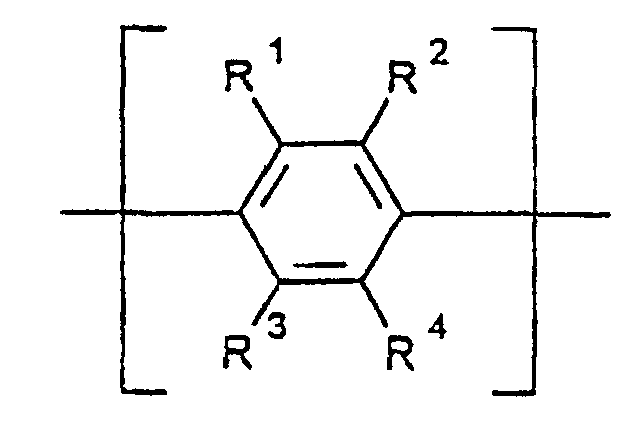
- Elektrolumineszenzvorrichtung enthaltend eine lichtemittierende Schicht, die mindestens ein Polymer enthält, dadurch gekennzeichnet, daß das Polymer mindestens ein Strukturelement der allgemeinen Formel (AkBl)n enthält, wobei die Symbole und Indizes folgende Bedeutungen haben:
- A
- ist gleich oder verschieden
- B
- ist gleich oder verschieden
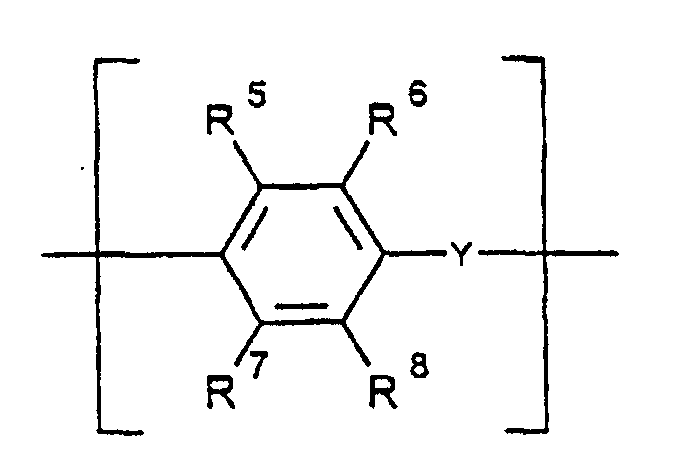
- Y
- ist gleich oder verschieden (E)-CR9=CR10-,
- R1, R2, R3, R4, R5, R6, R7, R8, R9, R10
- sind in den einzelnen Strukturelementen unabhängig voneinander gleich oder verschieden H, eine geradkettige oder verzweigte Alkylkette mit 1 bis 22 C-Atomen, wobei eine oder mehrere nicht benachbarte CH2-Gruppen auch durch -O-, -S-, -SO2-, -COOC-, -OOC- undloder Phenylen, vorzugsweise 1,4-Phenylen, ersetzt sein können, Aryl- oder Aryloxygruppen, vorzugsweise mit 4 bis 14 C-Atomen, wobei der Aromat in diesen Gruppen mit C1-C22-Alkyl, C1-C22-Alkoxy, Br, Cl, F und/oder CN substituiert sein kann, Br, Cl, F, CN oder Alkyloxycarbonyl mit 2 bis 23 C-Atomen;
- k
- ist 0 bis 25;
- l
- ist 0 bis 25, wobei die Summe k + l ≥ 1 ist;
- n
- ist 1 bis 200;
- Elektrolumineszenzvorrichtung gemäß Anspruch 1, erhältlich durch einen direkten Aufbau der lichtemittierenden Schicht.
- Elektrolumineszenzvorrichtung gemäß mindestens einem der vorhergehenden Ansprüche, dadurch gekennzeichnet, daß die lichtemittierende Schicht mittels Flüssig-Gas-Grenzflächen Übertragungsmethoden aufgebaut ist.
- Elektrolumineszenzvorrichtung gemäß mindestens einem der vorhergehenden Ansprüche, dadurch gekennzeichnet, daß als Flüssig-Gas-Grenzflächen Übertragungsmethode die Langmuir-Blodgett-Technik verwendet wird.
- Elektrolumineszenzvorrichtung gemäß mindestens einem der Ansprüche 1 bis 4 dadurch gekennzeichnet, daß das Polymer ein Blockcopolymer oder ein statistisches Copolymer ist.
- Verfahren zur Herstellung einer Elektrolumineszenzvorrichtung gemäß mindestens einem der Ansprüche 1 bis 5 dadurch gekennzeichnet, daß die lichtemittierende Schicht mittels Flüssig-Gas-Grenzflächen Übertragungsmethoden aufgebaut ist.
- Verwendung einer Vorrichtung gemäß mindestens einem der Ansprüche 1 bis 5 als Hintergrundbeleuchtung für Flüssigkristallanzeigen.
Applications Claiming Priority (3)
| Application Number | Priority Date | Filing Date | Title |
|---|---|---|---|
| DE19509450 | 1995-03-20 | ||
| DE19509450A DE19509450A1 (de) | 1995-03-20 | 1995-03-20 | Elektrolumineszenzvorrichtung mit Emission polarisierten Lichtes |
| PCT/EP1996/001202 WO1996029376A1 (de) | 1995-03-20 | 1996-03-20 | Elektrolumineszenzvorrichtung mit emission polarisierten lichtes |
Publications (2)
| Publication Number | Publication Date |
|---|---|
| EP0815181A1 EP0815181A1 (de) | 1998-01-07 |
| EP0815181B1 true EP0815181B1 (de) | 2002-12-11 |
Family
ID=7756783
Family Applications (1)
| Application Number | Title | Priority Date | Filing Date |
|---|---|---|---|
| EP96908087A Expired - Lifetime EP0815181B1 (de) | 1995-03-20 | 1996-03-20 | Elektrolumineszenzvorrichtung mit emission polarisierten lichtes |
Country Status (6)
| Country | Link |
|---|---|
| US (1) | US6040069A (de) |
| EP (1) | EP0815181B1 (de) |
| JP (1) | JPH11503178A (de) |
| AT (1) | ATE229561T1 (de) |
| DE (2) | DE19509450A1 (de) |
| WO (1) | WO1996029376A1 (de) |
Families Citing this family (12)
| Publication number | Priority date | Publication date | Assignee | Title |
|---|---|---|---|---|
| US20020001732A1 (en) * | 1997-10-23 | 2002-01-03 | Hermannus F.M. Schoo | Polymer electroluminescent device |
| DE19857860A1 (de) * | 1998-12-15 | 2000-06-21 | Mannesmann Vdo Ag | Zeigerinstrument |
| DE69841627D1 (de) * | 1998-12-15 | 2010-06-02 | Max Planck Inst Fuer Polymerfo | Funktionelles Material enthaltende Polyimid-Schicht, Vorrichtung die sie verwendet und Verfahren zur Herstellung dieser Vorrichtung |
| KR100763818B1 (ko) | 2000-04-10 | 2007-10-05 | 허니웰 인터내셔날 인코포레이티드 | 퀴논의 아릴화에 의해 제조되는 올리고머 및 폴리머oled 물질 |
| JP4984343B2 (ja) * | 2000-09-29 | 2012-07-25 | 株式会社日立製作所 | 有機電界発光素子及びそれを用いた光電子素子 |
| US6944032B1 (en) | 2001-04-12 | 2005-09-13 | Rockwell Collins | Interconnect for flat panel displays |
| JP5250922B2 (ja) * | 2001-07-05 | 2013-07-31 | 凸版印刷株式会社 | 有機エレクトロルミネセンス表示素子の製造方法 |
| DE10144983A1 (de) * | 2001-08-15 | 2003-07-03 | Siemens Ag | Anzeigeeinheit |
| JP2004538480A (ja) * | 2001-08-15 | 2004-12-24 | シーメンス アクチエンゲゼルシヤフト | 表示器ユニット |
| US7037599B2 (en) * | 2003-02-28 | 2006-05-02 | Eastman Kodak Company | Organic light emitting diodes for production of polarized light |
| US20060094859A1 (en) * | 2004-11-03 | 2006-05-04 | Marrocco Matthew L Iii | Class of bridged biphenylene polymers |
| US20110001905A1 (en) | 2008-02-28 | 2011-01-06 | Sumitomo Chemical Company, Limited | Transparent thin-film electrode |
Family Cites Families (2)
| Publication number | Priority date | Publication date | Assignee | Title |
|---|---|---|---|---|
| JPH0343991A (ja) * | 1989-07-10 | 1991-02-25 | Canon Inc | 発光素子 |
| SE503039C2 (sv) * | 1994-07-19 | 1996-03-11 | Forskarpatent I Linkoeping Ab | Elektroluminescerande anordning samt sätt att framställa denna |
-
1995
- 1995-03-20 DE DE19509450A patent/DE19509450A1/de not_active Withdrawn
-
1996
- 1996-03-20 WO PCT/EP1996/001202 patent/WO1996029376A1/de not_active Ceased
- 1996-03-20 AT AT96908087T patent/ATE229561T1/de not_active IP Right Cessation
- 1996-03-20 JP JP8528083A patent/JPH11503178A/ja active Pending
- 1996-03-20 US US08/913,651 patent/US6040069A/en not_active Expired - Fee Related
- 1996-03-20 DE DE59609976T patent/DE59609976D1/de not_active Expired - Fee Related
- 1996-03-20 EP EP96908087A patent/EP0815181B1/de not_active Expired - Lifetime
Also Published As
| Publication number | Publication date |
|---|---|
| ATE229561T1 (de) | 2002-12-15 |
| JPH11503178A (ja) | 1999-03-23 |
| US6040069A (en) | 2000-03-21 |
| WO1996029376A1 (de) | 1996-09-26 |
| DE19509450A1 (de) | 1996-09-26 |
| DE59609976D1 (de) | 2003-01-23 |
| EP0815181A1 (de) | 1998-01-07 |
Similar Documents
| Publication | Publication Date | Title |
|---|---|---|
| EP0815156B1 (de) | OLIGO-p-PHENYLEN-EINHEITEN ENTHALTENDE POLYMERE, VERFAHREN ZU IHRER HERSTELLUNG SOWIE IHRE VERWENDUNG | |
| EP0699699B1 (de) | Poly(4,5,9,10-tetrahydropyren-2,7-diyl)-Derivate und ihre Verwendung als Elektrolumineszenzmaterialien | |
| DE60130762T3 (de) | Elektrolumineszierende materialien und gegenstände aus einer polymermatrix | |
| EP0707020B1 (de) | Konjugierte Polymere mit Spirozentren und ihre Verwendung als Elektrolumineszenzmaterialien | |
| EP0894107B1 (de) | Verbindungen mit spiroatomen und ihre verwendung als elektrolumineszenzmaterialien | |
| EP0793698B1 (de) | Konjugierte polymere mit hetero-spiroatomen und ihre verwendung als elektrolumineszenzmaterialien | |
| DE69016345T2 (de) | Elektrolumineszierende anordnungen. | |
| EP1029019B1 (de) | Substituierte poly(arylenvinylene), verfahren zur herstellung und deren verwendung in elektrolumineszenzelementen | |
| DE69529512T2 (de) | Elektrolumineszente Vorrichtung mit einer Poly-3,4-Ethylen-Dioxythiophen-Schicht | |
| EP0719309B1 (de) | Verwendung von polymeren mit isolierten chromophoren als elektrolumineszenzmaterialien | |
| EP1123337A1 (de) | Konjugierte polymere enthaltend 2,7-fluorenyleinheiten mit verbesserten eigenschaften | |
| EP0815181B1 (de) | Elektrolumineszenzvorrichtung mit emission polarisierten lichtes | |
| EP1307498A2 (de) | Strukturierbare materialien, verfahren zu deren herstellung und deren verwendung | |
| DE10343606A1 (de) | Weiß emittierende Copolymere, deren Darstellung und Verwendung | |
| DE10249723A1 (de) | Arylamin-Einheiten enthaltende konjugierte Polymere, deren Darstellung und Verwendung | |
| EP0690086B1 (de) | Konjugierte Polymere mit Ansateilstrukturen und ihre Verwendung als Elektrolumineszenzmaterialien | |
| WO2002072714A1 (de) | Lösung und dispersionen organischer halbleiter | |
| DE19953806A1 (de) | Substituierte Poly(arylenvinylene), Verfahren zur Herstellung und deren Verwendung in Elektrolumineszenzvorrichtungen | |
| DE19615128A1 (de) | Konjugierte Polymere mit Hetero-Spiroatomen und ihre Verwendung als Elektrolumineszenzmaterialien | |
| DE10044840A1 (de) | Photostrukturierbare neue organische Halbleitermaterialien | |
| DE112010001630T5 (de) | Monomer, Polymerisationsverfahren und Polymer |
Legal Events
| Date | Code | Title | Description |
|---|---|---|---|
| PUAI | Public reference made under article 153(3) epc to a published international application that has entered the european phase |
Free format text: ORIGINAL CODE: 0009012 |
|
| 17P | Request for examination filed |
Effective date: 19971020 |
|
| AK | Designated contracting states |
Kind code of ref document: A1 Designated state(s): AT CH DE FR GB LI |
|
| 17Q | First examination report despatched |
Effective date: 19990520 |
|
| RAP1 | Party data changed (applicant data changed or rights of an application transferred) |
Owner name: AVENTIS RESEARCH & TECHNOLOGIES GMBH & CO. KG |
|
| RAP1 | Party data changed (applicant data changed or rights of an application transferred) |
Owner name: AXIVA GMBH |
|
| RAP1 | Party data changed (applicant data changed or rights of an application transferred) |
Owner name: CELANESE VENTURES GMBH |
|
| GRAG | Despatch of communication of intention to grant |
Free format text: ORIGINAL CODE: EPIDOS AGRA |
|
| RAP1 | Party data changed (applicant data changed or rights of an application transferred) |
Owner name: COVION ORGANIC SEMICONDUCTORS GMBH |
|
| GRAG | Despatch of communication of intention to grant |
Free format text: ORIGINAL CODE: EPIDOS AGRA |
|
| GRAH | Despatch of communication of intention to grant a patent |
Free format text: ORIGINAL CODE: EPIDOS IGRA |
|
| GRAH | Despatch of communication of intention to grant a patent |
Free format text: ORIGINAL CODE: EPIDOS IGRA |
|
| GRAA | (expected) grant |
Free format text: ORIGINAL CODE: 0009210 |
|
| AK | Designated contracting states |
Kind code of ref document: B1 Designated state(s): AT CH DE FR GB LI |
|
| REF | Corresponds to: |
Ref document number: 229561 Country of ref document: AT Date of ref document: 20021215 Kind code of ref document: T |
|
| REG | Reference to a national code |
Ref country code: GB Ref legal event code: FG4D Free format text: NOT ENGLISH |
|
| REG | Reference to a national code |
Ref country code: CH Ref legal event code: EP |
|
| REF | Corresponds to: |
Ref document number: 59609976 Country of ref document: DE Date of ref document: 20030123 |
|
| GBT | Gb: translation of ep patent filed (gb section 77(6)(a)/1977) |
Effective date: 20030401 |
|
| ET | Fr: translation filed | ||
| PLBE | No opposition filed within time limit |
Free format text: ORIGINAL CODE: 0009261 |
|
| STAA | Information on the status of an ep patent application or granted ep patent |
Free format text: STATUS: NO OPPOSITION FILED WITHIN TIME LIMIT |
|
| 26N | No opposition filed |
Effective date: 20030912 |
|
| PGFP | Annual fee paid to national office [announced via postgrant information from national office to epo] |
Ref country code: CH Payment date: 20060929 Year of fee payment: 11 |
|
| PGFP | Annual fee paid to national office [announced via postgrant information from national office to epo] |
Ref country code: AT Payment date: 20060930 Year of fee payment: 11 |
|
| PGFP | Annual fee paid to national office [announced via postgrant information from national office to epo] |
Ref country code: GB Payment date: 20070314 Year of fee payment: 12 |
|
| PGFP | Annual fee paid to national office [announced via postgrant information from national office to epo] |
Ref country code: DE Payment date: 20070315 Year of fee payment: 12 |
|
| REG | Reference to a national code |
Ref country code: CH Ref legal event code: PL |
|
| PG25 | Lapsed in a contracting state [announced via postgrant information from national office to epo] |
Ref country code: AT Free format text: LAPSE BECAUSE OF NON-PAYMENT OF DUE FEES Effective date: 20070320 |
|
| PG25 | Lapsed in a contracting state [announced via postgrant information from national office to epo] |
Ref country code: CH Free format text: LAPSE BECAUSE OF NON-PAYMENT OF DUE FEES Effective date: 20070331 Ref country code: LI Free format text: LAPSE BECAUSE OF NON-PAYMENT OF DUE FEES Effective date: 20070331 |
|
| PGFP | Annual fee paid to national office [announced via postgrant information from national office to epo] |
Ref country code: FR Payment date: 20070308 Year of fee payment: 12 |
|
| REG | Reference to a national code |
Ref country code: FR Ref legal event code: TP |
|
| GBPC | Gb: european patent ceased through non-payment of renewal fee |
Effective date: 20080320 |
|
| REG | Reference to a national code |
Ref country code: FR Ref legal event code: ST Effective date: 20081125 |
|
| PG25 | Lapsed in a contracting state [announced via postgrant information from national office to epo] |
Ref country code: DE Free format text: LAPSE BECAUSE OF NON-PAYMENT OF DUE FEES Effective date: 20081001 |
|
| PG25 | Lapsed in a contracting state [announced via postgrant information from national office to epo] |
Ref country code: FR Free format text: LAPSE BECAUSE OF NON-PAYMENT OF DUE FEES Effective date: 20080331 |
|
| PG25 | Lapsed in a contracting state [announced via postgrant information from national office to epo] |
Ref country code: GB Free format text: LAPSE BECAUSE OF NON-PAYMENT OF DUE FEES Effective date: 20080320 |