EP0815560B1 - Zeitinformationsaddition - Google Patents
Zeitinformationsaddition Download PDFInfo
- Publication number
- EP0815560B1 EP0815560B1 EP96907572A EP96907572A EP0815560B1 EP 0815560 B1 EP0815560 B1 EP 0815560B1 EP 96907572 A EP96907572 A EP 96907572A EP 96907572 A EP96907572 A EP 96907572A EP 0815560 B1 EP0815560 B1 EP 0815560B1
- Authority
- EP
- European Patent Office
- Prior art keywords
- data stream
- data
- timing
- time information
- sequence
- Prior art date
- Legal status (The legal status is an assumption and is not a legal conclusion. Google has not performed a legal analysis and makes no representation as to the accuracy of the status listed.)
- Expired - Lifetime
Links
Images
Classifications
-
- G—PHYSICS
- G11—INFORMATION STORAGE
- G11B—INFORMATION STORAGE BASED ON RELATIVE MOVEMENT BETWEEN RECORD CARRIER AND TRANSDUCER
- G11B27/00—Editing; Indexing; Addressing; Timing or synchronising; Monitoring; Measuring tape travel
- G11B27/02—Editing, e.g. varying the order of information signals recorded on, or reproduced from, record carriers
- G11B27/031—Electronic editing of digitised analogue information signals, e.g. audio or video signals
-
- G—PHYSICS
- G11—INFORMATION STORAGE
- G11B—INFORMATION STORAGE BASED ON RELATIVE MOVEMENT BETWEEN RECORD CARRIER AND TRANSDUCER
- G11B27/00—Editing; Indexing; Addressing; Timing or synchronising; Monitoring; Measuring tape travel
- G11B27/10—Indexing; Addressing; Timing or synchronising; Measuring tape travel
-
- G—PHYSICS
- G11—INFORMATION STORAGE
- G11B—INFORMATION STORAGE BASED ON RELATIVE MOVEMENT BETWEEN RECORD CARRIER AND TRANSDUCER
- G11B27/00—Editing; Indexing; Addressing; Timing or synchronising; Monitoring; Measuring tape travel
- G11B27/10—Indexing; Addressing; Timing or synchronising; Measuring tape travel
- G11B27/19—Indexing; Addressing; Timing or synchronising; Measuring tape travel by using information detectable on the record carrier
- G11B27/28—Indexing; Addressing; Timing or synchronising; Measuring tape travel by using information detectable on the record carrier by using information signals recorded by the same method as the main recording
- G11B27/30—Indexing; Addressing; Timing or synchronising; Measuring tape travel by using information detectable on the record carrier by using information signals recorded by the same method as the main recording on the same track as the main recording
- G11B27/3027—Indexing; Addressing; Timing or synchronising; Measuring tape travel by using information detectable on the record carrier by using information signals recorded by the same method as the main recording on the same track as the main recording used signal is digitally coded
- G11B27/3036—Time code signal
-
- G—PHYSICS
- G11—INFORMATION STORAGE
- G11B—INFORMATION STORAGE BASED ON RELATIVE MOVEMENT BETWEEN RECORD CARRIER AND TRANSDUCER
- G11B27/00—Editing; Indexing; Addressing; Timing or synchronising; Monitoring; Measuring tape travel
- G11B27/02—Editing, e.g. varying the order of information signals recorded on, or reproduced from, record carriers
- G11B27/031—Electronic editing of digitised analogue information signals, e.g. audio or video signals
- G11B27/032—Electronic editing of digitised analogue information signals, e.g. audio or video signals on tapes
Definitions
- This invention relates to the addition of time information to data streams such as multimedia data streams, to facilitate editing and replay of the data.
- Timestamps on multimedia data streams enable time information to be associated with the data representing audio, video or other time dependent media. Recorded streams may require alteration as to rate of play, synchronisation with other streams or editing. The use of timestamps embedded in the streams provides a marker for controlling such operations.
- timestamps embedded in a data stream can be used to meter the playback rate to ensure that the stream runs at the desired rate. Additionally if several streams are recorded simultaneously and require editing, then operations such as cuts may be required at a particular recorded time on each stream. The use of a timestamp ensures that the cuts can be precisely synchronised.
- Timestamps are used within current video tape formats and DAT formats. Timing information in actual time (GMT) is typically laid down with the audio and video streams as they are recorded. Subsequent editing of the streams results in a time track with discontinuities where cuts have been made, and 'false' timing data where inserts have occurred, so that during subsequent playback the timestamps do not bear a simple relationship to the times at which the data should be played.
- GTT actual time
- relative timestamps can be used instead of timestamping with actual time (GMT). These are relative times with independent origins and are linked to every data segment (whether audio or video) by the hardware that captures the data. These timestamps often exhibit drift since the electronic clocks in different hardware do not necessarily run with sufficient accuracy.
- GMT actual time
- new sets of relative timestamps are laid down so that the playout software does not have to take care of discontinuities where the edits have been made.
- WO 94/24817 shows a method and apparatus for synchronising the playback of data streams for individual clips of audio and video data with the aid of a reference time base which is used to locate time codes corresponding to the start of the clip.
- a reference time base which is used to locate time codes corresponding to the start of the clip.
- GB-A-2273220 shows a video processing system in which each video frame recorded in a bulk storage device is uniquely identified by a respective time code indicative of the time at which the frame was input to the system.
- the system does not provide any means of matching simultaneously originating frames of different video clips stored in the bulk storage device.
- a method of adding time information to a data stream comprising the steps of linking first and second timing sequences with the data stream, the first sequence providing a permanent, digitally encoded time record of when the data first originated and the second sequence being re-writable if the data stream is edited, wherein that time information in the first sequence is permanently linked to the data stream so as to provide a permanent record of the respective originating time of each piece of data in the stream which is always maintained with any data preserved from the original stream, the second sequence providing a continuous, internally consistent time track which is updated each time the data stream is edited so as to be consistent with the data stream as edited, for subsequent replay and editing purposes.
- the timing sequences may be generated and transmitted with the data stream.
- the data stream and timing sequences are preferably buffered before being transmitted to reproduction apparatus.
- the data stream and timing sequences may be recorded in a synchronous or linked manner and the timing sequence information may be embedded in the data stream.
- the first and second timing sequences may be embedded into the data stream together or the second timing sequence may be embedded into the data stream after the first timing sequence. Alternatively the timing sequences may be stored separately from the data stream.
- the second timing sequence may be re-recorded when, and if, the data stream is subsequently edited, so that a consistent time sequence is ensured with no discontinuities, to facilitate subsequent replay and editing of the data stream.
- the first permanent timing sequence is derived from an absolute reference such as, for example, Universal Coordinated Time(UTC) or Global Positioning System(GPS) Time.
- an absolute reference such as, for example, Universal Coordinated Time(UTC) or Global Positioning System(GPS) Time.
- UTC introduces leap seconds to remain synchronised to the rotation of the Earth. This complicates any software that deals with the smooth flow of data streams or calculates the times between data samples. Accordingly the use of GPS Time is preferred as this system avoids the introduction of leap seconds and is easily related to UTC, following UTC to within 363ns(95%) plus the accumulated leap second offset.
- the second timing sequence is preferably in relative time units such as GPS seconds.
- the timing information provided in the timing sequences may be provided by a series of timestamps.
- the timestamps are preferably applied using a 64 bit time data format.
- Each timestamp preferably comprises a 64 bit word.
- This 64 bit word may be interpreted as a 2's complement binary representation in units of 2x10 -32 second. This permits negative times to be handled in the same format as positive times during calculations.
- the series of timestamps may be positioned along the data stream with varying spacing, or granularity. Thus for example the granularity can be altered independently of the timestamp precision.
- the first and second timing sequences may have different granularities.
- the methods as aforesaid may be applied to a plurality of data streams, thus permitting linking of data streams, for example a separate video data stream and audio data stream of common originating time with timing sequences applied according to the methods as aforesaid can be replayed in synchronism due to the identical first timing sequences applied to the data streams.
- This may be of particular use for synchronisation of live streams.
- three or more timing sequences may be stored with the data. This permits the storage of two or more sets of second timing sequences, each of which corresponds to a different presentation of common sets of data streams.
- the first timing sequence will be common to all the presentations.
- some or all of the time sequences may be stored separately from the data streams.
- the invention also lies in apparatus for performing the aforesaid methods, the apparatus comprising apparatus for adding time information to a data stream and for editing the data stream, the apparatus comprising generating means for generating first and second timing sequences, wherein the first timing sequence provides a permanent record of when the data originated, the second timing sequence provides an internal time track for subsequent replay and editing purposes, in that the apparatus further comprises means for linking the sequences with the data stream and editing means for editing the data stream, and in that the first timing sequence is permanently linked to the data stream so as to provide a record of originating time which is always maintained with the data stream, and the editing means is operable to rewrite the second data stream during editing so that the second sequence provides an internally consistent timetrack in the edited stream, whilst the record of the time when the data originated, as provided by the first timing sequence, is maintained.
- the invention also lies in an edited video or a audio signal comprising a data stream, the stream being provided with time information for use in the playback and synchronisation of the data stream with another data stream, wherein the time information comprises a first timing data sequence, each datum of which relates to a respective part of the stream which provides a permanent time record of when the data first originated, and a second timing data sequence each datum of which relates to a respective part of the stream and which provides an internally consistent continuous time track, the continuity of which is unaffected by any discontinuity in the first timing sequence, wherein said editing has resulted in discontinuities where the data has been edited in the first timing sequence, whilst not having affected the relationship between the first timing sequence and data in the stream, the second timing sequence being continuous over the portions of the stream at which the data has been edited.
- the time information comprises a first timing data sequence, each datum of which relates to a respective part of the stream which provides a permanent time record of when the data first originated, and a second timing data sequence each datum of which
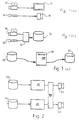
- Figure 1 shows schematic views of timing sequences comprising a series of timestamps being applied and used in connection with data streams.
- Figure 1a shows the application of timestamps to live data streams in accordance with the invention.
- a video camera 10 is used to convert an optical scene into a live video data stream which can be recorded in known manner for subsequent display as on a screen 12.
- a microphone 14 converts sound waves into a "sound" data stream which can also be recorded in known manner and replayed via a loudspeaker 16. As the data is transmitted from the camera 10 and the microphone 14, first and second timing sequences are linked to the data streams.
- the first timing sequence is an absolute time system and contains source timestamps. These timestamps are set to the time at which data is captured and are synchronised to Global Positioning System (GPS) time so as to be compatible with international timing systems such as Universal Coordinated Time (UTC).
- GPS Global Positioning System
- UTC Universal Coordinated Time
- the source timestamps can be regarded as part of the data, just as much as the data describing the pixels making up the image or the waveform samples making up the audio signal.
- the source timestamps are permanent and not changed by editing or filing operations.
- the second timing sequence contains playback timestamps. These define relative times at which data is to be replayed.
- the playback timestamps are not related to any particular time origin but are in standard time units of GPS seconds.
- the playback timestamps indicate the times at which the data in a recorded stream is to be replayed, thus for example allowing alteration in the play back speed of clips and insertion of pauses.
- apparatus reproducing the data streams as picture(s) and/or sound are controlled by the playback timestamps.
- the data streams typically comprise a series of data segments.
- the source timestamp can be embedded into the data segments initially with the playback timestamp embedded later, for example when the streams are recorded onto a data store.
- the source and playback timestamps are embedded together and with the same values made identical, so that if replayed the data will be played back at the same rate and in the same order in which it was recorded.
- Figure 1b shows a schematic view of time sequences being recorded onto data streams for storage.
- a video camera 18 and microphone 20 transmit the data stream and the data processing apparatus 22 applies the timestamps.
- the spacing of individual timestamps in a time sequence i.e. the granularity, can be varied independently of the timestamp precision. Times for data between timestamps may be deduced from knowledge of sampling rates. In a system where one or several data samples are passed as a single message, timestamps can be incorporated in all messages, some messages, or in special messages interleaved with the data.
- the timestamps may be stored separately from the data stream. By referencing each timestamp to a byte in the corresponding data stream to which they refer, it is possible to use timestamps with older incompatible data storage hardware. At playback, the required video byte is selected and the timestamps supplied from a timestamp index by use of the video byte reference number.
- the source and playback timestamps may be kept together, or can be introduced at different granularities according to the application.
- the timestamps are observed somewhere in the data processing apparatus 22, and the data flow controlled accordingly.
- the data streams are stored with the applied time sequences on a storage means 24 and played out later as described, for example, in connection with Figure 2.
- the replay device For replay of stored streams, the replay device computes a time offset from the current real time TR being used by the players.
- TOff T - S.
- Figure 1c shows a schematic view of editing the data streams.
- the data including source and playback timestamps are recorded on the storage media 26 with no special attention given to the timestamps, as for example shown in Figure 1b.
- Editing of the data stream occurs at the editing suite 28.
- the data stream is given a new set of playback timestamps that define the relative times at which each timestamped section of data is to be played.
- the cut and edited data stream is joined to give an edited data stream 30.
- the original first timing sequence with the source timestamps remains, with jumps in the track where data has been edited.
- the second timing sequence containing the playback timestamps is re-written by, for example, deriving a signal from the source timestamps via offsets.
- the re-written second timing sequence provides a consistent time track for playback purposes without any jumps in it. This removes cumulative errors where the precise times of cut points differ because of incompatible sampling rates.
- the source timestamps can be used by a computer system to determine which parts of the video have associated audio tracks.
- the computer edits together the exactly corresponding sounds to any given video clip without the need for manual alignment after each cut.
- the playback timestamps may be set on a common basis so that only a single time offset needs to be computed as in the case of unedited streams. This is performed by a controlling system interacting with time gating modules as shown in Figure 2.
- the synchronised playback can be initiated by giving an offset to be maintained between the playback timestamps of each stream and real time.
- the offsets can be enforced in the destination machine such as a video display or loudspeaker driver, but in simpler systems the offsets can be enforced as data is released from playback devices.
- time gates 36,38 In Figure 2 stored data streams 32,34 are fed into time gates 36,38.
- the time gates 36,38 initialise with the largest possible time offset Toff so that no data will be played out.
- the time gates 36,38 read the input streams until the first timestamp is encountered. This is held (as the playout time will be a long way in the future), and its value is available as an attribute of the gate module.
- a controlling system 40 reads the current timestamp values as supplied by the time gates 36,38 from all the streams that are to be synchronised, and from these values determines at what time offset to play the media stream to loudspeakers 44,46.
- the initial playback timestamps may be 941 and 946, and known to be relative to the same timebase.
- the controlling system 40 reads the actual time from the gate modules 36,38, or some other source, and this may be 1000.
- the controlling system 40 subtracts the current timestamps from the current time and adds a time quantity, for example 1 unit, to ensure that every piece of data in the two streams is seen.
- the controlling system 40 identifies that stream 32 is late, and forwards the stream, discarding data, until the playback timestamp of stream 32 reaches 946 at real time 1001, when the stream will start playing.
- Stream 34 also starts at time 1001.
- the timestamps are applied in a time data format having a 64 bit representation.
- Each timestamp is a 64 bit word interpreted as a 2's complement binary representation in units of 2x10 -32 second since GPS epoch(Midnight, 5th January 1980).
- the top 32 bits represent binary GPS seconds, the bottom 32 bits binary fractions of each second.
- Low precision code uses just the top 32 bits as a 2's complement number of seconds since the GPS epoch.
- High precision code down to the nanosecond level can be accommodated by the bottom 32 bits, the time resolution of the system being about 0.2ns.
- the top bit of the 64 bit word represents whether the number is positive or negative. If the top digit is 0 the number is positive, if the top digit is 1 the number is negative.
- library code can handle negative times, ie times before GPS epoch, in calculations. This time format is only valid for times between the years 1915 and 2045, i.e. until the positive time is reached at which the top bit is 1. This is sufficient for most multimedia timestamping requirements. Alternatively the rollover of the counting at year 2045 can be taken into account.
- the retention of the original source timestamps allows data to be retrieved according to the times of recording (e.g. between 6 and 7pm on 5th November), enables streams to be synchronised even if they have been recorded on different media, and makes it possible for a program to systematically add new audio and video tracks to an edited sequence, even where it has pauses, speed changes or other effects.
- the source timestamps also provide an unchanging reference time scale from which playback timestamps can be computed with no cumulative error after multiple edit.
- GPS time standard makes high accuracy time hardware available worldwide, avoids problems with leap seconds, and is easily related to UTC. Discussion of GPS standards and associated accurancy figures when related to UTC are contained in 'Technical Characteristics of the Navstar GPS, NATO Navstar GPS Support Group, June 1991.'
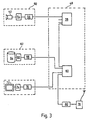
- FIG. 3 shows a schematic diagram of how timing sequences are applied by use of an ATM (Asynchronous Transfer Mode) computer network.
- the ATM Network 48 is a computer network which continuously sends small cells of information between individual processing sections and so controls the interaction of different sections such as a data collection section 50, a data storage facility 62 and a user display section 70.
- Switches 58,60 are provided within the network 48 to direct the cells.
- Each cell contains 53 bits of information with the network address of each cell being contained within a header 5 bits long.
- Each cell address is translated within the switches 58,60 and due to the small size of the header, the switches 58,60 process each cell quickly and. direct them according to the network address.
- a network time protocol NTP is used to measure how fast the cells travel throughout the ATM Network 48. This allows for synchronisation between each section attached via the ATM Network 48.
- Network time Protocols are discussed in, for example, Network Time Protocol (Version 2) by D.L. Mills in DARPA Network Working Group Report RFC-1119, University of Delaware, September 1989.
- the data collection section 50 comprises a video camera 52, an Analogue to Digital(A/D) converter 54 and a processing unit and network interface 56.
- the video camera 52 converts an optical scene into a live video analogue data stream.
- This analogue signal is sent to the A/D convertor 54 for conversion to a digital signal before passing to the processing unit 56 where the first and second timing sequences are applied to the data stream.
- the processing unit and network interface 56 is typically provided by an Olivetti Research Laboratories ATMos board with a local digital clock signal.
- the software protocol defining the addition of the timing sequences containg the timestamps to the data stream is provided from the ATM Network 48.
- the data storage facility 62 comprises a disc storage facility 64 sometimes known as a disc brick, a signal convertor 66 and a data processing unit 68.
- the data processing and interface unit 68 is typically another ATMos board and allows connection via switch 60 into the controlling ATM Network 48.
- the user display section 70 comprises a video display unit 72, a D/A convertor 74 and a data processing and interface unit 76.
- the data processing unit and network interface 76 is similarly an ATMos board connected into switch 60.
- a GPS receiver 78 receiving time pulses from GPS transmitters in orbit around the earth is used to provide the absolute time reference for the timing sequences.
- the receiver 78 is connected into the ATM Network 48 by a further ATMos board 80, typically by use of an RS 232 interface, and the switch 60.
- the time pulse from the receiver 78 is used to calibrate and synchronise the clocks on each of the ATMos boards. Typically the boards can be calibrated to within 100 ⁇ s although better accuracy can be achieved if necessary.
- a video data stream from camera 52 has playback and source timestamps applied at ATMos board 56.
- An information cell comprising one or more timestamps is sent via switch 58 to the appropriate part of the processing network.
- Switch 58 allows combination of data streams from the data collection section 50 with those of the data storage facility 62.
- Data streams from the data storage facility 62 may be stored with timestamps or alternatively timestamps, in particular playback timestamps, can be applied to the data stream by ATMos board 68.
- the different data streams are combined according to the playback instructions contained within ATMos board 76 and sent via the D/A converter 74 to the video display unit 72.
- the different data streams supplied through the ATM network 48 to the video display unit 72 can be synchronised or offset relative to each other depending on the software protocol supplied to the ATMos board 76 by the ATM network 48.
Landscapes
- Engineering & Computer Science (AREA)
- Multimedia (AREA)
- Television Signal Processing For Recording (AREA)
- Time Recorders, Dirve Recorders, Access Control (AREA)
- Management Or Editing Of Information On Record Carriers (AREA)
- Organic Low-Molecular-Weight Compounds And Preparation Thereof (AREA)
- Compounds Of Unknown Constitution (AREA)
- Saccharide Compounds (AREA)
- Electric Clocks (AREA)
- Position Fixing By Use Of Radio Waves (AREA)
- Signal Processing For Digital Recording And Reproducing (AREA)
Claims (20)
- Ein Verfahren zum Hinzufügen von Zeitinformation zu einem Datenstrom mit den Stufen des Verkettens erster und zweiter Zeittaktsequenzen mit dem Datenstrom, wobei die erste Sequenz eine dauerhafte, digital kodierte Zeitaufzeichnung davon ergibt, wann die Daten zuerst entstanden, und die zweite Sequenz neu einschreibbar ist, falls der Datenstrom editiert wird, wobei die Zeitinformation in der ersten Sequenz dauerhaft mit dem Datenstrom verkettet wird, so daß sich eine dauerhafte Aufzeichnung der jeweiligen Entstehungszeit jedes Datenstückes in dem Strom ergibt, die immer bei sämtlichen vom ursprünglichen Strom bewahrten Daten beibehalten wird, und die zweite Sequenz eine kontinuierliche, intern schlüssige Zeitspur ergibt, die jedesmal bei Editieren des Datenstroms aktualisiert wird, um für anschließende Wiedergabe- und Editierungszwecke mit dem Datenstrom, wie er editiert ist, konsistent zu sein.
- Das Verfahren zum Hinzufügen von Zeitinformation zu einem Datenstrom nach Anspruch 1, wobei die Zeittaktsequenzen mit dem Datenstrom generiert und übertragen werden.
- Ein Verfahren zum Hinzufügen von Zeitinformation zu einem Datenstrom nach Anspruch 1 oder Anspruch 2, wobei der Datenstrom und die Zeittaktsequenzen vor dem Übertragen zu einer Wiedergabeeinrichtung zwischengespeichert werden.
- Ein Verfahren zum Hinzufügen von Zeitinformation zu einem Datenstrom nach irgendeinem der Ansprüche 1 bis 3, wobei der Datenstrom und die Zeittaktsequenzen in einer verketteten Weise aufgezeichnet werden und die Zeittaktsequenzinformation in dem Datenstrom eingebettet ist.
- Ein Verfahren zum Hinzufügen von Zeitinformation zu einem Datenstrom nach Anspruch 4, wobei die erste und die zweite Zeittaktsequenz zusammen in den Datenstrom eingebettet werden.
- Ein Verfahren zum Hinzufügen von Zeitinformation zu einem Datenstrom nach Anspruch 4, wobei die zweite Zeittaktsequenz nach der ersten Zeittaktsequenz in den Datenstrom eingebettet wird.
- Ein Verfahren zum Hinzufügen von Zeitinformation zu einem Datenstrom nach den Ansprüchen 1, 2 oder 3, wobei die Zeittaktsequenzen und der Datenstrom getrennt voneinander abgespeichert werden.
- Ein Verfahren zum Hinzufügen von Zeitinformation zu einem Datenstrom nach irgendeinem der vorhergehenden Ansprüche, wobei der Datenstrom auf einem Speichermedium aufgezeichnet und die zweite Zeittaktsequenz bei der anschließenden Editierung des Datenstroms neu aufgezeichnet wird, so daß eine schlüssige Zeittaktsequenz zum Erleichtern der sich anschließenden Wiedergabe und Edition des Datenstroms ohne Unstetigkeiten sichergestellt wird.
- Ein Verfahren zum Hinzufügen von Zeitinformation zu einem Datenstrom nach irgendeinem der vorhergehenden Ansprüche, wobei die erste dauerhafte Zeittaktsequenz von einem absoluten Bezugspunkt abgeleitet wird.
- Ein Verfahren zum Hinzufügen von Zeitinformation zu einem Datenstrom nach irgendeinem der vorhergehenden Ansprüche, wobei die Zeittaktinformation in den Zeittaktsequenzen durch eine Reihe von Zeitmarken dargestellt wird.
- Ein Verfahren zum Hinzufügen von Zeitinformation zu einem Datenstrom nach Anspruch 10, wobei die Zeitmarken unter Verwendung eines 64-bit-Zeitdatenformats angewendet werden.
- Ein Verfahren zum Hinzufügen von Zeitinformation zu einem Datenstrom gemäß Anspruch 12, wobei das 64-bit-Zeitdatenformat als eine binäre Zweier-Komplement-Darstellung ausgelegt wird, um während Berechnungen eine Handhabung negativer Zeiten im gleichen Format wie bei positiven Zeiten zu gestatten.
- Ein Verfahren zum Hinzufügen von Zeitinformation zu einem Datenstrom nach Anspruch 10, 11 oder 12, wobei die Serie der Zeitmarken entlang des Datenstroms mit veränderlichem Abstand zwischen aufeinanderfolgenden Zeitmarken positioniert wird.
- Ein Verfahren zum Hinzufügen von Zeitinformation zu einem Datenstrom nach Anspruch 14, wobei der Abstand zwischen Zeitmarken der ersten Zeittaktsequenz sich von dem Abstand zwischen Zeitmarken der zweiten Zeittaktsequenz unterscheidet.
- Ein Verfahren zum Hinzufügen von Zeitinformation zu einem Datenstrom nach irgendeinem der vorhergehenden Ansprüche, wobei die Zeitinformation zum Ermöglichen einer Verkettung verschiedener Datenströme einer Vielzahl von Datenströmen hinzugefügt wird.
- Ein Verfahren zum Hinzufügen von Zeitinformation zu einem Datenstrom nach irgendeinem der vorhergehenden Ansprüche, wobei die Zeittaktsequenzen zum Synchronisieren von Live-Strömen eingesetzt werden.
- Ein Verfahren zum Hinzufügen von Zeitinformation zu einem Datenstrom nach irgendeinem der vorhergehenden Ansprüche, wobei mindestens drei Zeittaktsequenzen mit den Daten abgespeichert werden, so daß das Abspeichern von mindestens zwei Sätzen von zweiten Zeittaktsequenzen, von denen jede einer anderen Darstellung gemeinsamer Sätze von Datenströmen entspricht, gestattet wird.
- Einrichtung zum Hinzufügen von Zeitinformation zu einem Datenstrom und zum Editieren des Datenstroms mit Generierungsmitteln zum Generieren erster und zweiter Zeittaktsequenzen, wobei die erste Zeittaktsequenz eine dauerhafte Aufzeichnung davon ergibt, wann die Daten entstanden, die zweite Zeittaktsequenz eine interne Zeitspur für sich anschließende Wiedergabeund Editierungszwecke ergibt, daß die Einrichtung weiter Mittel zum Verketten der Sequenzen mit dem Datenstrom und ein Editierungsmittel zum Editieren des Datenstroms aufweist und daß die erste Zeittaktsequenz dauerhaft mit dem Datenstrom verkettet ist, um eine Aufzeichnung der Ursprungszeit, die immer mit dem Datenstrom aufrechterhalten wird, zu ergeben, und das Editierungsmittel zum erneuten Aufzeichnen des zweiten Datenstroms während des Editierens einsetzbar ist, so daß die zweite Sequenz eine intern schlüssige Zeitspur in dem editierten Datenstrom ergibt, während die Aufzeichnung der Zeit, zu der die Daten entstanden, wie sie durch die erste Zeittaktsequenz dargestellt wird, aufrechterhalten wird.
- Ein editiertes Video- oder ein Audiosignal mit einem Datenstrom, der mit der Zeitinformation zur Verwendung in dem Playback und der Synchronisation des Datenstroms mit einem anderen Datenstrom vorgesehen ist, wobei die Zeitinformation eine erste Zeittaktdatensequenz umfaßt, von der sich jede Bezugsgröße auf einen jeweiligen Teil des Stroms bezieht, der eine dauerhafte Zeitaufzeichnung darüber, wann die Daten zuerst entstanden, und eine zweite Zeittaktdatensequenz ergibt, von der sich jede Bezugsgröße auf eeinen jeweiligen Teil des Stroms bezieht und die eine intern schlüssige stetige Zeitspur ergibt, deren Stetigkeit durch irgendeine Unstetigkeit in der ersten Zeittaktsequenz nicht berührt wird wobei dieses Editieren zu Unstetigkeiten führte, wo die Daten editiert wurden, in der ersten Zeittaktsequenz, während die Beziehung zwischen der ersten Zeittaktsequenz und den Daten im Strom nicht berührt wurde, wobei die zweite Zeittaktsequenz über den Abschnitten des Stroms, bei denen die Daten editiert wurden, kontinuierlich ist.
- Ein Verfahren nach irgendeinem der Ansprüche 1 bis 17, bei dem die erste und die zweite Zeittaktsequenz beide im gleichen Format sind.
Applications Claiming Priority (3)
| Application Number | Priority Date | Filing Date | Title |
|---|---|---|---|
| GB9505417 | 1995-03-17 | ||
| GB9505417A GB2298951B (en) | 1995-03-17 | 1995-03-17 | Addition of time information |
| PCT/GB1996/000645 WO1996029702A1 (en) | 1995-03-17 | 1996-03-15 | Addition of time information |
Publications (2)
| Publication Number | Publication Date |
|---|---|
| EP0815560A1 EP0815560A1 (de) | 1998-01-07 |
| EP0815560B1 true EP0815560B1 (de) | 2002-09-18 |
Family
ID=10771377
Family Applications (1)
| Application Number | Title | Priority Date | Filing Date |
|---|---|---|---|
| EP96907572A Expired - Lifetime EP0815560B1 (de) | 1995-03-17 | 1996-03-15 | Zeitinformationsaddition |
Country Status (8)
| Country | Link |
|---|---|
| US (1) | US6055246A (de) |
| EP (1) | EP0815560B1 (de) |
| KR (1) | KR19980702988A (de) |
| AT (1) | ATE224575T1 (de) |
| AU (1) | AU5114996A (de) |
| DE (1) | DE69623757T2 (de) |
| GB (1) | GB2298951B (de) |
| WO (1) | WO1996029702A1 (de) |
Families Citing this family (53)
| Publication number | Priority date | Publication date | Assignee | Title |
|---|---|---|---|---|
| US6209090B1 (en) | 1997-05-29 | 2001-03-27 | Sol Aisenberg | Method and apparatus for providing secure time stamps for documents and computer files |
| US6134243A (en) | 1998-01-15 | 2000-10-17 | Apple Computer, Inc. | Method and apparatus for media data transmission |
| US6744763B1 (en) | 1998-01-15 | 2004-06-01 | Apple Computer, Inc. | Method and apparatus for media data transmission |
| US6453355B1 (en) | 1998-01-15 | 2002-09-17 | Apple Computer, Inc. | Method and apparatus for media data transmission |
| US6553086B1 (en) * | 1998-10-02 | 2003-04-22 | Lg Electronics, Inc. | Method and apparatus for recording time information for digital data streams |
| KR100326144B1 (ko) * | 1999-02-09 | 2002-03-13 | 구자홍 | 기록 디지털 데이터 스트림의 탐색정보 생성방법 및 이를이용한 탐색방법과, 그 장치 |
| US7194548B1 (en) * | 1999-03-30 | 2007-03-20 | Matsushita Electric Industrial Co., Ltd. | Data transmission apparatus, receiving apparatus, and sending apparatus |
| US6760328B1 (en) * | 1999-10-14 | 2004-07-06 | Synchrodyne Networks, Inc. | Scheduling with different time intervals |
| KR100654023B1 (ko) * | 1999-12-10 | 2006-12-04 | 엘지전자 주식회사 | 기록 디지털 스트림의 파일 관리방법 |
| US6757284B1 (en) * | 2000-03-07 | 2004-06-29 | Cisco Technology, Inc. | Method and apparatus for pipeline sorting of ordered streams of data items |
| GB0007868D0 (en) * | 2000-03-31 | 2000-05-17 | Koninkl Philips Electronics Nv | Methods and apparatus for editing digital video recordings and recordings made by such methods |
| US8037152B2 (en) * | 2000-06-20 | 2011-10-11 | At&T Intellectual Property Ii, L.P. | Active requesting of information for psuedo-live performance |
| WO2002041103A2 (en) * | 2000-11-17 | 2002-05-23 | Lecroy Corporation | Streaming architecture for waveform processing |
| JP3948264B2 (ja) * | 2001-12-03 | 2007-07-25 | ソニー株式会社 | ネットワーク情報処理システム、及び情報処理方法 |
| US7672895B2 (en) | 2002-02-19 | 2010-03-02 | Trading Technologies International, Inc. | System and method for simulating an electronic trading environment |
| DE60211157T2 (de) * | 2002-09-06 | 2007-02-08 | Sony Deutschland Gmbh | Synchrones Abspielen von Medien-Paketen |
| US7051245B2 (en) * | 2002-11-30 | 2006-05-23 | International Business Machines Corporation | System and method for handling out-of-order data supplied by a real-time feed |
| US7372865B2 (en) * | 2003-07-09 | 2008-05-13 | Fujitsu Limited | Processing data packets using time stamped marker packets |
| US7710965B2 (en) * | 2004-11-23 | 2010-05-04 | Broadlogic Network Technologies Inc. | Method and system for multi-program clock recovery and timestamp correction |
| US20070022215A1 (en) * | 2005-07-19 | 2007-01-25 | Singer David W | Method and apparatus for media data transmission |
| US7610554B2 (en) * | 2005-11-01 | 2009-10-27 | Microsoft Corporation | Template-based multimedia capturing |
| US7447931B1 (en) | 2005-12-09 | 2008-11-04 | Rockwell Automation Technologies, Inc. | Step time change compensation in an industrial automation network |
| EP1855402A1 (de) * | 2006-05-11 | 2007-11-14 | Koninklijke Philips Electronics N.V. | Übertragung, Empfang und Synchronisierung von zwei Datenströmen |
| KR100772193B1 (ko) | 2006-07-07 | 2007-11-01 | 한국전자통신연구원 | Gps 시간 정보를 갖는 데이터 생성 장치 |
| US8269763B2 (en) * | 2006-11-03 | 2012-09-18 | Apple Inc. | Continuous random access points |
| TW200906659A (en) * | 2007-08-09 | 2009-02-16 | Appro Technology Inc | GPS-based automatic time calibration device for vehicle security monitoring system |
| US8972269B2 (en) * | 2008-12-01 | 2015-03-03 | Adobe Systems Incorporated | Methods and systems for interfaces allowing limited edits to transcripts |
| US8370675B2 (en) * | 2009-01-28 | 2013-02-05 | Mellanox Technologies Ltd. | Precise clock synchronization |
| DE102010038838A1 (de) * | 2010-08-03 | 2012-02-09 | Sennheiser Electronic Gmbh & Co. Kg | Audio- und/oder Videoübertragungssystem |
| US9892172B2 (en) * | 2013-03-15 | 2018-02-13 | Dropbox, Inc. | Date and time handling |
| US11483127B2 (en) | 2018-11-18 | 2022-10-25 | Mellanox Technologies, Ltd. | Clock synchronization |
| US10778406B2 (en) | 2018-11-26 | 2020-09-15 | Mellanox Technologies, Ltd. | Synthesized clock synchronization between networks devices |
| US11283454B2 (en) | 2018-11-26 | 2022-03-22 | Mellanox Technologies, Ltd. | Synthesized clock synchronization between network devices |
| US11543852B2 (en) | 2019-11-07 | 2023-01-03 | Mellanox Technologies, Ltd. | Multihost clock synchronization |
| US11070304B1 (en) | 2020-02-25 | 2021-07-20 | Mellanox Technologies, Ltd. | Physical hardware clock chaining |
| US12081427B2 (en) | 2020-04-20 | 2024-09-03 | Mellanox Technologies, Ltd. | Time-synchronization testing in a network element |
| US11552871B2 (en) | 2020-06-14 | 2023-01-10 | Mellanox Technologies, Ltd. | Receive-side timestamp accuracy |
| US11606427B2 (en) | 2020-12-14 | 2023-03-14 | Mellanox Technologies, Ltd. | Software-controlled clock synchronization of network devices |
| US11588609B2 (en) | 2021-01-14 | 2023-02-21 | Mellanox Technologies, Ltd. | Hardware clock with built-in accuracy check |
| US12111681B2 (en) | 2021-05-06 | 2024-10-08 | Mellanox Technologies, Ltd. | Network adapter providing isolated self-contained time services |
| US12028155B2 (en) | 2021-11-24 | 2024-07-02 | Mellanox Technologies, Ltd. | Controller which adjusts clock frequency based on received symbol rate |
| US11907754B2 (en) | 2021-12-14 | 2024-02-20 | Mellanox Technologies, Ltd. | System to trigger time-dependent action |
| US11835999B2 (en) | 2022-01-18 | 2023-12-05 | Mellanox Technologies, Ltd. | Controller which adjusts clock frequency based on received symbol rate |
| US11706014B1 (en) | 2022-01-20 | 2023-07-18 | Mellanox Technologies, Ltd. | Clock synchronization loop |
| US12524038B2 (en) | 2022-05-12 | 2026-01-13 | Mellanox Technologies, Ltd | Scalable boundary clock |
| US12294469B2 (en) | 2022-05-12 | 2025-05-06 | Mellanox Technologies, Ltd | Boundary clock synchronized loop |
| US12308952B2 (en) | 2022-07-06 | 2025-05-20 | Mellanox Technologies, Ltd. | Companion metadata for precision time protocol (PTP) hardware clock |
| US12289388B2 (en) | 2022-07-20 | 2025-04-29 | Mellanox Technologies, Ltd | Syntonization through physical layer of interconnects |
| US11917045B2 (en) | 2022-07-24 | 2024-02-27 | Mellanox Technologies, Ltd. | Scalable synchronization of network devices |
| US12375199B2 (en) | 2022-12-19 | 2025-07-29 | Mellanox Technologies, Ltd | Hybrid clock synchronization |
| US12216489B2 (en) | 2023-02-21 | 2025-02-04 | Mellanox Technologies, Ltd | Clock adjustment holdover |
| US12289389B2 (en) | 2023-08-13 | 2025-04-29 | Mellanox Technologies, Ltd. | Physical layer syntonization using digitally controlled oscillator |
| US12615130B2 (en) | 2024-04-02 | 2026-04-28 | Mellanox Technologies, Ltd | Environmental-based parameters optimization of clock |
Family Cites Families (17)
| Publication number | Priority date | Publication date | Assignee | Title |
|---|---|---|---|---|
| GB2187028B (en) * | 1986-02-24 | 1989-11-08 | Sony Corp | Methods of and apparatus for processing timecode data in a recorded digital video signal |
| GB2224866A (en) * | 1988-11-02 | 1990-05-16 | Julian David Williams | Improvements in or relating to an event recording device |
| JP2785345B2 (ja) * | 1989-06-30 | 1998-08-13 | ソニー株式会社 | 映像信号記録及び再生装置 |
| DE4128327C2 (de) * | 1991-08-27 | 1994-06-09 | Joachim Behrens | Verfahren zur Tonnachbearbeitung und Vorrichtung zur Durchführung des Verfahrens |
| US5420801A (en) * | 1992-11-13 | 1995-05-30 | International Business Machines Corporation | System and method for synchronization of multimedia streams |
| GB2273220B (en) * | 1992-12-07 | 1997-01-08 | Quantel Ltd | A video processing system |
| US5396497A (en) * | 1993-02-26 | 1995-03-07 | Sony Corporation | Synchronization of audio/video information |
| US5452435A (en) * | 1993-03-31 | 1995-09-19 | Kaleida Labs, Inc. | Synchronized clocks and media players |
| EP1089279A3 (de) * | 1993-04-16 | 2004-01-07 | Avid Technology, Inc. | Synchronisation mehrerer Medienströme |
| JP3599738B2 (ja) * | 1993-05-10 | 2004-12-08 | オブジェクト テクノロジー ライセンシング コーポレイション | マルチメディア同期システム |
| US5440336A (en) * | 1993-07-23 | 1995-08-08 | Electronic Data Systems Corporation | System and method for storing and forwarding audio and/or visual information on demand |
| US5602992A (en) * | 1993-11-29 | 1997-02-11 | Intel Corporation | System for synchronizing data stream transferred from server to client by initializing clock when first packet is received and comparing packet time information with clock |
| JP3197766B2 (ja) * | 1994-02-17 | 2001-08-13 | 三洋電機株式会社 | Mpegオーディオデコーダ、mpegビデオデコーダおよびmpegシステムデコーダ |
| DE69410489T2 (de) * | 1994-03-16 | 1999-02-04 | International Business Machines Corp., Armonk, N.Y. | Verfahren und gerät für die synchronisation und den ablauf von mehreren datenströmen und echtzeitaufgaben |
| JP3248380B2 (ja) * | 1994-12-15 | 2002-01-21 | ソニー株式会社 | データ復号化装置およびデータ復号化方法 |
| US5619337A (en) * | 1995-01-27 | 1997-04-08 | Matsushita Electric Corporation Of America | MPEG transport encoding/decoding system for recording transport streams |
| US5617502A (en) * | 1996-03-22 | 1997-04-01 | Cirrus Logic, Inc. | System and method synchronizing audio and video digital data signals during playback |
-
1995
- 1995-03-17 GB GB9505417A patent/GB2298951B/en not_active Expired - Fee Related
-
1996
- 1996-03-15 AT AT96907572T patent/ATE224575T1/de not_active IP Right Cessation
- 1996-03-15 US US08/913,794 patent/US6055246A/en not_active Expired - Fee Related
- 1996-03-15 WO PCT/GB1996/000645 patent/WO1996029702A1/en not_active Ceased
- 1996-03-15 DE DE69623757T patent/DE69623757T2/de not_active Expired - Lifetime
- 1996-03-15 AU AU51149/96A patent/AU5114996A/en not_active Abandoned
- 1996-03-15 KR KR1019970706396A patent/KR19980702988A/ko not_active Ceased
- 1996-03-15 EP EP96907572A patent/EP0815560B1/de not_active Expired - Lifetime
Also Published As
| Publication number | Publication date |
|---|---|
| WO1996029702A1 (en) | 1996-09-26 |
| AU5114996A (en) | 1996-10-08 |
| DE69623757D1 (en) | 2002-10-24 |
| DE69623757T2 (de) | 2003-08-14 |
| US6055246A (en) | 2000-04-25 |
| EP0815560A1 (de) | 1998-01-07 |
| GB2298951B (en) | 1999-10-27 |
| GB2298951A (en) | 1996-09-18 |
| ATE224575T1 (de) | 2002-10-15 |
| KR19980702988A (ko) | 1998-09-05 |
| GB9505417D0 (en) | 1995-05-03 |
Similar Documents
| Publication | Publication Date | Title |
|---|---|---|
| US6055246A (en) | Addition of time information | |
| US8260112B2 (en) | Method for generating additional information for guaranteeing seamless playback between data streams, recording medium storing the information, and recording, editing and/or playback apparatus using the same | |
| JP3666625B2 (ja) | データ記録方法およびデータ記録装置 | |
| JPS63246087A (ja) | 記録方式 | |
| JP3106937B2 (ja) | パケットデータの記録方法、再生方法、記録再生装置及び記録媒体 | |
| US6771881B1 (en) | Method for maintaining edit decision lists for digital audio/video reproducers to maintain synchronization across timecode edits | |
| CN100417213C (zh) | 流式数据记录装置 | |
| US6522829B1 (en) | Data reproducing apparatus, data recording and reproducing apparatus, data reproducing method and data recording and reproducing method | |
| US5963382A (en) | Methods of recording and reproducing and apparatus for recording and reproducing time codes | |
| JP2735289B2 (ja) | ディジタル信号の信号処理装置 | |
| US20210134256A1 (en) | Midi events synchronization system, method and device | |
| JPH06195957A (ja) | 音声再生に付随する付属装置を同期させる,音声記録を記憶及び再生する装置 | |
| KR100532113B1 (ko) | 데이터열간의 연속 재생을 보장하는 데이터의 기록및/또는 재생 장치 | |
| KR100657262B1 (ko) | 데이터열간의 연속 재생을 보장하기 위한 부가 정보를저장하는 기록 매체 | |
| JPH06325560A (ja) | Midi編集装置 | |
| JPS60130276A (ja) | ビデオ信号の編集記録装置 | |
| JP2786481B2 (ja) | ディジタル信号の信号処理装置 | |
| JP2000216745A (ja) | 時間情報再付加装置 | |
| JPH01272385A (ja) | ディジタル静止画像記録方式 | |
| KR20040018418A (ko) | 데이터열간의 연속 재생을 보장하는 데이터의 기록및/또는 편집 장치 | |
| JPH0675355B2 (ja) | 信号再生装置 |
Legal Events
| Date | Code | Title | Description |
|---|---|---|---|
| PUAI | Public reference made under article 153(3) epc to a published international application that has entered the european phase |
Free format text: ORIGINAL CODE: 0009012 |
|
| 17P | Request for examination filed |
Effective date: 19970826 |
|
| AK | Designated contracting states |
Kind code of ref document: A1 Designated state(s): AT BE CH DE DK ES FI FR GB GR IE IT LI LU MC NL PT SE |
|
| AX | Request for extension of the european patent |
Free format text: AL PAYMENT 970826;LT PAYMENT 970826;LV PAYMENT 970826;SI PAYMENT 970826 |
|
| 17Q | First examination report despatched |
Effective date: 19980122 |
|
| GRAG | Despatch of communication of intention to grant |
Free format text: ORIGINAL CODE: EPIDOS AGRA |
|
| GRAG | Despatch of communication of intention to grant |
Free format text: ORIGINAL CODE: EPIDOS AGRA |
|
| GRAH | Despatch of communication of intention to grant a patent |
Free format text: ORIGINAL CODE: EPIDOS IGRA |
|
| GRAH | Despatch of communication of intention to grant a patent |
Free format text: ORIGINAL CODE: EPIDOS IGRA |
|
| GRAA | (expected) grant |
Free format text: ORIGINAL CODE: 0009210 |
|
| AK | Designated contracting states |
Kind code of ref document: B1 Designated state(s): AT BE CH DE DK ES FI FR GB GR IE IT LI LU MC NL PT SE |
|
| AX | Request for extension of the european patent |
Free format text: AL PAYMENT 19970826;LT PAYMENT 19970826;LV PAYMENT 19970826;SI PAYMENT 19970826 |
|
| PG25 | Lapsed in a contracting state [announced via postgrant information from national office to epo] |
Ref country code: NL Free format text: LAPSE BECAUSE OF FAILURE TO SUBMIT A TRANSLATION OF THE DESCRIPTION OR TO PAY THE FEE WITHIN THE PRESCRIBED TIME-LIMIT Effective date: 20020918 Ref country code: LI Free format text: LAPSE BECAUSE OF FAILURE TO SUBMIT A TRANSLATION OF THE DESCRIPTION OR TO PAY THE FEE WITHIN THE PRESCRIBED TIME-LIMIT Effective date: 20020918 Ref country code: IT Free format text: LAPSE BECAUSE OF FAILURE TO SUBMIT A TRANSLATION OF THE DESCRIPTION OR TO PAY THE FEE WITHIN THE PRE;WARNING: LAPSES OF ITALIAN PATENTS WITH EFFECTIVE DATE BEFORE 2007 MAY HAVE OCCURRED AT ANY TIME BEFORE 2007. THE CORRECT EFFECTIVE DATE MAY BE DIFFERENT FROM THE ONE RECORDED.SCRIBED TIME-LIMIT Effective date: 20020918 Ref country code: GR Free format text: LAPSE BECAUSE OF FAILURE TO SUBMIT A TRANSLATION OF THE DESCRIPTION OR TO PAY THE FEE WITHIN THE PRESCRIBED TIME-LIMIT Effective date: 20020918 Ref country code: FI Free format text: LAPSE BECAUSE OF FAILURE TO SUBMIT A TRANSLATION OF THE DESCRIPTION OR TO PAY THE FEE WITHIN THE PRESCRIBED TIME-LIMIT Effective date: 20020918 Ref country code: CH Free format text: LAPSE BECAUSE OF FAILURE TO SUBMIT A TRANSLATION OF THE DESCRIPTION OR TO PAY THE FEE WITHIN THE PRESCRIBED TIME-LIMIT Effective date: 20020918 Ref country code: BE Free format text: LAPSE BECAUSE OF FAILURE TO SUBMIT A TRANSLATION OF THE DESCRIPTION OR TO PAY THE FEE WITHIN THE PRESCRIBED TIME-LIMIT Effective date: 20020918 Ref country code: AT Free format text: LAPSE BECAUSE OF FAILURE TO SUBMIT A TRANSLATION OF THE DESCRIPTION OR TO PAY THE FEE WITHIN THE PRESCRIBED TIME-LIMIT Effective date: 20020918 |
|
| REF | Corresponds to: |
Ref document number: 224575 Country of ref document: AT Date of ref document: 20021015 Kind code of ref document: T |
|
| REG | Reference to a national code |
Ref country code: GB Ref legal event code: FG4D |
|
| REG | Reference to a national code |
Ref country code: CH Ref legal event code: EP |
|
| REG | Reference to a national code |
Ref country code: IE Ref legal event code: FG4D |
|
| REF | Corresponds to: |
Ref document number: 69623757 Country of ref document: DE Date of ref document: 20021024 |
|
| PG25 | Lapsed in a contracting state [announced via postgrant information from national office to epo] |
Ref country code: SE Free format text: LAPSE BECAUSE OF FAILURE TO SUBMIT A TRANSLATION OF THE DESCRIPTION OR TO PAY THE FEE WITHIN THE PRESCRIBED TIME-LIMIT Effective date: 20021218 Ref country code: DK Free format text: LAPSE BECAUSE OF FAILURE TO SUBMIT A TRANSLATION OF THE DESCRIPTION OR TO PAY THE FEE WITHIN THE PRESCRIBED TIME-LIMIT Effective date: 20021218 |
|
| PG25 | Lapsed in a contracting state [announced via postgrant information from national office to epo] |
Ref country code: PT Free format text: LAPSE BECAUSE OF FAILURE TO SUBMIT A TRANSLATION OF THE DESCRIPTION OR TO PAY THE FEE WITHIN THE PRESCRIBED TIME-LIMIT Effective date: 20021219 |
|
| LTIE | Lt: invalidation of european patent or patent extension |
Effective date: 20020918 |
|
| NLV1 | Nl: lapsed or annulled due to failure to fulfill the requirements of art. 29p and 29m of the patents act | ||
| PG25 | Lapsed in a contracting state [announced via postgrant information from national office to epo] |
Ref country code: LU Free format text: LAPSE BECAUSE OF NON-PAYMENT OF DUE FEES Effective date: 20030315 |
|
| PG25 | Lapsed in a contracting state [announced via postgrant information from national office to epo] |
Ref country code: IE Free format text: LAPSE BECAUSE OF NON-PAYMENT OF DUE FEES Effective date: 20030317 |
|
| PG25 | Lapsed in a contracting state [announced via postgrant information from national office to epo] |
Ref country code: ES Free format text: LAPSE BECAUSE OF FAILURE TO SUBMIT A TRANSLATION OF THE DESCRIPTION OR TO PAY THE FEE WITHIN THE PRESCRIBED TIME-LIMIT Effective date: 20030328 |
|
| PG25 | Lapsed in a contracting state [announced via postgrant information from national office to epo] |
Ref country code: MC Free format text: LAPSE BECAUSE OF NON-PAYMENT OF DUE FEES Effective date: 20030331 |
|
| REG | Reference to a national code |
Ref country code: CH Ref legal event code: PL |
|
| ET | Fr: translation filed | ||
| PLBE | No opposition filed within time limit |
Free format text: ORIGINAL CODE: 0009261 |
|
| STAA | Information on the status of an ep patent application or granted ep patent |
Free format text: STATUS: NO OPPOSITION FILED WITHIN TIME LIMIT |
|
| 26N | No opposition filed |
Effective date: 20030619 |
|
| REG | Reference to a national code |
Ref country code: IE Ref legal event code: MM4A |
|
| REG | Reference to a national code |
Ref country code: GB Ref legal event code: 732E |
|
| REG | Reference to a national code |
Ref country code: FR Ref legal event code: CD Ref country code: FR Ref legal event code: CA |
|
| REG | Reference to a national code |
Ref country code: FR Ref legal event code: TP |
|
| PGFP | Annual fee paid to national office [announced via postgrant information from national office to epo] |
Ref country code: FR Payment date: 20110304 Year of fee payment: 16 |
|
| PGFP | Annual fee paid to national office [announced via postgrant information from national office to epo] |
Ref country code: DE Payment date: 20110331 Year of fee payment: 16 Ref country code: GB Payment date: 20110221 Year of fee payment: 16 |
|
| GBPC | Gb: european patent ceased through non-payment of renewal fee |
Effective date: 20120315 |
|
| REG | Reference to a national code |
Ref country code: FR Ref legal event code: ST Effective date: 20121130 |
|
| PG25 | Lapsed in a contracting state [announced via postgrant information from national office to epo] |
Ref country code: GB Free format text: LAPSE BECAUSE OF NON-PAYMENT OF DUE FEES Effective date: 20120315 Ref country code: FR Free format text: LAPSE BECAUSE OF NON-PAYMENT OF DUE FEES Effective date: 20120402 |
|
| REG | Reference to a national code |
Ref country code: DE Ref legal event code: R119 Ref document number: 69623757 Country of ref document: DE Effective date: 20121002 |
|
| PG25 | Lapsed in a contracting state [announced via postgrant information from national office to epo] |
Ref country code: DE Free format text: LAPSE BECAUSE OF NON-PAYMENT OF DUE FEES Effective date: 20121002 |