EP0815746B1 - Verfahren zur erhaltung von lebensmitteln und dergleichen in einem ungefrorenen zustand in einem temperaturbereich unter dem gefrierpunkt - Google Patents
Verfahren zur erhaltung von lebensmitteln und dergleichen in einem ungefrorenen zustand in einem temperaturbereich unter dem gefrierpunkt Download PDFInfo
- Publication number
- EP0815746B1 EP0815746B1 EP96906064A EP96906064A EP0815746B1 EP 0815746 B1 EP0815746 B1 EP 0815746B1 EP 96906064 A EP96906064 A EP 96906064A EP 96906064 A EP96906064 A EP 96906064A EP 0815746 B1 EP0815746 B1 EP 0815746B1
- Authority
- EP
- European Patent Office
- Prior art keywords
- food
- freezing point
- freezing
- temperature
- frozen
- Prior art date
- Legal status (The legal status is an assumption and is not a legal conclusion. Google has not performed a legal analysis and makes no representation as to the accuracy of the status listed.)
- Expired - Lifetime
Links
- 235000013305 food Nutrition 0.000 title claims description 197
- 238000000034 method Methods 0.000 title claims description 94
- 238000007710 freezing Methods 0.000 claims description 206
- 230000008014 freezing Effects 0.000 claims description 206
- 238000001816 cooling Methods 0.000 claims description 91
- 238000010583 slow cooling Methods 0.000 claims description 23
- XLYOFNOQVPJJNP-UHFFFAOYSA-N water Substances O XLYOFNOQVPJJNP-UHFFFAOYSA-N 0.000 claims description 19
- 238000004519 manufacturing process Methods 0.000 claims description 15
- 241001465754 Metazoa Species 0.000 claims description 13
- PEDCQBHIVMGVHV-UHFFFAOYSA-N Glycerine Chemical compound OCC(O)CO PEDCQBHIVMGVHV-UHFFFAOYSA-N 0.000 claims description 12
- 239000013078 crystal Substances 0.000 claims description 12
- 230000003028 elevating effect Effects 0.000 claims description 10
- 239000000126 substance Substances 0.000 claims description 10
- 239000005022 packaging material Substances 0.000 claims description 7
- 230000005611 electricity Effects 0.000 claims description 6
- 235000013611 frozen food Nutrition 0.000 claims description 6
- 230000003068 static effect Effects 0.000 claims description 6
- 239000012620 biological material Substances 0.000 claims description 5
- 230000002401 inhibitory effect Effects 0.000 claims description 5
- 102000003886 Glycoproteins Human genes 0.000 claims description 4
- 108090000288 Glycoproteins Proteins 0.000 claims description 4
- 229920000159 gelatin Polymers 0.000 claims description 4
- 235000019322 gelatine Nutrition 0.000 claims description 4
- 239000005418 vegetable material Substances 0.000 claims description 4
- 239000013039 cover film Substances 0.000 claims description 3
- 239000012535 impurity Substances 0.000 claims description 3
- 229920003002 synthetic resin Polymers 0.000 claims description 3
- 239000000057 synthetic resin Substances 0.000 claims description 3
- 239000001828 Gelatine Substances 0.000 claims description 2
- 230000001678 irradiating effect Effects 0.000 claims description 2
- 238000004321 preservation Methods 0.000 description 37
- 235000013399 edible fruits Nutrition 0.000 description 25
- 235000014102 seafood Nutrition 0.000 description 23
- 239000000047 product Substances 0.000 description 22
- 235000013311 vegetables Nutrition 0.000 description 21
- 238000003306 harvesting Methods 0.000 description 18
- CIWBSHSKHKDKBQ-JLAZNSOCSA-N Ascorbic acid Chemical compound OC[C@H](O)[C@H]1OC(=O)C(O)=C1O CIWBSHSKHKDKBQ-JLAZNSOCSA-N 0.000 description 14
- 230000007423 decrease Effects 0.000 description 14
- 241001504592 Trachurus trachurus Species 0.000 description 11
- 235000013361 beverage Nutrition 0.000 description 10
- 210000004027 cell Anatomy 0.000 description 10
- 241000234282 Allium Species 0.000 description 9
- 235000002732 Allium cepa var. cepa Nutrition 0.000 description 9
- 244000068988 Glycine max Species 0.000 description 9
- 235000010469 Glycine max Nutrition 0.000 description 9
- 235000013527 bean curd Nutrition 0.000 description 9
- 238000009826 distribution Methods 0.000 description 9
- 239000002994 raw material Substances 0.000 description 9
- 235000001014 amino acid Nutrition 0.000 description 8
- 229940024606 amino acid Drugs 0.000 description 8
- 150000001413 amino acids Chemical class 0.000 description 8
- ZZZCUOFIHGPKAK-UHFFFAOYSA-N D-erythro-ascorbic acid Natural products OCC1OC(=O)C(O)=C1O ZZZCUOFIHGPKAK-UHFFFAOYSA-N 0.000 description 7
- 229930003268 Vitamin C Natural products 0.000 description 7
- 235000013405 beer Nutrition 0.000 description 7
- 210000001519 tissue Anatomy 0.000 description 7
- 235000019154 vitamin C Nutrition 0.000 description 7
- 239000011718 vitamin C Substances 0.000 description 7
- 238000000354 decomposition reaction Methods 0.000 description 6
- 230000006866 deterioration Effects 0.000 description 6
- 235000020188 drinking water Nutrition 0.000 description 6
- 239000003651 drinking water Substances 0.000 description 6
- 235000021067 refined food Nutrition 0.000 description 6
- 230000002349 favourable effect Effects 0.000 description 5
- 235000012055 fruits and vegetables Nutrition 0.000 description 5
- 239000005457 ice water Substances 0.000 description 5
- 210000002977 intracellular fluid Anatomy 0.000 description 5
- 238000011835 investigation Methods 0.000 description 5
- 238000012545 processing Methods 0.000 description 5
- 238000003860 storage Methods 0.000 description 5
- 238000010257 thawing Methods 0.000 description 5
- 241000251468 Actinopterygii Species 0.000 description 4
- QGZKDVFQNNGYKY-UHFFFAOYSA-N Ammonia Chemical compound N QGZKDVFQNNGYKY-UHFFFAOYSA-N 0.000 description 4
- 235000005340 Asparagus officinalis Nutrition 0.000 description 4
- 235000011299 Brassica oleracea var botrytis Nutrition 0.000 description 4
- 240000003259 Brassica oleracea var. botrytis Species 0.000 description 4
- 230000003679 aging effect Effects 0.000 description 4
- 230000003750 conditioning effect Effects 0.000 description 4
- 230000000694 effects Effects 0.000 description 4
- 238000005516 engineering process Methods 0.000 description 4
- 210000003722 extracellular fluid Anatomy 0.000 description 4
- 235000021107 fermented food Nutrition 0.000 description 4
- 235000019688 fish Nutrition 0.000 description 4
- 239000000796 flavoring agent Substances 0.000 description 4
- 235000019634 flavors Nutrition 0.000 description 4
- 235000013622 meat product Nutrition 0.000 description 4
- 240000004507 Abelmoschus esculentus Species 0.000 description 3
- 241000196324 Embryophyta Species 0.000 description 3
- 240000008415 Lactuca sativa Species 0.000 description 3
- 235000003228 Lactuca sativa Nutrition 0.000 description 3
- 244000088401 Pyrus pyrifolia Species 0.000 description 3
- 235000001630 Pyrus pyrifolia var culta Nutrition 0.000 description 3
- 230000032683 aging Effects 0.000 description 3
- 235000013334 alcoholic beverage Nutrition 0.000 description 3
- 235000015278 beef Nutrition 0.000 description 3
- 229930002875 chlorophyll Natural products 0.000 description 3
- 235000019804 chlorophyll Nutrition 0.000 description 3
- ATNHDLDRLWWWCB-AENOIHSZSA-M chlorophyll a Chemical compound C1([C@@H](C(=O)OC)C(=O)C2=C3C)=C2N2C3=CC(C(CC)=C3C)=[N+]4C3=CC3=C(C=C)C(C)=C5N3[Mg-2]42[N+]2=C1[C@@H](CCC(=O)OC\C=C(/C)CCC[C@H](C)CCC[C@H](C)CCCC(C)C)[C@H](C)C2=C5 ATNHDLDRLWWWCB-AENOIHSZSA-M 0.000 description 3
- 238000011161 development Methods 0.000 description 3
- 230000018109 developmental process Effects 0.000 description 3
- 238000010586 diagram Methods 0.000 description 3
- 238000001914 filtration Methods 0.000 description 3
- 235000015097 nutrients Nutrition 0.000 description 3
- 230000003287 optical effect Effects 0.000 description 3
- -1 polyethylene Polymers 0.000 description 3
- 230000008569 process Effects 0.000 description 3
- 238000004781 supercooling Methods 0.000 description 3
- 244000151012 Allium neapolitanum Species 0.000 description 2
- 244000003416 Asparagus officinalis Species 0.000 description 2
- 241000167854 Bourreria succulenta Species 0.000 description 2
- 235000005979 Citrus limon Nutrition 0.000 description 2
- 244000131522 Citrus pyriformis Species 0.000 description 2
- 235000011511 Diospyros Nutrition 0.000 description 2
- 235000016623 Fragaria vesca Nutrition 0.000 description 2
- 235000011363 Fragaria x ananassa Nutrition 0.000 description 2
- 108010010803 Gelatin Proteins 0.000 description 2
- 244000017020 Ipomoea batatas Species 0.000 description 2
- 235000002678 Ipomoea batatas Nutrition 0.000 description 2
- 235000007688 Lycopersicon esculentum Nutrition 0.000 description 2
- 235000011430 Malus pumila Nutrition 0.000 description 2
- 235000015103 Malus silvestris Nutrition 0.000 description 2
- 240000004713 Pisum sativum Species 0.000 description 2
- 235000010582 Pisum sativum Nutrition 0.000 description 2
- 239000004698 Polyethylene Substances 0.000 description 2
- 244000018633 Prunus armeniaca Species 0.000 description 2
- 235000009827 Prunus armeniaca Nutrition 0.000 description 2
- 235000006040 Prunus persica var persica Nutrition 0.000 description 2
- 244000088415 Raphanus sativus Species 0.000 description 2
- 235000006140 Raphanus sativus var sativus Nutrition 0.000 description 2
- 240000003768 Solanum lycopersicum Species 0.000 description 2
- 244000061456 Solanum tuberosum Species 0.000 description 2
- 235000002595 Solanum tuberosum Nutrition 0.000 description 2
- 244000269722 Thea sinensis Species 0.000 description 2
- 235000006468 Thea sinensis Nutrition 0.000 description 2
- 235000003095 Vaccinium corymbosum Nutrition 0.000 description 2
- 235000017537 Vaccinium myrtillus Nutrition 0.000 description 2
- 244000193174 agave Species 0.000 description 2
- 229910021529 ammonia Inorganic materials 0.000 description 2
- 230000008901 benefit Effects 0.000 description 2
- 230000015572 biosynthetic process Effects 0.000 description 2
- 235000021014 blueberries Nutrition 0.000 description 2
- 235000019693 cherries Nutrition 0.000 description 2
- 235000016213 coffee Nutrition 0.000 description 2
- 235000013353 coffee beverage Nutrition 0.000 description 2
- 235000009508 confectionery Nutrition 0.000 description 2
- 238000007796 conventional method Methods 0.000 description 2
- 230000003247 decreasing effect Effects 0.000 description 2
- 230000000881 depressing effect Effects 0.000 description 2
- 230000000994 depressogenic effect Effects 0.000 description 2
- 239000008273 gelatin Substances 0.000 description 2
- 235000011852 gelatine desserts Nutrition 0.000 description 2
- 239000000463 material Substances 0.000 description 2
- 235000021110 pickles Nutrition 0.000 description 2
- 229920000573 polyethylene Polymers 0.000 description 2
- 235000018102 proteins Nutrition 0.000 description 2
- 108090000623 proteins and genes Proteins 0.000 description 2
- 102000004169 proteins and genes Human genes 0.000 description 2
- 238000011160 research Methods 0.000 description 2
- 230000001953 sensory effect Effects 0.000 description 2
- 238000012360 testing method Methods 0.000 description 2
- PSLCKQYQNVNTQI-BHFSHLQUSA-N (2s)-2-aminobutanedioic acid;(2s)-2-aminopentanedioic acid Chemical compound OC(=O)[C@@H](N)CC(O)=O.OC(=O)[C@@H](N)CCC(O)=O PSLCKQYQNVNTQI-BHFSHLQUSA-N 0.000 description 1
- 244000144730 Amygdalus persica Species 0.000 description 1
- 241000894006 Bacteria Species 0.000 description 1
- 241000238366 Cephalopoda Species 0.000 description 1
- 241000131500 Chionoecetes opilio Species 0.000 description 1
- 244000236655 Diospyros kaki Species 0.000 description 1
- 244000055850 Diospyros virginiana Species 0.000 description 1
- 244000307700 Fragaria vesca Species 0.000 description 1
- 240000009088 Fragaria x ananassa Species 0.000 description 1
- 241000287828 Gallus gallus Species 0.000 description 1
- WHUUTDBJXJRKMK-UHFFFAOYSA-N Glutamic acid Natural products OC(=O)C(N)CCC(O)=O WHUUTDBJXJRKMK-UHFFFAOYSA-N 0.000 description 1
- CKLJMWTZIZZHCS-REOHCLBHSA-N L-aspartic acid Chemical compound OC(=O)[C@@H](N)CC(O)=O CKLJMWTZIZZHCS-REOHCLBHSA-N 0.000 description 1
- AGPKZVBTJJNPAG-WHFBIAKZSA-N L-isoleucine Chemical compound CC[C@H](C)[C@H](N)C(O)=O AGPKZVBTJJNPAG-WHFBIAKZSA-N 0.000 description 1
- KDXKERNSBIXSRK-YFKPBYRVSA-N L-lysine Chemical compound NCCCC[C@H](N)C(O)=O KDXKERNSBIXSRK-YFKPBYRVSA-N 0.000 description 1
- AYFVYJQAPQTCCC-GBXIJSLDSA-N L-threonine Chemical compound C[C@@H](O)[C@H](N)C(O)=O AYFVYJQAPQTCCC-GBXIJSLDSA-N 0.000 description 1
- KZSNJWFQEVHDMF-BYPYZUCNSA-N L-valine Chemical compound CC(C)[C@H](N)C(O)=O KZSNJWFQEVHDMF-BYPYZUCNSA-N 0.000 description 1
- 239000004472 Lysine Substances 0.000 description 1
- KDXKERNSBIXSRK-UHFFFAOYSA-N Lysine Natural products NCCCCC(N)C(O)=O KDXKERNSBIXSRK-UHFFFAOYSA-N 0.000 description 1
- 241000220225 Malus Species 0.000 description 1
- 240000007594 Oryza sativa Species 0.000 description 1
- 235000007164 Oryza sativa Nutrition 0.000 description 1
- 241000237509 Patinopecten sp. Species 0.000 description 1
- 235000010627 Phaseolus vulgaris Nutrition 0.000 description 1
- 244000046052 Phaseolus vulgaris Species 0.000 description 1
- 241001600434 Plectroglyphidodon lacrymatus Species 0.000 description 1
- 240000005809 Prunus persica Species 0.000 description 1
- 241001125048 Sardina Species 0.000 description 1
- 241000269821 Scombridae Species 0.000 description 1
- 241001441724 Tetraodontidae Species 0.000 description 1
- AYFVYJQAPQTCCC-UHFFFAOYSA-N Threonine Natural products CC(O)C(N)C(O)=O AYFVYJQAPQTCCC-UHFFFAOYSA-N 0.000 description 1
- 239000004473 Threonine Substances 0.000 description 1
- 240000000851 Vaccinium corymbosum Species 0.000 description 1
- 244000077233 Vaccinium uliginosum Species 0.000 description 1
- KZSNJWFQEVHDMF-UHFFFAOYSA-N Valine Natural products CC(C)C(N)C(O)=O KZSNJWFQEVHDMF-UHFFFAOYSA-N 0.000 description 1
- 230000001476 alcoholic effect Effects 0.000 description 1
- 238000004458 analytical method Methods 0.000 description 1
- 235000003704 aspartic acid Nutrition 0.000 description 1
- OQFSQFPPLPISGP-UHFFFAOYSA-N beta-carboxyaspartic acid Natural products OC(=O)C(N)C(C(O)=O)C(O)=O OQFSQFPPLPISGP-UHFFFAOYSA-N 0.000 description 1
- 235000020279 black tea Nutrition 0.000 description 1
- 235000013532 brandy Nutrition 0.000 description 1
- 235000008429 bread Nutrition 0.000 description 1
- 235000014121 butter Nutrition 0.000 description 1
- 235000013339 cereals Nutrition 0.000 description 1
- 230000008859 change Effects 0.000 description 1
- 235000013351 cheese Nutrition 0.000 description 1
- 239000007795 chemical reaction product Substances 0.000 description 1
- 238000004320 controlled atmosphere Methods 0.000 description 1
- 235000013365 dairy product Nutrition 0.000 description 1
- 238000010790 dilution Methods 0.000 description 1
- 239000012895 dilution Substances 0.000 description 1
- 230000003292 diminished effect Effects 0.000 description 1
- 238000011156 evaluation Methods 0.000 description 1
- 238000002474 experimental method Methods 0.000 description 1
- 239000010408 film Substances 0.000 description 1
- 235000015203 fruit juice Nutrition 0.000 description 1
- 235000013569 fruit product Nutrition 0.000 description 1
- 235000013922 glutamic acid Nutrition 0.000 description 1
- 239000004220 glutamic acid Substances 0.000 description 1
- 235000009569 green tea Nutrition 0.000 description 1
- 235000008216 herbs Nutrition 0.000 description 1
- 235000015243 ice cream Nutrition 0.000 description 1
- 239000013067 intermediate product Substances 0.000 description 1
- 229960000310 isoleucine Drugs 0.000 description 1
- AGPKZVBTJJNPAG-UHFFFAOYSA-N isoleucine Natural products CCC(C)C(N)C(O)=O AGPKZVBTJJNPAG-UHFFFAOYSA-N 0.000 description 1
- 235000015094 jam Nutrition 0.000 description 1
- 235000021056 liquid food Nutrition 0.000 description 1
- 235000020640 mackerel Nutrition 0.000 description 1
- 238000012423 maintenance Methods 0.000 description 1
- 238000005259 measurement Methods 0.000 description 1
- 235000013372 meat Nutrition 0.000 description 1
- 238000002844 melting Methods 0.000 description 1
- 230000008018 melting Effects 0.000 description 1
- 235000013336 milk Nutrition 0.000 description 1
- 239000008267 milk Substances 0.000 description 1
- 210000004080 milk Anatomy 0.000 description 1
- 229930014626 natural product Natural products 0.000 description 1
- 235000019520 non-alcoholic beverage Nutrition 0.000 description 1
- 235000012149 noodles Nutrition 0.000 description 1
- 235000016709 nutrition Nutrition 0.000 description 1
- 235000020333 oolong tea Nutrition 0.000 description 1
- 238000004806 packaging method and process Methods 0.000 description 1
- 230000036961 partial effect Effects 0.000 description 1
- 235000015277 pork Nutrition 0.000 description 1
- 239000000843 powder Substances 0.000 description 1
- 230000009467 reduction Effects 0.000 description 1
- 238000005057 refrigeration Methods 0.000 description 1
- 230000004044 response Effects 0.000 description 1
- 235000009566 rice Nutrition 0.000 description 1
- 235000019992 sake Nutrition 0.000 description 1
- 235000019512 sardine Nutrition 0.000 description 1
- 235000015067 sauces Nutrition 0.000 description 1
- 235000020637 scallop Nutrition 0.000 description 1
- 235000020083 shōchū Nutrition 0.000 description 1
- 235000014214 soft drink Nutrition 0.000 description 1
- 235000021055 solid food Nutrition 0.000 description 1
- 230000006641 stabilisation Effects 0.000 description 1
- 238000011105 stabilization Methods 0.000 description 1
- 238000010561 standard procedure Methods 0.000 description 1
- 230000001629 suppression Effects 0.000 description 1
- 230000008961 swelling Effects 0.000 description 1
- 235000013616 tea Nutrition 0.000 description 1
- 230000007704 transition Effects 0.000 description 1
- 238000000108 ultra-filtration Methods 0.000 description 1
- 239000004474 valine Substances 0.000 description 1
- 235000021419 vinegar Nutrition 0.000 description 1
- 239000000052 vinegar Substances 0.000 description 1
- 235000015041 whisky Nutrition 0.000 description 1
- 235000014101 wine Nutrition 0.000 description 1
Images


Classifications
-
- A—HUMAN NECESSITIES
- A23—FOODS OR FOODSTUFFS; TREATMENT THEREOF, NOT COVERED BY OTHER CLASSES
- A23B—PRESERVATION OF FOODS, FOODSTUFFS OR NON-ALCOHOLIC BEVERAGES; CHEMICAL RIPENING OF FRUIT OR VEGETABLES
- A23B2/00—Preservation of foods or foodstuffs, in general
- A23B2/80—Freezing; Subsequent thawing; Cooling
-
- A—HUMAN NECESSITIES
- A23—FOODS OR FOODSTUFFS; TREATMENT THEREOF, NOT COVERED BY OTHER CLASSES
- A23B—PRESERVATION OF FOODS, FOODSTUFFS OR NON-ALCOHOLIC BEVERAGES; CHEMICAL RIPENING OF FRUIT OR VEGETABLES
- A23B4/00—Preservation of meat, sausages, fish or fish products
- A23B4/06—Freezing; Subsequent thawing; Cooling
-
- A—HUMAN NECESSITIES
- A23—FOODS OR FOODSTUFFS; TREATMENT THEREOF, NOT COVERED BY OTHER CLASSES
- A23B—PRESERVATION OF FOODS, FOODSTUFFS OR NON-ALCOHOLIC BEVERAGES; CHEMICAL RIPENING OF FRUIT OR VEGETABLES
- A23B7/00—Preservation of fruit or vegetables; Chemical ripening of fruit or vegetables
- A23B7/04—Freezing; Subsequent thawing; Cooling
Definitions
- This invention relates to a method for the non-frozen preservation of food in a temperature zone below the freezing point, and more particularly, the present invention is a method for preserving perishable food in a non-frozen state in a non-freezing region below the freezing point, and relates to a non-frozen preservation method for perishable food in which a slow cooling treatment for putting said perishable food in a non-frozen state below the freezing point is combined with a stepped temperature elevation treatment for elevating the temperature of the perishable food in said non-frozen state to room temperature, which makes it possible to maintain perishable food in a favorable non-frozen state in a temperature zone below the freezing point, and also makes it possible to maintain the effect and characteristics of the non-freezing treatment and to restore the food favorably to room temperature, and relates to the temperature elevation method therefore.
- the ideal way to supply products in a fresh and high-quality form would be via a "cold chain” that comprises specific low-temperature conditions, from the production stage (the site of harvest) to the consumption stage.
- the preservation conditions are often less than adequate along the distribution channels, which is due to distribution cost considerations, low-temperature preservation technology limitations, and so on.
- vegetables, fruits, seafood, and other such perishable food are harvested and produced in many different locations as agricultural and marine products, and in most cases reach the consumer after first going through a market and a retail outlet, so even today, with all of our sophisticated technology for preserving said perishable food, it is still quite difficult to maintain that fresh-picked or fresh-caught flavor and freshness over an extended period. For instance, even if the distribution time could be specially shortened to ensure a good state of preservation, the cost at the current time would be tremendous, and except for some high-end products, this would be an impractical method for the general distribution of perishable foods.
- an object of the present invention is to provide a method for the non-frozen preservation of perishable food, which makes it possible to keep vegetables, fruits, seafood, and other such perishable food at a high level of freshness without causing any decrease in freshness or deterioration in quality, and to provide a slow cooling method and means with which it is possible to simply and reliably achieve a non-frozen state for food in the temperature zone below the freezing point.
- a further object of the present invention is to provide a method for manufacturing food in a non-frozen state below the freezing point by utilizing the above-mentioned non-frozen preservation method, and a product of this method.
- a still further object of the present invention is to provide a method for preserving perishable food at a high level of freshness, with which it is possible to keep vegetables, fruits, seafood, and other such perishable food in a non-freezing region below the freezing point for an extended period without the food losing the freshness it had immediately after harvest.
- Another object of the present invention is to provide a slow conditioning technique for favorably controlling the temperature conditions in said non-freezing region, the temperature conditions for restoring the food to room temperature, in a method for preserving perishable food in a non-frozen state in the non-freezing region below the freezing point.
- an object of the present invention is to provide a method for keeping a non-frozen state of a food in a temperature region below the freezing point of said food, which comprises rapidly cooling the food from room temperature to close to said freezing point, and then slowly cooling the food at a gradual cooling rate of 0.01 to 0.5°C/hour to below said freezing point to keep the food in the non-frozen state in a low temperature zone 0.1 to 10°C below said freezing point.
- the second embodiment of the present invention is a method for keeping a non-frozen state of a food in a temperature region below the freezing point of said food according to the invention, wherein the method comprises elevating the temperature of the food to said freezing point or to 0.5 to 1.0°C over said freezing point at a predetermined time and in a predetermined cycle.
- the third embodiment of the present invention is a method for elevating to room temperature the temperature of the food kept in a non-frozen state in a non-freezing region below the freezing point by the method according to the invention, which comprises elevating the temperature of the food at a gradual temperature elevation rate of 0.01 to 0.5°C/hour to close to the freezing point, and then, elevating the temperature of the food from the freezing point of the food to room temperature.
- the fourth embodiment of the present invention is a method for manufacturing non-frozen water in a temperature zone below the freezing point thereof by the method defined in the invention, wherein the water is pretreated by means of a microfilter to remove impurities in the water.
- the fifth embodiment of the present invention is a method for manufacturing food kept in a non-frozen state below the freezing point thereof by the method defined in the invention, wherein the food is cooled by means of a slow cooling treatment at a gradual cooling rate of 0.01 to 0.5°C/hour under predetermined pressurization conditions.
- the sixth embodiment of the present invention is a method for keeping a non-frozen state of a food in a temperature region below the freezing point thereof according to the invention, which comprises irradiating the food with far infrared rays, microwaves or static electricity, and optionally vibrating the food in a temperature zone above a breaking point of a supercooled state of the food at a predetermined time and in a predetermined cycle to stabilize the supercooled state below the freezing point.
- the seventh embodiment of the present invention is a method for keeping a non-frozen state of a food in a temperature region below the freezing point thereof according to the invention, wherein the food packaged or covered with a packaging material of a synthetic resin, paper or a biological material; or with the packaging material coated with glycerol as ice nucleatation inhibiting substance, a glycoprotein, or gelatine as ice crystal growth inhibiting substance; or with a cover film of these substances, is cooled in a specific low temperature region.
- the eighth embodiment of the present invention is a method for keeping a non-frozen state of only inner cells of a food of an animal or vegetable material below the freezing point thereof, which comprises adopting the food kept in a non-frozen state by the method defined in the invention, and breaking a supercooled state of the food by rapid freezing treatment below the freezing point to obtain the outer cells of the food frozen, and the inner cells in a non-frozen state.
- the ninth embodiment of the present invention is a method for manufacturing a frozen food from a food kept in a non-frozen state in a non-freezing region below the freezing point thereof, which comprises adopting the food kept in a non-frozen state by the method defined in the invention, and breaking a supercooled state of the food by rapid freezing treatment below the freezing point to obtain the food frozen.
- the invention can be carried out in cooling equipment furnished with control apparatus for automatically temperature controlling the temperature conditions specified for the invention.
- control apparatus for automatically temperature controlling the temperature conditions specified for the invention.
- such equipment can be provided with pressurization, irradiation or vibration systems of particular embodiments of the invention.
- Another embodiment of the present invention is a method for manufacturing non-frozen water in a temperature zone below the freezing point by the above method, wherein a flow rate of 0.1 to 2000 m/min is imparted to the raw material water in the course of the cooling step to inhibit the formation of ice nuclei and the growth of ice crystals in the raw material water preferably.
- Still another embodiment of the present invention is a method for pre-thawing a frozen food and obtaining a high-quality thawed food while raising the temperature in stages at suitable times, wherein the food is gradually thawed with suppressed damage to the cells or tissue while the temperature is raised in stages after gradual thawing while the non-frozen components in the frozen food are maintained in a supercooled state (1 to 10 °C below the freezing point).
- the present invention is a method for preserving food (such as vegetables, fruits, seafood, and other such perishable foods, as well as foods composed of animal or vegetable materials, various processed foods, food raw materials, raw material water, animal or vegetable biological materials, biological tissue, and so on) in a non-frozen state in a non-freezing region below the freezing point, and relates to a non-frozen preservation method for food, which comprises relatively rapidly cooling the food (within from 1 to 30 minutes or a few hours) from room temperature to close to the freezing point of said perishable food, and then slowly cooling the food at a gradual cooling rate of 0.01 to 0.5 °C/hour to below the freezing point.
- a non-frozen preservation method for food which comprises relatively rapidly cooling the food (within from 1 to 30 minutes or a few hours) from room temperature to close to the freezing point of said perishable food, and then slowly cooling the food at a gradual cooling rate of 0.01 to 0.5 °C/hour to below the freezing point.
- the "method for preserving food in a non-frozen state in a non-freezing region below the freezing point" referred to in the present invention means, for example, a preservation method comprising the transition of various foods to a non-frozen state in a non-freezing region below the freezing point by subjecting the food to a super-slow cooling treatment by a stepped cooling process in the presence or absence of a freezing point depressant, a component having a freezing point depressing action, or a component having the same effect (super CFP preservation method ("super CFP" is a registered trademark)).
- any method that has the same effect as said method shall be similarly considered.
- the present invention can be applied especially favorably to vegetables, fruits, seafood, and other such perishable food, but is not limited to these, and can also be applied to fermented foods, processed foods, food raw materials, intermediate products, cooked foods, animal or vegetable biological materials, biological tissue (cells or tissue from animals or plants).
- any method may be employed to subject the food to a cooling treatment in a temperature zone in the non-freezing region below the freezing point as long as a relatively rapid cooling treatment can be carried out in a low-temperature region below 0°C, and as long as a slow cooling treatment to below the freezing point at 0.01 to 0.5°C/hour, and preferably 0.01 to 0.4 °C/hour, can be carried out, and no particular restrictions are imposed on this method, but a method in which the cooling is accomplished by cooling equipment furnished with a control apparatus for automatically controlling the temperature conditions (an automatic temperature control apparatus) is a favorable example thereof.
- the perishable food When a perishable food is subjected to a cooling treatment by the above-mentioned rapid cooling treatment and slow cooling method, the perishable food is favorably cooled gradually below the freezing point, so that the perishable food is stable in the non-freezing region below the freezing point without freezing, and is maintained in a favorable non-frozen state. Furthermore, investigation on the part of the inventors has revealed that when the above-mentioned slow cooling treatment conditions and process are not employed, that is, when a slow cooling treatment involving cooling at a gradual rate of 0.01 to 0.5 °C /hour to below the freezing point is not performed, it is difficult to maintain a food in a non-frozen state in the temperature zone below the freezing point, and the stated objects cannot be achieved.
- the food is introduced into a non-freezing region below the freezing point, and kept in a low temperature zone 0.1 to 10°C below the freezing point, and then preserved in this low temperature zone for between several hours and several months, but since the favorable range of said low temperature zone varies considerably with the type and properties of the food, it should be question.
- vegetables, fruits, animal products, seafood, and other such perishable food may be any ordinary vegetables, fruits, animal products, or seafood, and the present invention is applicable regardless of the type thereof.
- the "perishable food” referred to in the present invention also encompasses fresh flowers, medicinal herbs, rice bran and other grains, nuts, and other such foods, as well as fresh plants related to these, and so on.
- the present invention is utilized to keep a perishable food fresh, it is important that this perishable food be treated as soon after its harvest as possible.
- the above-mentioned cooling preservation treatment should be carried out within a few hours after harvest.
- the present invention is not limited to a perishable food immediately after harvest, and of course can also be applied similarly to a perishable food at a suitable point in the distribution process, or to a perishable food at the consumption stage.
- the perishable food in a non-frozen state in a non-freezing region below the freezing point, it is preferable to perform the treatment at the site of harvest or production, but it is also possible, for example, to load the food onto a truck or the like equipped with cooling equipment and ship it to the treatment site, and it is also possible to treat the perishable food where large-scale cooling equipment is located.
- a perishable food that has just been harvested is subjected to a cooling preservation treatment under the above-mentioned super-cold conditions in a non-frozen state in a non-freezing region below the freezing point, which makes it possible to effectively suppress the decrease in freshness of perishable food that occurs immediately after harvest, namely, with fruits and vegetables, the rapid decomposition of useful components such as vitamin C and other nutrients, chlorophyll, and so on, and with seafood, the decrease in the K value (an index of freshness) caused by the rapid decomposition of ATP, and other such deteriorations in quality, and also makes it possible to supply perishable food with high levels of freshness and quality that could not be obtained with a conventional preservation method.
- the present invention in the above-mentioned method for preserving a food in a non-frozen state in a non-freezing region below the freezing point, it is also possible to maintain the food simply and favorably in a non-frozen state by adding a step in which the temperature is elevated to the freezing point or to between 0.5 and 1.0 °C over said freezing point at a rate of no more than 1 °C in a period ranging from 1 hour to several days at a suitable time and in a suitable cycle during the preservation. Therefore, the addition of said temperature elevation step to the above-mentioned method of the present invention for the non-frozen preservation of a food in a temperature zone below the freezing point is desirable in that the non-frozen state is even more stable.
- the food in order to restore to room temperature a food that has been preserved in a non-frozen state in a non-freezing region below the freezing point, the food is not heated rapidly, but rather is subjected to a temperature elevation treatment at a gradual temperature elevation rate of 0.01 to 0.5 °C/hour up to the freezing point, and then, from the freezing point up to room temperature, the temperature elevation conditions are set to suitable temperatures of 0°C , 5°C , and 15°C , so that the temperature is elevated in stages at suitable times.
- the temperature it is also possible for the temperature to be elevated at a relatively high rate from the freezing point to room temperature, and the rate should be suitably set according to the type and properties of the food or the like in question.
- the form of the food is not limited to a solid food (including powders and the like), and the present invention can also be applied to a liquid food, such as alcoholic and non-alcoholic beverages, tea beverages, and drinking water.
- the method of the present invention can be applied to drinking water to manufacture non-frozen water below the freezing point (below 0 °C ).
- the impurities in the raw material water can be removed ahead of time by filtering and/or distilling the raw material water by microfilter filtration, precision filtration, ultrafiltration, or another such suitable means, which allows the non-freezing region below the freezing point to be expanded stably and simply.
- a flow rate of 0.1 to 2000 m/min can be imparted to the raw material water in the course of the cooling step, which allows the formation of ice nuclei and the growth of ice crystals in the raw material water to be inhibited.
- the food in order to preserve the food more stably in a non-frozen state in a non-freezing region below the freezing point, that is, to stabilize the supercooled state below the freezing point, it is desirable to add a step in which the food is irradiated with far infrared rays, microwaves, or other such light, and/or is irradiated with static electricity, and/or is vibrated continuously or discontinuously in a temperature zone above the breaking point (the lower limit of the non-freezing region) at a suitable time during preservation and in a suitable cycle.
- a packaging material such as polyethylene or another synthetic resin, Japanese paper or another type of paper, or a biological material; or with a suitable material capable of satisfying the gradual cooling conditions and preventing partial supercooling of the food; or with a packaging material coated with an inner film of glycerol or another such ice nucleatation inhibiting substance, a glycoprotein, or gelatin or another such suitable chemical substance that inhibits ice crystal growth; or with a cover film of these substances.
- packaging or covering materials such as these are used in the present invention, the expansion of the non-freezing region below the freezing point and even better stabilization of the non-frozen state in said region can be achieved.
- a perishable food especially one composed of an animal or vegetable material
- the above-mentioned slow cooling treatment which is carried out at a gradual cooling rate of 0.01 to 0.5°C/hour, can be combined with a rapid freezing treatment, in which the food is frozen at -18°C or lower, for example, from a supercooled state below the freezing point, which makes it easier for the extracellular fluid to freeze, while making it more difficult for the intracellular fluid to freeze, so that it is possible to freeze the outer cells of the food and to preserve the inner cells in a non-frozen state.
- a method such as this is employed in the present invention, it is possible to maintain a perishable food, especially fruit, an animal product, seafood, at a high level of freshness and quality.
- This method can be used to advantage in the case of other foods and beverages as a method for instantly freezing, from a supercooled state below the freezing point, water, a beverage (such as coffee, black tea, oolong tea, green tea, fruit juice, and other cooling drinks, or fruit sauce, jam, alcoholic beverages, and the like), a food, that has been preserved in a non-freezing region below the freezing point.
- a beverage such as coffee, black tea, oolong tea, green tea, fruit juice, and other cooling drinks, or fruit sauce, jam, alcoholic beverages, and the like
- a slow cooling treatment performed at a gradual cooling rate of 0.01 to 0.5°C/hour is combined with a rapid freezing treatment, together with the addition of ice nuclei (ice crystals or another ice crystal forming substance) to the food, a treatment in which pressure, vibration, or friction is instantaneously released from the vessel side walls, as needed, it is possible to manufacture a frozen product that retains high levels of quality, properties, and so on for a variety of foods and beverages by flash freezing, such as sherbet, popsicles, ice cream, frozen liquors (such as beer, sake, shochu, wine, whiskey, and brandy), chilled tofu, thinly-sliced raw fish, uncured ham, and fruit.
- flash freezing such as sherbet, popsicles, ice cream, frozen liquors (such as beer, sake, shochu, wine, whiskey, and brandy), chilled tofu, thinly-sliced raw fish, uncured ham, and fruit.
- a frozen product can be thawed with suppressed damage to the cells or tissue while the temperature is raised in stages after gradual thawing while the non-frozen components in the frozen food are maintained in a supercooled state (1 to 10 °C below the freezing point).
- the present invention can be utilized favorably as a technique for preserving and processing perishable food (such as agricultural, animal, and marine products); pickles; pickled seafood; meat products; noodles; jams; fish paste; refined sake, beer, and other liquors; table vinegar, fermented soybeans, dairy products, and other such processed foods and fermented foods; animal and plant cells and other such biological tissue; and so on.
- perishable food such as agricultural, animal, and marine products
- pickles pickled seafood; meat products; noodles; jams; fish paste; refined sake, beer, and other liquors
- table vinegar fermented soybeans, dairy products, and other such processed foods and fermented foods
- animal and plant cells and other such biological tissue and so on.
- Example 1 Cooling preservation treatment of vegetables in super-low-temperature region (super CFP region)
- a perishable food (lettuce) that had just been harvested was put in a refrigerator and subjected to a cooling treatment by rapid cooling treatment to close to the freezing point (-0.2 °C ), then subjected to a slow cooling treatment in which it was cooled at a gradual cooling rate of 0.1°C/hour to below the freezing point, and then said perishable food was preserved in a non-frozen state in a non-freezing region below the freezing point (-0.2 to -4.0°C ).
- the perishable food After the perishable food had been preserved for 1 week in said non-freezing region, it was subjected to a temperature elevation treatment at a gradual temperature elevation rate of 0.1 °C/hour up to the freezing point without being heated rapidly, after which the temperature was elevated from the freezing point up to 5 °C.
- a perishable food (lettuce) that had undergone a cooling treatment by the above-mentioned slow cooling method, and one that had not undergone said cooling treatment were stored for 22 days in a 5°C refrigerator and then examined for the state of preservation of their freshness. The results of this are given in Tables 1 and 2.
- Freshness Taste Appearance Super CFP cooling treatment +++ +++ +++ No treatment - - - Notes: 1) Freshness: Extent to which the green color was preserved 2) Taste: Softness on tongue, Crispiness 3) Appearance: Extent of wilting and swelling 4) +++: extremely good; ++: good; +: average; -: somewhat poor; --: poor; ---: extremely poor Vitamin C residual rate (%) Super CFP cooling treatment 95 No treatment 10
- Example 2 Cooling treatment of fruits and vegetables in super-low-temperature region (super CFP region)
- the horse mackerel used in this Example 3 was cultivated horse mackerel.
- the perishable food live horse mackerel
- a super CFP container 2 °C
- a freezing container -0.5 °C
- This product was then subjected to a slow cooling treatment in which it was cooled at a gradual cooling rate of 0.1 °C /hour to below the freezing point, and said perishable food was then preserved in a non-frozen state in a non-freezing region below the freezing point (-1.5 to -15.5 °C ).
- the perishable food had been preserved for 1 week in said non-freezing region, it was subjected to a temperature elevation treatment at a gradual temperature elevation rate of 0.1 °C /hour up to the freezing point without being heated rapidly, after which the temperature was elevated from the freezing point up to 5 °C.
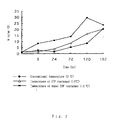
- a perishable food live horse mackerel that had undergone a cooling treatment by the above-mentioned slow cooling method, and one that had been immersed and cooled in an ice water container (+2 °C ) were then preserved at temperatures of -2 °C (super CFP group), - 0.5°C (freezing group), and +2 °C (ice water group), and these samples were subjected to a sensory test by a panel of experts and to measurement of the K value (an index of freshness) by a standard method, which were conducted at the start of the experiment and 5, 24, 72, and 192 hours later.
- the K values* for the horse mackerel cooled using the freezing container and super CFP container were lower than that of the horse mackerel cooled in the ice water container, and furthermore, the change in these values was less over the various preservation temperatures and elapsed days of preservation, which meant that the gap between these values and the value for the ice water cooling treatment widened, which makes the difference in freshness more distinct.
- Leaf onions were put into a refrigerator and subjected to a cooling treatment by rapid cooling treatment to 0 °C , after which they were subjected to a slow cooling treatment in which they were cooled at a gradual cooling rate of 0.1°C/hour to the freezing point of -0.8 °C , after which this perishable food was preserved in a non-freezing region of -0.8 to -0.2 °C in a non-frozen state below the freezing point. After the food had been preserved for 2 weeks in this non-freezing region, the temperature was gradually elevated to the freezing point, and the temperature was then elevated from the freezing point to room temperature.
- the sugar content of the leaf onions prior to the cooling treatment was 2.0%, and while the sugar content of the leaf onions in the refrigerated group decreased to 1.2% after 2 weeks, that of the samples in the cooling treatment group increased to 3.3%.
- the free amino acid content was measured, which revealed that the content of sweet free amino acids (aspartic acid, threonine, cerine, and glutamic acid) increased, while the content of bitter free amino acids (valine, isoleucine, and lysine) decreased, so that the onion tasted like that of a winter crop.
- sweet free amino acids aspartic acid, threonine, cerine, and glutamic acid
- bitter free amino acids valine, isoleucine, and lysine
- Sliced tuna was put into a refrigerator and subjected to a rapid cooling treatment down to -0.5 °C , after which it was subjected to a slow cooling treatment in which it was cooled at a gradual cooling rate of 0.1 °C/hour from -0.5 °C to the freezing point, after which it was preserved for 1 week in the non-freezing region (-2.5 to -3.5°C ) below the freezing point (-1.7°C ). After the food had been preserved for 1 week in this non-freezing region, its temperature was gradually elevated to the freezing point, and its temperature was then elevated to 5°C . Tables 4 and 5 show the results of examining the preservation of freshness of the tuna and the aging effect after the cooling treatment.
- the tuna that underwent the cooling treatment was compared with tuna from a control group that had been stored at 5 °C , which revealed that the K value (an index of freshness) and the sweet free amino acid content were higher in the former.
- Preservation of tuna freshness K value (%) Start 3 days 5 days 7 days
- Control group tuna (stored at 5°C) 19.2 27.4 39.0
- Cooling treatment tuna 4.1 5.3 6.1 7.4 Tuna aging effect (third day) from standpoint of free amino acid content Content out of total free amino acids (%) Aspartic acid Glutamic acid Before treatment 1.3 7.3
- Control group tuna (stored at 5°C) 1.2 5.4 Cooling treatment tuna 2.2 11.5
- Example 7 Cooling treatment of drinking water in super-low temperature region (super CFP region)
- Drinking water was put into a refrigerator and subjected to a cooling treatment by rapid cooling treatment to close to the freezing point (-2.8 °C), after which it was subjected to a slow cooling treatment in which it was cooled at a gradual cooling rate of 0.2 °C/hour down to the freezing point under six sets of conditions: just as it was, pressurization of 0.1 to 10 kg/cm 2 , far infrared irradiation of 30 to 100 ⁇ m, microwave irradiation of 500 to 5000 MHz, a suitable amount of static electricity irradiation, and vibration at 1 to 20 KHz.
- Example 8 Cooling treatment of beverage (beer) in super-low temperature region (super CFP region)
- a beverage (beer) was put into a refrigerator and subjected to a cooling treatment by rapid cooling treatment to close to the freezing point (-2.8°C), after which it was subjected to a slow cooling treatment in which it was cooled at a gradual cooling rate of 0.01 to 0.5 °C/hour down to the freezing point under six sets of conditions: just as it was, pressurization of 0.1 to 10 kg/cm 2 , far infrared irradiation of 30 to 100 ⁇ m, microwave irradiation of 500 to 5000 MHz, a suitable amount of static electricity irradiation, and vibration at 1 to 20 KHz.
- This beverage (beer) was preserved in a non-frozen state in the non-freezing region below the freezing point (-2.8 to -17.0°C) to manufacture a non-frozen beverage (beer) below the freezing point.
- the introduction of the beverage into the non-freezing region was easier and more stable when the steps in which pressure, optical irradiation, and vibration were imparted were added than when said steps were not added.
- Example 9 Cooling treatment of meat product (sliced beef) in super-low temperature region (super CFP region)
- Sliced beef was wrapped in a packaging material made of Japanese paper and put into a refrigerator, where it was subjected to a cooling treatment by rapid cooling treatment to -0.5°C , after which it was subjected to a slow cooling treatment in which it was cooled at a gradual cooling rate of 0.1°C/hour down to between the freezing point and -0.5 °C , after which it was preserved for 1 week in the non-freezing region (-1.7 to -18.0 °C ) below the freezing point, which yielded a non-frozen meat product below the freezing point (-1.7°C ). After the food had been preserved for 1 week in this non-freezing region, its temperature was gradually elevated to the freezing point, and its temperature was then elevated to 5°C . It was found that the meat product thus obtained had reached a higher level of curing than a conventional product. The results were more or less the same when the food was covered or wrapped with polyethylene, glycerol, glycoprotein, gelatin.
- Example 10 Cooling treatment of fruit in super-low temperature region (super CFP region)
- Fruit (Asian pears) was put into a refrigerator and subjected to a rapid cooling treatment down to 0°C , after which it was subjected to a slow cooling treatment in which it was cooled at a gradual cooling rate of 0.1 °C/hour down to the freezing point of -1.5°C , after which this perishable food was preserved in the non-freezing region of -2.2 to -15.0°C below the freezing point.
- the fruit After the fruit had been preserved for 2 weeks in this non-freezing region and put into a supercooled state, it was subjected to a freezing treatment below - 18 °C , which cause the free water to move from the intracellular fluid to the extracellular fluid, resulting in the simultaneous dilution of the extracellular fluid and concentration of the intracellular fluid, which made it easier for the extracellular fluid to freeze and, conversely, made it more difficult for the intracellular fluid to freeze, thus yielding a new type of fruit product in which the intracellular fluid was preserved in a non-frozen state.
- a freezing treatment below - 18 °C
- beverages alcoholic beverages, coffee, soft drinks, and so on
- thinly sliced raw fish uncured ham, fruit, tofu
- a cooling treatment which yielded the following results.
- beverages when they were frozen from a supercooled state of 1 to 10°C below the freezing point, fine ice crystals formed immediately, resulting in a new type of smooth, sherbet-like food that melted nicely in the mouth.
- the present invention is a method for preserving perishable food (such as vegetables, fruits, meats, and seafood) for an extended period in a non-frozen state in a non-freezing region below the freezing point, and relates to a method for preserving perishable food comprises relatively rapidly cooling the perishable food (within from 1 to 30 minutes or a few hours) from room temperature to close to its freezing point, and then slowly cooling the food at a gradual cooling rate of 0.01 to 0.5 °C/hour to below the freezing point.
- the present invention yields the following merits.
Landscapes
- Life Sciences & Earth Sciences (AREA)
- Engineering & Computer Science (AREA)
- Chemical & Material Sciences (AREA)
- Wood Science & Technology (AREA)
- Zoology (AREA)
- Food Science & Technology (AREA)
- Polymers & Plastics (AREA)
- Chemical Kinetics & Catalysis (AREA)
- General Chemical & Material Sciences (AREA)
- Storage Of Fruits Or Vegetables (AREA)
- Freezing, Cooling And Drying Of Foods (AREA)
Claims (9)
- Verfahren zum Halten eines gefrierfreien Zustands eines Lebensmittels in Temperaturbereich unterhalb des Gefrierpunkts des Lebensmittels, welches Verfahren umfasst: schnelles Kühlen des Lebensmittels von Raumtemperatur bis nahe an den Gefrierpunkt; und danach langsames Kühlen des Lebensmittels bei einer schrittweisen Kühlgeschwindigkeit von 0,01° bis 0,5°C/h bis unterhalb des Gefrierpunkts, um das Lebensmittel in dem gefrierfreien Zustand in einem Niedertemperaturbereich 0,1° bis 10°C unterhalb des Gefrierpunkts zu halten.
- Verfahren zum Halten eines gefrierfreien Zustands eines Lebensmittels im Temperaturbereich unterhalb des Gefrierpunkts des Lebensmittels nach Anspruch 1, wobei das Verfahren umfasst: Erhöhen der Temperatur des Lebensmittels auf den Gefrierpunkt oder bis 0,5° bis 1,0°C oberhalb des Gefrierpunkts zu einem vorbestimmten Zeitpunkt und in einem vorbestimmten Zyklus.
- Verfahren zum Erhöhen der Temperatur des Lebensmittel auf Raumtemperatur, das in einem gefrierfreien Zustand in einem nichtgefrierenden Bereich unterhalb des Gefrierpunkts gehalten wird nach dem Verfahren, wie unter Anspruch 1 festgelegt, welches Verfahren umfasst: Erhöhen der Temperatur des Lebensmittels mit einer schrittweisen Temperaturerhöhungsgeschwindigkeit von 0,01°C/h bis 0,5°C/h bis nahe an den Gefrierpunkt; und danach Erhöhen der Temperatur des Lebensmittels vom Gefrierpunkt des Lebensmittel auf Raumtemperatur.
- Verfahren zum Herstellen von nichtgefrorenem Wasser in einem Temperaturbereich unterhalb des Gefrierpunkts nach dem Verfahren von Anspruch 1, wobei das Wasser mit Hilfe eines Mikrofilters zum Entfernen von Verunreinigungen in dem Wasser vorbehandelt wird.
- Verfahren zum Herstellen von Lebensmittel, die in einem gefrierfreien Zustand unterhalb ihres Gefrierpunktes gehalten werden, nach dem Verfahren nach Anspruch 1, wobei das Lebensmittel durch eine langsame Kühlbehandlung bei einer schrittweisen Kühlgeschwindigkeit von 0,01° bis 0,5°C/h unter vorbestimmten Druckbedingungen gekühlt wird.
- Verfahren zum Halten eines gefrierfreien Zustands eines Lebensmittels in einem Temperaturbereich unterhalb seines Gefrierpunkts nach Anspruch 1, welches Verfahren umfasst: Bestrahlen des Lebensmittels mit Strahlung im fernen Infrarot, mit Mikrowellen oder durch statische Elektrizität und wahlweise Vibrieren des Lebensmittels in einem Temperaturbereich oberhalb des Berstpunktes eines unterkühlten Zustands des Lebensmittels für eine vorbestimmte Zeit und in einem vorbestimmten Zyklus, um den unterkühlten Zustand unterhalb des Gefrierpunkts zu stabilisieren.
- Verfahren zum Halten eines gefrierfreien Zustands eines Lebensmittels in einem Temperaturbereich unterhalb seines Gefrierpunkts nach Anspruch 1, wobei das Lebensmittel, das verpackt oder überzogen ist mit einem Verpackungsmittel aus einem synthetischen Harz, aus Papier oder einem biologischen Material; oder mit einem Verpackungsmittel, das beschichtet ist mit Glycerin als einer für die Eiskristallkeimbildung hemmenden Substanz, einem Glykoprotein oder Gelatine als einer das Eiskristallwachstum hemmenden Substanz; oder mit einer Abdeckfolie aus diesen Substanzen; auf einen speziellen Niedertemperaturbereich gekühlt wird.
- Verfahren zum Halten eines gefrierfreien Zustands von lediglich inneren Zellen eines Lebensmittels aus tierischer oder pflanzlicher Herkunft unterhalb seines Gefrierpunkts, welches Verfahren umfasst: Übernehmen des Lebensmittels, das nach dem Verfahren nach Anspruch 1 in einem gefrierfreien Zustand gehalten wird, und Unterbrechen eines unterkühlten Zustands des Lebensmittels durch eine schnelle Gefrierbehandlung unterhalb des Gefrierpunkts, um die äußeren Zellen des Lebensmittels in einem gefrorenen und die inneren Zellen in einem gefrierfreien Zustand zu erhalten.
- Verfahren zum Herstellen eines gefrorenen Lebensmittels aus einem Lebensmittel, das in einem gefrierfreien Zustand in einem Bereich unterhalb seines Gefrierpunkts gehalten wurde, welches Verfahren umfasst: Übernehmen des Lebensmittels, das in einem gefrierfreien Zustand nach dem Verfahren nach Anspruch 1 gehalten wurde, und Unterbrechen eines unterkühlten Zustands des Lebensmittels durch eine schnelle Gefrierbehandlung unterhalb des Gefrierpunkts, um das Lebensmittel gefroren zu erhalten.
Applications Claiming Priority (4)
| Application Number | Priority Date | Filing Date | Title |
|---|---|---|---|
| JP83253/95 | 1995-03-15 | ||
| JP08325395A JP3787171B2 (ja) | 1995-03-15 | 1995-03-15 | 氷結点以下の温度帯における食品等の未凍結保存方法 |
| JP8325395 | 1995-03-15 | ||
| PCT/JP1996/000692 WO1996028047A1 (en) | 1995-03-15 | 1996-03-15 | Method of preserving food or the like in nonfrozen state in the temperature zone below icing point |
Publications (3)
| Publication Number | Publication Date |
|---|---|
| EP0815746A1 EP0815746A1 (de) | 1998-01-07 |
| EP0815746A4 EP0815746A4 (de) | 1998-07-29 |
| EP0815746B1 true EP0815746B1 (de) | 2000-12-20 |
Family
ID=13797181
Family Applications (1)
| Application Number | Title | Priority Date | Filing Date |
|---|---|---|---|
| EP96906064A Expired - Lifetime EP0815746B1 (de) | 1995-03-15 | 1996-03-15 | Verfahren zur erhaltung von lebensmitteln und dergleichen in einem ungefrorenen zustand in einem temperaturbereich unter dem gefrierpunkt |
Country Status (8)
| Country | Link |
|---|---|
| US (1) | US6096361A (de) |
| EP (1) | EP0815746B1 (de) |
| JP (1) | JP3787171B2 (de) |
| KR (1) | KR100435379B1 (de) |
| AU (1) | AU4955896A (de) |
| CA (1) | CA2215412C (de) |
| DE (1) | DE69611289T2 (de) |
| WO (1) | WO1996028047A1 (de) |
Families Citing this family (55)
| Publication number | Priority date | Publication date | Assignee | Title |
|---|---|---|---|---|
| EP1779890B8 (de) | 1997-07-16 | 2009-07-08 | Metacure Limited | Einrichtung zur Steuerung eines glatten Muskels |
| FR2780858B1 (fr) * | 1998-07-10 | 2000-09-29 | Maurice Campagne | Procede et installation de conservation temporaire par refrigeration de produits alimentaires agricoles |
| US8666495B2 (en) | 1999-03-05 | 2014-03-04 | Metacure Limited | Gastrointestinal methods and apparatus for use in treating disorders and controlling blood sugar |
| EP1306019A4 (de) * | 2000-08-04 | 2006-08-30 | Fuji Oil Co Ltd | Verfahren zur kontinuierlichen herstellung von gefrorenen lebensmitteln |
| KR100353036B1 (ko) * | 2000-08-14 | 2002-09-16 | 주식회사 하림 | 침지 냉동닭의 제조방법 |
| DE60212239T2 (de) * | 2001-04-09 | 2006-11-09 | Unilever N.V. | Einfrieren von Gemüse |
| JP3592668B2 (ja) * | 2001-12-13 | 2004-11-24 | 森永乳業株式会社 | 食品の保存方法および未凍結水の製造方法 |
| US20030143314A1 (en) * | 2002-01-22 | 2003-07-31 | Smith Michael G. | Process for manufacturing individually quick-freeze-formed Calamari squid rings |
| JP4859326B2 (ja) * | 2002-03-05 | 2012-01-25 | 孝雄 嘉陽 | 植物鮮度保持材および植物鮮度保持法 |
| ATE310395T1 (de) * | 2002-10-04 | 2005-12-15 | Unilever Nv | Verfahren zum gefrieren von früchten |
| GB0223339D0 (en) * | 2002-10-08 | 2002-11-13 | Unilever Plc | Freezing vegetables |
| US20040156960A1 (en) * | 2003-02-10 | 2004-08-12 | Kraft Foods Holdings, Inc. | Food product preservation method |
| GB0308258D0 (en) * | 2003-04-10 | 2003-05-14 | Central Science Lab Representi | Marking system and method |
| US8792985B2 (en) | 2003-07-21 | 2014-07-29 | Metacure Limited | Gastrointestinal methods and apparatus for use in treating disorders and controlling blood sugar |
| JP2006230257A (ja) * | 2005-02-23 | 2006-09-07 | Feel Technology Co Ltd | 氷点下静電場装置の利用方法 |
| JP2006292347A (ja) * | 2005-03-16 | 2006-10-26 | Oyama Yoshio | 電磁波冷凍装置、電磁波冷凍容器及び電磁波冷凍方法 |
| JP2007159516A (ja) * | 2005-12-15 | 2007-06-28 | Taguchi Seika:Kk | 野菜の保存方法 |
| US8653482B2 (en) * | 2006-02-21 | 2014-02-18 | Goji Limited | RF controlled freezing |
| US10674570B2 (en) | 2006-02-21 | 2020-06-02 | Goji Limited | System and method for applying electromagnetic energy |
| CN103384422B (zh) | 2006-02-21 | 2016-11-09 | 高知有限公司 | 电磁加热 |
| US8839527B2 (en) | 2006-02-21 | 2014-09-23 | Goji Limited | Drying apparatus and methods and accessories for use therewith |
| JP4740006B2 (ja) * | 2006-03-24 | 2011-08-03 | 三洋電機株式会社 | 冷却貯蔵庫 |
| WO2008004762A1 (en) * | 2006-07-01 | 2008-01-10 | Lg Electronics, Inc. | Supercooling apparatus |
| EP2127481A1 (de) * | 2007-02-21 | 2009-12-02 | RF Dynamics Ltd. | Hf-gesteuertes einfrieren |
| WO2008129718A1 (ja) * | 2007-04-17 | 2008-10-30 | Mitsubishi Electric Corporation | 冷蔵庫および冷凍保存方法 |
| IL184672A (en) | 2007-07-17 | 2012-10-31 | Eran Ben-Shmuel | Apparatus and method for concentrating electromagnetic energy on a remotely-located object |
| US9131543B2 (en) | 2007-08-30 | 2015-09-08 | Goji Limited | Dynamic impedance matching in RF resonator cavity |
| CN101156618B (zh) * | 2007-10-25 | 2010-06-09 | 中国农业大学 | 一种超冰温贮藏牛肉的方法 |
| JP5203760B2 (ja) * | 2008-03-21 | 2013-06-05 | 株式会社東芝 | 冷蔵庫 |
| JP4781378B2 (ja) * | 2008-03-25 | 2011-09-28 | 三菱電機株式会社 | 食品貯蔵装置、冷蔵庫、製氷装置並びに高周波加熱調理器 |
| EP2376154A2 (de) | 2008-11-10 | 2011-10-19 | Goji Ltd | Verfahren und system zur erw?rmung und/oder zum auftauen von blutprodukten |
| WO2011004597A1 (ja) | 2009-07-10 | 2011-01-13 | パナソニック株式会社 | 保存装置、保存方法 |
| WO2011058538A1 (en) | 2009-11-10 | 2011-05-19 | Goji Ltd. | Device and method for heating using rf energy |
| US8934975B2 (en) | 2010-02-01 | 2015-01-13 | Metacure Limited | Gastrointestinal electrical therapy |
| JP2011222279A (ja) * | 2010-04-08 | 2011-11-04 | Toyo Eng Works Ltd | マイクロ波加熱装置及びマイクロ波加熱方法 |
| WO2011138688A2 (en) | 2010-05-03 | 2011-11-10 | Goji Ltd. | Loss profile analysis |
| JP5637773B2 (ja) * | 2010-08-17 | 2014-12-10 | 株式会社東芝 | 食品貯蔵庫 |
| JP5840154B2 (ja) * | 2013-01-31 | 2016-01-06 | 株式会社東芝 | 冷蔵庫 |
| CN103202330A (zh) * | 2013-05-07 | 2013-07-17 | 辛万森 | 活枣、枸杞、杏保鲜贮藏及在商品流通中保存的方法 |
| JP5847235B2 (ja) * | 2014-05-20 | 2016-01-20 | 三菱電機株式会社 | 冷蔵庫 |
| WO2016159274A1 (ja) * | 2015-03-31 | 2016-10-06 | クアン テイン グエン | 生鮮食品の保存方法および生鮮食品用貯蔵システム |
| CN105145807A (zh) * | 2015-08-04 | 2015-12-16 | 安徽润生农业开发有限公司 | 一种猕猴桃表面涂膜冷藏处理方法 |
| JP5959703B2 (ja) * | 2015-08-27 | 2016-08-02 | 三菱電機株式会社 | 冷蔵庫 |
| JP6928776B2 (ja) * | 2016-10-21 | 2021-09-01 | パナソニックIpマネジメント株式会社 | 冷却調理方法及び冷蔵庫 |
| US10588334B2 (en) * | 2017-11-16 | 2020-03-17 | Rlmb Group, Llc | System and methods for supercooling perishable products |
| CN108935646A (zh) * | 2018-08-30 | 2018-12-07 | 大连宽达科技有限公司 | 蔬菜、菌类食材的微冻保鲜工艺 |
| JP7292867B2 (ja) * | 2018-12-12 | 2023-06-19 | 株式会社前川製作所 | 食品の冷凍熟成方法及び冷却装置 |
| JP7590816B2 (ja) * | 2019-04-26 | 2024-11-27 | 四国計測工業株式会社 | 食品のマイクロ波熟成方法およびマイクロ波熟成装置 |
| CN110671876B (zh) * | 2019-09-10 | 2023-10-27 | 珠海格力电器股份有限公司 | 一种过冷却冷冻方法及冰箱和冰箱控制方法 |
| CN111156754B (zh) * | 2020-01-03 | 2023-03-17 | 珠海格力电器股份有限公司 | 冰箱间隔室的冷冻方法及使用该冷冻方法的冰箱 |
| JP7123446B1 (ja) * | 2021-10-04 | 2022-08-23 | 株式会社ゆめみらい | 食材の保存方法 |
| CN114041498B (zh) * | 2021-12-10 | 2024-01-19 | 安徽省农业科学院农产品加工研究所 | 一种保持竹笋原有品质的速冻方法 |
| JP2023157739A (ja) * | 2022-04-15 | 2023-10-26 | アクア株式会社 | 冷蔵庫 |
| US20230364172A1 (en) * | 2022-05-14 | 2023-11-16 | Syncotrance, LLC | Modulation of solubility, palatability, absorption, and bioavailability of mitragyna speciosa-derived compounds for oral and buccal delivery |
| CN117044869A (zh) * | 2023-07-18 | 2023-11-14 | 浙江工业大学 | 一种气体密封控容的非冻结食品低温保鲜方法 |
Family Cites Families (9)
| Publication number | Priority date | Publication date | Assignee | Title |
|---|---|---|---|---|
| JPS5636887B2 (de) * | 1972-11-20 | 1981-08-27 | ||
| JPS615745A (ja) * | 1984-06-19 | 1986-01-11 | Sanyo Electric Co Ltd | 食品の解凍方法 |
| JPS62201565A (ja) * | 1985-10-31 | 1987-09-05 | Jipukomu Kk | 大型食品の冷凍保存方法 |
| JPS63254945A (ja) * | 1987-04-10 | 1988-10-21 | Showa Denko Kk | 食品の冷凍法 |
| US5153403A (en) * | 1988-06-06 | 1992-10-06 | Showa Denko K.K. | Process and apparatus for thawing frozen food |
| JP2515157B2 (ja) * | 1989-07-14 | 1996-07-10 | 株式会社氷温 | 生鮮食品の低温貯蔵法 |
| JPH04252171A (ja) * | 1990-12-26 | 1992-09-08 | Oozeki Kk | 注ぐと凍る酒類 |
| JPH0799991B2 (ja) * | 1991-12-17 | 1995-11-01 | 株式会社氷温 | 果実・野菜の貯蔵や輸送における予冷方法 |
| JPH06125759A (ja) * | 1992-10-19 | 1994-05-10 | Hiyouon:Kk | 植物性食品及び動物性食品の熟成方法 |
-
1995
- 1995-03-15 JP JP08325395A patent/JP3787171B2/ja not_active Expired - Lifetime
-
1996
- 1996-03-15 US US08/913,108 patent/US6096361A/en not_active Expired - Lifetime
- 1996-03-15 EP EP96906064A patent/EP0815746B1/de not_active Expired - Lifetime
- 1996-03-15 AU AU49558/96A patent/AU4955896A/en not_active Abandoned
- 1996-03-15 KR KR1019970706373A patent/KR100435379B1/ko not_active Expired - Lifetime
- 1996-03-15 CA CA002215412A patent/CA2215412C/en not_active Expired - Fee Related
- 1996-03-15 DE DE69611289T patent/DE69611289T2/de not_active Expired - Fee Related
- 1996-03-15 WO PCT/JP1996/000692 patent/WO1996028047A1/ja not_active Ceased
Also Published As
| Publication number | Publication date |
|---|---|
| DE69611289D1 (de) | 2001-01-25 |
| JPH08252082A (ja) | 1996-10-01 |
| JP3787171B2 (ja) | 2006-06-21 |
| CA2215412C (en) | 2004-07-27 |
| KR100435379B1 (ko) | 2004-09-04 |
| US6096361A (en) | 2000-08-01 |
| AU4955896A (en) | 1996-10-02 |
| DE69611289T2 (de) | 2001-08-23 |
| EP0815746A1 (de) | 1998-01-07 |
| KR19980702965A (ko) | 1998-09-05 |
| CA2215412A1 (en) | 1996-09-19 |
| WO1996028047A1 (en) | 1996-09-19 |
| EP0815746A4 (de) | 1998-07-29 |
Similar Documents
| Publication | Publication Date | Title |
|---|---|---|
| EP0815746B1 (de) | Verfahren zur erhaltung von lebensmitteln und dergleichen in einem ungefrorenen zustand in einem temperaturbereich unter dem gefrierpunkt | |
| Stonehouse et al. | The use of supercooling for fresh foods: A review | |
| US5256438A (en) | Non-freeze fruit products and processes | |
| US5968573A (en) | Method for enhancing the flavor of fruits and vegetables | |
| Silva et al. | Freezing of fruits and vegetables | |
| Muthukumarappan et al. | Refrigeration and freezing preservation of vegetables | |
| US4879127A (en) | Method of preserving produce for further processing | |
| JPH1146676A (ja) | 高鮮度・高品質の食品流通加工方法 | |
| CN1068771C (zh) | 冰点以下温度非冷冻保藏食品的方法 | |
| AU678558B2 (en) | Process preparing stabilized, partially-dehydrated aromatic plant products and the resulting products | |
| WO2005063032A1 (en) | Process for preparing shelf stable custard apple pulp and powder | |
| EP0741524A1 (de) | Verfahren zur herstellung eines gefrorenen kraut | |
| AU750161B2 (en) | Process for preserving fresh pineapple | |
| Zhao | Freezing process of berries | |
| EP1662910B1 (de) | Verfahren zur herstellung und lagerung von frucht und/oder beerenprodukten | |
| Potter | Cold preservation and processing | |
| KR102950825B1 (ko) | 사과 및 멜론 컵과일 제품 제조방법 | |
| US20250008986A1 (en) | Method for producing pulp-containing juice and pulp-containing juice produced thereby | |
| AU643607B2 (en) | Non-freeze fruit products | |
| JPH08116869A (ja) | 超低温水処理による生鮮食品の保存方法 | |
| Potter et al. | Cold preservation and processing | |
| Senarathne et al. | Enhancing Conventional Freezing: Assessing Pretreatments for Optimal Preservation of Selected Vegetables | |
| AU623896B2 (en) | Method of preserving produce for further processing | |
| KR20250132941A (ko) | 수산물의 장기 냉동 가공 방법 | |
| JPS63216430A (ja) | 食品の凍結法 |
Legal Events
| Date | Code | Title | Description |
|---|---|---|---|
| PUAI | Public reference made under article 153(3) epc to a published international application that has entered the european phase |
Free format text: ORIGINAL CODE: 0009012 |
|
| 17P | Request for examination filed |
Effective date: 19971009 |
|
| AK | Designated contracting states |
Kind code of ref document: A1 Designated state(s): DE GB |
|
| RIN1 | Information on inventor provided before grant (corrected) |
Inventor name: YAMANE, AKIHIKO Inventor name: YAMANE, AKIYOSHI |
|
| A4 | Supplementary search report drawn up and despatched |
Effective date: 19980615 |
|
| AK | Designated contracting states |
Kind code of ref document: A4 Designated state(s): DE GB |
|
| 17Q | First examination report despatched |
Effective date: 19990430 |
|
| GRAG | Despatch of communication of intention to grant |
Free format text: ORIGINAL CODE: EPIDOS AGRA |
|
| 17Q | First examination report despatched |
Effective date: 19990430 |
|
| GRAG | Despatch of communication of intention to grant |
Free format text: ORIGINAL CODE: EPIDOS AGRA |
|
| GRAH | Despatch of communication of intention to grant a patent |
Free format text: ORIGINAL CODE: EPIDOS IGRA |
|
| GRAH | Despatch of communication of intention to grant a patent |
Free format text: ORIGINAL CODE: EPIDOS IGRA |
|
| GRAA | (expected) grant |
Free format text: ORIGINAL CODE: 0009210 |
|
| AK | Designated contracting states |
Kind code of ref document: B1 Designated state(s): DE GB |
|
| REF | Corresponds to: |
Ref document number: 69611289 Country of ref document: DE Date of ref document: 20010125 |
|
| EN | Fr: translation not filed | ||
| PLBE | No opposition filed within time limit |
Free format text: ORIGINAL CODE: 0009261 |
|
| STAA | Information on the status of an ep patent application or granted ep patent |
Free format text: STATUS: NO OPPOSITION FILED WITHIN TIME LIMIT |
|
| 26N | No opposition filed | ||
| REG | Reference to a national code |
Ref country code: GB Ref legal event code: IF02 |
|
| PGFP | Annual fee paid to national office [announced via postgrant information from national office to epo] |
Ref country code: GB Payment date: 20020114 Year of fee payment: 7 |
|
| PGFP | Annual fee paid to national office [announced via postgrant information from national office to epo] |
Ref country code: DE Payment date: 20020226 Year of fee payment: 7 |
|
| PG25 | Lapsed in a contracting state [announced via postgrant information from national office to epo] |
Ref country code: GB Free format text: LAPSE BECAUSE OF NON-PAYMENT OF DUE FEES Effective date: 20030315 |
|
| PG25 | Lapsed in a contracting state [announced via postgrant information from national office to epo] |
Ref country code: DE Free format text: LAPSE BECAUSE OF NON-PAYMENT OF DUE FEES Effective date: 20031001 |
|
| GBPC | Gb: european patent ceased through non-payment of renewal fee |
Effective date: 20030315 |