EP0816066A2 - Lackierte Kunststoffgegenstände - Google Patents
Lackierte Kunststoffgegenstände Download PDFInfo
- Publication number
- EP0816066A2 EP0816066A2 EP97304932A EP97304932A EP0816066A2 EP 0816066 A2 EP0816066 A2 EP 0816066A2 EP 97304932 A EP97304932 A EP 97304932A EP 97304932 A EP97304932 A EP 97304932A EP 0816066 A2 EP0816066 A2 EP 0816066A2
- Authority
- EP
- European Patent Office
- Prior art keywords
- polymeric material
- paint
- article
- substrate
- compatibiliser
- Prior art date
- Legal status (The legal status is an assumption and is not a legal conclusion. Google has not performed a legal analysis and makes no representation as to the accuracy of the status listed.)
- Withdrawn
Links
Images

Classifications
-
- B—PERFORMING OPERATIONS; TRANSPORTING
- B05—SPRAYING OR ATOMISING IN GENERAL; APPLYING FLUENT MATERIALS TO SURFACES, IN GENERAL
- B05D—PROCESSES FOR APPLYING FLUENT MATERIALS TO SURFACES, IN GENERAL
- B05D7/00—Processes, other than flocking, specially adapted for applying liquids or other fluent materials to particular surfaces or for applying particular liquids or other fluent materials
- B05D7/02—Processes, other than flocking, specially adapted for applying liquids or other fluent materials to particular surfaces or for applying particular liquids or other fluent materials to macromolecular substances, e.g. rubber
-
- C—CHEMISTRY; METALLURGY
- C08—ORGANIC MACROMOLECULAR COMPOUNDS; THEIR PREPARATION OR CHEMICAL WORKING-UP; COMPOSITIONS BASED THEREON
- C08J—WORKING-UP; GENERAL PROCESSES OF COMPOUNDING; AFTER-TREATMENT NOT COVERED BY SUBCLASSES C08B, C08C, C08F, C08G or C08H
- C08J7/00—Chemical treatment or coating of shaped articles made of macromolecular substances
- C08J7/04—Coating
- C08J7/042—Coating with two or more layers, where at least one layer of a composition contains a polymer binder
-
- C—CHEMISTRY; METALLURGY
- C08—ORGANIC MACROMOLECULAR COMPOUNDS; THEIR PREPARATION OR CHEMICAL WORKING-UP; COMPOSITIONS BASED THEREON
- C08J—WORKING-UP; GENERAL PROCESSES OF COMPOUNDING; AFTER-TREATMENT NOT COVERED BY SUBCLASSES C08B, C08C, C08F, C08G or C08H
- C08J2323/00—Characterised by the use of homopolymers or copolymers of unsaturated aliphatic hydrocarbons having only one carbon-to-carbon double bond; Derivatives of such polymers
- C08J2323/02—Characterised by the use of homopolymers or copolymers of unsaturated aliphatic hydrocarbons having only one carbon-to-carbon double bond; Derivatives of such polymers not modified by chemical after treatment
-
- C—CHEMISTRY; METALLURGY
- C08—ORGANIC MACROMOLECULAR COMPOUNDS; THEIR PREPARATION OR CHEMICAL WORKING-UP; COMPOSITIONS BASED THEREON
- C08J—WORKING-UP; GENERAL PROCESSES OF COMPOUNDING; AFTER-TREATMENT NOT COVERED BY SUBCLASSES C08B, C08C, C08F, C08G or C08H
- C08J2323/00—Characterised by the use of homopolymers or copolymers of unsaturated aliphatic hydrocarbons having only one carbon-to-carbon double bond; Derivatives of such polymers
- C08J2323/02—Characterised by the use of homopolymers or copolymers of unsaturated aliphatic hydrocarbons having only one carbon-to-carbon double bond; Derivatives of such polymers not modified by chemical after treatment
- C08J2323/10—Homopolymers or copolymers of propene
-
- C—CHEMISTRY; METALLURGY
- C08—ORGANIC MACROMOLECULAR COMPOUNDS; THEIR PREPARATION OR CHEMICAL WORKING-UP; COMPOSITIONS BASED THEREON
- C08J—WORKING-UP; GENERAL PROCESSES OF COMPOUNDING; AFTER-TREATMENT NOT COVERED BY SUBCLASSES C08B, C08C, C08F, C08G or C08H
- C08J2479/00—Characterised by the use of macromolecular compounds obtained by reactions forming in the main chain of the macromolecule a linkage containing nitrogen with or without oxygen, or carbon only, not provided for in groups C08J2461/00 - C08J2477/00
- C08J2479/04—Polycondensates having nitrogen-containing heterocyclic rings in the main chain; Polyhydrazides; Polyamide acids or similar polyimide precursors
- C08J2479/08—Polyimides; Polyester-imides; Polyamide-imides; Polyamide acids or similar polyimide precursors
-
- Y—GENERAL TAGGING OF NEW TECHNOLOGICAL DEVELOPMENTS; GENERAL TAGGING OF CROSS-SECTIONAL TECHNOLOGIES SPANNING OVER SEVERAL SECTIONS OF THE IPC; TECHNICAL SUBJECTS COVERED BY FORMER USPC CROSS-REFERENCE ART COLLECTIONS [XRACs] AND DIGESTS
- Y10—TECHNICAL SUBJECTS COVERED BY FORMER USPC
- Y10T—TECHNICAL SUBJECTS COVERED BY FORMER US CLASSIFICATION
- Y10T428/00—Stock material or miscellaneous articles
- Y10T428/31504—Composite [nonstructural laminate]
- Y10T428/31786—Of polyester [e.g., alkyd, etc.]
- Y10T428/31797—Next to addition polymer from unsaturated monomers
Definitions
- the invention relates to painted plastics articles and their method of manufacture.
- Complex articles such as motor vehicles frequently use painted plastic parts in place of metal for reasons which include lightness and corrosion resistance.
- the paint is required not only to enhance the appearance of the vehicle but also to help protect the plastic parts from the long term environmental effects such as UV radiation or salt spray.
- Polyolefins, particularly polypropylene, are particularly suitable for use as vehicle parts because of their mechanical properties and cost-effectiveness.
- such materials are particularly difficult to paint unless the surface to be painted is specially prepared after moulding, e.g. by chemical or plasma etching.
- the present invention is intended to overcome the above difficulties.
- a painted plastics article comprising a substrate made of a first polymeric material and a paint layer made of a paint which in normal use has a low adhesion to the first polymeric material, wherein the article further comprises a coating made of a second polymeric material which is interposed between and is in direct contact with the substrate and the paint layer and which in normal use has a high adhesion to the paint layer, the first polymeric material including a compatibiliser which increases adhesion between the substrate and the coating.
- a method of manufacturing a painted plastics article comprising a substrate made of a first polymeric material and a paint layer made of a paint which in normal use has a low adhesion to the first polymeric material, the method comprising forming the substrate and a coating made of a second polymeric material in a mould to form a coated substrate, removing the coated substrate from the mould and applying the paint layer, the method including the steps of selecting the second polymeric material so that in normal use it has a high adhesion to the paint layer and including in the first polymeric material a compatibiliser which increases adhesion between the substrate and the coating.
- the first polymeric material may comprise a polyolefin, preferably a polypropylene.
- the second polymeric material conveniently comprises a polyamide or a polyester such as PET (Polyethylene Terephthalate) or PBT (Polybutylene Terephthalate).
- a preferred compatibiliser comprises a maleic anhydride grafted polypropylene.
- the compatibiliser may also include a random copolymer of ethylene and glycidyl methacrylate, either alone or with a maleic anhydride grafted polypropylene.
- a polypropylene grafted with acrylic acid may also be suitable.
- the paint may comprise a water-borne polyester resin.
- Such paints are commonly used in the manufacture of motor vehicles but other e.g. solvent based paints, may also be used.
- the invention is particularly appropriate to the manufacture of motor vehicles and other complex articles which comprise metal parts and plastic parts.
- a third aspect of the invention there is provided a method of manufacturing a complex article comprising a metal part and a plastics part wherein the plastics part is a painted plastics article manufactured by a method according to said second aspect of the invention and at the time that the paint is applied to the coated substrate to form the paint layer the same paint is applied to the metal part.
- Figs. 1 and 2 show a vehicle wing 11 moulded in two polymeric materials by a dual injection process such as has been described and referred to in WO 93/17855 and WO 94/06612 which are hereby incorporated by reference.
- the wing 11 includes integral fixing flanges 12, 13 which have holes 14, 15 for fasteners which attach the wing to structural members of the vehicle body. Elsewhere there is a stiffening flange 16.
- the dual injection process results in a substrate 17 made of a first polymeric material and a coating 18 made of a second polymeric material.
- the coating has a thickness "d" of about 300 ⁇ m whereas the wing 11 is about 2 to 4 mm thick in total.
- the substrate 17 is made of a polypropylene material, DSM Stamylan P, grade 43T1030. although other polypropylenes may be used, for example Montell Hifax SP98E or SP98F.
- the coating material is a polyamide, DSM Akulon Grade K-222-D. Other polyamides such as DSM Akulon K-223-PM3 may be used.
- the polypropylene substrate material contains an admixture of a compatibiliser which increases adhesion between the substrate 17 and the coating 18.
- the compatibiliser is a maleic anhydride grafted polypropylene such as Uniroyal Polybond 3150, Montell Qestron KA-805 EXP or Eastman Epolene G3003.
- the compatibiliser is of a kind which is commonly used in the manufacture of a thermoplastic alloy or blend containing polypropylene and polyamide polymers. For this reason it is believed that other compatibilisers would be suitable, for example ethylene butylene acrylate grafted with phumaric acid. This needs to be judged by experimentation, as does the quantity of compatibiliser.
- the quantity of compatibiliser required is suprisingly low because it is believed that the compatibiliser tends to concentrate at the interface of the substrate 17 with the coating 18.
- polyester such as PET (Polyethylene Terephthalate) or PBT (Polybutylene Terephthalate)
- PET Polyethylene Terephthalate
- PBT Polybutylene Terephthalate
- Compatibilisers suitable for use in the polypropylene substrate when used with a polyester coating material include:
- the compatibiliser is of a kind which is commonly used in the manufacture of a thermoplastic alloy or blend, in this case one containing polypropylene and polyester polymers.
- the interface of the substrate 17 with the coating 18 is at a high temperature and pressure and it is believed that this helps the bonding of the coating to the substrate.
- the exposed external surface of the polyamide or polyester coating 18 is suitable for painting by conventional vehicle paints without the need for further treatment.
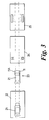
- Fig. 3 shows an all metal partially assembled vehicle body 21 (i.e. as assembled as a body-in-white) undergoing an electro-chemical priming treatment at station 22.
- the wing 11 and its counterpart 11A on the opposite side of the vehicle are attached and the consequent assembly is sprayed with multiple layers of a conventional polyester based water-borne paint in a paint booth 24 followed by curing in a bake oven 25.
- the invention is believed to be equally effective with other conventional water-borne paints.
- Conventional solvent-based paints such as alkyds or melamines can also be used, but have been found to have a slightly reduced adhesion to the coating 18.
- parts which may be painted with solvent-based paints e.g. spare parts for the motor repair trade
- Fig. 3 is a simplification of modern finishing processes and that additional coating/baking processes may be involved.
- a surfacer treatment may be applied after the electro-chemical treatment at station 22 and a clearcoat such as an acrylic may be applied after the polyester basecoat is applied in the spray booth 24.
- polypropylene parts which require painting normally have to be prepared by chemical etching or other methods.
- the bake oven such as oven 25
- the polyamide or polyester coating 18 provides both thermal insulation and structural support for the polypropylene substrate 17 so that the bake oven 25 does not destroy the wings 11, 11a.
- polyamide In the case of polyamide, this has a melting point of 255°C and the paint bake oven 25 heats to 140°C which is below the melting point of the polypropylene (about 160°C). It will be appreciated that polypropylene is extremely soft at this temperature, indeed polyamide itself starts to become soft at about 160°C.
- the ability of the polyamide or polyester to withstand the temperature of the bake booth may be enhanced by an appropriate choice of filler materials, e.g. glass fibre, possibly to the extent where the wings 11, 11a are applied before the vehicle body undergoes a surfacer treatment as referred to above, this including a bake of up to 160°C.
- the substrate material is polypropylene
- the invention is equally applicable to other polyolefins such as polyethylene which are equally difficult to paint and that it may be applied when other difficult to paint materials are involved.
- WO 94/06612 includes for example a blow moulding process which may be used for making box section articles such as sills and spoilers which may also be attached to the vehicle body-in-white before painting as described above.
Landscapes
- Life Sciences & Earth Sciences (AREA)
- Engineering & Computer Science (AREA)
- Wood Science & Technology (AREA)
- Chemical & Material Sciences (AREA)
- Health & Medical Sciences (AREA)
- Chemical Kinetics & Catalysis (AREA)
- Medicinal Chemistry (AREA)
- Polymers & Plastics (AREA)
- Organic Chemistry (AREA)
- Laminated Bodies (AREA)
- Application Of Or Painting With Fluid Materials (AREA)
Applications Claiming Priority (4)
| Application Number | Priority Date | Filing Date | Title |
|---|---|---|---|
| GB9614196 | 1996-07-05 | ||
| GBGB9614196.5A GB9614196D0 (en) | 1996-07-05 | 1996-07-05 | Coated article |
| GB9625029 | 1996-12-02 | ||
| GBGB9625029.5A GB9625029D0 (en) | 1996-07-05 | 1996-12-02 | Painted plastics articles |
Publications (2)
| Publication Number | Publication Date |
|---|---|
| EP0816066A2 true EP0816066A2 (de) | 1998-01-07 |
| EP0816066A3 EP0816066A3 (de) | 1999-12-29 |
Family
ID=26309648
Family Applications (1)
| Application Number | Title | Priority Date | Filing Date |
|---|---|---|---|
| EP19970304932 Withdrawn EP0816066A3 (de) | 1996-07-05 | 1997-07-07 | Lackierte Kunststoffgegenstände |
Country Status (2)
| Country | Link |
|---|---|
| US (1) | US5932357A (de) |
| EP (1) | EP0816066A3 (de) |
Families Citing this family (7)
| Publication number | Priority date | Publication date | Assignee | Title |
|---|---|---|---|---|
| US6284098B1 (en) * | 1998-07-20 | 2001-09-04 | Wwj, Llc | Lignocellulose fiber filler for thermoplastic composite compositions |
| MXPA02011451A (es) * | 2000-05-24 | 2005-04-19 | Bhattacharya Shubho | Sistema y proceso para la aplicacion de promotores de adhesion. |
| AU2001293535B2 (en) | 2000-09-05 | 2006-05-18 | Fieldturf Tarkett Inc. | Artificial grass for landscaping |
| US6620482B2 (en) * | 2000-11-30 | 2003-09-16 | Avturf Llc | Safety system for airports and airfields |
| WO2002103115A2 (en) * | 2000-11-30 | 2002-12-27 | Avturf L.L.C. | Artificial turf for an airport filed |
| US7901753B2 (en) * | 2003-11-12 | 2011-03-08 | Avturf L.L.C. | Synthetic runway surface system |
| US8740141B2 (en) * | 2006-10-23 | 2014-06-03 | Tarkett Inc. | Aircraft arrestor system and method of decelerating an aircraft |
Family Cites Families (14)
| Publication number | Priority date | Publication date | Assignee | Title |
|---|---|---|---|---|
| US3637428A (en) * | 1968-12-10 | 1972-01-25 | Union Carbide Corp | Adhesion of coatings to ethylene-polar monomer copolymer |
| GB1292882A (en) * | 1970-02-27 | 1972-10-18 | Ici Ltd | Improvements in or relating to the production of laminates |
| US3697311A (en) * | 1971-03-31 | 1972-10-10 | Union Carbide Corp | Coated ethylene-polar monomer copolymer substrate |
| FR2208778A1 (en) * | 1972-12-05 | 1974-06-28 | Ici Ltd | Polyamide and polyolefin composite article prodn. - by successive injection into mould, using grafted polypropylene as adhesion aid |
| JPS522843A (en) * | 1975-06-24 | 1977-01-10 | Doryokuro Kakunenryo | Method of producing corrosionnresistant coating |
| JPS53125463A (en) * | 1977-04-09 | 1978-11-01 | Mitsui Petrochem Ind Ltd | Injection molding of laminates |
| JPH0653261B2 (ja) * | 1988-12-13 | 1994-07-20 | 日本ジーイープラスチックス株式会社 | 耐低温衝撃性を有する塗装された樹脂成形品及びそのような樹脂成形品の塗装方法 |
| US5114756A (en) * | 1990-04-27 | 1992-05-19 | E. I. Du Pont De Nemours And Company | Conductive epoxypolyamide coating composition |
| JPH04353414A (ja) * | 1991-05-31 | 1992-12-08 | Toyoda Gosei Co Ltd | サンドイッチ成形法による樹脂成形品 |
| GB9204730D0 (en) * | 1992-03-05 | 1992-04-15 | Rover Group | A method of forming a moulding by dual injection and a moulding formed in accordance with such a method |
| WO1994006612A1 (en) * | 1992-09-24 | 1994-03-31 | H.B. Fuller Company | Thermoplastic coated substrates |
| EP0595550A1 (de) * | 1992-10-26 | 1994-05-04 | Rohm And Haas Company | Polyolefinsubstrate mit verbesserten Adhäsioneigenschaften |
| US5629050A (en) * | 1995-08-30 | 1997-05-13 | The Dow Chemical Company | Process for preparing coated articles |
| US5601770A (en) * | 1995-09-29 | 1997-02-11 | Airtech International, Inc. | Method for producing sheet molding compounds utilizing a multilayered, multistructured, multipolymer release / barrier film |
-
1997
- 1997-06-20 US US08/879,375 patent/US5932357A/en not_active Expired - Fee Related
- 1997-07-07 EP EP19970304932 patent/EP0816066A3/de not_active Withdrawn
Also Published As
| Publication number | Publication date |
|---|---|
| US5932357A (en) | 1999-08-03 |
| EP0816066A3 (de) | 1999-12-29 |
Similar Documents
| Publication | Publication Date | Title |
|---|---|---|
| US5288356A (en) | Method of making a coated article | |
| US6991237B2 (en) | Paintable seal system | |
| EP0285071B1 (de) | Trockenübertragungsverfahren zum Aufbringen von Farbe sowie erhaltenes Produkt | |
| US20070051465A1 (en) | Method of attaching components and article formed using same | |
| JP3347732B2 (ja) | 装飾成形体の製造方法 | |
| US5932357A (en) | Painted plastics articles | |
| US20210283999A1 (en) | Liftgate reinforcement arrangements | |
| US5516551A (en) | Powder coating edge primer | |
| US20020114965A1 (en) | Co-extruded pigmented/clear coated polymeric coating for automotive exterior body panels | |
| JP3294609B2 (ja) | 塗装した強化熱可塑性物品の性質の改善法及びそれにより得られる製品 | |
| GB2315039A (en) | Painted plastics coated articles | |
| WO2005097902A1 (en) | Process for coating vehicle exterior parts made from electrically conductive polyamide resin compositions | |
| EP0753358B1 (de) | Verfahren zum Anstreichen von Kunststoffgegenstände und Gegenstände nach diesem Verfahren hergestellt | |
| KR19990008448A (ko) | 성형 부품용 판지생지 코팅용의 필름 및 자동차 제조에서의 그의 용도 | |
| KR19990008446A (ko) | 여러개의 코팅 층이 제공된 필름 및 자동차 제조에서의 그의 용도 | |
| JP2002524306A (ja) | 2個以上の層で被覆されたフィルムおよび自動車部品へのその使用 | |
| US6063230A (en) | Substrates coated with two or more coats and process for producing these substrates | |
| US20010025407A1 (en) | Process for the production of a double-layer metal sheet and a more particularly stove enamelled shaped constructional member shaped therefrom, and also a deep-drawable double-layer metal sheet | |
| US20050084628A1 (en) | Method for achieving a two-tone finish on a vehicle | |
| GB2131723A (en) | Painting plastics components | |
| CN106660070A (zh) | 被覆基材及其制造方法 | |
| JP2876654B2 (ja) | 樹脂外板の成形方法 | |
| WO2001096034A2 (en) | Composition and method of coating automotive underbodies | |
| US20050037187A1 (en) | Completely formed components laminated with preformable paint films and method for applying preformable paint films | |
| KR102106584B1 (ko) | 금속-플라스틱-복합물 컴포넌트 및 상기 유형의 복합물 컴포넌트의 제조 방법 |
Legal Events
| Date | Code | Title | Description |
|---|---|---|---|
| PUAI | Public reference made under article 153(3) epc to a published international application that has entered the european phase |
Free format text: ORIGINAL CODE: 0009012 |
|
| AK | Designated contracting states |
Kind code of ref document: A2 Designated state(s): AT BE CH DE DK ES FI FR GB GR IE IT LI LU MC NL PT SE |
|
| PUAL | Search report despatched |
Free format text: ORIGINAL CODE: 0009013 |
|
| AK | Designated contracting states |
Kind code of ref document: A3 Designated state(s): AT BE CH DE DK ES FI FR GB GR IE IT LI LU MC NL PT SE |
|
| RIC1 | Information provided on ipc code assigned before grant |
Free format text: 6B 32B 27/08 A, 6C 08J 7/04 B, 6C 08L 23/12 B |
|
| AKX | Designation fees paid | ||
| REG | Reference to a national code |
Ref country code: DE Ref legal event code: 8566 |
|
| STAA | Information on the status of an ep patent application or granted ep patent |
Free format text: STATUS: THE APPLICATION IS DEEMED TO BE WITHDRAWN |
|
| 18D | Application deemed to be withdrawn |
Effective date: 20000630 |