EP0816083A2 - Dispositif et procédé de pulvérisation d'encre - Google Patents
Dispositif et procédé de pulvérisation d'encre Download PDFInfo
- Publication number
- EP0816083A2 EP0816083A2 EP97304601A EP97304601A EP0816083A2 EP 0816083 A2 EP0816083 A2 EP 0816083A2 EP 97304601 A EP97304601 A EP 97304601A EP 97304601 A EP97304601 A EP 97304601A EP 0816083 A2 EP0816083 A2 EP 0816083A2
- Authority
- EP
- European Patent Office
- Prior art keywords
- ink
- membrane
- chamber
- head according
- working fluid
- Prior art date
- Legal status (The legal status is an assumption and is not a legal conclusion. Google has not performed a legal analysis and makes no representation as to the accuracy of the status listed.)
- Withdrawn
Links
Images




Classifications
-
- B—PERFORMING OPERATIONS; TRANSPORTING
- B41—PRINTING; LINING MACHINES; TYPEWRITERS; STAMPS
- B41J—TYPEWRITERS; SELECTIVE PRINTING MECHANISMS, i.e. MECHANISMS PRINTING OTHERWISE THAN FROM A FORME; CORRECTION OF TYPOGRAPHICAL ERRORS
- B41J2/00—Typewriters or selective printing mechanisms characterised by the printing or marking process for which they are designed
- B41J2/005—Typewriters or selective printing mechanisms characterised by the printing or marking process for which they are designed characterised by bringing liquid or particles selectively into contact with a printing material
- B41J2/01—Ink jet
- B41J2/135—Nozzles
- B41J2/14—Structure thereof only for on-demand ink jet heads
- B41J2/14016—Structure of bubble jet print heads
- B41J2/14032—Structure of the pressure chamber
- B41J2/14064—Heater chamber separated from ink chamber by a membrane
-
- B—PERFORMING OPERATIONS; TRANSPORTING
- B41—PRINTING; LINING MACHINES; TYPEWRITERS; STAMPS
- B41J—TYPEWRITERS; SELECTIVE PRINTING MECHANISMS, i.e. MECHANISMS PRINTING OTHERWISE THAN FROM A FORME; CORRECTION OF TYPOGRAPHICAL ERRORS
- B41J2/00—Typewriters or selective printing mechanisms characterised by the printing or marking process for which they are designed
- B41J2/005—Typewriters or selective printing mechanisms characterised by the printing or marking process for which they are designed characterised by bringing liquid or particles selectively into contact with a printing material
- B41J2/01—Ink jet
- B41J2/07—Ink jet characterised by jet control
Definitions
- the present invention relates to a spray device for an ink-jet printer and an ink spraying method for an ink-jet printer.
- An ink-jet printer has a CPU 10 for receiving a signal form a computer (not shown) through a printer interface.
- the CPU reads a system program from EPROM 11 which stores an initial value set for operating the printer and the system.
- the CPU outputs a control signal according to the program content.
- ROM 12 holds a control program and several fonts.
- RAM 13 temporarily stores data during the operation of the systems.
- An ASIC circuit part 20, in which most of the CPU-controlling logic circuits are realized in an ASIC form, transmits data from CPU 10 to the majority of the circuits around CPU 10.
- a head driver controls the operation of an ink cartridge 31 in response to the control signal of the CPU 10 which is transmitted from the ASIC circuit part 20.
- a maintenance driving circuit 40 protects the nozzle of the ink cartridge 31 from exposure to air and drives a driving circuit of a maintenance motor 41.
- a carriage motor driving circuit 50 controls the operation of a carriage return driving motor 51.
- a line feed motor driving circuit 60 controls the operation of line feed motor 61 for feeding/discharging paper by using a stepping motor.
- the ink cartridge 31 sprays fine ink drops through a plurality of openings in the nozzle, and thus forms dots.
- Ink cartridge 31 will be described in detail.
- the ink cartridge includes a head 3. Ink 2 is absorbed through a sponge in case 1 which forms the external profile of the container.
- the head 3 has a filter 32 for eliminating impurity materials mixed with the ink.
- An ink stand pipe chamber 33 contains ink filtered through the filter 32.
- An ink via 34 supplies ink transmitted through the ink stand pipe chamber 33 to an ink heating part and a chip 35 having a chamber.
- a nozzle plate 36 has a plurality of orifices for expelling ink transmitted from the ink via 34, from the heating part (not shown) to a print media.
- the head 3 includes the ink via 34 for supplying ink to an ink chamber (not shown) between the nozzle plate 36 and the chip 35.
- a plurality of ink channels 37 supplies ink from the ink via 34 to each opening of the nozzle plate 36.
- a plurality of spraying parts 35 is provided for spraying ink transmitted through the ink channels 37.
- a plurality of electrically connecting means 38 is provided for supplying power to the plurality of chips 35.
- the head 3 includes a resistor layer 103 formed on an oxide layer (SiO 2 ) 102 on a silicon substrate 101 by an oxidation process when heated by electrical energy.
- Two electrodes 104 and 104' formed on the resistor layer 103 one provided with an electrical connection.
- a protective layer including several layers is provided for preventing the heating part 103 formed on resistor layers 104 and 104' and resistor layer 103 from being etched and deformed by a chemical reaction with the ink.
- An ink chamber 107 is provided for generating bubbles in the ink from the heat of the heated part 105.
- An ink channel 108 allows ink to flow from the ink via to the ink chamber 107.
- An ink barrier 109 plays the role of a wall to form a space used for leading ink transmitted through the ink channel to the ink chamber 107.
- a nozzle plate 111 has a plurality of orifices 110 for spraying ink pushed out as a result of the volume variation caused by generation of bubbles in the ink chamber 107.
- Nozzle plate 111 and the heated portion 105 are spaced apart at regular intervals to face each other.
- a pair of electrodes 104 and 104' are connected to an externally electrically connected terminal bumper (not shown) and this bumper is connected to a head controller (not shown) so that the ink is sprayed from each position through the nozzle openings.
- Each of the heating portions has an ink barrier 109 for guiding the ink from the side, and this ink barrier 109 is connected to a common ink via to guide the ink from the ink container.
- the conventional ink spray device sprays as follows.
- Head driver 30 transmits electrical energy to a pair of electrodes 104 and 104' placed where the desired characters will be printed in response to the control command of CPU 10 which receives the printing command through the printer interface.
- the surface of the heating portion 105 is heated up to 500 to 550°C, and heat is conducted to the plurality of protective layers 106. At this point heat is applied to the ink in wetting contact with the protective layers.
- the distribution of the bubbles generated by the vapour pressure is highest in the centre, regarding the centre of the heating part 105 about a symmetrical axis.
- ink expanded and discharged out of the openings of the nozzle plate, is sprayed onto print media in the form of a drop due to the surface tension, and this forms an image. Due to the internal pressure drop following the decrease in volume of the bubbles, ink is re-charged from the container via the ink via.
- the above-mentioned conventional ink spraying method has the following problems.
- the content of the ink may be affected by the thermal variation.
- the life of the internal components is decreased due to the impact wave from the bubbles. These may cause dissatisfactory use instead of the desired high quality printing.
- the ink, the protective layer 106 of the resistor 103 and the two electrodes 104 and 104' inter-act electrically with each other, and, accordingly, corrosion occurs by ion exchange at the border layer of the heating part 105 and the two electrodes 104 and 104', thereby decreasing the lifetime of the head.
- the shape of the drop affects its direction of travel its roundness and the uniformity of the quantity of ink in the drop according to the shape of the bubbles, and therefore this affects the printing quality.
- the nozzle plate has openings which serve as orifices for the ink spray.
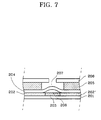
- a flexible membrane 204 made of rubber silicone is installed across the nozzle plate 206 and therefore forms the ink chamber 207 temporarily containing the ink with the ink barrier 205.
- Two electrodes 202 and 202' and a resistor 203 are placed under the membrane 204. Resistor 203 is laid at the centre of the two electrodes 202 and 202'.
- Liquid is supplied to a second space 208 formed between the membrane 204 and the resistor 203 by the capillaries caused due by the surface roughness.
- the flexible elastic material of the membrane 204 is deformed.
- ink in the upper ink chamber 207 is sprayed through the nozzle openings. Ink is sprayed, using deformation of the membrane 204 not by the thermal deformation, but deformation in response to the generation of bubbles ie the vapour pressure of the liquid trapped in the space 208 in the state when the surfaces of the resistor 203 and the membrane 204 are directly adjoined.
- the membrane is made of flexible rubber silicon and therefore has a low heat-conductivity. Consequently, it takes long time to return it to the original state after the expansion, and it affects the ink supply speed and slows down the entire printing speed.
- an ink-jet printing head comprising: an ink chamber having an orifice through which ink is ejected; a heating chamber containing a working fluid separated from the ink chamber by a thermally conductive and thermally expansive membrane; and first and second electrodes, electrically isolated from each other and adapted to pass current through a resistor positioned spaced from and opposite the membrane so as to create bubbles in the working fluid thus to deform the membrane so as to eject ink through the orifice.
- the membrane is subject to deformation on cooling.
- the membrane is subject to deformation resulting from the difference in the rate of cooling of the side of the membrane facing the ink chamber and that of the side of the membrane facing the heating chamber when the power is cut off.
- the membrane is adapted to project temporarily into the heating chamber on cooling.
- a head according to claim 1 in which the membrane is substantially opposite the orifice.
- a head in which the resistor, or a layer covering the resistor, constitutes an inner face of the working fluid chamber opposite the orifice.
- an ink-jet printer head in which a protective layer is provided to separate the electrodes and resistor from the working fluid.
- a head in which the first and second electrodes are formed adjacent a resistor layer constituting the resistor.
- a head in which the electrodes are formed on the resistor layer and the space between the electrodes forms part of the heating chamber.
- an ink-jet printer head in which an insulating layer of predetermined thickness is provided to space the membrane from the resistor and to provide walls of the heating chamber.
- a head in which the membrane covers the insulating layer and the heating chamber so as to seal the working fluid in the heating chamber.
- an ink-jet printer head comprising an ink barrier formed above the membrane and serving as a wall of the ink chamber and for forming a flow channel which guides ink into the ink chamber.
- the ink chamber is uppermost and the working fluid chamber is lowermost.
- the membrane extends across and seals a plurality working fluid chambers.
- the working fluid has a high temperature-conductivity.
- the working fluid has a high vapour pressure.
- the working fluid comprises fluorinate.
- the membrane is adapted to have a high temperature conductivity.
- the membrane is adapted to have good thermal expansion properties.
- the membrane comprises a thin film.
- it is a thin metal film.
- the membrane contains one or more of Ag, Al, Cd, Cs, K, Li, Mg, Mn, Na, Zn.
- a preferred embodiment of the present invention is a spray device for an ink-jet printer, in which the spraying speed is enhanced by dividing an ink chamber area into an ink chamber and a heating chamber using, preferably, a thin metal film membrane.
- a spray device is provided with means for heating a heating part, using for example, electrical energy transmitted to individual electrodes, deforming a membrane using thermally expanding liquid and spraying ink on to a print media according to the flow of the membrane.
- the membrane is a composite of one or more metals and an organic material.
- a head in which one of the surfaces of the membrane seals the working fluid chamber and the other makes contact with the ink and is wet.
- a head in which one surface of the membrane is in contact with gas and the other surface of the membrane is in contact with ink.
- a head in which the working fluid is liquid, gas or a mixture of the liquid and gas.
- the working fluid chamber when the working fluid chamber is lowermost, the lowermost surface of the membrane is in contact with gas even if working fluid liquid is present, and not in wetting contact with the working fluid liquid.
- a head in which as the heating chamber cools the volume of membrane varies and the membrane retracts towards the heating chamber opposing the decreasing of the pressure in the heating chamber and due to a contracting force generated in the membrane on the surface cooled by the ink so that it generates an absorbing force, and ink is drawn into the ink chamber as a result.
- the sides of the membrane making contact with the ink and with the heating chamber have a difference in their contracting rate on cooling so that the membrane is elastically deformed over a predetermined area towards the direction to the heating chamber by the inertia force, so as to generate a momentary absorbing force to draw ink into the ink chamber.
- an inlet for allowing the working fluid to flow into the heating chamber, and in which a bending operation can be performed to seal the inlet.
- a method of ejecting ink from an ink-jet printer head as described herein comprising:
- heating or cooling liquid in the heating chamber so bubbles are created in the heater chamber thus to deform the membrane so as to spray ink out of the orifice.
- a spray device of an ink-jet printer of the invention which includes a resistor layer formed on an oxide layer (SiO 2 ) generated by an oxide surface treatment on a silicon substrate.
- electrodes are formed on the resistor layer in pairs for supplying electrical energy of a different polarity.
- a heating layer is formed in a portion of the resistor layer which is heated with heat generated from the resistor layer with the different polarity of electrical energy supplied to the two electrodes.
- there is a protective layer or multi-layer for preventing the surface of the two electrodes and the heating layer from being corroded by contact of an oxide with air.
- an insulating layer for surrounding the protective layer to form a predetermined space on the heating layer.
- a heating chamber formed by the insulating layer and for containing working fluid which is heat-expanded by the heat generated from the heating layer.
- a membrane for covering the insulating layer and the heating chamber to thereby seal a plurality of heating chambers, and having a volume variation according to the bubbles generated by a heat-expansion when the inside of the heating chamber is heated by the heat from the lower heating layer.
- an ink barrier formed on the membrane and serving as a wall for forming a flow guide line which guides ink from an ink via through an ink channel.
- an ink chamber is formed between the ink barrier on the membrane for containing the ink transmitted from the ink channel.
- a nozzle plate is formed on the ink barrier and the ink chamber.
- the nozzle plate may have a plurality of openings for spraying the ink in the ink chamber towards the print media.
- FIG. 1 is a block diagram illustrating the structure of a conventional ink-jet printer.
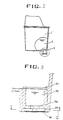
- FIG. 2 is a schematic sectional view of an ink cartridge of a conventional ink-jet printer.
- FIG. 3 is an enlarged sectional view of a head in a conventional spray device.
- FIG. 4 is a plan sectional view taken along lines E-E of FIG. 3 from the direction of A.
- FIG. 5 is an enlarged sectional view of a conventional spray device taken along line F - F of FIG. 4 from the direction of B.
- FIG. 6 is an exemplified view of the conventional ink spray mechanism.
- FIG. 7 is an enlarged sectional view of an improved conventional spray device.
- FIG. 8 is an enlarged sectional view of a spray device of the invention.
- FIG. 9 illustrates expansion of a membrane in the spray device of the invention.
- FIG. 10 illustrates contraction of the membrane in the spray device of the invention.
- FIG. 8 the same reference numerals are allocated to the same features as in FIGS. 5 and 6.
- the spray head of the invention includes a resistor layer 103 formed on an oxide layer (SiO 2 ) 102 generated by an oxide surface treatment of a silicon substrate 101. Electrodes 104 and 104' formed on the resistor layer in pairs supply electrical energy of different polarity. Heating layer 105, which is part of resistor layer 103, is heated with the heat generated from the resistor layer 103 when electrical energy is supplied to the two electrodes 104 and 104'. A protective layer 106 is provided on top of the heating layer 105 and 104 and 104 to prevent the exposed surfaces from being corroded by oxiding contact with air. An insulating layer 112 and surrounds the protective layer to form a predetermined space around the heating portion 105.
- a heating chamber 113 is formed by the insulating layer 112. Chamber 113 contains working fluid which is thermally expanded by the heat generated from the heating layer 105.
- a membrane 114 covers the insulating layer 112 and contains the working fluid. The membrane 114 covers the insulating layer 112 and the heating chamber 113 to seal a plurality of heating chambers 113. The membrane deforms in response to the volume variation when bubbles are generated by a heat-expansion when the inside of the heating chamber is heated by the heat from the lower heating part 105.
- An ink barrier 109 formed on the membrane 114 serves as a wall for forming a flow guide which guides ink from an ink via through an ink channel.
- An ink chamber 107 is formed between the ink barrier 109 on the membrane 114 and it contains the ink transmitted from the ink channel.
- a nozzle plate 111 is positioned on the ink barrier 109 and the ink chamber 107 opposite the print media.
- An electrical connection means 115 is provided for supplying different polarity of electrical energy to the pair of electrodes 104 and 104'.
- the membrane 14 is made from a thin film having a high heat conductivity such as a metallic thin film.
- the film contains, preferably, one or more of the following materials: Ag, Al, Cd, Cs, K, Li, Mg, Mn, Na, Zn.
- the metals and organic material of the membrane are chosen to increase its lifetime.
- Liquid such as fluorinate with a high temperature conductivity and a high vapour pressure is supplied into the heating chamber 113.
- an inlet for implanting liquid is formed (not shown), and a bending process is performed to seal this inlet.
- the resistor layer 103 is positioned beneath the electrodes 104 and 104' so a recess is provided between the electrodes. It will be understood, though this is less preferred, that a resistor could be provided between the electrodes of, say, approximately the same thickness as the electrodes or the electrodes may be positioned below the resistor layer.
- the ink chamber area is divided into an ink chamber 107 and a heating chamber 113 by the membrane 114.
- the ink chamber is divided by the membrane 114 to alleviate the conventional problems which resulted from heating the ink with the heating part. That is, it is to prevent the corrosion generated from the contact of the ink with the heating layer and to protect the heating layer from the spraying impact after the generation of bubbles.
- FIG. 9 illustrates the state where power is applied to two electrodes 104 and 104'.
- the head driver (not shown) supplies an electrical signal energy to the corresponding electrodes.
- the electrical connecting means 115 supplies power of differing polarity to the corresponding electrodes 104 and 104'.
- Heat is generated in the heating portion 105 by the supplied electrical energy, and this heat is transferred, through a working fluid in the heating chamber 113, to the membrane 114 which is a thin film made of a metal composed material with good thermal expansion properties. Accordingly, when it is exposed to heat, the membrane expands in a longitudinal direction.
- the working fluid is liquid, gas or a mixture of liquid and gas.
- the vapour pressure which thermally expands in the sealed space of the heating chamber pushes out the membrane 114.
- the deformed membrane pushes the ink in the ink chamber 107 through the openings 110 of the nozzle plate 111.
- the reason is that the working fluid in the heating chamber 113 is expanded by the heat and its pressure P1 is greater than the initial pressure so that the membrane 114 is pushed out when power is not applied.
- An ink drop pushed out of the openings 110 is divided in the direction of media from the ink remaining in the ink chamber when the electrical energy provided to two electrodes 104 and 104' is cut off.
- the membrane 114 which has a high temperature conductivity, is cooled by the ink on its upper surface and by a metallization layer on the substrate through the working fluid in the heating chamber which has a high temperature conductivity.
- the membrane has a volume variation in the direction of the heating chamber at a time point due to the speedy cooling of its surface on the ink chamber side. Therefore, in the ink chamber, an absorbing force is generated and ink is drawn in. This phenomenon is called a bucking phenomenon.
- the upper surface of the membrane 114 namely, the surface wetted to the ink in the ink chamber 107 interacts with the ink in the ink chamber 107, so that the heat is easily lost and the inertia energy required to return the deformed membrane to the original state becomes greater.
- the lower surface namely the surface making contact with working fluid in the heating chamber 113, has a relatively low elasticity and therefore relatively low impetus to return to the original state. This is because there is a difference in the contracting rate as a result of the heat variation between the surface making contact with the ink and with the heating chamber.
- the pressure P2 in the heating chamber 113 becomes smaller with respect to the initial air pressure PO in the heating chamber 113 in response to the power transmitted to two electrodes 104 and 104' being cut off. Even though the pressure P2 may still be greater than the air pressure P0 in the ink chamber, the membrane 114 deforms in an opposing direction due to the elasticity forces in a predetermined area of the membrane. The membrane deforms towards the heating chamber by the inertia force, so that the membrane causes a momentary absorbing force in the ink chamber. Accordingly, the ink drop is separated from the openings 110 due to the surface tension effects of the ink remaining in the ink chamber and is sprayed onto the print media.
- the invention controls the vapour pressure generated by the thermal expansion of a working fluid in a heating chamber, and thus sprays ink in response to the deformation of a membrane.
- the invention can alleviate the corrosion generated by the contact between ink and the protective layer, and also alleviates damage to the protective layer by the impact generated when the bubbles are sprayed to the openings, thereby improving the quality of the printing.
Landscapes
- Particle Formation And Scattering Control In Inkjet Printers (AREA)
- Ink Jet (AREA)
Applications Claiming Priority (2)
| Application Number | Priority Date | Filing Date | Title |
|---|---|---|---|
| KR9624617 | 1996-06-27 | ||
| KR1019960024617A KR100189155B1 (ko) | 1996-06-27 | 1996-06-27 | 잉크젯 프린터의 분사 장치 및 분사 방법 |
Publications (2)
| Publication Number | Publication Date |
|---|---|
| EP0816083A2 true EP0816083A2 (fr) | 1998-01-07 |
| EP0816083A3 EP0816083A3 (fr) | 1998-09-16 |
Family
ID=19463952
Family Applications (1)
| Application Number | Title | Priority Date | Filing Date |
|---|---|---|---|
| EP97304601A Withdrawn EP0816083A3 (fr) | 1996-06-27 | 1997-06-27 | Dispositif et procédé de pulvérisation d'encre |
Country Status (3)
| Country | Link |
|---|---|
| EP (1) | EP0816083A3 (fr) |
| JP (1) | JP3063971B2 (fr) |
| KR (1) | KR100189155B1 (fr) |
Cited By (14)
| Publication number | Priority date | Publication date | Assignee | Title |
|---|---|---|---|---|
| RU2146621C1 (ru) * | 1998-11-03 | 2000-03-20 | Самсунг Электроникс Ко., Лтд | Микроинжектор |
| RU2147522C1 (ru) * | 1998-11-03 | 2000-04-20 | Самсунг Электроникс Ко., Лтд. | Микроинжекционное устройство |
| EP0956953A3 (fr) * | 1998-04-16 | 2000-05-31 | Canon Kabushiki Kaisha | Procédé de fabrication d'une tête à éjection de liquide |
| EP0999051A3 (fr) * | 1998-11-03 | 2000-11-08 | Samsung Electronics Co., Ltd. | Procédé d'assemblage d'un micro-dispositif d'injection et appareil pour sa mise en oeuvre |
| EP1005994A3 (fr) * | 1998-12-03 | 2000-11-29 | Canon Kabushiki Kaisha | Procédé de fabrication d'une tête à jet de liquide, tête à jet de liquide, cartouche et appareil d'enregistrement à jet de liquide |
| EP1122069A1 (fr) * | 2000-01-12 | 2001-08-08 | Pamelan Company Limited | Tête d'impression par jet d'encre avec une membrane flexible entraínée par bulle de vapeur |
| US6474783B1 (en) | 1998-12-09 | 2002-11-05 | Aprion Digital Ltd. | Ink-jet printing apparatus and method using laser initiated acoustic waves |
| US6540336B2 (en) * | 1997-12-05 | 2003-04-01 | Canon Kabushiki Kaisha | Liquid discharge head, method for manufacturing such head, head cartridge and liquid discharging apparatus |
| WO2003086768A1 (fr) * | 2002-04-12 | 2003-10-23 | Silverbrook Research Pty Ltd | Actionneur thermoelastique de jet d'encre a canaux thermoconducteurs |
| US6895659B2 (en) | 1998-10-26 | 2005-05-24 | Samsung Electronics Co., Ltd. | Process of manufacturing fluid jetting apparatuses |
| US9004652B2 (en) | 2013-09-06 | 2015-04-14 | Xerox Corporation | Thermo-pneumatic actuator fabricated using silicon-on-insulator (SOI) |
| US9004651B2 (en) | 2013-09-06 | 2015-04-14 | Xerox Corporation | Thermo-pneumatic actuator working fluid layer |
| US9096057B2 (en) | 2013-11-05 | 2015-08-04 | Xerox Corporation | Working fluids for high frequency elevated temperature thermo-pneumatic actuation |
| EP3251855A4 (fr) * | 2015-01-30 | 2018-02-14 | Konica Minolta, Inc. | Tête de déversement de liquide et imprimante à jet d'encre |
Families Citing this family (3)
| Publication number | Priority date | Publication date | Assignee | Title |
|---|---|---|---|---|
| KR100561355B1 (ko) * | 1999-11-04 | 2006-03-16 | 삼성전자주식회사 | 잉크분사장치의 노즐부 제작방법 및 잉크분사장치 |
| JP4719978B2 (ja) * | 2001-01-11 | 2011-07-06 | ソニー株式会社 | プリンタ、プリンタヘッド及びプリンタヘッドの製造方法 |
| KR102671036B1 (ko) * | 2018-11-07 | 2024-06-03 | 삼성디스플레이 주식회사 | 유기 기상젯 프린터 및 그것을 이용한 유기막 형성 방법 |
Family Cites Families (8)
| Publication number | Priority date | Publication date | Assignee | Title |
|---|---|---|---|---|
| US4480259A (en) * | 1982-07-30 | 1984-10-30 | Hewlett-Packard Company | Ink jet printer with bubble driven flexible membrane |
| JPS6169467A (ja) * | 1985-06-11 | 1986-04-10 | Seiko Epson Corp | 記録液滴吐出型記録装置 |
| JPH02137930A (ja) * | 1988-11-18 | 1990-05-28 | Nec Home Electron Ltd | インクジェット・ヘッド |
| JPH02266945A (ja) * | 1989-04-10 | 1990-10-31 | Ricoh Co Ltd | インクジェットヘッド |
| JPH04329148A (ja) * | 1991-04-30 | 1992-11-17 | Matsushita Electric Ind Co Ltd | インクジェットプリンタ |
| JPH05229122A (ja) * | 1992-02-25 | 1993-09-07 | Seiko Instr Inc | インクジェットプリントヘッドおよびインクジェットプリントヘッドの駆動方法 |
| JPH06996A (ja) * | 1992-06-19 | 1994-01-11 | Hitachi Koki Co Ltd | 液滴吐出器 |
| JPH08142323A (ja) * | 1994-11-24 | 1996-06-04 | Sharp Corp | インクジェットヘッドおよびその製造方法 |
-
1996
- 1996-06-27 KR KR1019960024617A patent/KR100189155B1/ko not_active Expired - Fee Related
-
1997
- 1997-06-27 JP JP9187879A patent/JP3063971B2/ja not_active Expired - Lifetime
- 1997-06-27 EP EP97304601A patent/EP0816083A3/fr not_active Withdrawn
Cited By (28)
| Publication number | Priority date | Publication date | Assignee | Title |
|---|---|---|---|---|
| US6540336B2 (en) * | 1997-12-05 | 2003-04-01 | Canon Kabushiki Kaisha | Liquid discharge head, method for manufacturing such head, head cartridge and liquid discharging apparatus |
| US6436301B1 (en) | 1998-04-16 | 2002-08-20 | Canon Kabushiki Kaisha | Method for manufacturing a liquid discharge head |
| EP0956953A3 (fr) * | 1998-04-16 | 2000-05-31 | Canon Kabushiki Kaisha | Procédé de fabrication d'une tête à éjection de liquide |
| US6895659B2 (en) | 1998-10-26 | 2005-05-24 | Samsung Electronics Co., Ltd. | Process of manufacturing fluid jetting apparatuses |
| EP0999052A3 (fr) * | 1998-11-03 | 2000-11-08 | Samsung Electronics Co., Ltd. | Micro-dispositif d'injection |
| EP0999053A3 (fr) * | 1998-11-03 | 2000-11-08 | Samsung Electronics Co., Ltd. | Micro-dispositif d'injection de liquide |
| EP0999051A3 (fr) * | 1998-11-03 | 2000-11-08 | Samsung Electronics Co., Ltd. | Procédé d'assemblage d'un micro-dispositif d'injection et appareil pour sa mise en oeuvre |
| RU2146621C1 (ru) * | 1998-11-03 | 2000-03-20 | Самсунг Электроникс Ко., Лтд | Микроинжектор |
| RU2147522C1 (ru) * | 1998-11-03 | 2000-04-20 | Самсунг Электроникс Ко., Лтд. | Микроинжекционное устройство |
| EP1005994A3 (fr) * | 1998-12-03 | 2000-11-29 | Canon Kabushiki Kaisha | Procédé de fabrication d'une tête à jet de liquide, tête à jet de liquide, cartouche et appareil d'enregistrement à jet de liquide |
| US6334670B1 (en) | 1998-12-03 | 2002-01-01 | Canon Kabushiki Kaisha | Method for manufacturing liquid jet head, liquid jet head, head cartridge, and liquid jet recording apparatus |
| US6474783B1 (en) | 1998-12-09 | 2002-11-05 | Aprion Digital Ltd. | Ink-jet printing apparatus and method using laser initiated acoustic waves |
| EP1122069A1 (fr) * | 2000-01-12 | 2001-08-08 | Pamelan Company Limited | Tête d'impression par jet d'encre avec une membrane flexible entraínée par bulle de vapeur |
| US6863365B2 (en) | 2002-04-12 | 2005-03-08 | Silverbrook Research Pty. Ltd. | Thermoelastic inkjet actuator with heat conductive pathways |
| US7287837B2 (en) | 2002-04-12 | 2007-10-30 | Silverbrook Research Pty Ltd | Thermoelastic inkjet actuator with a heat conductive layer |
| WO2003086768A1 (fr) * | 2002-04-12 | 2003-10-23 | Silverbrook Research Pty Ltd | Actionneur thermoelastique de jet d'encre a canaux thermoconducteurs |
| AU2002304993B2 (en) * | 2002-04-12 | 2005-11-03 | Memjet Technology Limited | Thermoelastic inkjet actuator with heat conductive pathways |
| US7066580B2 (en) | 2002-04-12 | 2006-06-27 | Silverbrook Research Pty Ltd | Thermoelastic inkjet actuator with heat conductive pathways |
| US7077490B2 (en) | 2002-04-12 | 2006-07-18 | Kia Silverbrook | Micro-electromechanical actuator assembly with heat conductive pathways |
| AU2002304993C1 (en) * | 2002-04-12 | 2006-11-02 | Memjet Technology Limited | Thermoelastic inkjet actuator with heat conductive pathways |
| US6688719B2 (en) | 2002-04-12 | 2004-02-10 | Silverbrook Research Pty Ltd | Thermoelastic inkjet actuator with heat conductive pathways |
| CN100376397C (zh) * | 2002-04-12 | 2008-03-26 | 西尔弗布鲁克研究有限公司 | 热弹性喷墨激励器 |
| US7661792B2 (en) | 2002-04-12 | 2010-02-16 | Silverbrook Research Pty Ltd | Thermoelastic inkjet actuator with heat conductive pathways |
| US7775635B2 (en) | 2002-04-12 | 2010-08-17 | Silverbrook Research Pty Ltd | Method of producing thermoelastic inkjet actuator |
| US9004652B2 (en) | 2013-09-06 | 2015-04-14 | Xerox Corporation | Thermo-pneumatic actuator fabricated using silicon-on-insulator (SOI) |
| US9004651B2 (en) | 2013-09-06 | 2015-04-14 | Xerox Corporation | Thermo-pneumatic actuator working fluid layer |
| US9096057B2 (en) | 2013-11-05 | 2015-08-04 | Xerox Corporation | Working fluids for high frequency elevated temperature thermo-pneumatic actuation |
| EP3251855A4 (fr) * | 2015-01-30 | 2018-02-14 | Konica Minolta, Inc. | Tête de déversement de liquide et imprimante à jet d'encre |
Also Published As
| Publication number | Publication date |
|---|---|
| EP0816083A3 (fr) | 1998-09-16 |
| JPH1058691A (ja) | 1998-03-03 |
| JP3063971B2 (ja) | 2000-07-12 |
| KR100189155B1 (ko) | 1999-06-01 |
| KR980000922A (ko) | 1998-03-30 |
Similar Documents
| Publication | Publication Date | Title |
|---|---|---|
| US6074043A (en) | Spray device for ink-jet printer having a multilayer membrane for ejecting ink | |
| EP0816083A2 (fr) | Dispositif et procédé de pulvérisation d'encre | |
| EP0677387B1 (fr) | Couche de base pour tête à jet d'encre et tête à jet d'encre l'utilisant | |
| JP5213367B2 (ja) | インクジェット記録ヘッド | |
| EP1213146B1 (fr) | Tête d'impression jet d'encre à projection par bulles | |
| US8376522B2 (en) | Liquid ejection head and printing apparatus | |
| EP0885721A2 (fr) | Cartouche d'impression à jet d'encre avec cellule active de refroidissement | |
| KR101684727B1 (ko) | 열 저항기 유체 토출 어셈블리 | |
| EP0812691A2 (fr) | Tête d'impression à jet d'encre et procédé d'impression à jet d'encre | |
| US6364464B1 (en) | Spray device for ink-jet printer and its spraying method | |
| US6048051A (en) | Ink-jet printing method and ink-jet printing apparatus using dielectric migration force | |
| EP0885737A1 (fr) | Cartouche à jet d'encre avec cellule de refroidissement active | |
| US6332668B1 (en) | Apparatus for and method of ejecting ink of an ink-jet printer | |
| JP2004268430A (ja) | インクジェット記録ヘッド及びインクジェット記録装置 | |
| EP1216835B1 (fr) | Tête d'impression par jet d'encre | |
| KR100205746B1 (ko) | 잉크젯 프린터의 분사 장치 및 분사 방법 | |
| JP2005305973A (ja) | インクジェットプリンタ | |
| KR100209522B1 (ko) | 잉크젯 프린터의 분사장치 및 분사방법 | |
| JPH0343254A (ja) | 熱インクジェットの印字ヘッド | |
| EP0493039A2 (fr) | Tête d'impression à jet d'encre thermique avec une vitesse élevée de gouttelettes | |
| JPH03239561A (ja) | インクジェットプリンタ | |
| JPH08290574A (ja) | インクジエット記録ヘッドなどの積層膜デバイスおよびその製造方法 | |
| JPH09216356A (ja) | インクジェットプリンタのインク噴射装置及び方法 | |
| KR20030048611A (ko) | 버블 젯 방식 프린터용 잉크 카트리지 | |
| JPH0538848A (ja) | 記録装置 |
Legal Events
| Date | Code | Title | Description |
|---|---|---|---|
| PUAI | Public reference made under article 153(3) epc to a published international application that has entered the european phase |
Free format text: ORIGINAL CODE: 0009012 |
|
| AK | Designated contracting states |
Kind code of ref document: A2 Designated state(s): DE FR GB IT |
|
| 17P | Request for examination filed |
Effective date: 19980219 |
|
| PUAL | Search report despatched |
Free format text: ORIGINAL CODE: 0009013 |
|
| AK | Designated contracting states |
Kind code of ref document: A3 Designated state(s): AT BE CH DE DK ES FI FR GB GR IE IT LI LU MC NL PT SE |
|
| AKX | Designation fees paid |
Free format text: DE FR GB IT |
|
| RBV | Designated contracting states (corrected) |
Designated state(s): DE FR GB IT |
|
| 17Q | First examination report despatched |
Effective date: 20000331 |
|
| STAA | Information on the status of an ep patent application or granted ep patent |
Free format text: STATUS: THE APPLICATION IS DEEMED TO BE WITHDRAWN |
|
| 18D | Application deemed to be withdrawn |
Effective date: 20010522 |