EP0816241A1 - Behälter mit variabler Kapazität, z.B. zum Lagern von Flüssigkeiten - Google Patents
Behälter mit variabler Kapazität, z.B. zum Lagern von Flüssigkeiten Download PDFInfo
- Publication number
- EP0816241A1 EP0816241A1 EP96490029A EP96490029A EP0816241A1 EP 0816241 A1 EP0816241 A1 EP 0816241A1 EP 96490029 A EP96490029 A EP 96490029A EP 96490029 A EP96490029 A EP 96490029A EP 0816241 A1 EP0816241 A1 EP 0816241A1
- Authority
- EP
- European Patent Office
- Prior art keywords
- container
- liquids
- modules
- module
- variable capacity
- Prior art date
- Legal status (The legal status is an assumption and is not a legal conclusion. Google has not performed a legal analysis and makes no representation as to the accuracy of the status listed.)
- Withdrawn
Links
- 239000007788 liquid Substances 0.000 title claims abstract description 38
- 238000004806 packaging method and process Methods 0.000 claims description 20
- 239000000047 product Substances 0.000 description 19
- 238000004519 manufacturing process Methods 0.000 description 9
- 239000012263 liquid product Substances 0.000 description 4
- 239000000463 material Substances 0.000 description 4
- 230000003750 conditioning effect Effects 0.000 description 3
- 230000006978 adaptation Effects 0.000 description 2
- 239000002994 raw material Substances 0.000 description 2
- 230000000295 complement effect Effects 0.000 description 1
- 239000000470 constituent Substances 0.000 description 1
- 238000012423 maintenance Methods 0.000 description 1
- 238000007789 sealing Methods 0.000 description 1
- 229910001220 stainless steel Inorganic materials 0.000 description 1
- 239000010935 stainless steel Substances 0.000 description 1
Images

Classifications
-
- B—PERFORMING OPERATIONS; TRANSPORTING
- B65—CONVEYING; PACKING; STORING; HANDLING THIN OR FILAMENTARY MATERIAL
- B65D—CONTAINERS FOR STORAGE OR TRANSPORT OF ARTICLES OR MATERIALS, e.g. BAGS, BARRELS, BOTTLES, BOXES, CANS, CARTONS, CRATES, DRUMS, JARS, TANKS, HOPPERS, FORWARDING CONTAINERS; ACCESSORIES, CLOSURES, OR FITTINGS THEREFOR; PACKAGING ELEMENTS; PACKAGES
- B65D21/00—Nestable, stackable or joinable containers; Containers of variable capacity
- B65D21/08—Containers of variable capacity
Definitions
- the present invention relates to a container for variable capacity intended in particular for the packaging of liquids such as edible liquids.
- This container will find its particular application in the fields of packaging, storage and transportation of various products, including liquid products such as food liquids.
- receptacles allowing the packaging and transport of various products. For example, we often use crates having an internal plastic pocket and to contain liquids. These receptacles for liquids therefore include a case constituting the part rigid and mechanically resistant and a pocket constituting the product container, by its characteristics sealing.
- Crates and other receptacles generally have various dimensions and have volumes chosen according to the size of conditioning to achieve. So, for conditioning 250 liters of liquid, a case of particular size and at least one capacity pocket equal to 200 liters.
- the current receptacles and in particular the packaging boxes for liquids have many disadvantages and mainly, do not adapt variations in the volume of products to be packaged.
- a special box must be provided for suitable dimensions. If the user must frequently condition its products in different volumes, by example, following a customer's order, it is then necessary to have a fleet of receptacles of dimensions different and corresponding to different capacities.
- the oversizing of receptacles causes costs in terms of manufacturing and of raw materials that are superior to those that requires the creation of receptacles of dimensions adapted to the volume to be packaged.
- transportation and handling large receptacles are difficult and expensive because they are particularly bulky and heavy.
- the subject of the present invention is a container with variable capacity intended in particular for the packaging of liquids such as edible liquids and which presents many advantages.
- the main object of the invention is to allow the realization of a container whose capacity is variable.
- Another object of the invention is to allow the storage of the container as it occupies a reduced space during periods of non-use.
- the container has the advantage of being present in the form of modules which can be nested when the modules are in a relative position particular. According to this configuration, the container occupies a reduced volume slightly greater than that of a module.
- the nesting storage that allows the invention allows handling of the empty container in a very practical way and very significantly reduces the space occupied by containers during storage.
- the invention also aims to allow the standardization of the manufacturing of the constituent elements the containers.
- Another object of the invention is to authorize a quick and easy assembly and disassembly of the modules of the container.
- Assembly and disassembly is carried out by nesting or stacking. They do not require therefore, no particular means of attachment and no tool. The assembly operations are also achievable at the container use site.
- Another object of the invention is to allow the stacking of different containers.
- the invention comprises a cover. This one, associated with the good mechanical strength of the container, authorizes stacking.
- variable capacity container has for this the advantage of being palletizable and can include a pocket constituting the container.
- the base of the container has a shape allowing palletizing.
- a pocket for example of plastic material food is placed inside the container and constitutes the product container. In this way, the invention ensures perfect hygiene and adaptation from container to products such as liquids food.
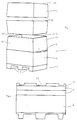
- variable capacity container (1) here presented is mainly constituted by a structure modular.
- This structure includes a basic module (2) and one or more enhancement modules (3).
- the basic module (2) constitutes the lower part of the container (1). It can come in forms and variable dimensions and will preferably be substantially rectangular parallelepiped shape. he will typically include side panels and a panel bottom, which can be formed in a single block so as not to constitute only one piece.
- the bottom (6) of the module base (2) will preferably be adapted to the mode of handling of the container (1). In a particular mode of embodiment, the bottom (6) has grooves (7) such as illustrated in figure 1 which allow palletizing of the container.
- the raising modules (3) can also come in dimensions and shapes variables. To allow storage by stacking modules, these will preferably have side walls (11 to 14) of trapezoidal shape.
- the raising modules (3) are in this case constituted by four faces which define a raising module (3) rectangular base: the free ends of the walls lateral (11 to 14) delimit two rectangular frames: a low frame (20) and a high perimeter frame (19) shown in Figure 1.
- the dimensions of the base module (2) and booster modules (3) will be adapted to allow good stacking or good interlocking.
- height and form enhancement modules (3) identical in order to standardize the manufacturing and for allow convenient assembly and disassembly of the container (1).
- the modules making up the container will be preferably made of the same material which may be of a diverse nature. We can in particular use stainless steel or plastic particularly suitable for transporting products requiring good hygiene such as liquids food.
- the container is assembled by stacking the raising modules (3) on the basic modules (2).
- the stack is carried out by placing opposite the frames (19) and (20) enhancement modules (3) having the same dimensions.
- the frames (19) and (20) are oriented, by a reversal movement, so as to alternately position with the bottom frame (20) towards the up, then down for the raising module (3) following.
- An example of this assembly is illustrated in the figure 1.
- stacking is done by means of housings (9) and bosses (10) made on some of the walls side (11 to 14) of the base module (2) and the raising (3). Housing (9) and bosses (10) are trained identically on each module.
- At least one housing (9) is first produced on the surface of one of the side walls (11 to 14) of each module.
- Figure 3 illustrates the realization of a housing (9) substantially centered on one of the faces side (11 to 14) constituting the width of the module.
- the housing (9) is in the form of a groove which the edges (15) are vertical and delimit a surface at concave profile (17) oriented towards the interior of the module (2 or 3).
- One or more bosses are formed (10) preferably on the opposite side wall (11 to 14) to that comprising the housing (9).
- bosses (10) such as illustrated in figure 3.
- the bosses (10) consist of width grooves lower than that of the housings (9) whose edges (21) are vertical and define a surface with a concave profile (23) oriented towards the interior of the module (2-3).
- housings (9) and the bosses (10) are formed in such a way that a wall comprising a housing (9) cannot cooperate and fit into a wall having bosses (10).
- housings (9) and bosses (10) can be presented in forms, dimensions variables and can be placed according to various configurations on the walls of the base modules and enhancement (2-3).
- variable capacity container (1) has a cover (4).
- the cover may be of design diverse but will preferably have a shape and dimensions adapted to its good positioning on a module raising (3).
- the cover (4) will most often made of the same material as the raising module (3) and the basic module (2).
- the cover (4) has a shape allowing it to partially fit into a module raising (3). If we use enhancement modules (3) and a basic module (2) which have housings (9) and bosses (10), one could also constitute a housing (9) and bosses (10) on the side walls of the cover (4). In this way, the cover (4) can fit quickly and precisely onto one of the modules.
- the cover (4) has grooves (25) on its upper part shown schematically in Figure 4, allowing stacking of other containers (1).
- grooves (25) formed on the surface upper cover (4) allow to superimpose containers.
- the grooves (25) of the cover (4) and the grooves (7) of the bottom (6) of the base module (2) will preferably be carried out in a complementary manner so that they can associate.
- the container variable capacity (1) described here includes a pocket flexible (5) placed inside the container (1) and intended to receive the product.
- the flexible pocket (5) allows in particular to facilitate the maintenance of the container (1) since it can be disposable after use. She permits also to constitute a waterproof container for the packaging of liquid products.
- the flexible pocket (5) can be presented under different shapes and sizes but will most often as it takes up most of the volume inside of container (1).
- the flexible pocket (5) can be in various matters and mainly in matters plastic. We can choose a material food-type plastic that allows packaging of food liquids.
- assembly means (8) allowing to associate the stacked modules (2-3). Any way common assembly can be used and in particular a rod and lock system allowing fast and practical connection.
- the assembly means (8) will be the most often placed near the top edges and lower side walls (11 to 14) of the modules raising (3).
- variable capacity container (1) can include draining means. Any known means and current can be used.
- a orifice near the bottom (6) of the base module (2). This orifice can for example be opened or closed by through a tap.
- variable capacity container (1) described here presents a modular structure with a basic module (2) and stackable raising modules (3).
- the number of enhancement modules (3) is not not limited and determines the capacity of the container (1). We could for example train capacity modules unit of 250 liters which will be combined to form a container (1) whose internal volume is substantially a multiple of 250 liters.
- the stacking takes place mainly in two ways.
- the raising module (3) superior can only fit together in a very limited way and is blocked by pressing the lower end (18; 24) housing (9) and bosses (10) in the top frame (19) of the lower module as illustrated in Figure 2.
- the modules are thus quickly stacked and joined by a socket on a low height without additional means of assembly.
- the modules (2-3) are not assembled by nesting on a limited height. This is why, we preferentially use assembly means (8) allowing to associate the stacked modules.
- Figure 1 illustrates the production of these assembly means (8) under the shape of a bolting system. We can also make a system of locks and canes.
- the pocket (5) allows to contain a liquid in ensuring a tight packaging in a structure rigid container.
- variable capacity container (1) is thus totally closed and allows the transport of the contained products and especially liquid products.
- handling the container (1) can be done using a forklift since the bottom (6) is thus palletizable.
- the container (1) can empty the container (1) by any common means.
- the empty flexible bag (5) it can be removed from the container (1) and proceed with the storage of the container (1).
- the invention allows storage by nesting raising modules (3) inside the volume of base (2). This embodiment is illustrated in the figure 4.
- the interlocking is done by introducing a raising module (3) by its low frame (20) in the basic module (2). We then repeat this operation of identical way to fit other modules of raising (3), successively.
- the modules have housings (9) and bosses (10), they must be oriented by a pivoting movement so as to fit the same side the walls of the modules which have housings (9) and on the other side, the walls of the modules which include the bosses (10).
- the container (1) is oriented by a reversal movement in order to position its bottom frame (20) down.
- the container (1) can thus be stored in occupying a very small space. If the container (1) is equipped with a bottom (6) with grooves (7) and a cover (4), empty storage and transport can s stack the containers (1).
Landscapes
- Engineering & Computer Science (AREA)
- Mechanical Engineering (AREA)
- Stackable Containers (AREA)
Priority Applications (1)
| Application Number | Priority Date | Filing Date | Title |
|---|---|---|---|
| EP96490029A EP0816241A1 (de) | 1996-07-02 | 1996-07-02 | Behälter mit variabler Kapazität, z.B. zum Lagern von Flüssigkeiten |
Applications Claiming Priority (1)
| Application Number | Priority Date | Filing Date | Title |
|---|---|---|---|
| EP96490029A EP0816241A1 (de) | 1996-07-02 | 1996-07-02 | Behälter mit variabler Kapazität, z.B. zum Lagern von Flüssigkeiten |
Publications (1)
| Publication Number | Publication Date |
|---|---|
| EP0816241A1 true EP0816241A1 (de) | 1998-01-07 |
Family
ID=8225486
Family Applications (1)
| Application Number | Title | Priority Date | Filing Date |
|---|---|---|---|
| EP96490029A Withdrawn EP0816241A1 (de) | 1996-07-02 | 1996-07-02 | Behälter mit variabler Kapazität, z.B. zum Lagern von Flüssigkeiten |
Country Status (1)
| Country | Link |
|---|---|
| EP (1) | EP0816241A1 (de) |
Cited By (1)
| Publication number | Priority date | Publication date | Assignee | Title |
|---|---|---|---|---|
| CN117985321A (zh) * | 2024-04-03 | 2024-05-07 | 山东妙迪食品有限公司 | 一种可改变容积的海产品运输容器 |
Citations (7)
| Publication number | Priority date | Publication date | Assignee | Title |
|---|---|---|---|---|
| FR2194615A2 (de) * | 1972-08-01 | 1974-03-01 | Pauly Roger | |
| CH553052A (de) * | 1972-03-22 | 1974-08-30 | Utz Ag Georg | Verfahren zur herstellung von behaeltern aus kunststoff und nach diesem verfahren hergestellter behaelter. |
| FR2219884A1 (de) * | 1973-03-01 | 1974-09-27 | Ponsy Jacques | |
| GB1503555A (en) * | 1974-07-26 | 1978-03-15 | Brooks & Perkins | Stacking and nesting baskets |
| FR2372743A1 (fr) * | 1976-12-02 | 1978-06-30 | Gellert Jobst | Recipient pouvant etre ouvert et ferme |
| FR2432446A1 (fr) * | 1978-08-02 | 1980-02-29 | Isobox Barbier Sa | Nouveau conteneur en matiere plastique etanche et isotherme a palette incorporee |
| DE4244713A1 (de) * | 1992-03-02 | 1993-12-23 | Plastorbis Derisen & Mueller G | Transport- und Lagerbehälter |
-
1996
- 1996-07-02 EP EP96490029A patent/EP0816241A1/de not_active Withdrawn
Patent Citations (7)
| Publication number | Priority date | Publication date | Assignee | Title |
|---|---|---|---|---|
| CH553052A (de) * | 1972-03-22 | 1974-08-30 | Utz Ag Georg | Verfahren zur herstellung von behaeltern aus kunststoff und nach diesem verfahren hergestellter behaelter. |
| FR2194615A2 (de) * | 1972-08-01 | 1974-03-01 | Pauly Roger | |
| FR2219884A1 (de) * | 1973-03-01 | 1974-09-27 | Ponsy Jacques | |
| GB1503555A (en) * | 1974-07-26 | 1978-03-15 | Brooks & Perkins | Stacking and nesting baskets |
| FR2372743A1 (fr) * | 1976-12-02 | 1978-06-30 | Gellert Jobst | Recipient pouvant etre ouvert et ferme |
| FR2432446A1 (fr) * | 1978-08-02 | 1980-02-29 | Isobox Barbier Sa | Nouveau conteneur en matiere plastique etanche et isotherme a palette incorporee |
| DE4244713A1 (de) * | 1992-03-02 | 1993-12-23 | Plastorbis Derisen & Mueller G | Transport- und Lagerbehälter |
Cited By (2)
| Publication number | Priority date | Publication date | Assignee | Title |
|---|---|---|---|---|
| CN117985321A (zh) * | 2024-04-03 | 2024-05-07 | 山东妙迪食品有限公司 | 一种可改变容积的海产品运输容器 |
| CN117985321B (zh) * | 2024-04-03 | 2024-06-04 | 山东妙迪食品有限公司 | 一种可改变容积的海产品运输容器 |
Similar Documents
| Publication | Publication Date | Title |
|---|---|---|
| BE1004754A6 (fr) | Grand recipient pour vrac, empilable, reutilisable, a parois rabattables. | |
| FR2727383A1 (fr) | Recipient comportant des poignees et un couvercle | |
| FR2678585A1 (fr) | Bac gerbable emboitable a elements supports pivotants. | |
| FR2709290A1 (fr) | Support pour loger un conteneur souple. | |
| EP0579158A1 (de) | Stapelbare-Ineinandersetzbare Verpackungskiste mit Seiten nach Skelett-Bauart | |
| FR2536043A1 (fr) | Caisses de manutention empilables et emboitables du type a piliers de support sensiblement verticaux | |
| FR2710900A1 (fr) | Récipient polyvalent en matière plastique, repliable, réutilisable et gerbable. | |
| FR2781457A3 (fr) | Conteneur perfectionne, de preference pour fruits et legumes | |
| FR2480240A1 (fr) | Nouvelle caisse-palette repliable | |
| WO1994014684A1 (fr) | Conteneur parallelepipedique pliable a six faces | |
| EP0588740B1 (de) | Verpackung für Nahrungsmittel mit übereinanderliegenden Stapelelementen | |
| FR2829111A1 (fr) | Casier empilable en matiere plastique moulee | |
| EP0680886B1 (de) | Stapelbarer und ineinandersetzbarer Kasten mit vertikalen Säulen | |
| EP1386847B1 (de) | Faltbarer und stapelbarer Behälter | |
| FR2659587A1 (fr) | Panier pour boite a outils. | |
| FR2608130A1 (fr) | Bidon gerbable | |
| CA2933140C (fr) | Bouteille empilable a double poignee a goulot surdimensionne | |
| FR2921044A1 (fr) | Bac pliable | |
| FR2885352A1 (fr) | Bac de transport et de stockage | |
| FR2599005A1 (fr) | Conteneur gerbable | |
| FR2527172A1 (fr) | Recipient ouvert vers le haut | |
| FR2578224A1 (fr) | Conditionnement gerbable du type des caisses palettes | |
| EP1386848B1 (de) | Faltbarer Behälter | |
| FR2698610A1 (fr) | Caisse de manutention évasée, du type gerbable emboîtable, à piliers support. | |
| FR2698072A1 (fr) | Cageot gerbable emboîtable à volets rabattables. |
Legal Events
| Date | Code | Title | Description |
|---|---|---|---|
| PUAI | Public reference made under article 153(3) epc to a published international application that has entered the european phase |
Free format text: ORIGINAL CODE: 0009012 |
|
| AK | Designated contracting states |
Kind code of ref document: A1 Designated state(s): BE CH DE DK ES FR GB IT LI NL PT SE |
|
| AKX | Designation fees paid |
Free format text: BE CH DE DK ES FR GB IT LI NL PT SE |
|
| RBV | Designated contracting states (corrected) |
Designated state(s): BE CH DE DK ES FR GB IT LI NL PT SE |
|
| STAA | Information on the status of an ep patent application or granted ep patent |
Free format text: STATUS: THE APPLICATION IS DEEMED TO BE WITHDRAWN |
|
| 18D | Application deemed to be withdrawn |
Effective date: 19980708 |