EP0816465A2 - Polysiloxanklebestoff für optisches Speicherelement, optisches Speicherelement und Verfahren zur Herstellung - Google Patents
Polysiloxanklebestoff für optisches Speicherelement, optisches Speicherelement und Verfahren zur Herstellung Download PDFInfo
- Publication number
- EP0816465A2 EP0816465A2 EP97109982A EP97109982A EP0816465A2 EP 0816465 A2 EP0816465 A2 EP 0816465A2 EP 97109982 A EP97109982 A EP 97109982A EP 97109982 A EP97109982 A EP 97109982A EP 0816465 A2 EP0816465 A2 EP 0816465A2
- Authority
- EP
- European Patent Office
- Prior art keywords
- silicone
- memory element
- optical memory
- bonding agent
- component
- Prior art date
- Legal status (The legal status is an assumption and is not a legal conclusion. Google has not performed a legal analysis and makes no representation as to the accuracy of the status listed.)
- Granted
Links
Images
Classifications
-
- G—PHYSICS
- G11—INFORMATION STORAGE
- G11B—INFORMATION STORAGE BASED ON RELATIVE MOVEMENT BETWEEN RECORD CARRIER AND TRANSDUCER
- G11B7/00—Recording or reproducing by optical means, e.g. recording using a thermal beam of optical radiation by modifying optical properties or the physical structure, reproducing using an optical beam at lower power by sensing optical properties; Record carriers therefor
- G11B7/24—Record carriers characterised by shape, structure or physical properties, or by the selection of the material
- G11B7/241—Record carriers characterised by shape, structure or physical properties, or by the selection of the material characterised by the selection of the material
- G11B7/252—Record carriers characterised by shape, structure or physical properties, or by the selection of the material characterised by the selection of the material of layers other than recording layers
- G11B7/256—Record carriers characterised by shape, structure or physical properties, or by the selection of the material characterised by the selection of the material of layers other than recording layers of layers improving adhesion between layers
-
- C—CHEMISTRY; METALLURGY
- C08—ORGANIC MACROMOLECULAR COMPOUNDS; THEIR PREPARATION OR CHEMICAL WORKING-UP; COMPOSITIONS BASED THEREON
- C08L—COMPOSITIONS OF MACROMOLECULAR COMPOUNDS
- C08L83/00—Compositions of macromolecular compounds obtained by reactions forming in the main chain of the macromolecule a linkage containing silicon with or without sulfur, nitrogen, oxygen or carbon only; Compositions of derivatives of such polymers
-
- C—CHEMISTRY; METALLURGY
- C09—DYES; PAINTS; POLISHES; NATURAL RESINS; ADHESIVES; COMPOSITIONS NOT OTHERWISE PROVIDED FOR; APPLICATIONS OF MATERIALS NOT OTHERWISE PROVIDED FOR
- C09J—ADHESIVES; NON-MECHANICAL ASPECTS OF ADHESIVE PROCESSES IN GENERAL; ADHESIVE PROCESSES NOT PROVIDED FOR ELSEWHERE; USE OF MATERIALS AS ADHESIVES
- C09J183/00—Adhesives based on macromolecular compounds obtained by reactions forming in the main chain of the macromolecule a linkage containing silicon, with or without sulfur, nitrogen, oxygen, or carbon only; Adhesives based on derivatives of such polymers
- C09J183/04—Polysiloxanes
-
- G—PHYSICS
- G11—INFORMATION STORAGE
- G11B—INFORMATION STORAGE BASED ON RELATIVE MOVEMENT BETWEEN RECORD CARRIER AND TRANSDUCER
- G11B7/00—Recording or reproducing by optical means, e.g. recording using a thermal beam of optical radiation by modifying optical properties or the physical structure, reproducing using an optical beam at lower power by sensing optical properties; Record carriers therefor
- G11B7/24—Record carriers characterised by shape, structure or physical properties, or by the selection of the material
-
- G—PHYSICS
- G11—INFORMATION STORAGE
- G11B—INFORMATION STORAGE BASED ON RELATIVE MOVEMENT BETWEEN RECORD CARRIER AND TRANSDUCER
- G11B7/00—Recording or reproducing by optical means, e.g. recording using a thermal beam of optical radiation by modifying optical properties or the physical structure, reproducing using an optical beam at lower power by sensing optical properties; Record carriers therefor
- G11B7/24—Record carriers characterised by shape, structure or physical properties, or by the selection of the material
- G11B7/26—Apparatus or processes specially adapted for the manufacture of record carriers
-
- C—CHEMISTRY; METALLURGY
- C08—ORGANIC MACROMOLECULAR COMPOUNDS; THEIR PREPARATION OR CHEMICAL WORKING-UP; COMPOSITIONS BASED THEREON
- C08L—COMPOSITIONS OF MACROMOLECULAR COMPOUNDS
- C08L2666/00—Composition of polymers characterized by a further compound in the blend, being organic macromolecular compounds, natural resins, waxes or and bituminous materials, non-macromolecular organic substances, inorganic substances or characterized by their function in the composition
- C08L2666/28—Non-macromolecular organic substances
-
- G—PHYSICS
- G11—INFORMATION STORAGE
- G11B—INFORMATION STORAGE BASED ON RELATIVE MOVEMENT BETWEEN RECORD CARRIER AND TRANSDUCER
- G11B7/00—Recording or reproducing by optical means, e.g. recording using a thermal beam of optical radiation by modifying optical properties or the physical structure, reproducing using an optical beam at lower power by sensing optical properties; Record carriers therefor
- G11B7/24—Record carriers characterised by shape, structure or physical properties, or by the selection of the material
- G11B7/241—Record carriers characterised by shape, structure or physical properties, or by the selection of the material characterised by the selection of the material
- G11B7/242—Record carriers characterised by shape, structure or physical properties, or by the selection of the material characterised by the selection of the material of recording layers
- G11B7/243—Record carriers characterised by shape, structure or physical properties, or by the selection of the material characterised by the selection of the material of recording layers comprising inorganic materials only, e.g. ablative layers
- G11B2007/24302—Metals or metalloids
- G11B2007/24314—Metals or metalloids group 15 elements (e.g. Sb, Bi)
-
- G—PHYSICS
- G11—INFORMATION STORAGE
- G11B—INFORMATION STORAGE BASED ON RELATIVE MOVEMENT BETWEEN RECORD CARRIER AND TRANSDUCER
- G11B7/00—Recording or reproducing by optical means, e.g. recording using a thermal beam of optical radiation by modifying optical properties or the physical structure, reproducing using an optical beam at lower power by sensing optical properties; Record carriers therefor
- G11B7/24—Record carriers characterised by shape, structure or physical properties, or by the selection of the material
- G11B7/241—Record carriers characterised by shape, structure or physical properties, or by the selection of the material characterised by the selection of the material
- G11B7/242—Record carriers characterised by shape, structure or physical properties, or by the selection of the material characterised by the selection of the material of recording layers
- G11B7/243—Record carriers characterised by shape, structure or physical properties, or by the selection of the material characterised by the selection of the material of recording layers comprising inorganic materials only, e.g. ablative layers
- G11B2007/24302—Metals or metalloids
- G11B2007/24316—Metals or metalloids group 16 elements (i.e. chalcogenides, Se, Te)
-
- G—PHYSICS
- G11—INFORMATION STORAGE
- G11B—INFORMATION STORAGE BASED ON RELATIVE MOVEMENT BETWEEN RECORD CARRIER AND TRANSDUCER
- G11B7/00—Recording or reproducing by optical means, e.g. recording using a thermal beam of optical radiation by modifying optical properties or the physical structure, reproducing using an optical beam at lower power by sensing optical properties; Record carriers therefor
- G11B7/24—Record carriers characterised by shape, structure or physical properties, or by the selection of the material
- G11B7/241—Record carriers characterised by shape, structure or physical properties, or by the selection of the material characterised by the selection of the material
- G11B7/242—Record carriers characterised by shape, structure or physical properties, or by the selection of the material characterised by the selection of the material of recording layers
- G11B7/243—Record carriers characterised by shape, structure or physical properties, or by the selection of the material characterised by the selection of the material of recording layers comprising inorganic materials only, e.g. ablative layers
- G11B2007/24318—Non-metallic elements
- G11B2007/2432—Oxygen
-
- G—PHYSICS
- G11—INFORMATION STORAGE
- G11B—INFORMATION STORAGE BASED ON RELATIVE MOVEMENT BETWEEN RECORD CARRIER AND TRANSDUCER
- G11B7/00—Recording or reproducing by optical means, e.g. recording using a thermal beam of optical radiation by modifying optical properties or the physical structure, reproducing using an optical beam at lower power by sensing optical properties; Record carriers therefor
- G11B7/24—Record carriers characterised by shape, structure or physical properties, or by the selection of the material
- G11B7/241—Record carriers characterised by shape, structure or physical properties, or by the selection of the material characterised by the selection of the material
- G11B7/252—Record carriers characterised by shape, structure or physical properties, or by the selection of the material characterised by the selection of the material of layers other than recording layers
- G11B7/253—Record carriers characterised by shape, structure or physical properties, or by the selection of the material characterised by the selection of the material of layers other than recording layers of substrates
- G11B7/2533—Record carriers characterised by shape, structure or physical properties, or by the selection of the material characterised by the selection of the material of layers other than recording layers of substrates comprising resins
-
- G—PHYSICS
- G11—INFORMATION STORAGE
- G11B—INFORMATION STORAGE BASED ON RELATIVE MOVEMENT BETWEEN RECORD CARRIER AND TRANSDUCER
- G11B7/00—Recording or reproducing by optical means, e.g. recording using a thermal beam of optical radiation by modifying optical properties or the physical structure, reproducing using an optical beam at lower power by sensing optical properties; Record carriers therefor
- G11B7/24—Record carriers characterised by shape, structure or physical properties, or by the selection of the material
- G11B7/241—Record carriers characterised by shape, structure or physical properties, or by the selection of the material characterised by the selection of the material
- G11B7/252—Record carriers characterised by shape, structure or physical properties, or by the selection of the material characterised by the selection of the material of layers other than recording layers
- G11B7/253—Record carriers characterised by shape, structure or physical properties, or by the selection of the material characterised by the selection of the material of layers other than recording layers of substrates
- G11B7/2533—Record carriers characterised by shape, structure or physical properties, or by the selection of the material characterised by the selection of the material of layers other than recording layers of substrates comprising resins
- G11B7/2534—Record carriers characterised by shape, structure or physical properties, or by the selection of the material characterised by the selection of the material of layers other than recording layers of substrates comprising resins polycarbonates [PC]
-
- G—PHYSICS
- G11—INFORMATION STORAGE
- G11B—INFORMATION STORAGE BASED ON RELATIVE MOVEMENT BETWEEN RECORD CARRIER AND TRANSDUCER
- G11B7/00—Recording or reproducing by optical means, e.g. recording using a thermal beam of optical radiation by modifying optical properties or the physical structure, reproducing using an optical beam at lower power by sensing optical properties; Record carriers therefor
- G11B7/24—Record carriers characterised by shape, structure or physical properties, or by the selection of the material
- G11B7/241—Record carriers characterised by shape, structure or physical properties, or by the selection of the material characterised by the selection of the material
- G11B7/252—Record carriers characterised by shape, structure or physical properties, or by the selection of the material characterised by the selection of the material of layers other than recording layers
- G11B7/258—Record carriers characterised by shape, structure or physical properties, or by the selection of the material characterised by the selection of the material of layers other than recording layers of reflective layers
- G11B7/2585—Record carriers characterised by shape, structure or physical properties, or by the selection of the material characterised by the selection of the material of layers other than recording layers of reflective layers based on aluminium
Definitions
- Optical memory elements such as optical cards or optical disks (video disks or compact disks, etc.), which allow the optical recording, erasing and playback of information, are subject to warping. Warping of the optical memory element is caused by changes in temperature and humidity and can be alleviated by bonding together two substrates at least one of which has a recording layer on one side.
- Bonding agents which are used to bond such substrates together include silicone optical memory element bonding agents containing a silicone composition which is cured by a two-liquid type condensation reaction (Japanese Patent Application [Kokai] 61-267947), silicone optical memory element bonding agents containing a silicone composition which is cured by a de-alcohol condensation reaction (Japanese Patent Application [Kokai] 1-276452), and silicone optical memory element bonding agents containing a silicone composition which is cured by a condensation reaction or an addition reaction (Japanese Patent Application [Kokai] 3-113744).
- Silicone compositions which are cured by a condensation reaction tend to be free of any cure inhibition, so that the substrates can be bonded in a favorable manner.
- curing proceeds gradually from-portions of the composition that are in contact with moisture in the air, such composition must be allowed to stand for a long period of time. This is necessary to achieve sufficient curing of the interior portions of the composition sandwiched between the abovementioned substrates such that a fastening force which is sufficient to allow movement of the optical memory element or treatment of the optical memory element in subsequent processes is obtained. Continuous bonding of the substrates is impossible.
- compositions of this type tends to be inferior to that of compositions cured by a condensation reaction, so that it is necessary to subject the substrates to a cleaning treatment or a primer treatment beforehand. Continuous bonding of the abovementioned substrates is impossible.
- the present invention provides (a) a silicone bonding agent for an optical memory element which can be quickly cured by an addition reaction and a condensation reaction, and which makes it possible to bond together in a favorable manner a substrate which has a recording layer on one side and a substrate which may or may not have a recording layer on one side, (b) an optical memory element which is formed by bonding such substrates together in a favorable manner, and (c) a method for the efficient manufacture of such an optical memory element.
- the optical memory element of the present invention is characterized by the fact that said element is formed by bonding together a substrate which has a recording layer on one side and a substrate which may or may not have a recording layer on one side via a silicone bonding agent for an optical memory element which comprises of a silicone composition that is cured by an addition reaction and a condensation reaction.
- the method of the present invention for manufacturing an optical memory element is characterized by the fact that a substrate which has a recording layer on one side and a substrate which may or may not have a recording layer on one side are bonded together via a silicone type bonding agent for an optical memory element which comprises a silicone composition that is cured by an addition reaction and a condensation reaction.
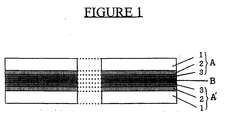
- Figure 1 is a sectional view of the optical memory element of the present invention.
- the silicone type bonding agent for an optical memory element provided by the present invention is used to bond together a substrate which has a recording layer on one side and a substrate which may or may not have a recording layer on one side. In cases where the optical memory element involved is an optical disk, these substrates are disk substrates.
- the silicone bonding agent for an optical memory element provided by the present invention comprises a silicone composition which is cured by an addition reaction and a condensation reaction. There are no particular restrictions on this composition; however, from the standpoints of relatively unimpaired curing, good adhesion and a rapid curing rate, it is desirable that this silicone composition comprise the following:
- Component (A) is the main ingredient of the silicone bonding agent of the present invention.
- This component is an organopolysiloxane having an average of at least two alkoxy groups and an average of at least two silicon-bonded alkenyl groups per molecule, in the same or different molecules, or of a mixture of such organopolysiloxanes.
- this component (A) examples include organopolysiloxanes which have at least two silicon-bonded alkoxy groups and at least two silicon-bonded alkenyl groups per molecule in the same molecule, such as vinyldimethoxysiloxy-terminated dimethylpolysiloxanes; trimethoxysiloxy-terminated dimethylsiloxane-methylvinylsiloxane copolymers; and methyldimethoxysiloxy-terminated dimethylsiloxanemethylvinylsiloxane copolymers, and mixtures of organopolysiloxanes which have at least two silicon-bonded alkoxy groups and two silicon-bonded alkenyl groups per molecule in different molecules, such as mixtures of (a) an organopolysiloxane which has at least an average of two silicon-bonded alkoxy groups per molecule, and (b) an organopolysiloxane which has an average of at least two silicon-bonded alkenyl groups per molecule, etc.
- mixtures of (a) an alkoxyl-substituted organopolysiloxane which has an averge of at least two silicon-bonded alkoxy groups per molecule, and (b) an alkenyl-subtituted organopolysiloxane which has an average of at least two silicon-bonded alkenyl groups per molecule are especially desirable in that the respective numbers of silicon-bonded alkoxy groups and silicon-bonded alkenyl groups in component (A) can be finely adjusted, and in that the silicone bonding agent memory element that is obtained has better adhesive properties.
- the resulting silicone bonding agent may show insufficient curing or impaired curing, or the adhesive properties of said bonding agent may be inferior.
- the molecular structure of this component (a) may be a linear structure, a linear structure with some branching, a branched structure, a cyclic structure or a network structure. A linear structure is preferred. Examples of silicon-bonded alkoxy groups in component (a) include methoxy groups, ethoxy groups, propoxy groups and butoxy groups. Methoxy groups are preferred. The bonding positions of these alkoxy groups may be at the ends of the molecular chains and/or on side chains of the molecular chains.
- alkoxy groups may be bonded directly to silicon atoms in the principal chains, or may be bonded to silicon atoms which are bonded to principal-chain silicon atoms via alkylene groups.
- Groups other than alkoxy groups which may be bonded to silicon atoms in this component (a) include substituted or unsubstituted monovalent hydrocarbon groups.
- Preferred monovalent hydrocarbon groups include alkyl groups, such as methyl, ethyl, propyl, butyl, pentyl, hexyl, heptyl, octyl, nonyl, decyl or octadecyl; cycloalkyl groups, such as cyclopentyl and cyclohexyl; aryl groups, such as phenyl, tolyl, xylyl and naphthyl groups; aralkyl groups such as benzyl, phenethyl and phenylpropyl; and halogenated alkyl groups, such as 3-chloropropyl and 3,3,3-trifluoropropyl.
- alkyl groups such as methyl, ethyl, propyl, butyl, pentyl, hexyl, heptyl, octyl, nonyl, decyl or octadec
- Methyl and phenyl are particularly preferred. Furthermore, from the standpoint of obtaining better adhesive properties in the resulting silicone bonding agent, it is preferred that the silicon-bonded alkoxy groups in component (a) be methoxy groups, and that the groups other than said alkoxy groups be methyl or phenyl. It is desirable that the viscosity of this component (a) at 25°C be from 20 to 1,000,000 centipoise (mPa.s.). A viscosity of 100 to 500,000 centipoise (mPa.s.) is preferred. If the viscosity is less than 20 centipoise (mPa.s.), the physical characteristics of the cured product that is obtained tend to deteriorate.
- mPa.s. centipoise
- component (a) is an alkoxy-subtituted organopolysiloxane having the following general formula (1):
- R 1 is individually selected from the substituted or unsubstituted monovalent hydrocarbon groups. Examples of such groups include the monovalent hydrocarbon groups described above. Methyl and phenyl are preferred.
- R 2 in the above formula indicates alkyl groups. Examples of such alkyl groups include methyl, ethyl, propyl and butyl. Methyl is particularly preferred.
- a in the above formula is individually selected from the oxygen atoms and alkylene groups.
- alkylene groups include ethylene, propylene and butylene. Ethylene or propylene are particularly preferred.
- x is 2 or 3, with 3 being preferred.
- R 1 in the above formula is selected from phenyl, R 2 is methyl, A is an oxygen atom, and x is 3.
- n in the above formula is a positive number; from the standpoint of obtaining favorable handling and working characteristics in the resulting silicone bonding agent, and favorable physical characteristics in the resulting cured product, it is preferred that n be a positive number selected such that the viscosity of the abovementioned organopolysiloxane at 25°C is from 20 to 1,000,000 centipoise (mPa.s.). It is more preferred that n is selected such that the viscosity of component (A) is 100 to 500,000 centipoise (mPa.s.).
- Examples of compounds which can be used as component (a) include trimethoxysiloxy-terminated dimethylpolysiloxanes, methyldimethoxysiloxy-terminated dimethylpolysiloxanes, trimethoxysilylethyldimethylsiloxy-terminated dimethylpolysiloxanes, organopolysiloxanes formed by substituting some of the methyl groups of the abovementioned dimethylpolysiloxanes with alkyl groups other than methyl groups, phenyl groups or 3,3,3-trifluoropropyl groups, and mixtures consisting of two or more of these organopolysiloxanes.
- the alkenyl-substituted organopolysiloxane of component (b) may have an average of at least two silicon-bonded alkenyl groups per molecule. If the average number of silicon-bonded alkenyl groups is less than two per molecule, the resulting silicone bonding agent may show insufficient curing.
- the molecular structure of this component (b) may be a linear structure, a linear structure with some branching, a branched structure, a cyclic structure or a network structure.
- Examples of silicon-bonded alkenyl groups of (b) include vinyl, allyl, butenyl, pentenyl and hexenyl. Vinyl groups are particularly preferred.
- the bonding positions of these alkenyl groups may be at the ends of the molecular chains and/or on side chains of the molecular chains. From the standpoint of favorable reactivity, bonding positions at the ends of the molecular chains are especially desirable.
- Groups other than alkenyl groups which may be bonded to silicon atoms in component (b) include substituted or unsubstituted monovalent hydrocarbon groups.
- Preferred monovalent hydrocarbon groups include alkyl groups, such as methyl, ethyl, propyl, butyl, pentyl, hexyl, heptyl, octyl, nonyl, decyl or octadecyl; cycloalkyl groups, such as cyclopentyl and cyclohexyl; aryl groups, such as phenyl, tolyl, xylyl and naphthyl; aralkyl groups, such as benzyl, phenethyl and phenylpropyl, and halogenated alkyl groups, such as 3-chloropropyl and 3,3,3-trifluoropropyl.
- alkyl groups such as methyl, ethyl, propyl, butyl, pentyl, hexyl, heptyl, octyl, nonyl, decyl or octadec
- Methyl and phenyl are particularly preferred. It is desirable that the viscosity of component (b) at 25°C be from 20 to 1,000,000 centipoise (mPa.s.). A viscosity of 100 to 500,000 centipoise (mPa.s.) is particularly preferred. If the viscosity is less than the 20 centipoise (mPa.s.), the physical characteristics of the cured product that is obtained tend to deteriorate. If the viscosity is greater than 1,000,000 centipoise (mPa.s.), the handling and working characteristics of the resulting silicone bonding agent tend to deteriorate.
- mPa.s. centipoise
- the amount of component (a) that is added constitute 5 to 95 wt % of component (A), with component (b) constituting the remainder of component (A).
- a mixture ratio which is such that component (a) constitutes 20 to 80 wt % of component (A), while component (b) constitutes the remainder of component (A) is especially desirable.
- the reason for this is that if the amount of component (a) added to component (A) is less than the lower limit of this range, the resulting silicone bonding agent will show impaired curing, and will tend to have inferior adhesive properties. If the amount of component (a) that is added exceeds the upper limit of this range, the curing of the resulting silicone-type bonding agent tends to be slow.
- the organohydrogenpolysiloxane of component (B) is a component which is used to cure the silicone bonding agent by means of an addition reaction between the alkenyl groups bonded to silicon atoms in component (A) and the hydrogen atoms bonded to silicon atoms in component (B). It is necessary that this component (B) have an average of at least two silicon-bonded hydrogen atoms per molecule. If the average number of silicon-bonded hydrogen atoms in component (b) is less than two per molecule, the resulting silicone bonding agent will not be sufficiently cured.
- the molecular structure of component (B) may be a linear structure, a linear structure with some branching, a branched structure, a cyclic structure or a network structure.
- the bonding positions of the silicon-bonded hydrogen atoms may be at the ends of the molecular chains and/or on side chains of the molecular chains.
- groups other than hydrogen atoms which may be bonded to silicon atoms in component (B) include substituted or unsubstituted monovalent hydrocarbon groups.
- Preferred monovalent hydrocarbon groups include alkyl groups, such as methyl, ethyl, propyl, butyl, pentyl, hexyl, heptyl, octyl, nonyl, decyl and octadecyl; cycloalkyl groups, such as cyclopentyl and cyclohexyl; aryl groups, such as phenyl, tolyl, xylyl and naphthyl; aralkyl, such as benzyl, phenethyl and phenylpropyl; and halogenated alkyl groups, such as 3-chloropropyl and 3,3,3-trifluoropropyl; etc.
- alkyl groups such as methyl, ethyl, propyl, butyl, pentyl, hexyl, heptyl, octyl, nonyl, decyl and octade
- Methyl and phenyl groups are particularly preferred from the standpoint of obtaining better adhesive properties in the resulting silicone bonding agent. It is desirable that the viscosity of component (B) at 25°C be from 1 to 10,000 centipoise (mPa.s.). If the viscosity is less than 1 centipoise (mPa.s.), the physical characteristics of the cured product that is obtained tend to deteriorate. If the viscosity is greater than 10,000 centipoise (mPa.s.), the handling and working characteristics of the resulting silicone bonding agent tend to deteriorate.
- mPa.s. centipoise
- Examples of compounds which can be used as component (B) include trimethylsiloxy-terminated methylhydrogenpolysiloxanes, trimethylsiloxy-terminated dimethylsiloxane-methylhydrogensiloxane copolymers, dimethylhydrogensiloxy-terminated dimethylpolysiloxanes, dimethylhydrogensiloxy-terminated dimethylsiloxane-methylhydrogensiloxane copolymers, organopolysiloxanes consisting of (CH 3 ) 2 HSiO 1/2 units and SiO 4/2 units, organopolysiloxanes consisting of (CH 3 ) 3 SiO 1/2 units, (CH 3 ) 2 HSiO 1/2 units and SiO 4/2 units, organopolysiloxanes consisting of (CH 3 ) 3 SiO 1/2 units, (CH 3 ) 2 HSiO 1/2 units, (CH 3 ) 2 SiO 2/2 units and SiO 4/2 units, organopolysiloxanes formed by substituting some
- the amount of component (B) that is added to the composition is an amount which is such that the molar ratio of the silicon-bonded hydrogen atoms in component (B) to silicon-bonded alkenyl groups in component (A) is from 0.3:1 to 20:1. In preferred embodiments, the molar ratio is from 0.5:1 to 10:1. If the molar ratio is less than 0.3:1 the resulting silicone bonding agent tends to be insufficient cured. If the molar ratio is greater than 20:1, the physical properties of the resulting cured product tend to deteriorate.
- Component (C) consists of at least one metal condensation reaction catalyst wherein the metal of the metal condensation reaction catalyst is selected from titanium, zirconium and aluminum. This component is a catalyst which is used to promote the condensation reaction of the silicon-bonded alkoxy groups in component (A).
- Examples of compounds which can be used as component (C) include titanium condensation reaction catalysts, such as organo-titanic acid esters (such as tetrabutyl titanate and tetraisopropyl titanate), and organo-titanium chelate compounds (such as diisopropoxybis(acetylacetate)titanium and diisopropoxybis(ethylacetoacetate) titanium); zirconium condensation reaction catalysts, such as organo-zirconium esters (such as zirconium tetrapropylate and zirconium tetrabutyrate), and organo-zirconium chelate compounds (such as zirconium diacetate, zirconium tetra(acetylacetonate), tributoxyzirconium acetylacetonate, dibutoxyzirconium bis (acetylacetonate), tributoxyzirconium acetoacetate and dibutoxyzirconium acetylacet
- the amount of component (C) that is added is 0.01 to 20 parts by weight (preferably 0.1 to 5 parts by weight) per 100 parts by weight of component (A). If the amount of component (C) is less than 0.01 parts, the resulting silicone bonding agent tends to show insufficient curing or impaired curing, and the adhesive properties of said bonding agent tend to be inferior. If the amount added exceeds 20 parts, the storage stability of the resulting silicone bonding agent tends to deteriorate.
- the hydrosilylation reaction catalyst of component (D) is a catalyst which is used to promote an addition reaction between the silicon-bonded alkenyl groups in component (A) and the silicon-bonded hydrogen atoms in component (B).
- catalysts which can be used as component (D) include platinum type catalysts such as platinum black, platinum-supporting powdered active carbon, platinum-supporting powdered silica, chloroplatinic acid, alcohol solutions of chloroplatinic acid, olefin complexes of platinum and alkenylsiloxane complexes of platinum; rhodium catalysts, palladium catalysts, fine particles of thermoplastic resins containing these catalysts, and mixtures of two or more of these hydrosilylation reaction catalysts.
- platinum type catalysts and fine particles of thermoplastic resins containing platinum catalysts are especially desirable from the standpoint of obtaining favorable curability in the resulting silicone bonding agent.
- the fine thermoplastic resin particles consist of a silicone resin, polycarbonate resin, acrylic resin, nylon resin or polyester resin with a softening point of 5 to 200°C, and that said particles have a particle size of 0.01 to 10 micrometers.
- the amount of component (D) that is added to the composition is a catalytic amount.
- a platinum catalyst is used as component D
- An amount which is such that the quantity of platinum atoms is from 0.5 to 500 ppm is especially desirable.
- a platinum type catalyst is used as component (D)
- the amount of component (D) that is added is less than 0.01 ppm, the resulting silicone bonding agent tends to show insufficient curing. If the amount added exceeds 1,000 ppm, there is no great effect on curability, and the external appearance of the cured product tends to deteriorate.
- a silicone composition which is suitable for use in the silicone optical memory element bonding agent of the present invention can be prepared by uniformly mixing components (A) through (D). Furthermore, alkoxysilanes or partially hydrolyzed condensates of alkoxysilanes, inorganic fillers, addition reaction inhibiting agents, non-reactive organopolysiloxanes, organic solvents, flame retarding agents, heat resistance enhancing agents, plasticizers, thixotropic agents, adhesion promoting agents and/or anti-mildew agents, may also be added to the composition as long as the addition of such agents does not interfere with the object of the present invention.
- the alkoxysilanes be alkoxysilanes expressed by the following general formula (2): R 3 a Si(OR 4 ) (4-a)
- R 3 is selected from monovalent hydrocarbon groups, epoxy-functional organic groups and acrylic-functional organic groups.
- monovalent hydrocarbon groups which can be used include substituted or unsubstituted monovalent hydrocarbon groups, e.
- alkyl groups such as methyl, ethyl, propyl, butyl, pentyl, hexyl, heptyl, octyl, nonyl, decyl and octadecyl; cycloalkyl groups, such as cyclopentyl and cyclohexyl; alkenyl groups, such as vinyl and allyl; aryl groups, such as phenyl, tolyl, xylyl and naphthyl; aralkyl groups, such as benzyl, phenethyl and phenylpropyl; and halogenated alkyl groups, such as 3-chloropropyl and 3,3,3-trifluoropropyl.
- alkyl groups such as methyl, ethyl, propyl, butyl, pentyl, hexyl, heptyl, octyl, nonyl, decyl and o
- epoxy-functional organic groups which can be used include oxiranylalkyl groups, such as 4-oxiranylbutyl or 8-oxiranyloctyl; glycidoxyalkyl groups, such as 3-glycidoxypropyl and 4-glycidoxybutyl; and 2-(3,4-epoxycyclohexyl)vinyl groups.
- examples of the abovementioned acrylic-functional organic groups include 3-acryloxypropyl groups, 3-methacryloxypropyl and 4-methacryloxybutyl.
- R 4 indicates an alkyl group or an alkoxyalkyl group.
- groups which can be used include alkyl groups, such as methyl, ethyl, propyl, butyl, pentyl, hexyl, heptyl, octyl, nonyl, decyl and octadecyl; and alkoxyalkyl groups, such as methoxyethyl, ethoxyethyl, methoxypropyl and methoxybutyl. Methyl is especially desirable.
- a is 0, 1 or 2, and is preferably 1.
- an alkoxysilane in which R 3 in the above formula is a methyl group, R 4 is a methyl group and a is 1, i. e., methyltrimethoxysilane, is especially desirable.
- alkoxysilanes examples include alkoxysilanes such as tetramethoxysilane, tetraethoxy-silane, methylcellosolve ortho-silicate, methyltrimethoxysilane, methyltriethoxysilane, ethyltrimethoxysilane, vinyltrimethoxy-silane, phenyltrimethoxysilane, methyltrimethoxyethoxysilane, dimethyldimethoxysilane and diphenyldimethoxysilane; epoxy-functional alkoxysilanes such as 4-oxiranylbutyltrimethoxysilane, 8-oxiranyloctyltrimethoxysilane, 3-glycidoxypropyltrimethoxysilane and 2-(3,4-epoxycyclohexyl)ethyltrimethoxysilane; and acrylic-functional alkoxysilanes such as 4-oxiranylbutyltrime
- the amount of such alkoxysilanes (or partially hydrolyzed condensates of the same) added to the composition be in the range of 0.1 to 20 parts by weight per 100 parts by weight of component (A).
- the addition reaction inhibiting agents are used in order to adjust the curing time of the silicone bonding agent of the present invention.
- examples of such agents include acetylene type compounds such as 3-methyl-1-butyn-3-ol, 3,5-dimethyl-1-hexyn-3-ol and 3-phenyl-2-butyn-3-ol; "enyne” compounds, such as 3-methyl-3-penten-1-yne and 3,5-dimethyl-3-hexen-1-yne; cycloalkenylsiloxanes, such as 1,3,5,7-tetramethyl-1,3,5,7-tetravinylcyclotetrasiloxane and 1,3,5,7-tetramethyl-1,3,5,7-tetrahexenylcyclotetrasiloxane; and triazole compounds such as benzotriazole.
- the amount of such addition reaction inhibiting agents added to the composition may be appropriately adjusted in accordance with the desired curing time of the silicone bonding agent of the present invention. However, from the standpoint of avoiding any deterioration in the physical properties of the resulting cured product, it is desirable that said amount be in the range of 0.001 to 5 parts by weight per 100 parts by weight of component (A).
- the inorganic fillers are components that are used in order to improve the physical characteristics of the cured product that is obtained by curing the silicone bonding agent of the present invention.
- examples of such fillers include inorganic fillers such as finely powdered dry-process silica, finely powdered wet-process silica, finely powdered quartz, finely powdered calcium carbonate, finely powdered titanium dioxide, finely powdered diatomaceous earth, finely powdered aluminum oxide, finely powdered aluminum hydroxide, finely powdered zinc oxide or finely powdered zinc carbonate, and inorganic fillers prepared by surface-treating the inorganic fillers with organoalkoxysilanes such as methyltrimethoxysilane, organohalosilanes such as trimethylchlorosilane, organosilanes such as hexamethyldisilazane, or siloxane oligomers such as hydroxy-terminated dimethylsiloxane oligomers
- the abovementioned silicone composition which is suitable for use in the silicone bonding agent of the present invention be stored as a two-liquid composition consisting of a composition (I) which comprises components (C) and (D) and which does not contain components (a) and (B), and a composition (II) which comprises components (a) and (B) and which does not contain components (C) and (D).
- Component (b) may be contained in either composition (I) or (II).
- the composition of the present invention may also be stored as a single-liquid type composition, the storage stability of the composition of the present invention is better when said composition is stored as a two-liquid type composition as described above. Furthermore, problems such as a drop in curability and adhesive properties during storage, can be avoided.
- the silicone bonding agent of the present invention By allowing the silicone bonding agent of the present invention to stand at room temperature, or by heating said bonding agent, it is possible to cure said bonding agent by means of an addition reaction and a condensation reaction, and thus to manufacture an optical memory element which is formed by bonding together a substrate which has a recording layer on one side and a substrate which may or may not have a recording layer on one side.
- the configuration of the cured product of this bonding agent may be a gel-form configuration, a rubber-form configuration or a resin-form configuration, etc.
- a rubber-form configuration is especially desirable, since such a configuration makes it possible to maintain good adhesion even when the optical memory element is subjected to shock or vibration.
- the optical memory element of the present invention is an optical disk or optical card such as a video disk, compact disk, read-only type disk memory or rewritable disk memory.
- This optical memory element comprises a substrate A which has a recording layer on one side, and a substrate A' which may or may not have a recording layer on one side.
- the substrates are bonded together by means of a silicone bonding agent B.
- substrate A consists of an assembly in which a recording layer 2 is formed on one side of a transparent resin layer 1, and a reflective film layer 3 is formed on the outside of said recording layer 2.
- the substrate A' which is bonded together with the substrate A may be a substrate similar to said substrate A, or may consist of a transparent resins layer 1 alone, or of an opaque resin layer (in Figure 1, a substrate in which a recording layer 2 is formed on one side of a transparent resin layer 1, and a reflective film layer 3 is formed on the outside of said recording layer 2, is shown for example as substrate A').
- the transparent resin layer 1 consists of a polycarbonate resin or an acrylic resin.
- the recording layer 2 is the principal part used for the optical recording and playback of information in the optical memory element of the present invention.
- this recording layer 2 comprises a metal or metal alloy such as Te or Ti, a metal oxide such as TeO x SbO x , a thin film of an organic dye, a thin film of a silver salt, or a photochromic thin film.
- the reflective film layer 3 consists of a metal such as gold or aluminum, etc.
- the silicone bonding agent B which is used to bond together substrates A and A' comprises a silicone composition which is cured by an addition reaction and a condensation reaction. It is desirable that this silicone composition be a silicone composition of the type described above.
- the method of the present invention for manufacturing an optical memory element comprises a substrate which has a recording layer on one side and a substrate which may or may not have a recording layer on one side are bonded together via a silicone bonding agent comprising a silicone composition which is cured by an addition reaction and a condensation reaction.
- a silicone bonding agent comprising a silicone composition which is cured by an addition reaction and a condensation reaction.
- Thee substrates are as described above. Examples of methods which can be used to apply the silicone bonding agent to said substrates include brush coating, spray coating, spin coating, calendering and knife coating. From the standpoint of achieving efficient bonding of the substrates, it is desirable that the thickness of the coating of the silicone bonding agent that is applied to the substrates be from 1 to 1,000 micrometers.
- the method of the present invention for manufacturing an optical memory element comprises a silicone bonding agent which is used to bond together the substrates consisting of a silicone composition which is cured by an addition reaction and a condensation reaction. It is desirable that this silicone composition be a silicone composition of the type described above.
- Heating the bonding agent to a high temperature results in the generation of thermal stress in the substrates; accordingly, it is desirable that the bonding agent be cured at a temperature ranging from room temperature to 50°C.
- composition (II) 0.5 parts by weight of diisopropoxybis(ethylacetoacetate)titanium (used as component (C)) and an isopropyl alcohol solution of chloroplatinic acid (in which the amount of chloroplatinic acid added was adjusted so that the amount of platinum metal was 50 ppm in weight units relative to the abovementioned dimethylpolysiloxane; this was used as component (D)) were added and uniformly mixed, thus producing composition (II).
- composition (I) and the total amount of composition (II) were mixed, thus producing a silicone optical memory element bonding agent (in this case, the molar ratio of the silicon-bonded hydrogen atoms in component (B) to the silicon-bonded vinyl groups in component (A) was 1.4).
- An optical memory element such as that shown in Figure 1 was manufactured using this silicone bonding agent. Specifically, said silicone bonding agent was applied to a thickness of 100 micrometers on the reflective film layer side of a substrate A in which a recording layer 2 was formed on one side of a transparent resin layer 1 consisting of a polycarbonate resin, and a reflective film layer 3 consisting of aluminum was formed on the outside of said recording layer 2.
- An optical memory element such as that shown in Figure 1 was manufactured using the silicone bonding agent. Specifically, the silicone bonding agent was applied at a thickness of 50 micrometers on the reflective film layer side of a substrate A in which a recording layer 2 was formed on one side of a transparent resin layer 1 consisting of a polycarbonate resin, and a reflective film layer 3 consisting of aluminum was formed on the outside of said recording layer 2.
- composition (III) 10 parts by weight of dry-process silica with a BET specific surface area of 200 m 2 /g which had been surface-treated with hexamethyldisilazane was uniformly mixed with 100 parts by weight of a dimethylhydroxysiloxy-terminated dimethylpolysiloxane (viscosity: 12,000 centipoise (mPa.s.)), thus producing composition (III).
- a dimethylhydroxysiloxy-terminated dimethylpolysiloxane viscosity: 12,000 centipoise (mPa.s.)
- An optical memory element was also manufactured in the same manner as in Practical Example 2 using the silicone bonding agent.
- an adhesion test specimen was cut out from this optical memory element in the same manner as in Practical Example 2, and the tensile shear adhesive strength was measured, a value of 0.078 MPa (0.8 kgf/cm 2 ) was obtained.
- the test specimen was examined following testing, it was found that the cured silicone type optical memory element bonding agent had peeled completely away from the substrates.
- composition (V) 10 parts by weight of dry-process silica with a BET specific surface area of 200 m 2 /g which had been surface-treated with hexamethyldisilazane was uniformly mixed with 100 parts by weight of a dimethylvinylsiloxy-terminated dimethylpolysiloxane (viscosity: 10,000 centipoise (mPa.s.)). Afterward, an isopropyl alcohol solution of chloroplatinic acid (in which the amount of chloroplatinic acid added was adjusted so that the amount of platinum metal was 50 ppm in weight units relative to the dimethylpolysiloxane) was added and uniformly mixed, thus producing composition (V).
- composition (VI) 10 parts by weight of dry-process silica with a BET specific surface area of 200 m 2 /g which had been surface-treated with hexamethyldisilazane was similarly uniformly mixed with 100 parts by weight of a dimethylvinylsiloxy-terminated dimethylpolysiloxane (viscosity: 10,000 centipoise (mPa.s.)), after which 2 parts by weight of a trimethylsiloxy-terminated dimethylsiloxanemethylhydrogensiloxane copolymer (viscosity: 5 centipoise (mPa.s.); in this copolymer, the molar ratio of dimethylsiloxane units to methylhydrogensiloxane units was 3 : 5) was added and uniformly mixed, thus producing composition (VI).
- a dimethylvinylsiloxy-terminated dimethylpolysiloxane viscosity: 10,000 centipoise (mPa.s
- an optical memory element was also manufactured in the same manner as in Practical Example 2 using the silicone bonding agent.
- an adhesion test specimen was cut out from this optical memory element in the same manner as in Practical Example 2, and the tensile shear adhesive strength was measured, a value of 0.157 MPa (1.6 kgf/cm 2 ) was obtained.
- the test specimen was examined following testing, it was found that the cured silicone bonding agent had peeled completely away from the substrates.
Landscapes
- Chemical & Material Sciences (AREA)
- Chemical Kinetics & Catalysis (AREA)
- Organic Chemistry (AREA)
- Engineering & Computer Science (AREA)
- Manufacturing & Machinery (AREA)
- Health & Medical Sciences (AREA)
- Medicinal Chemistry (AREA)
- Polymers & Plastics (AREA)
- Adhesives Or Adhesive Processes (AREA)
- Silicon Polymers (AREA)
- Optical Record Carriers And Manufacture Thereof (AREA)
Applications Claiming Priority (3)
| Application Number | Priority Date | Filing Date | Title |
|---|---|---|---|
| JP8183976A JPH108022A (ja) | 1996-06-25 | 1996-06-25 | 光メモリ素子用シリコーン系接着剤、光メモリ素子、および光メモリ素子の製造方法 |
| JP18397696 | 1996-06-25 | ||
| JP183976/96 | 1996-06-25 |
Publications (3)
| Publication Number | Publication Date |
|---|---|
| EP0816465A2 true EP0816465A2 (de) | 1998-01-07 |
| EP0816465A3 EP0816465A3 (de) | 1998-10-07 |
| EP0816465B1 EP0816465B1 (de) | 2003-02-26 |
Family
ID=16145137
Family Applications (1)
| Application Number | Title | Priority Date | Filing Date |
|---|---|---|---|
| EP97109982A Expired - Lifetime EP0816465B1 (de) | 1996-06-25 | 1997-06-19 | Polysiloxanklebestoff für optisches Speicherelement, optisches Speicherelement und Verfahren zur Herstellung |
Country Status (8)
| Country | Link |
|---|---|
| US (1) | US5981682A (de) |
| EP (1) | EP0816465B1 (de) |
| JP (1) | JPH108022A (de) |
| KR (1) | KR100470015B1 (de) |
| DE (1) | DE69719248T2 (de) |
| MY (1) | MY119389A (de) |
| SG (1) | SG50851A1 (de) |
| TW (1) | TW541329B (de) |
Cited By (2)
| Publication number | Priority date | Publication date | Assignee | Title |
|---|---|---|---|---|
| WO1999043753A1 (fr) * | 1998-02-27 | 1999-09-02 | Rhodia Chimie | Composition silicone adhesive reticulable et utilisation de cette composition pour le collage de substrats divers |
| WO2004100926A3 (en) * | 2003-05-13 | 2005-02-24 | Medtronic Inc | Delivery of agents using hydrolyzable leaving groups |
Families Citing this family (14)
| Publication number | Priority date | Publication date | Assignee | Title |
|---|---|---|---|---|
| KR20050090999A (ko) * | 2002-12-13 | 2005-09-14 | 코닌클리케 필립스 일렉트로닉스 엔.브이. | 레플리카의 제조방법과, 반응성 혼합물의 유.브이. 광개시또는 열경화 처리를 수행하여 얻어진 레플리카 |
| JP4895247B2 (ja) * | 2004-04-05 | 2012-03-14 | 旭化成ワッカーシリコーン株式会社 | 接着性シリコーンゴム組成物 |
| JP4733933B2 (ja) * | 2004-06-18 | 2011-07-27 | 東レ・ダウコーニング株式会社 | 硬化性オルガノポリシロキサン組成物 |
| GB0509648D0 (en) * | 2005-05-12 | 2005-06-15 | Dow Corning Ireland Ltd | Plasma system to deposit adhesion primer layers |
| US7588967B2 (en) * | 2005-05-27 | 2009-09-15 | Shin-Etsu Chemical Co., Ltd. | Curable silicone rubber composition and semiconductor device |
| JP2007009189A (ja) * | 2005-06-03 | 2007-01-18 | Shin Etsu Chem Co Ltd | 付加型シリコーン接着剤組成物 |
| JP5142071B2 (ja) * | 2006-06-06 | 2013-02-13 | 信越化学工業株式会社 | 液状シリコーンゴムコーティング剤組成物、カーテンエアーバッグ及びその製造方法 |
| JP2008013623A (ja) * | 2006-07-04 | 2008-01-24 | Shin Etsu Chem Co Ltd | 光関連デバイス封止用樹脂組成物およびその硬化物 |
| JP4367656B2 (ja) * | 2006-12-26 | 2009-11-18 | 信越化学工業株式会社 | 付加硬化型シリコーンゴム接着剤組成物の製造方法 |
| JP5594991B2 (ja) * | 2009-07-29 | 2014-09-24 | 旭化成ワッカーシリコーン株式会社 | 接着性シリコーンゴム組成物 |
| US8070045B1 (en) * | 2010-12-02 | 2011-12-06 | Rohm And Haas Electronic Materials Llc | Curable amine flux composition and method of soldering |
| US8070046B1 (en) * | 2010-12-02 | 2011-12-06 | Rohm And Haas Electronic Materials Llc | Amine flux composition and method of soldering |
| US10077339B2 (en) * | 2014-04-09 | 2018-09-18 | Dow Corning Toray Co., Ltd. | Curable organopolysiloxane composition, and protective-agent or adhesive-agent composition for electrical/electronic components |
| EP4079811A4 (de) * | 2019-12-20 | 2024-01-10 | Dow Toray Co., Ltd. | Härtbare elastomerzusammensetzung, gehärtetes produkt derselben, mit einem gehärteten produkt versehener film, mehrschichtiger körper mit einem film, verfahren zur herstellung des mehrschichtigen körpers, elektronisches bauteil und anzeigevorrichtung, die jeweils ein gehärtetes produkt enthalten, und verfahren zum entwurf einer wandlervorrichtung |
Family Cites Families (14)
| Publication number | Priority date | Publication date | Assignee | Title |
|---|---|---|---|---|
| JPH0644355B2 (ja) * | 1985-05-23 | 1994-06-08 | 株式会社東芝 | 光デイスク |
| JPS62240361A (ja) * | 1986-04-11 | 1987-10-21 | Toray Silicone Co Ltd | 硬化性オルガノポリシロキサン組成物 |
| US4754013A (en) * | 1986-12-29 | 1988-06-28 | Dow Corning Corporation | Self-adhering polyorganosiloxane compositions |
| JP2613082B2 (ja) * | 1988-04-26 | 1997-05-21 | 京セラ株式会社 | 光磁気記録素子 |
| JP2565752B2 (ja) * | 1988-09-09 | 1996-12-18 | 信越化学工業 株式会社 | 電子写真キャリア用コーティング組成物 |
| JP2656985B2 (ja) * | 1989-09-22 | 1997-09-24 | シャープ株式会社 | 光メモリ素子 |
| EP0544674B1 (de) * | 1990-04-26 | 1995-03-01 | Wacker-Chemie Gmbh | Organo(poly)siloxane mit organyloxy- und hydrogengruppen aufweisenden, endständigen siloxaneinheiten |
| JP2518954B2 (ja) * | 1990-05-28 | 1996-07-31 | パイオニア株式会社 | 情報記録媒体 |
| JPH04222871A (ja) * | 1990-12-25 | 1992-08-12 | Toray Dow Corning Silicone Co Ltd | 硬化性オルガノポリシロキサン組成物 |
| JP2734302B2 (ja) * | 1992-01-21 | 1998-03-30 | 信越化学工業株式会社 | シリコーンゴム接着剤組成物 |
| JP2781124B2 (ja) * | 1993-04-16 | 1998-07-30 | 昭和高分子株式会社 | シリコーン共重合体エマルジョン |
| JP3846640B2 (ja) * | 1994-01-20 | 2006-11-15 | 東レ・ダウコーニング株式会社 | 硬化性オルガノポリシロキサン組成物 |
| JPH0912892A (ja) * | 1995-07-04 | 1997-01-14 | Toray Dow Corning Silicone Co Ltd | 現場成形ガスケット用シリコーンゴム組成物 |
| JPH09324152A (ja) * | 1996-06-06 | 1997-12-16 | Toray Dow Corning Silicone Co Ltd | 同種もしくは異種の基材からなる接着構造体の製造方法 |
-
1996
- 1996-06-25 JP JP8183976A patent/JPH108022A/ja active Pending
-
1997
- 1997-06-19 DE DE69719248T patent/DE69719248T2/de not_active Expired - Fee Related
- 1997-06-19 US US08/878,723 patent/US5981682A/en not_active Expired - Fee Related
- 1997-06-19 EP EP97109982A patent/EP0816465B1/de not_active Expired - Lifetime
- 1997-06-23 MY MYPI97002818A patent/MY119389A/en unknown
- 1997-06-23 SG SG1997002123A patent/SG50851A1/en unknown
- 1997-06-25 TW TW086108883A patent/TW541329B/zh not_active IP Right Cessation
- 1997-06-25 KR KR1019970026993A patent/KR100470015B1/ko not_active Expired - Fee Related
Cited By (6)
| Publication number | Priority date | Publication date | Assignee | Title |
|---|---|---|---|---|
| WO1999043753A1 (fr) * | 1998-02-27 | 1999-09-02 | Rhodia Chimie | Composition silicone adhesive reticulable et utilisation de cette composition pour le collage de substrats divers |
| FR2775481A1 (fr) * | 1998-02-27 | 1999-09-03 | Rhodia Chimie Sa | Composition silicone adhesive reticulable et utilisation de cette composition pour le collage de substrats divers |
| US6562180B1 (en) | 1998-02-27 | 2003-05-13 | Rhodia Chimie | Cross-linkable adhesive silicone composition and use of said composition for bonding various substrates |
| CN1296434C (zh) * | 1998-02-27 | 2007-01-24 | 罗狄亚化学公司 | 可交联粘合剂硅氧烷组合物及其在粘结各种基质方面的用途 |
| WO2004100926A3 (en) * | 2003-05-13 | 2005-02-24 | Medtronic Inc | Delivery of agents using hydrolyzable leaving groups |
| US7776351B2 (en) | 2003-05-13 | 2010-08-17 | Medtronic, Inc. | Moisture curable materials for delivery of agents, methods, and medical devices |
Also Published As
| Publication number | Publication date |
|---|---|
| TW541329B (en) | 2003-07-11 |
| DE69719248D1 (de) | 2003-04-03 |
| MY119389A (en) | 2005-05-31 |
| US5981682A (en) | 1999-11-09 |
| EP0816465A3 (de) | 1998-10-07 |
| DE69719248T2 (de) | 2003-12-11 |
| JPH108022A (ja) | 1998-01-13 |
| SG50851A1 (en) | 1998-07-20 |
| KR100470015B1 (ko) | 2005-06-16 |
| KR980004422A (ko) | 1998-03-30 |
| EP0816465B1 (de) | 2003-02-26 |
Similar Documents
| Publication | Publication Date | Title |
|---|---|---|
| EP0816465B1 (de) | Polysiloxanklebestoff für optisches Speicherelement, optisches Speicherelement und Verfahren zur Herstellung | |
| US12384941B2 (en) | Curable silicone composition, cured product of same, and method for manufacturing same | |
| US7592070B2 (en) | Adhesive silicone elastomer sheet | |
| KR101275046B1 (ko) | 핫 멜트형 실리콘 접착제 | |
| CN102131874B (zh) | 可固化的有机基聚硅氧烷组合物,光学半导体元件密封剂,和光学半导体器件 | |
| EP1945716B1 (de) | Härtbare silikonzusammensetzung | |
| KR102933342B1 (ko) | 경화성 실리콘 조성물, 그의 경화물 및 그의 제조 방법 | |
| JP2002285130A (ja) | シリコーンゴム用接着剤 | |
| KR101896930B1 (ko) | 경화성 실리콘 조성물, 이의 경화 생성물, 및 광반도체 디바이스 | |
| EP2196503B1 (de) | Wärmehärtende Silikonharzzusammensetzung, Silikonharz, Silikonharzfolie und Verwendung dafür | |
| US12258496B2 (en) | Curable silicone composition, cured product of same and method for producing same | |
| US11384268B2 (en) | Curable silicone composition for die bonding use | |
| CN103814087B (zh) | 用于密封光学半导体元件的可固化有机硅组合物、制备树脂密封的光学半导体元件的方法、以及树脂密封的光学半导体元件 | |
| WO2014002918A1 (en) | Reactive silicone composition, reactive thermoplastic article, cured product, and optical semiconductor device | |
| US7781560B2 (en) | Curable organopolysiloxane composition | |
| KR20220123417A (ko) | 경화성 오가노폴리실록산 조성물 및 그의 경화물, 보호제 또는 접착제 및 전기·전자 기기 | |
| US20080262157A1 (en) | Curable Organopolysiloxane Composition | |
| KR20140043744A (ko) | 가교결합성 실리콘 조성물 및 그의 가교결합 생성물 | |
| CN115003760A (zh) | 固化性聚有机硅氧烷组合物和其固化物、保护剂或粘接剂以及电气/电子设备 | |
| EP0781823B1 (de) | Primerzusammensetzung und Haftungsverfahren | |
| EP0818520A2 (de) | Verfahren zur Herstellung einer verbundenen Struktur | |
| JP2004323633A (ja) | 車両用シリコーン接着剤及び車両用シーリング材の補修方法 | |
| JPH10101933A (ja) | 硬化性オルガノポリシロキサン組成物 |
Legal Events
| Date | Code | Title | Description |
|---|---|---|---|
| PUAI | Public reference made under article 153(3) epc to a published international application that has entered the european phase |
Free format text: ORIGINAL CODE: 0009012 |
|
| AK | Designated contracting states |
Kind code of ref document: A2 Designated state(s): DE FR GB NL |
|
| PUAL | Search report despatched |
Free format text: ORIGINAL CODE: 0009013 |
|
| AK | Designated contracting states |
Kind code of ref document: A3 Designated state(s): AT BE CH DE DK ES FI FR GB GR IE IT LI LU MC NL PT SE |
|
| 17P | Request for examination filed |
Effective date: 19990325 |
|
| AKX | Designation fees paid |
Free format text: DE FR GB NL |
|
| 17Q | First examination report despatched |
Effective date: 20010124 |
|
| GRAG | Despatch of communication of intention to grant |
Free format text: ORIGINAL CODE: EPIDOS AGRA |
|
| GRAG | Despatch of communication of intention to grant |
Free format text: ORIGINAL CODE: EPIDOS AGRA |
|
| GRAH | Despatch of communication of intention to grant a patent |
Free format text: ORIGINAL CODE: EPIDOS IGRA |
|
| GRAG | Despatch of communication of intention to grant |
Free format text: ORIGINAL CODE: EPIDOS AGRA |
|
| GRAH | Despatch of communication of intention to grant a patent |
Free format text: ORIGINAL CODE: EPIDOS IGRA |
|
| GRAH | Despatch of communication of intention to grant a patent |
Free format text: ORIGINAL CODE: EPIDOS IGRA |
|
| GRAA | (expected) grant |
Free format text: ORIGINAL CODE: 0009210 |
|
| AK | Designated contracting states |
Designated state(s): DE FR GB NL |
|
| REG | Reference to a national code |
Ref country code: GB Ref legal event code: FG4D |
|
| REF | Corresponds to: |
Ref document number: 69719248 Country of ref document: DE Date of ref document: 20030403 Kind code of ref document: P |
|
| ET | Fr: translation filed | ||
| PLBE | No opposition filed within time limit |
Free format text: ORIGINAL CODE: 0009261 |
|
| STAA | Information on the status of an ep patent application or granted ep patent |
Free format text: STATUS: NO OPPOSITION FILED WITHIN TIME LIMIT |
|
| 26N | No opposition filed |
Effective date: 20031127 |
|
| PGFP | Annual fee paid to national office [announced via postgrant information from national office to epo] |
Ref country code: NL Payment date: 20050605 Year of fee payment: 9 |
|
| PGFP | Annual fee paid to national office [announced via postgrant information from national office to epo] |
Ref country code: FR Payment date: 20060608 Year of fee payment: 10 |
|
| PGFP | Annual fee paid to national office [announced via postgrant information from national office to epo] |
Ref country code: GB Payment date: 20060614 Year of fee payment: 10 |
|
| PGFP | Annual fee paid to national office [announced via postgrant information from national office to epo] |
Ref country code: DE Payment date: 20060615 Year of fee payment: 10 |
|
| PG25 | Lapsed in a contracting state [announced via postgrant information from national office to epo] |
Ref country code: NL Free format text: LAPSE BECAUSE OF NON-PAYMENT OF DUE FEES Effective date: 20070101 |
|
| NLV4 | Nl: lapsed or anulled due to non-payment of the annual fee |
Effective date: 20070101 |
|
| GBPC | Gb: european patent ceased through non-payment of renewal fee |
Effective date: 20070619 |
|
| REG | Reference to a national code |
Ref country code: FR Ref legal event code: ST Effective date: 20080229 |
|
| PG25 | Lapsed in a contracting state [announced via postgrant information from national office to epo] |
Ref country code: DE Free format text: LAPSE BECAUSE OF NON-PAYMENT OF DUE FEES Effective date: 20080101 |
|
| PG25 | Lapsed in a contracting state [announced via postgrant information from national office to epo] |
Ref country code: GB Free format text: LAPSE BECAUSE OF NON-PAYMENT OF DUE FEES Effective date: 20070619 |
|
| PG25 | Lapsed in a contracting state [announced via postgrant information from national office to epo] |
Ref country code: FR Free format text: LAPSE BECAUSE OF NON-PAYMENT OF DUE FEES Effective date: 20070702 |