EP0816532A2 - Procédé de production de fermetures à glissières et rubans - Google Patents
Procédé de production de fermetures à glissières et rubans Download PDFInfo
- Publication number
- EP0816532A2 EP0816532A2 EP97304265A EP97304265A EP0816532A2 EP 0816532 A2 EP0816532 A2 EP 0816532A2 EP 97304265 A EP97304265 A EP 97304265A EP 97304265 A EP97304265 A EP 97304265A EP 0816532 A2 EP0816532 A2 EP 0816532A2
- Authority
- EP
- European Patent Office
- Prior art keywords
- coupling elements
- copper
- acid
- slide fastener
- treatment
- Prior art date
- Legal status (The legal status is an assumption and is not a legal conclusion. Google has not performed a legal analysis and makes no representation as to the accuracy of the status listed.)
- Granted
Links
Images
Classifications
-
- C—CHEMISTRY; METALLURGY
- C23—COATING METALLIC MATERIAL; COATING MATERIAL WITH METALLIC MATERIAL; CHEMICAL SURFACE TREATMENT; DIFFUSION TREATMENT OF METALLIC MATERIAL; COATING BY VACUUM EVAPORATION, BY SPUTTERING, BY ION IMPLANTATION OR BY CHEMICAL VAPOUR DEPOSITION, IN GENERAL; INHIBITING CORROSION OF METALLIC MATERIAL OR INCRUSTATION IN GENERAL
- C23F—NON-MECHANICAL REMOVAL OF METALLIC MATERIAL FROM SURFACE; INHIBITING CORROSION OF METALLIC MATERIAL OR INCRUSTATION IN GENERAL; MULTI-STEP PROCESSES FOR SURFACE TREATMENT OF METALLIC MATERIAL INVOLVING AT LEAST ONE PROCESS PROVIDED FOR IN CLASS C23 AND AT LEAST ONE PROCESS COVERED BY SUBCLASS C21D OR C22F OR CLASS C25
- C23F3/00—Brightening metals by chemical means
- C23F3/04—Heavy metals
- C23F3/06—Heavy metals with acidic solutions
-
- A—HUMAN NECESSITIES
- A44—HABERDASHERY; JEWELLERY
- A44B—BUTTONS, PINS, BUCKLES, SLIDE FASTENERS, OR THE LIKE
- A44B19/00—Slide fasteners
- A44B19/42—Making by processes not fully provided for in one other class, e.g. B21D53/50, B21F45/18, B22D17/16, B29D5/00
Definitions
- This invention relates to a method for the production of a slide fastener or stringers thereof having coupling elements made of copper or a copper alloy.
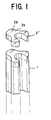
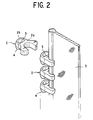
- the coupling elements made of copper or a copper alloy are generally formed by sequentially cutting a multiplicity of coupling element blanks 2' of a prescribed thickness from a linear material 1 made of copper or a copper alloy and possessed of a prescribed sectional shape conforming to the shape of coupling elements as illustrated in Fig. 1 and then imparting meshing or engaging depressions 3 and meshing or engaging projections 4 by the forming punch to the opposite faces of the coupling element blanks as illustrated in Fig. 2 and the coupling elements 2 thus cut and formed are sequentially fixed as spaced with a prescribed interval on the longitudinal edge of a fastener tape 5.
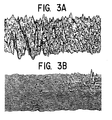
- the chemical polishing treatment generally uses a chemical polishing liquid which contains hydrogen peroxide and sulfuric acid. It is implemented by wholly immersing in the chemical polishing liquid the slide fastener stringers having the coupling elements made of copper or a copper alloy fixed as spaced with a prescribed interval to the longitudinal edges of the fastener tapes. According to this chemical polishing treatment, an oxide is formed on the surfaces of the coupling elements made of copper or a copper alloy and the undulating cutting marks on the outer surfaces of the coupling elements are smoothly flattened when the oxide is dissolved by the acid.
- Such mechanical means as punches and dies are used when the multiplicity of coupling element blanks are cut from the linear material of copper or a copper alloy and the meshing depressions and meshing projections are formed on the surfaces of the coupling element blanks with a forming punch.
- cutting oil and machine oil adhere to the outer surfaces of the coupling elements and they tend to impair the evenness of the chemical polishing.
- These coupling elements therefore, must undergo a degreasing treatment with an aqueous alkali solution prior to the chemical polishing treatment. Since the chemical polishing liquid is an acidic liquid, the coupling elements which have undergone the degreasing treatment must be given a neutralizing treatment prior to the chemical polishing treatment.
- the coupling elements made of copper or a copper alloy are chemically polished with a treating liquid containing hydrogen peroxide, they require a step of washing with an acid (pickling step) for the removal of the skin of copper oxide (CuO) which is formed on the outer surfaces of the coupling elements.
- the slide fastener stringers having the coupling elements of copper or a copper alloy are subjected to the chemical polishing treatment, therefore, they need to be first degreased with an alkali, washed with water, neutralized (as with sulfuric acid), washed with water, chemically polished by immersion in the chemical polishing liquid, washed with water, further washed with acid (sulfuric acid), and washed with water.
- the chemical polishing treatment therefore, is problematic in terms of cost because the number of component steps is so large as to boost the cost of materials and the cost of energy required for the steps. Further, the fact that the number of component steps is so large as mentioned above has entrained such problems as discoloring the fastener tapes dyed in advance and deteriorating the materials thereof.
- the chemical polishing treatment by the use of the liquid containing hydrogen peroxide as mentioned above has the problem that the hydrogen peroxide during the treatment undergoes decomposition with evolution of bubbles and the produced bubbles adhere to the outer surfaces of the coupling elements and, as a result, disrupt the evenness of the chemical polishing.
- An object of the present invention is to eliminate the problems encountered by the prior art as mentioned above and provide a method which is capable of producing a slide fastener or stringers of the slide fastener having coupling elements made of copper or a copper alloy, which coupling elements excel in smoothness of outer surface and abounding in gloss, with a very few steps as compared with the conventional chemical polishing treatment and consequently with high productivity and low cost.
- a further object of the present invention is to provide a method for the production of a slide fastener or stringers thereof which have coupling elements excelling in strength of attachment to the fastener tapes, resistance to corrosion, fastness to rubbing, fastness to laundering, and fastness to solvents and enjoying excellent touch and high gloss and which avoid discoloring the fastener tapes or deteriorating the material thereof.
- Another object of the present invention is to provide a method which is capable of producing a slide fastener or stringers thereof excelling in resistance to corrosion, adhesion of a coating, and weatherability while enabling the rustproofing treatment and/or the coating treatment or the plating treatment as well as the treatment for smoothing the outer faces of coupling elements to be carried out rapidly in a series of steps.
- a method for the production of a slide fastener or stringers thereof comprises: providing a slide fastener or stringer thereof manufactured by cutting and forming a multiplicity of coupling elements from a linear material made of copper or a copper alloy and fixing the coupling elements as spaced with a prescribed interval to the longitudinal edge of a fastener tape; and then immersing the coupling elements of the slide fastener or stringer in an acidic treating liquid containing hydrogen peroxide, sulfuric acid, phosphoric acid, a surfactant, and an aliphatic alcohol to effect acid treatment thereby smoothing the outer surfaces of the coupling elements.
- the method of the present invention may be applied appropriately to coupling elements made of copper or a copper alloy composed of 60 - 100% of Cu, 0 - 35% of Zn, 0 - 15% of Ni, and an inevitable impurity.
- an acidic aqueous solution containing 50 - 250 g/liter of hydrogen peroxide, 10 - 150 g/liter of sulfuric acid, 1 - 5 g/liter of phosphoric acid, 0.01 - 2 g/liter of a surfactant (surface-active agent), and 1 - 100 g/liter of an aliphatic alcohol may be used advantageously.
- the coupling elements of the slide fastener or the stringer thereof which have undergone the aforementioned acid treatment may be immersed in a rustproofing liquid to have the outer surfaces thereof further rustproofed and the rustproofed outer surfaces of the coupling elements may be further subjected to the application of a clear coating.
- the outer surfaces of the coupling elements which have undergone the acid treatment may be further subjected to a plating treatment.
- the method of the present invention for the production of a slide fastener or stringer thereof comprises providing a slide fastener or stringer thereof by cutting and forming a multiplicity of coupling elements from a linear material of copper or a copper alloy and fixing the coupling elements as spaced with a prescribed interval to the longitudinal edge of a fastener tape and then immersing the coupling elements of the slide fastener or stringer in an acidic treating liquid containing hydrogen peroxide, sulfuric acid, phosphoric acid, a surfactant, and an aliphatic alcohol thereby acid treating the outer surfaces of the coupling elements.
- this method of production is characterized by enabling the conventional process, i.e. the series of degreasing, neutralizing, chemically polishing, and pickling steps to be implemented solely by the aforementioned acid treatment.
- the present invention resides in providing a novel method for the treatment of coupling elements made of copper or a copper alloy and used on a slide fastener or stringers thereof, which method differs widely from the concept of the conventional chemical polishing treatment while adopting the principle of chemical polishing as follows in the smoothing treatment of the coupling elements made of copper or a copper alloy.
- the coupling elements made of copper or a copper alloy on exposure to an oxidizing atmosphere, first form the oxide and the formed oxide dissolves in acid as represented by the following reaction formulas (1) - (3), which results in smoothing the surfaces of the coupling elements.
- reaction formulas (1) - (3) which results in smoothing the surfaces of the coupling elements.
- the dissolution rate of the oxide film which is high on the projections and low on the depressions as mentioned above is not easily obtained and the projections and the depressions on the metal surface are inevitably dissolved at the same rate.
- the amount of phosphoric acid incorporated in the treating liquid therefore, is limited below a certain level.
- the concentration of sulfuric acid is increased in an effort to promote the reaction of the formula (3) mentioned above, the treatment fails to obtain a glossy surface of good smoothness.
- the hydrogen peroxide-sulfuric acid-phosphoric acid type treating liquid therefore, requires to keep the sulfuric acid concentration thereof at a low level.
- the sulfuric acid concentration should be kept at a lower level as mentioned above, it is considered that the lower part of the oxide film (close to the metal surface) becomes sparingly susceptible of oxidation and dissolution and consequently the reaction fails to proceed easily not only in the direction of depth but also in the lateral direction in the projections.
- this grease functions as a barrier layer against the reactions mentioned above, with the result that the reaction of formation of the oxide film and the dissolution reaction thereof will be inhibited in the relevant parts.
- the acidic treating liquid to be used in the present invention contains a surfactant (surface-active agent) and an aliphatic alcohol besides hydrogen peroxide, sulfuric acid, and phosphoric acid.
- a surfactant surface-active agent
- an aliphatic alcohol besides hydrogen peroxide, sulfuric acid, and phosphoric acid.
- the aliphatic alcohol has the function to promote the dissolution of the film of copper oxide in the liquid more rapidly on the projections than on the depression of the metal surface besides manifesting the effect in inhibiting the self-decomposition of hydrogen peroxide and stably retaining the composition of the liquid.
- the glossy surface with good smoothness therefore, can be obtained even when the sulfuric acid concentration is heightened.
- the reaction represented by the formula (3) mentioned above proceeds rapidly and the film of copper oxide dissolves in the liquid as soon as it forms and the dissolution reaction of copper oxide on the projections of the metal surface, as coupled with the reaction represented by the formula (4) mentioned above, proceeds rapidly.
- the acidic treating liquid to be used in the present invention starts dissolving the oxide film as soon as the film forms on the metal surface, it is considered that the reactions mentioned above proceed rapidly not only in the direction of depth but also in the lateral direction in the projections. Even when the gaps between the projections are smeared with grease, therefore, it is considered that the polishing of the projections proceeds in concert with the floatation of the grease from the metal surface because the chemical polishing is additionally effected in the lateral direction of the projections. As a result, the adhesion of grease to the metal surface will-not result in impairing the evenness of surface smoothing in the parts smeared with the grease. The presence of the surfactant is believed to function effectively to promote the separation of the grease from the metal surface.
- the acid treatment is capable of imparting to the metal surface a glossy surface with good smoothness without requiring the metal surface to be given a degreasing treatment in advance.
- the reaction rate of the chemical polishing is appreciably heightened and the decomposition of hydrogen peroxide which occurs at this time generates minute bubbles of oxygen and the bubbles adhere to the metal surface. If these bubbles are not promptly removed from the metal surface, the portions of the metal surface covered by the adhering bubbles escape being chemically polished and impair the evenness of surface smoothing (with the result that the metal surface will be coarsened).
- the acidic treating liquid of the present invention contains the surfactant, however, this surfactant has the function to lower the surface tension of the treating liquid and permit abrupt removal of the bubbles adhering to the metal surface.
- the treatment therefore, produces a glossy surface of high quality without impairing the evenness of surface smoothing.
- the coupling elements made of copper or a copper alloy are treated with the acidic treating liquid of the present invention as described above, since the functions of the components of the acidic treating liquid are manifested as extremelyly combined in an organic relation, the sole step of immersion in the acidic treating liquid suffices to smooth very rapidly the cutting marks inflicted on the outer surfaces of the coupling elements while the coupling element blanks are cut and formed from a linear material without requiring the conventional series of degreasing, neutralizing, and pickling steps.
- the treatment therefore, proves extremely advantageous in terms of cost because it allows a slide fastener or stringers thereof having coupling elements excellent in touch and gloss to be manufactured with high productivity and, at the same time, permits a generous cut in the number of steps of process and a great decrease in the cost of material and the cost of energy necessary for the process.
- the acid treatment according to the present invention is attained solely by immersing the given object of treatment in the acidic treating liquid of the present invention and further since the number of steps of process is small, slide fastener stringers having coupling elements can be treated in their continued state and also slide fasteners having stringers of a prescribed length, when demanded by a client who needs to use slide fasteners, can be easily treated by a manual work as set in a suitable jig such as a hanger made of stainless steel.
- a suitable jig such as a hanger made of stainless steel.
- the coupling elements which have undergone the acid treatment of the present invention described above have their outer surfaces further subjected to a rustproofing, a clear coating, or a plating treatment, the ultimate products excel in resistance to corrosion, adhesion of a coat, weatherability, etc.
- the treating liquid does not easily reach the inner faces of the crotches of the coupling elements which embrace the edges of the fastener tapes. Since the inner faces of the crotches of the coupling elements are sparingly chemically polished, the possibility that the strength of attachment of the coupling elements to the fastener tapes will be lowered is nil.
- the step of acid treatment resides in immersing slide fastener stringers or slide fasteners having coupling elements made of copper or a copper alloy in the acidic treating liquid thereby rapidly smoothing the outer surfaces of the coupling elements by oxidation and dissolution and, at the same time, removing the cutting oil and the machine oil adhering to the outer surfaces of the coupling elements.
- this step simultaneously performs the degreasing, chemically polishing, and pickling steps of the conventional chemical polishing treatment.
- the treating time is generally proper in the range of 10 seconds to 3 minutes and the treating temperature is not higher than 50 °C. If the temperature exceeds 50°C, the hydrogen peroxide will be easily decomposed.
- the acidic aqueous solution containing hydrogen peroxide, sulfuric acid, phosphoric acid, a surfactant, and an aliphatic alcohol is used as mentioned above.
- the concentration of hydrogen peroxide is in the range of 50 - 250 g/liter, that of sulfuric acid in the range of 10 - 150 g/liter, that of phosphoric acid in the range of 1 - 5 g/liter, that of the surfactant in the range of 0.01 - 2 g/liter, and that of the aliphatic alcohol in the range of 1 - 100 g/liter.
- concentrations of the components of the acidic treating liquid have been selected in consideration of such factors as the susceptibility of the outer surfaces of the coupling elements to the smoothing treatment, the discoloration of the fastener tapes, and the deterioration of the quality thereof.
- anionic surfactants such as higher alcohol sulfuric ester salts, alkylbenzene sulfonates, alkylnaphthalene sulfonates, formalin-condensed naphthalene sulfonates, dialkyl sulfosuccinates, alkylphosphates, and polyoxyethylene sulfates; cationic surfactants such as alkyl amine salts and polyoxyethylene alkyl amines; nonionic surfactants such as polyoxyethylene alkyl ethers, polyoxyethylene alkylaryl ethers, polyoxyethylene polyoxypropylene ethers, sorbitan fatty acid esters, polyoxyethylene fatty acid esters, fatty acid polyoxyethylene amides, and fatty acid ethanol amides; and ampholytic surfactants such as alkyl betaine may be cited.
- lower aliphatic alcohols or polyhydric alcohols of not more than five carbon atoms such as methyl alcohol, ethyl alcohol, ethylene glycol, and propylene glycol may be cited.
- the coupling elements made of copper or a copper alloy to be treated by the method of the present invention while those made of copper or a copper alloy having the composition mentioned above are invariably usable herein, those made of brass composed of 65 - 100% of Cu, 0 - 35% of Zn, and inevitable impurities and those of German silver composed of 60 - 70% of Cu, 20 - 25% of Zn, 10 - 15% of Ni, and inevitable impurities are favorably usable.
- the tapes manufactured by weaving or knitting fibers of various materials such as polyester, cotton, acetate, nylon, and polyester/cotton mixture (textile blend) can be used.
- polyester or polyester/cotton mixture which manifest resistance to acidic liquids prove to be particularly advantageous because they hardly succumb to discoloration or deterioration of quality when they undergo the treatment of the present invention.
- the fastener tapes made of cotton are possibly discolored, depending on the kind of a dye to be used.
- the dye to be used therefore, must be selected attentively.
- the fastener stringers are subjected to the step of washing with water for the purpose of removing the acidic treating liquid adhering thereto.
- the fastener stringers which have undergone the acid treatment are first deprived of the acidic treating liquid adhering thereto by the method of vacuum dehydration so as to decrease to the fullest possible extent the amount of the acidic treating liquid suffered to enter the washing bath.
- the step of washing with water which is performed after the vacuum dehydration mentioned above can be rapidly and effectively carried out by the cyclic washing of spray washing, dehydration, rinsing by immersion, and dehydration. Some other method of washing by immersion may be adopted instead.
- step of washing with water will be used in the sense of embracing both the vacuum dehydration and the washing with water.
- the coupling elements of the slide fastener stringers which have undergone the step of acid treatment and the step of washing with water may be further subjected to the rustproofing treatment (step of rustproofing + step of washing with water + step of drying) or further to the treatment of clear coating (step of coating + step of drying) or the plating treatment to improve the resistance to corrosion, weatherability, etc. thereof.
- the rustproofing step is a step for preventing the surfaces of the coupling elements already smoothed by the acid treatment mentioned above from forming an oxide again or for improving the adhesiveness of a coat to be produced during the step of clear coating. If the acidic treating liquid remains in the meshing depressions of the coupling elements, it will be concentrated by drying and suffered to impair the fastness of adhesion of a coat to the surfaces of the coupling elements. Where the clear coating is performed at all, the coupling elements are preferred to undergo the rustproofing treatment in advance of the coating treatment..
- This rustproofing step is performed by immersing the coupling elements in or spraying them with a benzotriazole type aqueous solution, a phosphoric ester type aqueous solution, or other rustproofing liquid heretofore known to the art.
- the rustproofing liquid may additionally incorporate therein such a surfactant as mentioned above.
- the concentration of the rustproofing agent in the rustproofing liquid is in the range of 0.1 - 5% by weight. If this concentration is unduly high, the white powder of the rustproofing agent will possibly remain in the gaps between the fibers of the tapes and impair the appearance of the tapes.
- the temperature of treatment is properly not higher than 50 °C, preferably near room temperature, and the duration of treatment is in the approximate range of 10 seconds to one minute.
- the rustproofing step is not necessary when the plating treatment or some other similar treatment is immediately carried out at the next step. It may be omitted when the oxide formed only slightly does not matter for the sake of the subsequent step.
- the plating treatment can be carried out by any of various methods heretofore known to the art.
- the step of washing with water after the rustproofing step may be omitted when the rustproofing agent has no adverse effect on the fastener tapes.
- the drying step is preferred to be carried out at a temperature not exceeding 150 °C, the highest level at which the dyefastness of the fastener tapes is not adversely affected, by the use of hot air or some other heat source.
- the clear coating step is carried out by applying a clear coating material with a roll coater or any other means exclusively to the coupling elements of copper or a copper alloy on the fastener stringers. This treatment is capable of improving the coupling elements in resistance to corrosion.
- the step of drying the coat is carried out in the same manner as the drying step which is performed subsequently to the rustproofing step mentioned above.
- the coupling elements may be waxed for the purpose of allaying the resistance thereof to sliding as is usually performed on standard slide fasteners. This step may be omitted when the resistance to sliding is amply slight.
- a fastener stringer having coupling elements of a copper alloy composed of 85% of Cu and 15% of Zn was given an acid treatment by immersion in an acidic treating liquid kept at 30°C for two minutes.
- an acidic aqueous solution containing 1 g/liter of polyoxyethylene oleyl ether as a surfactant, 80 g/liter of hydrogen peroxide, 20 g/liter of sulfuric acid, 0.5 g/liter of phosphoric acid, and 20 g/liter of methyl alcohol was used.
- the acidic treating liquid contained consequently in the fastener tape was removed by vacuum dehydration for the purpose of facilitating the washing with water at the next step.
- the fastener stringer was vigorously sprayed with water, subjected immediately to vacuum dehydration, immersed in water, and subjected at once to vacuum dehydration.
- the aforementioned step of washing with water consisting of spraying, dehydration, immersion, and dehydration was repeated three times.
- the coupling elements of the fastener stringers could not be tested for glossiness because they were extremely small, i.e. 1 mm in width and 3 mm in length.
- a plate of the copper alloy composed of 85% of Cu and 15% of Zn was subjected to the acid treatment of Example 1 and it was tested for glossiness before and after the acid treatment.
- the test for glossiness was performed by determining a 20-degree specular gloss with a gloss meter produced by Murakami Shikisai Gijutsu Kenkyosho and marketed under product code of "GM-26D” in accordance with JIS (Japanese industrial standards) Z-8741 with necessary modifications.
- the increase in glossiness was found by calculating the difference of glossiness before and after the acid treatment. The results are shown in Table 2. Item Before acid treatment After acid treatment Increase of glossiness Glossiness 337 1089 752
- a fastener stringer having coupling elements of a copper alloy composed of 85% of Cu and 15% of Zn was given an acid treatment by immersion in an acidic treating liquid kept at 30°C for two minutes and then washed with water in the same manner as in Example 1.
- the acidic treating liquid used herein was the same as that used in Example 1.
- the step of washing with water was performed in the same manner as in Example 1.
- the acid treated fastener stringer was rustproofed by immersion in an aqueous solution containing 1 g/liter of 1,1,1-benzotriazole at room temperature for 30 seconds.
- the rustproofed fastener stringer was dehydrated, placed in a drying device, and dried therein by being blown with hot air of 130 °C for three minutes.
- an acryl-urethane type clear coating material was applied with a roll to the obverse surfaces of the coupling elements on the fastener stringer and the applied layer of the coating material was dried with hot air at 110 °C for 10 minutes to effect clear coating.
- the reverse surface of the fastener stringer was similarly subjected to clear coating and the surfaces of the coupling elements were waxed to complete a product.
- the coupling elements of the product of Example 2 were tested for various corrosionproof properties shown in Table 3. The results are shown in Table 3. The numerical values shown in Table 3 represent the ratios (%) of an area sustaining corrosion to the total area of the surfaces of the coupling elements.
- the test for fastness to acidic perspiration and the test for fastness to alkaline perspiration were carried out in accordance with JIS-L-0848 (A process), the salt spray test in accordance with JIS-H-8610, the test for lightfastness in accordance with JIS-L-0841, and the test for weatherability in accordance with JIS-D-0205.
- the sulfur dioxide gas exposure test was carried out by placing in a desiccator a beaker containing 10 ml of an aqueous 35% sodium hydrogen sulfite solution and suspending a sample in the desiccator with a hanger.
- the ammonia gas exposure test was carried out by placing in a desiccator a beaker containing 10 ml of an aqueous 28% ammonia solution and suspending a sample in the desiccator with a hanger.
Landscapes
- Chemical & Material Sciences (AREA)
- Chemical Kinetics & Catalysis (AREA)
- General Chemical & Material Sciences (AREA)
- Engineering & Computer Science (AREA)
- Materials Engineering (AREA)
- Mechanical Engineering (AREA)
- Metallurgy (AREA)
- Organic Chemistry (AREA)
- Chemical Treatment Of Metals (AREA)
- Slide Fasteners (AREA)
Applications Claiming Priority (3)
| Application Number | Priority Date | Filing Date | Title |
|---|---|---|---|
| JP18537496 | 1996-06-27 | ||
| JP185374/96 | 1996-06-27 | ||
| JP18537496A JP3284057B2 (ja) | 1996-06-27 | 1996-06-27 | スライドファスナー又はそのチェーンの製造方法 |
Publications (3)
| Publication Number | Publication Date |
|---|---|
| EP0816532A2 true EP0816532A2 (fr) | 1998-01-07 |
| EP0816532A3 EP0816532A3 (fr) | 1998-01-14 |
| EP0816532B1 EP0816532B1 (fr) | 2001-03-28 |
Family
ID=16169690
Family Applications (1)
| Application Number | Title | Priority Date | Filing Date |
|---|---|---|---|
| EP97304265A Expired - Lifetime EP0816532B1 (fr) | 1996-06-27 | 1997-06-18 | Procédé de polissage d'éléments de fermetures à glissières et procédé de production de fermetures à glissières et rubans |
Country Status (6)
| Country | Link |
|---|---|
| US (1) | US6245251B1 (fr) |
| EP (1) | EP0816532B1 (fr) |
| JP (1) | JP3284057B2 (fr) |
| KR (1) | KR100240219B1 (fr) |
| CN (1) | CN1170494C (fr) |
| DE (1) | DE69704398T2 (fr) |
Cited By (2)
| Publication number | Priority date | Publication date | Assignee | Title |
|---|---|---|---|---|
| WO2001049899A3 (fr) * | 1999-12-30 | 2002-05-02 | Henkel Kgaa | Brillantage/passivation de surfaces metalliques sans risques d'emissions d'oxydes d'azote |
| US6858097B2 (en) | 1999-12-30 | 2005-02-22 | Henkel Kommanditgesellschaft Auf Aktien (Henkel Kgaa) | Brightening/passivating metal surfaces without hazard from emissions of oxides of nitrogen |
Families Citing this family (8)
| Publication number | Priority date | Publication date | Assignee | Title |
|---|---|---|---|---|
| US6419784B1 (en) * | 2000-06-21 | 2002-07-16 | Donald Ferrier | Process for improving the adhesion of polymeric materials to metal surfaces |
| JP2005272875A (ja) * | 2004-03-23 | 2005-10-06 | Ykk Corp | 電解処理方法及び装置 |
| CN102605645A (zh) * | 2011-01-25 | 2012-07-25 | 上海雅运纺织助剂有限公司 | 用于成衣印染加工的金属辅料保护剂及其应用 |
| CN102845936A (zh) * | 2012-04-29 | 2013-01-02 | 无锡金卫星实业有限公司 | 拉链的金属链牙 |
| WO2016103505A1 (fr) | 2014-12-26 | 2016-06-30 | Ykk株式会社 | Composant de fermeture métallique de couleur dorée claire, et fermeture équipée de celui-ci |
| CN104911608B (zh) * | 2015-04-30 | 2017-10-03 | 深圳市联星服装辅料有限公司 | 具有双面颜色效果的金属拉链及其制作方法 |
| CN106555213A (zh) * | 2015-09-25 | 2017-04-05 | Ykk株式会社 | 金属拉链的涂装方法 |
| CN105803438B (zh) * | 2016-05-04 | 2018-08-07 | 深圳市联星服装辅料有限公司 | 一种黑色金属拉链及其制作方法 |
Family Cites Families (11)
| Publication number | Priority date | Publication date | Assignee | Title |
|---|---|---|---|---|
| US3556883A (en) | 1967-07-21 | 1971-01-19 | Mitsubishi Edogawa Kagaku Kk | Method for chemically polishing copper or copper alloy |
| JPS5332339B2 (fr) * | 1973-01-12 | 1978-09-07 | ||
| JPS4998731A (fr) * | 1973-01-30 | 1974-09-18 | ||
| JPS5332340B2 (fr) * | 1973-02-09 | 1978-09-07 | ||
| JPS5286933A (en) * | 1976-01-14 | 1977-07-20 | Tokai Electro Chemical Co | Method of treating surface of copper and copper alloy |
| DE2847267C2 (de) * | 1978-10-31 | 1993-12-23 | Decker Gmbh & Co Kg Geb | Stabilisator für eine wäßrige Lösung zum Beizen und/oder chemischen Glänzen von Gegenständen aus Kupfer oder Kupferlegierungen in einem mehrstufigen Verfahren und Verwendung des Stabilisators |
| US4880495A (en) * | 1987-04-13 | 1989-11-14 | The Harshaw Chemical Company | Regeneration of copper etch bath |
| US4859281A (en) * | 1987-06-04 | 1989-08-22 | Pennwalt Corporation | Etching of copper and copper bearing alloys |
| JP2909743B2 (ja) * | 1989-03-08 | 1999-06-23 | 富山日本電気株式会社 | 銅または銅合金の化学研磨方法 |
| US5630950A (en) * | 1993-07-09 | 1997-05-20 | Enthone-Omi, Inc. | Copper brightening process and bath |
| KR950005232A (ko) * | 1993-08-21 | 1995-03-20 | 한금섭 | 광택 연마 처리된 슬라이더 파스너 체인 및 그의 제조방법 |
-
1996
- 1996-06-27 JP JP18537496A patent/JP3284057B2/ja not_active Expired - Fee Related
-
1997
- 1997-06-18 EP EP97304265A patent/EP0816532B1/fr not_active Expired - Lifetime
- 1997-06-18 DE DE69704398T patent/DE69704398T2/de not_active Expired - Lifetime
- 1997-06-25 US US08/882,255 patent/US6245251B1/en not_active Expired - Lifetime
- 1997-06-26 CN CNB971139989A patent/CN1170494C/zh not_active Expired - Lifetime
- 1997-06-27 KR KR1019970028063A patent/KR100240219B1/ko not_active Expired - Fee Related
Cited By (2)
| Publication number | Priority date | Publication date | Assignee | Title |
|---|---|---|---|---|
| WO2001049899A3 (fr) * | 1999-12-30 | 2002-05-02 | Henkel Kgaa | Brillantage/passivation de surfaces metalliques sans risques d'emissions d'oxydes d'azote |
| US6858097B2 (en) | 1999-12-30 | 2005-02-22 | Henkel Kommanditgesellschaft Auf Aktien (Henkel Kgaa) | Brightening/passivating metal surfaces without hazard from emissions of oxides of nitrogen |
Also Published As
| Publication number | Publication date |
|---|---|
| HK1004095A1 (en) | 1998-11-20 |
| DE69704398T2 (de) | 2001-08-30 |
| CN1173306A (zh) | 1998-02-18 |
| EP0816532B1 (fr) | 2001-03-28 |
| JP3284057B2 (ja) | 2002-05-20 |
| JPH1018046A (ja) | 1998-01-20 |
| KR100240219B1 (ko) | 2000-01-15 |
| US6245251B1 (en) | 2001-06-12 |
| DE69704398D1 (de) | 2001-05-03 |
| EP0816532A3 (fr) | 1998-01-14 |
| CN1170494C (zh) | 2004-10-13 |
Similar Documents
| Publication | Publication Date | Title |
|---|---|---|
| EP0816532B1 (fr) | Procédé de polissage d'éléments de fermetures à glissières et procédé de production de fermetures à glissières et rubans | |
| US3140203A (en) | Method of and composition for treating aluminum and aluminum alloys | |
| US3368913A (en) | Process for the treatment of metal surfaces prior to enameling | |
| US4496404A (en) | Composition and process for treatment of ferrous substrates | |
| US4149912A (en) | Process for treating aluminum and aluminum alloy surfaces | |
| EP0053351A1 (fr) | Procédé pour former un revêtement protecteur à la surface des éléments constitutifs d'une fermeture à glissière fabriqués en aluminium | |
| US3653931A (en) | Anti-tarnish composition for metal surfaces and process for its use | |
| CA1160981A (fr) | Sechage d'une surface metallique a l'aide d'un sel d'acide carboxylique aliphatique | |
| US4617068A (en) | Composition and process for treatment of ferrous substrates | |
| CN1944716B (zh) | 凸点形成用非氰系电解镀金浴 | |
| US2548419A (en) | Method for production of lustrous zinc | |
| EP0352399B1 (fr) | Procédé de post-traitement chimique de surfaces de bandes en acier | |
| JPS6320489A (ja) | めつきの剥離方法 | |
| HK1004095B (en) | Method for production of slide fastener or stringers thereof | |
| US2353019A (en) | Method of etching steel | |
| JPS62109997A (ja) | 弁金属の陽極酸化前処理方法 | |
| US3736157A (en) | Electroless copper tin plating solution and process | |
| JPH0824012A (ja) | 光沢研磨処理されたスライドファスナーチェーン及びその製造方法 | |
| US3380921A (en) | Process for desmutting metal | |
| US2836548A (en) | Surface treatment of metallic uranium | |
| JPS61174390A (ja) | アルミニウム又はアルミニウム合金の表面処理方法 | |
| US6200942B1 (en) | Cleaning composition | |
| JP2807359B2 (ja) | 錫を含む銅合金材のめっき方法 | |
| US3639646A (en) | Anti-tarnish process using dicyandiamide formaldehyde condensation product | |
| DE2054090C3 (de) | Verfahren zum Einschichtemaillieren von Bändern und Blechen. Ausscheidung aus: 2016989 |
Legal Events
| Date | Code | Title | Description |
|---|---|---|---|
| PUAI | Public reference made under article 153(3) epc to a published international application that has entered the european phase |
Free format text: ORIGINAL CODE: 0009012 |
|
| PUAL | Search report despatched |
Free format text: ORIGINAL CODE: 0009013 |
|
| AK | Designated contracting states |
Kind code of ref document: A2 Designated state(s): DE FR GB IT |
|
| AK | Designated contracting states |
Kind code of ref document: A3 Designated state(s): AT BE CH DE DK ES FI FR GB GR IE IT LI LU MC NL PT SE |
|
| 17P | Request for examination filed |
Effective date: 19980402 |
|
| 17Q | First examination report despatched |
Effective date: 19980615 |
|
| AKX | Designation fees paid |
Free format text: DE FR GB IT |
|
| RBV | Designated contracting states (corrected) |
Designated state(s): DE FR GB IT |
|
| GRAG | Despatch of communication of intention to grant |
Free format text: ORIGINAL CODE: EPIDOS AGRA |
|
| RTI1 | Title (correction) |
Free format text: METHOD FOR POLISHING SLIDE FASTENER ELEMENTS AND PROCEES FOR PRODUCING SLIDE FASTENER OR STRINGERS THEREOF |
|
| GRAG | Despatch of communication of intention to grant |
Free format text: ORIGINAL CODE: EPIDOS AGRA |
|
| GRAH | Despatch of communication of intention to grant a patent |
Free format text: ORIGINAL CODE: EPIDOS IGRA |
|
| GRAH | Despatch of communication of intention to grant a patent |
Free format text: ORIGINAL CODE: EPIDOS IGRA |
|
| GRAA | (expected) grant |
Free format text: ORIGINAL CODE: 0009210 |
|
| AK | Designated contracting states |
Kind code of ref document: B1 Designated state(s): DE FR GB IT |
|
| ET | Fr: translation filed | ||
| REF | Corresponds to: |
Ref document number: 69704398 Country of ref document: DE Date of ref document: 20010503 |
|
| ITF | It: translation for a ep patent filed | ||
| REG | Reference to a national code |
Ref country code: GB Ref legal event code: IF02 |
|
| PLBE | No opposition filed within time limit |
Free format text: ORIGINAL CODE: 0009261 |
|
| STAA | Information on the status of an ep patent application or granted ep patent |
Free format text: STATUS: NO OPPOSITION FILED WITHIN TIME LIMIT |
|
| 26N | No opposition filed | ||
| PGFP | Annual fee paid to national office [announced via postgrant information from national office to epo] |
Ref country code: GB Payment date: 20140618 Year of fee payment: 18 |
|
| PGFP | Annual fee paid to national office [announced via postgrant information from national office to epo] |
Ref country code: DE Payment date: 20140611 Year of fee payment: 18 |
|
| PGFP | Annual fee paid to national office [announced via postgrant information from national office to epo] |
Ref country code: FR Payment date: 20140609 Year of fee payment: 18 |
|
| REG | Reference to a national code |
Ref country code: DE Ref legal event code: R119 Ref document number: 69704398 Country of ref document: DE |
|
| GBPC | Gb: european patent ceased through non-payment of renewal fee |
Effective date: 20150618 |
|
| REG | Reference to a national code |
Ref country code: FR Ref legal event code: ST Effective date: 20160229 |
|
| PG25 | Lapsed in a contracting state [announced via postgrant information from national office to epo] |
Ref country code: DE Free format text: LAPSE BECAUSE OF NON-PAYMENT OF DUE FEES Effective date: 20160101 Ref country code: GB Free format text: LAPSE BECAUSE OF NON-PAYMENT OF DUE FEES Effective date: 20150618 |
|
| PG25 | Lapsed in a contracting state [announced via postgrant information from national office to epo] |
Ref country code: FR Free format text: LAPSE BECAUSE OF NON-PAYMENT OF DUE FEES Effective date: 20150630 |
|
| PGFP | Annual fee paid to national office [announced via postgrant information from national office to epo] |
Ref country code: IT Payment date: 20160621 Year of fee payment: 20 |