EP0817465A1 - Fehlerdiffusionsverfahren mit symmetrischer Verbesserung - Google Patents
Fehlerdiffusionsverfahren mit symmetrischer Verbesserung Download PDFInfo
- Publication number
- EP0817465A1 EP0817465A1 EP97304624A EP97304624A EP0817465A1 EP 0817465 A1 EP0817465 A1 EP 0817465A1 EP 97304624 A EP97304624 A EP 97304624A EP 97304624 A EP97304624 A EP 97304624A EP 0817465 A1 EP0817465 A1 EP 0817465A1
- Authority
- EP
- European Patent Office
- Prior art keywords
- image
- signals
- threshold
- signal
- levels
- Prior art date
- Legal status (The legal status is an assumption and is not a legal conclusion. Google has not performed a legal analysis and makes no representation as to the accuracy of the status listed.)
- Granted
Links
- 238000009792 diffusion process Methods 0.000 title claims abstract description 36
- 238000000034 method Methods 0.000 claims abstract description 39
- 238000012545 processing Methods 0.000 claims abstract description 17
- 230000008569 process Effects 0.000 claims description 14
- 230000004044 response Effects 0.000 claims description 10
- 238000001914 filtration Methods 0.000 claims description 6
- 238000001228 spectrum Methods 0.000 claims description 6
- 238000012937 correction Methods 0.000 abstract description 5
- 230000006870 function Effects 0.000 description 30
- 238000004422 calculation algorithm Methods 0.000 description 12
- 239000011159 matrix material Substances 0.000 description 6
- 238000013139 quantization Methods 0.000 description 6
- 230000000694 effects Effects 0.000 description 5
- 230000003287 optical effect Effects 0.000 description 5
- 230000001419 dependent effect Effects 0.000 description 4
- 230000003044 adaptive effect Effects 0.000 description 3
- 238000010586 diagram Methods 0.000 description 3
- 238000004364 calculation method Methods 0.000 description 2
- 230000001364 causal effect Effects 0.000 description 2
- 238000006243 chemical reaction Methods 0.000 description 2
- 239000003086 colorant Substances 0.000 description 2
- 238000003384 imaging method Methods 0.000 description 2
- 238000004519 manufacturing process Methods 0.000 description 2
- 238000012986 modification Methods 0.000 description 2
- 230000004048 modification Effects 0.000 description 2
- 238000004886 process control Methods 0.000 description 2
- 238000000926 separation method Methods 0.000 description 2
- 240000005002 Erythronium dens canis Species 0.000 description 1
- 206010027146 Melanoderma Diseases 0.000 description 1
- 230000004075 alteration Effects 0.000 description 1
- 238000004458 analytical method Methods 0.000 description 1
- 238000013459 approach Methods 0.000 description 1
- 230000003247 decreasing effect Effects 0.000 description 1
- 238000013461 design Methods 0.000 description 1
- 230000006872 improvement Effects 0.000 description 1
- 230000001939 inductive effect Effects 0.000 description 1
- 230000001788 irregular Effects 0.000 description 1
- 238000003672 processing method Methods 0.000 description 1
- 230000009467 reduction Effects 0.000 description 1
- 239000013643 reference control Substances 0.000 description 1
- 230000003252 repetitive effect Effects 0.000 description 1
- 238000012216 screening Methods 0.000 description 1
- 230000003595 spectral effect Effects 0.000 description 1
- 238000010561 standard procedure Methods 0.000 description 1
- 230000001629 suppression Effects 0.000 description 1
- 238000012546 transfer Methods 0.000 description 1
- 230000001131 transforming effect Effects 0.000 description 1
- 230000007704 transition Effects 0.000 description 1
Images

Classifications
-
- H—ELECTRICITY
- H04—ELECTRIC COMMUNICATION TECHNIQUE
- H04N—PICTORIAL COMMUNICATION, e.g. TELEVISION
- H04N1/00—Scanning, transmission or reproduction of documents or the like, e.g. facsimile transmission; Details thereof
- H04N1/40—Picture signal circuits
- H04N1/405—Halftoning, i.e. converting the picture signal of a continuous-tone original into a corresponding signal showing only two levels
- H04N1/4051—Halftoning, i.e. converting the picture signal of a continuous-tone original into a corresponding signal showing only two levels producing a dispersed dots halftone pattern, the dots having substantially the same size
- H04N1/4052—Halftoning, i.e. converting the picture signal of a continuous-tone original into a corresponding signal showing only two levels producing a dispersed dots halftone pattern, the dots having substantially the same size by error diffusion, i.e. transferring the binarising error to neighbouring dot decisions
- H04N1/4053—Halftoning, i.e. converting the picture signal of a continuous-tone original into a corresponding signal showing only two levels producing a dispersed dots halftone pattern, the dots having substantially the same size by error diffusion, i.e. transferring the binarising error to neighbouring dot decisions with threshold modulated relative to input image data or vice versa
Definitions
- the present invention relates generally to error diffusion method with symmetric enhancement for the representation of digital image data, and in particular, to the binary or multilevel representation of images for display purposes.
- Image information is commonly generated in a bitmap format where the bitmap comprises a plurality of gray level pixels, i.e. pixels that are defined by digital values, each value representing a gray level among a number of gray levels.
- bitmap comprises a plurality of gray level pixels, i.e. pixels that are defined by digital values, each value representing a gray level among a number of gray levels.
- 256 levels of gray are present, where each level represents an increment of gray between black and white.
- color bitmaps where three defining colors or separations each include 256 levels of information, there may be more than 16 million colors defined by gray bitmaps.
- bitmaps in such a gray level format are unprintable by standard printers.
- Standard printers print in a limited number of levels, either a spot or a no spot in the binary case, or a limited number of levels associated with the spot, for example, four in the quaternary case. Accordingly, it is necessary to reduce the gray level image data to a limited number of levels so that it is printed.
- gray level information derived by scanning computer graphics processes and other image processing methods may produce gray level images for reproduction.
- One standard method of converting gray level pixel values to binary level pixel values is through the use of dithering or halftoning processes.
- each pixel value of an array of gray level pixels within the area is compared to one of a set of preselected thresholds (the thresholds are stored as a dither matrix and the repetitive pattern generated by this matrix is considered a halftone cell) as described, for example, in US-A-4 149 194.
- the effect of such an arrangement is that, for an area where the image is gray, some of the thresholds within the dither matrix will be exceeded, i.e. the image value at that specific location is larger than the value stored in the dither matrix for that same location, while others are not.
- the pixels or cell elements for which the thresholds are exceeded might be printed as black, while the remaining elements are allowed to remain white, dependent on the actual physical quantity described by the data.
- the effect of the distribution of black and white over the halftone cell is integrated by the human eye as gray.
- Dithering or halftoning presents problems, however, in that the amount of gray within an original image is not maintained exactly over an area, because the finite number of elements inside each dither matrix - and therefore halftone cell - only allows the reproduction of a finite number of gray levels, i.e. number of elements in the cell plus one, or less.
- the error arising from the difference between the output pixel value and the actual gray level pixel value at any particular cell is simply thrown away. This results in a loss of image information.
- dithering introduces coarse quantization artifacts which are visible in the image areas where the scene has little variation. This is also known as “banding", and is caused by the limited number of output gray levels available.
- the "banding" artifacts generally increase with decreasing cell size, which is identical to a decrease in the number of levels that can be represented by the halftone cell.
- image information initially has a set of halftone screen values for a cell added to the information.
- a uniform threshold value is applied to the screened information, to produce an output value.
- the average gray value over the cell area of the input image is compared to the average gray value over the cell area of the output image. This is also described in US-A 4 051 536 and US-A 4 633 327. In this way, the error between original and output is minimized over each halftone cell. The banding artifact, however, is not reduced.
- US-A 5 055 942 suggests another pixel based error diffusion scheme where the tendency of the individual dots to form clusters in a screened image can be varied by applying a hysteresis constant and recursion techniques known from adaptive screening, to allow adjustment of image coarseness by adjustment of the hysteresis constant.
- This method produces better images, particularly for electrophotographic printing than the original error diffusion algorithm, but the images tend to have reduced sharpness or detail resolution, as compared to Floyd and Steinberg.
- the method described in US-A-5 055 942 uses an error diffusion process, providing a feedback response based on the output image, and particularly, dot size. The resulting irregular placement of dots improves the number of gray shades which can be reproduced.
- the hysteresis function implemented to control the feedback response tends to dampen the response at edges.
- US-A-4 625 222 discloses a print enhancement control system for an electrostatic copying machine wherein control logic circuitry processes a set of image altering parameters to improve image production quality. These parameters, whose values are either predetermined, fixed or have been received from an exterior source, improve image quality (i.e., resolution) by modifying modulated gray signals.
- US-A-4 700 229 discloses an image enhancement circuit which converts a low quality image signal into a high quality image signal by modifying the binary representation of a picture.
- Image enhancement is accomplished by multiplying a series of error difference signals by a series of weighting factors k(i) which produce a clearer image by improving picture resolution.
- US-A-4 672 463 discloses a method to improve image quality within an electrostatic reproduction machine wherein the sharpness of an image is improved based on the value of an image sharpness control parameter that has been calculated examining the copy quality of an original.
- US-A-4 709 250 discloses an image forming apparatus which improves the halftone image quality of an original.
- the pulse width of a reference control signal controls and improves image quality in response to a detected image density signal.
- US-A-4 256 401 discloses an image density adjustment method wherein a predetermined image density level within an electrostatic copying machine is maintained at a standard density by varying a set of input control parameters.
- US-A-4 693 593 discloses a method of improving the image quality by controlling a single process parameter in response to changes in sensitometric characteristics of an image transfer member.
- Modifications to the Floyd and Steinberg algorithm may, as shown by Billotet-Hoffman and Bryngdahl in the Proceedings of the Society for Information Display, Volume 24, 1983, "On the Error Diffusion Technique for Electronic Halftoning", include a varying threshold, a dither, instead of a fixed threshold.
- the adaptive nature of the Floyd and Steinberg algorithm automatically provides a sharp, edge-enhanced appearance which, while visually appealing, may not necessarily be desirable in the output image.
- a difficulty with the Floyd and Steinberg error diffusion algorithm is that an inherent edge enhancement is built into the algorithm.
- Analysis of the output of the Floyd and Steinberg error diffusion algorithm illustrates a characteristic overshoot (too dark or too light) at upward and downward transitions, or steps, in the continuous tone digital image data.
- continuous tone refers to input data that has been quantized to a larger number of discrete values than intended for the output data.
- US-A-5 045 952 serves to provide some image dependent edge enhancement.
- US-A-5 045 952 describes a method of dynamically adjusting the threshold level of an error diffusion algorithm to selectively control the amount of edge enhancement introduced into the encoded output.
- the threshold level is selectively modified on a pixel by pixel basis and may be used to increase or decrease the edge enhancement of the output digital image, thus, more closely representing the original detail and edge sharpness of the continuous tone input image.
- a method of processing electronic images defined in terms of image signals each image signal representing density at a discrete position within the electronic image, and quantizing image signals defined at "c" gray levels for use in a device requiring image signals defined at “d” levels, where c ⁇ d
- the method comprising: receiving at least a portion of the electronic image as input signals; adding error signals determined from any previous thresholding processing to said input signals to generate corrected input signals; receiving corrected image signals defined at "c" levels, and quantizing said corrected image signals to "d” levels, by comparison to a threshold signal and outputting said corrected image signals at "d” levels as output signals; outputting output signals defined at "d” levels; generating a difference signal representative of the difference in image density between corresponding corrected input signals and the output signal; receiving said difference signals, and directing weighted portions thereof to said error adding circuit for addition to subsequent image signals in a predetermined spatial relationship to the input signals; and varying the threshold signal proportionally to the input image, and recurs
- a processing system for processing electronic images defined in terms of image signals, each image signal representing density at a discrete position within the electronic image, and quantizing image signals defined at "c” gray levels for use in a device requiring image signals defined at “d” levels, where “d” may be less than or equal to “c”, said system comprising: an image input receiving at least a portion of the electronic image as input signals; an error adding circuit, adding error signals determined from any previous thresholding processing to said input signals to generate corrected input signals; a thresholding processor, receiving corrected image signals defined at "c” levels, and quantizing said corrected image signals to "d” levels, by comparison to at least one threshold signal and outputting said corrected image signals at "d” levels as output signals; an image output, outputting output signals defined at "d” levels; a differencing circuit, generating a difference signal representative of the difference in image density between corresponding corrected input signals and the output signal; an error distribution circuit, receiving said difference signals, and directing weighted portions thereof to said
- the invention provides an operation that effectively cancels the asymmetric edge enhancement of the edge enhanced error diffusion of US-A-5 045 952 and substitutes a more desirable symmetric edge enhancement.
- Yet another aspect of the invention is the use of edge enhanced error diffusion to do symmetric edge enhancement on continuous tone images, including non-halftoning processes.
- edge enhanced error diffusion rather than quantizing pixels from M levels to N levels, where M>N, the process may simply convert pixels from one appearance to another while retaining the same number of levels.
- US-A-5 363 209 an example of an edge enhancement error diffusion processor is illustrated, without requiring quantization to a lower number of levels defining each image signal or pixel.
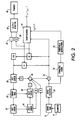
- gray level image data from image input terminal (hereinafter, IIT) 1 may be characterized as image data or pixels, each pixel of which is defined at a single level or optical density in a set of 'c' optical density magnitudes or levels, the number of members in the set of levels often being larger than desired.
- the number of desired levels is given by the capabilities of printer 4, or by other system considerations.
- IPU 2 image processing unit 2 in the manner described hereinbelow, which has a halftoning processing 3 to redefine each pixel in terms of a new, possibly smaller set of 'd' magnitudes or levels.
- 'c' and 'd' are integer values representing pixel depth representing the magnitude of density.
- color data may be represented by a number of independent channels or separations which are handled independently, or the color data might be represented as vector data in a predefined color space, e.g. RGB, ClELab etc., being submitted to vector operations in the thresholding, error calculation and correction.
- One common case of this method includes the conversion of data from a relatively large set of gray level values to one of two legal or allowed bin values for printing in a binary printer 4.
- Another case of this is the conversion of data from a relatively large set of color data expressed as red, green and blue, or cyan, magenta, yellow and black, to one of five legal bin values for printing on printer 4, as described in US-A-5 317 653.
- edge enhanced error diffusion to do edge enhancement on continuous tone images, including non-halftoning processes.
- the process may simply convert pixels from one appearance to another while retaining the same number of levels.
- An input image of the type to be processed as hereinafter described may be represented by a set of gray values (gray level pixels) arranged in an array of L lines, each line containing N gray values with depth b, with any one pixel in said array denoted by l(n,l).
- Gray values are typically expressed as integers, with one example falling in the range from 0 to 255, although greater or lesser number of levels, as well as non-integer representations, are possible.
- An output image is considered to consist of pixels, each pixel corresponding to an output element that is printed by a digital printer or display. Gray does not refer to a specific color herein, but to a gradation of optical density.
- a stored array of input image signals at input RAM 8 which may be from any image, including scanned images from a scanner 9 such as the Xerox 7650 Pro Imager or DocuSP scanner operated in accordance with suitable driver software or computer generated representations, directs input image I into the system on a signal by signal basis, where n,l represents the position of a single image signal l(n,l) in a stream of image signals.
- a scanner 9 such as the Xerox 7650 Pro Imager or DocuSP scanner operated in accordance with suitable driver software or computer generated representations, directs input image I into the system on a signal by signal basis, where n,l represents the position of a single image signal l(n,l) in a stream of image signals.
- Such a scanner produces gray level signals or pixels, generally defined as multi-bit or N bit values, which define 2 N possible levels of optical density.
- (n,l) refers in this description to both the signal that is positioned at n,l in the image signal stream, and the optical intensity or density of the image signal at position n,l.
- a single signal l(n,l) is stored to input register 10 suitable for holding such a multi-bit signal.
- Each input signal has a corresponding error correction signal ⁇ added to the image signal l(n,l) at adder 12, where ⁇ (n,l) is a sum of weighted error term signals of previous pixels to be added to l(n,l) resulting in a modified image signal.
- the modified image signal the sum of the input image signal and the error correction signal of previous pixels (l(n,l) + ⁇ (n,l)), is passed to threshold comparator 14 to determine the corresponding output state Si, where the drawing shows the case for two output states S1 and S2 for simplicity, although more output levels are possible.
- signal l(n,l) + ⁇ (n,l) is less than the reference, then an image signal representing a single black spot is directed to output register 18 from RAM memory 22. If a white pixel is directed to output register 18, switch S1 is enabled to allow the modified input image signal l(n,l) + ⁇ (n,l) to be stored to error register 30 without alteration. If a black pixel is directed to output register 18, switch S2 is enabled to allow the modified input image signal l(n,l) + ⁇ (n,l) to be stored to error register 30, after having a value equal to black (- 255 in the 8 bit case) subtracted from the signal.
- Pixels stored to output register 18 are eventually output as printer output signals required by the imaging application, for example, binary printer 40.
- the printer can be any binary printer, for example, the Xerox 4011 Printer (simple, low speed printer) or the Xerox DocuTech Model Production Printer 135 (a very complex, high speed printer).
- Error determined in the quantization of pixels is stored at error RAM 32, until an image signal which requires the addition of error passes through the system. Then, the portion of the stored errors from previous quantization is directed to adder 50 from past error registers 52, 54, 56 and error register 30. Error registers 52, 54, 56 are connected to allow the error signal to be shifted from register to register as a line of data is directed through the described system. Error signals are directed through multipliers A, B, C and D respectively, in accordance with Floyd and Steinberg type error diffusion, with a weighting scheme selected as desired. Note that the use of four error signals is for illustrative purposes only and that lesser or larger numbers might be used in the actual implementation.
- input image signal l(n,l), stored at input register 10 is directed to threshold modulation processor 70, as will be described further hereinbelow.
- threshold modulation a spatially varying function is subtracted from the threshold (or equivalently, added to the input image). It can be shown that the process of modulating the threshold in this manner produces an output image that is exactly equal to the image produced by pre-filtering the input image and processing it with standard error diffusion.
- This equivalence is taught by K. Knox and R. Eschbach in "Threshold Modulation in Error Diffusion", J. Electronic Imaging, pp. 185-192, July 1993. The following description is shown using one-dimensional functions, but the extension to two-dimensional functions is clear.
- the equivalent input image l e (u) is an enhanced version on the input image, which has had its high spatial frequencies boosted by the filter F(u).
- the only difficulty is that because F(u) is asymmetric, the enhancement is asymmetric.
- T(u) cl(u) S(u)/F(u)
- the key to producing the threshold function shown in equation (2) is to apply the symmetric filter S(u), to the raw input image, and the asymmetric filter F(u) to the existing threshold modulation function.
- F(u)T(u) cl(u) S(u)
- the edge enhancement constant, c is assumed to be unity.
- the threshold function is multiplied by c, at a later step.
- t(x,y) i(x,y) - ⁇ nm i(x - m ⁇ x, y - n ⁇ y)+ ⁇ nm t(x, m ⁇ x, y - n ⁇ y)
- ⁇ nm and ⁇ nm are the two-dimensional coefficients for the symmetric filter, S(u) and the asymmetric error diffusion filter, F(u) respectively.
- the threshold function, t(x) is determined from a symmetric filtering of input image data and an asymmetric filtering of the threshold function itself.
- the symmetric filter may be both forward and backward looking.
- the asymmetric filter needs only to be backward looking, since its purpose is to cancel out the effects of the asymmetric error diffusion filter.
- the enhancement may be adjusted by multiplying the threshold function by the constant, c. If this constant is zero, then there will be no edge enhancement induced in the output image.
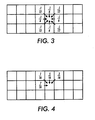
- Figure 3 shows the symmetric filter coefficients that are applied to the raw input image.
- Figure 4 shows the asymmetric filter coefficients that are applied to the threshold filter. Note that the symmetric filter is non causal and requires knowledge of the image ahead of the current scan line. This is easily accomplished with an internal scanline buffer. On the other hand, the filter effected by the error diffusion process is causal and does not require knowledge of the filtered threshold modulation function ahead of the current scanline.
- the threshold modulation function can be altered to meet the requirement of generating threshold values that cancel the asymmetrical response of the standard error diffusion filter.
- block 70 provides a threshold modulation function that will cancel the asymmetric effects of the error diffusion process.
- the function t(x,y) is dependent on the image input i(x,y), and, because the function is recursive, is dependent on prior thresholds determined for neighboring pixels.
- a scanline buffer is assumed to be internal to symmetric filter function 74, for holding upcoming image input data
- a second scanline buffer is assumed to be internal to threshold modulation function 70, for storing prior threshold determinations.
- the disclosed method may be readily implemented in software using object oriented software development environments that provide portable source code that can be used on a variety of computer or workstation hardware platforms.
- the disclosed data or structured document processing system may be implemented partially or fully in hardware using standard logic circuits or specifically on a single chip using VLSI design. Whether software or hardware is used to implement the system varies depending on the speed and efficiency requirements of the system and also the particular function and the particular software or hardware systems and the particular microprocessor or microcomputer systems being utilized.
- the document processing system can be readily developed by those skilled in the applicable arts without undue experimentation from the functional description provided herein together with a general knowledge of the computer arts.
Landscapes
- Engineering & Computer Science (AREA)
- Multimedia (AREA)
- Signal Processing (AREA)
- Image Processing (AREA)
- Facsimile Image Signal Circuits (AREA)
- Dot-Matrix Printers And Others (AREA)
Applications Claiming Priority (2)
| Application Number | Priority Date | Filing Date | Title |
|---|---|---|---|
| US671479 | 1996-06-27 | ||
| US08/671,479 US5668638A (en) | 1996-06-27 | 1996-06-27 | Error diffusion method with symmetric enhancement |
Publications (2)
| Publication Number | Publication Date |
|---|---|
| EP0817465A1 true EP0817465A1 (de) | 1998-01-07 |
| EP0817465B1 EP0817465B1 (de) | 2002-05-15 |
Family
ID=24694696
Family Applications (1)
| Application Number | Title | Priority Date | Filing Date |
|---|---|---|---|
| EP97304624A Expired - Lifetime EP0817465B1 (de) | 1996-06-27 | 1997-06-27 | Fehlerdiffusionsverfahren mit symmetrischer Verbesserung |
Country Status (4)
| Country | Link |
|---|---|
| US (1) | US5668638A (de) |
| EP (1) | EP0817465B1 (de) |
| JP (1) | JP3973734B2 (de) |
| DE (1) | DE69712572T2 (de) |
Families Citing this family (20)
| Publication number | Priority date | Publication date | Assignee | Title |
|---|---|---|---|---|
| US6011878A (en) * | 1996-09-26 | 2000-01-04 | Canon Kabushiki Kaisha | Image processing method and apparatus |
| KR100251551B1 (ko) * | 1997-03-06 | 2000-04-15 | 구자홍 | 디지탈영상양자화를위한비인과성오차확산계수의위치및결정방법 |
| US6006011A (en) * | 1997-09-03 | 1999-12-21 | International Business Machines Corporation | Target patterns controlled error management |
| US5991513A (en) * | 1997-09-30 | 1999-11-23 | Levien; Raphael L | Method and apparatus for suppressing moire patterns |
| JP3747643B2 (ja) * | 1998-08-07 | 2006-02-22 | コニカミノルタホールディングス株式会社 | 傾き補正装置及び画像読取装置 |
| JP4053185B2 (ja) * | 1999-06-22 | 2008-02-27 | 富士フイルム株式会社 | 画像処理方法および装置 |
| US6753978B1 (en) | 1999-09-22 | 2004-06-22 | Sharp Laboratories Of America, Inc. | Higher order error diffusion of digital halftoning |
| DE60001143T2 (de) * | 1999-10-29 | 2003-10-16 | Ricoh Co., Ltd. | Bildverarbeitungsvorrichtung und -verfahren und Aufzeichnungsmedium |
| US6614556B1 (en) | 1999-11-22 | 2003-09-02 | Sindoricoh Co., Ltd. | Apparatus for quantizing a digital image by using an error diffusion coefficient and threshold modulation in zigzag quantization |
| US6707576B1 (en) | 1999-12-02 | 2004-03-16 | Sharp Laboratories Of America, Inc. | Noise modulation error diffusion of digital halftoning |
| US6999202B2 (en) | 2001-03-27 | 2006-02-14 | Polaroid Corporation | Method for generating a halftone of a source image |
| US6937365B2 (en) * | 2001-05-30 | 2005-08-30 | Polaroid Corporation | Rendering images utilizing adaptive error diffusion |
| US6906736B2 (en) | 2002-02-19 | 2005-06-14 | Polaroid Corporation | Technique for printing a color image |
| JP4095423B2 (ja) * | 2002-12-06 | 2008-06-04 | キヤノン株式会社 | 画像処理装置、画像データ処理方法、記憶媒体、プログラム |
| US7283666B2 (en) | 2003-02-27 | 2007-10-16 | Saquib Suhail S | Digital image exposure correction |
| US8773685B2 (en) | 2003-07-01 | 2014-07-08 | Intellectual Ventures I Llc | High-speed digital image printing system |
| US7265872B2 (en) * | 2003-10-15 | 2007-09-04 | International Business Machines Corporation | Error diffusion with averaged directional biases |
| DE602005025677D1 (de) | 2004-11-03 | 2011-02-10 | Koninkl Philips Electronics Nv | Programmierbare datenverarbeitungsschaltung, die simd-befehle unterstützt |
| US7639887B2 (en) * | 2004-12-14 | 2009-12-29 | Intel Corporation | Error diffusion-based image processing |
| US7731342B2 (en) * | 2006-07-21 | 2010-06-08 | Xerox Corporation | Image correction system and method for a direct marking system |
Citations (4)
| Publication number | Priority date | Publication date | Assignee | Title |
|---|---|---|---|---|
| US4319268A (en) * | 1979-07-02 | 1982-03-09 | Dainippon Screen Seizo Kabushiki Kaisha | Reproduction picture sharpness emphasizing method |
| US5014333A (en) * | 1988-07-21 | 1991-05-07 | Eastman Kodak Company | Image processor with smooth transitioning between dither and diffusion processes |
| EP0454495A1 (de) * | 1990-04-26 | 1991-10-30 | Fujitsu Limited | Halbton-Bildverarbeitungssystem |
| EP0702482A2 (de) * | 1994-09-15 | 1996-03-20 | Xerox Corporation | Fehlerdiffusionhalbtonrasterung mit homogener Ausgabe in Bildbereichen hoher/niedriger Intensität |
Family Cites Families (16)
| Publication number | Priority date | Publication date | Assignee | Title |
|---|---|---|---|---|
| US4051536A (en) * | 1975-03-14 | 1977-09-27 | Xerox Corporation | Electronic halftone imaging system |
| US4149194A (en) * | 1977-07-07 | 1979-04-10 | Xerox Corporation | Variable angle electronic halftone screening |
| JPS5497432A (en) * | 1978-01-18 | 1979-08-01 | Ricoh Co Ltd | Image density control method |
| US4633327A (en) * | 1983-11-10 | 1986-12-30 | Xerox Corporation | Enhancement halftoning |
| US4625222A (en) * | 1984-05-17 | 1986-11-25 | International Business Machines Corporation | Interacting print enhancement techniques |
| US4709250A (en) * | 1985-02-19 | 1987-11-24 | Canon Kabushiki Kaisha | Image forming apparatus |
| JPS61230571A (ja) * | 1985-04-05 | 1986-10-14 | Dainippon Screen Mfg Co Ltd | 画像走査装置 |
| NL8501956A (nl) * | 1985-07-09 | 1987-02-02 | Philips Nv | Beeldherstelschakeling. |
| US4693593A (en) * | 1986-06-24 | 1987-09-15 | Eastman Kodak Company | Electrographic process control |
| US4724461A (en) * | 1987-04-06 | 1988-02-09 | Eastman Kodak Company | Dynamic process control for electrostatographic machines |
| US5045952A (en) * | 1989-08-21 | 1991-09-03 | Xerox Corporation | Method for edge enhanced error diffusion |
| US5055942A (en) * | 1990-02-06 | 1991-10-08 | Levien Raphael L | Photographic image reproduction device using digital halftoning to screen images allowing adjustable coarseness |
| JP2500834B2 (ja) * | 1991-09-05 | 1996-05-29 | ゼロックス コーポレイション | 画素値の量子化方法及び装置 |
| US5521989A (en) * | 1993-08-05 | 1996-05-28 | Xerox Corporation | Balanced error diffusion system |
| US5363209A (en) * | 1993-11-05 | 1994-11-08 | Xerox Corporation | Image-dependent sharpness enhancement |
| US5467201A (en) * | 1994-05-31 | 1995-11-14 | Xerox Corporation | Iterative error diffusion system |
-
1996
- 1996-06-27 US US08/671,479 patent/US5668638A/en not_active Expired - Lifetime
-
1997
- 1997-06-19 JP JP16237697A patent/JP3973734B2/ja not_active Expired - Fee Related
- 1997-06-27 DE DE69712572T patent/DE69712572T2/de not_active Expired - Lifetime
- 1997-06-27 EP EP97304624A patent/EP0817465B1/de not_active Expired - Lifetime
Patent Citations (4)
| Publication number | Priority date | Publication date | Assignee | Title |
|---|---|---|---|---|
| US4319268A (en) * | 1979-07-02 | 1982-03-09 | Dainippon Screen Seizo Kabushiki Kaisha | Reproduction picture sharpness emphasizing method |
| US5014333A (en) * | 1988-07-21 | 1991-05-07 | Eastman Kodak Company | Image processor with smooth transitioning between dither and diffusion processes |
| EP0454495A1 (de) * | 1990-04-26 | 1991-10-30 | Fujitsu Limited | Halbton-Bildverarbeitungssystem |
| EP0702482A2 (de) * | 1994-09-15 | 1996-03-20 | Xerox Corporation | Fehlerdiffusionhalbtonrasterung mit homogener Ausgabe in Bildbereichen hoher/niedriger Intensität |
Also Published As
| Publication number | Publication date |
|---|---|
| US5668638A (en) | 1997-09-16 |
| JPH1075362A (ja) | 1998-03-17 |
| EP0817465B1 (de) | 2002-05-15 |
| DE69712572D1 (de) | 2002-06-20 |
| DE69712572T2 (de) | 2002-09-26 |
| JP3973734B2 (ja) | 2007-09-12 |
Similar Documents
| Publication | Publication Date | Title |
|---|---|---|
| US5325211A (en) | Error diffusion with output and input based feedback | |
| EP0702482B1 (de) | Fehlerdiffusionhalbtonrasterung mit homogener Ausgabe in Bildbereichen hoher/niedriger Intensität | |
| EP0817465B1 (de) | Fehlerdiffusionsverfahren mit symmetrischer Verbesserung | |
| EP0833499B1 (de) | Farbbildverarbeitung zwischen Auszügen mit Verwendung von Fehlerdiffusion | |
| US5353127A (en) | Method for quantization gray level pixel data with extended distribution set | |
| EP0531170B1 (de) | Verfahren zur Quantifizierung von Grautonpixeldaten mit Anwendung von teilkompensierter Fehlerdiffusion | |
| CA2140410C (en) | Hybrid quantization method for color document reproduction | |
| US5268774A (en) | Halftoning with enhanced dynamic range and edge enhanced error diffusion | |
| US5565994A (en) | Multiple separation error diffusion, with cross separation correlation control for color images | |
| US5321525A (en) | Clustered halftoning with dot-to-dot error diffusion | |
| US5757976A (en) | Adaptive filtering and thresholding arrangement for reducing graininess of images | |
| US5243443A (en) | Halftoning with error feedback and image dependent enhancement | |
| EP0946049A1 (de) | Bildverarbeitung | |
| US5467201A (en) | Iterative error diffusion system | |
| US5784496A (en) | Error sum method and apparatus for intercolor separation control in a printing system | |
| JP4017217B2 (ja) | 多色画像作成装置 | |
| US5225915A (en) | Image processing with noise enhancing operators for moire reduction and/or random dot generation | |
| EP0817466B1 (de) | Randverbesserte Fehlerdiffusion | |
| US5598204A (en) | Image halftoning system capable of producing additional gradations | |
| US6844941B1 (en) | Color halftoning using a single successive-filling halftone screen | |
| US6141114A (en) | Edge enhanced error diffusion with artifact correction in areas of highlights and shadows | |
| US6717696B1 (en) | Systems and methods for moiré-reduced halftoning |
Legal Events
| Date | Code | Title | Description |
|---|---|---|---|
| PUAI | Public reference made under article 153(3) epc to a published international application that has entered the european phase |
Free format text: ORIGINAL CODE: 0009012 |
|
| AK | Designated contracting states |
Kind code of ref document: A1 Designated state(s): DE FR GB |
|
| 17P | Request for examination filed |
Effective date: 19980707 |
|
| AKX | Designation fees paid |
Free format text: DE FR GB |
|
| RBV | Designated contracting states (corrected) |
Designated state(s): DE FR GB |
|
| 17Q | First examination report despatched |
Effective date: 20001214 |
|
| GRAG | Despatch of communication of intention to grant |
Free format text: ORIGINAL CODE: EPIDOS AGRA |
|
| GRAG | Despatch of communication of intention to grant |
Free format text: ORIGINAL CODE: EPIDOS AGRA |
|
| GRAH | Despatch of communication of intention to grant a patent |
Free format text: ORIGINAL CODE: EPIDOS IGRA |
|
| GRAH | Despatch of communication of intention to grant a patent |
Free format text: ORIGINAL CODE: EPIDOS IGRA |
|
| GRAA | (expected) grant |
Free format text: ORIGINAL CODE: 0009210 |
|
| AK | Designated contracting states |
Kind code of ref document: B1 Designated state(s): DE FR GB |
|
| REG | Reference to a national code |
Ref country code: GB Ref legal event code: FG4D |
|
| REF | Corresponds to: |
Ref document number: 69712572 Country of ref document: DE Date of ref document: 20020620 |
|
| ET | Fr: translation filed | ||
| PLBE | No opposition filed within time limit |
Free format text: ORIGINAL CODE: 0009261 |
|
| STAA | Information on the status of an ep patent application or granted ep patent |
Free format text: STATUS: NO OPPOSITION FILED WITHIN TIME LIMIT |
|
| 26N | No opposition filed |
Effective date: 20030218 |
|
| PGFP | Annual fee paid to national office [announced via postgrant information from national office to epo] |
Ref country code: FR Payment date: 20130724 Year of fee payment: 17 |
|
| PGFP | Annual fee paid to national office [announced via postgrant information from national office to epo] |
Ref country code: GB Payment date: 20140527 Year of fee payment: 18 |
|
| PGFP | Annual fee paid to national office [announced via postgrant information from national office to epo] |
Ref country code: DE Payment date: 20140523 Year of fee payment: 18 |
|
| REG | Reference to a national code |
Ref country code: FR Ref legal event code: ST Effective date: 20150227 |
|
| PG25 | Lapsed in a contracting state [announced via postgrant information from national office to epo] |
Ref country code: FR Free format text: LAPSE BECAUSE OF NON-PAYMENT OF DUE FEES Effective date: 20140630 |
|
| REG | Reference to a national code |
Ref country code: DE Ref legal event code: R119 Ref document number: 69712572 Country of ref document: DE |
|
| GBPC | Gb: european patent ceased through non-payment of renewal fee |
Effective date: 20150627 |
|
| PG25 | Lapsed in a contracting state [announced via postgrant information from national office to epo] |
Ref country code: DE Free format text: LAPSE BECAUSE OF NON-PAYMENT OF DUE FEES Effective date: 20160101 Ref country code: GB Free format text: LAPSE BECAUSE OF NON-PAYMENT OF DUE FEES Effective date: 20150627 |