EP0818484A1 - Wärmehärtende, abspalt- und lösemittelfreie Einkomponenten-Klebstoffe auf Basis von Polyurethanen, ein Verfahren zu ihrer Herstellung sowie deren Verwendung - Google Patents
Wärmehärtende, abspalt- und lösemittelfreie Einkomponenten-Klebstoffe auf Basis von Polyurethanen, ein Verfahren zu ihrer Herstellung sowie deren Verwendung Download PDFInfo
- Publication number
- EP0818484A1 EP0818484A1 EP19970108200 EP97108200A EP0818484A1 EP 0818484 A1 EP0818484 A1 EP 0818484A1 EP 19970108200 EP19970108200 EP 19970108200 EP 97108200 A EP97108200 A EP 97108200A EP 0818484 A1 EP0818484 A1 EP 0818484A1
- Authority
- EP
- European Patent Office
- Prior art keywords
- component
- adhesives according
- compounds
- groups
- component adhesives
- Prior art date
- Legal status (The legal status is an assumption and is not a legal conclusion. Google has not performed a legal analysis and makes no representation as to the accuracy of the status listed.)
- Withdrawn
Links
- 230000001070 adhesive effect Effects 0.000 title claims abstract description 55
- 239000000853 adhesive Substances 0.000 title claims abstract description 54
- 239000004814 polyurethane Substances 0.000 title claims abstract description 42
- 229920002635 polyurethane Polymers 0.000 title claims abstract description 39
- 229920001187 thermosetting polymer Polymers 0.000 title claims abstract description 11
- 238000002360 preparation method Methods 0.000 title claims description 5
- 239000002904 solvent Substances 0.000 title description 18
- 238000000034 method Methods 0.000 title description 9
- 230000008569 process Effects 0.000 title description 6
- 125000002887 hydroxy group Chemical group [H]O* 0.000 claims abstract description 38
- 150000001875 compounds Chemical class 0.000 claims abstract description 29
- 239000004848 polyfunctional curative Substances 0.000 claims abstract description 23
- 239000003054 catalyst Substances 0.000 claims abstract description 19
- 239000000203 mixture Substances 0.000 claims abstract description 16
- 239000011230 binding agent Substances 0.000 claims abstract description 11
- 239000000654 additive Substances 0.000 claims abstract description 7
- 229920001228 polyisocyanate Polymers 0.000 claims description 25
- 239000005056 polyisocyanate Substances 0.000 claims description 24
- -1 cyclic amidines Chemical class 0.000 claims description 21
- PCHXZXKMYCGVFA-UHFFFAOYSA-N 1,3-diazetidine-2,4-dione Chemical group O=C1NC(=O)N1 PCHXZXKMYCGVFA-UHFFFAOYSA-N 0.000 claims description 20
- 150000003077 polyols Chemical class 0.000 claims description 16
- 229920005862 polyol Polymers 0.000 claims description 15
- 229920000728 polyester Polymers 0.000 claims description 13
- NIMLQBUJDJZYEJ-UHFFFAOYSA-N isophorone diisocyanate Chemical compound CC1(C)CC(N=C=O)CC(C)(CN=C=O)C1 NIMLQBUJDJZYEJ-UHFFFAOYSA-N 0.000 claims description 12
- 125000005442 diisocyanate group Chemical group 0.000 claims description 11
- 125000003700 epoxy group Chemical group 0.000 claims description 11
- IQPQWNKOIGAROB-UHFFFAOYSA-N isocyanate group Chemical group [N-]=C=O IQPQWNKOIGAROB-UHFFFAOYSA-N 0.000 claims description 11
- 239000011347 resin Substances 0.000 claims description 10
- 229920005989 resin Polymers 0.000 claims description 10
- 125000001931 aliphatic group Chemical group 0.000 claims description 9
- 238000006116 polymerization reaction Methods 0.000 claims description 8
- 239000000758 substrate Substances 0.000 claims description 7
- BKCCAYLNRIRKDJ-UHFFFAOYSA-N 2-phenyl-4,5-dihydro-1h-imidazole Chemical compound N1CCN=C1C1=CC=CC=C1 BKCCAYLNRIRKDJ-UHFFFAOYSA-N 0.000 claims description 6
- 239000004970 Chain extender Substances 0.000 claims description 6
- 238000006243 chemical reaction Methods 0.000 claims description 6
- 239000004593 Epoxy Substances 0.000 claims description 5
- 239000002184 metal Substances 0.000 claims description 5
- 229910052751 metal Inorganic materials 0.000 claims description 5
- IISBACLAFKSPIT-UHFFFAOYSA-N bisphenol A Chemical compound C=1C=C(O)C=CC=1C(C)(C)C1=CC=C(O)C=C1 IISBACLAFKSPIT-UHFFFAOYSA-N 0.000 claims description 4
- 150000002009 diols Chemical class 0.000 claims description 4
- 238000005516 engineering process Methods 0.000 claims description 4
- 239000012442 inert solvent Substances 0.000 claims description 4
- 150000002739 metals Chemical class 0.000 claims description 4
- JJUVAPMVTXLLFR-UHFFFAOYSA-N 5-methyl-2-phenyl-4,5-dihydro-1h-imidazole Chemical compound N1C(C)CN=C1C1=CC=CC=C1 JJUVAPMVTXLLFR-UHFFFAOYSA-N 0.000 claims description 3
- 238000000265 homogenisation Methods 0.000 claims description 3
- DIHAURBCYGTGCV-UHFFFAOYSA-N xi-4,5-Dihydro-2,4(5)-dimethyl-1H-imidazole Chemical compound CC1CN=C(C)N1 DIHAURBCYGTGCV-UHFFFAOYSA-N 0.000 claims description 3
- BRLQWZUYTZBJKN-UHFFFAOYSA-N Epichlorohydrin Chemical compound ClCC1CO1 BRLQWZUYTZBJKN-UHFFFAOYSA-N 0.000 claims description 2
- 238000004026 adhesive bonding Methods 0.000 claims description 2
- 125000003710 aryl alkyl group Chemical group 0.000 claims description 2
- 150000005840 aryl radicals Chemical class 0.000 claims description 2
- 125000004432 carbon atom Chemical group C* 0.000 claims description 2
- 238000000576 coating method Methods 0.000 claims description 2
- 238000009833 condensation Methods 0.000 claims description 2
- 230000005494 condensation Effects 0.000 claims description 2
- 239000012948 isocyanate Substances 0.000 claims description 2
- 150000002513 isocyanates Chemical group 0.000 claims description 2
- 150000003606 tin compounds Chemical class 0.000 claims 1
- 150000002118 epoxides Chemical group 0.000 abstract 2
- 239000000047 product Substances 0.000 description 18
- ZWEHNKRNPOVVGH-UHFFFAOYSA-N 2-Butanone Chemical compound CCC(C)=O ZWEHNKRNPOVVGH-UHFFFAOYSA-N 0.000 description 12
- 238000004519 manufacturing process Methods 0.000 description 11
- LYCAIKOWRPUZTN-UHFFFAOYSA-N Ethylene glycol Chemical compound OCCO LYCAIKOWRPUZTN-UHFFFAOYSA-N 0.000 description 9
- PEDCQBHIVMGVHV-UHFFFAOYSA-N Glycerine Chemical compound OCC(O)CO PEDCQBHIVMGVHV-UHFFFAOYSA-N 0.000 description 7
- CSCPPACGZOOCGX-UHFFFAOYSA-N Acetone Chemical compound CC(C)=O CSCPPACGZOOCGX-UHFFFAOYSA-N 0.000 description 6
- DNIAPMSPPWPWGF-UHFFFAOYSA-N Propylene glycol Chemical compound CC(O)CO DNIAPMSPPWPWGF-UHFFFAOYSA-N 0.000 description 6
- MTHSVFCYNBDYFN-UHFFFAOYSA-N diethylene glycol Chemical compound OCCOCCO MTHSVFCYNBDYFN-UHFFFAOYSA-N 0.000 description 6
- 238000002844 melting Methods 0.000 description 6
- 230000008018 melting Effects 0.000 description 6
- SLCVBVWXLSEKPL-UHFFFAOYSA-N neopentyl glycol Chemical compound OCC(C)(C)CO SLCVBVWXLSEKPL-UHFFFAOYSA-N 0.000 description 6
- 229920000642 polymer Polymers 0.000 description 6
- 239000005058 Isophorone diisocyanate Substances 0.000 description 5
- ZJCCRDAZUWHFQH-UHFFFAOYSA-N Trimethylolpropane Chemical compound CCC(CO)(CO)CO ZJCCRDAZUWHFQH-UHFFFAOYSA-N 0.000 description 5
- 239000002253 acid Substances 0.000 description 5
- 239000012790 adhesive layer Substances 0.000 description 5
- WNLRTRBMVRJNCN-UHFFFAOYSA-N adipic acid Chemical compound OC(=O)CCCCC(O)=O WNLRTRBMVRJNCN-UHFFFAOYSA-N 0.000 description 5
- 230000015572 biosynthetic process Effects 0.000 description 5
- 239000002981 blocking agent Substances 0.000 description 5
- 239000007795 chemical reaction product Substances 0.000 description 5
- 238000004132 cross linking Methods 0.000 description 5
- 229920005906 polyester polyol Polymers 0.000 description 5
- 239000000126 substance Substances 0.000 description 5
- 150000005846 sugar alcohols Polymers 0.000 description 5
- VZCYOOQTPOCHFL-OWOJBTEDSA-N Fumaric acid Chemical compound OC(=O)\C=C\C(O)=O VZCYOOQTPOCHFL-OWOJBTEDSA-N 0.000 description 4
- 150000008064 anhydrides Chemical class 0.000 description 4
- 238000001723 curing Methods 0.000 description 4
- 238000006471 dimerization reaction Methods 0.000 description 4
- WOZVHXUHUFLZGK-UHFFFAOYSA-N dimethyl terephthalate Chemical compound COC(=O)C1=CC=C(C(=O)OC)C=C1 WOZVHXUHUFLZGK-UHFFFAOYSA-N 0.000 description 4
- 150000002148 esters Chemical class 0.000 description 4
- XXMIOPMDWAUFGU-UHFFFAOYSA-N hexane-1,6-diol Chemical compound OCCCCCCO XXMIOPMDWAUFGU-UHFFFAOYSA-N 0.000 description 4
- 239000000155 melt Substances 0.000 description 4
- 238000005245 sintering Methods 0.000 description 4
- VZCYOOQTPOCHFL-UHFFFAOYSA-N trans-butenedioic acid Natural products OC(=O)C=CC(O)=O VZCYOOQTPOCHFL-UHFFFAOYSA-N 0.000 description 4
- WAFROHAOKGSSRH-UHFFFAOYSA-N 1,5-diisocyanato-3-methylpentane Chemical compound O=C=NCCC(C)CCN=C=O WAFROHAOKGSSRH-UHFFFAOYSA-N 0.000 description 3
- LFQSCWFLJHTTHZ-UHFFFAOYSA-N Ethanol Chemical compound CCO LFQSCWFLJHTTHZ-UHFFFAOYSA-N 0.000 description 3
- 150000007513 acids Chemical class 0.000 description 3
- 125000003118 aryl group Chemical group 0.000 description 3
- 230000000903 blocking effect Effects 0.000 description 3
- 150000001735 carboxylic acids Chemical class 0.000 description 3
- 238000003776 cleavage reaction Methods 0.000 description 3
- KORSJDCBLAPZEQ-UHFFFAOYSA-N dicyclohexylmethane-4,4'-diisocyanate Chemical compound C1CC(N=C=O)CCC1CC1CCC(N=C=O)CC1 KORSJDCBLAPZEQ-UHFFFAOYSA-N 0.000 description 3
- 238000009472 formulation Methods 0.000 description 3
- 235000011187 glycerol Nutrition 0.000 description 3
- RRAMGCGOFNQTLD-UHFFFAOYSA-N hexamethylene diisocyanate Chemical compound O=C=NCCCCCCN=C=O RRAMGCGOFNQTLD-UHFFFAOYSA-N 0.000 description 3
- QQVIHTHCMHWDBS-UHFFFAOYSA-N isophthalic acid Chemical compound OC(=O)C1=CC=CC(C(O)=O)=C1 QQVIHTHCMHWDBS-UHFFFAOYSA-N 0.000 description 3
- WXZMFSXDPGVJKK-UHFFFAOYSA-N pentaerythritol Chemical compound OCC(CO)(CO)CO WXZMFSXDPGVJKK-UHFFFAOYSA-N 0.000 description 3
- 229920000570 polyether Polymers 0.000 description 3
- 230000007017 scission Effects 0.000 description 3
- 238000003860 storage Methods 0.000 description 3
- XLYOFNOQVPJJNP-UHFFFAOYSA-N water Substances O XLYOFNOQVPJJNP-UHFFFAOYSA-N 0.000 description 3
- PUPZLCDOIYMWBV-UHFFFAOYSA-N (+/-)-1,3-Butanediol Chemical compound CC(O)CCO PUPZLCDOIYMWBV-UHFFFAOYSA-N 0.000 description 2
- SZCWBURCISJFEZ-UHFFFAOYSA-N (3-hydroxy-2,2-dimethylpropyl) 3-hydroxy-2,2-dimethylpropanoate Chemical compound OCC(C)(C)COC(=O)C(C)(C)CO SZCWBURCISJFEZ-UHFFFAOYSA-N 0.000 description 2
- RPSYCBAAMNCRLV-UHFFFAOYSA-N 1,1-diisocyanato-2,4,4-trimethylhexane Chemical compound CCC(C)(C)CC(C)C(N=C=O)N=C=O RPSYCBAAMNCRLV-UHFFFAOYSA-N 0.000 description 2
- ZWVMLYRJXORSEP-UHFFFAOYSA-N 1,2,6-Hexanetriol Chemical compound OCCCCC(O)CO ZWVMLYRJXORSEP-UHFFFAOYSA-N 0.000 description 2
- RTBFRGCFXZNCOE-UHFFFAOYSA-N 1-methylsulfonylpiperidin-4-one Chemical compound CS(=O)(=O)N1CCC(=O)CC1 RTBFRGCFXZNCOE-UHFFFAOYSA-N 0.000 description 2
- YRAJNWYBUCUFBD-UHFFFAOYSA-N 2,2,6,6-tetramethylheptane-3,5-dione Chemical compound CC(C)(C)C(=O)CC(=O)C(C)(C)C YRAJNWYBUCUFBD-UHFFFAOYSA-N 0.000 description 2
- PTBDIHRZYDMNKB-UHFFFAOYSA-N 2,2-Bis(hydroxymethyl)propionic acid Chemical compound OCC(C)(CO)C(O)=O PTBDIHRZYDMNKB-UHFFFAOYSA-N 0.000 description 2
- JLVSRWOIZZXQAD-UHFFFAOYSA-N 2,3-disulfanylpropane-1-sulfonic acid Chemical compound OS(=O)(=O)CC(S)CS JLVSRWOIZZXQAD-UHFFFAOYSA-N 0.000 description 2
- CDBAMNGURPMUTG-UHFFFAOYSA-N 4-[2-(4-hydroxycyclohexyl)propan-2-yl]cyclohexan-1-ol Chemical compound C1CC(O)CCC1C(C)(C)C1CCC(O)CC1 CDBAMNGURPMUTG-UHFFFAOYSA-N 0.000 description 2
- CKPKHTKLLYPGFM-UHFFFAOYSA-N 6,6-dimethylheptane-1,1-diol Chemical compound CC(CCCCC(O)O)(C)C CKPKHTKLLYPGFM-UHFFFAOYSA-N 0.000 description 2
- UUAGPGQUHZVJBQ-UHFFFAOYSA-N Bisphenol A bis(2-hydroxyethyl)ether Chemical compound C=1C=C(OCCO)C=CC=1C(C)(C)C1=CC=C(OCCO)C=C1 UUAGPGQUHZVJBQ-UHFFFAOYSA-N 0.000 description 2
- CURLTUGMZLYLDI-UHFFFAOYSA-N Carbon dioxide Chemical compound O=C=O CURLTUGMZLYLDI-UHFFFAOYSA-N 0.000 description 2
- XDTMQSROBMDMFD-UHFFFAOYSA-N Cyclohexane Chemical compound C1CCCCC1 XDTMQSROBMDMFD-UHFFFAOYSA-N 0.000 description 2
- FBPFZTCFMRRESA-FSIIMWSLSA-N D-Glucitol Natural products OC[C@H](O)[C@H](O)[C@@H](O)[C@H](O)CO FBPFZTCFMRRESA-FSIIMWSLSA-N 0.000 description 2
- FBPFZTCFMRRESA-KVTDHHQDSA-N D-Mannitol Chemical compound OC[C@@H](O)[C@@H](O)[C@H](O)[C@H](O)CO FBPFZTCFMRRESA-KVTDHHQDSA-N 0.000 description 2
- FBPFZTCFMRRESA-JGWLITMVSA-N D-glucitol Chemical compound OC[C@H](O)[C@@H](O)[C@H](O)[C@H](O)CO FBPFZTCFMRRESA-JGWLITMVSA-N 0.000 description 2
- 229930195725 Mannitol Natural products 0.000 description 2
- OFOBLEOULBTSOW-UHFFFAOYSA-N Propanedioic acid Natural products OC(=O)CC(O)=O OFOBLEOULBTSOW-UHFFFAOYSA-N 0.000 description 2
- PPBRXRYQALVLMV-UHFFFAOYSA-N Styrene Chemical compound C=CC1=CC=CC=C1 PPBRXRYQALVLMV-UHFFFAOYSA-N 0.000 description 2
- KKEYFWRCBNTPAC-UHFFFAOYSA-N Terephthalic acid Chemical compound OC(=O)C1=CC=C(C(O)=O)C=C1 KKEYFWRCBNTPAC-UHFFFAOYSA-N 0.000 description 2
- UWHCKJMYHZGTIT-UHFFFAOYSA-N Tetraethylene glycol, Natural products OCCOCCOCCOCCO UWHCKJMYHZGTIT-UHFFFAOYSA-N 0.000 description 2
- 239000001361 adipic acid Substances 0.000 description 2
- 235000011037 adipic acid Nutrition 0.000 description 2
- JFCQEDHGNNZCLN-UHFFFAOYSA-N anhydrous glutaric acid Natural products OC(=O)CCCC(O)=O JFCQEDHGNNZCLN-UHFFFAOYSA-N 0.000 description 2
- BVKZGUZCCUSVTD-UHFFFAOYSA-N carbonic acid Chemical compound OC(O)=O BVKZGUZCCUSVTD-UHFFFAOYSA-N 0.000 description 2
- 239000003795 chemical substances by application Substances 0.000 description 2
- 238000001816 cooling Methods 0.000 description 2
- 239000007799 cork Substances 0.000 description 2
- PDXRQENMIVHKPI-UHFFFAOYSA-N cyclohexane-1,1-diol Chemical compound OC1(O)CCCCC1 PDXRQENMIVHKPI-UHFFFAOYSA-N 0.000 description 2
- 239000000539 dimer Substances 0.000 description 2
- SZXQTJUDPRGNJN-UHFFFAOYSA-N dipropylene glycol Chemical compound OCCCOCCCO SZXQTJUDPRGNJN-UHFFFAOYSA-N 0.000 description 2
- GHLKSLMMWAKNBM-UHFFFAOYSA-N dodecane-1,12-diol Chemical compound OCCCCCCCCCCCCO GHLKSLMMWAKNBM-UHFFFAOYSA-N 0.000 description 2
- 239000003822 epoxy resin Substances 0.000 description 2
- 229930195729 fatty acid Natural products 0.000 description 2
- 150000004665 fatty acids Chemical class 0.000 description 2
- 239000001530 fumaric acid Substances 0.000 description 2
- 125000000524 functional group Chemical group 0.000 description 2
- 150000002334 glycols Chemical class 0.000 description 2
- 125000005843 halogen group Chemical group 0.000 description 2
- LNEPOXFFQSENCJ-UHFFFAOYSA-N haloperidol Chemical compound C1CC(O)(C=2C=CC(Cl)=CC=2)CCN1CCCC(=O)C1=CC=C(F)C=C1 LNEPOXFFQSENCJ-UHFFFAOYSA-N 0.000 description 2
- SXCBDZAEHILGLM-UHFFFAOYSA-N heptane-1,7-diol Chemical compound OCCCCCCCO SXCBDZAEHILGLM-UHFFFAOYSA-N 0.000 description 2
- 125000000623 heterocyclic group Chemical group 0.000 description 2
- 150000002596 lactones Chemical class 0.000 description 2
- VZCYOOQTPOCHFL-UPHRSURJSA-N maleic acid Chemical compound OC(=O)\C=C/C(O)=O VZCYOOQTPOCHFL-UPHRSURJSA-N 0.000 description 2
- 239000011976 maleic acid Substances 0.000 description 2
- 239000000594 mannitol Substances 0.000 description 2
- 235000010355 mannitol Nutrition 0.000 description 2
- 239000000463 material Substances 0.000 description 2
- 238000002156 mixing Methods 0.000 description 2
- 238000013008 moisture curing Methods 0.000 description 2
- OEIJHBUUFURJLI-UHFFFAOYSA-N octane-1,8-diol Chemical compound OCCCCCCCCO OEIJHBUUFURJLI-UHFFFAOYSA-N 0.000 description 2
- 229920003023 plastic Polymers 0.000 description 2
- 239000004033 plastic Substances 0.000 description 2
- 229920000058 polyacrylate Polymers 0.000 description 2
- 229920001748 polybutylene Polymers 0.000 description 2
- 229920000647 polyepoxide Polymers 0.000 description 2
- 229920001451 polypropylene glycol Polymers 0.000 description 2
- 239000000843 powder Substances 0.000 description 2
- 238000012545 processing Methods 0.000 description 2
- 239000007787 solid Substances 0.000 description 2
- 239000000600 sorbitol Substances 0.000 description 2
- 238000005507 spraying Methods 0.000 description 2
- 239000007858 starting material Substances 0.000 description 2
- ZIBGPFATKBEMQZ-UHFFFAOYSA-N triethylene glycol Chemical compound OCCOCCOCCO ZIBGPFATKBEMQZ-UHFFFAOYSA-N 0.000 description 2
- 238000005829 trimerization reaction Methods 0.000 description 2
- QXJQHYBHAIHNGG-UHFFFAOYSA-N trimethylolethane Chemical compound OCC(C)(CO)CO QXJQHYBHAIHNGG-UHFFFAOYSA-N 0.000 description 2
- AVWRKZWQTYIKIY-UHFFFAOYSA-N urea-1-carboxylic acid Chemical compound NC(=O)NC(O)=O AVWRKZWQTYIKIY-UHFFFAOYSA-N 0.000 description 2
- 0 *C1(*)C(*)(*)N=C(*)N*1 Chemical compound *C1(*)C(*)(*)N=C(*)N*1 0.000 description 1
- BPXVHIRIPLPOPT-UHFFFAOYSA-N 1,3,5-tris(2-hydroxyethyl)-1,3,5-triazinane-2,4,6-trione Chemical compound OCCN1C(=O)N(CCO)C(=O)N(CCO)C1=O BPXVHIRIPLPOPT-UHFFFAOYSA-N 0.000 description 1
- SMZOUWXMTYCWNB-UHFFFAOYSA-N 2-(2-methoxy-5-methylphenyl)ethanamine Chemical compound COC1=CC=C(C)C=C1CCN SMZOUWXMTYCWNB-UHFFFAOYSA-N 0.000 description 1
- HIXDQWDOVZUNNA-UHFFFAOYSA-N 2-(3,4-dimethoxyphenyl)-5-hydroxy-7-methoxychromen-4-one Chemical compound C=1C(OC)=CC(O)=C(C(C=2)=O)C=1OC=2C1=CC=C(OC)C(OC)=C1 HIXDQWDOVZUNNA-UHFFFAOYSA-N 0.000 description 1
- NIXOWILDQLNWCW-UHFFFAOYSA-N 2-Propenoic acid Natural products OC(=O)C=C NIXOWILDQLNWCW-UHFFFAOYSA-N 0.000 description 1
- 125000000954 2-hydroxyethyl group Chemical group [H]C([*])([H])C([H])([H])O[H] 0.000 description 1
- NIXOWILDQLNWCW-UHFFFAOYSA-M Acrylate Chemical compound [O-]C(=O)C=C NIXOWILDQLNWCW-UHFFFAOYSA-M 0.000 description 1
- 239000004971 Cross linker Substances 0.000 description 1
- JOYRKODLDBILNP-UHFFFAOYSA-N Ethyl urethane Chemical compound CCOC(N)=O JOYRKODLDBILNP-UHFFFAOYSA-N 0.000 description 1
- 239000004831 Hot glue Substances 0.000 description 1
- 238000005684 Liebig rearrangement reaction Methods 0.000 description 1
- CERQOIWHTDAKMF-UHFFFAOYSA-N Methacrylic acid Chemical compound CC(=C)C(O)=O CERQOIWHTDAKMF-UHFFFAOYSA-N 0.000 description 1
- 239000004721 Polyphenylene oxide Substances 0.000 description 1
- 229920002396 Polyurea Polymers 0.000 description 1
- 229910000831 Steel Inorganic materials 0.000 description 1
- UKLDJPRMSDWDSL-UHFFFAOYSA-L [dibutyl(dodecanoyloxy)stannyl] dodecanoate Chemical compound CCCCCCCCCCCC(=O)O[Sn](CCCC)(CCCC)OC(=O)CCCCCCCCCCC UKLDJPRMSDWDSL-UHFFFAOYSA-L 0.000 description 1
- 239000002318 adhesion promoter Substances 0.000 description 1
- 239000004840 adhesive resin Substances 0.000 description 1
- 229920006223 adhesive resin Polymers 0.000 description 1
- 239000003570 air Substances 0.000 description 1
- 238000007605 air drying Methods 0.000 description 1
- 150000001298 alcohols Chemical class 0.000 description 1
- 229920000180 alkyd Polymers 0.000 description 1
- 239000012080 ambient air Substances 0.000 description 1
- 150000001409 amidines Chemical class 0.000 description 1
- 229920003180 amino resin Polymers 0.000 description 1
- 150000001491 aromatic compounds Chemical class 0.000 description 1
- 239000012298 atmosphere Substances 0.000 description 1
- 230000008901 benefit Effects 0.000 description 1
- 150000004657 carbamic acid derivatives Chemical class 0.000 description 1
- 239000001569 carbon dioxide Substances 0.000 description 1
- 229910002092 carbon dioxide Inorganic materials 0.000 description 1
- 125000003178 carboxy group Chemical group [H]OC(*)=O 0.000 description 1
- 230000003197 catalytic effect Effects 0.000 description 1
- 229920002678 cellulose Polymers 0.000 description 1
- 229920003086 cellulose ether Polymers 0.000 description 1
- 239000000919 ceramic Substances 0.000 description 1
- 239000011248 coating agent Substances 0.000 description 1
- 230000000052 comparative effect Effects 0.000 description 1
- 229920001577 copolymer Polymers 0.000 description 1
- 230000006866 deterioration Effects 0.000 description 1
- 238000011161 development Methods 0.000 description 1
- 239000012975 dibutyltin dilaurate Substances 0.000 description 1
- 238000004821 distillation Methods 0.000 description 1
- 239000000975 dye Substances 0.000 description 1
- 230000007613 environmental effect Effects 0.000 description 1
- 125000004185 ester group Chemical group 0.000 description 1
- 229950006159 etersalate Drugs 0.000 description 1
- RTZKZFJDLAIYFH-UHFFFAOYSA-N ether Substances CCOCC RTZKZFJDLAIYFH-UHFFFAOYSA-N 0.000 description 1
- 150000002170 ethers Chemical class 0.000 description 1
- 238000007046 ethoxylation reaction Methods 0.000 description 1
- XYNHXGSVIMGDPF-UHFFFAOYSA-N ethyl N-amino-N-sulfanylcarbamate Chemical compound CCOC(=O)N(N)S XYNHXGSVIMGDPF-UHFFFAOYSA-N 0.000 description 1
- 230000007717 exclusion Effects 0.000 description 1
- 239000000945 filler Substances 0.000 description 1
- 239000007789 gas Substances 0.000 description 1
- 239000011521 glass Substances 0.000 description 1
- 230000009477 glass transition Effects 0.000 description 1
- 238000000227 grinding Methods 0.000 description 1
- 238000010438 heat treatment Methods 0.000 description 1
- 150000002391 heterocyclic compounds Chemical class 0.000 description 1
- 239000012456 homogeneous solution Substances 0.000 description 1
- 239000012943 hotmelt Substances 0.000 description 1
- 239000011261 inert gas Substances 0.000 description 1
- 150000002576 ketones Chemical class 0.000 description 1
- 150000007974 melamines Chemical class 0.000 description 1
- 239000007769 metal material Substances 0.000 description 1
- 230000004048 modification Effects 0.000 description 1
- 238000012986 modification Methods 0.000 description 1
- 239000000178 monomer Substances 0.000 description 1
- 230000006855 networking Effects 0.000 description 1
- 239000003921 oil Substances 0.000 description 1
- 230000003647 oxidation Effects 0.000 description 1
- 238000007254 oxidation reaction Methods 0.000 description 1
- 238000004806 packaging method and process Methods 0.000 description 1
- 239000000049 pigment Substances 0.000 description 1
- 239000004014 plasticizer Substances 0.000 description 1
- 229920000768 polyamine Polymers 0.000 description 1
- 229920000343 polyazomethine Polymers 0.000 description 1
- 229920006149 polyester-amide block copolymer Polymers 0.000 description 1
- 230000000379 polymerizing effect Effects 0.000 description 1
- 229920006324 polyoxymethylene Polymers 0.000 description 1
- 229920006295 polythiol Polymers 0.000 description 1
- QQONPFPTGQHPMA-UHFFFAOYSA-N propylene Natural products CC=C QQONPFPTGQHPMA-UHFFFAOYSA-N 0.000 description 1
- 125000004805 propylene group Chemical group [H]C([H])([H])C([H])([*:1])C([H])([H])[*:2] 0.000 description 1
- 239000000376 reactant Substances 0.000 description 1
- 230000009257 reactivity Effects 0.000 description 1
- 238000007873 sieving Methods 0.000 description 1
- 239000000243 solution Substances 0.000 description 1
- 230000002269 spontaneous effect Effects 0.000 description 1
- 239000003381 stabilizer Substances 0.000 description 1
- 239000010959 steel Substances 0.000 description 1
- KKEYFWRCBNTPAC-UHFFFAOYSA-L terephthalate(2-) Chemical compound [O-]C(=O)C1=CC=C(C([O-])=O)C=C1 KKEYFWRCBNTPAC-UHFFFAOYSA-L 0.000 description 1
- 238000012360 testing method Methods 0.000 description 1
- UMGDCJDMYOKAJW-UHFFFAOYSA-N thiourea Chemical group NC(N)=S UMGDCJDMYOKAJW-UHFFFAOYSA-N 0.000 description 1
- 239000013638 trimer Substances 0.000 description 1
- 150000003673 urethanes Chemical class 0.000 description 1
Classifications
-
- C—CHEMISTRY; METALLURGY
- C08—ORGANIC MACROMOLECULAR COMPOUNDS; THEIR PREPARATION OR CHEMICAL WORKING-UP; COMPOSITIONS BASED THEREON
- C08G—MACROMOLECULAR COMPOUNDS OBTAINED OTHERWISE THAN BY REACTIONS ONLY INVOLVING UNSATURATED CARBON-TO-CARBON BONDS
- C08G18/00—Polymeric products of isocyanates or isothiocyanates
- C08G18/06—Polymeric products of isocyanates or isothiocyanates with compounds having active hydrogen
- C08G18/70—Polymeric products of isocyanates or isothiocyanates with compounds having active hydrogen characterised by the isocyanates or isothiocyanates used
- C08G18/72—Polyisocyanates or polyisothiocyanates
- C08G18/77—Polyisocyanates or polyisothiocyanates having heteroatoms in addition to the isocyanate or isothiocyanate nitrogen and oxygen or sulfur
- C08G18/78—Nitrogen
- C08G18/79—Nitrogen characterised by the polyisocyanates used, these having groups formed by oligomerisation of isocyanates or isothiocyanates
- C08G18/798—Nitrogen characterised by the polyisocyanates used, these having groups formed by oligomerisation of isocyanates or isothiocyanates containing urethdione groups
-
- C—CHEMISTRY; METALLURGY
- C08—ORGANIC MACROMOLECULAR COMPOUNDS; THEIR PREPARATION OR CHEMICAL WORKING-UP; COMPOSITIONS BASED THEREON
- C08G—MACROMOLECULAR COMPOUNDS OBTAINED OTHERWISE THAN BY REACTIONS ONLY INVOLVING UNSATURATED CARBON-TO-CARBON BONDS
- C08G18/00—Polymeric products of isocyanates or isothiocyanates
- C08G18/06—Polymeric products of isocyanates or isothiocyanates with compounds having active hydrogen
- C08G18/28—Polymeric products of isocyanates or isothiocyanates with compounds having active hydrogen characterised by the compounds used containing active hydrogen
- C08G18/40—High-molecular-weight compounds
- C08G18/58—Epoxy resins
-
- C—CHEMISTRY; METALLURGY
- C08—ORGANIC MACROMOLECULAR COMPOUNDS; THEIR PREPARATION OR CHEMICAL WORKING-UP; COMPOSITIONS BASED THEREON
- C08G—MACROMOLECULAR COMPOUNDS OBTAINED OTHERWISE THAN BY REACTIONS ONLY INVOLVING UNSATURATED CARBON-TO-CARBON BONDS
- C08G59/00—Polycondensates containing more than one epoxy group per molecule; Macromolecules obtained by polymerising compounds containing more than one epoxy group per molecule using curing agents or catalysts which react with the epoxy groups
- C08G59/18—Macromolecules obtained by polymerising compounds containing more than one epoxy group per molecule using curing agents or catalysts which react with the epoxy groups ; e.g. general methods of curing
- C08G59/40—Macromolecules obtained by polymerising compounds containing more than one epoxy group per molecule using curing agents or catalysts which react with the epoxy groups ; e.g. general methods of curing characterised by the curing agents used
- C08G59/4007—Curing agents not provided for by the groups C08G59/42 - C08G59/66
- C08G59/4014—Nitrogen containing compounds
- C08G59/4028—Isocyanates; Thioisocyanates
-
- C—CHEMISTRY; METALLURGY
- C09—DYES; PAINTS; POLISHES; NATURAL RESINS; ADHESIVES; COMPOSITIONS NOT OTHERWISE PROVIDED FOR; APPLICATIONS OF MATERIALS NOT OTHERWISE PROVIDED FOR
- C09J—ADHESIVES; NON-MECHANICAL ASPECTS OF ADHESIVE PROCESSES IN GENERAL; ADHESIVE PROCESSES NOT PROVIDED FOR ELSEWHERE; USE OF MATERIALS AS ADHESIVES
- C09J175/00—Adhesives based on polyureas or polyurethanes; Adhesives based on derivatives of such polymers
- C09J175/04—Polyurethanes
-
- C—CHEMISTRY; METALLURGY
- C08—ORGANIC MACROMOLECULAR COMPOUNDS; THEIR PREPARATION OR CHEMICAL WORKING-UP; COMPOSITIONS BASED THEREON
- C08G—MACROMOLECULAR COMPOUNDS OBTAINED OTHERWISE THAN BY REACTIONS ONLY INVOLVING UNSATURATED CARBON-TO-CARBON BONDS
- C08G2170/00—Compositions for adhesives
- C08G2170/20—Compositions for hot melt adhesives
-
- Y—GENERAL TAGGING OF NEW TECHNOLOGICAL DEVELOPMENTS; GENERAL TAGGING OF CROSS-SECTIONAL TECHNOLOGIES SPANNING OVER SEVERAL SECTIONS OF THE IPC; TECHNICAL SUBJECTS COVERED BY FORMER USPC CROSS-REFERENCE ART COLLECTIONS [XRACs] AND DIGESTS
- Y10—TECHNICAL SUBJECTS COVERED BY FORMER USPC
- Y10S—TECHNICAL SUBJECTS COVERED BY FORMER USPC CROSS-REFERENCE ART COLLECTIONS [XRACs] AND DIGESTS
- Y10S528/00—Synthetic resins or natural rubbers -- part of the class 520 series
- Y10S528/905—Polymer prepared from isocyanate reactant has adhesive property
-
- Y—GENERAL TAGGING OF NEW TECHNOLOGICAL DEVELOPMENTS; GENERAL TAGGING OF CROSS-SECTIONAL TECHNOLOGIES SPANNING OVER SEVERAL SECTIONS OF THE IPC; TECHNICAL SUBJECTS COVERED BY FORMER USPC CROSS-REFERENCE ART COLLECTIONS [XRACs] AND DIGESTS
- Y10—TECHNICAL SUBJECTS COVERED BY FORMER USPC
- Y10T—TECHNICAL SUBJECTS COVERED BY FORMER US CLASSIFICATION
- Y10T428/00—Stock material or miscellaneous articles
- Y10T428/31504—Composite [nonstructural laminate]
- Y10T428/31551—Of polyamidoester [polyurethane, polyisocyanate, polycarbamate, etc.]
- Y10T428/31605—Next to free metal
Definitions
- the invention relates to the use of hydroxyl and uretdione group-containing polyadducts for the production of split-off and solvent-free polyurethanes and then produced, one-component, thermosetting polyurethane (PUR) adhesives.
- PUR thermosetting polyurethane
- Polyurethane adhesives are generally characterized by very good adhesion properties on a wide variety of material surfaces, resistance to solvents, Plasticizers, greases, oils and water as well as the high flexibility of the adhesive layers even at low temperatures. Because of the versatility of polyurethane chemistry knows the literature - see e.g. B. G. Have not, gluing - basics, Technology, applications, Springer Verlag, Berlin, Heidelberg, New York, Tokyo, 1986 - a number of different types of polyurethane adhesives. It will Distinguished one and two component systems. Two-component polyurethane adhesives are essentially characterized by polyisocyanates as hardeners as well predominantly oligomeric diols or polyols as resin.
- the post-crosslinking polyurethane hot melt adhesives are a further development (reactive hot melts), which after application from the melt after cooling (physically setting) bring a spontaneous initial strength and then through Influence of further ambient air humidity on the still reactive ones Crosslink isocyanate groups to form the adhesive layer polymer.
- carbon dioxide can be critical in the crosslinking reaction by means of moisture due to the decay of the unstable carbamic acid derivatives, especially if there are thicker adhesive layers with higher viscosities and the gas bubbles be enclosed in the adhesive layer. They also achieve moisture-curing PUR adhesives do not have the strengths like two-component PUR adhesives.
- One-component systems are an alternative to moisture-curing systems thermally activated PUR adhesives. They consist of polyol resins and polyisocyanates, whose isocyanate groups are inhibited by so-called blocking agents. Elevated temperatures cause the hardener molecules to split. The The blocking agent is released and the polymer is formed by the formation of polyurethane generated. The formation of cleavage products is also disadvantageous with regard to Deterioration of the adhesive properties. In addition, the blocking agent due to their organic structure toxicologically z. T. not harmless.
- Polyurethanes are also used as solvent-based adhesive systems. Here can differentiate between physically setting and chemically reacting systems will. Both systems have high molecular weight hydroxyl polyurethanes as polymers, the chemically reacting systems additionally a polyisocyanate as the second Include component in the solvent system. To form the adhesive layer, the at normal or higher temperature is the removal of the solvent required.
- adhesives provide that are free of emissions in the form of solvents or cleavage products how blocking agents are.
- the object underlying the invention was therefore to develop new PUR adhesives to develop that does not have the disadvantages of the prior art are afflicted, d. H. which are one-component, free of blocking agents and solvents and can be thermally crosslinked to form thermosets.
- the PUR adhesives after hardening, bonds with very good temperature and solvent resistance exhibit.
- Resin / hardener mixture which contains hydroxyl and uretdione groups as hardening agent Contains polyaddition products described.
- the crosslinking of hydroxyl groups Resins go through a urethane reaction as well as one Polymerization of the epoxy groups.
- Component D) is in amounts of 0 to 99% by mass, based on the component B).
- the mixing ratio of all compounds containing hydroxyl groups and the hydroxyl and uretdione group-containing polyadducts (crosslinkers) is generally chosen so that 0.5 to 10, preferably, to an NCO group 0.8 to 5 OH groups come.
- the invention furthermore relates to the use of the polyurethanes according to the invention as thermosetting, one-component, non-splitting and solvent-free adhesives for bonding any heat-resistant substrates, especially for bonding of metals.
- Hardener component A is a polyaddition compound containing uretdione groups.
- the uretdione products which may contain up to 40% by mass of trimers and higher oligomers in addition to the uretdione, are based on the reaction products of the dimerization of polyisocyanates, especially on the dimerization products of aliphatic and / or cycloaliphatic diisocyanates.
- 1,6-diisocyanatohexane (HDI), 3-methyl-1,5-diisocyanatopentane (MPDI), 2,2,4- or 2,4,4-trimethyldiisocyanatohexane (TMDI), 1-isocyanato-3 come as diisocyanates -Isocyanatomethyl-3,5,5-trimethylcyclohexane (IPDI) and 4,4'-diisocyanatodicyclohexylmethane (H 12 MDI) or any mixtures of these diisocyanates.
- IPDI 3-methyl-1,5-diisocyanatopentane
- TMDI 2,2,4- or 2,4,4-trimethyldiisocyanatohexane
- 1-isocyanato-3 come as diisocyanates -Isocyanatomethyl-3,5,5-trimethylcyclohexane (IPDI) and 4,4'-diisocyanatodicyclohe
- polyaddition compounds containing uretdione groups by reacting polyisocyanates containing uretdione groups with isocyanate groups reactive, difunctional and optionally monofunctional compounds, in particular diols and / or chain extenders and optionally Monoalcohols or monoamines are known in principle and are used, for example, in DE-PS 24 20 475, DE-PS 30 30 572, DE-PS 30 30 588, DE-PS 30 30 539, EP-PS 0 669 353 and EP-PS 0 669 354.
- the uretdione groups used as hardeners having polyaddition compounds generally have one Total NCO content of 3 to 26% (determined by heating the for 30 to 60 minutes Connections to 180 ° C). This so-called "hot value" is a direct measure of the content of uretdione groups in the reaction product.
- the melting point of these compounds is generally within the range of 40 to 130 ° C.
- the binder component B) is any, at least two Epoxy groups, i.e. H. aliphatic, preferably 1,2-epoxy groups, cycloaliphatic, aromatic or heterocyclic compounds with one or several hydroxyl groups in the molecule.
- the preferred hydroxyl-containing epoxy resins suitable as component B) have epoxy equivalent weights of approx. 800 to 3 500 and OH equivalent weights from 300 to 250.
- the epoxy resins are produced by known processes, for. B. by implementation of bisphenol A with epichlorohydrin.
- the products obtained show Degree of condensation between 0 and 27, corresponding to a molecular weight of 380 to 8,000.
- cyclic amidines which can be used as catalysts C) are described in DE-OSS Describe 22 48 776 and 28 35 029.
- 2-Phenylimidazoline, 2-phenyl-4-methylimidazoline are particularly suitable and 2,4-dimethylimidazoline.
- the catalysts can also be chemically blocked on compounds.
- the starting compounds which can be used for blocking with the cyclic amidines are any polyisocyanates in polyurethane chemistry with aliphatic, cycloaliphatic and / or aromatically bound isocyanate groups.
- polyisocyanates in particular diisocyanates, are described in Houbel-Weyl, Methods of Organic Chemistry, Vol. 14/2, pp. 61 to 70 or in Liebigs Annalen der Chemie 562 , pp. 75 to 136.
- the technically easily accessible aliphatic and cycloaliphatic diisocyanates such as 1,6-diisocyanatohexane (HDI), 3-methyl-1,5-diisocyanatopentane (MPDI), 2,2,4- and 2,4, are particularly preferred.
- 4-trimethyldiisocyanatohexane (TMDI) 1-isocyanato-3-isocyanatomethyl-3,5,5-trimethylcyclohexane (IPDI) and 4,4'-diisocyanatodicyclohexylmethane (H 12 MDI) or any mixture of these diisocyanates.
- polyisocyanates are also to be understood as those which precede the blocking of a reaction to enlarge the molecule with that in isocyanate chemistry common chain extenders, such as water, polyols and polyamines, have been subjected.
- chain extender was in short supply Amount used for diisocyanate, d. H. the reaction product contained on average at least two NCO groups.
- the blocking of the polyisocyanates is carried out analogously to that in DE-PS 27 29 704 described production of blocked polyisocyanates.
- Suitable binder components D) are compounds with functional groups, which deal with isocyanate groups during the curing process depending on the Let temperature and time be implemented, e.g. B. hydroxyl, carboxyl, mercapto, amino, Urethane, (thio) urea groups. Polymers, polycondensates can be used as polymers and polyaddition compounds are used.
- Preferred components are primarily polyethers, polythioethers, polyacetals, Polyesteramides, aminoplasts and their modification products with polyfunctional Alcohols, polyazomethines, polysulfonamides, acrylate resins, melamine derivatives, Cellulose esters and ethers, polyureas, but especially polyols, polyester and Polyurethanes.
- Suitable polyols are e.g. B. ethylene glycol, propylene glycol 1,2 and 1,3, butylene glycol 1,4 and -2,3, di- ⁇ -hydroxybutanediol, 1,6-hexanediol, 1,7-heptanediol, 1,8-octanediol, Dodecanediol-1.12, octadecanediol-1.18, neopentyl glycol, cyclohexanediol, bis (1,4-hydroxymethyl) cyclohexane, 2,2-bis (4-hydroxycyclohexyl) propane, 2,2-bis [4- ( ⁇ -hydroxyethoxy) phenyl] propane, 2-methyl-propanediol-1,3, 3-methylpentanediol-1,5, 2,2,4- or 2,4,4-trimethylhexanediol-1,6, glycerol, 1,1,1-trimethylo
- Preferred carboxylic acids for the production of polyesters can be aliphatic, be cycloaliphatic, aromatic and / or heterocyclic in nature and optionally be substituted by halogen atoms and / or unsaturated.
- polyhydric alcohol component to represent the polyester Polyols mentioned above by way of example.
- Lactone or hydroxy carboxylic acid polyesters can also be used.
- the hydroxyl-containing polyesters in the binder component D) can preferably consist of two types with different characteristics.
- Preferred type I polyesters have an OH functionality of 2.0 to 5.0, preferably 2.0 to 4.0, an OH number of 20 to 200 mg KOH / g, preferably 30 to 150 mg KOH / g, a molecular weight from 1,500 to 30,000, preferably from 2,000 to 7,000, a viscosity at 130 ° C. of ⁇ 300,000 mPa ⁇ s, a melting or pouring point up to approx. 230 ° C. and a glass transition temperature (T. g ) from -80 to 120 ° C.
- the morphology of the polyester ranges from amorphous to crystalline.
- Preferred type II hydroxyl-containing polyesters have an OH functionality from 2.0 to 5.0, an OH number of 100 to 600 mg KOH / g, preferably 100 to 400 mg KOH / g, and a molecular weight of 100 to 2,000
- polyesters of both types may still have acid numbers of up to about 35 mg KOH / g.
- the polyesters can be condensed in a known manner Inert gas atmosphere at temperatures from 100 to 260 ° C, preferably 130 to 220 ° C, can be obtained in the melt or in an azeotropic driving style, such as. B. in Houben-Weyl, Methods of Organic Chemistry, Vol. 14/2, 1-5, 21, 23, 40, 44, Georg Thieme Verlag, Stuttgart, 1963 or with C. R. Martens, Alkyd Resins, 51 - 59, Reinhold Plastics Appl. Series, Reinhold Publishing Comp., New York, 1961 is.
- the polyisocyanate (i) includes both aromatic and in particular (cyclo) aliphatic diisocyanates such as 1,6-diisocyanatohexane (HDI), 3-methyl-1,5-diisocyanatopentane (MPDI), 2,2,4- and 2,4 , 4-trimethyldiisocyanatohexane (TMDI), 1-isocyanato-3-isocyanatomethyl-3,5,5-trimethylcyclohexane (IPDI) and 4,4'-diisocyanatodicyclohexylmethane (H 12 MDI).
- HDI 1,6-diisocyanatohexane
- MPDI 3-methyl-1,5-diisocyanatopentane
- TMDI 4-trimethyldiisocyanatohexane
- IPDI 1-isocyanato-3-isocyanatomethyl-3,5,5-trimethylcyclohexane
- H 12 MDI 4,
- Typical examples of polyhydric alcohols (ii) without additional functional groups are z.
- B ethylene glycol, propylene glycol 1,2 and 1,3, butylene glycol 1,4 and 2,3, di- ⁇ -hydroxybutanediol, 1,6-hexanediol, 1,7-heptanediol, 1,8-octanediol, 1,12-dodecanediol, Octadecanediol-1,18, neopentyl glycol, cyclohexanediol, bis- (1,4-hydroxymethyl) cyclohexane, 2,2-bis (4-hydroxycyclohexyl) propane, 2,2-bis [4- ( ⁇ -hydroxyethoxy) phenyl] propane, 2-methyl-propanediol-1,3, 3-methylpentanediol-1,5, 2,2,4- or 2,4,4-trimethylhexanediol-1,6, Glycerin, 1,
- polyester polyols (ii) are, in particular, those in polyurethane chemistry known reaction products of polyhydric alcohols the aforementioned type with polycarboxylic acids.
- Suitable polycarboxylic acids can be aliphatic, cycloaliphatic, aromatic and / or heterocyclic in nature and optionally substituted by halogen atoms and / or unsaturated.
- polyester polyols there are of course any Mixtures of the polyhydric alcohols mentioned by way of example or any mixtures the exemplified carboxylic acids or their anhydrides or esters can be used.
- Suitable polyether polyols (ii) are those known per se from polyurethane chemistry Ethoxylation and / or propoxylation products of suitable 2- to 4-valent Starter molecules such as B. water, ethylene glycol, propylene glycol-1,2 and -1,3, 1,1,1-trimethylolpropane, Glycerin and / or pentaerythritol.
- the polyhydroxy polyacrylates (ii) are copolymers known per se of simple esters of acrylic acid and / or methacrylic acid and optionally Styrene, with the purpose of introducing the hydroxyl groups hydroxyalkyl esters, such as the 2-hydroxyethyl, 2-hydroxypropyl, 2-, 3-, 4-hydroxybutyl esters, of these acids can also be used.
- polyhydroxy polyesters as described above, polyhydroxy polyethers and polyhydroxy polyacrylates generally have a hydroxyl number of 20 to 200 mg KOH / g, preferably from 50 to 130 mg KOH / g, based on 100% products.
- the polyurethane polyols are preferably prepared in inert solvents, such as B. ketones, at temperatures of 20 to 90 ° C.
- the amounts of the reactants generally correspond to an NCO / OH ratio of 1: 1.4 to 1:15.
- the exemplified polyols and hydroxyl-containing polyesters and polyurethanes can be mixed with each other in any ratio and with the hardener component A), the binder component B) and the catalysts C) implemented will.
- auxiliaries and additives customary in the adhesives sector can be used in the production of the adhesives according to the invention.
- the hardener component A) is used for the production of the PUR adhesives according to the invention with the hydroxyl-containing polymers B) and D) and the catalysts for the polymerization of the epoxy groups C) and optionally further auxiliaries and additives E) either in an inert solvent, such as, for. As acetone or methyl ethyl ketone, homogenized or mixed after grinding and homogenized in the melt.
- the solvent is removed by distillation in vacuo.
- the product obtained is then ground with a mill to a grain size of less than 500 microns.
- the homogenization in the melt can be carried out in suitable units, such as. B. heatable kneaders or extruders, temperature limits of 150 ° C should not be exceeded.
- the kneaded or extruded mass is comminuted after cooling to room temperature and ground with a mill smaller than 500 ⁇ m.
- the cyclic Amidine content 1 to 10 mass%, preferably 2 to 8 mass%, based on the Sum of resin and hardener.
- the catalyst fraction must therefore be chosen in this way be that its cyclic amidine content for catalytic curing of the EP resin sufficient (polymerization of the epoxy groups), at the same time a crosslinking of the compounds containing hydroxyl groups with those unblocked at the curing temperature Isocyanate groups of the hardener reached. Stay with this urethane reaction however, the epoxy groups are intact.
- the application of the one-component adhesive to the substrates to be bonded can e.g. B. by sieving, electrostatic powder spraying, fluidized bed sintering, electrostatic Vortex sintering or melting take place.
- the coated workpieces are cured at 150 to 220 ° C within 60 to 4 minutes, preferably 160 to 200 ° C within 30 to 6 Minutes.
- the resin / hardener systems according to the invention can, for. B. as a coating agent for different substrates or preferably as an adhesive, in particular as a one-component PUR adhesives for bonding a wide variety of materials, e.g. B. metals, Light metals, but also non-metallic materials such as glass, ceramic or plastic be used.
- the substrates used must be heat-resistant.
- thermosetting PUR adhesives according to the invention also form bonds excellent temperature resistance after the tensile shear test at variable adjustable flexibility.
- the adhesives are ecologically extremely advantageous because they are solvent-free and do not release any cleavage products during curing.
- the coatings according to the invention are notable for excellent Resistance to solvents against aggressive solvents, e.g. B. methyl ethyl ketone, out.
- the hydroxyl- and uretdione group-containing polyadducts are produced by a known process.
- the physical and chemical characteristics of a compound used as a hardener and its molar compositions are summarized in Table 1.
- the IPDI uretdione produced as an example of uretdione by a known method has the following NCO characteristics: free: 16.8 to 18.5 mass% total: 37.5 to 37.8 mass%
- the chain extender listed as an example of 1 mol adipic acid and 2 mol neopentyl glycol has an OH number of 335 ⁇ 15 mg KOH / g and a viscosity at 25 ° C of approx. 1,500 mPa ⁇ s
- IPDI isophorone diisocyanate
- dibutyltin dilaurate 0.05 mass% based on solid
- the hydroxyl and uretdione group-containing polyaddition product, the hydroxyl group-containing product Compounds, 2-phenylimidazoline (Example C) 1) or 2-phenylimidazoline blocked isophorone diisocyanate (Example C) 2) as catalysts for the polymerization the epoxy groups and optionally auxiliary substances and additives are mixed in an inert Solvents such as B. dissolved acetone. After obtaining a homogeneous solution the solvent is removed in vacuo, the solid is ground and broken up in a mill a grain size ⁇ 500 microns ground. The substance then dries out to constant weight.
- the adhesive formulations according to the invention are applied to the degreased and roughened normal steel sheets (St 1405) via a 100 m sieve.
- Alternatives to this are electrostatic powder spraying, fluidized bed sintering and electrostatic fluidized bed sintering and the melting or melting of the connections.
- the bonds are carried out according to DIN EN 1465.
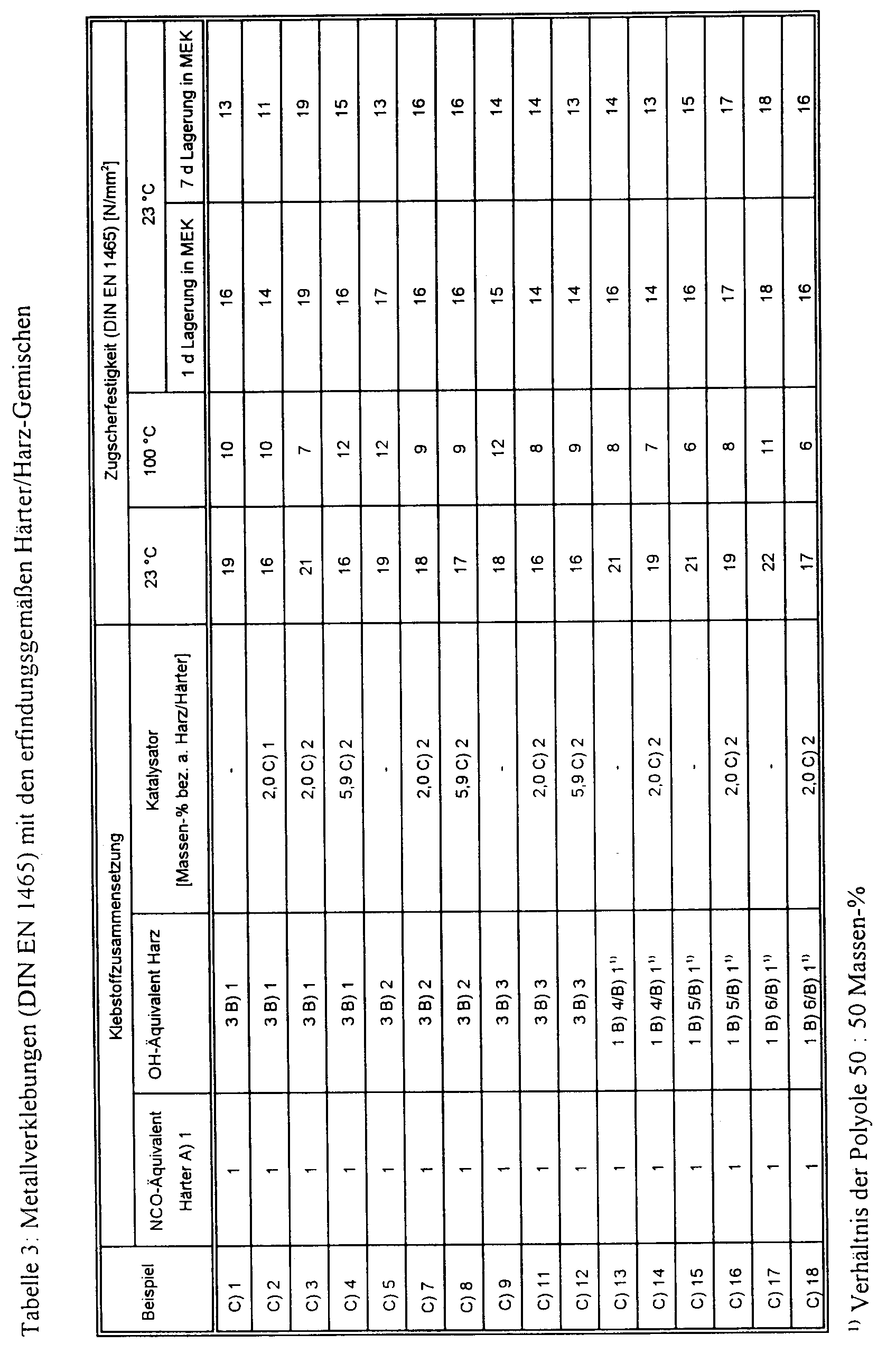
- the tensile shear strengths of these metal bonds hardened at different temperatures in a forced-air drying cabinet and the tensile shear strengths of the bonds after storage in methyl ethyl ketone (MEK) are listed in Table 3.
- the comparative examples of the bonds which do not contain any catalyst for polymerizing the epoxy groups are also given.
Landscapes
- Chemical & Material Sciences (AREA)
- Organic Chemistry (AREA)
- Health & Medical Sciences (AREA)
- Chemical Kinetics & Catalysis (AREA)
- Medicinal Chemistry (AREA)
- Polymers & Plastics (AREA)
- Adhesives Or Adhesive Processes (AREA)
- Polyurethanes Or Polyureas (AREA)
- Epoxy Resins (AREA)
Abstract
Description
gegebenenfalls
und gegebenenfalls
wobei die uretdiongruppenhaltigen Polyadditionsprodukte sowohl im Lösemittel als auch insbesondere lösemittelfrei dargestellt werden können,

und/oder mit cyclischen Amidinen blockierte Polyisocyanate sind,
und daß die Bindemittelkomponente D) aus hydroxylgruppenhaltigen Verbindungen mit einer Molmasse von mindestens 60, einer OH-Zahl von mindestens 20 mg KOH/g und einer Hydroxylfunktionalität von mindestens 2 besteht.
gegebenenfalls
und gegebenenfalls
der vorstehend genannten Art.
Die Härterkomponente A) wird für die Herstellung der erfindungsgemäßen PUR-Klebstoffe mit den hydroxylgruppenhaltigen Polymeren B) und D) und den Katalysatoren zur Polymerisation der Epoxidgruppen C) und gegebenenfalls weiteren Hilfs- und Zusatzmitteln E) entweder in einem inerten Lösemittel, wie z. B. Aceton oder Methylethylketon, homogenisiert oder nach dem Mahlen gemischt und in der Schmelze homogenisiert. Bei einer Homogenisierung im Lösemittel wird das Lösemittel destillativ im Vakuum entfernt. Das erhaltene Produkt wird nun mit einer Mühle auf eine Korngröße kleiner 500 µm gemahlen. Die Homogenisierung in der Schmelze kann in geeigneten Aggregaten, wie z. B. beheizbaren Knetern oder Extrudern, erfolgen, wobei Temperaturobergrenzen von 150 °C nicht überschritten werden sollten. Die geknetete bzw. extrudierte Masse wird nach Abkühlen auf Raumtemperatur geeignet zerkleinert und mit einer Mühle kleiner 500 µm gemahlen.
- As
- = Adipinsäure
- DMPS
- = Dimethylolpropionsäure
- HD
- = 1,6-Hexandiol
- IPS
- = Isophthalsäure
- NPG
- = Neopentylglykol (2,2-Dimethylpropandiol-1,3)
- P
- = Pentandiol-1,5
- TMHD
- = Trimethylhexandiol
- TMP
- = 1,1,1-Trimethylolpropan
Das als Beispiel für Uretdione nach bekanntem Verfahren hergestellte IPDI-Uretdion hat folgende NCO-Kenndaten:
| frei: | 16,8 bis 18,5 Massen-% |
| gesamt: | 37,5 bis 37,8 Massen-% |

| Verwendete hydroxylgruppenhaltige Verbindungen | |||||
| Beispiel | Hersteller/Land | Bezeichnung | Chemische und physikalische Kenndaten | ||
| OH-Zahl [mg KOH/g] | Säurezahl [mg KOH/g] | Schmelzbereich [°C] | |||
| B) 1 | Shell/BRD | Epikote® 1004 | 185 | 0 | 90 - 100 |
| B) 2 | Shell/BRD | Epikote® 1007 | 193 | 0 | 120 - 130 |
| B) 3 | Shell/BRD | Epikote® 1009 | 216 | 0 | 140 - 155 |
| B) 4 | Hüls/BRD | DYNACOLL® 7130 | 31 - 39 | < 2 | - |
| B) 5 | Hüls/BRD | Polyesterpolyol | 104 | < 1 | - |
| B) 6 | Hüls/BRD | Polyurethanpolyol | 76 | 15 | - |
Alternativen dazu stellen das elektrostatische Pulverspritzen, das Wirbelsintern und das elektrostatische Wirbelsintern und das Aufschmelzen bzw. Anschmelzen der Verbindungen dar.
Claims (17)
- Wärmehärtende Einkomponenten-Klebstoffe auf Basis von Polyurethanen mit gegebenenfalls aus der Klebstofftechnologie bekannten Hilfs- und Zusatzmitteln,
dadurch gekennzeichnet,
daß die Klebstoffe eine Mischung ausA) einer Härterkomponente, bestehend aus hydroxyl- und uretdiongruppenhaltigen Polyadditionsprodukten,B) einer Bindemittelkomponente, bestehend aus 1,2-Epoxidverbindungen mit mehr als einer 1,2-Epoxidgruppe und einer oder mehrerer Hydroxylgruppen im Molekül,C) Katalysatoren zur Polymerisation von Epoxidgruppen,
und gegebenenfallsD) weiteren hydroxylgruppenhaltigen Verbindungen
enthalten. - Einkomponenten-Klebstoffe nach Anspruch 1,
dadurch gekennzeichnet,
daß die Härterkomponente A) erhältlich ist durch Umsetzung von (i) Uretdionen aus Basis von Polyisocyanaten mit mindestens zwei freien Isocyanatgruppen und (ii) gegenüber Isocyanatgruppen reaktiven, difunktionellen und gegebenenfalls monofunktionellen Verbindungen. - Einkomponenten-Klebstoffe nach einem der vorherigen Ansprüche,
dadurch gekennzeichnet,
daß als Polyisocyanate zur Herstellung der Härterkomponente A) aliphatische und/oder cycloaliphatische Diisocyanate eingesetzt werden. - Einkomponenten-Klebstoffe nach einem der vorherigen Ansprüche,
dadurch gekennzeichnet,
daß als Polyisocyanat zur Herstellung der Härterkomponente A) das Uretdion des Isophorondiisocyanates (IPDI) eingesetzt wird. - Einkomponenten-Klebstoffe nach einem der vorherigen Ansprüche,
dadurch gekennzeichnet,
daß als gegenüber Isocyanatgruppen reaktiven Verbindungen zur Herstellung der Härterkomponente A) Diole und/oder Kettenverlängerer sowie Monoalkohole und/oder Monoamine eingesetzt werden. - Einkomponenten-Klebstoffe nach einem der vorherigen Ansprüche,
dadurch gekennzeichnet,
daß als Bindemittelkomponente B) 1,2-Epoxidverbindungen auf Basis von Bisphenol A und Epichlorhydrin mit Kondensationsgraden zwischen 0 und 27, entsprechend einer Molmasse von 380 und 8 000, eingesetzt werden. - Einkomponenten-Klebstoffe nach einem der vorherigen Ansprüche,
dadurch gekennzeichnet,
daß als Katalysatoren zur Polymerisation von Epoxidgruppen C) cyclische Amidine der allgemeinen Formelworin R gleiche oder veschiedene (Cyclo)alkylreste mit 1 bis 10 C-Atomen, Aralkyl- und Arylreste sind, und wobei der Gehalt an cyclischem Amidin 1 bis 10 Massen-%, vorzugsweise 2 bis 8 Massen-%, bezogen auf die Summe aus Harz und Härter, beträgt,
und/oder mit diesen cyclischen Amidinen blockierte Polyisocyanate eingesetzt werden. - Einkomponenten-Klebstoffe nach einem der vorherigen Ansprüche,
dadurch gekennzeichnet,
daß als Katalysatoren 2-Phenylimidazolin, 2-Phenyl-4-methylimidazolin sowie 2,4-Dimethylimidazolin eingesetzt werden. - Einkomponenten-Klebstoffe nach einem der vorherigen Ansprüche,
dadurch gekennzeichnet,
daß als Katalysatoren die Addukte aus 1 mol Isophorondiisocyanat (IPDI) und 2 mol 2-Phenylimidazolin, 1 mol Isophorondiisocyanat (IPDI) und 2 mol 2-Phenyl-4-methylimidazolin sowie 1 mol Isophorondiisocyanat (IPDI) und 2 mol 2,4-Dimethylimidazolin eingesetzt werden. - Einkomponenten-Klebstoffe nach einem der vorherigen Ansprüche,
dadurch gekennzeichnet,
daß hydroxylgruppenhaltige Verbindungen D) mit einer Molmasse von mindestens 60, einer OH-Zahl von mindestens 20 mg KOH/g und einer Hydroxylfunktionalität von mindestens 2 eingesetzt werden. - Einkomponenten-Klebstoffe nach einem der vorherigen Ansprüche,
dadurch gekennzeichnet,
daß als hydroxylgruppenhaltige Verbindungen D) Polyole, Polyester und Polyurethane eingesetzt werden. - Einkomponenten-Klebstoffe nach einem der vorherigen Ansprüche,
dadurch gekennzeichnet,
daß die Homogenisierung der Ausgangsprodukte in inerten Lösemitteln, die nach erfolgter Reaktion entfernt werden, oder lösemittelfrei im Kneter oder im Extruder, bei Temperaturen bis 150 °C erfolgt. - Einkomponenten-Klebstoffe nach einem der vorherigen Ansprüche,
dadurch gekennzeichnet,
daß ein OH/NCO-Verhältnis von 0,5 bis 10, vorzugsweise 0,8 bis 5 vorliegt. - Einkomponenten-Klebstoffe nach einem der vorherigen Ansprüche,
dadurch gekennzeichnet,
daß den PUR-Klebstoffen Katalysatoren zugesetzt werden, bevorzugt organische Zinnverbindungen, in einer Konzentration von 0,01 bis 1 Massen-%, vorzugsweise 0,01 bis 0,5 Massen-%, unter Einbeziehung der bereits enthaltenen Katalysatormenge in der Härterkomponente A). - Verwendung der PUR-Klebstoffe nach einem der vorherigen Ansprüche zum Verkleben beliebiger hitzeresistenter Substrate.
- Verwendung der PUR-Klebstoffe nach einem der vorherigen Ansprüche zum Verkleben von Metallen.
- Verwendung der einkomponentigen Polyurethane nach einem der vorherigen Ansprüche zum Aufbringen auf Substrate für hitzehärtbare Beschichtungen sowie die daraus hergestellten beschichteten hitzegehärteten Substrate.
Applications Claiming Priority (2)
| Application Number | Priority Date | Filing Date | Title |
|---|---|---|---|
| DE1996128327 DE19628327A1 (de) | 1996-07-13 | 1996-07-13 | Wärmehärtende, abspalt- und lösemittelfreie Einkomponenten-Klebstoffe auf Basis von Polyurethanen, ein Verfahren zu ihrer Herstellung sowie deren Verwendung |
| DE19628327 | 1996-07-13 |
Publications (1)
| Publication Number | Publication Date |
|---|---|
| EP0818484A1 true EP0818484A1 (de) | 1998-01-14 |
Family
ID=7799768
Family Applications (1)
| Application Number | Title | Priority Date | Filing Date |
|---|---|---|---|
| EP19970108200 Withdrawn EP0818484A1 (de) | 1996-07-13 | 1997-05-21 | Wärmehärtende, abspalt- und lösemittelfreie Einkomponenten-Klebstoffe auf Basis von Polyurethanen, ein Verfahren zu ihrer Herstellung sowie deren Verwendung |
Country Status (5)
| Country | Link |
|---|---|
| US (1) | US5874173A (de) |
| EP (1) | EP0818484A1 (de) |
| JP (1) | JPH1060406A (de) |
| CA (1) | CA2210279A1 (de) |
| DE (1) | DE19628327A1 (de) |
Families Citing this family (5)
| Publication number | Priority date | Publication date | Assignee | Title |
|---|---|---|---|---|
| DE19832500A1 (de) * | 1998-07-20 | 2000-01-27 | Ticona Gmbh | Thermoformbare Verbundfolie |
| US6410635B1 (en) * | 1999-02-22 | 2002-06-25 | Ppg Industries Ohio, Inc. | Curable coating compositions containing high aspect ratio clays |
| DE10008928A1 (de) | 2000-02-25 | 2001-08-30 | Degussa | Transparente oder pigmentierte Pulverlacke mit Vernetzern aus Hydroxyalkylamiden und blockierten, nicht aromatischen Polyisocyanaten |
| US9080074B2 (en) * | 2010-03-19 | 2015-07-14 | Bayer Materialscience Llc | Low temperature curing polyuretdione compositions |
| EP3853278B1 (de) | 2018-09-20 | 2025-08-20 | 3M Innovative Properties Company | Polymeres material mit einem uretdionhaltigen material und einer epoxidkomponente, zweiteilige zusammensetzungen und verfahren |
Citations (4)
| Publication number | Priority date | Publication date | Assignee | Title |
|---|---|---|---|---|
| US3494888A (en) * | 1966-08-30 | 1970-02-10 | Wilbur R Mcelroy | Resin compositions from polyepoxides and isocyanate polymers |
| US4335228A (en) * | 1978-02-27 | 1982-06-15 | Air Products And Chemicals, Inc. | Isocyanate blocked imidazoles and imidazolines for epoxy powder coating |
| EP0601793A2 (de) * | 1992-12-04 | 1994-06-15 | Nippon Polyurethane Industry Co. Ltd. | Einkomponenten-Polyurethanklebstoff und seine Verwendung |
| EP0669353A1 (de) * | 1994-02-28 | 1995-08-30 | Hüls Aktiengesellschaft | Hydroxyl- und uretdiongruppenhaltige Polyadditionsprodukte und Verfahren zu ihrer Herstellung sowie deren Verwendung zur Herstellung abspaltfreier Polyurethan-Pulverlacke hoher Reaktivität und die danach hergestellten Polyurethan-Pulverlacke |
Family Cites Families (2)
| Publication number | Priority date | Publication date | Assignee | Title |
|---|---|---|---|---|
| DE3931844A1 (de) * | 1989-09-23 | 1991-04-04 | Bayer Ag | Lagerstabile polyurethanklebstoffe |
| DE4406445C2 (de) * | 1994-02-28 | 2002-10-31 | Degussa | Verfahren zur Herstellung von uretdiongruppenhaltigen Polyadditionsprodukten und deren Verwendung in Polyurethan-Lacksystemen |
-
1996
- 1996-07-13 DE DE1996128327 patent/DE19628327A1/de not_active Withdrawn
-
1997
- 1997-05-21 EP EP19970108200 patent/EP0818484A1/de not_active Withdrawn
- 1997-07-11 US US08/893,684 patent/US5874173A/en not_active Expired - Fee Related
- 1997-07-11 JP JP18617597A patent/JPH1060406A/ja active Pending
- 1997-07-11 CA CA 2210279 patent/CA2210279A1/en not_active Abandoned
Patent Citations (4)
| Publication number | Priority date | Publication date | Assignee | Title |
|---|---|---|---|---|
| US3494888A (en) * | 1966-08-30 | 1970-02-10 | Wilbur R Mcelroy | Resin compositions from polyepoxides and isocyanate polymers |
| US4335228A (en) * | 1978-02-27 | 1982-06-15 | Air Products And Chemicals, Inc. | Isocyanate blocked imidazoles and imidazolines for epoxy powder coating |
| EP0601793A2 (de) * | 1992-12-04 | 1994-06-15 | Nippon Polyurethane Industry Co. Ltd. | Einkomponenten-Polyurethanklebstoff und seine Verwendung |
| EP0669353A1 (de) * | 1994-02-28 | 1995-08-30 | Hüls Aktiengesellschaft | Hydroxyl- und uretdiongruppenhaltige Polyadditionsprodukte und Verfahren zu ihrer Herstellung sowie deren Verwendung zur Herstellung abspaltfreier Polyurethan-Pulverlacke hoher Reaktivität und die danach hergestellten Polyurethan-Pulverlacke |
Also Published As
| Publication number | Publication date |
|---|---|
| JPH1060406A (ja) | 1998-03-03 |
| DE19628327A1 (de) | 1998-01-15 |
| US5874173A (en) | 1999-02-23 |
| CA2210279A1 (en) | 1998-01-13 |
Similar Documents
| Publication | Publication Date | Title |
|---|---|---|
| EP1526146B1 (de) | Hochreaktive Polyurethan-Pulverlackzusammensetzungen auf Basis epoxidgruppenterminierter, uretdiongruppenhaltiger Polyadditionsverbindungen | |
| EP3247732B1 (de) | Kristallisationsstabile polyesterprepolymere | |
| EP1666513B1 (de) | Verfahren zur Herstellung eines Polyurethanbindemittels mit einem niedrigen Gehalt an leichtflüchtigen Monomeren | |
| EP0818482A1 (de) | Wärmehärtende Einkomponenten-Klebstoffe auf Basis von Polyurethanen, ein Verfahren zu ihrer Herstellung sowie deren Verwendung | |
| DE3328131A1 (de) | Pulverlacke auf der basis teilblockierter ipdi-isocyanurate und hydroxylgruppenhaltiger polyester sowie ein verfahren zur herstellung matter ueberzuege | |
| DE102004011005A1 (de) | Bei niedriger Temperatur härtbare uretdiongruppenhaltige Polyurethanzusammensetzungen | |
| EP0868463B1 (de) | Verbindungen mit isocyanatgruppen und verkappten gegenüber isocyanaten reaktiven gruppen | |
| EP0600310B1 (de) | Polyisocyanatgemische, ein Verfahren zu ihrer Herstellung und ihre Verwendung | |
| DE19604581A1 (de) | Polyurethan-Pulvermattlacke | |
| DE3711374A1 (de) | Polyurethan-pulverlacke, die nach aushaertung eine matte oberflaeche ergeben | |
| EP1524284B1 (de) | Mit Diisopropylamin blockierte Polyisocyanate mit Biuretstruktur | |
| EP0781771A1 (de) | Cyclische Amidin- sowie Uretdiongruppen enthaltende Verbindungen, ein Verfahren zu ihrer Herstellung sowie deren Verwendung | |
| EP1318161A1 (de) | PUR-Pulverlackzusammensetzungen und ihre Verwendung für Polyurethan-Pulverlacke und insbesondere für Pulver-Coil Coating-Lacke | |
| DE19903710A1 (de) | Uretdiongruppen und freie Isocyanatgruppen aufweisende Pulverlackvernetzer | |
| EP0818483A1 (de) | Wärmehärtender abspalt- und lösemittelfreier Einkomponenten-Klebstoff auf Basis von Polyurethanen sowie deren Verwendung | |
| DE19628327A1 (de) | Wärmehärtende, abspalt- und lösemittelfreie Einkomponenten-Klebstoffe auf Basis von Polyurethanen, ein Verfahren zu ihrer Herstellung sowie deren Verwendung | |
| EP0950676A1 (de) | Harnstoff- und uretdiongruppenhaltige Polyisocyanate | |
| US4952632A (en) | Trans-cyclohexane-1,4-diisocyanate which is completely or partially blocked with epsilon-caprolactam; and the manufacture and use of the same | |
| EP0780416A1 (de) | Pulverlack und seine Verwendung zur Beschichtung von hitzeresistenten Substraten | |
| DE10233104A1 (de) | Verwendung von PUR-Pulverlacken für Coil Coating-Beschichtungen mit mattem Erscheinungsbild | |
| EP1321482A1 (de) | Verwendung von Polyurethan-Pulverlacken | |
| DE4120323C2 (de) | Verfahren zur Herstellung von Harnstoffgruppen aufweisenden Melaminharzen, die so erhaltenen Harze und ihre Verwendung | |
| DE19943034A1 (de) | Uretdiongruppen und freie Isocyanatgruppen aufweisende Pulverlackvernetzer hoher Funktionalität | |
| DE19627951A1 (de) | Pulverförmige Verbindungen, ein Verfahren zu ihrer Herstellung sowie deren Verwendung | |
| EP0972786A1 (de) | Harnstoff- und uretdiongruppenhaltige Polyadditionsverbindungen, ein Verfahren zu ihrer Herstellung sowie deren Verwendung |
Legal Events
| Date | Code | Title | Description |
|---|---|---|---|
| PUAI | Public reference made under article 153(3) epc to a published international application that has entered the european phase |
Free format text: ORIGINAL CODE: 0009012 |
|
| AK | Designated contracting states |
Kind code of ref document: A1 Designated state(s): AT BE CH DE ES FR GB IT LI NL SE |
|
| 17P | Request for examination filed |
Effective date: 19971210 |
|
| AKX | Designation fees paid |
Free format text: AT BE CH DE ES FR GB IT LI NL SE |
|
| RBV | Designated contracting states (corrected) |
Designated state(s): AT BE CH DE ES FR GB IT LI NL SE |
|
| RAP1 | Party data changed (applicant data changed or rights of an application transferred) |
Owner name: DEGUSSA-HUELS AKTIENGESELLSCHAFT |
|
| STAA | Information on the status of an ep patent application or granted ep patent |
Free format text: STATUS: THE APPLICATION HAS BEEN WITHDRAWN |
|
| 18W | Application withdrawn |
Withdrawal date: 20001120 |