EP0950676A1 - Harnstoff- und uretdiongruppenhaltige Polyisocyanate - Google Patents
Harnstoff- und uretdiongruppenhaltige Polyisocyanate Download PDFInfo
- Publication number
- EP0950676A1 EP0950676A1 EP99103522A EP99103522A EP0950676A1 EP 0950676 A1 EP0950676 A1 EP 0950676A1 EP 99103522 A EP99103522 A EP 99103522A EP 99103522 A EP99103522 A EP 99103522A EP 0950676 A1 EP0950676 A1 EP 0950676A1
- Authority
- EP
- European Patent Office
- Prior art keywords
- diamines
- compounds according
- polyaddition compounds
- diprimary
- uretdione
- Prior art date
- Legal status (The legal status is an assumption and is not a legal conclusion. Google has not performed a legal analysis and makes no representation as to the accuracy of the status listed.)
- Withdrawn
Links
- XSQUKJJJFZCRTK-UHFFFAOYSA-N Urea Chemical compound NC(N)=O XSQUKJJJFZCRTK-UHFFFAOYSA-N 0.000 title claims description 9
- 239000004202 carbamide Substances 0.000 title claims description 6
- 239000005056 polyisocyanate Substances 0.000 title description 4
- 229920001228 polyisocyanate Polymers 0.000 title description 4
- 150000004985 diamines Chemical class 0.000 claims abstract description 63
- 150000001875 compounds Chemical class 0.000 claims abstract description 35
- PCHXZXKMYCGVFA-UHFFFAOYSA-N 1,3-diazetidine-2,4-dione Chemical group O=C1NC(=O)N1 PCHXZXKMYCGVFA-UHFFFAOYSA-N 0.000 claims abstract description 27
- 239000000843 powder Substances 0.000 claims abstract description 26
- 239000005058 Isophorone diisocyanate Substances 0.000 claims abstract description 23
- NIMLQBUJDJZYEJ-UHFFFAOYSA-N isophorone diisocyanate Chemical compound CC1(C)CC(N=C=O)CC(C)(CN=C=O)C1 NIMLQBUJDJZYEJ-UHFFFAOYSA-N 0.000 claims abstract description 22
- 239000004814 polyurethane Substances 0.000 claims abstract description 20
- 239000000203 mixture Substances 0.000 claims abstract description 17
- 229920002635 polyurethane Polymers 0.000 claims abstract description 16
- 125000002887 hydroxy group Chemical group [H]O* 0.000 claims abstract description 9
- 239000002981 blocking agent Substances 0.000 claims abstract description 8
- 238000000034 method Methods 0.000 claims abstract description 7
- 229920000642 polymer Polymers 0.000 claims abstract description 7
- IQPQWNKOIGAROB-UHFFFAOYSA-N isocyanate group Chemical group [N-]=C=O IQPQWNKOIGAROB-UHFFFAOYSA-N 0.000 claims abstract description 6
- 239000004215 Carbon black (E152) Substances 0.000 claims abstract description 3
- 229930195733 hydrocarbon Natural products 0.000 claims abstract description 3
- 238000000576 coating method Methods 0.000 claims description 27
- 239000007795 chemical reaction product Substances 0.000 claims description 12
- ZWEHNKRNPOVVGH-UHFFFAOYSA-N 2-Butanone Chemical compound CCC(C)=O ZWEHNKRNPOVVGH-UHFFFAOYSA-N 0.000 claims description 9
- -1 phenylene radicals Chemical class 0.000 claims description 9
- 150000002576 ketones Chemical class 0.000 claims description 7
- LFQSCWFLJHTTHZ-UHFFFAOYSA-N Ethanol Chemical compound CCO LFQSCWFLJHTTHZ-UHFFFAOYSA-N 0.000 claims description 6
- OKKJLVBELUTLKV-UHFFFAOYSA-N Methanol Chemical compound OC OKKJLVBELUTLKV-UHFFFAOYSA-N 0.000 claims description 6
- 238000002844 melting Methods 0.000 claims description 6
- 230000008018 melting Effects 0.000 claims description 6
- 229920000728 polyester Polymers 0.000 claims description 6
- 125000005396 acrylic acid ester group Chemical group 0.000 claims description 5
- 150000001299 aldehydes Chemical class 0.000 claims description 5
- NAQMVNRVTILPCV-UHFFFAOYSA-N hexane-1,6-diamine Chemical compound NCCCCCCN NAQMVNRVTILPCV-UHFFFAOYSA-N 0.000 claims description 5
- 238000002360 preparation method Methods 0.000 claims description 5
- YIWUKEYIRIRTPP-UHFFFAOYSA-N 2-ethylhexan-1-ol Chemical compound CCCCC(CC)CO YIWUKEYIRIRTPP-UHFFFAOYSA-N 0.000 claims description 4
- POSWICCRDBKBMH-UHFFFAOYSA-N 3,3,5-trimethylcyclohexan-1-one Chemical compound CC1CC(=O)CC(C)(C)C1 POSWICCRDBKBMH-UHFFFAOYSA-N 0.000 claims description 4
- AMIMRNSIRUDHCM-UHFFFAOYSA-N Isopropylaldehyde Chemical compound CC(C)C=O AMIMRNSIRUDHCM-UHFFFAOYSA-N 0.000 claims description 4
- LRHPLDYGYMQRHN-UHFFFAOYSA-N N-Butanol Chemical compound CCCCO LRHPLDYGYMQRHN-UHFFFAOYSA-N 0.000 claims description 4
- HQABUPZFAYXKJW-UHFFFAOYSA-N butan-1-amine Chemical compound CCCCN HQABUPZFAYXKJW-UHFFFAOYSA-N 0.000 claims description 4
- 125000004432 carbon atom Chemical group C* 0.000 claims description 4
- JHIVVAPYMSGYDF-UHFFFAOYSA-N cyclohexanone Chemical compound O=C1CCCCC1 JHIVVAPYMSGYDF-UHFFFAOYSA-N 0.000 claims description 4
- JQVDAXLFBXTEQA-UHFFFAOYSA-N dibutylamine Chemical compound CCCCNCCCC JQVDAXLFBXTEQA-UHFFFAOYSA-N 0.000 claims description 4
- 229910052757 nitrogen Inorganic materials 0.000 claims description 4
- NTIZESTWPVYFNL-UHFFFAOYSA-N Methyl isobutyl ketone Chemical compound CC(C)CC(C)=O NTIZESTWPVYFNL-UHFFFAOYSA-N 0.000 claims description 3
- UIHCLUNTQKBZGK-UHFFFAOYSA-N Methyl isobutyl ketone Natural products CCC(C)C(C)=O UIHCLUNTQKBZGK-UHFFFAOYSA-N 0.000 claims description 3
- 125000001424 substituent group Chemical group 0.000 claims description 3
- PTTPXKJBFFKCEK-UHFFFAOYSA-N 2-Methyl-4-heptanone Chemical compound CC(C)CC(=O)CC(C)C PTTPXKJBFFKCEK-UHFFFAOYSA-N 0.000 claims description 2
- LTHNHFOGQMKPOV-UHFFFAOYSA-N 2-ethylhexan-1-amine Chemical compound CCCCC(CC)CN LTHNHFOGQMKPOV-UHFFFAOYSA-N 0.000 claims description 2
- LGYNIFWIKSEESD-UHFFFAOYSA-N 2-ethylhexanal Chemical compound CCCCC(CC)C=O LGYNIFWIKSEESD-UHFFFAOYSA-N 0.000 claims description 2
- NFGVLFZEHYLQKW-UHFFFAOYSA-N 2-methyl-4-n-propan-2-ylpentane-2,4-diamine Chemical compound CC(C)NC(C)CC(C)(C)N NFGVLFZEHYLQKW-UHFFFAOYSA-N 0.000 claims description 2
- JZUHIOJYCPIVLQ-UHFFFAOYSA-N 2-methylpentane-1,5-diamine Chemical compound NCC(C)CCCN JZUHIOJYCPIVLQ-UHFFFAOYSA-N 0.000 claims description 2
- RNLHGQLZWXBQNY-UHFFFAOYSA-N 3-(aminomethyl)-3,5,5-trimethylcyclohexan-1-amine Chemical compound CC1(C)CC(N)CC(C)(CN)C1 RNLHGQLZWXBQNY-UHFFFAOYSA-N 0.000 claims description 2
- SAIKULLUBZKPDA-UHFFFAOYSA-N Bis(2-ethylhexyl) amine Chemical compound CCCCC(CC)CNCC(CC)CCCC SAIKULLUBZKPDA-UHFFFAOYSA-N 0.000 claims description 2
- PIICEJLVQHRZGT-UHFFFAOYSA-N Ethylenediamine Chemical compound NCCN PIICEJLVQHRZGT-UHFFFAOYSA-N 0.000 claims description 2
- XTUVJUMINZSXGF-UHFFFAOYSA-N N-methylcyclohexylamine Chemical compound CNC1CCCCC1 XTUVJUMINZSXGF-UHFFFAOYSA-N 0.000 claims description 2
- 239000000654 additive Substances 0.000 claims description 2
- 125000001931 aliphatic group Chemical group 0.000 claims description 2
- SSJXIUAHEKJCMH-UHFFFAOYSA-N cyclohexane-1,2-diamine Chemical compound NC1CCCCC1N SSJXIUAHEKJCMH-UHFFFAOYSA-N 0.000 claims description 2
- 239000003822 epoxy resin Substances 0.000 claims description 2
- LNEPOXFFQSENCJ-UHFFFAOYSA-N haloperidol Chemical compound C1CC(O)(C=2C=CC(Cl)=CC=2)CCN1CCCC(=O)C1=CC=C(F)C=C1 LNEPOXFFQSENCJ-UHFFFAOYSA-N 0.000 claims description 2
- QHJABUZHRJTCAR-UHFFFAOYSA-N n'-methylpropane-1,3-diamine Chemical compound CNCCCN QHJABUZHRJTCAR-UHFFFAOYSA-N 0.000 claims description 2
- 229920000647 polyepoxide Polymers 0.000 claims description 2
- AOHJOMMDDJHIJH-UHFFFAOYSA-N propylenediamine Chemical compound CC(N)CN AOHJOMMDDJHIJH-UHFFFAOYSA-N 0.000 claims description 2
- BAPJBEWLBFYGME-UHFFFAOYSA-N Methyl acrylate Chemical compound COC(=O)C=C BAPJBEWLBFYGME-UHFFFAOYSA-N 0.000 claims 2
- GOXQRTZXKQZDDN-UHFFFAOYSA-N 2-Ethylhexyl acrylate Chemical compound CCCCC(CC)COC(=O)C=C GOXQRTZXKQZDDN-UHFFFAOYSA-N 0.000 claims 1
- FRTSMRXOEJVPOE-UHFFFAOYSA-N CC(C)CC(C)C1(CCCC(C1)(C)C)C Chemical compound CC(C)CC(C)C1(CCCC(C1)(C)C)C FRTSMRXOEJVPOE-UHFFFAOYSA-N 0.000 claims 1
- JIGUQPWFLRLWPJ-UHFFFAOYSA-N Ethyl acrylate Chemical compound CCOC(=O)C=C JIGUQPWFLRLWPJ-UHFFFAOYSA-N 0.000 claims 1
- 150000001298 alcohols Chemical class 0.000 claims 1
- CQEYYJKEWSMYFG-UHFFFAOYSA-N butyl acrylate Chemical compound CCCCOC(=O)C=C CQEYYJKEWSMYFG-UHFFFAOYSA-N 0.000 claims 1
- AZIQALWHRUQPHV-UHFFFAOYSA-N prop-2-eneperoxoic acid Chemical class OOC(=O)C=C AZIQALWHRUQPHV-UHFFFAOYSA-N 0.000 claims 1
- ISXSCDLOGDJUNJ-UHFFFAOYSA-N tert-butyl prop-2-enoate Chemical compound CC(C)(C)OC(=O)C=C ISXSCDLOGDJUNJ-UHFFFAOYSA-N 0.000 claims 1
- 238000006243 chemical reaction Methods 0.000 abstract description 13
- 238000004519 manufacturing process Methods 0.000 abstract description 13
- 239000003973 paint Substances 0.000 abstract description 2
- 125000002947 alkylene group Chemical group 0.000 abstract 1
- 150000002430 hydrocarbons Chemical class 0.000 abstract 1
- 125000000843 phenylene group Chemical group C1(=C(C=CC=C1)*)* 0.000 abstract 1
- CSCPPACGZOOCGX-UHFFFAOYSA-N Acetone Chemical compound CC(C)=O CSCPPACGZOOCGX-UHFFFAOYSA-N 0.000 description 13
- 239000004848 polyfunctional curative Substances 0.000 description 7
- 239000002262 Schiff base Substances 0.000 description 5
- 235000013877 carbamide Nutrition 0.000 description 5
- 150000004753 Schiff bases Chemical class 0.000 description 4
- 238000007792 addition Methods 0.000 description 4
- ISAOCJYIOMOJEB-UHFFFAOYSA-N benzoin Chemical compound C=1C=CC=CC=1C(O)C(=O)C1=CC=CC=C1 ISAOCJYIOMOJEB-UHFFFAOYSA-N 0.000 description 4
- 229920005862 polyol Polymers 0.000 description 4
- 150000003077 polyols Chemical class 0.000 description 4
- 239000000047 product Substances 0.000 description 4
- YXFVVABEGXRONW-UHFFFAOYSA-N Toluene Chemical compound CC1=CC=CC=C1 YXFVVABEGXRONW-UHFFFAOYSA-N 0.000 description 3
- 239000003795 chemical substances by application Substances 0.000 description 3
- 230000000694 effects Effects 0.000 description 3
- 238000010438 heat treatment Methods 0.000 description 3
- 239000002904 solvent Substances 0.000 description 3
- XEEYBQQBJWHFJM-UHFFFAOYSA-N Iron Chemical compound [Fe] XEEYBQQBJWHFJM-UHFFFAOYSA-N 0.000 description 2
- 244000028419 Styrax benzoin Species 0.000 description 2
- 235000000126 Styrax benzoin Nutrition 0.000 description 2
- 235000008411 Sumatra benzointree Nutrition 0.000 description 2
- GWEVSGVZZGPLCZ-UHFFFAOYSA-N Titan oxide Chemical compound O=[Ti]=O GWEVSGVZZGPLCZ-UHFFFAOYSA-N 0.000 description 2
- UKLDJPRMSDWDSL-UHFFFAOYSA-L [dibutyl(dodecanoyloxy)stannyl] dodecanoate Chemical compound CCCCCCCCCCCC(=O)O[Sn](CCCC)(CCCC)OC(=O)CCCCCCCCCCC UKLDJPRMSDWDSL-UHFFFAOYSA-L 0.000 description 2
- 239000002253 acid Substances 0.000 description 2
- TZCXTZWJZNENPQ-UHFFFAOYSA-L barium sulfate Chemical compound [Ba+2].[O-]S([O-])(=O)=O TZCXTZWJZNENPQ-UHFFFAOYSA-L 0.000 description 2
- 229960002130 benzoin Drugs 0.000 description 2
- 239000006227 byproduct Substances 0.000 description 2
- 150000001728 carbonyl compounds Chemical class 0.000 description 2
- 238000009833 condensation Methods 0.000 description 2
- 230000005494 condensation Effects 0.000 description 2
- 239000012975 dibutyltin dilaurate Substances 0.000 description 2
- 235000019382 gum benzoic Nutrition 0.000 description 2
- 238000005984 hydrogenation reaction Methods 0.000 description 2
- 125000000467 secondary amino group Chemical group [H]N([*:1])[*:2] 0.000 description 2
- 239000000126 substance Substances 0.000 description 2
- VZCYOOQTPOCHFL-UHFFFAOYSA-N trans-butenedioic acid Natural products OC(=O)C=CC(O)=O VZCYOOQTPOCHFL-UHFFFAOYSA-N 0.000 description 2
- XLYOFNOQVPJJNP-UHFFFAOYSA-N water Substances O XLYOFNOQVPJJNP-UHFFFAOYSA-N 0.000 description 2
- PIFBMJMXJMZZRG-UHFFFAOYSA-N 2,2,4,6,6-pentamethyl-1,5-dihydropyrimidine Chemical compound CC1=NC(C)(C)NC(C)(C)C1 PIFBMJMXJMZZRG-UHFFFAOYSA-N 0.000 description 1
- NPSJHQMIVNJLNN-UHFFFAOYSA-N 2-ethylhexyl 4-nitrobenzoate Chemical compound CCCCC(CC)COC(=O)C1=CC=C([N+]([O-])=O)C=C1 NPSJHQMIVNJLNN-UHFFFAOYSA-N 0.000 description 1
- 239000004808 2-ethylhexylester Substances 0.000 description 1
- FEWFXBUNENSNBQ-UHFFFAOYSA-N 2-hydroxyacrylic acid Chemical class OC(=C)C(O)=O FEWFXBUNENSNBQ-UHFFFAOYSA-N 0.000 description 1
- DKPFZGUDAPQIHT-UHFFFAOYSA-N Butyl acetate Natural products CCCCOC(C)=O DKPFZGUDAPQIHT-UHFFFAOYSA-N 0.000 description 1
- 101100116570 Caenorhabditis elegans cup-2 gene Proteins 0.000 description 1
- 239000004970 Chain extender Substances 0.000 description 1
- 101100116572 Drosophila melanogaster Der-1 gene Proteins 0.000 description 1
- XEKOWRVHYACXOJ-UHFFFAOYSA-N Ethyl acetate Natural products CCOC(C)=O XEKOWRVHYACXOJ-UHFFFAOYSA-N 0.000 description 1
- VZCYOOQTPOCHFL-OWOJBTEDSA-N Fumaric acid Natural products OC(=O)\C=C\C(O)=O VZCYOOQTPOCHFL-OWOJBTEDSA-N 0.000 description 1
- 241001244466 New world arenaviruses Species 0.000 description 1
- 241000170793 Phalaris canariensis Species 0.000 description 1
- OFOBLEOULBTSOW-UHFFFAOYSA-N Propanedioic acid Natural products OC(=O)CC(O)=O OFOBLEOULBTSOW-UHFFFAOYSA-N 0.000 description 1
- VYPSYNLAJGMNEJ-UHFFFAOYSA-N Silicium dioxide Chemical compound O=[Si]=O VYPSYNLAJGMNEJ-UHFFFAOYSA-N 0.000 description 1
- 229910010413 TiO 2 Inorganic materials 0.000 description 1
- FDLQZKYLHJJBHD-UHFFFAOYSA-N [3-(aminomethyl)phenyl]methanamine Chemical compound NCC1=CC=CC(CN)=C1 FDLQZKYLHJJBHD-UHFFFAOYSA-N 0.000 description 1
- 150000007513 acids Chemical class 0.000 description 1
- 125000003277 amino group Chemical group 0.000 description 1
- 150000004945 aromatic hydrocarbons Chemical class 0.000 description 1
- 230000015572 biosynthetic process Effects 0.000 description 1
- 230000000903 blocking effect Effects 0.000 description 1
- 125000000484 butyl group Chemical group [H]C([*])([H])C([H])([H])C([H])([H])C([H])([H])[H] 0.000 description 1
- 239000001569 carbon dioxide Substances 0.000 description 1
- 229910002092 carbon dioxide Inorganic materials 0.000 description 1
- CURLTUGMZLYLDI-UHFFFAOYSA-N carbon dioxide Natural products O=C=O CURLTUGMZLYLDI-UHFFFAOYSA-N 0.000 description 1
- 239000001913 cellulose Substances 0.000 description 1
- 229920002678 cellulose Polymers 0.000 description 1
- 238000004140 cleaning Methods 0.000 description 1
- 239000011248 coating agent Substances 0.000 description 1
- 230000007797 corrosion Effects 0.000 description 1
- 238000005260 corrosion Methods 0.000 description 1
- 230000006866 deterioration Effects 0.000 description 1
- 230000008030 elimination Effects 0.000 description 1
- 238000003379 elimination reaction Methods 0.000 description 1
- 150000002148 esters Chemical class 0.000 description 1
- 125000001495 ethyl group Chemical group [H]C([H])([H])C([H])([H])* 0.000 description 1
- 238000001125 extrusion Methods 0.000 description 1
- 239000000945 filler Substances 0.000 description 1
- 238000004508 fractional distillation Methods 0.000 description 1
- 239000001530 fumaric acid Substances 0.000 description 1
- FUZZWVXGSFPDMH-UHFFFAOYSA-M hexanoate Chemical compound CCCCCC([O-])=O FUZZWVXGSFPDMH-UHFFFAOYSA-M 0.000 description 1
- 229910052742 iron Inorganic materials 0.000 description 1
- VZCYOOQTPOCHFL-UPHRSURJSA-N maleic acid Chemical compound OC(=O)\C=C/C(O)=O VZCYOOQTPOCHFL-UPHRSURJSA-N 0.000 description 1
- 239000011976 maleic acid Substances 0.000 description 1
- 238000005259 measurement Methods 0.000 description 1
- 239000000178 monomer Substances 0.000 description 1
- 125000004433 nitrogen atom Chemical group N* 0.000 description 1
- 239000000049 pigment Substances 0.000 description 1
- 229920001485 poly(butyl acrylate) polymer Polymers 0.000 description 1
- 229940098458 powder spray Drugs 0.000 description 1
- 125000002924 primary amino group Chemical group [H]N([H])* 0.000 description 1
- 239000011347 resin Substances 0.000 description 1
- 229920005989 resin Polymers 0.000 description 1
- 229910052814 silicon oxide Inorganic materials 0.000 description 1
- 238000005507 spraying Methods 0.000 description 1
- 239000007858 starting material Substances 0.000 description 1
- 125000000999 tert-butyl group Chemical group [H]C([H])([H])C(*)(C([H])([H])[H])C([H])([H])[H] 0.000 description 1
- 150000003672 ureas Chemical class 0.000 description 1
- 239000001993 wax Substances 0.000 description 1
- 239000012463 white pigment Substances 0.000 description 1
Classifications
-
- C—CHEMISTRY; METALLURGY
- C08—ORGANIC MACROMOLECULAR COMPOUNDS; THEIR PREPARATION OR CHEMICAL WORKING-UP; COMPOSITIONS BASED THEREON
- C08G—MACROMOLECULAR COMPOUNDS OBTAINED OTHERWISE THAN BY REACTIONS ONLY INVOLVING UNSATURATED CARBON-TO-CARBON BONDS
- C08G18/00—Polymeric products of isocyanates or isothiocyanates
- C08G18/06—Polymeric products of isocyanates or isothiocyanates with compounds having active hydrogen
- C08G18/70—Polymeric products of isocyanates or isothiocyanates with compounds having active hydrogen characterised by the isocyanates or isothiocyanates used
- C08G18/72—Polyisocyanates or polyisothiocyanates
- C08G18/77—Polyisocyanates or polyisothiocyanates having heteroatoms in addition to the isocyanate or isothiocyanate nitrogen and oxygen or sulfur
- C08G18/78—Nitrogen
- C08G18/79—Nitrogen characterised by the polyisocyanates used, these having groups formed by oligomerisation of isocyanates or isothiocyanates
- C08G18/798—Nitrogen characterised by the polyisocyanates used, these having groups formed by oligomerisation of isocyanates or isothiocyanates containing urethdione groups
-
- C—CHEMISTRY; METALLURGY
- C08—ORGANIC MACROMOLECULAR COMPOUNDS; THEIR PREPARATION OR CHEMICAL WORKING-UP; COMPOSITIONS BASED THEREON
- C08G—MACROMOLECULAR COMPOUNDS OBTAINED OTHERWISE THAN BY REACTIONS ONLY INVOLVING UNSATURATED CARBON-TO-CARBON BONDS
- C08G18/00—Polymeric products of isocyanates or isothiocyanates
- C08G18/06—Polymeric products of isocyanates or isothiocyanates with compounds having active hydrogen
- C08G18/70—Polymeric products of isocyanates or isothiocyanates with compounds having active hydrogen characterised by the isocyanates or isothiocyanates used
- C08G18/72—Polyisocyanates or polyisothiocyanates
- C08G18/80—Masked polyisocyanates
- C08G18/8003—Masked polyisocyanates masked with compounds having at least two groups containing active hydrogen
- C08G18/8006—Masked polyisocyanates masked with compounds having at least two groups containing active hydrogen with compounds of C08G18/32
- C08G18/8038—Masked polyisocyanates masked with compounds having at least two groups containing active hydrogen with compounds of C08G18/32 with compounds of C08G18/3225
-
- C—CHEMISTRY; METALLURGY
- C08—ORGANIC MACROMOLECULAR COMPOUNDS; THEIR PREPARATION OR CHEMICAL WORKING-UP; COMPOSITIONS BASED THEREON
- C08G—MACROMOLECULAR COMPOUNDS OBTAINED OTHERWISE THAN BY REACTIONS ONLY INVOLVING UNSATURATED CARBON-TO-CARBON BONDS
- C08G2150/00—Compositions for coatings
- C08G2150/20—Compositions for powder coatings
Definitions
- the present invention relates to urea and Polyaddition compounds containing uretdione groups with free, partial or totally blocked isocyanate groups, a process for their preparation as well the polyurethane powder coatings produced from them for coatings with matt surface.
- the simplest principle to get a matte surface is that Powder coating smaller or smaller depending on the extent of the desired matt effect larger amounts of fillers such. B. chalk, finely divided silicon oxide or Barium sulfate to be mixed. However, these additions do Deterioration in film properties such as adhesion, Flexibility, impact resistance and chemical resistance.
- DE-OS 196 30 844 describes matt PUR powder coatings for the first time described the urea-containing isophorone diisocyanate uretdiones as Contain hardener component. They are implemented by Uretdions made with water. Intermediate form Elimination of carbon dioxide primary amines that deal with still existing Convert isocyanate groups to ureas. The nitrogen atoms of the Urea groups are each monosubstituted. Reactions from Polyisocyanates with water are due to the formation of by-products difficult to reproduce.
- PU powder coatings for matt coatings can be found which do not have the disadvantages listed, if as a hardener component for the PUR powder coatings Polyaddition compounds of isophorone diisocyanate uretdione (abbreviated: IPDI uretdione) and mixtures of diprimary, primary / secondary and secondary diamines were used.
- IPDI uretdione isophorone diisocyanate uretdione
- diprimary, primary / secondary and secondary diamines were used.
- the diamine mixtures preferably contain at least 1 mol% of diprimary Diamines, at least 30 mol% primary / secondary diamines and at least 1 mole% of secondary diamines.
- the present invention further provides a process for the preparation of the compounds according to the invention in accordance with the following reaction equation: where the free NCO groups of the UR-DA can optionally be completely or partially reacted with a blocking agent BH, and the substituents have the meaning given above.
- the compounds according to the invention are notable for a content free NCO groups of 0-5%, preferably 0.1-2%, a total NCO content (free + latent NCO groups) of 10 - 18%, preferably 12 - 17%, a uretdione group content of 1.2 - 2.1 mmol / g, a content of blocked NCO groups from 0 - 1 mmol / g.
- Their melting point varies in a range of 120-180 ° C, preferably 140-170 ° C. They are suitable in an excellent way for the production of PUR powder coatings.
- the uretdione to be used according to the invention is the IPDI uretdione, as described in DE-OSS 30 30 513 and 37 39 549 is, with a free NCO content of 17-18%, d. H. that more or less high proportions of IPDI polyuretdione are present in the reaction product have to.
- the monomer content is ⁇ 1%.
- the total NCO content of the IPDI uretdions after heating to 180 - 200 ° C (0.5 h) is 37.5 - 37.7%.
- the diamines to be used according to the invention are mixtures of diprimary, primary / secondary and secondary diamines.
- the diamines with A primary and a secondary amino group are in two stages prepared, the diprimary diamine with an aldehyde in the 1st stage or ketone is condensed to the Schiff base and in the 2nd stage the Hydrogenation and fractional distillation of the Schiff base takes place.
- Di-Schiff base a large excess of diamine can be worked; usually will 10 mol of diamine reacted with one mol of carbonyl compound.
- All aliphatic condensate to the Schiff base and cycloaliphatic diamines such as e.g. B.
- ethylenediamine 1,2-diaminopropane, 2-methylpentamethylene diamine, hexamethylene diamine, 2,2,4- (2,4,4) trimethylene hexamethylene diamine, Isophoronediamine, 1,2-diaminocyclohexane and 1,3-bis (aminomethyl) benzene, in question.
- diamines by reaction of diprimary diamines with acrylic acid esters, such as. B. Acrylklaremethyl-, - ethyl, butyl, t-butyl, 2-ethylhexyl ester can be obtained.
- the implementation of the diamine with the acrylic acid ester takes place at 60 - 80 ° C in a molar ratio 1: 1.
- the secondary diamines suitable according to the invention are in principle after the same two-stage process as described above. At The condensation is one mole of aldehyde or ketone per mole of amino group used.
- a preferred secondary diamine is N, N'-bis (1,3-dimethylbutyl) -1,3,3-trimethylcyclohexane methane diamine-1,5.
- the polyaddition products according to the invention can be partial or total be blocked.
- the blocking agents are monoalcohols, such as B. methanol, ethanol, butanol, 2-ethylhexanol or primary as secondary monoamines, such as. B. butylamine, 2-ethylhexylamine, dibutylamine, Di-2-ethylhexylamine and methylcyclohexylamine.
- the 1st and 2nd stages are implemented in solution, with the solvent from the group of aromatic hydrocarbons, esters or ketones, such as. B. toluene, ethyl or butyl acetate, acetone, methyl ethyl ketone, Methyl isobutyl ketone and any mixtures of these solvents becomes.
- the preferred solvent is acetone.
- the manufacture of the Compounds according to the invention are such that the acetone Solution of the IPDI uretdione at room temperature the diamine mixture like this is metered in that the temperature of the reaction solution does not exceed 40 ° C. increases. When the addition of diamine has ended, the reaction is complete.
- the present invention further relates to polyurethane powder coatings, which the polyaddition compounds according to the invention in Contain in combination with hydroxyl-containing polymers for Manufacture of matt surfaces.
- hydroxyl-containing polymers As a polyol component for the production of the PUR powder coatings according to the invention basically all hydroxyl-containing polymers come in Question how B. epoxy resins or hydroxyacrylates.
- Such OH-containing polyesters such as those obtained in a known manner by condensation of Polyols and polycarboxylic acids are produced, for. B. in the DE-OSS 27 35 497 and 30 04 903.
- the OH-containing polymer and the polyaddition compounds according to the invention optionally with pigments, such as. B. TiO 2 , leveling agents such. B. polybutyl acrylate, mixed on extruders or kneaders at temperatures between 80 - 140 ° C so that on an OH group of the hydroxyl-containing resin 0.6 to 1.2, preferably 0.8 - 1.1, blocked NCO groups come to stand.
- pigments such as. B. TiO 2
- leveling agents such. B. polybutyl acrylate
- the powder coatings produced in this way can be prepared according to the usual Powder application processes, such as. B. electrostatic powder spraying or Vertebral sinter, on which molded parts to be coated are applied.
- the coatings are cured by heating to temperatures of 170-220 ° C. You get matt, flexible coatings with excellent Corrosion protection properties and excellent thermal stability.
- PU powder coatings based blocked polyisocyanates are distinguished by the PU powder coatings according to the invention by the matt appearance of the coatings, the Matt gloss varies in a wide range.
- an IPDI uretdione As an NCO component, an IPDI uretdione with an NCO content of 17.6% and an IPDI content of 1%.
- the NCO content of the IPDI uretdions were 37.5% after heating to 180 ° C (1 h).
- the diamine mixture is added to the acetone solution of the IPDI uretdione Room temperature metered in so that the temperature of the reaction solution does not exceed 40 ° C rises.
- the reaction is complete. After that the acetone is distilled off.
- the reaction product still contains free NCO groups.
- the polyester ALFTALAT® AN 739 (Hoechst, Italy) with an OH number of 55-60 mg KOH / g, an acid number of 2-4 mg KOH / g, one Melting point of 82 - 90 ° C and a viscosity at 160 ° C of 24 - 29 000 mPa ⁇ s used.
- the ground products - IPDI uretdione / diamine adduct, polyester, Leveling agents white pigment are mixed intimately in a pan mill and then homogenized in an extruder at 80 - 140 ° C. After this The extrudate is broken when it is cold and placed on a pin mill Grain size ⁇ 100 ⁇ m milled.
- the powder thus produced is with a electrostatic powder spray system at 60 KV on degreased, if necessary pretreated iron sheets applied and in a convection oven Baked at 200 ° C for 15 minutes.
Landscapes
- Chemical & Material Sciences (AREA)
- Health & Medical Sciences (AREA)
- Chemical Kinetics & Catalysis (AREA)
- Medicinal Chemistry (AREA)
- Polymers & Plastics (AREA)
- Organic Chemistry (AREA)
- Polyurethanes Or Polyureas (AREA)
- Paints Or Removers (AREA)
Abstract
Die Erfindung betrifft harnstoff- und uretdiongruppenhaltige Polyadditionsverbindungen mit freien, partiell oder total blockierten Isocyanatgruppen, ein Verfahren zu ihrer Herstellung sowie die daraus hergestellten Polyurethan-Pulverlacken für Beschichtungen mit matter Oberfläche.
Description
Gegenstand der vorliegenden Erfindung sind harnstoff- und
uretdiongruppenhaltige Polyadditionsverbindungen mit freien, partiell oder
total blockierten Isocyanatgruppen, ein Verfahren zu ihrer Herstellung sowie
die daraus hergestellten Polyurethan-Pulverlacke für Beschichtungen mit
matter Oberfläche.
Seit geraumer Zeit gibt es ein zunehmendes Interesse an Pulverlacken, die
eine matte Oberfläche ergeben. Die Ursache dafür ist überwiegend
praktischer Art. Glänzende Flächen erfordern ein weitaus höheres Maß an
Reinigung als matte Flächen. Darüber hinaus kann es aus
sicherheitstechnischen Gründen wünschenswert sein, stark reflektierende
Flächen zu vermeiden.
Das einfachste Prinzip, eine matte Oberfläche zu erhalten, besteht darin, dem
Pulverlack je nach Ausmaß des gewünschten Matteffektes kleinere oder
größere Mengen Füllstoffe, wie z. B. Kreide, fein verteiltes Siliciumoxid oder
Bariumsulfat, beizumischen. Diese Zusätze bewirken jedoch eine
Verschlechterung der lacktechnischen Filmeigenschaften, wie Haftung,
Flexibilität, Schlagfestigkeit und Chemikalienbeständigkeit.
Die Zugabe von Stoffen, die mit dem Lack unverträglich sind, wie z. B.
Wachse oder Cellulosederivate, bewirkt zwar deutlich eine Mattierung, aber
geringfügige Änderungen während des Extrudierens führen zu
Schwankungen im Oberflächenglanz Die Reproduzierbarkeit des
Matteffektes ist nicht gewährleistet.
Harnstoff- und uretdiongruppenhaltige Polyisocyanate sind erst seit kurzer
Zeit bekannt. In der DE-OS 195 46 750 werden Reaktionsprodukte aus
Isophorondiisocyanat-Uretdion und disekundären Diaminen als Härter zur
Herstellung von Polyurethan (PUR)-Beschichtungen mit glänzenden
Oberflächen offenbart.
In der DE-OS 196 30 844 werden erstmals matte PUR-Pulverlacke
beschrieben, die harnstoffgruppenhaltige Isophorondiisocyanat-Uretdione als
Härterkomponente enthalten. Sie werden durch die Umsetzung von
Uretdionen mit Wasser hergestellt. Dabei bilden sich intermediär unter
Abspaltung von Kohlendioxid primäre Amine, die sich mit noch vorhandenen
Isocyanatgruppen zu Harnstoffen umsetzen. Die Stickstoffatome der
Harnstoffgruppen sind jeweils monosubstituiert. Reaktionen von
Polyisocyanaten mit Wasser sind aufgrund der Bildung von Nebenprodukten
schwierig zu reproduzieren.
Die DE-OS 196 37 375 beschreibt PUR-Pulverlacke, die durch
harnstoffgruppenhaltige Isophorondiisocyanat-Uretdione als Härter mattierend
eingestellt werden. Diese Härter entstehen durch die Umsetzung von
Isophorondiisocyanat-Uretdion mit disekundären Diaminen. Die disekundären
Diamine sind Umsetzungsprodukte aus diprimären Diaminen und Malein- oder
Fumarsäureester.
In der DE-OS 196 37 377 werden uretdiongruppen- und
harnstoffgruppenhaltige Polyadditionsprodukte als Härterkomponente zur
Mattierung von PUR-Pulverlacken beansprucht. Die Herstellung dieser Härter
erfolgt durch die Umsetzung von Isophorondiisocyanat-Uretdion mit
Diaminen, die eine primäre und sekundäre Aminogruppen enthalten. Die
Herstellung der reinen Diamine ist z. T. komplex und recht kostenintensiv.
Überraschenderweise konnten PUR-Pulverlacke für matte Beschichtungen
gefunden werden, die nicht mit den aufgeführten Nachteilen behaftet sind,
wenn als Härterkomponente für die PUR-Pulverlacke
Polyadditionsverbindungen des Isophorondiisocyanat-Uretdions (abgekürzt:
IPDI-Uretdion) und Gemische aus diprimären, primär/sekundären und
disekundären Diaminen eingesetzt wurden.
Gegenstand der vorliegenden Erfindung sind Harnstoff- und
uretdiongruppenhaltige Polyadditionsverbindungen mit freien, partiell oder
total blockierten Isaocyanatgruppen folgender Zusammensetzung:
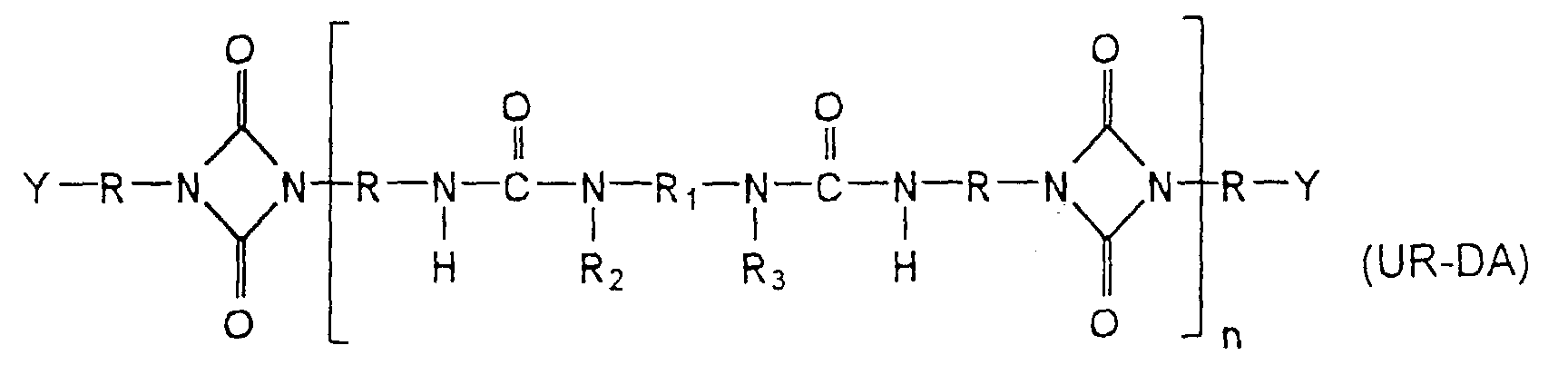
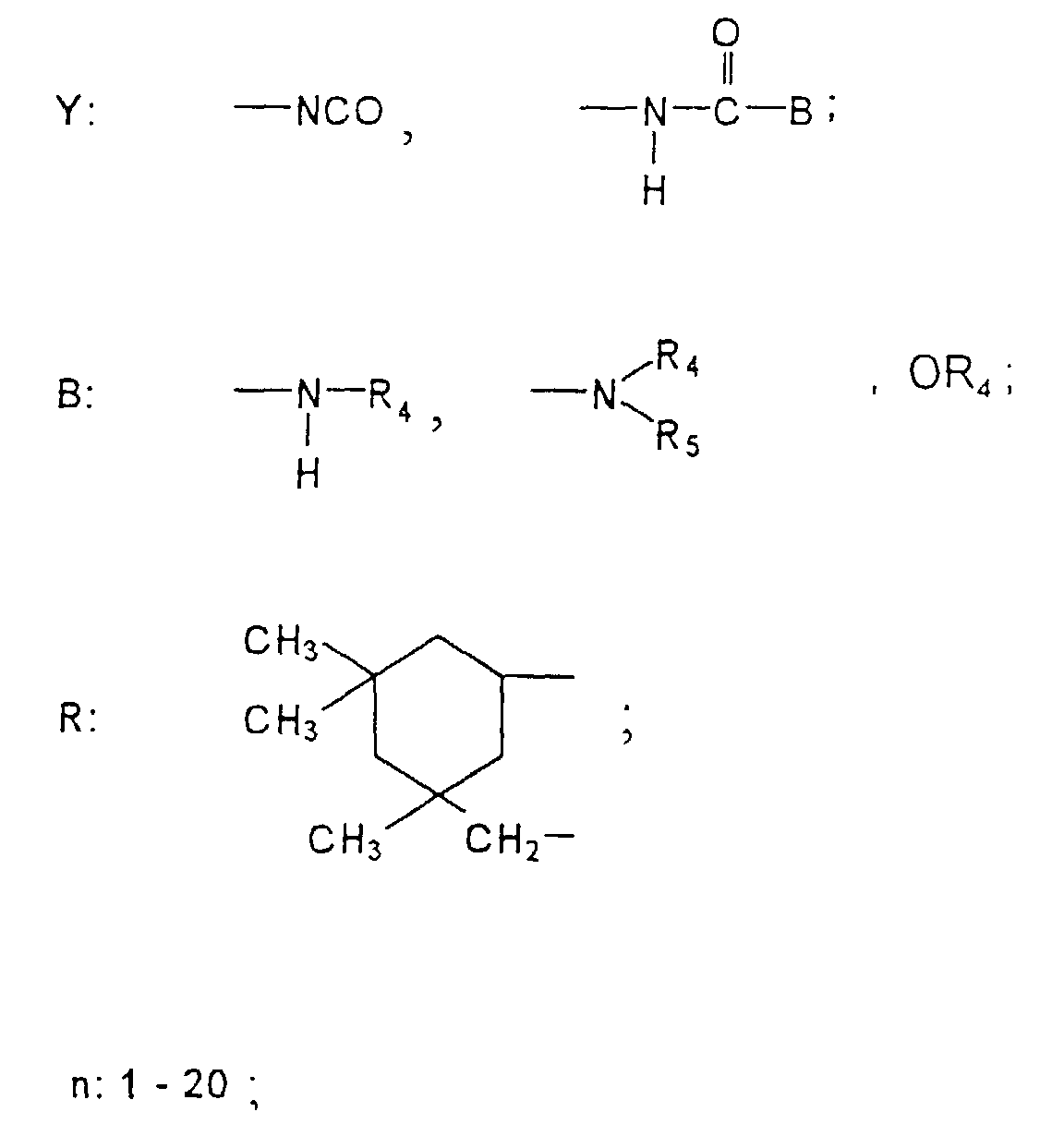
 wobei die Substituenten die folgende Bedeutung aufweisen

- R1:
- R oder lineare, verzweigte oder cyclische Alkylen- oder Phenylenreste mit 2 - 16 C-Atomen;
- R2, R3:
- H, R4 oder eine
Gruppe;
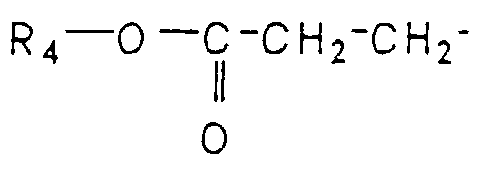
- R4, R5:
- gleiche oder verschiedene Kohlenwasserstoffreste mit 1 -
14 C-Atomen;
erhältlich durch Umsetzung von Isophorondiisocyanat-Uretdion mit Diamingemischen aus 1 - 60 Mol-% diprimären Diaminen, 1 - 98 Mol-% primär/sekundären Diaminen und 1 - 98 Mol-% disekundären Diaminen.
Vorzugsweise enthalten die Diamingemische mindestens 1 Mol-% diprimäre
Diamine, mindestens 30 Mol-% primär/sekundären Diamine und mindestens
1 Mol-% disekundäre Diamine.
Ein weiterer Gegenstand der vorliegenden Erfindung ist ein Verfahren zur
Herstellung der erfindungsgemäßen Verbindungen entsprechend der
folgenden Reaktionsgleichung:
 wobei die freien NCO-Gruppen des UR-DA gegebenenfalls ganz oder partiell
mit einem Blockierungsmittel B-H umgesetzt sein können, und die
Substituenten die obengenannte Bedeutung haben.
wobei die freien NCO-Gruppen des UR-DA gegebenenfalls ganz oder partiell
mit einem Blockierungsmittel B-H umgesetzt sein können, und die
Substituenten die obengenannte Bedeutung haben.
Die erfindungsgemäßen Verbindungen zeichnen sich durch einen Gehalt an
freien NCO-Gruppen von 0 - 5 %, vorzugsweise 0,1 - 2 %, einen Gesamt-NCO-Gehalt
(freie + latente NCO-Gruppen) von 10 - 18 %, vorzugsweise 12 -
17 %, einen Uretdiongruppengehalt von 1,2 - 2,1 mmol/g, einen Gehalt an
blockierten NCO-Gruppen von 0 - 1 mmol/g aus. Ihr Schmelzpunkt variiert in
einem Bereich von 120 - 180 °C, vorzugsweise 140 - 170 °C. Sie eignen sich
in hervorragender Weise zur Herstellung von PUR-Pulverbeschichtungen.
Bei dem erfindungsgemäß einzusetzenden Uretdion handelt es sich um das
IPDI-Uretdion, wie es in den DE-OSS 30 30 513 und 37 39 549 beschrieben
wird, mit einem freien NCO-Gehalt von 17 - 18 %, d. h. daß mehr oder minder
hohe Anteile an Polyuretdion des IPDI im Reaktionsprodukt vorliegen
müssen. Der Monomergehalt liegt bei ≤ 1 %. Der Gesamt-NCO-Gehalt des
IPDI-Uretdions nach dem Erhitzen auf 180 - 200 °C (0,5 h) beträgt 37,5 -
37,7 %.
Die erfindungsgemäß einzusetzenden Diamine sind Gemische aus
diprimären, primär/sekundären und disekundären Diaminen. Die Diamine mit
einer primären und einer sekundären Aminogruppe werden in zwei Stufen
hergestellt, wobei in der 1. Stufe das diprimäre Diamin mit einem Aldehyd
oder Keton zur Schiffschen Base kondensiert wird und in der 2. Stufe die
Hydrierung und fraktionierte Destillation der Schiffschen Base erfolgt. Um
möglichst wenig Nebenprodukt (Di-Schiffsche Base) zu erhalten, muß mit
einem großen Überschuß an Diamin gearbeitet werden; in der Regel werden
10 mol Diamin mit einem Mol Carbonylverbindung umgesetzt. Für die
Kondensation zur Schiffschen Base kommen grundsätzlich alle aliphatischen
und cycloaliphatischen Diamine, wie z. B. Ethylendiamin, 1,2-Diaminopropan,
2-Methylpentamethylendiamin, Hexamethylendiamin, 2,2,4-(2,4,4)-Trimethylenhexamethylendiamin,
Isophorondiamin, 1,2-Diaminocyclohexan sowie 1,3-Bis(aminomethyl)benzol,
in Frage. Für die Herstellung der Schiffschen Base
einzusetzende Carbonylverbindung kommen grundsätzlich alle
(cyclo)aliphatischen Aldehyde und Ketone in Frage; bevorzugt werden jedoch
Isobutyraldehyd, 2-Ethylhexanal, Methylisobutylketon, Methylethylketon,
Diisobutylketon, Cyclohexanon und 3,5,5-Trimethylcyclohexanon eingesetzt.
Ein bevorzugtes primär/sekundäres Diamin ist 5-Amino-N-(1,3-dimethylbutyl)-1,3,3-trimethylcyclohexanmethanamin.
Eine weitere Variante besteht darin, Diamine einzusetzen, die durch Reaktion
von diprimären Diaminen mit Acrylsäureestern, wie z. B. Acrylsäuremethyl-,
-
ethyl-, -butyl-, -t-butyl-, 2-Ethylhexylester, erhalten werden. Die Umsetzung
des Diamins mit dem Acrylsäureester erfolgt bei 60 - 80 °C im Molverhältnis
1 : 1.Bevorzugt werden hydrierte cyanethylierte Monoamine, wie z. B. N-Methyl-1,3-propandiamin,
eingesetzt, besonders bevorzugt das
Hydrierungsprodukt des Acetonins (4-Isopropylamino-2-amino-2-methylpentan).
Die erfindungsgemäß geeigneten disekundären Diamine sind im Prinzip nach
dem gleichen zweistufigen Verfahren wie oben beschrieben herstellbar. Bei
der Kondensation werden pro Mol Aminogruppe ein Mol Aldehyd oder Keton
eingesetzt. Ein bevorzugtes disekundäres Diamin ist N,N'-Bis(1,3-dimethylbutyl)-1,3,3-trimethylcyclohexanmethandiamin-1,5.
Die erfindungsgemäßen Polyadditionsprodukte können partiell oder total
blockiert sein. Bei den Blockierungsmitteln handelt es sich um Monoalkohole,
wie z. B. Methanol, Ethanol, Butanol, 2-Ethylhexanol oder primäre wie
sekundäre Monoamine, wie z. B. Butylamin, 2-Ethylhexylamin, Dibutylamin,
Di-2-Ethylhexylamin sowie Methylcyclohexylamin.
Die erfindungsgemäßen Polyadditionsverbindungen werden nach dem
nunmehr erläuterten Verfahren hergestellt. Die Herstellung erfolgt in zwei
aufeinander folgenden Stufen, wobei
Die Umsetzung der 1. und 2. Stufe erfolgt in Lösung, wobei das Lösemittel
aus der Gruppe aromatischer Kohlenwasserstoffe, Ester oder Ketone, wie z.
B. Toluol, Ethyl- oder Butylacetat, Aceton, Methylethylketon,
Methylisobutylketon sowie beliebige Gemische dieser Lösemittel, ausgewählt
wird. Bevorzugtes Lösemittel ist Aceton. Die Herstellung der
erfindungsgemäßen Verbindungen erfolgt so, daß zu der acetonischen
Lösung des IPDI-Uretdions bei Raumtemperatur das Diamingemisch so
zudosiert wird, daß die Temperatur der Reaktionslösung nicht über 40 °C
steigt. Nach Beendigung der Diaminzugabe ist die Reaktion beendet. Danach
wird entweder das Aceton abdestilliert, das ist der Fall, wenn das
Reaktionsprodukt noch freie NCO-Gruppen enthalten soll. Soll jedoch das
Reaktionsprodukt keine freien NCO-Gruppen mehr enthalten, schließt sich
die Umsetzung mit dem Blockierungsmittel an. Für den Fall der Monoamine
ist dies bei Raumtemperatur möglich, wobei nach der portionsweisen Zugabe
des Monoamins die Reaktion beendet ist Für den Fall, daß es sich bei den
Blockierungsmitteln um Monoalkohole handelt, wird die Blockierung bei 60 °C
in Gegenwart von 0,01 - 0,2 Gew.-% Dibutylzinndilaurat (DBTL) durchgeführt.
Ein weiterer Gegenstand der vorliegenden Erfindung sind Polyurethan-Pulverlacke,
welche die erfindungsgemäßen Polyadditionsverbindungen in
Kombination mit hydroxylgruppenhaltigen Polymeren enthalten, zur
Herstellung von matten Oberflächen.
Als Polyolkomponente zur Herstellung der erfindungsgemäßen PUR-Pulverlacke
kommen grundsätzlich alle hydroxylgruppenhaltigen Polymere in
Frage, wie z. B. Epoxidharze oder Hydroxyacrylate. Bevorzugt werden jedoch
hydroxylgruppenhaltige Polyester mit einer OH-Funktionalität von 3 - 6, einem
mittleren Molgewicht von 1800 - 5000, bevorzugt 2300 - 4500, einer OH-Zahl
von 25 -140 mg KOH/g, bevorzugt 30 - 90 mg KOH/g, und einem
Schmelzpunkt von ≥ 70 bis ≤§ 130 °C, bevorzugt ≥ 75 bis ≤ 110 °C. Derartige
OH-haltige Polyester, wie sie in bekannter Weise durch Kondensation von
Polyolen und Polycarbonsäuren hergestellt werden, sind z. B. in den DE-OSS
27 35 497 und 30 04 903 beschrieben.
Zur Herstellung der gebrauchsfertigen Pulverlacke werden das OH-haltige
Polymer und die erfindungsgemäßen Polyadditionsverbindungen,
gegebenenfalls mit Pigmenten, wie z. B. TiO2, Verlaufsmittel, wie z. B.
Polybutylacrylat, auf Extrudern oder Knetern bei Temperaturen zwischen 80 -
140 °C so gemischt, daß auf eine OH-Gruppe des hydroxylgruppenhaltigen
Harzes 0,6 bis 1,2, vorzugsweise 0,8 - 1,1, blockierte NCO-Gruppen zu
stehen kommen.
Die so hergestellten Pulverlacke können nach den üblichen
Pulverauftragsverfahren, wie z. B. elektrostatisches Pulversprühen oder
Wirbelsintern, auf die zu überziehenden Formteile aufgebracht werden. Die
Härtung der Überzüge erfolgt durch Erhitzen auf Temperaturen von 170 - 220
°C. Man erhält matte, flexible Beschichtungen mit hervorragenden
Korrosionsschutzeigenschaften und einer ausgezeichneten Thermostabilität.
Im Vergleich zu den bis jetzt bekannten PUR-Pulverlacken auf Basis
blockierter Polyisocyanate zeichnen sich die erfindungsgemäßen PUR-Pulverlacken
durch mattes Aussehen der Beschichtungen aus, wobei der
Mattglanz in einem weiten Bereich variiert.
Nachfolgend wird der Gegenstand der Erfindung anhand von Beispielen
erläutert.
Als NCO-Komponente wurde ein IPDI-Uretdion mit einem NCO-Gehalt von
17,6 % und einem IPDI-Gehalt von 1 % eingesetzt. Der NCO-Gehalt des
IPDI-Uretdions betrug nach dem Erhitzen auf 180 °C (1 h) 37,5 %.

Zu der acetonischen Lösung des IPDI-Uretdions wird das Diamingemisch bei
Raumtemperatur so zudosiert, daß die Temperatur der Reaktionslösung nicht über
40 °C steigt. Nach Beendigung der Diaminzugabe ist die Reaktion beendet. Danach
wird das Aceton abdestilliert. Das Reaktionsprodukt enthält noch freie NCO-Gruppen.
Die in der nachfolgenden Tabelle 1 aufgeführten Verbindungen wurden
entsprechend der allgemeinen Herstellungsvorschrift hergestellt.
| Erfindungsgemäße Polyadditionsverbindungen | |||||||
| Beispiel Nr. | Zusammensetzung [mol] | NCO-Gehalt frei [Massen-%] | NCO-Gehalt gesamt [Massen-%] | Schmelzbereich [°C] | |||
| IPDI-Uretdion | IPD | IPD-M | IPD-M-D | ||||
| B.1 | 10 | 2.25 | 4,5 | 2,25 | 0,8 | 13,5 | 158 -161 |
| B.2 | 10 | 2,03 | 5,11 | 1,86 | 1,1 | 14,6 | 153 -156 |
| B.3 | 10 | 1,92 | 4,87 | 2,21 | 1,1 | 14,6 | 155 -158 |
| B.4 | 10 | 1,75 | 7,00 | 0,2 | 0,6 | 13.6 | 167 -170 |
Als OH-Komponente zur Herstellung der erfindungsgemäßen PUR-Pulver
wurde der Polyester ALFTALAT® AN 739 (Hoechst, Italien) mit einer OH-Zahl
von 55 - 60 mg KOH/g, einer Säurezahl von 2 - 4 mg KOH/g, einem
Schmelzpunkt von 82 - 90 °C und einer Viskosität bei 160 °C von 24 - 29 000
mPa·s eingesetzt.
Die gemahlenen Produkte - IPDI-Uretdion/Diamin-Addukt, Polyester,
Verlaufsmittel Weißpigment werden in einem Kollergang innig vermischt
und anschließend im Extruder bei 80 - 140 °C homogenisiert. Nach dem
Erkalten wird das Extrudat gebrochen und mit einer Stiftsmühle auf eine
Korngröße < 100 µm gemahlen. Das so hergestellte Pulver wird mit einer
elektrostatischen Pulverspritzanlage bei 60 KV auf entfettete, gegebenenfalls
vorbehandelte Eisenbleche appliziert und in einem Umlufttrockenschrank bei
200 °C 15 Minuten eingebrannt.
Der Härter wurde mit dem Polyol im Verhaltnis NCO : OH = 1 : 1 gemischt.
Zusatzstoffe waren:
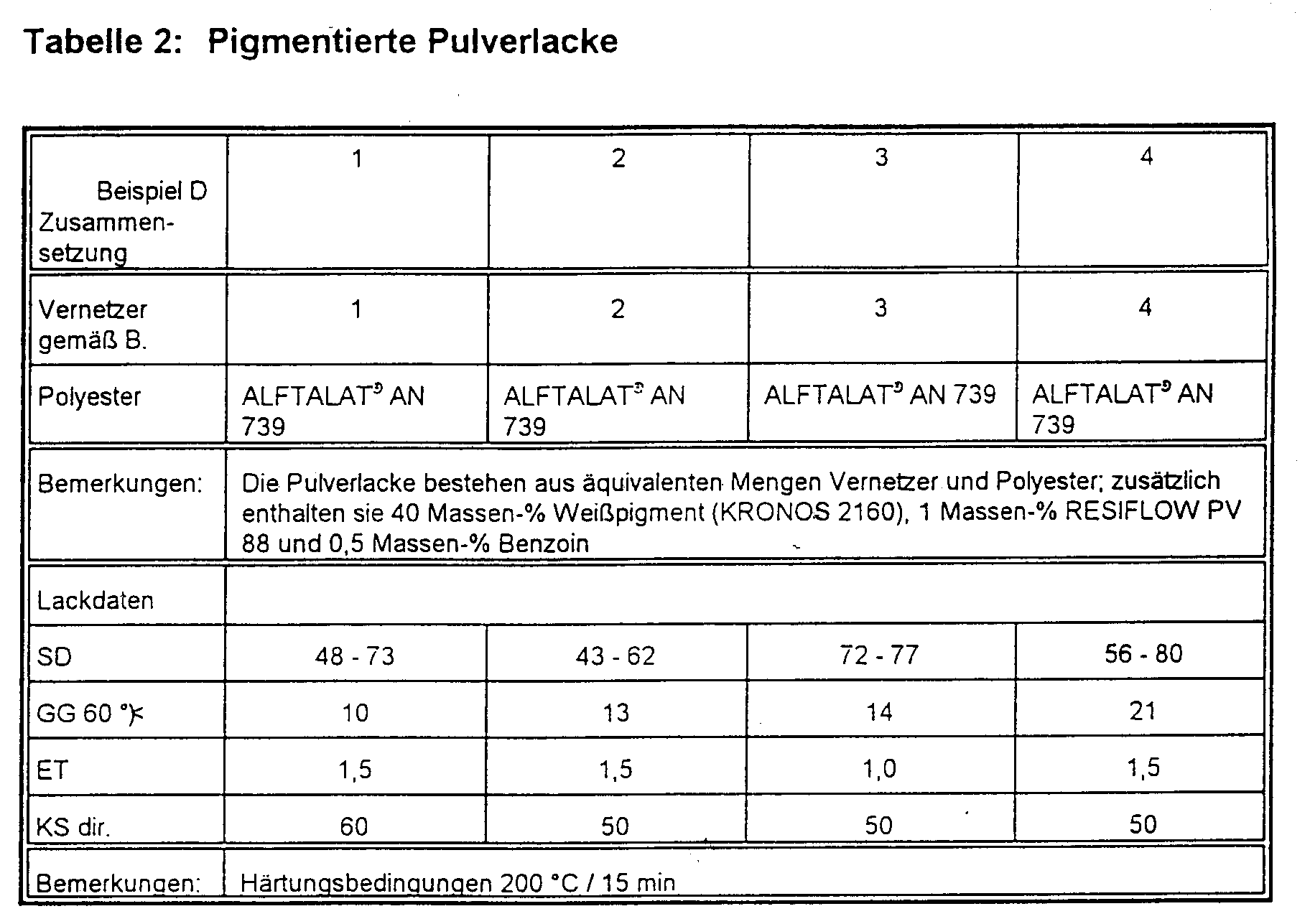
Die Abkürzungen in der folgenden Tabelle 2 bedeuten:
- SD
- = Schichtdicke in µm
- ET
- = Tiefung nach Erichsen in mm (DIN 53 156)
- GG 60 °∢
- = Messung des Glanzes nach Gardner (ASTM-D 523)
- KS dir.
- = direkter Kugelschlag in inch·lb
Claims (24)
- Harnstoff- und uretdiongruppenhaltige Polyadditionsverbindungen mit freien, partiell oder total blockierten Isocyanatgruppen folgender Zusammensetzung:wobei die Substituenten die folgende Bedeutung aufweisen
- R1:
- R oder lineare, verzweigte oder cyclische Alkylen- oder Phenylenreste mit 2 - 16 C-Atomen;
- R2, R3:
- H, R4 oder eine
Gruppe;

- R4, R5:
- gleiche oder verschiedene Kohlenwasserstoffreste mit 1 -
14 C-Atomen;
erhältlich durch Umsetzung von Isophorondiisocyanat-Uretdion mit Diamingemischen aus 1 - 60 Mol-% diprimären Diaminen, 1 - 98 Mol-% primär/sekundären Diaminen und 1 - 98 Mol-% disekundären Diaminen.
- Polyadditionsverbindungen gemäß Anspruch 1,
dadurch gekennzeichnet,
daß als diprimäre Diamine aliphatische und/oder cycloaliphatische Diamine eingesetzt werden. - Polyadditionsverbindungen gemäß Anspruch 1,
dadurch gekennzeichnet,
daß als primär/sekundäre Diamine hydrierte 1 : 1-Umsetzungsprodukte aus diprimären Diaminen und Aldehyden eingesetzt werden. - Polyadditionsverbindungen gemäß Anspruch 1,
dadurch gekennzeichnet,
daß als primär/sekundäre Diamine hydrierte 1 : 1-Umsetzungsprodukte aus diprimären Diaminen und Ketonen eingesetzt werden. - Polyadditionsverbindungen gemäß Anspruch 1,
dadurch gekennzeichnet,
daß als primär/sekundäre Diamine 1 : 1-Umsetzungsprodukte aus diprimären Diaminen und Acrylsäureestern eingesetzt werden. - Polyadditionsverbindungen gemäß Anspruch 1,
dadurch gekennzeichnet,
daß als disekundäre Diamine hydrierte 1 : 2-Umsetzungsprodukte aus diprimären Diaminen und Aldehyden eingesetzt werden. - Polyadditionsverbindungen gemäß Anspruch 1,
dadurch gekennzeichnet,
daß als disekundäre Diamine hydrierte 1 : 2-Umsetzungsprodukte aus diprimären Diaminen und Ketonen eingesetzt werden. - Polyadditionsverbindungen gemäß Anspruch 1,
dadurch gekennzeichnet,
daß als disekundäre Diamine 1 : 2-Umsetzungsprodukte aus diprimären Diaminen und Acrylsäureestern eingesetzt werden. - Polyadditionsverbindungen gemäß den Ansprüchen 1-8,
dadurch gekennzeichnet,
daß als diprimäre Diamine Ethylendiamin, 1,2-Diaminopropan, 2-Methylpentamethylendiamin, Hexamethylendiamin, 2,2,4-(2,4,4)-Trimethylenhexamethylendiamin, Isophorondiamin und 1,2-Diaminocyclohexan allein oder in Mischungen eingesetzt werden. - Polyadditionsverbindungen gemäß den Ansprüchen 3 oder 6,
dadurch gekennzeichnet,
daß als Aldehyde Isobutyraldehyd und 2-Ethylhexanal eingesetzt werden. - Polyadditionsverbindungen gemäß den Ansprüchen 4 oder 7,
dadurch gekennzeichnet,
daß als Ketone Methylisobutylketon, Methylethylketon, Diisobutylketon, Cyclohexanon und 3,5,5-Trimethylcyclohexanon eingesetzt werden. - Polyadditionsverbindungen gemäß den Ansprüchen 5 oder 8,
dadurch gekennzeichnet,
daß als Acrylsäureester Acrylsäuremethylester, Acrylsäureethylester, Acrylsäurebutylester, Acrylsäure-t-butylester und Acrylsäure-2-ethylhexylester allein oder in Mischungen eingesetzt werden. - Polyadditionsverbindungen gemäß den Ansprüchen 1, 3, 4 oder 5,
dadurch gekennzeichnet,
daß als primär/sekundäre Diamine 5-Amino-N-(1,3-dimethylbutyl)-1,3,3-trimethylcyclohexanmethanamin (IPD-M), N-Methyl-1,3-propandiamin und/oder 4-Isopropylamino-2-amino-2-methylpentan eingesetzt werden. - Polyadditionsverbindungen gemäß den Ansprüchen 1, 6, 7 oder 8,
dadurch gekennzeichnet,
daß als disekundäres Diamin N,N'-Bis(1,3-dimethylbutyl)-1,3,3-trimethylcyclohexanmethandiamin-1,5 (IPD-M-D) eingesetzt wird. - Polyadditionsverbindungen gemäß den Ansprüchen 1 bis 14,
dadurch gekennzeichnet,
daß als Blockierungsmittel Monoalkohole, primäre und sekundäre Diamine eingesetzt werden. - Polyadditionsverbindungen gemäß Anspruch 15,
dadurch gekennzeichnet,
daß als Monoalkohole Methanol, Ethanol, Butanol und 2-Ethylhexanol eingesetzt werden. - Polyadditionsverbindungen gemäß Anspruch 15,
dadurch gekennzeichnet,
daß als Monoamine Butylamin, 2-Ethylhexylamin, Dibutylamin, Di-2-ethylhexylamin und Methylcyclohexylamin eingesetzt werden. - Uretdiongruppenhaltige Polyadditionsverbindungen nach den Ansprüchen 1 bis 17,
dadurch gekennzeichnet,
daß sie einen Gehalt an freien NCO-Gruppen von 0 - 5 %, einen Gesamt-NCO-Gehalt von 10 - 18 %, einen Uretdiongruppengehalt von 1,2 - 2,1 mmol/g, einen Gehalt an blockierten NCO-Gruppen von 0 - 1 mmol/g und einen Schmelzbereich von 120 - 180 °C aufweisen. - Verfahren zur Herstellung der Polyadditionsverbindungen nach den Ansprüchen 1 bis 18,
dadurch gekennzeichnet,
daß zunächst IPDI-Uretdion mit dem Gemisch aus diprimären, primär/disekundären und disekundären Diaminen umgesetzt wird und nachfolgend gegebenenfalls die Umsetzung der noch freien NCO-Gruppen mit dem Blockierungsmittel erfolgt. - Transparente und pigmentierte Polyurethan-Pulverlacke enthaltend Polyadditionsverbindungen nach den Ansprüchen 1 bis 18 in Kombination mit hydroxylgruppenhaltigen Polymeren.
- Transparente und pigmentierte Polyurethan-Pulverlacke nach Anspruch 20 in Kombination mit Polyestern, Epoxidharzen und/oder Hydroxyacrylaten.
- Transparente und pigmentierte Polyurethan-Pulverlacke gemäß Anspruch 21,
dadurch gekennzeichnet,
daß als hydroxylgruppenhaltige Polymere Polyester mit einer OH-Funktionalität von 3 - 6, einem mittleren Molgewicht von 1800 - 5000, einer OH-Zahl von 25 - 140 mg KOH/g und einem Schmelzpunkt von ≥ 70 bis ≤§ 130 °C, eingesetzt werden. - Transparente und pigmentierte Polyurethan-Pulverlacke nach den Ansprüchen 20 bis 22,
dadurch gekennzeichnet,
daß die uretdiongruppenhaltigen Polyadditionsverbindungen in Kombination mit hydroxylgruppenhaltigen Polymeren weitere Zuschlags-und Hilfsstoffe enthalten. - Transparente und pigmentierte Polyurethan-Pulverlacke nach den Ansprüchen 20 bis 23,
dadurch gekennzeichnet,
daß ein OH/NCO-Verhältnis von 1 : 0,6 bis 1 : 1,2 zugrunde liegt.
Applications Claiming Priority (2)
| Application Number | Priority Date | Filing Date | Title |
|---|---|---|---|
| DE19816547A DE19816547A1 (de) | 1998-04-15 | 1998-04-15 | Harnstoff- und uretdiongruppenhaltige Polyisocyanate |
| DE19816547 | 1998-04-15 |
Publications (1)
| Publication Number | Publication Date |
|---|---|
| EP0950676A1 true EP0950676A1 (de) | 1999-10-20 |
Family
ID=7864509
Family Applications (1)
| Application Number | Title | Priority Date | Filing Date |
|---|---|---|---|
| EP99103522A Withdrawn EP0950676A1 (de) | 1998-04-15 | 1999-02-23 | Harnstoff- und uretdiongruppenhaltige Polyisocyanate |
Country Status (5)
| Country | Link |
|---|---|
| US (1) | US6156863A (de) |
| EP (1) | EP0950676A1 (de) |
| JP (1) | JPH11322883A (de) |
| CA (1) | CA2268723A1 (de) |
| DE (1) | DE19816547A1 (de) |
Cited By (1)
| Publication number | Priority date | Publication date | Assignee | Title |
|---|---|---|---|---|
| EP1184433A3 (de) * | 2000-08-29 | 2002-04-10 | Degussa AG | Matte PUR-Pulverlacke |
Families Citing this family (8)
| Publication number | Priority date | Publication date | Assignee | Title |
|---|---|---|---|---|
| DE10008928A1 (de) | 2000-02-25 | 2001-08-30 | Degussa | Transparente oder pigmentierte Pulverlacke mit Vernetzern aus Hydroxyalkylamiden und blockierten, nicht aromatischen Polyisocyanaten |
| US7152983B2 (en) * | 2003-03-06 | 2006-12-26 | 3M Innovative Properties Company | Lamina comprising cube corner elements and retroreflective sheeting |
| US7964695B2 (en) * | 2005-03-28 | 2011-06-21 | Albemarle Corporation | Chain extenders |
| WO2006104528A1 (en) * | 2005-03-28 | 2006-10-05 | Albemarle Corporation | Diimines and secondary diamines |
| US8076518B2 (en) | 2005-03-28 | 2011-12-13 | Albemarle Corporation | Chain extenders |
| CA2670041A1 (en) * | 2007-01-10 | 2008-07-17 | Albemarle Corporation | Formulations for reaction injection molding and for spray systems |
| JP5997665B2 (ja) * | 2013-06-19 | 2016-09-28 | 三井化学株式会社 | 熱硬化性ポリウレタンウレア樹脂組成物および成形品 |
| CN114736350B (zh) * | 2022-05-25 | 2023-12-19 | 安徽科瑞达新材料有限公司 | 一种脂肪族二异氰酸酯的二聚体加成产物的制备方法 |
Citations (4)
| Publication number | Priority date | Publication date | Assignee | Title |
|---|---|---|---|---|
| FR2298566A1 (fr) * | 1975-01-24 | 1976-08-20 | Bayer Ag | Compose |
| US3998794A (en) * | 1972-04-29 | 1976-12-21 | Bayer Aktiengesellschaft | Polyurethane polyureas which contain uretdione groups |
| DE19546750A1 (de) * | 1995-12-14 | 1997-06-19 | Huels Chemische Werke Ag | Uretdiongruppenhaltige Polyadditionsprodukte sowie deren Herstellung |
| EP0825215A1 (de) * | 1996-08-23 | 1998-02-25 | Hüls Aktiengesellschaft | Ein vereinfachtes Verfahren zur Herstellung von uretdiongruppenhaltigen Polyadditionsverbindungen |
Family Cites Families (1)
| Publication number | Priority date | Publication date | Assignee | Title |
|---|---|---|---|---|
| DE19637375A1 (de) * | 1996-09-13 | 1998-03-19 | Huels Chemische Werke Ag | Uretdiongruppenhaltige Polyisocyanate, ein Verfahren zu ihrer Herstellung sowie deren Verwendung |
-
1998
- 1998-04-15 DE DE19816547A patent/DE19816547A1/de not_active Withdrawn
-
1999
- 1999-02-23 EP EP99103522A patent/EP0950676A1/de not_active Withdrawn
- 1999-04-13 JP JP11105727A patent/JPH11322883A/ja active Pending
- 1999-04-14 CA CA002268723A patent/CA2268723A1/en not_active Abandoned
- 1999-04-15 US US09/292,374 patent/US6156863A/en not_active Expired - Fee Related
Patent Citations (4)
| Publication number | Priority date | Publication date | Assignee | Title |
|---|---|---|---|---|
| US3998794A (en) * | 1972-04-29 | 1976-12-21 | Bayer Aktiengesellschaft | Polyurethane polyureas which contain uretdione groups |
| FR2298566A1 (fr) * | 1975-01-24 | 1976-08-20 | Bayer Ag | Compose |
| DE19546750A1 (de) * | 1995-12-14 | 1997-06-19 | Huels Chemische Werke Ag | Uretdiongruppenhaltige Polyadditionsprodukte sowie deren Herstellung |
| EP0825215A1 (de) * | 1996-08-23 | 1998-02-25 | Hüls Aktiengesellschaft | Ein vereinfachtes Verfahren zur Herstellung von uretdiongruppenhaltigen Polyadditionsverbindungen |
Cited By (2)
| Publication number | Priority date | Publication date | Assignee | Title |
|---|---|---|---|---|
| EP1184433A3 (de) * | 2000-08-29 | 2002-04-10 | Degussa AG | Matte PUR-Pulverlacke |
| US6710136B2 (en) * | 2000-08-29 | 2004-03-23 | Degussa Ag | Matt PU powder coatings |
Also Published As
| Publication number | Publication date |
|---|---|
| US6156863A (en) | 2000-12-05 |
| JPH11322883A (ja) | 1999-11-26 |
| DE19816547A1 (de) | 1999-10-21 |
| CA2268723A1 (en) | 1999-10-15 |
Similar Documents
| Publication | Publication Date | Title |
|---|---|---|
| EP1184433A2 (de) | Matte PUR-Pulverlacke | |
| EP0178398B1 (de) | Lagerstabile Polyurethanharz-Pulverlacke | |
| EP1426423A1 (de) | Pulverlackzusammensetzungen für Beschichtungen mit mattem Erscheinungsbild | |
| DE19816547A1 (de) | Harnstoff- und uretdiongruppenhaltige Polyisocyanate | |
| DE3328133C2 (de) | Pulverlacke auf der Basis von uretdiongruppenhaltigen Isophorondiisocyanatadditionsverbindungen und ein Verfahren zur Herstellung matter Überzüge | |
| EP0829498A1 (de) | Uretdiongruppenhaltige Polyadditionsverbindungen, ein Verfahren zu ihrer Herstellung sowie deren Verwendung | |
| DE3711374A1 (de) | Polyurethan-pulverlacke, die nach aushaertung eine matte oberflaeche ergeben | |
| DE19637375A1 (de) | Uretdiongruppenhaltige Polyisocyanate, ein Verfahren zu ihrer Herstellung sowie deren Verwendung | |
| DE19549029A1 (de) | Cyclische Amidin- sowie Uretdiongruppen enthaltende Verbindungen, ein Verfahren zu ihrer Herstellung sowie deren Verwendung | |
| DE10233103A1 (de) | PUR-Pulverlacke für Beschichtungen mit mattem Erscheinungsbild | |
| EP0218040B1 (de) | Ganz oder teilweise mit Epsilon-Caprolactam blockiertes trans-Cyclohexan-1,4-diisocyanat, dessen Herstellung und Verwendung | |
| EP0787754A2 (de) | Blockierte aliphatische Diisocyanate oder Diisocyanat-Addukte | |
| EP1321482B1 (de) | Verwendung von Polyurethan-Pulverlacken | |
| EP1382649A1 (de) | Verwendung von PUR-Pulverlacken für Coil Coating-Beschichtungen mit mattem Erscheinungsbild | |
| EP0779278A2 (de) | Uretdiongruppenhaltige Polyadditionsprodukte sowie deren Verwendung | |
| EP0972786A1 (de) | Harnstoff- und uretdiongruppenhaltige Polyadditionsverbindungen, ein Verfahren zu ihrer Herstellung sowie deren Verwendung | |
| EP0795569A1 (de) | Polyadditionsverbindungen aus disekundären Diaminen und aus Uretdiongruppen enthaltenden Polyisocyanat-Gemischen | |
| EP0780416A1 (de) | Pulverlack und seine Verwendung zur Beschichtung von hitzeresistenten Substraten | |
| DE10215474A1 (de) | Flexiblere Polyurethan-Pulverlacke mit mattem Erscheinungsbild | |
| EP1491564B1 (de) | Polyisocyanat-modifizierte Polycarbonsäuren | |
| DE19804281A1 (de) | Verfahren zur Herstellung eines blockierten Lackpolyisocyanats und dessen Verwendung | |
| DE10064675A1 (de) | Flexibilisierung von Polyurethan-Pulverlacken mit mattem Erscheinungsbild | |
| DE19611820A1 (de) | Carbodiimidgruppen enthaltende blockierte (cyclo)aliphatische Diisocyanate, ein Verfahren zu ihrer Herstellung sowie ihre Verwendung | |
| DE19630844A1 (de) | Harnstoffgruppenhaltige Isophorondiisocyanat-Uretdione, ein Verfahren zu ihrer Herstellung sowie deren Verwendung | |
| DE19729262A1 (de) | Harnstoff- und uretdiongruppenhaltige Polyisocyanate, ein Verfahren zu ihrer Herstellung und deren Verwendung |
Legal Events
| Date | Code | Title | Description |
|---|---|---|---|
| PUAI | Public reference made under article 153(3) epc to a published international application that has entered the european phase |
Free format text: ORIGINAL CODE: 0009012 |
|
| AK | Designated contracting states |
Kind code of ref document: A1 Designated state(s): AT BE CH DE FR GB IT LI NL SE |
|
| AX | Request for extension of the european patent |
Free format text: AL;LT;LV;MK;RO;SI |
|
| 17P | Request for examination filed |
Effective date: 20000408 |
|
| AKX | Designation fees paid |
Free format text: AT BE CH DE FR GB IT LI NL SE |
|
| RAP1 | Party data changed (applicant data changed or rights of an application transferred) |
Owner name: DEGUSSA AG |
|
| STAA | Information on the status of an ep patent application or granted ep patent |
Free format text: STATUS: THE APPLICATION HAS BEEN WITHDRAWN |
|
| 18W | Application withdrawn |
Withdrawal date: 20020213 |