EP0780416A1 - Pulverlack und seine Verwendung zur Beschichtung von hitzeresistenten Substraten - Google Patents
Pulverlack und seine Verwendung zur Beschichtung von hitzeresistenten Substraten Download PDFInfo
- Publication number
- EP0780416A1 EP0780416A1 EP19960116397 EP96116397A EP0780416A1 EP 0780416 A1 EP0780416 A1 EP 0780416A1 EP 19960116397 EP19960116397 EP 19960116397 EP 96116397 A EP96116397 A EP 96116397A EP 0780416 A1 EP0780416 A1 EP 0780416A1
- Authority
- EP
- European Patent Office
- Prior art keywords
- powder coating
- coating according
- groups
- polyols
- component
- Prior art date
- Legal status (The legal status is an assumption and is not a legal conclusion. Google has not performed a legal analysis and makes no representation as to the accuracy of the status listed.)
- Withdrawn
Links
- 239000000843 powder Substances 0.000 title claims abstract description 45
- 238000000576 coating method Methods 0.000 title claims abstract description 42
- 239000011248 coating agent Substances 0.000 title claims abstract description 31
- 239000000758 substrate Substances 0.000 title claims description 5
- 125000002887 hydroxy group Chemical group [H]O* 0.000 claims abstract description 24
- 239000005056 polyisocyanate Substances 0.000 claims abstract description 18
- 229920001228 polyisocyanate Polymers 0.000 claims abstract description 18
- 239000000203 mixture Substances 0.000 claims abstract description 11
- 239000007787 solid Substances 0.000 claims abstract description 11
- 239000007788 liquid Substances 0.000 claims abstract description 7
- 229920005862 polyol Polymers 0.000 claims description 21
- 150000003077 polyols Chemical class 0.000 claims description 21
- NIMLQBUJDJZYEJ-UHFFFAOYSA-N isophorone diisocyanate Chemical compound CC1(C)CC(N=C=O)CC(C)(CN=C=O)C1 NIMLQBUJDJZYEJ-UHFFFAOYSA-N 0.000 claims description 19
- LYCAIKOWRPUZTN-UHFFFAOYSA-N Ethylene glycol Chemical compound OCCO LYCAIKOWRPUZTN-UHFFFAOYSA-N 0.000 claims description 12
- 238000004519 manufacturing process Methods 0.000 claims description 12
- 125000005442 diisocyanate group Chemical group 0.000 claims description 11
- 150000004985 diamines Chemical class 0.000 claims description 9
- WNLRTRBMVRJNCN-UHFFFAOYSA-N adipic acid Chemical compound OC(=O)CCCCC(O)=O WNLRTRBMVRJNCN-UHFFFAOYSA-N 0.000 claims description 7
- WOZVHXUHUFLZGK-UHFFFAOYSA-N dimethyl terephthalate Chemical compound COC(=O)C1=CC=C(C(=O)OC)C=C1 WOZVHXUHUFLZGK-UHFFFAOYSA-N 0.000 claims description 7
- KKEYFWRCBNTPAC-UHFFFAOYSA-N Terephthalic acid Chemical compound OC(=O)C1=CC=C(C(O)=O)C=C1 KKEYFWRCBNTPAC-UHFFFAOYSA-N 0.000 claims description 6
- 238000000034 method Methods 0.000 claims description 6
- YIMQCDZDWXUDCA-UHFFFAOYSA-N [4-(hydroxymethyl)cyclohexyl]methanol Chemical compound OCC1CCC(CO)CC1 YIMQCDZDWXUDCA-UHFFFAOYSA-N 0.000 claims description 5
- QQVIHTHCMHWDBS-UHFFFAOYSA-N isophthalic acid Chemical compound OC(=O)C1=CC=CC(C(O)=O)=C1 QQVIHTHCMHWDBS-UHFFFAOYSA-N 0.000 claims description 5
- PUPZLCDOIYMWBV-UHFFFAOYSA-N (+/-)-1,3-Butanediol Chemical compound CC(O)CCO PUPZLCDOIYMWBV-UHFFFAOYSA-N 0.000 claims description 4
- CDMDQYCEEKCBGR-UHFFFAOYSA-N 1,4-diisocyanatocyclohexane Chemical compound O=C=NC1CCC(N=C=O)CC1 CDMDQYCEEKCBGR-UHFFFAOYSA-N 0.000 claims description 4
- ZJCCRDAZUWHFQH-UHFFFAOYSA-N Trimethylolpropane Chemical compound CCC(CO)(CO)CO ZJCCRDAZUWHFQH-UHFFFAOYSA-N 0.000 claims description 4
- 239000002253 acid Substances 0.000 claims description 4
- 150000007513 acids Chemical class 0.000 claims description 4
- 239000000654 additive Substances 0.000 claims description 4
- IISBACLAFKSPIT-UHFFFAOYSA-N bisphenol A Chemical compound C=1C=C(O)C=CC=1C(C)(C)C1=CC=C(O)C=C1 IISBACLAFKSPIT-UHFFFAOYSA-N 0.000 claims description 4
- 238000005516 engineering process Methods 0.000 claims description 4
- 239000003822 epoxy resin Substances 0.000 claims description 4
- XNGIFLGASWRNHJ-UHFFFAOYSA-N phthalic acid Chemical compound OC(=O)C1=CC=CC=C1C(O)=O XNGIFLGASWRNHJ-UHFFFAOYSA-N 0.000 claims description 4
- 229920000647 polyepoxide Polymers 0.000 claims description 4
- GBURUDXSBYGPBL-UHFFFAOYSA-N 2,2,3-trimethylhexanedioic acid Chemical compound OC(=O)C(C)(C)C(C)CCC(O)=O GBURUDXSBYGPBL-UHFFFAOYSA-N 0.000 claims description 3
- QPYKYDBKQYZEKG-UHFFFAOYSA-N 2,2-dimethylpropane-1,1-diol Chemical compound CC(C)(C)C(O)O QPYKYDBKQYZEKG-UHFFFAOYSA-N 0.000 claims description 3
- 239000001361 adipic acid Substances 0.000 claims description 3
- 235000011037 adipic acid Nutrition 0.000 claims description 3
- LNEPOXFFQSENCJ-UHFFFAOYSA-N haloperidol Chemical compound C1CC(O)(C=2C=CC(Cl)=CC=2)CCN1CCCC(=O)C1=CC=C(F)C=C1 LNEPOXFFQSENCJ-UHFFFAOYSA-N 0.000 claims description 3
- ZETYUTMSJWMKNQ-UHFFFAOYSA-N n,n',n'-trimethylhexane-1,6-diamine Chemical compound CNCCCCCCN(C)C ZETYUTMSJWMKNQ-UHFFFAOYSA-N 0.000 claims description 3
- 238000005829 trimerization reaction Methods 0.000 claims description 3
- DNIAPMSPPWPWGF-GSVOUGTGSA-N (R)-(-)-Propylene glycol Chemical compound C[C@@H](O)CO DNIAPMSPPWPWGF-GSVOUGTGSA-N 0.000 claims description 2
- QFGCFKJIPBRJGM-UHFFFAOYSA-N 12-[(2-methylpropan-2-yl)oxy]-12-oxododecanoic acid Chemical compound CC(C)(C)OC(=O)CCCCCCCCCCC(O)=O QFGCFKJIPBRJGM-UHFFFAOYSA-N 0.000 claims description 2
- JZUHIOJYCPIVLQ-UHFFFAOYSA-N 2-methylpentane-1,5-diamine Chemical compound NCC(C)CCCN JZUHIOJYCPIVLQ-UHFFFAOYSA-N 0.000 claims description 2
- 125000002015 acyclic group Chemical group 0.000 claims description 2
- CDQSJQSWAWPGKG-UHFFFAOYSA-N butane-1,1-diol Chemical compound CCCC(O)O CDQSJQSWAWPGKG-UHFFFAOYSA-N 0.000 claims description 2
- PMMYEEVYMWASQN-IMJSIDKUSA-N cis-4-Hydroxy-L-proline Chemical compound O[C@@H]1CN[C@H](C(O)=O)C1 PMMYEEVYMWASQN-IMJSIDKUSA-N 0.000 claims description 2
- 239000000470 constituent Substances 0.000 claims description 2
- 125000004122 cyclic group Chemical group 0.000 claims description 2
- INSRQEMEVAMETL-UHFFFAOYSA-N decane-1,1-diol Chemical compound CCCCCCCCCC(O)O INSRQEMEVAMETL-UHFFFAOYSA-N 0.000 claims description 2
- KORSJDCBLAPZEQ-UHFFFAOYSA-N dicyclohexylmethane-4,4'-diisocyanate Chemical compound C1CC(N=C=O)CCC1CC1CCC(N=C=O)CC1 KORSJDCBLAPZEQ-UHFFFAOYSA-N 0.000 claims description 2
- GTZOYNFRVVHLDZ-UHFFFAOYSA-N dodecane-1,1-diol Chemical compound CCCCCCCCCCCC(O)O GTZOYNFRVVHLDZ-UHFFFAOYSA-N 0.000 claims description 2
- ACCCMOQWYVYDOT-UHFFFAOYSA-N hexane-1,1-diol Chemical compound CCCCCC(O)O ACCCMOQWYVYDOT-UHFFFAOYSA-N 0.000 claims description 2
- DNIAPMSPPWPWGF-UHFFFAOYSA-N monopropylene glycol Natural products CC(O)CO DNIAPMSPPWPWGF-UHFFFAOYSA-N 0.000 claims description 2
- ITZPOSYADVYECJ-UHFFFAOYSA-N n'-cyclohexylpropane-1,3-diamine Chemical compound NCCCNC1CCCCC1 ITZPOSYADVYECJ-UHFFFAOYSA-N 0.000 claims description 2
- SLCVBVWXLSEKPL-UHFFFAOYSA-N neopentyl glycol Chemical compound OCC(C)(C)CO SLCVBVWXLSEKPL-UHFFFAOYSA-N 0.000 claims description 2
- 235000013772 propylene glycol Nutrition 0.000 claims description 2
- SRPWOOOHEPICQU-UHFFFAOYSA-N trimellitic anhydride Chemical compound OC(=O)C1=CC=C2C(=O)OC(=O)C2=C1 SRPWOOOHEPICQU-UHFFFAOYSA-N 0.000 claims description 2
- AZYRZNIYJDKRHO-UHFFFAOYSA-N 1,3-bis(2-isocyanatopropan-2-yl)benzene Chemical compound O=C=NC(C)(C)C1=CC=CC(C(C)(C)N=C=O)=C1 AZYRZNIYJDKRHO-UHFFFAOYSA-N 0.000 claims 1
- GFMIDCCZJUXASS-UHFFFAOYSA-N hexane-1,1,6-triol Chemical compound OCCCCCC(O)O GFMIDCCZJUXASS-UHFFFAOYSA-N 0.000 claims 1
- 125000004955 1,4-cyclohexylene group Chemical group [H]C1([H])C([H])([H])C([H])([*:1])C([H])([H])C([H])([H])C1([H])[*:2] 0.000 abstract 1
- 125000000217 alkyl group Chemical group 0.000 abstract 1
- 125000002947 alkylene group Chemical group 0.000 abstract 1
- VNWKTOKETHGBQD-UHFFFAOYSA-N methane Natural products C VNWKTOKETHGBQD-UHFFFAOYSA-N 0.000 abstract 1
- JBKVHLHDHHXQEQ-UHFFFAOYSA-N epsilon-caprolactam Chemical compound O=C1CCCCCN1 JBKVHLHDHHXQEQ-UHFFFAOYSA-N 0.000 description 14
- 239000005058 Isophorone diisocyanate Substances 0.000 description 12
- 239000004814 polyurethane Substances 0.000 description 12
- 229920000728 polyester Polymers 0.000 description 11
- 239000004848 polyfunctional curative Substances 0.000 description 10
- 239000002981 blocking agent Substances 0.000 description 7
- 238000004898 kneading Methods 0.000 description 7
- 238000002844 melting Methods 0.000 description 7
- 230000008018 melting Effects 0.000 description 7
- 239000011347 resin Substances 0.000 description 7
- 229920005989 resin Polymers 0.000 description 7
- 239000007795 chemical reaction product Substances 0.000 description 6
- -1 aliphatic diamine Chemical class 0.000 description 4
- 238000006243 chemical reaction Methods 0.000 description 4
- 229920000642 polymer Polymers 0.000 description 4
- OKKJLVBELUTLKV-UHFFFAOYSA-N Methanol Chemical compound OC OKKJLVBELUTLKV-UHFFFAOYSA-N 0.000 description 3
- 229910000831 Steel Inorganic materials 0.000 description 3
- GWEVSGVZZGPLCZ-UHFFFAOYSA-N Titan oxide Chemical compound O=[Ti]=O GWEVSGVZZGPLCZ-UHFFFAOYSA-N 0.000 description 3
- 230000000903 blocking effect Effects 0.000 description 3
- 150000001875 compounds Chemical class 0.000 description 3
- 150000002009 diols Chemical class 0.000 description 3
- 239000004922 lacquer Substances 0.000 description 3
- 239000000155 melt Substances 0.000 description 3
- CXMXRPHRNRROMY-UHFFFAOYSA-N sebacic acid Chemical compound OC(=O)CCCCCCCCC(O)=O CXMXRPHRNRROMY-UHFFFAOYSA-N 0.000 description 3
- 239000010959 steel Substances 0.000 description 3
- LPEKGGXMPWTOCB-UHFFFAOYSA-N 8beta-(2,3-epoxy-2-methylbutyryloxy)-14-acetoxytithifolin Natural products COC(=O)C(C)O LPEKGGXMPWTOCB-UHFFFAOYSA-N 0.000 description 2
- 239000008199 coating composition Substances 0.000 description 2
- 238000010438 heat treatment Methods 0.000 description 2
- NAQMVNRVTILPCV-UHFFFAOYSA-N hexane-1,6-diamine Chemical compound NCCCCCCN NAQMVNRVTILPCV-UHFFFAOYSA-N 0.000 description 2
- IQPQWNKOIGAROB-UHFFFAOYSA-N isocyanate group Chemical group [N-]=C=O IQPQWNKOIGAROB-UHFFFAOYSA-N 0.000 description 2
- 239000000463 material Substances 0.000 description 2
- 229910052751 metal Inorganic materials 0.000 description 2
- 239000002184 metal Substances 0.000 description 2
- 239000003973 paint Substances 0.000 description 2
- 238000002360 preparation method Methods 0.000 description 2
- 239000000047 product Substances 0.000 description 2
- 239000011541 reaction mixture Substances 0.000 description 2
- 230000009257 reactivity Effects 0.000 description 2
- 239000007858 starting material Substances 0.000 description 2
- 238000005809 transesterification reaction Methods 0.000 description 2
- 150000004072 triols Chemical class 0.000 description 2
- JOYRKODLDBILNP-UHFFFAOYSA-N urethane group Chemical group NC(=O)OCC JOYRKODLDBILNP-UHFFFAOYSA-N 0.000 description 2
- PCHXZXKMYCGVFA-UHFFFAOYSA-N 1,3-diazetidine-2,4-dione Chemical compound O=C1NC(=O)N1 PCHXZXKMYCGVFA-UHFFFAOYSA-N 0.000 description 1
- WMRCTEPOPAZMMN-UHFFFAOYSA-N 2-undecylpropanedioic acid Chemical compound CCCCCCCCCCCC(C(O)=O)C(O)=O WMRCTEPOPAZMMN-UHFFFAOYSA-N 0.000 description 1
- RNLHGQLZWXBQNY-UHFFFAOYSA-N 3-(aminomethyl)-3,5,5-trimethylcyclohexan-1-amine Chemical compound CC1(C)CC(N)CC(C)(CN)C1 RNLHGQLZWXBQNY-UHFFFAOYSA-N 0.000 description 1
- DOBIZWYVJFIYOV-UHFFFAOYSA-N 7-hydroxynaphthalene-1,3-disulfonic acid Chemical compound C1=C(S(O)(=O)=O)C=C(S(O)(=O)=O)C2=CC(O)=CC=C21 DOBIZWYVJFIYOV-UHFFFAOYSA-N 0.000 description 1
- UDSFAEKRVUSQDD-UHFFFAOYSA-N Dimethyl adipate Chemical compound COC(=O)CCCCC(=O)OC UDSFAEKRVUSQDD-UHFFFAOYSA-N 0.000 description 1
- 239000005057 Hexamethylene diisocyanate Substances 0.000 description 1
- OFOBLEOULBTSOW-UHFFFAOYSA-N Malonic acid Chemical compound OC(=O)CC(O)=O OFOBLEOULBTSOW-UHFFFAOYSA-N 0.000 description 1
- 241000170793 Phalaris canariensis Species 0.000 description 1
- 229910010413 TiO 2 Inorganic materials 0.000 description 1
- XSTXAVWGXDQKEL-UHFFFAOYSA-N Trichloroethylene Chemical compound ClC=C(Cl)Cl XSTXAVWGXDQKEL-UHFFFAOYSA-N 0.000 description 1
- XSQUKJJJFZCRTK-UHFFFAOYSA-N Urea Chemical compound NC(N)=O XSQUKJJJFZCRTK-UHFFFAOYSA-N 0.000 description 1
- 239000000853 adhesive Substances 0.000 description 1
- 230000001070 adhesive effect Effects 0.000 description 1
- 125000001931 aliphatic group Chemical group 0.000 description 1
- 239000011230 binding agent Substances 0.000 description 1
- 239000004202 carbamide Substances 0.000 description 1
- 125000003178 carboxy group Chemical group [H]OC(*)=O 0.000 description 1
- 239000003054 catalyst Substances 0.000 description 1
- 239000003795 chemical substances by application Substances 0.000 description 1
- 238000004140 cleaning Methods 0.000 description 1
- 238000009833 condensation Methods 0.000 description 1
- 230000005494 condensation Effects 0.000 description 1
- 238000005260 corrosion Methods 0.000 description 1
- 230000007797 corrosion Effects 0.000 description 1
- 238000004132 cross linking Methods 0.000 description 1
- 239000003431 cross linking reagent Substances 0.000 description 1
- 238000013016 damping Methods 0.000 description 1
- 238000004821 distillation Methods 0.000 description 1
- JMLPVHXESHXUSV-UHFFFAOYSA-N dodecane-1,1-diamine Chemical compound CCCCCCCCCCCC(N)N JMLPVHXESHXUSV-UHFFFAOYSA-N 0.000 description 1
- ODQWQRRAPPTVAG-GZTJUZNOSA-N doxepin Chemical compound C1OC2=CC=CC=C2C(=C/CCN(C)C)/C2=CC=CC=C21 ODQWQRRAPPTVAG-GZTJUZNOSA-N 0.000 description 1
- 230000008030 elimination Effects 0.000 description 1
- 238000003379 elimination reaction Methods 0.000 description 1
- 125000003700 epoxy group Chemical group 0.000 description 1
- 230000032050 esterification Effects 0.000 description 1
- 238000005886 esterification reaction Methods 0.000 description 1
- 150000002148 esters Chemical class 0.000 description 1
- 238000011049 filling Methods 0.000 description 1
- 230000009477 glass transition Effects 0.000 description 1
- RRAMGCGOFNQTLD-UHFFFAOYSA-N hexamethylene diisocyanate Chemical compound O=C=NCCCCCCN=C=O RRAMGCGOFNQTLD-UHFFFAOYSA-N 0.000 description 1
- TZMQHOJDDMFGQX-UHFFFAOYSA-N hexane-1,1,1-triol Chemical compound CCCCCC(O)(O)O TZMQHOJDDMFGQX-UHFFFAOYSA-N 0.000 description 1
- 238000005259 measurement Methods 0.000 description 1
- 125000002496 methyl group Chemical group [H]C([H])([H])* 0.000 description 1
- 229940057867 methyl lactate Drugs 0.000 description 1
- 239000000178 monomer Substances 0.000 description 1
- 229940117969 neopentyl glycol Drugs 0.000 description 1
- 230000006855 networking Effects 0.000 description 1
- 150000002923 oximes Chemical class 0.000 description 1
- 239000002245 particle Substances 0.000 description 1
- 239000000049 pigment Substances 0.000 description 1
- 229920001485 poly(butyl acrylate) polymer Polymers 0.000 description 1
- 229920000058 polyacrylate Polymers 0.000 description 1
- 229920005591 polysilicon Polymers 0.000 description 1
- 239000002244 precipitate Substances 0.000 description 1
- 230000008569 process Effects 0.000 description 1
- 150000003242 quaternary ammonium salts Chemical class 0.000 description 1
- 238000011084 recovery Methods 0.000 description 1
- 150000003335 secondary amines Chemical class 0.000 description 1
- 238000007873 sieving Methods 0.000 description 1
- 238000005245 sintering Methods 0.000 description 1
- 238000005507 spraying Methods 0.000 description 1
- 238000003756 stirring Methods 0.000 description 1
- 229920001187 thermosetting polymer Polymers 0.000 description 1
- 239000010409 thin film Substances 0.000 description 1
- 239000004408 titanium dioxide Substances 0.000 description 1
- DVKJHBMWWAPEIU-UHFFFAOYSA-N toluene 2,4-diisocyanate Chemical compound CC1=CC=C(N=C=O)C=C1N=C=O DVKJHBMWWAPEIU-UHFFFAOYSA-N 0.000 description 1
- 150000003852 triazoles Chemical class 0.000 description 1
- IMNIMPAHZVJRPE-UHFFFAOYSA-N triethylenediamine Chemical compound C1CN2CCN1CC2 IMNIMPAHZVJRPE-UHFFFAOYSA-N 0.000 description 1
- 239000002966 varnish Substances 0.000 description 1
- 239000012463 white pigment Substances 0.000 description 1
Classifications
-
- C—CHEMISTRY; METALLURGY
- C08—ORGANIC MACROMOLECULAR COMPOUNDS; THEIR PREPARATION OR CHEMICAL WORKING-UP; COMPOSITIONS BASED THEREON
- C08G—MACROMOLECULAR COMPOUNDS OBTAINED OTHERWISE THAN BY REACTIONS ONLY INVOLVING UNSATURATED CARBON-TO-CARBON BONDS
- C08G18/00—Polymeric products of isocyanates or isothiocyanates
- C08G18/06—Polymeric products of isocyanates or isothiocyanates with compounds having active hydrogen
- C08G18/70—Polymeric products of isocyanates or isothiocyanates with compounds having active hydrogen characterised by the isocyanates or isothiocyanates used
- C08G18/72—Polyisocyanates or polyisothiocyanates
- C08G18/80—Masked polyisocyanates
- C08G18/8003—Masked polyisocyanates masked with compounds having at least two groups containing active hydrogen
- C08G18/8006—Masked polyisocyanates masked with compounds having at least two groups containing active hydrogen with compounds of C08G18/32
- C08G18/8038—Masked polyisocyanates masked with compounds having at least two groups containing active hydrogen with compounds of C08G18/32 with compounds of C08G18/3225
-
- C—CHEMISTRY; METALLURGY
- C08—ORGANIC MACROMOLECULAR COMPOUNDS; THEIR PREPARATION OR CHEMICAL WORKING-UP; COMPOSITIONS BASED THEREON
- C08G—MACROMOLECULAR COMPOUNDS OBTAINED OTHERWISE THAN BY REACTIONS ONLY INVOLVING UNSATURATED CARBON-TO-CARBON BONDS
- C08G18/00—Polymeric products of isocyanates or isothiocyanates
- C08G18/06—Polymeric products of isocyanates or isothiocyanates with compounds having active hydrogen
- C08G18/28—Polymeric products of isocyanates or isothiocyanates with compounds having active hydrogen characterised by the compounds used containing active hydrogen
- C08G18/40—High-molecular-weight compounds
- C08G18/42—Polycondensates having carboxylic or carbonic ester groups in the main chain
- C08G18/4205—Polycondensates having carboxylic or carbonic ester groups in the main chain containing cyclic groups
- C08G18/4208—Polycondensates having carboxylic or carbonic ester groups in the main chain containing cyclic groups containing aromatic groups
- C08G18/4211—Polycondensates having carboxylic or carbonic ester groups in the main chain containing cyclic groups containing aromatic groups derived from aromatic dicarboxylic acids and dialcohols
- C08G18/4219—Polycondensates having carboxylic or carbonic ester groups in the main chain containing cyclic groups containing aromatic groups derived from aromatic dicarboxylic acids and dialcohols from aromatic dicarboxylic acids and dialcohols in combination with polycarboxylic acids and/or polyhydroxy compounds which are at least trifunctional
-
- C—CHEMISTRY; METALLURGY
- C08—ORGANIC MACROMOLECULAR COMPOUNDS; THEIR PREPARATION OR CHEMICAL WORKING-UP; COMPOSITIONS BASED THEREON
- C08G—MACROMOLECULAR COMPOUNDS OBTAINED OTHERWISE THAN BY REACTIONS ONLY INVOLVING UNSATURATED CARBON-TO-CARBON BONDS
- C08G18/00—Polymeric products of isocyanates or isothiocyanates
- C08G18/06—Polymeric products of isocyanates or isothiocyanates with compounds having active hydrogen
- C08G18/28—Polymeric products of isocyanates or isothiocyanates with compounds having active hydrogen characterised by the compounds used containing active hydrogen
- C08G18/40—High-molecular-weight compounds
- C08G18/58—Epoxy resins
-
- C—CHEMISTRY; METALLURGY
- C08—ORGANIC MACROMOLECULAR COMPOUNDS; THEIR PREPARATION OR CHEMICAL WORKING-UP; COMPOSITIONS BASED THEREON
- C08G—MACROMOLECULAR COMPOUNDS OBTAINED OTHERWISE THAN BY REACTIONS ONLY INVOLVING UNSATURATED CARBON-TO-CARBON BONDS
- C08G18/00—Polymeric products of isocyanates or isothiocyanates
- C08G18/06—Polymeric products of isocyanates or isothiocyanates with compounds having active hydrogen
- C08G18/28—Polymeric products of isocyanates or isothiocyanates with compounds having active hydrogen characterised by the compounds used containing active hydrogen
- C08G18/40—High-molecular-weight compounds
- C08G18/60—Polyamides or polyester-amides
- C08G18/603—Polyamides
-
- C—CHEMISTRY; METALLURGY
- C08—ORGANIC MACROMOLECULAR COMPOUNDS; THEIR PREPARATION OR CHEMICAL WORKING-UP; COMPOSITIONS BASED THEREON
- C08G—MACROMOLECULAR COMPOUNDS OBTAINED OTHERWISE THAN BY REACTIONS ONLY INVOLVING UNSATURATED CARBON-TO-CARBON BONDS
- C08G18/00—Polymeric products of isocyanates or isothiocyanates
- C08G18/06—Polymeric products of isocyanates or isothiocyanates with compounds having active hydrogen
- C08G18/70—Polymeric products of isocyanates or isothiocyanates with compounds having active hydrogen characterised by the isocyanates or isothiocyanates used
- C08G18/72—Polyisocyanates or polyisothiocyanates
- C08G18/77—Polyisocyanates or polyisothiocyanates having heteroatoms in addition to the isocyanate or isothiocyanate nitrogen and oxygen or sulfur
- C08G18/78—Nitrogen
- C08G18/79—Nitrogen characterised by the polyisocyanates used, these having groups formed by oligomerisation of isocyanates or isothiocyanates
- C08G18/791—Nitrogen characterised by the polyisocyanates used, these having groups formed by oligomerisation of isocyanates or isothiocyanates containing isocyanurate groups
-
- C—CHEMISTRY; METALLURGY
- C08—ORGANIC MACROMOLECULAR COMPOUNDS; THEIR PREPARATION OR CHEMICAL WORKING-UP; COMPOSITIONS BASED THEREON
- C08G—MACROMOLECULAR COMPOUNDS OBTAINED OTHERWISE THAN BY REACTIONS ONLY INVOLVING UNSATURATED CARBON-TO-CARBON BONDS
- C08G18/00—Polymeric products of isocyanates or isothiocyanates
- C08G18/06—Polymeric products of isocyanates or isothiocyanates with compounds having active hydrogen
- C08G18/70—Polymeric products of isocyanates or isothiocyanates with compounds having active hydrogen characterised by the isocyanates or isothiocyanates used
- C08G18/72—Polyisocyanates or polyisothiocyanates
- C08G18/80—Masked polyisocyanates
- C08G18/8003—Masked polyisocyanates masked with compounds having at least two groups containing active hydrogen
- C08G18/8006—Masked polyisocyanates masked with compounds having at least two groups containing active hydrogen with compounds of C08G18/32
- C08G18/8009—Masked polyisocyanates masked with compounds having at least two groups containing active hydrogen with compounds of C08G18/32 with compounds of C08G18/3203
-
- C—CHEMISTRY; METALLURGY
- C08—ORGANIC MACROMOLECULAR COMPOUNDS; THEIR PREPARATION OR CHEMICAL WORKING-UP; COMPOSITIONS BASED THEREON
- C08G—MACROMOLECULAR COMPOUNDS OBTAINED OTHERWISE THAN BY REACTIONS ONLY INVOLVING UNSATURATED CARBON-TO-CARBON BONDS
- C08G2150/00—Compositions for coatings
- C08G2150/20—Compositions for powder coatings
-
- C—CHEMISTRY; METALLURGY
- C08—ORGANIC MACROMOLECULAR COMPOUNDS; THEIR PREPARATION OR CHEMICAL WORKING-UP; COMPOSITIONS BASED THEREON
- C08G—MACROMOLECULAR COMPOUNDS OBTAINED OTHERWISE THAN BY REACTIONS ONLY INVOLVING UNSATURATED CARBON-TO-CARBON BONDS
- C08G2170/00—Compositions for adhesives
- C08G2170/20—Compositions for hot melt adhesives
-
- Y—GENERAL TAGGING OF NEW TECHNOLOGICAL DEVELOPMENTS; GENERAL TAGGING OF CROSS-SECTIONAL TECHNOLOGIES SPANNING OVER SEVERAL SECTIONS OF THE IPC; TECHNICAL SUBJECTS COVERED BY FORMER USPC CROSS-REFERENCE ART COLLECTIONS [XRACs] AND DIGESTS
- Y10—TECHNICAL SUBJECTS COVERED BY FORMER USPC
- Y10S—TECHNICAL SUBJECTS COVERED BY FORMER USPC CROSS-REFERENCE ART COLLECTIONS [XRACs] AND DIGESTS
- Y10S524/00—Synthetic resins or natural rubbers -- part of the class 520 series
- Y10S524/904—Powder coating compositions
-
- Y—GENERAL TAGGING OF NEW TECHNOLOGICAL DEVELOPMENTS; GENERAL TAGGING OF CROSS-SECTIONAL TECHNOLOGIES SPANNING OVER SEVERAL SECTIONS OF THE IPC; TECHNICAL SUBJECTS COVERED BY FORMER USPC CROSS-REFERENCE ART COLLECTIONS [XRACs] AND DIGESTS
- Y10—TECHNICAL SUBJECTS COVERED BY FORMER USPC
- Y10T—TECHNICAL SUBJECTS COVERED BY FORMER US CLASSIFICATION
- Y10T428/00—Stock material or miscellaneous articles
- Y10T428/31504—Composite [nonstructural laminate]
- Y10T428/31511—Of epoxy ether
-
- Y—GENERAL TAGGING OF NEW TECHNOLOGICAL DEVELOPMENTS; GENERAL TAGGING OF CROSS-SECTIONAL TECHNOLOGIES SPANNING OVER SEVERAL SECTIONS OF THE IPC; TECHNICAL SUBJECTS COVERED BY FORMER USPC CROSS-REFERENCE ART COLLECTIONS [XRACs] AND DIGESTS
- Y10—TECHNICAL SUBJECTS COVERED BY FORMER USPC
- Y10T—TECHNICAL SUBJECTS COVERED BY FORMER US CLASSIFICATION
- Y10T428/00—Stock material or miscellaneous articles
- Y10T428/31504—Composite [nonstructural laminate]
- Y10T428/31551—Of polyamidoester [polyurethane, polyisocyanate, polycarbamate, etc.]
Definitions
- the present invention relates to a new powder coating based on combinations of organic polyhydroxyl compounds with organic polyisocyanates as crosslinking agents and the use of this powder coating in the production of coatings on any heat-resistant substrates.
- Thermosetting powdery compositions which are obtained by reacting a hydroxyl-containing resin with a masked polyisocyanate belong to the prior art and are widely used.
- a masked polyisocyanate ⁇ -caprolactam-blocked isophorone diisocyanate adducts have established themselves as PU powder hardeners.
- the PUR powders made with these hardeners occupy an excellent position due to their superior weather and heat color stability.
- IPDI isophorone diisocyanate
- diols or triols are mentioned as hardeners of PUR powders because of a number of advantages.
- DE-OS 27 35 497 ( ⁇ USP 4 246 308) describes powdered PU lacquers made from hydroxyl-containing polyesters, polyacrylates or epoxy resins, which are characterized in that the isocyanato-isocyanurate and optionally oligomers together with monomeric are used as polyisocyanate components for ⁇ -caprolactam blocking IPDI can be used.
- DE-OS 27 07 656 ( ⁇ USP 4 150 211) contains a binder combination similar to that in DE-OS 27 35 497, a partially trimerized IPDI / hexamethylene diisocyanate / toluene diisocyanate mixture being used as hardener component, whose free NCO groups are blocked with ⁇ -caprolactam is used.
- blocked polyisocyanates consist of ⁇ -caprolactam blocked adducts of IPDI and polyols, the adducts containing 3.3-8 NCO equivalents per OH equivalent. These blocked IPDI adducts are used to produce PUR powder coatings.
- DE-OS 31 43 060 describes PU powders which contain reaction products as hardener component, which are obtained by chain extension of IPDI with an aliphatic diamine and subsequent ⁇ -caprolactam blocking.
- varnishes are obtained when stoved with suitable hydroxyl compounds.
- a disadvantage of these PU powder coatings is the baking temperature of approx. 180 - 200 ° C.
- a further disadvantage of these PUR powder coatings is the splitting off of ⁇ -caprolactam, which makes special precautions for cleaning the exhaust air and recovery of the blocking agent essential when processing the powder coatings.
- This object could be achieved by using solid adducts of cycloaliphatic diisocyanates with free NCO groups as the hardener and polymers containing secondary OH groups as the resin component.
- the invention also relates to the use of this powder coating for the production of coatings and the bonding of any heat-resistant substrates using the methods of powder coating technology.
- Starting compounds for the production of component A of the coating composition according to the invention are the following diisocyanates: isophorone diisocyanate (IPDI), bis (4-isocyanatocyclohexyl) methane (H 12 MDI), ⁇ , ⁇ , ⁇ ', ⁇ '-tetramethyl-m-xylylene diisocyanate (m- TMXDI) and cyclohexane-1,4-diisocyanate (CHDI).
- IPDI isophorone diisocyanate
- H 12 MDI bis (4-isocyanatocyclohexyl) methane
- m- TMXDI bis (4-isocyanatocyclohexyl) methane
- CHDI cyclohexane-1,4-diisocyanate
- the diisocyanate with the polyol is heated in the NCO: OH equivalent ratio of (1.5-2): 1, preferably 2: 1, in the melt at 80-150 ° C. until one NCO- per OH equivalent Equivalent has been consumed.
- the diamine is added in portions to the diisocyanate heated to 180 ° C. in such a way that the temperature does not rise above 220 ° C.
- the mixture is then heated at 220 ° C. until the precipitate that has occurred has dissolved. If this is the case, it is immediately cooled to room temperature.
- all primary and secondary low-molecular diamines can be used as diamines; however, preference is given to using 2.2.4 (2.4.4) trimethylhexamethylene diamine, 2-methylpentamethylene diamine, N.N'-dihexyl-isophorone diamine, N-iso-propyl-isophorone diamine, N-cyclohexylpropane-1,3-diamine.
- the polyols B to be used for the lacquer according to the invention are polymers containing secondary OH groups, such as, for. B. Bisphenol A-based epoxy resins:
- EP resins are preferably used in combination with the solid polyisocyanates A for the production of metal bonds.
- polyesters are prepared in a manner known per se by esterification or transesterification, if appropriate in the presence of customary catalysts, end products having a hydroxyl number between 25 and 250, preferably between 40 and 150, being obtained by suitable choice of the COOH / OH ratio.
- the softening temperatures of the polyester must be so low that they are at temperatures between 70 and 120 ° C with the manufacturing the necessary additives of the coating agent according to the invention can be processed.
- the softening points must be so high that the lacquers according to the invention obtained from the polyesters can be ground to form non-clumping, free-flowing powders with a particle size of approximately 20 to approximately 120 ⁇ m.
- a simple method for the production of polyesters with secondary OH groups consists in the transesterification of polyesters containing primary OH groups with methyl lactate.
- oligoamides with terminal NH 2 groups are reacted with lactic acid methyl ester at 120-150 ° C. with the elimination of methanol.
- the basic oligoamides are known in a known manner by condensation of aliphatic dicarboxylic acids or their esters, such as. B.
- adipic acid 2.2.4 (2.4.4) trimethyladipic acid, sebacic acid, decanedicarboxylic acid, dodecanedicarboxylic acid and (cyclo) aliphatic primary diamines, such as hexamethylenediamine, 2.4.4 (2.2.4) trimethylhexamethylenediamine, isophoronediamine, 4.4'-diaminodicyclohexylmethan '-Dimethyl-4,4'-diaminodicyclohexylmethane, dodecanediamine.
- the molecular weight of the basic oligoamides which is between 300 and 3000, preferably 1000-2000, is set by the molar ratio of diamine to dicarboxylic acid.
- the auxiliaries and additives which may be used are, for example, pigments, such as. B. titanium dioxide, leveling agents such as polybutyl acrylate or those based on polysilicones.
- pigments such as. B. titanium dioxide
- leveling agents such as polybutyl acrylate or those based on polysilicones.
- the polyisocyanate component A and the polyhydroxyl component B are mixed with one another and optionally with the additives C and, for example, on extruders or kneaders at temperatures above the melting range of the individual components, for example 80 - 120 ° C, combined into a homogeneous material.
- the solid resulting after the melt has cooled is then ground and the grain fractions above 100 ⁇ m are removed by sieving.
- the powder coating prepared in this way can be carried out by customary powder application methods, such as, for. B. electrostatic powder spraying or fluidized bed sintering, are applied to the substrates to be coated.
- the coatings are cured by heating to temperatures of 150 to 180 ° C., preferably 160 ° C., for a period of 10 to 30 minutes.
- Hard, shiny and elastic coatings with excellent corrosion protection properties and very good thermal color stability are obtained.
- the metal bonds produced with the powder coating according to the invention have high tensile shear strengths (DIN 53 283) at room temperature as well as at higher temperatures.
- the reaction product had a melting range of 52-62 ° C, a monomer content of 5.3%.
- the NCO functionality was 2.
- a good indication of the reactivity of a resin / hardener mixture can be obtained by kneading this mixture in a kneading chamber at temperatures of 100 - 120 ° C and following the kneading resistance as a function of time. As the reaction occurs, the viscosity increases and with it the kneading resistance. If networking occurs, this is associated with a steep increase in the kneading resistance, which, however, immediately drops sharply (almost to zero). The networked product is finely ground and hardly provides resistance to the kneaders.
- the paints were baked under various curing conditions and subjected to a paint test after 24 hours.
- Burning conditions SD HK HB ET GS Impact reverse GG 60 ° ⁇ Time / temp. min / ° C 30th 180 60-70 195 111 > 10 0 > 944.6 89 20th 180 65-80 193 111 > 10 0 > 944.6 88 30th 160 50-60 188 125 > 10 0 > 944.6 91 20th 160 60-70 192 111 5.6-7.1 0 115.2 92
- the B containing OH groups was mixed intensively with the polyisocyanate A in an OH: NCO ratio of 2: 1 and 1: 1 and extruded at 100 ° C, finely ground and onto the steel plates to be glued and cleaned with Scotch Brite (1.5 mm thick), which were fixed with screw clamps until setting was complete. Curing took place at 180 ° C.
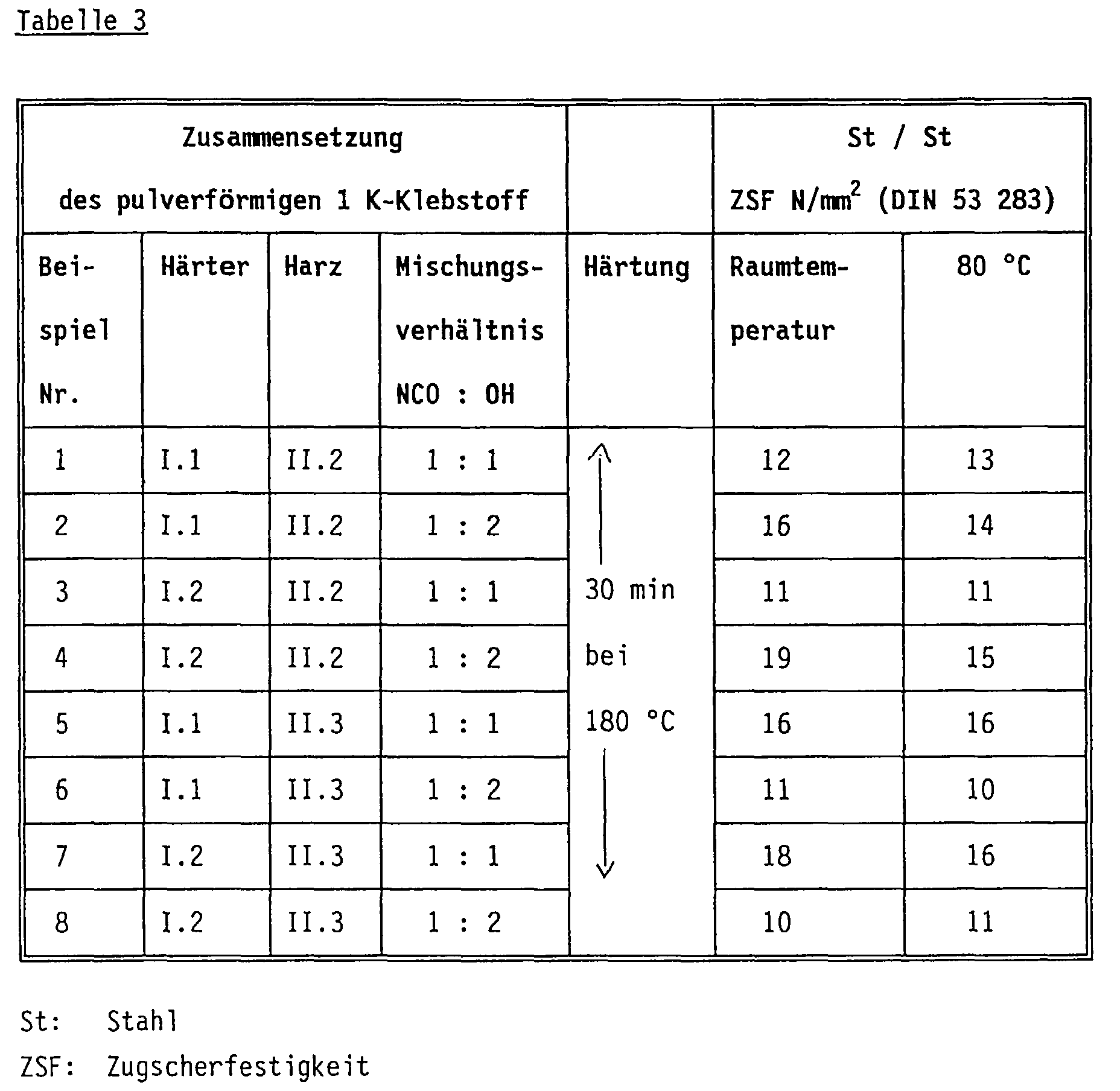
- the tensile shear strengths of these steel sheets bonded according to DIN 53 283 are listed in the table below (see Table 3).
Landscapes
- Chemical & Material Sciences (AREA)
- Health & Medical Sciences (AREA)
- Chemical Kinetics & Catalysis (AREA)
- Medicinal Chemistry (AREA)
- Polymers & Plastics (AREA)
- Organic Chemistry (AREA)
- Polyurethanes Or Polyureas (AREA)
- Paints Or Removers (AREA)
- Adhesives Or Adhesive Processes (AREA)
Abstract
Pulverlack, enthaltend im wesentlichen ein Gemisch aus A) einer pulverförmigen, unterhalb 50 °C festen und oberhalb 160 °C flüssigen Polyisocyanatkomponente der Formel I <IMAGE> B) einer pulverförmigen, unterhalb 50 °C festen und oberhalb 160 °C flüssigen organischen Polyhydroxylkomponente, bei der das Verhältnis von sekundären zu primären OH-Gruppen mindestens 3 : 1 beträgt, wobei die Komponenten A und B in einem Äquivalenzverhältnis NCO:OH-Gruppen von 0,5 : 1 bis 1,3 : 1 vorliegen.
Description
- Die vorliegende Erfindung betrifft einen neuen Pulverlack auf Basis von Kombinationen von organischen Polyhydroxylverbindungen mit organischen Polyisocyanaten als Vernetzer und die Verwendung dieses Pulverlackes bei der Herstellung von Beschichtungen auf beliebigen hitzeresistenten Substraten.
- Hitzehärtbare pulverförmige Massen, die man durch Reaktion eines hydroxylgruppenhaltigen Harzes mit einem maskierten Polyisocyanat erhält, gehören zum Stand der Technik und werden weit verbreitet angewandt. Von den maskierten Polyisocyanaten haben sich als PUR-Pulverhärter ε-Caprolactam-blockierte Isophorondiisocyanataddukte durchgesetzt. Die mit diesen Härtern hergestellten PUR-Pulver nehmen infolge ihrer überlegenen Witterungs- und Wärmefarbstabilität eine hervorragende Stellung ein.
- So werden in der DE-OS 21 05 777 als Härter von PUR-Pulvern wegen einer Reihe von Vorteilen insbesondere ε-Caprolactam-blockierte Addukte des Isophorondiisocyanats (abgekürzt: IPDI) und Di- bzw. Triolen genannt.
- In der DE-OS 25 42 191 werden blockierte Polyisocyanate aus IPDI, ε-Caprolactam und einem Polyol, das ein Gemisch aus einem Diol und Triol ist, beansprucht, sowie deren Verwendung zur Herstellung (in Kombination mit einem Hydroxylgruppen enthaltenden Polymeren) von in der Hitze härtbaren pulverförmigen Überzugsmassen.
- In der DE-OS 27 35 497 (≙ USP 4 246 308) werden pulverförmige PUR-Lacke aus hydroxylgruppenhaltigen Polyestern, Polyacrylaten oder Epoxidharzen beschrieben, die dadurch gekennzeichnet sind, daß als Polyisocyanatkomponente zur ε-Caprolactamblockierung das Isocyanatoisocyanurat und ggf. Oligomere zusammen mit monomerem IPDI eingesetzt werden.
- In der DE-OS 27 07 656 (≙ USP 4 150 211) findet sich eine ähnliche Bindemittelkombination wie in der DE-OS 27 35 497, wobei als Härterkomponente ein partiell trimerisiertes IPDI/Hexamethylendiisocyanat/Toluylendiisocyanat-Gemisch, dessen freie NCO-Gruppen mit ε-Caprolactam blockiert sind, eingesetzt wird.
- In der DE-OS 30 04 876 werden blockierte Polyisocyanate beansprucht, die aus ε-Caprolactam blockierten Addukten des IPDI und Polyolen bestehen, wobei die Addukte pro OH-Äquivalent 3,3 - 8 NCO-Äquivalente enthalten. Mit diesen blockierten IPDI-Addukten werden PUR-Pulverlacke hergestellt.
- In der DE-OS 31 43 060 werden PUR-Pulver beschrieben, die als Härterkomponente Reaktionsprodukte enthalten, die durch Kettenverlängerung von IPDI mit einem aliphatischen Diamin und anschließende ε-Caprolactam-Blockierung erhalten werden.
- Aus diesen mit ε-Caprolactam blockierten IPDI-Derivaten werden beim Einbrennen mit geeigneten Hydroxylverbindungen Lacke erhalten, die sich bei leichter Handbarkeit durch guten Verlauf, hohe Härte und Elastizität sowie gute Chemikalienbeständigkeit auszeichnen. Ein Nachteil dieser PUR-Pulverlacke ist jedoch die Einbrenntemperatur von ca. 180 - 200 °C. Ein weiterer Nachteil dieser PUR-Pulverlacke ist in der Abspaltung des ε-Caprolactams zu sehen, welche bei der Verarbeitung der Pulverlacke besondere Vorkehrungen zwecks Reinigung der Abluft und Wiedergewinnung des Blockierungsmittels unerläßlich macht.
- Es hat nicht an Versuchen gefehlt, die hohen Einbrenntemperaturen durch Auswahl anderer Blockierungsmittel zu senken. So wurden z.B. Oxime (DE-OS 22 00 342, EP-OS 0 432 257, USP 3 857 818), Triazole (DE-OS 28 12 252), cyclische Amidine (DE-OS 27 44 721) oder sekundäre Amine (DE-OS 34 34 881) als Blockierungsmittel mit niedrigeren Aufspalttemperaturen für PUR-Pulverlackhärter vorgeschlagen.
- Der prinzipielle Nachteil des Gehalts an Blockierungsmitteln im Pulverlack ist damit jedoch nicht behoben.
- Dieser prinzipielle Nachteil des Gehalts an Blockierungsmitteln im Pulverlack konnte durch Verwendung von blockierungsmittelfreien, linearen Uretdion- und Urethangruppen-haltigen IPDI-Derivaten, die endständig Urethan-, Harnstoff- oder freie NCO-Gruppen aufweisen (EP-A 0 045 994, EP-A 0 045 996 oder EP-A 0 045 998), beseitigt werden. Die Herstellung des Härters ist jedoch mit einer aufwendigen Technologie verbunden.
- Das Gleiche gilt für die PUR-Pulverlacke der DE-OS 36 24 775, in der als Härterkomponente Polyisocyanate, die unterhalb 40 °C fest und oberhalb 150 °C flüssig sind und keine Blockierungsmittel für Isocyanatgruppen aufweisen, eingesetzt werden.
- Aufgabe der vorliegenden Erfindung war es deshalb, blockierungmittelfreie PUR-Pulverlacke aufzufinden, die die Nachteile des Standes der Technik nicht aufweisen.
- Diese Aufgabe konnte dadurch gelöst werden, daß als Härter feste Addukte cycloaliphatischer Diisocyanate mit freien NCO-Gruppen und als Harzkomponente sekundäre OH-Gruppen enthaltende Polymere eingesetzt wurden.
- Gegenstand der vorliegenden Erfindung ist somit ein Pulverlack, enthaltend im wesentlichen ein Gemisch aus
- A) einer pulverförmigen, unterhalb 50 °C festen und oberhalb 160 °C flüssigen Polyisocyanatkomponente der Formel I

- B) einer pulverförmigen, unterhalb 50 °C festen und oberhalb 160 °C flüssigen organischen Polyhydroxylkomponente, bei der das Verhältnis von sekundären zu primären OH-Gruppen mindestens 3 : 1 beträgt, wobei die Komponenten A und B in einem Äquivalenzverhältnis NCO:OH-Gruppen von 0,5 : 1 bis 1,3 : 1 vorliegen.
- Gegenstand der Erfindung ist auch die Verwendung dieses Pulverlacks zur Herstellung von Beschichtungen sowie Verklebungen beliebiger hitzeresistenter Substrate nach den Methoden der Pulverlack-Technologie.
- Ausgangsverbindungen zur Herstellung der Komponente A der erfindungsgemäßen Lackzusammensetzung sind folgende Diisocyanate: Isophorondiisocyanat (IPDI), Bis(4-isocyanatocyclohexyl)-methan (H12MDI), α,α,α',α'-Tetramethyl-m-Xylylendiisocyanat (m-TMXDI) und Cyclohexan-1,4-diisocyanat (CHDI). Diese Diisocyanate werden einer Molekülvergrößerung, wie sie durch Trimerisierung, Reaktion mit unterschüssigen Mengen von Polyolen sowie Diaminen erreicht wird, unterworfen. Die Molekülvergrößerung durch Trimerisierung hat sich bei IPDI und H12MDI als zweckmäßig erwiesen. Hier werden die Diisocyanate bei 80 °C mit 0,2 - 0,4 % eines quaternären Ammoniumsalzes zu ca. 40 % umgesetzt. Das nicht umgesetzte Diisocyanat wird dann durch Dünnschichtdestillation vom Reaktionsprodukt entfernt. Diese Isocyanatgruppen enthaltenden Polyisocyanate werden bevorzugt für die Polyole B mit einer niedrigen OH-Funktionalität eingesetzt.
- Die Molekülvergrößerung mit Polyolen ist auf alle oben aufgeführten Diisocyanate gleichermaßen gut anwendbar. Dabei wird das Diisocyanat mit dem Polyol im NCO:OH-Äquivalenzverhältnis von (1,5 - 2) : 1, bevorzugt 2 : 1, in der Schmelze bei 80 - 150 °C so lange erhitzt, bis pro OH-Äquivalent ein NCO-Äquivalent verbraucht worden ist. Als Polyol zur Kettenverlängerung der genannten Diisocyanate kommen grundsätzlich alle niedermolekularen Di- und Triole in Frage, besonders geeignet haben sich Ethylenglykol, Butandiol, Hexandiol, Decandiol, Dodecandiol, Neopentylglykol, 1,4-Dimethylolcyclohexan, 1.1.1-Trimethylolpropan, 1.2.6-Hexantriol erwiesen.
- Bei der Molekülvergrößerung mit Diaminen wird zu dem auf 180 °C erhitzten Diisocyanat das Diamin portionsweise so zugegeben, daß die Temperatur nicht über 220 °C steigt. Es wird dann so lange bei 220 °C weiter erhitzt, bis der zwischenzeitlich auftretende Niederschlag in Lösung gegangen ist. Wenn dies der Fall ist, wird sofort auf Raumtemperatur abgekühlt. Als Diamine kommen grundsätzlich alle primären wie sekundären niedermolekularen Diamine in Frage; bevorzugt kommen jedoch 2.2.4 (2.4.4)-Trimethylhexamethylendiamin, 2-Methylpentamethylendiamin, N.N'-Dihexyl-Isophorondiamin, N-iso-Propyl-Isophorondiamin, N-Cyclohexylpropan-1.3-diamin zum Einsatz.
- Bei den für den erfindungsgemäßen Lack einzusetzende Polyolen B handelt es sich um sekundäre OH-Gruppen enthaltende Polymere, wie z. B. Epoxidharze auf Bisphenol A-Basis:

- Diese EP-Harze werden in Kombination mit den festen Polyisocyanaten A bevorzugt zur Herstellung von Metallverklebungen eingesetzt.
- Weitere als Polyole mit sekundären OH-Gruppen (Komponente B) einzusetzende hydroxylgruppenhaltige Verbindungen sind Polyester, die als wesentliche Bestandteile folgende Verbindungen einkondensiert enthalten:
- 1. Cyclische Polycarbonsäuren, wie Phthalsäure, Isophthalsäure, Terephthalsäure, Trimellithsäureanhydrid, Dimethylterephthalat sowie acyclische Polycarbonsäuren, wie z. B. Adipinsäure, 2.2.4(2.4.4)-Trimethyladipinsäure, Dodecandisäure,
- 2. Polyole, wie z. B. Ethylenglykol, 1.2-Propandiol, 1.3-Butandiol, 2.2-Dimethylpropandiol, 4.4'-Dihydroxydicyclohexylpropan-2.2, 1.4-Cyclohexandiol, Trimethylolpropan.
- Die Polyester werden in an sich bekannter Weise durch Verestern oder Umestern, gegebenenfalls in Gegenwart üblicher Katalysatoren, hergestellt, wobei durch geeignete Wahl des COOH/OH-Verhältnisses Endprodukte erhalten werden, deren Hydroxylzahl zwischen 25 und 250, bevorzugt zwischen 40 und 150, liegen.
- Die Erweichungstemperaturen der Polyester müssen so niedrig liegen, daß sie sich bei Temperaturen zwischen 70 und 120 °C mit den zur Herstellung der erfindungsgemäßen Überzugsmittel notwendigen Zusätzen verarbeiten lassen. Die Erweichungspunkte müssen andererseits so hoch liegen, daß die aus den Polyestern gewonnenen erfingungsgemäßen Lacke zu nicht klumpenden, freifließenden Pulvern mit einer Teilchengröße von etwa 20 bis etwa 120 µm vermahlen werden können.
- Eine einfache Methode zur Herstellung von Polyestern mit sekundären OH-Gruppen besteht in der Umesterung von primären OH-Gruppen enthaltenden Polyestern mit Milchsäuremethylester.
- Bei einem weiteren Verfahren zur Herstellung von Polymeren mit sekundären OH-Gruppen werden Oligoamide mit endständigen NH2-Gruppen mit Milchsäuremethylester bei 120 - 150 °C unter Abspaltung von Methanol umgesetzt. Die basischen Oligoamide werden in bekannter Weise durch Kondensation von aliphatischen Dicarbonsäuren bzw. deren Ester, wie z. B. Adipinsäure, 2.2.4(2.4.4)-Trimethyladipinsäure, Sebacinsäure, Decandicarbonsäure, Dodecandicarbonsäure und (cyclo) aliphatischen primären Diaminen, wie Hexamethylendiamin, 2.4.4 (2.2.4) -Trimethylhexamethylendiamin, Isophorondiamin, 4.4'-Diaminodicyclohexylmethan, 3.3'-Dimethyl-4.4'-diaminodicyclohexylmethan, Dodecandiamin hergestellt. Das Molgewicht der basischen Oligoamide, das zwischen 300 und 3000, bevorzugt 1000 - 2000, liegt, wird durch das Molverhältnis Diamin zu Dicarbonsäure eingestellt.
- Bei den gegebenenfalls mitzuverwendenden Hilf- und Zusatzmitteln handelt es sich beispielsweise um Pigmente, wie z. B. Titandioxid, Verlaufsmittel, wie z.B. Polybutylacrylat oder solchen auf Basis von Polysilikonen. Zur Herstellung des gebrauchsfertigen Pulverlacks, der gleichzeitig als pulverförmiger 1K-Klebstoff eingesetzt werden kann, werden die Polyisocyanatkomponente A und die Polyhydroxylkomponente B miteinander gemischt und gegebenenfalls mit den Zusatzmitteln C versehen und beispielsweise auf Extrudern oder Knetern bei Temperaturen oberhalb des Schmelzbereiches der Einzelkomponenten, beispielsweise 80 - 120 °C, zu einem homogenen Material vereinigt. Der nach Abkühlen der Schmelze resultierende Feststoff wird anschließend gemahlen und durch Sieben von den Kornanteilen oberhalb 100 µm befreit. Zur Herstellung des gebrauchsfertigen Pulverlacks aus den Ausgangsmaterialien ist nur ein kurzzeitiges Erhitzen auf Temperaturen oberhalb des Schmelzbereichs der Einzelkomponenten erforderlich. Eine nennenswerte Reaktion zwischen den Komponenten A und B findet nicht statt. Wäre dies der Fall, so würde sich dies in starken Verlaufsstörungen des ausgehärteten Pulverlacks bemerkbar machen.
- Der so hergestellte Pulverlack kann nach üblichen Pulverauftrags-Verfahren, wie z. B. elektrostatisches Pulverversprühen oder Wirbelsintern, auf die zu überziehenden Substrate aufgebracht werden. Die Härtung der Beschichtungen erfolgt durch Erhitzen auf Temperaturen von 150 bis 180 °C, vorzugsweise 160 °C, während eines Zeitraumes von 10 - 30 Minuten. Man erhält harte, glänzende und elastische Überzüge mit hervorragenden Korrosionsschutzeigenschaften und einer sehr guten Wärmefarbstabilität. Die mit dem erfindungsgemäßen Pulverlack hergestellten Metallverklebungen weisen bei Raumtemperatur, wie auch höheren Temperaturen hohe Zugscherfestigkeiten (DIN 53 283) auf.
-
- 1. 1000 Gew. T. IPDI wurden auf 80 °C erhitzt. Unter intensivem Rühren wurden 2 Gew.-T. Dabco® TMR (Fa. Air Products) zugegeben. Die Temperatur stieg auf 125 °C. Nach Erreichen dieses Temperaturmaximums war die Reaktion beendet. Der NCO-Gehalt des Reaktionsgemisches betrug 30,5 %.
In einem 2. Schritt wurde das nicht umgesetzte IPDI bei 180 °C/0,1 mbar im Dünnschichtverdampfer vom Reaktionsprodukt abgetrennt. Das Reaktionsprodukt hatte einen NCO-Gehalt von 17,2 %, einen IPDI-Gehalt von 0,5 %. Der Schmelzbereich lag bei 92 - 96 °C. Die mittlere NCO-Funktionalität betrug ca. 3,4. - 2. Zu 444 Gew. T. IPDI wurden bei 100 °C 144 Gew. T. 1,4-Bis(hydroxymethyl)-cyclohexan (CHDM) zugegeben. Nach Beendigung der CHDM-Zugabe wurde noch so lange bei 100 °C weitererhitzt, bis der NCO-Gehalt des Reaktionsgemisches 14,1 % betrug.
- Das Reaktionsprodukt hatte einen Schmelzbereich von 52 - 62 °C, einen Monomergehalt von 5,3 %. Die NCO-Funktionalität betrug 2.
-
- 1. Einsatzstoffe:
- 8.75 mol Dimethylterephthalat
- 1.0 mol Adipinsäuredimethylester
- 3.25 mol Terephthalsäure
- 13.25 mol Propandiol-1.2
- 0.75 mol Trimethylolpropan
Aus diesen Einsatzstoffen wurde nach bekannten Methoden ein Polyester mit den folgenden Kennzahlen hergestellt:
Physikalische Daten:- OH-Zahl :
- 48

- Säurezahl :
- 6

- Methylesterendgruppen :
- 0,4

- Schmelzbereich :
- 84 - 90 °C
- Glasumwandlungstemp. (DTA) :
- 55- 62 / 57 °C
- Molverhältnis: sek. OH: prim. OH :
- 4,1 : 1
- 2. Epoxidgruppen enthaltendes Polyol
In den Anwendungsbeispielen wurde als Polyolkomponente ein hydroxylgruppenhaltiges Epoxidharz der Fa. Shell eingesetzt. Das EP-Harz ist gemäß dem Hersteller durch folgende Kennzahlen charakterisiert.- EP-Äquivalentgew. :
- 875 - 975
- OH-Äquivalentgew. :
- ca. 300
- Schmelzpunkt [°C] :
- 96 - 104
- 3. In den Anwendungsbeispielen wurde als Polyolkomponente ein weiteres EP-Harz der Fa. Shell eingesetzt. Dieses EP-Harz ist gemäß dem Hersteller durch folgende Kennzahlen charakterisiert.
- EP-Äquivalentgewicht :
- 450 - 500
- OH-Äquivalentgewicht :
- ca. 310
- Schmelzpunkt [°C] :
- 64 - 74
- Einen guten Hinweis über die Reaktivität eines Harz/Härter-Gemisches erhält man, indem dieses Gemisch in einer Knetkammer bei Temperaturen von 100 - 120 °C geknetet wird, und der Knetwiderstand in Abhängigkeit der Zeit verfolgt wird. In dem Maße, wie die Reaktion eintritt, steigt die Viskosität und damit der Knetwiderstand. Tritt Vernetzung ein, so ist dies mit einem steilen Anstieg des Knetwiderstandes verbunden, der allerdings sofort wieder stark (fast auf Null) abfällt. Das vernetzte Produkt wird fein zerrieben und bereitet den Knetern kaum noch Widerstand.
Tabelle 1 Knetverhalten von Polyolen und Polyisocyanaten im Brabender-Plastographen Polyol Polyisocyanat OH:NCO Knetdauer [min] bis zur Vernetzung bei 100 °C 120 °C a) * Alftalat AN 739 (Oxyester mit prim. OH-Gruppen) I. 1 1 : 1 vernetzt beim Einfüllen - b) Alftalat AN 739 I. 2 1 : 1 1 - c) II. 2 I. 1 1 : 1 32 13 d) II. 2 I. 2 1 : 1 35 17 * Polyester der Fa. Hoechst; OH-Z: 56-60 
- 49,6 Gew.-T. des hydroxylgruppenhaltigen Polyesters II. 1, 10.4 Gew.-T. des gemäß Beispiel I. 1 hergestellten Polyisocyanats und 40 Gew.-T. Weißpigment, TiO2, KRONOS RN 57 P® wurden in einem Feststoffmischer innig vermengt und anschließend bei einer Massetemperatur von 95 - 100 °C extrudiert. Die erstarrte Schmelze wurde auf eine Korngröße < 100 µm gemahlen. Der so erhaltene Pulverlack wurde elektrostatisch auf 1 mm Stahlprüfbleche appliziert.
- Die Lacke wurden unter verschiedenen Härtungsbedingungen eingebrannt und nach 24 h einer lacktechnischen Abprüfung unterworfen.
Einbrennbedingungen SD HK HB ET GS Impact reverse GG 60 °∢ Zeit / Temp. min / °C 30 180 60-70 195 111 > 10 0 > 944,6 89 20 180 65-80 193 111 > 10 0 > 944,6 88 30 160 50-60 188 125 > 10 0 > 944,6 91 20 160 60-70 192 111 5,6-7,1 0 115,2 92 - Die Abkürzungen in der Tabelle bedeuten:
- SD
- ≙ Schichtdicke in µm
- HK
- ≙ Pendeldämpfung nach König in sec (DIN 53 157)
- HB
- ≙ Härte nach Bucholz (DIN 53 153)
- ET
- ≙ Tiefung nach Erichsen in mm (DIN 53 156)
- GS
- ≙ Gitterschnittprüfung (DIN 53 151)
- GG 60 °∢
- ≙ Messung des Glanzes nach Gardner (ASTM-D 523)
- Imp. rev.
- ≙ Impact reverve in g.m
- Das OH-Gruppen enthaltende B wurde mit dem Polyisocyanat A im OH:NCO-Verhältnis 2 : 1 sowie 1 : 1 intensiv gemischt und bei 100 °C extrudiert, fein gemahlen und auf die zu verklebenden, mit Scotch Brite gereinigten Stahlbleche (1,5 mm dick) aufgesiebt, die bis zum beendeten Abbinden mit Schraubzwingen fixiert wurden. Die Härtung erfolgte bei 180 °C. Die Zugscherfestigkeiten dieser nach DIN 53 283 verklebten Stahlbleche sind in der nachfolgenden Tabelle aufgelistet (siehe Tabelle 3).
Claims (11)
- Pulverlack, enthaltend im wesentlichen ein Gemisch ausA) einer pulverförmigen, unterhalb 50 °C festen und oberhalb 160 °C flüssigen Polyisocyanatkomponente der Formel I
 B) einer pulverförmigen, unterhalb 50 ° C festen und oberhalb 160 °C flüssigen organischen Polyhydroxylkomponente, bei der das Verhältnis von sekundären zu primären OH-Gruppen mindestens 3 : 1 beträgt, wobei die Komponenten A und B in einem Äquivalenzverhältnis NCO:OH-Gruppen von 0,5 : 1 bis 1,3 : 1 vorliegen.
 - Pulverlack nach Anspruch 1,
dadurch gekennzeichnet,
daß er zuzätzlich aus der Pulverlack-Technologie bekannte Hilfs- und Zusatzmittel enthält. - Pulverlack nach den Ansprüchen 1 oder 2,
dadurch gekennzeichnet,
daß als Komponente A Diisocyanate ausgewählt aus der Gruppe Isophorondiisocyanat (IPDI), Bis(4-isocyanatocyclohexyl)-methan (H12MDI), α,α,α',α'-Tetramethyl-m-Xylylendiisocyanat (m-TMXDI) und Cyclohexan-1,4-diisocyanat (CHDI), enthalten sind. - Pulverlack nach einem der vorherigen Ansprüche 1 bis 3,
dadurch gekennzeichnet,
daß die Diisocyanate A kettenverlängert sind. - Pulverlack nach Anspruch 4,
dadurch gekennzeichnet,
daß die Kettenverlängerung durch Trimerisierung oder mit unterschüssigen Mengen von Polyolen oder Diaminen erfolgt. - Pulverlack nach Anspruch 5,
dadurch gekennzeichnet,
daß Polyole ausgewählt aus der Gruppe Ethylenglykol, Butandiol, Hexandiol, Decandiol, Dodecandiol, Neopentylglykol, 1,4-Dimethylolcyclohexan, 1.1.1-Trimethylolpropan, 1.2.6-Hexantriol, enthalten sind. - Pulverlack nach Anspruch 5,
dadurch gekennzeichnet,
daß Diamine ausgewählt aus der Gruppe 2.2.4 (2.4.4)-Trimethylhexamethylendiamin, 2-Methylpentamethylendiamin, N.N'-Dihexyl-Isophorondiamin, N-iso-Propyl-Isophorondiamin, N-Cyclohexylpropan-1.3-diamin, enthalten sind. - Pulverlack nach den Ansprüchen 1 bis 7,
dadurch gekennzeichnet,
daß als Komponente B Epoxidharze auf Basis Bisphenol A enthalten sind. - Pulverlack nach den Ansprüchen 1 bis 8,
dadurch gekennzeichnet,
daß als Polyole Polyester enthalten sind, wobei diese die folgenden Bestandteile einkondensiert enthalten:1. Cyclische Polycarbonsäuren, wie Phthalsäure, Isophthalsäure, Terephthalsäure, Trimellithsäureanhydrid, Dimethylterephthalat sowie acyclische Polycarbonsäuren, wie z. B. Adipinsäure, 2.2.4(2.4.4)-Trimethyladipinsäure, Dodecandisäure, und2. Polyole, wie z. B. Ethylenglykol, 1.2-Propandiol, 1.3-Butandiol, 2.2-Dimethylpropandiol, 4.4'-Dihydroxydicyclohexylpropan-2.2, 1.4-Cyclohexandiol, Trimethylolpropan. - Pulverlack nach den Ansprüchen 1 bis 9,
dadurch gekennzeichnet,
daß als Komponente B sekundäre OH-Gruppen aufweisende Oligoamide enthalten sind. - Verwendung des Pulverlacks gemäß den Ansprüchen 1 bis 10 zur Herstellung von Beschichtungen sowie Verklebungen beliebiger hitzeresistenter Substrate nach den Methoden der Pulverlack-Technologie.
Applications Claiming Priority (2)
| Application Number | Priority Date | Filing Date | Title |
|---|---|---|---|
| DE19547205 | 1995-12-18 | ||
| DE1995147205 DE19547205A1 (de) | 1995-12-18 | 1995-12-18 | Pulverlack und seine Verwendung zur Beschichtung von hitzeresistenten Substraten |
Publications (1)
| Publication Number | Publication Date |
|---|---|
| EP0780416A1 true EP0780416A1 (de) | 1997-06-25 |
Family
ID=7780429
Family Applications (1)
| Application Number | Title | Priority Date | Filing Date |
|---|---|---|---|
| EP19960116397 Withdrawn EP0780416A1 (de) | 1995-12-18 | 1996-10-12 | Pulverlack und seine Verwendung zur Beschichtung von hitzeresistenten Substraten |
Country Status (4)
| Country | Link |
|---|---|
| US (1) | US5919568A (de) |
| EP (1) | EP0780416A1 (de) |
| JP (1) | JPH09176572A (de) |
| DE (1) | DE19547205A1 (de) |
Cited By (1)
| Publication number | Priority date | Publication date | Assignee | Title |
|---|---|---|---|---|
| EP2159238A1 (de) | 2008-08-30 | 2010-03-03 | Bayer MaterialScience AG | Pulverlack |
Families Citing this family (4)
| Publication number | Priority date | Publication date | Assignee | Title |
|---|---|---|---|---|
| CZ298956B6 (cs) * | 1998-12-09 | 2008-03-19 | Rotorový list pro zarízení na využití vetrné energie a zarízení na využití vetrné energie | |
| US20080265201A1 (en) * | 2007-04-26 | 2008-10-30 | Degussa Gmbh | Low-temperature-curable polyurethane compositions with uretdione groups, containing polymers based on polyols that carry secondary oh groups |
| JP2012111802A (ja) * | 2010-11-19 | 2012-06-14 | Akebono Brake Ind Co Ltd | 接着剤 |
| KR20200007820A (ko) * | 2017-05-17 | 2020-01-22 | 바스프 에스이 | 폴리이소시아네이트 (p) 및 그의 제조 방법 |
Citations (5)
| Publication number | Priority date | Publication date | Assignee | Title |
|---|---|---|---|---|
| EP0254152A1 (de) * | 1986-07-22 | 1988-01-27 | Bayer Ag | Pulverlack und seine Verwendung zur Beschichtung von Hitzeresistenten Substraten |
| NL9201868A (nl) * | 1992-10-28 | 1994-05-16 | Dsm Nv | Bindmiddelsamenstelling voor poederverven op basis van een hydroxyl functioneel polymeer als bindmiddel en een isocyanaat groepen bevattende verbinding als crosslinker. |
| EP0652263A1 (de) * | 1993-11-05 | 1995-05-10 | Bayer Ag | Pulverlack und seine Verwendung |
| EP0669351A1 (de) * | 1994-02-25 | 1995-08-30 | Bayer Ag | Pulverlack und seine Verwendung |
| EP0669353A1 (de) * | 1994-02-28 | 1995-08-30 | Hüls Aktiengesellschaft | Hydroxyl- und uretdiongruppenhaltige Polyadditionsprodukte und Verfahren zu ihrer Herstellung sowie deren Verwendung zur Herstellung abspaltfreier Polyurethan-Pulverlacke hoher Reaktivität und die danach hergestellten Polyurethan-Pulverlacke |
Family Cites Families (5)
| Publication number | Priority date | Publication date | Assignee | Title |
|---|---|---|---|---|
| US4093674A (en) * | 1972-11-30 | 1978-06-06 | Nippon Paint Co., Ltd. | Powder coating composition |
| DE2707656C2 (de) * | 1977-02-23 | 1986-04-17 | Bayer Ag, 5090 Leverkusen | Pulverförmige Überzugsmittel |
| DE2806731A1 (de) * | 1978-02-17 | 1979-08-23 | Bayer Ag | Verfahren zur herstellung von isocyanuratgruppen aufweisenden polyisocyanaten |
| DE4406443A1 (de) * | 1994-02-28 | 1995-08-31 | Huels Chemische Werke Ag | Verfahren zur Herstellung von blockierten Polyisocyanaten und deren Verwendung in Polyurethan-Lacksystemen |
| US5508349A (en) * | 1994-05-09 | 1996-04-16 | Basf Corporation | Reactive flow agent for powder coatings |
-
1995
- 1995-12-18 DE DE1995147205 patent/DE19547205A1/de not_active Withdrawn
-
1996
- 1996-10-12 EP EP19960116397 patent/EP0780416A1/de not_active Withdrawn
- 1996-12-12 US US08/764,442 patent/US5919568A/en not_active Expired - Fee Related
- 1996-12-16 JP JP33582496A patent/JPH09176572A/ja active Pending
Patent Citations (5)
| Publication number | Priority date | Publication date | Assignee | Title |
|---|---|---|---|---|
| EP0254152A1 (de) * | 1986-07-22 | 1988-01-27 | Bayer Ag | Pulverlack und seine Verwendung zur Beschichtung von Hitzeresistenten Substraten |
| NL9201868A (nl) * | 1992-10-28 | 1994-05-16 | Dsm Nv | Bindmiddelsamenstelling voor poederverven op basis van een hydroxyl functioneel polymeer als bindmiddel en een isocyanaat groepen bevattende verbinding als crosslinker. |
| EP0652263A1 (de) * | 1993-11-05 | 1995-05-10 | Bayer Ag | Pulverlack und seine Verwendung |
| EP0669351A1 (de) * | 1994-02-25 | 1995-08-30 | Bayer Ag | Pulverlack und seine Verwendung |
| EP0669353A1 (de) * | 1994-02-28 | 1995-08-30 | Hüls Aktiengesellschaft | Hydroxyl- und uretdiongruppenhaltige Polyadditionsprodukte und Verfahren zu ihrer Herstellung sowie deren Verwendung zur Herstellung abspaltfreier Polyurethan-Pulverlacke hoher Reaktivität und die danach hergestellten Polyurethan-Pulverlacke |
Cited By (2)
| Publication number | Priority date | Publication date | Assignee | Title |
|---|---|---|---|---|
| EP2159238A1 (de) | 2008-08-30 | 2010-03-03 | Bayer MaterialScience AG | Pulverlack |
| DE102008045224A1 (de) | 2008-08-30 | 2010-03-04 | Bayer Materialscience Ag | Pulverlack |
Also Published As
| Publication number | Publication date |
|---|---|
| US5919568A (en) | 1999-07-06 |
| JPH09176572A (ja) | 1997-07-08 |
| DE19547205A1 (de) | 1997-06-19 |
Similar Documents
| Publication | Publication Date | Title |
|---|---|---|
| EP1526146B1 (de) | Hochreaktive Polyurethan-Pulverlackzusammensetzungen auf Basis epoxidgruppenterminierter, uretdiongruppenhaltiger Polyadditionsverbindungen | |
| EP0053766B2 (de) | Verfahren zur Herstellung von Ueberzügen | |
| EP0096210B1 (de) | Lagerstabile Polyurethan-Einkomponenten-Einbrennlacke | |
| EP1475400A1 (de) | Bei niedriger Temperatur härtbare feste uretdiongruppenhaltige Polyurethan-Pulverlackzusammensetzungen | |
| DE102004020451A1 (de) | Uretdiongruppenhaltige Polyurethanzusammensetzungen, welche bei niedriger Temperatur härtbar sind und (teil-)kristalline Harze enthalten | |
| EP1740633A1 (de) | Uretdiongruppenhaltige polyurethanzusammensetzungen, welche bei niedriger temperatur härtbar sind und (teil-)kristalline harze enthalten | |
| DE102004011005A1 (de) | Bei niedriger Temperatur härtbare uretdiongruppenhaltige Polyurethanzusammensetzungen | |
| WO2008028769A1 (de) | Bei niedriger temperatur härtbare, uretdiongruppenhaltige polyurethanzusammensetzungen mit quartären ammoniumhalogeniden | |
| EP0818482A1 (de) | Wärmehärtende Einkomponenten-Klebstoffe auf Basis von Polyurethanen, ein Verfahren zu ihrer Herstellung sowie deren Verwendung | |
| DE19604581A1 (de) | Polyurethan-Pulvermattlacke | |
| DE3711374A1 (de) | Polyurethan-pulverlacke, die nach aushaertung eine matte oberflaeche ergeben | |
| DE3004876A1 (de) | Blockierte polyisocyanate mit hoher reaktionsfaehigkeit, ihre herstellung und verwendung | |
| EP0781771A1 (de) | Cyclische Amidin- sowie Uretdiongruppen enthaltende Verbindungen, ein Verfahren zu ihrer Herstellung sowie deren Verwendung | |
| EP0829499A1 (de) | Uretdiongruppenhaltige Polyisocyanate, ein Verfahren zu ihrer Herstellung sowie deren Verwendung | |
| EP0950676A1 (de) | Harnstoff- und uretdiongruppenhaltige Polyisocyanate | |
| EP1382650A1 (de) | PUR-Pulverlacke für Beschichtungen mit mattem Erscheinungsbild | |
| EP1362875A1 (de) | Bifunktionelle Polyadditionsverbindungen als Vernetzer für Polyurethan-Pulverlacke | |
| DE19547205A1 (de) | Pulverlack und seine Verwendung zur Beschichtung von hitzeresistenten Substraten | |
| DE10233104A1 (de) | Verwendung von PUR-Pulverlacken für Coil Coating-Beschichtungen mit mattem Erscheinungsbild | |
| EP1448652B1 (de) | Mit epsilon -caprolactam und dipa bzw. 1,2,4-triazol mischblockierte polyisocyanate, deren herstellung und verwendung | |
| DE3536017A1 (de) | Ganz oder teilweise mit epsilon-caprolactam blockiertes trans-cyclohexan-1,4-diisocyanat, dessen herstellung und verwendung | |
| EP0818483A1 (de) | Wärmehärtender abspalt- und lösemittelfreier Einkomponenten-Klebstoff auf Basis von Polyurethanen sowie deren Verwendung | |
| DE3610758C2 (de) | ||
| DE10159768A1 (de) | Verwendung von Polyurethan-Pulverlacken | |
| EP0818484A1 (de) | Wärmehärtende, abspalt- und lösemittelfreie Einkomponenten-Klebstoffe auf Basis von Polyurethanen, ein Verfahren zu ihrer Herstellung sowie deren Verwendung |
Legal Events
| Date | Code | Title | Description |
|---|---|---|---|
| PUAI | Public reference made under article 153(3) epc to a published international application that has entered the european phase |
Free format text: ORIGINAL CODE: 0009012 |
|
| 17P | Request for examination filed |
Effective date: 19970329 |
|
| AK | Designated contracting states |
Kind code of ref document: A1 Designated state(s): AT CH DE FR GB IT LI NL |
|
| 17Q | First examination report despatched |
Effective date: 19980312 |
|
| STAA | Information on the status of an ep patent application or granted ep patent |
Free format text: STATUS: THE APPLICATION HAS BEEN WITHDRAWN |
|
| 18W | Application withdrawn |
Withdrawal date: 19990303 |