EP0819680B1 - Verfahren zur Herstellung von Pyrimidin-2-essigsäureestern - Google Patents
Verfahren zur Herstellung von Pyrimidin-2-essigsäureestern Download PDFInfo
- Publication number
- EP0819680B1 EP0819680B1 EP97112147A EP97112147A EP0819680B1 EP 0819680 B1 EP0819680 B1 EP 0819680B1 EP 97112147 A EP97112147 A EP 97112147A EP 97112147 A EP97112147 A EP 97112147A EP 0819680 B1 EP0819680 B1 EP 0819680B1
- Authority
- EP
- European Patent Office
- Prior art keywords
- alkyl
- alkoxy
- process according
- hydrogen
- palladium
- Prior art date
- Legal status (The legal status is an assumption and is not a legal conclusion. Google has not performed a legal analysis and makes no representation as to the accuracy of the status listed.)
- Expired - Lifetime
Links
- 0 CC1=CC1c1nc(*)c(*)c(*)n1 Chemical compound CC1=CC1c1nc(*)c(*)c(*)n1 0.000 description 2
Classifications
-
- C—CHEMISTRY; METALLURGY
- C07—ORGANIC CHEMISTRY
- C07D—HETEROCYCLIC COMPOUNDS
- C07D239/00—Heterocyclic compounds containing 1,3-diazine or hydrogenated 1,3-diazine rings
- C07D239/02—Heterocyclic compounds containing 1,3-diazine or hydrogenated 1,3-diazine rings not condensed with other rings
- C07D239/24—Heterocyclic compounds containing 1,3-diazine or hydrogenated 1,3-diazine rings not condensed with other rings having three or more double bonds between ring members or between ring members and non-ring members
- C07D239/28—Heterocyclic compounds containing 1,3-diazine or hydrogenated 1,3-diazine rings not condensed with other rings having three or more double bonds between ring members or between ring members and non-ring members with hetero atoms or with carbon atoms having three bonds to hetero atoms with at the most one bond to halogen, directly attached to ring carbon atoms
- C07D239/46—Two or more oxygen, sulphur or nitrogen atoms
- C07D239/52—Two oxygen atoms
Definitions
- the present invention relates to a process for the preparation of substituted pyrimidine-2-acetic acid esters by reacting 2- (halomethyl) pyrimidines with carbon monoxide and an alcohol in the presence of a catalyst and a base.
- the esters which can be prepared according to the invention have the general formula
- the object of the present invention was to provide a process which gives the desired product in only one stage with good yield. According to the invention, this object is achieved by the method according to claim 1.
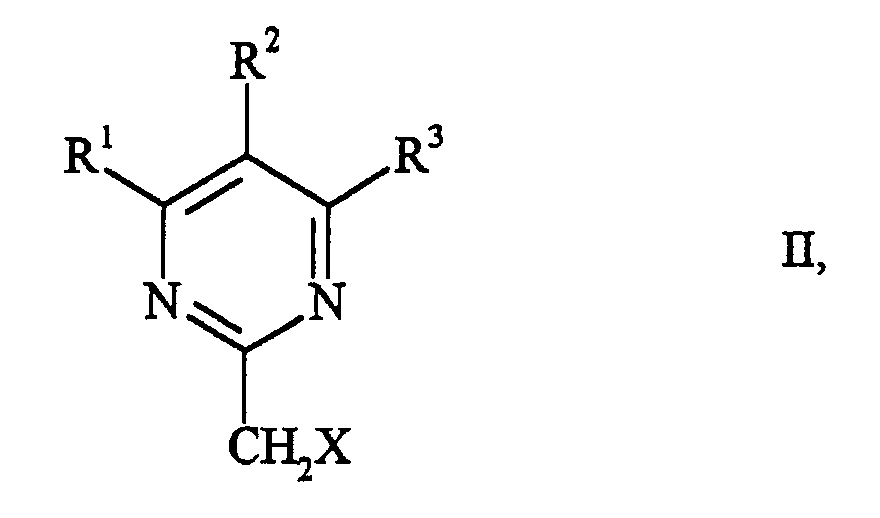
- 2- (halomethyl) pyrimidines have the general formula wherein R 1 to R 3 have the meanings given above and X is chlorine or bromine, with carbon monoxide and an alcohol of the general formula RAW wherein R has the meaning given above, in the presence of a base from the group consisting of the alkali and alkaline earth metal salts of carboxylic acids having 1 to 6 carbon atoms, the alkali and alkaline earth metal carbonates and hydrogen carbonates and the alkali metal and alkaline earth metal (hydrogen) phosphates , react directly to the desired products (I) in good yield if a palladium-phosphine complex is used as the catalyst, in which a diphosphine of the general formula R 4 R 5 PQ-PR 6 R 7 is used, wherein R 4 to R 7 are independently phenyl, substitute
- C 1-6 alkyl here and in the following is to be understood to mean all linear or branched primary, secondary or tertiary alkyl groups with up to 6 carbon atoms.
- C 1-6 alkoxy and (C 1-6 alkoxy) carbonyl are understood to mean the ether and ester functions composed of C 1-6 alkyl and oxygen or oxygen and carbonyl, and analogously to (C 1-6 -Alkoxy) -C 1-6 -alkyl, the alkoxyalkyl groups formed by replacing a hydrogen atom in C 1-6 alkyl with C 1-6 alkoxy, for example methoxymethyl or ethoxymethyl.
- Phenyl, naphthyl, biphenylyl or anthracenyl radicals can carry one or more identical or different substituents, namely C 1-6 alkyl groups such as methyl, halogenated C 1-6 alkyl groups such as trifluoromethyl, C 1-6 alkoxy groups such as methoxy, or C 1-6 alkylthio (alkanesulfanyl) or alkanesulfonyl groups such as methylthio or ethanesulfonyl.
- Substituted phenyl is to be understood in particular as groups such as fluorophenyl, methoxyphenyl, tolyl or trifluoromethylphenyl, the substituents preferably being in the para position.
- aryl-C 1-6 -alkyl is to be understood as meaning the groups formed from C 1-6 -alkyl groups by exchanging a hydrogen atom for one of the aryl groups defined above, for example benzyl or phenylethyl.
- the 2- (halomethyl) pyrimidines (II) serving as starting material are known compounds or can be prepared analogously to known compounds, for example by the process described in EP-A-0 552 759.
- pyrimidine-2-acetic acid esters (I) which, in positions 4 and 6 of the pyrimidine ring (R 1 , R 3 ), are hydrogen, C 1-4 alkoxy groups, (C 1-4 alkoxy) carbonyl groups or (C 1-4 alkoxy) methyl groups.
- a diphosphine of the general formula is used as phosphine in the catalytically active palladium-phosphine complex
- R 4 R 5 PQ-PR 6 R 7 used in which R 4 to R 7 independently of one another are optionally substituted with fluorine, C 1-6 -alkyl, halogenated or unhalogenated, C 1-6 -alkoxy, C 1-6 -alkylthio and / or C 1-6 -alkanesulfonyl, C 1-6 alkyl or C 3-6 cycloalkyl and Q represents a 1,1'-ferrocendiyl group or a group of the formula - [CH 2 ] n -, in which n is 3 or 4.
- the catalytically active palladium-phosphine complex is advantageously formed in situ by using palladium in finely divided elemental form (e.g. palladium on activated carbon), a Pd (II) salt (e.g. the chloride or the acetate), or a suitable Pd (II) complex (e.g. dichlorobis (triphenylphosphine) palladium (II)) is reacted with the phosphine.
- Palladium (II) acetate and dichlorobis (triphenylphosphine) palladium (II) are particularly preferred.
- the palladium is preferably used in an amount of 0.02 to 2 mol% Pd (II) or 0.5 to 5 mol% Pd (0) (e.g. as Pd / C), in each case based on the halogen compound ( II), used.
- the phosphine is advantageously used in excess (based on Pd), preferably in an amount of 0.2 to 10 mol%, also based on the halogen compound (II).
- the alcohol (III) can also serve as a solvent at the same time. If necessary, an additional solvent can be used. Both relatively non-polar solvents such as toluene or xylene and polar solvents such as acetonitrile, tetrahydrofuran or N, N -dimethylacetamide are suitable as additional solvents.
- the reaction temperature is preferably 80 to 250 ° C.
- the carbon monoxide pressure is preferably 1 to 50 bar.
- the reaction time depends, among other things, on the temperature and the reactivity of the used Compounds and the concentration ratios, it is typically in the Range of a few hours. Because with an excessively long reaction time under certain circumstances Subsequent reactions occur, the course of the reaction is advantageous with a suitable analysis method (e.g. GC) and monitors the reaction after reaching the maximum product concentration canceled.
- a suitable analysis method e.g. GC
Landscapes
- Chemical & Material Sciences (AREA)
- Organic Chemistry (AREA)
- Low-Molecular Organic Synthesis Reactions Using Catalysts (AREA)
- Organic Low-Molecular-Weight Compounds And Preparation Thereof (AREA)
- Plural Heterocyclic Compounds (AREA)
- Pharmaceuticals Containing Other Organic And Inorganic Compounds (AREA)
- Catalysts (AREA)
- Agricultural Chemicals And Associated Chemicals (AREA)
Description
Die erfindungsgemäss herstellbaren Ester besitzen die allgemeine Formel

Es wurde gefunden, dass 2-(Halomethyl)pyrimidine der allgemeinen Formel
Phenyl-, Naphthyl-, Biphenylyl- oder Anthracenyl reste können einen oder mehrere gleiche oder verschiedene Substituenten tragen, nämlich C1-6-Alkylgruppen wie Methyl, halogenierte C1-6-Alkylgruppen wie Trifluormethyl, C1-6-Alkoxygruppen wie Methoxy, oder C1-6-Alkylthio-(Alkansulfanyl-) oder Alkansulfonylgruppen wie Methylthio oder Ethansulfonyl. Unter substituiertem Phenyl sind insbesondere Gruppen wie Fluorphenyl, Methoxyphenyl, Tolyl oder Trifluormethylphenyl zu verstehen, wobei sich die Substituenten vorzugsweise in paraStellung befinden.
Entsprechend sind unter Aryl-C1-6-alkyl die aus C1-6-Alkylgruppen durch Austausch eines Wasserstoffatoms gegen eine der vorstehend definierten Arylgruppen gebildeten Gruppen zu verstehen, also beispielsweise Benzyl oder Phenylethyl.
Vorzugsweise werden als 2-(Halomethyl)pyrimidine die 2-(Chlormethyl)pyrimidine (X = Cl) eingesetzt.
- Isolierte Ausbeute:
- 1,30 g (59%) gelbes Öl, Gehalt (GC) 96,5%
- 1H NMR (CDCl3) δ =
- 5,92 (s, 1H); 3,92 (s, 6H); 3,82 (s, 2H); 3,75 (s, 3H).
- MS (m/z):
- 212 (M+); 211; 183; 169; 140.
- Isolierte Ausbeute:
- 1,90 g (82,4%) gelbes Öl, Gehalt (GC) 98,1%
- 1H NMR (CDCl3) δ =
- 5,92 (s, 1H); 4,22 (q, 2H); 3,92 (s, 6H); 3,80 (s, 2H); 1,28 (t, 3H).
- 13C NMR (CDCl3) δ =
- 14,2 (CH2CH3); 45,4 (CH2CO); 54,0 (OCH3); 60,9 (OCH2); 87,9 (CH); 163,7 (C=O), 167,7 (N=C-N); 171,6 (C-OCH3).
- MS (m/z):
- 226 (M+); 211; 196; 181; 153; 122.
- Isolierte Ausbeute:
- 1,34 g (54%) gelbes Öl, Gehalt (GC) 97%
- 1H NMR (CDCl3) δ =
- 5,92 (s, 1H); 5,10 (sept., 1H); 3,91 (s, 6H); 3,78 (s, 2H); 1,26 (t, 6H).
- 13C NMR (CDCl3) δ =
- 21,81 (CH(CH3)2); 45,63 (CH2CO); 54,02 (OCH3); 68,31 (OCH); 87,91 (C-CH-C); 163,87 (C=O), 169,22 (N=C-N); 171,56 (C-OCH3).
- MS (m/z):
- 240 (M+); 197; 181; 154; 125; 113.
Claims (7)
- Verfahren zur Herstellung von Pyrimidin-2-essigsäureestem der allgemeinen Formelworin RC1-6-Alkyl, C3-6-Cycloalkyl, Fluorphenyl C1-6-alkyl oder gegebenenfalls am Arylrest mit C1-6-Alkyl, halogeniert oder unhalogeniert, C1-6-Alkoxy, C1-6-Alkylthio und/oder C1-6-Alkansulfonyl substituiertes Aryl-C1-6-alkyl ist, wobei Aryl für Phenyl, Naphthyl, Biphenylyl oder Anthracenyl steht, und R1 bis R3 unabhängig voneinander Wasserstoff, C1-6-Alkyl, fluoriertes C1-6-Alkyl, C1-6-Alkoxy, (C1-6-Alkoxy)-C1-6-alkyl oder (C1-6-Alkoxy)carbonyl bedeuten, dadurch gekennzeichnet, dass ein 2-(Halomethyl)pyrimidin der allgemeinen Formel
 worin R1 bis R3 die oben genannten Bedeutungen haben und X Chlor oder Brom ist, mit Kohlenmonoxid und einem Alkohol der allgemeinen Formel
- Verfahren nach Anspruch 1, dadurch gekennzeichnet, dass X Chlor ist.
- Verfahren nach Anspruch 1 oder 2, dadurch gekennzeichnet, dass R C1-4-Alkyl ist.
- Verfahren nach einem der Ansprüche 1 bis 3, dadurch gekennzeichnet, dass R2 Wasserstoff ist.
- Verfahren nach einem der Ansprüche 1 bis 4, dadurch gekennzeichnet, dass R1 und R3 Wasserstoff, C1-4-Alkoxy, (C1-4-Alkoxy)carbonyl, oder (C1-4-Alkoxy)methyl sind.
- Verfahren nach einem der Ansprüche 1 bis 5, dadurch gekennzeichnet, dass der katalytisch aktive Palladium-Phosphin-Komplex in situ aus dem Phosphin und Palladium(II)acetat oder Dichloro-bis(triphenylphosphin)palladium(II) gebildet wird.
- Verfahren nach einem der Ansprüche 1 bis 6, dadurch gekennzeichnet, dass als Base ein Alkalicarbonat oder -acetat, vorzugsweise Natriumcarbonat, Kaliumcarbonat, Natriumacetat oder Kaliumacetat, eingesetzt wird.
Applications Claiming Priority (3)
| Application Number | Priority Date | Filing Date | Title |
|---|---|---|---|
| CH1798/96 | 1996-07-18 | ||
| CH179896 | 1996-07-18 | ||
| CH179896 | 1996-07-18 |
Publications (3)
| Publication Number | Publication Date |
|---|---|
| EP0819680A2 EP0819680A2 (de) | 1998-01-21 |
| EP0819680A3 EP0819680A3 (de) | 1998-03-25 |
| EP0819680B1 true EP0819680B1 (de) | 2003-06-18 |
Family
ID=4218854
Family Applications (1)
| Application Number | Title | Priority Date | Filing Date |
|---|---|---|---|
| EP97112147A Expired - Lifetime EP0819680B1 (de) | 1996-07-18 | 1997-07-16 | Verfahren zur Herstellung von Pyrimidin-2-essigsäureestern |
Country Status (9)
| Country | Link |
|---|---|
| US (1) | US5821368A (de) |
| EP (1) | EP0819680B1 (de) |
| JP (1) | JPH1072452A (de) |
| AT (1) | ATE243201T1 (de) |
| CA (1) | CA2209258C (de) |
| DE (1) | DE59710294D1 (de) |
| DK (1) | DK0819680T3 (de) |
| ES (1) | ES2196217T3 (de) |
| PT (1) | PT819680E (de) |
Families Citing this family (1)
| Publication number | Priority date | Publication date | Assignee | Title |
|---|---|---|---|---|
| US6297388B1 (en) * | 1999-11-05 | 2001-10-02 | Daicel Chemical Industries, Ltd. | Ester and process for producing the same |
Family Cites Families (3)
| Publication number | Priority date | Publication date | Assignee | Title |
|---|---|---|---|---|
| DE3826230A1 (de) * | 1988-08-02 | 1990-02-08 | Hoechst Ag | Heterocyclische n-acylsufonamide, verfahren zu ihrer herstellung, sie enthaltende mittel und ihre verwendung als herbizide oder wachstumsregulatoren |
| SK393392A3 (en) * | 1992-01-23 | 1995-09-13 | Lonza Ag | Method of preparation of 4,6-dialkoxy-pyrimidines |
| US5322959A (en) * | 1993-05-11 | 1994-06-21 | Ethyl Corporation | Catalytic carboxylation process for preparing aryl-substituted aliphatic carboxylic esters |
-
1997
- 1997-06-27 CA CA002209258A patent/CA2209258C/en not_active Expired - Fee Related
- 1997-07-08 US US08/889,442 patent/US5821368A/en not_active Expired - Fee Related
- 1997-07-11 JP JP9186948A patent/JPH1072452A/ja active Pending
- 1997-07-16 DK DK97112147T patent/DK0819680T3/da active
- 1997-07-16 ES ES97112147T patent/ES2196217T3/es not_active Expired - Lifetime
- 1997-07-16 AT AT97112147T patent/ATE243201T1/de not_active IP Right Cessation
- 1997-07-16 DE DE59710294T patent/DE59710294D1/de not_active Expired - Fee Related
- 1997-07-16 PT PT97112147T patent/PT819680E/pt unknown
- 1997-07-16 EP EP97112147A patent/EP0819680B1/de not_active Expired - Lifetime
Also Published As
| Publication number | Publication date |
|---|---|
| US5821368A (en) | 1998-10-13 |
| CA2209258A1 (en) | 1998-01-18 |
| PT819680E (pt) | 2003-11-28 |
| ES2196217T3 (es) | 2003-12-16 |
| DE59710294D1 (de) | 2003-07-24 |
| JPH1072452A (ja) | 1998-03-17 |
| DK0819680T3 (da) | 2003-10-06 |
| EP0819680A3 (de) | 1998-03-25 |
| EP0819680A2 (de) | 1998-01-21 |
| ATE243201T1 (de) | 2003-07-15 |
| CA2209258C (en) | 2007-09-11 |
Similar Documents
| Publication | Publication Date | Title |
|---|---|---|
| EP0579797B1 (de) | Diphosphinliganden | |
| EP0606065B1 (de) | Verfahren zur Herstellung von Biphenylderivaten | |
| DE19741411A1 (de) | Verfahren zur Herstellung von 3-Aryluracilen | |
| DD280320A5 (de) | Herstellung von zwischenprodukten der oxophthalazinyl-essigsaeuren mit benzothiazol oder anderen heterocyclischen seitenketten | |
| DE60023296T2 (de) | Verfahren zur herstellung von 2-amino-4(4-fluorphenyl)-6-alkylpyrimidin-5-carbonsäureester | |
| EP1414833B1 (de) | Neue übergangsmetall-komplexe und deren einsatz in übergangsmetall-katalysierten reaktionen | |
| EP1311483B1 (de) | Verfahren zur herstellung von 2-aminomethyl-halogen-pyridinen | |
| EP0864565B1 (de) | Verfahren zur Herstellung von 2,6-Pyridindicarbonsäureestern | |
| DE19647582A1 (de) | Verfahren zur Herstellung von aromatischen Olefinen mittels Katalyse durch Palladaphosphacyclobutane | |
| EP0819679B1 (de) | Verfahren zur Herstellung von Pyrimidin-2-carbonsäureestern | |
| EP0393453A2 (de) | Verfahren zur Herstellung von 2-Chlor-5-chlormethyl-pyridin und neue Zwischenprodukte | |
| EP0820987B1 (de) | Verfahren zur Herstellung von Pyridin-2,3-dicarbonsäureestern | |
| EP0237480B1 (de) | Verfahren zur Herstellung von 2-Alkoxybenzosulfonamiden | |
| EP0820986B1 (de) | Verfahren zur Herstellung von Pyridincarbonsäureestern | |
| EP0819680A2 (de) | Verfahren zur Herstellung von Pyrimidin-2-essigsäureestern | |
| JP2019147829A (ja) | 5−(トリフルオロメチル)ピリミジン誘導体及びその製造方法 | |
| EP0802189B1 (de) | Verfahren zur Herstellung von Arylamiden heteroaromatischer Carbonsäuren | |
| DE60101391T2 (de) | Verfahren zum Herstellen von Pivaloylessigsäureester | |
| EP0806415B1 (de) | Verfahren zur Herstellung von Arylamiden heteroaromatischer Carbonsäuren | |
| DE60020539T2 (de) | Verfahren zur herstellung von thiobarbitursäurederivaten | |
| DE69503212T2 (de) | Verfahren zur Herstellung von (1,1-Dichloromethyl)methylether und (1,1-Dichloromethyl)ethylether | |
| DE102006016462A1 (de) | Verfahren zum Herstellen von Biphenylaminen über Vinylaniline | |
| DD285349A5 (de) | Verfahren zur herstellung von substituierten pyridylalkylketonen | |
| EP1861343B1 (de) | Verfahren zur herstellung von alkylsubstituierten aromaten und heteroaromaten durch kreuzkupplung von alkylboronsäuren mit aryl- oder heteroarylhalogeniden oder -sulfonaten unter pd-katalyse in gegenwart eines liganden | |
| EP0002019A1 (de) | Verfahren zur Herstellung von Organozinnverbindungen |
Legal Events
| Date | Code | Title | Description |
|---|---|---|---|
| PUAI | Public reference made under article 153(3) epc to a published international application that has entered the european phase |
Free format text: ORIGINAL CODE: 0009012 |
|
| AK | Designated contracting states |
Kind code of ref document: A2 Designated state(s): AT BE CH DE DK ES FI FR GB IE IT LI NL PT SE |
|
| AX | Request for extension of the european patent |
Free format text: AL;LT;LV;RO;SI |
|
| PUAL | Search report despatched |
Free format text: ORIGINAL CODE: 0009013 |
|
| RTI1 | Title (correction) | ||
| AK | Designated contracting states |
Kind code of ref document: A3 Designated state(s): AT BE CH DE DK ES FI FR GB GR IE IT LI LU MC NL PT SE |
|
| AX | Request for extension of the european patent |
Free format text: AL;LT;LV;RO;SI |
|
| 17P | Request for examination filed |
Effective date: 19980714 |
|
| AKX | Designation fees paid |
Free format text: AT BE CH DE DK ES FI FR GB IE IT LI NL PT SE |
|
| RBV | Designated contracting states (corrected) |
Designated state(s): AT BE CH DE DK ES FI FR GB IE IT LI NL PT SE |
|
| 17Q | First examination report despatched |
Effective date: 19990917 |
|
| RAP1 | Party data changed (applicant data changed or rights of an application transferred) |
Owner name: LONZA AG |
|
| GRAH | Despatch of communication of intention to grant a patent |
Free format text: ORIGINAL CODE: EPIDOS IGRA |
|
| GRAH | Despatch of communication of intention to grant a patent |
Free format text: ORIGINAL CODE: EPIDOS IGRA |
|
| GRAA | (expected) grant |
Free format text: ORIGINAL CODE: 0009210 |
|
| AK | Designated contracting states |
Designated state(s): AT BE CH DE DK ES FI FR GB IE IT LI NL PT SE |
|
| REG | Reference to a national code |
Ref country code: GB Ref legal event code: FG4D Free format text: NOT ENGLISH |
|
| REG | Reference to a national code |
Ref country code: CH Ref legal event code: EP |
|
| GBT | Gb: translation of ep patent filed (gb section 77(6)(a)/1977) | ||
| REG | Reference to a national code |
Ref country code: IE Ref legal event code: FG4D Free format text: GERMAN |
|
| REF | Corresponds to: |
Ref document number: 59710294 Country of ref document: DE Date of ref document: 20030724 Kind code of ref document: P |
|
| REG | Reference to a national code |
Ref country code: DK Ref legal event code: T3 |
|
| REG | Reference to a national code |
Ref country code: SE Ref legal event code: TRGR |
|
| REG | Reference to a national code |
Ref country code: ES Ref legal event code: FG2A Ref document number: 2196217 Country of ref document: ES Kind code of ref document: T3 |
|
| ET | Fr: translation filed | ||
| PLBE | No opposition filed within time limit |
Free format text: ORIGINAL CODE: 0009261 |
|
| STAA | Information on the status of an ep patent application or granted ep patent |
Free format text: STATUS: NO OPPOSITION FILED WITHIN TIME LIMIT |
|
| 26N | No opposition filed |
Effective date: 20040319 |
|
| PGFP | Annual fee paid to national office [announced via postgrant information from national office to epo] |
Ref country code: IE Payment date: 20090601 Year of fee payment: 13 Ref country code: DK Payment date: 20090602 Year of fee payment: 13 |
|
| PGFP | Annual fee paid to national office [announced via postgrant information from national office to epo] |
Ref country code: SE Payment date: 20090529 Year of fee payment: 13 Ref country code: PT Payment date: 20090529 Year of fee payment: 13 Ref country code: FR Payment date: 20090528 Year of fee payment: 13 Ref country code: FI Payment date: 20090601 Year of fee payment: 13 |
|
| PGFP | Annual fee paid to national office [announced via postgrant information from national office to epo] |
Ref country code: BE Payment date: 20090602 Year of fee payment: 13 |
|
| PGFP | Annual fee paid to national office [announced via postgrant information from national office to epo] |
Ref country code: ES Payment date: 20090720 Year of fee payment: 13 Ref country code: CH Payment date: 20090602 Year of fee payment: 13 |
|
| PGFP | Annual fee paid to national office [announced via postgrant information from national office to epo] |
Ref country code: NL Payment date: 20090531 Year of fee payment: 13 Ref country code: GB Payment date: 20090528 Year of fee payment: 13 Ref country code: DE Payment date: 20090601 Year of fee payment: 13 Ref country code: AT Payment date: 20090601 Year of fee payment: 13 |
|
| REG | Reference to a national code |
Ref country code: PT Ref legal event code: MM4A Free format text: LAPSE DUE TO NON-PAYMENT OF FEES Effective date: 20110117 |
|
| BERE | Be: lapsed |
Owner name: *LONZA A.G. Effective date: 20100731 |
|
| REG | Reference to a national code |
Ref country code: NL Ref legal event code: V1 Effective date: 20110201 |
|
| REG | Reference to a national code |
Ref country code: CH Ref legal event code: PL |
|
| GBPC | Gb: european patent ceased through non-payment of renewal fee |
Effective date: 20100716 |
|
| PG25 | Lapsed in a contracting state [announced via postgrant information from national office to epo] |
Ref country code: IT Free format text: LAPSE BECAUSE OF NON-PAYMENT OF DUE FEES Effective date: 20090716 |
|
| REG | Reference to a national code |
Ref country code: FR Ref legal event code: ST Effective date: 20110331 |
|
| REG | Reference to a national code |
Ref country code: IE Ref legal event code: MM4A |
|
| PG25 | Lapsed in a contracting state [announced via postgrant information from national office to epo] |
Ref country code: CH Free format text: LAPSE BECAUSE OF NON-PAYMENT OF DUE FEES Effective date: 20100731 Ref country code: LI Free format text: LAPSE BECAUSE OF NON-PAYMENT OF DUE FEES Effective date: 20100731 Ref country code: DE Free format text: LAPSE BECAUSE OF NON-PAYMENT OF DUE FEES Effective date: 20110201 |
|
| REG | Reference to a national code |
Ref country code: DE Ref legal event code: R119 Ref document number: 59710294 Country of ref document: DE Effective date: 20110201 |
|
| PG25 | Lapsed in a contracting state [announced via postgrant information from national office to epo] |
Ref country code: FR Free format text: LAPSE BECAUSE OF NON-PAYMENT OF DUE FEES Effective date: 20100802 Ref country code: FI Free format text: LAPSE BECAUSE OF NON-PAYMENT OF DUE FEES Effective date: 20100716 Ref country code: AT Free format text: LAPSE BECAUSE OF NON-PAYMENT OF DUE FEES Effective date: 20100716 Ref country code: NL Free format text: LAPSE BECAUSE OF NON-PAYMENT OF DUE FEES Effective date: 20110201 Ref country code: PT Free format text: LAPSE BECAUSE OF NON-PAYMENT OF DUE FEES Effective date: 20110117 |
|
| PG25 | Lapsed in a contracting state [announced via postgrant information from national office to epo] |
Ref country code: BE Free format text: LAPSE BECAUSE OF NON-PAYMENT OF DUE FEES Effective date: 20100731 |
|
| PG25 | Lapsed in a contracting state [announced via postgrant information from national office to epo] |
Ref country code: IE Free format text: LAPSE BECAUSE OF NON-PAYMENT OF DUE FEES Effective date: 20100716 Ref country code: GB Free format text: LAPSE BECAUSE OF NON-PAYMENT OF DUE FEES Effective date: 20100716 |
|
| PGFP | Annual fee paid to national office [announced via postgrant information from national office to epo] |
Ref country code: IT Payment date: 20090713 Year of fee payment: 13 |
|
| PGRI | Patent reinstated in contracting state [announced from national office to epo] |
Ref country code: IT Effective date: 20110616 |
|
| REG | Reference to a national code |
Ref country code: ES Ref legal event code: FD2A Effective date: 20110818 |
|
| REG | Reference to a national code |
Ref country code: DK Ref legal event code: EBP |
|
| PG25 | Lapsed in a contracting state [announced via postgrant information from national office to epo] |
Ref country code: ES Free format text: LAPSE BECAUSE OF NON-PAYMENT OF DUE FEES Effective date: 20100717 |
|
| PG25 | Lapsed in a contracting state [announced via postgrant information from national office to epo] |
Ref country code: DK Free format text: LAPSE BECAUSE OF NON-PAYMENT OF DUE FEES Effective date: 20100802 |
|
| PG25 | Lapsed in a contracting state [announced via postgrant information from national office to epo] |
Ref country code: SE Free format text: LAPSE BECAUSE OF NON-PAYMENT OF DUE FEES Effective date: 20100717 |
|
| PGRI | Patent reinstated in contracting state [announced from national office to epo] |
Ref country code: IT Effective date: 20110616 |