EP0819937A2 - Verfahren und Vorrichtung zur Analyse von Spurenbestandteilen in Gasen - Google Patents
Verfahren und Vorrichtung zur Analyse von Spurenbestandteilen in Gasen Download PDFInfo
- Publication number
- EP0819937A2 EP0819937A2 EP97305409A EP97305409A EP0819937A2 EP 0819937 A2 EP0819937 A2 EP 0819937A2 EP 97305409 A EP97305409 A EP 97305409A EP 97305409 A EP97305409 A EP 97305409A EP 0819937 A2 EP0819937 A2 EP 0819937A2
- Authority
- EP
- European Patent Office
- Prior art keywords
- gas
- sampling probe
- distal end
- mass spectrometer
- gas sampling
- Prior art date
- Legal status (The legal status is an assumption and is not a legal conclusion. Google has not performed a legal analysis and makes no representation as to the accuracy of the status listed.)
- Withdrawn
Links
- 239000007789 gas Substances 0.000 title claims description 115
- 238000000034 method Methods 0.000 title claims description 57
- 239000000470 constituent Substances 0.000 title claims description 46
- 238000004458 analytical method Methods 0.000 title abstract description 28
- 239000003205 fragrance Substances 0.000 claims abstract description 10
- 238000012544 monitoring process Methods 0.000 claims abstract description 5
- 230000035622 drinking Effects 0.000 claims abstract 2
- 239000000523 sample Substances 0.000 claims description 80
- 238000005070 sampling Methods 0.000 claims description 53
- 150000002500 ions Chemical class 0.000 claims description 45
- 230000029058 respiratory gaseous exchange Effects 0.000 claims description 19
- 238000013467 fragmentation Methods 0.000 claims description 11
- 238000006062 fragmentation reaction Methods 0.000 claims description 11
- 238000004891 communication Methods 0.000 claims description 9
- IJGRMHOSHXDMSA-UHFFFAOYSA-N Atomic nitrogen Chemical compound N#N IJGRMHOSHXDMSA-UHFFFAOYSA-N 0.000 claims description 8
- 238000000451 chemical ionisation Methods 0.000 claims description 8
- 238000000175 multiple-ion monitoring Methods 0.000 claims description 8
- 230000000694 effects Effects 0.000 claims description 6
- 239000007788 liquid Substances 0.000 claims description 5
- XKRFYHLGVUSROY-UHFFFAOYSA-N Argon Chemical compound [Ar] XKRFYHLGVUSROY-UHFFFAOYSA-N 0.000 claims description 4
- 239000003153 chemical reaction reagent Substances 0.000 claims description 4
- 238000010438 heat treatment Methods 0.000 claims description 4
- 230000007935 neutral effect Effects 0.000 claims description 4
- 229910052757 nitrogen Inorganic materials 0.000 claims description 4
- 230000009467 reduction Effects 0.000 claims description 4
- VYPSYNLAJGMNEJ-UHFFFAOYSA-N Silicium dioxide Chemical class O=[Si]=O VYPSYNLAJGMNEJ-UHFFFAOYSA-N 0.000 claims description 3
- 239000007787 solid Substances 0.000 claims description 3
- 229910052786 argon Inorganic materials 0.000 claims description 2
- 239000001307 helium Substances 0.000 claims description 2
- 229910052734 helium Inorganic materials 0.000 claims description 2
- SWQJXJOGLNCZEY-UHFFFAOYSA-N helium atom Chemical compound [He] SWQJXJOGLNCZEY-UHFFFAOYSA-N 0.000 claims description 2
- 238000002341 plasma ionisation Methods 0.000 claims description 2
- 150000001875 compounds Chemical class 0.000 abstract description 12
- 238000010223 real-time analysis Methods 0.000 abstract description 3
- 239000000463 material Substances 0.000 abstract 1
- 238000004949 mass spectrometry Methods 0.000 description 12
- 241000894007 species Species 0.000 description 12
- 238000009616 inductively coupled plasma Methods 0.000 description 11
- 239000012528 membrane Substances 0.000 description 10
- 235000013305 food Nutrition 0.000 description 9
- 150000002894 organic compounds Chemical class 0.000 description 9
- 239000000796 flavoring agent Substances 0.000 description 8
- 235000019634 flavors Nutrition 0.000 description 8
- XLYOFNOQVPJJNP-UHFFFAOYSA-N water Substances O XLYOFNOQVPJJNP-UHFFFAOYSA-N 0.000 description 7
- CURLTUGMZLYLDI-UHFFFAOYSA-N Carbon dioxide Chemical compound O=C=O CURLTUGMZLYLDI-UHFFFAOYSA-N 0.000 description 6
- 235000019568 aromas Nutrition 0.000 description 5
- 238000010790 dilution Methods 0.000 description 5
- 239000012895 dilution Substances 0.000 description 5
- 230000000155 isotopic effect Effects 0.000 description 5
- 238000005086 pumping Methods 0.000 description 5
- 230000004044 response Effects 0.000 description 5
- OKTJSMMVPCPJKN-UHFFFAOYSA-N Carbon Chemical compound [C] OKTJSMMVPCPJKN-UHFFFAOYSA-N 0.000 description 3
- 229910052799 carbon Inorganic materials 0.000 description 3
- 229910002092 carbon dioxide Inorganic materials 0.000 description 3
- 239000001569 carbon dioxide Substances 0.000 description 3
- 230000002452 interceptive effect Effects 0.000 description 3
- VLKZOEOYAKHREP-UHFFFAOYSA-N n-Hexane Chemical compound CCCCCC VLKZOEOYAKHREP-UHFFFAOYSA-N 0.000 description 3
- 230000035945 sensitivity Effects 0.000 description 3
- OXQOBQJCDNLAPO-UHFFFAOYSA-N 2,3-Dimethylpyrazine Chemical compound CC1=NC=CN=C1C OXQOBQJCDNLAPO-UHFFFAOYSA-N 0.000 description 2
- QGZKDVFQNNGYKY-UHFFFAOYSA-N Ammonia Chemical compound N QGZKDVFQNNGYKY-UHFFFAOYSA-N 0.000 description 2
- 229920001774 Perfluoroether Polymers 0.000 description 2
- 230000009471 action Effects 0.000 description 2
- 238000001514 detection method Methods 0.000 description 2
- 201000010099 disease Diseases 0.000 description 2
- 208000037265 diseases, disorders, signs and symptoms Diseases 0.000 description 2
- 239000012634 fragment Substances 0.000 description 2
- 238000000752 ionisation method Methods 0.000 description 2
- 239000000203 mixture Substances 0.000 description 2
- 230000008569 process Effects 0.000 description 2
- 241000819038 Chichester Species 0.000 description 1
- 239000002250 absorbent Substances 0.000 description 1
- 230000002745 absorbent Effects 0.000 description 1
- 229910021529 ammonia Inorganic materials 0.000 description 1
- 239000012159 carrier gas Substances 0.000 description 1
- 238000006243 chemical reaction Methods 0.000 description 1
- 239000003638 chemical reducing agent Substances 0.000 description 1
- 239000013626 chemical specie Substances 0.000 description 1
- 238000009792 diffusion process Methods 0.000 description 1
- 229920001971 elastomer Polymers 0.000 description 1
- 238000010292 electrical insulation Methods 0.000 description 1
- 238000005516 engineering process Methods 0.000 description 1
- 230000007613 environmental effect Effects 0.000 description 1
- 238000002290 gas chromatography-mass spectrometry Methods 0.000 description 1
- 239000012535 impurity Substances 0.000 description 1
- 239000011261 inert gas Substances 0.000 description 1
- 238000003780 insertion Methods 0.000 description 1
- 230000037431 insertion Effects 0.000 description 1
- 239000012212 insulator Substances 0.000 description 1
- 238000005040 ion trap Methods 0.000 description 1
- 238000005259 measurement Methods 0.000 description 1
- 238000012986 modification Methods 0.000 description 1
- 230000004048 modification Effects 0.000 description 1
- 230000003287 optical effect Effects 0.000 description 1
- 230000005855 radiation Effects 0.000 description 1
- 230000002285 radioactive effect Effects 0.000 description 1
- 238000007789 sealing Methods 0.000 description 1
- 229920002379 silicone rubber Polymers 0.000 description 1
- 239000004945 silicone rubber Substances 0.000 description 1
- 239000000126 substance Substances 0.000 description 1
- 230000002459 sustained effect Effects 0.000 description 1
- 238000012546 transfer Methods 0.000 description 1
Images

Classifications
-
- H—ELECTRICITY
- H01—ELECTRIC ELEMENTS
- H01J—ELECTRIC DISCHARGE TUBES OR DISCHARGE LAMPS
- H01J49/00—Particle spectrometers or separator tubes
- H01J49/02—Details
- H01J49/04—Arrangements for introducing or extracting samples to be analysed, e.g. vacuum locks; Arrangements for external adjustment of electron- or ion-optical components
- H01J49/0422—Arrangements for introducing or extracting samples to be analysed, e.g. vacuum locks; Arrangements for external adjustment of electron- or ion-optical components for gaseous samples
-
- G—PHYSICS
- G01—MEASURING; TESTING
- G01N—INVESTIGATING OR ANALYSING MATERIALS BY DETERMINING THEIR CHEMICAL OR PHYSICAL PROPERTIES
- G01N33/00—Investigating or analysing materials by specific methods not covered by groups G01N1/00 - G01N31/00
- G01N33/0004—Gaseous mixtures, e.g. polluted air
- G01N33/0009—General constructional details of gas analysers, e.g. portable test equipment
- G01N33/0011—Sample conditioning
-
- H—ELECTRICITY
- H01—ELECTRIC ELEMENTS
- H01J—ELECTRIC DISCHARGE TUBES OR DISCHARGE LAMPS
- H01J49/00—Particle spectrometers or separator tubes
- H01J49/02—Details
- H01J49/24—Vacuum systems, e.g. maintaining desired pressures
-
- G—PHYSICS
- G01—MEASURING; TESTING
- G01N—INVESTIGATING OR ANALYSING MATERIALS BY DETERMINING THEIR CHEMICAL OR PHYSICAL PROPERTIES
- G01N33/00—Investigating or analysing materials by specific methods not covered by groups G01N1/00 - G01N31/00
- G01N33/02—Food
-
- G—PHYSICS
- G01—MEASURING; TESTING
- G01N—INVESTIGATING OR ANALYSING MATERIALS BY DETERMINING THEIR CHEMICAL OR PHYSICAL PROPERTIES
- G01N33/00—Investigating or analysing materials by specific methods not covered by groups G01N1/00 - G01N31/00
- G01N33/48—Biological material, e.g. blood, urine; Haemocytometers
- G01N33/483—Physical analysis of biological material
- G01N33/497—Physical analysis of biological material of gaseous biological material, e.g. breath
-
- Y—GENERAL TAGGING OF NEW TECHNOLOGICAL DEVELOPMENTS; GENERAL TAGGING OF CROSS-SECTIONAL TECHNOLOGIES SPANNING OVER SEVERAL SECTIONS OF THE IPC; TECHNICAL SUBJECTS COVERED BY FORMER USPC CROSS-REFERENCE ART COLLECTIONS [XRACs] AND DIGESTS
- Y10—TECHNICAL SUBJECTS COVERED BY FORMER USPC
- Y10T—TECHNICAL SUBJECTS COVERED BY FORMER US CLASSIFICATION
- Y10T436/00—Chemistry: analytical and immunological testing
- Y10T436/17—Nitrogen containing
-
- Y—GENERAL TAGGING OF NEW TECHNOLOGICAL DEVELOPMENTS; GENERAL TAGGING OF CROSS-SECTIONAL TECHNOLOGIES SPANNING OVER SEVERAL SECTIONS OF THE IPC; TECHNICAL SUBJECTS COVERED BY FORMER USPC CROSS-REFERENCE ART COLLECTIONS [XRACs] AND DIGESTS
- Y10—TECHNICAL SUBJECTS COVERED BY FORMER USPC
- Y10T—TECHNICAL SUBJECTS COVERED BY FORMER US CLASSIFICATION
- Y10T436/00—Chemistry: analytical and immunological testing
- Y10T436/17—Nitrogen containing
- Y10T436/177692—Oxides of nitrogen
-
- Y—GENERAL TAGGING OF NEW TECHNOLOGICAL DEVELOPMENTS; GENERAL TAGGING OF CROSS-SECTIONAL TECHNOLOGIES SPANNING OVER SEVERAL SECTIONS OF THE IPC; TECHNICAL SUBJECTS COVERED BY FORMER USPC CROSS-REFERENCE ART COLLECTIONS [XRACs] AND DIGESTS
- Y10—TECHNICAL SUBJECTS COVERED BY FORMER USPC
- Y10T—TECHNICAL SUBJECTS COVERED BY FORMER US CLASSIFICATION
- Y10T436/00—Chemistry: analytical and immunological testing
- Y10T436/18—Sulfur containing
-
- Y—GENERAL TAGGING OF NEW TECHNOLOGICAL DEVELOPMENTS; GENERAL TAGGING OF CROSS-SECTIONAL TECHNOLOGIES SPANNING OVER SEVERAL SECTIONS OF THE IPC; TECHNICAL SUBJECTS COVERED BY FORMER USPC CROSS-REFERENCE ART COLLECTIONS [XRACs] AND DIGESTS
- Y10—TECHNICAL SUBJECTS COVERED BY FORMER USPC
- Y10T—TECHNICAL SUBJECTS COVERED BY FORMER US CLASSIFICATION
- Y10T436/00—Chemistry: analytical and immunological testing
- Y10T436/18—Sulfur containing
- Y10T436/182—Organic or sulfhydryl containing [e.g., mercaptan, hydrogen, sulfide, etc.]
-
- Y—GENERAL TAGGING OF NEW TECHNOLOGICAL DEVELOPMENTS; GENERAL TAGGING OF CROSS-SECTIONAL TECHNOLOGIES SPANNING OVER SEVERAL SECTIONS OF THE IPC; TECHNICAL SUBJECTS COVERED BY FORMER USPC CROSS-REFERENCE ART COLLECTIONS [XRACs] AND DIGESTS
- Y10—TECHNICAL SUBJECTS COVERED BY FORMER USPC
- Y10T—TECHNICAL SUBJECTS COVERED BY FORMER US CLASSIFICATION
- Y10T436/00—Chemistry: analytical and immunological testing
- Y10T436/19—Halogen containing
-
- Y—GENERAL TAGGING OF NEW TECHNOLOGICAL DEVELOPMENTS; GENERAL TAGGING OF CROSS-SECTIONAL TECHNOLOGIES SPANNING OVER SEVERAL SECTIONS OF THE IPC; TECHNICAL SUBJECTS COVERED BY FORMER USPC CROSS-REFERENCE ART COLLECTIONS [XRACs] AND DIGESTS
- Y10—TECHNICAL SUBJECTS COVERED BY FORMER USPC
- Y10T—TECHNICAL SUBJECTS COVERED BY FORMER US CLASSIFICATION
- Y10T436/00—Chemistry: analytical and immunological testing
- Y10T436/20—Oxygen containing
-
- Y—GENERAL TAGGING OF NEW TECHNOLOGICAL DEVELOPMENTS; GENERAL TAGGING OF CROSS-SECTIONAL TECHNOLOGIES SPANNING OVER SEVERAL SECTIONS OF THE IPC; TECHNICAL SUBJECTS COVERED BY FORMER USPC CROSS-REFERENCE ART COLLECTIONS [XRACs] AND DIGESTS
- Y10—TECHNICAL SUBJECTS COVERED BY FORMER USPC
- Y10T—TECHNICAL SUBJECTS COVERED BY FORMER US CLASSIFICATION
- Y10T436/00—Chemistry: analytical and immunological testing
- Y10T436/24—Nuclear magnetic resonance, electron spin resonance or other spin effects or mass spectrometry
-
- Y—GENERAL TAGGING OF NEW TECHNOLOGICAL DEVELOPMENTS; GENERAL TAGGING OF CROSS-SECTIONAL TECHNOLOGIES SPANNING OVER SEVERAL SECTIONS OF THE IPC; TECHNICAL SUBJECTS COVERED BY FORMER USPC CROSS-REFERENCE ART COLLECTIONS [XRACs] AND DIGESTS
- Y10—TECHNICAL SUBJECTS COVERED BY FORMER USPC
- Y10T—TECHNICAL SUBJECTS COVERED BY FORMER US CLASSIFICATION
- Y10T436/00—Chemistry: analytical and immunological testing
- Y10T436/25—Chemistry: analytical and immunological testing including sample preparation
- Y10T436/25625—Dilution
-
- Y—GENERAL TAGGING OF NEW TECHNOLOGICAL DEVELOPMENTS; GENERAL TAGGING OF CROSS-SECTIONAL TECHNOLOGIES SPANNING OVER SEVERAL SECTIONS OF THE IPC; TECHNICAL SUBJECTS COVERED BY FORMER USPC CROSS-REFERENCE ART COLLECTIONS [XRACs] AND DIGESTS
- Y10—TECHNICAL SUBJECTS COVERED BY FORMER USPC
- Y10T—TECHNICAL SUBJECTS COVERED BY FORMER US CLASSIFICATION
- Y10T436/00—Chemistry: analytical and immunological testing
- Y10T436/25—Chemistry: analytical and immunological testing including sample preparation
- Y10T436/25875—Gaseous sample or with change of physical state
Definitions
- This invention relates to apparatus and methods for the analysis of trace constituents in gases by means of an analytical instrument such as a mass spectrometer, especially a mass spectrometer having an ionization source which operates at atmospheric pressure.
- an analytical instrument such as a mass spectrometer, especially a mass spectrometer having an ionization source which operates at atmospheric pressure.
- it provides methods and apparatus for the real-time analysis of trace constituents present in breath, especially compounds responsible for the aroma and taste of foodstuffs during eating, and those indicative of a medical condition.
- the invention further provides methods and apparatus for the real-time analysis of fragrances, for example during their release from skin or clothing.
- trace compounds present in samples of air or other gases has many applications, for example in studies of atmospheric pollution and in the analysis of breath, which has application in both medical science and in the food industry.
- Certain compounds present in breath may serve as markers for a particular disease, and the study of compounds responsible for the flavour and aroma of food released during eating is of interest to the food industry.
- the compounds to be analysed are usually present in very small quantities in a large volume of gas.
- the human nose is very sensitive, and odour thresholds in the sub-ppb level are not uncommon (see Teranishi, et.al., in "Standardised Human Olfactory Thresholds", Ed. Devos, pub. IRL Press, Oxford, 1990).
- One prior off-line method of admitting samples of breath into an analytical instrument involves the collection of discrete samples of breath in bags or vessels, the contents of which are subsequently analysed by mass spectroscopy.
- This method is most successful for the determination of carbon isotopic ratios in exhaled carbon dioxide. More suitably for the analysis of traces of organic compounds, breath may be passed into absorbent (eg, Tenax) or cryogenic traps which collect the organic compounds but not air.
- the organic compounds may then be subsequently desorbed from the trap and analysed by, for example, gas chromatography-mass spectrometry.
- This method is commonly employed for atmospheric air sampling. Linforth and Taylor in Food Chem., 1993 vol 48(2) pp 115-20 describe use of the method for the study of the aroma release from foods. However, the method lacks adequate sensitivity for the detection of many food aromas and, being an off-line method, is difficult to use to study the kinetics of the release of aromas during eating.
- a further problem with prior mass spectrometric methods in which at least a portion of a complete breath sample is admitted to the mass spectrometer is the depression of the sensitivity of the spectrometer, especially for spectrometers having conventional electron impact or chemical ionization sources, by the large quantity of water always present in such samples.
- membrane inlet systems These methods involve the passage of exhaled air over a thin membrane (usually silicone rubber) the other side of which is in communication with the mass spectrometer. In this way air and water is excluded from the spectrometer, but the organic compounds will diffuse through the membrane and enter the mass spectrometer.
- membrane inlet systems also have disadvantages.
- the membrane may exhibit selectivity, excluding some compounds which have a low affinity for the membrane, and some compounds may exhibit very slow diffusion through the membrane and consequently have extended response times.
- Membranes are also very thin and consequently fragile and of limited lifetime.
- a mass-spectrometric technique which has been used for the analysis of trace organic compounds in breath is direct-introduction atmospheric pressure ionization mass spectrometry (API).
- API atmospheric pressure ionization mass spectrometry
- ions are formed in a sample gas at high pressure (typically atmospheric pressure) by means of a corona discharge or radiation from a suitable source (eg, 63 Ni) and enter a mass analyzer (which operates at high vacuum) through a very small orifice.
- a gas to be analyzed is caused to flow through a tube in which a discharge electrode is suspended, and ions formed in the discharge pass through an aperture disposed downstream of the electrode into the mass analyzer.
- the ions formed in API mass spectrometry are typically cluster ions, often comprising a molecule of a trace organic compound clustered with water molecules.
- the ionization process is a chemical ionization process which may be represented by the following: H 3 O + (H 2 O) n + T ⁇ TH + (H 2 O) m + (n-m+1)H 2 O where T represents a trace organic molecule present in the sample.
- the species H 3 O + (H 2 O) n is a protonated water cluster ion formed in the discharge in air in the presence of water.
- API mass spectrometry More details of API mass spectrometry are given by French, Thomson, Davidson, Reid, and Buckley in "Mass Spectrometry in Environmental Sciences", Eds. Karasek, Hutzinger and Safe, pub. Plenum Press, 1985, at pp 101 - 120. These authors quote detection limits in the low ppb - ppt range for various organic compounds present in atmospheric air. Benoit, Davidson, Lovett, et.al, in Anal. Chem. 1983 vol 55 pp 805-7 report the use of such an API system for breath analysis.
- the inlet system used comprised a capillary tube through which breath is introduced into a flow of an inert carrier gas which then enters the mass spectrometer.
- the invention provides an apparatus for analyzing trace constituents in a sample of gas, said apparatus comprising:
- the analytical instrument comprises a mass spectrometer, most preferably one having an atmospheric pressure ionization source.
- apparatus according to the invention may further comprise:
- the volume of the entrance port in a mass spectrometer according to the invention should preferably be less than the volume of the entrance port in a conventional APCI mass spectrometer intended for the analysis of liquid samples.
- the volume of the gas sampling probe means, venturi means and the entrance port should not exceed 200 ml. This ensures that the residence time of a gaseous sample in the entrance port is minimised and allows rapid changes in composition of the sampled gas to be monitored.
- the ion mass analyzing means may comprise any type of mass analyzer, for example a quadrupole mass analyzer, a magnetic sector analyzer, a quadrupole ion trap, an ion-cyclotron resonance spectrometer or a time-of-flight analyzer.
- the inlet aperture means comprises a small aperture (20-30 microns diameter) formed in an electrically conductive diaphragm which separates the entrance port from the evacuated chamber, and the pressure in the evacuated chamber is preferably maintained at less than 10-4 torr.
- a curtain gas chamber disposed immediately adjacent to the inlet aperture means and through which a clean inert gas is caused to flow, may also be provided.
- the gas in such a chamber is provided at a pressure slightly higher than that in the entrance port so that a small flow of gas passes through the inlet aperture from the curtain gas chamber to the entrance port, minimising the quantity of impurities which may pass from the entrance port to the analyzer.
- the ionization means comprise a corona electrode and a counter electrode, both disposed in said entrance port, and means for sustaining a corona discharge between them.
- the counter electrode may comprise a plate-like electrode disposed between the distal end of the gas sampling probe means and the inlet aperture means
- the corona electrode may comprise a pin shaped electrode disposed between the distal end of the sampling probe means and the counter electrode with its axis approximately perpendicular to the direction of gas flow from the sampling probe means.
- One or more small holes are provided in the counter electrode so that ions generated in the corona discharge sustained between the electrodes may be drifted through them towards the inlet aperture means.
- the means for sustaining a corona discharge may comprise a high voltage power supply which can provide either a positive or a negative voltage to the corona electrode, respectively allowing the generation of either positive ions or negative ions in the discharge.
- ionization means for example a 63 Ni radioactive source disposed in the entrance port, may also be employed.
- means are also provided for introducing into the transport gas one or more additional chemical ionization reagents, or a calibration sample for the mass spectrometer.
- additional chemical ionization reagents or a calibration sample for the mass spectrometer.
- the analytical instrument comprises a plasma ionisation source, for example an inductively coupled plasma (ICP) or a microwave-induced plasma (MIP) source.
- ICP inductively coupled plasma
- MIP microwave-induced plasma
- the transport gas is typically argon or helium and the sample inlet of the ICP or MIP torch is arranged to receive gas from the distal end of the sampling probe means.
- ICP or MIP spectrometers are useful for the determination of the elemental or isotopic composition of constituents in the gas to be analysed, for example carbon isotopic ratios in expired carbon dioxide.
- Other analytical instruments may also be employed, for example optical, IR, or UV spectrometers.
- the entrance port of the invention may comprise the sampling cell of the spectrometer.
- Mass spectrometers having conventional high-vacuum ionization sources such as electron impact or chemical ionization sources may also be employed, in which case the ionization means may be disposed inside the evacuated chamber rather than in the entrance port as in the case of an API spectrometer.
- the sampling probe means may comprise a capillary tube, preferably but not essentially made of deactivated fused silica.
- a capillary tube minimises the dead volume of the inlet system and reduces the response time.
- the capillary tube is heated.
- the venturi means comprises an outer tubular member disposed coaxially about the sampling probe means, said tubular member extending a short distance beyond the end of the sampling probe means.
- Transport gas typically nitrogen
- the distance the outer tubular member extends beyond the distal end of the sampling probe means may be adjusted to provide the desired pressure reduction across the sampling probe means and therefore the flow rate through it.
- a distance of between 0.2 and 2 cm has been found to give good results.
- a flow of transport gas of about 5 - 10 l/minute has been found to give a sufficient pumping effect with components having dimensions in the ranges specified. With the above defined parameters, a flow of between 10 and 100 ml/minute, typically 20 ml/minute of air can be generated through the sampling probe means.
- the linear flow velocity of the sample gas in the sample probe means should be between 10 and 100 m.s -1 , and most preferably between 35 and 60 m.s -1 , which typically results in a response time of 0.01-0.10 seconds.
- the invention is especially suitable for the analysis of trace constituents present in a sample of breath. Therefore, in another preferred embodiment the invention further comprises breathing tube means open at one end to the atmosphere and at the other end in communication with the nose or mouth of a subject whose breath is to be analysed so that at least the exhaled breath of the subject passes through the breathing tube means, wherein the proximal end of said sampling probe means is disposed within said breathing tube means.
- breathing tube means open at one end to the atmosphere and at the other end in communication with the nose or mouth of a subject whose breath is to be analysed so that at least the exhaled breath of the subject passes through the breathing tube means, wherein the proximal end of said sampling probe means is disposed within said breathing tube means.
- the flow generated by the action of the venturi means is independent of the breathing of the subject, and therefore provides a constant dilution ratio, eliminating the need for the controlled breathing by the subject characteristic of certain prior API methods of breath analysis discussed above.
- apparatus according to the invention therefore, the subject is able to eat and drink while still providing useful breath samples, which is impossible in practice with these prior methods.
- a calibration sample for example, dimethylpyrazine
- a calibration sample may be introduced into the gas sampling means between samples in order to calibrate the mass spectrometer and check on its performance.
- Heating of the sampling probe means is also easily achieved in apparatus according to the invention by preheating the flow of transport gas and arranging it to flow over the bulk of the sampling probe means before reaching the distal end. It is also within the scope of the invention to provide other means for heating the sample probe means, for example electrical heaters, additionally or alternatively to that provided by the transport gas. It has been found that the efficiency of ionization of certain species which are difficult to ionize in a corona discharge at temperatures of 100°C or less can be greatly increased by heating the sample probe means to between 200° and 300°C.
- the invention also provides apparatus substantially as described above for sampling gas containing trace constituents from an enclosed volume, for example the headspace in a vessel containing a liquid or a solid, merely by insertion of the proximal end of the sampling probe means into the enclosed volume from which the gas is to be analyzed.
- the invention provides means for monitoring the constituents of fragrances applied to skin, hair or clothing, etc.
- the proximal end of the sample probe means is merely disposed adjacent to a surface on which is either emitting a fragrance (for example, an item of food ) or to which a fragrance has been applied.
- Trace constituents of the fragrance released from the surface are then drawn into the sampling probe means as described above and may be analyzed substantially in real-time. In this way the release of fragrance constituents from a particular surface during any given period can be studied.
- the invention provides a method of analyzing trace constituents comprised in a sample of gas, said method comprising the steps of:
- the analytical instrument comprises a mass spectrometer, most preferably an atmospheric pressure ionization mass spectrometer.
- a preferred method further comprises the steps of ionising in said entrance port at least some of said trace constituents present in the gas received therein, allowing at least some of the ions so generated to pass through inlet aperture means into an evacuated chamber, and mass analyzing at least some of the ions which enter said evacuated chamber.
- the ionization is achieved by sustaining a corona discharge in said entrance port.
- the invention further provides a method of analyzing trace constituents present in the breath of a subject wherein the subject breathes through breathing tube means and at least some of the exhaled breath of the subject is sampled through the proximal end of said sampling probe means which is disposed in said breathing tube means.
- the trace constituents present in the breath of a subject may be associated with the aroma and taste of a foodstuff or a drink being consumed by the subject at the time of sampling, or may be associated with the environment to which the subject is presently, or has previously been, exposed to. They may also be associated with a medical condition.
- the invention therefore further provides methods of analysis for these particular trace constituents.
- the invention further provides a method of simultaneously determining a plurality of trace components present in a sample of gas or breath substantially as described wherein the mass spectrometer is operated in a multiple-ion monitoring mode so that selected mass-to-charge ratios characteristic of each of the trace constituents can be monitored substantially simultaneously.
- This method is particularly useful for flavour analysis because it is often desirable to monitor the release of many different trace constituents simultaneously, as it is the combination of many constituents which result in a characteristic flavour or aroma.
- API mass spectrometry it is known that ions generated in a corona discharge can be fragmented by collisions with neutral molecules in the region immediately downstream of the counter electrode where the pressure is typically between 1 and 10 torr, and that the extent of that fragmentation can be controlled by adjusting the potential between the counter electrode and the inlet aperture of the mass analyzer. This potential determines the energy of the collisions between the ions and neutral molecules and therefore the extent of fragmentation.
- Preferred methods according to the invention therefore comprise the substantially simultaneous monitoring of a plurality of trace constituents present in a sample of gas using API mass spectrometry in a multiple-ion monitoring mode, wherein the difference in the potential at which the ions are generated and that at which they enter the ion mass analyzer is set automatically to a predetermined value according to the constituent species being monitored at any given instant, said predetermined values being selected to give a desired extent of fragmentation for the constituent species to which they apply, thereby enabling different degrees of fragmentation to be selected for different species during one the multiple-ion monitoring cycle of the mass spectrometer.
- the invention further provides a method of analyzing the trace constituents comprised in a sample of gas in enclosed volume, such as the headspace in a vessel partially filled with a liquid or a solid.
- a method of analyzing the trace constituents comprised in a sample of gas in enclosed volume such as the headspace in a vessel partially filled with a liquid or a solid.
- the proximal end of the sampling probe means is inserted into the enclosed volume or headspace so that some of the gas present in it is transferred to the entrance port of the analytical instrument and the trace constituents analyzed by means of the analytical instrument.
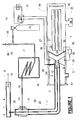
- an analytical instrument for analyzing trace constituents comprises an API mass spectrometer generally indicated by the numeral 1 which has an entrance port 2 and gas sampling probe means comprising a 0.53mm inside diameter, 0.68mm outside diameter capillary tube 3 made of deactivated fused silica.
- the capillary tube 3 has a proximal end 4 and a distal end 5.
- Means for reducing the pressure in the vicinity of the distal end 5 comprises a venturi means generally indicated by the numeral 6.
- the apparatus illustrated in Fig. 1 is intended for the analysis of exhaled human breath and to facilitate this a breathing tube 7 is in communication at its end 8 with the nostril (or mouth) of a subject.
- the other end 9 of the breathing tube 7 is open to the atmosphere so that alternate inhalations and exhalations by the subject pass through the tube 7, as indicated by the arrow 10. During exhalations the breathing tube 7 is therefore filled with the breath of the subject which contains the trace constituents to be analyzed.
- the proximal end 4 of the capillary tube 3 is sealably inserted through the wall of the breathing tube 7 as shown in the figure.
- the venturi means 6 comprises an outer tubular member 11 disposed coaxially about the capillary tube 3 and extending about 6mm beyond the distal end 5 of the capillary tube 3.
- the inside diameter of the outer tubular member 11 is 3.2 mm, reduced to 1.6mm for a distance of 15mm by a reducer 12, as shown in the figure.
- Transport gas nitrogen
- Transport gas nitrogen
- a coil 16 disposed in an oven 17, so that the transport gas flowing through the pipe 18, connected to the outlet of the coil 16, is at a temperature of at least 100°C.
- An additional inlet port 49 and an isolating valve 50 allow the introduction of additional or alternative chemical ionization reagents or other chemical species for chemical or physical modification of the sample gas, for example, removal of an unwanted interfering species by a specific reaction.
- Samples for calibrating the mass spectrometer may also be introduced into port 49.
- a 'T' connector 19 is fitted over the capillary tube 3 as shown, sealing the outside of that tube in its connection 20, the outside of the pipe 18 in connection 21, and the outside of the outer tubular member 11 in connection 22. Hot transport gas from pipe 18 is thereby directed to the annular space 23 between the outside of the capillary tube 3 and the inside of the outer tubular member 11 and heats the capillary tube to the desired temperature.
- the transport gas then flows coaxially over the distal end 5 of the capillary tube 3 into the entrance port 2, reducing as it does so the pressure in the vicinity of the distal end 5 by the venturi effect and thereby causes a flow of gas from the breathing tube 7 into the entrance port 2.
- a nitrogen flow of approximately 10 l/min a flow of sampled breath of about 50 ml/min can be created in this way in the capillary tube 3.
- a vent 51 discharges the majority of the gas entering the entrance port 2 to the atmosphere, maintaining the pressure in it at about that of the atmosphere.
- the end of the outer tubular member 11 is disposed very close to the counter electrode 25 as shown in Fig. 1, minimising the volume of the ionization region.
- ionising means are provided in the port 2 comprising a sharply pointed corona electrode 24 supported in an insulator 28, a counter electrode 25, and means for sustaining a corona discharge between them comprising a power supply 26, a 10 M ⁇ series resistor 27 and a polarity reversing switch 37.
- Power supply 26 is an adjustable supply having a range of 0-4KV at a few milliamps. The voltage used is adjusted to give optimum ionization conditions.
- the corona electrode 24 is inserted through the wall of the tubular member 11, which is made of a PFA (perfluoroalkoxy) rubber to provide electrical insulation.
- the counter electrode 25 comprises four passages, two of which are shown at 29 and 30, through which ions formed in the corona discharge are drifted towards the inlet aperture means by the flow of transport gas and sampled breath from the venturi means 6.
- the inlet aperture means comprises an electrically conductive diaphragm 31 in which a hole 32 (about 0.5mm diameter) is formed.
- the counter electrode 25, insulated flange 38 (see below) and the inlet diaphragm 31 define a first pumping stage 52 in which the pressure is maintained between 1 and 10 torr by means of a vacuum pump (not shown). Ions pass through the hole 32 into an evacuated chamber 33 in which there is disposed ion mass analyzing means comprising a quadrupole mass filter 34 and an ion detector 35.
- filter 34 and detector 35 are shown as representative major components of a conventional mass analyzer which also contains many minor components (not shown) such as ion lenses and, typically, further evacuated chambers.
- a high vacuum pump 36 is shown as representative of the pumping system of such a conventional analyzer, and maintains the pressure in the vicinity of the mass filter 34 at less than 10 -4 torr.
- a polarity reversing switch 37 operable in conjunction with the control system of the mass analyzer, is provided to allow ions of either polarity to be generated and mass analyzed.
- the counter electrode 25 and the housing of the entrance port 2 are mounted from the inlet aperture diaphragm 31 by an insulated flange 38 so that a potential difference (adjustable, up to about 50 volts, positive to the inlet aperture diaphragm 31 for positive ions) can be maintained between them by the power supply 39.
- the potential difference used controls the extent of fragmentation of the ions formed in the corona discharge because it determines the energy of the collisions between the ions and neutral gas molecules present in the region between the counter-electrode 25 and the electrically conductive diaphragm 31.
- the power supply 39 is a programmable supply, controlled by the mass spectrometer control system in such a way that its output potential may be set to any desired value at any given instant during a mass scan or during multiple-ion monitoring cycles of the spectrometer. This allows different predetermined potentials to be set for each ion species monitored, and provides the option of causing different extents of fragmentation for each ion species monitored during a single multiple-ion-monitoring cycle. This is especially useful, for example, if it is desired to simultaneously monitor constituents which produce pseudo-molecular ions of the same mass-to-charge ratio.
- Fig. 2 shows an alternative embodiment of the invention for sampling gases containing trace constituents from an enclosed volume.
- the proximal end 4 of the capillary tube 3 is sealably inserted into the headspace 41 of a vessel 40 which also contains a liquid 42.
- the venturi pumping effect described previously is used to extract a sample of gas from the headspace and transfer it to the entrance port 2 of the mass analyzer.
- a conventional autosampler can be used to provide automatic analysis of many samples.
- Fig. 3 shows an embodiment of the invention using an ICP or MIP mass analyser.
- the distal end 5 of the capillary tube 3 and the outer tubular member 6 are disposed in a buffer chamber 43 having a restrictor 44 leading to the atmosphere to generate a pressure inside the chamber 43 slightly greater than atmospheric.
- An outlet 45 from the chamber 44 is connected to the inlet of a conventional ICP torch 46 which generates a plasma 47.
- Ions generated in the plasma 47 may then be analyzed in a conventional ICP mass spectrometer 48.
- Power for generating the plasma 47 may be obtained as in conventional ICP or MIP spectrometers from a coil surrounding the torch 46 or by disposing the torch in a microwave cavity.
- Use of ICP or MIP mass spectroscopy is appropriate when elemental or isotopic analyses of the sample gas are required.
Landscapes
- Chemical & Material Sciences (AREA)
- Analytical Chemistry (AREA)
- Life Sciences & Earth Sciences (AREA)
- Engineering & Computer Science (AREA)
- Health & Medical Sciences (AREA)
- Biochemistry (AREA)
- Medicinal Chemistry (AREA)
- Physics & Mathematics (AREA)
- Food Science & Technology (AREA)
- Combustion & Propulsion (AREA)
- General Health & Medical Sciences (AREA)
- General Physics & Mathematics (AREA)
- Immunology (AREA)
- Pathology (AREA)
- Other Investigation Or Analysis Of Materials By Electrical Means (AREA)
- Sampling And Sample Adjustment (AREA)
Applications Claiming Priority (4)
| Application Number | Priority Date | Filing Date | Title |
|---|---|---|---|
| GB9615304 | 1996-07-19 | ||
| GB9615303 | 1996-07-19 | ||
| GBGB9615304.4A GB9615304D0 (en) | 1996-07-20 | 1996-07-20 | Improvements relating to volatile compound detection |
| GBGB9615303.6A GB9615303D0 (en) | 1996-07-20 | 1996-07-20 | Apparatus and methods for the analysis of trace constituents in gases |
Publications (2)
| Publication Number | Publication Date |
|---|---|
| EP0819937A2 true EP0819937A2 (de) | 1998-01-21 |
| EP0819937A3 EP0819937A3 (de) | 2000-03-29 |
Family
ID=26309731
Family Applications (1)
| Application Number | Title | Priority Date | Filing Date |
|---|---|---|---|
| EP97305409A Withdrawn EP0819937A3 (de) | 1996-07-19 | 1997-07-18 | Verfahren und Vorrichtung zur Analyse von Spurenbestandteilen in Gasen |
Country Status (3)
| Country | Link |
|---|---|
| US (1) | US5869344A (de) |
| EP (1) | EP0819937A3 (de) |
| CA (1) | CA2210766C (de) |
Cited By (5)
| Publication number | Priority date | Publication date | Assignee | Title |
|---|---|---|---|---|
| WO1999042814A1 (en) * | 1998-02-20 | 1999-08-26 | Marino Bruno D | Apparatus and method for the measurement of global carbon emissions from natural and anthropogenic sources |
| GB2345134A (en) * | 1998-12-22 | 2000-06-28 | Ion Science Ltd | Gas sampling and detecting system |
| EP1494027A1 (de) * | 2003-07-02 | 2005-01-05 | Quest International B.V. | Künstlicher Rachen |
| WO2006007752A1 (en) * | 2004-07-21 | 2006-01-26 | Givaudan Sa | Method to identify or evaluate compounds useful in the field of fragrances and aromas |
| WO2011022364A1 (en) * | 2009-08-17 | 2011-02-24 | Temple University Of The Commonwealth System Of Higher Education | Vaporization device and method for imaging mass spectrometry |
Families Citing this family (52)
| Publication number | Priority date | Publication date | Assignee | Title |
|---|---|---|---|---|
| US5942699A (en) * | 1997-06-12 | 1999-08-24 | R.A.Y. Buechler Ltd. | Method and apparatus for sampling contaminants |
| US6085576A (en) * | 1998-03-20 | 2000-07-11 | Cyrano Sciences, Inc. | Handheld sensing apparatus |
| US7399958B2 (en) | 1999-07-21 | 2008-07-15 | Sionex Corporation | Method and apparatus for enhanced ion mobility based sample analysis using various analyzer configurations |
| US7005632B2 (en) * | 2002-04-12 | 2006-02-28 | Sionex Corporation | Method and apparatus for control of mobility-based ion species identification |
| US6806463B2 (en) * | 1999-07-21 | 2004-10-19 | The Charles Stark Draper Laboratory, Inc. | Micromachined field asymmetric ion mobility filter and detection system |
| US6815668B2 (en) * | 1999-07-21 | 2004-11-09 | The Charles Stark Draper Laboratory, Inc. | Method and apparatus for chromatography-high field asymmetric waveform ion mobility spectrometry |
| US6815669B1 (en) * | 1999-07-21 | 2004-11-09 | The Charles Stark Draper Laboratory, Inc. | Longitudinal field driven ion mobility filter and detection system |
| US7098449B1 (en) | 1999-07-21 | 2006-08-29 | The Charles Stark Draper Laboratory, Inc. | Spectrometer chip assembly |
| US7129482B2 (en) | 1999-07-21 | 2006-10-31 | Sionex Corporation | Explosives detection using differential ion mobility spectrometry |
| US6690004B2 (en) * | 1999-07-21 | 2004-02-10 | The Charles Stark Draper Laboratory, Inc. | Method and apparatus for electrospray-augmented high field asymmetric ion mobility spectrometry |
| US7057168B2 (en) * | 1999-07-21 | 2006-06-06 | Sionex Corporation | Systems for differential ion mobility analysis |
| US6465776B1 (en) | 2000-06-02 | 2002-10-15 | Board Of Regents, The University Of Texas System | Mass spectrometer apparatus for analyzing multiple fluid samples concurrently |
| US6593569B2 (en) * | 2001-02-08 | 2003-07-15 | Thermo Finnigan Llc | Collisional gas delivery apparatus and method |
| US6427543B1 (en) | 2001-03-23 | 2002-08-06 | Eric Torrison | Venturi-based gas sampling manifold |
| US7399961B2 (en) * | 2001-04-20 | 2008-07-15 | The University Of British Columbia | High throughput ion source with multiple ion sprayers and ion lenses |
| EP1405065B1 (de) * | 2001-06-30 | 2012-04-11 | Dh Technologies Development Pte. Ltd. | System zum sammeln von daten und zur identifizierung unbekannter substanzen in einem elektrischen feld |
| US7119328B2 (en) * | 2001-06-30 | 2006-10-10 | Sionex Corporation | System for DMS peak resolution |
| US7274015B2 (en) * | 2001-08-08 | 2007-09-25 | Sionex Corporation | Capacitive discharge plasma ion source |
| US7091481B2 (en) | 2001-08-08 | 2006-08-15 | Sionex Corporation | Method and apparatus for plasma generation |
| US6956206B2 (en) * | 2001-10-03 | 2005-10-18 | Drexel University | Negative ion atmospheric pressure ionization and selected ion mass spectrometry using a 63NI electron source |
| US6727495B2 (en) | 2002-01-17 | 2004-04-27 | Agilent Technologies, Inc. | Ion mobility spectrometer with high ion transmission efficiency |
| US7122794B1 (en) * | 2002-02-21 | 2006-10-17 | Sionex Corporation | Systems and methods for ion mobility control |
| GB2389903B (en) * | 2002-04-16 | 2006-06-07 | Univ Bern | Process and apparatus for providing a gaseous substance for the analysis of chemical elements or compounds |
| JP4162138B2 (ja) * | 2003-10-27 | 2008-10-08 | 株式会社リガク | 昇温脱離ガス分析装置 |
| CA2550088A1 (en) * | 2003-12-18 | 2005-07-07 | Sionex Corporation | Methods and apparatus for enhanced ion based sample detection using selective pre-separation and amplification |
| CA2551991A1 (en) * | 2004-01-13 | 2005-07-28 | Sionex Corporation | Methods and apparatus for enhanced sample identification based on combined analytical techniques |
| WO2005074584A2 (en) * | 2004-02-02 | 2005-08-18 | Sionex Corporation | Compact sample analysis systems and related methods using combined chromatography and mobility spectrometry techniques |
| US20070023631A1 (en) * | 2004-03-30 | 2007-02-01 | Zoltan Takats | Parallel sample handling for high-throughput mass spectrometric analysis |
| EP1756561A1 (de) * | 2004-04-28 | 2007-02-28 | Sionex Corporation | System und verfahren zur ionenspeziesanalyse mit verbesserter zustandskontrolle und dateninterpretation unter verwendung differentieller mobilitätsspektrometer |
| NZ536082A (en) * | 2004-10-22 | 2007-06-29 | Syft Technologies Ltd | Detection of bromamines and chloramines in breath samples for detecting asthma |
| EP1920243B1 (de) * | 2005-04-29 | 2015-09-09 | DH Technologies Development Pte. Ltd. | Kompakte auf gaschromatographie und ionenmobilität basierende probenanalysesysteme, -verfahren und -vorrichtungen |
| US7579589B2 (en) | 2005-07-26 | 2009-08-25 | Sionex Corporation | Ultra compact ion mobility based analyzer apparatus, method, and system |
| US7855357B2 (en) * | 2006-01-17 | 2010-12-21 | Agilent Technologies, Inc. | Apparatus and method for ion calibrant introduction |
| US20070272852A1 (en) * | 2006-01-26 | 2007-11-29 | Sionex Corporation | Differential mobility spectrometer analyzer and pre-filter apparatus, methods, and systems |
| HU226837B1 (hu) | 2006-05-31 | 2009-12-28 | Semmelweis Egyetem | Folyadéksugárral mûködõ deszorpciós ionizációs eljárás és eszköz |
| JP5362586B2 (ja) | 2007-02-01 | 2013-12-11 | サイオネックス コーポレイション | 質量分光計のための微分移動度分光計プレフィルタ |
| EP2365939A1 (de) * | 2008-11-17 | 2011-09-21 | Hemlock Semiconductor Corporation | Verfahren zur analyse einer verunreinigungen enthaltenden zusammensetzung |
| CA2763145C (en) * | 2009-05-27 | 2021-05-25 | Medimass Kft | System and method for identification of biological tissues |
| US8642952B2 (en) * | 2009-11-10 | 2014-02-04 | Waters Technologies Corporation | Apparatus and methods for gas chromatography-mass spectrometry |
| CN101806763B (zh) * | 2010-02-26 | 2012-11-21 | 华东理工大学 | 一种嗅觉模拟仪器和多种气味定性定量同时分析方法 |
| RU2436506C1 (ru) * | 2010-05-11 | 2011-12-20 | Федеральное государственное бюджетное образовательное учреждение высшего профессионального образования "Санкт-Петербургский государственный политехнический университет (ФГБОУ ВПО "СПбГПУ") | Газовый медицинский масс-спектрометр для диагностики живого организма в режиме реального времени |
| US20110313306A1 (en) * | 2010-06-16 | 2011-12-22 | Sociedad Europea de Analisis Diferencial de Movilidad | Method and apparatus for monitoring stress levels or sudden changes of humor in humans or other individuals in real time by means of vapor analysis |
| US8309916B2 (en) * | 2010-08-18 | 2012-11-13 | Thermo Finnigan Llc | Ion transfer tube having single or multiple elongate bore segments and mass spectrometer system |
| JP5764433B2 (ja) | 2011-08-26 | 2015-08-19 | 株式会社日立ハイテクノロジーズ | 質量分析装置及び質量分析方法 |
| JP6346567B2 (ja) | 2011-12-28 | 2018-06-20 | マイクロマス・ユーケー・リミテッド | 液相試料の急速蒸発イオン化を行うためのシステムおよび方法 |
| EP3699950B1 (de) | 2011-12-28 | 2026-01-28 | Micromass UK Limited | Kollisionsionengenerator und separator |
| CN104155417B (zh) * | 2014-08-22 | 2015-12-30 | 中国计量科学研究院 | 一种超高纯气体中痕量水分分析的前处理系统及方法 |
| EP3075321A1 (de) | 2015-04-03 | 2016-10-05 | Ryan, Maximillian Frederick | System zur erzeugung von daten im zusammenhang mit einer gewebekernbiopsie und verwendung des systems zur detektion von gewebeanomalien, insbesondere krebsgewebe, bei einem patienten |
| CN111665103B (zh) * | 2020-05-13 | 2023-08-18 | 中国科学院微电子研究所 | 一种低真空痕量气体的快速无损采样分析装置和方法 |
| CN114441650B (zh) * | 2020-10-30 | 2023-06-06 | 海宁森德皮革有限公司 | 真皮气味溯源分析与控制方法 |
| CN113156032B (zh) * | 2021-03-22 | 2022-08-30 | 启先核(北京)科技有限公司 | 一种同时测量同位素丰度与杂质含量的质谱系统与方法 |
| US12569138B2 (en) | 2021-04-02 | 2026-03-10 | Stryker European Operations Limited | Methods and systems for analyzing surgical smoke using atomic absorption spectroscopy |
Family Cites Families (12)
| Publication number | Priority date | Publication date | Assignee | Title |
|---|---|---|---|---|
| US3759249A (en) * | 1971-08-19 | 1973-09-18 | Nasa | Respiratory analysis system and method |
| GB1582869A (en) * | 1977-05-11 | 1981-01-14 | Univ Toronto | Gas curtain device and method for transfering matter between a gas and a vacuum |
| US4178919A (en) * | 1978-04-03 | 1979-12-18 | The Perkin-Elmer Corporation | Flowmeter for providing synchronized flow data and respiratory gas samples to a medical mass spectrometer |
| US4167667A (en) * | 1978-06-12 | 1979-09-11 | The Perkin-Elmer Corporation | Respiratory gas moisture separator system for mass spectrometer monitoring systems |
| SU824998A1 (ru) * | 1979-08-07 | 1981-04-30 | Sp K Byuro Analit Priborostr | Устройство дл исследовани дыхани |
| SU904660A1 (ru) * | 1980-02-18 | 1982-02-15 | Ордена Трудового Красного Знамени Специальное Конструкторское Бюро Аналитического Приборостроения Научно-Технического Объединения Ан Ссср | Устройство дл синхронного определени объема и концентрации дыхательных газов |
| JPS60250227A (ja) * | 1984-05-28 | 1985-12-10 | Hitachi Ltd | 試料ガス採取装置 |
| US4735777A (en) * | 1985-03-11 | 1988-04-05 | Hitachi, Ltd. | Instrument for parallel analysis of metabolites in human urine and expired air |
| GB8525290D0 (en) * | 1985-10-14 | 1985-11-20 | Boc Group Plc | Mass spectrometers |
| US5043576A (en) * | 1988-06-13 | 1991-08-27 | Broadhurst John H | Endotracheal tube and mass spectrometer |
| US5081871A (en) * | 1989-02-02 | 1992-01-21 | The United States Of America As Represented By The Secretary Of The Department Of Health And Human Services | Breath sampler |
| US5042501A (en) * | 1990-05-01 | 1991-08-27 | Battelle Memorial Institute | Apparatus and method for analysis of expired breath |
-
1997
- 1997-07-18 EP EP97305409A patent/EP0819937A3/de not_active Withdrawn
- 1997-07-18 US US08/896,487 patent/US5869344A/en not_active Expired - Lifetime
- 1997-07-18 CA CA002210766A patent/CA2210766C/en not_active Expired - Fee Related
Cited By (10)
| Publication number | Priority date | Publication date | Assignee | Title |
|---|---|---|---|---|
| WO1999042814A1 (en) * | 1998-02-20 | 1999-08-26 | Marino Bruno D | Apparatus and method for the measurement of global carbon emissions from natural and anthropogenic sources |
| GB2345134A (en) * | 1998-12-22 | 2000-06-28 | Ion Science Ltd | Gas sampling and detecting system |
| EP1494027A1 (de) * | 2003-07-02 | 2005-01-05 | Quest International B.V. | Künstlicher Rachen |
| WO2005003757A1 (en) * | 2003-07-02 | 2005-01-13 | Quest International B.V. | Artificial throat |
| US7559225B2 (en) | 2003-07-02 | 2009-07-14 | Imperial Chemical Industries Plc | Artificial throat |
| WO2006007752A1 (en) * | 2004-07-21 | 2006-01-26 | Givaudan Sa | Method to identify or evaluate compounds useful in the field of fragrances and aromas |
| JP2008506958A (ja) * | 2004-07-21 | 2008-03-06 | ジボダン エス エー | 香料および芳香の分野において有用な化合物を同定または評価する方法 |
| US7638343B2 (en) | 2004-07-21 | 2009-12-29 | Boris Schilling | Method to identify or evaluate compounds useful in the field of fragrances and aromas |
| WO2011022364A1 (en) * | 2009-08-17 | 2011-02-24 | Temple University Of The Commonwealth System Of Higher Education | Vaporization device and method for imaging mass spectrometry |
| US8598521B2 (en) | 2009-08-17 | 2013-12-03 | Temple University Of The Commonwealth System Of Higher Education | Vaporization device and method for imaging mass spectrometry |
Also Published As
| Publication number | Publication date |
|---|---|
| EP0819937A3 (de) | 2000-03-29 |
| US5869344A (en) | 1999-02-09 |
| CA2210766A1 (en) | 1998-01-19 |
| CA2210766C (en) | 2001-02-06 |
Similar Documents
| Publication | Publication Date | Title |
|---|---|---|
| US5869344A (en) | Apparatus and methods for the analysis of trace constituents in gases | |
| Ruzsanyi et al. | Detection of human metabolites using multi-capillary columns coupled to ion mobility spectrometers | |
| Zhan et al. | Recent developments of proton‐transfer reaction mass spectrometry (PTR‐MS) and its applications in medical research | |
| US5448062A (en) | Analyte separation process and apparatus | |
| US5955886A (en) | Microliter-sized ionization device and method | |
| US9646811B2 (en) | Miniaturized ion mobility spectrometer | |
| CN109755097B (zh) | 一种四极杆质谱仪及其使用方法 | |
| JP2012037529A (ja) | 四重極または飛行時間型質量分光計を用いた化学イオン化反応または陽子移動反応質量分光分析 | |
| US4413185A (en) | Selective photoionization gas chromatograph detector | |
| US20090278038A1 (en) | Method and device for generating positively and/or negatively ionized gas analytes for gas analysis | |
| US6982416B2 (en) | Method and device for evaluating the state of organisms and natural products and for analyzing a gaseous mixture comprising main constituents and secondary constituents | |
| Drees et al. | Stepwise optimization of a Flexible Microtube Plasma (FµTP) as an ionization source for Ion Mobility Spectrometry | |
| US11581177B2 (en) | System for introducing particle-containing samples to an analytical instrument and methods of use | |
| Smith et al. | Facility monitoring of toxic industrial compounds in air using an automated, fieldable, miniature mass spectrometer | |
| US7956323B2 (en) | Ion mobility spectrometer and method for determining an analyte substance or an analyte substance mixture in the presence of a dopant mixture by means of an ion mobility spectrometer | |
| Déléris et al. | Comparison of direct mass spectrometry methods for the on‐line analysis of volatile compounds in foods | |
| Chen et al. | Development of ambient sampling chemi/chemical ion source with dielectric barrier discharge | |
| CN113671014A (zh) | 即时检测七氟烷的便携式质谱装置和方法 | |
| US8084000B2 (en) | Dopant delivery system for use in ion mobility and ion trap mobility spectrometry | |
| US7812307B2 (en) | Microplasma-based sample ionizing device and methods of use thereof | |
| WO2019097283A1 (en) | Ion source for analysis of low volatility species in the gas phase. | |
| EP0292974B1 (de) | Entladungsionisierungsquelle zum Analysieren der Atmosphäre | |
| Baumbach et al. | Metabolites in human breath: ion mobility spectrometers as diagnostic tools for lung diseases | |
| US20050233471A1 (en) | Method of assaying the antioxidant activity of pure compounds, extracts and biological fluids | |
| US5760291A (en) | Method and apparatus for mixing column effluent and make-up gas in an electron capture detector |
Legal Events
| Date | Code | Title | Description |
|---|---|---|---|
| PUAI | Public reference made under article 153(3) epc to a published international application that has entered the european phase |
Free format text: ORIGINAL CODE: 0009012 |
|
| AK | Designated contracting states |
Kind code of ref document: A2 Designated state(s): CH DE FR GB LI NL |
|
| AX | Request for extension of the european patent |
Free format text: AL;LT;LV;RO;SI |
|
| 111L | Licence recorded |
Free format text: 980121 0100 MICROMASS UK LIMITED |
|
| PUAL | Search report despatched |
Free format text: ORIGINAL CODE: 0009013 |
|
| RIC1 | Information provided on ipc code assigned before grant |
Free format text: 7G 01N 33/00 A, 7G 01N 33/497 B, 7G 01N 33/02 B, 7H 01J 49/26 B, 7H 01J 49/04 B |
|
| AK | Designated contracting states |
Kind code of ref document: A3 Designated state(s): AT BE CH DE DK ES FI FR GB GR IE IT LI LU MC NL PT SE |
|
| AX | Request for extension of the european patent |
Free format text: AL;LT;LV;RO;SI |
|
| 17P | Request for examination filed |
Effective date: 20000508 |
|
| AKX | Designation fees paid |
Free format text: CH DE FR GB LI NL |
|
| STAA | Information on the status of an ep patent application or granted ep patent |
Free format text: STATUS: THE APPLICATION IS DEEMED TO BE WITHDRAWN |
|
| 18D | Application deemed to be withdrawn |
Effective date: 20060323 |