EP0820524B1 - Nachweis von nukleinsäure-variationen - Google Patents
Nachweis von nukleinsäure-variationen Download PDFInfo
- Publication number
- EP0820524B1 EP0820524B1 EP96909255A EP96909255A EP0820524B1 EP 0820524 B1 EP0820524 B1 EP 0820524B1 EP 96909255 A EP96909255 A EP 96909255A EP 96909255 A EP96909255 A EP 96909255A EP 0820524 B1 EP0820524 B1 EP 0820524B1
- Authority
- EP
- European Patent Office
- Prior art keywords
- target
- oligonucleotide
- tethered
- probes
- array
- Prior art date
- Legal status (The legal status is an assumption and is not a legal conclusion. Google has not performed a legal analysis and makes no representation as to the accuracy of the status listed.)
- Expired - Lifetime
Links
- 108091028043 Nucleic acid sequence Proteins 0.000 title description 3
- 108091034117 Oligonucleotide Proteins 0.000 claims abstract description 113
- JLCPHMBAVCMARE-UHFFFAOYSA-N [3-[[3-[[3-[[3-[[3-[[3-[[3-[[3-[[3-[[3-[[3-[[5-(2-amino-6-oxo-1H-purin-9-yl)-3-[[3-[[3-[[3-[[3-[[3-[[5-(2-amino-6-oxo-1H-purin-9-yl)-3-[[5-(2-amino-6-oxo-1H-purin-9-yl)-3-hydroxyoxolan-2-yl]methoxy-hydroxyphosphoryl]oxyoxolan-2-yl]methoxy-hydroxyphosphoryl]oxy-5-(5-methyl-2,4-dioxopyrimidin-1-yl)oxolan-2-yl]methoxy-hydroxyphosphoryl]oxy-5-(6-aminopurin-9-yl)oxolan-2-yl]methoxy-hydroxyphosphoryl]oxy-5-(6-aminopurin-9-yl)oxolan-2-yl]methoxy-hydroxyphosphoryl]oxy-5-(6-aminopurin-9-yl)oxolan-2-yl]methoxy-hydroxyphosphoryl]oxy-5-(6-aminopurin-9-yl)oxolan-2-yl]methoxy-hydroxyphosphoryl]oxyoxolan-2-yl]methoxy-hydroxyphosphoryl]oxy-5-(5-methyl-2,4-dioxopyrimidin-1-yl)oxolan-2-yl]methoxy-hydroxyphosphoryl]oxy-5-(4-amino-2-oxopyrimidin-1-yl)oxolan-2-yl]methoxy-hydroxyphosphoryl]oxy-5-(5-methyl-2,4-dioxopyrimidin-1-yl)oxolan-2-yl]methoxy-hydroxyphosphoryl]oxy-5-(5-methyl-2,4-dioxopyrimidin-1-yl)oxolan-2-yl]methoxy-hydroxyphosphoryl]oxy-5-(6-aminopurin-9-yl)oxolan-2-yl]methoxy-hydroxyphosphoryl]oxy-5-(6-aminopurin-9-yl)oxolan-2-yl]methoxy-hydroxyphosphoryl]oxy-5-(4-amino-2-oxopyrimidin-1-yl)oxolan-2-yl]methoxy-hydroxyphosphoryl]oxy-5-(4-amino-2-oxopyrimidin-1-yl)oxolan-2-yl]methoxy-hydroxyphosphoryl]oxy-5-(4-amino-2-oxopyrimidin-1-yl)oxolan-2-yl]methoxy-hydroxyphosphoryl]oxy-5-(6-aminopurin-9-yl)oxolan-2-yl]methoxy-hydroxyphosphoryl]oxy-5-(4-amino-2-oxopyrimidin-1-yl)oxolan-2-yl]methyl [5-(6-aminopurin-9-yl)-2-(hydroxymethyl)oxolan-3-yl] hydrogen phosphate Polymers Cc1cn(C2CC(OP(O)(=O)OCC3OC(CC3OP(O)(=O)OCC3OC(CC3O)n3cnc4c3nc(N)[nH]c4=O)n3cnc4c3nc(N)[nH]c4=O)C(COP(O)(=O)OC3CC(OC3COP(O)(=O)OC3CC(OC3COP(O)(=O)OC3CC(OC3COP(O)(=O)OC3CC(OC3COP(O)(=O)OC3CC(OC3COP(O)(=O)OC3CC(OC3COP(O)(=O)OC3CC(OC3COP(O)(=O)OC3CC(OC3COP(O)(=O)OC3CC(OC3COP(O)(=O)OC3CC(OC3COP(O)(=O)OC3CC(OC3COP(O)(=O)OC3CC(OC3COP(O)(=O)OC3CC(OC3COP(O)(=O)OC3CC(OC3COP(O)(=O)OC3CC(OC3COP(O)(=O)OC3CC(OC3COP(O)(=O)OC3CC(OC3CO)n3cnc4c(N)ncnc34)n3ccc(N)nc3=O)n3cnc4c(N)ncnc34)n3ccc(N)nc3=O)n3ccc(N)nc3=O)n3ccc(N)nc3=O)n3cnc4c(N)ncnc34)n3cnc4c(N)ncnc34)n3cc(C)c(=O)[nH]c3=O)n3cc(C)c(=O)[nH]c3=O)n3ccc(N)nc3=O)n3cc(C)c(=O)[nH]c3=O)n3cnc4c3nc(N)[nH]c4=O)n3cnc4c(N)ncnc34)n3cnc4c(N)ncnc34)n3cnc4c(N)ncnc34)n3cnc4c(N)ncnc34)O2)c(=O)[nH]c1=O JLCPHMBAVCMARE-UHFFFAOYSA-N 0.000 claims abstract description 55
- 238000000034 method Methods 0.000 claims abstract description 36
- 230000035772 mutation Effects 0.000 claims abstract description 20
- 102000003960 Ligases Human genes 0.000 claims abstract description 15
- 108090000364 Ligases Proteins 0.000 claims abstract description 15
- 108091033319 polynucleotide Proteins 0.000 claims abstract description 14
- 102000040430 polynucleotide Human genes 0.000 claims abstract description 14
- 239000002157 polynucleotide Substances 0.000 claims abstract description 14
- 108020005187 Oligonucleotide Probes Proteins 0.000 claims abstract description 10
- 239000002751 oligonucleotide probe Substances 0.000 claims abstract description 10
- 238000004458 analytical method Methods 0.000 claims description 30
- 239000000523 sample Substances 0.000 claims description 28
- -1 nucleoside triphosphates Chemical class 0.000 claims description 24
- 239000007787 solid Substances 0.000 claims description 24
- 230000000295 complement effect Effects 0.000 claims description 23
- 125000003729 nucleotide group Chemical group 0.000 claims description 18
- 102000004190 Enzymes Human genes 0.000 claims description 17
- 108090000790 Enzymes Proteins 0.000 claims description 17
- 239000002773 nucleotide Substances 0.000 claims description 16
- 108010014303 DNA-directed DNA polymerase Proteins 0.000 claims description 10
- 102000016928 DNA-directed DNA polymerase Human genes 0.000 claims description 10
- 102000012410 DNA Ligases Human genes 0.000 claims description 9
- 108010061982 DNA Ligases Proteins 0.000 claims description 9
- 235000011178 triphosphate Nutrition 0.000 claims description 7
- 239000001226 triphosphate Substances 0.000 claims description 7
- 229910019142 PO4 Inorganic materials 0.000 claims description 6
- 238000011065 in-situ storage Methods 0.000 claims description 6
- 108010058966 bacteriophage T7 induced DNA polymerase Proteins 0.000 claims description 5
- 239000011324 bead Substances 0.000 claims description 4
- 230000015572 biosynthetic process Effects 0.000 claims description 4
- XUIMIQQOPSSXEZ-UHFFFAOYSA-N Silicon Chemical compound [Si] XUIMIQQOPSSXEZ-UHFFFAOYSA-N 0.000 claims description 3
- 108010006785 Taq Polymerase Proteins 0.000 claims description 3
- 239000005547 deoxyribonucleotide Substances 0.000 claims description 3
- 239000011521 glass Substances 0.000 claims description 3
- 239000002777 nucleoside Substances 0.000 claims description 3
- 239000010452 phosphate Substances 0.000 claims description 3
- 229910052710 silicon Inorganic materials 0.000 claims description 3
- 239000010703 silicon Substances 0.000 claims description 3
- 102000004163 DNA-directed RNA polymerases Human genes 0.000 claims description 2
- 108090000626 DNA-directed RNA polymerases Proteins 0.000 claims description 2
- 102100034343 Integrase Human genes 0.000 claims description 2
- 108010092799 RNA-directed DNA polymerase Proteins 0.000 claims description 2
- 238000004519 manufacturing process Methods 0.000 claims description 2
- 238000012544 monitoring process Methods 0.000 claims 3
- QQONPFPTGQHPMA-UHFFFAOYSA-N propylene Natural products CC=C QQONPFPTGQHPMA-UHFFFAOYSA-N 0.000 claims 2
- 125000004805 propylene group Chemical group [H]C([H])([H])C([H])([*:1])C([H])([H])[*:2] 0.000 claims 2
- 241000588724 Escherichia coli Species 0.000 claims 1
- 238000003491 array Methods 0.000 abstract description 7
- 238000009396 hybridization Methods 0.000 description 23
- 239000000243 solution Substances 0.000 description 23
- 108020004414 DNA Proteins 0.000 description 18
- 239000004743 Polypropylene Substances 0.000 description 17
- 229920001155 polypropylene Polymers 0.000 description 17
- 238000006243 chemical reaction Methods 0.000 description 16
- 108700028369 Alleles Proteins 0.000 description 15
- 239000000758 substrate Substances 0.000 description 14
- 238000001514 detection method Methods 0.000 description 12
- 239000000872 buffer Substances 0.000 description 11
- 238000002474 experimental method Methods 0.000 description 9
- 239000002243 precursor Substances 0.000 description 9
- OAICVXFJPJFONN-UHFFFAOYSA-N Phosphorus Chemical compound [P] OAICVXFJPJFONN-UHFFFAOYSA-N 0.000 description 8
- 150000003839 salts Chemical class 0.000 description 7
- 238000003860 storage Methods 0.000 description 7
- 239000004606 Fillers/Extenders Substances 0.000 description 6
- ZHNUHDYFZUAESO-UHFFFAOYSA-N Formamide Chemical compound NC=O ZHNUHDYFZUAESO-UHFFFAOYSA-N 0.000 description 6
- 108010021757 Polynucleotide 5'-Hydroxyl-Kinase Proteins 0.000 description 6
- 102000008422 Polynucleotide 5'-hydroxyl-kinase Human genes 0.000 description 6
- 238000005304 joining Methods 0.000 description 6
- 238000005259 measurement Methods 0.000 description 6
- 239000000203 mixture Substances 0.000 description 6
- 238000012360 testing method Methods 0.000 description 6
- XLYOFNOQVPJJNP-UHFFFAOYSA-N water Substances O XLYOFNOQVPJJNP-UHFFFAOYSA-N 0.000 description 6
- 210000004027 cell Anatomy 0.000 description 5
- 238000001502 gel electrophoresis Methods 0.000 description 5
- 150000007523 nucleic acids Chemical class 0.000 description 5
- 239000000178 monomer Substances 0.000 description 4
- 102000039446 nucleic acids Human genes 0.000 description 4
- 108020004707 nucleic acids Proteins 0.000 description 4
- 150000008300 phosphoramidites Chemical class 0.000 description 4
- 238000003786 synthesis reaction Methods 0.000 description 4
- 102000053602 DNA Human genes 0.000 description 3
- 241000282326 Felis catus Species 0.000 description 3
- 108091081062 Repeated sequence (DNA) Proteins 0.000 description 3
- 101000803959 Thermus thermophilus (strain ATCC 27634 / DSM 579 / HB8) DNA ligase Proteins 0.000 description 3
- 230000001419 dependent effect Effects 0.000 description 3
- 230000002255 enzymatic effect Effects 0.000 description 3
- 238000006911 enzymatic reaction Methods 0.000 description 3
- 238000012252 genetic analysis Methods 0.000 description 3
- 125000002887 hydroxy group Chemical group [H]O* 0.000 description 3
- 108090000623 proteins and genes Proteins 0.000 description 3
- 239000000126 substance Substances 0.000 description 3
- 229920000742 Cotton Polymers 0.000 description 2
- 108091092878 Microsatellite Proteins 0.000 description 2
- 101900061264 Thermus thermophilus DNA ligase Proteins 0.000 description 2
- NHVNXKFIZYSCEB-XLPZGREQSA-N dTTP Chemical compound O=C1NC(=O)C(C)=CN1[C@@H]1O[C@H](COP(O)(=O)OP(O)(=O)OP(O)(O)=O)[C@@H](O)C1 NHVNXKFIZYSCEB-XLPZGREQSA-N 0.000 description 2
- 208000037265 diseases, disorders, signs and symptoms Diseases 0.000 description 2
- 238000007169 ligase reaction Methods 0.000 description 2
- 239000007791 liquid phase Substances 0.000 description 2
- 239000000463 material Substances 0.000 description 2
- NBIIXXVUZAFLBC-UHFFFAOYSA-K phosphate Chemical compound [O-]P([O-])([O-])=O NBIIXXVUZAFLBC-UHFFFAOYSA-K 0.000 description 2
- 125000002467 phosphate group Chemical group [H]OP(=O)(O[H])O[*] 0.000 description 2
- 230000002285 radioactive effect Effects 0.000 description 2
- UNXRWKVEANCORM-UHFFFAOYSA-N triphosphoric acid Chemical compound OP(O)(=O)OP(O)(=O)OP(O)(O)=O UNXRWKVEANCORM-UHFFFAOYSA-N 0.000 description 2
- 108020005029 5' Flanking Region Proteins 0.000 description 1
- 101150029409 CFTR gene Proteins 0.000 description 1
- 101100275473 Caenorhabditis elegans ctc-3 gene Proteins 0.000 description 1
- 201000003883 Cystic fibrosis Diseases 0.000 description 1
- 241000282412 Homo Species 0.000 description 1
- 208000026350 Inborn Genetic disease Diseases 0.000 description 1
- 241001465754 Metazoa Species 0.000 description 1
- 108091092919 Minisatellite Proteins 0.000 description 1
- 206010028980 Neoplasm Diseases 0.000 description 1
- 108010090804 Streptavidin Proteins 0.000 description 1
- 108700025695 Suppressor Genes Proteins 0.000 description 1
- 239000007984 Tris EDTA buffer Substances 0.000 description 1
- 238000004873 anchoring Methods 0.000 description 1
- 238000003975 animal breeding Methods 0.000 description 1
- 238000013459 approach Methods 0.000 description 1
- 238000003556 assay Methods 0.000 description 1
- 230000037429 base substitution Effects 0.000 description 1
- 238000009835 boiling Methods 0.000 description 1
- QXJJQWWVWRCVQT-UHFFFAOYSA-K calcium;sodium;phosphate Chemical compound [Na+].[Ca+2].[O-]P([O-])([O-])=O QXJJQWWVWRCVQT-UHFFFAOYSA-K 0.000 description 1
- 210000000349 chromosome Anatomy 0.000 description 1
- SUYVUBYJARFZHO-RRKCRQDMSA-N dATP Chemical compound C1=NC=2C(N)=NC=NC=2N1[C@H]1C[C@H](O)[C@@H](COP(O)(=O)OP(O)(=O)OP(O)(O)=O)O1 SUYVUBYJARFZHO-RRKCRQDMSA-N 0.000 description 1
- SUYVUBYJARFZHO-UHFFFAOYSA-N dATP Natural products C1=NC=2C(N)=NC=NC=2N1C1CC(O)C(COP(O)(=O)OP(O)(=O)OP(O)(O)=O)O1 SUYVUBYJARFZHO-UHFFFAOYSA-N 0.000 description 1
- RGWHQCVHVJXOKC-SHYZEUOFSA-J dCTP(4-) Chemical compound O=C1N=C(N)C=CN1[C@@H]1O[C@H](COP([O-])(=O)OP([O-])(=O)OP([O-])([O-])=O)[C@@H](O)C1 RGWHQCVHVJXOKC-SHYZEUOFSA-J 0.000 description 1
- HAAZLUGHYHWQIW-KVQBGUIXSA-N dGTP Chemical compound C1=NC=2C(=O)NC(N)=NC=2N1[C@H]1C[C@H](O)[C@@H](COP(O)(=O)OP(O)(=O)OP(O)(O)=O)O1 HAAZLUGHYHWQIW-KVQBGUIXSA-N 0.000 description 1
- 238000013480 data collection Methods 0.000 description 1
- 238000012217 deletion Methods 0.000 description 1
- 230000037430 deletion Effects 0.000 description 1
- 125000002637 deoxyribonucleotide group Chemical group 0.000 description 1
- 238000013461 design Methods 0.000 description 1
- 238000010586 diagram Methods 0.000 description 1
- 201000010099 disease Diseases 0.000 description 1
- 208000035475 disorder Diseases 0.000 description 1
- 238000001962 electrophoresis Methods 0.000 description 1
- 238000011156 evaluation Methods 0.000 description 1
- 230000002349 favourable effect Effects 0.000 description 1
- 239000012634 fragment Substances 0.000 description 1
- 208000016361 genetic disease Diseases 0.000 description 1
- 108060003196 globin Proteins 0.000 description 1
- 102000018146 globin Human genes 0.000 description 1
- 238000010438 heat treatment Methods 0.000 description 1
- 238000010348 incorporation Methods 0.000 description 1
- 238000003780 insertion Methods 0.000 description 1
- 230000037431 insertion Effects 0.000 description 1
- 238000002844 melting Methods 0.000 description 1
- 230000008018 melting Effects 0.000 description 1
- 238000012986 modification Methods 0.000 description 1
- 230000004048 modification Effects 0.000 description 1
- 229940046166 oligodeoxynucleotide Drugs 0.000 description 1
- 238000002966 oligonucleotide array Methods 0.000 description 1
- 239000002245 particle Substances 0.000 description 1
- 239000012071 phase Substances 0.000 description 1
- 230000026731 phosphorylation Effects 0.000 description 1
- 238000006366 phosphorylation reaction Methods 0.000 description 1
- 238000003976 plant breeding Methods 0.000 description 1
- 238000002264 polyacrylamide gel electrophoresis Methods 0.000 description 1
- 229920000642 polymer Polymers 0.000 description 1
- 238000003752 polymerase chain reaction Methods 0.000 description 1
- 238000002360 preparation method Methods 0.000 description 1
- 125000006239 protecting group Chemical group 0.000 description 1
- 238000004445 quantitative analysis Methods 0.000 description 1
- 239000000376 reactant Substances 0.000 description 1
- 239000011541 reaction mixture Substances 0.000 description 1
- 230000003362 replicative effect Effects 0.000 description 1
- 229920006395 saturated elastomer Polymers 0.000 description 1
- 230000035945 sensitivity Effects 0.000 description 1
- 238000012163 sequencing technique Methods 0.000 description 1
- 238000007619 statistical method Methods 0.000 description 1
- 230000004304 visual acuity Effects 0.000 description 1
Images


Classifications
-
- C—CHEMISTRY; METALLURGY
- C12—BIOCHEMISTRY; BEER; SPIRITS; WINE; VINEGAR; MICROBIOLOGY; ENZYMOLOGY; MUTATION OR GENETIC ENGINEERING
- C12Q—MEASURING OR TESTING PROCESSES INVOLVING ENZYMES, NUCLEIC ACIDS OR MICROORGANISMS; COMPOSITIONS OR TEST PAPERS THEREFOR; PROCESSES OF PREPARING SUCH COMPOSITIONS; CONDITION-RESPONSIVE CONTROL IN MICROBIOLOGICAL OR ENZYMOLOGICAL PROCESSES
- C12Q1/00—Measuring or testing processes involving enzymes, nucleic acids or microorganisms; Compositions therefor; Processes of preparing such compositions
- C12Q1/68—Measuring or testing processes involving enzymes, nucleic acids or microorganisms; Compositions therefor; Processes of preparing such compositions involving nucleic acids
- C12Q1/6844—Nucleic acid amplification reactions
- C12Q1/6858—Allele-specific amplification
-
- B—PERFORMING OPERATIONS; TRANSPORTING
- B01—PHYSICAL OR CHEMICAL PROCESSES OR APPARATUS IN GENERAL
- B01J—CHEMICAL OR PHYSICAL PROCESSES, e.g. CATALYSIS OR COLLOID CHEMISTRY; THEIR RELEVANT APPARATUS
- B01J19/00—Chemical, physical or physico-chemical processes in general; Their relevant apparatus
- B01J19/0046—Sequential or parallel reactions, e.g. for the synthesis of polypeptides or polynucleotides; Apparatus and devices for combinatorial chemistry or for making molecular arrays
-
- C—CHEMISTRY; METALLURGY
- C12—BIOCHEMISTRY; BEER; SPIRITS; WINE; VINEGAR; MICROBIOLOGY; ENZYMOLOGY; MUTATION OR GENETIC ENGINEERING
- C12Q—MEASURING OR TESTING PROCESSES INVOLVING ENZYMES, NUCLEIC ACIDS OR MICROORGANISMS; COMPOSITIONS OR TEST PAPERS THEREFOR; PROCESSES OF PREPARING SUCH COMPOSITIONS; CONDITION-RESPONSIVE CONTROL IN MICROBIOLOGICAL OR ENZYMOLOGICAL PROCESSES
- C12Q1/00—Measuring or testing processes involving enzymes, nucleic acids or microorganisms; Compositions therefor; Processes of preparing such compositions
- C12Q1/68—Measuring or testing processes involving enzymes, nucleic acids or microorganisms; Compositions therefor; Processes of preparing such compositions involving nucleic acids
- C12Q1/6813—Hybridisation assays
- C12Q1/6827—Hybridisation assays for detection of mutation or polymorphism
-
- C—CHEMISTRY; METALLURGY
- C12—BIOCHEMISTRY; BEER; SPIRITS; WINE; VINEGAR; MICROBIOLOGY; ENZYMOLOGY; MUTATION OR GENETIC ENGINEERING
- C12Q—MEASURING OR TESTING PROCESSES INVOLVING ENZYMES, NUCLEIC ACIDS OR MICROORGANISMS; COMPOSITIONS OR TEST PAPERS THEREFOR; PROCESSES OF PREPARING SUCH COMPOSITIONS; CONDITION-RESPONSIVE CONTROL IN MICROBIOLOGICAL OR ENZYMOLOGICAL PROCESSES
- C12Q1/00—Measuring or testing processes involving enzymes, nucleic acids or microorganisms; Compositions therefor; Processes of preparing such compositions
- C12Q1/68—Measuring or testing processes involving enzymes, nucleic acids or microorganisms; Compositions therefor; Processes of preparing such compositions involving nucleic acids
- C12Q1/6813—Hybridisation assays
- C12Q1/6834—Enzymatic or biochemical coupling of nucleic acids to a solid phase
-
- C—CHEMISTRY; METALLURGY
- C12—BIOCHEMISTRY; BEER; SPIRITS; WINE; VINEGAR; MICROBIOLOGY; ENZYMOLOGY; MUTATION OR GENETIC ENGINEERING
- C12Q—MEASURING OR TESTING PROCESSES INVOLVING ENZYMES, NUCLEIC ACIDS OR MICROORGANISMS; COMPOSITIONS OR TEST PAPERS THEREFOR; PROCESSES OF PREPARING SUCH COMPOSITIONS; CONDITION-RESPONSIVE CONTROL IN MICROBIOLOGICAL OR ENZYMOLOGICAL PROCESSES
- C12Q1/00—Measuring or testing processes involving enzymes, nucleic acids or microorganisms; Compositions therefor; Processes of preparing such compositions
- C12Q1/68—Measuring or testing processes involving enzymes, nucleic acids or microorganisms; Compositions therefor; Processes of preparing such compositions involving nucleic acids
- C12Q1/6813—Hybridisation assays
- C12Q1/6834—Enzymatic or biochemical coupling of nucleic acids to a solid phase
- C12Q1/6837—Enzymatic or biochemical coupling of nucleic acids to a solid phase using probe arrays or probe chips
-
- C—CHEMISTRY; METALLURGY
- C12—BIOCHEMISTRY; BEER; SPIRITS; WINE; VINEGAR; MICROBIOLOGY; ENZYMOLOGY; MUTATION OR GENETIC ENGINEERING
- C12Q—MEASURING OR TESTING PROCESSES INVOLVING ENZYMES, NUCLEIC ACIDS OR MICROORGANISMS; COMPOSITIONS OR TEST PAPERS THEREFOR; PROCESSES OF PREPARING SUCH COMPOSITIONS; CONDITION-RESPONSIVE CONTROL IN MICROBIOLOGICAL OR ENZYMOLOGICAL PROCESSES
- C12Q1/00—Measuring or testing processes involving enzymes, nucleic acids or microorganisms; Compositions therefor; Processes of preparing such compositions
- C12Q1/68—Measuring or testing processes involving enzymes, nucleic acids or microorganisms; Compositions therefor; Processes of preparing such compositions involving nucleic acids
- C12Q1/6844—Nucleic acid amplification reactions
- C12Q1/6862—Ligase chain reaction [LCR]
-
- B—PERFORMING OPERATIONS; TRANSPORTING
- B01—PHYSICAL OR CHEMICAL PROCESSES OR APPARATUS IN GENERAL
- B01J—CHEMICAL OR PHYSICAL PROCESSES, e.g. CATALYSIS OR COLLOID CHEMISTRY; THEIR RELEVANT APPARATUS
- B01J2219/00—Chemical, physical or physico-chemical processes in general; Their relevant apparatus
- B01J2219/00274—Sequential or parallel reactions; Apparatus and devices for combinatorial chemistry or for making arrays; Chemical library technology
- B01J2219/00583—Features relative to the processes being carried out
- B01J2219/00603—Making arrays on substantially continuous surfaces
- B01J2219/00605—Making arrays on substantially continuous surfaces the compounds being directly bound or immobilised to solid supports
- B01J2219/00608—DNA chips
-
- B—PERFORMING OPERATIONS; TRANSPORTING
- B01—PHYSICAL OR CHEMICAL PROCESSES OR APPARATUS IN GENERAL
- B01J—CHEMICAL OR PHYSICAL PROCESSES, e.g. CATALYSIS OR COLLOID CHEMISTRY; THEIR RELEVANT APPARATUS
- B01J2219/00—Chemical, physical or physico-chemical processes in general; Their relevant apparatus
- B01J2219/00274—Sequential or parallel reactions; Apparatus and devices for combinatorial chemistry or for making arrays; Chemical library technology
- B01J2219/00583—Features relative to the processes being carried out
- B01J2219/00603—Making arrays on substantially continuous surfaces
- B01J2219/00605—Making arrays on substantially continuous surfaces the compounds being directly bound or immobilised to solid supports
- B01J2219/0061—The surface being organic
-
- B—PERFORMING OPERATIONS; TRANSPORTING
- B01—PHYSICAL OR CHEMICAL PROCESSES OR APPARATUS IN GENERAL
- B01J—CHEMICAL OR PHYSICAL PROCESSES, e.g. CATALYSIS OR COLLOID CHEMISTRY; THEIR RELEVANT APPARATUS
- B01J2219/00—Chemical, physical or physico-chemical processes in general; Their relevant apparatus
- B01J2219/00274—Sequential or parallel reactions; Apparatus and devices for combinatorial chemistry or for making arrays; Chemical library technology
- B01J2219/00583—Features relative to the processes being carried out
- B01J2219/00603—Making arrays on substantially continuous surfaces
- B01J2219/00605—Making arrays on substantially continuous surfaces the compounds being directly bound or immobilised to solid supports
- B01J2219/00623—Immobilisation or binding
- B01J2219/00626—Covalent
-
- C—CHEMISTRY; METALLURGY
- C12—BIOCHEMISTRY; BEER; SPIRITS; WINE; VINEGAR; MICROBIOLOGY; ENZYMOLOGY; MUTATION OR GENETIC ENGINEERING
- C12Q—MEASURING OR TESTING PROCESSES INVOLVING ENZYMES, NUCLEIC ACIDS OR MICROORGANISMS; COMPOSITIONS OR TEST PAPERS THEREFOR; PROCESSES OF PREPARING SUCH COMPOSITIONS; CONDITION-RESPONSIVE CONTROL IN MICROBIOLOGICAL OR ENZYMOLOGICAL PROCESSES
- C12Q1/00—Measuring or testing processes involving enzymes, nucleic acids or microorganisms; Compositions therefor; Processes of preparing such compositions
- C12Q1/68—Measuring or testing processes involving enzymes, nucleic acids or microorganisms; Compositions therefor; Processes of preparing such compositions involving nucleic acids
- C12Q1/6869—Methods for sequencing
-
- C—CHEMISTRY; METALLURGY
- C12—BIOCHEMISTRY; BEER; SPIRITS; WINE; VINEGAR; MICROBIOLOGY; ENZYMOLOGY; MUTATION OR GENETIC ENGINEERING
- C12Q—MEASURING OR TESTING PROCESSES INVOLVING ENZYMES, NUCLEIC ACIDS OR MICROORGANISMS; COMPOSITIONS OR TEST PAPERS THEREFOR; PROCESSES OF PREPARING SUCH COMPOSITIONS; CONDITION-RESPONSIVE CONTROL IN MICROBIOLOGICAL OR ENZYMOLOGICAL PROCESSES
- C12Q1/00—Measuring or testing processes involving enzymes, nucleic acids or microorganisms; Compositions therefor; Processes of preparing such compositions
- C12Q1/68—Measuring or testing processes involving enzymes, nucleic acids or microorganisms; Compositions therefor; Processes of preparing such compositions involving nucleic acids
- C12Q1/6876—Nucleic acid products used in the analysis of nucleic acids, e.g. primers or probes
-
- C—CHEMISTRY; METALLURGY
- C12—BIOCHEMISTRY; BEER; SPIRITS; WINE; VINEGAR; MICROBIOLOGY; ENZYMOLOGY; MUTATION OR GENETIC ENGINEERING
- C12Q—MEASURING OR TESTING PROCESSES INVOLVING ENZYMES, NUCLEIC ACIDS OR MICROORGANISMS; COMPOSITIONS OR TEST PAPERS THEREFOR; PROCESSES OF PREPARING SUCH COMPOSITIONS; CONDITION-RESPONSIVE CONTROL IN MICROBIOLOGICAL OR ENZYMOLOGICAL PROCESSES
- C12Q2563/00—Nucleic acid detection characterized by the use of physical, structural and functional properties
- C12Q2563/179—Nucleic acid detection characterized by the use of physical, structural and functional properties the label being a nucleic acid
-
- C—CHEMISTRY; METALLURGY
- C12—BIOCHEMISTRY; BEER; SPIRITS; WINE; VINEGAR; MICROBIOLOGY; ENZYMOLOGY; MUTATION OR GENETIC ENGINEERING
- C12Q—MEASURING OR TESTING PROCESSES INVOLVING ENZYMES, NUCLEIC ACIDS OR MICROORGANISMS; COMPOSITIONS OR TEST PAPERS THEREFOR; PROCESSES OF PREPARING SUCH COMPOSITIONS; CONDITION-RESPONSIVE CONTROL IN MICROBIOLOGICAL OR ENZYMOLOGICAL PROCESSES
- C12Q2600/00—Oligonucleotides characterized by their use
- C12Q2600/156—Polymorphic or mutational markers
Definitions
- DNA sequences forms the basis of many applications in modern genetic analysis: it is used in linkage analysis to track disease genes in human pedigrees or economically important traits in animal and plant breeding programmes; it forms the basis of fingerprinting methods used in forensic and paternity testing [Krawczak and Schmidtke, 1994]; it is used to discover mutations in biologically and clinically important genes [Cooper and Krawczak, 1989].
- the importance of DNA polymorphism is underlined by the large number of methods that have been developed to detect and measure it [Cotton, 1993]. Most of these methods depend on one of two analytical procedures, gel electrophoresis or molecular reassociation, to detect sequence variation. Each of these powerful procedures has its drawbacks.
- Gel electrophoresis has very high resolving power, and is especially useful for the detection of variation in the mini- and microsatellite markers that are used in linkage analysis and fingerprinting; it is also the method used to analyse the variation found in the triplet repeats that cause a number of mutations now known to be the cause of around ten genetic disorders in humans [Willems, 1994].
- gel electrophoresis has proved difficult to automate: even the systems which automate data collection require manual gel preparation; and as samples are loaded by hand, it is easy to confuse samples.
- the continuous reading electrophoresis machines are expensive, and manual analysis is technically demanding, so that its use is confined to specialised laboratories which have a high throughput. Furthermore, difficulties in measuring fragment size preclude rigorous statistical analysis of the results.
- oligonucleotide hybridisation lends itself to automation and to quantitative analysis [Southern et al ., 1992], but it is not well suited to the analysis of variation in the number of repeats in the micro- and minisatellites, as the small fractional change in the number of repeats produces a barely detectable change in signal strength; and of course it would not be possible to distinguish two alleles in the same sample as each would contribute to a single intensity measurement. Thus, many different combinations of alleles would produce the same signal.
- the invention describes a general approach which can be applied to all forms of variation commonly used as DNA markers for genetic analysis. It combines sequence-specific hybridisation to oligonucleotides, which in the preferred embodiment are tethered to a solid support, with enzymatic reactions which enhance the discrimination between matching and non-matching duplexes, and at the same time provide a way of attaching a label to indicate when or which reaction has taken place.
- Two enzymatic reactions, chain extension by DNA dependent DNA polymerases and DNA strand-joining by DNA ligases are dependent on perfect matching of sequences at or around the point of extension or joining. As we shall show, there are several ways in which these enzymes can be used with sequence-specific oligonucleotides to detect variation in target sequences.
- the sequence to be analysed the target sequence
- the target sequence will be available as a nucleic acid molecule, and may be a DNA molecule produced, for example, by the polymerase chain reaction.
- the methods are not confined to analysis of DNA produced in this way.
- the target sequence is first captured by hybridisation to oligonucleotides which are tethered to a solid support; for example, the oligonucleotides, may be synthesised in situ as described [Maskos and Southern, 1992]; or they may be presynthesised and then coupled to the surface [Khrapko et al , 1991].
- the novelty arises from the exploitation of enzymes in combination with substrates or primers tethered to solid supports.
- a further novelty exploits the observation that DNA ligases and polymerases can be used to distinguish sequence variants which differ in the number of units of a tandemly repeating sequence. This observation is surprising, as tandemly repeated sequences can form duplex in any register, thus in principle, length variants can form duplexes which match at the ends even when the two strands contain different numbers of repeat units.
- the claimed invention uses tethered oligonucleotides, it should be evident that this reaction could be used to analyse VNTR (variable number tandem repeat) sequences in the liquid phase followed by some other method of analysis, such as gel electrophoresis.
- the invention provides the method of claim 1 or of claim 2.
- the invention provides the method of claim 3.
- a polynucleotide target is provided in solution and may be DNA or RNA. This polynucleotide target is caused to hybridise with an oligonucleotide probe.
- oligonucleotide is used here, as common terminology for the primers and substrates commonly utilised by polymerase and ligase enzymes. However, the term is used in a broad sense to cover any substance that serves as a substrate for the enzymes, including single stranded chains of short or moderate length composed of the residues of nucleotides or of nucleotide analogues, and also longer chains that would ordinarily be referred to as polynucleotides.
- Probes are tethered to a support, preferably by a covalent linkage and preferably through a 5' or 3' terminal nucleotide residue.
- An array of oligonucleotide probes may be tethered at spaced locations, for example on a derivatised glass surface or the surface of a silicon microchip, or alternatively on individual beads.
- the invention provides an array as defined in claim 17 or claim 18 or claim 25.
- the invention also provides a method of making an array as defined in claim 26.
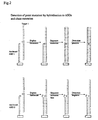
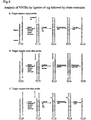
- the tethered oligonucleotide terminates at a position one base before the variable base in the target sequence (Fig.1).
- a nucleotide precursor triphosphate or dideoxyribonucleotide triphosphate labelled, for example with a fluorescent tag, is added in the presence of a nucleic acid synthesising enzyme which requires a specific template in order to incorporate the complementary base.
- the labelled base will be incorporated from a deoxyribonucleotide precursor only if the precursor base is complementary to the base in the target sequence. Thus, mutants will give a negative result.
- the tethered oligonucleotide terminates in a base which is complementary to the variable base in the target sequence.
- Labelled precursor nucleoside triphosphates and polymerase are added. Polymerisation takes place only if the last base of the primer is complementary to the variable base in the target (Fig.2). Thus, mutants will give a negative result.
- the tethered oligonucleotide may end at the variable position in the target sequence, or it may end close to this position.
- hybridisation of the target to the tethered ASOs will produce a substrate for ligating a tag oligonucleotide only if the bases at the join are well matched (Fig. 3a).
- mutants which are close enough to the joining position to prevent ligation will give a negative result.
- the tethered oligonucleotide may terminate at the base before the variable position; in this case, the ligation reaction can be carried out using a mixture of tag oligonucleotides, one for each of the possible alternative variants. Each tag would be labelled differently, for example, with a different fluorophore, so that those that ligated could be recognised identifying the variant base (Fig. 3b).
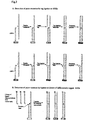
- tag oligonucleotides are ligated to sets of tethered oligonucleotides after hybridisation of the target, which acts as a template to bring the tags and the tethered oligonucleotides together.
- the tethered oligonucleotides comprise three parts, an "anchor" sequence which is common to all members of a VNTR set, which is attached to the solid support and which hybridises to a sequence flanking the variable region, a variable number of the repeated sequence unit, and a distal sequence.
- Each allele, represented by a different number of repeats, is located on a different solid support or at a different location on the same solid surface.
- Hybridisation of the target sequence will produce a series of duplexes, the structures of which depend on the number of units that the target contains.
- the target will meet the end of a tag when the tag is hybridised to the distal sequence of the tethered oligonucleotide. If the number is greater or smaller, there will be a gap in the duplex which reduces or prevents ligation of the tag.
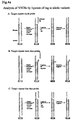
- the tethered oligonucleotides comprise two parts: an "anchor" sequence which is common to all members of a VNTR set and which hybridises to a sequence flanking the repeated region, and a variable number of the repeated sequence unit.
- an "anchor" sequence which is common to all members of a VNTR set and which hybridises to a sequence flanking the repeated region, and a variable number of the repeated sequence unit.
- Each allele, represented by a different number of repeats is located on a different solid support, or at a different location on the same solid surface.
- Hybridisation of the target sequence will produce a series of duplexes, the structures of which depend on the number of repeat units that the target contains (Fig.4b).
- the number matches the number in a tethered oligonucleotide, the latter will meet the end of the tag when the tag is hybridised to its complement in the target sequence, and form a substrate for ligation of the tag. If the number is greater or smaller, there will be a gap in the duplex which reduces or prevents ligation of the tag.
- the number of repeat units in a VNTR may vary within small limits, and in these circumstances, the method of analysis described above, using a ligase, will be appropriate; in other cases, for example the trinucleotide repeats associated with a number of human inherited disorders, the variation may be too large to analyse in this way.
- the variation can be from around 10-50 in the normal chromosome to more than a thousand in the affected individual (Table 1). It is probably unrealistic to measure such large numbers of repeats using the ligase reaction. In these cases, where the difference between the normal and the mutant allele is large, an alternative is to measure approximately the number of repeat units using labelled precursors with a polymerising enzyme.
- the enzyme may be either a polymerase, such as DNA dependent DNA polymerase, or a ligase.
- the oligonucleotides have to be tethered at their 5' ends to satisfy the requirement for enzymatic extension by the polymerase.
- the solid support carries an oligonucleotide anchor complementary to a sequence flanking the repeat unit; for example, the sequence can be that of one of the primers used to amplify the test sequence by the PCR.
- the repeat insert may be copied by a polymerase or a ligase (Fig. 5) incorporating a labelled precursor. The amount of label incorporated is proportional to the number of repeat units.
- incorporation will end at the point in the sequence where the missing precursor base is needed for further extension; where a ligase had been used to polymerise monomers of the basic repeat unit, this will also end at the end of the VNTR insert.
- a labelled "capping" sequence can be added by ligation. In such cases, the measurement will be the ratio of cap to polymer labels.
- VNTRs which may vary in length over a wide range
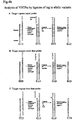
- a more powerful way of analysing VNTRs which may vary in length over a wide range would be to test first for ligation to a labelled tag oligonucleotide; this would give the results already described for targets with different lengths of repeats: a negative result where the VNTR lengths were longer or shorter in the target than in the tethered oligonucleotides, and positive results where they were the same.
- the different length classes will behave differently as substrates for DNA polymerase. Those targets in which the repeat number is less than that of the tethered probe will not act as substrates (Fig. 6c).
- Targets which have the same number of repeats as the probes will not be elongated by polymerase, because the ligated tag will block extension (Fig. 6a). The only cases where extension will occur are those for which the targets are longer than the probes (Fig. 6b). If the analysis is done on an array of probes with different numbers of inserts up to a certain limit, there will be a clear indication of the number of repeats in the targets from the ligation results provided they are within the s range of sizes represented in the array of probes. If, within the targets, there is one which is longer than this range, it will show up in the polymerase analysis.
- DNA polymerases can use as substrates one or more oligonucleotides which are bound to a long DNA strand through Watson-Crick base pairing.
- an oligonucleotide is used as a primer to which the first base in the growing chain is added.
- ligases two oligonucleotides are joined provided that both are paired to the DNA strand and perfectly matched in the base pairs at or close to the junction point.
- hybridisation under stringent conditions and enzymatic extension or joining provide greater discrimination than either alone, and several methods have been developed to exploit this combination in systems for genetic analysis [references in cotton. 1993].
- the hybridisation and the enzyme reaction are normally carried out in solution, following which the product is captured on a solid support, or separated by gel electrophoresis for detection and/or measurement.
- the invention described here employs oligonucleotides coupled to a solid surface, so that the advantages of working in mixed phase are brought to all steps: hybridisation, enzymatic extension or joining, and detection. This provides great sensitivity and convenience. As many different oligonucleotides can be bound to one surface in an array, it enables many different sequences to be analysed together, in a single reaction; this also ensures that all reactions are carried out under identical conditions, making comparisons more reliable.
- oligonucleotides bound to a solid support Two different methods have been developed for making oligonucleotides bound to a solid support: they can be synthesised in situ , or presynthesised and attached to the support. In either case, it is possible to use the support-bound oligonucleotides in a hybridisation reaction with oligonucleotides in the liquid phase to form duplexes; the excess of oligonucleotide in solution can then be washed away. Hybridisation can be carried out under stringent conditions, so that only well-matched duplexes are stable.
- oligonucleotide When enzymes are to be used, the chemical orientation of the oligonucleotide is important; polymerases add bases to the 3' end of the chain; ligases join oligonucleotides which are phosphorylated at the 5' end to those with a 3'-OH group. Oligonucleotides tethered to the solid substrate through either end can be made in situ by using the appropriate phosphoramidite precursors [references in Beaucage and lyer, 1992]; or presynthesised oligonucleotides can be fixed through appropriate groups at either end. We will demonstrate that oligonucleotides can be phosphorylated at the 5' end in situ using ATP and polynucleotide kinase, or they may be phosphorylated chemically [Horn and Urdea, 1986].
- oligonucleotides tethered to the solid substrate can take part in reactions catalysed by DNA polymerases and ligases.
- the M 13 sequencing primer - 5'-GTAAAACGACGGCCAGT-3' - attached to aminated polypropylene through its 5' end was synthesised as described.
- a solution of M13 DNA (single-strand, replicative form, 0.1 ⁇ l, 200 ng/ ⁇ l) was applied in two small spots to the surface of the derivatised polypropylene.
- the polypropylene was incubated at 37°C for 1 hr in a vapour saturated chamber. It was then washed in 1% SDS at 100°C for one minute, and exposed to a storage phosphor screen for one minute and scanned in a phosphorimager. The regions where the DNA had been applied showed a high level of radioactivity, against a low background where no DNA had been applied.
- This experiment shows that oligonucleotides tethered to a solid support can act as primers for DNA-dependent synthesis by DNA polymerase, as required for applications using this enzyme for mutation detection.
- oligonucleotides tethered to a solid support may take the form of particles, for example, glass spheres, or magnetic beads. In this case the reactions could be carried out in tubes, or in the wells of a microtitre plate. Methods for both synthesising oligonucleotides and for attaching presynthesised oligonucleotides to these materials are known [Stahl et al ., 1988]. Methods for making arrays of ASO's representing point mutations were described in patent application PCT/GB89/00460 and in Maskos and Southern (1993). We also demonstrated how oligonucleotides tethered to a solid support in an array could distinguish mutant from wild type alleles by molecular hybridisation.
- oligonucleotide arrays of ASOs could be used as substrates for the enzymes, they need to be modified; for ligation, it may be necessary to phosphorylate the 5' end; for extension by polymerase it will be necessary to attach to oligonucleotides to the solid substrate by their 5' ends.
- VNTRs are repeats of very short units, typically mono to tetranucieotides.
- minisatellites in which the repeat unit is somewhat longer, up to 20 or more nucleotides.
- the short repeats may be made using chemical synthesis; in the case of inserts with large numbers of repeat units, it would be more economical to use a synthetic route which used the repeat unit as a reactant, rather than building them up one base at a time; such methods have been used to make polynucleotides by chemical synthesis.
- the repeat units by ligating the monomer units; they could be added stepwise, one unit at a time provided a method could be found to block one end to prevent polymerisation; for example the oligonucleotide building block may be terminated by a hydroxyl group, which is then phosphorylated after ligation so that the unit becomes an acceptor for the next one; the monomer may have a phosphate group protected by a cleavable group, such as a photocleavable group, which can be removed after ligation to allow a subsequent ligation [Pillai, 1980].
- a cleavable group such as a photocleavable group
- a second alternative which would be especially favourable for longer units such the minisatellites, would be to attach either cloned or enzymatically amplified molecules to the solid support.
- each variant sequence could be amplified by the PCR, using a biotinylated oligonucleotide for one of the primers.
- the strand starting with this group could then be attached to a streptavidin coated surface, and the other strand removed by melting [Stahl et al ., 1988].
- VNTRs An array of VNTRs was made as described in Fig. 4b, in which the anchor sequence was 5'-tgtagtggtgtgatcaaggc-3'.
- the synthesis was carried out using 3'-deoxyribophosphoramidites, this chemical orientation produces oligonucleotides tethered through their 3' ends to the polypropylene, and a free 5' hydroxyl group.
- this OH group was phosphorylated by immersing a strip of the polypropylene (3mm x 18mm), carrying the array of oligonucleotides, in 0.5 ml of a solution containing 4mM ATP and 77.6 units of polynucleotide kinase with buffer and Mg ++ according to the supplier's instructions. The reaction was left for 6 hours at 37°C; the strip was removed and immersed in boiling water to kill the polynucleotide kinase.
- the target sequences which are complementary to elements of the array oligonucleotides and to the ligation tag, 5'-Anchor-Repeat 10 -Tag and 5'-Anchor-Repeat 5 -Tag were added to 0.5 ml of a solution, preheated to 95°C, containing the tag, 5'-gtggtcactaaagtttctgct-3', which had been labelled at its 5' end using polynucleotide kinase and 33 P-gamma-ATP, thermal ligase (500 units), and buffer and salts according to the supplier's instructions.
- the polypropylene strip was immersed in the hot solution, which was then allowed to cool to 68°C, and left at this temperature for 16 hours.
- the polypropylene strip was removed and placed in 25% formamide at 95°C for 5 minutes, rinsed in water at the same temperature, dried and exposed to a storage phosphor screen, from which an image of the radioactivity was collected.
- the results showed counts close to background over most of the array; counts on Anchor-Repeats and Anchor-Repeat 10 were more than five times those over adjacent cells in the array.
- This experiment indicates that the ligase is able to distinguish length variants of the repeat sequence and gives optimum ligation only when the number of repeats in the target matches that in the allele specific oligonucleotide in the array. Thus, it should easily be possible to detect the two allelic variants in a heterozygote.
- oligonucleotide is tethered through the 5' end .
- the oligonucleotides can be synthesised in situ using deoxyribophosphoramidites with 3' dimethoxytrityl groups and 5' phosphoramidite (reverse phosphoramidites). It is unnecessary to phosphorylate the tethered polynucleotide for ligation assays since the phosphate needed for ligation is provided by the tag oligonucleotide.
- VNTR's An array of VNTR's was made as described in Figure 4B, with the oligonucleotides anchored through their 5' ends.
- the repeat unit was 5' ttca and the anchoring sequence 5' cttatttccctca.
- Stripes 6mm wide of sequence variants of the form: Anchor-Repeat N where N 4-8 were made on the surface of a sheet of polypropylene using "reverse" phosphoramidite monomers.
- a strip of the array (30mm x 2mm) was immersed in a solution of 600pmols of the target oligonucleotide 5' cacagactccatgg(tgaa) 6 tgagggaaataag, 1.4 pmol of oligo 5' ccatggagtctgtg (labelled at its 5' end using polynucleotide kinase and 33 P gamma ATP) and buffer and salts according to the suppliers instructions, the total volume being 293 ⁇ l.
- the solution was heated to 65°C and 7 ⁇ l of Tth DNA ligase added. The reaction was then cooled to 37°C and left at that temperature for 18hrs.
- a strip of the array (30mm x 2mm) from Example 2 was added to a solution of 200 pmols of the target oligonucleotide 5' cacagactccatgg(tgaa) 6 tgagggaaataag, 200 pmol of oligo 5' ccatggagtctgtg (chemically phosphorylated at the 5' end) with buffer and salts according to the suppliers instructions, the total volume being 243 ⁇ l.
- the solution was heated to 85°C and cooled to 37°C over a period of 30 mins. 7 ⁇ l of Tth DNA ligase was added and the reaction mixture heated at 34°C for 17hrs.
- the strip was removed and added to a solution of 8 mM DTT, 3.3 pmol 32 P alpha dTT'P, 13 units sequenase version 2.0 and buffer and salts according to the suppliers instructions. The total volume was 250 ⁇ l. After heating at 37°C for 3 hrs the strip was removed from the reaction solution, washed in TE buffer, blotted dry and exposed to a storage phosphor screen from which an image of the radioactivity was taken. The results showed counts equal to background over the area of the array where repeats were equal in length or greater than the repeat length of the target, with 20 times the signal in the areas where the repeat length of the array was shorter than the repeat length in the target.
- reporter nucleotides were chosen, in one case to identify the correct repeat length, and in the other case to identify shorter repeat lengths. This is made possible when the repeat sequence comprises less than all four bases.
- a base is chosen which is present in the repeat sequence and is different from the first base in the flanking sequence.
- a base is chosen to be complementary to the first base in the flanking sequence which is absent from the repeat.
- a strip of the array from Example 2 (30mm x 2mm) was added to a solution of 500 pmols of the target oligonucleotide 5' cacagactccatgg(tgaa) 6 tgagggaaataag in buffer and salts at a concentration 1.09 times the suppliers instructions, the total volume being 275 ⁇ l.
- the solution was heated to 75°C for 5 minutes and cooled to 37°C over a period of 25mins.
- the solution was removed and added to 3.3 pmols 32 P alpha dCTP, 5 ⁇ l 1M DTT. 13 units of Sequenase version 2.0 and water to give a final volume of 295 ⁇ l.
- a similar strip of the array (30mm x 2mm) was added to a solution of 500 pmols of the target oligonucleotide 5' cacagactccatgg(tgaa) 6 tgagggaaataag in buffer and salts 1.09 times the suppliers instructions, the total volume being 275 ⁇ l.
- the solution was heated to 75°C for 5 mins and cooled to 37°C over a period of 25 mins.
- the solution was removed and added to 3.3 pmols 32 P alpha dTTP, 5 ⁇ l 1M DTT, 13 units of Sequenase version 2.0 and water to give a final volume of 295 ⁇ l.
- This solution was added to the array and heated at 37°C for 15hrs 40mins.
- the polypropylene strip was removed, washed in water and exposed to a storage phosphor screen. The results showed counts of 4.5 times more for the shorter array sequences than the correct and longer repeat lengths.
- an array was created using the human fes/fps locus sequence as a target.
- the anchor sequence 5' agagatgtagtctcattctttcgccaggctgg 3' was the actual flanking sequence to the attt repeats of the fes/fps microsatellite (EMBL Accession No X06292 M14209 M14589) as it occurs in human genomic DNA.
- a small square (2mm x 2mm) piece of this material was placed in standard ligation buffer, with template oligonucleotide 5'tcg ttt tac cgt cat gcg tcc tct ctc 3' (250 nM) and a protected ligator oligonucleotide 5' NB PO 4 cgc atg acg 3' (250 nM) and 33 P labelled extender oligonucleotide 5' gag aga gga 3'.
- NB is a protecting group based on a photocleavable o-nitrobenzyl derivative.
- the NB protected phosphate of the ligator oligonucleotide had previously been shown to be unable to take part in the ligation reaction.
- the NB group had also been shown to be removable by uv light to leave a fully functional phosphate group.
- To this mixture was added thermus thermophilus DNA ligase (Advanced Biotechnologies) 25u and the reaction incubated at room temperature for 6 hours. The mixture was then irradiated with uv light (20 minutes room temperature) and incubated for a further 12 hours. The polypropylene patch was then washed with 30% formamide at 95°C for 5 minutes, and exposed to a storage phosphor screen for 24 hours and scanned in a phosphorimager.
- the patch showed a level of radioactivity 50 fold higher than a patch treated in a similar fashion but without addition of the central "ligator" oligonucleotide.
- a similar amount of radioactive extender oligonucleotide became covalently attached to a third polypropylene/oligonucleotide primer square.
- the ligated and unligated products were separated by 20% denaturing polyacrylamide gel electrophoresis.
- the gel was exposed to a phosphor screen for 18hours and scanned by a phosphorimager.
- the relative proportions of ligated to unligated products of the reaction were then measured. 50% of the extender sequence had been ligated to the ligator sequence in 30 minutes.
Landscapes
- Chemical & Material Sciences (AREA)
- Organic Chemistry (AREA)
- Life Sciences & Earth Sciences (AREA)
- Engineering & Computer Science (AREA)
- Zoology (AREA)
- Wood Science & Technology (AREA)
- Proteomics, Peptides & Aminoacids (AREA)
- Health & Medical Sciences (AREA)
- Biophysics (AREA)
- General Engineering & Computer Science (AREA)
- Immunology (AREA)
- Microbiology (AREA)
- Molecular Biology (AREA)
- Analytical Chemistry (AREA)
- Physics & Mathematics (AREA)
- Genetics & Genomics (AREA)
- Biochemistry (AREA)
- Bioinformatics & Cheminformatics (AREA)
- Biotechnology (AREA)
- General Health & Medical Sciences (AREA)
- Chemical Kinetics & Catalysis (AREA)
- Measuring Or Testing Involving Enzymes Or Micro-Organisms (AREA)
- Apparatus Associated With Microorganisms And Enzymes (AREA)
Claims (26)
- Verfahren zur Analyse welches umfasst: Bereitstellen eines Polynucleotid-Ziels, das ein Nucleotid an einer festgelegten Position einschließt, und von zwei oder mehreren verschiedenen Oligonucleotid-Sonden, die in Form einer Aneinanderreihung an verschiedene Stellen eines Trägers gebunden sind, wobei jede Sonde zu dem Ziel einschließlich einer erwarteten Variante des Ziels komplementär ist und an oder nahe an der festgelegten Position endet; und Durchführen der Schritte:(a) Inkubieren des Ziels mit den Sonden unter Bildung eines Doppelstrangs (von Doppelsträngen),(b) Inkubieren des Doppelstrangs (der Doppelstränge) unter (i) Ligationsbedingungen mit einem markierten Oligonucleotid, das zu dem Ziel komplementär ist, oder (ii) Kettenextensionsbedingungen mit mindestens einem markierten Nucleotid; und(c) Aufzeichnen der Zugabe des Nucleotids/Oligonucleotids zu einer Sonde durch Ligation oder Kettenextension in Schritt (b) als Zeichen einer Punktmutation an der festgelegten Position in dem Ziel.
- Verfahren zur Analyse, welches umfasst: Bereitstellen eines Polynucleotid-Ziels, das ein Nucleotid an einer festgelegten Position einschließt, und einer Oligonucleotid-Sonde, die an einen Träger gebunden ist, wobei die Sonde zu dem Ziel komplementär ist und eine Base vor der festgelegten Position endet; und Durchführen der Schritte(a) Inkubieren des Ziels mit der Sonde unter Bildung eines Doppelstrangs,(b) Inkubieren des Doppelstrangs unter (i) Ligationsbedingungen mit einem markierten Oligonucleotid, das zu dem Ziel komplementär ist und eine erwartete Variante des Ziels einschließt, oder (ii) Kettenextensionsbedingungen mit einem markierten Nucleotid, das zu einer erwarteten Variante des Ziels komplementär ist; und(c) Aufzeichnen der Zugabe des Nucleotids/Oligonucleotids zu der Sonde durch Ligation oder Kettenextension in Schritt (b) als Zeichen einer Punktmutation an der festgelegten Position in dem Ziel.
- Verfahren zur Analyse, welches umfasst: Bereitstellen eines Polynucleotid-Ziels mit einer variablen Anzahl von Wiederholungsabschnitten in Tandemanordnung und mit einem flankierenden Abschnitt und von zwei oder mehreren verschiedenen Oligonucleotid-Sonden, die in Form einer Aneinanderreihung an verschiedene Stellen eines Trägers gebunden sind, wobei jede Sonde einen Abschnitt, der zu dem Wiederholungsabschnitt und einem flankierenden Abschnitt des Ziels komplementär ist, aufweist; und Durchführen der Schritte(a) Inkubieren des Ziels mit den Sonden unter Bildung eines Doppelstrangs (von Doppelsträngen)(b) Inkubieren des Doppelstrangs (der Doppelstränge) unter (i) Ligationsbedingungen mit einem markierten Oligonucleotid, das zu dem Ziel komplementär ist, und/oder (ii) Kettenextensionsbedingungen mit mindestens einem markierten Nucleotid; und(c) Aufzeichnen der Zugabe des Nucleotids/Oligonucleotids zu einer Sonde oder einem Ziel durch Ligation oder Kettenextension in Schritt (b) als Zeichen der Länge der variablen Wiederholungsabschnitt-Anzahl des Ziels.
- Verfahren nach Anspruch 3, wobei das Polynucleotid-Ziel eine variable Wiederholungsabschnittsanzahl in Tandemanordnung und zwei flankierende Abschnitte aufweist und wobei in Schritt (b) das (die) markierte(n) Oligonucleotid(e) an den Sondenstrang des Doppelstrangs (der Doppelstränge) ligiert wird (werden).
- Verfahren nach Anspruch 3, wobei das Polynucleotid-Ziel eine variable Wiederholungsabschnittsanzahl in Tandemanordnung und zwei flankierende Abschnitte aufweist und wobei in Schritt (b) der Sondenstrang des Doppelstrangs (der Doppelstränge) durch Zugabe von markierten Nucleotiden kettenverlängert wird.
- Verfahren nach einem vorhergehenden Anspruch, wobei in Schritt (b) ein Enzym verwendet wird.
- Verfahren nach Anspruch 6, wobei das Enzym eine Polymerase oder eine Ligase ist.
- Verfahren nach Anspruch 6 oder 7, wobei das Enzym eine DNA-Polymerase, eine reverse Transcriptase oder eine RNA-Polymerase ist.
- Verfahren nach Anspruch 8, wobei das Enzym eine Taq-Polymerase, eine Thermosequenase, eine T4-DNA-Ligase oder eine E. coli-DNA-Ligase ist.
- Verfahren nach einem vorhergehenden Anspruch, wobei die Sonden über eine kovalente Bindung gebunden sind.
- Verfahren nach einem vorhergehenden Anspruch, wobei die Sonden über ein 5'- oder 3'-Nucleotid gebunden sind.
- Verfahren nach einem vorhergehenden Anspruch, wobei die Sonden an beabstandete Stellen auf einer derivatisierten Glasoberfläche oder auf der Oberfläche eines Silicium-Mikrochips oder auf Propylen gebunden sind.
- Verfahren nach einem der Ansprüche 1 bis 11, wobei die Sonden an einzelne Perlen gebunden sind.
- Verfahren nach einem vorhergehenden Anspruch, wobei das markierte Oligonucleotid oder Nucleotid Fluoreszenz-markiert ist.
- Verfahren nach einem vorhergehenden Anspruch, wobei die markierten Nucleosidtriphosphate vor Schritt (c) zugesetzt werden.
- Verfahren nach Anspruch 15, wobei die Nucleosidtriphosphate Deoxyribonucleotidtriphosphate sind.
- Aneinanderreihung von Oligonucleotid-Sonden zur Analyse eines Polynucleotid-Ziels, enthaltend eine variable Sequenz, in der jedes Komponenten-Oligonucleotid (i) eine Sequenz umfasst, die zu dem Ziel einschließlich einer erwarteten Variante des Ziels komplementär ist, (ii) eine freie 3'-OH-Gruppe aufweist, und (iii) an einen festen Träger in einer Orientierung gebunden ist, die (a) die Doppelstrangbildung mit dem Ziel ermöglicht und (b) die Kettenextension nur ermöglicht, wenn die Sequenz des Oligonucleotids mit der variablen Sequenz des Ziels zusammenpasst.
- Aneinanderreihung von Oligonucleotid-Sonden zur Analyse eines Polynucleotid-Ziels, enthaltend eine variable Wiederholungssequenzanzahl in Tandemanordnung, in der jedes Komponenten-Oligonucleotid an einen festen Träger gebunden ist und (i) eine zu einem Teil des Ziels unmittelbar im Anschluss an die Wiederholungssequenz komplementäre Sequenz umfasst, (ii) eine freie 3'-OH-Gruppe- oder ein freies 5'-Phosphat aufweist und (iii) eine zu der Wiederholungssequenz des Ziels komplementäre Sequenz umfasst und eine Anzahl von in dem Ziel erwarteten Wiederholungen enthält, und (iii) auf eine Weise konfiguriert ist, die (a) die Doppelstrangbildung mit dem Ziel ermöglicht und (b) die Ligation oder Kettenextension nur ermöglicht, wenn die Anzahl von Wiederholungen in dem Oligonucleotid gleich oder kleiner ist als die Anzahl der Wiederholungen in dem Ziel.
- Aneinanderreihung nach Anspruch 17 oder Anspruch 18, wobei die Sonden über eine kovalente Bindung gebunden sind.
- Aneinanderreihung nach einem der Ansprüche 17 bis 19, wobei die Sonden über ein 5'- oder 3'-Nucleotid gebunden sind.
- Aneinanderreihung nach einem der Ansprüche 17 bis 20, wobei die Sonden an beabstandete Stellen auf einer derivatisierten Glasoberfläche oder auf der Oberfläche eines Silicium-Mikrochips oder auf Polypropylen gebunden sind.
- Aneinanderreihung nach einem der Ansprüche 17 bis 20, wobei die Sonden an einzelne Perlen gebunden sind.
- Aneinanderreihung nach einem der Ansprüche 17 bis 22, wobei die Sonden in situ synthetisiert sind.
- Aneinanderreihung nach einem der Ansprüche 17 bis 22, wobei die Sonden vorsynthetisiert sind.
- Verfahren zur Herstellung einer Aneinanderreihung von verschiedenen Oligonucleotid-Sonden, die an verschiedene Stellen eines Trägers gebunden sind, wobei das Verfahren die Schritte umfasst: Bereitstellen eines ersten intermediären Oligonucleotids, das an den Träger gebunden ist, und eines zweiten intermediären Oligonucleotids in Lösung und eines dritten Oligonucleotids, das sowohl zu dem ersten als auch zu dem zweiten intermediären Oligonucleotid komplementär ist, Bilden eines Doppelstrangs des dritten Oligonucleotids mit dem ersten und zweiten intermediären Oligonucleotid, Ligieren des ersten intermediären Oligonucleotids mit dem zweiten intermediären Oligonucleotid; und Wiederholen der Schritte mit den Oligonucleotiden, die an verschiedene Stellen des Trägers gebunden sind.
Priority Applications (2)
| Application Number | Priority Date | Filing Date | Title |
|---|---|---|---|
| EP03075104A EP1308523B1 (de) | 1995-04-07 | 1996-04-09 | Nachweis von Nukleinsäure-Änderungen |
| EP06076004A EP1693469B1 (de) | 1995-04-07 | 1996-04-09 | Nachweis von DNS-Sequenz Variationen |
Applications Claiming Priority (3)
| Application Number | Priority Date | Filing Date | Title |
|---|---|---|---|
| GB9507238 | 1995-04-07 | ||
| GBGB9507238.5A GB9507238D0 (en) | 1995-04-07 | 1995-04-07 | Detecting dna sequence variations |
| PCT/GB1996/000848 WO1996031622A1 (en) | 1995-04-07 | 1996-04-09 | Detecting dna sequence variations |
Related Child Applications (2)
| Application Number | Title | Priority Date | Filing Date |
|---|---|---|---|
| EP03075104A Division EP1308523B1 (de) | 1995-04-07 | 1996-04-09 | Nachweis von Nukleinsäure-Änderungen |
| EP03075104.4 Division-Into | 2003-01-08 |
Publications (2)
| Publication Number | Publication Date |
|---|---|
| EP0820524A1 EP0820524A1 (de) | 1998-01-28 |
| EP0820524B1 true EP0820524B1 (de) | 2004-12-01 |
Family
ID=10772698
Family Applications (3)
| Application Number | Title | Priority Date | Filing Date |
|---|---|---|---|
| EP96909255A Expired - Lifetime EP0820524B1 (de) | 1995-04-07 | 1996-04-09 | Nachweis von nukleinsäure-variationen |
| EP03075104A Expired - Lifetime EP1308523B1 (de) | 1995-04-07 | 1996-04-09 | Nachweis von Nukleinsäure-Änderungen |
| EP06076004A Expired - Lifetime EP1693469B1 (de) | 1995-04-07 | 1996-04-09 | Nachweis von DNS-Sequenz Variationen |
Family Applications After (2)
| Application Number | Title | Priority Date | Filing Date |
|---|---|---|---|
| EP03075104A Expired - Lifetime EP1308523B1 (de) | 1995-04-07 | 1996-04-09 | Nachweis von Nukleinsäure-Änderungen |
| EP06076004A Expired - Lifetime EP1693469B1 (de) | 1995-04-07 | 1996-04-09 | Nachweis von DNS-Sequenz Variationen |
Country Status (6)
| Country | Link |
|---|---|
| US (5) | US6150095A (de) |
| EP (3) | EP0820524B1 (de) |
| JP (3) | JP3908784B2 (de) |
| DE (3) | DE69636843T2 (de) |
| GB (1) | GB9507238D0 (de) |
| WO (1) | WO1996031622A1 (de) |
Families Citing this family (212)
| Publication number | Priority date | Publication date | Assignee | Title |
|---|---|---|---|---|
| US6270961B1 (en) * | 1987-04-01 | 2001-08-07 | Hyseq, Inc. | Methods and apparatus for DNA sequencing and DNA identification |
| US5547839A (en) | 1989-06-07 | 1996-08-20 | Affymax Technologies N.V. | Sequencing of surface immobilized polymers utilizing microflourescence detection |
| US6401267B1 (en) | 1993-09-27 | 2002-06-11 | Radoje Drmanac | Methods and compositions for efficient nucleic acid sequencing |
| US6468742B2 (en) | 1993-11-01 | 2002-10-22 | Nanogen, Inc. | Methods for determination of single nucleic acid polymorphisms using bioelectronic microchip |
| US7582421B2 (en) | 1993-11-01 | 2009-09-01 | Nanogen, Inc. | Methods for determination of single nucleic acid polymorphisms using a bioelectronic microchip |
| US6207373B1 (en) * | 1998-02-25 | 2001-03-27 | Nanogen, Inc. | Methods for determining nature of repeat units in DNA |
| WO1997025444A1 (en) * | 1996-01-16 | 1997-07-17 | Hybridon, Inc. | Method of monitoring pharmacokinetics of oligonucleotide pharmaceuticals |
| ES2288760T3 (es) | 1996-04-25 | 2008-01-16 | Bioarray Solutions Ltd. | Ensamblaje electrocinetico controlado por luz de particulas proximas a superficies. |
| GB9624165D0 (en) | 1996-11-19 | 1997-01-08 | Amdex A S | Use of nucleic acids bound to carrier macromolecules |
| WO1998023776A1 (en) * | 1996-11-29 | 1998-06-04 | Amersham Pharmacia Biotech Uk Ltd. | Method for determining tandem repeat sequence length |
| AUPO427996A0 (en) * | 1996-12-20 | 1997-01-23 | Co-Operative Research Centre For Diagnostic Technologies | Method for detecting a nucleotide at a specific location within a polynucleotide sequence and apparatus therefor |
| US6297006B1 (en) * | 1997-01-16 | 2001-10-02 | Hyseq, Inc. | Methods for sequencing repetitive sequences and for determining the order of sequence subfragments |
| US6309824B1 (en) * | 1997-01-16 | 2001-10-30 | Hyseq, Inc. | Methods for analyzing a target nucleic acid using immobilized heterogeneous mixtures of oligonucleotide probes |
| US6309829B1 (en) | 1997-05-27 | 2001-10-30 | Pe Corporation (Ny) | Length determination of nucleic acid repeat sequences by discontinuous primer extension |
| EP0996500A1 (de) | 1997-07-22 | 2000-05-03 | Rapigene, Inc. | Vorrichtung und verfahren zur gruppierung von einer lösung auf einem festen träger |
| WO1999005321A1 (en) * | 1997-07-22 | 1999-02-04 | Rapigene, Inc. | Amplification and other enzymatic reactions performed on nucleic acid arrays |
| AU742599B2 (en) * | 1997-07-22 | 2002-01-10 | Qiagen Genomics, Inc. | Multiple functionalities within an array element and uses thereof |
| US6844158B1 (en) | 1997-12-22 | 2005-01-18 | Hitachi Chemical Co., Ltd. | Direct RT-PCR on oligonucleotide-immobilized PCR microplates |
| ATE506449T1 (de) * | 1997-12-22 | 2011-05-15 | Hitachi Chemical Co Ltd | Direkte rt-pcr auf oligonukleotid-immobilisierten pcr-mikroplatten |
| US6087102A (en) | 1998-01-07 | 2000-07-11 | Clontech Laboratories, Inc. | Polymeric arrays and methods for their use in binding assays |
| US6289229B1 (en) | 1998-01-20 | 2001-09-11 | Scimed Life Systems, Inc. | Readable probe array for in vivo use |
| US6355419B1 (en) | 1998-04-27 | 2002-03-12 | Hyseq, Inc. | Preparation of pools of nucleic acids based on representation in a sample |
| US6410278B1 (en) * | 1998-11-09 | 2002-06-25 | Eiken Kagaku Kabushiki Kaisha | Process for synthesizing nucleic acid |
| US6410231B1 (en) | 1999-02-26 | 2002-06-25 | Incyte Genomics, Inc. | SNP detection |
| EP1159453B1 (de) * | 1999-03-10 | 2008-05-28 | ASM Scientific, Inc. | Methode zur direkten sequenzierung von nukleinsäuren |
| AU4058500A (en) * | 1999-03-30 | 2000-10-16 | Nanogen, Inc. | Single nucleotide polymorphic discrimination by electronic dot blot assay on semiconductor microchips |
| CA2366374C (en) | 1999-04-09 | 2009-09-22 | Keygene N.V. | Method for the detection and/or analysis, by means of primer extension techniques, of single nucleotide polymorphisms in restriction fragments, in particular in amplified restriction fragments generated using aflp |
| CA2370976C (en) * | 1999-04-20 | 2009-10-20 | Illumina, Inc. | Detection of nucleic acid reactions on bead arrays |
| US20060275782A1 (en) | 1999-04-20 | 2006-12-07 | Illumina, Inc. | Detection of nucleic acid reactions on bead arrays |
| WO2000065098A2 (en) * | 1999-04-27 | 2000-11-02 | University Of Chicago | Nucleotide extension on a microarray of gel-immobilized primers |
| IL148344A0 (en) * | 1999-09-01 | 2002-09-12 | Yeda Res & Dev | Template-dependent nucleic acid polymerization using oligonucleotide triphosphate building blocks |
| US7244559B2 (en) | 1999-09-16 | 2007-07-17 | 454 Life Sciences Corporation | Method of sequencing a nucleic acid |
| US7211390B2 (en) | 1999-09-16 | 2007-05-01 | 454 Life Sciences Corporation | Method of sequencing a nucleic acid |
| US6297016B1 (en) * | 1999-10-08 | 2001-10-02 | Applera Corporation | Template-dependent ligation with PNA-DNA chimeric probes |
| US6500620B2 (en) | 1999-12-29 | 2002-12-31 | Mergen Ltd. | Methods for amplifying and detecting multiple polynucleotides on a solid phase support |
| US7582420B2 (en) | 2001-07-12 | 2009-09-01 | Illumina, Inc. | Multiplex nucleic acid reactions |
| US6376191B1 (en) * | 2000-03-22 | 2002-04-23 | Mergen, Ltd. | Microarray-based analysis of polynucleotide sequence variations |
| US7875442B2 (en) | 2000-03-24 | 2011-01-25 | Eppendorf Array Technologies | Identification and quantification of a plurality of biological (micro)organisms or their components |
| US7829313B2 (en) | 2000-03-24 | 2010-11-09 | Eppendorf Array Technologies | Identification and quantification of a plurality of biological (micro)organisms or their components |
| CA2409309A1 (en) | 2000-05-19 | 2001-11-29 | Eragen Biosciences, Inc. | Materials and methods for detection of nucleic acids |
| US6977161B2 (en) | 2000-10-14 | 2005-12-20 | Eragen Biosciences, Inc. | Solid support assay systems and methods utilizing non-standard bases |
| US7892854B2 (en) | 2000-06-21 | 2011-02-22 | Bioarray Solutions, Ltd. | Multianalyte molecular analysis using application-specific random particle arrays |
| US9709559B2 (en) | 2000-06-21 | 2017-07-18 | Bioarray Solutions, Ltd. | Multianalyte molecular analysis using application-specific random particle arrays |
| JP4310599B2 (ja) * | 2000-07-05 | 2009-08-12 | 東洋紡績株式会社 | 塩基多型を検出する方法 |
| EP1598432A3 (de) * | 2000-07-31 | 2006-06-07 | Agilent Technologies, Inc. | Array-basierende Methoden zur Synthese von Nukleinsäuregemischen |
| EP1186669B1 (de) * | 2000-09-05 | 2006-01-25 | Zeltz, Patrick, Dr. | Verfahren zur spezifischen Bestimmung von DNA-Sequenzen mittels paralleler Amplifikation |
| CN100385013C (zh) * | 2000-10-14 | 2008-04-30 | 伊拉根生物科学公司 | 使用非标准碱基的固相支持体分析系统和方法 |
| EP1349924A2 (de) | 2000-11-03 | 2003-10-08 | Dana Farber Cancer Institute | Zusammensetzungen und verfahren zur diagnose von krebsanfälligkeit und defekter dna reparaturmechanismen und behandlungen davon. |
| US6489115B2 (en) * | 2000-12-21 | 2002-12-03 | The Board Of Regents Of The University Of Nebraska | Genetic assays for trinucleotide repeat mutations in eukaryotic cells |
| US7226737B2 (en) | 2001-01-25 | 2007-06-05 | Luminex Molecular Diagnostics, Inc. | Polynucleotides for use as tags and tag complements, manufacture and use thereof |
| JP4422963B2 (ja) * | 2001-01-25 | 2010-03-03 | ルミネックス モレキュラー ダイアグノスティックス, インク. | 標識および標識補体として使用するための非クロス交雑しているポリヌクレオチドのファミリー、製品、ならびにその使用方法 |
| US20030165865A1 (en) * | 2001-01-29 | 2003-09-04 | Hinkel Christopher A. | Methods of analysis of nucleic acids |
| WO2002079518A1 (en) * | 2001-03-29 | 2002-10-10 | Chugai Seiyaku Kabushiki Kaisha | A method for genotyping individuals for multiple snps |
| JP2004532026A (ja) * | 2001-03-30 | 2004-10-21 | アメルシャム・バイオサイエンシーズ・アクチボラグ | P450単一ヌクレオチド多型バイオチップ分析 |
| EP1256632A3 (de) * | 2001-05-07 | 2004-01-02 | Smithkline Beecham Corporation | Hochdurchsatz-Screening von Polymorphismen |
| WO2002095065A2 (en) * | 2001-05-18 | 2002-11-28 | Azign Bioscience A/S | G-protein coupled receptor arrays |
| JP2002372533A (ja) * | 2001-06-13 | 2002-12-26 | Kiwamu Akagi | 血液の検査方法、検査用チップ、並びに検査装置 |
| US7262063B2 (en) | 2001-06-21 | 2007-08-28 | Bio Array Solutions, Ltd. | Directed assembly of functional heterostructures |
| US7771930B2 (en) | 2001-06-27 | 2010-08-10 | Cancer Research Technology Limited | Cancer |
| US20030170695A1 (en) * | 2001-06-29 | 2003-09-11 | Liang Shi | Enzymatic ligation-based identification of nucleotide sequences |
| US20030082584A1 (en) * | 2001-06-29 | 2003-05-01 | Liang Shi | Enzymatic ligation-based identification of transcript expression |
| US20050009022A1 (en) * | 2001-07-06 | 2005-01-13 | Weiner Michael P. | Method for isolation of independent, parallel chemical micro-reactions using a porous filter |
| US20030054396A1 (en) * | 2001-09-07 | 2003-03-20 | Weiner Michael P. | Enzymatic light amplification |
| US20070264641A1 (en) * | 2001-10-15 | 2007-11-15 | Li Alice X | Multiplexed analysis of polymorphic loci by concurrent interrogation and enzyme-mediated detection |
| CA2497740C (en) * | 2001-10-15 | 2011-06-21 | Bioarray Solutions, Ltd. | Multiplexed analysis of polymorphic loci by probe elongation-mediated detection |
| US6956114B2 (en) | 2001-10-30 | 2005-10-18 | '454 Corporation | Sulfurylase-luciferase fusion proteins and thermostable sulfurylase |
| US20050124022A1 (en) * | 2001-10-30 | 2005-06-09 | Maithreyan Srinivasan | Novel sulfurylase-luciferase fusion proteins and thermostable sulfurylase |
| US6902921B2 (en) * | 2001-10-30 | 2005-06-07 | 454 Corporation | Sulfurylase-luciferase fusion proteins and thermostable sulfurylase |
| US7294504B1 (en) * | 2001-12-27 | 2007-11-13 | Allele Biotechnology & Pharmaceuticals, Inc. | Methods and compositions for DNA mediated gene silencing |
| US7282355B2 (en) | 2002-03-13 | 2007-10-16 | Syngenta Participations Ag | Nucleic acid detection method |
| US9126165B1 (en) | 2002-04-24 | 2015-09-08 | The University Of North Carolina At Greensboro | Nucleic acid arrays to monitor water and other ecosystems |
| US7214492B1 (en) | 2002-04-24 | 2007-05-08 | The University Of North Carolina At Greensboro | Nucleic acid arrays to monitor water and other ecosystems |
| US8048623B1 (en) | 2002-04-24 | 2011-11-01 | The University Of North Carolina At Greensboro | Compositions, products, methods and systems to monitor water and other ecosystems |
| US8383342B2 (en) | 2002-04-24 | 2013-02-26 | The University Of North Carolina At Greensboro | Compositions, products, methods and systems to monitor water and other ecosystems |
| US7601493B2 (en) * | 2002-07-26 | 2009-10-13 | Nanogen, Inc. | Methods and apparatus for screening and detecting multiple genetic mutations |
| US7491492B2 (en) | 2002-07-30 | 2009-02-17 | Toppan Printing Co., Ltd. | Method of detecting nucleotide mutations |
| US20060105337A1 (en) * | 2002-08-30 | 2006-05-18 | Brian Warner | Solid phase based nucleic acid assays combining high affinity and high specificity |
| US7157228B2 (en) * | 2002-09-09 | 2007-01-02 | Bioarray Solutions Ltd. | Genetic analysis and authentication |
| WO2004047007A1 (en) | 2002-11-15 | 2004-06-03 | Bioarray Solutions, Ltd. | Analysis, secure access to, and transmission of array images |
| DE602004018270D1 (de) | 2003-01-17 | 2009-01-22 | Eragen Biosciences Inc | Nukleinsäureamplifikation mit nichtstandardbasen |
| US7575865B2 (en) * | 2003-01-29 | 2009-08-18 | 454 Life Sciences Corporation | Methods of amplifying and sequencing nucleic acids |
| CA2513889A1 (en) | 2003-01-29 | 2004-08-19 | 454 Corporation | Double ended sequencing |
| CA2458085A1 (en) | 2003-03-21 | 2004-09-21 | F. Hoffmann-La Roche Ag | Transcriptional activity assay |
| JP4567673B2 (ja) | 2003-04-01 | 2010-10-20 | エラジェン バイオサイエンシズ インコーポレイテッド | ポリメラーゼ阻害剤およびその使用方法 |
| US20050233390A1 (en) * | 2003-04-09 | 2005-10-20 | Allen John W | Device including a proteinaceous factor, a recombinant proteinaceous factor, and a nucleotide sequence encoding the proteinaceous factor |
| AU2003902299A0 (en) * | 2003-05-13 | 2003-05-29 | Flinders Medical Centre | A method of analysing a marker nucleic acid molecule |
| DE10325098B3 (de) * | 2003-06-03 | 2004-12-02 | IPK-Institut für Pflanzengenetik und Kulturpflanzenforschung | Verfahren zur SNP-Analyse auf Biochips mit Oligonukleotid-Arealen |
| US20050181394A1 (en) * | 2003-06-20 | 2005-08-18 | Illumina, Inc. | Methods and compositions for whole genome amplification and genotyping |
| US20040259100A1 (en) * | 2003-06-20 | 2004-12-23 | Illumina, Inc. | Methods and compositions for whole genome amplification and genotyping |
| EP1636337A4 (de) | 2003-06-20 | 2007-07-04 | Illumina Inc | Verfahren und zusammensetzungen zur ganzgenomischen amplifikation und genotypisierung |
| CA2531123A1 (en) * | 2003-07-02 | 2005-01-13 | Perkinelmer Las, Inc. | Assay and process for labeling and detection of micro rna and small interfering rna sequences |
| US7927796B2 (en) | 2003-09-18 | 2011-04-19 | Bioarray Solutions, Ltd. | Number coding for identification of subtypes of coded types of solid phase carriers |
| JP4564959B2 (ja) | 2003-09-22 | 2010-10-20 | バイオアレイ ソリューションズ リミテッド | 生体分子に共有結合できる、複数の官能基を持つ表面固定化高分子電解質 |
| US7563569B2 (en) | 2003-10-28 | 2009-07-21 | Michael Seul | Optimization of gene expression analysis using immobilized capture probes |
| AU2004287069B2 (en) | 2003-10-29 | 2009-07-16 | Bioarray Solutions, Ltd. | Multiplexed nucleic acid analysis by fragmentation of double-stranded DNA |
| US20050282195A1 (en) * | 2004-04-30 | 2005-12-22 | Applera Corporation | Compositions, methods, and kits for (MIS)ligating oligonucleotides |
| US20060008823A1 (en) * | 2004-05-12 | 2006-01-12 | Kemp Jennifer T | DNA profiling and SNP detection utilizing microarrays |
| EP2290073A3 (de) | 2004-05-28 | 2011-08-31 | Asuragen, Inc. | Verfahren und Zusammensetzungen mit MicroRNA |
| US7848889B2 (en) | 2004-08-02 | 2010-12-07 | Bioarray Solutions, Ltd. | Automated analysis of multiplexed probe-target interaction patterns: pattern matching and allele identification |
| US7238486B2 (en) * | 2004-09-21 | 2007-07-03 | The Board Of Trustees Of The Leland Stanford Junior University | DNA fingerprinting using a branch migration assay |
| US7501253B2 (en) * | 2004-09-21 | 2009-03-10 | The Board Of Trustees Of The Leland Stanford Junior University | DNA fingerprinting using a branch migration assay |
| CA2857878A1 (en) | 2004-11-12 | 2006-12-28 | Asuragen, Inc. | Methods and compositions involving mirna and mirna inhibitor molecules |
| US7977119B2 (en) * | 2004-12-08 | 2011-07-12 | Agilent Technologies, Inc. | Chemical arrays and methods of using the same |
| WO2006099421A2 (en) | 2005-03-14 | 2006-09-21 | The Board Of Trustees Of The Leland Stanford Junior University | Methods and compositions for evaluating graft survival in a solid organ transplant recipient |
| WO2006101913A2 (en) | 2005-03-18 | 2006-09-28 | Eragen Biosciences, Inc. | Methods for detecting multiple species and subspecies of neiserria |
| US20060240443A1 (en) * | 2005-04-20 | 2006-10-26 | Combimatrix Corporation | Microarray-based single nucleotide polymorphism, sequencing, and gene expression assay method |
| US8486629B2 (en) | 2005-06-01 | 2013-07-16 | Bioarray Solutions, Ltd. | Creation of functionalized microparticle libraries by oligonucleotide ligation or elongation |
| EP1731620A1 (de) | 2005-06-07 | 2006-12-13 | Institut National De La Sante Et De La Recherche Medicale (Inserm) | Methode zur Diagnose von Immun-Transplantatstoleranz |
| CA2610863C (en) | 2005-06-07 | 2017-01-17 | Eragen Biosciences, Inc. | Methods for detection and typing of nucleic acids |
| US8507197B2 (en) | 2005-08-10 | 2013-08-13 | Ge Healthcare Bio-Sciences Corp. | Quality control methods for arrayed oligonucleotides |
| US7359222B2 (en) * | 2005-09-15 | 2008-04-15 | Power Integrations, Inc. | Method and apparatus to improve regulation of a power supply |
| WO2007035836A2 (en) * | 2005-09-20 | 2007-03-29 | The Board Of Regents Of The University Of Oklahoma | Accelerated class i and class ii hla dna sequence-based typing |
| US8841069B2 (en) | 2005-12-29 | 2014-09-23 | Korea Materials & Analysis Corporation | Dendron-mediated DNA virus detection |
| ATE463585T1 (de) | 2005-12-29 | 2010-04-15 | Ind Cooperation Agency | Ein-schritt-diagnose mit dna-chip |
| US20070196832A1 (en) * | 2006-02-22 | 2007-08-23 | Efcavitch J William | Methods for mutation detection |
| JP2007267644A (ja) * | 2006-03-30 | 2007-10-18 | Toshiba Corp | 単位塩基の繰り返し回数の測定方法 |
| CA2657576C (en) | 2006-07-14 | 2023-10-31 | The Regents Of The University Of California | Cancer biomarkers and methods of use thereof |
| JP2010510964A (ja) | 2006-09-19 | 2010-04-08 | アシュラジェン インコーポレイテッド | 治療的介入の標的としての、miR−15、miR−26、miR−31、miR−145、miR−147、miR−188、miR−215、miR−216、miR−331、mmu−miR−292−3pによって調節される遺伝子および経路 |
| WO2008036765A2 (en) | 2006-09-19 | 2008-03-27 | Asuragen, Inc. | Micrornas differentially expressed in pancreatic diseases and uses thereof |
| US9845494B2 (en) | 2006-10-18 | 2017-12-19 | Affymetrix, Inc. | Enzymatic methods for genotyping on arrays |
| EA201201640A1 (ru) | 2007-01-30 | 2013-09-30 | Фармасайкликс, Инк. | Способы определения устойчивости рака к ингибиторам гистондеацетилазы |
| US20080194416A1 (en) * | 2007-02-08 | 2008-08-14 | Sigma Aldrich | Detection of mature small rna molecules |
| JP5266646B2 (ja) * | 2007-02-15 | 2013-08-21 | 東レ株式会社 | 繰り返し塩基配列の配列数測定方法および繰り返し塩基配列の配列数測定キット |
| EP1961825A1 (de) | 2007-02-26 | 2008-08-27 | INSERM (Institut National de la Santé et de la Recherche Medicale) | Verfahren zur Vorhersage des Auftretens von Metastasen bei Brustkrebspatienten |
| EP2171097A2 (de) * | 2007-06-29 | 2010-04-07 | Population Genetics Technologies LTD. | Verfahren und zusammensetzungen zur isolierung der varianten von nukleinsäuresequenzen |
| JP2009011247A (ja) * | 2007-07-05 | 2009-01-22 | Sumitomo Bakelite Co Ltd | 遺伝子の検出方法 |
| US20090061424A1 (en) * | 2007-08-30 | 2009-03-05 | Sigma-Aldrich Company | Universal ligation array for analyzing gene expression or genomic variations |
| WO2009097424A1 (en) | 2008-01-29 | 2009-08-06 | University Of Pittsburgh-Of The Commonwealth System Of Higher Education | Fstl-1 as a biomarker of inflammation |
| US8658379B2 (en) | 2008-01-29 | 2014-02-25 | University of Pittsburgh—of the Commonwealth System of Higher Education | Follistatin-like protein-1 as a biomarker for sepsis |
| EP2113574A1 (de) | 2008-04-28 | 2009-11-04 | Biotype AG | Stoffe und Verfahren für Profilierungstest auf DNA-Basis |
| US8258111B2 (en) | 2008-05-08 | 2012-09-04 | The Johns Hopkins University | Compositions and methods related to miRNA modulation of neovascularization or angiogenesis |
| US20110201519A1 (en) | 2008-08-18 | 2011-08-18 | Sarwal Minnie M | Methods and Compositions for Determining a Graft Tolerant Phenotype in a Subject |
| BR112012003847B1 (pt) | 2009-08-22 | 2020-12-01 | The Board Of Trustees Of The Leland Standford Junior University | método para selecionar um ou mais embriões humanos que provavelmente alcançarão o estágio de blastocisto |
| US8975019B2 (en) * | 2009-10-19 | 2015-03-10 | University Of Massachusetts | Deducing exon connectivity by RNA-templated DNA ligation/sequencing |
| EP2314714A1 (de) | 2009-10-22 | 2011-04-27 | Universiteit Leiden | Empfänglichkeit für eine Krankheit |
| US9644240B2 (en) | 2009-10-22 | 2017-05-09 | Leiden University | Disease susceptibility |
| CN102639712A (zh) | 2009-10-23 | 2012-08-15 | 卢米耐克斯公司 | 用于提高反应特异性的具有非标准碱基的扩增引物 |
| EP3185013B1 (de) | 2009-12-02 | 2019-10-09 | The Board of Trustees of the Leland Stanford Junior University | Biomarker zur bestimmung eines allotransplantattoleranten phänotyps |
| GB0922085D0 (en) | 2009-12-17 | 2010-02-03 | Cambridge Entpr Ltd | Cancer diagnosis and treatment |
| US20130058915A1 (en) | 2010-03-02 | 2013-03-07 | Children's Medica Center Corporation | Methods and compositions for treatment of angelman syndrome and autism spectrum disorders |
| EP3214174B1 (de) | 2010-03-04 | 2019-10-16 | InteRNA Technologies B.V. | Mirna-molekül, das über seine quelle definiert ist, und seine diagnostischen und therapeutischen verwendungen bei mit emt assoziierten krankheiten |
| WO2011133538A1 (en) | 2010-04-19 | 2011-10-27 | The Procter & Gamble Company | Genetic signatures and gene chips associated with administration of electrically conducted radio frequency current to skin and methods and treatments relating thereto |
| KR101490573B1 (ko) | 2010-04-19 | 2015-02-05 | 시네론 메디컬 리미티드 | 포유류 피부의 상태를 조절하기 위한 조합된 에너지 및 국소 조성물 적용 |
| WO2011139721A1 (en) | 2010-04-27 | 2011-11-10 | The Regents Of The University Of California | Cancer biomarkers and methods of use thereof |
| NZ605420A (en) | 2010-07-06 | 2015-02-27 | Interna Technologies Bv | Mirna and its diagnostic and therapeutic uses in diseases or conditions associated with melanoma, or in diseases or conditions associated with activated braf pathway |
| WO2012019099A2 (en) | 2010-08-05 | 2012-02-09 | University Of Pittsburgh - Of The Commonwealth System Of Higher Education | Follistatin-like-protein-1 as a biomarker for inflammatory disorders |
| EA201390370A1 (ru) | 2010-09-15 | 2013-07-30 | Олмак Дайэгностикс Лимитед | Молекулярно-диагностический тест для определения онкологического заболевания |
| CA2817882C (en) | 2010-11-17 | 2022-08-23 | Asuragen, Inc. | Mirnas as biomarkers for distinguishing benign from malignant thyroid neoplasms |
| EP2474617A1 (de) | 2011-01-11 | 2012-07-11 | InteRNA Technologies BV | MIR zur Behandlung von Neoangiogenese |
| CA2827945C (en) | 2011-02-23 | 2021-10-12 | The Board Of Trustees Of The Leland Stanford Junior University | Methods of detecting aneuploidy in human embryos |
| MX2013009863A (es) | 2011-02-28 | 2013-12-06 | Univ Iowa Res Found | Cambios de la hormona anti-mulleriana en el embarazo y prediccion de sexo y de resultados adversos en el embarazo. |
| SG10201604497UA (en) | 2011-06-02 | 2016-07-28 | Almac Diagnostics Ltd | Molecular Diagnostic Test For Cancer |
| CN103765212A (zh) | 2011-06-27 | 2014-04-30 | 杰克逊实验室 | 治疗癌症和自体免疫性疾病的方法和组合物 |
| WO2013009705A2 (en) | 2011-07-09 | 2013-01-17 | The Trustees Of Columbia University In The City Of New York | Biomarkers, methods, and compositions for inhibiting a multi-cancer mesenchymal transition mechanism |
| WO2013040251A2 (en) | 2011-09-13 | 2013-03-21 | Asurgen, Inc. | Methods and compositions involving mir-135b for distinguishing pancreatic cancer from benign pancreatic disease |
| US20130157884A1 (en) | 2011-10-26 | 2013-06-20 | Asuragen, Inc. | Methods and compositions involving mirna expression levels for distinguishing pancreatic cysts |
| EP2771487A1 (de) | 2011-10-27 | 2014-09-03 | Asuragen, INC. | Mirnas als diagnostische biomarker zur unterscheidung gutartiger von bösartigen tumoren in der schilddrüse |
| WO2013087789A1 (en) | 2011-12-13 | 2013-06-20 | Glykos Finland Ltd. | Antibody isoform arrays and methods thereof |
| CN104136611B (zh) * | 2012-02-27 | 2018-03-27 | 东丽株式会社 | 核酸的检测方法 |
| US20150152499A1 (en) | 2012-07-03 | 2015-06-04 | Interna Technologies B.V. | Diagnostic portfolio and its uses |
| US20140100124A1 (en) | 2012-10-04 | 2014-04-10 | Asuragen, Inc. | Diagnostic mirnas for differential diagnosis of incidental pancreatic cystic lesions |
| CA2893033A1 (en) | 2012-12-03 | 2014-06-12 | Almac Diagnostics Limited | Molecular diagnostic test for cancer |
| US9944992B2 (en) | 2013-03-15 | 2018-04-17 | The University Of Chicago | Methods and compositions related to T-cell activity |
| US9758835B2 (en) | 2013-03-15 | 2017-09-12 | Baylor Research Institute | Ulcerative colitis (UC)-associated colorectal neoplasia markers |
| US9868992B2 (en) | 2013-03-15 | 2018-01-16 | Baylor Research Institute | Tissue and blood-based miRNA biomarkers for the diagnosis, prognosis and metastasis-predictive potential in colorectal cancer |
| JP6427883B2 (ja) * | 2014-01-27 | 2018-11-28 | 株式会社大林組 | セメント組成体の仕上げ方法 |
| GB201409479D0 (en) | 2014-05-28 | 2014-07-09 | Almac Diagnostics Ltd | Molecular diagnostic test for cancer |
| WO2016025510A1 (en) | 2014-08-12 | 2016-02-18 | Rappolee Daniel A | Systems and methods to detect stem cell stress and uses thereof |
| US11543411B2 (en) | 2014-12-05 | 2023-01-03 | Prelude Corporation | DCIS recurrence and invasive breast cancer |
| TW201702218A (zh) | 2014-12-12 | 2017-01-16 | 美國杰克森實驗室 | 關於治療癌症、自體免疫疾病及神經退化性疾病之組合物及方法 |
| GB201512869D0 (en) | 2015-07-21 | 2015-09-02 | Almac Diagnostics Ltd | Gene signature for minute therapies |
| JP6904910B2 (ja) * | 2016-02-10 | 2021-07-21 | 日本電気株式会社 | Dna検査用チップ、dna検査方法、dna検査システム、及びdna検査チップ制御装置 |
| EP3446123A4 (de) | 2016-04-20 | 2019-11-06 | LDX Prognostics Limited Co. | Verfahren und zusammensetzungen zur prognose einer frühgeburt |
| WO2017197573A1 (en) | 2016-05-17 | 2017-11-23 | Ldx Prognostics Limited Co. | Methods and compositions for providing preeclampsia assessment |
| US9932631B1 (en) | 2017-09-11 | 2018-04-03 | Omniome, Inc. | Genotyping by polymerase binding |
| CA3050241C (en) | 2017-01-20 | 2022-11-29 | Omniome, Inc. | Allele-specific capture of nucleic acids |
| WO2019051465A1 (en) | 2017-09-11 | 2019-03-14 | Cyteir Therapeutics, Inc. | RAD51 INHIBITORS |
| EP3704250A1 (de) | 2017-11-03 | 2020-09-09 | InteRNA Technologies B.V. | Mirna-molekül, äquivalent, antagomir oder quelle davon zur behandlung und/oder diagnose eines zustands und/oder einer erkrankung im zusammenhang mit neuronaler defizienz oder neuronaler (re)generation |
| EP3714053B1 (de) | 2017-11-22 | 2025-12-31 | The University of Chicago | Von chemischer sonde abhängige bewertung der proteinaktivität und verwendung davon |
| GB201803019D0 (en) * | 2018-02-26 | 2018-04-11 | Univ Newcastle | Methods for detecting target polynucleotides |
| US11957695B2 (en) | 2018-04-26 | 2024-04-16 | The Broad Institute, Inc. | Methods and compositions targeting glucocorticoid signaling for modulating immune responses |
| WO2019213660A2 (en) | 2018-05-04 | 2019-11-07 | The Broad Institute, Inc. | Compositions and methods for modulating cgrp signaling to regulate innate lymphoid cell inflammatory responses |
| WO2020036926A1 (en) | 2018-08-17 | 2020-02-20 | Cellecta, Inc. | Multiplex preparation of barcoded gene specific dna fragments |
| WO2020056338A1 (en) | 2018-09-14 | 2020-03-19 | Prelude Corporation | Method of selection for treatment of subjects at risk of invasive breast cancer |
| WO2020077135A1 (en) | 2018-10-10 | 2020-04-16 | Dana-Farber Cancer Institute, Inc. | Modulating resistance to bcl-2 inhibitors |
| US12402610B2 (en) | 2018-11-09 | 2025-09-02 | The Broad Institute, Inc. | Methods and compositions for modulating innate lymphoid cell pathogenic effectors |
| CA3131740A1 (en) | 2019-02-27 | 2020-09-03 | Madera Therapeutics, LLC | Use of caseinolytic protease p function as a biomarker of drug response to imipridone-like agents |
| WO2020186101A1 (en) | 2019-03-12 | 2020-09-17 | The Broad Institute, Inc. | Detection means, compositions and methods for modulating synovial sarcoma cells |
| SG11202109399SA (en) | 2019-03-12 | 2021-09-29 | Cyteir Therapeutics Inc | Rad51 inhibitors |
| EP3937969A1 (de) | 2019-03-14 | 2022-01-19 | The Broad Institute, Inc. | Zusammensetzungen und verfahren zur modulation der cgrp-signalisierung zur regulierung der angeborenen lymphoiden darmzellen |
| US20220152148A1 (en) | 2019-03-18 | 2022-05-19 | The Broad Institute, Inc. | Modulation of type 2 immunity by targeting clec-2 signaling |
| EP3942023A1 (de) | 2019-03-18 | 2022-01-26 | The Broad Institute, Inc. | Zusammensetzungen und verfahren zur modulation metabolischer regulatoren der t-zell-pathogenität |
| PH12021552205A1 (en) | 2019-03-25 | 2022-06-13 | Cyteir Therapeutics Inc | Combinations of rad51 and parp inhibitors |
| US20220205035A1 (en) | 2019-04-05 | 2022-06-30 | Board Of Regents, The University Of Texas System | Methods and applications for cell barcoding |
| WO2020210521A2 (en) | 2019-04-12 | 2020-10-15 | The Regents Of The University Of California | Compositions and methods for increasing muscle mass and oxidative metabolism |
| JP7628090B2 (ja) | 2019-06-21 | 2025-02-07 | サイティアー セラピューティクス,インコーポレイティド | 膵臓がんの治療にrad51阻害剤を利用する方法 |
| WO2021030627A1 (en) | 2019-08-13 | 2021-02-18 | The General Hospital Corporation | Methods for predicting outcomes of checkpoint inhibition and treatment thereof |
| US12421557B2 (en) | 2019-08-16 | 2025-09-23 | The Broad Institute, Inc. | Methods for predicting outcomes and treating colorectal cancer using a cell atlas |
| US11981922B2 (en) | 2019-10-03 | 2024-05-14 | Dana-Farber Cancer Institute, Inc. | Methods and compositions for the modulation of cell interactions and signaling in the tumor microenvironment |
| US12195725B2 (en) | 2019-10-03 | 2025-01-14 | Dana-Farber Cancer Institute, Inc. | Compositions and methods for modulating and detecting tissue specific TH17 cell pathogenicity |
| US11793787B2 (en) | 2019-10-07 | 2023-10-24 | The Broad Institute, Inc. | Methods and compositions for enhancing anti-tumor immunity by targeting steroidogenesis |
| US11844800B2 (en) | 2019-10-30 | 2023-12-19 | Massachusetts Institute Of Technology | Methods and compositions for predicting and preventing relapse of acute lymphoblastic leukemia |
| US20230044602A1 (en) | 2019-12-20 | 2023-02-09 | EDWARD Via COLLEGE OF OSTEOPATHIC MEDICINE | Cancer signatures, methods of generating cancer signatures, and uses thereof |
| US12165747B2 (en) | 2020-01-23 | 2024-12-10 | The Broad Institute, Inc. | Molecular spatial mapping of metastatic tumor microenvironment |
| KR20220149733A (ko) | 2020-03-03 | 2022-11-08 | 사이티어 테라퓨틱스, 인크. | 암을 치료하기 위한 특정 투여량의 rad51 억제제 화합물 67a(2301085-06-1) |
| AU2021321586A1 (en) | 2020-08-07 | 2023-03-16 | Dana-Farber Cancer Institute, Inc. | Therapeutic targeting of phosphate dysregulation in cancer via the XPR1:KIDINS220 protein complex |
| WO2022192419A2 (en) | 2021-03-09 | 2022-09-15 | Massachusetts Institute Of Technology | Methods of treating inflammatory bowel disease (ibd) with anti- tnf-blockade |
| WO2024028794A1 (en) | 2022-08-02 | 2024-02-08 | Temple Therapeutics BV | Methods for treating endometrial and ovarian hyperproliferative disorders |
| WO2024124044A1 (en) | 2022-12-07 | 2024-06-13 | The Brigham And Women’S Hospital, Inc. | Compositions and methods targeting sat1 for enhancing anti¬ tumor immunity during tumor progression |
| WO2024192141A1 (en) | 2023-03-13 | 2024-09-19 | Dana-Farber Cancer Institute, Inc. | Treatment of cancers having a drug-resistant mesenchymal cell state |
| WO2024226838A2 (en) | 2023-04-25 | 2024-10-31 | The Brigham And Women's Hospital, Inc. | Treatment of autoimmune diseases having a pathogenic t cell state |
| WO2025248505A1 (en) | 2024-05-31 | 2025-12-04 | Wayne State University | Methods for treating endometrial and ovarian hyperproliferative disorders |
Citations (1)
| Publication number | Priority date | Publication date | Assignee | Title |
|---|---|---|---|---|
| EP0721016A2 (de) * | 1994-10-21 | 1996-07-10 | Affymax Technologies N.V. | Immobilisierte Nukleinsäure-Banken, Verfahren für ihre Herstellung und ihre Vewendung in Sequenzierungs- und Screeningsverfahren |
Family Cites Families (29)
| Publication number | Priority date | Publication date | Assignee | Title |
|---|---|---|---|---|
| US4883750A (en) * | 1984-12-13 | 1989-11-28 | Applied Biosystems, Inc. | Detection of specific sequences in nucleic acids |
| US4797355A (en) * | 1985-06-13 | 1989-01-10 | Amgen Inc. | Methods for attaching polynucleotides to supports |
| US4851331A (en) | 1986-05-16 | 1989-07-25 | Allied Corporation | Method and kit for polynucleotide assay including primer-dependant DNA polymerase |
| GB8612087D0 (en) * | 1986-05-19 | 1986-06-25 | Ici Plc | Hybridisation probes |
| US5403711A (en) * | 1987-11-30 | 1995-04-04 | University Of Iowa Research Foundation | Nucleic acid hybridization and amplification method for detection of specific sequences in which a complementary labeled nucleic acid probe is cleaved |
| GB8810400D0 (en) * | 1988-05-03 | 1988-06-08 | Southern E | Analysing polynucleotide sequences |
| US5700637A (en) * | 1988-05-03 | 1997-12-23 | Isis Innovation Limited | Apparatus and method for analyzing polynucleotide sequences and method of generating oligonucleotide arrays |
| AU656514B2 (en) | 1989-02-13 | 1995-02-09 | Geneco Pty Ltd | Detection of a nucleic acid sequence or a change therein |
| US5856092A (en) * | 1989-02-13 | 1999-01-05 | Geneco Pty Ltd | Detection of a nucleic acid sequence or a change therein |
| IL97222A (en) | 1990-02-16 | 1995-08-31 | Orion Yhtymae Oy | Method and reagent for determining specific nucleotide variations |
| US6013431A (en) | 1990-02-16 | 2000-01-11 | Molecular Tool, Inc. | Method for determining specific nucleotide variations by primer extension in the presence of mixture of labeled nucleotides and terminators |
| US6004744A (en) | 1991-03-05 | 1999-12-21 | Molecular Tool, Inc. | Method for determining nucleotide identity through extension of immobilized primer |
| US5888819A (en) * | 1991-03-05 | 1999-03-30 | Molecular Tool, Inc. | Method for determining nucleotide identity through primer extension |
| US5348853A (en) * | 1991-12-16 | 1994-09-20 | Biotronics Corporation | Method for reducing non-specific priming in DNA amplification |
| NZ245242A (en) * | 1992-01-17 | 1994-12-22 | Pioneer Hi Bred Int | Identifying variations between organisms by detecting polymorphisms in single sequence repeats |
| WO1993025563A1 (en) * | 1992-06-17 | 1993-12-23 | City Of Hope | A method of detecting and discriminating between nucleic acid sequences |
| US5981176A (en) * | 1992-06-17 | 1999-11-09 | City Of Hope | Method of detecting and discriminating between nucleic acid sequences |
| US5795714A (en) * | 1992-11-06 | 1998-08-18 | Trustees Of Boston University | Method for replicating an array of nucleic acid probes |
| SE501439C2 (sv) | 1993-06-22 | 1995-02-13 | Pharmacia Lkb Biotech | Sätt och anordning för analys av polynukleotidsekvenser |
| US5858659A (en) * | 1995-11-29 | 1999-01-12 | Affymetrix, Inc. | Polymorphism detection |
| GB9315847D0 (en) * | 1993-07-30 | 1993-09-15 | Isis Innovation | Tag reagent and assay method |
| UA48119C2 (uk) * | 1993-09-27 | 2002-08-15 | Арч Девелопмент Корп. | Спосіб визначення послідовності молекули нуклеїнової кислоти (варіанти) та набір для використання при визначенні послідовності нуклеїнової кислоти |
| US6156501A (en) * | 1993-10-26 | 2000-12-05 | Affymetrix, Inc. | Arrays of modified nucleic acid probes and methods of use |
| DE69531542T2 (de) | 1994-02-07 | 2004-06-24 | Beckman Coulter, Inc., Fullerton | Ligase/polymerase-vermittelte analyse genetischer elemente von einzelnukleotid-polymorphismen und ihre verwendung in der genetischen analyse |
| DE69506393T2 (de) * | 1994-04-04 | 1999-07-01 | Ciba Corning Diagnostics Corp., Medfield, Mass. | Hybridisation-ligitation-verfahren zum nachweis von spezifischen dns sequenzen |
| US5723320A (en) * | 1995-08-29 | 1998-03-03 | Dehlinger; Peter J. | Position-addressable polynucleotide arrays |
| US5759779A (en) * | 1995-08-29 | 1998-06-02 | Dehlinger; Peter J. | Polynucleotide-array assay and methods |
| US6023540A (en) * | 1997-03-14 | 2000-02-08 | Trustees Of Tufts College | Fiber optic sensor with encoded microspheres |
| US6355431B1 (en) * | 1999-04-20 | 2002-03-12 | Illumina, Inc. | Detection of nucleic acid amplification reactions using bead arrays |
-
1995
- 1995-04-07 GB GBGB9507238.5A patent/GB9507238D0/en active Pending
-
1996
- 1996-04-09 DE DE69636843T patent/DE69636843T2/de not_active Expired - Lifetime
- 1996-04-09 EP EP96909255A patent/EP0820524B1/de not_active Expired - Lifetime
- 1996-04-09 DE DE69633974T patent/DE69633974T2/de not_active Expired - Lifetime
- 1996-04-09 US US08/930,798 patent/US6150095A/en not_active Expired - Lifetime
- 1996-04-09 EP EP03075104A patent/EP1308523B1/de not_active Expired - Lifetime
- 1996-04-09 WO PCT/GB1996/000848 patent/WO1996031622A1/en not_active Ceased
- 1996-04-09 EP EP06076004A patent/EP1693469B1/de not_active Expired - Lifetime
- 1996-04-09 DE DE69638248T patent/DE69638248D1/de not_active Expired - Lifetime
- 1996-04-09 JP JP53011396A patent/JP3908784B2/ja not_active Expired - Lifetime
-
2000
- 2000-02-11 US US09/502,778 patent/US6307039B1/en not_active Expired - Lifetime
-
2001
- 2001-08-23 US US09/934,604 patent/US6770751B2/en not_active Expired - Lifetime
-
2003
- 2003-11-06 US US10/701,605 patent/US7192707B2/en not_active Expired - Fee Related
-
2006
- 2006-05-17 JP JP2006137603A patent/JP2006246897A/ja active Pending
- 2006-09-07 US US11/516,521 patent/US8084211B2/en not_active Expired - Fee Related
-
2007
- 2007-08-22 JP JP2007216119A patent/JP2007306940A/ja active Pending
Patent Citations (1)
| Publication number | Priority date | Publication date | Assignee | Title |
|---|---|---|---|---|
| EP0721016A2 (de) * | 1994-10-21 | 1996-07-10 | Affymax Technologies N.V. | Immobilisierte Nukleinsäure-Banken, Verfahren für ihre Herstellung und ihre Vewendung in Sequenzierungs- und Screeningsverfahren |
Non-Patent Citations (7)
| Title |
|---|
| CASE-GREEN S.C.; SOUTHERN E.M.: "Studies on the base pairing properties of deoxyinosine by solid ohase hybridisation to oligonucleotides", NUCLEIC ACIDS RESEARCH, vol. 22, no. 2, 1994, pages 131 - 136 * |
| DATABASE BIONET.MOLECULES.REPERTOI [online] 27 September 1995 (1995-09-27), ELISABETTA BIANCHI; ANDREW WALLACE: "Meeting Report on Solid-Phase Synthesis, Edinburgh 1995" * |
| DATABASE CAPLUS [online] EPTON ROGER: "Innovation Perspect. Solid Phase Synth. Comb. Libr., Collect. Pap., Int.Symp., 4th (1996), Meeting date 1995, 499-502." * |
| LIU J.; TAYLOR J.-S.: "Template-directed photoligation of oligodeoxyribonucleotides via 4-thiothymidine", NUCLEIC ACIDS RESEARCH, vol. 26, no. 13, 1998, pages 3300 - 3304, XP002988079, DOI: doi:10.1093/nar/26.13.3300 * |
| SHABAROVA Z.A. ET AL: "Chemical ligation of DNA: the first non-enzymatic assembly of a biologically active gene", NUCLEIC ACIDS RESEARCH, vol. 19, no. 15, 11 August 1991 (1991-08-11), pages 4247 - 4251 * |
| SIEVERS D.; VON KIEDROWSKI G.: "Self-replication of complementary nucleotide-based oligomers", NATURE, vol. 369, no. 6477, 19 May 1994 (1994-05-19), pages 221 - 224 * |
| XU Y.; KOOL E.T.: "High sequence fidelity in a non-enzymatic DNA autoligation reaction", NUCLEIC ACIDS RESEARCH, vol. 27, no. 3, 1999, pages 875 - 881, XP002225841, DOI: doi:10.1093/nar/27.3.875 * |
Also Published As
| Publication number | Publication date |
|---|---|
| DE69633974T2 (de) | 2005-12-01 |
| EP1693469A2 (de) | 2006-08-23 |
| JPH11503019A (ja) | 1999-03-23 |
| US8084211B2 (en) | 2011-12-27 |
| US7192707B2 (en) | 2007-03-20 |
| US6770751B2 (en) | 2004-08-03 |
| EP1693469B1 (de) | 2010-08-25 |
| US20070111235A1 (en) | 2007-05-17 |
| DE69636843D1 (de) | 2007-02-22 |
| JP2007306940A (ja) | 2007-11-29 |
| EP1308523A3 (de) | 2003-12-10 |
| EP0820524A1 (de) | 1998-01-28 |
| GB9507238D0 (en) | 1995-05-31 |
| JP3908784B2 (ja) | 2007-04-25 |
| EP1308523A2 (de) | 2003-05-07 |
| DE69636843T2 (de) | 2007-10-18 |
| US6307039B1 (en) | 2001-10-23 |
| US6150095A (en) | 2000-11-21 |
| EP1308523B1 (de) | 2007-01-10 |
| DE69638248D1 (de) | 2010-10-07 |
| US20050266408A1 (en) | 2005-12-01 |
| WO1996031622A1 (en) | 1996-10-10 |
| DE69633974D1 (de) | 2005-01-05 |
| JP2006246897A (ja) | 2006-09-21 |
| US20020106665A1 (en) | 2002-08-08 |
| EP1693469A3 (de) | 2007-07-04 |
Similar Documents
| Publication | Publication Date | Title |
|---|---|---|
| US6150095A (en) | Method for analyzing a polynucleotide containing a variable sequence | |
| US6294336B1 (en) | Method for analyzing the nucleotide sequence of a polynucleotide by oligonucleotide extension on an array | |
| EP1138782B1 (de) | Multiplex Sequenzvariationsanalyse von DNA-Proben mittels Massenspektrometrie | |
| US6387626B1 (en) | Covalent attachment of unmodified nucleic acids to silanized solid phase surfaces | |
| US5728526A (en) | Method for analyzing a nucleotide sequence | |
| EP0333465B1 (de) | Mutationsnachweis durch kompetitiven Oligonukleotid-Priming | |
| US6268147B1 (en) | Nucleic acid analysis using sequence-targeted tandem hybridization | |
| US20030017487A1 (en) | Method for detecting single nucleotide polymorphisms (SNP'S) and point mutations | |
| AU772002B2 (en) | Method for relative quantification of methylation of cytosin-type bases in DNA samples | |
| US20040038206A1 (en) | Method for high throughput assay of genetic analysis | |
| CA2252911A1 (en) | Covalent attachment of nucleic acid molecules onto solid-phases via disulfide bonds | |
| AU8162498A (en) | Methods for the detection of multiple single nucleotide polymorphisms in a single reaction | |
| CN101142325A (zh) | 制备用于分析的多核苷酸的方法 | |
| JP2003521252A (ja) | ユニバーサルプライミングを用いる核酸検出方法 | |
| JP2007525998A (ja) | 脆弱x症候群などのstrpの検出 | |
| US6692915B1 (en) | Sequencing a polynucleotide on a generic chip | |
| Pastinen | Single nucleotide polymorphism genotyping using microarrays | |
| WO2003064692A1 (en) | Detecting and quantifying many target nucleic acids within a single sample | |
| EP1171637A2 (de) | Nukleotidverlängerung auf einem aus gel-immobolisierten primern bestehenden mikroarray | |
| US20100285970A1 (en) | Methods of sequencing nucleic acids | |
| JPWO2006064745A1 (ja) | 塩基多型の同定方法 | |
| Park et al. | DNA Microarray‐Based Technologies to Genotype Single Nucleotide Polymorphisms | |
| WO2004044242A1 (en) | Polymorphism assay |
Legal Events
| Date | Code | Title | Description |
|---|---|---|---|
| PUAI | Public reference made under article 153(3) epc to a published international application that has entered the european phase |
Free format text: ORIGINAL CODE: 0009012 |
|
| 17P | Request for examination filed |
Effective date: 19970917 |
|
| AK | Designated contracting states |
Kind code of ref document: A1 Designated state(s): CH DE FR GB LI |
|
| 17Q | First examination report despatched |
Effective date: 19990426 |
|
| RAP1 | Party data changed (applicant data changed or rights of an application transferred) |
Owner name: OXFORD GENE TECHNOLOGY IP LIMITED |
|
| GRAP | Despatch of communication of intention to grant a patent |
Free format text: ORIGINAL CODE: EPIDOSNIGR1 |
|
| GRAS | Grant fee paid |
Free format text: ORIGINAL CODE: EPIDOSNIGR3 |
|
| GRAA | (expected) grant |
Free format text: ORIGINAL CODE: 0009210 |
|
| AK | Designated contracting states |
Kind code of ref document: B1 Designated state(s): CH DE FR GB LI |
|
| REG | Reference to a national code |
Ref country code: GB Ref legal event code: FG4D |
|
| REG | Reference to a national code |
Ref country code: CH Ref legal event code: EP |
|
| REF | Corresponds to: |
Ref document number: 69633974 Country of ref document: DE Date of ref document: 20050105 Kind code of ref document: P |
|
| REG | Reference to a national code |
Ref country code: CH Ref legal event code: NV Representative=s name: PATENTANWAELTE SCHAAD, BALASS, MENZL & PARTNER AG |
|
| PLBE | No opposition filed within time limit |
Free format text: ORIGINAL CODE: 0009261 |
|
| STAA | Information on the status of an ep patent application or granted ep patent |
Free format text: STATUS: NO OPPOSITION FILED WITHIN TIME LIMIT |
|
| ET | Fr: translation filed | ||
| 26N | No opposition filed |
Effective date: 20050902 |
|
| REG | Reference to a national code |
Ref country code: FR Ref legal event code: PLFP Year of fee payment: 20 |
|
| PGFP | Annual fee paid to national office [announced via postgrant information from national office to epo] |
Ref country code: DE Payment date: 20150428 Year of fee payment: 20 Ref country code: CH Payment date: 20150423 Year of fee payment: 20 Ref country code: GB Payment date: 20150423 Year of fee payment: 20 |
|
| PGFP | Annual fee paid to national office [announced via postgrant information from national office to epo] |
Ref country code: FR Payment date: 20150422 Year of fee payment: 20 |
|
| REG | Reference to a national code |
Ref country code: DE Ref legal event code: R071 Ref document number: 69633974 Country of ref document: DE |
|
| REG | Reference to a national code |
Ref country code: CH Ref legal event code: PL |
|
| REG | Reference to a national code |
Ref country code: GB Ref legal event code: PE20 Expiry date: 20160408 |
|
| PG25 | Lapsed in a contracting state [announced via postgrant information from national office to epo] |
Ref country code: GB Free format text: LAPSE BECAUSE OF EXPIRATION OF PROTECTION Effective date: 20160408 |