EP0820976B1 - Fluorsubstituierte flüssigkristalline verbindung, flüssigkristalline zusammensetzung und flüssigkristalline anzeige - Google Patents
Fluorsubstituierte flüssigkristalline verbindung, flüssigkristalline zusammensetzung und flüssigkristalline anzeige Download PDFInfo
- Publication number
- EP0820976B1 EP0820976B1 EP96909354A EP96909354A EP0820976B1 EP 0820976 B1 EP0820976 B1 EP 0820976B1 EP 96909354 A EP96909354 A EP 96909354A EP 96909354 A EP96909354 A EP 96909354A EP 0820976 B1 EP0820976 B1 EP 0820976B1
- Authority
- EP
- European Patent Office
- Prior art keywords
- group
- trans
- phe
- coo
- cyc
- Prior art date
- Legal status (The legal status is an assumption and is not a legal conclusion. Google has not performed a legal analysis and makes no representation as to the accuracy of the status listed.)
- Expired - Lifetime
Links
- 150000001875 compounds Chemical class 0.000 title claims abstract description 248
- 239000000203 mixture Substances 0.000 title claims abstract description 100
- 239000004973 liquid crystal related substance Substances 0.000 title claims abstract description 71
- 239000007788 liquid Substances 0.000 claims abstract description 42
- 125000005407 trans-1,4-cyclohexylene group Chemical group [H]C1([H])C([H])([H])[C@]([H])([*:2])C([H])([H])C([H])([H])[C@@]1([H])[*:1] 0.000 claims abstract description 28
- 229910052731 fluorine Inorganic materials 0.000 claims abstract description 27
- 125000001140 1,4-phenylene group Chemical group [H]C1=C([H])C([*:2])=C([H])C([H])=C1[*:1] 0.000 claims abstract description 25
- 125000004432 carbon atom Chemical group C* 0.000 claims abstract description 15
- 125000000217 alkyl group Chemical group 0.000 claims abstract description 14
- 125000004435 hydrogen atom Chemical group [H]* 0.000 claims abstract description 11
- 229910052739 hydrogen Inorganic materials 0.000 claims abstract description 9
- 125000003545 alkoxy group Chemical group 0.000 claims abstract description 3
- -1 pyrimidine-2,5-diyl group Chemical group 0.000 claims description 31
- 125000001570 methylene group Chemical group [H]C([H])([*:1])[*:2] 0.000 claims description 10
- 125000004430 oxygen atom Chemical group O* 0.000 claims description 10
- 125000003342 alkenyl group Chemical group 0.000 claims description 8
- 125000000876 trifluoromethoxy group Chemical group FC(F)(F)O* 0.000 claims description 8
- 125000005714 2,5- (1,3-dioxanylene) group Chemical group [H]C1([H])OC([H])([*:1])OC([H])([H])C1([H])[*:2] 0.000 claims description 3
- 125000002947 alkylene group Chemical group 0.000 claims 2
- 239000000463 material Substances 0.000 abstract description 6
- YXFVVABEGXRONW-UHFFFAOYSA-N Toluene Chemical compound CC1=CC=CC=C1 YXFVVABEGXRONW-UHFFFAOYSA-N 0.000 description 117
- XEKOWRVHYACXOJ-UHFFFAOYSA-N Ethyl acetate Chemical compound CCOC(C)=O XEKOWRVHYACXOJ-UHFFFAOYSA-N 0.000 description 48
- ZMXDDKWLCZADIW-UHFFFAOYSA-N N,N-Dimethylformamide Chemical compound CN(C)C=O ZMXDDKWLCZADIW-UHFFFAOYSA-N 0.000 description 48
- IMNFDUFMRHMDMM-UHFFFAOYSA-N N-Heptane Chemical compound CCCCCCC IMNFDUFMRHMDMM-UHFFFAOYSA-N 0.000 description 26
- 238000000034 method Methods 0.000 description 25
- FYSNRJHAOHDILO-UHFFFAOYSA-N thionyl chloride Chemical compound ClS(Cl)=O FYSNRJHAOHDILO-UHFFFAOYSA-N 0.000 description 24
- XLYOFNOQVPJJNP-UHFFFAOYSA-N water Substances O XLYOFNOQVPJJNP-UHFFFAOYSA-N 0.000 description 23
- JUJWROOIHBZHMG-UHFFFAOYSA-N Pyridine Chemical compound C1=CC=NC=C1 JUJWROOIHBZHMG-UHFFFAOYSA-N 0.000 description 22
- HEMHJVSKTPXQMS-UHFFFAOYSA-M Sodium hydroxide Chemical compound [OH-].[Na+] HEMHJVSKTPXQMS-UHFFFAOYSA-M 0.000 description 22
- YMWUJEATGCHHMB-UHFFFAOYSA-N Dichloromethane Chemical compound ClCCl YMWUJEATGCHHMB-UHFFFAOYSA-N 0.000 description 20
- 239000004988 Nematic liquid crystal Substances 0.000 description 19
- 239000002904 solvent Substances 0.000 description 19
- RTZKZFJDLAIYFH-UHFFFAOYSA-N Diethyl ether Chemical compound CCOCC RTZKZFJDLAIYFH-UHFFFAOYSA-N 0.000 description 18
- 150000001732 carboxylic acid derivatives Chemical class 0.000 description 18
- NLKNQRATVPKPDG-UHFFFAOYSA-M potassium iodide Chemical compound [K+].[I-] NLKNQRATVPKPDG-UHFFFAOYSA-M 0.000 description 18
- 238000006243 chemical reaction Methods 0.000 description 17
- LFQSCWFLJHTTHZ-UHFFFAOYSA-N Ethanol Chemical class CCO LFQSCWFLJHTTHZ-UHFFFAOYSA-N 0.000 description 15
- VEXZGXHMUGYJMC-UHFFFAOYSA-N Hydrochloric acid Chemical compound Cl VEXZGXHMUGYJMC-UHFFFAOYSA-N 0.000 description 14
- CSNNHWWHGAXBCP-UHFFFAOYSA-L Magnesium sulfate Chemical compound [Mg+2].[O-][S+2]([O-])([O-])[O-] CSNNHWWHGAXBCP-UHFFFAOYSA-L 0.000 description 14
- 238000004458 analytical method Methods 0.000 description 13
- 239000003480 eluent Substances 0.000 description 13
- 238000001819 mass spectrum Methods 0.000 description 13
- 239000012046 mixed solvent Substances 0.000 description 13
- 150000002989 phenols Chemical class 0.000 description 13
- 238000002360 preparation method Methods 0.000 description 13
- 238000010898 silica gel chromatography Methods 0.000 description 13
- 238000003786 synthesis reaction Methods 0.000 description 13
- 239000000047 product Substances 0.000 description 12
- 0 *c1cnc(-c2ccc(*c3cc(F)c(*)c(*)c3)cc2)nc1 Chemical compound *c1cnc(-c2ccc(*c3cc(F)c(*)c(*)c3)cc2)nc1 0.000 description 11
- UMJSCPRVCHMLSP-UHFFFAOYSA-N pyridine Natural products COC1=CC=CN=C1 UMJSCPRVCHMLSP-UHFFFAOYSA-N 0.000 description 11
- VHYFNPMBLIVWCW-UHFFFAOYSA-N 4-Dimethylaminopyridine Chemical compound CN(C)C1=CC=NC=C1 VHYFNPMBLIVWCW-UHFFFAOYSA-N 0.000 description 10
- WYURNTSHIVDZCO-UHFFFAOYSA-N Tetrahydrofuran Chemical compound C1CCOC1 WYURNTSHIVDZCO-UHFFFAOYSA-N 0.000 description 10
- 239000012044 organic layer Substances 0.000 description 10
- 239000000126 substance Substances 0.000 description 10
- 239000007795 chemical reaction product Substances 0.000 description 9
- 239000011737 fluorine Substances 0.000 description 9
- 125000001153 fluoro group Chemical group F* 0.000 description 9
- 230000003287 optical effect Effects 0.000 description 7
- UHOVQNZJYSORNB-UHFFFAOYSA-N Benzene Chemical compound C1=CC=CC=C1 UHOVQNZJYSORNB-UHFFFAOYSA-N 0.000 description 6
- CURLTUGMZLYLDI-UHFFFAOYSA-N Carbon dioxide Chemical compound O=C=O CURLTUGMZLYLDI-UHFFFAOYSA-N 0.000 description 6
- MZRVEZGGRBJDDB-UHFFFAOYSA-N N-Butyllithium Chemical compound [Li]CCCC MZRVEZGGRBJDDB-UHFFFAOYSA-N 0.000 description 6
- KEAYESYHFKHZAL-UHFFFAOYSA-N Sodium Chemical compound [Na] KEAYESYHFKHZAL-UHFFFAOYSA-N 0.000 description 6
- ZMANZCXQSJIPKH-UHFFFAOYSA-N Triethylamine Chemical compound CCN(CC)CC ZMANZCXQSJIPKH-UHFFFAOYSA-N 0.000 description 6
- 239000013078 crystal Substances 0.000 description 6
- CSJLBAMHHLJAAS-UHFFFAOYSA-N diethylaminosulfur trifluoride Chemical compound CCN(CC)S(F)(F)F CSJLBAMHHLJAAS-UHFFFAOYSA-N 0.000 description 6
- 150000004820 halides Chemical class 0.000 description 6
- XMBWDFGMSWQBCA-UHFFFAOYSA-N hydrogen iodide Chemical compound I XMBWDFGMSWQBCA-UHFFFAOYSA-N 0.000 description 6
- 239000012312 sodium hydride Substances 0.000 description 6
- 229910000104 sodium hydride Inorganic materials 0.000 description 6
- QOSSAOTZNIDXMA-UHFFFAOYSA-N Dicylcohexylcarbodiimide Chemical compound C1CCCCC1N=C=NC1CCCCC1 QOSSAOTZNIDXMA-UHFFFAOYSA-N 0.000 description 5
- 239000004990 Smectic liquid crystal Substances 0.000 description 5
- 230000003197 catalytic effect Effects 0.000 description 5
- 125000002485 formyl group Chemical class [H]C(*)=O 0.000 description 5
- 150000002828 nitro derivatives Chemical class 0.000 description 5
- 229910000030 sodium bicarbonate Inorganic materials 0.000 description 5
- UIIMBOGNXHQVGW-UHFFFAOYSA-M sodium bicarbonate Substances [Na+].OC([O-])=O UIIMBOGNXHQVGW-UHFFFAOYSA-M 0.000 description 5
- YLQBMQCUIZJEEH-UHFFFAOYSA-N tetrahydrofuran Natural products C=1C=COC=1 YLQBMQCUIZJEEH-UHFFFAOYSA-N 0.000 description 5
- NAOKJLSRDFRVLJ-UHFFFAOYSA-N 3,5-difluoro-4-(trifluoromethyl)phenol Chemical compound OC1=CC(F)=C(C(F)(F)F)C(F)=C1 NAOKJLSRDFRVLJ-UHFFFAOYSA-N 0.000 description 4
- 239000003153 chemical reaction reagent Substances 0.000 description 4
- 125000001495 ethyl group Chemical group [H]C([H])([H])C([H])([H])* 0.000 description 4
- 230000002140 halogenating effect Effects 0.000 description 4
- BASFCYQUMIYNBI-UHFFFAOYSA-N platinum Chemical compound [Pt] BASFCYQUMIYNBI-UHFFFAOYSA-N 0.000 description 4
- LPXPTNMVRIOKMN-UHFFFAOYSA-M sodium nitrite Chemical compound [Na+].[O-]N=O LPXPTNMVRIOKMN-UHFFFAOYSA-M 0.000 description 4
- UTFSPWRTXCDUIJ-UHFFFAOYSA-N 3-fluoro-4-(trifluoromethoxy)phenol Chemical compound OC1=CC=C(OC(F)(F)F)C(F)=C1 UTFSPWRTXCDUIJ-UHFFFAOYSA-N 0.000 description 3
- WSFSSNUMVMOOMR-UHFFFAOYSA-N Formaldehyde Chemical compound O=C WSFSSNUMVMOOMR-UHFFFAOYSA-N 0.000 description 3
- 239000007818 Grignard reagent Substances 0.000 description 3
- WHXSMMKQMYFTQS-UHFFFAOYSA-N Lithium Chemical compound [Li] WHXSMMKQMYFTQS-UHFFFAOYSA-N 0.000 description 3
- KWYUFKZDYYNOTN-UHFFFAOYSA-M Potassium hydroxide Chemical compound [OH-].[K+] KWYUFKZDYYNOTN-UHFFFAOYSA-M 0.000 description 3
- 239000002253 acid Substances 0.000 description 3
- 230000015572 biosynthetic process Effects 0.000 description 3
- SIPUZPBQZHNSDW-UHFFFAOYSA-N bis(2-methylpropyl)aluminum Chemical compound CC(C)C[Al]CC(C)C SIPUZPBQZHNSDW-UHFFFAOYSA-N 0.000 description 3
- MOOAHMCRPCTRLV-UHFFFAOYSA-N boron sodium Chemical compound [B].[Na] MOOAHMCRPCTRLV-UHFFFAOYSA-N 0.000 description 3
- 239000001569 carbon dioxide Substances 0.000 description 3
- 229910002092 carbon dioxide Inorganic materials 0.000 description 3
- 230000001747 exhibiting effect Effects 0.000 description 3
- 239000000706 filtrate Substances 0.000 description 3
- 150000004795 grignard reagents Chemical class 0.000 description 3
- 229910052744 lithium Inorganic materials 0.000 description 3
- 239000012280 lithium aluminium hydride Substances 0.000 description 3
- 239000012419 sodium bis(2-methoxyethoxy)aluminum hydride Substances 0.000 description 3
- 238000003756 stirring Methods 0.000 description 3
- MAEQNMUHDHDVBE-UHFFFAOYSA-N 1,3-difluoro-5-[(4-propylphenyl)methoxy]-2-(trifluoromethyl)benzene Chemical compound C1=CC(CCC)=CC=C1COC1=CC(F)=C(C(F)(F)F)C(F)=C1 MAEQNMUHDHDVBE-UHFFFAOYSA-N 0.000 description 2
- FEWLNYSYJNLUOO-UHFFFAOYSA-N 1-Piperidinecarboxaldehyde Chemical compound O=CN1CCCCC1 FEWLNYSYJNLUOO-UHFFFAOYSA-N 0.000 description 2
- MEKOFIRRDATTAG-UHFFFAOYSA-N 2,2,5,8-tetramethyl-3,4-dihydrochromen-6-ol Chemical compound C1CC(C)(C)OC2=C1C(C)=C(O)C=C2C MEKOFIRRDATTAG-UHFFFAOYSA-N 0.000 description 2
- 125000005449 2-fluoro-1,4-phenylene group Chemical group [H]C1=C([*:2])C([H])=C(F)C([*:1])=C1[H] 0.000 description 2
- YFSSMJKKUILNJG-UHFFFAOYSA-N 2-fluoro-4-propylbenzoyl chloride Chemical compound CCCC1=CC=C(C(Cl)=O)C(F)=C1 YFSSMJKKUILNJG-UHFFFAOYSA-N 0.000 description 2
- PIXPCUOWSHDLII-UHFFFAOYSA-N 4-[3,5-difluoro-4-(trifluoromethyl)phenyl]phenol Chemical group C1=CC(O)=CC=C1C1=CC(F)=C(C(F)(F)F)C(F)=C1 PIXPCUOWSHDLII-UHFFFAOYSA-N 0.000 description 2
- OBDHUMSKEKYCKR-UHFFFAOYSA-N 4-ethylcyclohexane-1-carbonyl chloride Chemical compound CCC1CCC(C(Cl)=O)CC1 OBDHUMSKEKYCKR-UHFFFAOYSA-N 0.000 description 2
- QTDXSEZXAPHVBI-UHFFFAOYSA-N 4-methylcyclohexane-1-carboxylic acid Chemical compound CC1CCC(C(O)=O)CC1 QTDXSEZXAPHVBI-UHFFFAOYSA-N 0.000 description 2
- FBBRKYLXMNQFQU-UHFFFAOYSA-N 4-pentylbenzoyl chloride Chemical compound CCCCCC1=CC=C(C(Cl)=O)C=C1 FBBRKYLXMNQFQU-UHFFFAOYSA-N 0.000 description 2
- AMNBQGMVUJSZEQ-IFSQOONMSA-N C(C)[C@@H]1CC[C@H](CC1)[C@@H]1CC[C@H](CC1)C1=CC=C(C(=O)OC2=CC(=C(C(=C2)F)CF)F)C=C1 Chemical compound C(C)[C@@H]1CC[C@H](CC1)[C@@H]1CC[C@H](CC1)C1=CC=C(C(=O)OC2=CC(=C(C(=C2)F)CF)F)C=C1 AMNBQGMVUJSZEQ-IFSQOONMSA-N 0.000 description 2
- ZBXLDHFIQAXHKH-WGSAOQKQSA-N CCCCC[C@H]1CC[C@H](CCc2ccc(C(=O)Oc3cc(F)c(C#N)c(F)c3)c(F)c2)CC1 Chemical compound CCCCC[C@H]1CC[C@H](CCc2ccc(C(=O)Oc3cc(F)c(C#N)c(F)c3)c(F)c2)CC1 ZBXLDHFIQAXHKH-WGSAOQKQSA-N 0.000 description 2
- UEHCHSHRORIFOM-WKILWMFISA-N CCCCC[C@H]1CC[C@H](CCc2ccc(C(Cl)=O)c(F)c2)CC1 Chemical compound CCCCC[C@H]1CC[C@H](CCc2ccc(C(Cl)=O)c(F)c2)CC1 UEHCHSHRORIFOM-WKILWMFISA-N 0.000 description 2
- JOABAALVPSHEAU-SHTZXODSSA-N CCCCC[C@H]1CC[C@H](COc2ccc(OC(F)(F)F)c(F)c2)CC1 Chemical compound CCCCC[C@H]1CC[C@H](COc2ccc(OC(F)(F)F)c(F)c2)CC1 JOABAALVPSHEAU-SHTZXODSSA-N 0.000 description 2
- LINUUUAGYUSDEM-WKILWMFISA-N CCC[C@H]1CC[C@@H](CC1)c1ccc(cc1)C(=O)Oc1ccc(OC(F)(F)F)c(F)c1 Chemical compound CCC[C@H]1CC[C@@H](CC1)c1ccc(cc1)C(=O)Oc1ccc(OC(F)(F)F)c(F)c1 LINUUUAGYUSDEM-WKILWMFISA-N 0.000 description 2
- HEDRZPFGACZZDS-UHFFFAOYSA-N Chloroform Chemical compound ClC(Cl)Cl HEDRZPFGACZZDS-UHFFFAOYSA-N 0.000 description 2
- XTHFKEDIFFGKHM-UHFFFAOYSA-N Dimethoxyethane Chemical compound COCCOC XTHFKEDIFFGKHM-UHFFFAOYSA-N 0.000 description 2
- IAZDPXIOMUYVGZ-UHFFFAOYSA-N Dimethylsulphoxide Chemical compound CS(C)=O IAZDPXIOMUYVGZ-UHFFFAOYSA-N 0.000 description 2
- LTYLFVCESODPDZ-CHDDOINTSA-N FC=1C=C(C=C(C1C(F)(F)F)F)C1=CC=C(C=C1)OC[C@@H]1CC[C@H](CC1)[C@@H]1CC[C@H](CC1)CCC Chemical compound FC=1C=C(C=C(C1C(F)(F)F)F)C1=CC=C(C=C1)OC[C@@H]1CC[C@H](CC1)[C@@H]1CC[C@H](CC1)CCC LTYLFVCESODPDZ-CHDDOINTSA-N 0.000 description 2
- QAOWNCQODCNURD-UHFFFAOYSA-N Sulfuric acid Chemical compound OS(O)(=O)=O QAOWNCQODCNURD-UHFFFAOYSA-N 0.000 description 2
- JABHSCWIMIAETG-UHFFFAOYSA-N [3,5-difluoro-4-(trifluoromethyl)phenyl] 2-fluoro-4-propylbenzoate Chemical compound FC1=CC(CCC)=CC=C1C(=O)OC1=CC(F)=C(C(F)(F)F)C(F)=C1 JABHSCWIMIAETG-UHFFFAOYSA-N 0.000 description 2
- CROBKMWKXQFSQQ-UHFFFAOYSA-N [3,5-difluoro-4-(trifluoromethyl)phenyl] 4-pentylbenzoate Chemical compound C1=CC(CCCCC)=CC=C1C(=O)OC1=CC(F)=C(C(F)(F)F)C(F)=C1 CROBKMWKXQFSQQ-UHFFFAOYSA-N 0.000 description 2
- 239000000654 additive Substances 0.000 description 2
- 150000001298 alcohols Chemical class 0.000 description 2
- QVQLCTNNEUAWMS-UHFFFAOYSA-N barium oxide Chemical compound [Ba]=O QVQLCTNNEUAWMS-UHFFFAOYSA-N 0.000 description 2
- UORVGPXVDQYIDP-UHFFFAOYSA-N borane Chemical compound B UORVGPXVDQYIDP-UHFFFAOYSA-N 0.000 description 2
- 239000003054 catalyst Substances 0.000 description 2
- 239000003638 chemical reducing agent Substances 0.000 description 2
- 239000003795 chemical substances by application Substances 0.000 description 2
- GBRBMTNGQBKBQE-UHFFFAOYSA-L copper;diiodide Chemical compound I[Cu]I GBRBMTNGQBKBQE-UHFFFAOYSA-L 0.000 description 2
- HPXRVTGHNJAIIH-PTQBSOBMSA-N cyclohexanol Chemical class O[13CH]1CCCCC1 HPXRVTGHNJAIIH-PTQBSOBMSA-N 0.000 description 2
- 239000012954 diazonium Substances 0.000 description 2
- 150000001989 diazonium salts Chemical class 0.000 description 2
- 150000002148 esters Chemical class 0.000 description 2
- ZOOODBUHSVUZEM-UHFFFAOYSA-N ethoxymethanedithioic acid Chemical compound CCOC(S)=S ZOOODBUHSVUZEM-UHFFFAOYSA-N 0.000 description 2
- 239000012025 fluorinating agent Substances 0.000 description 2
- 230000007062 hydrolysis Effects 0.000 description 2
- 238000006460 hydrolysis reaction Methods 0.000 description 2
- 230000003301 hydrolyzing effect Effects 0.000 description 2
- 125000005647 linker group Chemical group 0.000 description 2
- NUJOXMJBOLGQSY-UHFFFAOYSA-N manganese dioxide Chemical compound O=[Mn]=O NUJOXMJBOLGQSY-UHFFFAOYSA-N 0.000 description 2
- 125000002496 methyl group Chemical group [H]C([H])([H])* 0.000 description 2
- LCEDQNDDFOCWGG-UHFFFAOYSA-N morpholine-4-carbaldehyde Chemical compound O=CN1CCOCC1 LCEDQNDDFOCWGG-UHFFFAOYSA-N 0.000 description 2
- 229910052697 platinum Inorganic materials 0.000 description 2
- 229920000642 polymer Polymers 0.000 description 2
- BWHMMNNQKKPAPP-UHFFFAOYSA-L potassium carbonate Chemical compound [K+].[K+].[O-]C([O-])=O BWHMMNNQKKPAPP-UHFFFAOYSA-L 0.000 description 2
- 238000001556 precipitation Methods 0.000 description 2
- 125000001436 propyl group Chemical group [H]C([*])([H])C([H])([H])C([H])([H])[H] 0.000 description 2
- NDVLTYZPCACLMA-UHFFFAOYSA-N silver oxide Chemical compound [O-2].[Ag+].[Ag+] NDVLTYZPCACLMA-UHFFFAOYSA-N 0.000 description 2
- 235000010288 sodium nitrite Nutrition 0.000 description 2
- 125000001424 substituent group Chemical group 0.000 description 2
- 239000012991 xanthate Substances 0.000 description 2
- ZJNNDDWLGWFHPE-UHFFFAOYSA-N (4-cyano-3,5-difluorophenyl) benzoate Chemical class FC1=C(C#N)C(F)=CC(OC(=O)C=2C=CC=CC=2)=C1 ZJNNDDWLGWFHPE-UHFFFAOYSA-N 0.000 description 1
- AVQQQNCBBIEMEU-UHFFFAOYSA-N 1,1,3,3-tetramethylurea Chemical compound CN(C)C(=O)N(C)C AVQQQNCBBIEMEU-UHFFFAOYSA-N 0.000 description 1
- VDFVNEFVBPFDSB-UHFFFAOYSA-N 1,3-dioxane Chemical compound C1COCOC1 VDFVNEFVBPFDSB-UHFFFAOYSA-N 0.000 description 1
- WNXJIVFYUVYPPR-UHFFFAOYSA-N 1,3-dioxolane Chemical compound C1COCO1 WNXJIVFYUVYPPR-UHFFFAOYSA-N 0.000 description 1
- ICPVFOAWQNIBBW-UHFFFAOYSA-N 1-(bromomethyl)-4-propylbenzene Chemical compound CCCC1=CC=C(CBr)C=C1 ICPVFOAWQNIBBW-UHFFFAOYSA-N 0.000 description 1
- 125000004973 1-butenyl group Chemical group C(=CCC)* 0.000 description 1
- 125000006039 1-hexenyl group Chemical group 0.000 description 1
- 125000006023 1-pentenyl group Chemical group 0.000 description 1
- AUXIEQKHXAYAHG-UHFFFAOYSA-N 1-phenylcyclohexane-1-carbonitrile Chemical compound C=1C=CC=CC=1C1(C#N)CCCCC1 AUXIEQKHXAYAHG-UHFFFAOYSA-N 0.000 description 1
- 125000006017 1-propenyl group Chemical group 0.000 description 1
- KEIYYIGMDPTAPL-UHFFFAOYSA-N 2,6-difluoro-4-hydroxybenzonitrile Chemical compound OC1=CC(F)=C(C#N)C(F)=C1 KEIYYIGMDPTAPL-UHFFFAOYSA-N 0.000 description 1
- 125000004974 2-butenyl group Chemical group C(C=CC)* 0.000 description 1
- UQEFEAZEMHUVAV-UHFFFAOYSA-N 2-fluoro-4-propylbenzoic acid Chemical compound CCCC1=CC=C(C(O)=O)C(F)=C1 UQEFEAZEMHUVAV-UHFFFAOYSA-N 0.000 description 1
- 125000006024 2-pentenyl group Chemical group 0.000 description 1
- 125000003903 2-propenyl group Chemical group [H]C([*])([H])C([H])=C([H])[H] 0.000 description 1
- LOWGZUYQUBWTMR-UHFFFAOYSA-N 3,5-difluoro-4-(fluoromethyl)phenol Chemical compound OC1=CC(F)=C(CF)C(F)=C1 LOWGZUYQUBWTMR-UHFFFAOYSA-N 0.000 description 1
- AMZMLROLIVUFOM-UHFFFAOYSA-N 3,5-difluoro-4-(trifluoromethoxy)phenol Chemical compound OC1=CC(F)=C(OC(F)(F)F)C(F)=C1 AMZMLROLIVUFOM-UHFFFAOYSA-N 0.000 description 1
- BMYNFMYTOJXKLE-UHFFFAOYSA-N 3-azaniumyl-2-hydroxypropanoate Chemical compound NCC(O)C(O)=O BMYNFMYTOJXKLE-UHFFFAOYSA-N 0.000 description 1
- 125000004975 3-butenyl group Chemical group C(CC=C)* 0.000 description 1
- 125000006041 3-hexenyl group Chemical group 0.000 description 1
- NSGMZTNTQKRAFA-UHFFFAOYSA-N 4-(4-heptylcyclohexyl)benzonitrile Chemical compound C1CC(CCCCCCC)CCC1C1=CC=C(C#N)C=C1 NSGMZTNTQKRAFA-UHFFFAOYSA-N 0.000 description 1
- FURZYCFZFBYJBT-UHFFFAOYSA-N 4-(4-pentylcyclohexyl)benzonitrile Chemical compound C1CC(CCCCC)CCC1C1=CC=C(C#N)C=C1 FURZYCFZFBYJBT-UHFFFAOYSA-N 0.000 description 1
- VACLULPMEXHBMD-UHFFFAOYSA-N 4-(4-propylcyclohexyl)benzoic acid Chemical compound C1CC(CCC)CCC1C1=CC=C(C(O)=O)C=C1 VACLULPMEXHBMD-UHFFFAOYSA-N 0.000 description 1
- XXUSEPRYHRDKFV-UHFFFAOYSA-N 4-(4-propylcyclohexyl)benzonitrile Chemical compound C1CC(CCC)CCC1C1=CC=C(C#N)C=C1 XXUSEPRYHRDKFV-UHFFFAOYSA-N 0.000 description 1
- OEABBNGVFWXEJP-UHFFFAOYSA-N 4-(4-propylcyclohexyl)benzoyl chloride Chemical compound C1CC(CCC)CCC1C1=CC=C(C(Cl)=O)C=C1 OEABBNGVFWXEJP-UHFFFAOYSA-N 0.000 description 1
- 239000005254 4-(trans-4-Propylcyclohexyl)benzonitrile Substances 0.000 description 1
- QKEBUASRTJNJJS-UHFFFAOYSA-N 4-[4-(4-pentylcyclohexyl)phenyl]benzonitrile Chemical group C1CC(CCCCC)CCC1C1=CC=C(C=2C=CC(=CC=2)C#N)C=C1 QKEBUASRTJNJJS-UHFFFAOYSA-N 0.000 description 1
- IGHIFMYWHVJAKV-UHFFFAOYSA-N 4-[4-(difluoromethoxy)-3-fluorophenyl]phenol Chemical group C1=CC(O)=CC=C1C1=CC=C(OC(F)F)C(F)=C1 IGHIFMYWHVJAKV-UHFFFAOYSA-N 0.000 description 1
- UNROFSAOTBVBBT-UHFFFAOYSA-N 4-ethylcyclohexane-1-carboxylic acid Chemical compound CCC1CCC(C(O)=O)CC1 UNROFSAOTBVBBT-UHFFFAOYSA-N 0.000 description 1
- CWYNKKGQJYAHQG-UHFFFAOYSA-N 4-pentylbenzoic acid Chemical compound CCCCCC1=CC=C(C(O)=O)C=C1 CWYNKKGQJYAHQG-UHFFFAOYSA-N 0.000 description 1
- 125000006043 5-hexenyl group Chemical group 0.000 description 1
- ZCYVEMRRCGMTRW-UHFFFAOYSA-N 7553-56-2 Chemical compound [I] ZCYVEMRRCGMTRW-UHFFFAOYSA-N 0.000 description 1
- LGVUAUZWFZGMEW-OPMHRUBESA-N C(C)[C@@H]1CC[C@H](CC1)[C@@H]1CC[C@H](CC1)C1=CC=C(C(=O)O)C=C1 Chemical compound C(C)[C@@H]1CC[C@H](CC1)[C@@H]1CC[C@H](CC1)C1=CC=C(C(=O)O)C=C1 LGVUAUZWFZGMEW-OPMHRUBESA-N 0.000 description 1
- JXPGQFKJNKWDKP-KTSLABGISA-N C1C[C@@H](CCC)CC[C@@H]1[C@@H]1CC[C@@H](C(O)=O)CC1 Chemical compound C1C[C@@H](CCC)CC[C@@H]1[C@@H]1CC[C@@H](C(O)=O)CC1 JXPGQFKJNKWDKP-KTSLABGISA-N 0.000 description 1
- KUPORGFERMBXKS-UHFFFAOYSA-N CC(CC1)CCC1C(Oc(cc1)ccc1C#N)=O Chemical compound CC(CC1)CCC1C(Oc(cc1)ccc1C#N)=O KUPORGFERMBXKS-UHFFFAOYSA-N 0.000 description 1
- YFELOVXXPPRMAK-UHFFFAOYSA-N CC(CC1)CCC1N=O Chemical compound CC(CC1)CCC1N=O YFELOVXXPPRMAK-UHFFFAOYSA-N 0.000 description 1
- HXOWMHXGHNZDFT-HAQNSBGRSA-N CCCCC[C@H]1CC[C@H](CBr)CC1 Chemical compound CCCCC[C@H]1CC[C@H](CBr)CC1 HXOWMHXGHNZDFT-HAQNSBGRSA-N 0.000 description 1
- BTYWXDPALPVUQT-WKILWMFISA-N CCCCC[C@H]1CC[C@H](CCc2ccc(C(O)=O)c(F)c2)CC1 Chemical compound CCCCC[C@H]1CC[C@H](CCc2ccc(C(O)=O)c(F)c2)CC1 BTYWXDPALPVUQT-WKILWMFISA-N 0.000 description 1
- MVMZKLKIUWBNCA-XYPYZODXSA-N CCCC[C@H]1CC[C@H](CBr)CC1 Chemical compound CCCC[C@H]1CC[C@H](CBr)CC1 MVMZKLKIUWBNCA-XYPYZODXSA-N 0.000 description 1
- SJZQKDKYTVJQBA-QAQDUYKDSA-N CCCC[C@H]1CC[C@H](COc2ccc(cc2)-c2cc(F)c(c(F)c2)C(F)(F)F)CC1 Chemical compound CCCC[C@H]1CC[C@H](COc2ccc(cc2)-c2cc(F)c(c(F)c2)C(F)(F)F)CC1 SJZQKDKYTVJQBA-QAQDUYKDSA-N 0.000 description 1
- WUSTVJACYJGYEH-GARHLSDISA-N CCC[C@H]1CC[C@@H](CC1)[C@H]1CC[C@@H](CC1)C(=O)Oc1cc(F)c(OC(F)(F)F)c(F)c1 Chemical compound CCC[C@H]1CC[C@@H](CC1)[C@H]1CC[C@@H](CC1)C(=O)Oc1cc(F)c(OC(F)(F)F)c(F)c1 WUSTVJACYJGYEH-GARHLSDISA-N 0.000 description 1
- SPZZOBWIGRURRL-XYPYZODXSA-N CC[C@H]1CC[C@@H](CC1)C(=O)Oc1ccc(OC(F)(F)F)c(F)c1 Chemical compound CC[C@H]1CC[C@@H](CC1)C(=O)Oc1ccc(OC(F)(F)F)c(F)c1 SPZZOBWIGRURRL-XYPYZODXSA-N 0.000 description 1
- XSAZFGVKIFDSBJ-CTYIDZIISA-N C[C@H]1CC[C@@H](CC1)C(=O)Oc1ccc(cc1)-c1ccc(OC(F)F)c(F)c1 Chemical compound C[C@H]1CC[C@@H](CC1)C(=O)Oc1ccc(cc1)-c1ccc(OC(F)F)c(F)c1 XSAZFGVKIFDSBJ-CTYIDZIISA-N 0.000 description 1
- QTDXSEZXAPHVBI-LJGSYFOKSA-N C[C@H]1CC[C@H](C(O)=O)CC1 Chemical compound C[C@H]1CC[C@H](C(O)=O)CC1 QTDXSEZXAPHVBI-LJGSYFOKSA-N 0.000 description 1
- AUZJIOAZZZKTJO-UHFFFAOYSA-N Cc1cnc(-c(cc2)cc(F)c2F)nc1 Chemical compound Cc1cnc(-c(cc2)cc(F)c2F)nc1 AUZJIOAZZZKTJO-UHFFFAOYSA-N 0.000 description 1
- VOPWNXZWBYDODV-UHFFFAOYSA-N Chlorodifluoromethane Chemical compound FC(F)Cl VOPWNXZWBYDODV-UHFFFAOYSA-N 0.000 description 1
- 239000004986 Cholesteric liquid crystals (ChLC) Substances 0.000 description 1
- XFXPMWWXUTWYJX-UHFFFAOYSA-N Cyanide Chemical compound N#[C-] XFXPMWWXUTWYJX-UHFFFAOYSA-N 0.000 description 1
- NJCITNYMUMTTLS-OPMHRUBESA-N FC=1C=C(C=C(C=1C(F)(F)F)F)OC[C@@H]1CC[C@H](CC1)[C@@H]1CC[C@H](CC1)CCC Chemical compound FC=1C=C(C=C(C=1C(F)(F)F)F)OC[C@@H]1CC[C@H](CC1)[C@@H]1CC[C@H](CC1)CCC NJCITNYMUMTTLS-OPMHRUBESA-N 0.000 description 1
- GRQNVCJGLHSYMW-UBBSCCEASA-N FC=1C=C(C=C(C=1C(F)(F)F)F)OC[C@@H]1CC[C@H](CC1)[C@@H]1CC[C@H](CC1)CCCCC Chemical compound FC=1C=C(C=C(C=1C(F)(F)F)F)OC[C@@H]1CC[C@H](CC1)[C@@H]1CC[C@H](CC1)CCCCC GRQNVCJGLHSYMW-UBBSCCEASA-N 0.000 description 1
- KRHYYFGTRYWZRS-UHFFFAOYSA-M Fluoride anion Chemical compound [F-] KRHYYFGTRYWZRS-UHFFFAOYSA-M 0.000 description 1
- YCKRFDGAMUMZLT-UHFFFAOYSA-N Fluorine atom Chemical compound [F] YCKRFDGAMUMZLT-UHFFFAOYSA-N 0.000 description 1
- XPDWGBQVDMORPB-UHFFFAOYSA-N Fluoroform Chemical compound FC(F)F XPDWGBQVDMORPB-UHFFFAOYSA-N 0.000 description 1
- UFHFLCQGNIYNRP-UHFFFAOYSA-N Hydrogen Chemical compound [H][H] UFHFLCQGNIYNRP-UHFFFAOYSA-N 0.000 description 1
- JLTDJTHDQAWBAV-UHFFFAOYSA-N N,N-dimethylaniline Chemical compound CN(C)C1=CC=CC=C1 JLTDJTHDQAWBAV-UHFFFAOYSA-N 0.000 description 1
- GRYLNZFGIOXLOG-UHFFFAOYSA-N Nitric acid Chemical compound O[N+]([O-])=O GRYLNZFGIOXLOG-UHFFFAOYSA-N 0.000 description 1
- DPOPAJRDYZGTIR-UHFFFAOYSA-N Tetrazine Chemical compound C1=CN=NN=N1 DPOPAJRDYZGTIR-UHFFFAOYSA-N 0.000 description 1
- JEDZLBFUGJTJGQ-UHFFFAOYSA-N [Na].COCCO[AlH]OCCOC Chemical compound [Na].COCCO[AlH]OCCOC JEDZLBFUGJTJGQ-UHFFFAOYSA-N 0.000 description 1
- 230000000996 additive effect Effects 0.000 description 1
- PYKYMHQGRFAEBM-UHFFFAOYSA-N anthraquinone Natural products CCC(=O)c1c(O)c2C(=O)C3C(C=CC=C3O)C(=O)c2cc1CC(=O)OC PYKYMHQGRFAEBM-UHFFFAOYSA-N 0.000 description 1
- 150000004056 anthraquinones Chemical class 0.000 description 1
- 125000003118 aryl group Chemical group 0.000 description 1
- 125000005337 azoxy group Chemical group [N+]([O-])(=N*)* 0.000 description 1
- PASDCCFISLVPSO-UHFFFAOYSA-N benzoyl chloride Chemical compound ClC(=O)C1=CC=CC=C1 PASDCCFISLVPSO-UHFFFAOYSA-N 0.000 description 1
- 238000009835 boiling Methods 0.000 description 1
- 229910000085 borane Inorganic materials 0.000 description 1
- 125000000484 butyl group Chemical group [H]C([*])([H])C([H])([H])C([H])([H])C([H])([H])[H] 0.000 description 1
- 229910052799 carbon Inorganic materials 0.000 description 1
- 150000004651 carbonic acid esters Chemical class 0.000 description 1
- 230000003098 cholesteric effect Effects 0.000 description 1
- 239000012043 crude product Substances 0.000 description 1
- NZNMSOFKMUBTKW-UHFFFAOYSA-N cyclohexanecarboxylic acid Chemical compound OC(=O)C1CCCCC1 NZNMSOFKMUBTKW-UHFFFAOYSA-N 0.000 description 1
- 125000000113 cyclohexyl group Chemical group [H]C1([H])C([H])([H])C([H])([H])C([H])(*)C([H])([H])C1([H])[H] 0.000 description 1
- 125000002704 decyl group Chemical group [H]C([H])([H])C([H])([H])C([H])([H])C([H])([H])C([H])([H])C([H])([H])C([H])([H])C([H])([H])C([H])([H])C([H])([H])* 0.000 description 1
- 230000007547 defect Effects 0.000 description 1
- CMMUKUYEPRGBFB-UHFFFAOYSA-L dichromic acid Chemical compound O[Cr](=O)(=O)O[Cr](O)(=O)=O CMMUKUYEPRGBFB-UHFFFAOYSA-L 0.000 description 1
- QDOXWKRWXJOMAK-UHFFFAOYSA-N dichromium trioxide Chemical compound O=[Cr]O[Cr]=O QDOXWKRWXJOMAK-UHFFFAOYSA-N 0.000 description 1
- 239000004815 dispersion polymer Substances 0.000 description 1
- 239000002019 doping agent Substances 0.000 description 1
- 230000000694 effects Effects 0.000 description 1
- 230000005684 electric field Effects 0.000 description 1
- 230000005670 electromagnetic radiation Effects 0.000 description 1
- 238000007429 general method Methods 0.000 description 1
- 125000003187 heptyl group Chemical group [H]C([*])([H])C([H])([H])C([H])([H])C([H])([H])C([H])([H])C([H])([H])C([H])([H])[H] 0.000 description 1
- GNOIPBMMFNIUFM-UHFFFAOYSA-N hexamethylphosphoric triamide Chemical compound CN(C)P(=O)(N(C)C)N(C)C GNOIPBMMFNIUFM-UHFFFAOYSA-N 0.000 description 1
- 125000004051 hexyl group Chemical group [H]C([H])([H])C([H])([H])C([H])([H])C([H])([H])C([H])([H])C([H])([H])* 0.000 description 1
- 239000001257 hydrogen Substances 0.000 description 1
- 229940071870 hydroiodic acid Drugs 0.000 description 1
- 239000011630 iodine Substances 0.000 description 1
- 229910052740 iodine Inorganic materials 0.000 description 1
- 150000002642 lithium compounds Chemical class 0.000 description 1
- 229910052943 magnesium sulfate Inorganic materials 0.000 description 1
- 235000019341 magnesium sulphate Nutrition 0.000 description 1
- DZVCFNFOPIZQKX-LTHRDKTGSA-M merocyanine Chemical compound [Na+].O=C1N(CCCC)C(=O)N(CCCC)C(=O)C1=C\C=C\C=C/1N(CCCS([O-])(=O)=O)C2=CC=CC=C2O\1 DZVCFNFOPIZQKX-LTHRDKTGSA-M 0.000 description 1
- GQJCAQADCPTHKN-UHFFFAOYSA-N methyl 2,2-difluoro-2-fluorosulfonylacetate Chemical compound COC(=O)C(F)(F)S(F)(=O)=O GQJCAQADCPTHKN-UHFFFAOYSA-N 0.000 description 1
- 239000003094 microcapsule Substances 0.000 description 1
- 229910017604 nitric acid Inorganic materials 0.000 description 1
- 150000002825 nitriles Chemical class 0.000 description 1
- 238000006053 organic reaction Methods 0.000 description 1
- 239000007800 oxidant agent Substances 0.000 description 1
- 230000003647 oxidation Effects 0.000 description 1
- 238000007254 oxidation reaction Methods 0.000 description 1
- 125000001147 pentyl group Chemical group C(CCCC)* 0.000 description 1
- 125000001997 phenyl group Chemical group [H]C1=C([H])C([H])=C(*)C([H])=C1[H] 0.000 description 1
- NHKJPPKXDNZFBJ-UHFFFAOYSA-N phenyllithium Chemical compound [Li]C1=CC=CC=C1 NHKJPPKXDNZFBJ-UHFFFAOYSA-N 0.000 description 1
- 230000000704 physical effect Effects 0.000 description 1
- 229910000027 potassium carbonate Inorganic materials 0.000 description 1
- 125000006239 protecting group Chemical group 0.000 description 1
- IZMJMCDDWKSTTK-UHFFFAOYSA-N quinoline yellow Chemical compound C1=CC=CC2=NC(C3C(C4=CC=CC=C4C3=O)=O)=CC=C21 IZMJMCDDWKSTTK-UHFFFAOYSA-N 0.000 description 1
- 239000002994 raw material Substances 0.000 description 1
- 238000012552 review Methods 0.000 description 1
- 229910001923 silver oxide Inorganic materials 0.000 description 1
- ODZPKZBBUMBTMG-UHFFFAOYSA-N sodium amide Chemical compound [NH2-].[Na+] ODZPKZBBUMBTMG-UHFFFAOYSA-N 0.000 description 1
- UKLNMMHNWFDKNT-UHFFFAOYSA-M sodium chlorite Chemical compound [Na+].[O-]Cl=O UKLNMMHNWFDKNT-UHFFFAOYSA-M 0.000 description 1
- 229960002218 sodium chlorite Drugs 0.000 description 1
- UYCAUPASBSROMS-AWQJXPNKSA-M sodium;2,2,2-trifluoroacetate Chemical compound [Na+].[O-][13C](=O)[13C](F)(F)F UYCAUPASBSROMS-AWQJXPNKSA-M 0.000 description 1
- 125000005504 styryl group Chemical group 0.000 description 1
- 150000003459 sulfonic acid esters Chemical class 0.000 description 1
- 125000001412 tetrahydropyranyl group Chemical group 0.000 description 1
- 239000010409 thin film Substances 0.000 description 1
- 230000007704 transition Effects 0.000 description 1
Classifications
-
- C—CHEMISTRY; METALLURGY
- C07—ORGANIC CHEMISTRY
- C07C—ACYCLIC OR CARBOCYCLIC COMPOUNDS
- C07C69/00—Esters of carboxylic acids; Esters of carbonic or haloformic acids
- C07C69/76—Esters of carboxylic acids having a carboxyl group bound to a carbon atom of a six-membered aromatic ring
-
- C—CHEMISTRY; METALLURGY
- C07—ORGANIC CHEMISTRY
- C07D—HETEROCYCLIC COMPOUNDS
- C07D239/00—Heterocyclic compounds containing 1,3-diazine or hydrogenated 1,3-diazine rings
- C07D239/02—Heterocyclic compounds containing 1,3-diazine or hydrogenated 1,3-diazine rings not condensed with other rings
- C07D239/24—Heterocyclic compounds containing 1,3-diazine or hydrogenated 1,3-diazine rings not condensed with other rings having three or more double bonds between ring members or between ring members and non-ring members
- C07D239/26—Heterocyclic compounds containing 1,3-diazine or hydrogenated 1,3-diazine rings not condensed with other rings having three or more double bonds between ring members or between ring members and non-ring members with only hydrogen atoms, hydrocarbon or substituted hydrocarbon radicals, directly attached to ring carbon atoms
-
- C—CHEMISTRY; METALLURGY
- C07—ORGANIC CHEMISTRY
- C07C—ACYCLIC OR CARBOCYCLIC COMPOUNDS
- C07C43/00—Ethers; Compounds having groups, groups or groups
- C07C43/02—Ethers
- C07C43/20—Ethers having an ether-oxygen atom bound to a carbon atom of a six-membered aromatic ring
- C07C43/225—Ethers having an ether-oxygen atom bound to a carbon atom of a six-membered aromatic ring containing halogen
-
- C—CHEMISTRY; METALLURGY
- C07—ORGANIC CHEMISTRY
- C07C—ACYCLIC OR CARBOCYCLIC COMPOUNDS
- C07C69/00—Esters of carboxylic acids; Esters of carbonic or haloformic acids
- C07C69/74—Esters of carboxylic acids having an esterified carboxyl group bound to a carbon atom of a ring other than a six-membered aromatic ring
- C07C69/75—Esters of carboxylic acids having an esterified carboxyl group bound to a carbon atom of a ring other than a six-membered aromatic ring of acids with a six-membered ring
-
- C—CHEMISTRY; METALLURGY
- C07—ORGANIC CHEMISTRY
- C07C—ACYCLIC OR CARBOCYCLIC COMPOUNDS
- C07C69/00—Esters of carboxylic acids; Esters of carbonic or haloformic acids
- C07C69/74—Esters of carboxylic acids having an esterified carboxyl group bound to a carbon atom of a ring other than a six-membered aromatic ring
- C07C69/757—Esters of carboxylic acids having an esterified carboxyl group bound to a carbon atom of a ring other than a six-membered aromatic ring having any of the groups OH, O—metal, —CHO, keto, ether, acyloxy, groups, groups, or in the acid moiety
-
- C—CHEMISTRY; METALLURGY
- C07—ORGANIC CHEMISTRY
- C07C—ACYCLIC OR CARBOCYCLIC COMPOUNDS
- C07C69/00—Esters of carboxylic acids; Esters of carbonic or haloformic acids
- C07C69/76—Esters of carboxylic acids having a carboxyl group bound to a carbon atom of a six-membered aromatic ring
- C07C69/84—Esters of carboxylic acids having a carboxyl group bound to a carbon atom of a six-membered aromatic ring of monocyclic hydroxy carboxylic acids, the hydroxy groups and the carboxyl groups of which are bound to carbon atoms of a six-membered aromatic ring
- C07C69/86—Esters of carboxylic acids having a carboxyl group bound to a carbon atom of a six-membered aromatic ring of monocyclic hydroxy carboxylic acids, the hydroxy groups and the carboxyl groups of which are bound to carbon atoms of a six-membered aromatic ring with esterified hydroxyl groups
-
- C—CHEMISTRY; METALLURGY
- C07—ORGANIC CHEMISTRY
- C07C—ACYCLIC OR CARBOCYCLIC COMPOUNDS
- C07C69/00—Esters of carboxylic acids; Esters of carbonic or haloformic acids
- C07C69/76—Esters of carboxylic acids having a carboxyl group bound to a carbon atom of a six-membered aromatic ring
- C07C69/84—Esters of carboxylic acids having a carboxyl group bound to a carbon atom of a six-membered aromatic ring of monocyclic hydroxy carboxylic acids, the hydroxy groups and the carboxyl groups of which are bound to carbon atoms of a six-membered aromatic ring
- C07C69/92—Esters of carboxylic acids having a carboxyl group bound to a carbon atom of a six-membered aromatic ring of monocyclic hydroxy carboxylic acids, the hydroxy groups and the carboxyl groups of which are bound to carbon atoms of a six-membered aromatic ring with etherified hydroxyl groups
-
- C—CHEMISTRY; METALLURGY
- C07—ORGANIC CHEMISTRY
- C07D—HETEROCYCLIC COMPOUNDS
- C07D213/00—Heterocyclic compounds containing six-membered rings, not condensed with other rings, with one nitrogen atom as the only ring hetero atom and three or more double bonds between ring members or between ring members and non-ring members
- C07D213/02—Heterocyclic compounds containing six-membered rings, not condensed with other rings, with one nitrogen atom as the only ring hetero atom and three or more double bonds between ring members or between ring members and non-ring members having three double bonds between ring members or between ring members and non-ring members
- C07D213/04—Heterocyclic compounds containing six-membered rings, not condensed with other rings, with one nitrogen atom as the only ring hetero atom and three or more double bonds between ring members or between ring members and non-ring members having three double bonds between ring members or between ring members and non-ring members having no bond between the ring nitrogen atom and a non-ring member or having only hydrogen or carbon atoms directly attached to the ring nitrogen atom
- C07D213/60—Heterocyclic compounds containing six-membered rings, not condensed with other rings, with one nitrogen atom as the only ring hetero atom and three or more double bonds between ring members or between ring members and non-ring members having three double bonds between ring members or between ring members and non-ring members having no bond between the ring nitrogen atom and a non-ring member or having only hydrogen or carbon atoms directly attached to the ring nitrogen atom with hetero atoms or with carbon atoms having three bonds to hetero atoms with at the most one bond to halogen, e.g. ester or nitrile radicals, directly attached to ring carbon atoms
- C07D213/78—Carbon atoms having three bonds to hetero atoms, with at the most one bond to halogen, e.g. ester or nitrile radicals
- C07D213/79—Acids; Esters
-
- C—CHEMISTRY; METALLURGY
- C07—ORGANIC CHEMISTRY
- C07D—HETEROCYCLIC COMPOUNDS
- C07D239/00—Heterocyclic compounds containing 1,3-diazine or hydrogenated 1,3-diazine rings
- C07D239/02—Heterocyclic compounds containing 1,3-diazine or hydrogenated 1,3-diazine rings not condensed with other rings
- C07D239/24—Heterocyclic compounds containing 1,3-diazine or hydrogenated 1,3-diazine rings not condensed with other rings having three or more double bonds between ring members or between ring members and non-ring members
- C07D239/28—Heterocyclic compounds containing 1,3-diazine or hydrogenated 1,3-diazine rings not condensed with other rings having three or more double bonds between ring members or between ring members and non-ring members with hetero atoms or with carbon atoms having three bonds to hetero atoms with at the most one bond to halogen, directly attached to ring carbon atoms
-
- C—CHEMISTRY; METALLURGY
- C07—ORGANIC CHEMISTRY
- C07D—HETEROCYCLIC COMPOUNDS
- C07D319/00—Heterocyclic compounds containing six-membered rings having two oxygen atoms as the only ring hetero atoms
- C07D319/04—1,3-Dioxanes; Hydrogenated 1,3-dioxanes
- C07D319/06—1,3-Dioxanes; Hydrogenated 1,3-dioxanes not condensed with other rings
-
- C—CHEMISTRY; METALLURGY
- C09—DYES; PAINTS; POLISHES; NATURAL RESINS; ADHESIVES; COMPOSITIONS NOT OTHERWISE PROVIDED FOR; APPLICATIONS OF MATERIALS NOT OTHERWISE PROVIDED FOR
- C09K—MATERIALS FOR MISCELLANEOUS APPLICATIONS, NOT PROVIDED FOR ELSEWHERE
- C09K19/00—Liquid crystal materials
- C09K19/04—Liquid crystal materials characterised by the chemical structure of the liquid crystal components, e.g. by a specific unit
- C09K19/0403—Liquid crystal materials characterised by the chemical structure of the liquid crystal components, e.g. by a specific unit the structure containing one or more specific, optionally substituted ring or ring systems
-
- C—CHEMISTRY; METALLURGY
- C09—DYES; PAINTS; POLISHES; NATURAL RESINS; ADHESIVES; COMPOSITIONS NOT OTHERWISE PROVIDED FOR; APPLICATIONS OF MATERIALS NOT OTHERWISE PROVIDED FOR
- C09K—MATERIALS FOR MISCELLANEOUS APPLICATIONS, NOT PROVIDED FOR ELSEWHERE
- C09K19/00—Liquid crystal materials
- C09K19/04—Liquid crystal materials characterised by the chemical structure of the liquid crystal components, e.g. by a specific unit
- C09K19/06—Non-steroidal liquid crystal compounds
- C09K19/08—Non-steroidal liquid crystal compounds containing at least two non-condensed rings
- C09K19/10—Non-steroidal liquid crystal compounds containing at least two non-condensed rings containing at least two benzene rings
- C09K19/20—Non-steroidal liquid crystal compounds containing at least two non-condensed rings containing at least two benzene rings linked by a chain containing carbon and oxygen atoms as chain links, e.g. esters or ethers
- C09K19/2007—Non-steroidal liquid crystal compounds containing at least two non-condensed rings containing at least two benzene rings linked by a chain containing carbon and oxygen atoms as chain links, e.g. esters or ethers the chain containing -COO- or -OCO- groups
-
- C—CHEMISTRY; METALLURGY
- C09—DYES; PAINTS; POLISHES; NATURAL RESINS; ADHESIVES; COMPOSITIONS NOT OTHERWISE PROVIDED FOR; APPLICATIONS OF MATERIALS NOT OTHERWISE PROVIDED FOR
- C09K—MATERIALS FOR MISCELLANEOUS APPLICATIONS, NOT PROVIDED FOR ELSEWHERE
- C09K19/00—Liquid crystal materials
- C09K19/04—Liquid crystal materials characterised by the chemical structure of the liquid crystal components, e.g. by a specific unit
- C09K19/06—Non-steroidal liquid crystal compounds
- C09K19/08—Non-steroidal liquid crystal compounds containing at least two non-condensed rings
- C09K19/30—Non-steroidal liquid crystal compounds containing at least two non-condensed rings containing saturated or unsaturated non-aromatic rings, e.g. cyclohexane rings
- C09K19/3001—Cyclohexane rings
-
- C—CHEMISTRY; METALLURGY
- C09—DYES; PAINTS; POLISHES; NATURAL RESINS; ADHESIVES; COMPOSITIONS NOT OTHERWISE PROVIDED FOR; APPLICATIONS OF MATERIALS NOT OTHERWISE PROVIDED FOR
- C09K—MATERIALS FOR MISCELLANEOUS APPLICATIONS, NOT PROVIDED FOR ELSEWHERE
- C09K19/00—Liquid crystal materials
- C09K19/04—Liquid crystal materials characterised by the chemical structure of the liquid crystal components, e.g. by a specific unit
- C09K19/06—Non-steroidal liquid crystal compounds
- C09K19/08—Non-steroidal liquid crystal compounds containing at least two non-condensed rings
- C09K19/30—Non-steroidal liquid crystal compounds containing at least two non-condensed rings containing saturated or unsaturated non-aromatic rings, e.g. cyclohexane rings
- C09K19/3001—Cyclohexane rings
- C09K19/3066—Cyclohexane rings in which the rings are linked by a chain containing carbon and oxygen atoms, e.g. esters or ethers
-
- C—CHEMISTRY; METALLURGY
- C09—DYES; PAINTS; POLISHES; NATURAL RESINS; ADHESIVES; COMPOSITIONS NOT OTHERWISE PROVIDED FOR; APPLICATIONS OF MATERIALS NOT OTHERWISE PROVIDED FOR
- C09K—MATERIALS FOR MISCELLANEOUS APPLICATIONS, NOT PROVIDED FOR ELSEWHERE
- C09K19/00—Liquid crystal materials
- C09K19/04—Liquid crystal materials characterised by the chemical structure of the liquid crystal components, e.g. by a specific unit
- C09K19/06—Non-steroidal liquid crystal compounds
- C09K19/08—Non-steroidal liquid crystal compounds containing at least two non-condensed rings
- C09K19/30—Non-steroidal liquid crystal compounds containing at least two non-condensed rings containing saturated or unsaturated non-aromatic rings, e.g. cyclohexane rings
- C09K19/3001—Cyclohexane rings
- C09K19/3066—Cyclohexane rings in which the rings are linked by a chain containing carbon and oxygen atoms, e.g. esters or ethers
- C09K19/3068—Cyclohexane rings in which the rings are linked by a chain containing carbon and oxygen atoms, e.g. esters or ethers chain containing -COO- or -OCO- groups
-
- C—CHEMISTRY; METALLURGY
- C09—DYES; PAINTS; POLISHES; NATURAL RESINS; ADHESIVES; COMPOSITIONS NOT OTHERWISE PROVIDED FOR; APPLICATIONS OF MATERIALS NOT OTHERWISE PROVIDED FOR
- C09K—MATERIALS FOR MISCELLANEOUS APPLICATIONS, NOT PROVIDED FOR ELSEWHERE
- C09K19/00—Liquid crystal materials
- C09K19/04—Liquid crystal materials characterised by the chemical structure of the liquid crystal components, e.g. by a specific unit
- C09K19/42—Mixtures of liquid crystal compounds covered by two or more of the preceding groups C09K19/06 - C09K19/40
-
- C—CHEMISTRY; METALLURGY
- C09—DYES; PAINTS; POLISHES; NATURAL RESINS; ADHESIVES; COMPOSITIONS NOT OTHERWISE PROVIDED FOR; APPLICATIONS OF MATERIALS NOT OTHERWISE PROVIDED FOR
- C09K—MATERIALS FOR MISCELLANEOUS APPLICATIONS, NOT PROVIDED FOR ELSEWHERE
- C09K19/00—Liquid crystal materials
- C09K19/04—Liquid crystal materials characterised by the chemical structure of the liquid crystal components, e.g. by a specific unit
- C09K19/42—Mixtures of liquid crystal compounds covered by two or more of the preceding groups C09K19/06 - C09K19/40
- C09K19/46—Mixtures of liquid crystal compounds covered by two or more of the preceding groups C09K19/06 - C09K19/40 containing esters
-
- C—CHEMISTRY; METALLURGY
- C07—ORGANIC CHEMISTRY
- C07C—ACYCLIC OR CARBOCYCLIC COMPOUNDS
- C07C2601/00—Systems containing only non-condensed rings
- C07C2601/12—Systems containing only non-condensed rings with a six-membered ring
- C07C2601/14—The ring being saturated
-
- C—CHEMISTRY; METALLURGY
- C09—DYES; PAINTS; POLISHES; NATURAL RESINS; ADHESIVES; COMPOSITIONS NOT OTHERWISE PROVIDED FOR; APPLICATIONS OF MATERIALS NOT OTHERWISE PROVIDED FOR
- C09K—MATERIALS FOR MISCELLANEOUS APPLICATIONS, NOT PROVIDED FOR ELSEWHERE
- C09K19/00—Liquid crystal materials
- C09K19/04—Liquid crystal materials characterised by the chemical structure of the liquid crystal components, e.g. by a specific unit
- C09K19/0403—Liquid crystal materials characterised by the chemical structure of the liquid crystal components, e.g. by a specific unit the structure containing one or more specific, optionally substituted ring or ring systems
- C09K2019/0407—Liquid crystal materials characterised by the chemical structure of the liquid crystal components, e.g. by a specific unit the structure containing one or more specific, optionally substituted ring or ring systems containing a carbocyclic ring, e.g. dicyano-benzene, chlorofluoro-benzene or cyclohexanone
-
- C—CHEMISTRY; METALLURGY
- C09—DYES; PAINTS; POLISHES; NATURAL RESINS; ADHESIVES; COMPOSITIONS NOT OTHERWISE PROVIDED FOR; APPLICATIONS OF MATERIALS NOT OTHERWISE PROVIDED FOR
- C09K—MATERIALS FOR MISCELLANEOUS APPLICATIONS, NOT PROVIDED FOR ELSEWHERE
- C09K19/00—Liquid crystal materials
- C09K19/04—Liquid crystal materials characterised by the chemical structure of the liquid crystal components, e.g. by a specific unit
- C09K2019/0444—Liquid crystal materials characterised by the chemical structure of the liquid crystal components, e.g. by a specific unit characterized by a linking chain between rings or ring systems, a bridging chain between extensive mesogenic moieties or an end chain group
-
- C—CHEMISTRY; METALLURGY
- C09—DYES; PAINTS; POLISHES; NATURAL RESINS; ADHESIVES; COMPOSITIONS NOT OTHERWISE PROVIDED FOR; APPLICATIONS OF MATERIALS NOT OTHERWISE PROVIDED FOR
- C09K—MATERIALS FOR MISCELLANEOUS APPLICATIONS, NOT PROVIDED FOR ELSEWHERE
- C09K2323/00—Functional layers of liquid crystal optical display excluding electroactive liquid crystal layer characterised by chemical composition
-
- C—CHEMISTRY; METALLURGY
- C09—DYES; PAINTS; POLISHES; NATURAL RESINS; ADHESIVES; COMPOSITIONS NOT OTHERWISE PROVIDED FOR; APPLICATIONS OF MATERIALS NOT OTHERWISE PROVIDED FOR
- C09K—MATERIALS FOR MISCELLANEOUS APPLICATIONS, NOT PROVIDED FOR ELSEWHERE
- C09K2323/00—Functional layers of liquid crystal optical display excluding electroactive liquid crystal layer characterised by chemical composition
- C09K2323/03—Viewing layer characterised by chemical composition
-
- C—CHEMISTRY; METALLURGY
- C09—DYES; PAINTS; POLISHES; NATURAL RESINS; ADHESIVES; COMPOSITIONS NOT OTHERWISE PROVIDED FOR; APPLICATIONS OF MATERIALS NOT OTHERWISE PROVIDED FOR
- C09K—MATERIALS FOR MISCELLANEOUS APPLICATIONS, NOT PROVIDED FOR ELSEWHERE
- C09K2323/00—Functional layers of liquid crystal optical display excluding electroactive liquid crystal layer characterised by chemical composition
- C09K2323/04—Charge transferring layer characterised by chemical composition, i.e. conductive
Definitions
- the present invention relates to a liquid crystalline compound and a liquid crystal composition. More specifically, the present invention relates to a novel fluorine substituted compound having 3-fluoro-4-substituted phenyl group or 3,5-difluoro-4-substituted phenyl group, a liquid crystal composition containing the fluorine substituted compound, and a liquid crystal display device comprising the liquid crystal composition.
- Liquid crystal display devices comprising liquid crystalline compounds have widely been used for displays of watches, tabletop calculators, word processors, and others. These display devices employ the optical anisotropy and dielectric anisotropy of liquid crystalline compounds.
- liquid crystal phase includes a nematic liquid crystal phase, smectic liquid crystal phase, and cholesteric liquid crystal phase
- display devices employing the nematic liquid crystal phase have most widely been used.
- dynamic scattering (DS) type deformation of aligned phase (DAP) type, guest-host (GH) type, twisted nematic (TN) type, super twisted nematic (STN) type, and thin film transistor (TFT) type are known.
- DAP dynamic scattering
- DAP deformation of aligned phase
- GH guest-host
- TN twisted nematic
- STN super twisted nematic
- TFT thin film transistor
- liquid crystalline compounds employed in these display modes must exhibit a liquid crystal phase at a wide temperature range having its center at room temperature, must be sufficiently stable under conditions in which the liquid crystalline compounds are used, and must have characteristics sufficient to drive the display devices, no compound which satisfies those requirements by its self has been found. Accordingly, it is an actual circumstance that several kinds to several tens kinds of liquid crystalline compounds are mixed, together with not-liquid crystalline compounds when necessary, to produce a liquid crystal composition provided with required characteristics.
- These liquid crystal compositions are required to be stable against moisture, light, heat, and air which usually exist under the conditions in which display devices are used, to be stable against electric field and electromagnetic radiation, and further to be chemically stable against the compounds to be mixed.
- the liquid crystal compositions are also required to have appropriate physical parameters such as the value of optical anisotropy ( ⁇ n) and dielectric anisotropy ( ⁇ ) depending on the display mode and the shape of display devices. Still further, it is important that each of the components in the liquid crystal compositions have good solubility to each other.
- liquid crystalline compounds having a small change of threshold voltage depending on temperature are considered to be necessary.
- An object of the present invention is to solve the defects in the prior art mentioned above; particularly to provide a fluorine substituted compound which has a large ⁇ and small change of threshold voltage depending on temperature, is excellent in stability, and is improved in solubility to other liquid crystal materials at low temperatures; to provide a liquid crystal composition containing the compound; and to provide a liquid crystal display device comprising the liquid crystal composition.
- the present invention provides a liquid crystalline compound which is as defined in the claims 1 to 14.
- the invention also provides a liquid crystalline composition as defined in the claims 15 to 17 and a liquid crystal display device as defined in claim 18.
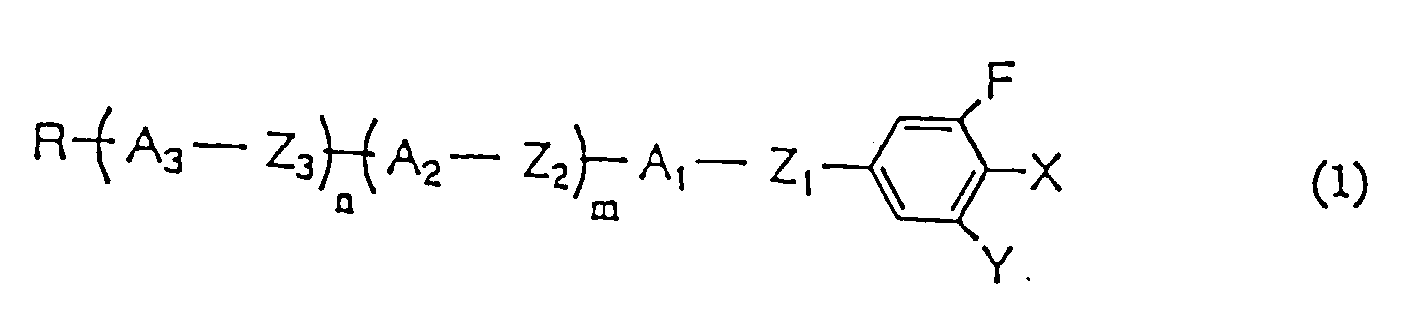
- Liquid crystalline compounds of the present invention expressed by general formula (1) have a large ⁇ and small change of threshold voltage depending on temperature. These liquid crystalline compounds are physically and chemically stable to a sufficient extent under the conditions in which display devices are ordinarily used, and excellent in solubility at low temperatures. Further, they can be derived into compounds of desired physical parameters by suitably selecting the 6-membered ring, substituent and/or bonding group from the group of the elements which form the molecule. Accordingly, when the compound of the present invention was used as a component of liquid crystal compositions, novel liquid crystal compositions having preferable characteristics can be provided.
- Q represents the group shown just below.
- Cyc represents trans-1,4-cyclohexylene group, Phe does 1,4-phenylene group, Pyr does pyrimidine-2,5-diyl group, Pyd does pyridine-2,5-diyl group, and Dio represents 1,3-dioxane-2,5-diyl group; one or more hydrogen atoms in the Phe may be replaced by F; A 1 , A 2 , and A 3 are selected from the group consisting of Cyc, Phe, Pyr, Pyd, and Dio, and preferably two or more Pyr, Pyd, or Dio are not contained in one molecule.
- the compounds expressed by any one of formulas (1oa) to (1od) are preferable.
- R 9 represents an alkyl group or alkoxy group having 1 to 10 carbon atoms or an alkenyl group having 2 to 10 carbon atoms (any methylene group (-CH 2 -) in the alkenyl group may be replaced by oxygen atom (-O-) provided that in no case two or more methylene groups are continually replaced by oxygen atom).
- most preferable groups are methyl, ethyl, propyl, butyl, pentyl, hexyl, heptyl, decyl, methoxy, ethoxy, propoxy, butoxy, pentyloxy, hexyloxy, heptyloxy, nonyloxy, ethenyl, 1-propenyl, 2-propenyl, 1-butenyl, 2-butenyl, 3-butenyl, 1-pentenyl, 2-pentenyl, 3-pentenyl, 4-pentenyl, 1-hexenyl, 3-hexenyl, 5-hexenyl, 1-heptenyl, 3-heptenyl, 5-heptenyl, 6-heptenyl, 2-propenyloxy, 3-butenyloxy, 3-methoxypropenyl, 2-propenyloxymethy 1, and 6-methoxy-3-hexenyl group.
- the compounds expressed by one of the following formulas can be considered to be particularly preferable examples: (1aa), (1ab), (1ba), (1bb), (1ca), (1cb), (1ce), (1da), (1db), (1ea) to (1ee), (1ej), (1fa), (1fb), (1fe), (1ff), (1ga) to (1ge), (1gi), (1ha), (1hb), (1he), (1hf), (1ia) to (1id), (1ja) to (1jd), (1ka) to (1ke), (1ki), (1la), (1lb), (1le), (1lf), (1ma) to (1me), (1mi), (1na), (1nb), (1ne), (1nf), (1oa) to (1od), (1pa) to (1pd), (1qb), (1qc), (1qf), (1qh), (1rb) to (1rd), (1sa), (1sb), (1xb), (1xc), (1za), (1zb), and (1zd).
- Liquid crystalline compounds of the present invention expressed by general formula (1) can readily be produced by known, general methods of organic synthesis, for example, by the following method:
- a carboxylic acid derivative ( 1 ) is converted into an acid halide ( 2 ) with a halogenating reagent such as thionyl chloride in a solvent such as toluene and benzene, or in the absence of a solvent.
- the objective compound ( 4 ) can be obtained by reacting the acid halide with a phenol derivative ( 3 ) in a solvent such as toluene and benzene.
- a series of the reactions are preferably conducted at a temperature between room temperature and the boiling point of the solvent and further in the presence of a base such as pyridine (E. J.
- the objective compound ( 4 ) can also be obtained by reacting a carboxylic acid derivative ( 1 ) with a phenol derivative ( 3 ) in a solvent such as dichloromethane and chloroform in the presence of dicyclohexylcarbodiimide (DCC) or 4-dimethylaminopyridine (DMAP) (B. Neises et al., Organic Synthesis, 63, 183 (1985)).
- a solvent such as dichloromethane and chloroform
- DCC dicyclohexylcarbodiimide
- DMAP 4-dimethylaminopyridine
- the objective compound ( 6 ) can be produced by reacting an ⁇ -halogenomethyl compound ( 5 ) with a corresponding alcohol derivative, phenol derivative ( 3 ), or cyclohexanol derivative in a solvent such as dimethyl sulfoxide, dimethyl formamide (DMF), 1,2-dimethoxyethane, tetrahydrofuran, hexamethylphosphoric triamide, and toluene in the presence of a base, for example, sodium amide (J. B. Wright et al., Journal of the American Chemical Society, 70 , 3098 (1948)), potassium carbonate (W. T.
- a solvent such as dimethyl sulfoxide, dimethyl formamide (DMF), 1,2-dimethoxyethane, tetrahydrofuran, hexamethylphosphoric triamide, and toluene
- a base for example, sodium amide (J. B. Wright et al., Journal of the American Chemical Society, 70 , 3098 (1948)
- the objective compound ( 6 ) can be produced from the reaction of an ester derivative ( 7 ) such as a sulfonic acid ester (T. Gramstad et al., Journal of the Chemical Society, 4069 (1957), and P. M. Dewick, Synthetic Communications, 11 , 853 (1981)), carbonic acid ester (D. Grobelny et al, Tetrahedron Letters, 2639 (1979), M. Lissel et al., Synthesis, 382 (1986), and R. Lakhmiri et al., Tetrahedron Letters, 30 , 4669 (1989)), and phosphorous acid ester (Y. Kashman, The Journal of Organic Chemistry, 37 , 912 (1972)) with a corresponding alcohol derivative, phenol derivative ( 3 ), or cyclohexanol derivative.
- an ester derivative ( 7 ) such as a sulfonic acid ester (T. Gramstad et al., Journal of the Chemical Society, 4069 (1957),
- Carboxylic acid derivative as a raw material can be produced by known, general procedures of organic synthesis or their combination.
- the derivatives can readily be produced by methods, such as hydrolysis of a nitrile derivative (R. C. Fuson et al., Organic Synthesis, III, 557 (1955), and P. G. Baraldi et al., The Journal of Organic Chemistry, 50 , 23 (1985)), reaction of Grignard reagent or a lithium compound with carbon dioxide (H. Gilman et al., Organic Synthesis, I, 361 (1941), and Y. Fukuyama et al., Synthesis, 443 (1974)), hydrolysis of a halide (N. O.V.
- carboxylic acid derivative ( 8 ) can be obtained by preparing Grignard reagent of 4-alkylhalogenobenz ene and then reacting it with carbon dioxide.
- Fluorine substituted compound ( 9 ) is converted into a compound protected with, for example, 1,3-dioxolane or 1,3-dioxane, and then alkylated by the method of L. Friedman et al. (Journal of the American Chemical Society, 96 , 7101 (1974)) or M. Tiecco et al. (Tetrahedron Letters, 23 , 4629 (1982)). Subsequently, it is deprotected, and the aldehyde ( 10 ) thus obtained is oxidized with an oxidizing agent such as chrome oxide, dichromic acid, active manganese dioxide, silver oxide, and sodium chlorite to obtain carboxylic acid derivative ( 11 ).
- an oxidizing agent such as chrome oxide, dichromic acid, active manganese dioxide, silver oxide, and sodium chlorite to obtain carboxylic acid derivative ( 11 ).
- fluorine substituted compound ( 12 ) is alkylated by the method mentioned above, and then reacted with an organic lithium reagent such as n-butyl lithium, and carbon dioxide to obtain carboxylic acid derivative ( 13 ).
- Phenol derivative can be produced, for instance, by the following method:
- a substituted phenol ( 14 ) is converted into an ether ( 15 ) with a protecting group such as tetrahydropyranyl group and then reacted with an organic lithium reagent such as n-butyl lithium, and iodine to form an iodide ( 16 ).
- Phenol derivative ( 17 ) can be obtained by cyanogenating the iodide and then deprotecting the cyanide.
- Phenol derivative ( 19 ) can be obtained by reacting the iodide ( 16 ) mentioned above with sodium trifluoroacetate/copper iodide (I) (G. E. Carr et al., Journal of the Chemical Society, Perkin Trans Reactions I, 921, (1988) or methyl fluorosulfonyl-difluoroacetate/copper iodide (I) (Q. Y. Chen et al., Journal of the Chemical Society, Chemical Communications, 705 (1989) to form methyl trifluoride ( 18 ) and then deprotecting the fluoride.
- I sodium trifluoroacetate/copper iodide
- I methyl fluorosulfonyl-difluoroacetate/copper iodide
- the ether ( 15 ) mentioned above is reacted with an organic lithium reagent such as n-butyl lithium or phenyl lithium, and a formylating agent such as N-formylpiperidine (G. A. Olah et al., Angewandte Chemie, International Edition in English, 20 , 878 (1981), N-formylmorpholine (G. A. Olah et al., The Journal of Organic Chemistry, 49 , 385 (1984)), and DMF (G.
- organic lithium reagent such as n-butyl lithium or phenyl lithium
- a formylating agent such as N-formylpiperidine (G. A. Olah et al., Angewandte Chemie, International Edition in English, 20 , 878 (1981), N-formylmorpholine (G. A. Olah et al., The Journal of Organic Chemistry, 49 , 385 (1984)), and DMF (G.
- Aldehyde ( 20 ) is reduced by a reducing agent such as sodium boron hydride (SBH), lithium aluminum hydride (LAH), diisobutyl aluminum hydride (DIBAL), and sodium bis(2-methoxyethoxy) aluminum hydride (SBMEA) to form an alcohol ( 23 ), and the alcohol is reacted with a fluorinating agent such as DAST to form a monofluoromethyl compound ( 24 ).
- Phenol derivative ( 25 ) can be obtained by deprotecting the compound ( 24 ).
- Another substituted phenol ( 26 ) is treated in the presence of nitric acid and sulfuric acid to form a nitro compound ( 27 ) and then converted into a xanthate by the method of Albert et al., (Synthetic Communications, 19 , 547 (1989).
- This xanthate is fluorinated by the method of Kurohoshi et al., (Tetrahedron Letters, 33 , 29, 4173 (1992) and then catalytically reduced in the presence of platinum catalyst to convert it into compound (28).
- Phenol derivative ( 29 ) can be obtained by subsequently reacting the compound (28) with hydrochloric acid and sodium nitrite, and then hydrolyzing the diazonium salt thus obtained.
- Nitro compound ( 27 ) is reacted in the system of chlorodifluoromethane/sodium hydroxide (Laid-open WO Japanese Patent Publication No. Hei 3-500413) to fluorinate, and catalytically reduced with hydrogen in the presence of a platinum catalyst to convert it into compound ( 30 ).
- Phenol derivative ( 31 ) can be obtained by subsequently reacting the compound ( 30 ) with hydrochloric acid and sodium nitrite, and then hydrolyzing the diazonium salt thus obtained.
- ⁇ -halogenomethyl compound can readily be produced by general procedures of organic synthesis known in the art.
- an alcohol ( 32 ) is obtained by the reduction of 4-alkylbenzoic acid or 4-alkylbenzaldehyde with a reducing agent such as SBH, LAH, DIBAL, SBMEA, or borane, or by the reaction of Grignard reagent of 4-alkylbenzhalide with formaldehyde (H. Gilman et al., Organic Synthesis, I, 188 (1941)).
- ⁇ -halogenomethyl compound ( 33 ) can be obtained by halogenating the alcohol ( 32 ) with a halogenating agent such as thionyl chloride, hydrobromic acid, hydroiodic acid, or potassium iodide.
- fluorine substituted ⁇ -halogenomethyl compounds can be obtained through a reducing reaction and halogenating reaction of the carboxylic acid derivative (11) and ( 13 ) mentioned above.
- liquid crystalline compounds of the present invention obtained by such methods as mentioned above exhibits a large ⁇ , has a small change of threshold voltage depending on temperature, is excellent in stability, is readily mixed with various liquid crystal materials, and is good in solubility even at low temperatures. Thus, the compound is remarkably excellent as component for nematic liquid crystal compositions.
- the compounds of the present invention can be used as component even in any of the liquid crystal compositions of TFT mode, TN mode, and STN mode which have become current main streams, the compounds expressed by general formula (1) wherein X is CN are particularly preferable as ones for TN and STN, and the compounds expressed by general formula (1) wherein X is a group substituted with fluorine are particularly preferable as ones for TN and TFT since their stability is remarkably excellent.
- the compounds When the compounds are used as component for nematic liquid crystal compositions, it is sufficient to use the compounds having 2 or 3 rings for producing liquid crystal compositions of a low viscosity, and it is sufficient to use the compounds having 3 or 4 rings for producing liquid crystal compositions exhibiting a wide temperature range of liquid crystal phase.
- liquid crystal compositions exhibiting a large ⁇ n can be produced, and when the compounds having a cyclohexane ring were used, liquid crystal compositions exhibiting a small ⁇ n can be produced.
- liquid crystal compositions having desired physical characteristics can be obtained by properly selecting the compounds.
- liquid crystal compositions provided according to the present invention may be composed only of the first component containing at least one liquid crystalline compound expressed by general formula (1), it is preferable that at least one compound selected from the group consisting of the compounds expressed by any one of general formulas (2), (3), and (4) (hereinafter referred to as second A component) and/or at least one compound selected from the group consisting of the compounds expressed by any one general formulas (5), (6), (7), (8), and (9) (hereinafter referred to as second B component) is mixed therein.
- second A component at least one compound selected from the group consisting of the compounds expressed by any one of general formulas (2), (3), and (4)
- second B component a known compound can be mixed as a third component for the purpose of adjusting threshold voltage, temperature range of liquid crystal phase, optical anisotropy, dielectric anisotropy, and viscosity of liquid crystal compositions.
- Amount of the compounds to be used is suitably in the range of 1 to 99 % by weight, preferably 10 to 97 % by weight, and more desirably 40 to 95 % by weight based on the total amount of liquid crystal composition.
- Compounds expressed by the general formulas (5) to (7) have a large positive value of dielectric anisotropy and are used as component of liquid crystal compositions particularly for the purpose of lowering threshold voltage. Also, they are used even for the purpose of adjusting viscosity, adjusting optical anisotropy, widening the temperature range of liquid crystal phase, and further for the purpose of improving steepness.
- Compounds expressed by the general formulas (8) or (9) have a negative or small positive value of dielectric anisotropy.
- the compounds expressed by general formula (8) are used, as component of liquid crystal composition, for the purpose of reducing viscosity and adjusting optical anisotropy while the compounds expressed by general formula (9) are used for the purpose of widening the temperature range of liquid crystal phase and/or adjusting optical anisotropy.
- Compounds expressed by the general formulas (5) to (9) are indispensable particularly when the liquid crystal compositions for STN display mode or ordinary TN display mode are produced.
- Amount of the compounds to be used is suitably 1 to 99 % by weight, preferably 10 to 97 % by weight, and more desirably 40 to 95 % by weight based on the total amount of liquid crystal composition when liquid crystal compositions for STN display mode or ordinary TN display mode are produced.
- Liquid crystal compositions provided according to the present invention preferably contain at least one liquid crystalline compound expressed by general formula (1) in an amount of 0.1 to 99 % by weight to develop excellent characteristics.
- the liquid crystal compositions are generally produced by the methods which are already known in the art, for instance, by the method in which various components are dissolved with each other at a high temperature. Also, they are improved, depending on the intended uses, by adding a suitable additive to optimize. Such additives are well known in the art and described in literatures in detail. Usually, a chiral dopant or likes are added which has an effect of causing a helical structure of liquid crystal to adjust a required twisting angle, and avoiding reverse-twist.
- liquid crystal compositions can be used as liquid crystal compositions for guest-host (GH) mode by adding a dichroic dye such as merocyanine type, styryl type, azo type, azomethine type, azoxy type, quinophthalone type, anthraquinone type, and tetrazine type dye.
- a dichroic dye such as merocyanine type, styryl type, azo type, azomethine type, azoxy type, quinophthalone type, anthraquinone type, and tetrazine type dye.
- liquid crystal compositions of the present invention can also be used in the form of a NCAP which is prepared by forming a nematic liquid crystal into a microcapsule, or used as for polymer dispersion type liquid crystal display devices (PDLCD) which are produced by forming a polymer in the form of a three dimensional net work structure in a liquid crystal display, for example, for a polymer net work liquid crystal display device (PNLCD), as well as for electrically controlled birefringence (ECB) mode or dynamic scattering (DS) mode.
- NCAP polymer dispersion type liquid crystal display devices
- PLCD polymer dispersion type liquid crystal display devices
- PLCD polymer dispersion type liquid crystal display devices
- ECB electrically controlled birefringence
- DS dynamic scattering
- liquid crystal compositions containing the compounds of the present invention the followings can be mentioned in which the number of compounds is the same as that shown in Examples below: Now, the present invention will be described in more detail below with reference to Examples.
- Cr represents crystal
- S A does smectic A phase
- S B does smectic B phase
- S C does smectic C phase
- S X does smectic phase structure of which has not yet been analyzed
- N does nematic phase
- Iso represents isotropic liquid
- all of the unit of phase transition temperature is °C.
- each compound is indicated by extracting parameters R; A which represents -(A 3 -Z 3 ) n -(A 2 -Z 2 ) m -A 1 -Z 1 -; X; and Y in the compounds expressed by general formula (1), and the same rule is applied even in Example 2 and so on.
- trans-4-ethylcyclohexane carboxylic acid 1.0 g (6.1 mmol) was mixed with 1.1 g (9.2 mmol) of thionyl chloride, 0.1 ml of pyridine, and 3 ml of toluene, and reacted at 60°C for 4 hours. Excess amount of thionyl chloride and toluene were distilled off at a reduced pressure to obtain a crude trans-4-ethylcyclohexylcarbonylchloride.
- DMF dimethyl formamide
- liquid crystalline compounds of the present invention were used as component of liquid crystal compositions are demonstrated below.
- NI clearing point (°C)
- ⁇ does the value of dielectric anisotropy
- ⁇ n does optical anisotropy
- ⁇ does viscosity (mPa.s) at 20°C
- V 10 represents threshold voltage (V).
- Liquid crystal composition comprising cyanophenylcyclohexane type liquid crystalline compounds and has the following specific composition 4-(trans-4-propylcyclohexyl)benzonitrile 24 % by weight 4-(trans-4-pentylcyclohexyl)benzonitrile 36 % by weight 4-(trans-4-heptylcyclohexyl)benzonitrile 25 % by weight 4-(trans-4-pentylcyclohexyl)-4'-cyanobiphenyl 15 % by weight had the following parameters: NI: 72.4, ⁇ : 11.0, ⁇ n: 0.137, ⁇ : 26.9, and V 10 at a cell thickness of 9 ⁇ : 1.78
- This composition in an amount of 85 % by weight was mixed with 15 % by weight of Compound No. 205 to obtain a nematic liquid crystal composition.
- Parameters of the liquid crystal composition thus obtained were as follows: NI: 75.1, ⁇ :55.7, ⁇ n: 0.144, ⁇ : 38.7, and V 10 at a cell thickness of 8.8 ⁇ : 1.29
- Example 14 was repeated to obtain a nematic liquid crystal composition except that Compound No. 277 was used in place of Compound No. 205.
- Parameters of the liquid crystal composition thus obtained were as follows: NI: 75.4, ⁇ :16.8, ⁇ n: 0.139, ⁇ : 37.4, and V 10 at a cell thickness of 8.8 ⁇ : 1.40
- Example 16 (Use Example 3)
- nematic liquid crystal composition shown in Composition Example 39 were as follows: NI: 94.3, ⁇ :8.2, ⁇ n: 0.164, ⁇ : 16.0, and V 10 at a cell thickness of 8.8 ⁇ : 1.91
- Example 17 (Use Example 4)
- nematic liquid crystal composition shown in Composition Example 40 were as follows: NI: 82.3, ⁇ : 12.1, ⁇ n: 0.151, ⁇ : 23.5, and V 10 at a cell thickness of 8.9 ⁇ : 1.49
- Example 18 (Use Example 5)
- nematic liquid crystal composition shown in Composition Example 41 were as follows: NI: 71.3, ⁇ :25.1, ⁇ n: 0.160, ⁇ : 25.1, and V 10 at a cell thickness of 8.8 ⁇ : 0.85
- Example 19 (Use Example 6)
- NI 100.7, ⁇ :4.4, ⁇ n: 0.216, ⁇ : 34.0, and V 10 at a cell thickness of 9.0 ⁇ : 2.39
- Example 20 (Use Example 7)
- nematic liquid crystal composition shown in Composition Example 43 were as follows: NI: 76.2, ⁇ :13.6, ⁇ n: 0.125, ⁇ : 42.6, and V 10 at a cell thickness of 8.9 ⁇ : 1.33
- nematic liquid crystal composition shown in Composition Example 44 were as follows: NI: 84.1, ⁇ :18.1, ⁇ n: 0.137, ⁇ : 36.8, and V 10 at a cell thickness of 8.9 ⁇ : 1.20
- nematic liquid crystal composition shown in Composition Example 45 were as follows: NI: 74.5, ⁇ :10.9, ⁇ n: 0.132, ⁇ : 22.7, and V 10 at a cell thickness of 8.8 ⁇ : 1.36
- Example 23 (Use Example 10)
- nematic liquid crystal composition shown in Composition Example 46 were as follows: NI: 82.0, ⁇ :6.4, ⁇ n: 0.094, ⁇ : 25.2, and V 10 at a cell thickness of 8.8 ⁇ : 1.90
- nematic liquid crystal composition shown in Composition Example 47 were as follows: NI: 84.9, ⁇ :7.1, ⁇ n: 0.135, ⁇ : 27.7, and V 10 at a cell thickness of 8.9 ⁇ : 1.69
- NI 100.3, ⁇ :4.1, ⁇ n: 0.091, ⁇ : 28.0, and V 10 at a cell thickness of 8.8 ⁇ : 2.31
- nematic liquid crystal composition shown in Composition Example 49 were as follows: NI: 92.0, ⁇ :5.4, ⁇ n: 0.093, ⁇ : 21.8, and V 10 at a cell thickness of 9.0 ⁇ : 2.32
- NI 101.6, ⁇ :10.5, ⁇ n: 0.098, ⁇ : 39.2, and V 10 at a cell thickness of 8.9 ⁇ : 1.53
- any of the liquid crystalline compounds of the present invention has a large dielectric anisotropy. Besides, it can be seen that the compound is small particularly in the change of threshold voltage depending of temperature and can be improved in solubility in other liquid crystal materials at low temperatures.
- novel liquid crystal compositions having desired physical characteristics can be provided by properly selecting molecule constituting elements, that is, six-membered rings, substituents and/or bonding groups, in addition to the characteristic that the solubility to other liquid crystal compositions is excellent.
Landscapes
- Chemical & Material Sciences (AREA)
- Organic Chemistry (AREA)
- Crystallography & Structural Chemistry (AREA)
- Engineering & Computer Science (AREA)
- Materials Engineering (AREA)
- Liquid Crystal Substances (AREA)
- Organic Low-Molecular-Weight Compounds And Preparation Thereof (AREA)
- Pyridine Compounds (AREA)
Claims (18)
- Flüssigkristallverbindung mit der allgemeinen Formel (1)worin R eine Alkylgruppe oder Alkoxygruppe mit 1 bis 10 Kohlenstoffatomen oder eine Alkenylgruppe mit 2 bis 10 Kohlenstoffatomen ist (jede Methylengruppe (-CH2-) in der Alkenylgruppe kann durch ein Sauerstoffatom (-O-) ersetzt sein, vorausgesetzt dass in keinem Fall 2 oder mehr Methylengruppen aufeinanderfolgend durch Sauerstoffatom ersetzt sind), m und n unabhängig 0 oder 1 sind, A1, A2 und A3 unabhängig trans-1,4-Cyclohexylengruppe, 1,4-Phenylengruppe und ein oder mehrere Wasserstoffatome am Ring durch F ersetzt sein können, Pyrimidin-2,5-diylgrupe, Pyridin-2,5-diylgruppe oder 1,3-Dioxan-2,5-diylgruppe sind, Z1, Z2 und Z3 unabhängig -COO-, -OCO-, -(CH2)2-, -CH2O-, -OCH2- oder eine kovalente Bindung sind, vorausgesetzt, dass zumindest eines von Z1, Z2 und Z3 eine Esterbindung, -CH2O- oder -OCH2- ist; X CF3, CF2H, CFH2, OCF3, OCF2H oder CN bedeutet und Y H oder F ist, vorausgesetzt, dass dann, wenn X CN ist, n 0, m 1, A2 trans-1,4-Cyclohexylengruppe, A1 1,4-Phenylengruppe, wobei ein oder mehrere Wasserstoffatome am Ring durch F ersetzt sind, Z2 eine kovalente Bindung, Z1 eine Esterbindung und Y F sind.
- Flüssigkristallverbindung nach Anspruch 1, worin m und n 0 sind.
- Flüssigkristallverbindung nach Anspruch 1, worin m 1 und n 0 sind.
- Flüssigkristallverbindung nach Anspruch 1, worin m und n jeweils 1 sind.
- Flüssigkristallverbindung nach Anspruch 2, worin A1 1,4-Phenylengruppe ist, worin ein oder mehrere Wasserstoffatome am Ring durch F ersetzt sein können.
- Flüssigkristallverbindung nach Anspruch 2, worin A1 trans-1,4-Cyclohexylengruppe ist.
- Flüssigkristallverbindung nach Anspruch 3, worin A2 trans-1,4-Cyclohexylengruppe ist.
- Flüssigkristallverbindung nach Anspruch 4, worin A2 und A3 jeweils trans-1,4-Cyclohexylengruppe und Z3 eine kovalente Bindung sind.
- Flüssigkristallverbindung nach Anspruch 7, worin A1 1,4-Phenylengruppe ist, worin ein oder mehrere Wasserstoffatome am Ring durch F ersetzt sein können und Z2 eine kovalente Gruppe ist.
- Flüssigkristallverbindung nach Anspruch 7, worin A1 trans-1,4-Cyclohexylengruppe und Z2 eine kovalente Bindung sind.
- Flüssigkristallverbindung nach Anspruch 7, worin A1 1,4-Phenylengruppe ist, worin ein oder mehrere Wasserstoffatome am Ring durch F ersetzt sein können, Z1 eine Esterbindung, Z2 -(CH2)2- oder eine kovalente Bindung, X CN und Y F sind.
- Flüssigkristallverbindung nach Anspruch 8, worin A1 1,4-Phenylengruppe ist, worin ein oder mehrere Wasserstoffatome am Ring durch F ersetzt sein können und Z2 eine kovalente Bindung ist.
- Flüssigkristallverbindung nach Anspruch 8, worin A1 trans-1,4-Cyclohexylengruppe oder 1,4-Phenylengruppe ist, worin ein oder mehrere Wasserstoffatome am Ring durch F ersetzt sein können und Z1 eine kovalente Bindung ist.
- Flüssigkristallzusammensetzung, umfassend zumindest eine Flüssigkristallverbindung nach einem der Ansprüche 1 bis 13.
- Flüssigkristallzusammensetzung, umfassend als erste Komponente zumindest eine Flüssigkristallverbindung, wie in einem der Ansprüche 1 bis 13 definiert und als zweite Komponente zumindest eine Verbindung, ausgewählt aus der Gruppe, bestehend aus den Verbindungen mit einer der allgemeinen Formeln (2), (3) und (4)

 worin R1 eine Alkylgruppe mit 1 bis 10 Kohlenstoffatomen ist, X1 F, Cl, OCF3, OCF2H, CF3, CF2H oder CFH2, L1, L2, L3 und L4 unabhängig H oder F sind, Z4 und Z5 unabhängig -(CH2)2-, -CH=CH- oder eine kovalente Bindung sind und a 1 oder 2 ist.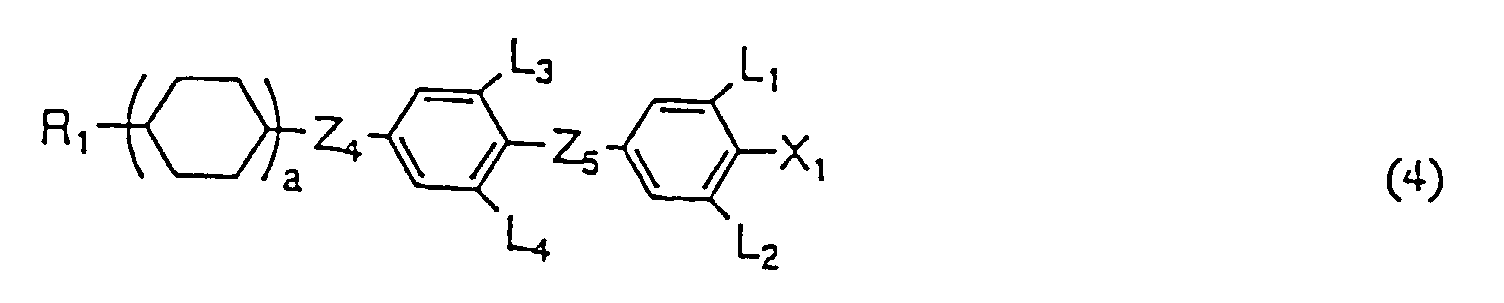
- Flüssigkristallzusammensetzung, umfassend als erste Komponente zumindest eine Flüssigkristallverbindung wie in einem der Ansprüche 1 bis 13 definiert und als zweite Komponente zumindest eine Verbindung, ausgewählt aus der Gruppe, bestehend aus den Verbindungen mit einer der allgemeinen Formeln (5), (6), (7), (8) und (9)worin R2 F, eine Alkylgruppe mit 1 bis 10 Kohlenstoffatomen oder Alkenylgruppe mit 2 bis 10 Kohlenstoffatomen ist, wobei jede Methylengruppe (-CH2-) in der Alkylgruppe oder Alkenylgruppe durch Sauerstoffatom (-O-) ersetzt sein kann, vorausgesetzt, dass in keinem Fall zwei oder mehr Methylengruppen aufeinanderfolgend durch Sauerstoffatome ersetzt sind, Ring A trans-1,4-Cyclohexylengruppe, 1,4-Phenylengruppe oder 1,3-Dioxan-2,5-diylgruppe ist, Ring B trans-1,4-Cyclohexylengruppe, 1,4-Phenylengruppe oder Pyrimidin-2,5-diylgruppe ist, Ring C trans-1,4-Cyclohexylengruppe oder 1,4-Phenylengruppe ist, Z6 -(CH2)2-, -COO- oder eine kovalente Bindung ist, L5 und L6 unabhängig H oder F sind und b und c unabhängig 0 oder 1 sind,
 worin R3 eine Alkylgruppe mit 1 bis 10 Kohlenstoffatomen, L7 H oder F und d 0 oder 1 sind;
 worin R4 eine Alkylgruppe mit 1 bis 10 Kohlenstoffatomen, die Ringe D und E unabhängig trans-1,4-Cyclohexylengruppe oder 1,4-Phenylengruppe sind, Z7 und Z8 unabhängig -COO- oder eine kovalente Bindung sind, Z9 -COO- oder -C≡C- sind, L8 und L9 unabhängig H oder F, X2 F, OCF3, OCF2H, CF3, CF2H oder CFH2 sind, vorausgesetzt, dass dann, wenn X2 OCF3, OCF2H, CF3, CF2H oder CFH2 bedeutet, L8 und L9 jeweils H sind; und e, f und g unabhängig 0 oder 1 sind;
 worin R5 und R6 unabhängig eine Alkylgruppe mit 1 bis 10 Kohlenstoffatomen oder eine Alkenylgruppe mit 2 bis 10 Kohlenstoffatomen sind, wobei in jedem Fall jede Methylengruppe (-CH2-) in der Alkyl- oder Alkylengruppe durch Sauerstoffatom (-O-) ersetzt sein kann, vorausgesetzt dass in keinem Fall zwei oder mehr Methylengruppen aufeinanderfolgend durch Sauerstoffatome ersetzt sind, wenn G trans-1,4-Cyclohexylengruppe, 1,4-Phenylengruppe oder Pyrimidin-2,5-diylgruppe sind, Ring H trans-1,4-Cyclohexylengruppe oder 1,4-Phenylengruppe sind, Z10 -C≡C-, -COO-, -(CH2)2-, -CH=CH-C≡C- oder eine kovalente Bindung ist, und Z11 -COO- oder eine kovalente Bindung ist,
 worin R7 und R8 unabhängig eine Alkylgruppe mit 1 bis 10 Kohlenstoffatomen oder eine Alkenylgruppe mit 2 bis 10 Kohlenstoffatomen sind, wobei in jedem Fall jede Methylengruppe (-CH2-) in der Alkyl- oder Alkenylgruppe durch Sauerstoffatom (-O-) ersetzt sein kann, vorausgesetzt, dass in keinem Fall 2 oder mehr Methylengruppen aufeinanderfolgend durch Sauerstoffatom ersetzt sind, Ring I trans-1,4-Cyclohexylengruppe, 1,4-Phenylengruppe oder Pyrimidin-2,5-diylgruppe ist, Ring J trans-1,4-Cyclohexylengruppe, 1,4-Phenylengruppe wobei ein oder mehrere Wasserstoffatome am Ring durch F ersetzt sein können, oder Pyrimidin-2,5-diylgruppe, Ring K trans-1,4-Cyclohexylengruppe oder 1,4-Phenylengruppe, Z12 und Z14 unabhängig -COO-, -(CH2)2- oder eine kovalente Bindung sind, Z13 -CH=CH-, -C≡C-, -COO- oder eine kovalente Bindung sind, und h 0 oder 1 sind.
- Flüssigkristallzusammensetzung, umfassend als erste Komponente zumindest eine Flüssigkristallverbindung, wie in einem der Ansprüche 1 bis 13 definiert, umfassend als einen Teil einer zweiten Komponente zumindest eine Flüssigkristallverbindung, ausgewählt aus der Gruppe, bestehend aus den Verbindungen, dargestellt durch eine der allgemeinen Formeln (2), (3) und (4), wie in Anspruch 15 definiert, und umfassend als anderen Teil der zweiten Komponente zumindest eine Flüssigkristallverbindung, ausgewählt aus der Gruppe, bestehend aus den Verbindungen, dargestellt durch eine der allgemeinen Formeln (5), (6), (7), (8) und (9), wie in Anspruch 16 definiert.
- Flüssigkristallanzeigegerät, umfassend eine Flüssigkristallzusammensetzung, wie in einem der Ansprüche 14 bis 17 definiert.
Applications Claiming Priority (4)
| Application Number | Priority Date | Filing Date | Title |
|---|---|---|---|
| JP11255195 | 1995-04-12 | ||
| JP112551/95 | 1995-04-12 | ||
| JP11255195 | 1995-04-12 | ||
| PCT/JP1996/001010 WO1996032365A1 (en) | 1995-04-12 | 1996-04-12 | Fluorine-substituted liquid-crystal compound, liquid-crystal composition and liquid-crystal display device |
Publications (3)
| Publication Number | Publication Date |
|---|---|
| EP0820976A1 EP0820976A1 (de) | 1998-01-28 |
| EP0820976A4 EP0820976A4 (de) | 1998-04-15 |
| EP0820976B1 true EP0820976B1 (de) | 2001-02-21 |
Family
ID=14589500
Family Applications (2)
| Application Number | Title | Priority Date | Filing Date |
|---|---|---|---|
| EP96909355A Expired - Lifetime EP0765926B1 (de) | 1995-04-12 | 1996-04-12 | Flüssigkristallzusammensetzung und flüssigkristallanzeigevorrichtung |
| EP96909354A Expired - Lifetime EP0820976B1 (de) | 1995-04-12 | 1996-04-12 | Fluorsubstituierte flüssigkristalline verbindung, flüssigkristalline zusammensetzung und flüssigkristalline anzeige |
Family Applications Before (1)
| Application Number | Title | Priority Date | Filing Date |
|---|---|---|---|
| EP96909355A Expired - Lifetime EP0765926B1 (de) | 1995-04-12 | 1996-04-12 | Flüssigkristallzusammensetzung und flüssigkristallanzeigevorrichtung |
Country Status (10)
| Country | Link |
|---|---|
| US (2) | US6051288A (de) |
| EP (2) | EP0765926B1 (de) |
| JP (1) | JP3487861B2 (de) |
| KR (1) | KR100354582B1 (de) |
| CN (1) | CN1088453C (de) |
| AT (1) | ATE199242T1 (de) |
| AU (2) | AU5288596A (de) |
| DE (2) | DE69609917T2 (de) |
| TW (1) | TW371312B (de) |
| WO (2) | WO1996032365A1 (de) |
Families Citing this family (46)
| Publication number | Priority date | Publication date | Assignee | Title |
|---|---|---|---|---|
| DE19528106A1 (de) * | 1995-02-03 | 1996-08-08 | Merck Patent Gmbh | Elektrooptische Flüssigkristallanzeige |
| CN1125158C (zh) * | 1995-02-03 | 2003-10-22 | 默克专利股份有限公司 | 电光液晶显示器 |
| TW297047B (de) * | 1995-02-09 | 1997-02-01 | Chisso Corp | |
| TW371312B (en) * | 1995-04-12 | 1999-10-01 | Chisso Corp | Fluorine-substituted liquid-crystal compound, liquid-crystal composition and liquid-crystal display device |
| DE59608275D1 (de) * | 1995-08-01 | 2002-01-03 | Merck Patent Gmbh | Flüssigkristallines medium |
| US6149990A (en) * | 1996-02-07 | 2000-11-21 | Chisso Corporation | Carboxylate derivatives comprising an ether group and liquid crystal composition comprising the same |
| EP0884302A4 (de) * | 1996-02-07 | 1999-05-19 | Chisso Corp | Carbonsaureester-derivate die eine ethergruppe enthalten und flussigkristalline zusammensetzung die diese enthalt |
| EP0881221B1 (de) * | 1996-10-22 | 2016-06-29 | JNC Corporation | Dioxanderivate, flüssigkeitskristallzusammensetzungen, die diese enthalten, und flüssigkeitskristallanzeige unter verwendung derselben |
| DE19803112A1 (de) | 1997-03-14 | 1998-09-17 | Merck Patent Gmbh | Elektrooptische Flüssigkristallanzeige |
| CN1176898C (zh) | 1997-11-28 | 2004-11-24 | 大日本油墨化学工业株式会社 | 氟取代4-链烯基苯甲酸及其衍生物、向列液晶组合物和使用该组合物的液晶显示装置 |
| US6693223B1 (en) | 1997-11-28 | 2004-02-17 | Dainippon Ink And Chemicals, Inc. | Fluorine-substituted-4-alkenylbenzoic acid and derivatives thereof, and nematic liquid crystal composition containing cyanophenyl benzoate derivatives and liquid crystal display system using the same |
| DE19906254B4 (de) * | 1998-03-12 | 2013-05-29 | Merck Patent Gmbh | α,β-Difluorzimtsäureester |
| DE10002462B4 (de) * | 1999-02-11 | 2010-04-15 | Merck Patent Gmbh | Flüssigkristallines Medium und seine Verwendung |
| JP4686954B2 (ja) * | 1999-06-28 | 2011-05-25 | チッソ株式会社 | ワニス組成物および液晶表示素子 |
| DE19947954A1 (de) * | 1999-10-06 | 2001-04-12 | Merck Patent Gmbh | Flüssigkristalline Phenolester |
| DE19949333A1 (de) * | 1999-10-13 | 2001-04-19 | Merck Patent Gmbh | Esterverbindungen und deren Verwendung in flüssigkristallinen Medien |
| DE10111139A1 (de) * | 2000-04-07 | 2001-10-11 | Merck Patent Gmbh | Elektrooptische Flüssigkristallanzeige |
| JP4876353B2 (ja) * | 2000-08-31 | 2012-02-15 | Dic株式会社 | 液晶組成物 |
| KR100745543B1 (ko) * | 2000-08-31 | 2007-08-03 | 다이니뽄 잉끼 가가꾸 고오교오 가부시끼가이샤 | 액정 표시 소자 |
| JP4876352B2 (ja) * | 2000-08-31 | 2012-02-15 | Dic株式会社 | 液晶組成物及び液晶表示素子 |
| JP4763943B2 (ja) * | 2001-09-19 | 2011-08-31 | シチズンホールディングス株式会社 | エステル化合物およびそれを含有する液晶組成物 |
| TWI248968B (en) * | 2001-09-28 | 2006-02-11 | Merck Patent Gmbh | Liquid crystalline medium and liquid crystal display |
| DE102004058002B4 (de) * | 2003-12-17 | 2014-01-09 | Merck Patent Gmbh | Flüssigkristallines Medium und seine Verwendung |
| DE102004056901B4 (de) * | 2003-12-17 | 2014-01-09 | Merck Patent Gmbh | Flüssigkristallines Medium und seine Verwendung |
| US7597945B2 (en) * | 2004-11-09 | 2009-10-06 | Chisso Corporation | Polymerizable liquid crystal composition containing fluorine-substituted (meth) acrylate derivatives |
| CN101555192B (zh) * | 2009-05-19 | 2013-06-05 | 烟台显华化工科技有限公司 | 对链烯溴苯、对链烯碘苯或对链烯氯苯、其合成方法及其应用 |
| WO2011145536A1 (en) | 2010-05-21 | 2011-11-24 | Semiconductor Energy Laboratory Co., Ltd. | Liquid crystal composition and liquid crystal display device |
| KR20140003579A (ko) | 2011-01-31 | 2014-01-09 | 가부시키가이샤 한도오따이 에네루기 켄큐쇼 | 액정성 화합물, 액정 조성물, 액정 소자, 및 액정 표시 장치 |
| KR101488314B1 (ko) * | 2011-08-02 | 2015-01-30 | 디아이씨 가부시끼가이샤 | 네마틱 액정 조성물 |
| KR101894068B1 (ko) * | 2011-12-05 | 2018-09-05 | 주식회사 동진쎄미켐 | 액정혼합물의 고속응답 발현을 위한 비대칭성 굽은 핵 분자 화합물 |
| TWI570221B (zh) | 2012-03-19 | 2017-02-11 | Dainippon Ink & Chemicals | Nematic liquid crystal composition |
| KR101316708B1 (ko) | 2012-04-26 | 2013-10-10 | 디아이씨 가부시끼가이샤 | 네마틱 액정 조성물 및 이를 사용한 액정 표시 소자 |
| CN103562345B (zh) * | 2012-05-23 | 2015-04-15 | Dic株式会社 | 向列型液晶组合物以及使用其的液晶显示元件 |
| JP5534382B1 (ja) * | 2012-08-22 | 2014-06-25 | Dic株式会社 | ネマチック液晶組成物 |
| WO2014030481A1 (ja) * | 2012-08-22 | 2014-02-27 | Dic株式会社 | ネマチック液晶組成物 |
| CN104603236B (zh) * | 2012-09-03 | 2016-03-09 | Dic株式会社 | 向列液晶组合物 |
| KR101555598B1 (ko) * | 2012-10-17 | 2015-09-24 | 디아이씨 가부시끼가이샤 | 네마틱 액정 조성물 |
| US20150284634A1 (en) * | 2012-10-17 | 2015-10-08 | Dic Corporation | Nematic liquid crystal composition |
| WO2014136315A1 (ja) | 2013-03-06 | 2014-09-12 | Dic株式会社 | ネマチック液晶組成物及びこれを用いた液晶表示素子 |
| US10544365B2 (en) | 2013-08-30 | 2020-01-28 | Dic Corporation | Nematic liquid crystal composition |
| JP5910800B1 (ja) | 2014-07-31 | 2016-04-27 | Dic株式会社 | ネマチック液晶組成物 |
| WO2016017615A1 (ja) | 2014-07-31 | 2016-02-04 | Dic株式会社 | ネマチック液晶組成物 |
| WO2016035667A1 (ja) | 2014-09-05 | 2016-03-10 | Dic株式会社 | 液晶組成物及びそれを使用した液晶表示素子 |
| CN107312549B (zh) * | 2015-09-02 | 2021-08-31 | 石家庄诚志永华显示材料有限公司 | 含有二甲基苯和二氟亚甲氧基连接基团的液晶化合物及其应用 |
| CN109134423B (zh) | 2017-11-23 | 2020-03-17 | 江苏和成显示科技有限公司 | 一种化合物及其液晶组合物和光电显示器件 |
| KR20250156190A (ko) | 2018-06-22 | 2025-10-31 | 큐진 인크. | 인터루킨-2 변이체 및 이의 사용 방법 |
Family Cites Families (17)
| Publication number | Priority date | Publication date | Assignee | Title |
|---|---|---|---|---|
| JPS5910652B2 (ja) * | 1978-09-19 | 1984-03-10 | ダイキン工業株式会社 | 含フツ素フェニルベンゾエ−ト化合物およびその用途 |
| DE3909802A1 (de) * | 1988-07-27 | 1990-04-05 | Merck Patent Gmbh | Difluormethylverbindungen |
| DE3732284A1 (de) * | 1987-09-25 | 1989-04-13 | Merck Patent Gmbh | Substituierte phenyltrifluormethylether |
| GB8804330D0 (en) * | 1988-02-24 | 1988-03-23 | Secr Defence | Laterally fluorinated 4-cyanophenyl & 4-cyanobiphenyl benzoates |
| JPH0669987B2 (ja) * | 1989-03-02 | 1994-09-07 | チッソ株式会社 | 正の誘電異方性の大きい安息香酸誘導体 |
| JP2696557B2 (ja) * | 1989-03-07 | 1998-01-14 | チッソ株式会社 | トリフルオロベンゼン誘導体 |
| GB8910240D0 (en) * | 1989-05-04 | 1989-06-21 | Secr Defence | Phenyl esters and their use in liquid crystal materials |
| DE4027315A1 (de) * | 1989-08-30 | 1991-03-07 | Merck Patent Gmbh | Halogenierte benzolderivate und fluessigkristallines medium |
| ATE119871T1 (de) * | 1989-09-06 | 1995-04-15 | Merck Patent Gmbh | Fluorbenzolderivate und flüssigkristallines medium. |
| JP3144801B2 (ja) * | 1990-04-02 | 2001-03-12 | メルク パテント ゲゼルシャフト ミット ベシュレンクテル ハフトング | ネマチック液晶混合物類およびマトリックス液晶ディスプレイ |
| DE4107119A1 (de) * | 1990-08-03 | 1992-02-06 | Merck Patent Gmbh | Fluessigkristallines medium |
| JP2807357B2 (ja) * | 1991-03-27 | 1998-10-08 | セイミケミカル株式会社 | トランスエチレン誘導体化合物、液晶組成物及び液晶電気光学素子 |
| CN1085591A (zh) * | 1992-08-06 | 1994-04-20 | 窒素公司 | 液晶组合物以及利用该组合物来制作的液晶显示元件 |
| CN1055769C (zh) * | 1994-03-17 | 2000-08-23 | 株式会社日立制作所 | 有源矩阵型液晶显示系统及其驱动方法 |
| TW262553B (de) * | 1994-03-17 | 1995-11-11 | Hitachi Seisakusyo Kk | |
| CN1136067A (zh) * | 1995-02-22 | 1996-11-20 | 智索公司 | 酯衍生物、液晶组合物和液晶显示元件 |
| TW371312B (en) * | 1995-04-12 | 1999-10-01 | Chisso Corp | Fluorine-substituted liquid-crystal compound, liquid-crystal composition and liquid-crystal display device |
-
1995
- 1995-06-09 TW TW084105873A patent/TW371312B/zh not_active IP Right Cessation
-
1996
- 1996-04-12 CN CN96193858A patent/CN1088453C/zh not_active Expired - Lifetime
- 1996-04-12 EP EP96909355A patent/EP0765926B1/de not_active Expired - Lifetime
- 1996-04-12 WO PCT/JP1996/001010 patent/WO1996032365A1/ja not_active Ceased
- 1996-04-12 DE DE69609917T patent/DE69609917T2/de not_active Expired - Lifetime
- 1996-04-12 US US08/913,022 patent/US6051288A/en not_active Expired - Lifetime
- 1996-04-12 AU AU52885/96A patent/AU5288596A/en not_active Abandoned
- 1996-04-12 WO PCT/JP1996/001011 patent/WO1996032458A1/ja not_active Ceased
- 1996-04-12 KR KR1019970707165A patent/KR100354582B1/ko not_active Expired - Lifetime
- 1996-04-12 EP EP96909354A patent/EP0820976B1/de not_active Expired - Lifetime
- 1996-04-12 AT AT96909354T patent/ATE199242T1/de not_active IP Right Cessation
- 1996-04-12 US US08/750,326 patent/US5733477A/en not_active Expired - Lifetime
- 1996-04-12 JP JP53088796A patent/JP3487861B2/ja not_active Expired - Fee Related
- 1996-04-12 AU AU52886/96A patent/AU5288696A/en not_active Abandoned
- 1996-04-12 DE DE69611825T patent/DE69611825T2/de not_active Expired - Lifetime
Also Published As
| Publication number | Publication date |
|---|---|
| CN1088453C (zh) | 2002-07-31 |
| EP0765926B1 (de) | 2000-08-23 |
| EP0765926A1 (de) | 1997-04-02 |
| WO1996032365A1 (en) | 1996-10-17 |
| TW371312B (en) | 1999-10-01 |
| EP0820976A4 (de) | 1998-04-15 |
| US5733477A (en) | 1998-03-31 |
| DE69609917D1 (de) | 2000-09-28 |
| US6051288A (en) | 2000-04-18 |
| AU5288596A (en) | 1996-10-30 |
| DE69611825T2 (de) | 2001-07-19 |
| EP0765926A4 (de) | 1997-12-10 |
| EP0820976A1 (de) | 1998-01-28 |
| ATE199242T1 (de) | 2001-03-15 |
| DE69609917T2 (de) | 2001-02-01 |
| CN1184462A (zh) | 1998-06-10 |
| AU5288696A (en) | 1996-10-30 |
| WO1996032458A1 (en) | 1996-10-17 |
| KR100354582B1 (ko) | 2003-04-10 |
| DE69611825D1 (de) | 2001-03-29 |
| JP3487861B2 (ja) | 2004-01-19 |
| KR19980703765A (ko) | 1998-12-05 |
Similar Documents
| Publication | Publication Date | Title |
|---|---|---|
| EP0820976B1 (de) | Fluorsubstituierte flüssigkristalline verbindung, flüssigkristalline zusammensetzung und flüssigkristalline anzeige | |
| EP0675187B1 (de) | Flüssigkristallverbindungen und diese enthaltende Flüssigkristallzusammensetzung | |
| EP0679707B1 (de) | Flüssigkristallverbindung, Flüssigkristallzusammensetzung und Flüssigkristallanzeigeelement | |
| JP2587561B2 (ja) | 4,4’―ジ置換された2’,3―ジフルオルビフェニル化合物及び液晶媒質 | |
| JP2000169403A (ja) | 架橋シクロヘキサン誘導体および液晶媒体 | |
| KR100343061B1 (ko) | 치환된 벤젠 유도체, 액정 조성물 및 액정 표시소자 | |
| JP4449156B2 (ja) | シクロヘキサン誘導体、それを含有する液晶組成物および液晶表示素子 | |
| JPH0812605A (ja) | 液晶性化合物、液晶組成物および液晶表示素子 | |
| KR100294288B1 (ko) | 에스테르화합물,이를함유하는액정조성물및액정디스플레이소자 | |
| JP5152947B2 (ja) | 2−フルオロナフタレン誘導体である新規液晶性化合物とそれを含有する液晶組成物 | |
| JP3601190B2 (ja) | アルケニルシクロヘキサン誘導体および液晶組成物 | |
| EP0733692A1 (de) | Flüssigkristallverbindung, Flüssigkristallzusammensetzung und Anzeigevorrichtung | |
| EP0893421A1 (de) | Alkenylzusammensetzungen, flüssigkristallzusammensetzungen und flüssigkristallanzeigevorrichtungen | |
| EP0893424A1 (de) | Alpha, alpha-difluorbenzylether-derivate, flüssigkristalline zusammensetzungen und flüssigkristallines anzeigeelement | |
| JP3579705B2 (ja) | エステル誘導体、液晶組成物および液晶表示素子 | |
| JP5139607B2 (ja) | デカヒドロナフタレン誘導体 | |
| JP2886989B2 (ja) | クロロベンゼン誘導体およびこれを含む液晶組成物 | |
| JP3579756B2 (ja) | 結合基に不飽和結合を有する液晶性化合物、液晶組成物および液晶表示素子 | |
| EP1053996A1 (de) | Esterderivate, flüssigkristallzubereitungen und flüssigkristallanzeigeelemente | |
| WO1995010498A1 (de) | 3,4,5-trifluorbenzole und ihre verwendung in flüssigkristallmischungen | |
| JP3025534B2 (ja) | フッ素置換液晶性化合物、液晶組成物および液晶表示素子 | |
| JPWO1996009272A1 (ja) | クロロベンゼン誘導体およびこれを含む液晶組成物 | |
| JP4385202B2 (ja) | フェニルデカヒドロナフタレン誘導体 | |
| JP3899530B2 (ja) | 液晶性化合物および液晶組成物 | |
| JPWO1996032365A1 (ja) | フッ素置換液晶性化合物、液晶組成物および液晶表示素子 |
Legal Events
| Date | Code | Title | Description |
|---|---|---|---|
| PUAI | Public reference made under article 153(3) epc to a published international application that has entered the european phase |
Free format text: ORIGINAL CODE: 0009012 |
|
| 17P | Request for examination filed |
Effective date: 19971016 |
|
| AK | Designated contracting states |
Kind code of ref document: A1 Designated state(s): AT BE CH DE DK ES FI FR GB GR IE IT LI LU MC NL PT SE |
|
| A4 | Supplementary search report drawn up and despatched | ||
| AK | Designated contracting states |
Kind code of ref document: A4 Designated state(s): AT BE CH DE DK ES FI FR GB GR IE IT LI LU MC NL PT SE |
|
| 17Q | First examination report despatched |
Effective date: 19990601 |
|
| GRAG | Despatch of communication of intention to grant |
Free format text: ORIGINAL CODE: EPIDOS AGRA |
|
| GRAG | Despatch of communication of intention to grant |
Free format text: ORIGINAL CODE: EPIDOS AGRA |
|
| GRAH | Despatch of communication of intention to grant a patent |
Free format text: ORIGINAL CODE: EPIDOS IGRA |
|
| GRAH | Despatch of communication of intention to grant a patent |
Free format text: ORIGINAL CODE: EPIDOS IGRA |
|
| GRAA | (expected) grant |
Free format text: ORIGINAL CODE: 0009210 |
|
| AK | Designated contracting states |
Kind code of ref document: B1 Designated state(s): AT BE CH DE DK ES FI FR GB GR IE IT LI LU MC NL PT SE |
|
| PG25 | Lapsed in a contracting state [announced via postgrant information from national office to epo] |
Ref country code: NL Free format text: LAPSE BECAUSE OF FAILURE TO SUBMIT A TRANSLATION OF THE DESCRIPTION OR TO PAY THE FEE WITHIN THE PRESCRIBED TIME-LIMIT Effective date: 20010221 Ref country code: SE Free format text: THE PATENT HAS BEEN ANNULLED BY A DECISION OF A NATIONAL AUTHORITY Effective date: 20010221 Ref country code: LI Free format text: LAPSE BECAUSE OF FAILURE TO SUBMIT A TRANSLATION OF THE DESCRIPTION OR TO PAY THE FEE WITHIN THE PRESCRIBED TIME-LIMIT Effective date: 20010221 Ref country code: IT Free format text: LAPSE BECAUSE OF FAILURE TO SUBMIT A TRANSLATION OF THE DESCRIPTION OR TO PAY THE FEE WITHIN THE PRESCRIBED TIME-LIMIT;WARNING: LAPSES OF ITALIAN PATENTS WITH EFFECTIVE DATE BEFORE 2007 MAY HAVE OCCURRED AT ANY TIME BEFORE 2007. THE CORRECT EFFECTIVE DATE MAY BE DIFFERENT FROM THE ONE RECORDED. Effective date: 20010221 Ref country code: FI Free format text: LAPSE BECAUSE OF FAILURE TO SUBMIT A TRANSLATION OF THE DESCRIPTION OR TO PAY THE FEE WITHIN THE PRESCRIBED TIME-LIMIT Effective date: 20010221 Ref country code: ES Free format text: THE PATENT HAS BEEN ANNULLED BY A DECISION OF A NATIONAL AUTHORITY Effective date: 20010221 Ref country code: CH Free format text: LAPSE BECAUSE OF FAILURE TO SUBMIT A TRANSLATION OF THE DESCRIPTION OR TO PAY THE FEE WITHIN THE PRESCRIBED TIME-LIMIT Effective date: 20010221 Ref country code: BE Free format text: LAPSE BECAUSE OF FAILURE TO SUBMIT A TRANSLATION OF THE DESCRIPTION OR TO PAY THE FEE WITHIN THE PRESCRIBED TIME-LIMIT Effective date: 20010221 Ref country code: AT Free format text: LAPSE BECAUSE OF FAILURE TO SUBMIT A TRANSLATION OF THE DESCRIPTION OR TO PAY THE FEE WITHIN THE PRESCRIBED TIME-LIMIT Effective date: 20010221 |
|
| REF | Corresponds to: |
Ref document number: 199242 Country of ref document: AT Date of ref document: 20010315 Kind code of ref document: T |
|
| REG | Reference to a national code |
Ref country code: CH Ref legal event code: EP |
|
| REG | Reference to a national code |
Ref country code: IE Ref legal event code: FG4D |
|
| REF | Corresponds to: |
Ref document number: 69611825 Country of ref document: DE Date of ref document: 20010329 |
|
| PG25 | Lapsed in a contracting state [announced via postgrant information from national office to epo] |
Ref country code: LU Free format text: LAPSE BECAUSE OF NON-PAYMENT OF DUE FEES Effective date: 20010412 Ref country code: IE Free format text: LAPSE BECAUSE OF NON-PAYMENT OF DUE FEES Effective date: 20010412 |
|
| PG25 | Lapsed in a contracting state [announced via postgrant information from national office to epo] |
Ref country code: MC Free format text: LAPSE BECAUSE OF NON-PAYMENT OF DUE FEES Effective date: 20010430 |
|
| ET | Fr: translation filed | ||
| PG25 | Lapsed in a contracting state [announced via postgrant information from national office to epo] |
Ref country code: PT Free format text: LAPSE BECAUSE OF FAILURE TO SUBMIT A TRANSLATION OF THE DESCRIPTION OR TO PAY THE FEE WITHIN THE PRESCRIBED TIME-LIMIT Effective date: 20010521 Ref country code: DK Free format text: LAPSE BECAUSE OF FAILURE TO SUBMIT A TRANSLATION OF THE DESCRIPTION OR TO PAY THE FEE WITHIN THE PRESCRIBED TIME-LIMIT Effective date: 20010521 |
|
| PG25 | Lapsed in a contracting state [announced via postgrant information from national office to epo] |
Ref country code: GR Free format text: LAPSE BECAUSE OF FAILURE TO SUBMIT A TRANSLATION OF THE DESCRIPTION OR TO PAY THE FEE WITHIN THE PRESCRIBED TIME-LIMIT Effective date: 20010525 |
|
| NLV1 | Nl: lapsed or annulled due to failure to fulfill the requirements of art. 29p and 29m of the patents act | ||
| REG | Reference to a national code |
Ref country code: CH Ref legal event code: PL |
|
| REG | Reference to a national code |
Ref country code: IE Ref legal event code: FD4D |
|
| PLBE | No opposition filed within time limit |
Free format text: ORIGINAL CODE: 0009261 |
|
| STAA | Information on the status of an ep patent application or granted ep patent |
Free format text: STATUS: NO OPPOSITION FILED WITHIN TIME LIMIT |
|
| REG | Reference to a national code |
Ref country code: GB Ref legal event code: IF02 |
|
| 26N | No opposition filed | ||
| REG | Reference to a national code |
Ref country code: IE Ref legal event code: MM4A |
|
| REG | Reference to a national code |
Ref country code: GB Ref legal event code: 732E Free format text: REGISTERED BETWEEN 20110616 AND 20110622 |
|
| REG | Reference to a national code |
Ref country code: FR Ref legal event code: TP |
|
| REG | Reference to a national code |
Ref country code: DE Ref legal event code: R082 Ref document number: 69611825 Country of ref document: DE Representative=s name: HOFFMANN - EITLE, DE |
|
| REG | Reference to a national code |
Ref country code: DE Ref legal event code: R082 Ref document number: 69611825 Country of ref document: DE Representative=s name: HOFFMANN - EITLE PATENT- UND RECHTSANWAELTE PA, DE Effective date: 20120117 Ref country code: DE Ref legal event code: R082 Ref document number: 69611825 Country of ref document: DE Representative=s name: HOFFMANN - EITLE, DE Effective date: 20120117 Ref country code: DE Ref legal event code: R081 Ref document number: 69611825 Country of ref document: DE Owner name: JNC CORPORATION, JP Free format text: FORMER OWNER: CHISSO CORP., OSAKA, JP Effective date: 20120117 |
|
| PGFP | Annual fee paid to national office [announced via postgrant information from national office to epo] |
Ref country code: FR Payment date: 20120504 Year of fee payment: 17 |
|
| REG | Reference to a national code |
Ref country code: FR Ref legal event code: ST Effective date: 20131231 |
|
| PG25 | Lapsed in a contracting state [announced via postgrant information from national office to epo] |
Ref country code: FR Free format text: LAPSE BECAUSE OF NON-PAYMENT OF DUE FEES Effective date: 20130430 |
|
| PGFP | Annual fee paid to national office [announced via postgrant information from national office to epo] |
Ref country code: DE Payment date: 20150408 Year of fee payment: 20 Ref country code: GB Payment date: 20150408 Year of fee payment: 20 |
|
| REG | Reference to a national code |
Ref country code: DE Ref legal event code: R071 Ref document number: 69611825 Country of ref document: DE |
|
| REG | Reference to a national code |
Ref country code: GB Ref legal event code: PE20 Expiry date: 20160411 |
|
| PG25 | Lapsed in a contracting state [announced via postgrant information from national office to epo] |
Ref country code: GB Free format text: LAPSE BECAUSE OF EXPIRATION OF PROTECTION Effective date: 20160411 |