EP0821038A2 - Härtbare Silikonzusammensetzungen und ein Verfahren zur Herstellung von elektrischen Teilen - Google Patents
Härtbare Silikonzusammensetzungen und ein Verfahren zur Herstellung von elektrischen Teilen Download PDFInfo
- Publication number
- EP0821038A2 EP0821038A2 EP97305590A EP97305590A EP0821038A2 EP 0821038 A2 EP0821038 A2 EP 0821038A2 EP 97305590 A EP97305590 A EP 97305590A EP 97305590 A EP97305590 A EP 97305590A EP 0821038 A2 EP0821038 A2 EP 0821038A2
- Authority
- EP
- European Patent Office
- Prior art keywords
- resin
- component
- curable
- composition
- cured
- Prior art date
- Legal status (The legal status is an assumption and is not a legal conclusion. Google has not performed a legal analysis and makes no representation as to the accuracy of the status listed.)
- Granted
Links
Images

Classifications
-
- H—ELECTRICITY
- H10—SEMICONDUCTOR DEVICES; ELECTRIC SOLID-STATE DEVICES NOT OTHERWISE PROVIDED FOR
- H10W—GENERIC PACKAGES, INTERCONNECTIONS, CONNECTORS OR OTHER CONSTRUCTIONAL DETAILS OF DEVICES COVERED BY CLASS H10
- H10W74/00—Encapsulations, e.g. protective coatings
- H10W74/40—Encapsulations, e.g. protective coatings characterised by their materials
- H10W74/47—Encapsulations, e.g. protective coatings characterised by their materials comprising organic materials, e.g. plastics or resins
- H10W74/476—Organic materials comprising silicon
-
- C—CHEMISTRY; METALLURGY
- C08—ORGANIC MACROMOLECULAR COMPOUNDS; THEIR PREPARATION OR CHEMICAL WORKING-UP; COMPOSITIONS BASED THEREON
- C08L—COMPOSITIONS OF MACROMOLECULAR COMPOUNDS
- C08L83/00—Compositions of macromolecular compounds obtained by reactions forming in the main chain of the macromolecule a linkage containing silicon with or without sulfur, nitrogen, oxygen or carbon only; Compositions of derivatives of such polymers
- C08L83/04—Polysiloxanes
-
- H—ELECTRICITY
- H10—SEMICONDUCTOR DEVICES; ELECTRIC SOLID-STATE DEVICES NOT OTHERWISE PROVIDED FOR
- H10W—GENERIC PACKAGES, INTERCONNECTIONS, CONNECTORS OR OTHER CONSTRUCTIONAL DETAILS OF DEVICES COVERED BY CLASS H10
- H10W76/00—Containers; Fillings or auxiliary members therefor; Seals
- H10W76/40—Fillings or auxiliary members in containers, e.g. centering rings
- H10W76/42—Fillings
- H10W76/47—Solid or gel fillings
-
- C—CHEMISTRY; METALLURGY
- C08—ORGANIC MACROMOLECULAR COMPOUNDS; THEIR PREPARATION OR CHEMICAL WORKING-UP; COMPOSITIONS BASED THEREON
- C08G—MACROMOLECULAR COMPOUNDS OBTAINED OTHERWISE THAN BY REACTIONS ONLY INVOLVING UNSATURATED CARBON-TO-CARBON BONDS
- C08G77/00—Macromolecular compounds obtained by reactions forming a linkage containing silicon with or without sulfur, nitrogen, oxygen or carbon in the main chain of the macromolecule
- C08G77/04—Polysiloxanes
- C08G77/12—Polysiloxanes containing silicon bound to hydrogen
-
- C—CHEMISTRY; METALLURGY
- C08—ORGANIC MACROMOLECULAR COMPOUNDS; THEIR PREPARATION OR CHEMICAL WORKING-UP; COMPOSITIONS BASED THEREON
- C08G—MACROMOLECULAR COMPOUNDS OBTAINED OTHERWISE THAN BY REACTIONS ONLY INVOLVING UNSATURATED CARBON-TO-CARBON BONDS
- C08G77/00—Macromolecular compounds obtained by reactions forming a linkage containing silicon with or without sulfur, nitrogen, oxygen or carbon in the main chain of the macromolecule
- C08G77/04—Polysiloxanes
- C08G77/14—Polysiloxanes containing silicon bound to oxygen-containing groups
- C08G77/16—Polysiloxanes containing silicon bound to oxygen-containing groups to hydroxy groups
-
- C—CHEMISTRY; METALLURGY
- C08—ORGANIC MACROMOLECULAR COMPOUNDS; THEIR PREPARATION OR CHEMICAL WORKING-UP; COMPOSITIONS BASED THEREON
- C08G—MACROMOLECULAR COMPOUNDS OBTAINED OTHERWISE THAN BY REACTIONS ONLY INVOLVING UNSATURATED CARBON-TO-CARBON BONDS
- C08G77/00—Macromolecular compounds obtained by reactions forming a linkage containing silicon with or without sulfur, nitrogen, oxygen or carbon in the main chain of the macromolecule
- C08G77/04—Polysiloxanes
- C08G77/20—Polysiloxanes containing silicon bound to unsaturated aliphatic groups
-
- C—CHEMISTRY; METALLURGY
- C08—ORGANIC MACROMOLECULAR COMPOUNDS; THEIR PREPARATION OR CHEMICAL WORKING-UP; COMPOSITIONS BASED THEREON
- C08G—MACROMOLECULAR COMPOUNDS OBTAINED OTHERWISE THAN BY REACTIONS ONLY INVOLVING UNSATURATED CARBON-TO-CARBON BONDS
- C08G77/00—Macromolecular compounds obtained by reactions forming a linkage containing silicon with or without sulfur, nitrogen, oxygen or carbon in the main chain of the macromolecule
- C08G77/70—Siloxanes defined by use of the MDTQ nomenclature
-
- H—ELECTRICITY
- H10—SEMICONDUCTOR DEVICES; ELECTRIC SOLID-STATE DEVICES NOT OTHERWISE PROVIDED FOR
- H10W—GENERIC PACKAGES, INTERCONNECTIONS, CONNECTORS OR OTHER CONSTRUCTIONAL DETAILS OF DEVICES COVERED BY CLASS H10
- H10W72/00—Interconnections or connectors in packages
- H10W72/01—Manufacture or treatment
- H10W72/015—Manufacture or treatment of bond wires
- H10W72/01515—Forming coatings
-
- H—ELECTRICITY
- H10—SEMICONDUCTOR DEVICES; ELECTRIC SOLID-STATE DEVICES NOT OTHERWISE PROVIDED FOR
- H10W—GENERIC PACKAGES, INTERCONNECTIONS, CONNECTORS OR OTHER CONSTRUCTIONAL DETAILS OF DEVICES COVERED BY CLASS H10
- H10W72/00—Interconnections or connectors in packages
- H10W72/071—Connecting or disconnecting
- H10W72/075—Connecting or disconnecting of bond wires
-
- H—ELECTRICITY
- H10—SEMICONDUCTOR DEVICES; ELECTRIC SOLID-STATE DEVICES NOT OTHERWISE PROVIDED FOR
- H10W—GENERIC PACKAGES, INTERCONNECTIONS, CONNECTORS OR OTHER CONSTRUCTIONAL DETAILS OF DEVICES COVERED BY CLASS H10
- H10W72/00—Interconnections or connectors in packages
- H10W72/851—Dispositions of multiple connectors or interconnections
- H10W72/874—On different surfaces
- H10W72/884—Die-attach connectors and bond wires
-
- H—ELECTRICITY
- H10—SEMICONDUCTOR DEVICES; ELECTRIC SOLID-STATE DEVICES NOT OTHERWISE PROVIDED FOR
- H10W—GENERIC PACKAGES, INTERCONNECTIONS, CONNECTORS OR OTHER CONSTRUCTIONAL DETAILS OF DEVICES COVERED BY CLASS H10
- H10W74/00—Encapsulations, e.g. protective coatings
Definitions
- the present invention claims an electrical part and a method for manufacturing the same. More specifically, our invention provides (a) an electrical part with superior reliability in which a cured silicone resin, covering an electrical element, is bonded to a sealing resin that covers said cured silicone resin; and (b) an efficient method for manufacturing such an electrical part.
- Electrical elements such as integrated circuits of the types known as monolithic, hybrid, and large scale integration (IC, hybrid IC and LSI) transistors; diodes; capacitors and resistors, are generally covered with a sealing resin to protect such elements from external stresses, such as bends and impacts, and to prevent water penetration into such elements.
- a sealing resin to protect such elements from external stresses, such as bends and impacts, and to prevent water penetration into such elements.
- the elements are usually covered with a cured silicone resin.
- the cured silicone resin is typically not bonded to the sealing resin. As a result, the reliability of such electrical parts is poor.
- the object of the present invention is to provide: (a) an electrical part with superior reliability in which a cured silicone resin that covers an electrical element is integrally; bonded to, and integrated with, a cured sealing resin that covers said cured silicone resin, and (b) an efficient method for manufacturing such an electrical part.
- our electrical element is first covered by a silicone resin which is then cured and thereafter subjected to UV treatment to integrally bond said silicone resin to a cured sealing resin that covers the surface of said silicone resin.
- the cured silicone resin is made by curing an addition curable silicone composition that compnses a mixture of: (a) an organosiloxane with siianol groups and (b) an alkoxysilane with epoxy groups, and/or (c) an organosiloxanerepresented by the formula (R 1 SiO 3/2 ) a (R 2 2 SiO 2/2 ) b (R 2 3 SiO 1/2 ) c (R 3 O 1/2 ) d, wherein R 1 indicates a monovalent organic group containing an epoxy group; R 2 indicates a substituted or unsubstituted monovalent hydrocarbon group which may be the same or different; R 3 indicates a hydrogen atom or an alkyl group with 1 to 4 carbon atoms; a, b and d are respective positive numbers; and c is 0 or
- the method of our invention for manufacturing an electrical part comprises an electrical element that is covered with the above addition curable silicone composition.
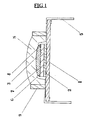
- Figure 1 is a sectional view of semiconductor device constituting an electrical part of the present invention.
- Figure 2 is a partially sectional perspective view of a capacitor constituting an electrical part of the present invention.
- the electrical part of our invention comprises a cured silicone resin that covers an electrical element which is integrally bonded to a cured sealing resin that covers the surface of said cured silicone resin.
- electrical element describes electrical elements, such as transistors, resistors, capacitors and diodes; electrical devices containing such electrical elements ; semiconductor elements such as IC's, hybrid IC and LSI's, or semiconductor devices containing such semiconductor elements.
- semiconductor devices and capacitors are especially preferred. Such a semiconductor device is shown in Figure 1, and an example of a capacitor an electrical element is shown in Figure 2.
- a semiconductorelement 3 is mounted on a circuit board 1 by a bonding agent 2.
- Bonding pads 4 are installed on the upper end portions of the semiconductor element 3, and extemal leads 5 are installed on the end portions of the circuit board 1.
- the bonding pads 4 are electrically connected to the circuit board 1 by bonding wires 6.
- the semiconductor element 3 is covered by a cured silicone resin 7, and said cured resin is covered by a cured sealing resin 8.
- a frame 9 is installed around the periphery of the semiconductor element 3 to prevent the sealing resin from flowing out.
- the surface of the cured silicone resin 7 is subjected to UV treatment, and the resin 7 is thereafter thoroughly bonded to, and integrated with, the cured sealing resin 8 covering said silicone resin.
- a capacitor [comprising a polyester film 10 on which aluminum has been vacuum-evaporated(metallized)] is wrapped or laminated. Electrodes 11 are then formed by covering both ends of said wrapped or laminated film with a flame-coated metal and are electrically connected to external leads 12. This capacitor is next covered by a cured silicone resin 13, and said resin is covered by a cured sealing resin 14. Furthermore, the surface of the cured silicone resin 13 is subjected to UV treatment, is thereby thoroughly bonded to, and integrated with, the cured sealing resin 14 that covers said silicone resin.
- a preferred embodiment of our addition curable silicone composition comprises :
- the preferred organopolysiloxane of component (A) has at least two silicon-bonded alkenyl groups per molecule.
- alkenyl groups in component (A) include vinyl, allyl, butenyl, pentenyl, hexenyl and heptenyl.
- the bonding positions of the alkenyl groups may be on the ends of the molecular chains and'or on molecular side chains.
- groups other than alkenyl groups which are bonded to silicon atoms in component (A) include substituted or unsubstituted monovalent hydrocarbon groups, e.
- component (A) may be linear, linear with some branching, completely branched cyclic or net-form. Moreover, it is desirable that the viscosity of component (A) at 25°C be in the range of 5 to 1,000,000 rnPa.s (centipoise).
- the organohydrogenpolysiloxaneof component (B) is a cross linking agent for our composition, and has at least two silicon-bonded hydrogen atoms per molecule.
- the bonding positions of these hydrogen atoms may be on the ends of the molecular chains and/or on molecular side chains.
- groups other than hydrogen atoms which are bonded to silicon atoms in component (B) include substituted or unsubstituted monovalent hydrocarbon groups as identified above.
- the molecular structure of component (B) may be linear, linear with some branching, completely branched cyclic or net-form.
- the viscosity of component (B) at 25°C be in the range of 1 to 100,000 mPa.s (centipoise).
- the amount of component (B) that is added to this composition is an amount sufficient to cause curing of the composition. It is preferred that the amount added will provide molar ratio of silicon-bonded hydrogen atoms in component (B) to silicon-bonded alkenyl groups in component (A) of from 0.4 to 10. A molar ratio is from 0.5 to 3.0 is more preferred. If the molar ratio of silicon-bonded hydrogen atoms in component (B) to silicon-bonded alkenyl groups in component (A) is less than 0.4, the claimed composition tends to show insufficient curing. If the molar ratio exceeds 10, the mechanical strength of the cured silicone resin obtained is unsatisfactory.
- the addition reaction catalyst of component (C) promotes the curing of our composition.
- catalysts are platinum catalysts such as platinum black, platinum supported on silica, platinum supported on active carbon, alcohol solutions of chloroplatinic acid, olefin complexes of platinum or alkenylsiloxane complexes of platinum, as well as similiar rhodium and palladium catalysts.
- the amount of component (C) that is added to this composition is a catalytic amount. It is preferred that the amount added provide a metal concentration of 0.1 to 1,000 ppm (in weight units) based on the total composition.
- Component (D) is used to insure sufficient bonding of the ultraviolet irradiation treated cured silicone resin to the cured sealing resin.
- This component is a mixture of components (a) and (b), and/or (c).
- Component (a) is a silanol group containing organosiloxane.
- a silanol group is a hydroxy group bonded to a silicon atom.
- component (a) is an organosiloxane having an average of at least two silanol groups per molecule.
- the molecular structure of component (a) may be linear, linear with some branching, completely branched, cyclic or net-form. A linear structure is preferred.
- Examples of organic groups which may be bonded to the silicon atoms in component (a) include substituted or unsubstitutedmonovalent hydrocarbon groups, e. g..
- alkyl groups such as methyl, ethyl, propyl, butyl, pentyl, hexyl and heptyl.; aryl groups such phenyl, tolyl, xylyl and naphthyl; aralkyl groups such as benzyl or phenethyl and halogenated alkyl groups such as chloromethyl, 3 -chloropropyl and 3,3,3-trifluoropropyl.
- methyl, vinyl and phenyl are groups preferred.
- component (a) examples include silanol-terminated dimethylpolysiloxanes, silanol-terminated dimethylsiloxane-methylvinylsiloxane copolymers and silanol-terminated dimethylsiloxane-methylphenylsiloxane copolymers.
- Component (b) is an epoxy group containing alkoxysilane.
- alkoxysilanes include alkoxysilanes having the general formula R 1 Si(OR 4 ) 3 wherein R 1 is as described above.
- R 1 is selected from the group consisting of glycidoxyalkyl, epoxycyclohexylalkyl and oxiranylalkyl.
- Preferred glycidoxyalkyl groups include 3-glycidoxypropyl or 4-glycidoxybutyl.
- Preferred epoxycyclohexylalkyl groups include 2-(3,4-epoxycyclohexyl)ethyl or 3-(3,4-epoxycyclo-hexyl)propylgroups.
- Preferred oxiranylalkyl groups include 4-oxiranylbutyl or 8-oxiranyloctyl groups. Glycidoxyalkyl groups (such as 3-glycidoxypropyl) are especially preferred.
- R 4 is an alkyl group with 1 to 4 carbon atoms, e. g., methyl, ethyl, propyl or butyl.
- a methyl group is especially preferred.
- compounds which are used as component (b) include 3-glycidoxypropyltrimethoxysilane,2-(3,4-epoxycyclohexyl)ethyltrimethoxysilane4-oxiranylbutyltrimethoxysilane and 8-oxiranyloctyltrimethoxysilane.
- 3-glycidoxypropyltrimethoxysilane is especially preferred.
- Components (a) and (b) may be simply mixed, or caused to undergo a condensation or equilibrium reaction. It is preferred that the weight ratio of component (a) to component (b) be from 0.1 : 1 to 1 : 10.
- the organosiloxane of component (c) is expressed by the formula (R 1 SiO 3/2 ) a (R 2 2 SiO 2/2 ) b (R 2 3 SiO 1/2 ) c (R 3 O 1/2 ) d wherein R 1 , R 2 , R 3 , a, b, c and d are as described above.
- R 2 is selected from the group consisting of alkyl, alkenyl, aryl. aralkyl and halogenated alkyl.
- Preferred alkyl groups include methyl, ethyl, propyl, butyl, pentyl, hexyl and heptyl groups.
- the preferred alkenyl group is vinyl.
- Preferred aryl groups include phenyl, tolyl, xylyl and naphthyl.
- Preferred aralkyl groups include benzyl or phenethyl.
- Preferred halogenated alkyl groups include chloromethyl, 3-chloropropyl and 3,3,3-trifluoropropyl.
- methyl, vinyl and phenyl groups are especially preferred.
- R 3 is preferably selected from the group consisting of methyl, ethyl, propyl and butyl. In particular, methyl groups are especially preferred.
- component (c) is a method in which a linear or cyclic diorganosiloxane and an alkoxysilane containing epoxy groups are subjected to equilibrium polymerization in the presence of a polymerization catalyst such as sodium hydroxide, etc.
- component (D) there are no particular restrictions on the amount of component (D) that is added to our claimed composition, as long as said amount is such that the adhesion of the resulting silicone resin to the sealing resin is sufficient.
- the content of component (D) in our composition be from 0.01 to 20 wt % preferably from 0.1 to 20 wt %, and more preferably from 0. 1 to 10 wt %. If the amount of component (D) is less than 0.01 wt. %, it becomes difficult to achieve the object of the present invention. If the added amount exceeds 20 wt. %, the mechanical strength of the cured silicone resin is unacceptable.
- Optional components may be added to our claimed composition and include addition reaction inhibiting agents, e. g., acetylene compounds such as 3-methyl-1-butyn-3-ol,3,5-dimethyl-1-hexyn-3-oland 3-phenyl-1-butyn-3-ol; "enyne” type compounds such as 3-methyl-3-penten-1-yne or 3,5-dimethyl-3-hexen-1-yne; siloxane compounds containing alkenyl groups such as 1,3,5,7-tetramethyl-1,3,5,7-tetravinylcyclotetrasiloxane or 1,3,5,7-tetramethyl-1,3,5,7-tetrahexenylcyclotetrasiloxane; and triazole compounds such as benzotriazole. It is preferred that such inhibiting agents be added at the rate of 10 to 5.000 ppm (in weight units) relative to the total composition.
- addition reaction inhibiting agents e. acetylene compounds such
- fiber-form fillers such as glass, asbestos, alumina, ceramic fibers containing alumina and silica components, boron, zirconia, silicon carbide, metal, phenol, aramide, nylon, polyester and natural animal or vegetable; and inorganic fillers such as fused silica, precipitated silica, fumed silica, calcined silica, zinc oxide, calcined clay, carbon black, glass beads, alumina, talc, calcium carbonate, clay, alumina hydroxide, barium sulfate, titanium dioxide, titanium oxide.
- fiber-form fillers such as glass, asbestos, alumina, ceramic fibers containing alumina and silica components, boron, zirconia, silicon carbide, metal, phenol, aramide, nylon, polyester and natural animal or vegetable
- inorganic fillers such as fused silica, precipitated silica, fumed silica, calcined silica, zinc oxide, calcined clay, carbon black, glass beads,
- a semiconductor element such as an IC, hybrid IC and LSI, or an electrical element such as a transistor, diode, capacitor or resistor
- an addition curable silicone composition that comprises a mixture of (a) an organosiloxane with silanol groups and (b) an alkoxysilane with epoxy groups, and/or (c) an organosiloxane having the formula (R 1 SiO 3/2 ) a (R 2 2 SiO 2/2 ) b (R 2 3 SiO 1/2 ) c (R 3 O 1/2 ) d wherein R 1 , R 2 , R 3 , a, b, c and d are as described above.
- the addition curable silicone composition used to cover the electrical elements is the same as described above.
- Methods which can be used to apply this composition to the electrical element include potting, casting, dip coating, drip coating by means of a dispenser, spray coating and brush coating.
- the method used to cure said composition on the electrical element comprises allowing the coated element to stand at room temperature or heating the composition to a temperature of 50 to 250°C. For example, this heating is accomplished by means of an oven, hot plate or heat lamp, or by the radiant heat generated during the UV irradiation treatment.
- UV irradiation treatments on the surface of the cured silicone resin covering our electrical element include methods using light sources such as mercury lamp, a xenon-mercury lamp or a metal halide lamp. Furthermore, it is preferred that the UV irradiation conditions used will prove an amount of irradiation at 254 nm of from 0.01 to 10 J/cm 2 . If necessary, an optical filter (for UV irradiation at a specified wavelength), a thermal radiation cutting filter or reflective mirror may be installed on the light source during the UV treatment. Moreover, this UV treatment may be performed while cooling the cured silicone resin by means of an air cooling fan or a water cooling system.
- curable sealing resins include epoxy, phenol. polyphenylene sulfide polyether and polyimide.
- epoxy resins are especially preferred.
- epoxy resins include glycidyl ether epoxy resins such as bisphenol A, bisphenol F, biphenyl epoxy resins, phenol novolak epoxy resins, orthocresol novolak epoxy resins and brominated epoxy, resins; alicyclic epoxy resins; glycidyl ester epoxy resins; glycidylamine epoxy resins; and heterocyclic epoxy resins.
- curable epoxy resins examples include heat-curability, ultraviolet-curability and moisture-curability. However, heat-curability is especially preferred.
- the curable epoxy resins may be liquid at room temperature. or may be solid resins which have a softening point above room temperature. However, from the standpoint of handling and working characteristics, it is preferred that the resin be a liquid at room temperature.
- Methods used to apply the sealing resin to the cured and UV treated silicone resin include transfer molding, injection molding, potting, casting, dip coating, drip coating by means of a dispenser, spray coating and brush coating.
- the curing methods used to cure this sealing resin on the cured silicone resin include methods in which said sealing resin is heated to a temperature of 50 to 250°C (when the sealing resin used is heat-curable); methods in which said resin is irradiated with ultraviolet light from the aforementioned light source (when the sealing resin is ultraviolet-curable); and methods in which said resin is allowed to stand at room temperature (when the sealing resin is moisture-curable).
- Means used to heat the resin include for example, an oven, hot plate or heat lamp.
- viscosities are values measured at 25°C.
- adhesion of the cured sealing resin to the cured silicone resin and the reliability of the electrical part (semiconductor device or capacitor) were evaluated as described below.
- the sealing resin used in the examples was prepared as follows:
- the curable silicone composition was applied to the surface of an aluminum plate, and was cured by being heated for 5 minutes in a hot air draft circulation oven at 100°C.
- the sealing resin was applied to the surface of the UV treated cured silicone resin, and said sealing resin was cured by being heated for 4 hours in said hot air oven at 120°C.
- the adhesion of the cured sealing resin to the cured silicone resin was observed. Cases where the adhesion was strong were indicated by a circle; cases where some peeling occurred were indicated by a triangle; and cases where complete peeling occurred were indicated by an X.
- a semiconductor device of Figure 1 was constructed as follows:
- a semiconductor element 3, which had an aluminum wiring pattern formed on its surface was mounted by means of a bonding agent 2 on the surface of a circuit board 1 made of an alumina ceramic. Afterward, bonding pads 4, located on the upper end portions of the semiconductor element 3, were electrically connected to the circuit board 1 by means of metal bonding wires 6. Next, the surface of this semiconductor element 3 was coated with a curable silicone composition by means of a dispenser, and a cured silicone resin 7 was formed by heating for 5 minutes in said hot air oven at 100°C. Then. the surface of this cured silicone resin 7 was irradiated with UV light by means of said high-pressure mercury lamp. Afterward, a sealing resin was applied by a dispenser to the surface of the treated cured silicone resin 7.
- a capacitor of Figure 2 was constructed as follows:
- this UV treated cured silicone resin 13 was dipped in a sealing resin, and the resulting assembly was heated for 4 hours in said hot air oven at 120°C so a cured sealing resin 14 was formed on the surface of the cured silicone resin 13, thus completing a capacitor of this invention. 20 samples of this capacitor were manufactured in the same manner.
- a curable silicone composition was prepared by uniformly mixing 96.9 parts by weight of a dimethylvinylsiloxy-terminated dimethylpolysiloxane (viscosity: 400 centipoise (mPa.s), 2.0 parts by weight of a trimethylsiloxy-terminated dimethylsiloxane-methylhydrogensiloxane copolymer (viscosity: 5 centipoise (mPa.s), 0.5 part by weight of 3-glycidoxypropyltrimethoxysilane, 0.5 part by weight of a silanol-terminated dimethylsiloxane-methylvinylsiloxane copolymer (viscosity: 25 centipoise (mPa.s), 0.1 part by weight of a 1 wt % isopropyl alcohol solution of chloroplatinic acid, and 0.01 part by weight of 3-phenyl-1-butyn-3-ol (used as an inhibiting agent).
- a curable silicone composition was prepared as in Example 1, except that 1.0 part by weight of the organopolysiloxaneprepared in Reference Example 1 was used instead of 0.5 part by weight of 3-glycidoxypropyltrimethoxysilane and 0.5 part by weight of silanol -terminated dimethylsiloxane-methylvinylsiloxane copolymer.
- a curable silicone composition was prepared as in Example 1, except that the 0.5 part by weight of 3-glycidoxypropyltrimethoxysilaneand 0.5 part by weight of silanol-terminated dimethylsiloxane-methylvinylsiloxane copolymer were omitted.
- a curable silicone composition was prepared as in Example 1, except that 0.5 part by weight of 3-glycidoxypropyltrimethoxysilane was not added.
- a curable silicone composition was prepared as in Example 1. except that 0.5 part by weight of silanol-terminated dimethylsiloxane-methylvinylsiloxane copolymer was omitted.
- a cured silicone resin which covers an electrical element is thoroughly.bonded to, and integrated with, a cured sealing resin which covers said cured silicone resin. Accordingly, the electrical part of this invention has superior reliability. Furthermore, the method of the present invention for manufacturing an electrical part produces an electrical part with good efficiency.
Landscapes
- Chemical & Material Sciences (AREA)
- Health & Medical Sciences (AREA)
- Chemical Kinetics & Catalysis (AREA)
- Medicinal Chemistry (AREA)
- Polymers & Plastics (AREA)
- Organic Chemistry (AREA)
- Structures Or Materials For Encapsulating Or Coating Semiconductor Devices Or Solid State Devices (AREA)
- Compositions Of Macromolecular Compounds (AREA)
- Epoxy Resins (AREA)
- Silicon Polymers (AREA)
Applications Claiming Priority (3)
| Application Number | Priority Date | Filing Date | Title |
|---|---|---|---|
| JP21518796 | 1996-07-26 | ||
| JP215187/96 | 1996-07-26 | ||
| JP8215187A JPH1036510A (ja) | 1996-07-26 | 1996-07-26 | 電気部品およびその製造方法 |
Publications (3)
| Publication Number | Publication Date |
|---|---|
| EP0821038A2 true EP0821038A2 (de) | 1998-01-28 |
| EP0821038A3 EP0821038A3 (de) | 1998-04-22 |
| EP0821038B1 EP0821038B1 (de) | 2003-08-13 |
Family
ID=16668125
Family Applications (1)
| Application Number | Title | Priority Date | Filing Date |
|---|---|---|---|
| EP97305590A Expired - Lifetime EP0821038B1 (de) | 1996-07-26 | 1997-07-25 | Härtbare Silikonzusammensetzungen und ein Verfahren zur Herstellung von elektrischen Teilen |
Country Status (4)
| Country | Link |
|---|---|
| US (1) | US5958176A (de) |
| EP (1) | EP0821038B1 (de) |
| JP (1) | JPH1036510A (de) |
| DE (1) | DE69724049T2 (de) |
Cited By (10)
| Publication number | Priority date | Publication date | Assignee | Title |
|---|---|---|---|---|
| EP0827993A3 (de) * | 1996-09-04 | 1998-07-01 | Dow Corning Toray Silicone Company, Ltd. | Elektrische Komponente und Verfahren zur Herstellung |
| EP0939440A3 (de) * | 1998-02-25 | 2000-05-03 | Shin-Etsu Chemical Co., Ltd. | Verfahren zur Herstellung einer Halbleiterverpackung und dazu verwendete Organopolysiloxanverbindung |
| EP1605020A1 (de) * | 2004-06-08 | 2005-12-14 | Shin-Etsu Chemical Co., Ltd. | Härtbare Organopolysiloxanzusammensetzung |
| WO2006098493A1 (en) * | 2005-03-15 | 2006-09-21 | Dow Corning Toray Co., Ltd. | Curable silicone composition and electronic device produced therefrom |
| WO2006118335A1 (en) * | 2005-04-27 | 2006-11-09 | Dow Corning Toray Co., Ltd. | Curable silicone composition and electronic components |
| EP1795550A4 (de) * | 2004-10-01 | 2008-11-26 | Nippon Kayaku Kk | Epoxyharzzusammensetzung zur optischen halbleiterverkapselung |
| US7915439B2 (en) | 2004-10-13 | 2011-03-29 | Dow Corning Toray Company, Ltd. | Method of producing silylalkoxymethyl halide |
| US8273815B2 (en) | 2006-09-11 | 2012-09-25 | Dow Corning Toray Company, Ltd. | Curable silicone composition and electronic component |
| EP2535927A3 (de) * | 2011-06-17 | 2013-05-15 | Robert Bosch GmbH | Abdeckmaterial für einen Mikrochip, Mikrochip mit Abdeckmaterial sowie Verfahren zur Bereitstellung eines solchen Mikrochips |
| CN106715591A (zh) * | 2014-06-03 | 2017-05-24 | 道康宁东丽株式会社 | 可固化有机硅组合物及光半导体装置 |
Families Citing this family (12)
| Publication number | Priority date | Publication date | Assignee | Title |
|---|---|---|---|---|
| USD421302S (en) * | 1998-12-30 | 2000-02-29 | Ultracell Medical Technologies Of Connecticut, Inc. | Sponge spear for microsurgical procedures |
| US20060209569A1 (en) * | 2005-03-21 | 2006-09-21 | Yuen Se K | Soft glow nightlight |
| US7952108B2 (en) * | 2005-10-18 | 2011-05-31 | Finisar Corporation | Reducing thermal expansion effects in semiconductor packages |
| WO2008088523A1 (en) * | 2006-12-21 | 2008-07-24 | Dow Corning Corporation | Dual curing polymers and methods for their preparation and use |
| US8618233B2 (en) * | 2006-12-21 | 2013-12-31 | Dow Corning Corporation | Dual curing polymers and methods for their preparation and use |
| JP5460983B2 (ja) * | 2008-08-01 | 2014-04-02 | トヨタ紡織株式会社 | ボード |
| TWI480335B (zh) * | 2011-11-25 | 2015-04-11 | Lg化學股份有限公司 | 可固化組成物 |
| JP5871413B2 (ja) * | 2011-11-25 | 2016-03-01 | エルジー・ケム・リミテッド | 硬化性組成物 |
| CN103013370B (zh) * | 2012-12-14 | 2014-12-10 | 京东方科技集团股份有限公司 | 一种各向异性导电胶膜及电子装置 |
| US9470395B2 (en) | 2013-03-15 | 2016-10-18 | Abl Ip Holding Llc | Optic for a light source |
| US10807329B2 (en) | 2013-05-10 | 2020-10-20 | Abl Ip Holding Llc | Silicone optics |
| DE102014105493B3 (de) * | 2014-04-17 | 2015-09-24 | Schott Ag | Glaskeramikkondensator mit Kunststoffverkapselung, sowie Verfahren zu dessen Herstellung |
Family Cites Families (15)
| Publication number | Priority date | Publication date | Assignee | Title |
|---|---|---|---|---|
| US4208503A (en) * | 1975-04-07 | 1980-06-17 | Sws Silicones Corporation | Epoxy-functional polysiloxane polymers |
| US4122246A (en) * | 1977-09-21 | 1978-10-24 | Dow Corning Corporation | Method of preventing discoloration of platinum containing silicone gels |
| US4645551A (en) * | 1984-08-31 | 1987-02-24 | Motorola, Inc. | Method of making an octocoupler |
| JP2585006B2 (ja) * | 1987-07-22 | 1997-02-26 | 東レ・ダウコーニング・シリコーン株式会社 | 樹脂封止型半導体装置およびその製造方法 |
| GB2208650B (en) * | 1987-08-15 | 1991-09-04 | Dow Corning Sa | Curable organopolysiloxane compositions |
| JP2604178B2 (ja) * | 1987-10-06 | 1997-04-30 | 東レ・ダウコーニング・シリコーン株式会社 | 樹脂封止型光結合半導体装置およびその製造方法 |
| KR0157844B1 (ko) * | 1988-07-15 | 1998-10-15 | 모리나카 마사미 | 수지봉지형 반도체장치 및 제조방법 |
| JP2701045B2 (ja) * | 1988-07-15 | 1998-01-21 | 東レ・ダウコーニング・シリコーン株式会社 | 樹脂封止型半導体装置およびその製造方法 |
| JP2701072B2 (ja) * | 1989-06-20 | 1998-01-21 | 東レ・ダウコーニング・シリコーン株式会社 | 樹脂封止型光結合半導体装置およびその製造方法 |
| CA2064989A1 (en) * | 1991-04-23 | 1992-10-24 | Dawn M. Houghtaling | One part solventless conformal coatings |
| US5292787A (en) * | 1992-07-30 | 1994-03-08 | General Electric Company | Epoxysilicone controlled release composition |
| JPH06145525A (ja) * | 1992-11-05 | 1994-05-24 | Toray Dow Corning Silicone Co Ltd | 硬化性オルガノポリシロキサン組成物 |
| US5270425A (en) * | 1992-11-23 | 1993-12-14 | Dow Corning Corporation | One-part curable organosiloxane compositions |
| US5595826A (en) * | 1995-10-11 | 1997-01-21 | Dow Corning Corporation | Curable organopolysiloxane compositions with improved adhesion |
| JP3592825B2 (ja) * | 1996-02-07 | 2004-11-24 | 東レ・ダウコーニング・シリコーン株式会社 | 硬化性エポキシ樹脂組成物および電子部品 |
-
1996
- 1996-07-26 JP JP8215187A patent/JPH1036510A/ja active Pending
-
1997
- 1997-07-24 US US08/899,967 patent/US5958176A/en not_active Expired - Fee Related
- 1997-07-25 EP EP97305590A patent/EP0821038B1/de not_active Expired - Lifetime
- 1997-07-25 DE DE69724049T patent/DE69724049T2/de not_active Expired - Lifetime
Cited By (15)
| Publication number | Priority date | Publication date | Assignee | Title |
|---|---|---|---|---|
| US5958515A (en) * | 1996-09-04 | 1999-09-28 | Dow Corning Toray Silicone Co., Ltd. | Electrical components and method for the fabrication thereof |
| US6040395A (en) * | 1996-09-04 | 2000-03-21 | Dow Corning Toray Silicone Co., Ltd. | Electrical components and method for the fabrication thereof |
| EP0827993A3 (de) * | 1996-09-04 | 1998-07-01 | Dow Corning Toray Silicone Company, Ltd. | Elektrische Komponente und Verfahren zur Herstellung |
| EP0939440A3 (de) * | 1998-02-25 | 2000-05-03 | Shin-Etsu Chemical Co., Ltd. | Verfahren zur Herstellung einer Halbleiterverpackung und dazu verwendete Organopolysiloxanverbindung |
| EP1605020A1 (de) * | 2004-06-08 | 2005-12-14 | Shin-Etsu Chemical Co., Ltd. | Härtbare Organopolysiloxanzusammensetzung |
| US7741412B2 (en) | 2004-06-08 | 2010-06-22 | Shin-Etsu Chemical Co., Ltd. | Curable organopolysiloxane composition |
| EP1795550A4 (de) * | 2004-10-01 | 2008-11-26 | Nippon Kayaku Kk | Epoxyharzzusammensetzung zur optischen halbleiterverkapselung |
| US7915439B2 (en) | 2004-10-13 | 2011-03-29 | Dow Corning Toray Company, Ltd. | Method of producing silylalkoxymethyl halide |
| WO2006098493A1 (en) * | 2005-03-15 | 2006-09-21 | Dow Corning Toray Co., Ltd. | Curable silicone composition and electronic device produced therefrom |
| WO2006118335A1 (en) * | 2005-04-27 | 2006-11-09 | Dow Corning Toray Co., Ltd. | Curable silicone composition and electronic components |
| US8338527B2 (en) | 2005-04-27 | 2012-12-25 | Dow Corning Toray Company, Ltd. | Curable silicone composition and electronic components |
| US8273815B2 (en) | 2006-09-11 | 2012-09-25 | Dow Corning Toray Company, Ltd. | Curable silicone composition and electronic component |
| EP2535927A3 (de) * | 2011-06-17 | 2013-05-15 | Robert Bosch GmbH | Abdeckmaterial für einen Mikrochip, Mikrochip mit Abdeckmaterial sowie Verfahren zur Bereitstellung eines solchen Mikrochips |
| CN106715591A (zh) * | 2014-06-03 | 2017-05-24 | 道康宁东丽株式会社 | 可固化有机硅组合物及光半导体装置 |
| EP3153548A4 (de) * | 2014-06-03 | 2018-01-31 | Dow Corning Toray Co., Ltd. | Härtbare silikonzusammensetzung und optisches halbleiterbauelement |
Also Published As
| Publication number | Publication date |
|---|---|
| EP0821038B1 (de) | 2003-08-13 |
| US5958176A (en) | 1999-09-28 |
| EP0821038A3 (de) | 1998-04-22 |
| DE69724049D1 (de) | 2003-09-18 |
| DE69724049T2 (de) | 2004-06-03 |
| JPH1036510A (ja) | 1998-02-10 |
Similar Documents
| Publication | Publication Date | Title |
|---|---|---|
| US5958176A (en) | Electrical parts and method for manufacturing the same | |
| US6235862B1 (en) | Adhesive silicone sheet, method for the preparation thereof and semiconductor devices | |
| JP3950493B2 (ja) | 導電性シリコーンゴム組成物、半導体装置の製造方法およびその半導体装置 | |
| EP0789057B1 (de) | Härtbare Epoxidharzzusammensetzungen und elektronische Bauteile | |
| EP1067161B1 (de) | Siliziumklebefilm und Verfahren zu dessen Herstellung | |
| CN102066492B (zh) | 可固化的有机基聚硅氧烷组合物和半导体器件 | |
| JP4040858B2 (ja) | 硬化性オルガノポリシロキサン組成物および半導体装置 | |
| US6551676B1 (en) | Silicone-based adhesive sheet method for manufacturing same and semiconductor device | |
| JP6059010B2 (ja) | 硬化性シリコーン組成物、その硬化物、および光半導体装置 | |
| KR20140064931A (ko) | 경화성 오가노폴리실록산 조성물 및 반도체 장치 | |
| TWI682009B (zh) | 底漆組合物、接著方法、及電氣.電子零件 | |
| KR20040049316A (ko) | 가교결합된 실리콘 접착 시트, 이의 제조방법 및 이를포함하는 디바이스 | |
| EP1858983B1 (de) | Härtbare silikonzusammensetzung und daraus hergestellte elektronische vorrichtung | |
| KR20170015357A (ko) | 오르가노실록산, 경화성 실리콘 조성물 및 반도체 장치 | |
| KR20190103457A (ko) | 경화성 오가노폴리실록산 조성물 및 반도체 장치 | |
| KR100490186B1 (ko) | 전기전도성실리콘조성물,이를사용하는반도체장치의제조방법및반도체장치 | |
| KR100637611B1 (ko) | 접착제 및 반도체 장치 | |
| EP0818511B1 (de) | Flüssige härtbare Zusammensetzungen, daraus gehärteter Gegenstand und elektronisches Bauelement | |
| EP0827993B1 (de) | Elektrische Komponente und Verfahren zur Herstellung | |
| US6518204B2 (en) | Curable organopolysiloxane composition and method of manufacturing semiconductor devices with the use of the aforementioned composition | |
| JP3691587B2 (ja) | 硬化性オルガノポリシロキサン組成物および半導体装置 | |
| JP3420510B2 (ja) | シリコーン系接着性シート、その製造方法、および半導体装置 | |
| KR20050014845A (ko) | 열전도성 경화성 액체 중합체 조성물 및 당해 조성물을사용하여 제조된 반도체 장치 | |
| JPH07278438A (ja) | 電子部品含浸用硬化性オルガノポリシロキサン組成物および電子部品 |
Legal Events
| Date | Code | Title | Description |
|---|---|---|---|
| PUAI | Public reference made under article 153(3) epc to a published international application that has entered the european phase |
Free format text: ORIGINAL CODE: 0009012 |
|
| AK | Designated contracting states |
Kind code of ref document: A2 Designated state(s): DE FR GB |
|
| AX | Request for extension of the european patent |
Free format text: AL;LT;LV;RO;SI |
|
| PUAL | Search report despatched |
Free format text: ORIGINAL CODE: 0009013 |
|
| AK | Designated contracting states |
Kind code of ref document: A3 Designated state(s): AT BE CH DE DK ES FI FR GB GR IE IT LI LU MC NL PT SE |
|
| AX | Request for extension of the european patent |
Free format text: AL;LT;LV;RO;SI |
|
| 17P | Request for examination filed |
Effective date: 19980526 |
|
| AKX | Designation fees paid |
Free format text: DE FR GB |
|
| RBV | Designated contracting states (corrected) |
Designated state(s): DE FR GB |
|
| 17Q | First examination report despatched |
Effective date: 19991021 |
|
| GRAH | Despatch of communication of intention to grant a patent |
Free format text: ORIGINAL CODE: EPIDOS IGRA |
|
| GRAH | Despatch of communication of intention to grant a patent |
Free format text: ORIGINAL CODE: EPIDOS IGRA |
|
| GRAA | (expected) grant |
Free format text: ORIGINAL CODE: 0009210 |
|
| AK | Designated contracting states |
Designated state(s): DE FR GB |
|
| REG | Reference to a national code |
Ref country code: GB Ref legal event code: FG4D |
|
| REF | Corresponds to: |
Ref document number: 69724049 Country of ref document: DE Date of ref document: 20030918 Kind code of ref document: P |
|
| ET | Fr: translation filed | ||
| PLBE | No opposition filed within time limit |
Free format text: ORIGINAL CODE: 0009261 |
|
| STAA | Information on the status of an ep patent application or granted ep patent |
Free format text: STATUS: NO OPPOSITION FILED WITHIN TIME LIMIT |
|
| 26N | No opposition filed |
Effective date: 20040514 |
|
| PGFP | Annual fee paid to national office [announced via postgrant information from national office to epo] |
Ref country code: FR Payment date: 20100805 Year of fee payment: 14 Ref country code: DE Payment date: 20100721 Year of fee payment: 14 |
|
| PGFP | Annual fee paid to national office [announced via postgrant information from national office to epo] |
Ref country code: GB Payment date: 20100721 Year of fee payment: 14 |
|
| GBPC | Gb: european patent ceased through non-payment of renewal fee |
Effective date: 20110725 |
|
| REG | Reference to a national code |
Ref country code: FR Ref legal event code: ST Effective date: 20120330 |
|
| PG25 | Lapsed in a contracting state [announced via postgrant information from national office to epo] |
Ref country code: FR Free format text: LAPSE BECAUSE OF NON-PAYMENT OF DUE FEES Effective date: 20110801 Ref country code: DE Free format text: LAPSE BECAUSE OF NON-PAYMENT OF DUE FEES Effective date: 20120201 |
|
| REG | Reference to a national code |
Ref country code: DE Ref legal event code: R119 Ref document number: 69724049 Country of ref document: DE Effective date: 20120201 |
|
| PG25 | Lapsed in a contracting state [announced via postgrant information from national office to epo] |
Ref country code: GB Free format text: LAPSE BECAUSE OF NON-PAYMENT OF DUE FEES Effective date: 20110725 |