EP0821543A2 - Membrane comme surface extérieure d'une prothèse auditive qui est individualisée par moulage d'un corps - Google Patents
Membrane comme surface extérieure d'une prothèse auditive qui est individualisée par moulage d'un corps Download PDFInfo
- Publication number
- EP0821543A2 EP0821543A2 EP97810484A EP97810484A EP0821543A2 EP 0821543 A2 EP0821543 A2 EP 0821543A2 EP 97810484 A EP97810484 A EP 97810484A EP 97810484 A EP97810484 A EP 97810484A EP 0821543 A2 EP0821543 A2 EP 0821543A2
- Authority
- EP
- European Patent Office
- Prior art keywords
- membrane
- membrane according
- opening
- hearing aid
- thickenings
- Prior art date
- Legal status (The legal status is an assumption and is not a legal conclusion. Google has not performed a legal analysis and makes no representation as to the accuracy of the status listed.)
- Withdrawn
Links
Images


Classifications
-
- H—ELECTRICITY
- H04—ELECTRIC COMMUNICATION TECHNIQUE
- H04R—LOUDSPEAKERS, MICROPHONES, GRAMOPHONE PICK-UPS OR LIKE ACOUSTIC ELECTROMECHANICAL TRANSDUCERS; ELECTRIC HEARING AIDS; PUBLIC ADDRESS SYSTEMS
- H04R25/00—Electric hearing aids
- H04R25/65—Housing parts, e.g. shells, tips or moulds, or their manufacture
- H04R25/658—Manufacture of housing parts
-
- H—ELECTRICITY
- H04—ELECTRIC COMMUNICATION TECHNIQUE
- H04R—LOUDSPEAKERS, MICROPHONES, GRAMOPHONE PICK-UPS OR LIKE ACOUSTIC ELECTROMECHANICAL TRANSDUCERS; ELECTRIC HEARING AIDS; PUBLIC ADDRESS SYSTEMS
- H04R25/00—Electric hearing aids
- H04R25/65—Housing parts, e.g. shells, tips or moulds, or their manufacture
- H04R25/652—Ear tips; Ear moulds
- H04R25/656—Non-customized, universal ear tips, i.e. ear tips which are not specifically adapted to the size or shape of the ear or ear canal
Definitions
- the invention is in the field of hearing aids and relates to a membrane according to the preamble of the independent claim.
- the membrane forms the outer surface of a hearing aid, which has the shape of an irregular Has truncated cone or cylinder and essentially serves for flexible delimitation of a casting cavity in which for the adjustment a body is cast on an individual ear canal.
- Various hearing aids have been described which are made by casting of a body in an individual ear canal or in a model of a such an ear canal can be individualized for a specific person. If casting such a body is essentially the last manufacturing step and is simple, that is to say can be carried out without complicated aids, can such a hearing aid in a general, that is, not yet delivered an individual ear canal adapted condition to hearing aids will.
- the hearing advisor can then connect the device to the ear canal Adjusting the person means pouring the body, and actually the finished device hand over to this person after a single session.
- Such a simple individualization of a hearing aid primarily requires that as far as possible all components serving the hearing function (microphone and / or receiving coil, amplifier chip and loudspeaker) in general Hearing aid are already installed and that this general hearing aid one Has casting cavity in which the individual body are poured can be such that the body cannot be reworked after casting got to.
- An adaptation to an individual ear canal is important for partially in the Hearing aids worn in the ear canal ("in-the-canal devices” or ITC devices) and especially for hearing aids worn completely in the ear canal (“Completely-In-the-Canal-Devices” or CIC devices).
- ITC devices in-the-canal devices
- CIC devices Completely-In-the-Canal-Devices
- Such devices have essentially the shape of an irregular truncated cone or cylinder with a the inner end face directed towards the inside of the ear, one towards the outside directed, outer end face and a lateral surface, only the Lateral surface comes into contact with the ear canal and therefore only this Shell surface to be adapted to the shape of an individual ear canal got to.
- Hearing aids that meet the requirements of easy customization, are described, for example, in publication EP-629101 and in a Parallel application for this application (Sweizer application no. 1859/96).
- the hearing aids described in both cases show in their general condition with a front plate defining the outer face a battery opening and other at least partially load-bearing elements, through which in particular the speaker in a relative to the front panel defined position, that is, at least at a fixed distance from it, is held such that these additional elements and / or the output side of the speaker essentially the inner end face of the device represent.
- the outer surface of the devices is essentially tubular, stretchable membrane around the outer face (Front panel) and around the inner face (formed by loudspeakers and / or other elements) is attached such that they are together with the front panel and speakers and / or other elements in the area of the inner Front forms a dense casting cavity, which through a pouring opening can be poured out with a casting compound in the area of the front panel.
- the General device is used for casting the body in the ear canal of the potential Carrier or positioned in a corresponding model.
- the membrane When the body is poured, it fits tightly against the ear canal wall, so that the cast body of the device so individualized exactly to the Ear canal is adapted and carries the membrane on its lateral surface.
- the membrane according to the invention takes advantage of the fact that the Force that is necessary to stretch a material or the elastic force, that the stretched material can exert, not just the material properties but also depends on the thickness (wall thickness) of the material is.
- the membrane according to the invention accordingly has areas of different Wall thickness as areas for different functions. Areas with higher wall thickness (higher elastic force) serve in particular as elastic fasteners; Areas with smaller wall thickness (smaller Resistance to stretching) serve in particular as an elastic boundary of the casting cavity. In addition, other areas with other Wall thicknesses can be provided for other functions.
- the membrane according to the invention is advantageously made of, for example a silicone plastic manufactured in an injection molding process, the Fasteners cast as areas with a larger wall thickness will.
- thermoplastic elastomers or highly elastic silicone plastics (e.g. two-component silicones) with an elasticity of over 500% and a Shore A hardness of less than 40.
- highly elastic silicone plastics e.g. two-component silicones
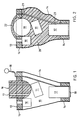
- FIGS. 1 and 2 show, as schematic sections parallel to the axis, an example of a hearing aid which is individualized by casting a body in an auditory canal or an auditory canal model, that is to say is adapted to an individual auditory canal.
- a membrane forming the outer surface of the device is provided for casting the body.
- the hearing aid is shown in its general state (FIG. 1), that is to say before the body is poured, and in its individualized state (FIG. 2), that is to say after the body has been poured.
- the hearing aid shown is a CIC device.
- the device itself is the subject of a parallel application to the present application (Swiss application No. 1859/96) and is therefore not described in detail here.
- the membrane according to the invention can be used not only on a hearing aid, as shown in FIGS. 1 and 2, but also on other hearing aids that are individualized by pouring out a casting cavity, for example also on a hearing aid, as described in the publication EP -629101.
- the hearing aid shown has, for example, elements serving as the hearing function a microphone 10, an amplifier chip 11 and a loudspeaker 12 and a front panel 13 with a battie opening or with a Battery compartment, the front panel 13 essentially the outer end face and the output side of the speaker 12 is essentially the inside Show the face of the device.
- FIG. 1 shows the device in its general state.
- a membrane 14 extends essentially in the form of a tube from the outer to the inner end face and represents the outer surface of the device.
- the membrane delimits a casting cavity 15 which, for example, includes a pouring opening in a casting template 16 a casting compound is pourable.
- the casting template 16 is positioned in the battery opening of the front plate 13 and serves primarily to keep a battery compartment free between the body to be cast and the front plate.
- the general hearing aid has a provisional support element 18 which protrudes from the device on the outer and on the inner end face and is removed therefrom after the body has been cast.
- the device is not necessarily in its general condition needs a supporting element that extends axially through the device. It it is also sufficient, through a flexible, the distance between the inner and the outer front limiting element, which also after casting the Body can be removed.
- Figure 2 shows the same device as Figure 1 but in its individualized state, that is, after casting the body.
- the individualized device differs from the general one by the body 20, by the lack of the provisional support element (or the length-limiting element), the removal of which creates a vent channel 21 through the device, and by the battery 19 replacing the casting template and the battery cover 22
- the membrane 14 essentially still forms the outer surface of the device and lies closely against the body 20.
- FIG. 3 shows an exemplary embodiment of the membrane 14 according to the invention in a section parallel to the axis.
- the membrane is essentially tubular and has an outer opening 30 and an inner opening 31.
- Outer fastening means 32 and inner fastening means 33 are arranged around the two openings, which essentially have the form of thickenings, ie areas in which the wall thickness is greater than in a central area 34 of the membrane.
- the outer fastening means 32 are designed as an elastic ring which, for fastening the membrane to a front plate, is positioned, for example, in a corresponding groove in this front plate, in which it is advantageously somewhat tensioned.
- the inner fastening means 33 have the shape of an internally stepped hose, the inner opening of which is matched to a loudspeaker, in such a way that a loudspeaker positioned in this opening elastically stretches the hose and is thereby held in place.
- the central region 34 of the membrane is stretched when the body is poured. This region 34 can be used to even out this expansion
- Such a pattern of thickening can cause unfavorable effects, caused by weak points in the membrane can be prevented. If a membrane has a weak point without such thickening, it becomes only in the initial stage of casting due to the resulting pressure stretched at this point, which further weakened this point and still is stretched further. Very undesirable humps can form in this way. Since the thickenings of the pattern mentioned have a higher wall thickness, a corresponding vulnerability has a significantly smaller impact on their elasticity, so that a pattern of such thickenings mentioned undesirable effects prevented.
- thickening as in Figure 3 as in the form of rings around ribs extending the inner periphery of the membrane are shown extend on the inside of the membrane in the axial direction and accordingly are dimensioned, they can in addition to the equalizing the expansion of the membrane Effect as a further function also the length limitation of the hearing aid. This function is very important because it is essential To prevent the hearing aid from turning during the pouring of the Body extended by a corresponding longitudinal expansion of the membrane and thereby hits the eardrum. If the length limit is absolute can not only be reliably taken over by the membrane as mentioned above on the provisional support element but also on a axially running length-limiting element can be dispensed with.
- FIG. 3 Further embodiments of the membrane according to the invention, which from the in The embodiment shown in Figure 3 can be derived, for example fasteners only in the area of the outer opening while the area of the inner opening, for example by gluing or welding is attached to other elements of the hearing aid. It can in Areas of the inner opening can also be provided with fastening means which like the outer fasteners shown, a fastening ring represent the corresponding internal support elements of the device in a groove is positioned.
- the outer and / or inner fasteners can also instead of by positive locking (ring in groove) without or with elastic expansion by material bonding (gluing or welding) to others, accordingly shaped components of the hearing aid to be attached.
- FIG. 4 shows the outer fastening means of the membrane according to FIG. 3 on a larger scale. Parts of the front plate 13, the body 20 and the membrane 14, in particular the outer fastening means 32 and the central region 34, are visible. It can be seen from the figure that a very continuous shape can be produced by appropriately shaping the thickening between membrane 14 and front plate 13.
- a continuous transition area 36 provided between outer fastening means 32 in the form of an edge thickening and the thin, central area of the membrane. This increases the stability of the membrane this transition area and increases the strength of a connection between Front panel 13 and body 20 when cast from one material becomes stable during casting with the membrane material Connection comes in, for example by anchoring the casting compound in Pores of the membrane or by an adhesive / chemical bond between Casting compound and membrane.
- FIG. 5 shows a further embodiment of inner fastening means 33 integrated into a membrane 14.
- a perforated protective cap 37 is shown, which by means of a snap lock sits positively on the outermost edge of the fastening means 32, which edge is designed as a form-locking means 39.
- the protective cap 37 has the function of protecting the loudspeaker output from contamination by cerumen.
- the actual fastening means 32 are in the form of an elastic tube, which advantageously has a step 38.
- the hose and the step are dimensioned such that the loudspeaker can be inserted down to the step, the hose being stretched in such a way that the loudspeaker is held in this position by the elastic force of the stretched hose.
- the membrane according to the invention is advantageously manufactured in an injection molding process. In such a It is also possible to restrict different materials to one another to pour, so that between the different materials very stable Flow seams arise. It is now possible, especially in the range of internal fastening means, as shown in Figure 5, for example to use a slightly harder material for the form-locking means 39 than for the rest of the membrane.
- FIGS. 6 and 7 also show sections transverse to the axis (section line VI-VI in FIG. 3) through exemplary embodiments of internal fastening means as are necessary for the hearing aid according to FIGS. 1 and 2.
- the hearing aid according to FIGS. 1 and 2 has a preliminary support element (18 in FIG. 1) which projects beyond both end faces or a corresponding, flexible length-limiting means, both of which are pulled out of the device after the body has been cast.
- Supporting element or length-limiting element need openings on both end faces, which openings represent the openings of the vent channel in the individualized area.
- the fastening means according to FIGS. 6 and 7 also have the inner opening of the vent channel in addition to their features which serve the function of fastening the membrane to the loudspeaker (inner end face).
- FIG. 6 and 7 show the tubular fastening means 33, which according to their double function has a first opening 40 for the speaker and a second opening 41 for the vent channel and for the have provisional support element or length restriction element.
- the second opening 41 is provided as a separate opening in the Figure 7 as bulge of the first opening 40.
- a sleeve can be provided, the sleeve in the case is advantageously additionally attached to the loudspeaker according to FIG. 7, for example by gluing.
Landscapes
- Engineering & Computer Science (AREA)
- Manufacturing & Machinery (AREA)
- Health & Medical Sciences (AREA)
- General Health & Medical Sciences (AREA)
- Neurosurgery (AREA)
- Otolaryngology (AREA)
- Physics & Mathematics (AREA)
- Acoustics & Sound (AREA)
- Signal Processing (AREA)
- Diaphragms For Electromechanical Transducers (AREA)
- Fishing Rods (AREA)
Applications Claiming Priority (3)
| Application Number | Priority Date | Filing Date | Title |
|---|---|---|---|
| CH186196 | 1996-07-24 | ||
| CH186196 | 1996-07-24 | ||
| CH1861/96 | 1996-07-24 |
Publications (2)
| Publication Number | Publication Date |
|---|---|
| EP0821543A2 true EP0821543A2 (fr) | 1998-01-28 |
| EP0821543A3 EP0821543A3 (fr) | 2004-06-02 |
Family
ID=4220329
Family Applications (1)
| Application Number | Title | Priority Date | Filing Date |
|---|---|---|---|
| EP97810484A Withdrawn EP0821543A3 (fr) | 1996-07-24 | 1997-07-15 | Membrane comme surface extérieure d'une prothèse auditive qui est individualisée par moulage d'un corps |
Country Status (3)
| Country | Link |
|---|---|
| US (1) | US6052473A (fr) |
| EP (1) | EP0821543A3 (fr) |
| AU (1) | AU725006B2 (fr) |
Cited By (3)
| Publication number | Priority date | Publication date | Assignee | Title |
|---|---|---|---|---|
| WO2004045245A1 (fr) * | 2002-11-13 | 2004-05-27 | Bernafon Ag | Ensemble et procede pour produire une prothese auditive et prothese auditive produite selon ledit procede |
| EP1492383A1 (fr) * | 2000-09-07 | 2004-12-29 | Phonak Ag | Procédé pour produire un appareil auditif et appareil auditif |
| US7174028B1 (en) | 2000-09-07 | 2007-02-06 | Phonak Ag | Method for manufacturing hearing aids, and a hearing aid |
Families Citing this family (15)
| Publication number | Priority date | Publication date | Assignee | Title |
|---|---|---|---|---|
| US6695943B2 (en) | 1997-12-18 | 2004-02-24 | Softear Technologies, L.L.C. | Method of manufacturing a soft hearing aid |
| US6438244B1 (en) * | 1997-12-18 | 2002-08-20 | Softear Technologies | Hearing aid construction with electronic components encapsulated in soft polymeric body |
| US6434248B1 (en) * | 1997-12-18 | 2002-08-13 | Softear Technologies, L.L.C. | Soft hearing aid moulding apparatus |
| US7217335B2 (en) * | 1998-05-26 | 2007-05-15 | Softear Technologies, L.L.C. | Method of manufacturing a soft hearing aid |
| US20080063231A1 (en) * | 1998-05-26 | 2008-03-13 | Softear Technologies, L.L.C. | Method of manufacturing a soft hearing aid |
| US6393130B1 (en) * | 1998-10-26 | 2002-05-21 | Beltone Electronics Corporation | Deformable, multi-material hearing aid housing |
| EP1246506A1 (fr) * | 2001-03-26 | 2002-10-02 | Widex A/S | Système CAD-CAM pour préparer une prothèse auditive |
| EP1246505A1 (fr) * | 2001-03-26 | 2002-10-02 | Widex A/S | Prothèse auditive avec plaque frontale qui est produite automatiquement pour s'adapter à la coquille de la prothèse |
| EP1246507A1 (fr) * | 2001-03-26 | 2002-10-02 | Widex A/S | Prothèse auditive avec anneau d' étanchéité |
| US20030123687A1 (en) * | 2001-11-27 | 2003-07-03 | Gn Resound A/S | Modular hearing aid assembly |
| KR20070033294A (ko) * | 2005-09-21 | 2007-03-26 | 소니온 호르젠스 에이/에스 | 기계적 보강재를 구비하는 인서트 몰딩된 서라운드 |
| EP2406967A4 (fr) * | 2009-03-13 | 2016-07-06 | Sivantos Pte Ltd | Prothèse auditive et dispositif à porter dans l'oreille |
| DE102011085511A1 (de) * | 2011-10-31 | 2013-05-02 | Siemens Medical Instruments Pte. Ltd. | Membran zum Abdecken einer Öffnung in einem Hörgerät |
| WO2014044291A1 (fr) | 2012-09-18 | 2014-03-27 | Phonak Ag | Dispositif auditif encapsulé |
| US11418865B2 (en) * | 2018-12-07 | 2022-08-16 | Gn Hearing A/S | Configurable hearing devices |
Family Cites Families (6)
| Publication number | Priority date | Publication date | Assignee | Title |
|---|---|---|---|---|
| US4712245A (en) * | 1985-01-24 | 1987-12-08 | Oticon Electronics A/S | In-the-ear hearing aid with the outer wall formed by rupturing a two-component chamber |
| US4617429A (en) * | 1985-02-04 | 1986-10-14 | Gaspare Bellafiore | Hearing aid |
| DE8613336U1 (de) * | 1986-05-16 | 1987-10-29 | Siemens AG, 1000 Berlin und 8000 München | Vorrichtung zur Herstellung eines Ohrabdrucks zur nachfolgenden Herstellung einer Otoplastik |
| US4870688A (en) * | 1986-05-27 | 1989-09-26 | Barry Voroba | Mass production auditory canal hearing aid |
| FR2633827A1 (fr) * | 1988-06-20 | 1990-01-12 | Deban Bruno | Housse protectrice pour protheses auditives |
| EP0629101B1 (fr) * | 1993-06-11 | 2001-09-05 | Ascom Audiosys Ag | Prothèse auditive à porter dans l'oreille et procédé pour sa fabrication |
-
1997
- 1997-07-15 EP EP97810484A patent/EP0821543A3/fr not_active Withdrawn
- 1997-07-22 AU AU30118/97A patent/AU725006B2/en not_active Ceased
- 1997-07-23 US US08/899,417 patent/US6052473A/en not_active Expired - Lifetime
Cited By (8)
| Publication number | Priority date | Publication date | Assignee | Title |
|---|---|---|---|---|
| EP1492383A1 (fr) * | 2000-09-07 | 2004-12-29 | Phonak Ag | Procédé pour produire un appareil auditif et appareil auditif |
| US7174028B1 (en) | 2000-09-07 | 2007-02-06 | Phonak Ag | Method for manufacturing hearing aids, and a hearing aid |
| EP2106162A1 (fr) * | 2000-09-07 | 2009-09-30 | Phonak AG | Procédé pour produire un appareil auditif et appareil auditif |
| EP2280561A1 (fr) * | 2000-09-07 | 2011-02-02 | Phonak Ag | Procédé pour produire un appareil auditif et appareil auditif |
| US8355518B2 (en) | 2000-09-07 | 2013-01-15 | Phonak Ag | Hearing aid |
| WO2004045245A1 (fr) * | 2002-11-13 | 2004-05-27 | Bernafon Ag | Ensemble et procede pour produire une prothese auditive et prothese auditive produite selon ledit procede |
| AU2003264221B2 (en) * | 2002-11-13 | 2009-04-23 | Bernafon Ag | Set and method for producing a hearing aid and hearing aid produced according to this method |
| US7564987B2 (en) | 2002-11-13 | 2009-07-21 | Bernafon Ag | Set and method for producing a hearing aid and hearing aid produced according to this method |
Also Published As
| Publication number | Publication date |
|---|---|
| AU3011897A (en) | 1998-02-05 |
| EP0821543A3 (fr) | 2004-06-02 |
| US6052473A (en) | 2000-04-18 |
| AU725006B2 (en) | 2000-10-05 |
Similar Documents
| Publication | Publication Date | Title |
|---|---|---|
| EP0821543A2 (fr) | Membrane comme surface extérieure d'une prothèse auditive qui est individualisée par moulage d'un corps | |
| EP0629101B1 (fr) | Prothèse auditive à porter dans l'oreille et procédé pour sa fabrication | |
| EP0325107B1 (fr) | Méthode pour la fabrication d'un moulage auriculaire ou d'un embout auriculaire | |
| DE19504478C2 (de) | Gehörgangseinsatz für Hörhilfen | |
| DE69518807T2 (de) | Im-ohr-hörgerät mit flexibler dichtung | |
| DE4019250C2 (fr) | ||
| DE69209254T2 (de) | Nicht-verschliessbarer Wandler für IdO-Verwendungen | |
| DE69225657T2 (de) | Verfahren zum Herstellen eines Im-Ohr-Hörgeräts sowie Hilfswerkzeuge zum Gebrauch bei dem Verfahren | |
| EP0310866B1 (fr) | Dispositif pour la fermeture des ouvertures des prothéses auditives ou des adaptateurs auriculaires pour prothéses auditives | |
| DE29918139U1 (de) | Otoplastik für Hinter-dem-Ohr (HdO)-Hörgeräte | |
| DE3504891A1 (de) | Ohrschmalz-schutzvorrichtung | |
| EP0159571B1 (fr) | Embout pour le canal auditif d'un moulage pour prothèse auditive et moulage pour prothèse auditive | |
| DE202006016737U1 (de) | Individuell angepasste Beatmungsmaske | |
| EP0821541A2 (fr) | Prothèse auditive portable complètement dans le conduit auditif et individualisée par moulage d'un corps | |
| EP1563712B1 (fr) | Ensemble et procede pour produire une prothese auditive et prothese auditive produite selon ledit procede | |
| EP0821542A2 (fr) | Prothèse auditive portable complètement dans le conduit auditif et individualisée par moulage d'un corps | |
| EP2441276A1 (fr) | Haut-parleur à moulure centrale | |
| DE1270616B (de) | Im Ohr zu tragendes elektronisches Schwerhoerigengeraet | |
| EP1562400A2 (fr) | Membrane protectrice remplacable d'écouteur de prothèses auditives | |
| DE10345504B3 (de) | Universeller Gehörgangseinsatz für Hörhilfegeräte | |
| DE102004050133B4 (de) | Offene Otoplastik | |
| DE3936062A1 (de) | Verfahren zum herstellen einer otoplastik fuer ein modulares, im ohr zu tragendes hoergeraet | |
| DE19504453C1 (de) | Verfahren zum Herstellen einer Membran für einen elektro-akustischen Wandler | |
| EP0951261B1 (fr) | Dispositif d'equilibrage de pression servant de prothese d'une trompe d'eustache | |
| DE20012498U1 (de) | Anpasshilfe für Stoma-Versorgungen |
Legal Events
| Date | Code | Title | Description |
|---|---|---|---|
| PUAI | Public reference made under article 153(3) epc to a published international application that has entered the european phase |
Free format text: ORIGINAL CODE: 0009012 |
|
| AK | Designated contracting states |
Kind code of ref document: A2 Designated state(s): AT BE CH DE DK ES FI FR GB GR IE IT LI LU MC NL PT SE |
|
| PUAL | Search report despatched |
Free format text: ORIGINAL CODE: 0009013 |
|
| AK | Designated contracting states |
Kind code of ref document: A3 Designated state(s): AT BE CH DE DK ES FI FR GB GR IE IT LI LU MC NL PT SE |
|
| 17P | Request for examination filed |
Effective date: 20040519 |
|
| AKX | Designation fees paid |
Designated state(s): CH DE DK FR GB LI |
|
| RIC1 | Information provided on ipc code assigned before grant |
Ipc: H04R 25/00 20060101AFI20150112BHEP |
|
| GRAP | Despatch of communication of intention to grant a patent |
Free format text: ORIGINAL CODE: EPIDOSNIGR1 |
|
| INTG | Intention to grant announced |
Effective date: 20150408 |
|
| STAA | Information on the status of an ep patent application or granted ep patent |
Free format text: STATUS: THE APPLICATION IS DEEMED TO BE WITHDRAWN |
|
| 18D | Application deemed to be withdrawn |
Effective date: 20150819 |