EP0821710B1 - Polyketonpolymer-zusammensetzung - Google Patents
Polyketonpolymer-zusammensetzung Download PDFInfo
- Publication number
- EP0821710B1 EP0821710B1 EP96914955A EP96914955A EP0821710B1 EP 0821710 B1 EP0821710 B1 EP 0821710B1 EP 96914955 A EP96914955 A EP 96914955A EP 96914955 A EP96914955 A EP 96914955A EP 0821710 B1 EP0821710 B1 EP 0821710B1
- Authority
- EP
- European Patent Office
- Prior art keywords
- polyketone
- polymer
- triazine
- composition
- polymers
- Prior art date
- Legal status (The legal status is an assumption and is not a legal conclusion. Google has not performed a legal analysis and makes no representation as to the accuracy of the status listed.)
- Expired - Lifetime
Links
- 229920000642 polymer Polymers 0.000 title claims abstract description 73
- 229920001470 polyketone Polymers 0.000 title claims abstract description 52
- 239000000203 mixture Substances 0.000 title claims abstract description 30
- 150000001875 compounds Chemical class 0.000 claims description 17
- UGFAIRIUMAVXCW-UHFFFAOYSA-N Carbon monoxide Chemical compound [O+]#[C-] UGFAIRIUMAVXCW-UHFFFAOYSA-N 0.000 claims description 14
- 229910002091 carbon monoxide Inorganic materials 0.000 claims description 14
- VGGSQFUCUMXWEO-UHFFFAOYSA-N Ethene Chemical compound C=C VGGSQFUCUMXWEO-UHFFFAOYSA-N 0.000 claims description 12
- 238000000034 method Methods 0.000 claims description 11
- QQONPFPTGQHPMA-UHFFFAOYSA-N Propene Chemical compound CC=C QQONPFPTGQHPMA-UHFFFAOYSA-N 0.000 claims description 8
- JYEUMXHLPRZUAT-UHFFFAOYSA-N 1,2,3-triazine Chemical compound C1=CN=NN=C1 JYEUMXHLPRZUAT-UHFFFAOYSA-N 0.000 claims description 6
- VXNZUUAINFGPBY-UHFFFAOYSA-N 1-Butene Chemical compound CCC=C VXNZUUAINFGPBY-UHFFFAOYSA-N 0.000 claims description 6
- 125000001997 phenyl group Chemical group [H]C1=C([H])C([H])=C(*)C([H])=C1[H] 0.000 claims description 6
- -1 2-hydroxyphenyl group Chemical group 0.000 claims description 5
- 229920005603 alternating copolymer Polymers 0.000 claims description 3
- 229920001577 copolymer Polymers 0.000 claims description 3
- 238000002156 mixing Methods 0.000 claims description 3
- 229910052739 hydrogen Inorganic materials 0.000 claims description 2
- 239000005977 Ethylene Substances 0.000 claims 1
- 239000005038 ethylene vinyl acetate Substances 0.000 claims 1
- 229920001200 poly(ethylene-vinyl acetate) Polymers 0.000 claims 1
- 229920001281 polyalkylene Polymers 0.000 claims 1
- 230000000087 stabilizing effect Effects 0.000 abstract description 7
- 239000003381 stabilizer Substances 0.000 description 17
- 239000012963 UV stabilizer Substances 0.000 description 12
- 239000000654 additive Substances 0.000 description 7
- 230000032683 aging Effects 0.000 description 7
- 238000010128 melt processing Methods 0.000 description 7
- 238000012360 testing method Methods 0.000 description 7
- 230000006641 stabilisation Effects 0.000 description 6
- 238000011105 stabilization Methods 0.000 description 6
- 230000015556 catabolic process Effects 0.000 description 5
- 238000006731 degradation reaction Methods 0.000 description 5
- 238000004519 manufacturing process Methods 0.000 description 5
- 239000000463 material Substances 0.000 description 5
- 239000008188 pellet Substances 0.000 description 5
- 238000010521 absorption reaction Methods 0.000 description 4
- 238000001125 extrusion Methods 0.000 description 4
- 230000000704 physical effect Effects 0.000 description 4
- 150000000182 1,3,5-triazines Chemical class 0.000 description 3
- 230000002411 adverse Effects 0.000 description 3
- 229910052799 carbon Inorganic materials 0.000 description 3
- 125000004432 carbon atom Chemical group C* 0.000 description 3
- 239000006229 carbon black Substances 0.000 description 3
- 125000000524 functional group Chemical group 0.000 description 3
- 239000000126 substance Substances 0.000 description 3
- 125000001424 substituent group Chemical group 0.000 description 3
- ZSSVCEUEVMALRD-UHFFFAOYSA-N 2-[4,6-bis(2,4-dimethylphenyl)-1,3,5-triazin-2-yl]-5-(octyloxy)phenol Chemical compound OC1=CC(OCCCCCCCC)=CC=C1C1=NC(C=2C(=CC(C)=CC=2)C)=NC(C=2C(=CC(C)=CC=2)C)=N1 ZSSVCEUEVMALRD-UHFFFAOYSA-N 0.000 description 2
- IJGRMHOSHXDMSA-UHFFFAOYSA-N Atomic nitrogen Chemical compound N#N IJGRMHOSHXDMSA-UHFFFAOYSA-N 0.000 description 2
- OKTJSMMVPCPJKN-UHFFFAOYSA-N Carbon Chemical compound [C] OKTJSMMVPCPJKN-UHFFFAOYSA-N 0.000 description 2
- PPBRXRYQALVLMV-UHFFFAOYSA-N Styrene Chemical compound C=CC1=CC=CC=C1 PPBRXRYQALVLMV-UHFFFAOYSA-N 0.000 description 2
- 125000000217 alkyl group Chemical group 0.000 description 2
- 239000003054 catalyst Substances 0.000 description 2
- 238000007796 conventional method Methods 0.000 description 2
- LPIQUOYDBNQMRZ-UHFFFAOYSA-N cyclopentene Chemical compound C1CC=CC1 LPIQUOYDBNQMRZ-UHFFFAOYSA-N 0.000 description 2
- 230000006866 deterioration Effects 0.000 description 2
- DMBHHRLKUKUOEG-UHFFFAOYSA-N diphenylamine Chemical compound C=1C=CC=CC=1NC1=CC=CC=C1 DMBHHRLKUKUOEG-UHFFFAOYSA-N 0.000 description 2
- 230000000694 effects Effects 0.000 description 2
- 150000002148 esters Chemical class 0.000 description 2
- 125000005842 heteroatom Chemical group 0.000 description 2
- 125000005027 hydroxyaryl group Chemical group 0.000 description 2
- 238000001746 injection moulding Methods 0.000 description 2
- 239000011872 intimate mixture Substances 0.000 description 2
- RLSSMJSEOOYNOY-UHFFFAOYSA-N m-cresol Chemical compound CC1=CC=CC(O)=C1 RLSSMJSEOOYNOY-UHFFFAOYSA-N 0.000 description 2
- 230000014759 maintenance of location Effects 0.000 description 2
- 238000005259 measurement Methods 0.000 description 2
- 239000000155 melt Substances 0.000 description 2
- 238000002844 melting Methods 0.000 description 2
- 230000008018 melting Effects 0.000 description 2
- QUAMTGJKVDWJEQ-UHFFFAOYSA-N octabenzone Chemical compound OC1=CC(OCCCCCCCC)=CC=C1C(=O)C1=CC=CC=C1 QUAMTGJKVDWJEQ-UHFFFAOYSA-N 0.000 description 2
- 230000005855 radiation Effects 0.000 description 2
- 150000003918 triazines Chemical class 0.000 description 2
- 239000004711 α-olefin Substances 0.000 description 2
- HJIAMFHSAAEUKR-UHFFFAOYSA-N (2-hydroxyphenyl)-phenylmethanone Chemical class OC1=CC=CC=C1C(=O)C1=CC=CC=C1 HJIAMFHSAAEUKR-UHFFFAOYSA-N 0.000 description 1
- JIHQDMXYYFUGFV-UHFFFAOYSA-N 1,3,5-triazine Chemical compound C1=NC=NC=N1 JIHQDMXYYFUGFV-UHFFFAOYSA-N 0.000 description 1
- VWGKEVWFBOUAND-UHFFFAOYSA-N 4,4'-thiodiphenol Chemical compound C1=CC(O)=CC=C1SC1=CC=C(O)C=C1 VWGKEVWFBOUAND-UHFFFAOYSA-N 0.000 description 1
- 0 Cc(cc1)cc(C)c1-c1nc(-c2c(C)cc(C)cc2)nc(-c(ccc(*)c2)c2O)n1 Chemical compound Cc(cc1)cc(C)c1-c1nc(-c2c(C)cc(C)cc2)nc(-c(ccc(*)c2)c2O)n1 0.000 description 1
- 239000004606 Fillers/Extenders Substances 0.000 description 1
- UFHFLCQGNIYNRP-UHFFFAOYSA-N Hydrogen Chemical compound [H][H] UFHFLCQGNIYNRP-UHFFFAOYSA-N 0.000 description 1
- OAICVXFJPJFONN-UHFFFAOYSA-N Phosphorus Chemical compound [P] OAICVXFJPJFONN-UHFFFAOYSA-N 0.000 description 1
- NINIDFKCEFEMDL-UHFFFAOYSA-N Sulfur Chemical compound [S] NINIDFKCEFEMDL-UHFFFAOYSA-N 0.000 description 1
- 239000005864 Sulphur Substances 0.000 description 1
- XTXRWKRVRITETP-UHFFFAOYSA-N Vinyl acetate Chemical compound CC(=O)OC=C XTXRWKRVRITETP-UHFFFAOYSA-N 0.000 description 1
- 239000006096 absorbing agent Substances 0.000 description 1
- 239000002253 acid Substances 0.000 description 1
- 230000000996 additive effect Effects 0.000 description 1
- 125000001931 aliphatic group Chemical group 0.000 description 1
- 150000001336 alkenes Chemical class 0.000 description 1
- 125000003545 alkoxy group Chemical group 0.000 description 1
- XYLMUPLGERFSHI-UHFFFAOYSA-N alpha-Methylstyrene Chemical compound CC(=C)C1=CC=CC=C1 XYLMUPLGERFSHI-UHFFFAOYSA-N 0.000 description 1
- 239000004411 aluminium Substances 0.000 description 1
- 229910052782 aluminium Inorganic materials 0.000 description 1
- XAGFODPZIPBFFR-UHFFFAOYSA-N aluminium Chemical compound [Al] XAGFODPZIPBFFR-UHFFFAOYSA-N 0.000 description 1
- 125000003368 amide group Chemical group 0.000 description 1
- 150000001408 amides Chemical class 0.000 description 1
- 150000001412 amines Chemical class 0.000 description 1
- 150000001450 anions Chemical class 0.000 description 1
- 229910052787 antimony Inorganic materials 0.000 description 1
- WATWJIUSRGPENY-UHFFFAOYSA-N antimony atom Chemical compound [Sb] WATWJIUSRGPENY-UHFFFAOYSA-N 0.000 description 1
- 238000013459 approach Methods 0.000 description 1
- 150000001491 aromatic compounds Chemical class 0.000 description 1
- 229910052785 arsenic Inorganic materials 0.000 description 1
- RQNWIZPPADIBDY-UHFFFAOYSA-N arsenic atom Chemical compound [As] RQNWIZPPADIBDY-UHFFFAOYSA-N 0.000 description 1
- 125000003118 aryl group Chemical group 0.000 description 1
- 125000004429 atom Chemical group 0.000 description 1
- QVGXLLKOCUKJST-UHFFFAOYSA-N atomic oxygen Chemical compound [O] QVGXLLKOCUKJST-UHFFFAOYSA-N 0.000 description 1
- 230000015572 biosynthetic process Effects 0.000 description 1
- 230000006835 compression Effects 0.000 description 1
- 238000007906 compression Methods 0.000 description 1
- 238000009833 condensation Methods 0.000 description 1
- 230000005494 condensation Effects 0.000 description 1
- 230000008021 deposition Effects 0.000 description 1
- 238000011161 development Methods 0.000 description 1
- 230000018109 developmental process Effects 0.000 description 1
- 238000000113 differential scanning calorimetry Methods 0.000 description 1
- 238000002845 discoloration Methods 0.000 description 1
- 229920003247 engineering thermoplastic Polymers 0.000 description 1
- UIWXSTHGICQLQT-UHFFFAOYSA-N ethenyl propanoate Chemical compound CCC(=O)OC=C UIWXSTHGICQLQT-UHFFFAOYSA-N 0.000 description 1
- 150000002170 ethers Chemical class 0.000 description 1
- 230000008020 evaporation Effects 0.000 description 1
- 238000001704 evaporation Methods 0.000 description 1
- 230000005281 excited state Effects 0.000 description 1
- 239000000835 fiber Substances 0.000 description 1
- 239000000945 filler Substances 0.000 description 1
- 238000005227 gel permeation chromatography Methods 0.000 description 1
- 229910052736 halogen Inorganic materials 0.000 description 1
- 150000002367 halogens Chemical class 0.000 description 1
- BHEPBYXIRTUNPN-UHFFFAOYSA-N hydridophosphorus(.) (triplet) Chemical compound [PH] BHEPBYXIRTUNPN-UHFFFAOYSA-N 0.000 description 1
- 229930195733 hydrocarbon Natural products 0.000 description 1
- 150000002430 hydrocarbons Chemical class 0.000 description 1
- 239000001257 hydrogen Substances 0.000 description 1
- 239000003112 inhibitor Substances 0.000 description 1
- 238000002347 injection Methods 0.000 description 1
- 239000007924 injection Substances 0.000 description 1
- 125000001905 inorganic group Chemical group 0.000 description 1
- 239000003446 ligand Substances 0.000 description 1
- 239000004611 light stabiliser Substances 0.000 description 1
- 238000011068 loading method Methods 0.000 description 1
- 239000000314 lubricant Substances 0.000 description 1
- 238000012423 maintenance Methods 0.000 description 1
- 238000002074 melt spinning Methods 0.000 description 1
- 150000002736 metal compounds Chemical class 0.000 description 1
- 239000006078 metal deactivator Substances 0.000 description 1
- 238000012544 monitoring process Methods 0.000 description 1
- 239000000178 monomer Substances 0.000 description 1
- 229910052757 nitrogen Inorganic materials 0.000 description 1
- 125000000962 organic group Chemical group 0.000 description 1
- 229910052760 oxygen Inorganic materials 0.000 description 1
- 239000001301 oxygen Substances 0.000 description 1
- RGSFGYAAUTVSQA-UHFFFAOYSA-N pentamethylene Natural products C1CCCC1 RGSFGYAAUTVSQA-UHFFFAOYSA-N 0.000 description 1
- 150000002978 peroxides Chemical class 0.000 description 1
- 150000002989 phenols Chemical class 0.000 description 1
- 229910052698 phosphorus Inorganic materials 0.000 description 1
- 239000011574 phosphorus Substances 0.000 description 1
- 238000001782 photodegradation Methods 0.000 description 1
- 239000000049 pigment Substances 0.000 description 1
- 239000004014 plasticizer Substances 0.000 description 1
- 239000000843 powder Substances 0.000 description 1
- 238000003825 pressing Methods 0.000 description 1
- 238000012545 processing Methods 0.000 description 1
- 150000003254 radicals Chemical class 0.000 description 1
- 238000011160 research Methods 0.000 description 1
- 238000000518 rheometry Methods 0.000 description 1
- 239000002904 solvent Substances 0.000 description 1
- 230000003595 spectral effect Effects 0.000 description 1
- 230000003019 stabilising effect Effects 0.000 description 1
- 238000003860 storage Methods 0.000 description 1
- 238000003856 thermoforming Methods 0.000 description 1
- 229930195735 unsaturated hydrocarbon Natural products 0.000 description 1
- 229920001567 vinyl ester resin Polymers 0.000 description 1
- 125000000391 vinyl group Chemical group [H]C([*])=C([H])[H] 0.000 description 1
- XLYOFNOQVPJJNP-UHFFFAOYSA-N water Substances O XLYOFNOQVPJJNP-UHFFFAOYSA-N 0.000 description 1
Classifications
-
- C—CHEMISTRY; METALLURGY
- C08—ORGANIC MACROMOLECULAR COMPOUNDS; THEIR PREPARATION OR CHEMICAL WORKING-UP; COMPOSITIONS BASED THEREON
- C08K—Use of inorganic or non-macromolecular organic substances as compounding ingredients
- C08K5/00—Use of organic ingredients
- C08K5/16—Nitrogen-containing compounds
- C08K5/34—Heterocyclic compounds having nitrogen in the ring
- C08K5/3467—Heterocyclic compounds having nitrogen in the ring having more than two nitrogen atoms in the ring
- C08K5/3477—Six-membered rings
- C08K5/3492—Triazines
Definitions
- This invention relates to polyketone polymer compositions. More particularly, this invention relates to polyketone polymer compositions containing a stabilizer acting against degradation by UV light.
- Polymers of carbon monoxide and olefins generally referred to as polyketones or polyketone polymers are well known in the art.
- the class of linear alternating polymers of carbon monoxide and at least one ethylenically unsaturated compound are of particular interest among polyketone polymers. This class of polymers is disclosed in numerous patent documents, exemplified by US-A-4880865 and US-A-4818811.
- polyketone polymers make them suitable for many applications. However, as is the case with most polymers, they can exhibit a deterioration of physical properties upon exposure to ultraviolet (UV) light. In polyketones, such degradation can result in a loss of physical properties such as ductility, strength and toughness.
- UV ultraviolet
- UV stabilizers which can be employed with varied levels of effectiveness in various combinations.
- Such stabilizers include radical inhibitors such as hindered amine light stabilizers (HALS) and hindered phenols, excited state quenchers, peroxide decomposers, metal deactivators and UV absorbing additives.
- HALS hindered amine light stabilizers
- UV absorbing additives include radical inhibitors such as hindered amine light stabilizers (HALS) and hindered phenols, excited state quenchers, peroxide decomposers, metal deactivators and UV absorbing additives.
- UV stabilization is accomplished through a combination of such stabilizers.
- Non-pigmenting UV absorbing additives are known in the art. These additives protect polymers by absorbing harmful UV energy while containing functional groups which efficiently dissipate the energy in the form of heat.
- US-A-5019614 proposes the use of UV absorbers such as 2-hydroxybenzophenones and aniline-substituted triazines as stabilizers for polyketone polymers.
- EP-A 0 654 469 describes that triazines containing two alkoxyphenyl substituents are used for stabilising a variety of polymers including polyketone copolymers. This citation do not refer to a linear alternating copolymer of CO and ethen.
- an improved melt stability of the polyketone polymer compositions can be achieved when as a UV stabilizer a 1,3,5-triazine,is used which possesses in its molecular structure a hydroxyaryl moiety which is directly connected with the triazine moiety, i.e. by no more than a chemical bond.
- these compositions possessed an improved level of UV stability and an improved colour performance.
- the stabilizers now proposed have a low level of volatility so that a loss of stabilizer by evaporation during melt processing, if any, will be minimised.
- the present invention relates to a polymer composition
- a polymer composition comprising a polyketone polymer and intimately mixed therewith a stabilizing quantity of a 2-(hydroxyaryl)-1,3,5-triazine.
- the invention relates to a process comprising intimately mixing a polyketone polymer with a stabilizing quantity of a 2-(hydroxyaryl)-1,3,5-triazine.
- Polyketone polymer compositions with improved UV stability are useful in a range of engineering thermoplastic applications such as in automotive structural parts and members. However, nearly any polyketone polymer article which faces exposure to sunlight can obtain some benefit by UV stabilization.
- the materials useful in practising this invention include polyketone polymer and a substituted 1,3,5-triazine as defined hereinbefore.
- Other polymer additives well known in the art can also be used in conjunction with polyketone compositions thus prepared. For instance, fillers, extenders, lubricants, pigments, plasticizers and other polymeric materials can be added to the polyketone compositions being stabilized to improve or otherwise alter the properties of the compositions.
- the polyketone polymers for use in this invention are typically linear alternating copolymers of carbon monoxide and at least one ethylenically unsaturated compound.
- the polyketone polymers are typically of a linear alternating structure which means that they typically contain one molecule of carbon monoxide for each molecule of the ethylenically unsaturated compound.
- Ethylenically unsaturated compounds comprise typically up to 20 carbon atoms and include compounds which consist exclusively of carbon and hydrogen and compounds which in addition comprise hetero atoms, such as unsaturated esters, ethers and amides. Unsaturated hydrocarbons are preferred.
- ethylenically monomers examples include aliphatic ⁇ -olefins, such as ethene, propene and butene-1, cyclic olefins such as cyclopentene, aromatic compounds, such as styrene and ⁇ -methylstyrene and vinyl esters, such as vinyl acetate and vinyl propionate.
- the preferred polyketone polymers are linear alternating polymers of carbon monoxide and ethene or linear alternating polymers of carbon monoxide, ethene and another ethylenically unsaturated compound of at least 3 carbon atoms, particularly an ⁇ -olefin such as propene or butene-1.
- polyketone polymers of carbon monoxide, ethene and another ethylenically unsaturated compound When the preferred polyketone polymers of carbon monoxide, ethene and another ethylenically unsaturated compound are employed there will be within the polymer typically at least 2 units incorporating a moiety of ethene for each unit incorporating a moiety of the other ethylenically unsaturated compound(s). Preferably, there will be from 10 units to 100 units incorporating a moiety of ethene for each unit incorporating a moiety of the other ethylenically unsaturated compound(s).
- the polymer chain of preferred polyketone polymers is therefore represented by the repeating formula [CO(CH 2 -CH 2 )] x [CO(G)] y where G is the moiety of the ethylenically unsaturated compound of at least 3 carbon atoms polymerized through the ethylenic unsaturation and the ratio of y:x is typically no more than about 0.5.
- G is the moiety of the ethylenically unsaturated compound of at least 3 carbon atoms polymerized through the ethylenic unsaturation and the ratio of y:x is typically no more than about 0.5.
- the polyketone polymers of number average molecular weight from 1000 to 200,000, particularly those of number average molecular weight from 20,000 to 90,000 as determined by gel permeation chromatography are of particular interest.
- the physical properties of the polymer will depend in part upon the molecular weight, whether the polymer is based on a single or on a plurality of ethylenically unsaturated compounds and on the nature and the proportion of the ethylenically unsaturated compounds.
- Typical melting points for the polymers are from 175 °C to 300 °C, more typically from 210 °C to 270 °C, as determined by differential scanning calorimetry.
- the polymers have typically a limiting viscosity number (LVN), measured in m-cresol at 60 °C in a standard capillary viscosity measuring device, from 0.5 dl/g to 10 dl/g, more typically from 0.8 dl/g to 4 dl/g.
- LN limiting viscosity number
- US-A-4808699 and US-A-4868282 Preferred methods for the production of the polyketone polymers are known from US-A-4808699 and US-A-4868282.
- US-A-4808699 teaches the production of polyketone polymers by contacting ethene and carbon monoxide in the presence of a catalyst comprising a Group VIII metal compound, an anion of a nonhydrohalogenic acid with a pKa less than 6 and a bidentate phosphorus, arsenic or antimony ligand.
- US-A-4868282 teaches the production of polyketone polymers by contacting carbon monoxide and ethene in the presence of one or more hydrocarbons having an ethylenically unsaturated group with a similar catalyst.
- the polyketone polymers are stabilized against degradation caused by exposure to UV radiation by forming an intimate mixture with a substituted 1,3,5-triazine UV stabilizer as defined hereinbefore.
- a substituted 1,3,5-triazine UV stabilizer as defined hereinbefore.
- the stabilizer according to this invention can absorb UV energy across a range of frequencies which includes the range between 280 and 380 nm and dissipates the UV energy such that the stabilizer is repeatedly able to absorb and dissipate UV energy in the form of heat. More particularly, UV absorption in the range 290-320 nm is considered most important to stabilizing polyketones towards the adverse effects of terrestrial sunlight.
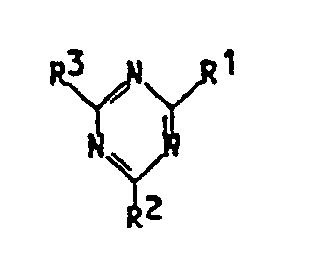
- the UV stabilizers of this invention are in particular comprised of substituted 1,3,5-triazine compounds having the general formula I: wherein R 1 , R 2 , and R 3 may be the same or different and may be H or a C 1-20 aliphatic substituent or a substituted or unsubstituted aryl group, in particular a phenyl group, or any other material which can substitute on the triazine ring wherein the substituted triazine compound retains significant absorption characteristics at the 290-320 nm range, such substituents include for example halogens, nitrogen, oxygen, phosphorous, or sulphur provided that at least one of R 1 , R 2 and R 3 is a hydroxyaryl group, in particular a 2-hydroxyaryl group, preferably a 2-hydroxyphenyl group.
- R 1 , R 2 and R 3 have preferably the structural formula: wherein R 4 , R 5 , R 6 and R 7 may be the same or different and may be H or any other substituent of which the total number of carbon or hetero atoms typically does not exceed 40 atoms. Such substituents may be, for example, alkyl groups or they may comprise an ester or amido group. In a preferred embodiment at least one of R 4 , R 5 , R 6 and R 7 , in particular R 5 represents an alkoxy group and the remainder of R 4 , R 5 , R 6 and R 7 , if any, represents H.
- R 1 , R 2 and R 3 are all phenyl groups.
- two of R 1 , R 2 and R 3 are alkyl substituted, more in particular 2,4-dialkyl substituted phenyl groups.
- the most preferred UV stabilizer has the following structure:
- the functional groups substituted onto the phenyl groups or added or substituted onto R 1 -R 4 can be used to adjust the overall physical and/or chemical properties of the stabilizer.
- pendent organic or inorganic groups may be present as needed to modify such properties as the spectral absorption maxima, volatility, or compatibility.
- the present UV stabilizer may contain more than one UV absorbing-dissipating functional group, it is preferred that it contains only one such group.
- the present UV stabilizers' ability to protect the polyketone polymers exceeds those of the prior art and further extends the availability of UV stabilizers for polyketones. Moreover, this protection is attained with substances which are less volatile and which have no or less negative impact on melt processability. Low loads of these stabilizers can be used relative to prior art stabilizers thereby leading to better property retention in the polymer.
- the process of the invention involves dispersing a stabilizing amount of UV stabilizer into polyketone polymer to form a mixture.
- a stabilizing amount of stabilizer is a quantity which is sufficient to prevent UV degradation of the polyketone. This quantity is generally between 0.1 and 10 wt% (based on the weight of the polyketone). Preferably, between 0.2 and 5 wt% is added. It is most preferred that between 0.4 and 2 wt% is added.
- the stabilizer may be incorporated into the polyketone polymer at any stage of its processing but this is preferably done prior to subjecting the polymer to elevated temperature.
- Any of the conventional methods suitable for forming an intimate mixture of the polymer and additive may be used to form the mixture so long as the method results in a substantially uniform blend of the composition components.
- Such methods are in general melt processing methods and may include dry blending of the polymer and stabilizer in a finely divided form followed by melt extrusion of the mixture. Techniques such as solvent deposition may also be used as well as other methods known by those skilled in the art.
- the stabilized polyketones formed in this manner are useful in the manufacture of fibers, sheets, films, laminates, containers, wire and cables of established utility which are produced by conventional methods such as melt spinning, extrusion, injection moulding and thermoforming.
- the compositions are particularly useful in applications where the finished product is likely to be exposed directly to ultraviolet light such as structural parts produced for external automotive applications.
- weight percent is on the basis of the weight of polymer unless otherwise indicated.
- Samples of a cryoground powder of a linear alternating polymer of carbon monoxide, ethene and a minor amount of propene having a melting point of 220 °C and a limiting viscosity number of 1.8 dl/g were admixed with 1 %w of a UV stabilizer.
- Example 1 the UV stabilizer tested was 2-(2-hydroxy-4-octyloxyphenyl)-4,6-bis(2,4-dimethylphenyl)-1,3,5-triazine (commercially available from Cytec Industries under the trademark CYASORB UV 1164) and in Example 2 the UV stabilizer tested was 2-hydroxy-4-octyloxybenzophenone (commercially available from Cytec Industries under the trademark CYASORB UV 531).
- the mixtures were each melt compounded into pellets on a 25 mm twin screw extruder applying a melt temperature of 255 °C. Test specimens were injection moulded in the form of 1.59 mm (1/16 inch) thick, type V, ASTM D638 tensile bars.
- test specimens were then submitted to accelerated W aging. Accelerated aging was carried out by exposing the test specimens to a fluorescent light source in a weatherometer.
- a QUV accelerated weathering tester used for these studies was equipped with UV-340A fluorescent bulbs. The conditions of the accelerated aging test used continuous UV exposure without any water condensation periods. The temperature of a black panel during the tests was 50 °C. This accelerated aging protocol is referred to herein as QUV aging.
- Photodegradation in polyketone polymers leads to a loss of ductility in polymer parts.
- the efficiency of stabilization can be measured by monitoring the relative retention of break strain.
- the yellowness index of the pellets after extrusion was measured using a Gardner Colorgard System 2000 (Trademark) according to ASTM D-1925. A lower yellowness index is indicative for less discoloration of the polymer. The values found were 30.8 for the pellets of Example 1 and 33.2 for the pellets of Example 2.
- samples of the pellets were compression moulded into 1-mm thick sheets by pressing at 250 °C for 0.5 minutes at 0.4 MPa and 1.5 minutes at 4 MPa pressure.
- Circular disks cut from the sheets were ⁇ subjected to dynamic rheology testing, i.e. measurement of dynamic shear moduli, at a temperature of 272 °C using an angular frequency of 1 rad/s and the samples being held between aluminium disks at a distance of 0.9 mm.
- the cross-over time is defined as the time lapsed during the measurement until the loss factor (i.e. the quotient of the loss modulus and the storage modulus) equals 1. A higher cross-over time is indicative for a better melt processing stability. In Example 1 the cross-over time was 27 minutes and in Example 2 the cross-over time was 18 minutes.
- compositions according to this invention are superior in melt processing stability, UV ageing performance and colour formation when compared with compositions in accordance with the prior art.
Landscapes
- Chemical & Material Sciences (AREA)
- Health & Medical Sciences (AREA)
- Chemical Kinetics & Catalysis (AREA)
- Medicinal Chemistry (AREA)
- Polymers & Plastics (AREA)
- Organic Chemistry (AREA)
- Compositions Of Macromolecular Compounds (AREA)
- Table Devices Or Equipment (AREA)
Claims (8)
- Polymerzusammensetzung, umfassend ein Polyketonpolymer und innig damit vermischt 0,1 bis 10 Gew.-%, bezogen auf das Gewicht des Polyketonpolymers, eines 2-(Hydroxyaryl)-1,3,5-triazins, mit der Maßgabe, daß dann, wenn das Triazin zwei Alkoxyphenylsubstituenten aufweist, das Polyketon nicht ein Ethylen-Vinylacetat-Copolymer und dessen Copolymer mit Kohlenmonoxid, und ein alternierendes oder statistisches Copolymer von Polyalkylen mit Kohlenmonoxid ist.
- Zusammensetzung nach Anspruch 1, worin das Triazin die nachfolgende Struktur:aufweist, worin R1, R2 und R3 unabhängig voneinander aus der aus Wasserstoff, C1-20 aliphatischen Substituenten, substituierten und unsubstituierten Phenylgruppen bestehenden Gruppe ausgewählt sind, mit der Maßgabe, daß wenigstens einer der Reste R1, R2 und R3 eine 2-Hydroxyphenylgruppe ist.
- Zusammensetzung nach Anspruch 2, worin alle Reste R1, R2 und R3 Phenylgruppen sind.
- Zusammensetzung nach einem der Ansprüche 1 bis 3, worin das Triazin die Struktur:aufweist.

- Zusammensetzung nach einem der Ansprüche 1 bis 4, worin das Triazin in einer Menge von 0,4 bis 2 Gew.-%, bezogen auf das Gewicht des Polyketonpolymers, vorliegt.
- Zusammensetzung nach einem der Ansprüche 1 bis 5, worin das Polyketonpolymer ein lineares alternierendes Polymer aus Kohlenmonoxid und Ethen und gegebenenfalls einer weiteren ethylenisch ungesättigten Verbindung, insbesondere Propen oder Buten-1, ist.
- Verfahren, umfassend ein inniges Vermischen eines Polyketonpolymers mit 0,1 bis 10 Gew.-%, bezogen auf das Gewicht des Polyketonpolymers, eines 2-(Hydroxyaryl)-1,3,5-triazins.
- Verwendung eines 2-(Hydroxyaryl)-1,3,5-triazins zur Verbesserung der UV-Stabilität eines Polyketons, worin das Polyketon ein lineares alternierendes Copolymer mit Ethylen und gegebenenfalls einer weiteren ethylenisch ungesättigten Verbindung ist.
Applications Claiming Priority (3)
| Application Number | Priority Date | Filing Date | Title |
|---|---|---|---|
| US424845 | 1989-10-20 | ||
| US42484595A | 1995-04-19 | 1995-04-19 | |
| PCT/EP1996/001647 WO1996033237A1 (en) | 1995-04-19 | 1996-04-18 | Polyketone polymer composition |
Publications (2)
| Publication Number | Publication Date |
|---|---|
| EP0821710A1 EP0821710A1 (de) | 1998-02-04 |
| EP0821710B1 true EP0821710B1 (de) | 2002-09-25 |
Family
ID=23684110
Family Applications (1)
| Application Number | Title | Priority Date | Filing Date |
|---|---|---|---|
| EP96914955A Expired - Lifetime EP0821710B1 (de) | 1995-04-19 | 1996-04-18 | Polyketonpolymer-zusammensetzung |
Country Status (10)
| Country | Link |
|---|---|
| EP (1) | EP0821710B1 (de) |
| JP (1) | JPH11503781A (de) |
| CN (1) | CN1106423C (de) |
| AT (1) | ATE224928T1 (de) |
| AU (1) | AU701371B2 (de) |
| CA (1) | CA2218285A1 (de) |
| DE (1) | DE69623945T2 (de) |
| DK (1) | DK0821710T3 (de) |
| ES (1) | ES2184860T3 (de) |
| WO (1) | WO1996033237A1 (de) |
Families Citing this family (5)
| Publication number | Priority date | Publication date | Assignee | Title |
|---|---|---|---|---|
| KR101773621B1 (ko) | 2009-01-19 | 2017-08-31 | 바스프 에스이 | 유기 흑색 안료 및 이의 제조 방법 |
| DE102010028062A1 (de) * | 2010-04-22 | 2011-10-27 | Evonik Degussa Gmbh | Verfahren zur Herstellung vernetzter organischer Polymere |
| KR101682996B1 (ko) * | 2015-10-16 | 2016-12-06 | 성민태 | 폴리케톤 수지 조성물 및 이로부터 제조된 성형품 |
| CN107513262B (zh) * | 2016-06-18 | 2021-03-26 | 合肥杰事杰新材料股份有限公司 | 聚酮组合物 |
| KR102695301B1 (ko) * | 2016-11-17 | 2024-08-16 | 현대자동차주식회사 | 폴리케톤 복합재 수지 조성물 |
Family Cites Families (4)
| Publication number | Priority date | Publication date | Assignee | Title |
|---|---|---|---|---|
| GB8709488D0 (en) * | 1987-04-22 | 1987-05-28 | Shell Int Research | Copolymer composition |
| ES2098242T3 (es) * | 1990-02-28 | 1997-05-01 | Cytec Tech Corp | Estabilizacion de recubrimientos de elevado contenido de solidos con composiciones liquidas de absorbentes de uv de triazina. |
| DE59409837D1 (de) * | 1993-11-23 | 2001-09-27 | Ciba Sc Holding Ag | o-Hydroxyphenyl-s-triazine enthaltende stabilisierte Polymere |
| TW308601B (de) * | 1995-01-18 | 1997-06-21 | Ciba Sc Holding Ag |
-
1996
- 1996-04-18 CA CA002218285A patent/CA2218285A1/en not_active Abandoned
- 1996-04-18 AT AT96914955T patent/ATE224928T1/de not_active IP Right Cessation
- 1996-04-18 DK DK96914955T patent/DK0821710T3/da active
- 1996-04-18 DE DE69623945T patent/DE69623945T2/de not_active Expired - Fee Related
- 1996-04-18 WO PCT/EP1996/001647 patent/WO1996033237A1/en not_active Ceased
- 1996-04-18 CN CN96193355A patent/CN1106423C/zh not_active Expired - Fee Related
- 1996-04-18 EP EP96914955A patent/EP0821710B1/de not_active Expired - Lifetime
- 1996-04-18 JP JP8531482A patent/JPH11503781A/ja not_active Ceased
- 1996-04-18 ES ES96914955T patent/ES2184860T3/es not_active Expired - Lifetime
- 1996-04-18 AU AU56904/96A patent/AU701371B2/en not_active Ceased
Also Published As
| Publication number | Publication date |
|---|---|
| CN1106423C (zh) | 2003-04-23 |
| DE69623945D1 (de) | 2002-10-31 |
| DE69623945T2 (de) | 2003-05-22 |
| ES2184860T3 (es) | 2003-04-16 |
| WO1996033237A1 (en) | 1996-10-24 |
| ATE224928T1 (de) | 2002-10-15 |
| AU5690496A (en) | 1996-11-07 |
| DK0821710T3 (da) | 2002-10-14 |
| JPH11503781A (ja) | 1999-03-30 |
| AU701371B2 (en) | 1999-01-28 |
| EP0821710A1 (de) | 1998-02-04 |
| CA2218285A1 (en) | 1996-10-24 |
| CN1181771A (zh) | 1998-05-13 |
Similar Documents
| Publication | Publication Date | Title |
|---|---|---|
| US5834541A (en) | Olefin polymer composition having low smoke generation and fiber and film prepared therefrom | |
| EP1863873B1 (de) | Vernetzbare feuchtigkeitspolymerzusammensetzung mit erhöhter wärmealterungsleistung | |
| JP4941920B2 (ja) | 紫外線に対して安定化された熱可塑性オレフィン | |
| KR100616177B1 (ko) | 입체 장애 페놀, 2차 아민 및 티오에테르의 혼합물에 의해안정화된 열가소성 수지 | |
| KR101494019B1 (ko) | 정전기 소산성 폴리아세탈 조성물 | |
| US6174940B1 (en) | Synergistic stabilizer mixture based on polyalkyl-1-oxa-diazaspirodecane compounds | |
| EP0309283B1 (de) | Durch eine Mischung aus einem gehinderten Phenol und einem Aminantioxidant stabilisiertes Polyäthylen | |
| AU701371B2 (en) | Polyketone polymer composition | |
| CA1262984A (en) | Uv stabilizer system and uv stabilized polyolefins | |
| CN1303408A (zh) | 紫外稳定的聚醚酯共聚物组合物及由其制造的薄膜 | |
| CA1118139A (en) | Light-stable polypropylene compositions | |
| EP0821709B1 (de) | Polyketonpolymer-zusammensetzung | |
| US4954548A (en) | Ethylene-carbon monoxide copolymer stabilization | |
| US4986932A (en) | Stabilizer system for polyolefins comprised of monocarboxylic acid esters of a piperidinol and a benzophenone or benzotriazole | |
| EP2227502B1 (de) | Stabilisierte polymerzusammensetzungen | |
| US4992499A (en) | Stabilized ethylene monoxide copolymers | |
| EP0395183B1 (de) | Polyketonpolymerzusammensetzungen | |
| CA1244597A (en) | Polymeric hindered amines | |
| KR20070116990A (ko) | 환형 올레핀 공중합체의 광분해를 예방하는 조성물 및 방법 | |
| JPH06240057A (ja) | ポリオレフィン樹脂組成物 | |
| GB2377937A (en) | Sterically hindered amine compounds |
Legal Events
| Date | Code | Title | Description |
|---|---|---|---|
| PUAI | Public reference made under article 153(3) epc to a published international application that has entered the european phase |
Free format text: ORIGINAL CODE: 0009012 |
|
| 17P | Request for examination filed |
Effective date: 19971002 |
|
| AK | Designated contracting states |
Kind code of ref document: A1 Designated state(s): AT BE CH DE DK ES FR GB IT LI NL SE |
|
| 17Q | First examination report despatched |
Effective date: 20010430 |
|
| GRAG | Despatch of communication of intention to grant |
Free format text: ORIGINAL CODE: EPIDOS AGRA |
|
| GRAG | Despatch of communication of intention to grant |
Free format text: ORIGINAL CODE: EPIDOS AGRA |
|
| GRAH | Despatch of communication of intention to grant a patent |
Free format text: ORIGINAL CODE: EPIDOS IGRA |
|
| GRAH | Despatch of communication of intention to grant a patent |
Free format text: ORIGINAL CODE: EPIDOS IGRA |
|
| GRAA | (expected) grant |
Free format text: ORIGINAL CODE: 0009210 |
|
| AK | Designated contracting states |
Kind code of ref document: B1 Designated state(s): AT BE CH DE DK ES FR GB IT LI NL SE |
|
| PG25 | Lapsed in a contracting state [announced via postgrant information from national office to epo] |
Ref country code: NL Free format text: LAPSE BECAUSE OF FAILURE TO SUBMIT A TRANSLATION OF THE DESCRIPTION OR TO PAY THE FEE WITHIN THE PRESCRIBED TIME-LIMIT Effective date: 20020925 |
|
| REF | Corresponds to: |
Ref document number: 224928 Country of ref document: AT Date of ref document: 20021015 Kind code of ref document: T |
|
| REG | Reference to a national code |
Ref country code: GB Ref legal event code: FG4D |
|
| REG | Reference to a national code |
Ref country code: CH Ref legal event code: EP |
|
| REG | Reference to a national code |
Ref country code: DK Ref legal event code: T3 |
|
| REG | Reference to a national code |
Ref country code: CH Ref legal event code: NV Representative=s name: KIRKER & CIE SA |
|
| REF | Corresponds to: |
Ref document number: 69623945 Country of ref document: DE Date of ref document: 20021031 |
|
| NLV1 | Nl: lapsed or annulled due to failure to fulfill the requirements of art. 29p and 29m of the patents act | ||
| ET | Fr: translation filed | ||
| REG | Reference to a national code |
Ref country code: ES Ref legal event code: FG2A Ref document number: 2184860 Country of ref document: ES Kind code of ref document: T3 |
|
| PG25 | Lapsed in a contracting state [announced via postgrant information from national office to epo] |
Ref country code: GB Free format text: LAPSE BECAUSE OF NON-PAYMENT OF DUE FEES Effective date: 20030418 Ref country code: AT Free format text: LAPSE BECAUSE OF NON-PAYMENT OF DUE FEES Effective date: 20030418 |
|
| PG25 | Lapsed in a contracting state [announced via postgrant information from national office to epo] |
Ref country code: SE Free format text: LAPSE BECAUSE OF NON-PAYMENT OF DUE FEES Effective date: 20030419 Ref country code: ES Free format text: LAPSE BECAUSE OF NON-PAYMENT OF DUE FEES Effective date: 20030419 |
|
| PG25 | Lapsed in a contracting state [announced via postgrant information from national office to epo] |
Ref country code: LI Free format text: LAPSE BECAUSE OF NON-PAYMENT OF DUE FEES Effective date: 20030430 Ref country code: DK Free format text: LAPSE BECAUSE OF NON-PAYMENT OF DUE FEES Effective date: 20030430 Ref country code: CH Free format text: LAPSE BECAUSE OF NON-PAYMENT OF DUE FEES Effective date: 20030430 Ref country code: BE Free format text: LAPSE BECAUSE OF NON-PAYMENT OF DUE FEES Effective date: 20030430 |
|
| PLBE | No opposition filed within time limit |
Free format text: ORIGINAL CODE: 0009261 |
|
| STAA | Information on the status of an ep patent application or granted ep patent |
Free format text: STATUS: NO OPPOSITION FILED WITHIN TIME LIMIT |
|
| 26N | No opposition filed |
Effective date: 20030626 |
|
| BERE | Be: lapsed |
Owner name: *SHELL INTERNATIONALE RESEARCH MAATSCHAPPIJ B.V. Effective date: 20030430 |
|
| PG25 | Lapsed in a contracting state [announced via postgrant information from national office to epo] |
Ref country code: DE Free format text: LAPSE BECAUSE OF NON-PAYMENT OF DUE FEES Effective date: 20031101 |
|
| EUG | Se: european patent has lapsed | ||
| REG | Reference to a national code |
Ref country code: DK Ref legal event code: EBP |
|
| GBPC | Gb: european patent ceased through non-payment of renewal fee |
Effective date: 20030418 |
|
| REG | Reference to a national code |
Ref country code: CH Ref legal event code: PL |
|
| PG25 | Lapsed in a contracting state [announced via postgrant information from national office to epo] |
Ref country code: FR Free format text: LAPSE BECAUSE OF NON-PAYMENT OF DUE FEES Effective date: 20031231 |
|
| REG | Reference to a national code |
Ref country code: FR Ref legal event code: ST |
|
| REG | Reference to a national code |
Ref country code: ES Ref legal event code: FD2A Effective date: 20030419 |
|
| PG25 | Lapsed in a contracting state [announced via postgrant information from national office to epo] |
Ref country code: IT Free format text: LAPSE BECAUSE OF NON-PAYMENT OF DUE FEES;WARNING: LAPSES OF ITALIAN PATENTS WITH EFFECTIVE DATE BEFORE 2007 MAY HAVE OCCURRED AT ANY TIME BEFORE 2007. THE CORRECT EFFECTIVE DATE MAY BE DIFFERENT FROM THE ONE RECORDED. Effective date: 20050418 |