EP0821877A2 - Procédé de valorisation de produits de boulangerie, plus spécialement de restes de pain et de pain retourné - Google Patents
Procédé de valorisation de produits de boulangerie, plus spécialement de restes de pain et de pain retourné Download PDFInfo
- Publication number
- EP0821877A2 EP0821877A2 EP97111815A EP97111815A EP0821877A2 EP 0821877 A2 EP0821877 A2 EP 0821877A2 EP 97111815 A EP97111815 A EP 97111815A EP 97111815 A EP97111815 A EP 97111815A EP 0821877 A2 EP0821877 A2 EP 0821877A2
- Authority
- EP
- European Patent Office
- Prior art keywords
- yeast
- fermentation
- bread
- aerobic
- anaerobic
- Prior art date
- Legal status (The legal status is an assumption and is not a legal conclusion. Google has not performed a legal analysis and makes no representation as to the accuracy of the status listed.)
- Granted
Links
Images

Classifications
-
- A—HUMAN NECESSITIES
- A21—BAKING; EDIBLE DOUGHS
- A21D—TREATMENT OF FLOUR OR DOUGH FOR BAKING, e.g. BY ADDITION OF MATERIALS; BAKING; BAKERY PRODUCTS
- A21D8/00—Methods for preparing or baking dough
- A21D8/02—Methods for preparing dough; Treating dough prior to baking
- A21D8/04—Methods for preparing dough; Treating dough prior to baking treating dough with microorganisms or enzymes
- A21D8/047—Methods for preparing dough; Treating dough prior to baking treating dough with microorganisms or enzymes with yeasts
-
- C—CHEMISTRY; METALLURGY
- C01—INORGANIC CHEMISTRY
- C01B—NON-METALLIC ELEMENTS; COMPOUNDS THEREOF; METALLOIDS OR COMPOUNDS THEREOF NOT COVERED BY SUBCLASS C01C
- C01B32/00—Carbon; Compounds thereof
- C01B32/50—Carbon dioxide
Definitions
- the invention relates to a method for recycling Baked goods, in particular of residual and return bread and / or similar products in their material composition as raw material for baked goods production, in particular breads made from wheat and rye ground products.
- Such a method is for example from DE-PS 36 23 896 known.
- a starchy one Starting material for example residual and / or Used baked goods can be a culture medium for baker's yeast made in the form of a sugar syrup. Doing so the starchy starting material is initially enzymatic liquefied, then saccharified enzymatically and by Decantation, decolorization, filtration etc. a refining subject. The one made with this process Sugar syrup is then used as a culture or nutrient medium for used the aerobic production of baker's yeast.
- DE-PS 34 02 778 describes a method for manufacturing a bread dough using a portion of the broth from residual bread and cereals, based on the Dry matter of the grain components used 1 is up to 50 wt .-% and that before mixing with the other dough components of an enzymatic treatment is subjected.
- a bread dough using a portion of the broth from residual bread and cereals, based on the Dry matter of the grain components used 1 is up to 50 wt .-% and that before mixing with the other dough components of an enzymatic treatment is subjected.
- improved freshness and one The carbohydrates are typical of bread part of the portion of the breakfast is amylolytically degraded, then isomerized and with other dough components mixed for dough preparation.
- EP 0 229 979 B1 discloses a method for the enzymatic Breakdown of residual bread with the help of amylases, proteases and amyloglucosidases to obtain a final product, that as a sweetener, tan or Flavor precursor, optionally also as a concentrate is used.
- a final product that as a sweetener, tan or Flavor precursor, optionally also as a concentrate is used.
- the final product heated for enzyme inactivation depending on the intended use or acidified when used as a dough acidifier will.
- DE 33 20 206 A1 discloses a method and an apparatus for crushing, mixing, homogenizing and subsequent fermentation of bread and rolls Sourdough.
- the starting products are during at a certain time a rotating, through crushing tools guided movement and subsequent fermentative residual comminution by adding water and subjected to inoculation.
- Sourdough is used for further bread making used.
- DE 33 23 081 A1 discloses a method and a device to prepare a sourdough for preparation of bread and bakery products using Residual bread.
- the starting product becomes an expanded one Subjected to fermentation process. The leaven will also for the preparation of bread and baked goods used.
- Meuser, F. describes in Development of fermentation technology in modern bread factories. Cereal Foods World (40) 1995, 114-122 the production of a liquid ferment, that in Russia in bread factories for several Decades.
- the liquid ferment exists from a lactic acid liquid in which lactic acid bacteria are active and in the anaerobic way yeast was increased.
- the fermentation system also has a high adaptation to continuous production one particular in large quantity with sourdough bread types to make, but it cannot be for the flexible production of a wide range of breads individual types of bread with yeast and / or with sourdough are manufactured, used.
- the solution to the problem provides that the procedure resulting products can be obtained separately and at least one product for the manufacture of Baked goods will continue to be used.
- the preparation of the remaining and return bread initially includes the control of hygienic safety, especially the control of the best-before date and, if necessary, unpacking the packaged Bread. Then the remaining and return bread becomes mechanical crushed and with water in a known manner mixed. The resulting mash becomes enzymatic Subjected to hydrolysis, the temperature and pH optima of the enzymes used must be observed. High molecular weight ingredients become low molecular weight ingredients Degradation products hydrolyzed. In this way it is created after decantation of the non-liquefiable solids a fermentation substrate that meets the requirements of Lactic acid bacteria and yeasts in growth and reproduction enough. Through fermentation with lactic acid bacteria the fermentation substrate is first acidified and after that a yeast culture becomes both aerobic and also increased anaerobically.
- the yeast is obtained as baker's yeast and serves as an essential ingredient in the recipe with a functional effect for the production of bread. This makes the bread factories largely self-sufficient with this valuable raw material in a closed Material cycle enables.
- the after distillation of the ethanol formed during anaerobic fermentation remaining acidic liquid is called liquid acid directly, if necessary completely, at least however, in part in the bread making process as Bulk water introduced for dough acidification.
- the one with the method according to the invention by decantation from the Parts of non-liquefiable that are obtained from hydrolyzate Solids perform the function of fiber. They are particularly suitable for improving the taste and / or the nutritional value of bread. That at the anaerobic fermentation resulting ethanol and carbon dioxide is used after distillation or liquefaction.
- the ethanol unless there is a higher value Can be used as fuel.
- the carbon dioxide is used for cooling (e.g. dough) and packaging used.
- the invention provides that Starting material of an amylolytic and proteolytic Is subjected to hydrolysis.
- amylolytic enzymes an alpha amylase and an amyloglucosidase are used.
- the proteolytic degradation is carried out with the help of a Protease performed.
- the enzymatically hydrolyzed return bread becomes inactivation the enzyme is heated and then fermented with lactic acid bacteria, the one Reduce the pH to 4.0. It has proven advantageous that the fermentation with Lactic acid bacteria (Lactobacillus delbgurii) performed becomes.
- the invention further provides that the acidic sugar-containing Hydrolyzate as a fermentation substrate for yeast propagation is used. It has proven to be beneficial proved that the yeast increase in two stages under aerobic and performing anaerobic conditions. This Process steps have the advantage that the acid Hydrolyzate optimally from the yeast for the formation of metabolic products and yeast cell mass can be used.
- liquid acid freed from ethanol for dilution of the fermentation substrate is used.
- yeast multiplication aerobically from flour or return their limitation by the out of these Substances are available for the formation of yeast cell mass adjustable proportion of nitrogen-containing compounds from the protein found.
- this is even under provided he was under the process conditions Fully absorbable from the yeast, significantly smaller than that available for aerobic cell mass formation Carbohydrate content.
- Carbohydrate content For example, from a wheat flour assumed that based on its dry matter a starch content of 78% and a protein content of 14% (N x 5.7) would result in a complete enzymatic hydrolysis of the starch to glucose 1,000.0 g dry matter from flour 866.7 g glucose, from those with an aerobic yeast formation of 0.54 g dry substance from 1.00 g glucose 468.0 g dry yeast would.
- the invention further provides that the division of the acidic hydrolyzate based on the mass flows the proportion of the protein content of the starting material released by proteolysis and from the Yeast absorbable nitrogen containing compounds he follows.
- the smallest cell mass formation occurs at purely anaerobic fermentation. This is at the same time with the smallest absorption of nitrogen compounds and the largest formation associated with ethanol. This allows the Cell mass formation while maintaining full implementation of the carbohydrate portion.
- the in the inventive method resulting liquid acid is used elsewhere. It provides suppose that it is for the direct acidification of dough from wheat and rye flours and doughs from mixtures of wheat and rye flour is used. Here, too, there are cost savings that can be achieved in Within the framework of a rational and economical procedure make it noticeable when making bread. in the It has also turned out within the framework of the tests carried out pointed out that the liquid acid obtained in the process in the sense of pre-dough tours for indirect Acidification of doughs from wheat and rye flour and Mixtures of wheat and rye flour are used can. It has also been shown that in the process resulting liquid acid using its active microorganism flora used for sourdough management can be.
- the invention provides that the Carrying out the process by ethanol Distillation obtained and in-house as fuel will continue to be used. That when performing Carbon dioxide from the process is liquefied and used as a coolant.
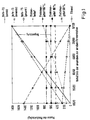
- Fig. 1 shows that within certain limits, the practical Conditions particularly due to the proportion of absorbable N compounds are placed in the substrate any ratio for the production of yeast and ethanol between aerobic and anaerobic fermentation can be adjusted.
- the example shown here refers to a bread factory that has a specific Return bread quantity according to the method according to the invention could process.
- they are Intersection between the protein demand curves the yeast and the curves for the assumed protein supply through the substrate equivalent to the maximum Amount of glucose that could be fermented aerobically. For example, would be the relationship between anaerobic and aerobic fermentation of the glucose 55 to 45, then would make about 1,000 kg of dry yeast (approx 4,000 kg of wet yeast) and 720 kg of ethanol.
- a jacket-heated agitator tank In a jacket-heated agitator tank are in As is known, 4,000 kg of return bread with 2,000 1 daily Mixed water. The dry weight of the return bread is 2,400 kg. Of these, 1,680 kg are strength and 288 kg Protein (N x 5.7).
- the batch is adjusted to a pH of 5.2 adjusted and with an ⁇ -amylase (e.g. Optiamyl L 840, from Solvey Enzymes), which is a temperature optimum of 70 ° C.
- the approach is at 70 ° C warmed and held at this temperature for 3 h to him to liquefy. After that, the liquefied approach cooled to 60 ° C and with amyloglucosidase (e.g.
- glucoamylase L 200 from Solvey, Enzymes.
- the batch is saccharified at pH 5.2 over 18 h. In doing so at least 80% of the starch is broken down into glucose, so that in the approach based on the example at 80% Starch hydrolysis 1,493 kg glucose occur.
- the batch After saccharification the batch is cooled to 45 ° C and to break down its protein content into soluble ones low molecular weight peptides and amino acids with a protease (e.g. Corolase PN-L, from Röhm), which as Endo- and exopeptidase works.
- the enzyme is at pH 5.2 Leave on for over 21 hours. During this time at least 70% of the protein in soluble N substances reduced. Then the approach to inactivate the Enzymes heated to 100 ° C and 30 min at this temperature held.
- the mixture is then cooled to 50 ° C. and acidified with Lactobacillus delbgurii.
- Approach based on volume with 10% of a previous one acidified approach. Acidification with the active lactic acid bacteria flora leads in 24 h to lower the pH to 4.0. The acidity in the batch at this pH is about 12-14 ° S, so that about 5% of the glucose present in the batch to lactic acid be implemented.
- Example still 1,418 kg of glucose available, the aerobic and fermented anaerobically.
- the aerobic and anaerobic fermentation takes place continuously, where all the following information relates to the refer to the previous example.
- the fermentation takes place as shown in Figure 2, in two fermenters at about 30 ° C. dwell time and volume flows through the fermenters result from the generation time the yeast under the respective fermentation conditions, which also determines the volumes of the fermenters are.
- the anaerobic fermenter with a concentration of glucose in the substrate of about 20 g glucose per liter and the anaerobic fermenter driven with about 125 g of glucose per liter.
- the Yeast concentration is in both fermenters about 40 g / l.
- Figure 2 does not include all intermediate storage and buffer tanks as well as pumps. In this regard, it should be mentioned in particular that in the course of the process it can be provided that the procedural route until the provision of the acidic, diluted and decanted fermentation approach discontinuously can be done.
- This Mass of liquid acid falls in the steady state of the Fermentation at when the dilution of the mass flow the first fermentation stage with the processes from the first and second stage without adding fresh water. It is the mass conversion of glucose and Protein taken into account in the end products. Besides, is the mass discharge is taken into account, that of the wet mass the yeast and fiber is done.
Landscapes
- Chemical & Material Sciences (AREA)
- Life Sciences & Earth Sciences (AREA)
- Organic Chemistry (AREA)
- Chemical Kinetics & Catalysis (AREA)
- Food Science & Technology (AREA)
- Engineering & Computer Science (AREA)
- Microbiology (AREA)
- Inorganic Chemistry (AREA)
- Mycology (AREA)
- Bakery Products And Manufacturing Methods Therefor (AREA)
- Preparation Of Compounds By Using Micro-Organisms (AREA)
- Meat, Egg Or Seafood Products (AREA)
- Disintegrating Or Milling (AREA)
- Micro-Organisms Or Cultivation Processes Thereof (AREA)
Applications Claiming Priority (2)
| Application Number | Priority Date | Filing Date | Title |
|---|---|---|---|
| DE19631180A DE19631180C1 (de) | 1996-08-02 | 1996-08-02 | Verfahren zur Verwertung von Backwaren, insbesondere von Rest- und Rückbrot |
| DE19631180 | 1996-08-02 |
Publications (3)
| Publication Number | Publication Date |
|---|---|
| EP0821877A2 true EP0821877A2 (fr) | 1998-02-04 |
| EP0821877A3 EP0821877A3 (fr) | 2004-02-25 |
| EP0821877B1 EP0821877B1 (fr) | 2010-09-15 |
Family
ID=7801560
Family Applications (1)
| Application Number | Title | Priority Date | Filing Date |
|---|---|---|---|
| EP97111815A Expired - Lifetime EP0821877B1 (fr) | 1996-08-02 | 1997-07-11 | Procédé de valorisation de produits de boulangerie, plus spécialement de restes de pain et de pain retourné |
Country Status (5)
| Country | Link |
|---|---|
| EP (1) | EP0821877B1 (fr) |
| AT (1) | ATE480996T1 (fr) |
| AU (1) | AU733776B2 (fr) |
| DE (1) | DE19631180C1 (fr) |
| ES (1) | ES2350037T3 (fr) |
Cited By (1)
| Publication number | Priority date | Publication date | Assignee | Title |
|---|---|---|---|---|
| BE1027645A1 (nl) | 2019-10-11 | 2021-05-05 | Destrooper Olivier Nv | Een werkwijze ter vervaardiging van een wafel en de wafel zelf |
Families Citing this family (4)
| Publication number | Priority date | Publication date | Assignee | Title |
|---|---|---|---|---|
| DE19835269A1 (de) * | 1998-08-04 | 2000-02-17 | Mueller Brot Gmbh | Verfahren zur Verwertung von Backwaren, insbesondere von Rest-, Rückbrot und/oder Altbackwaren |
| DE102012104764B4 (de) | 2012-06-01 | 2018-08-02 | Technologie Manufaktur Weissinger UG (haftungsbeschränkt) | Verfahren zur Verwertung von Altbackwaren |
| EP3223618B1 (fr) * | 2014-11-28 | 2018-10-24 | DIOSNA Dierks & Söhne GmbH | Procédé de traitement de pâte de retour en tant que produit de fermentation pour la fabrication de produits de boulangerie |
| EP4368026A1 (fr) * | 2022-11-10 | 2024-05-15 | Dino Grande | Procédé de préparation d'un mélange à être ajouté dans des pâtes pour produits de boulangerie |
Family Cites Families (6)
| Publication number | Priority date | Publication date | Assignee | Title |
|---|---|---|---|---|
| NL8302760A (nl) * | 1982-09-04 | 1984-04-02 | Menge Wilhelm | Werkwijze en inrichting voor de vervaardiging van een zuurdeeg voor de bereiding van brood- en bakkersprodukten, met gebruikmaking van broodresten. |
| DE3323081A1 (de) * | 1982-09-04 | 1984-03-08 | Wilhelm 3004 Isernhagen Menge | Verfahren und vorrichtung zur herstellung eines sauerteiges fuer die bereitung von brot- und backwaren unter verwendung von restbrot |
| DE3320206A1 (de) * | 1983-06-03 | 1984-12-06 | Wilhelm 3004 Isernhagen Menge | Verfahren und vorrichtung zum zerkleinern, mischen, homogenisieren und anschliessenden fermentieren von brot und broetchen zu sauerteig |
| DE3402778A1 (de) * | 1984-01-27 | 1985-08-08 | Lieken-Batscheider Mühlen- und Backbetriebe GmbH, 6500 Mainz | Verfahren zum herstellen eines brotteigs |
| DE3601479C1 (de) * | 1986-01-20 | 1987-01-29 | Wendeln Gmbh B Jr | Verfahren zum enzymatischen Abbau von Restbrot und Verwendung des erhaltenen Abbauprodukts |
| DE3623896C1 (en) * | 1986-07-15 | 1988-01-14 | Mueller-Brot Neufahrn Gmbh & Co Kg, 8056 Neufahrn, De | Process for the production of a sugar syrup and use of the sugar syrup as culture or nutrient medium for cultivating bakers' yeast |
-
1996
- 1996-08-02 DE DE19631180A patent/DE19631180C1/de not_active Expired - Fee Related
-
1997
- 1997-07-11 ES ES97111815T patent/ES2350037T3/es not_active Expired - Lifetime
- 1997-07-11 AT AT97111815T patent/ATE480996T1/de active
- 1997-07-11 EP EP97111815A patent/EP0821877B1/fr not_active Expired - Lifetime
- 1997-08-01 AU AU32453/97A patent/AU733776B2/en not_active Ceased
Cited By (1)
| Publication number | Priority date | Publication date | Assignee | Title |
|---|---|---|---|---|
| BE1027645A1 (nl) | 2019-10-11 | 2021-05-05 | Destrooper Olivier Nv | Een werkwijze ter vervaardiging van een wafel en de wafel zelf |
Also Published As
| Publication number | Publication date |
|---|---|
| AU3245397A (en) | 1998-02-12 |
| ATE480996T1 (de) | 2010-10-15 |
| EP0821877A3 (fr) | 2004-02-25 |
| AU733776B2 (en) | 2001-05-24 |
| EP0821877B1 (fr) | 2010-09-15 |
| ES2350037T3 (es) | 2011-01-17 |
| DE19631180C1 (de) | 1997-11-20 |
Similar Documents
| Publication | Publication Date | Title |
|---|---|---|
| DE60020940T2 (de) | Verfahren zur ethanolherstellung mit kontinuierliche beimischung von hefe | |
| DE69226772T2 (de) | Verfahren zur herstellung von ethanol | |
| DE69422160T2 (de) | Verfahren zur Herstellung von Kulturmedien, welche für die individuelle Kultur von Hefen und Milchsäurebakterien oder die Kokultur von Hefen und Milchsäurebakterien verwendbar sind. | |
| DE3149931C2 (fr) | ||
| DE69422161T2 (de) | Verfahren zur Gewinnung einer Biomasse, Verwendung von der erhaltenen Biomasse und Brottreibmittel | |
| DE1567331C3 (de) | Verfahren zur Herstellung von Produkten mit hohem Maltosegehalt | |
| DE69517442T2 (de) | Trockenen backwaren und ein verfahren zu deren herstellung | |
| WO1998041646A1 (fr) | Procede de valorisation d'une biomasse vegetale et presse a vis pour la mise en oeuvre de ce procede | |
| DE60129091T2 (de) | Verfahren zur Herstellung eines Kulturmediums aus erneuerbarem Rohmaterial | |
| DE69918593T2 (de) | Gebrauchsfertiger Brotsauerteig mit langer Konservierungszeit | |
| DE2524753A1 (de) | Verfahren zur entfernung wasserloeslicher kohlenhydrate bei der herstellung von pflanzenproteinprodukten | |
| EP0821877B1 (fr) | Procédé de valorisation de produits de boulangerie, plus spécialement de restes de pain et de pain retourné | |
| DE3601479C1 (de) | Verfahren zum enzymatischen Abbau von Restbrot und Verwendung des erhaltenen Abbauprodukts | |
| DE4017150A1 (de) | Verfahren zur herstellung eines backaktiven pentosanase-praeparates | |
| DE69737803T2 (de) | Bäckerhefe | |
| DE2153232A1 (de) | Verfahren zur Herstellung und Verwendung von Amylase | |
| DE69422159T3 (de) | Verfahren zur Gewinnung einer Biomasse aus einem Medium von Getreide, Verwendung der erhaltenen Produkte und Brottreibmittel | |
| CH621925A5 (en) | Process for isolating proteins from whey and protein- and starch-containing natural products | |
| EP1361796B1 (fr) | Preparation de levain pour la fabrication de pains et de produits de boulangerie | |
| DE68914050T2 (de) | Verfahren zur Herstellung von normaler Buttersäure durch Vergärung eines Zuckersubstrats in Anwesenheit von mindestens einem Stamm der Spezies clostridium. | |
| EP3223618B1 (fr) | Procédé de traitement de pâte de retour en tant que produit de fermentation pour la fabrication de produits de boulangerie | |
| DE69708055T2 (de) | Naehrstoffe fuer den boden, pflanzen, tiere und menschen | |
| DE10332200A1 (de) | Verfahren zur Herstellung von Vorteigen | |
| DE3623896C1 (en) | Process for the production of a sugar syrup and use of the sugar syrup as culture or nutrient medium for cultivating bakers' yeast | |
| DE69922374T2 (de) | Fermentiertes, pasteurisiertes Vorferment |
Legal Events
| Date | Code | Title | Description |
|---|---|---|---|
| PUAI | Public reference made under article 153(3) epc to a published international application that has entered the european phase |
Free format text: ORIGINAL CODE: 0009012 |
|
| AK | Designated contracting states |
Kind code of ref document: A2 Designated state(s): AT BE CH DE DK ES FI FR GB GR IE IT LI LU MC NL PT SE |
|
| PUAL | Search report despatched |
Free format text: ORIGINAL CODE: 0009013 |
|
| AK | Designated contracting states |
Kind code of ref document: A3 Designated state(s): AT BE CH DE DK ES FI FR GB GR IE IT LI LU MC NL PT SE |
|
| 17P | Request for examination filed |
Effective date: 20040729 |
|
| AKX | Designation fees paid |
Designated state(s): AT ES FR GB IT |
|
| REG | Reference to a national code |
Ref country code: DE Ref legal event code: 8566 |
|
| GRAP | Despatch of communication of intention to grant a patent |
Free format text: ORIGINAL CODE: EPIDOSNIGR1 |
|
| GRAS | Grant fee paid |
Free format text: ORIGINAL CODE: EPIDOSNIGR3 |
|
| RAP1 | Party data changed (applicant data changed or rights of an application transferred) |
Owner name: MUELLER-BROT GMBH Owner name: REIMELT HENSCHEL GMBH |
|
| GRAA | (expected) grant |
Free format text: ORIGINAL CODE: 0009210 |
|
| AK | Designated contracting states |
Kind code of ref document: B1 Designated state(s): AT ES FR GB IT |
|
| REG | Reference to a national code |
Ref country code: GB Ref legal event code: FG4D Free format text: NOT ENGLISH |
|
| REG | Reference to a national code |
Ref country code: ES Ref legal event code: FG2A Effective date: 20110104 |
|
| PLBE | No opposition filed within time limit |
Free format text: ORIGINAL CODE: 0009261 |
|
| STAA | Information on the status of an ep patent application or granted ep patent |
Free format text: STATUS: NO OPPOSITION FILED WITHIN TIME LIMIT |
|
| 26N | No opposition filed |
Effective date: 20110616 |
|
| PGFP | Annual fee paid to national office [announced via postgrant information from national office to epo] |
Ref country code: FR Payment date: 20110729 Year of fee payment: 15 |
|
| PGFP | Annual fee paid to national office [announced via postgrant information from national office to epo] |
Ref country code: AT Payment date: 20110711 Year of fee payment: 15 Ref country code: GB Payment date: 20110719 Year of fee payment: 15 Ref country code: ES Payment date: 20110713 Year of fee payment: 15 |
|
| PGFP | Annual fee paid to national office [announced via postgrant information from national office to epo] |
Ref country code: IT Payment date: 20110719 Year of fee payment: 15 |
|
| REG | Reference to a national code |
Ref country code: AT Ref legal event code: MM01 Ref document number: 480996 Country of ref document: AT Kind code of ref document: T Effective date: 20120711 |
|
| GBPC | Gb: european patent ceased through non-payment of renewal fee |
Effective date: 20120711 |
|
| REG | Reference to a national code |
Ref country code: FR Ref legal event code: ST Effective date: 20130329 |
|
| PG25 | Lapsed in a contracting state [announced via postgrant information from national office to epo] |
Ref country code: GB Free format text: LAPSE BECAUSE OF NON-PAYMENT OF DUE FEES Effective date: 20120711 Ref country code: FR Free format text: LAPSE BECAUSE OF NON-PAYMENT OF DUE FEES Effective date: 20120731 |
|
| PG25 | Lapsed in a contracting state [announced via postgrant information from national office to epo] |
Ref country code: IT Free format text: LAPSE BECAUSE OF NON-PAYMENT OF DUE FEES Effective date: 20120711 |
|
| PG25 | Lapsed in a contracting state [announced via postgrant information from national office to epo] |
Ref country code: AT Free format text: LAPSE BECAUSE OF NON-PAYMENT OF DUE FEES Effective date: 20120711 |
|
| REG | Reference to a national code |
Ref country code: ES Ref legal event code: FD2A Effective date: 20131021 |
|
| PG25 | Lapsed in a contracting state [announced via postgrant information from national office to epo] |
Ref country code: ES Free format text: LAPSE BECAUSE OF NON-PAYMENT OF DUE FEES Effective date: 20120712 |