EP0822937B1 - Herstellung von metallkomplexen der 4. gruppe mit diene - Google Patents
Herstellung von metallkomplexen der 4. gruppe mit diene Download PDFInfo
- Publication number
- EP0822937B1 EP0822937B1 EP95933931A EP95933931A EP0822937B1 EP 0822937 B1 EP0822937 B1 EP 0822937B1 EP 95933931 A EP95933931 A EP 95933931A EP 95933931 A EP95933931 A EP 95933931A EP 0822937 B1 EP0822937 B1 EP 0822937B1
- Authority
- EP
- European Patent Office
- Prior art keywords
- butadiene
- cyclopentadienyl
- group
- process according
- hydrocarbyl
- Prior art date
- Legal status (The legal status is an assumption and is not a legal conclusion. Google has not performed a legal analysis and makes no representation as to the accuracy of the status listed.)
- Expired - Lifetime
Links
- 150000001993 dienes Chemical class 0.000 title claims description 10
- 229910052751 metal Inorganic materials 0.000 title abstract description 22
- 239000002184 metal Substances 0.000 title abstract description 21
- 230000015572 biosynthetic process Effects 0.000 title description 3
- 238000003786 synthesis reaction Methods 0.000 title 1
- -1 zirconium diene Chemical class 0.000 claims abstract description 100
- 239000010936 titanium Substances 0.000 claims abstract description 13
- 230000003647 oxidation Effects 0.000 claims abstract description 10
- 238000007254 oxidation reaction Methods 0.000 claims abstract description 10
- RTAQQCXQSZGOHL-UHFFFAOYSA-N Titanium Chemical class [Ti] RTAQQCXQSZGOHL-UHFFFAOYSA-N 0.000 claims abstract description 9
- 229910052719 titanium Inorganic materials 0.000 claims abstract description 9
- 229910052726 zirconium Inorganic materials 0.000 claims abstract description 5
- 238000004519 manufacturing process Methods 0.000 claims abstract description 4
- IJGRMHOSHXDMSA-UHFFFAOYSA-N Atomic nitrogen Chemical compound N#N IJGRMHOSHXDMSA-UHFFFAOYSA-N 0.000 claims description 22
- 238000000034 method Methods 0.000 claims description 20
- 125000001183 hydrocarbyl group Chemical group 0.000 claims description 18
- 150000001875 compounds Chemical class 0.000 claims description 17
- 125000004435 hydrogen atom Chemical group [H]* 0.000 claims description 17
- 239000000203 mixture Substances 0.000 claims description 16
- PMJHHCWVYXUKFD-UHFFFAOYSA-N piperylene Natural products CC=CC=C PMJHHCWVYXUKFD-UHFFFAOYSA-N 0.000 claims description 16
- PMJHHCWVYXUKFD-SNAWJCMRSA-N (E)-1,3-pentadiene Chemical compound C\C=C\C=C PMJHHCWVYXUKFD-SNAWJCMRSA-N 0.000 claims description 15
- JFLKFZNIIQFQBS-FNCQTZNRSA-N trans,trans-1,4-Diphenyl-1,3-butadiene Chemical compound C=1C=CC=CC=1\C=C\C=C\C1=CC=CC=C1 JFLKFZNIIQFQBS-FNCQTZNRSA-N 0.000 claims description 14
- APPOKADJQUIAHP-GGWOSOGESA-N (2e,4e)-hexa-2,4-diene Chemical compound C\C=C\C=C\C APPOKADJQUIAHP-GGWOSOGESA-N 0.000 claims description 13
- BOGRNZQRTNVZCZ-AATRIKPKSA-N (3e)-3-methylpenta-1,3-diene Chemical compound C\C=C(/C)C=C BOGRNZQRTNVZCZ-AATRIKPKSA-N 0.000 claims description 13
- BOGRNZQRTNVZCZ-UHFFFAOYSA-N 1,2-dimethyl-butadiene Natural products CC=C(C)C=C BOGRNZQRTNVZCZ-UHFFFAOYSA-N 0.000 claims description 13
- WTHBQEAHMCCGFM-UHFFFAOYSA-N 1-methyl-2-[4-(2-methylphenyl)buta-1,3-dienyl]benzene Chemical compound CC1=CC=CC=C1C=CC=CC1=CC=CC=C1C WTHBQEAHMCCGFM-UHFFFAOYSA-N 0.000 claims description 13
- QLKINISCYVCLTE-UHFFFAOYSA-N 6-phenylhexa-2,4-dienylbenzene Chemical compound C=1C=CC=CC=1CC=CC=CCC1=CC=CC=C1 QLKINISCYVCLTE-UHFFFAOYSA-N 0.000 claims description 13
- KTDRTOYQXRJJTE-FIFLTTCUSA-N trimethyl-[(1e,3e)-4-trimethylsilylbuta-1,3-dienyl]silane Chemical compound C[Si](C)(C)\C=C\C=C\[Si](C)(C)C KTDRTOYQXRJJTE-FIFLTTCUSA-N 0.000 claims description 13
- 239000003638 chemical reducing agent Substances 0.000 claims description 12
- 229910052757 nitrogen Inorganic materials 0.000 claims description 11
- OAICVXFJPJFONN-UHFFFAOYSA-N Phosphorus Chemical compound [P] OAICVXFJPJFONN-UHFFFAOYSA-N 0.000 claims description 8
- QVGXLLKOCUKJST-UHFFFAOYSA-N atomic oxygen Chemical compound [O] QVGXLLKOCUKJST-UHFFFAOYSA-N 0.000 claims description 8
- 239000001301 oxygen Substances 0.000 claims description 8
- 229910052760 oxygen Inorganic materials 0.000 claims description 8
- 229910052698 phosphorus Inorganic materials 0.000 claims description 8
- 239000011574 phosphorus Substances 0.000 claims description 8
- 125000003808 silyl group Chemical group [H][Si]([H])([H])[*] 0.000 claims description 8
- 125000001424 substituent group Chemical group 0.000 claims description 8
- 150000004696 coordination complex Chemical class 0.000 claims description 7
- 239000001257 hydrogen Substances 0.000 claims description 7
- 229910052739 hydrogen Inorganic materials 0.000 claims description 7
- 239000002904 solvent Substances 0.000 claims description 7
- NINIDFKCEFEMDL-UHFFFAOYSA-N Sulfur Chemical compound [S] NINIDFKCEFEMDL-UHFFFAOYSA-N 0.000 claims description 6
- 239000011593 sulfur Substances 0.000 claims description 6
- 229910052717 sulfur Inorganic materials 0.000 claims description 6
- 125000000217 alkyl group Chemical group 0.000 claims description 5
- 125000004429 atom Chemical group 0.000 claims description 5
- 125000004122 cyclic group Chemical group 0.000 claims description 5
- 125000005843 halogen group Chemical group 0.000 claims description 5
- 230000007935 neutral effect Effects 0.000 claims description 5
- 230000000737 periodic effect Effects 0.000 claims description 5
- OKTJSMMVPCPJKN-UHFFFAOYSA-N Carbon Chemical group [C] OKTJSMMVPCPJKN-UHFFFAOYSA-N 0.000 claims description 4
- QCWXUUIWCKQGHC-UHFFFAOYSA-N Zirconium Chemical group [Zr] QCWXUUIWCKQGHC-UHFFFAOYSA-N 0.000 claims description 4
- 150000001342 alkaline earth metals Chemical class 0.000 claims description 4
- 125000000129 anionic group Chemical group 0.000 claims description 4
- 125000004093 cyano group Chemical group *C#N 0.000 claims description 4
- 125000003800 germyl group Chemical group [H][Ge]([H])([H])[*] 0.000 claims description 4
- 125000002496 methyl group Chemical group [H]C([H])([H])* 0.000 claims description 4
- YBYIRNPNPLQARY-UHFFFAOYSA-N 1H-indene Chemical group C1=CC=C2CC=CC2=C1 YBYIRNPNPLQARY-UHFFFAOYSA-N 0.000 claims description 3
- 239000002879 Lewis base Substances 0.000 claims description 3
- 229910052783 alkali metal Inorganic materials 0.000 claims description 3
- 150000001340 alkali metals Chemical group 0.000 claims description 3
- 229910052784 alkaline earth metal Inorganic materials 0.000 claims description 3
- 125000003118 aryl group Chemical group 0.000 claims description 3
- 229910052799 carbon Chemical group 0.000 claims description 3
- 125000004432 carbon atom Chemical group C* 0.000 claims description 3
- 125000000058 cyclopentadienyl group Chemical group C1(=CC=CC1)* 0.000 claims description 3
- ZSWFCLXCOIISFI-UHFFFAOYSA-N endo-cyclopentadiene Natural products C1C=CC=C1 ZSWFCLXCOIISFI-UHFFFAOYSA-N 0.000 claims description 3
- 150000002170 ethers Chemical class 0.000 claims description 3
- 125000003983 fluorenyl group Chemical group C1(=CC=CC=2C3=CC=CC=C3CC12)* 0.000 claims description 3
- 125000003454 indenyl group Chemical group C1(C=CC2=CC=CC=C12)* 0.000 claims description 3
- 150000007527 lewis bases Chemical class 0.000 claims description 3
- 239000003446 ligand Substances 0.000 claims description 3
- 125000001997 phenyl group Chemical group [H]C1=C([H])C([H])=C(*)C([H])=C1[H] 0.000 claims description 3
- ZOXJGFHDIHLPTG-UHFFFAOYSA-N Boron Chemical compound [B] ZOXJGFHDIHLPTG-UHFFFAOYSA-N 0.000 claims description 2
- ZLMJMSJWJFRBEC-UHFFFAOYSA-N Potassium Chemical compound [K] ZLMJMSJWJFRBEC-UHFFFAOYSA-N 0.000 claims description 2
- 150000001412 amines Chemical class 0.000 claims description 2
- 125000001797 benzyl group Chemical group [H]C1=C([H])C([H])=C(C([H])=C1[H])C([H])([H])* 0.000 claims description 2
- 229910052796 boron Inorganic materials 0.000 claims description 2
- 125000000484 butyl group Chemical group [H]C([*])([H])C([H])([H])C([H])([H])C([H])([H])[H] 0.000 claims description 2
- 125000001495 ethyl group Chemical group [H]C([H])([H])C([H])([H])* 0.000 claims description 2
- 125000000816 ethylene group Chemical group [H]C([H])([*:1])C([H])([H])[*:2] 0.000 claims description 2
- 229910002804 graphite Inorganic materials 0.000 claims description 2
- 239000010439 graphite Substances 0.000 claims description 2
- 150000004795 grignard reagents Chemical class 0.000 claims description 2
- 125000004051 hexyl group Chemical group [H]C([H])([H])C([H])([H])C([H])([H])C([H])([H])C([H])([H])C([H])([H])* 0.000 claims description 2
- 239000012442 inert solvent Substances 0.000 claims description 2
- 229910052744 lithium Inorganic materials 0.000 claims description 2
- 125000002868 norbornyl group Chemical group C12(CCC(CC1)C2)* 0.000 claims description 2
- 125000001147 pentyl group Chemical group C(CCCC)* 0.000 claims description 2
- 150000003003 phosphines Chemical class 0.000 claims description 2
- 229910052700 potassium Inorganic materials 0.000 claims description 2
- 239000011591 potassium Substances 0.000 claims description 2
- 125000001436 propyl group Chemical group [H]C([*])([H])C([H])([H])C([H])([H])[H] 0.000 claims description 2
- 229910052710 silicon Inorganic materials 0.000 claims description 2
- 239000010703 silicon Substances 0.000 claims description 2
- QLUMLEDLZDMGDW-UHFFFAOYSA-N sodium;1h-naphthalen-1-ide Chemical group [Na+].[C-]1=CC=CC2=CC=CC=C21 QLUMLEDLZDMGDW-UHFFFAOYSA-N 0.000 claims description 2
- 239000002243 precursor Substances 0.000 abstract 1
- YSRFHVJGXPIDGR-UHFFFAOYSA-N dimethylsilane titanium Chemical compound [Ti].C[SiH2]C YSRFHVJGXPIDGR-UHFFFAOYSA-N 0.000 description 56
- 239000000243 solution Substances 0.000 description 16
- VLKZOEOYAKHREP-UHFFFAOYSA-N n-Hexane Chemical compound CCCCCC VLKZOEOYAKHREP-UHFFFAOYSA-N 0.000 description 15
- 239000003054 catalyst Substances 0.000 description 12
- RTZKZFJDLAIYFH-UHFFFAOYSA-N Diethyl ether Chemical compound CCOCC RTZKZFJDLAIYFH-UHFFFAOYSA-N 0.000 description 10
- YXFVVABEGXRONW-UHFFFAOYSA-N Toluene Chemical compound CC1=CC=CC=C1 YXFVVABEGXRONW-UHFFFAOYSA-N 0.000 description 9
- 239000007787 solid Substances 0.000 description 9
- 125000000118 dimethyl group Chemical group [H]C([H])([H])* 0.000 description 8
- 238000006116 polymerization reaction Methods 0.000 description 8
- 238000002360 preparation method Methods 0.000 description 7
- ZCBSOTLLNBJIEK-UHFFFAOYSA-N silane titanium Chemical compound [SiH4].[Ti] ZCBSOTLLNBJIEK-UHFFFAOYSA-N 0.000 description 7
- 230000003213 activating effect Effects 0.000 description 6
- 229930195733 hydrocarbon Natural products 0.000 description 6
- 150000002430 hydrocarbons Chemical class 0.000 description 6
- 239000003085 diluting agent Substances 0.000 description 5
- 239000000047 product Substances 0.000 description 5
- 239000000376 reactant Substances 0.000 description 5
- XKRFYHLGVUSROY-UHFFFAOYSA-N Argon Chemical compound [Ar] XKRFYHLGVUSROY-UHFFFAOYSA-N 0.000 description 4
- XTHFKEDIFFGKHM-UHFFFAOYSA-N Dimethoxyethane Chemical compound COCCOC XTHFKEDIFFGKHM-UHFFFAOYSA-N 0.000 description 4
- YNQLUTRBYVCPMQ-UHFFFAOYSA-N Ethylbenzene Chemical compound CCC1=CC=CC=C1 YNQLUTRBYVCPMQ-UHFFFAOYSA-N 0.000 description 4
- 239000002841 Lewis acid Substances 0.000 description 4
- IMNFDUFMRHMDMM-UHFFFAOYSA-N N-Heptane Chemical compound CCCCCCC IMNFDUFMRHMDMM-UHFFFAOYSA-N 0.000 description 4
- 150000001335 aliphatic alkanes Chemical class 0.000 description 4
- 150000007517 lewis acids Chemical class 0.000 description 4
- 239000000463 material Substances 0.000 description 4
- 239000000178 monomer Substances 0.000 description 4
- 229920000642 polymer Polymers 0.000 description 4
- 239000000126 substance Substances 0.000 description 4
- OBAJXDYVZBHCGT-UHFFFAOYSA-N tris(pentafluorophenyl)borane Chemical compound FC1=C(F)C(F)=C(F)C(F)=C1B(C=1C(=C(F)C(F)=C(F)C=1F)F)C1=C(F)C(F)=C(F)C(F)=C1F OBAJXDYVZBHCGT-UHFFFAOYSA-N 0.000 description 4
- MCSXGCZMEPXKIW-UHFFFAOYSA-N 3-hydroxy-4-[(4-methyl-2-nitrophenyl)diazenyl]-N-(3-nitrophenyl)naphthalene-2-carboxamide Chemical compound Cc1ccc(N=Nc2c(O)c(cc3ccccc23)C(=O)Nc2cccc(c2)[N+]([O-])=O)c(c1)[N+]([O-])=O MCSXGCZMEPXKIW-UHFFFAOYSA-N 0.000 description 3
- 239000004215 Carbon black (E152) Substances 0.000 description 3
- VGGSQFUCUMXWEO-UHFFFAOYSA-N Ethene Chemical compound C=C VGGSQFUCUMXWEO-UHFFFAOYSA-N 0.000 description 3
- 239000005977 Ethylene Substances 0.000 description 3
- 229910001507 metal halide Inorganic materials 0.000 description 3
- UAEPNZWRGJTJPN-UHFFFAOYSA-N methylcyclohexane Chemical compound CC1CCCCC1 UAEPNZWRGJTJPN-UHFFFAOYSA-N 0.000 description 3
- VXUYXOFXAQZZMF-UHFFFAOYSA-N titanium(IV) isopropoxide Chemical compound CC(C)O[Ti](OC(C)C)(OC(C)C)OC(C)C VXUYXOFXAQZZMF-UHFFFAOYSA-N 0.000 description 3
- VOITXYVAKOUIBA-UHFFFAOYSA-N triethylaluminium Chemical group CC[Al](CC)CC VOITXYVAKOUIBA-UHFFFAOYSA-N 0.000 description 3
- KWKAKUADMBZCLK-UHFFFAOYSA-N 1-octene Chemical compound CCCCCCC=C KWKAKUADMBZCLK-UHFFFAOYSA-N 0.000 description 2
- UFHFLCQGNIYNRP-UHFFFAOYSA-N Hydrogen Chemical compound [H][H] UFHFLCQGNIYNRP-UHFFFAOYSA-N 0.000 description 2
- DGAQECJNVWCQMB-PUAWFVPOSA-M Ilexoside XXIX Chemical compound C[C@@H]1CC[C@@]2(CC[C@@]3(C(=CC[C@H]4[C@]3(CC[C@@H]5[C@@]4(CC[C@@H](C5(C)C)OS(=O)(=O)[O-])C)C)[C@@H]2[C@]1(C)O)C)C(=O)O[C@H]6[C@@H]([C@H]([C@@H]([C@H](O6)CO)O)O)O.[Na+] DGAQECJNVWCQMB-PUAWFVPOSA-M 0.000 description 2
- KFZMGEQAYNKOFK-UHFFFAOYSA-N Isopropanol Chemical compound CC(C)O KFZMGEQAYNKOFK-UHFFFAOYSA-N 0.000 description 2
- TWRXJAOTZQYOKJ-UHFFFAOYSA-L Magnesium chloride Chemical compound [Mg+2].[Cl-].[Cl-] TWRXJAOTZQYOKJ-UHFFFAOYSA-L 0.000 description 2
- OFBQJSOFQDEBGM-UHFFFAOYSA-N Pentane Chemical compound CCCCC OFBQJSOFQDEBGM-UHFFFAOYSA-N 0.000 description 2
- VYPSYNLAJGMNEJ-UHFFFAOYSA-N Silicium dioxide Chemical compound O=[Si]=O VYPSYNLAJGMNEJ-UHFFFAOYSA-N 0.000 description 2
- WYURNTSHIVDZCO-UHFFFAOYSA-N Tetrahydrofuran Chemical compound C1CCOC1 WYURNTSHIVDZCO-UHFFFAOYSA-N 0.000 description 2
- 239000000654 additive Substances 0.000 description 2
- 125000001931 aliphatic group Chemical group 0.000 description 2
- 229910052782 aluminium Inorganic materials 0.000 description 2
- 239000003963 antioxidant agent Substances 0.000 description 2
- 235000006708 antioxidants Nutrition 0.000 description 2
- 229910052786 argon Inorganic materials 0.000 description 2
- UHOVQNZJYSORNB-MZWXYZOWSA-N benzene-d6 Chemical compound [2H]C1=C([2H])C([2H])=C([2H])C([2H])=C1[2H] UHOVQNZJYSORNB-MZWXYZOWSA-N 0.000 description 2
- 238000001914 filtration Methods 0.000 description 2
- 239000007789 gas Substances 0.000 description 2
- 238000010438 heat treatment Methods 0.000 description 2
- 239000007788 liquid Substances 0.000 description 2
- 150000005309 metal halides Chemical class 0.000 description 2
- 238000000425 proton nuclear magnetic resonance spectrum Methods 0.000 description 2
- 238000010992 reflux Methods 0.000 description 2
- 239000011734 sodium Substances 0.000 description 2
- 239000007858 starting material Substances 0.000 description 2
- 229910052723 transition metal Inorganic materials 0.000 description 2
- 150000003754 zirconium Chemical class 0.000 description 2
- 238000005160 1H NMR spectroscopy Methods 0.000 description 1
- BHNQYGJTXLQHMK-UHFFFAOYSA-N 2,6-bis(2-methylpropyl)oxaluminane Chemical compound CC(C)CC1CCC[Al](CC(C)C)O1 BHNQYGJTXLQHMK-UHFFFAOYSA-N 0.000 description 1
- AQZWEFBJYQSQEH-UHFFFAOYSA-N 2-methyloxaluminane Chemical compound C[Al]1CCCCO1 AQZWEFBJYQSQEH-UHFFFAOYSA-N 0.000 description 1
- 229910000497 Amalgam Inorganic materials 0.000 description 1
- QGZKDVFQNNGYKY-UHFFFAOYSA-O Ammonium Chemical compound [NH4+] QGZKDVFQNNGYKY-UHFFFAOYSA-O 0.000 description 1
- 239000004604 Blowing Agent Substances 0.000 description 1
- FOSCDBCOYQJHPN-UHFFFAOYSA-M Cl[Mg] Chemical compound Cl[Mg] FOSCDBCOYQJHPN-UHFFFAOYSA-M 0.000 description 1
- XDTMQSROBMDMFD-UHFFFAOYSA-N Cyclohexane Chemical compound C1CCCCC1 XDTMQSROBMDMFD-UHFFFAOYSA-N 0.000 description 1
- OWYWGLHRNBIFJP-UHFFFAOYSA-N Ipazine Chemical compound CCN(CC)C1=NC(Cl)=NC(NC(C)C)=N1 OWYWGLHRNBIFJP-UHFFFAOYSA-N 0.000 description 1
- NHTMVDHEPJAVLT-UHFFFAOYSA-N Isooctane Chemical compound CC(C)CC(C)(C)C NHTMVDHEPJAVLT-UHFFFAOYSA-N 0.000 description 1
- 229910000799 K alloy Inorganic materials 0.000 description 1
- 229910000528 Na alloy Inorganic materials 0.000 description 1
- ISWSIDIOOBJBQZ-UHFFFAOYSA-N Phenol Chemical compound OC1=CC=CC=C1 ISWSIDIOOBJBQZ-UHFFFAOYSA-N 0.000 description 1
- BLRPTPMANUNPDV-UHFFFAOYSA-N Silane Chemical compound [SiH4] BLRPTPMANUNPDV-UHFFFAOYSA-N 0.000 description 1
- 239000012963 UV stabilizer Substances 0.000 description 1
- HCHKCACWOHOZIP-UHFFFAOYSA-N Zinc Chemical compound [Zn] HCHKCACWOHOZIP-UHFFFAOYSA-N 0.000 description 1
- 238000012644 addition polymerization Methods 0.000 description 1
- 239000002671 adjuvant Substances 0.000 description 1
- 238000013019 agitation Methods 0.000 description 1
- 229910000573 alkali metal alloy Inorganic materials 0.000 description 1
- 229910000941 alkaline earth metal alloy Inorganic materials 0.000 description 1
- 150000001336 alkenes Chemical class 0.000 description 1
- 125000003545 alkoxy group Chemical group 0.000 description 1
- 125000005248 alkyl aryloxy group Chemical group 0.000 description 1
- XAGFODPZIPBFFR-UHFFFAOYSA-N aluminium Chemical compound [Al] XAGFODPZIPBFFR-UHFFFAOYSA-N 0.000 description 1
- PNEYBMLMFCGWSK-UHFFFAOYSA-N aluminium oxide Inorganic materials [O-2].[O-2].[O-2].[Al+3].[Al+3] PNEYBMLMFCGWSK-UHFFFAOYSA-N 0.000 description 1
- 230000003078 antioxidant effect Effects 0.000 description 1
- 125000002102 aryl alkyloxo group Chemical group 0.000 description 1
- 125000004104 aryloxy group Chemical group 0.000 description 1
- 238000009835 boiling Methods 0.000 description 1
- 150000001639 boron compounds Chemical class 0.000 description 1
- 125000005517 carbenium group Chemical group 0.000 description 1
- 238000006243 chemical reaction Methods 0.000 description 1
- 239000000470 constituent Substances 0.000 description 1
- 229920001577 copolymer Polymers 0.000 description 1
- BOXSCYUXSBYGRD-UHFFFAOYSA-N cyclopenta-1,3-diene;iron(3+) Chemical compound [Fe+3].C=1C=C[CH-]C=1.C=1C=C[CH-]C=1 BOXSCYUXSBYGRD-UHFFFAOYSA-N 0.000 description 1
- JVSWJIKNEAIKJW-UHFFFAOYSA-N dimethyl-hexane Natural products CCCCCC(C)C JVSWJIKNEAIKJW-UHFFFAOYSA-N 0.000 description 1
- 238000004821 distillation Methods 0.000 description 1
- 239000011521 glass Substances 0.000 description 1
- 229910052734 helium Inorganic materials 0.000 description 1
- 239000001307 helium Substances 0.000 description 1
- SWQJXJOGLNCZEY-UHFFFAOYSA-N helium atom Chemical compound [He] SWQJXJOGLNCZEY-UHFFFAOYSA-N 0.000 description 1
- 238000011065 in-situ storage Methods 0.000 description 1
- 150000002500 ions Chemical class 0.000 description 1
- 231100001231 less toxic Toxicity 0.000 description 1
- 239000000314 lubricant Substances 0.000 description 1
- 229910001629 magnesium chloride Inorganic materials 0.000 description 1
- IUYHWZFSGMZEOG-UHFFFAOYSA-M magnesium;propane;chloride Chemical compound [Mg+2].[Cl-].C[CH-]C IUYHWZFSGMZEOG-UHFFFAOYSA-M 0.000 description 1
- 229910052753 mercury Inorganic materials 0.000 description 1
- QSHDDOUJBYECFT-UHFFFAOYSA-N mercury Chemical compound [Hg] QSHDDOUJBYECFT-UHFFFAOYSA-N 0.000 description 1
- 150000002739 metals Chemical class 0.000 description 1
- GYNNXHKOJHMOHS-UHFFFAOYSA-N methyl-cycloheptane Natural products CC1CCCCCC1 GYNNXHKOJHMOHS-UHFFFAOYSA-N 0.000 description 1
- 238000002156 mixing Methods 0.000 description 1
- TVMXDCGIABBOFY-UHFFFAOYSA-N n-Octanol Natural products CCCCCCCC TVMXDCGIABBOFY-UHFFFAOYSA-N 0.000 description 1
- 239000003921 oil Substances 0.000 description 1
- JRZJOMJEPLMPRA-UHFFFAOYSA-N olefin Natural products CCCCCCCC=C JRZJOMJEPLMPRA-UHFFFAOYSA-N 0.000 description 1
- 230000001590 oxidative effect Effects 0.000 description 1
- JYVLIDXNZAXMDK-UHFFFAOYSA-N pentan-2-ol Chemical compound CCCC(C)O JYVLIDXNZAXMDK-UHFFFAOYSA-N 0.000 description 1
- 239000012071 phase Substances 0.000 description 1
- XYFCBTPGUUZFHI-UHFFFAOYSA-O phosphonium Chemical compound [PH4+] XYFCBTPGUUZFHI-UHFFFAOYSA-O 0.000 description 1
- 239000003504 photosensitizing agent Substances 0.000 description 1
- 239000000049 pigment Substances 0.000 description 1
- 239000004014 plasticizer Substances 0.000 description 1
- 239000002685 polymerization catalyst Substances 0.000 description 1
- 229920000098 polyolefin Polymers 0.000 description 1
- 239000000843 powder Substances 0.000 description 1
- 238000001556 precipitation Methods 0.000 description 1
- 239000011541 reaction mixture Substances 0.000 description 1
- 230000000717 retained effect Effects 0.000 description 1
- 229920006395 saturated elastomer Polymers 0.000 description 1
- 229910000077 silane Inorganic materials 0.000 description 1
- 239000000377 silicon dioxide Substances 0.000 description 1
- SCABQASLNUQUKD-UHFFFAOYSA-N silylium Chemical class [SiH3+] SCABQASLNUQUKD-UHFFFAOYSA-N 0.000 description 1
- 239000002002 slurry Substances 0.000 description 1
- 229910052708 sodium Inorganic materials 0.000 description 1
- 239000007790 solid phase Substances 0.000 description 1
- 238000001228 spectrum Methods 0.000 description 1
- 238000003756 stirring Methods 0.000 description 1
- 239000006228 supernatant Substances 0.000 description 1
- 239000000725 suspension Substances 0.000 description 1
- 238000010189 synthetic method Methods 0.000 description 1
- 150000003609 titanium compounds Chemical class 0.000 description 1
- 238000004448 titration Methods 0.000 description 1
- 231100000331 toxic Toxicity 0.000 description 1
- 230000002588 toxic effect Effects 0.000 description 1
- 229920002554 vinyl polymer Polymers 0.000 description 1
- 238000005406 washing Methods 0.000 description 1
- 229910052725 zinc Inorganic materials 0.000 description 1
- 239000011701 zinc Substances 0.000 description 1
Classifications
-
- C—CHEMISTRY; METALLURGY
- C07—ORGANIC CHEMISTRY
- C07F—ACYCLIC, CARBOCYCLIC OR HETEROCYCLIC COMPOUNDS CONTAINING ELEMENTS OTHER THAN CARBON, HYDROGEN, HALOGEN, OXYGEN, NITROGEN, SULFUR, SELENIUM OR TELLURIUM
- C07F17/00—Metallocenes
Definitions
- the present invention relates to a process for preparing certain coordination complexes of Group 4 metals in the + 2 formal oxidation state starting from hydrocarbyloxide compounds wherein the metal is in the + 3 or +4 formal oxidation state.
- the metal complexes are highly useful as components of addition polymerization catalysts used to prepare polyolefins.
- the above mentioned synthetic method to prepare the metal coordination complexes use metal halide compounds as starting materials. These metal halides are corrosive, toxic, and air and moisture sensitive. In order to facilitate handling thereof, the halide compound is typically converted to its ether-adduct in a separate step with for example THF or diethyl ether. This adduct formation step often proceeds with difficulty, requiring the use of reduced temperatures and an inert atmosphere. For this and other reasons, the resulting yield of the aforementioned preparation is undesirably low.
- hydrocarbyloxy groups on the metal center of the starting reactants can be readily removed by contacting the starting compound with the diene in the presence of a reducing agent to give the desired complex in high yield and high purity.
- This discovery is considered to be surprising as hydrocarbyloxy-transition metal bonds are generally stronger bonds than halogen-transition metal bonds and therefore hydrocarbyloxy groups are usually less suitable leaving groups than halogen groups.
- This has not proven to be true in the present invention which provides the complexes in yields of 90 percent and higher.
- the product complexes can be readily isolated in high purity by standard filtration techniques.
- the starting hydrocarbyloxy compounds are also much less air sensitive, less toxic, and are more readily soluble in hydrocarbons than are the corresponding halide compounds, making the present invention more desirable for commercial implementation.
- the bonds between the metal atom and each constituent atom of the ⁇ -bonded moiety need not be equivalent. That is, the metal may be symmetrically or unsymmetrically ⁇ -bound to L.
- the metal hydrocarbyloxy complexes used as starting reactants in the present invention may be prepared by contacting a metal hydrocarbyloxy compound of the formula: M*X* x' wherein,
- X* independently each occurrence is selected from alkoxy, aryloxy, alkaryloxy, and arylalkoxy groups, said X* having up to 10 carbons, more preferably X* each occurrence is independently selected from methoxy, ethoxy, isopropoxy, n-butoxy, and t-butoxy.
- a neutral Lewis base, G such as an ether or amine compound, may also be associated with the complex, if desired, however, such is generally not preferred.
- Preferred metal coordination complexes prepared in the present process are those compounds of the formula: wherein;
- Y is -O-, -S-, -NR*-, or -PR*- wherein R* is as previously defined.
- Y is a nitrogen or phosphorus containing group corresponding to the formula -N(R*)- or -P(R*)-, wherein R" is C 1-10 hydrocarbyl.
- Cp groups include cyclopentadienyl, indenyl, tetrahydroindenyl, fluorenyl, tetrahydrofluorenyl, octahydrofluorenyl groups, and such groups substituted with from one to eight substituents of up to 20 nonhydrogen atoms per substituent.
- hydrocarbyloxy complexes used in the present process correspond to the formula: and the resulting diene containing products correspond to the formula: wherein:
- metal diene complexes are titanium compounds wherein (ER* 2 ) m is dimethylsilyl or 1,2-ethanediyl; R" is methyl, ethyl, propyl, butyl, pentyl, hexyl, (including all isomers where applicable), norbornyl, benzyl, or phenyl; L is cyclopentadienyl, indenyl, tetrahydroindenyl, fluorenyl, tetrahydrofluorenyl, octahydrofluorenyl, or a methyl substituted derivative thereof; and X is 1,4-diphenyl-1,3-butadiene, 1,3-pentadiene, 1,4-dibenzyl-1,3-butadiene, 2,4-hexadiene, 3-methyl-1,3-pentadiene, 1,4-ditolyl-1,3-butadiene, or 1,4-bis(
- titanium hydrocarbyloxy coordination compounds used as starting reactants include: (tert-butylamido)(tetramethyl- ⁇ 5 -cyclopentadienyl)-1,2-ethanediyltitanium diethoxide, (tert-butylamido)(tetramethyl- ⁇ 5 -cyclopentadienyl)-1,2-ethanediyltitanium diisopropoxide, (tert-butylamido)(tetramethyl- ⁇ 5 -cyclopentadienyl)-1,2-ethanediyltitanium di-n-butoxide, (tert-butylamido)(tetramethyl- ⁇ 5 -cyclopentadienyl)di-methylsilanetitanium diethoxide, (tert-butylamido)(tetramethyl- ⁇ 5 -cyclopentadienyl)dimethylsilanetitanium diisoprop
- titanium (II) diene complexes include: (tert-butylamido)(tetramethyl- ⁇ 5 -cyclopentadienyl)-1,2-ethanediyltitanium 1,4-diphenyl-1,3-butadiene, (tert-butylamido)(tetramethyl- ⁇ 5 -cyclopentadienyl)dimethylsilanetitanium 1,4-diphenyl-1,3-butadiene, (methylamido)(tetramethyl- ⁇ 5 -cyclopentadienyl)dimethylsilanetitanium 1,4-diphenyl-1,3-butadiene, (phenylamido)(tetramethyl- ⁇ 5 -cyclopentadienyl)dimethylsilanetitanium 1,4-diphenyl-1,3-butadiene, (benzylamido)(tetramethyl- ⁇ 5 -cyclopentadieny
- reducing agent herein is meant a metal or compound (or the product resulting from mixing a diene with such metal or compound) which, when combined with the starting complex causes M* to be reduced from the + 3 or +4 formal oxidation state to the + 2 formal oxidation state.
- suitable metal reducing agents are alkali metals, alkaline earth metals, aluminum and zinc, alloys of alkali metals or alkaline earth metals such as sodium/mercury amalgam and sodium/potassium alloy.
- suitable reducing agent compounds are sodium naphthalenide, potassium graphite, lithium alkyls, trihydrocarbylaluminum compounds and Grignard reagents.
- Most preferred reducing agents are the alkali metals, alkaline earth metals, trialkylaluminum compounds having from 2 to 8 carbons in each alkyl group and C 1-8 alkyllithium compounds.
- An especially preferred reducing agent is triethylaluminum.
- an inert, preferably aprotic organic liquid diluent is used.
- Suitable examples of such diluents are aliphatic or cycloaliphatic ethers and hydrocarbons.
- the hydrocarbon diluent is an aliphatic or cycloaliphatic hydrocarbon having from 5 to 10 carbon atoms. Examples include pentane, hexane, heptane, Isopar ETM (a mixture of isoparaffinic hydrocarbons available from Exxon Chemical Inc.), isooctane, cyclohexane, and methylcyclohexane.
- the temperature at which the process is conducted is not critical, but is preferably below the boiling point of the diluent. Preferred temperatures range from 0°C to 200°C, more preferably from 10°C to 150°C, and most preferably from 20° to 120°C.
- the reactants are contacted under an inert atmosphere for a time from several minutes to several days.
- the presence of oxygen and moisture are preferably avoided.
- the reactants can be added in any order. Agitation may be employed if desired.
- Catalyst systems prepared from the metal complexes are prepared by combining the diene containing metal coordination complex with one or more activating cocatalysts.
- the ratio of the coordination complex and cocatalyst on a molar basis is from 1:0.1 to 1:10,000.
- the catalyst system may also be formed in situ if the components thereof are added directly to the polymerization process and a suitable solvent or diluent, including condensed monomer, is used in said polymerization process. Suitable solvents include toluene, ethylbenzene, alkanes and mixtures thereof.
- the catalysts may be isolated from solution and retained under inert atmosphere prior to use.
- the catalysts' components are sensitive to both moisture and oxygen and should be handled and transferred in an inert atmosphere such as nitrogen, argon or helium or under vacuum.
- Suitable activating cocatalysts include polymeric or oligomeric alumoxanes, especially methylalumoxane, triisobutyl aluminum modified methylalumoxane, or diisobutylalumoxane; strong Lewis acids, such as, C 1-30 hydrocarbyl substituted Group 13 compounds, especially tri(hydrocarbyl)aluminum- or tri(hydrocarbyl)boron compounds and halogenated derivatives thereof, having from 1 to 10 carbons in each hydrocarbyl or halogenated hydrocarbyl group, more especially perfluorinated tri(aryl)boron compounds, and most especially tris(pentafluorophenyl)borane; nonpolymeric, compatible, noncoordinating, ion forming compounds (including the use of such compounds under oxidizing conditions), especially ammonium, phosphonium, ferrocenium, carbenium or silylium salts of tetrakis(perfluorophenyl)bor
- Combinations of strong Lewis acids especially the combination of a trialkyl aluminum compound having from 1 to 4 carbons in each alkyl group and a halogenated tri(hydrocarbyl)boron compound having from 1 to 10 carbons in each hydrocarbyl group, especially tris(pentafluorophenyl)borane, further combinations of such strong Lewis acid mixtures with a polymeric or oligomeric alumoxane, and combinations of a single strong Lewis acid, especially tris(pentafluorophenyl)borane with a polymeric or oligomeric alumoxane are especially desirable activating cocatalysts.
- the polymerization is conducted according to known techniques for Ziegler-Natta or Kaminsky-Sinn type polymerizations. That is, the monomer(s) and catalyst are contacted at a temperature from -30°C to 250°C, at reduced, elevated or atmospheric pressures.
- the polymerization is conducted under an inert atmosphere which may be a blanketing gas such as nitrogen, argon, hydrogen, or ethylene, or under vacuum.
- Hydrogen may additionally be utilized in the control of molecular weight through chain termination as is previously known in the art.
- the catalyst may be used as is or supported on a suitable support such as alumina, MgCl 2 or silica to provide a heterogeneous supported catalyst.
- a solvent may be employed if desired.
- Suitable solvents include toluene, ethylbenzene, alkanes and excess vinyl aromatic or olefin monomer.
- the reaction may also be conducted under solution or slurry conditions, in a suspension utilizing a perfluorinated hydrocarbon or similar liquid, in the gas phase, that is, utilizing a fluidized bed reactor, or in a solid phase powder polymerization.
- a catalytically effective amount of the present catalyst and cocatalyst are any amounts that successfully result in formation of polymer. Such amounts may be readily determined by the routine experimentation by the skilled artisan.
- Preferred amounts of catalyst and cocatalyst are sufficient to provide an equivalent ratio of addition polymerizable monomer:catalyst of from 1 ⁇ 10 10 : 1 to 100:1, preferably from 1 ⁇ 10 8 : 1 to 500:1, most preferably 1 ⁇ 10 6 :1 to 1000:1.
- the cocatalyst is generally utilized in an amount to provide an equivalent ratio of cocatalyst:catalystfrom 10,000:1 to 0.1:1, preferably from 1,000:1 to 1:1.
- additives and adjuvants may be incorporated in the polymers of the present invention in order to provide desirable characteristics. Suitable additives include pigments, UV stabilizers, antioxidants, blowing agents, lubricants, plasticizers, photosensitizers, and mixtures thereof.
- a 3 L round bottom flask equipped with a stirrer, condenser, and a nitrogen inlet was loaded 500 ml of toluene, followed by 106 g of Me 4 C 5 HSiMe 2 NH t Bu, and then 380 ml of 2.2 M i PrMgCl in diethyl ether.
- the mixture was heated, and the ether removed by distillation and trapped in a condenser cooled to -78°C. After five hours of heating, heating was discontinued and 450 ml of dimethoxyethane (DME) was slowly added to the still hot, stirred solution, resulting in the precipitation of a white solid.
- DME dimethoxyethane
- Ti(O i Pr) 4 titanium tetraisopropoxide (Ti(O i Pr) 4 ) (Aldrich Chemical Company) (88 mmol) was dissolved in about 200 ml of hexane.
- 58 g of solid [Me 4 C 5 SiMe 2 N t Bu][MgCl] 2 (DME) n (effective molecular weight by titration: about 629 g/mole; 92 mmol) was added to the flask, using about 50 ml of additional hexane. The mixture was stirred overnight at room temperature, then filtered through a medium porosity fritted glass filter (10-15 ⁇ m porosity).
- a 3.8 L stirred reactor was charged with 2 L of mixed alkane solvent (IsoparTM E, available from Exxon Chemicals Inc.) and 175 mL of 1-octene comonomer.
- the reactor was heated to 140 °C and saturated with ethylene at 3450 Kpa.
- Hydrogen ⁇ 340 kPa was added by differential pressure expansion from an approximately 30 mL addition tank.
- Catalyst/cocatalyst solutions were prepared in a drybox by combining 1.00 mL of 0.0050 M solution of (tert-butylamido)dimethyl(tetramethyl- ⁇ 5 -cyclopentadienyl)silane titanium ⁇ 4 -1,4-diphenyl-1,3-butadiene (made by preparation C1) in IsoparTM E, 1.50 mL of 0.0150 M solution of tris(pentafluorophenyl)borane and 1.00 mL of 0.050 M solution of triisobutylaluminum modified methylalumoxane in a mixture (50/50 by volume) of heptane and IsoparTM E. This solution was then transferred to a catalyst addition tank and injected into the reactor.
- the polymerization was allowed to proceed for ten minutes with ethylene supplied on demand.
- the solution was removed from the reactor and quenched with isopropanol.
- a hindered phenol anti-oxidant (IrganoxTM 1010, available from Ciba Geigy Corp.) was added to the polymer solution.
Landscapes
- Chemical & Material Sciences (AREA)
- Organic Chemistry (AREA)
- Transition And Organic Metals Composition Catalysts For Addition Polymerization (AREA)
- Catalysts (AREA)
- Organic Low-Molecular-Weight Compounds And Preparation Thereof (AREA)
Claims (10)
- Verfahren zur Herstellung eines Komplexes eines Metalls der Gruppe 4, der der Formel:entspricht, worin:
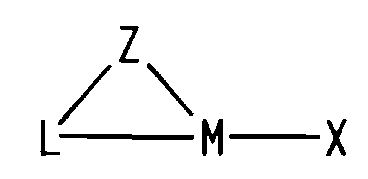 wobei die Schritte des Verfahrens umfassen:M Titan oder Zirkon in der formalen Oxidationsstufe +2 ist,L eine anionische Gruppe mit einem cyclischen delokalisierten π-System ist, durch das die Gruppe an M gebunden ist,Z eine zweibindige Einheit ist, die sowohl an L als auch an M gebunden ist und Bor oder ein Element der Gruppe 14 des Periodensystems der Elemente enthält und ebenfalls Stickstoff, Phosphor, Schwefel oder Sauerstoff enthält, wobei diese Einheit bis zu 60 Nichtwasserstoffatome aufweist, undX ein neutrales konjugiertes oder nichtkonjugiertes Dien ist, das gegebenenfalls mit einer oder mehreren Hydrocarbylgruppen substituiert ist, wobei X bis zu 40 Kohlenstoffatome aufweist und einen π-Komplex mit M bildet,1)odera) Inkontaktbringen einer konjugierten oder nichtkonjugierten C4- bis C40-Dienverbindung mit einem Metallkomplex, der der Formelentspricht, worin:
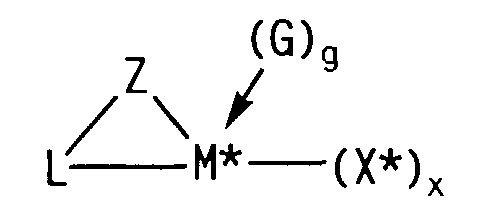 M* Titan oder Zirkon in der formalen Oxidationsstufe +3 oder +4 ist,X* unabhängig bei jedem Auftreten ein C1- bis C20-Hydrocarbyloxid ist,X = 1 oder 2 ist,G eine neutrale Lewis-Base, ausgewählt aus Aminen, Phosphinen und Ethern, ist, wobei G 3 bis 20 Nichtwasserstoffatome aufweist,L und Z wie vorgehend definiert sind undg eine Zahl von 0 bis 3 ist,in einem inerten Lösungsmittel undb) Inkontaktbringen der resultierenden Mischung mit einem Reduktionsmittel2)a) Inkontaktbringen einer konjugierten oder nichtkonjugierten C4- bis C40-Dienverbindung mit einem Reduktionsmittel in einem geeigneten nichtstörenden Lösungsmittel undb) Inkontaktbringen der resultierenden Mischung mit einem Komplex, der der Formelentspricht, worin:
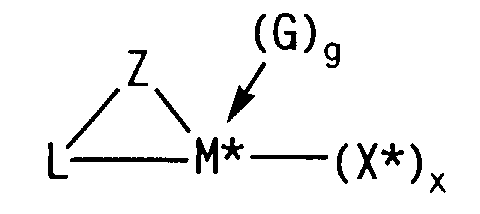
L, Z, M*, X*, x, G und g wie vorstehend definiert sind. - Verfahren nach Anspruch 1, worin X* Methoxy, Ethoxy, Isopropoxy, n-Butoxy oder t-Butoxy ist.
- Verfahren nach Anspruch 1 oder Anspruch 2, wobei dieses Metallkomplexprodukt der Formelentspricht, worin:
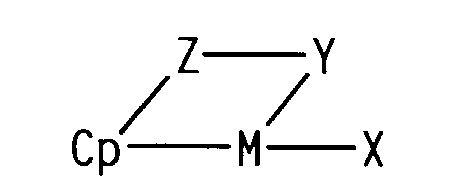 M und X wie in Anspruch 1 definiert sind,Cp eine C5H4-Gruppe ist, die an Z gebunden ist und in einem η5-Bindungsmodus an M gebunden ist oder eine solche η5-gebundene Gruppe ist, die mit einem bis vier Substituenten substituiert ist, die unabhängig voneinander ausgewählt sind aus Hydrocarbyl, Silyl, Germyl, Halogen, Cyano und Kombinationen davon, wobei diese Substituenten bis zu 20 Nichtwasserstoffatome aufweisen, und gegebenenfalls zwei solcher benachbarten Substituenten miteinander verbunden sind, was dazu führt, daß Cp eine anellierte Ringstruktur aufweist,Z gleich SiR*2, CR*2, SiR*2SiR*2, CR*2CR*2, CR*=CR*, CR*2SiR*2, GeR*2, BR* oder BR*2 ist, worin R* bei jedem Auftreten unabhängig voneinander ausgewählt ist aus Wasserstoff, Hydrocarbyl, halogenierten Hydrocarbyl und Silylgruppen mit bis zu 20 Nichtwasserstoffatomen und Mischungen davon oder zwei oder mehrere R*-Gruppen aus Z oder eine R*-Gruppe aus Z zusammen mit Y ein anelliertes Ringsystem bilden, undY eine zweibindige anionische Ligandengruppe ist, die Stickstoff, Phosphor, Sauerstoff oder Schwefel und bis zu 20 Nichtwasserstoffatome enthält, wobei Y an Z und M über diesen Stickstoff, Phosphor, Sauerstoff oder Schwefel gebunden ist.
- Verfahren nach Anspruch 3, worin Y eine stickstoff- oder phosphorhaltige Gruppe ist, die der Formel -N(R")- oder -P(R")-entspricht, worin R" ein C1- bis C10-Hydrocarbyl ist.
- Verfahren nach Anspruch 1 oder Anspruch 2, wobei die Hydrocarbyloxykomplexe der Formel entsprechen:und die resultierenden dienhaltigen Produkte der Formel entsprechen:
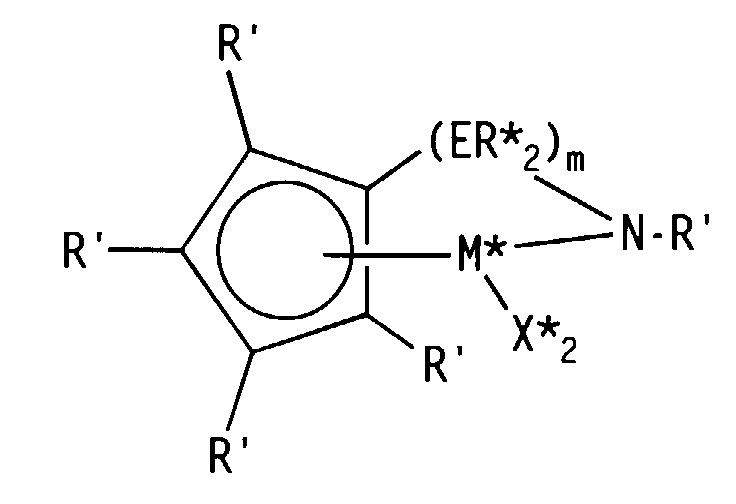 worin:
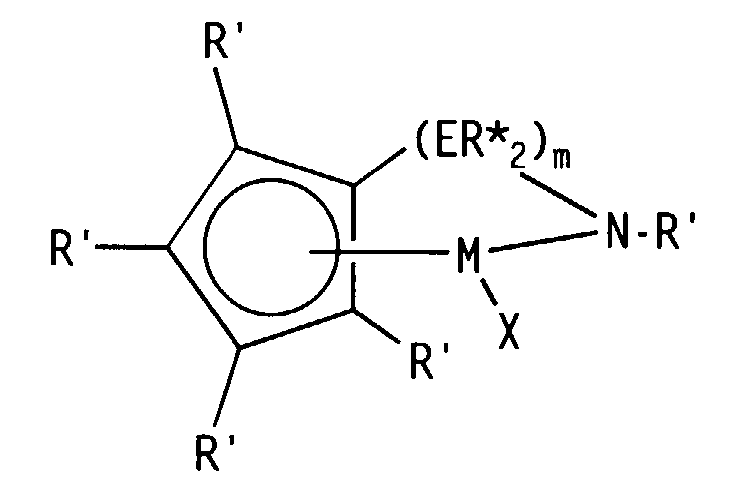 M, M*, X* und X wie in Anspruch 1 definiert sind,R* bei jedem Auftreten unabhängig voneinander ausgewählt ist aus Hydrocarbyl, Halogenhydrocarbyl und Silylgruppen mit bis zu 20 Nichtwasserstoffatomen und Mischungen davon undR" gleich C1- bis C10-Hydrocarbyl ist,R' bei jedem Auftreten unabhängig voneinander ausgewählt ist aus Wasserstoff, Silyl, Alkyl, Aryl, Germyl, Cyano, Halogen und Kombinationen davon mit bis zu 20 Nichtwasserstoffatomen oder zwei benachbarte R'-Gruppen zusammen ein zweibindiges Derivat davon bilden,E Silicium oder Kohlenstoff ist undm = 1 oder 2 ist.
- Verfahren nach Anspruch 1, worin das Dien 1,4-Diphenyl-1,3-butadien, 1,3-Pentadien, 1,4-Dibenzyl-1,3-butadien, 2,4-Hexadien, 3-Methyl-1,3-pentadien, 1,4-Ditolyl-1,3-butadien oder 1,4-Bis(trimethylsilyl)-1,3-butadien ist.
- Verfahren nach einem der vorstehenden Ansprüche, worin M und M* Titan sind.
- Verfahren nach Anspruch 5, worin:M und M* Titan sind,(EM*2)m Dimethylsilyl oder 1,2-Ethandiyl ist,R" Methyl, Ethyl, Propyl, Butyl, Pentyl, Hexyl (einschließlich aller Isomere wo möglich), Norbornyl, Benzyl oder Phenyl ist,L Cyclopentadienyl, Indenyl, Tetrahydroindenyl, Fluorenyl, Tetrahydrofluorenyl, Octahydrofluorenyl oder ein methylsubstituiertes Derivat davon ist undX 1,4-Diphenyl-1,3-butadien, 1,3-Pentadien, 1,4-Dibenzyl-1,3-butadien, 2,4-Hexadien, 3-Methyl-1,3-pentadien, 1,4-Ditolyl-1,3-butadien oder 1,4-Bis-(trimethylsilyl)-1,3-butadien ist.
- Verfahren nach einem der vorstehenden Ansprüche, worin das Reduktionsmittel ausgewählt ist aus Natriumnaphthalenid, Kaliumgraphit, Lithiumalkylen, Trihydrocarbylaluminiumverbindungen und Grignard-Reagenzien.
- Verfahren nach Anspruch 9, worin das Reduktionsmittel ausgewählt ist aus Alkalimetallen, Erdalkalimetallen, Trialkylaluminiumverbindungen mit 2 bis 8 Kohlenstoffatomen in jeder Alkylgruppe und C1- bis C8-Alkyllithiumverbindungen.
Applications Claiming Priority (3)
| Application Number | Priority Date | Filing Date | Title |
|---|---|---|---|
| US08/427,378 US5491246A (en) | 1995-04-24 | 1995-04-24 | Synthesis of group 4 metal diene complexes |
| US427378 | 1995-04-24 | ||
| PCT/US1995/012211 WO1996034001A1 (en) | 1995-04-24 | 1995-09-22 | Synthesis of group 4 metal diene complexes |
Publications (2)
| Publication Number | Publication Date |
|---|---|
| EP0822937A1 EP0822937A1 (de) | 1998-02-11 |
| EP0822937B1 true EP0822937B1 (de) | 2000-05-17 |
Family
ID=23694616
Family Applications (1)
| Application Number | Title | Priority Date | Filing Date |
|---|---|---|---|
| EP95933931A Expired - Lifetime EP0822937B1 (de) | 1995-04-24 | 1995-09-22 | Herstellung von metallkomplexen der 4. gruppe mit diene |
Country Status (12)
| Country | Link |
|---|---|
| US (1) | US5491246A (de) |
| EP (1) | EP0822937B1 (de) |
| JP (1) | JPH11504321A (de) |
| AT (1) | ATE193017T1 (de) |
| AU (1) | AU3640595A (de) |
| CO (1) | CO4410404A1 (de) |
| DE (1) | DE69517057T2 (de) |
| ES (1) | ES2145300T3 (de) |
| MY (1) | MY112187A (de) |
| TW (1) | TW343974B (de) |
| WO (1) | WO1996034001A1 (de) |
| ZA (1) | ZA958394B (de) |
Families Citing this family (15)
| Publication number | Priority date | Publication date | Assignee | Title |
|---|---|---|---|---|
| DE19522013A1 (de) * | 1995-06-21 | 1997-01-02 | Hoechst Ag | Übergangsmetallverbindung |
| AU2328497A (en) * | 1996-03-05 | 1997-09-22 | Massachusetts Institute Of Technology | Group 4 metal-containing organosilicon dendrimers |
| US6313239B1 (en) * | 1996-03-05 | 2001-11-06 | Bayer Corporation | Olefin polymerization with group 4 metal-containing organosilicon dendrimers |
| US6812289B2 (en) | 1996-12-12 | 2004-11-02 | Dow Global Technologies Inc. | Cast stretch film of interpolymer compositions |
| ATE223443T1 (de) | 1997-08-27 | 2002-09-15 | Dow Chemical Co | Elastomere mit verbesserter verarbeitbarkeit |
| DE69902638T2 (de) * | 1998-03-11 | 2003-04-24 | The Dow Chemical Co., Midland | Integriertes verfahren zur herstellung von dien-komplexen |
| EP1124834B1 (de) * | 1998-10-29 | 2002-11-06 | The Dow Chemical Company | Herstellung von titan(ii)- oder zirkon(ii)komplexe |
| US6479424B1 (en) | 1998-12-14 | 2002-11-12 | Bp Corporation North America Inc. | Fluxional catalysts and related ligands containing bulky substituents |
| US6015916A (en) * | 1999-02-02 | 2000-01-18 | Boulder Scientific Company | Constrained geometry metallocene catalyst complexes |
| US6369176B1 (en) | 1999-08-19 | 2002-04-09 | Dupont Dow Elastomers Llc | Process for preparing in a single reactor polymer blends having a broad molecular weight distribution |
| US6809209B2 (en) | 2000-04-07 | 2004-10-26 | Exxonmobil Chemical Patents Inc. | Nitrogen-containing group-13 anionic compounds for olefin polymerization |
| US6455719B1 (en) * | 2001-01-17 | 2002-09-24 | Boulder Scientific Company | Constrained geometry ligands and complexes derived therefrom |
| US6590114B2 (en) * | 2001-11-09 | 2003-07-08 | Boulder Scientific Company | Conversion of cyclopentadienyl silyl amines to organometallic complexes comprising titanium bisalkoxy moiety or titanium dichloride moiety |
| US6452031B1 (en) * | 2001-11-21 | 2002-09-17 | Boulder Scientific Company | Preparation of titanium organometallic complexes comprising a titanium bisalkoxide or dihalide moiety |
| KR101248423B1 (ko) * | 2011-06-09 | 2013-04-02 | 에스케이종합화학 주식회사 | 에틸렌 - α-올레핀 - 디엔 공중합체의 제조방법 |
Family Cites Families (9)
| Publication number | Priority date | Publication date | Assignee | Title |
|---|---|---|---|---|
| US5055438A (en) * | 1989-09-13 | 1991-10-08 | Exxon Chemical Patents, Inc. | Olefin polymerization catalysts |
| US5198401A (en) * | 1987-01-30 | 1993-03-30 | Exxon Chemical Patents Inc. | Ionic metallocene catalyst compositions |
| US5096867A (en) * | 1990-06-04 | 1992-03-17 | Exxon Chemical Patents Inc. | Monocyclopentadienyl transition metal olefin polymerization catalysts |
| US5153157A (en) * | 1987-01-30 | 1992-10-06 | Exxon Chemical Patents Inc. | Catalyst system of enhanced productivity |
| US5057475A (en) * | 1989-09-13 | 1991-10-15 | Exxon Chemical Patents Inc. | Mono-Cp heteroatom containing group IVB transition metal complexes with MAO: supported catalyst for olefin polymerization |
| US5064802A (en) * | 1989-09-14 | 1991-11-12 | The Dow Chemical Company | Metal complex compounds |
| US5374696A (en) * | 1992-03-26 | 1994-12-20 | The Dow Chemical Company | Addition polymerization process using stabilized reduced metal catalysts |
| JP2736938B2 (ja) * | 1993-06-24 | 1998-04-08 | ザ ダウ ケミカル カンパニー | チタン(▲ii▼)またはジルコニウム(▲ii▼)錯体およびそれからなる付加重合触媒 |
| US5372682A (en) * | 1993-06-24 | 1994-12-13 | The Dow Chemical Company | Electrochemical preparation of addition polymerization catalysts |
-
1995
- 1995-04-24 US US08/427,378 patent/US5491246A/en not_active Expired - Fee Related
- 1995-05-10 ZA ZA958394A patent/ZA958394B/xx unknown
- 1995-09-22 ES ES95933931T patent/ES2145300T3/es not_active Expired - Lifetime
- 1995-09-22 AT AT95933931T patent/ATE193017T1/de not_active IP Right Cessation
- 1995-09-22 DE DE69517057T patent/DE69517057T2/de not_active Expired - Fee Related
- 1995-09-22 WO PCT/US1995/012211 patent/WO1996034001A1/en not_active Ceased
- 1995-09-22 AU AU36405/95A patent/AU3640595A/en not_active Abandoned
- 1995-09-22 JP JP8532469A patent/JPH11504321A/ja not_active Ceased
- 1995-09-22 EP EP95933931A patent/EP0822937B1/de not_active Expired - Lifetime
- 1995-10-03 TW TW084110307A patent/TW343974B/zh active
- 1995-10-13 CO CO95048282A patent/CO4410404A1/es unknown
- 1995-10-16 MY MYPI95003104A patent/MY112187A/en unknown
Also Published As
| Publication number | Publication date |
|---|---|
| MY112187A (en) | 2001-04-30 |
| JPH11504321A (ja) | 1999-04-20 |
| CO4410404A1 (es) | 1997-01-09 |
| ATE193017T1 (de) | 2000-06-15 |
| DE69517057D1 (de) | 2000-06-21 |
| DE69517057T2 (de) | 2000-11-16 |
| US5491246A (en) | 1996-02-13 |
| ZA958394B (en) | 1997-04-07 |
| WO1996034001A1 (en) | 1996-10-31 |
| EP0822937A1 (de) | 1998-02-11 |
| AU3640595A (en) | 1996-11-18 |
| TW343974B (en) | 1998-11-01 |
| ES2145300T3 (es) | 2000-07-01 |
Similar Documents
| Publication | Publication Date | Title |
|---|---|---|
| CA2068938C (en) | Preparation of addition polymerization catalysts | |
| EP0741739B1 (de) | Synthese von cyclopentadienyl - metall - koordinationskomplexen aus metallhydrocarbyloxiden | |
| US5374696A (en) | Addition polymerization process using stabilized reduced metal catalysts | |
| US5350723A (en) | Process for preparation of monocyclopentadienyl metal complex compounds and method of use | |
| AU712417B2 (en) | Supported catalyst component, supported catalyst, preparation process, polymerization process, complex compounds, and their preparation | |
| EP0705269B1 (de) | Titan-und zirkoniumkomplexe und diese enthaltende polymerisationskatalysatoren | |
| US5470993A (en) | Titanium(II) or zirconium(II) complexes and addition polymerization catalysts therefrom | |
| US6153776A (en) | Bimetallic complexes and polymerization catalysts therefrom | |
| US5491246A (en) | Synthesis of group 4 metal diene complexes | |
| CA2134890A1 (en) | Preparation of addition polymerization catalysts via lewis acid mitigated metal center oxidation | |
| CA2204605C (en) | Improved preparation of titanium (ii) or zirconium (ii) complexes | |
| US5659054A (en) | Preparation of monocyclopentadienyl metal complexes by nucleophilic substitution of bis(cyclopentadienyl) metal complexes | |
| US6118013A (en) | Preparation of addition polymerization catalysts | |
| CA2247089A1 (en) | Heterocyclic metal complexes and olefin polymerization process | |
| US6160065A (en) | Yttrium containing metal complexes and olefin polymerization process | |
| US6090962A (en) | Preparation of titanium(II) or zirconium(II) complexes | |
| EP1124834B1 (de) | Herstellung von titan(ii)- oder zirkon(ii)komplexe | |
| EP0917543B1 (de) | Einen gesättigten tricyklischen ligand enthaltende metallkomplexe und verfahren zur polymerisation von olefinen | |
| EP1186611A2 (de) | Heterocyclische Metallkomplexe und Olefinpolymerisationsverfahren |
Legal Events
| Date | Code | Title | Description |
|---|---|---|---|
| PUAI | Public reference made under article 153(3) epc to a published international application that has entered the european phase |
Free format text: ORIGINAL CODE: 0009012 |
|
| 17P | Request for examination filed |
Effective date: 19971014 |
|
| AK | Designated contracting states |
Kind code of ref document: A1 Designated state(s): AT BE CH DE DK ES FR GB IT LI LU NL PT SE |
|
| RBV | Designated contracting states (corrected) |
Designated state(s): AT BE CH DE DK ES FR GB IT LI LU NL PT SE |
|
| GRAG | Despatch of communication of intention to grant |
Free format text: ORIGINAL CODE: EPIDOS AGRA |
|
| 17Q | First examination report despatched |
Effective date: 19990713 |
|
| GRAG | Despatch of communication of intention to grant |
Free format text: ORIGINAL CODE: EPIDOS AGRA |
|
| GRAH | Despatch of communication of intention to grant a patent |
Free format text: ORIGINAL CODE: EPIDOS IGRA |
|
| GRAH | Despatch of communication of intention to grant a patent |
Free format text: ORIGINAL CODE: EPIDOS IGRA |
|
| GRAA | (expected) grant |
Free format text: ORIGINAL CODE: 0009210 |
|
| AK | Designated contracting states |
Kind code of ref document: B1 Designated state(s): AT BE CH DE DK ES FR GB IT LI LU NL PT SE |
|
| PG25 | Lapsed in a contracting state [announced via postgrant information from national office to epo] |
Ref country code: IT Free format text: LAPSE BECAUSE OF FAILURE TO SUBMIT A TRANSLATION OF THE DESCRIPTION OR TO PAY THE FEE WITHIN THE PRESCRIBED TIME-LIMIT;WARNING: LAPSES OF ITALIAN PATENTS WITH EFFECTIVE DATE BEFORE 2007 MAY HAVE OCCURRED AT ANY TIME BEFORE 2007. THE CORRECT EFFECTIVE DATE MAY BE DIFFERENT FROM THE ONE RECORDED. Effective date: 20000517 |
|
| REF | Corresponds to: |
Ref document number: 193017 Country of ref document: AT Date of ref document: 20000615 Kind code of ref document: T |
|
| REG | Reference to a national code |
Ref country code: CH Ref legal event code: EP |
|
| REF | Corresponds to: |
Ref document number: 69517057 Country of ref document: DE Date of ref document: 20000621 |
|
| ET | Fr: translation filed | ||
| REG | Reference to a national code |
Ref country code: ES Ref legal event code: FG2A Ref document number: 2145300 Country of ref document: ES Kind code of ref document: T3 |
|
| REG | Reference to a national code |
Ref country code: CH Ref legal event code: NV Representative=s name: FIAMMENGHI-FIAMMENGHI |
|
| PG25 | Lapsed in a contracting state [announced via postgrant information from national office to epo] |
Ref country code: PT Free format text: LAPSE BECAUSE OF FAILURE TO SUBMIT A TRANSLATION OF THE DESCRIPTION OR TO PAY THE FEE WITHIN THE PRESCRIBED TIME-LIMIT Effective date: 20000817 Ref country code: DK Free format text: LAPSE BECAUSE OF FAILURE TO SUBMIT A TRANSLATION OF THE DESCRIPTION OR TO PAY THE FEE WITHIN THE PRESCRIBED TIME-LIMIT Effective date: 20000817 |
|
| PG25 | Lapsed in a contracting state [announced via postgrant information from national office to epo] |
Ref country code: LU Free format text: LAPSE BECAUSE OF NON-PAYMENT OF DUE FEES Effective date: 20000922 |
|
| PLBE | No opposition filed within time limit |
Free format text: ORIGINAL CODE: 0009261 |
|
| STAA | Information on the status of an ep patent application or granted ep patent |
Free format text: STATUS: NO OPPOSITION FILED WITHIN TIME LIMIT |
|
| 26N | No opposition filed | ||
| PGFP | Annual fee paid to national office [announced via postgrant information from national office to epo] |
Ref country code: SE Payment date: 20010615 Year of fee payment: 7 |
|
| PGFP | Annual fee paid to national office [announced via postgrant information from national office to epo] |
Ref country code: CH Payment date: 20010629 Year of fee payment: 7 |
|
| PGFP | Annual fee paid to national office [announced via postgrant information from national office to epo] |
Ref country code: AT Payment date: 20010709 Year of fee payment: 7 |
|
| PGFP | Annual fee paid to national office [announced via postgrant information from national office to epo] |
Ref country code: BE Payment date: 20010816 Year of fee payment: 7 |
|
| PGFP | Annual fee paid to national office [announced via postgrant information from national office to epo] |
Ref country code: ES Payment date: 20010904 Year of fee payment: 7 |
|
| REG | Reference to a national code |
Ref country code: GB Ref legal event code: IF02 |
|
| PG25 | Lapsed in a contracting state [announced via postgrant information from national office to epo] |
Ref country code: AT Free format text: LAPSE BECAUSE OF NON-PAYMENT OF DUE FEES Effective date: 20020922 |
|
| PG25 | Lapsed in a contracting state [announced via postgrant information from national office to epo] |
Ref country code: SE Free format text: LAPSE BECAUSE OF NON-PAYMENT OF DUE FEES Effective date: 20020923 Ref country code: ES Free format text: LAPSE BECAUSE OF NON-PAYMENT OF DUE FEES Effective date: 20020923 |
|
| PG25 | Lapsed in a contracting state [announced via postgrant information from national office to epo] |
Ref country code: LI Free format text: LAPSE BECAUSE OF NON-PAYMENT OF DUE FEES Effective date: 20020930 Ref country code: CH Free format text: LAPSE BECAUSE OF NON-PAYMENT OF DUE FEES Effective date: 20020930 Ref country code: BE Free format text: LAPSE BECAUSE OF NON-PAYMENT OF DUE FEES Effective date: 20020930 |
|
| BERE | Be: lapsed |
Owner name: THE *DOW CHEMICAL CY Effective date: 20020930 |
|
| EUG | Se: european patent has lapsed | ||
| REG | Reference to a national code |
Ref country code: CH Ref legal event code: PL |
|
| REG | Reference to a national code |
Ref country code: ES Ref legal event code: FD2A Effective date: 20031011 |
|
| PGFP | Annual fee paid to national office [announced via postgrant information from national office to epo] |
Ref country code: FR Payment date: 20040528 Year of fee payment: 10 |
|
| PGFP | Annual fee paid to national office [announced via postgrant information from national office to epo] |
Ref country code: NL Payment date: 20040530 Year of fee payment: 10 |
|
| PGFP | Annual fee paid to national office [announced via postgrant information from national office to epo] |
Ref country code: GB Payment date: 20040628 Year of fee payment: 10 |
|
| PGFP | Annual fee paid to national office [announced via postgrant information from national office to epo] |
Ref country code: DE Payment date: 20040810 Year of fee payment: 10 |
|
| PG25 | Lapsed in a contracting state [announced via postgrant information from national office to epo] |
Ref country code: GB Free format text: LAPSE BECAUSE OF NON-PAYMENT OF DUE FEES Effective date: 20050922 |
|
| PG25 | Lapsed in a contracting state [announced via postgrant information from national office to epo] |
Ref country code: NL Free format text: LAPSE BECAUSE OF NON-PAYMENT OF DUE FEES Effective date: 20060401 Ref country code: DE Free format text: LAPSE BECAUSE OF NON-PAYMENT OF DUE FEES Effective date: 20060401 |
|
| GBPC | Gb: european patent ceased through non-payment of renewal fee |
Effective date: 20050922 |
|
| PG25 | Lapsed in a contracting state [announced via postgrant information from national office to epo] |
Ref country code: FR Free format text: LAPSE BECAUSE OF NON-PAYMENT OF DUE FEES Effective date: 20060531 |
|
| NLV4 | Nl: lapsed or anulled due to non-payment of the annual fee |
Effective date: 20060401 |
|
| REG | Reference to a national code |
Ref country code: FR Ref legal event code: ST Effective date: 20060531 |