EP0823802A2 - Procédé de communication et d'authentification secrète basé sur un système cryptographique à clé secrète et utilisant une expansion n-ième - Google Patents
Procédé de communication et d'authentification secrète basé sur un système cryptographique à clé secrète et utilisant une expansion n-ième Download PDFInfo
- Publication number
- EP0823802A2 EP0823802A2 EP97113746A EP97113746A EP0823802A2 EP 0823802 A2 EP0823802 A2 EP 0823802A2 EP 97113746 A EP97113746 A EP 97113746A EP 97113746 A EP97113746 A EP 97113746A EP 0823802 A2 EP0823802 A2 EP 0823802A2
- Authority
- EP
- European Patent Office
- Prior art keywords
- authenticator
- adic
- encrypted
- public key
- plaintext
- Prior art date
- Legal status (The legal status is an assumption and is not a legal conclusion. Google has not performed a legal analysis and makes no representation as to the accuracy of the status listed.)
- Withdrawn
Links
Images

















Classifications
-
- H—ELECTRICITY
- H04—ELECTRIC COMMUNICATION TECHNIQUE
- H04L—TRANSMISSION OF DIGITAL INFORMATION, e.g. TELEGRAPHIC COMMUNICATION
- H04L9/00—Cryptographic mechanisms or cryptographic arrangements for secret or secure communications; Network security protocols
- H04L9/30—Public key, i.e. encryption algorithm being computationally infeasible to invert or user's encryption keys not requiring secrecy
- H04L9/3006—Public key, i.e. encryption algorithm being computationally infeasible to invert or user's encryption keys not requiring secrecy underlying computational problems or public-key parameters
- H04L9/302—Public key, i.e. encryption algorithm being computationally infeasible to invert or user's encryption keys not requiring secrecy underlying computational problems or public-key parameters involving the integer factorization problem, e.g. RSA or quadratic sieve [QS] schemes
-
- H—ELECTRICITY
- H04—ELECTRIC COMMUNICATION TECHNIQUE
- H04L—TRANSMISSION OF DIGITAL INFORMATION, e.g. TELEGRAPHIC COMMUNICATION
- H04L9/00—Cryptographic mechanisms or cryptographic arrangements for secret or secure communications; Network security protocols
- H04L9/32—Cryptographic mechanisms or cryptographic arrangements for secret or secure communications; Network security protocols including means for verifying the identity or authority of a user of the system or for message authentication, e.g. authorization, entity authentication, data integrity or data verification, non-repudiation, key authentication or verification of credentials
- H04L9/3247—Cryptographic mechanisms or cryptographic arrangements for secret or secure communications; Network security protocols including means for verifying the identity or authority of a user of the system or for message authentication, e.g. authorization, entity authentication, data integrity or data verification, non-repudiation, key authentication or verification of credentials involving digital signatures
- H04L9/3249—Cryptographic mechanisms or cryptographic arrangements for secret or secure communications; Network security protocols including means for verifying the identity or authority of a user of the system or for message authentication, e.g. authorization, entity authentication, data integrity or data verification, non-repudiation, key authentication or verification of credentials involving digital signatures using RSA or related signature schemes, e.g. Rabin scheme
Definitions
- the present invention relates to a public key cryptosystem in which an encryption key is publicly disclosed while a decryption key is kept in secret, and more particularly, to a secret communication and authentication scheme based on a public key cryptosystem which can improve a decryption speed while maintaining an equivalent security level as the known public key cryptosystem such as RSA (Rivest-Shamir-Adleman) cryptosystem and Rabin cryptosystem and resolving problems associated with the known public key cryptosystem.
- RSA Rastert-Shamir-Adleman
- the cryptographic techniques are indispensable for protecting communication contents from a wiretapping or a forgery.
- the public key cryptosystem which only requires a simple key management is effective and has been widely used.
- the representative public key cryptosystems include the RSA cryptosystem which uses the modular exponent calculation and the Rabin cryptosystem which uses the encryption function in a form of a quadratic polynomial in modulo a product of two prime numbers, both of which are already in practical use.
- (mod N) denotes a calculation in modulo N
- ⁇ denotes a congruence
- LCM denotes the least common multiplier
- GCD denotes the greatest common divisor
- [A] denotes the Gaussian symbol for the largest integer not exceeding a number A
- ⁇ (B) denotes a square root of a number B.
- An encryption key of the RSA cryptosystem is given by a set (e, N) and a corresponding decryption key is given by a set (d, N), where e and N are public keys and d is a secret key.
- M and C are integers in a range between 0 and N-1. If the original message is larger than N, the original message is to be divided into blocks of size N and the encryption and the decryption are to be applied block by block.
- L LCM(p-1, q-1)
- GCD(e, L) 1, 1 ⁇ e ⁇ L
- this generation procedure selects e at the second step first and then calculate d at the third step, but it is also possible to select d first and then calculate e if desired.
- the authenticated communication using the RSA cryptosystem is carried out as follows.
- a sender hashes an authentication message by using a hash function h so as to obtain an authenticator h(M).
- the authenticator h(M) is encrypted by using the own secret key d so as to obtain an encrypted authenticator h(C).
- the receiver decrypts the encrypted authenticator h(C) by using the public key e of the sender, so as to obtain the authenticator h(M). That is: h(M) ⁇ (h(C)) e (mod N)
- the received authentication message M is hashed by using the hash function h so as to obtain an authenticator h(M) o .
- the decrypted authenticator h(M) and the authenticator h(M) o obtained by hashing the authentication message M are compared to judge the authenticity. Namely, when they coincide the authentication message is judged as authentic and when they don't the authentication message is judged as not authentic.
- the RSA type public key cryptosystem device can also be used as an authenticated communication device by applying the public key calculation and the secret key calculation in reverse order.
- algorithm for the decryption D corresponds to the solving of the following equation (11) for M. M 2 + Mb - C ⁇ 0 (mod N)
- the decryption in the Rabin cryptosystem can be carried out only by an entity which knows the secret keys p and q. Also, the security of the Rabin cryptosystem relies on the difficulty in factoring N.
- the decryption D amounts to obtaining M which simultaneously satisfies both congruences (13) and (14), and can be expressed by the following equations (15) and (16).
- b/2 (mod p) in the equation (15) represents an integer s which satisfies 2s ⁇ b (mod p) .
- 2 and p are relatively prime so that it is always possible to obtain only one s.
- ⁇ ((b/2) 2 +C) (mod p) in the equation (15) represents a non-negative integer t which satisfies t 2 ⁇ (b/2) 2 +C (mod p) .
- t ((b/2) 2 +C) ⁇ +1 (mod p)
- the encryption function E of the Rabin cryptosystem is defined for all integers in a range of [0, N-1] as should be apparent from the above equation (10), so that every plaintext can be encrypted. Also, the encryption function E is a single-valued function, so that a ciphertext C ⁇ corresponding to a plaintext M ⁇ can be determined uniquely. However, the decryption function D is a multi-valued function, so that M ⁇ is not necessarily determined uniquely even when C ⁇ corresponding to M ⁇ is decrypted.
- a meaningful attribute information (such as a sender ID, a receiver ID, a date, etc.) is included in the original plaintext M ⁇ . Then, the receiver determines the true plaintext as a message containing this attribute information among decrypted messages M i (1 ⁇ i ⁇ 4).
- the decryption function D of the Rabin cryptosystem is defined for a part of integers in a range of [0, N-1]. That is, in the Rabin cryptosystem, it is not necessarily possible to realize the authenticated communication for an arbitrary plaintext M (0 ⁇ M ⁇ N-1).
- a condition required for realizing the authenticated communication is that the calculations of the equations (15) and (16) can be defined, or more specifically, that (b/2) 2 +M becomes the quadratic residue in mod p and mod q.
- each one of four signed messages S 1 , S 2 , S 3 and S 4 is obtained at nearly equal probability of 1/4.
- the plaintext M ⁇ can be recovered by applying the recovery processing to any of these four signed messages, so that it suffices to carry out a communication using any one signed message alone.
- the obtained transformation is denoted as f j * and the plaintext after the transformation is denoted as M j *.
- the receiver recovers M j * from S by using the public key, and also obtains M by further applying an inverse function f j * -1 of f j * to M j *. If M is a meaningful information, the authenticity of the sender can be verified.
- the Rabin type public key cryptosystem device can also be used as an authenticated communication device by applying the public key calculation and the secret key calculation in reverse order.
- the performance of the cryptographic technique is evaluated in terms of the security level against an attack that attempts to break the cryptosystem, and the speed of encryption/decryption.
- the cryptosystem with a high security level and a fast encryption/decryption speed can be considered as an excellent cryptosystem.
- the security of the public key cryptosystem such as the RSA cryptosystem and the Rabin cryptosystem is based on the fact that it is difficult to obtain the secret key that functions as the decryption key from the public key that functions as the encryption key because of an enormous amount of calculations required.
- the security of the public key cryptosystem such as the RSA cryptosystem relies on the computational difficulty in obtaining the secret key from the public key.
- the security level can also be increased accordingly.
- the RSA cryptosystem requires the higher degree modular exponent calculations, so that a major drawback of the RSA cryptosystem has been the fact that an amount of required calculations is large and the encryption/decryption is time consuming.
- the encryption/decryption can be made faster by reducing an amount of the modular exponent calculations, but this can only be done by reducing a size of the public key and this in turn leads to a lowering of the security level of the cryptosystem.
- this situation corresponds to a case of sending the same plaintext to plural correspondents (a case of multicast communication), a case of having a polynomial relationship between two plaintexts, a case of using a small number of bits in the plaintext, etc.
- the characteristic of the Rabin cryptosystem is that the encryption is fast.
- the known public key cryptosystem including the Rabin cryptosystem in a case of carrying out a secret communication of the plaintext with a data length exceeding that of the public key, it has been necessary to divide the plaintext into blocks in the size of the public key (or twice the size of the public key in two dimensional case) and encrypt each block separately.
- a length of the public key dictated a unit of secret communication.
- the Rabin cryptosystem has been associated with a drawback that it is very weak against the partial cryptanalysis.
- the Rabin cryptosystem can be easily cryptanalyzed in a case of multicast communication, a case of having a polynomial relationship between two plaintexts, a case of using a small number of bits in the plaintext, etc. (see references [2], [3] and [4] quoted above).
- the computer readable program code means including: first computer readable program code means for causing said computer to divide the plaintext into k plaintext blocks of a block size within a range of a residue class of n; second computer readable program code means for causing said computer to form a k-digit n-adic number by sequentially coupling the plaintext blocks so that different digits of the n-adic number correspond to different plaintext blocks; and third computer readable program
- the device comprising: a plaintext division unit for dividing the plaintext into k plaintext blocks of a block size within a range of a residue class of n; a data coupling unit for forming a k-digit n-adic number by sequentially coupling the plaintext blocks so that different digits of the n-adic number correspond to different plaintext blocks; and an encryption unit for obtaining the ciphertext as an e-th power of the n-adic number in modulo n k .
- the device comprising: a data coupling unit for sequentially coupling authenticator blocks dividing the encrypted authenticator to obtain an encrypted n-adic authenticator h(C) so that different digits of the encrypted n-adic authenticator h(C) correspond to different authenticator blocks; an authenticator decryption unit for obtaining a decrypted authenticator h(M) as an e-th power of the encrypted n-adic authenticator h(C) in modulo n k ; an authentication message hashing unit for obtaining an authenticator h(M)' by hash
- the computer readable program code means including: first computer readable program code means for causing said computer to divide the plaintext into k plaintext blocks of a block size within a range of a residue class of n; second computer readable program code means for causing said computer to form a k-digit n-adic number by sequentially coupling the plaintext blocks so that different digits of the n-adic number correspond to different plaintext blocks; and third computer readable program code means for causing said computer to obtain the ciphertext as a square
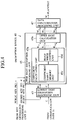
- Fig. 1 is a block diagram of an RSA type secret communication system in the first embodiment of a secret communication and authentication scheme based on a public key cryptosystem according to the present invention.
- Fig. 2 is a flow chart for the operation of a key generation processing unit in the secret communication system of Fig. 1.
- Fig. 3 is a flow chart for the operation of a plaintext division processing unit in the secret communication system of Fig. 1.
- Fig. 4 is a block diagram of a decryption device in the secret communication system of Fig. 1.
- Fig. 5 is a flow chart for a key generation processing by a key generation processing unit in the secret communication system of Fig. 1.
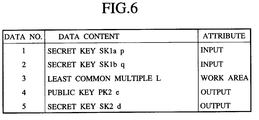
- Fig. 6 is a table indicating a data arrangement on a memory in the key generation processing according to the flow chart of Fig. 5.
- Fig. 7 is a flow chart for an encryption and transmission processing by an encryption device in the secret communication system of Fig. 1.
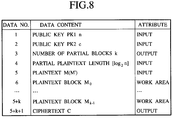
- Fig. 8 is a table indicating a data arrangement on a memory in the encryption and transmission processing according to the flow chart of Fig. 7.
- Fig. 9 is a flow chart for a reception and decryption processing by a decryption device in the secret communication system of Fig. 1.
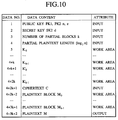
- Fig. 10 is a table indicating a data arrangement on a memory in the reception and decryption processing according to the flow chart of Fig. 9.
- Fig. 11 is a block diagram of an RSA type secret communication system according to onemodification of the first embodiment of the present invention.
- Fig. 12 is a block diagram of an RSA type authentication system in the second embodiment of a secret communication and authentication scheme based on a public key cryptosystem according to the present invention.
- Fig. 13 is a block diagram of an authentication message generation device in the authentication system of Fig. 12.
- Fig. 14 is a flow chart for a part of an authentication message generation processing by the authentication message generation device in the authentication system of Fig. 12.
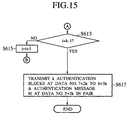
- Fig. 15 is a flow chart for another part of an authentication message generation processing by the authentication message generation device in the authentication system of Fig. 12.
- Fig. 16 is a table indicating a data arrangement on a memory in the authentication message generation processing according to the flow charts of Fig. 14 and Fig. 15.
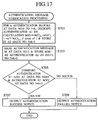
- Fig. 17 is a flow chart for an authentication message verification processing by an authentication message verification device in the authentication system of Fig. 12.
- Fig. 18 is a table indicating a data arrangement on a memory in the authentication message verification processing according to the flow chart of Fig. 17.
- Fig. 19 is a block diagram of a Rabin type secret communication system in the third embodiment of a secret communication and authentication scheme based on a public key cryptosystem according to the present invention.
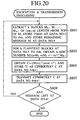
- Fig. 20 is a flow chart for an encryption and transmission processing by an encryption device in the secret communication system of Fig. 19.
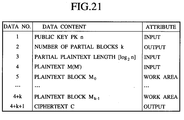
- Fig. 21 is a table indicating a data arrangement on a memory in the encryption and transmission processing according to the flow chart of Fig. 20.
- Fig. 22 is a flow chart for a reception and decryption processing by a decryption device in the secret communication system of Fig. 19.
- Fig. 23 is a flow chart for a plaintext block decryption step in the reception and decryption processing according to the flow chart of Fig. 22.
- Fig. 24 is a table indicating a data arrangement on a memory in the reception and decryption processing according to the flow chart of Fig. 22.
- Fig. 25 is a block diagram of a Rabin type secret communication system according to one modification of the third embodiment of the present invention.
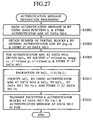
- Fig. 26 is a block diagram of a Rabin type authentication system in the fourth embodiment of a secret communication and authentication scheme based on a public key cryptosystem according to the present invention.
- Fig. 27 is a flow chart for an authentication message generation processing by the authentication message generation device in the authentication system of Fig. 26.
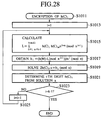
- Fig. 28 is a flow chart for an authenticator block encryption step in the authentication message generation processing according to the flow chart of Fig. 27.
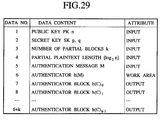
- Fig. 29 is a table indicating a data arrangement on a memory in the authentication message generation processing according to the flow chart of Fig. 27.
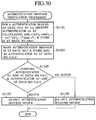
- Fig. 30 is a flow chart for an authentication message verification processing by an authentication message verification device in the authentication system of Fig. 26.
- Fig. 31 is a table indicating a data arrangement on a memory in the authentication message verification processing according to the flow chart of Fig. 30.
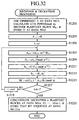
- Fig. 32 is a flow chart for an RSA type reception and decryption processing in the fifth embodiment of a secret communication and authentication scheme based on a public key cryptosystem according to the present invention.
- Fig. 33 is a table indicating a data arrangement on a memory in the reception and decryption processing according to the flow chart of Fig. 32.
- Fig. 34 is a flow chart for an RSA type authentication message generation processing in the fifth embodiment of a secret communication and authentication scheme based on a public key cryptosystem according to the present invention.
- Fig. 35 is a table indicating a data arrangement on a memory in the authentication message generation processing according to the flow chart of Fig. 34.
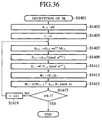
- Fig. 36 is a flow chart for a Rabin type reception and decryption processing in the fifth embodiment of a secret communication and authentication scheme based on a public key cryptosystem according to the present invention.
- Fig. 37 is a table indicating a data arrangement on a memory in the reception and decryption processing according to the flow chart of Fig. 36.
- Fig. 38 is a flow chart for a Rabin type authentication message generation processing in the fifth embodiment of a secret communication and authentication scheme based on a public key cryptosystem according to the present invention.
- Fig. 39 is a table indicating a data arrangement on a memory in the authentication message generation processing according to the flow chart of Fig. 39.
- Fig. 40 is a table summarizing differences between the RSA type N-adic public key cryptosystem and the Rabin type N-adic public key cryptosystem according to the present invention.
- N-adic number or base N will also be denoted as n-adic number or base n.
- This first embodiment is directed to an RSA type secret communication system in which the N-adic public key cryptosystem of the present invention is applied to the RSA type public key cryptosystem.
- Fig. 1 shows a configuration of a secret communication system 11 according to the first embodiment, which comprises a key generation processing unit 21, an encryption device 31, a decryption device 41, and a communication path 51.
- the key generation processing unit 21 has a key generation function equivalent to that of the known public key cryptosystem, and can be provided as an independent device or contained within the decryption device 41 as will be described below.
- the Encryption device 31 generates a ciphertext C obtained by encrypting a plaintext M and transmits the ciphertext C to the decryption device 41 through the communication path 51, and further comprises a plaintext division processing unit 33, a data coupling processing unit 35, and an encryption processing unit 37.
- the plaintext division processing unit 33 generates partial plaintexts (M ⁇ , M 1 , ⁇ , M k-1 ) by dividing the plaintext M into k blocks of a block size within a range of the residue class of n, and supplies these partial plaintexts to the data coupling processing unit 35.
- the data coupling processing unit 35 obtains a k-digit n-adic number M(n) in which a value of an i-th digit corresponds to an i-th partial plaintext block M i (0 ⁇ i ⁇ k-1), by coupling the partial plaintext block data according to the following equation (23), and supplies this n-adic number M(n) to the encryption processing unit 37.
- M(n) M ⁇ + nM 1 + n 2 M 2 + ⁇ + n k-1 M k-1
- the encryption processing unit 37 encrypts the n-adic number M(n) supplied from the data coupling processing unit 35 by using the public key PK2: e of the receiver according to the following congruence (24), and transmits the encrypted n-adic number as the ciphertext C to the decryption device 41 through the communication path 51.
- the decryption device 41 decrypts the partial plaintexts (M ⁇ , M 1 , ⁇ , M k-1 ) from the ciphertext C received through the communication path 51 and recovers the original plaintext M by concatenating these partial plaintexts, and further comprises a lowest digit decryption processing unit 43, an upper digit decryption processing unit 45, and a data concatenation processing unit 47.
- the lowest digit decryption processing unit 43 decrypts the lowest digit, i.e., the block M ⁇ , by using the own secret key SK2: d according to the following congruence (25), and supplies the decrypted block M ⁇ to the upper digit decryption processing unit 45.
- the upper digit decryption processing unit 45 sequentially decrypts the upper digits, i.e., the blocks M 1 , M 2 , ⁇ , M k-1 , other than the lowest digit M ⁇ , by solving the linear modular equations in modulo n while utilizing M ⁇ , and supplies these decrypted blocks along with M ⁇ to the data concatenation processing unit 47.
- the data concatenation processing unit 47 recovers the original plaintext M by concatenating the decrypted partial plaintexts (M ⁇ , M 1 , ⁇ , M k-1 ) together.
- the operation of the key generation processing unit 21 is carried out according to the flow chart of Fig. 2 as follows. Note that a pair of the secret key and the public key generated by the key generation processing unit 21 is utilizable for both the secret communication and the authentication, so that the encryption/decryption keys and the authentication message generation/authentication message verification keys will not be distinguished in the following.
- L LCM(p-1, q-1) where LCM is a function for obtaining the least common multiplier.
- step S102 ed that satisfy the following equation (27) are obtained (step S102).
- ed ⁇ 1 (mod L)
- d is set as the secret key SK2
- e is set as the public key PK2.
- a control variable i is initially set to 0 (step S201). Then, a block M i of a bit length [log 2 n] is extracted from a top of M, and a remaining bit sequence is set as a new M (step S203). Then, i and k-1 are compared (step S205), and when they are not equal, i is incremented by 1 (step S207) and the operation returns to the step S203. On the other hand, when i and k-1 are equal at the step S205, M ⁇ , M 1 , ⁇ , M k-1 are outputted to the data coupling processing unit 35 (step S209). Then, whether M is empty or not is judged (step S211), and when it is not empty, the operation returns to the step S201. When it is empty, the operation is terminated.
- the padding for the last block can be provided in the usual form of inserting blanks or 0s, or in a form of inserting randomly generated random numbers.
- the data coupling processing unit 35 obtains a k-digit n-adic number M(n) in which a value of an i-th digit corresponds to an i-th partial plaintext block M i (0 ⁇ i ⁇ k-1), by coupling the partial plaintext block data according to the following equation (28), and supplies this n-adic number M(n) to the encryption processing unit 37.
- M(n) M ⁇ + nM 1 + n 2 M 2 + ⁇ + n k-1 M k-1
- the encryption processing unit 37 encrypts the n-adic number M(n) supplied from the data coupling processing unit 35 by using the public key PK2: e and the public key PK1: n of the receiver according to the following congruence (29), and transmits the encrypted n-adic number as the ciphertext C to the decryption device 41 through the communication path 51.
- the lowest digit decryption processing unit 43 of the decryption device 41 decrypts the lowest digit of the n-adic number, i.e., the block M ⁇ , by calculating the following congruence (30) with respect to the received ciphertext C using the public key PK1: n and the secret key SK2: d. M ⁇ ⁇ C d (mod n)
- This decryption function is the same decryption function as in the usual RSA type public key cryptosystem, so that it can be said that the decryption of M ⁇ has the equivalent security level as the known RSA type public key cryptosystem.
- the upper digit decryption processing unit 45 of the decryption device 41 further comprises a coefficient calculation unit 45a and an upper digit calculation unit 45b.
- the coefficient calculation unit 45a further includes a coefficient table memory unit 45c and a read/write control unit 45d for controlling read/write with respect to the coefficient table memory unit 45c.
- the upper digits M i (1 ⁇ i ⁇ k-1) other than the lowest digit M ⁇ can be decrypted recursively by solving the linear modular equations at the upper digit calculation unit 45b, from the following congruence (31) for the encryption.
- K ⁇ , K 1 , K 2 , ⁇ , K k-1 are polynomial functions with M ⁇ , M 1 , M 2 , ⁇ , M k-1 as variables, that can output integer values upon entering values of M ⁇ , M 1 , M 2 , ⁇ , M k-1 . More specific forms of K ⁇ , K 1 , K 2 , ⁇ , K k-1 will be described below. Note that K k , K k+1 , ⁇ , K e(k-1) will not be considered here as they are not used in the decryption processing.
- K' i K i - eM ⁇ e-1 M i (1 ⁇ i ⁇ k-1)
- K' 1 , K' 2 , ⁇ , K' k-1 are polynomial functions with M ⁇ , M 1 , M 2 , ⁇ , M k-2 as variables, that can output integer values upon entering values of M ⁇ , M 1 , M 2 , ⁇ , M k-2 .
- K' i does not depend on a value of M i .
- K ⁇ and K' 1 are polynomial functions with only M ⁇ as a variable, so that they can output integer values upon entering M ⁇ decrypted prior to this point.
- K ⁇ and K' 1 define b 1 according to the following congruence (34).
- M 1 can be decrypted by obtaining x that satisfies the following congruence (35).
- K ⁇ , K 1 and K' 2 are polynomial functions with only M ⁇ and M 1 as variables, so that they can output integer values upon entering M ⁇ and M 1 decrypted prior to this point.
- K ⁇ , K 1 and K' 2 define b 2 according to the following congruence (36).
- M 2 can be decrypted by obtaining x that satisfies the following congruence (37).
- M 3 , M 4 , ⁇ can be decrypted in substantially the similar manner.
- K ⁇ , k 1 , ⁇ , K k-2 and K' k-1 are polynomial functions with only M ⁇ , M 1 , ⁇ , M k-2 as variables, so that they can output integer values upon entering M ⁇ , M 1 , ⁇ , M k-2 decrypted prior to this point.
- K ⁇ , K 1 , ⁇ , K k-2 , K' k-1 define b k-1 according to the following congruence (38).
- M k-1 can be decrypted by obtaining x that satisfies the following congruence (39).
- K 2 e C 2 M ⁇ e-2 M 1 2 + eM ⁇ e-1 M 2
- K 3 e C 3 M ⁇ e-3 M 1 3 + 2 e C 2 M ⁇ e-1 M 1 M 2 + eM ⁇ e-1 M 3
- K 4 e C 4 M ⁇ e-4 M 1 4 + 3 e C 3 M ⁇ e-3 M 1 2 M 2 + e C 2 M ⁇ e-2 M 2 2 + eM ⁇ e-1 M 4
- K 5 e C 5 M ⁇ e-5 M 1 5 + 4 e C 4 M ⁇ e-4 M 1 3 M 2 + 3 e C 3 M ⁇ e-3 M 1 M 2 2 + 2 e C 2 M ⁇ e-2 M 2 M 3 + 2 e C 2 M ⁇
- the data concatenation processing unit 47 recovers the original plaintext M by concatenating the decrypted partial plaintexts (M ⁇ , M 1 , ⁇ , M k-1 ) in an order as obtained by the lowest digit decryption processing unit 43 and the upper digit decryption processing unit 45.
- Fig. 5 shows the flow chart for the key generation processing in a case of applying the n-adic public key cryptosystem of the present invention to the RSA type public key cryptosystem
- Fig. 6 shows a table indicating the data arrangement on a memory in this key generation processing.
- an attribute column is provided to indicate a data attribute so as to distinguish input, work area, and output in each processing.
- Fig. 7 shows the flow chart for the encryption and transmission processing by the encryption device 31, while Fig. 8 shows a table indicating the data arrangement on a memory in this encryption and transmission processing.
- the public key PK1: n and the public key PK2: e are given at data numbers 1 and 2 respectively, and the partial plaintext length [log 2 n] and the plaintext M are given at data numbers 4 and 5 respectively.
- a number of partial blocks k is to be obtained as a result of the division, but it is also possible to provide a predetermined number from the beginning and carry out the encryption for this predetermined number of partial blocks.
- the plaintext M at the data number 5 is read out first, and k plaintext blocks M i (0 ⁇ i ⁇ k-1) of a bit length [log 2 n] each are extracted from a top of M. Then, these plaintext blocks are sequentially stored at data numbers 6 to 5+k, while the remaining message M' is stored at a data number 5 (step S401).
- the n-adic number M(n) M ⁇ + nM 1 + n 2 M 2 + ⁇ + n k-1 M k-1 is obtained (step S403).
- step S409 whether there is any message left at the data number 5 or not is checked (step S409), and if there is, the operation returns to the step S401, whereas otherwise the operation is terminated.
- Fig. 9 shows the flow chart for the reception and decryption processing by the decryption device 41
- Fig. 10 shows a table indicating the data arrangement on a memory in this reception and decryption processing.
- the public key PK1: n and the public key PK2: e are given at a data number 1
- the secret key SK2: d is given at a data number 2
- the number of partial blocks k and the partial plaintext length [log 2 n] are given at data numbers 3 and 4 respectively.
- the ciphertext C is given at a data number 4+2k+1, while data numbers 5 to 4+2k and 4+2k+2 to 4+3k+1 will be used as the work areas, and the decrypted plaintext will be stored at a data number 4+3k+2.
- a repetition parameter i for the purpose of sequentially obtaining the upper digits in the n-adic expression is initially set to 1 (step S505).
- the coefficient K i-1 that is the polynomial function with M ⁇ , M 1 , ⁇ , M i-1 as variables is calculated by using M ⁇ , M 1 , ⁇ , M i-1 that are obtained earlier, and its value (integer value) is stored at a data number 4+i (step S506).
- K' i that is the polynomial function with M ⁇ , M 1 , ⁇ , M i-1 as variables is calculated by using M ⁇ , M 1 , ⁇ , M i-1 that are obtained earlier, and its value (integer value) is stored at a data number 5+k+i (step S506).
- a value b i defined by the following congruence (44) is calculated (step S507).
- the decrypted M i is calculated by obtaining x that satisfies the following congruence (45), and the decrypted M i is stored at a data number 4+2k+2+i (step S509).
- This modification is directed to a case of providing a random number block R at a top of a plurality of plaintext blocks M i so as to replace M ⁇ of the above description by R.
- This can be considered as a case of applying the encryption with respect to R
- Fig. 11 shows a configuration of a secret communication system 12 according to this modification, which comprises a key generation processing unit 21, an encryption device 30, a decryption device 41, and a communication path 51.
- the elements other than the encryption device 30 are substantially the same as in Fig. 1 so that their description will be omitted.
- the encryption device 30 generates a ciphertext C obtained by encrypting a top block R and subsequent plaintext blocks M 1 , M 2 , ⁇ , M k-1 and transmits the ciphertext C to the decryption device 41 through the communication path 51, and further comprises a random number generation unit 32, a plaintext division processing unit 34, a data coupling processing unit 35, and an encryption processing unit 37.
- This encryption device 30 of Fig. 11 differs from the encryption device 31 of Fig. 1 in that the random number generation unit 32 is additionally provided and that the random number R and the plaintext M are entered into the plaintext division processing unit 34.
- the random number generation unit 32 generates the random number R in a length equal to the partial plaintext length of [log 2 n] bits.
- This random number may very well be a reproducible pseudo-random number that can be generated mathematically or logically, or a non-reproducible random number. Also, there is no need to share this random number R with the decryption device 41, so that it is also possible to use a mathematically or logically non-reproducible random number generation means such as that which utilizes the white noise.
- the plaintext division processing unit 34 concatenates the random number R supplied from the random number generation unit 32 to a top of the entered plaintext M to form R
- the random number R is positioned in place of the top block M ⁇ of the partial plaintexts used in the embodiment of Fig. 1. This can be considered as placing the random number R of a [log 2 n] bit length at a top of the bit sequence of the plaintext M to form R
- M(n) R + nM 1 + n 2 M 2 + ⁇ + n k-1 M k-1
- the encryption processing unit 37 encrypts the n-adic number M(n) supplied from the data coupling processing unit 35 by using the public key PK2: e of the receiver according to the following congruence (47), and transmits the encrypted n-adic number as the ciphertext C to the decryption device 41 through the communication path 51.
- the decryption device 41 decrypts the partial plaintexts (R, M 1 , ⁇ , M k-1 ) from the ciphertext C received through the communication path 51 and recovers the original plaintext M by concatenating these partial plaintexts, and further comprises a lowest digit decryption processing unit 43, an upper digit decryption processing unit 45, and a data concatenation processing unit 47 similarly as in Fig. 1.
- the lowest digit decryption processing unit 43 decrypts the lowest digit, i.e., the random number R, by using the own secret key SK2: d according to the following congruence (48), and supplies the decrypted random number R to the upper digit decryption processing unit 45.
- the upper digit decryption processing unit 45 sequentially decrypts the upper digits, i.e., the blocks M 1 , M 2 , ⁇ , M k-1 , other than the lowest digit R, by solving the linear modular equations in modulo n while utilizing R, and supplies these decrypted blocks to the data concatenation processing unit 47.
- the data concatenation processing unit 47 recovers the original plaintext M by concatenating the decrypted partial plaintexts (M 1 , ⁇ , M k-1 ) together.
- the random number R is not necessary as a message in this case, so that the random number R may be discarded after being utilized in the decryption by the upper digit decryption processing unit 45.
- This second embodiment is directed to an RSA type authentication system in which the N-adic public key cryptosystem of the present invention is applied to the RSA type public key cryptosystem.
- Fig. 12 shows a configuration of an authentication system 111 according to the second embodiment, which comprises a key generation processing unit 21, an authentication message generation device 131, an authentication message verification device 141, and a communication path 51.
- This authentication system 111 of Fig. 12 realizes the authentication scheme in which a person who wishes to carry out the authentication transmits to a receiver an authenticator which is generated by encrypting an authentication message by using his own secret key, according to the N-adic public key cryptosystem of the present invention.
- the authentication message generation device 131 further comprises an authentication message hashing processing unit 133, a lowest digit encryption processing unit 135, an upper digit encryption processing unit 137, and a data concatenation processing unit 139.
- the authentication message hashing processing unit 133 hashes the authentication message M by using a hash function h, so as to obtain the authenticator h(M).
- h(M) 0 ⁇ h(M) ⁇ n k .
- the lowest digit encryption processing unit 135 obtains the lowest digit of the authenticator in the n-adic expression by encrypting the authenticator h(M) according to the following congruence (52) using the public key PK1: n and the secret key SK2: d of the sender. h(C) ⁇ ⁇ h(M) d (mod n)
- the upper digit encryption processing unit 137 further comprises a coefficient calculation unit 137a and an upper digit calculation unit 137b
- the coefficient calculation unit 137a further includes a coefficient table memory unit 137c and a read/write control unit 137d for controlling read/write with respect to the coefficient table memory unit 137c.
- This upper digit decryption processing unit 137 calculates the upper digits h(C) 1 , h(C) 2 , ⁇ , h(C) k-1 other than the lowest digit of the authenticator in the n-adic expression, by solving the same linear modular equations as used in the decryption device 41 of Fig. 1 at the upper digit calculation unit 137b.
- the data concatenation processing unit 139 generates the encrypted authenticator A1(h(C) ⁇ , h(C) 1 , ⁇ , h(C) k-1 ) by concatenating the lowest digit and the upper digits of the authenticator in the n-adic expression. Then, a set of this encrypted authenticator A1 and the authentication message M is transmitted to the authentication message verification device 141 at the receiver side through the communication path 51.
- the authentication message verification device 141 further comprises a data coupling processing unit 143, an authenticator decryption processing unit 145, an authentication message hashing processing unit 147, and a matching judgement processing unit 149.
- the data coupling processing unit 143 couples the received blocks of the encrypted authenticator A1 as numerical values indicating respective digits of the n-adic number, so as to generate the n-adic number (h(C) ⁇ + nh(C) 1 + ⁇ + n k-1 h(C) k-1 ) .
- the authenticator decryption processing unit 145 decrypts the authenticator A1 by calculating the following congruence (53) by using the public key PK2: e of the sender. h(M) ⁇ (h(C) ⁇ + nh(C) 1 + ⁇ + n k-1 h(C) k-1 ) e (mod n k ) e
- the authentication message hashing processing unit 147 hashes the authentication message M by using the hash function h so as to obtain the hashed authentication message h(M) as an authenticator A2.
- the matching judgement processing unit 149 compares the authenticator A1 and the authenticator A2, and judges that the authentication is successful when they match, or that the authentication is unsuccessful when they do not match, so as to judge the authenticity of the authentication message.
- Fig. 14 and Fig. 15 show the flow chart for the authentication message generation processing in a case of applying the n-adic public key cryptosystem of the present invention to the RSA type public key cryptosystem, while Fig. 16 shows a table indicating the data arrangement on a memory in this authentication message generation processing.
- the public key PK1: n and the public key PK2: e are given at a data number 1
- the secret key SK2: d is given at a data number 2
- the number of partial blocks k and the partial plaintext length [log 2 n] are given at data numbers 3 and 4 respectively.
- the authentication message M is given at a data number 5+2k, while data numbers 5 to 4+2k and 6+2k will be used as the work areas, and the processing result of the encrypted authenticator blocks will be stored at data numbers 7+2k to 6+3k.
- the hashing using the hash function h is carried out, and the resulting authenticator h(M) is stored at a data number 6+2k (step S601).
- the encryption processing using the d-th power calculation in modulo n is carried out by using the own secret key SK2: d, and the resulting h(C) ⁇ which is the lowest digit of the authenticator in the n-adic expression is stored at a data number 7+2k (step S603).
- a repetition parameter i for the purpose of sequentially obtaining the upper digits in the n-adic expression is initially set to 1 (step S607).
- the coefficient K i-1 that is the polynomial function with h(C) ⁇ , h(C) 1 , ⁇ , h(C) i-1 as variables is calculated by using h(C) ⁇ , h(C) 1 , ⁇ , h(C) i-1 that are obtained earlier, and its value (integer value) is stored at a data number 4+i (step S608).
- K' i that is the polynomial function with h(C) ⁇ , h(C) 1 , ⁇ , h(C) i-1 as variables is calculated by using h(C) ⁇ , h(C) 1 , ⁇ , h(C) i-1 that are obtained earlier, and its value (integer value) is stored at a data number 5+k+i (step S608).
- a value b i defined by the following congruence (54) is calculated (step S609).
- the encrypted h(C) i is calculated by obtaining x that satisfies the following congruence (55), and the encrypted h(C) i is stored at a data number 7+2k+i (step S611). eh(C) ⁇ e-1 x ⁇ b i (mod n)
- Fig. 17 shows the flow chart for the authentication message verification processing in a case of applying the n-adic public key cryptosystem of the present invention to the RSA type public key cryptosystem
- Fig. 18 shows a table indicating the data arrangement on a memory in this authentication message verification processing.
- the public key PK1: n and the public key PK2: e are given at data numbers 1 and 2 respectively, and the number of partial blocks k and the partial plaintext length [log 2 n] are given at data numbers 3 and 4 respectively.
- the authentication message M in a form of the plaintext is given at a data number 5, and the encrypted authenticator blocks are given at data numbers 6 to 5+k, while data numbers 5+k+1 and 5+k+2 are work areas.
- the authenticator A1 is decrypted by calculating the following congruence (56) in modulo n k , and the decrypted authenticator A1 is stored at a data number 5+k+1 (step S701).
- step S703 With respect to the authentication message M at the data number 5, the hashing using the hash function h is carried out, and the resulting h(M)' is stored as the authenticator A2 at a data number 5+k+2 (step S703).
- step S705 the decrypted authenticator A1: h(M) at the data number 5+k+1 and the authenticator A2; h(M)' at the data number 5+k+2 obtained by the hashing are compared (step S705). When they match, the authentication success indication is outputted (step S707) whereas otherwise the authentication failure notice is outputted (step S709), and the operation is terminated.
- This third embodiment is directed to a Rabin type secret communication system in which the N-adic public key cryptosystem of the present invention is applied to the Rabin type public key cryptosystem.
- Fig. 19 shows a configuration of a secret communication system 211 according to the third embodiment, which comprises a key generation processing unit 21, an encryption device 231, a decryption device 241, and a communication path 51.
- the Encryption device 231 generates a ciphertext C obtained by encrypting a plaintext M and transmits the ciphertext C to the decryption device 241 through the communication path 51, and further comprises a plaintext division processing unit 233, a data coupling processing unit 235, and an encryption processing unit 237.
- the plaintext division processing unit 233 generates partial plaintexts (M ⁇ , M 1 , ⁇ , M k-1 ) by dividing the plaintext M into k blocks of a block size within a range of the residue class of n, and supplies these partial plaintexts to the data coupling processing unit 235.
- the data coupling processing unit 235 obtains a k-digit n-adic number M(n) in which a value of an i-th digit corresponds to an i-th partial plaintext block M i (0 ⁇ i ⁇ k-1), by coupling the partial plaintext block data according to the following equation (57), and supplies this n-adic number M(n) to the encryption processing unit 237.
- M(n) M ⁇ + nM 1 + n 2 M 2 + ⁇ + n k-1 M k-1
- the encryption processing unit 237 encrypts the n-adic number M(n) supplied from the data coupling processing unit 235 by using the public key PK: n of the receiver according to the following congruence (58), and transmits the encrypted n-adic number as the ciphertext C to the decryption device 241 through the communication path 51.
- the decryption device 241 decrypts the partial plaintexts (M ⁇ , M 1 , ⁇ , M k-1 ) from the ciphertext C received through the communication path 51 and recovers the original plaintext M by concatenating these partial plaintexts, and further comprises a lowest digit decryption processing unit 243, an upper digit decryption processing unit 245, and a data concatenation processing unit 247.
- the standard technique will be utilized.
- the upper digit decryption processing unit 245 sequentially decrypts the upper digits, i.e., the blocks M 1 , M 2 , ⁇ , M k-1 , other than the lowest digit M ⁇ , by solving the linear modular equations in modulo n while utilizing M ⁇ , and supplies these decrypted blocks along with M ⁇ to the data concatenation processing unit 247.
- M 1 , M 2 , ⁇ , M k-1 are inductively obtained as follows.
- the data concatenation processing unit 247 recovers the original plaintext M by concatenating the decrypted partial plaintexts (M ⁇ , M 1 , ⁇ , M k-1 ) together.
- Fig. 20 shows the flow chart for the encryption and transmission processing by the encryption device 231
- Fig. 21 shows a table indicating the data arrangement on a memory in this encryption and transmission processing.
- the public key PK: n the partial plaintext length [log 2 n] and the plaintext M are given at data numbers 1, 3 and 4 respectively.
- Data numbers 5 to 4+k will be used as the work areas for storing the partial plaintext blocks, and a number of partial blocks k and a ciphertext C will be obtained at data numbers 2 and 4+k+1 respectively as a result of this processing.
- a number of partial blocks k is to be obtained as a result of the division, but it is also possible to provide a predetermined number from the beginning and carry out the encryption for this predetermined number of partial blocks.
- the plaintext M at the data number 4 is read out first, and k plaintext blocks M i (0 ⁇ i ⁇ k-1) of a bit length [log 2 n] each are extracted from a top of M. Then, these plaintext blocks are sequentially stored at data numbers 5 to 4+k, while the remaining message M' is stored at a data number 4 (step S801).
- step S809 whether there is any message left at the data number 4 or not is checked (step S809), and if there is, the operation returns to the step S801, whereas otherwise the operation is terminated.
- Fig. 22 and Fig. 23 show the flow chart for the reception and decryption processing by the decryption device 241, while Fig. 24 shows a table indicating the data arrangement on a memory in this reception and decryption processing.
- the public key PK: n and the secret key SK: p, q are given at data numbers 1 and 2 respectively, and the number of partial blocks k, the partial plaintext length [log 2 n], and the ciphertext C are given at data numbers 3, 4 and 5 respectively.
- data numbers 6 to 6+k-1 will be used as the work areas for storing the partial plaintext blocks, and the decrypted plaintext will be stored at a data number 6+k.
- step S911 the decrypted upper digits M i (i ⁇ i ⁇ k-1) of the plaintext in the n-adic expression are obtained by the procedure of Fig. 23 to be described in detail below (step S911).
- step S931 the decrypted k plaintext blocks at the data numbers 6 to 6+k-1 are concatenated, and the resulting bit sequence is concatenated at an end of the data number 6+k (step S931) and the operation is terminated.
- an exemplary method for solving the simultaneous quadratic modular equations that can be used at the step S901 is as follows.
- x 2 ⁇ C (mod p) can be solved by calculating the following equation (62).
- GCD(x (p-1)/2 -1, x 2 -C) x - M p
- GCD denotes a function for obtaining the greatest common divisor.
- the decrypted upper digits M i (1 ⁇ i ⁇ k-1) of the plaintext in the n-adic expression can be obtained at the step S911 according to the flow chart of Fig. 23 as follows.
- a repetition parameter i for the purpose of sequentially obtaining the upper digits in the n-adic expression is initially set to 1 (step S913).
- a sum L of M l M m n l+m is calculated in modulo n i+1 (step S915).
- b i ⁇ (C - L (mod n i+1 ))/n i (mod n) is obtained (step S917).
- step S919 the linear modular equation 2M ⁇ x ⁇ b i (mod n) is solved (step S919), and the value M i of the i-th digit is determined as the obtained solution x, and stored at the data number 6+i (step S921).
- This modification is directed to a case of providing a random number block R at a top of a plurality of plaintext blocks M i so as to replace M ⁇ of the above description by R.
- This can be considered as a case of applying the encryption with respect to R
- Fig. 25 shows a configuration of a secret communication system 212 according to this modification, which comprises a key generation processing unit 21, an encryption device 230, a decryption device 241, and a communication path 51.
- the elements other than the encryption device 230 are substantially the same as in Fig. 19 so that their description will be omitted.
- the encryption device 230 generates a ciphertext C obtained by encrypting R
- the random number generation unit 232 generates the random number R in a length equal to the partial plaintext length of [log 2 n] bits.
- This random number may very well be a reproducible pseudo-random number that can be generated mathematically or logically, or a non-reproducible random number. Also, there is no need to share this random number R with the decryption device 241, so that it is also possible to use a mathematically or logically non-reproducible random number generation means such as that which utilizes the white noise.
- the plaintext division processing unit 234 concatenates the random number R supplied from the random number generation unit 232 to a top of the entered plaintext M to form R
- the random number R is positioned in place of the top block M ⁇ of the partial plaintexts used in the embodiment of Fig. 19. This can be considered as placing the random number R of a [log 2 n] bit length at a top of the bit sequence of the plaintext M to form R
- M(n) R + nM 1 + n 2 M 2 + ⁇ + n k-1 M k-1
- the encryption processing unit 237 encrypts the n-adic number M(n) supplied from the data coupling processing unit 235 by using the public key PK: n of the receiver according to the following congruence (65), and transmits the encrypted n-adic number as the ciphertext C to the decryption device 241 through the communication path 51.
- the decryption device 241 decrypts the partial plaintexts (R, M 1 , ⁇ , M k-1 ) from the ciphertext C received through the communication path 51 and recovers the original plaintext M by concatenating these partial plaintexts, and further comprises a lowest digit decryption processing unit 243, an upper digit decryption processing unit 245, and a data concatenation processing unit 247 similarly as in Fig. 19.
- the standard technique will be utilized.
- the upper digit decryption processing unit 245 sequentially decrypts the upper digits, i.e., the blocks M 1 , M 2 , ⁇ , M k-1 , other than the lowest digit R, by solving the linear modular equations in modulo n while utilizing R, and supplies these decrypted blocks to the data concatenation processing unit 247.
- the data concatenation processing unit 247 recovers the original plaintext M by concatenating the decrypted partial plaintexts (M 1 , ⁇ , M k-1 ) together.
- the random number R is not necessary as a message in this case, so that the random number R may be discarded after being utilized in the decryption by the upper digit decryption processing unit 245.
- the encryption is carried out according to the following congruence (68), and the obtained ciphertext C is transmitted to the receiver.
- C ⁇ (12345+632579 ⁇ 67890) 2 (mod 632579 2 ) 317915175516
- This fourth embodiment is directed to a Rabin type authentication system in which the N-adic public key cryptosystem of the present invention is applied to the Rabin type public key cryptosystem.
- Fig. 26 shows a configuration of an authentication system 311 according to the fourth embodiment, which comprises a key generation processing unit 21, an authentication message generation device 331, an authentication message verification device 341, and a communication path 51.
- This authentication system 311 of Fig. 26 realizes the authentication scheme in which a person who wishes to carry out the authentication transmits to a receiver an authenticator which is generated by encrypting an authentication message by using his own secret key, according to the N-adic public key cryptosystem of the present invention.
- the authentication message generation device 331 further comprises an authentication message hashing processing unit 333, a lowest digit encryption processing unit 335, an upper digit encryption processing unit 337, and a data concatenation processing unit 339.
- the authentication message hashing processing unit 333 hashes the authentication message M by using a hash function h, so as to obtain the authenticator h(M).
- h(M) 0 ⁇ h(M) ⁇ n k .
- the lowest digit encryption processing unit 335 obtains the lowest digit h(C) ⁇ of the encrypted authenticator in the n-adic expression as a solution of the following simultaneous quadratic modular equations (71) which is calculated by using the public key PK: n and the secret key SK: p, q of the sender. x 2 ⁇ h(M) (mod p), x 2 ⁇ h(M) (mod q)
- the upper digit encryption processing unit 337 calculates the upper digits h(C) 1 , h(C) 2 , ⁇ , h(C) k-1 other than the lowest digit of the authenticator in the n-adic expression, by solving the same linear modular equations as used in the decryption device 241 of Fig. 19.
- the data concatenation processing unit 339 generates the encrypted authenticator A1(h(C) ⁇ , h(C) 1 , ⁇ , h(C) k-1 ) by concatenating the lowest digit and the upper digits of the authenticator in the n-adic expression. Then, a set of this encrypted authenticator A1 and the authentication message M is transmitted to the authentication message verification device 341 at the receiver side through the communication path 51.
- the authentication message verification device 341 further comprises a data coupling processing unit 343, an authenticator decryption processing unit 345, an authentication message hashing processing unit 347, and a matching judgement processing unit 349.
- the data coupling processing unit 343 couples the received blocks of the encrypted authenticator A1 as numerical values indicating respective digits of the n-adic number, so as to generate the n-adic number (h(C) ⁇ + nh(C) 1 + ⁇ + n k-1 h(C) k-1 ) .
- the authenticator decryption processing unit 345 decrypts the authenticator A1 by calculating the following congruence (72) by using the public key PK: n of the sender. h(M) ⁇ (h(C) ⁇ + nh(C) 1 + ⁇ + n k-1 h(C) k-1 ) 2 (mod n k )
- the authentication message hashing processing unit 347 hashes the authentication message M by using the hash function h so as to obtain the hashed authentication message h(M) as an authenticator A2.
- the matching judgement processing unit 349 compares the authenticator A1 and the authenticator A2, and judges that the authentication is successful when they match, or that the authentication is unsuccessful when they do not match, so as to judge the authenticity of the authentication message.
- Fig. 27 and Fig. 28 show the flow chart for the authentication message generation processing in a case of applying the n-adic public key cryptosystem of the present invention to the Rabin type public key cryptosystem, while Fig. 29 shows a table indicating the data arrangement on a memory in this authentication message generation processing.
- the public key PK: n and the secret key SK: p, q are given at data numbers 1 and 2 respectively, and the partial plaintext length [log 2 n] and the authentication message M are given at data numbers 4 and 5 respectively.
- the number of partial blocks k will be stored at a data number 3, while a data number 6 will be used as the work area for storing the authenticator h(M) obtained by hashing the authentication message M, and the generated encrypted authenticator blocks will be stored at data numbers 7 to 6+k.
- step S1001 With respect to the authentication message M at the data number 5, the hashing using the hash function h is carried out, and the resulting authenticator h(M) is stored at a data number 6 (step S1001). Then, with respect to the authenticator h(M) at the data number 6, the number of partial blocks k is obtained by dividing the authenticator h(M) by the partial plaintext length [log 2 n], and stored at the data number 3 (step S1003).
- step S1011 the encrypted upper digits h(C) i (1 ⁇ i ⁇ k-1) of the authenticator in the n-adic expression are obtained by the procedure of Fig. 28 to be described in detail below (step S1011).
- step S1031 a set of the encrypted k authenticator blocks at the data numbers 7 to 7+k-1 and the authentication message M at the data number 5 are transmitted in pair (step S1031), and the operation is terminated.
- an exemplary method for solving the simultaneous quadratic modular equations that can be used at the step S1005 is as follows.
- x 2 ⁇ C (mod p) can be solved by calculating the following equation (73).
- GCD(x (p-1)/2-1 , x 2 -h(M)) x - h(C) p
- GCD denotes a function for obtaining the greatest common divisor.
- the encrypted upper digits h(C) i (1 ⁇ i ⁇ k-1) of the authenticator in the n-adic expression can be obtained at the step S1011 according to the flow chart of Fig. 28 as follows.
- a repetition parameter i for the purpose of sequentially obtaining the upper digits in the n-adic expression is initially set to 1 (step S1013).
- a sum L of h(C) l h(C) m n l+m is calculated in modulo n i+1 (step S1015).
- b i ⁇ (h(M) - L (mod n i+1 ))/n i (mod n) is obtained (step S1017).
- step S1019 the linear modular equation 2h(C) ⁇ x ⁇ b i (mod n) is solved (step S1019), and the value h(C) i of the i-th digit is determined as the obtained solution x, and stored at the data number 7+i (step S1021).
- Fig. 30 shows the flow chart for the authentication message verification processing in a case of applying the n-adic public key cryptosystem of the present invention to the Rabin type public key cryptosystem, while Fig. 31 shows a table indicating the data arrangement on a memory in this authentication message verification processing.
- the public key PK: n the number of partial blocks k and the partial plaintext length [log 2 n] are given at data numbers 1, 3 and 4 respectively.
- the authentication message M in a form of the plaintext is given at a data number 5
- the encrypted authenticator blocks are given at data numbers 6 to 5+k, while data numbers 5+k+1 and 5+k+2 are work areas. Data number 2 will not be used in this case.
- the authenticator A1 is decrypted by calculating the following congruence (75) in modulo n k where the authentication blocks are coupled together as respective digits of the n-adic number, and the decrypted authenticator A1 is stored at a data number 5+k+1 (step S1101).
- step S1103 With respect to the authentication message M at the data number 5, the hashing using the hash function h is carried out, and the resulting h(M)' is stored as the authenticator A2 at a data number 5+k+2 (step S1103).
- step S1105 the decrypted authenticator A1: h(M) at the data number 5+k+1 and the authenticator A2; h(M)' at the data number 5+k+2 obtained by the hashing are compared (step S1105). When they match, the authentication success indication is outputted (step S1107) whereas otherwise the authentication failure notice is outputted (step S1109), and the operation is terminated.
- This fifth embodiment is directed to a decryption scheme which does not require a use of a coefficient table unlike the previous embodiments.
- This decryption scheme of the fifth embodiment decrypts the upper digits Mi (1 ⁇ i ⁇ k-1) recursively by the identical mapping or formula, using the value of the lowest digit M ⁇ .
- the already decrypted i plaintext blocks of M ⁇ to M i-1 can be expressed as an n-adic number A i-1 given by the following equation (76).
- a i-1 M ⁇ + nM 1 + n 2 M 2 + ⁇ + n i-1 M i-1
- the received ciphertext C can be expressed by the following congruence (77).
- C can be given by the following congruence (78): C ⁇ A i-1 e + eA i-1 e-1 n i M i (mod n i+1 ) which can be re-expressed by the following congruence (79) by transposition: eA i-1 e-1 n i M i ⁇ C - A i-1 e (mod n i+1 ) Then, by dividing both sides by n i , the following congruence (80) can be obtained. eA i-1 e-1 M i ⁇ (C - A i-1 e (mod n i+1 ))/n i (mod n)
- the encryption of the upper digits in the authentication message generation is based on the same principle as the decryption of the upper digits in the secret communication in both the RSA type and the Rabin type, so that the principle of this scheme for decrypting the upper digits can be similarly utilized for encrypting the upper digits of the authentication message.
- the configurations of the secret communication system, the encryption device and the decryption device are similar to those of Fig. 1 or Fig. 11, and the operations in the encryption processing and the decryption processing up to the decryption of the lowest digit M ⁇ or R are also similar to the first embodiment described above.
- Fig. 32 shows the flow chart for the reception and decryption processing in the RSA type N-adic public key cryptosystem according to this fifth embodiment
- Fig. 33 shows a table indicating the data arrangement on a memory in this reception and decryption processing.
- the public key PK1: n and the public key PK2: e are given at a data number 1
- the secret key SK2: d is given at a data number 2
- the number of partial blocks k and the partial plaintext length [log 2 n] are given at data numbers 3 and 4 respectively.
- the ciphertext C is given at a data number 5, while data numbers 6 to 12+k-1 will be used as the work areas, and the decrypted plaintext will be stored at a data number 12+k.
- a value 0 of an initialization variable A -1 is stored at a data number 8 (step S1203), and an initial value 1 of a loop counter i is stored at a data number 7 (step S1205).
- a i-1 : A i-2 + n i-1 M i-1 is calculated and stored at a data number 9 (step S1207).
- F i-1 : A i-1 e (mod n i+1 ) is calculated and stored at a data number 10 (step S1209).
- E i : C - F i-1 (mod n i+1 ) is calculated and stored at a data number 11 (step S1211).
- M i : (eF i-1 ) -1 A i-1 B i (mod n) is calculated and stored at a data number 12+i (step S1215).
- the configurations of the authentication system, the authentication message generation device and the authentication message verification device are similar to that of Fig. 2, and the operations in the encryption processing for the lowest digit h(C) ⁇ and the authentication message verification processing are also similar to the second embodiment described above.
- Fig. 34 shows the flow chart for the authentication message generation processing in the RSA type N-adic public key cryptosystem according to this fifth embodiment, while Fig. 35 shows a table indicating the data arrangement on a memory in this authentication message generation processing.
- the public key PK1: n and the public key PK2: e are given at a data number 1
- the secret key SK2: d is given at a data number 2
- the number of partial blocks k and the partial plaintext length [log 2 n] are given at data numbers 3 and 4 respectively.
- the authentication message M is given at a data number 5, while data numbers 6 to 13+k-1 will be used as the work areas, and the processing result of the encrypted authenticator blocks will be stored at data numbers 7 and 14 to 13+k-1.
- step S1301 With respect to the authentication message M at the data number 5, the hashing using the hash function h is carried out, and the resulting authenticator h(M) is stored at a data number 6 (step S1301). Then, with respect to the authenticator h(M) at the data number 6, the encryption processing using the d-th power calculation in modulo n is carried out by using the own secret key SK2: d, and the resulting h(C) ⁇ which is the lowest digit of the authenticator in the n-adic expression is stored at a data number 7 (step S1303).
- a value 0 of an initialization variable A -1 is stored at a data number 9 (step S1305), and an initial value 1 of a loop counter i is stored at a data number 8 (step S1307).
- a i-1 : A i-2 + n i-1 h(C) i-1 is calculated and stored at a data number 10 (step S1309).
- E i : h(M) - F i-1 (mod n i+1 ) is calculated and stored at a data number 12 (step S1313).
- h(C) i : (eF i-1 ) -1 A i-1 B i (mod n) is calculated and stored at a data number 13+i (step S1317).
- the configurations of the secret communication system, the encryption device and the decryption device are similar to those of Fig. 19 or Fig. 25, and the operations in the encryption processing and the decryption processing up to the decryption of the lowest digit M ⁇ or R are also similar to the third embodiment described above.
- Fig. 36 shows the flow chart for the reception and decryption processing in the Rabin type N-adic public key cryptosystem according to this fifth embodiment, while Fig. 37 shows a table indicating the data arrangement on a memory in this reception and decryption processing.
- the public key PK: n and the secret key SK: p, q are given at data numbers 1 and 2 respectively, and the number of partial blocks k and the partial plaintext length [log 2 n] are given at data numbers 3 and 4 respectively.
- the ciphertext C is given at a data number 5, while data numbers 6 to 12+k-1 will be used as the work areas, and the decrypted plaintext will be stored at a data number 12+k.
- the decrypted plaintext block M ⁇ at the lowest digit of the plaintext in the n-adic expression is obtained by using the public key PK: n and the secret key SK: p, q at the data numbers 1 and 2, and stored at the data number 6 (step S1401), similarly as in the step S901 of Fig. 22.
- step S1403 a value 0 of an initialization variable A -1 is stored at a data number 8 (step S1403), and an initial value 1 of a loop counter i is stored at a data number 7 (step S1405).
- a i-1 : A i-2 + n i-1 M i-1 is calculated and stored at a data number 9 (step S1407).
- F i-1 : A i-1 2 (mod n i+1 ) is calculated and stored at a data number 10 (step S1409).
- E i : C - F i-1 (mod n i+1 ) is calculated and stored at a data number 11 (step S1411).
- M i : (2F i-1 ) -1 A i-1 B i (mod n) is calculated and stored at a data number 12+i (step S1415).
- the program for the decryption processing becomes small and an amount of calculations required by the program also becomes less because of the use of recursive calculations, so that it becomes possible to realize the faster decryption.
- the configurations of the authentication system, the authentication message generation device and the authentication message verification device are similar to that of Fig. 26, and the operations in the encryption processing for the lowest digit h(C) ⁇ and the authentication message verification processing are also similar to the fourth embodiment described above.
- Fig. 38 shows the flow chart for the authentication message generation processing in the Rabin type N-adic public key cryptosystem according to this fifth embodiment, while Fig. 39 shows a table indicating the data arrangement on a memory in this authentication message generation processing.
- the public key PK: n is given at a data number 1
- the partial plaintext length [log 2 n] is given at a data number 4.
- the authentication message M is given at a data number 5, while data numbers 6 to 13+k-1 will be used as the work areas, and the generated encrypted authenticator blocks will be stored at data numbers 14 to 13+k-1.
- Fig. 38 the operation similar to the steps S1001 to S1005 of Fig. 27 is carried out at the step S1501. Namely, with respect to the authentication message M at the data number 5, the hashing using the hash function h is carried out, and the resulting authenticator h(M) is stored at a data number 6. Then, with respect to the authenticator h(M) at the data number 6, the number of partial blocks k is obtained by dividing the authenticator h(M) by the partial plaintext length [log 2 n], and stored at the data number 3.
- the encrypted lowest digit h(C) ⁇ of the authenticator in the n-adic expression is obtained by solving the simultaneous quadratic modular equations of x 2 ⁇ h(M) (mod p) and x 2 ⁇ h(M) (mod q) , and stored at the data number 7.
- step S1503 a value 0 of an initialization variable A -1 is stored at a data number 9 (step S1503), and an initial value 1 of a loop counter i is stored at a data number 8 (step S1505).
- a i-1 : A i-2 + n i-1 h(C) i-1 is calculated and stored at a data number 10 (step S1507).
- F i-1 : A i-1 2 (mod n i+1 ) is calculated and stored at a data number 11 (step S1509).
- E i : h(M) - F i-1 (mod n i+1 ) is calculated and stored at a data number 12 (step S1511).
- the program for the authenticator encryption processing becomes small and an amount of calculations required by the program also becomes less because of the use of recursive calculations, so that it becomes possible to realize the faster authenticator encryption.
- Fig. 40 shows a table summarizing these differences.
- n pq , ed ⁇ 1 (mod L)
- L LCM(p-1, q-1) .
- the encryption is carried out by using the public keys n, e and the encryption function defined by C ⁇ M e (mod n k ) .
- the encryption is carried out by using the public key n and the encryption function defined by C ⁇ M 2 (mod n k ) .
- the RSA type which uses the exponential calculation for the encryption has a slower encryption speed than the Rabin type which uses the square calculation for the encryption. Note here that n is the public key which is used in both the RSA type and the Rabin type, while e is a key which is required only in the RSA type.
- the decryption is carried out by using the public key n, the secret key d, and the decryption function defined by M ⁇ C d (mod n) .
- the decryption is carried out by using the public key n and the secret key p, q and solving the quadratic modular equation x 2 ⁇ C in modulo p and q.
- n-adic expression with the public key n as a base in the encryption, it becomes possible to make the speed of the corresponding decryption considerably faster.
- a plurality of plaintext blocks are collectively encrypted by using the n-adic expression in the encryption processing, and in the decryption processing, the lowest digit in the n-adic expression is decrypted by the similar decryption function as in the conventional cryptosystem, but the upper digits other than the lowest digit are decrypted by solving the modular equations which require a significantly short calculation time than the conventionally used decryption function, while utilizing the value of the decrypted lowest digit.
- the encryption processing in the conventional RSA type public key cryptosystem uses the e-th power calculation in modulo n for each block
- the encryption processing in the n-adic public key cryptosystem of the present invention uses the e-th power calculation in modulo n for k blocks collectively but a number of bits for applying the e-th power calculation is k times larger, so that the encryption speed is substantially equivalent to the conventional case.
- the decryption processing in the conventional RSA type public key cryptosystem uses the d-th power calculation in modulo n for each block
- the present invention is capable of realizing the significantly faster decryption.
- the n-adic public key cryptosystem of the present invention is also utilizable for the authentication processing, so that it becomes possible to provide a secret communication and authentication scheme based on a public key cryptosystem which enables a single apparatus to carry out both the secret communication and the authentication.
- n-adic public key cryptosystem of the present invention becomes equivalent to the conventional RSA or Rabin type public key cryptosystem when a number of partial blocks k is set equal to 1.
- the random nature of the random number can conceal the statistical property of the subsequent blocks in the power calculation process in the encryption processing, so that an information useful for the cryptanalysis will not be provided by the first partial block, and therefore it becomes possible to provide a secret communication and authentication scheme based on a public key cryptosystem which can resolve the problem associated with the known public key cryptosystem such as RSA cryptosystem and Rabin cryptosystem regarding the fact that a security level of the cryptosystem is considerably lowered in a case of multicast communication, a case of having a polynomial relationship between two plaintexts, a case of using a small number of bits in the plaintext, etc.
- the random number used in the present invention can be arbitrarily generated at a sender side of the secret communication, but it is preferable to use the same random number only once. Also, at a receiver side, the random number portion can be simply dropped from the decryption result and there is no need to share the same random number at a sender side and a receiver side, so that there is no need to provide means for notifying the random number in use.
- the present invention realizes the decryption processing by repeating the same simpler loop calculation without using a technique for looking up a function table during the decryption processing, so that it becomes possible to save a memory capacity required for the decryption while realizing a considerably faster decryption processing.
- the encryption device, the decryption device, the authentication message generation device, and the authentication message verification device in the above described embodiments can be conveniently implemented in a form of a software package separately.
- Such a software package can be a computer program product which employs a storage medium including stored computer code which is used to program a computer to perform the disclosed function and process of the present invention.
- the storage medium may include, but is not limited to, any type of conventional floppy disks, optical disks, CD-ROMs, magneto-optical disks, ROMs, RAMs, EPROMs, EEPROMs, magnetic or optical cards, or any other suitable media for storing electronic instructions.
Landscapes
- Engineering & Computer Science (AREA)
- Computer Security & Cryptography (AREA)
- Computer Networks & Wireless Communication (AREA)
- Signal Processing (AREA)
- Computing Systems (AREA)
- Theoretical Computer Science (AREA)
- Storage Device Security (AREA)
- Mobile Radio Communication Systems (AREA)
Applications Claiming Priority (6)
| Application Number | Priority Date | Filing Date | Title |
|---|---|---|---|
| JP211654/96 | 1996-08-09 | ||
| JP21165496 | 1996-08-09 | ||
| JP15409597 | 1997-06-11 | ||
| JP154095/97 | 1997-06-11 | ||
| JP156903/97 | 1997-06-13 | ||
| JP9156903A JPH1165439A (ja) | 1996-08-09 | 1997-06-13 | N進表現暗号による通信および認証方法、ならびにそれらの装置、およびn進表現暗号による通信および認証プログラムを格納した記憶媒体 |
Publications (2)
| Publication Number | Publication Date |
|---|---|
| EP0823802A2 true EP0823802A2 (fr) | 1998-02-11 |
| EP0823802A3 EP0823802A3 (fr) | 2008-04-09 |
Family
ID=27320595
Family Applications (1)
| Application Number | Title | Priority Date | Filing Date |
|---|---|---|---|
| EP97113746A Withdrawn EP0823802A3 (fr) | 1996-08-09 | 1997-08-08 | Procédé de communication et d'authentification secrète basé sur un système cryptographique à clé secrète et utilisant une expansion n-ième |
Country Status (4)
| Country | Link |
|---|---|
| US (1) | US6259790B1 (fr) |
| EP (1) | EP0823802A3 (fr) |
| JP (1) | JPH1165439A (fr) |
| CA (1) | CA2212664C (fr) |
Cited By (2)
| Publication number | Priority date | Publication date | Assignee | Title |
|---|---|---|---|---|
| EP0946018A3 (fr) * | 1998-03-26 | 2002-08-14 | Nippon Telegraph and Telephone Corporation | Procédé de réalisation rapide d'un chiffrage, d'un déchiffrage ou d'une authentification |
| US6574609B1 (en) * | 1998-08-13 | 2003-06-03 | International Business Machines Corporation | Secure electronic content management system |
Families Citing this family (34)
| Publication number | Priority date | Publication date | Assignee | Title |
|---|---|---|---|---|
| CA2253009C (fr) * | 1997-11-04 | 2002-06-25 | Nippon Telegraph And Telephone Corporation | Methode et appareil d'inversion modulaire servant a proteger des informations et support d'enregistrement portant un programme d'implantation de cette methode |
| AUPQ439299A0 (en) | 1999-12-01 | 1999-12-23 | Silverbrook Research Pty Ltd | Interface system |
| JP4703805B2 (ja) * | 1999-11-16 | 2011-06-15 | 大日本印刷株式会社 | 暗号化装置、暗号化方法、復号化装置、復号化方法および通信システム |
| US7999964B2 (en) | 1999-12-01 | 2011-08-16 | Silverbrook Research Pty Ltd | Printing on pre-tagged media |
| US20020051545A1 (en) * | 2000-08-14 | 2002-05-02 | Ogilvie John W.L. | Encryption multiplexing |
| JP2002229445A (ja) * | 2001-01-30 | 2002-08-14 | Mitsubishi Electric Corp | べき乗剰余演算器 |
| FR2821225B1 (fr) * | 2001-02-20 | 2005-02-04 | Mobileway | Systeme de paiement electronique a distance |
| JP2003023421A (ja) * | 2001-07-09 | 2003-01-24 | C4 Technology Inc | 暗号方法、そのプログラム、そのプログラムを記録した記録媒体および暗号装置並びに復号方法および復号装置 |
| JP2003050745A (ja) * | 2001-08-07 | 2003-02-21 | Sony Corp | 情報処理装置、および情報処理方法、並びにコンピュータ・プログラム |
| US7237115B1 (en) * | 2001-09-26 | 2007-06-26 | Sandia Corporation | Authenticating concealed private data while maintaining concealment |
| JP3818263B2 (ja) * | 2003-01-28 | 2006-09-06 | 日本電気株式会社 | Aes暗号処理装置、aes復号処理装置、aes暗号・復号処理装置、aes暗号処理方法、aes復号処理方法、および、aes暗号・復号処理方法 |
| JP4696449B2 (ja) * | 2004-01-09 | 2011-06-08 | ソニー株式会社 | 暗号化装置およびその方法 |
| JP2005204134A (ja) * | 2004-01-16 | 2005-07-28 | Mitsubishi Electric Corp | 耐タンパ暗号システム及びメモリ装置及び認証端末及び及びプログラム |
| US8442219B2 (en) * | 2004-03-31 | 2013-05-14 | Jesse Lipson | Public key cryptographic methods and systems |
| JP2008502058A (ja) * | 2004-05-18 | 2008-01-24 | シルバーブルック リサーチ ピーティワイ リミテッド | セキュリティ文書を追跡する方法およびコンピュータシステム |
| US7725715B2 (en) * | 2005-02-24 | 2010-05-25 | Access Business Group International Llc | System and method for three-phase data encryption |
| US7284921B2 (en) | 2005-05-09 | 2007-10-23 | Silverbrook Research Pty Ltd | Mobile device with first and second optical pathways |
| US7447908B2 (en) * | 2005-05-09 | 2008-11-04 | Silverbrook Research Pty Ltd | Method of authenticating a print medium offline |
| US7680512B2 (en) * | 2005-05-09 | 2010-03-16 | Silverbrook Research Pty Ltd | Method of using a mobile device to print onto a print medium taking into account an orientation of a print medium |
| US7726764B2 (en) | 2005-05-09 | 2010-06-01 | Silverbrook Research Pty Ltd | Method of using a mobile device to determine a position of a print medium configured to be printed on by the mobile device |
| US7697159B2 (en) | 2005-05-09 | 2010-04-13 | Silverbrook Research Pty Ltd | Method of using a mobile device to determine movement of a print medium relative to the mobile device |
| KR20080033998A (ko) | 2005-07-25 | 2008-04-17 | 실버브룩 리서치 피티와이 리미티드 | 레이아웃을 식별하는 부호화 데이터를 가지는 상품 아이템 |
| CN101243388A (zh) * | 2005-08-19 | 2008-08-13 | Nxp股份有限公司 | 用于在加密计算中执行求逆运算的电路结构和方法 |
| US7499552B2 (en) * | 2006-01-11 | 2009-03-03 | International Business Machines Corporation | Cipher method and system for verifying a decryption of an encrypted user data key |
| US7848516B2 (en) * | 2006-01-20 | 2010-12-07 | Chiou-Haun Lee | Diffused symmetric encryption/decryption method with asymmetric keys |
| US7976549B2 (en) * | 2006-03-23 | 2011-07-12 | Theken Spine, Llc | Instruments for delivering spinal implants |
| KR20080084480A (ko) * | 2007-03-16 | 2008-09-19 | 삼성전자주식회사 | 매개 모듈을 이용한 디바이스간의 상호 인증 방법 및 그시스템 |
| IL185285A0 (en) * | 2007-08-14 | 2008-01-06 | Yeda Res & Dev | A method and apparatus for implementing a novel one-way hash function on highly constrained devices such as rfid tags |
| EP2415199B1 (fr) * | 2009-03-31 | 2017-10-18 | Koninklijke Philips N.V. | Procede pour effectuer une tache cryptographique dans un composant electronique |
| JP5594034B2 (ja) * | 2010-07-30 | 2014-09-24 | ソニー株式会社 | 認証装置、認証方法、及びプログラム |
| DE102010040688A1 (de) * | 2010-09-14 | 2012-03-15 | Siemens Aktiengesellschaft | Verfahren und Vorrichtung zum Authentisieren von Multicast-Nachrichten |
| WO2017001022A1 (fr) * | 2015-07-02 | 2017-01-05 | Telefonaktiebolaget Lm Ericsson (Publ) | Procédé d'obtention d'accès initial à un réseau ainsi que dispositifs sans fil et nœuds de réseau associés |
| FR3069993B1 (fr) * | 2017-08-07 | 2020-09-18 | Maxim Integrated Products | Dispositifs et procedes de masquage d'operations de chiffrement rsa |
| JP6926042B2 (ja) * | 2018-09-19 | 2021-08-25 | 株式会社東芝 | 鍵生成装置、鍵生成方法及びプログラム |
-
1997
- 1997-06-13 JP JP9156903A patent/JPH1165439A/ja active Pending
- 1997-08-08 CA CA002212664A patent/CA2212664C/fr not_active Expired - Fee Related
- 1997-08-08 US US08/907,852 patent/US6259790B1/en not_active Expired - Fee Related
- 1997-08-08 EP EP97113746A patent/EP0823802A3/fr not_active Withdrawn
Non-Patent Citations (2)
| Title |
|---|
| SCHWENK J ET AL INTERNATIONAL ASSOCIATION FOR CRYPTOLOGIC RESEARCH: "PUBLIC KEY ENCRYPTION AND SIGNATURE SCHEMES BASED ON POLYNOMIALS OVER N" ADVANCES IN CRYPTOLOGY - EUROCRYPT '96. INTERNATIONAL CONFERENCE ON THE THEORY AND APPLICATION OF CRYPTOGRAPHIC TECHNIQUES. SARAGOSSA, MAY 12 - 16, 1996, ADVANCES IN CRYPTOLOGY - EUROCRYPT. INTERNATIONAL CONFERENCE ON THE THEORY AND APPLICATION OF CR, 12 May 1996 (1996-05-12), pages 60-71, XP000577413 ISBN: 3-540-61186-X * |
| TAKAGI T ED - KALISKI B S (ED) INTERNATIONAL ASSOCIATION FOR CRYPTOLOGIC RESEARCH (EDS GOOS G ET AL: "FAST RSA-TYPE CRYPTOSYSTEMS USING N-ADIC EXPANSION" ADVANCES IN CRYPTOLOGY - CRYPTO '97. SANTA BARBARA, AUG. 17 - 21, 1997, PROCEEDINGS OF THE ANNUAL INTERNATIONAL CRYPTOLOGY CONFERENCE (CRYPTO), BERLIN, SPRINGER, DE, vol. CONF. 17, 17 August 1997 (1997-08-17), pages 372-384, XP000767546 ISBN: 3-540-63384-7 * |
Cited By (2)
| Publication number | Priority date | Publication date | Assignee | Title |
|---|---|---|---|---|
| EP0946018A3 (fr) * | 1998-03-26 | 2002-08-14 | Nippon Telegraph and Telephone Corporation | Procédé de réalisation rapide d'un chiffrage, d'un déchiffrage ou d'une authentification |
| US6574609B1 (en) * | 1998-08-13 | 2003-06-03 | International Business Machines Corporation | Secure electronic content management system |
Also Published As
| Publication number | Publication date |
|---|---|
| EP0823802A3 (fr) | 2008-04-09 |
| US6259790B1 (en) | 2001-07-10 |
| JPH1165439A (ja) | 1999-03-05 |
| CA2212664A1 (fr) | 1998-02-09 |
| CA2212664C (fr) | 2001-08-07 |
Similar Documents
| Publication | Publication Date | Title |
|---|---|---|
| EP0823802A2 (fr) | Procédé de communication et d'authentification secrète basé sur un système cryptographique à clé secrète et utilisant une expansion n-ième | |
| US5631961A (en) | Device for and method of cryptography that allows third party access | |
| EP0503119B1 (fr) | Système cryptographique à clé publique utilisant des courbes elliptiques sur des anneaux | |
| EP0946018B1 (fr) | Procédé de réalisation rapide d'un d'un déchiffrage ou d'une authentification | |
| EP0202768B1 (fr) | Méthode pour réduire la mémoire variable nécessaire pour le chiffrage RSA | |
| CN1326351C (zh) | 有限域离散对数密码系统的割圆多项式结构 | |
| US5231668A (en) | Digital signature algorithm | |
| JP4546231B2 (ja) | Idベース署名及び暗号化システムおよび方法 | |
| JP4137385B2 (ja) | 公開鍵および秘密鍵による暗号化方法 | |
| US20100166174A1 (en) | Hash functions using elliptic curve cryptography | |
| KR20020025630A (ko) | 비밀 정보의 처리 장치, 프로그램 또는 시스템 | |
| Zheng et al. | Practical approaches to attaining security against adaptively chosen ciphertext attacks | |
| US20050271203A1 (en) | Encryption apparatus, decryption apparatus, key generation apparatus, program, and method | |
| CN117795901A (zh) | 生成数字签名份额 | |
| KR20040009766A (ko) | 암호 시스템에서 송수신 장치 및 방법 | |
| US20060013389A1 (en) | Cryptographic method and apparatus | |
| KR100396740B1 (ko) | 계산적 디피-헬만 가정에 기반하는 안전성 증명 가능한공개키 암호화 방법 | |
| US20010036267A1 (en) | Method for generating electronic keys from integer numbers prime with each other and a device for implementing the method | |
| Andreevich et al. | On Using Mersenne Primes in Designing Cryptoschemes | |
| Boussif | Scalable implementation of array of 8-bit-based rsa with large key size | |
| EP1148675A1 (fr) | Chiffreur a cle non protegee et procede de partage de cle | |
| KR20060031845A (ko) | 메시지를 인코딩/디코딩하는 방법 및 관련 디바이스 | |
| JP2006319485A (ja) | 署名装置、署名暗号化装置、検証装置、復号装置、復元装置、情報提供装置、通信システム、署名方法、署名暗号化方法及び検証方法 | |
| US20060147039A1 (en) | Data encryption method cryptographic system and associated component | |
| CN106059769A (zh) | 使用查找表的模幂运算 |
Legal Events
| Date | Code | Title | Description |
|---|---|---|---|
| PUAI | Public reference made under article 153(3) epc to a published international application that has entered the european phase |
Free format text: ORIGINAL CODE: 0009012 |
|
| 17P | Request for examination filed |
Effective date: 19970808 |
|
| AK | Designated contracting states |
Kind code of ref document: A2 Designated state(s): AT BE CH DE DK ES FI FR GB GR IE IT LI LU MC NL PT SE |
|
| PUAL | Search report despatched |
Free format text: ORIGINAL CODE: 0009013 |
|
| AK | Designated contracting states |
Kind code of ref document: A3 Designated state(s): AT BE CH DE DK ES FI FR GB GR IE IT LI LU MC NL PT SE |
|
| STAA | Information on the status of an ep patent application or granted ep patent |
Free format text: STATUS: THE APPLICATION HAS BEEN WITHDRAWN |
|
| 18W | Application withdrawn |
Effective date: 20080502 |