EP0824077A2 - Farbstoffempfangsaufzeichnungsmaterial - Google Patents
Farbstoffempfangsaufzeichnungsmaterial Download PDFInfo
- Publication number
- EP0824077A2 EP0824077A2 EP97113856A EP97113856A EP0824077A2 EP 0824077 A2 EP0824077 A2 EP 0824077A2 EP 97113856 A EP97113856 A EP 97113856A EP 97113856 A EP97113856 A EP 97113856A EP 0824077 A2 EP0824077 A2 EP 0824077A2
- Authority
- EP
- European Patent Office
- Prior art keywords
- ink
- recording medium
- recording
- medium according
- base film
- Prior art date
- Legal status (The legal status is an assumption and is not a legal conclusion. Google has not performed a legal analysis and makes no representation as to the accuracy of the status listed.)
- Withdrawn
Links
Images

Classifications
-
- B—PERFORMING OPERATIONS; TRANSPORTING
- B41—PRINTING; LINING MACHINES; TYPEWRITERS; STAMPS
- B41M—PRINTING, DUPLICATING, MARKING, OR COPYING PROCESSES; COLOUR PRINTING
- B41M5/00—Duplicating or marking methods; Sheet materials for use therein
-
- B—PERFORMING OPERATIONS; TRANSPORTING
- B41—PRINTING; LINING MACHINES; TYPEWRITERS; STAMPS
- B41M—PRINTING, DUPLICATING, MARKING, OR COPYING PROCESSES; COLOUR PRINTING
- B41M5/00—Duplicating or marking methods; Sheet materials for use therein
- B41M5/50—Recording sheets characterised by the coating used to improve ink, dye or pigment receptivity, e.g. for ink-jet or thermal dye transfer recording
- B41M5/52—Macromolecular coatings
-
- B—PERFORMING OPERATIONS; TRANSPORTING
- B41—PRINTING; LINING MACHINES; TYPEWRITERS; STAMPS
- B41M—PRINTING, DUPLICATING, MARKING, OR COPYING PROCESSES; COLOUR PRINTING
- B41M5/00—Duplicating or marking methods; Sheet materials for use therein
- B41M5/50—Recording sheets characterised by the coating used to improve ink, dye or pigment receptivity, e.g. for ink-jet or thermal dye transfer recording
- B41M5/502—Recording sheets characterised by the coating used to improve ink, dye or pigment receptivity, e.g. for ink-jet or thermal dye transfer recording characterised by structural details, e.g. multilayer materials
- B41M5/504—Backcoats
-
- B—PERFORMING OPERATIONS; TRANSPORTING
- B41—PRINTING; LINING MACHINES; TYPEWRITERS; STAMPS
- B41M—PRINTING, DUPLICATING, MARKING, OR COPYING PROCESSES; COLOUR PRINTING
- B41M5/00—Duplicating or marking methods; Sheet materials for use therein
- B41M5/50—Recording sheets characterised by the coating used to improve ink, dye or pigment receptivity, e.g. for ink-jet or thermal dye transfer recording
- B41M5/502—Recording sheets characterised by the coating used to improve ink, dye or pigment receptivity, e.g. for ink-jet or thermal dye transfer recording characterised by structural details, e.g. multilayer materials
- B41M5/508—Supports
-
- B—PERFORMING OPERATIONS; TRANSPORTING
- B41—PRINTING; LINING MACHINES; TYPEWRITERS; STAMPS
- B41M—PRINTING, DUPLICATING, MARKING, OR COPYING PROCESSES; COLOUR PRINTING
- B41M5/00—Duplicating or marking methods; Sheet materials for use therein
- B41M5/50—Recording sheets characterised by the coating used to improve ink, dye or pigment receptivity, e.g. for ink-jet or thermal dye transfer recording
- B41M5/52—Macromolecular coatings
- B41M5/5254—Macromolecular coatings characterised by the use of polymers obtained by reactions only involving carbon-to-carbon unsaturated bonds, e.g. vinyl polymers
-
- B—PERFORMING OPERATIONS; TRANSPORTING
- B41—PRINTING; LINING MACHINES; TYPEWRITERS; STAMPS
- B41M—PRINTING, DUPLICATING, MARKING, OR COPYING PROCESSES; COLOUR PRINTING
- B41M5/00—Duplicating or marking methods; Sheet materials for use therein
- B41M5/50—Recording sheets characterised by the coating used to improve ink, dye or pigment receptivity, e.g. for ink-jet or thermal dye transfer recording
- B41M5/52—Macromolecular coatings
- B41M5/5263—Macromolecular coatings characterised by the use of polymers obtained otherwise than by reactions only involving carbon-to-carbon unsaturated bonds
- B41M5/5281—Polyurethanes or polyureas
-
- Y—GENERAL TAGGING OF NEW TECHNOLOGICAL DEVELOPMENTS; GENERAL TAGGING OF CROSS-SECTIONAL TECHNOLOGIES SPANNING OVER SEVERAL SECTIONS OF THE IPC; TECHNICAL SUBJECTS COVERED BY FORMER USPC CROSS-REFERENCE ART COLLECTIONS [XRACs] AND DIGESTS
- Y10—TECHNICAL SUBJECTS COVERED BY FORMER USPC
- Y10T—TECHNICAL SUBJECTS COVERED BY FORMER US CLASSIFICATION
- Y10T428/00—Stock material or miscellaneous articles
- Y10T428/24—Structurally defined web or sheet [e.g., overall dimension, etc.]
- Y10T428/24802—Discontinuous or differential coating, impregnation or bond [e.g., artwork, printing, retouched photograph, etc.]
- Y10T428/24893—Discontinuous or differential coating, impregnation or bond [e.g., artwork, printing, retouched photograph, etc.] including particulate material
- Y10T428/24901—Discontinuous or differential coating, impregnation or bond [e.g., artwork, printing, retouched photograph, etc.] including particulate material including coloring matter
-
- Y—GENERAL TAGGING OF NEW TECHNOLOGICAL DEVELOPMENTS; GENERAL TAGGING OF CROSS-SECTIONAL TECHNOLOGIES SPANNING OVER SEVERAL SECTIONS OF THE IPC; TECHNICAL SUBJECTS COVERED BY FORMER USPC CROSS-REFERENCE ART COLLECTIONS [XRACs] AND DIGESTS
- Y10—TECHNICAL SUBJECTS COVERED BY FORMER USPC
- Y10T—TECHNICAL SUBJECTS COVERED BY FORMER US CLASSIFICATION
- Y10T428/00—Stock material or miscellaneous articles
- Y10T428/249921—Web or sheet containing structurally defined element or component
- Y10T428/249953—Composite having voids in a component [e.g., porous, cellular, etc.]
-
- Y—GENERAL TAGGING OF NEW TECHNOLOGICAL DEVELOPMENTS; GENERAL TAGGING OF CROSS-SECTIONAL TECHNOLOGIES SPANNING OVER SEVERAL SECTIONS OF THE IPC; TECHNICAL SUBJECTS COVERED BY FORMER USPC CROSS-REFERENCE ART COLLECTIONS [XRACs] AND DIGESTS
- Y10—TECHNICAL SUBJECTS COVERED BY FORMER USPC
- Y10T—TECHNICAL SUBJECTS COVERED BY FORMER US CLASSIFICATION
- Y10T428/00—Stock material or miscellaneous articles
- Y10T428/25—Web or sheet containing structurally defined element or component and including a second component containing structurally defined particles
-
- Y—GENERAL TAGGING OF NEW TECHNOLOGICAL DEVELOPMENTS; GENERAL TAGGING OF CROSS-SECTIONAL TECHNOLOGIES SPANNING OVER SEVERAL SECTIONS OF THE IPC; TECHNICAL SUBJECTS COVERED BY FORMER USPC CROSS-REFERENCE ART COLLECTIONS [XRACs] AND DIGESTS
- Y10—TECHNICAL SUBJECTS COVERED BY FORMER USPC
- Y10T—TECHNICAL SUBJECTS COVERED BY FORMER US CLASSIFICATION
- Y10T428/00—Stock material or miscellaneous articles
- Y10T428/27—Web or sheet containing structurally defined element or component, the element or component having a specified weight per unit area [e.g., gms/sq cm, lbs/sq ft, etc.]
- Y10T428/273—Web or sheet containing structurally defined element or component, the element or component having a specified weight per unit area [e.g., gms/sq cm, lbs/sq ft, etc.] of coating
-
- Y—GENERAL TAGGING OF NEW TECHNOLOGICAL DEVELOPMENTS; GENERAL TAGGING OF CROSS-SECTIONAL TECHNOLOGIES SPANNING OVER SEVERAL SECTIONS OF THE IPC; TECHNICAL SUBJECTS COVERED BY FORMER USPC CROSS-REFERENCE ART COLLECTIONS [XRACs] AND DIGESTS
- Y10—TECHNICAL SUBJECTS COVERED BY FORMER USPC
- Y10T—TECHNICAL SUBJECTS COVERED BY FORMER US CLASSIFICATION
- Y10T428/00—Stock material or miscellaneous articles
- Y10T428/31—Surface property or characteristic of web, sheet or block
-
- Y—GENERAL TAGGING OF NEW TECHNOLOGICAL DEVELOPMENTS; GENERAL TAGGING OF CROSS-SECTIONAL TECHNOLOGIES SPANNING OVER SEVERAL SECTIONS OF THE IPC; TECHNICAL SUBJECTS COVERED BY FORMER USPC CROSS-REFERENCE ART COLLECTIONS [XRACs] AND DIGESTS
- Y10—TECHNICAL SUBJECTS COVERED BY FORMER USPC
- Y10T—TECHNICAL SUBJECTS COVERED BY FORMER US CLASSIFICATION
- Y10T428/00—Stock material or miscellaneous articles
- Y10T428/31504—Composite [nonstructural laminate]
-
- Y—GENERAL TAGGING OF NEW TECHNOLOGICAL DEVELOPMENTS; GENERAL TAGGING OF CROSS-SECTIONAL TECHNOLOGIES SPANNING OVER SEVERAL SECTIONS OF THE IPC; TECHNICAL SUBJECTS COVERED BY FORMER USPC CROSS-REFERENCE ART COLLECTIONS [XRACs] AND DIGESTS
- Y10—TECHNICAL SUBJECTS COVERED BY FORMER USPC
- Y10T—TECHNICAL SUBJECTS COVERED BY FORMER US CLASSIFICATION
- Y10T428/00—Stock material or miscellaneous articles
- Y10T428/31504—Composite [nonstructural laminate]
- Y10T428/31786—Of polyester [e.g., alkyd, etc.]
-
- Y—GENERAL TAGGING OF NEW TECHNOLOGICAL DEVELOPMENTS; GENERAL TAGGING OF CROSS-SECTIONAL TECHNOLOGIES SPANNING OVER SEVERAL SECTIONS OF THE IPC; TECHNICAL SUBJECTS COVERED BY FORMER USPC CROSS-REFERENCE ART COLLECTIONS [XRACs] AND DIGESTS
- Y10—TECHNICAL SUBJECTS COVERED BY FORMER USPC
- Y10T—TECHNICAL SUBJECTS COVERED BY FORMER US CLASSIFICATION
- Y10T428/00—Stock material or miscellaneous articles
- Y10T428/31504—Composite [nonstructural laminate]
- Y10T428/31855—Of addition polymer from unsaturated monomers
- Y10T428/31909—Next to second addition polymer from unsaturated monomers
- Y10T428/31928—Ester, halide or nitrile of addition polymer
Definitions
- the present invention relates to recording media, preferably recording films, and more preferably recording polyester films. More particularly, it relates to recording polyester films for use in the heat-sensitive transfer recording, heat transfer recording, sublimation transfer recording, intaglio print recording, mimeographic recording, relief print recording, lithographic recording, magnetic recording and electrostatic recording, preferably recording polyester films for use in the ink jet recording.
- ink jet printers have been rapidly pervaded because of their high applicability to full color printing and their low noise in the printing.
- the ink jet printers take a recording system in which ink drops are discharged as a high-speed ink jet from the nozzles of the printers toward the recording materials to be printed.
- ink has high solvent content.
- recording sheets for ink jet printers are required to exhibit rapid ink absorption and excellent color development.
- ink-receiving layers contained in the conventional recording media have poor water resistance, and images printed in the ink-receiving layers may be disordered by rain or dew.
- the conventional recording media can, therefore, find no outdoor applications with possible exposure to rain or dew, such as outdoor sign-boards.
- a recording medium comprising a base film and an ink-receiving layer formed thereon, characterized in that the ink drying time is 5 minutes or shorter at an amount of ink ranging from 10 g/m 2 inclusive to 50 g/m 2 exclusive, the reflection printing density is 1.3 or higher, the width of ink bleeding is 1 mm or lower, and the retention of density against water exposure is 60% or higher.
- the present invention further provides another recording medium comprising a base film and an ink-receiving layer formed thereon, characterized in that the amount of coating for the ink-receiving layer is in the range of from 10 g/m 2 to 18 g/m 2 both inclusive, the bulk density of the ink-receiving layer is in the range of from 0.40 inclusive to 0.60 exclusive, and the retention of density against water exposure is 60% or higher.
- the present invention further provides still another recording medium comprising a base film and an ink-receiving layer formed thereon, characterized in that the transmission printing density is 1.85 or higher, the transmission density of unprinted portions is 0.70 or lower, and the width of ink bleeding is 1 mm or lower.
- ink-receiving layer and “recording layer” as used herein are interchangeable unless otherwise indicated.
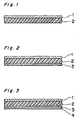
- Figure 1 is a schematic sectional view of a recording medium according to the present invention.
- Figure 2 is a schematic sectional view of another recording medium according to the present invention.
- Figure 3 is a schematic sectional view of still another recording medium according to the present invention.
- Figure 4 is a schematic view for explanation about the definition of the width of ink bleeding.
- the recording media of the present invention have a basic structure in which an ink-receiving layer 2 is formed on a base film 1 as shown in Figure 1.
- the ink-receiving 2 may be composed of two or more sub-layers.
- an adhesive layer 3 may be formed on the back of the base film 1 as shown in Figure 2.
- a release layer 4 may be formed on the adhesive layer 3 as shown in Figure 3, giving better handling properties.
- the thickness of the ink-receiving layer may be determined in some cases by the amount of coating as defined below.
- the thicknesses of the base film and the other layers are not particularly limited but may vary with conditions of printing and particular applications.
- the base films which can be used in the present invention include, but are not particularly limited to, plastic films, natural paper, synthetic paper, cloths, nonwoven fabrics, woods, metals, glass, artificial leather and natural leather. These materials may be used alone or in combination by making two or more materials into a laminate.
- the base films preferably used are plastic films.
- the plastic films may preferably be oriented monoaxially or biaxially by the methods known in the art.
- the base resins used in these plastic films include, but are not particularly limited to, polyester resins, polyolefin resins, polyamide resins, polyacrylic resins, polyurethane resins, polyvinyl resins, polyether resins and polystyrene resins with particularly preferred being polyester resins such as described below.
- polyester resins which can be used in the present invention are those prepared by polycondensation of an aromatic dicarboxylic acid or an ester thereof, such as terephthalic acid, isophthalic acid or naphthalenedicarboxylic acid, with a glycol such as ethylene glycol, diethylene glycol, 1,4-butanediol or neopentyl glycol.
- These polyester resins can be prepared, for example, by direct reaction of an aromatic dicarboxylic acid with a glycol, or by ester interchange of a aromatic dicarboxylic acid alkyl ester with a glycol and then polycondensation, or by polycondensation of an aromatic dicarboxylic acid diglycol ester.
- polyesters include polyethylene terephthalate, polyethylenebutylene terephthalate and polyethylene-2,6-naphthalate. These polyesters may be homopolymers or copolymers with additional monomers. In any case, preferred polyesters which can be used in the present invention contain ethylene terephthalate units, butylene terephthalate units or ethylene-2,6-naphthalate units at a ratio of 70 mol% or higher, preferably 80 mol% or higher, and more preferably 90 mol% or higher.
- void-containing films may preferably be used as the base film, more preferably void-containing polyester films.
- the void-containing films may be either single-layer films or laminated composite films.
- the void-containing film which can be used in the present invention should have an apparent specific gravity of from 0.5 to 1.3 both inclusive, preferably from 0.9 to 1.3 both inclusive, and more preferably from 1.05 to 1.27 both inclusive. If the apparent specific gravity is lower than 0.5, the content of voids in the film is so high that the film shows a marked lowering in strength and some cracks or wrinkles are liable to occur on the film surface. In contrast, if the apparent specific gravity exceeds 1.3, the content of voids in the film is so low that physical properties attained by the incorporation of voids, such as cushion effect and flexibility, are deteriorated.
- the method for lowering the apparent specific gravity is not particularly limited but, for example, the use of recording polyester films containing microvoids in the inside is preferred, which films can be prepared by mixing a polyester resin with any resin incompatible in the polyester resin and/or with any inert particulate matter, followed by extrusion and then at least one-way orientation.
- the incompatible resin and inert particulate matter may be any of those known in the art; preferred are polystyrene resins and inorganic particles such as titanium dioxide powder and calcium carbonate powder.
- the ink-receiving layer is formed on the base film.
- the ink-receiving may preferably be composed of, but not particularly limited to, water-soluble resin A, curing agent B, cationic substance C and particulate matter D.
- the water-soluble resin A may be any of those known in the art.
- the water-soluble resin A include, but are not particularly limited to, polyester resins, polyurethane resins, polyester-urethane resins, acrylic resins, polyvinyl alcohol, acrylate resins, starch, polyvinyl butyral, gelatin, casein, ionomers, gum arabic, carboxymethylcellulose, polyvinyl pyrrolidone, polyacrylamide and styrene-butadiene rubber.
- These water-soluble resins can be used alone or in combination when necessary.
- preferred are polyvinyl alcohol, polyvinylpyrrolidone, and mixtures thereof.
- the curing agent B may be any of those known in the art so long as it can effect curing of the water-soluble resin A.
- the curing agent B include, but are not particularly limited to, melamine resins, epoxy resins, blocked isocyanate group-containing resins, glyoxal and borax. Preferred are water-soluble melamine resins or methylol group-containing urea resins.
- the cationic substance C may be any of those known in the art so long as it has been cationically modified.
- Examples of the cationic substance C include, but are not particularly limited to, cationically modified polyvinyl alcohol, cationically modified polyesters, cationically modified polyamides, diallylamine polymers, dimethyldiallylammonium chloride polymers and cationically modified surfactants.
- the particulate matter D may be organic or inorganic particles.
- the particulate matter D include, but are not particularly limited to, fine particles of titanium dioxide, calcium carbonate, silicon dioxide, barium sulfate, aluminum oxide, aluminum hydroxide, zeolite, zinc oxide, benzoguanamine, cross-linked acrylic resins and cross-linked styrene resins. These fine particles can be used alone or in combination.
- the average particle diameter of fine particles used is not particularly limited but is preferably in the range of from 0.2 ⁇ m to 20 ⁇ m both inclusive, more preferably from 2 ⁇ m to 15 ⁇ m both inclusive.
- the components A, B, C and D may preferably be added at the following weight ratios.
- the weight ratio of A to B is in the range of from 95 / 5 to 55 / 45 both inclusive, preferably from 95 / 5 to 70 / 30 both inclusive. If the "A / B" weight ratio is lower 55 / 45, the speed of ink absorption may be lowered and the width of ink bleeding may be increased in printers with a larger amount of ink. If the "A / B" weight ratio exceeds 95 / 5, water resistance may be lost.
- the weight ratio of A and B to C is in the range of from 97 / 3 to 60 / 40 both inclusive, preferably 88 / 12 to 78 / 22 both inclusive.
- the weight ratio of A, B and C to D is in the range of from 1 / 1 to 1 / 2.5 both inclusive, preferably from 1 / 1.2 to 1 / 2 both inclusive. If the " (A + B + C) / D " weight ratio is lower than 1 / 1, the speed of ink absorption may be lowered and the width of ink bleeding may be increased. If the " (A + B + C) / D " weight ratio exceeds 1 / 2.5, the printing density may be decreased.
- the method for forming an ink-receiving on a base film is not particularly limited but may be carried out by any of the ordinary coating techniques used in the art, such as gravure coating, kiss coating, dip coating, spray coating, curtain coating, air-knife coating, blade coating, reverse-roll coating or bar coating.
- the ink-receiving layer may preferably be dried and heat treated under such conditions that drying temperature is adjusted within the range of from 100° to 120°C just after the initiation of drying and then raised at a step of 10° to 20°C up to the maximum temperature of 140° to 160°C. If these conditions are not fulfilled, the ink-receiving layer may not have optimized bulk density, nor may printing characteristics be balanced with each other. Instead of the drying temperature, the speed of drying air may be adjusted to be low in the beginning and then raised gradually.
- an adhesive layer On the back of the base film, i.e., the reverse side of the base film on which the ink-receiving layer has not been formed, there may be formed an adhesive layer.
- the adhesive used in the adhesive layer include, but are not particularly limited to, solvent type adhesives such as natural rubber, synthetic rubber, chloroprene rubber, acrylonitrile-butadiene rubber (NBR), butyl rubber, urethane rubber, vinyl acetate and copolymers thereof, acrylic acid and copolymers thereof; emulsion type adhesives such as natural rubber latices, chloroprene latices, acrylonitrile-butadiene rubber (NBR) latices, vinyl acetate and copolymers, acrylic acid and copolymers thereof; water-soluble adhesives such as polyvinyl alcohol, starch and glue; thermosetting resins such as epoxy resins, polyester resins, urea and melamine resins, phenol resins and polyurethane resins; hot-melt
- an anchor coat layer may be first formed on the back of a base film and an adhesive layer may be then formed on the anchor coat layer.
- the anchor coat layer may be formed with any material for this purpose known in the art.
- a release layer with any material for this purpose known in the art.
- the recording media of the present invention can also be characterized by their specific improved physical properties.
- the ink drying time is 5 minutes or shorter, preferably 4 minutes or shorter, at an amount of ink ranging from 10 mg/m 2 inclusive to 50 g/m 2 exclusive; the reflection printing density is 1.3 or higher, preferably 1.4 or higher; the width of ink bleeding is 1 mm or lower, preferably 0.5 mm or lower; and the retention of density against water exposure is 60% or higher, preferably 80% or higher. If the ink drying time exceeds 5 minutes, printed matter may be stained by a touch with the printed surface just after the printing. If the reflection printing density is lower than 1.3 or the width of ink bleeding exceeds 1 mm, printed matter may not be distinctly visible. The retention of density against water exposure lower than 60% is not preferred because when the recording medium is used for outdoor signboards images printed in the ink-receiving layers may be disordered by rain or dew.
- the retention of the ink-receiving layer is preferably 80% or higher, more preferably 90% or higher.
- the retention of the ink-receiving layer lower than 80% is not preferred because when printed matter is made into a wet laminate, i.e., a laminating film is stuck on the printed recording medium, while water placed between both is wiped off, the ink-receiving layer will be destroyed in the printed recording medium, which cannot, therefore, be applied to outdoor applications with possible exposure to rain or dew, such as outdoor signboards.
- the amount of coating for the ink-receiving layer is in the range of from 10 g/m 2 to 18 g/m 2 both inclusive; the bulk density of the ink-receiving layer is in the range of from 0.40 inclusive to 0.60 exclusive; and the retention of density against water exposure is 60% or higher, preferably 80% or higher. If the amount of coating for the ink-receiving layer is lower than 10 g/m 2 , the speed of ink absorption may be lowered and the width of ink bleeding may be increased. In contrast, if the amount of coating exceeds 18 g/m 2 , the printing density may be decreased.
- the bulk density of the ink-receiving layer is lower than 0.40, attempts to increase the printing density may increase the width of ink bleeding higher but attempts to decrease the width of ink bleeding will decrease the printing density, resulting in printed matter with poor distinction. If the bulk density of the ink-receiving layer is 0.60 or higher, the ink drying time at an amount of ink ranging from 10 g/m 2 inclusive to 50 g/m 2 exclusive may exceed 5 minutes and printed matter will be stained by a touch with the printed surface just after the printing. The retention of density against water exposure lower than 60% is not preferred because when the recording medium is used for outdoor signboards images printed in the ink-receiving layer may become disordered with exposure to rain or dew.
- the transmission printing density is 1.85 or higher; the transmission density of unprinted portions is 0.70 or lower; and the width of ink bleeding is 1 mm or lower, preferably 0.5 mm or lower. If the transmission printing density is lower than 1.85 or the transmission density of unprinted portions exceeds 0.70, printed matter may be indistinct in applications such as illumination signboards, which are appreciated with light illuminated from the back. If the width of ink bleeding exceed 1 mm, printed matter may not be distinctly visible.
- the recording media thus obtained according to the present invention which are preferably recording films and more preferably recording polyester films, can be used in the heat-sensitive transfer recording, heat transfer recording, sublimation transfer recording, intaglio print recording, mimeographic recording, relief print recording, lithographic recording, magnetic recording and electrostatic recording, preferably ink jet recording.
- the recording media of the present invention are most suitable for ink jet recording with pigment ink.
- the printed images obtained by ink jet recording with pigment ink exhibit rapid ink absorption, excellent water resistance, no ink bleeding and therefore particularly high distinction.
- the physical properties of the recording media of the present invention are measured or evaluated by the following methods.
- a base film is precisely cut into a square piece having a size of 5.00 cm x 5.00 cm.
- the thickness is measured at fifty different points on the square piece and the average thickness is calculated as t ⁇ m.
- the weight of the square piece is measured in a scale of 0.1 mg as w g.
- Solid black color (single color of black) is printed on a recording medium with an ink jet printer (model RJ-1300 from Mutoh Industrial Ltd.) using pigment ink.
- the reflection density and transmission density are measured with a Macbeth® densitometer model TR-927 having an orthochromatic filter for transmission of visible light.
- the amount of ink applied in this measurement was typically about 13 g/m 2 .
- solid blue color (mixed color of cyan and magenta) is printed on one half of a recording medium (hatched portion) and solid yellow color (single color of yellow) on the other half (unhatched portion).
- the width of ink bleeding is defined as a distance measured from the borderline between the portions as originally printed to the top crest of the ink bleeding portion in the direction of running of the recording medium as shown in Figure 4. In this case, blue ink bleeds toward the portion printed with yellow ink.
- Solid blue color (mixed color of cyan and magenta) is printed on a recording medium with an ink jet printer as described in item 2) above.
- the printed portion is slightly pressed with a finger and the time period by which the ink does not adhere to the finger is measured.
- the amount of ink applied in this measurement was typically about 26 g/m 2 .
- Solid black color (single color of black) is printed in a portion having a size of 5 cm x 5 cm on a recording medium with an ink jet printer as described in item 2) above, and left to stand for 1 hour.
- a weight of 500 g/16 cm 2 wrapped in a piece of shirting cloth (No. 3) is placed on the printed surface of the printed matter. The weight is moved on the printed surface, while flowing water is poured onto the printed surface. At this time, the reciprocating movement is effected 10 times within a distance of 10 cm at a speed of 2 seconds/reciprocation.
- the reflection density of black color is measured before and after the testing with a Macbeth® densitometer model TR-927.
- the retention of density against water exposure is defined as the percentage of density change, i.e., (density after testing) / (density before testing) x 100 (%) .
- Solid black color (single color of black) is printed in a portion having a size of 5 cm x 10 cm on a recording medium with an ink jet printer as described in item 2) above, and left to stand for 1 hour.
- the printed matter is immersed in water at 20°C for 3 hours.
- a weight of 500 g/16 cm 2 wrapped in a piece of shirting cloth (No. 3) is placed on the printed surface of the printed matter.
- the weight is moved on the printed surface, while flowing water is poured onto the printed surface. At this time, the reciprocating movement of the weight is effected 10 times over the longer dimension at a speed of 2 seconds/reciprocation.
- the area of the solid black colored portion is read before and after the testing with an image processing apparatus.
- the retention of ink-receiving layer against water exposure is defined as the percentage of area change, i.e., (area of solid black colored portion after testing) / (area of solid black colored portion before testing) x 100 (%) .
- the transmission density is measured in the unprinted portions on a recording medium by the method as described in item 2) above.
- An image containing letters and photographs is printed in a size of A1 on a recording medium with an ink jet printer as described in item 2) above.
- the printed matter is evaluated for distinction when viewed with reflected light from the printed matter stuck on an ordinary wall or with transmitted light by illumination of a fluorescent lamp from the back of the printed matter.
- the distinction of the printed matter is ranked by the following marks: o ⁇ , if the printed image is distinct; ⁇ , if the printed image is slightly indistinct but substantially acceptable; and X, if the printed image is scarcely distinct or indistinct.
- a 10 cm x 10 cm recording medium having a base film and an ink-receiving layer formed thereon is measured for the thickness in ⁇ m at ten different points with a dial gauge (Peacock from Ozaki Seisakusho Co., Ltd.) and for the weight in g.
- the ink-receiving layer is stripped off from the recording medium, and the thickness and weight of the recording medium having no ink-receiving layer are measured in the same manner as described above.
- the differences in thickness (T) and in weight (W) of the recording medium before and after the stripping are determined, and the bulk density in g/cm 2 of the ink-receiving layer is calculated as follows.
- a certain image is printed on a recording medium with an ink jet printer as described in item 2) above, and left to stand for 1 hour.
- a laminating film (Suncutmat N5 from Lintec Co., Ltd.) is stuck on the printed surface of the recording medium.
- the laminate is cut into a size of 10 cm x 10 cm, which is completely immersed in water for 24 hours and then taken out from the water.
- the water resistance of printed images is ranked by the following marks: X, if the laminating film is peeling off from the printed matter; ⁇ , if the laminating film shows substantially no peeling; and o ⁇ , if the laminating film shows no peeling.
- the test for water resistance is carried out in the same manner as described in item 10) above, except that a laminating film is not stuck on the printed surface of the printed matter.
- the water resistance of printed images is ranked by the following marks: ⁇ , if the printed image is slightly disordered but substantially acceptable; and X, if the printed image is so disordered as to have some problem for practical purposes.
- a polyester film (Crisper® G1211 from Toyobo Co., Ltd.; thickness, 50 ⁇ m; width, 1200 mm; length, 4000 m) was treated by corona discharge, to which treated surface was applied a mixture of 10% by weight of melamine resin (Sumitex Resin M-3 from Sumitomo Chemical Co., Ltd.) and 1% by weight of catalyst (Sumitex Accelerator ACX from Sumitomo Chemical Co., Ltd.) with 89% by weight of water so that the amount of coating was 0.1 g/m 2 after drying.
- This surface of the polyester film was further coated with a 10% suspension of polyvinyl alcohol (GH-20 from The Nippon Synthetic Chemical Industry Co., Ltd.), melamine resin (Sumitex M-3 from Sumitomo Chemical Co., Ltd.), cationic polyamide resin (SR1005 from Sumitomo Chemical Co., Ltd.) and two kinds of silica particles respectively having an average particle diameter of 5 ⁇ m and 12 ⁇ m by means of a wire bar so that the final solid content was 10 / 1 / 2 // 10 / 10 by weight ratio.
- the coated polyester film was dried and heat treated in a Geer oven at 140°C for 4 minutes so that the amount of coating was 12 g/m 2 , resulting in a recording film.
- a polyester film (Crisper® G1211 from Toyobo Co., Ltd.; thickness, 50 ⁇ m; width, 1200 mm; length, 4000 m) was treated by corona discharge, to which treated surface was applied a mixture of 10% by weight of melamine resin (Sumitex Resin M-3 from Sumitomo Chemical Co., Ltd.) and 1% by weight of catalyst (Sumitex Accelerator ACX from Sumitomo Chemical Co., Ltd.) with 89% by weight of water so that the amount of coating was 0.1 g/m 2 after drying.
- This surface of the polyester film was further coated with a 10% suspension of polyvinyl alcohol (RS117 from Kuraray Co., Ltd.), dimethylolhydroxyethylene urea resin (SR5004 from Sumitomo Chemical Co., Ltd.), cationic resin (Kayafix UR from Nippon Kayaku Co., Ltd.) and two kinds of silica particles respectively having an average particle diameter of 5 ⁇ m and 12 ⁇ m by means of a wire bar so that the final solid content was 10 / 3 / 1 // 10 / 10 by weight ratio.
- the coated polyester film was dried and heat treated a temperature of 100 / 120 / 140 / 120°C in this order by hot air at a speed of 15 m/min. for 2 minutes in total so that the amount of coating was 14 g/m 2 , resulting in a recording film.
- a recording film was prepared in the same manner as described in Example 2, except that a polyester film having a thickness of 100 ⁇ m was used.
- a recording film was prepared in the same manner as described in Example 2, except that the polyester film was replaced with a polypropyrene film (Toyopearl P6255 from Toyobo Co., Ltd.; thickness, 120 ⁇ m) and the drying temperature was changed to 80 / 100 / 120 / 100°C.
- a polypropyrene film Toyopearl P6255 from Toyobo Co., Ltd.; thickness, 120 ⁇ m
- An acrylic emulsion adhesive (Boncoat PS-378 from Dainippon Ink & Chemicals, Inc.) was applied to the back of the base film (i.e., the reverse side of the base film on which the ink-receiving layer had not been formed) of the recording film obtained in Example 1 was applied, and release paper was attached to the adhesive.
- the recording film having an adhesive layer and a release layer was tested for printability with an ink jet printer (model RJ-1300 from Mutoh Industrial Ltd.) using pigment ink, and found to exhibit excellent printability.
Landscapes
- Ink Jet Recording Methods And Recording Media Thereof (AREA)
- Ink Jet (AREA)
- Paper (AREA)
Applications Claiming Priority (4)
| Application Number | Priority Date | Filing Date | Title |
|---|---|---|---|
| JP212626/96 | 1996-08-12 | ||
| JP21262696 | 1996-08-12 | ||
| JP212627/96 | 1996-08-12 | ||
| JP8212627A JPH1052969A (ja) | 1996-08-12 | 1996-08-12 | 記録用フィルム |
Publications (2)
| Publication Number | Publication Date |
|---|---|
| EP0824077A2 true EP0824077A2 (de) | 1998-02-18 |
| EP0824077A3 EP0824077A3 (de) | 1999-06-02 |
Family
ID=26519330
Family Applications (1)
| Application Number | Title | Priority Date | Filing Date |
|---|---|---|---|
| EP19970113856 Withdrawn EP0824077A3 (de) | 1996-08-12 | 1997-08-11 | Farbstoffempfangsaufzeichnungsmaterial |
Country Status (5)
| Country | Link |
|---|---|
| US (1) | US6136440A (de) |
| EP (1) | EP0824077A3 (de) |
| KR (1) | KR100386019B1 (de) |
| CN (1) | CN1087694C (de) |
| TW (1) | TW455542B (de) |
Cited By (2)
| Publication number | Priority date | Publication date | Assignee | Title |
|---|---|---|---|---|
| EP1048478A3 (de) * | 1999-04-28 | 2002-01-09 | Toyo Boseki Kabushiki Kaisha | Aufzeichnungsmaterial |
| GB2400335A (en) * | 2003-04-08 | 2004-10-13 | Ilford Imaging Uk Ltd | Recording materials |
Families Citing this family (10)
| Publication number | Priority date | Publication date | Assignee | Title |
|---|---|---|---|---|
| US6887559B1 (en) * | 1999-10-01 | 2005-05-03 | Cabot Corporation | Recording medium |
| MXPA04000614A (es) | 2001-07-25 | 2005-02-17 | Avery Dennison Corp | Revestimientos para papel sintetico y metodo para su fabricacion. |
| ES2511042T3 (es) | 2003-03-13 | 2014-10-22 | Avery Dennison Corporation | Composición para láminas receptoras de imágenes de transferencia térmica |
| FR2881760B1 (fr) * | 2005-02-09 | 2007-04-13 | Eastman Kodak Co | Materiau destine a la formation d'images par impression par jet d'encre |
| US20070048466A1 (en) * | 2005-09-01 | 2007-03-01 | Huynh Dieu D | Thermal transfer image receiving sheet and method |
| WO2009126133A1 (en) * | 2008-04-06 | 2009-10-15 | Hewlett-Packard Development Comany, L.P. | Inkjet printable article and method of making the same |
| CN102011336B (zh) * | 2009-09-09 | 2015-09-16 | 李相荣 | 一种可粘揭、移动及复用的纤维胶粘印刷纸及其制造方法 |
| CN102501675A (zh) * | 2011-10-14 | 2012-06-20 | 江苏格美高科技发展有限公司 | 弱溶剂哑光聚丙烯喷绘写真纸 |
| CN104213474B (zh) * | 2014-08-28 | 2017-11-14 | 金东纸业(江苏)股份有限公司 | 涂料、涂布纸及其制作方法 |
| TR202003719A2 (tr) * | 2020-03-10 | 2021-01-21 | Oezer Yilmaz | Dijital Süblime Transfer Kâğıtlarında Yenilik |
Family Cites Families (12)
| Publication number | Priority date | Publication date | Assignee | Title |
|---|---|---|---|---|
| DE514633C (de) * | 1930-12-17 | Franz Goldberger | Vorrichtung zum Aufkleben von Briefmarken und Etiketten | |
| DE631880C (de) * | 1936-06-27 | Georg Reutlinger Dr | Vorrichtung zur Erzeugung erzwungener mechanischer Schwingungen | |
| DE379964C (de) * | 1919-12-07 | 1923-08-31 | Metan Spolka Z Ograniczona Odp | Verfahren zum staendigen Abdampfen von Kohlenwasserstoffe enthaltenden Gemischen |
| FR2598974B1 (fr) * | 1986-05-20 | 1990-04-27 | Aussedat Rey | Feuille pour enregistrement par jet d'encre et procede pour sa preparation. |
| JP2633671B2 (ja) * | 1989-01-18 | 1997-07-23 | 日本製紙 株式会社 | インクジェット記録用シート |
| US5213873A (en) * | 1989-10-20 | 1993-05-25 | Oji Paper Co., Ltd. | Aqueous ink-jet recording sheet |
| DE4116595A1 (de) * | 1991-05-22 | 1992-11-26 | Schoeller Felix Jun Papier | Aufzeichnungsmaterial fuer das tintenstrahlaufzeichnungsverfahren |
| JP3213630B2 (ja) * | 1991-07-25 | 2001-10-02 | 三菱製紙株式会社 | インクジェット記録シート |
| US5422175A (en) * | 1992-06-01 | 1995-06-06 | Toyo Boseki Kabushiki Kaisha | Void-containing composite film of polyester type |
| EP0605840A3 (de) * | 1992-12-25 | 1994-12-14 | Mitsubishi Paper Mills Ltd | Tintenstrahl-Aufzeichnungsblatt. |
| DE4322179C2 (de) * | 1993-07-03 | 1997-02-13 | Schoeller Felix Jun Papier | Aufzeichnungsmaterial für Ink-Jet-Druckverfahren |
| JPH09169159A (ja) * | 1995-07-21 | 1997-06-30 | Canon Inc | 記録媒体、これを用いた画像形成方法及び印字物 |
-
1997
- 1997-08-11 EP EP19970113856 patent/EP0824077A3/de not_active Withdrawn
- 1997-08-11 TW TW86111452A patent/TW455542B/zh active
- 1997-08-11 US US08/909,470 patent/US6136440A/en not_active Expired - Fee Related
- 1997-08-12 KR KR1019970038261A patent/KR100386019B1/ko not_active Expired - Fee Related
- 1997-08-12 CN CN97116641A patent/CN1087694C/zh not_active Expired - Fee Related
Cited By (4)
| Publication number | Priority date | Publication date | Assignee | Title |
|---|---|---|---|---|
| EP1048478A3 (de) * | 1999-04-28 | 2002-01-09 | Toyo Boseki Kabushiki Kaisha | Aufzeichnungsmaterial |
| US6605337B1 (en) | 1999-04-28 | 2003-08-12 | Toyo Boseki Kabushiki Kaisha | Recording material |
| KR100609668B1 (ko) * | 1999-04-28 | 2006-08-09 | 도요 보세키 가부시키가이샤 | 기록재 |
| GB2400335A (en) * | 2003-04-08 | 2004-10-13 | Ilford Imaging Uk Ltd | Recording materials |
Also Published As
| Publication number | Publication date |
|---|---|
| KR100386019B1 (ko) | 2003-08-21 |
| CN1174129A (zh) | 1998-02-25 |
| KR19980018585A (ko) | 1998-06-05 |
| CN1087694C (zh) | 2002-07-17 |
| TW455542B (en) | 2001-09-21 |
| US6136440A (en) | 2000-10-24 |
| EP0824077A3 (de) | 1999-06-02 |
Similar Documents
| Publication | Publication Date | Title |
|---|---|---|
| US5463178A (en) | Recording sheet and process for its production | |
| EP0407720B2 (de) | Druckfilm | |
| AU7201700A (en) | Coated film | |
| US6136440A (en) | Recording media | |
| JPH0781214A (ja) | 記録シート | |
| US4839337A (en) | Dye-receiving sheets for thermal dye transfer printing comprising a composite film substrate | |
| US5958564A (en) | Ink jet recording sheet | |
| JPH082093A (ja) | 記録シートおよびその製造方法 | |
| JP3932224B2 (ja) | インクジェット用記録フィルム | |
| JPH1052970A (ja) | 記録用媒体 | |
| JP3176816B2 (ja) | インクジェット記録シート | |
| JPH10109473A (ja) | 記録用媒体及び記録体 | |
| JP3918682B2 (ja) | インクジェット記録用シート | |
| JP2001219648A (ja) | 記録用媒体及び記録体 | |
| JPH08252968A (ja) | インクジェット記録シート | |
| JP3407250B2 (ja) | 記録用媒体 | |
| JPH0920069A (ja) | インクジェット用記録体 | |
| JPH10166742A (ja) | 染料熱転写受容シート | |
| JPH1076747A (ja) | インクジェット用記録フィルム | |
| JP3025773B2 (ja) | 記録用シート | |
| JP2001219647A (ja) | 記録用媒体及び記録体 | |
| JPH1052969A (ja) | 記録用フィルム | |
| JPH1052971A (ja) | 記録用フィルム | |
| JPH0943889A (ja) | 記録シート | |
| JPS62134285A (ja) | 被記録材 |
Legal Events
| Date | Code | Title | Description |
|---|---|---|---|
| PUAI | Public reference made under article 153(3) epc to a published international application that has entered the european phase |
Free format text: ORIGINAL CODE: 0009012 |
|
| AK | Designated contracting states |
Kind code of ref document: A2 Designated state(s): CH DE FR GB IT LI |
|
| AX | Request for extension of the european patent |
Free format text: AL;LT;LV;RO;SI |
|
| PUAL | Search report despatched |
Free format text: ORIGINAL CODE: 0009013 |
|
| AK | Designated contracting states |
Kind code of ref document: A3 Designated state(s): AT BE CH DE DK ES FI FR GB GR IE IT LI LU MC NL PT SE |
|
| AX | Request for extension of the european patent |
Free format text: AL;LT;LV;RO;SI |
|
| 17P | Request for examination filed |
Effective date: 19991105 |
|
| 17Q | First examination report despatched |
Effective date: 19991216 |
|
| AKX | Designation fees paid |
Free format text: CH DE FR GB IT LI |
|
| GRAH | Despatch of communication of intention to grant a patent |
Free format text: ORIGINAL CODE: EPIDOS IGRA |
|
| STAA | Information on the status of an ep patent application or granted ep patent |
Free format text: STATUS: THE APPLICATION IS DEEMED TO BE WITHDRAWN |
|
| 18D | Application deemed to be withdrawn |
Effective date: 20030819 |