EP0824101A2 - Carbosilan-Dendrimere mit Si-O-Metall-Bindungen, ein Verfahren zu deren Herstellung und deren Verwendung - Google Patents
Carbosilan-Dendrimere mit Si-O-Metall-Bindungen, ein Verfahren zu deren Herstellung und deren Verwendung Download PDFInfo
- Publication number
- EP0824101A2 EP0824101A2 EP97113443A EP97113443A EP0824101A2 EP 0824101 A2 EP0824101 A2 EP 0824101A2 EP 97113443 A EP97113443 A EP 97113443A EP 97113443 A EP97113443 A EP 97113443A EP 0824101 A2 EP0824101 A2 EP 0824101A2
- Authority
- EP
- European Patent Office
- Prior art keywords
- carbosilane
- sir
- metal
- carbosilane dendrimers
- preparation
- Prior art date
- Legal status (The legal status is an assumption and is not a legal conclusion. Google has not performed a legal analysis and makes no representation as to the accuracy of the status listed.)
- Granted
Links
Classifications
-
- C—CHEMISTRY; METALLURGY
- C08—ORGANIC MACROMOLECULAR COMPOUNDS; THEIR PREPARATION OR CHEMICAL WORKING-UP; COMPOSITIONS BASED THEREON
- C08G—MACROMOLECULAR COMPOUNDS OBTAINED OTHERWISE THAN BY REACTIONS ONLY INVOLVING UNSATURATED CARBON-TO-CARBON BONDS
- C08G83/00—Macromolecular compounds not provided for in groups C08G2/00 - C08G81/00
- C08G83/002—Dendritic macromolecules
- C08G83/003—Dendrimers
-
- C—CHEMISTRY; METALLURGY
- C07—ORGANIC CHEMISTRY
- C07F—ACYCLIC, CARBOCYCLIC OR HETEROCYCLIC COMPOUNDS CONTAINING ELEMENTS OTHER THAN CARBON, HYDROGEN, HALOGEN, OXYGEN, NITROGEN, SULFUR, SELENIUM OR TELLURIUM
- C07F17/00—Metallocenes
-
- C—CHEMISTRY; METALLURGY
- C07—ORGANIC CHEMISTRY
- C07F—ACYCLIC, CARBOCYCLIC OR HETEROCYCLIC COMPOUNDS CONTAINING ELEMENTS OTHER THAN CARBON, HYDROGEN, HALOGEN, OXYGEN, NITROGEN, SULFUR, SELENIUM OR TELLURIUM
- C07F7/00—Compounds containing elements of Groups 4 or 14 of the Periodic Table
- C07F7/02—Silicon compounds
- C07F7/08—Compounds having one or more C—Si linkages
- C07F7/0834—Compounds having one or more O-Si linkage
- C07F7/0836—Compounds with one or more Si-OH or Si-O-metal linkage
-
- C—CHEMISTRY; METALLURGY
- C07—ORGANIC CHEMISTRY
- C07F—ACYCLIC, CARBOCYCLIC OR HETEROCYCLIC COMPOUNDS CONTAINING ELEMENTS OTHER THAN CARBON, HYDROGEN, HALOGEN, OXYGEN, NITROGEN, SULFUR, SELENIUM OR TELLURIUM
- C07F7/00—Compounds containing elements of Groups 4 or 14 of the Periodic Table
- C07F7/02—Silicon compounds
- C07F7/21—Cyclic compounds having at least one ring containing silicon, but no carbon in the ring
-
- C—CHEMISTRY; METALLURGY
- C08—ORGANIC MACROMOLECULAR COMPOUNDS; THEIR PREPARATION OR CHEMICAL WORKING-UP; COMPOSITIONS BASED THEREON
- C08F—MACROMOLECULAR COMPOUNDS OBTAINED BY REACTIONS ONLY INVOLVING CARBON-TO-CARBON UNSATURATED BONDS
- C08F10/00—Homopolymers and copolymers of unsaturated aliphatic hydrocarbons having only one carbon-to-carbon double bond
-
- C—CHEMISTRY; METALLURGY
- C08—ORGANIC MACROMOLECULAR COMPOUNDS; THEIR PREPARATION OR CHEMICAL WORKING-UP; COMPOSITIONS BASED THEREON
- C08F—MACROMOLECULAR COMPOUNDS OBTAINED BY REACTIONS ONLY INVOLVING CARBON-TO-CARBON UNSATURATED BONDS
- C08F4/00—Polymerisation catalysts
- C08F4/42—Metals; Metal hydrides; Metallo-organic compounds; Use thereof as catalyst precursors
- C08F4/44—Metals; Metal hydrides; Metallo-organic compounds; Use thereof as catalyst precursors selected from light metals, zinc, cadmium, mercury, copper, silver, gold, boron, gallium, indium, thallium, rare earths or actinides
- C08F4/60—Metals; Metal hydrides; Metallo-organic compounds; Use thereof as catalyst precursors selected from light metals, zinc, cadmium, mercury, copper, silver, gold, boron, gallium, indium, thallium, rare earths or actinides together with refractory metals, iron group metals, platinum group metals, manganese, rhenium technetium or compounds thereof
- C08F4/62—Refractory metals or compounds thereof
- C08F4/64—Titanium, zirconium, hafnium or compounds thereof
- C08F4/659—Component covered by group C08F4/64 containing a transition metal-carbon bond
- C08F4/65912—Component covered by group C08F4/64 containing a transition metal-carbon bond in combination with an organoaluminium compound
-
- C—CHEMISTRY; METALLURGY
- C08—ORGANIC MACROMOLECULAR COMPOUNDS; THEIR PREPARATION OR CHEMICAL WORKING-UP; COMPOSITIONS BASED THEREON
- C08F—MACROMOLECULAR COMPOUNDS OBTAINED BY REACTIONS ONLY INVOLVING CARBON-TO-CARBON UNSATURATED BONDS
- C08F4/00—Polymerisation catalysts
- C08F4/42—Metals; Metal hydrides; Metallo-organic compounds; Use thereof as catalyst precursors
- C08F4/44—Metals; Metal hydrides; Metallo-organic compounds; Use thereof as catalyst precursors selected from light metals, zinc, cadmium, mercury, copper, silver, gold, boron, gallium, indium, thallium, rare earths or actinides
- C08F4/60—Metals; Metal hydrides; Metallo-organic compounds; Use thereof as catalyst precursors selected from light metals, zinc, cadmium, mercury, copper, silver, gold, boron, gallium, indium, thallium, rare earths or actinides together with refractory metals, iron group metals, platinum group metals, manganese, rhenium technetium or compounds thereof
- C08F4/62—Refractory metals or compounds thereof
- C08F4/64—Titanium, zirconium, hafnium or compounds thereof
- C08F4/659—Component covered by group C08F4/64 containing a transition metal-carbon bond
- C08F4/6592—Component covered by group C08F4/64 containing a transition metal-carbon bond containing at least one cyclopentadienyl ring, condensed or not, e.g. an indenyl or a fluorenyl ring
- C08F4/65922—Component covered by group C08F4/64 containing a transition metal-carbon bond containing at least one cyclopentadienyl ring, condensed or not, e.g. an indenyl or a fluorenyl ring containing at least two cyclopentadienyl rings, fused or not
- C08F4/65925—Component covered by group C08F4/64 containing a transition metal-carbon bond containing at least one cyclopentadienyl ring, condensed or not, e.g. an indenyl or a fluorenyl ring containing at least two cyclopentadienyl rings, fused or not two cyclopentadienyl rings being mutually non-bridged
Definitions
- the present invention relates to new carbosilane dendrimers with Si-O-metal bonds, a process for their manufacture and their use.
- Dendrimers are highly branched molecules with a highly ordered structure mostly three-dimensional structure, its molecular weight in the range of that of oligomers or polymers.
- dendrimers have the advantage that they have an exactly uniform molecular weight can be built up specifically, while the usual polymers always have a certain one Show molar mass distribution.
- certain functional dendrimers such as B. those with vinyl end groups, with a defined number of such reactive groups can be produced.
- Heterogeneous catalysts based on doped silicates or silicate carriers are often used in industry. So you use z. B. for cracking and isomerization reactions in petrochemicals aluminosilicate zeolites or for oxidation reactions titanium silicalites. Many metal complexes are also used as heterogeneous catalysts after being bonded to SiO 2 support materials. One uses the possibility of the metals to form Si-O-metal bonds.
- Metal-functionalized carboslan dendrimers are distinguished from silicate materials due to a well-defined molecular structure and an optimal surface / volume ratio out. Another advantage is that all metal centers the surface of the dendrimers are freely accessible. They can also do both can be used as homogeneous and heterogeneous catalysts.
- the previously known carbosilane dendrimers are built up from an initiator core by alternating hydrosilylation and Grignard reaction (e.g. US Pat. No. 5,276,110; Adv. Mater. 1993, 5, 466-468; Macromolecules 1993, 26, 963-968 ; J. Chem. Soc., Chem. Commun. 1994, 2575-2576; Organometallics 1994, 13, 2682-2690 and DE-P 19603242.3).
- the initiator molecule tetravinylsilane is reacted in THF with Pt catalysis with HSiCl 2 CH 3 .
- HSiCl 2 CH 3 By reaction with vinyl magnesium halide, a vinyl silane is in turn built up, which is again available for hydrosilylation.
- cyclic organosiloxanes can also be used as initiator cores, see DE-P 19603241.5.
- the Carbosilandendrimere z. B. for the production of hybrid materials for coatings or due to their defined molecular structure as calibration substances.
- alkyl radicals R in the sense of the invention are preferably linear or branched, optionally substituted C 1 -C 5 alkyl radicals.
- substituted includes all common substituents, such as. B. halogen, alkyl, amine, etc.
- aryl radicals R in the sense of the invention are preferably optionally substituted C 6 rings.
- the carbosilane dendrimers can be described by the following formulas: Si [(CH 2 ) 2 Si (CH 3 ) 2 (OM)] 4 , Si [(CH 2 ) 2 Si [(CH 2 ) 2 Si (CH 3 ) 2 (OM)] 3 ] 4 , Si [(CH 2 ) 3 Si (CH 3 ) 2 (OM)] 4 and or [OSi (CH 3 ) (CH 2 ) 2 Si (CH 3 ) 2 (OM)] 4 .
- Carbosilane dendrimers of the formula are particularly preferred Si [(CH 2 ) 2 Si (CH 3 ) 2 (OM)] 4
- Semi-metals and / or metals in the sense of the invention are in particular B, Al, Ga, In, Ge, Sn, Pb, As, Sb, Bi, Ti, Zr, Hf, V, Nb, Ta, Cr, Mo, W, Re, Fe, Ru, Os, Rh, Ir, Pt, Cu, Ag and / or Au in question.
- the metals and / or semimetals can be one or more for metals and / or Semimetals carry common substituents, for example linear, branched or cyclic, optionally substituted alkyl, cyclopentadienyl, aryl, P-containing Residues such as B. phosphines such as triaryl or trialkyl phosphines, N-containing Residues such as B. ethylenediamine, O-containing radicals, such as. B. acetylacetonate or Alcoholates, halogen, such as. B. chloride etc.
- B. phosphines such as triaryl or trialkyl phosphines
- N-containing Residues such as B. ethylenediamine
- O-containing radicals such as. B. acetylacetonate or Alcoholates
- halogen such as. B. chloride etc.
- the metals and / or semimetals can furthermore each be one or intramolecular form O-bridges to several Si atoms of the dendrimer molecule, preferred to a.
- Preferred metals and / or semimetals for the purposes of the invention are Elements Ti, Zr, Hf, V, Nb, Ta, Cr, Mo, W, particularly preferably Ti, Zr, Hf, whole particularly preferably Ti.
- the carbosilane dendrimer with Si-O metal bonds is Si [(CH 2 ) 2 Si (CH 3 ) 2 (OTiCp 2 Cl)] 4 , which has great stability.
- the attached metal compound is the metallocene compound Cp 2 TiCl 2 , which, for. B. can be used in combination with aluminum-organic compounds as a catalyst in the olefin polymerization ("Ziegler-Natta catalysts", Römpp Chemie Lexikon, 9th edition, Vol 6, S.5128-5129). It is also catalytically active in epoxidation reactions of olefins, the activity being able to be increased by heterogenization based on SiO 2 (Tetrahedron 51, No. 13, 3787-3792 (1995)).
- SiOH-functional carbosilane dendrimers of the formulas Si [(CH 2 ) 2 Si (CH 3 ) 2 (OH)] 4 , Si [(CH 2 ) 2 Si [(CH 2 ) 2 Si (CH 3 ) 2 (OH)] 3 ] 4 , Si [(CH 2 ) 3 Si (CH 3 ) 2 (OH)] 4 and or [OSi (CH 3 ) (CH 2 ) 2 Si (CH 3 ) 2 (OH)] 4 was used.
- Si (CH 2 ) 2 Si (CH 3 ) 2 (OH)] 4 is particularly preferred.
- the SiOH-functional carbosilane dendrimers are preferably after the in Process described DE-P 19603242.3 and DE-P 19603241.5.
- they can optionally carry one or more additional substituents customary for metals and / or semimetals, for example linear, branched or cyclic, optionally substituted alkyl, cyclopentadienyl, aryl, P-containing radicals, such as, for. B.
- phosphines such as triaryl or trialkyl phosphines, N-containing radicals, such as. B.
- ethylenediamine, O-containing radicals, such as. B. acetylacetonate or halogen, such as. B. chloride, etc. are preferred phosphane, metal carbonyl, metal nitrosyl, metallocene, olefin, and alkyne complex compounds, particularly preferably metallocene compounds, very particularly preferably Cp 2 TiCl 2 .
- Triorganoamines are preferably used as bases in the context of the invention, the organo radicals comprising all common C 1 -C 18 -alkyl, C 6 -C 18 -aryl and phenyl radicals, linear or branched and optionally substituted, preferably trialkylamines.
- Alkyl particularly preferably corresponds to a C 1 -C 3 radical.
- the bases are used stoichiometrically or in excess.
- the method according to the invention is preferably carried out in a solvent.
- solvents e.g. ethereal solvents such as THF, diethyl ether and tert. Butyl methyl ether, Alcohols such as Methanol, ethanol and isopropanol, ketones such as e.g. acetone and ethyl methyl ketone, acetonitrile and / or dimethyl sulfoxide.
- the inventive method is at temperatures from -78 ° C to the boiling point of the corresponding solvent, preferably from -20 ° C to to the boiling point of the corresponding solvent, particularly preferably from 0 ° C. to to the boiling point of the corresponding solvent.
- the process is preferably carried out as a homogeneous reaction, i. H. in one Solvent in which both the SiOH-functional carbosilane dendrimer and also loosen the metal and / or semimetal connection without decomposition.
- the present invention also relates to the use of the carbosilane dendrimers with Si-O-metal bonds as homogeneous or heterogeneous catalysts or as an additive or component for the manufacture or functionalization of inorganic-organic hybrid materials, e.g. B. for coating.
Landscapes
- Chemical & Material Sciences (AREA)
- Organic Chemistry (AREA)
- Health & Medical Sciences (AREA)
- Chemical Kinetics & Catalysis (AREA)
- Medicinal Chemistry (AREA)
- Polymers & Plastics (AREA)
- Silicon Polymers (AREA)
Abstract
Description
mit i = 3,4, bevorzugt 4
oder
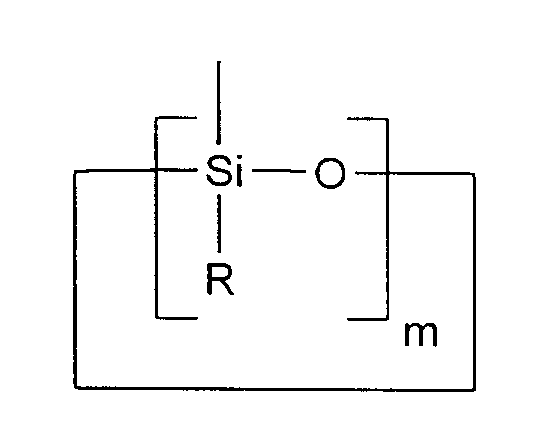
in Kombination mit
- X
- -OM für a=1
oder - X
- [(CH2)nSi(OM)R2], [(CH2)nSiR3-a[(CH2)nSi(OM)R2]a] und/oder [(CH2)nSiR3-a[(CH2)nSiR3-a[(CH2)nSi(OM)R2]a]a] für a = 1-3, bevorzugt a = 3, wobei
- M
- ein Halbmetall und/oder Metall ist, das gegebenenfalls weitere Substituenten tragen kann.
mit i = 3-4, bevorzugt 4,
oder
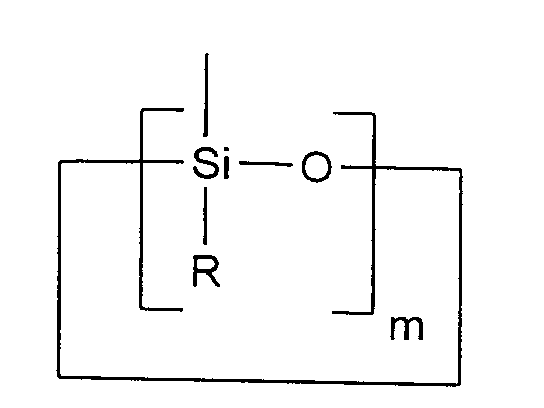
in Kombination mit:
- Y =
- (OH) für a = 1 oder
- Y =
- [(CH2)nSi(OH)R2], [(CH2)nSiR3-a[(CH2)nSi(OH)R2]a] und /oder [(CH2)nSiR3-a[(CH2)nSiR3-a[(CH2)nSi(OH)R2]a]a] für
- a =
- 1-3, bevorzugt a = 3,
- 1H-NMR (d8-THF): δ =
- 0,08 ppm (s, 6H, SiCH3); 0,58 ppm (m, 4H, SiCH2); 6,29 ppm (s, 10H, TiC5H5).
Claims (9)
- Carbosilan-Dendrimere mit Si-O-Metall-Bindungen der allgemeinen FormelA) K = [R4-iSi]
mit i = 3,4
oderB) K =mit i = m und m = 3-6,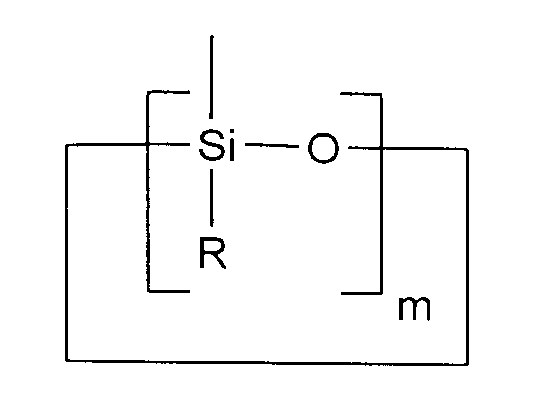
in Kombination mit- X =
- -OM für a=1 ,
oder - X=
- [(CH2)nSi(OM)R2], [(CH2)nSiR3-a[(CH2)nSi(OM)R2]a]
und/oder [(CH2)nSiR3-a(CH2)nSiR3-a[(CH2)nSi(OM)R2]a]a] für a = 1-3, wobei - M
- ein Halbmetall und/oder Metall ist, das gegebenenfalls weitere Substituenten tragen kann.
- Carbosilan-Dendrimere nach Anspruch 1, dadurch gekennzeichnet, daß diese
- Carbosilan-Dendrimere nach einem der Ansprüche 1 oder 2, dadurch gekennzeichnet, daß M gleich B, Al, Ga, In, Ge, Sn, Pb, As, Sb, Bi, Ti, Zr, Hf, V, Nb, Ta, Cr, Mo, W, Re, Fe, Ru, Os, Rh, Ir, Pt, Cu, Ag und/oder Au ist.
- Carbosilan-Dendrimere nach einem oder mehreren der Ansprüche 1 bis 3, dadurch gekennzeichnet, daß M Ti, Zr und / oder Hf ist.
- Verfahren zur Herstellung von Carbosilan-Dendrimeren nach einem oder mehreren der Ansprüche 1 bis 4, dadurch gekennzeichnet, daß ein SiOH-funktionelles Carbosilan-Dendrimer der Formelmit mindestens einer Metall- und/oder Halbmetall-Verbindung, gegebenenfalls in Gegenwart einer Base, umgesetzt wird.A) K = [R4-iSi] mit i = 3,4
oderB) K =mit i = m und m = 3-6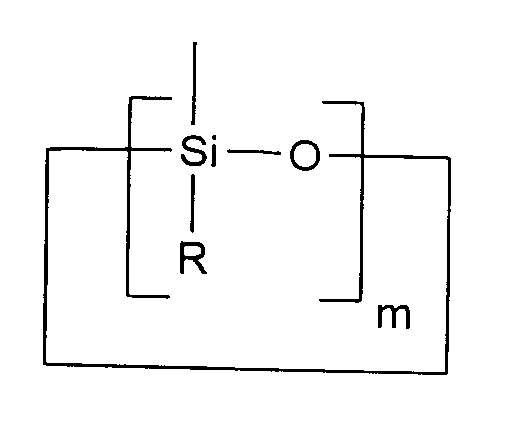
in Kombination mit Y = OH für a = 1 oder- Y =
- [(CH2)nSi(OH)R2], [(CH2)nSiR3-a[(CH2)nSi(OH)R2]a]
- Verfahren zur Herstellung von Carbosilan-Dendrimeren nach Anspruch 5, dadurch gekennzeichnet, daß als SiOH-funktionelles Carbosilan-Dendrimer
- Verfahren zur Herstellung von Carbosilan-Dendrimeren nach einem oder mehreren der Ansprüche 5 bis 6, dadurch gekennzeichnet, daß die Metall- und/oder Halbmetall-Verbindungen mit mindestens einem Liganden Z mit Z = Cl, Br, I, OR (R = Alkyl, Aryl) substituiert sind und unter Abspaltung von HZ Si-O-M-Bindungen ausbilden.
- Verfahren zur Herstellung von Carbosilan-Dendrimeren nach einem oder mehreren der Ansprüche 5 bis 7, dadurch gekennzeichnet, daß als Basen Triorganoamine eingesetzt werden.
- Verwendung der Carbosilan-Dendrimere nach einem oder mehreren der Ansprüche 1 bis 4 als homogene oder heterogene Katalysatoren oder als Zusatz oder Bestandteil zur Herstellung oder Funktionalisierung von anorganisch-organischen Hybridmaterialien.
Applications Claiming Priority (2)
| Application Number | Priority Date | Filing Date | Title |
|---|---|---|---|
| DE19632700 | 1996-08-14 | ||
| DE19632700A DE19632700C1 (de) | 1996-08-14 | 1996-08-14 | Carbosilan-Dendrimere mit Si-O-Metall-Bindungen, ein Verfahren zu deren Herstellung und deren Verwendung |
Publications (3)
| Publication Number | Publication Date |
|---|---|
| EP0824101A2 true EP0824101A2 (de) | 1998-02-18 |
| EP0824101A3 EP0824101A3 (de) | 1999-07-07 |
| EP0824101B1 EP0824101B1 (de) | 2002-08-14 |
Family
ID=7802575
Family Applications (1)
| Application Number | Title | Priority Date | Filing Date |
|---|---|---|---|
| EP97113443A Expired - Lifetime EP0824101B1 (de) | 1996-08-14 | 1997-08-04 | Carbosilan-Dendrimere mit Si-O-Metall-Bindungen, ein Verfahren zu deren Herstellung und deren Verwendung |
Country Status (4)
| Country | Link |
|---|---|
| US (1) | US5962713A (de) |
| EP (1) | EP0824101B1 (de) |
| JP (1) | JPH1087836A (de) |
| DE (2) | DE19632700C1 (de) |
Families Citing this family (3)
| Publication number | Priority date | Publication date | Assignee | Title |
|---|---|---|---|---|
| EP0981570B1 (de) * | 1997-05-23 | 2002-10-16 | Bayer Ag | Organosilan-oligomere |
| DE19814060A1 (de) * | 1998-03-30 | 1999-10-07 | Bayer Ag | Borhaltige Mischungen, Hybridmaterialien und Beschichtungen |
| WO2004022231A1 (en) * | 2002-09-04 | 2004-03-18 | Johnson Matthey Plc | Catalysts |
Family Cites Families (5)
| Publication number | Priority date | Publication date | Assignee | Title |
|---|---|---|---|---|
| US5276110A (en) * | 1992-08-12 | 1994-01-04 | National Research Council Of Canada | Highly regular multi-arm star polymers |
| US5378790A (en) * | 1992-09-16 | 1995-01-03 | E. I. Du Pont De Nemours & Co. | Single component inorganic/organic network materials and precursors thereof |
| US5677410A (en) * | 1995-05-16 | 1997-10-14 | Bayer Ag | Carbosilane-dendrimers, carbosilane-hybrid materials, methods for manufacturing them and a method for manufacturing coatings from the carbosilane-dendrimers |
| DE19517838A1 (de) * | 1995-05-16 | 1996-11-21 | Bayer Ag | Carbosilan-Dendrimere, ein Verfahren zur Herstellung und deren Verwendung |
| DE19603242A1 (de) * | 1995-05-16 | 1996-11-21 | Bayer Ag | Funktionelle Carbosilan-Dendrimere, organisch-anorganische Carbosilan-Hybridmaterialien, jeweils Verfahren zu deren Herstellung, ein Verfahren zur Herstellung von Lacken aus den fuktionellen Carbosilan-Dendrimeren und deren Verwendung |
-
1996
- 1996-08-14 DE DE19632700A patent/DE19632700C1/de not_active Expired - Fee Related
-
1997
- 1997-08-04 EP EP97113443A patent/EP0824101B1/de not_active Expired - Lifetime
- 1997-08-04 DE DE59707954T patent/DE59707954D1/de not_active Expired - Lifetime
- 1997-08-06 US US08/907,304 patent/US5962713A/en not_active Expired - Fee Related
- 1997-08-11 JP JP9228865A patent/JPH1087836A/ja active Pending
Also Published As
| Publication number | Publication date |
|---|---|
| US5962713A (en) | 1999-10-05 |
| EP0824101B1 (de) | 2002-08-14 |
| JPH1087836A (ja) | 1998-04-07 |
| DE19632700C1 (de) | 1998-02-26 |
| EP0824101A3 (de) | 1999-07-07 |
| DE59707954D1 (de) | 2002-09-19 |
Similar Documents
| Publication | Publication Date | Title |
|---|---|---|
| EP0372414B1 (de) | Verfahren zur Herstellung einer heterogenen Metallocenkatalysatorkomponente | |
| Allum et al. | Supported transition metal complexes: II. Silica as the support | |
| DE69221283T2 (de) | Verfahren zur Herstellung von Polysilanen | |
| JPS6157592A (ja) | 白金(0)アルキン錯体及びその製造方法 | |
| DE3423290A1 (de) | Hydrosilylierungskatalysator, verfahren zu seiner herstellung und seine verwendung in einem hydrosilylierungsverfahren | |
| EP0787734B1 (de) | Multifunktionelle, cyclische Organosiloxane, Verfahren zu deren Herstellung und deren Verwendung | |
| DE2550660C3 (de) | Verfahren zur Herstellung eines Organosiliciumprodukts | |
| EP0669340A1 (de) | Verfahren zur Herstellung von verbrückten stereorigiden Metallocenen | |
| Juvaste et al. | Preparation of new modified catalyst carriers | |
| DE2858037C2 (de) | Monomere, polymere und traegerfixierte rhodiumkomplexverbindungen, verfahren zu ihrer herstellung und verwendung als katalysatoren | |
| EP0205932A1 (de) | Verfahren zur Herstellung von Acetoxysiloxanen oder Organo(poly)-siloxanen mit an Silicium direkt gebundenem Halogen | |
| EP0743314B1 (de) | Carbosilan-Dendrimere, ein Verfahren zur Herstellung und deren Verwendung | |
| DE2731870C2 (de) | ||
| DE19632700C1 (de) | Carbosilan-Dendrimere mit Si-O-Metall-Bindungen, ein Verfahren zu deren Herstellung und deren Verwendung | |
| DE69424503T2 (de) | Verfahren zur Herstellung von Dimethylchlorsilan und Triorganochlorsilan | |
| EP0693497B1 (de) | Verfahren zur Herstellung von Silizium-verbrückten unsymmetrischen Cyclopentadienyl-, Indenyl- und Fluorenyl-Ligandsystemen | |
| DE3728801C2 (de) | (2-Phenylpropan-2-yl) silan-Verbindungen und ein Verfahren zu deren Herstellung | |
| WO2021170225A1 (de) | Verfahren zur herstellung von alkoxysil(ox)anen aus hydridosiliciumverbindungen | |
| EP1098926B1 (de) | Vernetzbare hyperverzweigte polymere, ein verfahren zu deren herstellung und deren verwendung | |
| DE68918211T2 (de) | Silylierungsverfahren. | |
| DE60001901T2 (de) | Herstellung von übergangsmetall-alkylkomplexen mit einer bidentaten, dianionischen ligande | |
| WO2003072584A1 (de) | Kovalent fixierte non-metallocene, verfahren zur herstellung von diesen und deren verwendung zur polymerisation von olefinen | |
| DE3883571T2 (de) | Silylierungsverfahren. | |
| WO2024002470A1 (de) | Monofunktioneller siliren-baustein | |
| EP3609901B1 (de) | Verfahren zur herstellung kationischer silicium(ii)-verbindungen |
Legal Events
| Date | Code | Title | Description |
|---|---|---|---|
| PUAI | Public reference made under article 153(3) epc to a published international application that has entered the european phase |
Free format text: ORIGINAL CODE: 0009012 |
|
| AK | Designated contracting states |
Kind code of ref document: A2 Designated state(s): DE FR GB IT NL |
|
| PUAL | Search report despatched |
Free format text: ORIGINAL CODE: 0009013 |
|
| AK | Designated contracting states |
Kind code of ref document: A3 Designated state(s): AT BE CH DE DK ES FI FR GB GR IE IT LI LU MC NL PT SE |
|
| 17P | Request for examination filed |
Effective date: 20000107 |
|
| AKX | Designation fees paid |
Free format text: DE FR GB IT NL |
|
| GRAG | Despatch of communication of intention to grant |
Free format text: ORIGINAL CODE: EPIDOS AGRA |
|
| GRAG | Despatch of communication of intention to grant |
Free format text: ORIGINAL CODE: EPIDOS AGRA |
|
| GRAH | Despatch of communication of intention to grant a patent |
Free format text: ORIGINAL CODE: EPIDOS IGRA |
|
| 17Q | First examination report despatched |
Effective date: 20020125 |
|
| GRAH | Despatch of communication of intention to grant a patent |
Free format text: ORIGINAL CODE: EPIDOS IGRA |
|
| GRAA | (expected) grant |
Free format text: ORIGINAL CODE: 0009210 |
|
| PUAC | Information related to the publication of a b1 document modified or deleted |
Free format text: ORIGINAL CODE: 0009299EPPU |
|
| STAA | Information on the status of an ep patent application or granted ep patent |
Free format text: STATUS: THE APPLICATION HAS BEEN WITHDRAWN |
|
| AK | Designated contracting states |
Kind code of ref document: B1 Designated state(s): DE FR GB IT NL |
|
| REG | Reference to a national code |
Ref country code: GB Ref legal event code: FG4D Free format text: NOT ENGLISH |
|
| DB1 | Publication of patent cancelled | ||
| 18W | Application withdrawn |
Withdrawal date: 20020711 |
|
| REF | Corresponds to: |
Ref document number: 59707954 Country of ref document: DE Date of ref document: 20020919 |
|
| REG | Reference to a national code |
Ref country code: GB Ref legal event code: FG4C Free format text: THE PATENT WAS ACTUALLY WITHDRAWN AT THE EPO ON 20020711. |