EP0824968A2 - Procédé et dispositif pour déterminer la pureté de déchets de verre recyclés - Google Patents
Procédé et dispositif pour déterminer la pureté de déchets de verre recyclés Download PDFInfo
- Publication number
- EP0824968A2 EP0824968A2 EP97890164A EP97890164A EP0824968A2 EP 0824968 A2 EP0824968 A2 EP 0824968A2 EP 97890164 A EP97890164 A EP 97890164A EP 97890164 A EP97890164 A EP 97890164A EP 0824968 A2 EP0824968 A2 EP 0824968A2
- Authority
- EP
- European Patent Office
- Prior art keywords
- foreign substances
- parts
- glass
- free
- sample
- Prior art date
- Legal status (The legal status is an assumption and is not a legal conclusion. Google has not performed a legal analysis and makes no representation as to the accuracy of the status listed.)
- Ceased
Links
Images


Classifications
-
- B—PERFORMING OPERATIONS; TRANSPORTING
- B03—SEPARATION OF SOLID MATERIALS USING LIQUIDS OR USING PNEUMATIC TABLES OR JIGS; MAGNETIC OR ELECTROSTATIC SEPARATION OF SOLID MATERIALS FROM SOLID MATERIALS OR FLUIDS; SEPARATION BY HIGH-VOLTAGE ELECTRIC FIELDS
- B03B—SEPARATING SOLID MATERIALS USING LIQUIDS OR USING PNEUMATIC TABLES OR JIGS
- B03B9/00—General arrangement of separating plant, e.g. flow sheets
- B03B9/06—General arrangement of separating plant, e.g. flow sheets specially adapted for refuse
- B03B9/061—General arrangement of separating plant, e.g. flow sheets specially adapted for refuse the refuse being industrial
- B03B9/062—General arrangement of separating plant, e.g. flow sheets specially adapted for refuse the refuse being industrial the refuse being glass
-
- Y—GENERAL TAGGING OF NEW TECHNOLOGICAL DEVELOPMENTS; GENERAL TAGGING OF CROSS-SECTIONAL TECHNOLOGIES SPANNING OVER SEVERAL SECTIONS OF THE IPC; TECHNICAL SUBJECTS COVERED BY FORMER USPC CROSS-REFERENCE ART COLLECTIONS [XRACs] AND DIGESTS
- Y02—TECHNOLOGIES OR APPLICATIONS FOR MITIGATION OR ADAPTATION AGAINST CLIMATE CHANGE
- Y02W—CLIMATE CHANGE MITIGATION TECHNOLOGIES RELATED TO WASTEWATER TREATMENT OR WASTE MANAGEMENT
- Y02W30/00—Technologies for solid waste management
- Y02W30/50—Reuse, recycling or recovery technologies
- Y02W30/60—Glass recycling
-
- Y—GENERAL TAGGING OF NEW TECHNOLOGICAL DEVELOPMENTS; GENERAL TAGGING OF CROSS-SECTIONAL TECHNOLOGIES SPANNING OVER SEVERAL SECTIONS OF THE IPC; TECHNICAL SUBJECTS COVERED BY FORMER USPC CROSS-REFERENCE ART COLLECTIONS [XRACs] AND DIGESTS
- Y10—TECHNICAL SUBJECTS COVERED BY FORMER USPC
- Y10S—TECHNICAL SUBJECTS COVERED BY FORMER USPC CROSS-REFERENCE ART COLLECTIONS [XRACs] AND DIGESTS
- Y10S209/00—Classifying, separating, and assorting solids
- Y10S209/93—Municipal solid waste sorting
Definitions
- the invention relates to a method for determining the Purity of processed waste glass according to the generic term of Claim 1.
- the processed may Waste glass maximum 20g opaque foreign matter per ton, such as ceramics Porcelain or stones, and contain a maximum of 5g non-ferrous metals. These high levels of purity are necessary since today up to 95% waste glass is already added to the melt. This The glass processor must guarantee a high degree of purity and verified by samples of the processed waste glass will. Because these samples are taken at regular intervals take place during processing and due to the very low approved impurities, especially from ceramics, Stones, porcelain and non-ferrous metals, large amounts of samples analysis of the processed data is necessary Old glass very expensive.
- the ⁇ P 400 906 has a method of the aforementioned Kind known.
- this known method the amount of sample once trickled over a free fall and opaque foreign substances recognized by the sensors, such as Ceramic, stone and porcelain parts, hereinafter referred to as KSP parts called, as well as non-ferrous parts, in the following NE parts called blown out.
- the aim of the invention is to avoid this disadvantage and a To propose methods of the type mentioned at the outset allows proper classification of the individual parts of the sample.
- the proposed procedure ensures that the parts of the sample initially classified as foreign substances any adhesive label residues are freed and then only clean glass parts and foreign substances are separated from each other, the assignment of the excreted foreign substances to a of the two groups, namely KSP parts and NE parts in the known way by detecting the weight gain of the Foreign matter collecting container and assignment to that group, whose sensor has responded immediately beforehand.
- Another object of the invention is to provide a device for Propose implementation of the method according to the invention.
- the proposed measures can achieve the inventive Procedure can be carried out in a very simple manner. So is in the device according to the invention ensured that the total sample quantity initially in clean glass parts and remaining parts is separated, the remaining parts being parts acts that were not clearly recognized as glass parts. To also include glass parts, on which remnants of labels stick and which therefore e.g. were classified as opaque parts.
- the measures according to claim 4 result in Advantage that the removal of the label residue very quickly and done safely and compared to the use of Solvents to destroy the adhesive film of the labels, also results in a lower environmental impact.
- the features of claim 5 give the advantage that practically completely avoided pollution of the environment becomes.
- the resulting glass dust mixed with paper dust can be easily reprocessed. All it takes is the to separate out small particles, which melt can be supplied. The paper particles it contains burn in the melt and are responsible for the quality of the manufactured glass harmless.
- the measures according to claim 7 result in Possibility to easily achieve a high resolution and therefore also small foreign matter parts, especially non-ferrous parts to be recorded, e.g. Fractions of metallic Bottle caps.
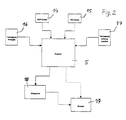
- the sample is taken from a one with a sampler 1 Waste glass processing plant leaving stream of the processed Used glass removed and fed to a processing plant 2. There the sample is dried and fines are sucked off or sieved. Then the sample is a Sorting device 3 supplied.
- the sorting device 3 has a slide over which the Sample slips in a single layer.
- the material flow of the The sample passes two over the entire width of the slide distributed rows of sensors, some of which for the detection of opaque foreign parts and the others for Serve detection of non-ferrous parts.
- the slide through a wall 4 running in its longitudinal direction in two divided sections of uneven width.
- a free-fall section connects to the slide of the sorting device 3 on. If one of the sensors detects contamination, as recognized as non-ferrous parts or KSP parts this a pulse signal to the computer 5 according to Art the contamination via a data line and this controls in Area of the free fall section arranged blow nozzles, which in the Area of the part assigned to the wider part of the slide the free fall distance across the free fall distance extending row are arranged, delayed, whereby all parts of the sample stream that are not clearly as glass blow out from the glass stream. From the duration of the individual pulse signals to the computer can also determine the grain sizes of impurities are calculated.
- a significant portion of that from the sample stream blown out parts are glass parts on which Glue parts of labels.
- the remaining parts collecting container 6 is via a conveyor 9 connected to a device 10 which is for detachment serving the labels from the glass parts.
- a device 10 which is for detachment serving the labels from the glass parts.
- Such a facility can e.g. through one on the inside with one in it Inside protruding worm gear drum, in the Center a burner is arranged to be formed.
- the device 10 can also be formed by a chamber in which there is a glass fan. In doing so the labels by irradiating the shards with small ones Glass balls mechanically rubbed off the shards. The one there emerging glass dust can be larger after vacuuming Paper particles are reprocessed by sieving, whereby Very fine particles, which can be mixed with paper particles, can be melted easily.
- the device 10 is on the output side via a conveyor 11 connected to a processing plant 2 ' essentially the same as the processing plant 2 for the Sample is formed.
- the processed material is the narrower part of the slide of the sorting device 3 given up.
- this subordinate free fall route are in a cross Blow nozzles arranged to the free-fall stretch provided the foreign parts detected by the sensors, such as KSP and blow non-ferrous parts into a foreign matter container 12, which also a weighing device is connected via a Signal line 13 is connected to the computer 5.
- the computer 5 can change the weight due to identify the blown out impurity and determine the type of impurity Assign contamination (NE or KSP) and the last one Weight change of the group of impurities in question count. This allows the mass of the sorted out non-ferrous parts of the sample and that of the KSP parts of the sample.
- NE or KSP type of impurity Assign contamination
- the computer 5 also with the weighing device of the clean glass container 7 is connected, it also determines the mass of the clean glass of a sample and the mass of the sorted out Non-ferrous parts and KSP parts related to the mass of the clean glass put.
- the computer 5 is on the input side with sensors 14 and 15 for the detection of KSP Parts, or non-ferrous parts, and the weighing devices 16, 17 for Detection of the weight increases of the clean glass container 7 and Foreign matter container 6 connected and the output side with a Screen 18 and a printer 19.
- the weight increases stored in the computer 5 are used for evaluation of the collecting container 6 separated according to NE and KSP impurities via an adjustable, defined Period t, preferably between 1 and 30 minutes, in relation set to the total enforced during this period Amount of sample.
- This sample amount is made up of the defined period t accrued weight gains as a result NE and KSP parts in the collecting container 6 plus the increases in Container 7.
- the results of these evaluations are on a Screen 19 displayed and can, if necessary, by the Printer 18 can be printed. In any case, they stay in the Calculator saved.
- the current Trend display also the trends of at least the previous one Evaluation are displayed.
- warning limits are set around the Value ⁇ f below and above the system value AW.
- the Computer via control devices in the preparation process for Used glass (A) intervened e.g. by taking back the task quantity in a waste glass processing device, not shown.
- the foreign substances are blown out with Glass particles sorted out and based on experience on the two groups of foreign substances NE and KSP-PARTS divided, with the very light non-ferrous parts, such as Bottle closures are blown out with more glass parts than for the heavier KSP parts.
- the weight ratio or standardized Impact value values based on the total sample quantity and the total Trial period from a large number of previous ones properly completed sampling into a memory written.
- the memory can be updated after each sampling by taking in the last value and the oldest is discarded. This function can also be - after reaching a stable state - stop.
Landscapes
- Processing Of Solid Wastes (AREA)
- Sampling And Sample Adjustment (AREA)
- Sorting Of Articles (AREA)
Applications Claiming Priority (2)
| Application Number | Priority Date | Filing Date | Title |
|---|---|---|---|
| AT1505/96 | 1996-08-21 | ||
| AT0150596A AT406089B (de) | 1996-08-21 | 1996-08-21 | Verfahren und einrichtung zur bestimmung der reinheit von aufbereitetem altglas |
Publications (2)
| Publication Number | Publication Date |
|---|---|
| EP0824968A2 true EP0824968A2 (fr) | 1998-02-25 |
| EP0824968A3 EP0824968A3 (fr) | 1998-12-09 |
Family
ID=3515211
Family Applications (1)
| Application Number | Title | Priority Date | Filing Date |
|---|---|---|---|
| EP19970890164 Ceased EP0824968A3 (fr) | 1996-08-21 | 1997-08-14 | Procédé et dispositif pour déterminer la pureté de déchets de verre recyclés |
Country Status (4)
| Country | Link |
|---|---|
| US (1) | US5913427A (fr) |
| EP (1) | EP0824968A3 (fr) |
| JP (1) | JPH10227786A (fr) |
| AT (1) | AT406089B (fr) |
Cited By (1)
| Publication number | Priority date | Publication date | Assignee | Title |
|---|---|---|---|---|
| EP1375017A1 (fr) * | 2002-06-05 | 2004-01-02 | Asahi Glass Company Ltd. | Procédé de récupération des particules en verre |
Families Citing this family (3)
| Publication number | Priority date | Publication date | Assignee | Title |
|---|---|---|---|---|
| US8436268B1 (en) | 2002-08-12 | 2013-05-07 | Ecullet | Method of and apparatus for type and color sorting of cullet |
| US7351929B2 (en) * | 2002-08-12 | 2008-04-01 | Ecullet | Method of and apparatus for high speed, high quality, contaminant removal and color sorting of glass cullet |
| US7355140B1 (en) | 2002-08-12 | 2008-04-08 | Ecullet | Method of and apparatus for multi-stage sorting of glass cullets |
Family Cites Families (5)
| Publication number | Priority date | Publication date | Assignee | Title |
|---|---|---|---|---|
| DE3618173A1 (de) * | 1986-05-30 | 1987-12-03 | Mab Marlis Kellermann | Glas-sortieranlage |
| DE3731402A1 (de) * | 1987-06-11 | 1988-12-29 | Mabeg Muell & Abfall | Anlage zur trennung von abfallhohlglaesern, insbesondere von flaschen mindestens nach weiss- und buntglas |
| US5314071A (en) * | 1992-12-10 | 1994-05-24 | Fmc Corporation | Glass sorter |
| AT399400B (de) * | 1993-03-15 | 1995-04-25 | Binder Co Ag | Verfahren und einrichtung zur bestimmung der reinheit von aufbereitetem altglas |
| AT400906B (de) * | 1994-10-25 | 1996-04-25 | Binder Co Ag | Verfahren und einrichtung zur bestimmung der reinheit von aufbereitetem altglas |
-
1996
- 1996-08-21 AT AT0150596A patent/AT406089B/de not_active IP Right Cessation
-
1997
- 1997-08-05 US US08/906,574 patent/US5913427A/en not_active Expired - Fee Related
- 1997-08-14 EP EP19970890164 patent/EP0824968A3/fr not_active Ceased
- 1997-08-21 JP JP22504097A patent/JPH10227786A/ja not_active Withdrawn
Cited By (1)
| Publication number | Priority date | Publication date | Assignee | Title |
|---|---|---|---|---|
| EP1375017A1 (fr) * | 2002-06-05 | 2004-01-02 | Asahi Glass Company Ltd. | Procédé de récupération des particules en verre |
Also Published As
| Publication number | Publication date |
|---|---|
| EP0824968A3 (fr) | 1998-12-09 |
| JPH10227786A (ja) | 1998-08-25 |
| US5913427A (en) | 1999-06-22 |
| AT406089B (de) | 2000-02-25 |
| ATA150596A (de) | 1999-06-15 |
Similar Documents
| Publication | Publication Date | Title |
|---|---|---|
| EP3191816B1 (fr) | Procédé et dispositif pour le tri de morceaux de matières premières recyclables | |
| AT398174B (de) | Verfahren und vorrichtung zum trennen von entrindeten holzknüppeln | |
| DE3612076C2 (fr) | ||
| DE3146049C2 (de) | Verfahren zur Aufbereitung von Titanschrott und Vorrichtung zur Durchführung desselben | |
| DE10146512C1 (de) | Anlage zum Reinigen von holzhaltigem Gut | |
| EP0982081B1 (fr) | Classification pneumatique de polysilicium | |
| DE2413706A1 (de) | Verfahren und vorrichtung zum sortieren von glasabfaellen und -ausschuss auf transparenz | |
| DE2907513C2 (de) | Probenentnahmeverfahren zur Bestimmung der chemischen Zusammensetzung makroskopischer Bestandteile von Materialien | |
| EP0439674A2 (fr) | Dispositif pour trier des déchets | |
| DE3726808A1 (de) | Verfahren zur muellsortierung und muellsortiervorrichtung | |
| AT399400B (de) | Verfahren und einrichtung zur bestimmung der reinheit von aufbereitetem altglas | |
| AT400906B (de) | Verfahren und einrichtung zur bestimmung der reinheit von aufbereitetem altglas | |
| EP0328126B1 (fr) | Méthode et dispositif pour trier des déchets de verre | |
| EP0282943A2 (fr) | Procédé et dispositif pour récupérer du verre de déchets de verre | |
| AT406089B (de) | Verfahren und einrichtung zur bestimmung der reinheit von aufbereitetem altglas | |
| DE3828067C2 (fr) | ||
| DE4310862C2 (de) | Verfahren zur Batteriesortierung | |
| DE4019203A1 (de) | Verfahren und vorrichtung zum sortieren von altglas | |
| EP3730224A1 (fr) | Installation de dépoussiérage | |
| EP3730225B1 (fr) | Installation de dépoussiérage | |
| DE3618173A1 (de) | Glas-sortieranlage | |
| DE19616036C1 (de) | Verfahren und Vorrichtung zur Abscheidung von Verunreinigungen aus Gesteinsbrocken | |
| DE3708180A1 (de) | Vorrichtung zur wiederaufbereitung von recyclingstoffen, vorzugsweise bauschutt | |
| DE2219179A1 (de) | Verfahren und vorrichtung zum sortieren und klassieren eines gemenges aus festen stoffteilchen unterschiedlicher groesse, zusammensetzung und spezifischem gewicht | |
| DE4343539A1 (de) | Verfahren und Vorrichtung zum Abtrennen von an Kunststoffprodukten anhaftenden Verunreinigungen |
Legal Events
| Date | Code | Title | Description |
|---|---|---|---|
| PUAI | Public reference made under article 153(3) epc to a published international application that has entered the european phase |
Free format text: ORIGINAL CODE: 0009012 |
|
| AK | Designated contracting states |
Kind code of ref document: A2 Designated state(s): CH DE ES FR IT LI |
|
| PUAL | Search report despatched |
Free format text: ORIGINAL CODE: 0009013 |
|
| AK | Designated contracting states |
Kind code of ref document: A3 Designated state(s): AT BE CH DE DK ES FI FR GB GR IE IT LI LU MC NL PT SE |
|
| 17P | Request for examination filed |
Effective date: 19990609 |
|
| AKX | Designation fees paid |
Free format text: CH DE ES FR IT LI |
|
| GRAG | Despatch of communication of intention to grant |
Free format text: ORIGINAL CODE: EPIDOS AGRA |
|
| 17Q | First examination report despatched |
Effective date: 20010223 |
|
| STAA | Information on the status of an ep patent application or granted ep patent |
Free format text: STATUS: THE APPLICATION HAS BEEN REFUSED |
|
| 18R | Application refused |
Effective date: 20010916 |