EP0825261A2 - Purinenukleosidase aus Ochrobactrum anthropi - Google Patents
Purinenukleosidase aus Ochrobactrum anthropi Download PDFInfo
- Publication number
- EP0825261A2 EP0825261A2 EP97306248A EP97306248A EP0825261A2 EP 0825261 A2 EP0825261 A2 EP 0825261A2 EP 97306248 A EP97306248 A EP 97306248A EP 97306248 A EP97306248 A EP 97306248A EP 0825261 A2 EP0825261 A2 EP 0825261A2
- Authority
- EP
- European Patent Office
- Prior art keywords
- purine
- wort
- protein
- enzyme
- nucleosidase
- Prior art date
- Legal status (The legal status is an assumption and is not a legal conclusion. Google has not performed a legal analysis and makes no representation as to the accuracy of the status listed.)
- Granted
Links
- 0 CC1*=C*C1 Chemical compound CC1*=C*C1 0.000 description 5
Images




Classifications
-
- C—CHEMISTRY; METALLURGY
- C12—BIOCHEMISTRY; BEER; SPIRITS; WINE; VINEGAR; MICROBIOLOGY; ENZYMOLOGY; MUTATION OR GENETIC ENGINEERING
- C12C—BEER; PREPARATION OF BEER BY FERMENTATION; PREPARATION OF MALT FOR MAKING BEER; PREPARATION OF HOPS FOR MAKING BEER
- C12C5/00—Other raw materials for the preparation of beer
-
- C—CHEMISTRY; METALLURGY
- C12—BIOCHEMISTRY; BEER; SPIRITS; WINE; VINEGAR; MICROBIOLOGY; ENZYMOLOGY; MUTATION OR GENETIC ENGINEERING
- C12C—BEER; PREPARATION OF BEER BY FERMENTATION; PREPARATION OF MALT FOR MAKING BEER; PREPARATION OF HOPS FOR MAKING BEER
- C12C5/00—Other raw materials for the preparation of beer
- C12C5/004—Enzymes
-
- C—CHEMISTRY; METALLURGY
- C12—BIOCHEMISTRY; BEER; SPIRITS; WINE; VINEGAR; MICROBIOLOGY; ENZYMOLOGY; MUTATION OR GENETIC ENGINEERING
- C12C—BEER; PREPARATION OF BEER BY FERMENTATION; PREPARATION OF MALT FOR MAKING BEER; PREPARATION OF HOPS FOR MAKING BEER
- C12C7/00—Preparation of wort
-
- C—CHEMISTRY; METALLURGY
- C12—BIOCHEMISTRY; BEER; SPIRITS; WINE; VINEGAR; MICROBIOLOGY; ENZYMOLOGY; MUTATION OR GENETIC ENGINEERING
- C12N—MICROORGANISMS OR ENZYMES; COMPOSITIONS THEREOF; PROPAGATING, PRESERVING, OR MAINTAINING MICROORGANISMS; MUTATION OR GENETIC ENGINEERING; CULTURE MEDIA
- C12N9/00—Enzymes; Proenzymes; Compositions thereof; Processes for preparing, activating, inhibiting, separating or purifying enzymes
- C12N9/14—Hydrolases (3)
- C12N9/24—Hydrolases (3) acting on glycosyl compounds (3.2)
- C12N9/2497—Hydrolases (3) acting on glycosyl compounds (3.2) hydrolysing N- glycosyl compounds (3.2.2)
-
- C—CHEMISTRY; METALLURGY
- C12—BIOCHEMISTRY; BEER; SPIRITS; WINE; VINEGAR; MICROBIOLOGY; ENZYMOLOGY; MUTATION OR GENETIC ENGINEERING
- C12Y—ENZYMES
- C12Y302/00—Hydrolases acting on glycosyl compounds, i.e. glycosylases (3.2)
- C12Y302/02—Hydrolases acting on glycosyl compounds, i.e. glycosylases (3.2) hydrolysing N-glycosyl compounds (3.2.2)
- C12Y302/02001—Purine nucleosidase (3.2.2.1)
Definitions
- the present invention relates to purine nucleosidases, obtainable e.g. from Ochrobactrum anthropi, and to their derivatives. It further relates to DNA coding for the enzyme or its derivatives, to an expression vector including the DNA, to recombinant host cells transformed with the expression vector, to a process for producing a protein with purine nucleosidase activity using the recombinant host cells, to a process for producing a protein with purine nucleosidase activity using a microorganism belonging to the genus Ochrobactrum capable of producing the protein, and to a process for producing beer or wort using purine nucleosidase enzyme/protein.
- Purine-rich foods include meat, milt, fish eggs and liver, but alcoholic beverages and especially beer also have rather high purine contents.
- Kaneko Korean Yamamoto, Japan Clin., Vol.49, No.5, 1108-1115, 1991
- fermented liquors such as beer, sake and wine contain larger amounts of purines than distilled liquors such as whiskey and Japanese shochu, and that among fermented liquors beer has an especially high purine content.
- the purine content of beer is only 1/100 to 1/10 that of meat, eggs or liver, the comparatively large amount of consumption thereof implies a considerable attack risk for hyperuricemia and gout.
- Tofler and Woodings (O.B. Tofler and T.L. Woodings, Med. J. Aust., Vol.2, 479-481, 1981) carried out a follow-up study over 13 years using groups among a survey population classified based on amount of beer consumption, and pointed out a positive correlation between beer consumption and gout frequency. Based on such etiological research conducted to date, beer is considered to be the alcoholic beverage with the highest attack risk for hyperuricemia and gout. However, no technology has been developed for reducing purine levels of foods, including beer.
- purine compounds are free purine bases, purine nucleosides, purine nucleotides and high molecular nucleic acids. Investigation of the nature of purine compounds in the beer production process reveals absolutely no purine nucleotides or high molecular nucleic acids in wort, but a large amount of free purine bases and purine nucleosides. The free purine bases are absorbed and metabolized by yeast during fermentation and thus virtually disappear. On the other hand, purine nucleosides which make up the greater part of the purine compounds in wort are not reduced during fermentation, and they even increase when the temperature falls to 0°C during storage after fermentation has been completed.
- microorganisms used for fermented products other than beer cannot assimilate purine nucleosides, if they are capable of utilizing free purine bases as a nutrition source it will be possible to reduce the amount of purine compounds in the fermented product in the same manner by decomposing the purine nucleosides in the raw fermentation substance to ribose and free purine bases. It has also been reported that fermentation during beer brewing is delayed if the wort has a low adenine content (Thompson, C.C., Leedham, P.A., and Lawrence, D.R., Am. Soc. Brew. Chem., Proc.
- yeast growth is expected by decomposing the purine nucleosides to ribose and free purine bases which increases the amount of nucleic acid compounds which can be assimilated by the yeast.
- the same effect is also expected for fermented foods prepared with microorganisms which cannot assimilate purine nucleosides but can utilize the free purine bases as a nutrition source.
- purine nucleosidase Two enzymes which are known to decompose purine nucleosides to ribose and free purine bases are purine nucleosidase and purine nucleoside phosphorylase.
- purine nucleoside phosphorylase is less efficient at completely decomposing purine nucleosides in reaction solutions to ribose and free purine bases because it catalyzes both decomposition and synthesis reactions, or catalyzes cross reaction.
- Purine nucleosidase produces an equilibrium shifted toward the decomposition side and can therefore accomplish thorough decomposition to ribose and free purine bases, but it varies in its substrate specificity, optimum pH, optimum temperature, etc.
- decomposition of extracted purine nucleosides would desirably involve a purine nucleosidase which can utilize adenosine, inosine and guanosine as substrates under conditions of pH 5.0 to 5.5 and 50 to 80°C.
- a purine nucleosidase which can utilize adenosine, inosine and guanosine as substrates under conditions of pH 5.0 to 5.5 and 50 to 80°C.
- nucleosidases with heat resistance there may be mentioned that of Aspergillus niger, that of Bacillus cereus and that of Crithidia fasciculata.
- Aspergillus niger nucleosidase has a slightly low optimum pH of 4.0 to 4.5, and cannot decompose xanthosine.
- Xanthosine is virtually absent in the case of beer, but for applications to other fermented foods activity against xanthosine may be required.
- Crithidia fasciculata nucleosidase has a high optimum pH of 8.5.
- Wort also contains various low molecular substances, sugars and proteins, and it has not yet been investigated whether known nucleosidases can actually act on them. Therefore, we screened natural sources for microorganism-derived purine nucleosidases which can utilize adenosine, inosine and guanosine as substrates under conditions of pH 5.0 to 5.5, 50 to 80°C. As a result, high purine nucleosidase activity was found in crushed cell solutions of Ochrobactrum anthropi.
- the present invention provides a purine nucleosidase with the following enzymological properties:
- the present invention further provides a purine nucleosidase having an amino acid sequence from amino acid No.1 to amino acid No.341 of SEQ NO.1, or a protein having an amino acid sequence which is that amino acid sequence modified by an addition or deletion of one or more amino acids and/or a substitution with other amino acids, and which maintains purine nucleosidase activity.
- the present invention still further provides a protein encoded by DNA which can be hybridized with the full or partial nucleotide sequence represented by SEQ ID NO.1 under hybridization conditions of 40°C to 55°C, and 6 x SSC, which protein also has purine nucleosidase activity.
- the present invention still further provides a gene coding for an aforementioned enzyme or protein, an expression vector including the gene, and recombinant host cells transformed with the expression vector.
- the present invention still further provides a process for producing a protein with purine nucleosidase activity which is characterized by culturing the aforementioned recombinant host cells and collecting the desired enzyme protein from the culture.
- the present invention still further provides a process for producing a purine nucleosidase which is characterized by culturing a microorganism belonging to Ochrobactrum anthropi which is capable of producing a said purine nucleosidase, and collecting the desired enzyme protein from the culture.
- Purine nucleosidase produced by Ochrobactrum preferably Ochrobactrum anthropi, are an aspect of the invention.
- the present invention still further provides a process for producing beer which is characterized by using nucleoside-decomposed wort obtained by allowing purine nucleosidase, preferably an above-defined purine nucleosidase, to act on wort to decompose the purine nucleosides contained in the wort to purine bases.
- purine nucleosidase preferably an above-defined purine nucleosidase
- the present invention still further provides a process for producing wort which is characterized by allowing purine nucleosidase, preferably as aforementioned, to act on wort to decompose the purine nucleosides contained in the wort to purine bases, in order to obtain nucleoside-decomposed wort.
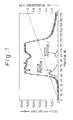
- Fig. 1 shows an elution pattern for the (1st) DEAE Sephacel column chromatography.
- Fig. 2 shows the optimum pH for adenosine substrate.
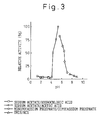
- Fig. 3 shows the optimum pH for guanosine substrate.
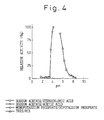
- Fig. 4 shows the optimum pH for inosine substrate.
- Fig. 5 shows the optimum temperature at pH 4.5.
- Fig. 6 shows the optimum temperature at pH 5.5.
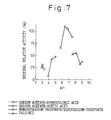
- Fig. 7 shows the pH stability with heat treatment at 50°C for 60 minutes.
- Fig. 8 shows the pH stability with heat temperature at 30°C for 30 minutes.
- Fig. 9 shows the temperature stability with heat treatment at pH 6.0 for 30 minutes.
- Fig. 10 shows the temperature stability with heat temperature at pH 4.5 for 60 minutes.
- Fig. 11 shows a time-temperature curve for a mash kettle and mash tun during wort production.
- Fig. 12 is a graph showing the results of purine analysis of wort produced with addition of enzyme and wort produced without addition of enzyme.
- Fig. 13 shows the change in purines during fermentation using the nucleoside-decomposed wort produced in Example 16 and normal wort.
- Fig. 14 shows the change in purines during fermentation using the nucleoside-decomposed wort produced in Example 16 and normal wort.
- enzyme purine nucleosidases of the invention and genes coding therefor may be obtained from microorganisms belonging to Ochrobactrum which have the ability to produce purine nucleosidases having the properties listed above, and microorganisms of the species Ochrobactruin anthropi may be given as an example. Representative thereof is a novel microbial strain of Ochrobactrum anthropi isolated by the present inventors.
- This Ochrobactrum anthropi strain newly isolated for the present invention has the following taxonomical properties.
- the physiochemical properties were determined using API20NE (BIO MERIEUX S.A.). A species name search was then conducted through the API20NE Analytical Profile Index based on these results; the nitrate reduction and glycine utilization differed from the description of Holmes et al. (International Journal of Systematic Bacteriology, Vol.38, No.4, 1988, p.406-416), but otherwise according to the index the strain was identified as Ochrobactrum anthropi.
- This strain was named Ochrobactrum anthropi SAM2125, and was internationally deposited as FERM BP-5377 at the National Institute of Bioscience and Human Technology, 1-3, Higashi 1-chome, Tsukuba-shi, Ibaraki-ken, 305 Japan on January 26, 1996 in accordance with the Budapest Treaty.
- the present invention further provides a purine nucleosidase having the amino acid sequence from amino acid No.1 to amino acid No.341 of SEQ ID NO.1, or a protein having an amino acid sequence modified by addition or deletion of one or more amino acids and/or a replacement of one or more amino acids with other amino acids, and which maintains purine nucleosidase activity.
- the number of amino acids to be modified should be such which allows modification by common gene manipulation procedures such as site-specific variable induction and the PCR.
- the present invention still further provides a protein encoded by DNA which can be hybridized with the full or partial nucleotide sequence represented by SEQ ID NO.1 under hybridization conditions of 40°C to 55°C, 6 x SSC, which protein also has purine nucleosidase activity.
- the DNA coding for the protein with purine nucleosidase activity may be used from a cDNA library or genomic DNA library obtained from, in addition to bacteria belonging to the genus Ochrobactrum, also microorganisms belonging to Serratia, Flavobacterium, Pseudomonas or Aspergillus, for example microorganisms such as Serratia marcescens, Flavobacterium meningosepticum, Pseudomonas fluorescens and Aspergillus terreus.
- the aforementioned microorganism used for the invention is first cultured according to conventional methods to obtain a disrupted cell solution.
- the purine nucleosidase alone is purified from the disrupted cell solution by chromatography with an ion-exchange column or gel filtration column, and the molecular weight, subunit structure, N-terminal amino acid sequence, partial amino acid sequences, etc. are determined. Also, synthetic DNA probes corresponding to the N-terminal amino acid sequence and partial amino acid sequences are used for screening of the Ochrobactrum anthropi purine nucleosidase gene to determine the entire nucleotide sequence.
- the present invention provides an Ochrobactruin anthropi protein with purine nucleosidase activity, and a gene coding therefor.
- proteins with purine nucleosidase activity also include those enzyme proteins with purine nucleosidase activity whose amino acid sequences have been modified.
- a modification means that there has been a substitution, addition and/or deletion of one or more amino acid residues in the amino acid sequence of SEQ. NO.1.
- Bacteria belonging to the genus Ochrobactrum may be used to obtain a protein with purine nucleosidase activity according to the invention or a gene coding therefor.
- Ochrobactruin anthropi SAM 2125 (FERM BP-5377) may be used.
- microorganisms may also exist which produce purine nucleosidases with activity which is biologically equivalent to the purine nucleosidase derived from Ochrobactrum, and the gene sequence elucidated by the present invention may be used to obtain the purine nucleosidase genes from these microorganisms as well.
- the microorganism may be cultured in medium containing a suitable carbon source, nitrogen source and trace metal elements.
- the cultured product is then recovered, and the enzyme of interest is purified from the cell extract or culture supernatant by a combination of known methods such as precipitation, adsorption, molecular sieving and electrophoresis.
- the purine nucleosidase may be purified by DEAE Sephacel column chromatography, ammonium sulfate precipitation, Phenyl-Sepharose CL-4B, Sephacryl S-200HR or Mono Q HR 5/5 chromatography, etc.
- the N-terminal amino acid sequence or partial amino acid sequences may then be determined from the purified purine nucleosidase by a known method. Isolation of the chromosomal DNA from the microorganism, preparation of a genomic library and screening may also be carried out by known methods. Such a method is described, for example, in Sambrook et. al., Molecular Cloning, 2nd Ed. (Cold Spring Harbor, 1989).
- the gene coding for a protein with purine nucleosidase activity may be obtained in the following manner. Chromosomal DNA is first extracted from Ochrobactrum anthropi cells. It is then partially digested with a suitable restriction endonuclease such as Sau3AI and inserted into a cloning vector such as EMBL3 and used to transform host cells of E. coli or the like. The resulting genomic DNA library is then screened using a synthetic DNA probe corresponding to a partial amino acid sequence of the purine nucleosidase, to obtain positive clones containing DNA fragments coding for the desired protein with purine nucleosidase activity.
- a suitable restriction endonuclease such as Sau3AI
- EMBL3 cloning vector
- the DNA probe can be obtained by purifying the desired protein with purine nucleosidase activity from the Ochrobactrum culture product in the manner explained above, determining at least its partial amino acid sequence, and synthesizing the probe based on this sequence. Longer probe fragments may be prepared using the polymerase chain reaction (PCR). Alternatively, the chromosomal DNA may be completely decomposed with different restriction endonucleases and subjected to agarose gel electrophoresis, transferred to a nylon membrane or other membrane, and the aforementioned probe used to identify hybridizing DNA fragments by Southern hybridization.
- PCR polymerase chain reaction
- the DNA fragments are then cut out from the agarose gel and collected, inserted into a cloning plasmid such as pUC, and used to transform host cells of E. coli or the like.
- the synthetic DNA probe corresponding to the partial amino acid sequence of the aforementioned purine nucleosidase may be used for screening of the clones to obtain positive clones containing the DNA fragment coding for the desired purine nucleosidase.
- the DNA inserted into the plasmids of the clones is then digested with a suitable restriction endonuclease to give DNA fragments which are then subcloned with a suitable vector, for example pUC18 or pUC19, and the nucleotide sequences of the inserted DNA fragment can be determined by dideoxy sequencing or the like.
- expression vectors used for E. coli include pUC and pBR systems, pBluescript II, pTrc99A, pKK223-3, pPL-Lambda, etc.
- An appropriate and suitable promoter can be selected by a person skilled in the art. For example, lac promoter, tac promoter, T7 promoter, T3 promoter, trc promoter and ⁇ PL promoter are preferred.
- a GST Gene Fusion Vector (pGEX system, etc.) may be used for expression as a fused protein with Glutathione S-transferase, followed by purification with Glutathione Sepharose 4B or the like and then separation of the nucleosidase with an appropriate protease.
- Expression vectors to used when yeast are used as the host cells include pYE22m (Japanese Unexamined Patent Publication No. 3-97615), YRp7 (Struhl, K. et al., Proc. Natl. Acad. Sci. USA 76, 1035-1039, 1979; Stinchcomb, D.T. et al., Nature 282, 39-43, 1979), YIp5 (Struhl, K.
- Promoters used include GAL1 promoter, GAL7 promoter, GAL10 promoter, ADH2 promoter and GAP promoter.
- Appropriate and suitable host cells for expression may also be selected by a person skilled in the art from among Bacillus subtilis, filamentous bacteria and animal cells.
- the present invention also relates to a process for producing a protein with purine nucleosidase activity, but since the culturing conditions may be appropriately selected by a person skilled in the art, no particular problems will be presented by the culturing itself so long as the aforementioned recombinant host cells can be obtained.
- the transformed cells After the transformed cells have been cultured in a culture medium containing a suitable carbon source, nitrogen source and trace metal elements and the desired enzyme protein or derivative protein has been expressed, it may be suitably collected by known methods from the culture, i.e. from the culture supernatant or from the recombinant host cells themselves after culturing. If necessary, for example, after the cells are disrupted by ultrasonic waves or a Dynamill or the like, the enzyme may be purified by a combination of known methods including precipitation, adsorption, molecular sieving and electrophoresis.
- the present invention further provides a use for protein with purine nucleosidase activity. That is, it also relates to a process for producing beer using such protein, especially the novel ones disclosed herein.
- the present inventors have completed the present invention as a result of much research aimed at providing a production process for beer which gives lower concentrations of purine compounds, after measuring amounts of purine nucleosides, purine nucleotides, purine bases and high molecular nucleic acids in beer.
- Purine bases is a general term for derivatives of purine (9H-imidazo[4,5-d]pyrimidine) which are substituted at various sites, and includes adenine, guanine and xanthine.
- Purine nucleosides is a general term for glucosides wherein purine bases are attached to reducing groups of sugars by N-glycoside bonds, and includes adenosine, guanosine, inosine, etc.
- Purine nucleotides is a general term for compounds wherein the sugar portion of the purine nucleoside forms an ester with phosphoric acid, and includes adenylic acid, guanylic acid and inosinic acid.
- Purine compounds is a general term for compounds which contain a purine skeleton of the aforementioned purine bases, purine nucleosides or purine nucleotides. Upon measuring amounts of purine compounds in beer and during the steps of production, the present inventors have discovered the following facts:
- an enzyme is allowed to act on the wort to decompose the purine nucleosides in the wort to purine bases and produce nucleoside-decomposed wort, so that by using this nucleoside-decomposed wort it becomes possible to reduce the purine compound content of the beer.
- the nucleoside-decomposed wort has part or all of the nucleosides in the wort decomposed to purine bases by the enzyme, and the purine nucleoside content of the nucleoside-decomposed wort can be adjusted based on the amount of enzyme added, the reaction time and the reaction temperature; however, it is preferred for all of the purine nucleosides to be decomposed to purine bases, to give wort containing no purine nucleosides.
- the enzyme can be employed (1) during the wort production process, (2) after wort production and before the fermentation process or (3) during the fermentation process. If the enzyme is to be employed during the wort production process, it may be added at an appropriate point at the start of wort production (saccharification) or during the wort production. If the enzyme is to be employed before the fermentation step, the enzyme is added to the wort during the wort production process, allowing it to stand for a prescribed time prior to starting fermentation, and in such a case the addition is most preferably made before boiling during the wort production process. This is because the boiling can result in inactivation of enzymes, and therefore the active enzymes in the beer product which are carried through may have some adverse effect on the quality of the beer.
- the enzyme is to be employed during the fermentation process, it is added at the start of fermentation or during fermentation. However, since the purine bases produced by the action of the enzyme must be metabolized and eliminated by the yeast, the enzyme is preferably added at the start of fermentation or during the first stage of the fermentation period.
- Ochrobactrum anthropi SAM2125 (FERM BP-5377) was inoculated into 5 ml of the medium described below and incubated in a test tube with shaking at 28°C for 16 hours. It was then transferred to 50 ml of medium and incubated in 500 ml of Mayer with shaking at 28°C for 25 hours. This was then transferred to 2 liters of medium and subjected to cultivate in a 3 liter jar with aeration and agitation at 28°C for 47 hours. Centrifugation of the culture solution yielded 29 g of wet cells.
- Medium composition tryptone 0.5% (w/v) yeast extract 0.5% glucose 0.1% dipotassium phosphate 0.1% inosine 3 mM pH 7.0
- the wet cells After suspending 20 g of the wet cells in 40 ml of 10 mM Tris-HCl buffer solution (pH 7.4) (hereunder referred to as "buffer"), they were disrupted in a Dynamill at 4°C for 10 minutes. After filtering the disrupted cell suspension it was centrifuged (10,000 rpm, 60 min) and the supernatant was used as a cell-free extract. The cell-free extract (250 ml) was dialyzed for 12 hours against 5 L of buffer and then applied to a DEAE-Sephacel column (3 x 30 cm, 200 ml) which had been equilibrized with the buffer. The adsorbed protein was eluted with an NaCl concentration gradient from 0 to 1.0 M and the active fractions were recovered.
- Tris-HCl buffer solution pH 7.4
- the purine nucleosidase activity at this time was split into two peaks (Fig. 1). Fraction nos. 46 to 69 were collected as the first active fraction and fraction nos. 85 to 101 were collected as the second active fraction. Table 1 shows the specific activities of the first and second active fractions with adenosine, inosine and guanosine as substrates. The two active fractions differ in their behavior with respect to temperature, suggesting the possibility that they are two different enzymes.
- Ammonium sulfate was added to the supernatant to 100% saturation, and after thorough agitation, centrifugation was performed (10,000 rpm, 20 min) and the precipitate was recovered. The precipitate was then dissolved in 9 ml of buffer and used as the active fraction. NaCl was added to the active fraction from ammonium sulfate fractionation to a concentration of 4.0 M, and this was then supplied to a Phenyl-Sepharose CL-4B column (1 x 7.5 cm, 6 ml) which had been equilibrized with buffer containing 4.0 M NaCl. The adsorbed protein was eluted with an NaCl concentration gradient from 4.0 to 0 M and the active fractions were recovered.
- the active fraction from Phenyl-Sepharose CL-4B column chromatography (16.5 ml) was concentrated to 4 ml with an ultrafiltration membrane with a fractionating molecular weight of 30,000 and then applied to a Sephacryl S-200 HR column (1.5 x 80 cm, 140 ml).
- the protein was eluted with buffer containing 0.2 M NaCl and the active fractions were recovered.
- the total activity was higher after DEAE-Sephacel column chromatography than in the cell-free extract, suggesting that substances inhibiting nucleosidase activity may be present in the cell-free extract.
- the enzyme was confirmed to be a homotetramer with a molecular weight of 172,000 by gel filtration chromatography (TSK-G 3000SW) and subunits of 43,000 by SDS-polyacrylamide gel electrophoresis.
- the reaction solution (200 ⁇ l) contained 0.5 mM of adenosine or inosine or 0.25 mM of guanosine as the substrate, 50 mM of acetate buffer at pH 4.5 and a sufficient amount of enzyme.
- the reaction was initiated by addition of the enzyme, and the reaction was conducted at 50°C for 5 minutes.
- the reaction was terminated by addition of 20 ⁇ l of 15% perchloric acid, and after centrifugation (35,000 rpm, 10 min) the supernatant was analyzed qualitatively by thin-layer chromatography (TLC) and quantitatively by high-performance liquid chromatography.
- TLC thin-layer chromatography
- the substrate specificity of the purine nucleosidase was determined by thin-layer chromatography (TLC). The results are shown in Table 3.
- the substrate of the enzyme was generally purine compounds, and it did not act on pyrimidines except for 2'-CMP.
- the specific activity was measured under conditions of 50°C, pH 4.5.
- the Km and Vmax were measured under conditions of 30°C, pH 4.5.
- the relative activity was expressed according to the following measurement method. - not reacted + ⁇ 10% ++ ⁇ 31% +++ ⁇ 50% ++++ >50% n.d. not determined
- the optimum pH was determined by high-performance liquid chromatography with adenosine, guanosine and inosine substrates.
- the reaction solution (200 ⁇ l) contained 0.5 mM of adenosine or inosine or 0.25 mM of guanosine as the substrate, 50-mM of the buffer solutions described below and a sufficient amount of enzyme, and the reaction was conducted at 50°C for 30 minutes. The results are shown in Figs. 2, 3 and 4.
- the optimum pH was pH 5.0 to 7.5 for adenosine, pH 4.0 to 5.5 for guanosine and pH 5.5 for inosine.
- the optimum temperature was determined by high-performance liquid chromatography with adenosine, guanosine and inosine substrates.
- the reaction solution (200 ⁇ l) contained 0.5 mM of adenosine or inosine or 0.25 mM of guanosine as the substrate, 50 mM of sodium acetate buffer solution (pH 4.5) or 50 mM of potassium phosphate buffer solution (pH 5.5) and a sufficient amount of enzyme, and the reaction was conducted at different temperatures for 20 minutes. The results are shown in Figs. 5 and 6.
- the optimum temperature at pH 4.5 was 50°C for adenosine, guanosine and inosine.
- the optimum temperature at pH 5.5 was 60°C for adenosine and inosine and 50°C for guanosine.
- the residual activity of the enzyme with inosine as the substrate was determined for treatment at 50°C for 60 minutes and treatment at 30°C for 30 minutes at different pH values.
- the buffer solutions for each pH were the same as those described above. The results are shown in Figs. 7 and 8.
- the purine nucleosidase protein was purified by reducing carboxymethylation followed by reverse phase HPLC. Specifically, 108 mg of purine nucleosidase (2.5 ⁇ mole) was dissolved in 3.0 ml of modified buffer (Tris-HCl (pH 8.5) containing 6M Gdn-HCl, 10 mM EDTA-2Na) and incubated at 50°C for one hour. After adding 143 ⁇ mole (10 ⁇ l) of 2-mercaptoethanol and performing nitrogen substitution on the reaction system, incubation was continued at 37°C for one hour.
- modified buffer Tris-HCl (pH 8.5) containing 6M Gdn-HCl, 10 mM EDTA-2Na
- reaction system was kept at pH 8.0 to 8.5.
- reaction solution was adequately dialyzed against H 2 O.
- the protein yield was 16%.
- a protein with a molecular weight of approximately 4 K was confirmed in the protein fractions by SDS-PAGE.
- N-terminal amino acid sequence of the 5 nmol of reducing carboxymethylated purine nucleosidase protein prepared earlier was analyzed with a gas-phase protein sequencer (product of Shimazu Laboratories) and confirmed to be the following sequence.
- Asp-Thr-Glu-Lys-Met-Ile-Ile-Asp-Thr-Asp-Phe-Ser-Thr-Ile-Gly SEQ. NO.2
- a 48 nmole (2.0 mg) portion of reducing carboxymethylated purine nucleosidase was suspended in 100 ⁇ l of 0.01 M Tris/HCl buffer solution at pH 9.0. After adding 2 ⁇ l of a 1% solution of lysyl endopeptidase (0.1 M Tris/HCl buffer at pH 9.0) the solution was incubated at 35°C for 6 hours. The cloudy matter in the solution disappeared immediately upon addition of the enzyme, giving a clear solution. After the reaction the solution was frozen. The reaction was terminated by drying. After the freeze-drying, the residue was dissolved in 70% formic acid and used for HPLC.
- Each of the resulting peaks were further purified by reverse phase HPLC.
- the amino acid sequences of the purified peptides were then determined. Among them, the following 8 peptide sequences were determined with a gas-phase protein sequencer (product of Shimazu Laboratories).
- the genomic DNA was prepared according to Methods in Molecular Biology, Vol.2 (Humana Press, Inc. 1984). That is, about 10 g of Ochrobactrum anthropi cells were suspended in 20 ml of TES buffer (10 mM Tris-HCl (pH 8.0); 10 mM NaCl; 1 mM EDTA).
- the DNA was dissolved in 15 ml of TES buffer, and RNase was added to 50 ⁇ g/ml prior to incubation at 37°C for one hour. Proteinase K was then added to 50 ⁇ g/ml prior to further incubation at 37°C for one hour. An equivalent of phenol was added, and extraction and ethanol precipitation were carried out in the same manner as described above.
- the recovered DNA was rinsed with 70% ethanol and then with ethanol, after which it was dried with a vacuum desiccator and dissolved in TE buffer (10 mM Tris-HCl (pH 8.0); 0.1 mM EDTA) to obtain the DNA.
- the obtained genomic DNA was digested with restriction endonucleases such as EcoRI, EcoRV, HindIII, PstI, HincII and XbaI and subjected to electrophoresis with 0.8% agarose gel.
- the agarose gel was treated with 0.25 N hydrochloric acid for 20 minutes and then 1.5 M NaCl, 0.5 M NaOH for 30 minutes, after which the DNA was transferred from the agarose gel to a nylon membrane (Amersham).
- the transfer was carried out according to the method of Reed and Mann (Nucleic Acids Research, Vol.3, 7207-7221, 1985). After air drying the membrane, DNA-DNA hybridization was performed according to the method of Jeffrey and Flavell (Cell 12: 439-439, 1977).
- the DNA-immobilizing membrane filter was immersed for 30 minutes in a hybridization solution at 65°C (6 x SSC, 5 x Denhardt's solution, 0.5% SDS, 10 ⁇ g/ml salmon sperm DNA).
- the membrane was transferred to a thick nylon bag and 106-108 cpm/ ⁇ g of 32P-labelled probe DNA was added for reaction in the hybridization solution at 48°C for 16-20 hours.
- the membrane filter was washed 4 times in a washing buffer solution [2 x SSC, 0.1% SDS (W/V)] at 48°C for 15 minutes.
- the probe DNA used was the synthetic DNA 5'-GAPyACIGAPuAAPuATGATIATIGAPyACIGAPyTT-3' (Py representing thymine or cytosine, Pu representing adenine or guanine), a nucleotide sequence corresponding to the N-terminal amino acid sequence.
- the probe DNA used was the synthetic DNA 5'-GAPyACIGAPuAAPuATGATIATIGAPyACIGAPyTT-3' (Py representing thymine or cytosine, Pu representing adenine or guanine), a nucleotide sequence corresponding to the N-terminal amino acid sequence.
- DNA digested with restriction endonucleases such as EcoRI, EcoRV, HindIII, PstI, HincII and XbaI was subjected to electrophoresis with 0.8% agarose gel, and the DNA fragments with lengths corresponding to the bands detected by the Southern hybridization were recovered and extracted from the agarose gel. Each of the fragments were then ligated with pUC19 which had been digested with appropriate restriction endonucleases and were used to transform E. coli JM109. The colonies were transferred to plates at 4°C when their diameters reached 1-2 mm after culturing at 37°C.
- restriction endonucleases such as EcoRI, EcoRV, HindIII, PstI, HincII and XbaI
- a nylon membrane (product of Amersham) was placed over each plate, holes were opened at a few locations using an injection needle, and the mutual positions of the plate and membrane were fixed. The membrane was later removed and allowed to stand for 15 minutes on filter paper which had been immersed in a modified solution (.1.5 M NaCl, 0.5 M NaOH) with the plaque side facing upward.
- the membrane was then placed and allowed to stand for 15 minutes on filter paper containing a neutralizing solution (1.5 M NaCl, 0.5 M Tris-HCl (pH 7.2), 1 mM EDTA). After an additional 15 minutes on filter paper containing the neutralizing solution, the membrane was dried. The DNA was fixed by 2-5 minutes of irradiation on a UV transilluminator with the colony side facing upward. The membrane was then washed with 2 x SSC to remove the cellular residue. The DNA-DNA hybridization was conducted exactly according to the method of Jeffrey and Flavell (Cell 12: 439-439, 1977).
- the membrane filter was washed 4 times in a washing buffer solution [2 x SSC, 0.1% SDS (W/V)] at 48°C for 15 minutes. After drying the membrane filter, an X-ray film and intensifying screen were used for autoradiography at -80°C. As a result, various positive clones were obtained from those having EcoRI fragments introduced and from those having HindIII fragments introduced.
- Plasmid DNA was prepared from these positive clones (EcoRI fragments: E1, E2, E3; HindIII fragments: H1, H2, H3) and upon digestion with restriction endonucleases including EcoRI, HindIII and EcoRV and electrophoresis on 0.8% agarose gel, E1, E2, E3 and H1, H2, H3 exhibited the same respective restriction enzyme patterns. Also, upon transfer of the DNA from the agarose gel to a nylon membrane and Southern hybridization, E1, E2, E3 and H1, H2, H3 hybridized to the same respective fragments.
- Plasmid DNA prepared from a positive clone (H1) was cut with various restriction endonucleases and subjected to agarose gel electrophoresis, and a restriction enzyme map of the inserted fragments was constructed. Each of the DNA fragments was recovered and extracted from the agarose gel and subcloned in pUC19. Upon sequencing with a DNA sequencer (Perkin-Elmer Applied), the nucleotide sequences corresponding to the N-terminal amino acid sequence and partial amino acid sequences were found.
- the nucleosidase-coding region of the nucleotide sequence for nucleosidase chromosomal DNA consists of the amino acid sequence of 363 residues in the Sequence List beginning from the initiation codon ATG and ending at the termination codon TGA.
- the amino acid sequence from the amino terminal of nucleosidase which was elucidated in Example 11 is an amino acid sequence of a total of 15 residues beginning from the residue No.1 Asp in the Sequence List to the following residue No.15 Gly, and it matched completely with the amino acid sequence deduced from the DNA sequence.
- nucleotide sequences corresponding to the other determined partial amino acid sequences (peptide 1: from the 317th residue Gln to the 320th residue Lys; peptide 2: from the 99th residue Thr to the 109th residue Lys; peptide 3: from the 226th residue Glu to the 240th residue Lys; peptide 4: from the 171st residue Xxx to the 182nd residue Lys; peptide 5: from the 110th residue Asp to the 120th residue Lys; peptide 6: from the 127th residue Glu to the 138th residue Lys; peptide 7: from the 67th residue Val to the 98th residue Lys; peptide 8: from the 241st residue Leu to the 253rd residue Lys).
- the peptide portion from Met encoded by the initiation codon ATG to the 22nd residue which was determined from the nucleotide sequence is a sequence not present in the mature nucleosidase, and thus it was believed that this portion is either the signal peptide or the pro sequence.
- purine nucleosidase genes from organisms other than Ochrobactrum anthropi can also be cloned by the same method.
- hybridized bands were also found upon hybridization (40°C) using portions of purine nucleosidase genes obtained from Serratia marcescens, Flavobacterium meningosepticum, Pseudomonas fluorescens and Aspergillus terreus as probes.
- Fig. 11 shows time-temperature curves for a mash kettle and mash tun during wort production.
- the proportions of starting materials in the mash kettle and mash tun are shown in Table 6.
- Fig. 11 shows time-temperature curves for a mash kettle and mash tun during wort production.
- Table 6 The proportions of starting materials in the mash kettle and mash tun are shown in Table 6.
- nucleoside-decomposed wort shows the analysis results for purines in wort produced with addition of the enzyme and wort produced without addition of the enzyme. No purine nucleosides were detected in the wort with the enzyme added, and the amount of purine bases increased. This wort will hereunder be referred to as nucleoside-decomposed wort.
- Beer was brewed using the nucleoside-decomposed wort produced in Example 15 and normal wort. Beer yeast was suspended in 2 liters of wort at a wet weight of 10.5 g and fermented at 12°C for 8 days. It was then stored at 4°C for 5 days. Fig. 13 shows the changes in purines during fermentation. All of the adenine was assimilated during the fermentation period. The amount of guanine in the fermentation solution decreased with time, becoming undetectable by the end of fermentation.
- Ochrobactrum anthropi -derived nucleosidase was purified and its features identified.
- This enzyme is capable of decomposing purine nucleosides such as adenosine, inosine, guanosine and xanthosine at an acidity of pH 5.5 and 60°C, and therefore the enzyme may be used to decompose purine nucleosides to purine bases during wort production. It thus becomes possible to lower the purine content of beer products.
- the nucleosidase gene was obtained and its nucleotide sequence and corresponding amino acid sequence were determined.
- Ochrobactrum anthropi nucleosidase can be expressed in large amounts by genetic engineering techniques, and the nucleosidase can be further improved by protein engineering methods.
Landscapes
- Chemical & Material Sciences (AREA)
- Organic Chemistry (AREA)
- Engineering & Computer Science (AREA)
- Health & Medical Sciences (AREA)
- Life Sciences & Earth Sciences (AREA)
- Zoology (AREA)
- Bioinformatics & Cheminformatics (AREA)
- Genetics & Genomics (AREA)
- Wood Science & Technology (AREA)
- General Engineering & Computer Science (AREA)
- General Health & Medical Sciences (AREA)
- Biochemistry (AREA)
- Food Science & Technology (AREA)
- Molecular Biology (AREA)
- Medicinal Chemistry (AREA)
- Biomedical Technology (AREA)
- Biotechnology (AREA)
- Microbiology (AREA)
- Enzymes And Modification Thereof (AREA)
- Micro-Organisms Or Cultivation Processes Thereof (AREA)
- Saccharide Compounds (AREA)
- Distillation Of Fermentation Liquor, Processing Of Alcohols, Vinegar And Beer (AREA)
- Agricultural Chemicals And Associated Chemicals (AREA)
- Pharmaceuticals Containing Other Organic And Inorganic Compounds (AREA)
Priority Applications (1)
| Application Number | Priority Date | Filing Date | Title |
|---|---|---|---|
| DK97306248T DK0825261T3 (da) | 1996-08-16 | 1997-08-18 | Purinnukleosidase fra Ochrobactum anthropi |
Applications Claiming Priority (3)
| Application Number | Priority Date | Filing Date | Title |
|---|---|---|---|
| JP216421/96 | 1996-08-16 | ||
| JP21642196 | 1996-08-16 | ||
| JP21642196A JP3824353B2 (ja) | 1996-08-16 | 1996-08-16 | 新規プリンヌクレオシダーゼ |
Publications (3)
| Publication Number | Publication Date |
|---|---|
| EP0825261A2 true EP0825261A2 (de) | 1998-02-25 |
| EP0825261A3 EP0825261A3 (de) | 1999-08-04 |
| EP0825261B1 EP0825261B1 (de) | 2004-07-28 |
Family
ID=16688308
Family Applications (1)
| Application Number | Title | Priority Date | Filing Date |
|---|---|---|---|
| EP97306248A Expired - Lifetime EP0825261B1 (de) | 1996-08-16 | 1997-08-18 | Purinnukleosidase aus Ochrobactrum anthropi |
Country Status (7)
| Country | Link |
|---|---|
| US (1) | US6066484A (de) |
| EP (1) | EP0825261B1 (de) |
| JP (1) | JP3824353B2 (de) |
| AT (1) | ATE272119T1 (de) |
| CA (1) | CA2213104A1 (de) |
| DE (1) | DE69729989T2 (de) |
| DK (1) | DK0825261T3 (de) |
Cited By (3)
| Publication number | Priority date | Publication date | Assignee | Title |
|---|---|---|---|---|
| WO2008101488A3 (de) * | 2007-02-21 | 2009-01-22 | Univ Hamburg | Nukleinsäure, die für eine pflanzliche adenosin-nukleosidase kodiert |
| EP3502249A4 (de) * | 2016-08-18 | 2020-02-12 | Amano Enzyme Inc. | Nukleosidase |
| EP3524063A4 (de) * | 2016-10-07 | 2020-05-13 | Amano Enzyme Inc. | Verfahren zur herstellung von nukleinsäurenwürze |
Families Citing this family (8)
| Publication number | Priority date | Publication date | Assignee | Title |
|---|---|---|---|---|
| US6689573B1 (en) * | 1999-05-24 | 2004-02-10 | New England Biolabs, Inc. | Method for screening restriction endonucleases |
| JP6804928B2 (ja) * | 2016-10-19 | 2020-12-23 | アサヒビール株式会社 | ビール様発泡性飲料の製造方法 |
| JP6916660B2 (ja) * | 2017-04-27 | 2021-08-11 | アサヒビール株式会社 | 発酵アルコール飲料の製造方法 |
| CN111670249B (zh) * | 2018-02-09 | 2024-12-10 | 天野酶制品株式会社 | 夹杂活性降低的核苷酶剂 |
| JP7319791B2 (ja) * | 2019-02-28 | 2023-08-02 | サントリーホールディングス株式会社 | ビールテイスト飲料 |
| WO2022004717A1 (ja) * | 2020-07-01 | 2022-01-06 | サントリーホールディングス株式会社 | ビールテイストアルコール飲料 |
| WO2022004719A1 (ja) * | 2020-07-01 | 2022-01-06 | サントリーホールディングス株式会社 | ノンアルコールビールテイスト飲料 |
| CN115448464B (zh) * | 2022-08-08 | 2025-03-04 | 华南理工大学 | 一种基于同步短程硝化反硝化工艺的制药废水深度脱氮方法 |
Family Cites Families (2)
| Publication number | Priority date | Publication date | Assignee | Title |
|---|---|---|---|---|
| US5200313A (en) * | 1983-08-05 | 1993-04-06 | Miles Inc. | Nucleic acid hybridization assay employing detectable anti-hybrid antibodies |
| JP3824326B2 (ja) * | 1995-02-17 | 2006-09-20 | サントリー株式会社 | ビールの製造法 |
-
1996
- 1996-08-16 JP JP21642196A patent/JP3824353B2/ja not_active Expired - Lifetime
-
1997
- 1997-08-14 CA CA002213104A patent/CA2213104A1/en not_active Abandoned
- 1997-08-18 EP EP97306248A patent/EP0825261B1/de not_active Expired - Lifetime
- 1997-08-18 DK DK97306248T patent/DK0825261T3/da active
- 1997-08-18 US US08/912,560 patent/US6066484A/en not_active Expired - Lifetime
- 1997-08-18 DE DE69729989T patent/DE69729989T2/de not_active Expired - Lifetime
- 1997-08-18 AT AT97306248T patent/ATE272119T1/de active
Cited By (5)
| Publication number | Priority date | Publication date | Assignee | Title |
|---|---|---|---|---|
| WO2008101488A3 (de) * | 2007-02-21 | 2009-01-22 | Univ Hamburg | Nukleinsäure, die für eine pflanzliche adenosin-nukleosidase kodiert |
| EP3502249A4 (de) * | 2016-08-18 | 2020-02-12 | Amano Enzyme Inc. | Nukleosidase |
| US11078470B2 (en) | 2016-08-18 | 2021-08-03 | Amano Enzyme Inc. | Nucleosidase |
| EP3524063A4 (de) * | 2016-10-07 | 2020-05-13 | Amano Enzyme Inc. | Verfahren zur herstellung von nukleinsäurenwürze |
| US11278045B2 (en) | 2016-10-07 | 2022-03-22 | Amano Enzyme Inc. | Method for producing nucleic acid seasoning |
Also Published As
| Publication number | Publication date |
|---|---|
| DE69729989T2 (de) | 2005-01-05 |
| CA2213104A1 (en) | 1998-02-16 |
| EP0825261B1 (de) | 2004-07-28 |
| US6066484A (en) | 2000-05-23 |
| DK0825261T3 (da) | 2004-12-06 |
| DE69729989D1 (de) | 2004-09-02 |
| ATE272119T1 (de) | 2004-08-15 |
| JPH1057063A (ja) | 1998-03-03 |
| EP0825261A3 (de) | 1999-08-04 |
| JP3824353B2 (ja) | 2006-09-20 |
Similar Documents
| Publication | Publication Date | Title |
|---|---|---|
| EP0825261B1 (de) | Purinnukleosidase aus Ochrobactrum anthropi | |
| JP3824326B2 (ja) | ビールの製造法 | |
| JPWO1996025483A1 (ja) | ビールの製造法 | |
| JPH08149980A (ja) | マルトースをトレハロースに変換する組換え型耐熱性酵素 | |
| JP7071265B2 (ja) | ヌクレオシダーゼ | |
| KR20050027009A (ko) | 캔디다 유틸리스 기원의 글루타티온 신테타제 암호화 유전자 | |
| JP2001245657A (ja) | アルドン酸を産生する新規菌体およびその酵素 | |
| WO1996025483A1 (fr) | Procede de production de biere | |
| JP4216719B2 (ja) | ハロゲン化合物耐性新規ギ酸脱水素酵素及びその製造方法 | |
| US11008552B2 (en) | Multicopper oxidase mutant with improved salt tolerance | |
| JPH08263A (ja) | マルトースをトレハロースに変換する組換え型酵素 | |
| JP4336897B2 (ja) | 新規微生物、マルトースホスホリラーゼおよびトレハロースホスホリラーゼ並びにその製造方法 | |
| JP4228644B2 (ja) | γ−グルタミルシステインの製造法 | |
| JP3469265B2 (ja) | 酸性アミラーゼ、その製造法およびそれを用いた澱粉分解物の製造法 | |
| CN111670249B (zh) | 夹杂活性降低的核苷酶剂 | |
| JP2003274964A (ja) | 新規グルコース脱水素酵素及びそれをコードする遺伝子 | |
| EP0316906B1 (de) | Urease und Verfahren zu deren Herstellung | |
| US20070026510A1 (en) | Process for biochemical production of glyoxylic acid | |
| JP2003250570A (ja) | 2’−デオキシリボヌクレオシド化合物の製造方法及びこの中間体の製造方法、並びにこれらに使用する2−デオキシリボース5−リン酸アルドラーゼ遺伝子 | |
| JP2000102393A (ja) | 酢酸菌のキシリト―ルデヒドロゲナ―ゼ及びその遺伝子 | |
| JP2000004879A (ja) | 安定な6ホスホグルコノラクトナーゼおよびその製造法 | |
| JPWO1998006832A1 (ja) | プロトペクチナーゼ | |
| JPH10243787A (ja) | 耐塩性グルタミナーゼ遺伝子発現プラスミド |
Legal Events
| Date | Code | Title | Description |
|---|---|---|---|
| PUAI | Public reference made under article 153(3) epc to a published international application that has entered the european phase |
Free format text: ORIGINAL CODE: 0009012 |
|
| AK | Designated contracting states |
Kind code of ref document: A2 Designated state(s): AT BE CH DE DK ES FI FR GB GR IE IT LI LU MC NL PT SE |
|
| PUAL | Search report despatched |
Free format text: ORIGINAL CODE: 0009013 |
|
| AK | Designated contracting states |
Kind code of ref document: A3 Designated state(s): AT BE CH DE DK ES FI FR GB GR IE IT LI LU MC NL PT SE |
|
| 17P | Request for examination filed |
Effective date: 20000126 |
|
| AKX | Designation fees paid |
Free format text: AT BE CH DE DK ES FI FR GB GR IE IT LI LU MC NL PT SE |
|
| 17Q | First examination report despatched |
Effective date: 20011220 |
|
| GRAP | Despatch of communication of intention to grant a patent |
Free format text: ORIGINAL CODE: EPIDOSNIGR1 |
|
| GRAS | Grant fee paid |
Free format text: ORIGINAL CODE: EPIDOSNIGR3 |
|
| GRAA | (expected) grant |
Free format text: ORIGINAL CODE: 0009210 |
|
| AK | Designated contracting states |
Kind code of ref document: B1 Designated state(s): AT BE CH DE DK ES FI FR GB GR IE IT LI LU MC NL PT SE |
|
| PG25 | Lapsed in a contracting state [announced via postgrant information from national office to epo] |
Ref country code: LI Free format text: LAPSE BECAUSE OF FAILURE TO SUBMIT A TRANSLATION OF THE DESCRIPTION OR TO PAY THE FEE WITHIN THE PRESCRIBED TIME-LIMIT Effective date: 20040728 Ref country code: IT Free format text: LAPSE BECAUSE OF FAILURE TO SUBMIT A TRANSLATION OF THE DESCRIPTION OR TO PAY THE FEE WITHIN THE PRE;WARNING: LAPSES OF ITALIAN PATENTS WITH EFFECTIVE DATE BEFORE 2007 MAY HAVE OCCURRED AT ANY TIME BEFORE 2007. THE CORRECT EFFECTIVE DATE MAY BE DIFFERENT FROM THE ONE RECORDED.SCRIBED TIME-LIMIT Effective date: 20040728 Ref country code: FR Free format text: LAPSE BECAUSE OF FAILURE TO SUBMIT A TRANSLATION OF THE DESCRIPTION OR TO PAY THE FEE WITHIN THE PRESCRIBED TIME-LIMIT Effective date: 20040728 Ref country code: FI Free format text: LAPSE BECAUSE OF FAILURE TO SUBMIT A TRANSLATION OF THE DESCRIPTION OR TO PAY THE FEE WITHIN THE PRESCRIBED TIME-LIMIT Effective date: 20040728 Ref country code: CH Free format text: LAPSE BECAUSE OF FAILURE TO SUBMIT A TRANSLATION OF THE DESCRIPTION OR TO PAY THE FEE WITHIN THE PRESCRIBED TIME-LIMIT Effective date: 20040728 |
|
| REG | Reference to a national code |
Ref country code: GB Ref legal event code: FG4D |
|
| REG | Reference to a national code |
Ref country code: CH Ref legal event code: EP |
|
| REG | Reference to a national code |
Ref country code: IE Ref legal event code: FG4D |
|
| PG25 | Lapsed in a contracting state [announced via postgrant information from national office to epo] |
Ref country code: MC Free format text: LAPSE BECAUSE OF NON-PAYMENT OF DUE FEES Effective date: 20040831 |
|
| REF | Corresponds to: |
Ref document number: 69729989 Country of ref document: DE Date of ref document: 20040902 Kind code of ref document: P |
|
| PG25 | Lapsed in a contracting state [announced via postgrant information from national office to epo] |
Ref country code: LU Free format text: LAPSE BECAUSE OF NON-PAYMENT OF DUE FEES Effective date: 20040928 |
|
| PG25 | Lapsed in a contracting state [announced via postgrant information from national office to epo] |
Ref country code: SE Free format text: LAPSE BECAUSE OF FAILURE TO SUBMIT A TRANSLATION OF THE DESCRIPTION OR TO PAY THE FEE WITHIN THE PRESCRIBED TIME-LIMIT Effective date: 20041028 Ref country code: GR Free format text: LAPSE BECAUSE OF FAILURE TO SUBMIT A TRANSLATION OF THE DESCRIPTION OR TO PAY THE FEE WITHIN THE PRESCRIBED TIME-LIMIT Effective date: 20041028 |
|
| PG25 | Lapsed in a contracting state [announced via postgrant information from national office to epo] |
Ref country code: ES Free format text: LAPSE BECAUSE OF FAILURE TO SUBMIT A TRANSLATION OF THE DESCRIPTION OR TO PAY THE FEE WITHIN THE PRESCRIBED TIME-LIMIT Effective date: 20041108 |
|
| REG | Reference to a national code |
Ref country code: DK Ref legal event code: T3 |
|
| REG | Reference to a national code |
Ref country code: CH Ref legal event code: PL |
|
| PLBE | No opposition filed within time limit |
Free format text: ORIGINAL CODE: 0009261 |
|
| STAA | Information on the status of an ep patent application or granted ep patent |
Free format text: STATUS: NO OPPOSITION FILED WITHIN TIME LIMIT |
|
| 26N | No opposition filed |
Effective date: 20050429 |
|
| EN | Fr: translation not filed | ||
| PG25 | Lapsed in a contracting state [announced via postgrant information from national office to epo] |
Ref country code: PT Free format text: LAPSE BECAUSE OF NON-PAYMENT OF DUE FEES Effective date: 20041228 |
|
| NLS | Nl: assignments of ep-patents |
Owner name: SUNTORY HOLDINGS LIMITED Effective date: 20090504 |
|
| PGFP | Annual fee paid to national office [announced via postgrant information from national office to epo] |
Ref country code: NL Payment date: 20130730 Year of fee payment: 17 Ref country code: DE Payment date: 20130814 Year of fee payment: 17 Ref country code: AT Payment date: 20130726 Year of fee payment: 17 Ref country code: IE Payment date: 20130812 Year of fee payment: 17 Ref country code: DK Payment date: 20130812 Year of fee payment: 17 |
|
| PGFP | Annual fee paid to national office [announced via postgrant information from national office to epo] |
Ref country code: GB Payment date: 20130814 Year of fee payment: 17 |
|
| PGFP | Annual fee paid to national office [announced via postgrant information from national office to epo] |
Ref country code: BE Payment date: 20130819 Year of fee payment: 17 |
|
| REG | Reference to a national code |
Ref country code: DE Ref legal event code: R119 Ref document number: 69729989 Country of ref document: DE |
|
| REG | Reference to a national code |
Ref country code: NL Ref legal event code: V1 Effective date: 20150301 |
|
| REG | Reference to a national code |
Ref country code: DK Ref legal event code: EBP Effective date: 20140831 |
|
| REG | Reference to a national code |
Ref country code: AT Ref legal event code: MM01 Ref document number: 272119 Country of ref document: AT Kind code of ref document: T Effective date: 20140818 |
|
| GBPC | Gb: european patent ceased through non-payment of renewal fee |
Effective date: 20140818 |
|
| PG25 | Lapsed in a contracting state [announced via postgrant information from national office to epo] |
Ref country code: BE Free format text: LAPSE BECAUSE OF NON-PAYMENT OF DUE FEES Effective date: 20140831 Ref country code: NL Free format text: LAPSE BECAUSE OF NON-PAYMENT OF DUE FEES Effective date: 20150301 |
|
| REG | Reference to a national code |
Ref country code: IE Ref legal event code: MM4A |
|
| REG | Reference to a national code |
Ref country code: DE Ref legal event code: R119 Ref document number: 69729989 Country of ref document: DE Effective date: 20150303 |
|
| PG25 | Lapsed in a contracting state [announced via postgrant information from national office to epo] |
Ref country code: AT Free format text: LAPSE BECAUSE OF NON-PAYMENT OF DUE FEES Effective date: 20140818 |
|
| PG25 | Lapsed in a contracting state [announced via postgrant information from national office to epo] |
Ref country code: DK Free format text: LAPSE BECAUSE OF NON-PAYMENT OF DUE FEES Effective date: 20140831 Ref country code: DE Free format text: LAPSE BECAUSE OF NON-PAYMENT OF DUE FEES Effective date: 20150303 Ref country code: GB Free format text: LAPSE BECAUSE OF NON-PAYMENT OF DUE FEES Effective date: 20140818 |
|
| PG25 | Lapsed in a contracting state [announced via postgrant information from national office to epo] |
Ref country code: IE Free format text: LAPSE BECAUSE OF NON-PAYMENT OF DUE FEES Effective date: 20140818 |