EP0825751A2 - Commande d'un terminal récepteur de télécommunication par un terminal émetteur avant que le récepteur ne prenne la ligne - Google Patents
Commande d'un terminal récepteur de télécommunication par un terminal émetteur avant que le récepteur ne prenne la ligne Download PDFInfo
- Publication number
- EP0825751A2 EP0825751A2 EP97113972A EP97113972A EP0825751A2 EP 0825751 A2 EP0825751 A2 EP 0825751A2 EP 97113972 A EP97113972 A EP 97113972A EP 97113972 A EP97113972 A EP 97113972A EP 0825751 A2 EP0825751 A2 EP 0825751A2
- Authority
- EP
- European Patent Office
- Prior art keywords
- communication terminal
- terminal
- communication
- sender
- receiver
- Prior art date
- Legal status (The legal status is an assumption and is not a legal conclusion. Google has not performed a legal analysis and makes no representation as to the accuracy of the status listed.)
- Withdrawn
Links
- 230000006854 communication Effects 0.000 claims description 609
- 238000004891 communication Methods 0.000 claims description 607
- 238000000034 method Methods 0.000 claims description 71
- 230000006870 function Effects 0.000 claims description 66
- 230000008569 process Effects 0.000 claims description 65
- 230000004044 response Effects 0.000 claims description 46
- 230000015654 memory Effects 0.000 claims description 44
- 230000008859 change Effects 0.000 claims description 14
- 238000005316 response function Methods 0.000 claims 1
- 238000012545 processing Methods 0.000 abstract description 60
- 238000010586 diagram Methods 0.000 description 14
- 230000005540 biological transmission Effects 0.000 description 9
- 238000006243 chemical reaction Methods 0.000 description 9
- 238000012986 modification Methods 0.000 description 7
- 230000004048 modification Effects 0.000 description 7
- 239000004973 liquid crystal related substance Substances 0.000 description 4
- 239000002131 composite material Substances 0.000 description 3
- 230000000994 depressogenic effect Effects 0.000 description 3
- 230000000694 effects Effects 0.000 description 3
- 230000003287 optical effect Effects 0.000 description 2
- 230000003044 adaptive effect Effects 0.000 description 1
- 208000001970 congenital sucrase-isomaltase deficiency Diseases 0.000 description 1
- 230000008602 contraction Effects 0.000 description 1
- 238000013075 data extraction Methods 0.000 description 1
- 230000003203 everyday effect Effects 0.000 description 1
- 239000000284 extract Substances 0.000 description 1
- 238000003780 insertion Methods 0.000 description 1
- 230000037431 insertion Effects 0.000 description 1
- 239000000203 mixture Substances 0.000 description 1
- 230000003534 oscillatory effect Effects 0.000 description 1
- 230000010363 phase shift Effects 0.000 description 1
- 239000004065 semiconductor Substances 0.000 description 1
- 230000008054 signal transmission Effects 0.000 description 1
Images



















Classifications
-
- H—ELECTRICITY
- H04—ELECTRIC COMMUNICATION TECHNIQUE
- H04W—WIRELESS COMMUNICATION NETWORKS
- H04W88/00—Devices specially adapted for wireless communication networks, e.g. terminals, base stations or access point devices
- H04W88/02—Terminal devices
-
- H—ELECTRICITY
- H04—ELECTRIC COMMUNICATION TECHNIQUE
- H04M—TELEPHONIC COMMUNICATION
- H04M1/00—Substation equipment, e.g. for use by subscribers
- H04M1/57—Arrangements for indicating or recording the number of the calling subscriber at the called subscriber's set
- H04M1/575—Means for retrieving and displaying personal data about calling party
-
- H—ELECTRICITY
- H04—ELECTRIC COMMUNICATION TECHNIQUE
- H04M—TELEPHONIC COMMUNICATION
- H04M1/00—Substation equipment, e.g. for use by subscribers
- H04M1/64—Automatic arrangements for answering calls; Automatic arrangements for recording messages for absent subscribers; Arrangements for recording conversations
- H04M1/65—Recording arrangements for recording a message from the calling party
- H04M1/6505—Recording arrangements for recording a message from the calling party storing speech in digital form
-
- H—ELECTRICITY
- H04—ELECTRIC COMMUNICATION TECHNIQUE
- H04M—TELEPHONIC COMMUNICATION
- H04M1/00—Substation equipment, e.g. for use by subscribers
- H04M1/66—Substation equipment, e.g. for use by subscribers with means for preventing unauthorised or fraudulent calling
- H04M1/663—Preventing unauthorised calls to a telephone set
-
- H—ELECTRICITY
- H04—ELECTRIC COMMUNICATION TECHNIQUE
- H04M—TELEPHONIC COMMUNICATION
- H04M1/00—Substation equipment, e.g. for use by subscribers
- H04M1/72—Mobile telephones; Cordless telephones, i.e. devices for establishing wireless links to base stations without route selection
- H04M1/725—Cordless telephones
- H04M1/72502—Cordless telephones with one base station connected to a single line
-
- H—ELECTRICITY
- H04—ELECTRIC COMMUNICATION TECHNIQUE
- H04M—TELEPHONIC COMMUNICATION
- H04M1/00—Substation equipment, e.g. for use by subscribers
- H04M1/72—Mobile telephones; Cordless telephones, i.e. devices for establishing wireless links to base stations without route selection
- H04M1/725—Cordless telephones
- H04M1/72502—Cordless telephones with one base station connected to a single line
- H04M1/72505—Radio link set-up procedures
-
- H—ELECTRICITY
- H04—ELECTRIC COMMUNICATION TECHNIQUE
- H04M—TELEPHONIC COMMUNICATION
- H04M19/00—Current supply arrangements for telephone systems
- H04M19/02—Current supply arrangements for telephone systems providing ringing current or supervisory tones, e.g. dialling tone or busy tone
- H04M19/04—Current supply arrangements for telephone systems providing ringing current or supervisory tones, e.g. dialling tone or busy tone the ringing-current being generated at the substations
- H04M19/041—Encoding the ringing signal, i.e. providing distinctive or selective ringing capability
-
- H—ELECTRICITY
- H04—ELECTRIC COMMUNICATION TECHNIQUE
- H04W—WIRELESS COMMUNICATION NETWORKS
- H04W4/00—Services specially adapted for wireless communication networks; Facilities therefor
- H04W4/24—Accounting or billing
-
- H—ELECTRICITY
- H04—ELECTRIC COMMUNICATION TECHNIQUE
- H04M—TELEPHONIC COMMUNICATION
- H04M1/00—Substation equipment, e.g. for use by subscribers
- H04M1/72—Mobile telephones; Cordless telephones, i.e. devices for establishing wireless links to base stations without route selection
- H04M1/724—User interfaces specially adapted for cordless or mobile telephones
-
- H—ELECTRICITY
- H04—ELECTRIC COMMUNICATION TECHNIQUE
- H04M—TELEPHONIC COMMUNICATION
- H04M2215/00—Metering arrangements; Time controlling arrangements; Time indicating arrangements
- H04M2215/32—Involving wireless systems
Definitions
- the present invention relates to communication system and communication terminals typified, for example, by portable PHS (Personal Handyphone Systems) employed in Japan, and communicating systems via which the communication terminals communicate with each other.
- portable PHS Personal Handyphone Systems
- PHS Personal Handyphone System
- one PHS terminal is connected to another PHS terminal via their respective base stations connected to the communication network,.
- Such base stations include public base stations, and personal base stations which are connected to subscriber lines.
- one PHS terminal can communicated with another PHS terminal outdoors via their respective personal base stations or indoors via their respective personal base stations.
- one and another PHS terminal having a system code of the same personal base station are close to each other (for example, in a range of about 100-200 meters), they can directly make peer-to-peer communication with each other like transceivers without using their base stations as intermediaries.
- a sender terminal When a terminal calls another terminal, a sender terminal sends a call setup message to another terminal.
- a call setup message is included a sender address (a caller ID), a sender subaddress, a receiver address (a dialed telephone number) and a receiver subaddress.
- a sender subaddress identifies a sub-address of a sender address and a receiver subaddress identifies a sub-address of a receiver address.
- a address and a subaddress are prepared as information items used in call control so as to provide a convenient service in which the receiver can recognize who is the sender before the receiver goes off the hook by knowing the subaddress of the sender's terminal and displaying information (sender telephone number/name) on the sender terminal at the receiver terminal.
- the conventional sender PHS terminal is such that it informs the receiver terminal of character information such as the sender's telephone number/name before the receiver terminal goes off the hook, and the sender terminal cannot yet control the receiver terminal before same goes off the hook.
- a second object of the present invention is to provide a communication system and a communication terminal which is capable of calling a particular communication terminal even when its extension number is unknown.
- a third object of the present invention is to provide a communication system and communication terminals in which the communication terminals are capable of representing their intentions between them before telephonic communication starts.
- a fourth object of the present invention is to provide a communication terminal which is capable of expressing the degree of urgency of a sent business matter and a sender's feeling depending on a sounding status of a ring tone.
- a fifth object of the present invention is to provide a communication system and a digital communication terminal which are capable of realizing a message reporting function and a sender number reporting function even between different communication systems.
- a sixth object of the present invention is to provide a communication terminal, system and method by which the user is able to know a communication charge which will cost if telephonic communication is made before the telephonic communication is made.
- a telephonic communication is made via base stations and a communication network between a sender and a receiver PHS terminal
- the sender terminal starts a call signal sending process, which substantially includes the following steps:
- the receiver terminal starts a call signal receiving process in response to an incoming call message due to the call signal sending process (more particularly, the link channel establishing request) from the sender terminal.
- the call signal receiving process substantially includes the following steps:
- the inventive process is performed between the transmission/receipt of the call setup message and the transmission/receipt of the call (alerting) message in the signal transmission and receipt starting processes.
- an initial call signal sending process used in the description of embodiments of the present invention corresponds to the item 1. of the call signal sending process described above.
- PHS Personal Handyphone system
- PHS terminals employed in Japan.
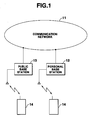
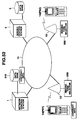
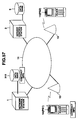
- FIG. 1 outlines a radio communication system to which the present invention is applied.
- reference numeral 11 denotes a communication network to which a personal base station 12 provided in a home area and a public base station 13 provided in a public area are connected.
- Portable PHS terminals (refer to as portable terminal) 14 are connected by radio to both the base stations (although not shown in FIG. 1, there are many personal base stations 12 and public base stations 13 and corresponding portable terminals 14).
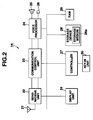
- FIG. 2 outlines the structure of a portable terminal 14 used in such radio communication system.
- reference numeral 21 denotes an antenna to which a send-receive unit 22 is connected.
- the send-receive unit 22 is composed of a frequency converter and a modem (none of which are shown).
- a signal is received from the antenna 21 via an antenna switch (not shown) which switches between transmission and receipt, and mixed with a local oscillator signal having a predetermined frequency output from a PLL synthesizer (not shown) to change from a signal of frequencies in the vicinity of 1.9 GHz to an IF (Intermediate Frequency) signal having frequencies in the vicinity of 1 MHz.
- IF Intermediate Frequency
- a ⁇ /4 shift QPSK (Quadriphase Phase Shift Keying) modulated signal fed from the modem is mixed with a local oscillatory signal having a predetermined frequency output from the PLL synthesizer to provide a signal of frequencies in the vicinity of 1.9 GHz, which is then radiated from the antenna 21 via the antenna switch.
- QPSK Quadriphase Phase Shift Keying
- the IF signal from the frequency converter is demodulated, and IQ (Inphase and Quadrature) data is separated and transferred in the form of a data string to the communication control unit 23.
- IQ data is produced from the data transferred from the communication control unit 23, subjected to a ⁇ /4 shift QPSK modulation, and then outputted to the frequency converter.
- the send-receive unit 22 is connected to the communication control unit 23 and a voice processor 24, in this order, and the voice processor 24 is, in turn, connected to a speaker 25 and a microphone 26.
- the communication control unit 23 performs a frame synchronization/slot data extraction/insertion process in which, in a receipt section of the communication control unit 23, picks up data for one slot at a predetermined timing from data fed by the modem of the send-receive unit 22, extracts a unique word (sync signal) from the data to take the frame synchronization and descrambles the control data and voice data, feeds the control data to a controller 27 to be described later, and transfers the voice data to the voice processor 24.
- a unique word sync signal
- the transmission section of the communication unit 23 adds control data to voice data fed by the voice processor 24, scrambles the voice data and control data, adds a unique word to the resulting data to provide send data for one slot, inserts the send data in a predetermined slot in a frame concerned at a predetermined timing, and sends it to the modem of the send-receive unit 22.
- the voice processor 24 is composed of a speech codec and a PCM (Pulse Code Modulation) codec (either of which is not shown).
- the speech codec compresses/expands digital data.
- a transmission section of the voice processor 24 encodes and compresses a PCM voice signal fed from the PCM codec to provide an ADPCM voice signal, which is then outputted to the communication control unit 23.
- the PCM codec performs an analog-to-digital conversion.
- a receipt section of the PCM codec performs a digital-to-analog conversion on the PCM voice signal fed from the speech codec and sends the resulting analog voice signal to the speaker 25.
- a transmission section of the PCM codec performs an analog-to-digital conversion on the analog voice signal inputted by the microphone 26 and outputs the resulting PCM voice signal to the speech codec.
- the send-receive unit 22, communication control unit 23, and voice processor 24 are connected to the controller 27 which is, in turn, connected to a storage device 28, RAM (Random Access Memory) 29, key-in unit 30 and display unit 31.
- RAM Random Access Memory
- the storage device 28 includes a storage medium 28a installed fixedly or removably therein and containing programs, data, etc.
- the storage medium 28a is composed of a magnetic storage medium (hard disc or floppy disc), an optical storage medium (optical disc) or a semiconductor memory (ROM).
- the programs, data, etc., recorded in the storage medium 28a may be received from a second device via communication lines and stored in the storage medium 28a.
- the storage device 28 which includes the storage medium 28a may be installed on the side of the second device so that the programs, data, etc., stored in the storage medium 28a are used via communication lines.
- the RAM 29 temporarily stores data handled under the control of the controller 27.
- the key-in unit 30 is used to enter data to set the respective functions into the controller 27.
- the display unit 31 displays input data for and the result of the respective control operations.
- the sender portable terminal 14 calls a receiver portable terminal 14
- a (call) setup message is sent via the public base station 13, the communication network 11 and the personal base station 12 to the receiver portable terminal 14, where an incoming call occurs.
- the receiver portable terminal 14 responds to this call to start communication.
- the sender portable terminal 14 is capable of controlling the receiver portable terminal 14.
- the setup message is composed of at least a protocol identifier, a call number, a message classification, facility, a sender number 31, sender subaddress 32, a receiver number 33, and a receiver subaddress 34.
- the control over the receiver portable terminal 14 includes "transceiver (peer-to-peer communication) information recording” which allows transceiver communication between terminals without using the communication network, "hide sender subaddress information” which controls display in the receiver terminal 14 and which inhibits viewing information on the sender subaddress 32 without confirming the coincidence of passwords, "change an incoming ringing tone” which converts information on the sender subaddress 32 to ringing tone string data to change the incoming ringing tone at the receiver PHS terminal 14, and "classify/record sender subaddress information in a specified memory area” which stores the sender subaddress 32 information in a special-purpose area of a memory of the receiver portable terminal 14 from the sender portable terminal 14.
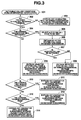
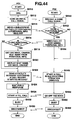
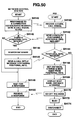
- FIG. 3 is a flow chart of a process for setting data and control information in the sender and receiver subaddress.
- a sender number notification key (not shown) is turned on and the conditions of a public call are set.
- control includes "transceiver information recording”. If so, control passes to step 305, which selects transceiver information recording data (system call code) to be sent to the receiver terminal.
- step 305 selects transceiver information recording data (system call code) to be sent to the receiver terminal.
- step 306 a system call code of the selected transceiver information recording data is entrained on the sender subaddress.
- PS portable terminal
- step 308 the system call code and the PS call number are entrained on the sender subaddress while the "transceiver information recording" processing signal (control code) is entrained on the receiver subaddress. If the PS call number is not entrained, the system call code is entrained on the sender subaddress and "transceiver information recording" processing signal is entrained on the receiver subaddress, at step 309.
- step 312 it is determined whether the control of the receiver portable terminal 14 is "change a ringing tone". If so, at step 313 any character information is entrained on the sender subaddress while the "change a ringing tone" processing signal is entrained on the receiver subaddress. If not at step 312, control passes to step 314, which entrains any character information on the sender subaddress while entraining a "classify/enter in a specified memory area" processing signal on the receiver subaddress.
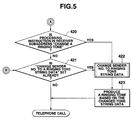
- FIGS. 4 and 5 are a flow chart of a ringing tone signal receiving process performed in the receiver portable terminal 14.
- step 401 when a public station signal is received that the public base station is notified of the sender number, it determined at step 402 whether the receiver portable terminal is notified of the sender subaddress (or whether there is any information in the sender subaddress). If so, it is determined at step 403 whether a processing instruction is contained as control information in the receiver subaddress.
- step 403 control passes to step 404, which records the sender number, sender subaddress information and receiver subaddress information in the received call history. If there is no processing instruction at step 403, step 405 records the sender number and sender subaddress information in the received call history.
- step 404 When at step 404 the sender number, sender subaddress information and receiver subaddress information are recorded in the received call history, control passes to step 406, which determines whether the processing instruction in the receiver subaddress contains "classify/records in a specified memory area". If so, step 407 stores the sender number and sender subaddress information in the special-purpose area of the memory in the receiver portable terminal 14. If not at step 406, step 408 determines whether the processing instruction in the receiver subaddress contains "hide sender subaddress information". If so, step 409 does not display the sender number and the sender subaddress whereas if not at step 408, step 410 displays the sender number and sender subaddress information. In this case, either one of the sender number and sender subaddress information may be displayed.
- step 411 determines whether the processing instruction in the receiver subaddress contains "change a ringing tone". If so, step 412 converts the sender subaddress information to ringing tone string data in the receiver portable terminal 14, and step 413 produces a ringing tone in accordance with the converted tone string to thereby terminate the processing concerned. If not at step 411, a regular ringing tone is produced and control passes to subsequent regular received signal processing (or telephone call).
- step 414 determines whether the receiver portable terminal 14 has beforehand set therein a process "convert the sender subaddress information to ringing tone string data" even when the receiver subaddress contains no processing instruction. If so, step 412 converts the sender subaddress information to ringing tone string data. At step 413, a ringing tone is produced in accordance with the converted tone sting data and then control passes to the received signal processing (telephonic communication).
- step 402 determines that the receiver is not notified of the sender subaddress
- control passes to step 415, which determines whether there is any processing instruction in the receiver subaddress.
- step 416 records the sender number and the receiver subaddress information in the received call history. If not at step 415, step 417 records the sender number in the received call history.
- step 420 determines whether the processing instruction in the receiver subaddress contains "change a ringing tone". If so, step 422 converts the sender number information to ringing tone string data, step 423 produces a ringing tone in accordance with the converted tone string data. Control then passes to the subsequent telephone call. If not at step 420, control passes to step 421 which determines whether the receiver portable terminal 14 has beforehand set "convert the sender number to ringing tone string data even if the receiver subaddress contains no processing instruction.
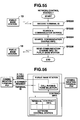
- FIG. 6 is a flow chart of a transceiver information recording process.
- a transceiver information recording mode starts.
- a memory to store data is selected from among a plurality of transceiver information recording memories.
- step 606 it is determined whether there is receiver subaddress information in the selected received call history.
- step 606 control passes to step 607, which determines whether there is the processing instruction "transceiver information recording" in the receiver subaddress information in the selected received call history. If not at step 606, control returns to step 605, which again selects a received call history to be cited.
- a name for example, of a group name
- step 611 it is determined whether there is a PS call number in the sender subaddress information in the selected received call history. If not, step 612 records the PS call number and control passes to step 613. If so at step 611, control directly passes to step 613.
- step 613 it is determined whether a name (for example, a user's name) should be entered/recorded for the PS call code number. If so, step 614 entered/records the name for the PS call code and terminates the transceiver information recording. If not at step 613, control directly terminates the recording processing.
- a name for example, a user's name
- FIG. 7 is a flow chart of searching a received call history by check.
- a received call history retrieval mode starts.
- a received call history to be displayed is selected from among a plurality of received call histories.
- step 703 it is determined whether there is a processing instruction "hide sender subaddress information" in the receiver subaddress information in the selected received call history. If not at step 703, step 710 displays the sender number and the sender subaddress information and terminates the appropriate processing. If so at step 703, control passes to step 704, which does not display the sender number and sender subaddress information in the received call history selected based on the processing instruction "hide sender subaddress information".
- step 705 it is determined whether a password is contained in the sender subaddress. If so, step 706 sets the password in the sender subaddress. Control then passes to step 708. If not at step 705, step 707 sets the preliminarily entered password and control then passes to step 708.
- step 708 any character string provided beforehand by the user is input for checking purposes.
- step 709 it is determined whether the input character string matches the set password. If so, control passes to step 710 which displays the sender number and sender subaddress information and terminates the appropriate processing. If not at step 709, none of the sender number and sender subaddress information are displayed and the appropriate processing is terminated.
- a predetermined processing signal as a control information to control the receiver portable terminal 14 is added to the receiver subaddress of an incoming signal to the receiver portable terminal 14 due to the calling operation of the sender portable terminal 14, predetermined data is also added to the sender subaddress of the incoming signal, and the resulting data is then sent to the receiver.
- the receiver portable terminal 14 is controlled by the data sent along with the control information on the basis of the control information from the sender portable terminal 14.
- the receiver portable terminal 14 is set as a terminal, which is capable of making transceiver communication, by the sender portable terminal 14, the display of the receiver portable terminal 14 is controlled, only the user who knows the password at the receiver portable terminal 14 can see the received data, the ringing tone in the receiver portable terminal 14 is controlled, data is stored by the sender portable terminal 14 into the memory of the receiver portable terminal 14---such various control operations are realized.
- the sender end may entrain a release request on the receiver subaddress and send same to the receiver, and the receiver end may release "hide sender subaddress information" on the sender number contained in the call setup message.
- arrangement may be such that a plurality of ringing tones are allocated to a corresponding plurality of items of identification information which identify a corresponding plurality of senders in a terminal which can produce a corresponding plurality of ringing tones, the sender terminal adds a sender identification number to the sender subaddress in addition to the receiver number, adds "change a ringing tone" to the receiver subaddress, and sends those resulting data to the receiver, and the receiver terminal receives those data and produces a ringing tone allocated on the basis of the sender identification information in the sender subaddress.
- the second embodiment of the present invention involves control of an answertelephone function of the receiver portable terminal 14 due to control information from the sender portable terminal 14.
- RAM 29 of portable terminal 14 of FIG. 2 contains telephone directory data, a self-made answer messages and a party's message.
- a storage medium 28a of a storage device 28 contains a pre-installed answer message intended for general callers.
- FIG. 8 illustrates one example of telephone directory data stored in RAM 29 which includes names, telephone numbers, answer message numbers, and forced answertelephone modes.
- the answer message numbers are those corresponding to the respective answer messages stored in another data area.
- the forced answertelephone modes contain "ON" for a caller whose call occurring in a normal mode (released from the answertelephone mode) is desired to be forcedly switched to an answertelephone mode, and "OFF" for a caller whose call occurring in the answertelephone mode is desired to be forcedly switched to the normal mode (normal receipt).
- the columns for the forced answertelephone mode contain no data.
- answer message number "0" and "there is no forced answertelephone mode" are set as default values.
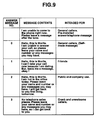
- FIG. 9 shows a table which is provided separate from the telephone directory data, and contains answer message numbers, and answer message contents and parties in corresponding relationship.
- five messages are prepared for corresponding parties; that is, a pre-installed answer message contained in the telephone terminal and intended for general callers, a self-made answer message intended for general callers, an answer message intended for friends, an answer message for public and company use and an answer message intended for crank and unwelcome callers.
- the pre-installed answer message intended for general callers and the self-made answer message set at the answer message number "0" are selectable respectively. Since in this case the self-made answer message is selected, the number of answer messages used actually are 4 in all.
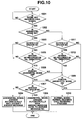
- FIG. 10 is a flow chart of the operation of such answertelephone function.
- step 1001 when the receiver portable terminal 14 determines that there is an incoming call, control passes to step 1002 which determines whether the answer telephone mode is set in the receiver portable terminal 14.
- step 1003 determines the "sender number" is contained in the received signal from the sender portable terminal. If not, control passes to step 1004, which automatically answers, using the self-made answer message stored in RAM 29 to terminate the appropriate processing. If the received signal contains the sender number "at step 1003, step 1005 determines whether the "sender number" is entered in the telephone directory data of FIG. 8. If not, control passes to step 1004 which automatically answers, using the self-made answer message stored in RAM 29, and then terminates the appropriate processing. If the "sender number" is entered in the telephone directory data, step 1006 determines whether the forced answertelephone mode is off.
- step 1009 determines whether the forced answertelephone mode is on. If so, step 1010 performs received signal processing in the normal mode and the appropriate processing is then terminated.
- step 1011 determines whether "sender number" is contained in the signal from the sender portable terminal 14.
- step 1011 control passes to step 1010, which performs the normal incoming call signal receiving process in the normal mode and the appropriate processing then ends. If the "sender number" is contained at step 1011, step 1012 determines whether the "sender number" is entered in the telephone directory data of FIG. 8. If not, control passes to step 1010, which performs normal incoming call processing in the normal mode and the processing concerned ends.
- step 1012 determines whether the "sender number" is entered in the telephone directory data at step 1012. If so, step 1010 performs the normal incoming call receiving process in the normal mode and the appropriate process ends. If not at step 1009, the processes at steps 1007, and 1004 or 1008 are performed.
- the answertelephone mode/answer message of the receiver portable terminal 14 can be switched on the basis of the control information.
- the receiver portable terminal 14 may contain telephone directory data and a plurality of answer messages such as a pre-installed answer message, a self-made answer message intended for general callers, an answer message intend for friends, an answer message intended for public and company use, and an answer message intended for crank and unwelcome callers which can be selectively extracted for a sender portable terminal 14 and output to the sender portable terminal.
- identification information which identifies the sender may be entrained on the sender subaddress to thereby select the answertelephone mode or normal mode.
- the third embodiment has the function of sending back to the sender portable terminal 14 a message receipt acknowledge signal containing information to the effect that data sent from the sender portable terminal 14 has been sent correctly to the receiver portable terminal 14 by receiving the signal from the sender portable terminal 14.
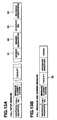
- a control code "automatic answer control” is entrained on a receiver subaddress of a call setup message of FIG. 13A to be sent from the sender portable terminal 14 to the receiver portable terminal 14.
- a message receipt acknowledge signal to be sent back to the sender portable terminal 14 in response to the control code "automatic answer control”, or to request an additional service or to confirm some matters contains an information identifier entrained on a protocol profile of a facility 35 of a call (or alerting) message or answer message, as shown in FIG. 13B.
- FIG. 11 is a flow chart of an initial call signal sending process performed by the sender.
- step 1101 wait for a call (or alerting) message from the receiver end.
- step 1102 checks whether there is an information identifier from the receiver in a facility of the call (alerting) message from the receiver.
- step 1103 displays that there is the information identifier, informs the sender of this fact and disconnects the line automatically. If not at step 1102, control passes to step 1104, which waits for an answer from the receiver. If there is the answer from the receiver, control passes to step 1105, which determines whether there is an information identifier from the receiver on the facility of the answer message.
- FIG. 12 is a flowchart of an initial call signal receiving process performed in the receiver.
- step 1201 determines whether there is information in the receiver subaddress when the incoming call signal is received. If not, the normal incoming call receiving process is performed. If so at step 1201, step 1202 checks whether a control code is contained in the receiver subaddress code.
- step 1202 If not at step 1202, the normal incoming call receiving process is performed. If so at step 1202, step 1203 checks whether "automatic answer control" is contained.
- step 1203 determines whether an information identifier indicating that character information has been correctly sent should be entrained on the protocol profile of the facility of the call (or alerting) message.
- step 1207 determines whether an information identifier indicating that character information has been correctly sent to the receiver should be entrained on the protocol profile of the facility of the answer message.
- step 1208 entrains the information identifier on the answer message and sends those data to the sender and then discounts the line automatically. If not at step 1207, control passes to a telephonic call.
- control information "automatic answer control" to control the receiver portable terminal 14 is added to the receiver subaddress of the incoming call signal to the receiver portable terminal 14 due to the call from the sender portable terminal 14, and the information identifier indicating that the data has been sent correctly to the receiver is entrained on a message receipt acknowledgement sent back to the sender portable terminal 14 on the basis of the control information "automatic response control", the sender portable 14 is notified that the data has been correctly sent to the receiver portable terminal 14. Alternatively, on condition that there is an answer from the receiver portable terminal 14, the sender portable terminal 14 may be notified that the data is correctly sent to the receiver.
- a communication terminal and system which is capable of performing various control operations on the receiver portable terminal can be realized on the basis of the control information sent by the sender portable terminal before the receiver portable terminal goes off the hook.
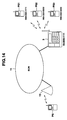
- FIG. 14 is a block diagram of a communication system of the fourth embodiment.
- reference numeral 11 denotes an ISDN (Integrated Services Digital Network : hereinafter referred to also as a communication network) spread over the whole country.
- a plurality of public base stations 13 (only one of which is shown) are connected at predetermined intervals to the communication network 11.
- Each public base station 13 has a service area or radio reach which has a radius of several hundreds of meters, and is a relay station which connects a portable (PHS) terminal PS present in the service area by radio to the communication network 11.
- a personal base station 3 is connected to the communication network 11, and has a handset, dial keys and various function keys, like a general telephone set which is capable of making telephonic communication with other telephone sets.
- Portable terminals PS1, PS2, and PS3 are registered in the personal base station 3 and operate as portable terminals of the personal base station 3.
- the personal base station 3 makes radio communication with the portable terminals PS1, PS2 and PS3, connects a call from the outside to a portable terminal, and also connects calls from the respective portable terminals PS1-PS3 to the communication line network 11 so as to send a calling signal to a desired external telephone set.
- the personal base station 3 recognizes the sender or caller, calls a portable terminal specified by the caller, and connects the portable terminal to the communication network 11.
- Portable terminals PS1-PS3 or portable terminal PS are each carried about by a user and driven by a battery. They each have functions similar to those of a general telephone set having a liquid crystal display unit and dial keys. They makes radio communication with the personal base station 3 or a public base station 13 so as to be connected with the communication network 11.
- the respective potrtable terminals PS1-PS3 are in the personal base station's service area, they each make radio communication with the personal base station 3 to be connected with the communication network 11 so that they can each communicate with another telephone set.
- they When they are each out of the personal base station's service area, they each make radio communication with a nearby public base station 13 to be connected with the communication network 11 so that they can each communicate with another telephone set or personal base station 3.
- the portable terminal PS is a sender or caller while the personal base station 3 and its portable terminals PS1-PS3 are receivers.
- the sender portable terminal PS (or telephone set) specifies a portable terminal to be called, with a public number (telephone number) allocated to that potable terminal. More specifically, at the sender portable terminal PS, the user enters the public number (telephone number) of the personal base station via which a desired portable terminal is to be called, and the public number (telephone number) of that portable terminal, or selects those public numbers from a predetermined database. Therefore, even when the user does not know the portable terminal number allocated to the portable terminal and set in the personal base station 3, the user can call that portable terminal as long as the user knows the public telephone number of that portable terminal. A method of specifying a portable terminal will be described later.
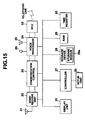
- FIG. 15 is a block diagram of the personal base station of the fourth embodiment.
- the structure of the personal base station is substantially the same as that of FIG. 2.
- the structural points of the personal base station of FIG. 15 different from those of the terminal 14 of FIG. 2 will be mainly described next.
- a NCU (Network Control Unit) 32 is connected to a telephone line via which the personal base station makes voice or data communication by sending/receiving a calling signal to and from the communication network 11 and providing connection control such as recovering and disconnecting the connection of the personal base station to and from the communication network.
- a key-in unit 30 is provided with numeral keys for entering a telephone number of a receiver to be called, a switch to determine whether to go off the hook, and a volume switch to change the voice output. Outputs from these keys/switches are fed to the controller 27, which controls the whole personal base station in accordance with a predetermined program.
- NCU 32 when NCU 32 receives an incoming call via the telephone line, it checks whether the public telephone number of a portable terminal to be called is added to sender/receiver subaddresses of a setup message to be also described later. If so, it calls a portable terminal to which its public telephone number is allocated.
- RAM 29 is used as a working area where data produced under control of the controller 27 is stored and further contains a telephone directory such as an address book which contains data such as the addresses and telephone numbers of telephone terminals to be called.
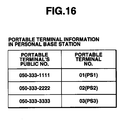
- RAM 19 contains portable terminal numbers to identify the corresponding portable terminals, in correspondence to the "portable terminals' public numbers".
- the personal base station 3 gets a portable terminal number on the basis of its public number sent from the sender and calls that portable terminal, using the portable terminal number.
- the public numbers of the portable terminals PS1, PS2 and PS3 are "050-333-1111", "050-333-2222" and "050-333-3333", respectively. Those data can be entered from the key-in unit 30, as requested.
- the display 20 is composed of a liquid crystal display unit which displays various data such as operational modes, telephone numbers and communication time duration, and LED(light emitting diode)s which display the on/off states of the switches, and displays various data under control of the controller 27.
- a time register 33 records the present time and delivers data on the present time to the controller 27 at predetermined timings.
- This setup message is the same as of FIG. 13A.
- the sender portable terminal PS entrains the public number of the personal base station 3 on the receiver number, and entrains the public number of a portable terminal to be called, on the sender or receiver subaddress, and send those data to the receiver.
- the receiver personal base station 3 gets the pubic number of the portable terminal entrained on the subaddress, refers to information of FIG. 16, gets the corresponding portable terminal number, and calls the portable terminal concerned.
- FIG. 17 illustrates telephone number information stored in the sender portable terminal PS.
- the sender portable terminal PS entrains the receiver personal base station's public number and a portable terminal's public number to be called on a (call) setup message and then sends the same to the receiver.
- the sender calls the particular portable terminal by specifying the personal base station's public number and the portable terminal's public number.
- the personal base station's and portable terminal's pubic numbers may be entered by the dial keys, they are selected from telephone number information (or telephone directory) beforehand entered, in order to simplify the operation in the present embodiment.
- the personal base station's public numbers and portable terminal's public numbers recorded in these personal base stations are stored in corresponding relationship in the sender terminal.
- a personal base station having a public number "03-1111-1111” corresponds to a single portable terminal having a public number "050-111-1111”; a personal base station having a public number "03-2222-1111” corresponds to two portable terminals having public number"050-222-1111” and "050-222-2222”; and a personal base station having a public number "03-3333-1111” corresponds to three portable terminals having public numbers "050-333-1111", "050-333-2222", and "050-333-3333”.
- the user of the sender is required to select a personal base station's public number, and then select a portable terminal's public number corresponding to the personal base station.
- the user enters or selects the personal base station's public number, displays the portable terminal's public numbers, and selects one from among those displayed numbers. Those numbers may be linked with corresponding names.
- the operations of the portable terminal PS and the personal base station 3 of the fourth embodiment (an initial call signal sending/receiving operations) will be described next.
- the operations of the respective elements involved in the telephonic communication are the same as those performed in the general telephonic communication and their description will be omitted.
- Program which realizes each function as shown in the flowchart of FIG. 18 is stored in said storage medium 28a provided in the portable terminal PS in the form of program codes readable by controller 27.
- Program which realizes each function as shown in the flowchart of FIG. 19 is stored in said storage medium 28a provided in the personal base station 3 in the form of program codes readable by controller 27.
- FIG. 18 is a flow chart of the operation of the sender portable terminal PS or another telephone set in the communication system according to the fourth embodiment.
- FIG. 19 is a flow chart of the operation of the receiver personal base station 3.
- FIG. 20 illustrates the initial call signal sending/receiving operations of the sender and receiver.
- step S10 the user at the sender portable terminal PS inputs a receiver telephone number of interest, using the dial keys or the telephone number information.
- step S16 sets the personal base station's public number "03-3333-1111" in a receiver number of the setup message
- step S18 sets the portable terminal PS2's public number "050-333-2222" in the sender subaddress of the setup message.
- step S22 sends the resulting setup message to the pubic base station 13 to call the portable terminal.
- step S24 determines whether there is a response from the receiver. If so, at step S26 the sender makes a telephone call to the receiver portable terminal PS2. Step S28 disconnects the communication line by when one of the sender and the receiver goes to off the hook to thereby terminate the appropriate processing.
- the personal base station 3 determines at step S30 whether there is an incoming call. If NCU 32 receives an incoming call via the telephone line, the personal base station 3 determines at step S32 whether there is a portable terminal's public number in the sender subaddress. If so, at step S34 the personal base station 3 searches information of FIG. 16 on the basis of the portable terminal's public number (in this case, "050-333-2222") set in the sender subaddress and gets the portable terminal's number "02:PS2" corresponding to its public number. At step S36, the personal base station 3 performs a preferential calling operation with the gotten portable terminal's number "02:PS2", that is, calls the potable terminal PS2 having the gotten potable terminal's number "02".
- the personal base station determines whether there is a response from the called portable terminal "PS2". If so, at step S40 the personal base station 3 connects the responding portable terminal PS2 to the communication network 11. At step S44, the sender portable terminal PS makes a radio telephone call to the receiver portable terminal PS2. At step S46, the communication line is disconnected when any one of the sender portable terminal PS and the receiver portable terminal PS 2 goes off the hook to terminate the processing concerned.
- step S42 determines whether the handset of the personal base station 3 is off the hook. If so, control passes to step S44, where the personal base station 3 itself makes a telephone call to the sender portable terminal PS.
- step S46 the communication line is disconnected when any one of the personal base station 3 and the sender portable terminal disconnects the line to terminate the appropriate processing.
- the portable terminal is called with its pubic number even in the call signal sending/receiving operation via the personal base station.
- the sender can call the particular portable terminal easily as long as the sender knows the portable terminal's public number. Since the sender calls the portable terminal by its public number, the sender can call the portable terminal in a similar operation to that performed when the portable terminal is in the personal base station's service area, even when the portable terminal is out of the personal base station's service area.
- the fifth embodiment of the present invention will be described next. Since the basic structures of the communication system, personal base station and potable terminal are the same of those of FIGS. 2, 14 and 15, further description thereof will be omitted.
- the sender when the sender calls a particular portable terminal, it sets the base station terminal's public number in a receiver number of the a call setup message, sets the public number of the portable terminal to be called in a subaddress (sender or receiver subaddress), and sends the resulting call setup message to the sender.
- the personal base station 3 of this embodiment has an answertelephone function which includes automatically answering to an incoming call from a sender, sending a predetermined answer message to the sender, and recording a message from the sender.
- the personal base station sends the sender an answer message set in the portable terminal called by the sender, and permits only that portable terminal to reproduce the recorded sender's message.
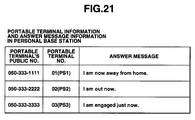
- FIG. 21 illustrates portable terminal information and answer message information stored in a personal base station in the fifth embodiment.
- the personal base station 3 contains public numbers, terminal numbers and answer messages of portable terminals PS1-PS3 in corresponding relationship.
- the personal base station 3 contains an answer message "I am now away from home” in correspondence to a portable terminal PS1 having a pubic number "050-333-1111".
- the personal base station 3 contains an answer message "I am out now” in correspondence to a portable terminal PS2, and an answer message “I am engaged just now” in correspondence to portable terminal PS3.
- the answer message "I am out” is sent to the caller.
- the answer message "I am out now” is sent to the caller.
- the answer message "I am engaged just now” is sent to the caller.
- FIG. 22 illustrates information (including messages) recorded in the personal base station in the fifth embodiment.
- the personal base station 3 when the personal base station 3 records a message from a sender, it stores a sender number (telephone number) to identify the sender, a terminal number of a called portable terminal, a recording time, and a message from the sender.
- the sender's number is the telephone number of the sender sent attached to the setup message. Any information to identify the sender except for the sender's telephone number, for example the sender's name, may be used.
- the personal base station 3 causes only a portable terminal having a terminal number attached to the message to reproduce the recorded message information.
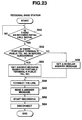
- FIG. 23 is a flow chart of the operation of the personal base station set in the answertelephone of the communication system as the fifth embodiment.
- FIG. 24 is a flow chart of the operation of the personal base station 3 performed when a recorded message is reproduced.
- Program which realizes each function as shown in the flowchart of FIGS. 23 and 24 is stored in said storage medium 28a provided in the personal base station 3 in the form of program codes readable by controller 27.
- the personal base station 3 determines whether there is an incoming call. When it receives an incoming call via NCU 15 and the telephone line, it determines at step S52 whether the sender subaddress has a portable terminal's public number. If so, at step S54 the personal base station 3 searches information of FIG. 17 on the basis of the portable terminal's pubic number (for example, "050-333-2222") set in the sender subaddress, and gets the portable terminal number "02:PS2" corresponding to the portable terminal's public number, and its answer message "I am now out".
- the portable terminal's pubic number for example, "050-333-2222”
- the personal base station 3 connects the line to the portable terminal, and at step S60 reproduces the gotten answer message "I am out now".
- the personal base station 3 records the message from the sender along with the sender number, portable terminal number "02:PS2", and the recording time, as shown in FIG. 22. After recording the message, the personal base station disconnects the line and terminates the appropriate processing at step S64.
- step S56 the personal base station 3 gets a regular response message (for example, "I am out now. So, please leave me a message"). Control then passes to step S58 and its subsequent steps, where the personal base station 3 records the message from the sender and terminates the appropriate processing.
- the personal base station 3 determines whether the personal base station 3 itself or one of the portable terminals PS1-PS3 was instructed to reproduce the recorded message. If so, at step S72 the personal base station 3 gets the terminal number of the portable terminal which was instructed to reproduce the messages, and gets at step S74 a portable terminal number attached to the recorded message. At step S76, the personal base station then determines whether the terminal number of the portable terminal which was instructed to reproduce the messages matches the portable terminal number of the message. If not, control returns to step S74 to get the next message without reproduction.
- step S76 control passes to step S78, where the sender number, recording time and message are reproduced. Thereafter at step S80, it is determined whether there is another message. If so, control returns to step S74 to get the next message. Thereafter, by repeating the steps S74-S80, messages for the portable terminal numbers matching that of the portable terminal which was instructed to reproduce the messages are sequentially reproduced. Thus, if there is no more message to be reproduced, the appropriate processing is terminated.
- the personal base station 3 since the personal base station 3 has the answertelephone function, no portable terminals PS1-PS3 are required to have an answertelephone function.
- the personal base station since the personal base station contains recorded messages and the portable terminal numbers in corresponding relationship, no contents of the recorded messages are heard by other base station and/or portable terminals, and thus privacy is protected.
- an answer message for an answering telephone call is sent to the caller
- the present invention is not limited to this particular case.
- a message such as "I'm afraid that I'll be late for coming to a place where we arranged to meet” or "Our tomorrow meeting is postponed" may be sent instead.
- a more appropriate answer message depending on the sender can be sent to the sender.
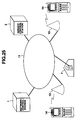
- FIG. 25 shows a radio communication system in which portable terminals are applied in a sixth embodiment of the present invention.
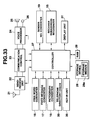
- FIG. 26 is a block diagram of the portable terminal.
- FIGS. 25 and 26 are similar to FIGS. 14 and 15, so that the structural portions of the radio communication system and the portable terminal of FIGS. 25 and 26 different from those of FIGS. 14 and 15 will be mainly described and further descriptions of other structural portions of the sixth embodiment will be omitted.
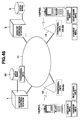
- reference numeral 1 denotes a network control station which connects respective radio base stations 13 via the communication network(ISDN) 11 and controls communication between portable terminals 14 or between portable terminal 14 and a general telephone set 7 in a home.
- Reference numeral 2 denotes a service control station which provides respective portable terminals 14 with various services, for example, of an incoming signal identifying function, mentioned above. The service control station 2 may be united with the network control station 1.
- RAM 18 is used as a working area for the controller 27 to store various register/flag data temporarily therein, and includes a data area for storage of various user data such as an address book which contains the name of a receiver to be called, and its address and telephone number, a keyed-in character string, and a character string sent by the receiver.
- the user data stored in RAM 18 are backed up by a secondary cell (not shown) for storing purposes.
- a touch panel (not shown) is provided on a liquid crystal display (LCD) panel of a display unit 31.
- LCD liquid crystal display
- a portion of the touch panel corresponding to the pressed icon detects that icon pressing operation, and instructs the controller 27 to fulfil a function assigned to the icon.
- a ringer 32 produces a ringing tone in accordance with an instruction from the controller 27 when there is an incoming signal.
- terminal PS1 and “terminal PS2” denote sender and receiver portable terminals 14, respectively.
- the operation of the sixth embodiment including the respective operations of the terminals PS1 and PS2 will be described.
- Program which realizes each function as shown in the flowchart of FIGS. 27 and 28 is stored in said storage medium 28a provided in the portable terminal 14 in the form of program codes readable by controller 27.
- the respective key-in units 30 are each manipulated to enter characters to record a character string, to be sent to each other, beforehand in a data area of RAM 29.
- step SA2 When a linked channel is established between terminal PS1 and the radio base station 13 in response to the terminal PS1 going off the hook, at step SA2 the receiver telephone number is dialed, the terminal PS1 shifts to an initial call signal sending control sequence (step SA3).
- the terminal PS2 is called by the radio base station 13 to start a call signal receiving control sequence (step SB2) corresponding to the initial call signal sending control sequence (step SA3).
- the terminal PS1 which has shifted to the initial call signal sending control sequence, transfers a call setup message to the network 11.
- a character string to be inserted into the sender subaddress of the call setup message may be selected.
- the user selects a character string to be sent to the receiver from among the character string produced and recorded at step SA1, inserts the selected character string into the sender subaddress and then sends the resulting sender subaddress to the receiver.
- the terminal PS 1 adds the selected character string to a facility and sends the facility data to the network.
- the terminal PS2 receives the facility via the network, it determines at step SB3 whether a character string is inserted.
- step SB4 displays the facility on the display unit 31. If not at step SB3, the terminal PS2 determines that it is a general incoming signal, and advances its control to step SB5, which performs a signal receipt operation by operating the ringer 32 after a predetermined incoming call receiving control sequence.
- the terminal PS2 receives the character string "Are you free today?" from the terminal PS1 and that the character string is displayed on the display unit 31. At this time, a predetermined reporting operation (with a ringing tone or vibrations) different from the general signal receipt operation may be performed.
- the terminal PS2 then advances its control to step SB6, where the terminal PS2 selects "YES” as a character string to be answered. Then, at step SB7, the terminal PS2 inserts the selected character string "YES" into a facility and sends the resulting facility to the network.
- step SA6 determines whether any character string has been inserted into the facility. If so, the result of the determination at step SA6 becomes "YES", and control then passes to step SA7, which displays the character string "YES" on the display unit 31. At this time, a predetermined reporting operation (with a ringing tone or vibrations) different from that performed when the regular signal receipt operation may be performed.
- step SA8 determines whether there is a character string to be sent. If so, the terminal PS1 iterates the processing at steps SA4-SA8.
- step SA9 If there are no more character strings to be sent at step SA8, control passes to step SA9, which disconnects the appropriate line. If there is no character string inserted in the facility information element at step SA6, the terminal PS1 determines that the terminal PS2 has no intention to communicate information with the terminal PS1, and advances its control to step SA9, which disconnects the appropriate line.
- the terminal PS2 After terminating the processing at step SB7, the terminal PS2 also determines at step SB8 whether there is any character string to be sent. If so, the terminal PS2 returns its control to step SB3. If there are no more character string to be sent at step SB8, the terminal PS2 passes its control to step SB9, which disconnects the appropriate line.
- the receiver stores as a message a character string which the sender sends back to the receiver in response to a character string with which the receiver answers, using its answertelephone function, in response to a sender's call. This process will be described next in more detail.
- terminals PS1 and PS2 enter character strings to be sent to each other from the respective key-in units 15 and store the character strings in their respective RAMS 18.
- terminal PS1 RAM 18 contains recorded six types of character strings "Please call me up”, “I am Hidaka”, “Fall in!, "I'm sorry, I'll be late”, “Yes” and "No” whereas the terminal PS2 RAM 18 contains a recorded character string "I am away from home now. Please leave me a message, Okay!.
- step SC2 When a linked channel between the terminal PS1 and the radio base station 13 is established in response to the terminal PS1 going off the hook, and the receiver telephone number is dialed at step SC2, the terminal PS1 shifts to a call signal sending control sequence (step SC3) whereas the terminal PS2 responds to a corresponding call signal from the radio base station 13 to start an initial call signal receiving control sequence (step SD2).
- step SD3 determines whether the present operational mode is an answertelephone mode. If not, processing at step SB3 and subsequent steps will be performed. If so at step SD3, the result of the determination at step SD 3 becomes "Yes" and control passes to step SD4.
- the terminal PS2 sends the network a character string "I'm not in home now. Please leave me a message.” for an answertelephone as a facility information element of a call setup message.
- step SC4 determines whether there is any character string inserted in the facility information element. If so, the result of the determination is "YES". Thus, control passes to step SC5, which displays the character string "I'm not in home now.” Please leave me a message.” on the display unit 31. As a result, the sender recognizes that the receiver is away from home.
- step SD5 determines whether any character string is inserted in the facility information element. If so, step SD6 stores the character string "I am Hidaka. Please call me up.” sent back in response to the answertelephone, as a message in the data area of RAM 18, and then disconnects the appropriate line.
- the terminal PS1 After sending the facility at step SC7, the terminal PS1 disconnects the appropriate line.
- the terminal PS2 When there is no character string inserted in the facility information element at step SC4, it is determined that the terminal PS2 has no intention to communicate information to the terminal PS1 and disconnects the appropriate line immediately.
- the receiver inserts a character string into a facility information element of a call setup message and answer in the answertelephone, whereas the sender similarly sends the receiver a message to the receiver's answer in the answertelephone, in the facility of a (call) setup message, and causes the receiver to store the sender's facility.
- information can be communicated mutually in a simple manner between the sender and the receiver.
- the present invention is not limited to this particular case.
- the character strings sent/received alternately between the sender and the receiver may be synthesized as voice data one word at a time to produce a voice message.
- compressed data for example, of graphic information, may be used to send a simple map to the receiver.
- the sender and the receiver can express their intentions, and the answertelephone function is realized, before their telephonic communication starts.
- radio communication system and PHS terminals of FIGS. 25 and 26 are also used in this embodiment so that further description thereof will be omitted.
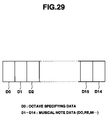
- the musical note data is set as a subaddress of a call setup message and composed of data which specifies at least a note pitch and length.
- musical note data for one phrase is composed of octave specifying data D0 and musical note data D1-D14.
- the octave specifying data D0 defines the note pitch areas (octave areas) of the respective note data D1-D14 (in this respect, when "0" is specified, a musical scale starting with a center C results).
- the musical note data D1-D14 individually specify the musical scale tones (Do, Re, Mi,%) and tone lengths (crotchet, quaver.7) of a ringing tone to be produced and are assigned a maximum of 14 different notes.
- a series of ringing tones (hereinafter refers to as a ringing tone string) specified by a maximum of 14 different tones of the note data D1-D14 forms a melody for one phrase.
- Such ringing tone string of the musical note data represents the urgency of a sent business matter and the sender's feeling.
- a ringing tone string produced at a predetermined pitch and a maximum octave is used.
- a ringing tone string having a gentle melody of a relatively high octave is used. That is, various tone patterns could be considered.
- musical note data of various patterns which represents the urgency of a sent business matter and a sender's feeling are recorded beforehand in a musical note database MDB of RAM 18.
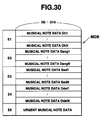
- FIG. 30 illustrates one example of the musical sound database MDB.
- reference symbols E1-F5 denote storage areas, which contain corresponding musical note data which represent feelings “happy”, “angry” "sad” and “delightful”.
- Each musical note data is composed of a plurality of musical subnote data.
- storage area E1 contains a plurality of musical subnote data Dh1-Dhn which compose a ringing tone string which represents "happy”. This applies to other respective musical note data representing the feelings "angry", “sad” and “delightful”.
- Storage area E5 contains musical note data Demer which represents the urgency of a sent business matter, for example, at a predetermined pitch and a maximum octave.
- the storage area E5 may contain a plurality of different musical note data Demer which provide ringing tones which are different depending on the degrees of urgency. In that case, the octave value may be changed depending on the degree of urgency.
- the musical sound database MDB may be customized so that musical note data selected depending on the user's editing operation may be rewritten so as to be a desired ringing tone string.
- musical note data sent from the receiver may be additionally recorded in the musical note database MDB.
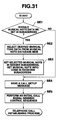
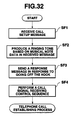
- Program which realizes each function as shown in the flowchart of FIGS. 31 and 32 is stored in said storage medium 28a provided in the portable terminal 14 in the form of program codes readable by controller 27.
- the controller 27 displays on the display unit 31 a message indicating whether musical note data should be set in the subaddress (step SA1).
- step SE4 When the user does not set the musical note data in the subaddress, the result of the determination is "NO", and control passes to step SE4.
- step SE1 When the musical note data is set in the subaddress, the result of the determination at step SE1 becomes "YES" and control then passes to step SA2, which selects desired musical note data from the musical note database MDB in accordance with the operation of the key-in unit 30.
- step SE3 the musical note data selected or edited at step SE2 is set along with a control code to change the ringing tone in the area of the sender subaddress and musical note information code is set in the receiver subaddress to form a call setup message.
- the musical note data specified in the musical note database MDB may be edited.
- Control then passes to step SE4, where the controller 27 transfers the call setup message via the radio base station 13 to the network and instructs the network to start a call setup process. Then, control shifts to a call receiving state. Control then passes to step SE5, which performs an initial call signal sending control sequence and then passes to a telephone call establishing step.
- the ringing tone generator 32 repeatedly generates a ringing tone string for one phrase depending on the musical note data.
- the ringing tone string produced repeatedly is, for example, based on the urgent musical note data Demer, it is known that the incoming call is urgent before telephonic communication starts. If it is a ringing tone string for any one of "happy”, “angry”, “sad” and “delightful”, the sender's feeling can be known before the telephonic communication. Thus, for example, when the user at the sender terminal does not want telephonic communication, but desires to tell the user's feeling to the receiver terminal, it is effective for expressing the user's feeling.
- a response message is sent to the network in response to the receiver going off the hook as in the general PHS terminal (step SF3), and then an incoming call control sequence is performed (step SF4).
- a telephone call establishing process then starts.
- the receiver when musical note data which specifies the sounding state of a ringing tone is set in the subaddress and sent, the receiver produces a ringing tone depending on the musical note data to express the urgency of the sent business matter and the sender's feeling.
- the sender can be identified and the urgency of the sent business matter and the sender's feeling can be expressed depending on the sounding state of the ringing tone.
- the present invention is not limited to this particular case.
- the present invention is applicable to data transmission and/or a pocket bell service.
- the pocket bell service the sent characters, the urgency of a sent business matter and the sender's feeling can be expressed, so that more various uses of the pocket bell are possible.
- melody reproducing means which stores contains melody data may be provided in the PHS terminal 14 so that it reproduces melody data specified by a subaddress as a ringing tone.
- the kind, tempo and pitch of a melody to be reproduced may be changed, so that various sounding states of a ringing tone are obtained.
- the musical note data is set in the subaddress of the call setup message and sent to the receiver
- the present invention is not limited to this particular case as long as the musical note data can be sent before the receiver goes off the hook.
- radio comminution has been referred to
- the present invention also is, of course, applicable to cable communication.
- the call sending means of the sender when the call sending means of the sender adds to the call setup message musical note data which specifies the sounding state of a ringing tone and sends the resulting message to the receiver, the call receiving means of the receiver generates a ringing tone depending on that musical note data to express the urgency of the sent business matter and the sender's feeling.
- the receiver is able to identify the sender, and know the urgency of the sent business matter and the sender's feeling depending on the sounding state of the ringing tone.
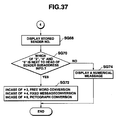
- a receiver subaddress recognizer 15 is started up by a controller 27 to determine whether there is a receiver subaddress information included. If so, it also determines whether there is a symbol "*" at the head of the receiver subaddress information, and delivers a signal indicative of the result of the determination to the controller 27.
- a free word converter 16 is started up by the controller 27, converts the code subsequent to the head symbol "*2" to character string data in accordance with a predetermined conversion table, and delivers the character string data to controller 27.
- the fixed message converter 17 When there is a symbol “*4" as the head of a code attached to the receiver subaddress, the fixed message converter 17 is started up by the controller 27, converts the code subsequent to the head symbol "*4" to fixed message data in accordance with a conversion table, and delivers the fixed message data to the controller 27.
- a pictograph converter 18 is started up by the controller 27, converts the code subsequent to the head symbol “*6” to pictograph data in accordance with a predetermined conversion table, and delivers the pictograph data to controller 27.
- a sender number converter 19 is started up by the controller 27, converts the code subsequent to the head symbol "*0” to numerical string data (sender number) in accordance with a predetermined conversion table, and delivers the numerical string data to the controller 27.
- a telephone directory checker 20 determines as the sender number the numerical string converted by the sender number converter 19, checks the sender number against telephone numbers in a telephone directory recorded beforehand, picks up a sender name recorded in correspondence to the matching telephone number, and delivers the sender number and name data to controller 27.
- the controller 27 when there is an incoming call, the controller 27 starts up the receiver subaddress recognizer 15, and an appropriate one of the converters based on the result of the recognition by the receiver subaddress recognizer 15, receives the result of the conversion from the appropriate converter, and delivers it to display unit 31.
- a portable terminal of this embodiment will be described next.
- the operations of the respective elements of the portable terminal related to telephonic communication are similar to those of a general portable terminal, and further description thereof will be omitted.
- a sender terminal calls a receiver terminal
- a call setup message is sent to the receiver.
- the call setup message contains at least a sender number, sender subaddress, and a receiver subaddress.
- the sender number notification function using this sender number is fulfilled usually, and its further description will be omitted.
- the sender number notification which will be described next, uses the subaddresses.
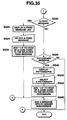
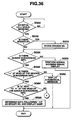
- Program which realizes each function as shown in the flowchart of FIGS. 34 and 35 is stored in said storage medium 28a provided in the portable terminal 14 in the form of program codes readable by controller 27.
- FIGS. 34 and 35 are a flow chart of an initial call signal sending operation of the portable terminal, and also shows the operation of an ISDN public terminal having no sender number notification function.
- steps SG10-SG16 represent a call signal sending process performed when a sender terminal such as an ISDN public terminal having no sender number notification function wants to notify the receiver of the sender terminal's telephone number or when a terminal having a sender number notification function wants to notify as the sender number the receiver of a telephone number which is not a telephone number (for example, a user-related company's, user home's or pager's telephone number) set in the sender terminal.
- a sender terminal such as an ISDN public terminal having no sender number notification function wants to notify the receiver of the sender terminal's telephone number or when a terminal having a sender number notification function wants to notify as the sender number the receiver of a telephone number which is not a telephone number (for example, a user-related company's, user home's or pager's telephone number
- step SG10 the controller determines in accordance with the user's instruction whether the receiver should be notified of the sender number. If the user selects the sender number notification, control passes to step SG12, which determines in accordance with the user's instruction whether the receiver should be notified of the telephone number set in the sender terminal.
- the sender sends a call signal from a public terminal such as an ISDN public terminal to the receiver
- the user enters such a telephone number (for example, user-related company's, user home's or pager's telephone number) that the sender can be identified by the receiver terminal or that the sender terminal can be contacted by the receiver terminal.
- Control passes to step SG16 which adds "*0" to the head of the entered telephone number.
- Control passes to an initial call signal sending process (not shown) which dials the receiver's telephone number and sends the receiver a call setup message which includes a receiver subaddress which additionally includes "*0" + the entered sender's number.
- the receiver In the case of a terminal having a sender number notification function, the receiver is automatically notified of the sender number in the call setup message. Thus, if the sender number is not added to the receiver address, the receiver displays the sender number of the sender subaddress. If the sender number is added to the receiver address, it is preferentially displayed. This process will also be described in a call signal receiving process to be described later.
- control directly passes to step SG16, which adds "*0" to the head of the telephone number set in the sender terminal. Then, control passes to step SG46 of FIG. 35, which adds "*0" + the telephone number set in the sender terminal as the sender number in the receiver subaddress information to produce a receiver subaddress. Control then passes to the initial call signal sending process (not shown) which dials the receiver's telephone number and sends the receiver a call setup message which includes the receiver subaddress information which, in turn, "*0" + the sender number set in the sender terminal.
- step SG20 determines in accordance with the user's instructions whether the message is a numerical message. If so, control passes to step SG22 which causes the user to enter numerals from the key-in unit (dial). Control then passes to step SG46, which adds the entered numerals as a numerical message to the receiver subaddress information to produce a receiver subaddress. Control then passes to the initial call signal sending process (not shown) which dials the receiver's telephone number to send the receiver the receiver subaddress which includes the receiver subaddress information which, in turn, includes the numerical message. In this case, nothing is added to the head of the numerical message.
- step SG24 determines whether the message is a fixed message. If so, control passes to step SG32, which displays a fixed message list on the display unit 31. Then, step SG34 causes the user to select a desired fixed message. In the case of an ISDN public terminal, the user sees the fixed message list (hard copy) and enters the number (code) of a desired fixed message to select the fixed message. Then, step SG36 adds "*4" to the head of a code corresponding to the selected fixed message. Then control passes to step SG46, which adds the "*4" + the code of the fixed message to the receiver subaddress information to produce a receiver subaddress. Control then passes to the initial call signal sending process (not shown) which dials the receiver's telephone number and sends the receiver a call setup message which includes the receiver subaddress information, which, in turn, includes "*4" + the code of the fixed message.
- step SG30 determines whether the message is a pictograph message. If so, control passes to step SG40, which displays pictographs on the display 31. Then, step SG42 causes the user to select a desired pictograph (or pictographs). In the case of an ISDN public terminal, the user sees a pictograph list (hard copy) to enter the number of a desired pictograph for selecting purposes. Then, step SG44 adds "*6"to the head of a code corresponding to the selected pictograph(s).
- Control then passes to step SG46, which adds the "*6" + the pictograph code to the receiver subaddress information to produce a receiver subaddress.
- Control then passes to the initial call signal sending process (not shown) which dials the receiver's telephone number, and sends the receiver a call setup message which includes receiver subaddress information which, in turn, includes "*6" + the pictograph code.
- FIGS. 36 and 37 are a flowchart of an initial call signal receiving operation of the portable terminal.
- step SG50 determines whether there is a received initial call signal. If not, step SG50 is repeated. In that case, this processing may be terminated to execute another processing (for example, whether there is any keyed-in data). If so at step SG50, control passes to step SG52, which determines whether there is a sender number in the received call setup message. If so, step SG54 stores the sender number in RAM 29 and then control passes to step SG56.
- step SG50 If there is no sender number at step SG50, control directly passes to step SG56, which starts up the sender subaddress recognizer 15, which causes the receiver subaddress recognizer to determine whether there is receiver subaddress information included. If not, control passes to step SG58, which displays the call signal in a regular manner and performs a general telephonic communication process.
- the sender number in this case is a telephone number (for example, user-related company's, user home's or pager's telephone number) entered by the user at the sender end.
- step SG68 of FIG. 37 displays on the display 31 the sender number added to the call setup message stored at step SG54. Also, in this case, if the sender number matches a telephone number in the telephone directory as at step SG66, the sender's name recorded in correspondence to that telephone number is displayed along with that sender number. Control then passes to step SG70, which determines which of "2", "4" and "6" is present next to the head symbol "*" of the sender subaddress information. If the head symbol of the receiver subaddress information is one of "*2", "*4" and "*6", control passes to step SG72, which performs a corresponding converting process.
- the free word converter 16 is started up to thereby convert the subsequent codes to a character string in accordance with a predetermined table.
- the character string is stored in RAM 29, and displayed as a free word on the display unit 31.
- the fixed message converter 17 is started up, which converts the subsequent codes to a fixed message in accordance with predetermined table.
- the fixed message is stored in RAM 29 and displayed on the display unit 31.
- the pictograph converter 18 is started up, which converts the codes subsequent to the "*6" to a pictograph character in accordance with a predetermined table.
- the pictograph is stored in RAM 29 and displayed on the display unit 31.
- step SG74 determines that the code following "*" is a numerical message, converts the message to a numerical string, stores same in RAM 29 and displays it on the display unit 31.
- the subsequent data is displayed as the sender number. If "*2", “*4" or “*6" is added to the receiver subaddress information, the subsequent data can be converted to a predetermined character string, which is then displayed.
- a terminal such as an ISDN public terminal having no sender number notification function wants to notify the receiver of the sender number or if a terminal having a sender number notification function wants to notify the receiver of a telephone number (for example, of a user's company, home or pager), which is not a telephone number set in the user's terminal, as the sender's number, the sender number can be displayed and a message can also be received from a terminal which has no message sending function.
- a telephone number for example, of a user's company, home or pager
- a composite terminal including a pager function and a portable terminal function
- the present invention is not limited to this particular case.
- a composite terminal may be used which includes a pager function and a portable telephone function.
- the receiver may have the sender's name sent and retrieve the sender's telephone number and an acknowledge on the basis of the sender's name sent by the sender.
- a time recording function may be provided in the composite terminal so that data on the time when a pager message is received is added to an acknowledge message so as to be displayed, for example, "I acknowledge receipt of your message at 10:35" in the sender's pager. While in the particular embodiment the receiver subaddress was used, the sender subaddress may be used instead.
- FIG. 38 is a block diagram of a communication system of the ninth embodiment. Structural portions of the present embodiment different from the eighth embodiment of FIG. 37 will be mainly described and further description of the other similar structural portions of the present and eighth embodiments will be omitted.
- a database 3 contains various data such as a voice mail, image data and text data to be used by the users.
- a time register 20 records a date and time on a real time basis in accordance with a predetermine clock signal, and delivers data on the date and time to the controller 27 at predetermined timings to record a call time and calculate telephone charges.
- a distance storage 40 contains data on the distance between public base stations associated with the sender and the receiver to get information on the distance between the sender and the receiver.
- a charge memory 41 contains data on a basic call charge for the distance between the public base stations.
- a seat name memory 42 contains data on the names of the seats of the public base stations. Information stored in those memories is read out in accordance with a read instruction from the controller 27.
- the distance memory 40, charge memory 41, and seat name memory 42 may also include RAM 29. The details of those memories will also be described later.
- FIG. 40A is a plan view of each portable terminal used in this embodiment;
- FIG. 40B is a left side view of the portable terminal;
- FIG. 40C is a front view of the portable terminal;
- FIG. 40D is a right side view of the portable terminal.
- Reference numeral 310 denotes a set of different dial buttons to enter various numerals, characters and symbols.
- Reference numeral 320 denotes a call button, which causes the portable terminal to go off the hook when depressed.
- Reference numeral 330 denotes a disconnect button which causes the PHS terminal to go back on the hook when pressed after the telephone call button is depressed.
- Reference numeral 340 denotes a transceiver/extension button used to make direct telephonic communication with another portable terminals.
- Reference numeral 350 denotes an answer/hold button, which is depressed to hold the conversation or to send the receiver terminal a voice mail stored in the sender terminal.
- Reference numeral 360 denotes various function buttons used to redial any telephone number, record/delete a shortened number, measure a call time, and call a telephone directory which is a database of beforehand recorded telephone numbers.
- Sound volume buttons 370 of FIG. 40B are used to search for the telephone directory or to adjust the sound volume.
- a recording button 380 is operated to record in this terminal a voice from a party and to record in this terminal a voice mail to be sent to a party.
- reference numeral 400 denotes a slide switch which is slid to turn on/off a power supply (not shown), and select one of determine in which of transceiver on/off, transceiver and telephone modes.
- Reference numeral 410 denotes a touch pen provided removably on the body of the portable terminal. When the user depresses any one of icons or choices on the liquid crystal display surface of the display unit 31 with the touch pen 410, a function allocated to that icon is fulfilled or one of the choices is selected.
- FIGS. 13A and B are also used in this embodiment, so that their further description will be omitted.
- the portable terminal inserts a positional information request into a sender or receiver subaddress of a call setup message or into a facility message and the call setting message or the facility message to the receiver.
- the receiver terminal In response to the positional information request, the receiver terminal inserts into a facility message its positional information, which includes the identification number CSID of a public base station for the portable terminal, and the number of a service area in which the portable terminal receives services from the public base station, and the name of the service area, and sends it back to the sender.
- a facility message which includes the identification number CSID of a public base station for the portable terminal, and the number of a service area in which the portable terminal receives services from the public base station, and the name of the service area, and sends it back to the sender.
- FIG. 41 schematically illustrates the arrangement of distance information stored in the distance memory 40.
- the distance memory 40 contains information on the distance between public base stations, which have identification numbers CS-IS.
- the portable terminal In an service area of a public base station from which a portable terminal receives services, the portable terminal records itself in the public base station as receiving the services from the public base station, which is hereinafter referred to as position recording.
- the portable terminal holds in its body (for example, its RAM) an identifier CS-ID to identify the public base station in which the portable terminal is recorded.
- the sender portable terminal calls a receiver terminal, the sender terminal requests receiver's positional information from the receiver in the subaddress or facility of a call setup message.
- the receiver sends back its CS-ID in a facility message.
- the sender terminal gets information on the distance between the sender and the receiver, 20 km in the illustrated example, on the basis of the sender-held identifier CS-IDA and the identifier CS-IDB received from the receiver terminal. Before telephonic communication, the sender terminal displays the distance on the display unit 31.
- FIG. 42 illustrates a charge memory 41, which contains respective distances, corresponding basic charges, and corresponding additional charges per minute exceeding a basic call time.
- a basic charge for telephonic communication with the receiver is displayed on the display unit 31.
- telephone charges calculated on the basis of the call time recorded by the time register 20 and the above-mentioned additional charge are accumulated on the basic charge to calculate the total telephone charge, which is then displayed real-time on the display unit 31.
- FIG. 43 illustrates seat name information stored in the seat name memory 42.
- the seat name memory 23 contains identifiers CS-ID which identify the corresponding public base stations, and corresponding names of the seats where the public base stations are installed.
- the sender terminal gets the name of the seat where the receiver terminal is present, in accordance with the identifier CS-ID gotten from the receiver terminal, and displays the seat name on the display unit 31.
- FIG. 44 is a flow chart of a first operation of the portable terminal.
- the user in the sender portable terminal PS1 refers to the telephone directory recorded beforehand or directly pushes dial buttons 310 to enter the receiver terminal's telephone number, and then depresses the call button 320.
- step SH12 performs an initial call signal sending process.
- Step SH14 inserts a positional information request into a subaddress of a (call) setup message or a facility message and sends the message to the receiver.
- Program which realizes each function as shown in the flowchart of FIG. 44 is stored in said storage medium 28a provided in the portable terminal 14 in the form of program codes readable by controller 27.
- Step SH40 the receiver portable terminal PS2 receives the call setup message from the sender terminal PH1.
- Step SH42 determines whether there is a positional information request included. If not, control directly passes to step SH46. If so at step SH42, control passes to step S44, which inserts the public basic station identifier CS-IDB (positional information), stored in the previous position recording in the public base station, into a facility message and sends same back to the sender.
- CS-IDB positional information
- step SH16 determines whether the base station positional information (CS-IDV) held by the receiver terminal PS2 has been received in response to the sender's positional information request. If so, control passes to step SH18, which searches for the distance memory 40 on the basis of the sender-held CS-IDA and the received receiver-held CS-IDB to get the distance between the sender and the receiver terminal (for example, 20 km), searches for the charge memory 41 on the basis of the gotten distance information to get a basic charge for telephonic communication over that distance, retrieves the seat name memory 42 on the basis of the received receiver-held CS-IDB to get the seat name of the receiver.
- Step SH20 displays the sheet name, distance and basic charge on the display unit 31. Then, step SH22 inserts a call signal receiving operation starting request into the facility message, sends it to the receiver, and waits for the receiver PS2 to go off the hook.
- step SH46 rings the arrival of the call signal to start a call signal receiving operation.
- step SH50 places the receiver terminal in a busy state. Since the receiver terminal PS2 has gone off the hook, the sender terminal PS1 starts to make a telephone call to the receiver at step SH26, and step SH28 places the terminal PS1 in a busy state. At this time, in the sender terminal PS1, additional charges gotten at step SH18 are accumulated in accordance with a lapse of the call time recorded by the time register 33, and the total call charge is calculated and displayed on the display unit 31. Steps SH30 and 52 on the sides of the sender and receiver terminals PS1 and PS2, respectively, disconnect the circuit line by going back on the hook.
- the sender terminal PS1 can know the receiver's position (seat name) and a related basic charge before telephonic communication starts.
- FIG. 45 is a flowchart of the second operation of the portable terminals PS1 and PS2.
- Program which realizes each function as shown in the flowchart of FIG. 45 is stored in said storage medium 28a provided in the portable terminal 14 in the form of program codes readable by controller 27.
- step SH60 the user at the sender terminal PS1 refers to the telephone directory recorded beforehand and pushes the dial buttons 310 to enter a receiver's telephone number.
- step SH62 performs an initial call signal sending operation.
- the receiver terminal PS2 receives a call signal based on the initial call signal sending process from the sender PS1, and then inserts a positional information request into a facility message and sends it back to the sender at step SH82.
- step SH64 the sender terminal PS1 receives the facility message and determines whether there is a positional information request included. If not, control directly passes to step SH68. If there is a positional information request included, control passes to step SH66, which inserts the public base station identifier CS-IDA (positional information) stored in the sender terminal in the previous position recording in the public base station and a call signal receiving operation starting request into a facility message, and sends it back to the sender. Step SH68 then waits for the receiver terminal PS2 to go off the hook.
- CS-IDA positional information
- step SH84 the receiver terminal PS2 determines whether the terminal PS1-held public base station identifier CS-IDA (positional information) has been received. If so, control passes to step SH86, which searches for the distance memory 40 on the basis of the receiver terminal PS2-held CS-IDB and the received sender terminal PS1-held public base station CS-IDA to get information on the distance between the sender and the receiver (for example, 20 km), searches for the charge memory 41 on the basis of the gotten distance information to get information on the basic charge for telephonic communication over that distance, and searches for the seat name memory 42 on the basis of the sender terminal PS1-held CS-IDA to get the seat name of the sender terminal. Then, step SH88 displays the seat name of the sender terminal, the distance and the basic charge on the display unit 31.
- step SH86 searches for the distance memory 40 on the basis of the receiver terminal PS2-held CS-IDB and the received sender terminal PS1-held public base station CS-IDA to get information on the distance between the sender and
- the receiver terminal PS2 rings the receipt of the call signal to start a corresponding receipt operation.
- the receiver goes off the hook at step SH92, the receiver is placed in a busy state at step SH94. Since the receiver terminal PS2 off the hook, the sender's terminal PS1 starts a telephone call to the receiver at step SH70, and is placed in a busy state at step SH72. At this time, the receiver terminal PS2 accumulates additional charges gotten at step SH86 in accordance with a lapse of the call time recorded by the time register 33 to calculate the total call charge, and displays it on the display unit 31.
- the sender and receiver terminals PS1 and PS2 themselves disconnect the circuit lines by going back on the hook at steps SH74 and SH96, respectively.
- the receiver terminal PS2 can know the sender's position (seat name) and the basic charge for telephonic communication when the receiver terminal receives a call signal from the sender.
- FIG. 46 illustrates a communication system of a tenth embodiment.
- the corresponding structural portions of the ninth and tenth embodiments of FIGS. 38 and 46 are identified by the same reference numeral and further description thereof will be omitted.
- the network control station 1 is provided with a database 34, which, as shown in FIG. 47, contains terminal identifications (telephone numbers) to identify the respective portable terminals and corresponding CS-IDs which identify public base stations in which the positions of the respective portable terminals are recorded.
- the data of the database 34 are rewritten automatically when the public base station for the portable terminal changes to another one, that is, when the portable terminal moves from the service area of one public base station to that of another.
- the IDs of the sender and receiver terminals PS1 and PS2 are inserted into a call setup message, which is then sent to the receiver when the sender terminal PS1 performs an initial call signal sending process.
- the network control stations 1 searches for the position information database 34 of FIG. 47 on the basis of the IDs (telephone numbers) of the sender and receiver terminals PS1 and PS2 to get the CS-IDA and CS-IDB held by the terminals PS1 and PS2, inserts them into a call control message and sends it to the terminal PS1 (or PS2).
- the terminals PS1, PS2 get information on the respective seat names, basic charges, additional charges and the distance between the terminals PS1 and PS2 on the basis of the respective CS-IDA and CS-IDB as in the ninth embodiment.
- FIG. 48 illustrates the kinds of call control messages usable in all the embodiments described above and to be described below.
- the messages are information sent/received between portable terminal PS1 or PS2 and a corresponding radio public station (or network control station) when initial communication starts.
- the call control messages used are call setting messages (an alerting message, call proceeding message, response (or connect) message, response (connect) acknowledge message, progress message, call setup message, call setup acknowledge message); call releasing messages (disconnect message, release message, release complete message); and other messages (facility message, information message, notify message, status message, status enquiry message).
- a portable terminal when a portable terminal sends the network control station (or a public radio station) a positional information request in a call setup message, the network control station (or public radio station) inserts positional information (IS-IDA, CS-IDB) in a facility message and sends it back to the sender portable terminal or sends it to the receiver portable terminal. While in the particular embodiment the call setup message and the facility message are used, any massage may be used as long as it has a facility area.
- positional information IS-IDA, CS-IDB
- Program which realizes each function as shown in the flowchart of FIGS. 49 and 50 is stored in said storage medium 28a provided in the portable terminal 14 in the form of program codes readable by controller 27.
- FIG. 49 illustrates a flow chart of a first operation of a sender portable terminal PS1 and the network control station of the tenth embodiment.
- the user at the sender terminal PS1 refers to the telephone directory recorded beforehand, or directly pushes the dial buttons 310 to enter a receiver's telephone number, and pushes the call button 320.
- step SH102 performs an initial call signal sending process.
- step SH104 inserts a positional information request into a subaddress of a call setup message and sends it out to the network control station or inserts a positional information request into a facility message, and then sends it to the network control station after the call setup message is sent out.
- step SH120 the network control station 1 receives a line establishing request due to the initial call signal sending process from the sender terminal PS1. Then, step SH122 determines whether there is a positional information request included. If not, control passes to step SH128 without performing processing at steps SH124 and SH126. If there is the positional information request, control passes to step SH124, which searches for the database 34 on the basis of the terminal ID (telephone number) of the receiver terminal PS2 to get the identifier (or positional information) CS-IDB of the public base station for the receiver terminal PS2. Then, step SH126 inserts the positional information (CS-IDB) into a facility of a call proceeding message and sends it back to the sender terminal PS1.
- step SH124 searches for the database 34 on the basis of the terminal ID (telephone number) of the receiver terminal PS2 to get the identifier (or positional information) CS-IDB of the public base station for the receiver terminal PS2.
- step SH126 inserts the positional information (CS-IDB) into
- step SH106 determines whether the receiver terminal PS27-held positional information CS-IDB has been received. If so, control passes to step SH108, which searches for the distance memory 40 on the basis of the received receiver terminal PS2-held CS-IDB and the sender terminal PS1-held CS-IDA to get information on the distance between the base stations for the sender and the receiver (for example, 20 km), searches for the charge memory 41 on the basis of the gotten distance information to get information on the basic charge for telephonic communication over that distance, searches for the seat name memory 42 on the basis of the received receiver terminal PS2-held CS-IDB to get the seat name of the receiver terminal. Then, step SH110 displays the seat name, distance and basic charge on the display unit 31. Then, step SH112 waits for the receiver terminal PS2 to go off the hook.
- step SH128 calls the receiver terminal PS2 via the public base station on the receiver side, using a call setup message, and step SH130 waits for the terminal PS2 to go off the hook. At this time, the terminal PS2 rings the arrival of a call to start a call signal receiving operation. When the terminal PS2 goes off the hook, step SH132 sends a call response message to the sender terminal PS1.
- step SH114 starts a telephone call to the receiver and step SH116 places the sender terminal PS1 in a busy state.
- the additional charges gotten at step SH108 are accumulated in accordance with a lapse of the call time recorded in the time register 20 to calculate the total call charge, and displays it on the display unit 31.
- step SH118 disconnects the appropriate circuit line.
- the sender terminal PS1 can know the position (seat name) of the receiver terminal and the basic charge for telephonic communication before the telephonic communication starts.
- FIG. 50 is a flow chart of a second operation of a receiver portable terminal PS2 and the network control station in the particular embodiment.
- the network control station 1 When there is a line establishing request (an initial call signal sending process) from the sender terminal PS1, the network control station 1 first calls a receiver terminal PS2 via a pubic base station on the receiver side in a call setup message at step SH140.
- step SH160 the receiver terminal PS2 receives a call signal and then at step SH162 inserts a positional information request into a facility message and sends it to the network control information.
- step SH142 determines whether there is a positional information request included. If not, without performing steps SH144 and SH146, control passes to step SH148. If there is a positional information request included, control passes to step SH144, which searches for the database 34 on the basis of the ID of the receiver terminal PS2 (telephone number received from the sender terminal) to get the public base station's CS-IDA for the sender terminal PS1. Then, step SH146 inserts the public base station's CS-IDA into a facility of the call setup message and sends it back to the receiver terminal PS2. Thereafter, step SH148 waits for the terminal PS2 to go off the hook.
- step SH164 determines whether the public base station's positional information CH-IDA held by the sender terminal PS1 has been received. If so, control passes to step SH166, which searches for the distance memory 40 on the basis of the received sender terminal PS1-held CS-IDA and the receiver terminal's CS-IDB to get information on the distance between the public base stations for the sender and the receiver terminals (for example, 20 km), searches the charge memory 41 to get the basic charge for a telephone call over that distance, further searches for the seat name memory 42 on the basis of the sender terminal-held CS-IDA to get the seat name of the sender terminal. Then, step SH168 displays the seat name of the sender terminal, the distance and the basic charge on the display unit 31. At this time, the receiver terminal PS2 rings the arrival of the call signal.
- step SH166 searches for the distance memory 40 on the basis of the received sender terminal PS1-held CS-IDA and the receiver terminal's CS-IDB to get information on the distance between the public base stations for the sender and
- step SH172 places the receiver terminal PS2 by a busy state. Since the receiver terminal PS2 goes off the hook, the sender terminal PS1 is also placed in a busy state. At this time, in the receiver terminal PS2, the additional charges gotten at step SH166 are accumulated in accordance with a lapse of the call time recorded by the time register 20 to calculate the total call charge and displays it on the display unit 31.
- step SH118 disconnect the appropriate circuit line.
- the receiver terminal PS2 can know the position (seat name) of the sender terminal and the basic charge for telephonic communication when the call signal is received.
- the network control station 1 is illustrated as controlling the CS-ID (the portable terminal-held public base station's positional information), the present invention is not limited to this particular case.
- the base station CS-ID held by a portable terminal may be controlled by the public base station 5 itself.
- the ID (telephone number) of the portable terminal whose positional information is recorded is stored in the public base station 5.
- the network control station may request the public base station in which the receiver terminal's position is recorded to send the network control station the CS-ID of the public base station 13.
- the distance/charge based on the positional information have been calculated between the portable terminals
- such calculation may be performed by the network control station.
- the network control station gets the positional information for the sender and the receiver, it is required to calculate the distance/charge on the basis of the positional information and to notify the respective sender and receiver terminals of the calculated distance/charge.
- FIG. 52 illustrates a communication system of an eleventh embodiment of the present invention.
- the structural portions of FIGS. 52, 38 and 46 are identified by the same reference numeral and further description thereof will be omitted.
- the network control station 1 is provided with a database (charge database) 310 which controls a terminal ID inherent in the user (portable terminal), and contract information on the contents of the communication services for which the user has contracted.
- the network control station 1 searches the data base 34 on the basis of the terminal ID of the sender terminal PS1 via the public base station 13 to get corresponding contract information, and sends it to the public base station 5.
- the public base station 5 is provided with a call sound selector 500.
- the public base station 13 sends the ID of the portable to the network control station 1.
- the network control station 1 sends back the contract information to the public base station 13.
- the public base station and more particularly the ring tone selector 500 receive the contract information sent from the network control station 1, determines whether the communication charge for the current time zone is a regular (higher) one or a discounted (lower) one, selects a ringing tone signal depending on the system of charges, and sends the ringing tone signal to the sender terminal PS1. Simultaneously, the public base station 5 starts circuit connection with the receiver terminal PS2.
- FIG. 53 illustrates the structure of a database 310 controlled by the network control station 1.
- the database 310 contains the ID of each user's portable terminal, the type of a communication service for which the user of the portable terminal having that ID has contracted, a period of time for which the communication service is available, and a communication charge per unit time of the communication service.
- the user of a portable having an ID "XX" has contracted for a regular communication service and a discounted service which is available everyday for a period of time of 23:00-8:00, whose the communication charge per unit time is ⁇ 50 with the regular communication service being available for another period of time with communication charge of ⁇ 100 per unit time.
- FIG. 54 is a flow chart of the operations of the sender terminal PS1 and the public base station 5.
- FIG. 55 is a flow chart of the operation of the network control station.
- FIG. 56 illustrates the whole operation of the communication system.
- Program which realizes each function as shown in the flowchart of FIGS. 54 and 55 is stored in said storage medium 28a provided in the portable terminal 14 in the form of program codes readable by controller 27.
- step SH180 the user refers to the telephone directory recorded beforehand or directly pushes the dial buttons 310 to enter the telephone number of a receiver terminal and presses the call button 320.
- step SH182 performs an initial call signal sending process.
- the sender terminal PS1 sends the public base station 13 a connection request and the ID of the terminal PS1.
- step SH184 inserts a charge information request into a subaddress of a call setup message, and sends the resulting message to the public base station 13 or inserts the charge information request into a facility message, and sends it after the call setup message is sent.
- step SH186 waits for a ringing tone from the pubic base station 13.
- step SH200 receives a line establishing request due to the initial call signal sending process from the sender terminal PS1, and then step SH202 determines whether there is a charge information request included. If not, control directly passes to step SH210 without performing the processing at steps SH204-SH208. If there is the charge information request included, control passes to step SH204, which sends the ID of the terminal PS1 to the network control station 1 (FIG. 56), and then waits for the charge information to come from
- step SH206 receives the communication charge information.
- Step SH208 selects ringing tone data depending on the communication charge from the ringing tone selector 500, and sends it to the terminal PS1 (FIG. 40).
- step SH210 calls the receiver terminal PS2, using a call setup message, and step SH212 waits for the terminal PS2 to go off the hook.
- step SH186 When in the sender terminal PS1 step SH186 receives a ringing tone signal from the public base station 13, step SH186 produces a ringing tone depending on a charge system employed at this time. More specifically, if the tome zone is such that the user can utilize only the regular service, a regular ringing tone is produced whereas, if the tome zone is such that the user can utilize a discounted service, a ringing tone different from the regular one is produced. Thus, the user can know the communication charge directly before the telephonic communication starts.
- step SH214 the public base station 13 sends back a response (connection) message to the sender terminal PS1.
- step SH188 starts telephonic communication and then step SH190 places the sender terminal PS1 in a busy state.
- step SH192 disconnects the appropriate circuit line.
- the sender terminal PS1 can know the communication charge before telephonic communication starts. As a result, if the charge is higher, the terminal PS1 can determine that the communication should be terminated in a minimum possible time for saving purposes and also adjusts the communication time. Since a different ringing tone notifies the sender of a different communication charge, the user can know the communication charge of interest even if the user does not severally confirm the display of the charge. Since the communication network confirms the charge information and correspondingly changes the ringing tone, even an already existing terminal is usable without changing its circuit composition.
- the present invention is not limited to this particular case.
- the user may be notified by corresponding voice or display.
- FIG. 57 illustrates a communication system of a twelfth embodiment of the present invention.
- the corresponding elements of the ninth, tenth and eleventh embodiments of FIGS. 38, 46 and 52 are identified with the same reference numeral and further description thereof will be omitted.
- contract information stored in the network control station 1 is also stored in the terminal PS1 or PS2.
- the sender terminal retrieves from the contractor information a communication service available at this time, and changes a ringing tone depending on the available communication service (regular high-charge service or discounted charge service) to notify of the communication charge.
- the contract information stored in the database 310 of the network control station 1 is so-called master data, which is first renewed when the user contracts newly for a comminution service or changes the contents of the contract.
- master data which is first renewed when the user contracts newly for a comminution service or changes the contents of the contract.
- the network control station 1 sends the contract information to the terminal PS1 (or PS2).
- the terminal PS1 or PS2
- receives the contract information it stores the contract information or renews the already existing contract information.
- FIG. 58 illustrates the data structure of the contract information stored in the terminals PS1 or PS2.
- the contract information in the terminal PS1 (or PS2) having its ID is composed of the type of a communication service for which the user of the portable terminal has contracted, a period of time for which that communication service is provided, and a communication charge per unit time for the communication service.
- FIG. 59 illustrates the data structure of the contract information stored in the network control station 1.
- the contract information in the network control station 1 includes a flag indicating first connection or a change of the contents of the contract in addition to the data structure of FIG. 58.
- the contract information in the network control station 1 are renewed, at which time the flag is set.
- FIG. 60 is a flow chart of the operations of the sender terminal PS1 and the public base station 13.
- FIG. 61 is a flow chart of the operation of the network control station 1.
- FIG. 62 illustrates the whole operation of the communication system in the communication.
- FIG. 63 illustrates the whole operation of the communication system in the contract information storing/renewing operation.
- Program which realizes each function as shown in the flowchart of FIGS. 60 and 61 is stored in said storage medium 28a provided in the portable terminal 14 in the form of program codes readable by controller 27.
- step SH230 the user at the sender terminal PS1 refers to the telephone directly recorded beforehand or directly pushes the dial buttons 310 to enter a receiver's telephone number, and then pushes the call button 320.
- step SH232 sends a line connection request to the public base station 13 (FIG. 61).
- step SH250 receives the line connection request, and step SH252 sends the ID of the sender terminal PS1 to the network control station 1.
- step SH270 of FIG. 61 receives the terminal ID. Then, step SH272 searches for the contraction information stored in the database 310 on the basis of the terminal ID. Step SH274 then determines whether a flag for the contract information is set. As described above, the flag is set, for example, when the user has contracted newly for a communication service or changed the contents of the contact. Thus, for example, when the user sends a line connection request to the public base station 13 after the terminal PS1 has contracted for a new communication service or directly after the terminal PS1 has changed the contents of the contract. If the flag is set at step SH274, control passes to step SH276, which sends contract information corresponding to the terminal ID to the public base station 13, and then clears the flag.
- step SH254 determines whether the contract information has been received from the network control station 1 in response to step SH252 sending the terminal ID to the network control station 1. If so, step SH256 notifies the terminal PS1 of the contract information. Thereafter, step SH258 sends a call setup message to the receiver terminal PS2 to call same. In the terminal PS2, the ringer is operated. Then, step SH260 waits for the terminal PS2 to go off the hook.
- step SH234 After performing the initial call signal sending process, the sender terminal PS1 determines at step SH234 whether the contract information has been received. If so, step SH236 writes the received contract information in a predetermined area.
- the sender terminal PS1 has contracted for a new communication service, no contract information is stored in the terminal PS1.
- the contract information written in the predetermined area is the first one.
- existing contract information is renewed, the contract information stored already in the terminal PS1 is renewed by substituting the received contract information therefor.
- step SH2308 searches the contract information for a communication service usable at this time and its communication charge.
- step SH240 selects ringing tone information depending on the communication charge.
- step SH242 waits for the receiver terminal PS2 to go off the hook.
- the ringer produces a ringing tone due to the selected ringing tone information, which is a sound depending on the charge system employed at that time; that is, a regular ringing tone if the tome zone is such that only the regular service is available whereas a sound different from the regular one if the tome zone is such that a discounted service is available.
- the user can know the communication charge at that time before the telephonic communication starts.
- step SH262 When the sender terminal PS2 goes off the hook, the public base station 13 shifts its control to step SH262, which sends back a call response (or connect) message to the sender terminal PS1.
- step SH246 starts a telephone call to the receiver PS2 and then, step SH248 places the terminal PS1 in a busy state.
- step SH250 discounts the appropriate circuit line.
- the flag for contract information stored in the database 310 of the network control station 1 is not set, excluding when the terminal PS1 first sends a line connection request to the public base station after a new contract is made or directly after the terminal PS1 changed the contents of the contract. Thus, in this case, in the network control station 1, the result of the determination at step SH274 becomes "NO" and no contract information is sent.
- step SH254 the result of the determination at step SH254 becomes "NO”, and steps SH258 and subsequent steps 260, 262 perform their corresponding processing operations with step SH256 sending no contract information to the PS1.
- step SH234 the result of the determination at step SH234 becomes "NO”
- step SH238 and the subsequent steps perform their corresponding processing operations with step SH236 storing/renewing no contract information.
- the contract information in the portable terminals is automatically stored/renewed by calling the portable terminals directly after a new contract is made or directly after the contract is renewed even when any special operations are not performed.
- the communication between the sender terminal PS1 and the network control station 1 is a calling operation made only once directly after the new contract has been made or directly after the contract is renewed.
- the contract information in the portable terminal can be searched, so that the communication charge can be known and the traffic is prevented from increasing.
- the present invention is not limited to those cases.
- the present invention is applicable to cable communication systems.
- the respective terminals or the network control station contains and controls installed positional information.
- a possible communication charge, and the distance between the sender and the receiver or the position of a party can be known from the sender or receiver without increasing the traffic of the communication network.
- the existing system may be used as it is.
Landscapes
- Engineering & Computer Science (AREA)
- Signal Processing (AREA)
- Computer Networks & Wireless Communication (AREA)
- Computer Security & Cryptography (AREA)
- Business, Economics & Management (AREA)
- Accounting & Taxation (AREA)
- Mobile Radio Communication Systems (AREA)
Applications Claiming Priority (18)
| Application Number | Priority Date | Filing Date | Title |
|---|---|---|---|
| JP21733196A JP3451586B2 (ja) | 1996-08-19 | 1996-08-19 | 通信システム及び通信端末 |
| JP21733196 | 1996-08-19 | ||
| JP217331/96 | 1996-08-19 | ||
| JP8250198A JPH1098544A (ja) | 1996-09-20 | 1996-09-20 | 通信システムおよびデジタル通信端末 |
| JP250198/96 | 1996-09-20 | ||
| JP25019896 | 1996-09-20 | ||
| JP04714397A JP3793902B2 (ja) | 1997-02-14 | 1997-02-14 | 通信機器、通信システムおよび通信方法 |
| JP4714397 | 1997-02-14 | ||
| JP47143/97 | 1997-02-14 | ||
| JP5518397 | 1997-03-10 | ||
| JP55183/97 | 1997-03-10 | ||
| JP9055183A JPH10257197A (ja) | 1997-03-10 | 1997-03-10 | 通信システムおよび通信端末装置 |
| JP56111/97 | 1997-03-11 | ||
| JP5611197 | 1997-03-11 | ||
| JP9056111A JPH10257131A (ja) | 1997-03-11 | 1997-03-11 | 通信端末装置 |
| JP6272997A JPH10257140A (ja) | 1997-03-17 | 1997-03-17 | 通信システム、通信機器および親機 |
| JP6272997 | 1997-03-17 | ||
| JP62729/97 | 1997-03-17 |
Publications (2)
| Publication Number | Publication Date |
|---|---|
| EP0825751A2 true EP0825751A2 (fr) | 1998-02-25 |
| EP0825751A3 EP0825751A3 (fr) | 2004-07-14 |
Family
ID=27550252
Family Applications (1)
| Application Number | Title | Priority Date | Filing Date |
|---|---|---|---|
| EP97113972A Withdrawn EP0825751A3 (fr) | 1996-08-19 | 1997-08-13 | Commande d'un terminal récepteur de télécommunication par un terminal émetteur avant que le récepteur ne prenne la ligne |
Country Status (2)
| Country | Link |
|---|---|
| EP (1) | EP0825751A3 (fr) |
| CN (1) | CN1175867A (fr) |
Cited By (17)
| Publication number | Priority date | Publication date | Assignee | Title |
|---|---|---|---|---|
| EP0991249A1 (fr) * | 1998-09-30 | 2000-04-05 | Mitsubishi Denki Kabushiki Kaisha | Terminal téléphonique mobile ayant une fonction de répondeur automatique |
| WO2001010152A1 (fr) * | 1999-07-30 | 2001-02-08 | Ericsson Inc. | Transmission automatique de message vers une partie distante |
| WO2001013659A1 (fr) | 1999-08-12 | 2001-02-22 | Elad Barkan | Station de base complementaire destinee a une expansion de reseau cellulaire |
| WO2002035862A3 (fr) * | 2000-10-26 | 2002-09-06 | Intel Corp | Dispositif de communication et procede correspondant |
| FR2834405A1 (fr) * | 2001-12-31 | 2003-07-04 | Radiotelephone Sfr | Procede de transmission de donnees entre un terminal d'un reseau de telecommunication et un equipement de ce reseau |
| WO2003063455A1 (fr) * | 2002-01-18 | 2003-07-31 | Qualcomm Incorporated | Poste telephonique commande par un appel entrant et procede de commande d'un poste telephonique d'apres un appel entrant |
| FR2837651A1 (fr) * | 2002-03-19 | 2003-09-26 | Sagem | Procede et systeme de generation de sonneries d'appel dans un reseau de radiocommunication vocale numerise |
| EP1416701A1 (fr) * | 2002-10-31 | 2004-05-06 | Motorola, Inc. | Dispositif et système de communication |
| EP1499995A1 (fr) * | 2002-04-26 | 2005-01-26 | Nokia Corporation | Procede et appareil permettant d'acheminer des messages et des modeles simples dans un reseau de communication |
| EP1202547A3 (fr) * | 2000-10-25 | 2005-03-09 | Siemens Aktiengesellschaft | Selection d'un signal de sonnerie |
| EP0941009A3 (fr) * | 1998-03-03 | 2006-01-11 | Siemens Aktiengesellschaft | Transmission d'information de noms via le réseau Euro-RNIS |
| EP1316897A4 (fr) * | 2000-08-07 | 2007-03-28 | Sharp Kk | Dispositif serveur servant a traiter des informations selon des informations concernant la position d'un terminal |
| WO2007068293A1 (fr) * | 2005-12-12 | 2007-06-21 | Sony Ericsson Mobile Communications Ab | Communication d'emotions entre equipements portables |
| EP1843560A3 (fr) * | 2006-04-06 | 2009-03-25 | NTT DoCoMo, Inc. | Système et procédé d'affichage d'informations additionnelles pendant d'établissement d'appel |
| EP1768362B1 (fr) * | 2004-06-07 | 2010-03-03 | Huawei Technologies Co., Ltd. | Procede pour acces d'appel entrant |
| US7970406B2 (en) | 1999-03-03 | 2011-06-28 | Alcatel-Lucent Usa Inc. | Method for transferring data |
| US9942414B2 (en) | 2012-07-05 | 2018-04-10 | Technomirai Co., Ltd. | Digital smart security network system, method and program |
Family Cites Families (6)
| Publication number | Priority date | Publication date | Assignee | Title |
|---|---|---|---|---|
| JPS60253360A (ja) * | 1983-12-05 | 1985-12-14 | Nippo Tsushin Kogyo Kk | 通信システム |
| US5001709A (en) * | 1988-02-09 | 1991-03-19 | Canon Kabushiki Kaisha | Communication system and apparatus |
| IE903907A1 (en) * | 1989-10-31 | 1991-05-08 | Anderson John James | Exchange area network and related devices |
| CA2100139C (fr) * | 1992-09-29 | 1997-02-18 | William Walter Demlow | Affichage d'informations chez un appelant |
| US5784444A (en) * | 1994-12-01 | 1998-07-21 | Lucent Technologies Inc. | Method and apparatus for providing personal calling identification at remote locations |
| EP0813787B1 (fr) * | 1995-03-08 | 2001-11-21 | TELEFONAKTIEBOLAGET L M ERICSSON (publ) | Combine telephonique a sonnerie variable en fonction de l'origine de l'appel |
-
1997
- 1997-08-13 EP EP97113972A patent/EP0825751A3/fr not_active Withdrawn
- 1997-08-19 CN CN97116786A patent/CN1175867A/zh active Pending
Cited By (39)
| Publication number | Priority date | Publication date | Assignee | Title |
|---|---|---|---|---|
| EP0941009A3 (fr) * | 1998-03-03 | 2006-01-11 | Siemens Aktiengesellschaft | Transmission d'information de noms via le réseau Euro-RNIS |
| USRE44293E1 (en) | 1998-09-30 | 2013-06-11 | Apple Inc. | Mobile telephone terminal with improved utility |
| USRE43613E1 (en) | 1998-09-30 | 2012-08-28 | Apple Inc. | Mobile telephone terminal with improved utility |
| US6493548B1 (en) | 1998-09-30 | 2002-12-10 | Mitsubishi Denki Kabushiki Kaisha | Mobile telephone terminal with improved utility |
| USRE42459E1 (en) | 1998-09-30 | 2011-06-14 | Apple Inc. | Mobile telephone terminal with improved utility |
| USRE41997E1 (en) | 1998-09-30 | 2010-12-14 | Mitsubishi Denki Kabushiki Kaisha | Mobile telephone terminal with improved utility |
| EP0991249A1 (fr) * | 1998-09-30 | 2000-04-05 | Mitsubishi Denki Kabushiki Kaisha | Terminal téléphonique mobile ayant une fonction de répondeur automatique |
| EP1662758A3 (fr) * | 1998-09-30 | 2006-08-09 | Mitsubishi Denki Kabushiki Kaisha | Terminal téléphonique mobile ayant une utilisation améliorée |
| EP1662757A3 (fr) * | 1998-09-30 | 2006-08-09 | Mitsubishi Denki Kabushiki Kaisha | Terminal téléphonique mobile ayant une utilisation améliorée |
| US7970406B2 (en) | 1999-03-03 | 2011-06-28 | Alcatel-Lucent Usa Inc. | Method for transferring data |
| WO2001010152A1 (fr) * | 1999-07-30 | 2001-02-08 | Ericsson Inc. | Transmission automatique de message vers une partie distante |
| EP1208707A4 (fr) * | 1999-08-12 | 2006-08-23 | Elad Barkan | Station de base complementaire destinee a une expansion de reseau cellulaire |
| US10051133B2 (en) | 1999-08-12 | 2018-08-14 | Barkan Wireless Ip Holdings, L.P. | Systems, devices and methods for providing access to a distributed network |
| US9392638B2 (en) | 1999-08-12 | 2016-07-12 | Barkan Wireless Ip Holdings, L.P. | Systems, devices and methods for providing access to a distributed network |
| US8559312B2 (en) | 1999-08-12 | 2013-10-15 | Elad Barkan | Systems, devices and methods for providing access to a distributed network |
| WO2001013659A1 (fr) | 1999-08-12 | 2001-02-22 | Elad Barkan | Station de base complementaire destinee a une expansion de reseau cellulaire |
| EP1316897A4 (fr) * | 2000-08-07 | 2007-03-28 | Sharp Kk | Dispositif serveur servant a traiter des informations selon des informations concernant la position d'un terminal |
| EP1202547A3 (fr) * | 2000-10-25 | 2005-03-09 | Siemens Aktiengesellschaft | Selection d'un signal de sonnerie |
| EP2071821A3 (fr) * | 2000-10-25 | 2013-01-16 | Siemens Aktiengesellschaft | Sélection d'un signal d'appel |
| EP2071821A2 (fr) | 2000-10-25 | 2009-06-17 | Siemens Aktiengesellschaft | Sélection d'un signal d'appel |
| GB2386034A (en) * | 2000-10-26 | 2003-09-03 | Intel Corp | Communication device and method therefor |
| GB2386034B (en) * | 2000-10-26 | 2005-02-23 | Intel Corp | Communication device and method therefor |
| WO2002035862A3 (fr) * | 2000-10-26 | 2002-09-06 | Intel Corp | Dispositif de communication et procede correspondant |
| FR2834405A1 (fr) * | 2001-12-31 | 2003-07-04 | Radiotelephone Sfr | Procede de transmission de donnees entre un terminal d'un reseau de telecommunication et un equipement de ce reseau |
| WO2003061312A1 (fr) * | 2001-12-31 | 2003-07-24 | Societe Française Du Radiotelephone | Procede de transmission de donnees entre un terminal d'un reseau de telecommunication et un equipement de ce reseau |
| US7496187B2 (en) | 2002-01-18 | 2009-02-24 | Qualcomm, Incorporated | In-bound call directed telephone station and method of directing a telephone station based on an in-bound call |
| US7197124B2 (en) | 2002-01-18 | 2007-03-27 | Qualcomm Incorporated | In-bound call directed telephone station and method of directing a telephone station based on an in-bound call |
| WO2003063455A1 (fr) * | 2002-01-18 | 2003-07-31 | Qualcomm Incorporated | Poste telephonique commande par un appel entrant et procede de commande d'un poste telephonique d'apres un appel entrant |
| FR2837651A1 (fr) * | 2002-03-19 | 2003-09-26 | Sagem | Procede et systeme de generation de sonneries d'appel dans un reseau de radiocommunication vocale numerise |
| EP1499995A1 (fr) * | 2002-04-26 | 2005-01-26 | Nokia Corporation | Procede et appareil permettant d'acheminer des messages et des modeles simples dans un reseau de communication |
| EP1416701A1 (fr) * | 2002-10-31 | 2004-05-06 | Motorola, Inc. | Dispositif et système de communication |
| WO2004040885A1 (fr) * | 2002-10-31 | 2004-05-13 | Motorola Inc | Dispositif et systeme de communication |
| US8345853B2 (en) | 2004-06-07 | 2013-01-01 | Huawei Technologies Co., Ltd. | Method for processing an incoming call |
| EP1768362B1 (fr) * | 2004-06-07 | 2010-03-03 | Huawei Technologies Co., Ltd. | Procede pour acces d'appel entrant |
| US8165564B2 (en) | 2005-12-12 | 2012-04-24 | Sony Ericsson Mobile Communications Ab | Emotional communication between portable equipments |
| WO2007068293A1 (fr) * | 2005-12-12 | 2007-06-21 | Sony Ericsson Mobile Communications Ab | Communication d'emotions entre equipements portables |
| US7809402B2 (en) | 2006-04-06 | 2010-10-05 | Ntt Docomo, Inc. | Communication terminal, communication system, and control method |
| EP1843560A3 (fr) * | 2006-04-06 | 2009-03-25 | NTT DoCoMo, Inc. | Système et procédé d'affichage d'informations additionnelles pendant d'établissement d'appel |
| US9942414B2 (en) | 2012-07-05 | 2018-04-10 | Technomirai Co., Ltd. | Digital smart security network system, method and program |
Also Published As
| Publication number | Publication date |
|---|---|
| EP0825751A3 (fr) | 2004-07-14 |
| CN1175867A (zh) | 1998-03-11 |
Similar Documents
| Publication | Publication Date | Title |
|---|---|---|
| US6233460B1 (en) | Portable telecommunications apparatus | |
| JP4146322B2 (ja) | 通信システムおよび情報通信端末 | |
| KR100297743B1 (ko) | 이동통신시스템 및 그 제어방법 | |
| JP2002176679A (ja) | 移動無線端末装置 | |
| EP0709812A2 (fr) | Récepteur de signalisation avec facilité de sélection d'alarmes | |
| US20030027605A1 (en) | Mobile wireless terminal device capable of informing with varied contents for ringing | |
| JPH10327232A (ja) | 携帯型電話機 | |
| JPH08274895A (ja) | 電話機及び電話機システム | |
| JP3577760B2 (ja) | 通信システム及び情報通信端末 | |
| JP2000261545A (ja) | 複数のidを持つ移動局の発着信制御方法ならびに装置 | |
| JP2002204300A (ja) | 携帯電話の対話式無音応答 | |
| JP3921983B2 (ja) | 電話装置 | |
| JP3551455B2 (ja) | 通信システム、網管理装置および通信端末装置 | |
| KR100953631B1 (ko) | 이동통신 단말기 및 이것의 수신음 설정 방법 | |
| JPH1098544A (ja) | 通信システムおよびデジタル通信端末 | |
| JPH11187084A (ja) | 呼出音登録方法、受信装置、及び呼出音登録装置 | |
| JP2004120788A (ja) | 携帯電話装置 | |
| JPH10257197A (ja) | 通信システムおよび通信端末装置 | |
| KR20000037006A (ko) | 발신자 정보 표시 및 사업자 번호 자동 다이얼링장치와 그방법 | |
| JPH11252644A (ja) | 携帯電話装置 | |
| KR100690748B1 (ko) | 휴대단말기의 착신벨 발생장치 및 방법 | |
| JPH06141068A (ja) | 無線端末及びその制御方式 | |
| JP3451586B2 (ja) | 通信システム及び通信端末 | |
| KR20010056424A (ko) | 이동전화 단말기의 메시지 송수신방법 | |
| JP3327203B2 (ja) | 電話装置 |
Legal Events
| Date | Code | Title | Description |
|---|---|---|---|
| PUAI | Public reference made under article 153(3) epc to a published international application that has entered the european phase |
Free format text: ORIGINAL CODE: 0009012 |
|
| 17P | Request for examination filed |
Effective date: 19970813 |
|
| AK | Designated contracting states |
Kind code of ref document: A2 Designated state(s): AT BE CH DE DK ES FI FR GB GR IE IT LI LU MC NL PT SE |
|
| RAP1 | Party data changed (applicant data changed or rights of an application transferred) |
Owner name: CASIO COMPUTER CO., LTD. |
|
| RIC1 | Information provided on ipc code assigned before grant |
Ipc: 7H 04Q 7/32 B Ipc: 7H 04M 19/04 B Ipc: 7H 04M 1/72 B Ipc: 7H 04M 1/66 A |
|
| PUAL | Search report despatched |
Free format text: ORIGINAL CODE: 0009013 |
|
| AK | Designated contracting states |
Kind code of ref document: A3 Designated state(s): AT BE CH DE DK ES FI FR GB GR IE IT LI LU MC NL PT SE |
|
| 17Q | First examination report despatched |
Effective date: 20050118 |
|
| AKX | Designation fees paid |
Designated state(s): DE FR GB |
|
| STAA | Information on the status of an ep patent application or granted ep patent |
Free format text: STATUS: THE APPLICATION IS DEEMED TO BE WITHDRAWN |
|
| 18D | Application deemed to be withdrawn |
Effective date: 20060510 |