EP0825764A2 - Kompakte Bildaufnahmevorrichtung - Google Patents
Kompakte Bildaufnahmevorrichtung Download PDFInfo
- Publication number
- EP0825764A2 EP0825764A2 EP97202459A EP97202459A EP0825764A2 EP 0825764 A2 EP0825764 A2 EP 0825764A2 EP 97202459 A EP97202459 A EP 97202459A EP 97202459 A EP97202459 A EP 97202459A EP 0825764 A2 EP0825764 A2 EP 0825764A2
- Authority
- EP
- European Patent Office
- Prior art keywords
- array
- current
- lenslet
- radiation
- output
- Prior art date
- Legal status (The legal status is an assumption and is not a legal conclusion. Google has not performed a legal analysis and makes no representation as to the accuracy of the status listed.)
- Withdrawn
Links
Images


Classifications
-
- H—ELECTRICITY
- H04—ELECTRIC COMMUNICATION TECHNIQUE
- H04N—PICTORIAL COMMUNICATION, e.g. TELEVISION
- H04N25/00—Circuitry of solid-state image sensors [SSIS]; Control thereof
- H04N25/60—Noise processing, e.g. detecting, correcting, reducing or removing noise
- H04N25/616—Noise processing, e.g. detecting, correcting, reducing or removing noise involving a correlated sampling function, e.g. correlated double sampling [CDS] or triple sampling
-
- H—ELECTRICITY
- H04—ELECTRIC COMMUNICATION TECHNIQUE
- H04N—PICTORIAL COMMUNICATION, e.g. TELEVISION
- H04N23/00—Cameras or camera modules comprising electronic image sensors; Control thereof
- H04N23/10—Cameras or camera modules comprising electronic image sensors; Control thereof for generating image signals from different wavelengths
-
- G—PHYSICS
- G02—OPTICS
- G02B—OPTICAL ELEMENTS, SYSTEMS OR APPARATUS
- G02B3/00—Simple or compound lenses
- G02B3/0006—Arrays
- G02B3/0037—Arrays characterized by the distribution or form of lenses
- G02B3/0043—Inhomogeneous or irregular arrays, e.g. varying shape, size, height
Definitions
- This invention relates generally to the field of image capture devices and more particularly to an improvement that integrates circuits into the areas between the individual photodetectors forming the image capture device and to their combination for forming an optic array camera.
- Fossum does not however allow for an increase in the overall sensitivity of the CCD detector elements, nor does it envision the utilization of an array optic type structure to form an image of different segments of the field of view, although the patent does disclose the use of a lens array for concentrating light on the active pixel.
- Fossum does not include means for adjusting the overall exposure level of the pixel internal to the unit cell of the detector array. Fossum is also performing most of the signal processing in a voltage amplification mode, whereas the present invention utilizes the advantages of the current mode of signal processing.
- Yoshimoto's invention The purpose of Yoshimoto's invention is to allow the utilization of received photocurrents with a large dynamic range by multiplying the input current by an adjustable ratio, where the multiple current ratios are selected through a switchable network of differential amplifiers.
- Yoshimoto's invention is not related to the field of array image sensors and requires the use of a switchable array of differencing amplifiers.
- Yoshimoto's invention does not integrate the current from the photosensor and the current is continuously generated by received light from the laser light emitted by the optical disk head. Therefore, the sensor is not exposed to an image with its sensed signals being integrated by signal processing electronics, as in the current invention, but is rather used in a continuous optical disk position monitoring mode.
- Yoshimoto does not utilize dual slope correlated double sampling for noise reduction as disclosed in the present invention.
- Yoshimoto does not make any mention of the use of array optics with a field of view which varies as a function of radial position in the sensor array.
- a photosensitive array comprised of a plurality of current generating photodetectors in combination with a plurality of multiplying current mirrors wherein each multiplying current mirror is comprised of one input transistor and two or more output transistors or an output transistor with an emitter area which is N times the area of the input transistor.
- the photocurrent from each photodetector is multiplied by an integer equal to the number of output transistors in the multiplying current mirror.
- the present invention has the advantages of increased signal current produced by a combination of current mirrors positioned in close physical proximity to associated arrayed photodetectors where the increased signal current represents an increase in sensitivity for the photosensor array.
- This increased sensitivity allows for the use of shorter exposure times, or the use of optics with smaller numerical apertures when the photosensor array is used in a camera.
- the use of lower numerical aperture optics (higher F/#'s) in a camera allows for greater depth of focus, easier alignment of optics and photosensor and in general decreased system costs.
- either a mechanical or an electrical shutter may be used.
- a unit pixel subassembly 10 forms part of a camera's photosensor array 100 (see array of Fig. 4).
- the unit pixel subassembly 10 is comprised of a photodetector 20, which may be, for example, a CCD device and/or a photodiode.
- the output 22 of the photodetector 20 is connected to a transfer gate 24, a reset gate 26, and a multiplying current mirror 30A.
- the transfer gate 24 allows the charge, accumulated by the photodetector 20 during the exposure period, to be transferred to the multiplying current mirror 30A at the desired time.
- the reset gate 26 allows for the emptying of the photodetector's 20 accumulated charge from the previously completed exposure.
- the reset gate 26 When the reset gate 26 is opened and the camera's shutter 110 (see Fig. 4) is closed the output from the photodetector 20 is integrated for a time equivalent to the previous exposure time so as to cancel dark current and noise. This cancellation occurs within a correlated double sampling circuit 40. The photosensor array 100 is then ready for exposure to a new image.
- the output of the current mirror 30A is a multiple of the current produced by the photodetector 20.
- the current multiplying effect is traditionally accomplished either by connecting the bases or gates of the transistors 32 1 through 32 n in parallel with each other or by making the emitter (or source) areas larger by an integral multiple of the emitter area of an input slide transistor 34.
- Current mirrors of this type operate on the principle that the emitter base voltage (or the gate source voltage) for all the transistors in the current mirror are the same so that each of the collector (drain) currents is the same, and therefore the sum of the currents from the output side T o is a multiple of either the number of transistors in the output side or the ratio of the area.
- the output of the current mirror 30A is switched between two current amplifiers, amplifiers 42 and 44, with gains of +1 and -1, respectively.
- amplifiers 42 and 44 When the photodetector 20 is receiving incident light its amplified current is switched through the +1 gain of amplifier 42 into an integrating amplifier 46 for a given amount of time and then after the shutter is closed the current is integrated through the -1 gain of amplifier 44 for an equal amount of time.
- This operation is known as dual slope, correlated double sampling and it eliminates the effects of dark current and KTC noise. It differs from dual sample CDS in that the signal is switched through two different amplifiers depending on whether the signal represents the image data or the background data wherever dual time CDS uses the same amplification chain. Correlated double sampling also reduces Johnson noise, flicker noise and 1/f noise.
- a similar effect can be achieved by integrating the current from an opaquely masked photodetector through the -1 gain of amplifier 44.
- Using an opaquely masked photodetector adjacent to the active photodetector 20 allows the correlated double sampling technique to be implemented in parallel and decreases readout time.
- the integration of the outputs of the current amplifiers 42 and 44 occurs simultaneously, thus eliminating the need to wait for two integration periods to have output data.
- separate photodetectors are used, small differences in dark current and noise can arise between them.
- the output of the correlated double sampling circuit 40 is selectively connected to a data bus 50 by means of row and column selection transistors 54 and 52, respectively.
- the incorporation of the row and column selection transistors in the pixel unit cell allows for addressing of subsections of the photosensitive array for more rapid image readout in a specific area of interest in the image. This is useful in digital cameras which monitor a scene and are only interested in updating the section of the image associated with moving objects.
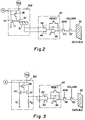
- a current mirror circuit 30B that may be substituted for the current mirror 30A provides a second variant of the current mirror function by utilizing an output transistor T o emitter or source whose area is n times the area of the emitter or source of the input transistor T I . This forms a smaller circuit which in turn allocates more area to the photodetector 20.
- Current mirror 30B would be substituted for the current mirror 30A at the connection point marked with a circled A.
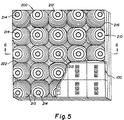
- Fig. 3 illustrates a variant of a current mirror labeled 30C that is connectable to the unit pixel subassembly 10 of Fig. 1 at the A labeled point marked with a circle in place of either 30A or 30B.
- the current mirror 30C achieves current multiplication by biasing the emitter base (or gate source) voltage higher on the input side of the current mirror than on the output side. This, more specifically, is accomplished by adjusting the value of R1 and R2. Alternately, a diode junction can be substituted into the emitter or source of the input side of the current mirror 30C in order to provide a fixed voltage bias.
- photosensor array 100 contains unused areas at each photodetector site. It is within these areas that the circuits 30A, B, or C, and circuit 40, along with row and column selection transistors 52 and 54 are located. As previously mentioned the placement of these circuits and transistors in close proximity to their associated photodetector 20 makes a more efficient photosensor array and reduces the need for external support circuitry.
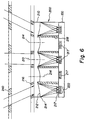
- Fig. 5 illustrates an optic array camera 200 incorporating the photosensor array 100 and a lenslet array 210.
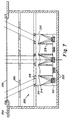
- Fig. 6 illustrates a cross-section of the optic array camera, taken along the section lines 6-6, in Fig. 5.
- the optic array camera 200 is formed with an array 210 of achromatized refractive/diffractive lenslets 212 or refractive lenslets which are centered over photosensitive sites 217.
- the array of lenslets 210 replaces the typical single round lenses that are spaced along one central axis in a camera. To be observed in Fig.
- each lenslet 212 is displaced relative to the fixed sensor-to-sensor distance as a function of its radial distance from the optical axis 213 of the central lenslet which is at the physical center of the array shown.
- the lines 215 appearing around the mechanical optical axis 214 of each lenslet 212 are topographical lines indicating changes in height of the lenslet's surface.
- An opaque mask 216 covers the areas between the lenslets 212 to prevent light from reaching the photodetectors (photosensor) other than by passing through a lenslet.
- the array depicted in Fig. 6 represents only a small portion of an array that is used in an actual camera.
- a typical implementation could consist of 280 x 640 pixels with 3 pixels per lens.
- Other configurations of the lenslets may be used such as forming the outer periphery of each lenslet 212 as a square, hexagon, or circle, without detracting from the invention.
- the optical axis 214 of the lenslets 212 in the lens array 100 are located at a distance which becomes progressively larger than the center-to-center distance of the pixels in the array.
- the displacement of the lenslets optical axis 214 increases radially from the center of the array. Decentering a lens element tends to bend rays from off-axis field angles into the center of the lens groups field of view.
- the optical axis of the lens element By moving the optical axis of the lens element further out radially with increasing distance from the center of the array, the angular location of an object at the center of the field of view for a given lenslet/photodetector pair originates from increasingly off-axis segments of the total field of view.
- the required decenter, for an array element of focal length Fl i necessary to deflect a ray from the desired field angle into the center of the array element's field stop can be determined from the paraxial ray tracing equations.
- the decenter necessary for a given element is approximately a linear function of the element's radial distance from the system's optical axis.
- the lenslet array 210 is positioned over the photosensor array 100 of grouped photosensors 222.
- Each photosensor group 222 is located at an associated photosensitive site 217.
- Each group of photosensors 222 is formed with red (R), green (G), and blue (B) sensors.
- the number of photosensitive sites 217 corresponds in number to at least the number of lenslets 212 in the lenslet array 210.
- the lenslet array 210 is maintained a distance apart from the surfaces of the photosensors by spacers 218 that serve the additional function of being light baffles.
- the opaque masks 216 on the lenslet array 210 combined with a field stop aperture plate 240 limit the field of view of any particular photosensor so that it does not overlap the field of view of its neighbors by a large amount.
- the aperture plate 240 is positioned approximately 0.5mm to 2mm from the surface of the lenslet array 210.
- the aperture plate 240 may be a layer of clear glass having a photoresist mask pattern formed on one of it's surfaces.
- the center of the apertures in the aperture plate 240 are aligned to the center of the field of view of a corresponding lenslet.
- the spacing of the mechanical optical centers 214 increases as a function of each lenslet's radial position radially from the center of the array causing the aperture plate 240 to be slightly larger than the associated lenslet array 210.
- the combination of the opaque areas 216 with the aperture plate 240 and a given lenslet focal length determines the field of view for a photosensitive site 217.
- the lenslet array 210 can be formed of etched quartz, or an epoxy replica on a glass substrate or can be injection molded plastic.
- the lenslets 212 combined with the appropriate field stop aperture plate 240, form images of a small segment of the field of view on each photosensitive site 217.
- the lenslets 212 By forming the lenslets 212 with decentrations of the mechanical optical axis 214 which increase radially across the lenslet array the angle which the axial ray incident on any particular lenslet makes with the surface normal of the plane of the lenslet array 210 will increase as a function of the particular lenslet's radial position on the array. Therefore, by appropriately forming the decenters of each lenslet each photosensitive site 217 will view a different segment of a scene (image). Since each photosensor group 222 has its own lenslet there is no need to reinvert the image with a relay lens.
- any camera system incorporating the present invention, can be extremely compact and flat due to the integration of the above described circuitry which allows for the elimination of support circuit boards which in turn allows for a further decrease in the size of the camera.
- the camera can work in black and white or in color if three unit pixel subassemblies with color filters are formed at each pixel site 217 to pass only assigned frequencies of incident radiation.
- the use of a lenslet that will physically displace incident radiation may be used in lieu of color filters to deflect the appropriate frequency of incident radiation to its assigned photosensor.
- An array of aspheric lenslets can also be used to form images on the photosensor array 100.
- the aforementioned embodiment does not correct for the variation in focal length as a function of wavelength since the lenslet is formed from a single refractive material, therefore the spot size of the incident light varies as a function of color.
- lens F/# Focal Length/Lens Diameter Reducing each lenslet's F/# allows for the reduction of the center-to-center spacing between array elements, since, for a given F/# and detector sensitivity a specific photocurrent is generated.
- an array optic camera is formed with 780 by 640 pixels the length of the long dimension of the array would be 32.5 mm, assuming 3 color pixels (photosensors) at each photosite. This would require a large area of silicon per photosensor array, which would increase part costs and result in lower yields of photosensors from a given wafer size.
- the lenslet diameters can be reduced by 4x to 65 ⁇ m and the length of the array will be reduced to 8.125 mm, resulting in higher photosensor yields and lower part costs.
- the array optic camera can utilize this technique with no decrease in usable photosensitive surface area since the space between photosites is not utilized for light detection, but is rather, empty space.
- Fig. 7 illustrates the optic array camera 200 of Fig. 6 positioned in a light tight housing 252 that is exposed to an image via a mechanical shutter 250.
- the mechanical shutter may be any of the typical shutters used in a film type camera.
- the advantage to the optic array camera 200 of Fig. 6 is that no mechanical shutter is required; the photosensors 222 are turned on " or active to capture light from the image focused onto the photosensor array 100. In the Fig. 7 embodiment the photosensors 222 are turned on " generally when camera power is on and image capture occurs when the shutter 250 is activated.
Landscapes
- Engineering & Computer Science (AREA)
- Multimedia (AREA)
- Signal Processing (AREA)
- Transforming Light Signals Into Electric Signals (AREA)
- Cameras In General (AREA)
- Solid State Image Pick-Up Elements (AREA)
- Color Television Image Signal Generators (AREA)
Applications Claiming Priority (2)
| Application Number | Priority Date | Filing Date | Title |
|---|---|---|---|
| US699306 | 1996-08-19 | ||
| US08/699,306 US6141048A (en) | 1996-08-19 | 1996-08-19 | Compact image capture device |
Publications (1)
| Publication Number | Publication Date |
|---|---|
| EP0825764A2 true EP0825764A2 (de) | 1998-02-25 |
Family
ID=24808758
Family Applications (1)
| Application Number | Title | Priority Date | Filing Date |
|---|---|---|---|
| EP97202459A Withdrawn EP0825764A2 (de) | 1996-08-19 | 1997-08-08 | Kompakte Bildaufnahmevorrichtung |
Country Status (3)
| Country | Link |
|---|---|
| US (1) | US6141048A (de) |
| EP (1) | EP0825764A2 (de) |
| JP (1) | JPH1090789A (de) |
Cited By (3)
| Publication number | Priority date | Publication date | Assignee | Title |
|---|---|---|---|---|
| EP0833502A3 (de) * | 1996-09-26 | 2000-01-05 | Eastman Kodak Company | Kompakte Bildaufnahmevorrichtung mit örtlichem Bildspeicher |
| EP0840502A3 (de) * | 1996-11-04 | 2000-01-05 | Eastman Kodak Company | Kompakte Digitalkamera mit segmentierten Blickfeldern |
| WO2005069607A1 (de) * | 2004-01-20 | 2005-07-28 | Frauhofer-Gesellschaft Zur Förderung Der Angewandten Forschung E.V. | Bilderfassungssystem und dessen verwendung |
Families Citing this family (88)
| Publication number | Priority date | Publication date | Assignee | Title |
|---|---|---|---|---|
| US6515701B2 (en) * | 1997-07-24 | 2003-02-04 | Polaroid Corporation | Focal plane exposure control system for CMOS area image sensors |
| NO305728B1 (no) * | 1997-11-14 | 1999-07-12 | Reidar E Tangen | Optoelektronisk kamera og fremgangsmÕte ved bildeformatering i samme |
| JP3657780B2 (ja) | 1998-06-30 | 2005-06-08 | 株式会社東芝 | 撮像装置 |
| US6572017B1 (en) * | 1999-08-12 | 2003-06-03 | Telxon Corporation | Optical device employing a mirror array for increasing the apparent resolution of a photosensor |
| US6750437B2 (en) * | 2000-08-28 | 2004-06-15 | Canon Kabushiki Kaisha | Image pickup apparatus that suitably adjusts a focus |
| JP2003060990A (ja) * | 2001-08-10 | 2003-02-28 | Victor Co Of Japan Ltd | 固体撮像装置及びその読み出し方法 |
| JP3518529B2 (ja) * | 2001-08-17 | 2004-04-12 | ソニー株式会社 | 固体撮像装置 |
| US8064650B2 (en) * | 2002-07-10 | 2011-11-22 | Hewlett-Packard Development Company, L.P. | File management of digital images using the names of people identified in the images |
| US7423679B2 (en) * | 2002-12-20 | 2008-09-09 | Eastman Kodak Company | Imaging system having extended useful latitude |
| US6801719B1 (en) * | 2003-03-14 | 2004-10-05 | Eastman Kodak Company | Camera using beam splitter with micro-lens image amplification |
| US7310477B2 (en) * | 2003-08-26 | 2007-12-18 | Eastman Kodak Company | Photographic film cartridge or cassette systems with microlens |
| JP2005167665A (ja) * | 2003-12-03 | 2005-06-23 | Sanyo Electric Co Ltd | 画像信号処理装置、画像信号処理方法、画像信号処理プログラム、固体撮像素子の制御装置及び固体撮像素子の制御方法 |
| US7375701B2 (en) * | 2004-07-01 | 2008-05-20 | Carestream Health, Inc. | Scanless virtual retinal display system |
| US20060044451A1 (en) * | 2004-08-30 | 2006-03-02 | Eastman Kodak Company | Wide angle lenslet camera |
| JP4306603B2 (ja) * | 2004-12-20 | 2009-08-05 | ソニー株式会社 | 固体撮像装置および固体撮像装置の駆動方法 |
| US7375312B2 (en) * | 2005-01-26 | 2008-05-20 | Avago Technologies Ecbu Ip Pte Ltd | Planar fly's eye detector |
| IL167637A (en) * | 2005-03-24 | 2009-09-22 | Semi Conductor Devices An Elbi | Method and system for determining the rate of non uniformity of bolometer based systems |
| IL167641A (en) * | 2005-03-24 | 2011-07-31 | Semi Conductor Devices An Elbit Systems Rafael Partnership | System for measuring and compensating for the case temperature variations in a bolometer based system |
| US7511323B2 (en) * | 2005-08-11 | 2009-03-31 | Aptina Imaging Corporation | Pixel cells in a honeycomb arrangement |
| FR2918449B1 (fr) * | 2007-07-02 | 2010-05-21 | Ulis | Dispositif de detection de rayonnement infrarouge a detecteurs bolometriques |
| EP3328048B1 (de) | 2008-05-20 | 2021-04-21 | FotoNation Limited | Aufnahme und verarbeitung von bildern mittels monolithischer kamera anordnung mit heterogenem bildwandler |
| US8866920B2 (en) | 2008-05-20 | 2014-10-21 | Pelican Imaging Corporation | Capturing and processing of images using monolithic camera array with heterogeneous imagers |
| US11792538B2 (en) | 2008-05-20 | 2023-10-17 | Adeia Imaging Llc | Capturing and processing of images including occlusions focused on an image sensor by a lens stack array |
| EP2502115A4 (de) | 2009-11-20 | 2013-11-06 | Pelican Imaging Corp | Aufnahme und verarbeitung von bildern mittels eines monolithischen kameraarrays mit heterogenem bildwandler |
| CN102640031A (zh) * | 2009-12-04 | 2012-08-15 | 株式会社尼康 | 成像光学系统及显微镜装置 |
| CN103004180A (zh) | 2010-05-12 | 2013-03-27 | 派力肯影像公司 | 成像器阵列和阵列照相机的架构 |
| US8878950B2 (en) | 2010-12-14 | 2014-11-04 | Pelican Imaging Corporation | Systems and methods for synthesizing high resolution images using super-resolution processes |
| GB2488519A (en) | 2011-02-16 | 2012-09-05 | St Microelectronics Res & Dev | Multi-channel image sensor incorporating lenslet array and overlapping fields of view. |
| US8305456B1 (en) * | 2011-05-11 | 2012-11-06 | Pelican Imaging Corporation | Systems and methods for transmitting and receiving array camera image data |
| US20130265459A1 (en) | 2011-06-28 | 2013-10-10 | Pelican Imaging Corporation | Optical arrangements for use with an array camera |
| EP2726930A4 (de) | 2011-06-28 | 2015-03-04 | Pelican Imaging Corp | Optische anordnungen zur verwendung mit einer arraykamera |
| US9229096B2 (en) * | 2011-07-27 | 2016-01-05 | Semiconductor Components Industries, Llc | Time-of-flight imaging systems |
| WO2013043751A1 (en) | 2011-09-19 | 2013-03-28 | Pelican Imaging Corporation | Systems and methods for controlling aliasing in images captured by an array camera for use in super resolution processing using pixel apertures |
| CN104081414B (zh) | 2011-09-28 | 2017-08-01 | Fotonation开曼有限公司 | 用于编码和解码光场图像文件的系统及方法 |
| US9412206B2 (en) | 2012-02-21 | 2016-08-09 | Pelican Imaging Corporation | Systems and methods for the manipulation of captured light field image data |
| US9210392B2 (en) | 2012-05-01 | 2015-12-08 | Pelican Imaging Coporation | Camera modules patterned with pi filter groups |
| EP2873028A4 (de) | 2012-06-28 | 2016-05-25 | Pelican Imaging Corp | Systeme und verfahren zur erkennung defekter kamera-arrays, optischer arrays und sensoren |
| US20140002674A1 (en) | 2012-06-30 | 2014-01-02 | Pelican Imaging Corporation | Systems and Methods for Manufacturing Camera Modules Using Active Alignment of Lens Stack Arrays and Sensors |
| CN107346061B (zh) | 2012-08-21 | 2020-04-24 | 快图有限公司 | 用于使用阵列照相机捕捉的图像中的视差检测和校正的系统和方法 |
| EP2888698A4 (de) | 2012-08-23 | 2016-06-29 | Pelican Imaging Corp | Eigenschaftsbasierte hochauflösende bewegungsschätzung aus mit einer arrayquelle aufgenommenen niedrigauflösenden bildern |
| WO2014043641A1 (en) | 2012-09-14 | 2014-03-20 | Pelican Imaging Corporation | Systems and methods for correcting user identified artifacts in light field images |
| WO2014052974A2 (en) | 2012-09-28 | 2014-04-03 | Pelican Imaging Corporation | Generating images from light fields utilizing virtual viewpoints |
| US9143711B2 (en) | 2012-11-13 | 2015-09-22 | Pelican Imaging Corporation | Systems and methods for array camera focal plane control |
| WO2014097507A1 (ja) * | 2012-12-21 | 2014-06-26 | パナソニック株式会社 | 固体撮像素子 |
| US9462164B2 (en) | 2013-02-21 | 2016-10-04 | Pelican Imaging Corporation | Systems and methods for generating compressed light field representation data using captured light fields, array geometry, and parallax information |
| US9253380B2 (en) | 2013-02-24 | 2016-02-02 | Pelican Imaging Corporation | Thin form factor computational array cameras and modular array cameras |
| US9638883B1 (en) | 2013-03-04 | 2017-05-02 | Fotonation Cayman Limited | Passive alignment of array camera modules constructed from lens stack arrays and sensors based upon alignment information obtained during manufacture of array camera modules using an active alignment process |
| US9774789B2 (en) | 2013-03-08 | 2017-09-26 | Fotonation Cayman Limited | Systems and methods for high dynamic range imaging using array cameras |
| US8866912B2 (en) | 2013-03-10 | 2014-10-21 | Pelican Imaging Corporation | System and methods for calibration of an array camera using a single captured image |
| US9521416B1 (en) | 2013-03-11 | 2016-12-13 | Kip Peli P1 Lp | Systems and methods for image data compression |
| US9124831B2 (en) | 2013-03-13 | 2015-09-01 | Pelican Imaging Corporation | System and methods for calibration of an array camera |
| US9888194B2 (en) | 2013-03-13 | 2018-02-06 | Fotonation Cayman Limited | Array camera architecture implementing quantum film image sensors |
| US9106784B2 (en) | 2013-03-13 | 2015-08-11 | Pelican Imaging Corporation | Systems and methods for controlling aliasing in images captured by an array camera for use in super-resolution processing |
| US9519972B2 (en) | 2013-03-13 | 2016-12-13 | Kip Peli P1 Lp | Systems and methods for synthesizing images from image data captured by an array camera using restricted depth of field depth maps in which depth estimation precision varies |
| WO2014153098A1 (en) | 2013-03-14 | 2014-09-25 | Pelican Imaging Corporation | Photmetric normalization in array cameras |
| WO2014159779A1 (en) | 2013-03-14 | 2014-10-02 | Pelican Imaging Corporation | Systems and methods for reducing motion blur in images or video in ultra low light with array cameras |
| US9497429B2 (en) | 2013-03-15 | 2016-11-15 | Pelican Imaging Corporation | Extended color processing on pelican array cameras |
| US9445003B1 (en) | 2013-03-15 | 2016-09-13 | Pelican Imaging Corporation | Systems and methods for synthesizing high resolution images using image deconvolution based on motion and depth information |
| EP4604059A3 (de) | 2013-03-15 | 2025-09-17 | Adeia Imaging LLC | Systémes et procédés d'imagerie stéréo á l'aide des réseaux de caméras |
| US9633442B2 (en) | 2013-03-15 | 2017-04-25 | Fotonation Cayman Limited | Array cameras including an array camera module augmented with a separate camera |
| US10122993B2 (en) | 2013-03-15 | 2018-11-06 | Fotonation Limited | Autofocus system for a conventional camera that uses depth information from an array camera |
| WO2014150856A1 (en) | 2013-03-15 | 2014-09-25 | Pelican Imaging Corporation | Array camera implementing quantum dot color filters |
| WO2015048694A2 (en) | 2013-09-27 | 2015-04-02 | Pelican Imaging Corporation | Systems and methods for depth-assisted perspective distortion correction |
| US9426343B2 (en) | 2013-11-07 | 2016-08-23 | Pelican Imaging Corporation | Array cameras incorporating independently aligned lens stacks |
| US10119808B2 (en) | 2013-11-18 | 2018-11-06 | Fotonation Limited | Systems and methods for estimating depth from projected texture using camera arrays |
| EP3075140B1 (de) | 2013-11-26 | 2018-06-13 | FotoNation Cayman Limited | Zeilenkamerakonfigurationen mit mehreren zeilenkameras |
| US10089740B2 (en) | 2014-03-07 | 2018-10-02 | Fotonation Limited | System and methods for depth regularization and semiautomatic interactive matting using RGB-D images |
| US9247117B2 (en) | 2014-04-07 | 2016-01-26 | Pelican Imaging Corporation | Systems and methods for correcting for warpage of a sensor array in an array camera module by introducing warpage into a focal plane of a lens stack array |
| US9521319B2 (en) | 2014-06-18 | 2016-12-13 | Pelican Imaging Corporation | Array cameras and array camera modules including spectral filters disposed outside of a constituent image sensor |
| CN113256730B (zh) | 2014-09-29 | 2023-09-05 | 快图有限公司 | 用于阵列相机的动态校准的系统和方法 |
| US9942474B2 (en) | 2015-04-17 | 2018-04-10 | Fotonation Cayman Limited | Systems and methods for performing high speed video capture and depth estimation using array cameras |
| US10482618B2 (en) | 2017-08-21 | 2019-11-19 | Fotonation Limited | Systems and methods for hybrid depth regularization |
| WO2021055585A1 (en) | 2019-09-17 | 2021-03-25 | Boston Polarimetrics, Inc. | Systems and methods for surface modeling using polarization cues |
| WO2021071995A1 (en) | 2019-10-07 | 2021-04-15 | Boston Polarimetrics, Inc. | Systems and methods for surface normals sensing with polarization |
| EP4066001B1 (de) | 2019-11-30 | 2026-03-04 | Intrinsic Innovation LLC | Systeme und verfahren zur transparenten objektsegmentierung unter verwendung von polarisationshinweisen |
| JP7462769B2 (ja) | 2020-01-29 | 2024-04-05 | イントリンジック イノベーション エルエルシー | 物体の姿勢の検出および測定システムを特徴付けるためのシステムおよび方法 |
| US11797863B2 (en) | 2020-01-30 | 2023-10-24 | Intrinsic Innovation Llc | Systems and methods for synthesizing data for training statistical models on different imaging modalities including polarized images |
| WO2021243088A1 (en) | 2020-05-27 | 2021-12-02 | Boston Polarimetrics, Inc. | Multi-aperture polarization optical systems using beam splitters |
| US12020455B2 (en) | 2021-03-10 | 2024-06-25 | Intrinsic Innovation Llc | Systems and methods for high dynamic range image reconstruction |
| US12069227B2 (en) | 2021-03-10 | 2024-08-20 | Intrinsic Innovation Llc | Multi-modal and multi-spectral stereo camera arrays |
| US11290658B1 (en) | 2021-04-15 | 2022-03-29 | Boston Polarimetrics, Inc. | Systems and methods for camera exposure control |
| US11954886B2 (en) | 2021-04-15 | 2024-04-09 | Intrinsic Innovation Llc | Systems and methods for six-degree of freedom pose estimation of deformable objects |
| US12067746B2 (en) | 2021-05-07 | 2024-08-20 | Intrinsic Innovation Llc | Systems and methods for using computer vision to pick up small objects |
| US12175741B2 (en) | 2021-06-22 | 2024-12-24 | Intrinsic Innovation Llc | Systems and methods for a vision guided end effector |
| US12340538B2 (en) | 2021-06-25 | 2025-06-24 | Intrinsic Innovation Llc | Systems and methods for generating and using visual datasets for training computer vision models |
| US12172310B2 (en) | 2021-06-29 | 2024-12-24 | Intrinsic Innovation Llc | Systems and methods for picking objects using 3-D geometry and segmentation |
| US11689813B2 (en) | 2021-07-01 | 2023-06-27 | Intrinsic Innovation Llc | Systems and methods for high dynamic range imaging using crossed polarizers |
| US12293535B2 (en) | 2021-08-03 | 2025-05-06 | Intrinsic Innovation Llc | Systems and methods for training pose estimators in computer vision |
Family Cites Families (41)
| Publication number | Priority date | Publication date | Assignee | Title |
|---|---|---|---|---|
| US3910683A (en) * | 1970-07-28 | 1975-10-07 | Minolta Camera Kk | Optical low-pass filter |
| US4085411A (en) * | 1976-04-16 | 1978-04-18 | Sprague Electric Company | Light detector system with photo diode and current-mirror amplifier |
| JPS54154728A (en) * | 1978-05-25 | 1979-12-06 | Boehringer Mannheim Gmbh | Manufacture of alphaa*44*44chlorobenzoylaminoo ethyl**phenoxyyisoethylacetic acid |
| DE2823164A1 (de) * | 1978-05-26 | 1979-11-29 | Bayer Ag | Verfahren zur herstellung von hexahydrophthalsaeureanhydrid |
| US4318123A (en) * | 1980-06-05 | 1982-03-02 | Rca Corporation | Solid-state, color-encoding television camera |
| US4323925A (en) * | 1980-07-07 | 1982-04-06 | Avco Everett Research Laboratory, Inc. | Method and apparatus for arraying image sensor modules |
| JPS5789731A (en) * | 1980-11-25 | 1982-06-04 | Canon Inc | Focusing screen |
| JPS57184376A (en) * | 1981-05-09 | 1982-11-13 | Sony Corp | Signal output circuit of image pickup device |
| US4377753A (en) * | 1981-06-01 | 1983-03-22 | Eastman Kodak Company | High resolution optical-addressing device and electronic scanner and/or printer apparatus employing such device |
| JPS59193699A (ja) * | 1983-04-18 | 1984-11-02 | Niles Parts Co Ltd | 平面駆動型スピ−カ |
| US4573177A (en) * | 1984-02-06 | 1986-02-25 | The United States Of America As Represented By The Secretary Of The Air Force | Bi-directional current differencer for complementary charge coupled device (CCD) outputs |
| NL8400805A (nl) * | 1984-03-14 | 1985-10-01 | Philips Nv | Ladingsgekoppeld transversaal filter. |
| US4708436A (en) * | 1985-07-12 | 1987-11-24 | Rca Corporation | Optical imager with diffractive lenticular array |
| US4689291A (en) * | 1985-08-30 | 1987-08-25 | Xerox Corporation | Pedestal-type microlens fabrication process |
| JPS62144459A (ja) * | 1985-12-19 | 1987-06-27 | Ricoh Co Ltd | 完全密着型センサ− |
| US5004901A (en) * | 1987-06-04 | 1991-04-02 | Mitsubishi Denki Kabushiki Kaisha | Current mirror amplifier for use in an optical data medium driving apparatus and servo-circuit |
| JPS63100879A (ja) * | 1986-10-17 | 1988-05-02 | Hitachi Ltd | 固体撮像装置 |
| US4973833A (en) * | 1988-09-28 | 1990-11-27 | Minolta Camera Kabushiki Kaisha | Image sensor including logarithmic converters |
| US5187358A (en) * | 1989-02-15 | 1993-02-16 | Canon Kabushiki Kaisha | Image reading device having a telecentric optical system and a blazed diffraction grating |
| US4994664A (en) * | 1989-03-27 | 1991-02-19 | Massachusetts Institute Of Technology | Optically coupled focal plane arrays using lenslets and multiplexers |
| US5151790A (en) * | 1990-07-23 | 1992-09-29 | Fuji Photo Film Co., Ltd. | Image pickup device for stabilizing optical aberrations |
| US5076687A (en) * | 1990-08-28 | 1991-12-31 | Massachusetts Institute Of Technology | Optical ranging apparatus |
| US5233174A (en) * | 1992-03-11 | 1993-08-03 | Hughes Danbury Optical Systems, Inc. | Wavefront sensor having a lenslet array as a null corrector |
| US5497269A (en) * | 1992-06-25 | 1996-03-05 | Lockheed Missiles And Space Company, Inc. | Dispersive microlens |
| US5329312A (en) * | 1992-08-17 | 1994-07-12 | Eastman Kodak Company | DC level control circuitry for CCD images |
| JP2987016B2 (ja) * | 1992-08-28 | 1999-12-06 | 松下電器産業株式会社 | 位相格子光学的ローパスフィルタ |
| US5529936A (en) * | 1992-09-30 | 1996-06-25 | Lsi Logic Corporation | Method of etching a lens for a semiconductor solid state image sensor |
| US5760834A (en) * | 1992-09-30 | 1998-06-02 | Lsi Logic | Electronic camera with binary lens element array |
| US5340978A (en) * | 1992-09-30 | 1994-08-23 | Lsi Logic Corporation | Image-sensing display panels with LCD display panel and photosensitive element array |
| JP3438205B2 (ja) * | 1993-02-25 | 2003-08-18 | 株式会社リコー | デジタル電子カメラ装置 |
| US5841126A (en) * | 1994-01-28 | 1998-11-24 | California Institute Of Technology | CMOS active pixel sensor type imaging system on a chip |
| US5471515A (en) * | 1994-01-28 | 1995-11-28 | California Institute Of Technology | Active pixel sensor with intra-pixel charge transfer |
| US5461425A (en) * | 1994-02-15 | 1995-10-24 | Stanford University | CMOS image sensor with pixel level A/D conversion |
| JPH08107194A (ja) * | 1994-10-03 | 1996-04-23 | Fuji Photo Optical Co Ltd | 固体撮像装置 |
| US5705807A (en) * | 1994-10-24 | 1998-01-06 | Nissan Motor Co., Ltd. | Photo detecting apparatus for detecting reflected light from an object and excluding an external light componet from the reflected light |
| US5814803A (en) * | 1994-12-23 | 1998-09-29 | Spectra-Physics Scanning Systems, Inc. | Image reader with multi-focus lens |
| US5708263A (en) * | 1995-12-27 | 1998-01-13 | International Business Machines Corporation | Photodetector array |
| US5784178A (en) * | 1996-03-06 | 1998-07-21 | Dyna Image Corporation | High performance contact image sensor |
| US5844238A (en) * | 1996-03-27 | 1998-12-01 | David Sarnoff Research Center, Inc. | Infrared imager using room temperature capacitance sensor |
| US5754056A (en) * | 1996-04-23 | 1998-05-19 | David Sarnoff Research Center, Inc. | Charge detector with long integration time |
| US5838176A (en) * | 1996-07-11 | 1998-11-17 | Foveonics, Inc. | Correlated double sampling circuit |
-
1996
- 1996-08-19 US US08/699,306 patent/US6141048A/en not_active Expired - Fee Related
-
1997
- 1997-08-08 EP EP97202459A patent/EP0825764A2/de not_active Withdrawn
- 1997-08-18 JP JP9221744A patent/JPH1090789A/ja not_active Withdrawn
Cited By (4)
| Publication number | Priority date | Publication date | Assignee | Title |
|---|---|---|---|---|
| EP0833502A3 (de) * | 1996-09-26 | 2000-01-05 | Eastman Kodak Company | Kompakte Bildaufnahmevorrichtung mit örtlichem Bildspeicher |
| EP0840502A3 (de) * | 1996-11-04 | 2000-01-05 | Eastman Kodak Company | Kompakte Digitalkamera mit segmentierten Blickfeldern |
| US6137535A (en) * | 1996-11-04 | 2000-10-24 | Eastman Kodak Company | Compact digital camera with segmented fields of view |
| WO2005069607A1 (de) * | 2004-01-20 | 2005-07-28 | Frauhofer-Gesellschaft Zur Förderung Der Angewandten Forschung E.V. | Bilderfassungssystem und dessen verwendung |
Also Published As
| Publication number | Publication date |
|---|---|
| JPH1090789A (ja) | 1998-04-10 |
| US6141048A (en) | 2000-10-31 |
Similar Documents
| Publication | Publication Date | Title |
|---|---|---|
| US6141048A (en) | Compact image capture device | |
| US6137535A (en) | Compact digital camera with segmented fields of view | |
| CN100499141C (zh) | 固体摄像装置 | |
| EP1031239B1 (de) | Optoelektronische kamera und verfahren zur bildformatierung | |
| EP0893915A2 (de) | Kompakter Bildsensor mit daran befestigter Bildanzeigevorrichtung | |
| US6750437B2 (en) | Image pickup apparatus that suitably adjusts a focus | |
| JP4388226B2 (ja) | センサ装置 | |
| JP3170847B2 (ja) | 固体撮像素子及びそれを用いた光学機器 | |
| EP1302986B1 (de) | Photodetektor mit grossem Dynamikbereich und erhöhtem Arbeitstemperaturbereich | |
| KR20010034571A (ko) | 능동 선형 센서 | |
| JP2004309701A (ja) | 測距測光用センサ及びカメラ | |
| EP0833502A2 (de) | Kompakte Bildaufnahmevorrichtung mit örtlichem Bildspeicher | |
| US10237501B2 (en) | Autofocus system for CMOS imaging sensors | |
| CN100474899C (zh) | 修正因输出电路特性所产生误差的固态图像拾取设备 | |
| WO2020079960A1 (ja) | 撮像装置及び固体撮像装置 | |
| EP2061235B1 (de) | Empfindlichkeitskorrekturverfahren und abbildungseinrichtung | |
| CN100498496C (zh) | 测光测距用固体摄像装置以及使用了该装置的摄像装置 | |
| US5864132A (en) | Full image optical detector with spaced detector pixels | |
| Monteiro et al. | Fast Hartmann-Shack wavefront sensors manufactured in standard CMOS technology | |
| JP7794278B2 (ja) | 撮像装置 | |
| JP2001346104A (ja) | 固体撮像装置及びこれを用いた撮影装置 | |
| JP2004191630A (ja) | 撮像装置 | |
| WO2011055117A1 (en) | Detector | |
| JPH11337815A (ja) | 固体撮像装置及びカメラ用測距装置 | |
| JP4500849B2 (ja) | Aeaf用固体撮像装置 |
Legal Events
| Date | Code | Title | Description |
|---|---|---|---|
| PUAI | Public reference made under article 153(3) epc to a published international application that has entered the european phase |
Free format text: ORIGINAL CODE: 0009012 |
|
| AK | Designated contracting states |
Kind code of ref document: A2 Designated state(s): AT BE CH DE DK ES FI FR GB GR IE IT LI LU MC NL PT SE |
|
| STAA | Information on the status of an ep patent application or granted ep patent |
Free format text: STATUS: THE APPLICATION HAS BEEN WITHDRAWN |
|
| 18W | Application withdrawn |
Withdrawal date: 19990505 |