EP0827019A1 - Procédé pour la préparation d'une émulsion à grains tabulaires riche en chlorure utilisant l'addition d'iodure en courants multiples - Google Patents
Procédé pour la préparation d'une émulsion à grains tabulaires riche en chlorure utilisant l'addition d'iodure en courants multiples Download PDFInfo
- Publication number
- EP0827019A1 EP0827019A1 EP97202528A EP97202528A EP0827019A1 EP 0827019 A1 EP0827019 A1 EP 0827019A1 EP 97202528 A EP97202528 A EP 97202528A EP 97202528 A EP97202528 A EP 97202528A EP 0827019 A1 EP0827019 A1 EP 0827019A1
- Authority
- EP
- European Patent Office
- Prior art keywords
- dispersing medium
- silver
- iodide
- grains
- tabular
- Prior art date
- Legal status (The legal status is an assumption and is not a legal conclusion. Google has not performed a legal analysis and makes no representation as to the accuracy of the status listed.)
- Granted
Links
- 238000000034 method Methods 0.000 title claims abstract description 49
- XMBWDFGMSWQBCA-UHFFFAOYSA-N hydrogen iodide Chemical compound I XMBWDFGMSWQBCA-UHFFFAOYSA-N 0.000 title claims abstract description 38
- 230000008569 process Effects 0.000 title claims abstract description 38
- VEXZGXHMUGYJMC-UHFFFAOYSA-M Chloride anion Chemical compound [Cl-] VEXZGXHMUGYJMC-UHFFFAOYSA-M 0.000 title claims abstract description 35
- 239000000839 emulsion Substances 0.000 title claims description 63
- 229910021607 Silver chloride Inorganic materials 0.000 claims abstract description 33
- HKZLPVFGJNLROG-UHFFFAOYSA-M silver monochloride Chemical compound [Cl-].[Ag+] HKZLPVFGJNLROG-UHFFFAOYSA-M 0.000 claims abstract description 33
- 239000003513 alkali Substances 0.000 claims abstract description 13
- FOIXSVOLVBLSDH-UHFFFAOYSA-N Silver ion Chemical compound [Ag+] FOIXSVOLVBLSDH-UHFFFAOYSA-N 0.000 claims abstract description 11
- 239000002245 particle Substances 0.000 claims abstract description 11
- -1 halide salts Chemical class 0.000 claims description 36
- 229910052709 silver Inorganic materials 0.000 claims description 36
- 239000004332 silver Substances 0.000 claims description 36
- XMBWDFGMSWQBCA-UHFFFAOYSA-M iodide Chemical compound [I-] XMBWDFGMSWQBCA-UHFFFAOYSA-M 0.000 claims description 26
- 229940006461 iodide ion Drugs 0.000 claims description 26
- BQCADISMDOOEFD-UHFFFAOYSA-N Silver Chemical compound [Ag] BQCADISMDOOEFD-UHFFFAOYSA-N 0.000 claims description 24
- 230000006911 nucleation Effects 0.000 claims description 20
- 238000010899 nucleation Methods 0.000 claims description 20
- 238000009826 distribution Methods 0.000 claims description 17
- 238000006243 chemical reaction Methods 0.000 claims description 15
- 239000012528 membrane Substances 0.000 claims 1
- 239000000243 solution Substances 0.000 description 23
- SQGYOTSLMSWVJD-UHFFFAOYSA-N silver(1+) nitrate Chemical compound [Ag+].[O-]N(=O)=O SQGYOTSLMSWVJD-UHFFFAOYSA-N 0.000 description 17
- 238000001556 precipitation Methods 0.000 description 16
- FAPWRFPIFSIZLT-UHFFFAOYSA-M sodium chloride Inorganic materials [Na+].[Cl-] FAPWRFPIFSIZLT-UHFFFAOYSA-M 0.000 description 15
- 230000015572 biosynthetic process Effects 0.000 description 14
- 239000013078 crystal Substances 0.000 description 9
- 230000003111 delayed effect Effects 0.000 description 8
- 239000007788 liquid Substances 0.000 description 8
- 239000011780 sodium chloride Substances 0.000 description 8
- 108010010803 Gelatin Proteins 0.000 description 7
- 229920000159 gelatin Polymers 0.000 description 7
- 239000008273 gelatin Substances 0.000 description 7
- 235000019322 gelatine Nutrition 0.000 description 7
- 235000011852 gelatine desserts Nutrition 0.000 description 7
- CPELXLSAUQHCOX-UHFFFAOYSA-M Bromide Chemical compound [Br-] CPELXLSAUQHCOX-UHFFFAOYSA-M 0.000 description 5
- 150000004820 halides Chemical class 0.000 description 5
- 238000002360 preparation method Methods 0.000 description 5
- 238000004519 manufacturing process Methods 0.000 description 4
- 239000000463 material Substances 0.000 description 4
- 239000000126 substance Substances 0.000 description 4
- XLYOFNOQVPJJNP-UHFFFAOYSA-N water Substances O XLYOFNOQVPJJNP-UHFFFAOYSA-N 0.000 description 4
- JKFYKCYQEWQPTM-UHFFFAOYSA-N 2-azaniumyl-2-(4-fluorophenyl)acetate Chemical compound OC(=O)C(N)C1=CC=C(F)C=C1 JKFYKCYQEWQPTM-UHFFFAOYSA-N 0.000 description 3
- VEXZGXHMUGYJMC-UHFFFAOYSA-N Hydrochloric acid Chemical compound Cl VEXZGXHMUGYJMC-UHFFFAOYSA-N 0.000 description 3
- 229910021612 Silver iodide Inorganic materials 0.000 description 3
- 239000002253 acid Substances 0.000 description 3
- 230000008901 benefit Effects 0.000 description 3
- 229940006460 bromide ion Drugs 0.000 description 3
- 239000012153 distilled water Substances 0.000 description 3
- 239000012530 fluid Substances 0.000 description 3
- 230000001376 precipitating effect Effects 0.000 description 3
- 229940045105 silver iodide Drugs 0.000 description 3
- FFEARJCKVFRZRR-BYPYZUCNSA-N L-methionine Chemical compound CSCC[C@H](N)C(O)=O FFEARJCKVFRZRR-BYPYZUCNSA-N 0.000 description 2
- 238000013459 approach Methods 0.000 description 2
- 230000001934 delay Effects 0.000 description 2
- 229930182817 methionine Natural products 0.000 description 2
- 239000007800 oxidant agent Substances 0.000 description 2
- 238000011160 research Methods 0.000 description 2
- GGCZERPQGJTIQP-UHFFFAOYSA-N sodium;9,10-dioxoanthracene-2-sulfonic acid Chemical compound [Na+].C1=CC=C2C(=O)C3=CC(S(=O)(=O)O)=CC=C3C(=O)C2=C1 GGCZERPQGJTIQP-UHFFFAOYSA-N 0.000 description 2
- BHPQYMZQTOCNFJ-UHFFFAOYSA-N Calcium cation Chemical compound [Ca+2] BHPQYMZQTOCNFJ-UHFFFAOYSA-N 0.000 description 1
- UXVMQQNJUSDDNG-UHFFFAOYSA-L Calcium chloride Chemical compound [Cl-].[Cl-].[Ca+2] UXVMQQNJUSDDNG-UHFFFAOYSA-L 0.000 description 1
- DGAQECJNVWCQMB-PUAWFVPOSA-M Ilexoside XXIX Chemical compound C[C@@H]1CC[C@@]2(CC[C@@]3(C(=CC[C@H]4[C@]3(CC[C@@H]5[C@@]4(CC[C@@H](C5(C)C)OS(=O)(=O)[O-])C)C)[C@@H]2[C@]1(C)O)C)C(=O)O[C@H]6[C@@H]([C@H]([C@@H]([C@H](O6)CO)O)O)O.[Na+] DGAQECJNVWCQMB-PUAWFVPOSA-M 0.000 description 1
- WHXSMMKQMYFTQS-UHFFFAOYSA-N Lithium Chemical compound [Li] WHXSMMKQMYFTQS-UHFFFAOYSA-N 0.000 description 1
- GRYLNZFGIOXLOG-UHFFFAOYSA-N Nitric acid Chemical compound O[N+]([O-])=O GRYLNZFGIOXLOG-UHFFFAOYSA-N 0.000 description 1
- ZLMJMSJWJFRBEC-UHFFFAOYSA-N Potassium Chemical compound [K] ZLMJMSJWJFRBEC-UHFFFAOYSA-N 0.000 description 1
- 150000007513 acids Chemical class 0.000 description 1
- 229910001854 alkali hydroxide Inorganic materials 0.000 description 1
- 150000008044 alkali metal hydroxides Chemical class 0.000 description 1
- 125000003118 aryl group Chemical group 0.000 description 1
- 239000002585 base Substances 0.000 description 1
- 239000001110 calcium chloride Substances 0.000 description 1
- 229910001628 calcium chloride Inorganic materials 0.000 description 1
- 229910001424 calcium ion Inorganic materials 0.000 description 1
- 239000012295 chemical reaction liquid Substances 0.000 description 1
- 239000003153 chemical reaction reagent Substances 0.000 description 1
- 230000003247 decreasing effect Effects 0.000 description 1
- 238000010586 diagram Methods 0.000 description 1
- 230000000694 effects Effects 0.000 description 1
- 230000005484 gravity Effects 0.000 description 1
- 229910052736 halogen Inorganic materials 0.000 description 1
- 150000002367 halogens Chemical class 0.000 description 1
- 230000006872 improvement Effects 0.000 description 1
- 238000010348 incorporation Methods 0.000 description 1
- 229910052500 inorganic mineral Inorganic materials 0.000 description 1
- 230000003993 interaction Effects 0.000 description 1
- KWGKDLIKAYFUFQ-UHFFFAOYSA-M lithium chloride Inorganic materials [Li+].[Cl-] KWGKDLIKAYFUFQ-UHFFFAOYSA-M 0.000 description 1
- 235000010755 mineral Nutrition 0.000 description 1
- 239000011707 mineral Substances 0.000 description 1
- 239000000203 mixture Substances 0.000 description 1
- 238000012544 monitoring process Methods 0.000 description 1
- 229910017604 nitric acid Inorganic materials 0.000 description 1
- 229910052757 nitrogen Inorganic materials 0.000 description 1
- 125000004433 nitrogen atom Chemical group N* 0.000 description 1
- 239000006174 pH buffer Substances 0.000 description 1
- 239000001103 potassium chloride Substances 0.000 description 1
- WCUXLLCKKVVCTQ-UHFFFAOYSA-M potassium chloride Inorganic materials [Cl-].[K+] WCUXLLCKKVVCTQ-UHFFFAOYSA-M 0.000 description 1
- 235000011164 potassium chloride Nutrition 0.000 description 1
- 239000002244 precipitate Substances 0.000 description 1
- 230000005855 radiation Effects 0.000 description 1
- 239000000376 reactant Substances 0.000 description 1
- 230000010076 replication Effects 0.000 description 1
- 239000012266 salt solution Substances 0.000 description 1
- 150000003839 salts Chemical class 0.000 description 1
- 238000013341 scale-up Methods 0.000 description 1
- 229910001961 silver nitrate Inorganic materials 0.000 description 1
- 230000002269 spontaneous effect Effects 0.000 description 1
- 239000003381 stabilizer Substances 0.000 description 1
- 238000003756 stirring Methods 0.000 description 1
- 238000012546 transfer Methods 0.000 description 1
- 230000007704 transition Effects 0.000 description 1
Images


Classifications
-
- G—PHYSICS
- G03—PHOTOGRAPHY; CINEMATOGRAPHY; ANALOGOUS TECHNIQUES USING WAVES OTHER THAN OPTICAL WAVES; ELECTROGRAPHY; HOLOGRAPHY
- G03C—PHOTOSENSITIVE MATERIALS FOR PHOTOGRAPHIC PURPOSES; PHOTOGRAPHIC PROCESSES, e.g. CINE, X-RAY, COLOUR, STEREO-PHOTOGRAPHIC PROCESSES; AUXILIARY PROCESSES IN PHOTOGRAPHY
- G03C1/00—Photosensitive materials
- G03C1/005—Silver halide emulsions; Preparation thereof; Physical treatment thereof; Incorporation of additives therein
- G03C1/0051—Tabular grain emulsions
- G03C1/0053—Tabular grain emulsions with high content of silver chloride
-
- B—PERFORMING OPERATIONS; TRANSPORTING
- B01—PHYSICAL OR CHEMICAL PROCESSES OR APPARATUS IN GENERAL
- B01F—MIXING, e.g. DISSOLVING, EMULSIFYING OR DISPERSING
- B01F25/00—Flow mixers; Mixers for falling materials, e.g. solid particles
- B01F25/20—Jet mixers, i.e. mixers using high-speed fluid streams
-
- G—PHYSICS
- G03—PHOTOGRAPHY; CINEMATOGRAPHY; ANALOGOUS TECHNIQUES USING WAVES OTHER THAN OPTICAL WAVES; ELECTROGRAPHY; HOLOGRAPHY
- G03C—PHOTOSENSITIVE MATERIALS FOR PHOTOGRAPHIC PURPOSES; PHOTOGRAPHIC PROCESSES, e.g. CINE, X-RAY, COLOUR, STEREO-PHOTOGRAPHIC PROCESSES; AUXILIARY PROCESSES IN PHOTOGRAPHY
- G03C1/00—Photosensitive materials
- G03C1/005—Silver halide emulsions; Preparation thereof; Physical treatment thereof; Incorporation of additives therein
- G03C1/015—Apparatus or processes for the preparation of emulsions
-
- G—PHYSICS
- G03—PHOTOGRAPHY; CINEMATOGRAPHY; ANALOGOUS TECHNIQUES USING WAVES OTHER THAN OPTICAL WAVES; ELECTROGRAPHY; HOLOGRAPHY
- G03C—PHOTOSENSITIVE MATERIALS FOR PHOTOGRAPHIC PURPOSES; PHOTOGRAPHIC PROCESSES, e.g. CINE, X-RAY, COLOUR, STEREO-PHOTOGRAPHIC PROCESSES; AUXILIARY PROCESSES IN PHOTOGRAPHY
- G03C1/00—Photosensitive materials
- G03C1/005—Silver halide emulsions; Preparation thereof; Physical treatment thereof; Incorporation of additives therein
- G03C1/035—Silver halide emulsions; Preparation thereof; Physical treatment thereof; Incorporation of additives therein characterised by the crystal form or composition, e.g. mixed grain
- G03C2001/03558—Iodide content
-
- G—PHYSICS
- G03—PHOTOGRAPHY; CINEMATOGRAPHY; ANALOGOUS TECHNIQUES USING WAVES OTHER THAN OPTICAL WAVES; ELECTROGRAPHY; HOLOGRAPHY
- G03C—PHOTOSENSITIVE MATERIALS FOR PHOTOGRAPHIC PURPOSES; PHOTOGRAPHIC PROCESSES, e.g. CINE, X-RAY, COLOUR, STEREO-PHOTOGRAPHIC PROCESSES; AUXILIARY PROCESSES IN PHOTOGRAPHY
- G03C2200/00—Details
- G03C2200/09—Apparatus
Definitions
- This invention relates to the formation of silver halide emulsions. It particularly relates to processes for the formation of tabular silver chloride emulsions.
- An object of the invention is to provide improved tabular silver chloride emulsions.
- a further object is to provide better control of processes for forming tabular silver chloride emulsions.
- the invention provides improved control of the formation of tabular silver chloride emulsions. It particularly provides improved control of the addition of the iodide ion so as to control the particle size of the tabular silver chloride grains in an exact and reproducible manner. The invention also provides reliable scaleability of batch sizes in the preparation of tabular silver chloride grains.
- Fig. 1 is a graphical representation of the grain size variation in the examples.
- Fig. 2 is a schematic representation of the apparatus utilized in the process of the invention.
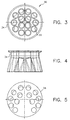
- Fig. 3, 4, and 5 are the top, front, and bottom view of a planar foraminous distribution device utilized in the invention.
- Fig. 6 illustrates a perforated pipe distribution device utilized in the invention.
- Fig. 7 is a manifold type distribution device utilized in the invention.
- the invention has numerous advantages over the prior techniques for forming tabular silver chloride grains.
- the invention is about non-chemical means to achieve variation in the size of the tabular silver chloride emulsion. It thus allows the use of a common set of chemical solutions to prepare a broad range of tabular grain emulsions, which is advantageous in a manufacturing environment. It is also attractive for the scale-up purposes as it minimizes the experimentation that is usually necessary when chemical means are used to adjust the size.
- the invention also allows the easy transfer of manufacturing processes from one facility to another as the easily controlled technique of the invention allows accurate reproducibility of processes in different manufacturing environments. It is surprising that the momentum of addition of material has been found to be important in determining grain size as in previous processes this was not recognized. Previously time of addition was considered a critical parameter as well as process conditions such as temperature, solubility, pH and peptizer level.
- the present invention relates to a process for precipitating high chloride tabular emulsions. Also disclosed are apparatus for precipitating high chloride tabular emulsions. While experimenting with the processes for manufacturing tabular silver chloride such as the process taught by Chang et. al. to enhance manufacturability, we have discovered that by modulating certain fluid dynamic properties of the iodide ion feed stream as it is added into the dispersing medium, it is possible to correspondingly vary the size of the tabular grain emulsion. In particular, the fluid dynamic properties of interest are the momentum (i.e., mass flow rate x velocity) and the characteristic length scale of the iodide feed stream (i.e., diameter).
- the momentum i.e., mass flow rate x velocity
- characteristic length scale of the iodide feed stream i.e., diameter
- the fluid dynamic properties can be easily modulated by passing the iodide ion feed stream through a Momentum Distribution Device (MDD).
- MDD Momentum Distribution Device
- the device essentially splits the single feed stream into a multiple of nominally identical streams, each having a certain desired momentum, and a desired characteristic length scale. The multiple streams are then added to the reactor.
- Fig. 2 is the schematic process diagram of the invention where the outlet 7 of the vessel 8 containing the iodide ion solution 9 is connected to a momentum distribution device 10 that opens above the surface 11 of the stirred dispersing medium 12 .
- nucleation is accomplished in vessel 14 by introduction of silver ion solution through device 16 while chloride ion is introduced through device 18 in the close vicinity of stirrer 22 .
- iodide ion is added from momentum distribution device 10 .
- the addition of the iodide there is a hold without addition of reactants to allow the completion of interaction between the nucleated silver chloride particles and iodide ions.
- Figs. 3, 4, and 5 are the top, front, and bottom views, respectively, of one of the preferred designs of the momentum distribution device 30 .
- a multiple of cylindrical bores 32 are made in a cylindrical body 34 .
- Each bore has a unique orientation.
- Fig. 5 which is the bottom view of device 30 , the streams exit the bores 32 in a diverging pattern.
- Fig. 6 is another preferred embodiment of the momentum distribution device of the invention.
- a single channel or pipe 42 has multiple perforations 44 that are appropriately separated from each other. Iodide ion would enter inlet 46 and be distributed to exit pipe 42 through holes 44 .
- Fig. 7 is another preferred embodiment 52 of the invention.
- a multiple of nominally identical perforations 53 are made in a circular disc 58 .
- Each of the perforations is then connected to a separate pipe or channel 54 that is positioned above the surface of the dispersing medium, and is separated appropriately from the other channels.
- Iodide ion solution enters at inlet 56 and passes through pipes 54 for distribution through perforations 53 .
- the momentum distribution device of the invention may be placed in any suitable location in the vessel in which the tabular silver chloride emulsion is being formed.
- the distribution device may be placed above the surface of the liquid in the reaction vessel such that the streams are directed onto the surface. Alternatively the distribution device may be submerged in the liquid in the reaction vessel.
- the momentum of the liquid being released from the device is controlled such that whether the device is above the surface of the liquid or below, the momentum of the liquid will be at the desired value when it reaches the reaction liquid in the vessel. Therefore, if delivery is from above the surface of the liquid in the vessel, the additional momentum created from the fall from the momentum distribution device to the dispersing medium must be calculated in order to determine the momentum at the moment contact is made with the dispersing medium.
- the momentum is defined as mass flow rate times average velocity of the stream and is defined in terms of gram centimeters per second squared (g cm/s 2 ).
- the size of the holes in the distribution device may be any size that results in a suitable tabular silver chloride grain emulsion. Size of the hole is preferred to be between about 0.1 and about 70 mm as this size produces suitable control of the process and desirable tabular silver chloride emulsions.
- the number of holes through which silver iodide is added may suitably be between 2 and about 200 as this number of holes produces in combination with the preferred diameter the desired range of momenta which results in suitable tabular silver chloride grain emulsion across a practical range of iodide solution mass delivery rates.
- the momentum of each of the iodide ion streams is any amount that will produce suitable tabular silver chloride grains. Preferably this is between about 1 x 10 -6 and 1 x 10 +9 g cm/s 2 to produce suitable tabular silver chloride grain emulsions in a reproducible manner.
- the momentum may be varied for a given number and size of holes by changing the pressure of the iodide solution as it is supplied to the momentum distribution device.
- the momentum also may be varied by changing the number of holes for delivery or the size of the holes when a given pressure is utilized for the iodide ion solution delivery.
- the process of the invention finds its preferred use in the process of U.S. Patent 5,413,904 (Chang et al) hereby incorporated by reference.
- the invention is directed to a process of precipitating a photographic emulsion containing grains comprised of iodide and at least 50 mole percent chloride with tabular grains having ⁇ 100 ⁇ major faces accounting for greater than 50 percent of total grain projected area, comprised of the steps of (1) separately introducing soluble silver and halide salts into a reaction vessel containing at least a portion of the dispersing medium so that nucleation occurs while the dispersing medium is maintained at a pCl in the range of from 0.5 to 3.5 and (2) following step (1) completing grain growth under conditions that maintain the ⁇ 100 ⁇ major faces of the tabular grains, wherein, (3) precipitation is conducted in the absence of an aromatic grain growth stabilizer containing a nitrogen atom having a resonance stabilized ⁇ electron pair and (4) during step (1) iodide ion is withheld from the reaction vessel until after the
- this invention is directed to a radiation sensitive emulsion containing a silver halide grain population comprised of iodide and at least 50 mole percent chloride, wherein tabular grains having ⁇ 100 ⁇ major faces and an aspect ratio of at least 2 account for greater than 95 percent of total grain projected area.
- high chloride ⁇ 100 ⁇ tabular grain indicates a grain that contains at least 50 mole percent chloride, based on silver, that exhibits major faces lying in ⁇ 100 ⁇ crystal planes, exhibits an aspect ratio of at least 2 and a ratio of major face adjacent edge lengths of less than 10.
- a "high chloride ⁇ 100 ⁇ tabular grain emulsion” is an emulsion in which greater than 50 percent of total grain projected area is accounted for by high chloride ⁇ 100 ⁇ tabular grains.
- Aspect ratio is defined as ECD/t, where ECD is the equivalent circular diameter of a grain and t is its thickness.
- Average aspect ratio is the quotient average ECD and average grain thickness.
- oxidized gelatin refers to gelatin that has been treated with an oxidizing agent to reduce methionine to less than 30 micromoles per gram.
- the present invention is an improvement on the high chloride ⁇ 100 ⁇ tabular grain precipitation process disclosed by House et al, cited above and here incorporated by reference. Except as otherwise described the precipitation procedures and emulsions satisfying the requirements of this invention can take any of the forms described by House et al, the disclosure of which is here incorporated by reference.
- Grain nucleation is undertaken by separately introducing soluble silver and halide salts into a reaction vessel containing at least a portion of the dispersing medium forming the final emulsion while the dispersing medium is maintained at a pCl in the range of from 0.5 to 3.5. Following grain nucleation grain growth is completed under conditions that maintain the ⁇ 100 ⁇ major faces of the tabular grains.
- the inclusion of iodide into the cubic crystal lattice being formed by silver ions and the remaining halide ions is disruptive because of the much larger diameter of iodide ion as compared to chloride ion.
- the incorporated iodide ions introduce crystal irregularities.
- the present invention differs from House et al in withholding iodide ion until after grain nuclei formation has been initiated in the high chloride environment. This avoids the formation of unwanted grain shapes, such as singly twinned nontabular grains.
- a reaction vessel containing a dispersing medium and conventional silver and reference electrodes for monitoring halide ion concentrations within the dispersing medium.
- Halide ion is introduced into the dispersing medium that is at least 50 mole percent chloride--i.e., at least half by number of the halide ions in the dispersing medium are chloride ions.
- the pCl of the dispersing medium is adjusted to favor the formation of ⁇ 100 ⁇ grain faces on nucleation--that is, within the range of from 0.5 to 3.5, preferably within the range of from 1.0 to 3.0 and, optimally, within the range of from 1.5 to 2.5.
- the grain nucleation step is initiated when a silver jet is opened to introduce silver ion into the dispersing medium. Iodide ion is withheld from the dispersing medium until after the onset of grain nucleation. Preferably iodide ion introduction is delayed until at least 0.005 percent of total silver used to form the emulsion has been introduced into the dispersing medium. Preferred results (high chloride ⁇ 100 ⁇ tabular grain projected areas of greater than 95 percent in the completed emulsions) are realized when iodide ion introduction is initiated in the period ranging from 0.01 to 3 (optimally 1.5) percent of total silver is introduction.
- Effective tabular grain formation can occur over a wide range of iodide ion concentrations ranging up to the saturation limit of iodide in silver chloride.
- the saturation limit of iodide in silver chloride is reported by H. Hirsch, "Photographic Emulsion Grains with Cores: Part I. Evidence for the Presence of Cores", J. of Photog. Science, Vol. 10 (1962), pp. 129-134, to be 13 mole percent.
- silver halide grains in which equal molar proportions of chloride and bromide ion are present up to 27 mole percent iodide, based on silver, can be incorporated in the grains.
- iodide saturation limit it is contemplated to undertake grain growth below the iodide saturation limit to avoid the precipitation of a separate silver iodide phase and thereby avoid creating an additional category of unwanted grains. It is generally preferred to maintain the iodide ion concentration after its delayed introduction into the dispersing medium at the outset of nucleation at less than 10 mole percent. In fact, only minute amounts of iodide are required to achieve the desired tabular grain population. Concentrations of iodide after its delayed introduction down to 0.001 mole percent, based on total silver, are contemplated.
- concentrations of iodide ion after its delayed introduction in the range of at least 0.005 mole percent and, optimally, at least 0.07 mole percent, based on total silver.
- the preferred delays of iodide ion introduction noted above are effective with minimum and near minimum iodide introduction levels. However, with further delays in iodide introduction that can range up to 40 percent or more of total silver introduction, compensating increases in iodide concentrations are contemplated.
- silver chloride grain nuclei are formed at the outset of the nucleation step. Minor amounts of bromide ion can be present also in the dispersing medium at the outset of nucleation. Any amount of bromide ion can be present in the dispersing medium at the outset of nucleation and subsequently that is compatible with at least 50 mole percent of the halide in the grain nuclei being chloride ions.
- the grain nuclei preferably contain at least 70 mole percent and optimally at least 90 mole percent chloride ion, based on silver.
- Step (1) conditions Precipitation under the initial conditions in the reaction vessel, hereinafter referred to as Step (1) conditions, can be terminated at any time after the minimum iodide addition described above has been completed. Since silver iodide is much less soluble than silver chloride, any iodide ion introduced into the dispersing medium precipitates instantaneously. For manipulative convenience and reproducibility, silver ion introduction under Step (1) conditions is preferably extended for a convenient period, typically from 5 seconds to less than 2 minutes, and typically during this period from about 0.1 to 10 mole percent of total silver is introduced into the dispersing medium.
- Step (2) subsequent iodide introduction in either or both of Step (1) or the subsequent growth step, hereinafter designated Step (2), is a matter of preference only based on well known photographic performance considerations.
- Silver ion is preferably introduced as an aqueous silver salt solution, such as a silver nitrate solution.
- Halide ion is preferably introduced as alkali or alkaline earth halide, such as lithium, sodium, potassium and/or calcium chloride, bromide and/or iodide.
- the dispersing medium contained in the reaction vessel prior to nucleation is comprised of water, the dissolved halide ions discussed previously and a peptizer.
- the dispersing medium can exhibit a pH within any convenient conventional range for silver halide precipitation, typically from 2 to 8. It is preferred, but not required, to maintain the pH of the dispersing medium on the acid side of neutrality (i.e., ⁇ 7.0). To minimize fog a preferred pH range for precipitation is from 2.0 to 6.0.
- Mineral acids such as nitric acid or hydrochloride acid, and bases, such as alkali hydroxides, can be used to adjust the pH of the dispersing medium. It is also possible to incorporate pH buffers.
- the peptizer can take any convenient conventional form known to be useful in the precipitation of photographic silver halide emulsions and particularly tabular grain silver halide emulsions.
- a summary of conventional peptizers is provided in Research Disclosure , Vol. 308, December 1989, Item 308119, Section IX. Research Disclosure is published by Kenneth Mason Publications, Ltd., Emsworth, Hampshire P010 7DD, England. While synthetic polymeric peptizers of the type disclosed by Maskasky I, cited previously and here incorporated by reference, can be employed, it is preferred to employ gelatino peptizers (e.g., gelatin and gelatin derivatives). As manufactured and employed in photography gelatino peptizers typically contain significant concentrations of calcium ion, although the use of deionized gelatino peptizers is a known practice.
- Step (1) can be performed at any convenient conventional temperature for the precipitation of silver halide emulsions. Temperatures ranging from near ambient--e.g., 30°C up to about 90°C are contemplated, with nucleation temperatures in the range of from 35 to 70°C being preferred.
- a grain growth step, Step (2) follows Step (1).
- Step (2) the grain nuclei are grown until tabular grains having ⁇ 100 ⁇ major faces of a desired average equivalent circular diameter (ECD) are obtained.
- ECD average equivalent circular diameter
- the objective of Step (1) is to form a grain population having the desired incorporated crystal structure irregularities
- the objective of Step (2) is to deposit additional silver halide onto (grow) the existing grain population while avoiding or minimizing the formation of additional tabular grains. If additional tabular grains are formed during the growth step, the polydispersity of the emulsion is increased and, unless conditions in the reaction vessel are maintained as described above for the nucleation step, the additional tabular grain population formed in the growth step will not have the desired tabular grain properties described herein for use in the invention.
- the process of preparing the desired emulsions can be performed as a single jet precipitation without interrupting silver ion introduction from start to finish, modified by providing a second, iodide jet for the delayed introduction of iodide--i.e., all chloride and/or bromide ions are in the dispersing medium at the outset of precipitation.
- iodide ion is introduced using a single halide jet
- the chloride in the dispersing medium can be relied upon at the outset of nucleation, so that by delaying in turning on the halide jet the appropriate delay in iodide introduction can be effected.
- a separate iodide jet can be provided.
- the average aspect ratio of the high chloride ⁇ 100 ⁇ tabular grains can only approach 2 as a lower limit.
- the tabular grain emulsions of this invention typically exhibit average aspect ratios of 5 or more, with average aspect ratios greater than 8 being preferred. That is, preferred emulsions prepared by the processes of the invention are high aspect ratio tabular grain emulsions.
- average aspect ratios of the tabular grain population are at least 12 and optimally at least 20.
- the average aspect ratio of the tabular grain population ranges up to 50, but higher average aspect ratios of 100, 200 or more can be realized. Emulsions in which the average aspect ratio approaches the minimum average aspect ratio limit of 2 still provide a surface to volume ratio that is greater than 100 percent that of cubic grains.
- the inventive process can be better appreciated by reference to the following examples.
- the term 'oxidized gelatin' is employed, except as otherwise indicated, to designate gelatin that has been treated with an oxidizing agent to reduce its methionine content to less than 30 micromoles per gram.
- a solution containing 4369 g of distilled water, 3 g NaCl, and 195 g oxidized gelatin, is stirred and adjusted to pH 5.7 at 35°C. Nucleation of silver chloride particles is initiated by the simultaneous double jet addition of 0.5 M AgNO 3 solution at a rate of 156 mL/min, and 0.5 M NaCl solution at a rate of 167 mL/min, for 1.37 minutes.
- a first solution containing 5689 g distilled water, 2.25 g NaCl, and 0.57 g KI is then added uniformly over ca. 88 seconds.
- the solution passes through a momentum distributor before it enters the reactor.
- the momentum distributor is a bundle of three tubes, each having a nominal internal diameter of ca . 7.4 mm at the discharge end.
- the corresponding terminal momentum of each stream is ca. 1230 g cm/sec 2 .
- the discharged streams travel ca . 19 cm vertically downwards through air before they impinge on the agitated surface of the dispersed medium.
- a second solution containing 2885 g of distilled water is added and the reactor content is held at 35°C.
- the total duration of addition of first and second solutions, and the hold is ca . 5 min.
- the mixture temperature is ramped from 35°C to 36.5°C in 3 minutes, and during the same time 0.5 M AgNO 3 solution is added at 40 mL/min, with pCl ramped from 2.19 to 2.35.
- the pCl ramp is accomplished by the controlled addition of 0.5 M NaCl.
- the temperature is further increased from 36.5°C to 50°C in 18 minutes, during which period 4 M AgNO 3 and 4 M NaCl solutions are added at a constant rate of 15 mL/min, with pCl shifting from 2.35 to 2.21.
- the temperature is further ramped from 50°C to 70°C in 20 minutes, during which period the 4 M AgNO 3 and 4 M NaCl solutions are added at linearly accelerated rates of from 15 mL/min to 22.5 mL/min, with pCl linearly decreasing from 2.21 to 1.72.
- the medium is allowed to sit at 70°C for 15 minutes.
- addition of the AgNO 3 and NaCl solutions is resumed at linearly accelerated rates from 15 to 37.8 mL/min in 38 minutes.
- the pCl of the emulsion is held at 1.72 during this growth period. Then the reactor is allowed to sit at 70°C with stirring for another 30 minutes.
- the resultant emulsion is a high chloride ⁇ 100 ⁇ tabular grain emulsion which is 1.61 micrometers in equivalent circular diameter (ECD) and 0.13 micrometers thick, with tabular grains accounting for more than 90% of the projected area.
- ECD equivalent circular diameter
- Example 1 The procedure in Example 1 is followed with the exception that the internal diameter of the discharge end of the momentum distributor tubes is ca . 3.4 mm. The corresponding terminal momentum of each stream is ca . 5170 g cm/sec 2 .
- the resultant emulsion is a high chloride ⁇ 100 ⁇ tabular grain emulsion which is 1.85 micrometers in equivalent circular diameter (ECD) and 0.13 micrometers thick, with tabular grains accounting for more than 90% of the projected area.
- ECD equivalent circular diameter
- Example 1 The procedure in Example 1 is followed with the exception that the internal diameter of the discharge end of the momentum distributor tubes is ca . 2.4 mm. The corresponding terminal momentum of each stream is ca . 10,300 g cm/sec 2 .
- the resultant emulsion is a high chloride ⁇ 100 ⁇ tabular grain emulsion which is 2.29 micrometers in equivalent circular diameter (ECD) and 0.13 micrometers thick, with tabular grains accounting for more than 90% of the projected area.
- ECD equivalent circular diameter
- Example 1 The procedure in Example 1 is followed with the exception that the internal diameter of the discharge end of the momentum distributor tubes is ca . 1.4 mm. The corresponding terminal momentum of each stream is ca . 30,300 g cm/sec 2 .
- the resultant emulsion is a high chloride ⁇ 100 ⁇ tabular grain emulsion which is 4.15 micrometers in equivalent circular diameter (ECD) and 0.22 micrometers thick, with tabular grains accounting for more than 90% of the projected area.
- ECD equivalent circular diameter
- Example 1 The reaction vessel used in Example 1 is expanded to a capacity of 2000 L with the relative dimensional proportions remaining unchanged. At the same time, the volume of the formula used in Example 1 is increased by a factor of 100.
- a tabular emulsion is prepared by procedures that otherwise are identical to those employed in Example 1.
- the resultant emulsion is a high chloride ⁇ 100 ⁇ tabular grain emulsion which is 2.0 micrometers in equivalent circular diameter (ECD) and 0.12 micrometers thick, with tabular grains accounting for more than 90% of the projected area.
- ECD equivalent circular diameter
- the number of tubes used in the momentum distribution device used for this example is 14, each having an internal diameter of ca . 19.1 mm.
- the corresponding terminal momentum of each stream is ca . 3.02 x 10 5 g cm/sec 2 .
Landscapes
- Chemical & Material Sciences (AREA)
- Chemical Kinetics & Catalysis (AREA)
- Engineering & Computer Science (AREA)
- Materials Engineering (AREA)
- Physics & Mathematics (AREA)
- General Physics & Mathematics (AREA)
- Silver Salt Photography Or Processing Solution Therefor (AREA)
Applications Claiming Priority (2)
| Application Number | Priority Date | Filing Date | Title |
|---|---|---|---|
| US708154 | 1996-08-27 | ||
| US08/708,154 US5709989A (en) | 1996-08-27 | 1996-08-27 | Process for making high chloride tabular grain emulsion using multiple stream addition of iodide |
Publications (2)
| Publication Number | Publication Date |
|---|---|
| EP0827019A1 true EP0827019A1 (fr) | 1998-03-04 |
| EP0827019B1 EP0827019B1 (fr) | 2001-11-14 |
Family
ID=24844594
Family Applications (1)
| Application Number | Title | Priority Date | Filing Date |
|---|---|---|---|
| EP97202528A Expired - Lifetime EP0827019B1 (fr) | 1996-08-27 | 1997-08-15 | Procédé pour la préparation d'une émulsion à grains tabulaires riche en chlorure utilisant l'addition d'iodure en courants multiples |
Country Status (3)
| Country | Link |
|---|---|
| US (1) | US5709989A (fr) |
| EP (1) | EP0827019B1 (fr) |
| DE (1) | DE69708236T2 (fr) |
Families Citing this family (1)
| Publication number | Priority date | Publication date | Assignee | Title |
|---|---|---|---|---|
| US6109778A (en) * | 1997-09-22 | 2000-08-29 | United States Filter Corporation | Apparatus for homogeneous mixing of a solution with tangential jet outlets |
Citations (2)
| Publication number | Priority date | Publication date | Assignee | Title |
|---|---|---|---|---|
| US5413904A (en) * | 1994-03-18 | 1995-05-09 | Eastman Kodak Company | High chloride [100] tabular grain emulsions improved emulsions and improved precipitation processes |
| EP0708362A1 (fr) * | 1994-09-23 | 1996-04-24 | Eastman Kodak Company | Procédé de précipitation à double jet à flux pulsé |
Family Cites Families (3)
| Publication number | Priority date | Publication date | Assignee | Title |
|---|---|---|---|---|
| DE1804289C2 (de) * | 1967-10-23 | 1985-01-10 | Fuji Shashin Film K.K., Minami-ashigara, Kanagawa | Verfahren zur Herstellung von Kristallen eines schwach löslichen anorganischen Salzes |
| US5424180A (en) * | 1990-03-27 | 1995-06-13 | Fuji Photo Film Co., Ltd. | Apparatus for uniform mixing of solutions |
| US5320938A (en) * | 1992-01-27 | 1994-06-14 | Eastman Kodak Company | High chloride tabular grain emulsions and processes for their preparation |
-
1996
- 1996-08-27 US US08/708,154 patent/US5709989A/en not_active Expired - Fee Related
-
1997
- 1997-08-15 DE DE69708236T patent/DE69708236T2/de not_active Expired - Fee Related
- 1997-08-15 EP EP97202528A patent/EP0827019B1/fr not_active Expired - Lifetime
Patent Citations (2)
| Publication number | Priority date | Publication date | Assignee | Title |
|---|---|---|---|---|
| US5413904A (en) * | 1994-03-18 | 1995-05-09 | Eastman Kodak Company | High chloride [100] tabular grain emulsions improved emulsions and improved precipitation processes |
| EP0708362A1 (fr) * | 1994-09-23 | 1996-04-24 | Eastman Kodak Company | Procédé de précipitation à double jet à flux pulsé |
Also Published As
| Publication number | Publication date |
|---|---|
| EP0827019B1 (fr) | 2001-11-14 |
| DE69708236D1 (de) | 2001-12-20 |
| DE69708236T2 (de) | 2002-08-14 |
| US5709989A (en) | 1998-01-20 |
Similar Documents
| Publication | Publication Date | Title |
|---|---|---|
| US4301241A (en) | Process for forming light-sensitive silver halide crystals | |
| US5413904A (en) | High chloride [100] tabular grain emulsions improved emulsions and improved precipitation processes | |
| US6096495A (en) | Method for preparing silver halide emulsion | |
| US5549879A (en) | Process for pulse flow double-jet precipitation | |
| JPS6227008B2 (fr) | ||
| US5104786A (en) | Plug-flow process for the nucleation of silver halide crystals | |
| EP0430196A1 (fr) | Procédé pour la stabilisation des cristaux haute-chlorure avec aspect cristal modifié utilisant des enveloppes bromure | |
| US5213772A (en) | Apparatus for forming silver halide grains | |
| US5238805A (en) | Method for preparing silver halide emulsion | |
| EP0827019B1 (fr) | Procédé pour la préparation d'une émulsion à grains tabulaires riche en chlorure utilisant l'addition d'iodure en courants multiples | |
| US5145768A (en) | Process of forming silver halide grains | |
| EP0161682B1 (fr) | Procédé de préparation d'émulsions d'halogénure d'argent à distribution de grains contrôlée | |
| US5484697A (en) | Method for obtaining monodisperse tabular grains | |
| EP0744653B1 (fr) | Méthode pour la préparation d'émulsions à l'halogenure d'argent utilisant des réacteurs avec une zone de microréaction | |
| JPS5943727B2 (ja) | ハロゲン化銀沈殿方法 | |
| JPH11217217A (ja) | ハロゲン化銀製造装置 | |
| JP2700678B2 (ja) | ハロゲン化銀粒子の製造方法及び装置 | |
| JP2003107608A (ja) | ハロゲン化銀乳剤の製造方法及び装置 | |
| JP2987011B2 (ja) | ハロゲン化銀乳剤の製造方法 | |
| JP2000187293A (ja) | ハロゲン化銀乳剤の製造方法 | |
| JP4248297B2 (ja) | ハロゲン化銀写真乳剤の製造方法 | |
| EP1273965B1 (fr) | Procédé pour préparer une émulsion photographique aux halogénures d' argent | |
| US7008761B2 (en) | Process for the preparation of high bromide cubical grain emulsions | |
| JPH09179225A (ja) | 写真乳剤の調製方法、及びそれに用いる装置 | |
| JP2003084380A (ja) | ハロゲン化銀写真乳剤の製造方法 |
Legal Events
| Date | Code | Title | Description |
|---|---|---|---|
| PUAI | Public reference made under article 153(3) epc to a published international application that has entered the european phase |
Free format text: ORIGINAL CODE: 0009012 |
|
| AK | Designated contracting states |
Kind code of ref document: A1 Designated state(s): DE GB |
|
| AX | Request for extension of the european patent |
Free format text: AL;LT;LV;RO;SI |
|
| 17P | Request for examination filed |
Effective date: 19980818 |
|
| AKX | Designation fees paid |
Free format text: CH DE FR GB LI |
|
| RBV | Designated contracting states (corrected) |
Designated state(s): CH DE FR GB LI |
|
| 17Q | First examination report despatched |
Effective date: 19990803 |
|
| GRAG | Despatch of communication of intention to grant |
Free format text: ORIGINAL CODE: EPIDOS AGRA |
|
| GRAG | Despatch of communication of intention to grant |
Free format text: ORIGINAL CODE: EPIDOS AGRA |
|
| GRAH | Despatch of communication of intention to grant a patent |
Free format text: ORIGINAL CODE: EPIDOS IGRA |
|
| GRAH | Despatch of communication of intention to grant a patent |
Free format text: ORIGINAL CODE: EPIDOS IGRA |
|
| RBV | Designated contracting states (corrected) |
Designated state(s): DE GB |
|
| GRAH | Despatch of communication of intention to grant a patent |
Free format text: ORIGINAL CODE: EPIDOS IGRA |
|
| GRAA | (expected) grant |
Free format text: ORIGINAL CODE: 0009210 |
|
| AK | Designated contracting states |
Kind code of ref document: B1 Designated state(s): DE GB |
|
| REF | Corresponds to: |
Ref document number: 69708236 Country of ref document: DE Date of ref document: 20011220 |
|
| REG | Reference to a national code |
Ref country code: GB Ref legal event code: IF02 |
|
| PLBE | No opposition filed within time limit |
Free format text: ORIGINAL CODE: 0009261 |
|
| STAA | Information on the status of an ep patent application or granted ep patent |
Free format text: STATUS: NO OPPOSITION FILED WITHIN TIME LIMIT |
|
| 26N | No opposition filed | ||
| PGFP | Annual fee paid to national office [announced via postgrant information from national office to epo] |
Ref country code: GB Payment date: 20040707 Year of fee payment: 8 |
|
| PGFP | Annual fee paid to national office [announced via postgrant information from national office to epo] |
Ref country code: DE Payment date: 20040831 Year of fee payment: 8 |
|
| PG25 | Lapsed in a contracting state [announced via postgrant information from national office to epo] |
Ref country code: GB Free format text: LAPSE BECAUSE OF NON-PAYMENT OF DUE FEES Effective date: 20050815 |
|
| PG25 | Lapsed in a contracting state [announced via postgrant information from national office to epo] |
Ref country code: DE Free format text: LAPSE BECAUSE OF NON-PAYMENT OF DUE FEES Effective date: 20060301 |
|
| GBPC | Gb: european patent ceased through non-payment of renewal fee |
Effective date: 20050815 |