EP0827331B1 - Appareil de facsimile - Google Patents
Appareil de facsimile Download PDFInfo
- Publication number
- EP0827331B1 EP0827331B1 EP19970114383 EP97114383A EP0827331B1 EP 0827331 B1 EP0827331 B1 EP 0827331B1 EP 19970114383 EP19970114383 EP 19970114383 EP 97114383 A EP97114383 A EP 97114383A EP 0827331 B1 EP0827331 B1 EP 0827331B1
- Authority
- EP
- European Patent Office
- Prior art keywords
- communication
- facsimile
- facsimile machine
- calling
- receiving party
- Prior art date
- Legal status (The legal status is an assumption and is not a legal conclusion. Google has not performed a legal analysis and makes no representation as to the accuracy of the status listed.)
- Expired - Lifetime
Links
- 238000004891 communication Methods 0.000 claims description 230
- 238000001514 detection method Methods 0.000 claims description 11
- 230000005236 sound signal Effects 0.000 claims description 5
- 230000006870 function Effects 0.000 description 19
- 230000005540 biological transmission Effects 0.000 description 11
- 230000004044 response Effects 0.000 description 6
- 230000008859 change Effects 0.000 description 4
- 238000010586 diagram Methods 0.000 description 4
- 238000000034 method Methods 0.000 description 3
- 238000011161 development Methods 0.000 description 1
- 230000018109 developmental process Effects 0.000 description 1
- 230000008569 process Effects 0.000 description 1
Images




Classifications
-
- H—ELECTRICITY
- H04—ELECTRIC COMMUNICATION TECHNIQUE
- H04N—PICTORIAL COMMUNICATION, e.g. TELEVISION
- H04N1/00—Scanning, transmission or reproduction of documents or the like, e.g. facsimile transmission; Details thereof
- H04N1/32—Circuits or arrangements for control or supervision between transmitter and receiver or between image input and image output device, e.g. between a still-image camera and its memory or between a still-image camera and a printer device
- H04N1/327—Initiating, continuing or ending a single-mode communication; Handshaking therefor
- H04N1/32704—Establishing a communication with one of a facsimile and another telecommunication apparatus sharing a single line
- H04N1/32706—Type of the other apparatus
- H04N1/32708—Telephone
-
- H—ELECTRICITY
- H04—ELECTRIC COMMUNICATION TECHNIQUE
- H04N—PICTORIAL COMMUNICATION, e.g. TELEVISION
- H04N1/00—Scanning, transmission or reproduction of documents or the like, e.g. facsimile transmission; Details thereof
- H04N1/32—Circuits or arrangements for control or supervision between transmitter and receiver or between image input and image output device, e.g. between a still-image camera and its memory or between a still-image camera and a printer device
- H04N1/327—Initiating, continuing or ending a single-mode communication; Handshaking therefor
- H04N1/32704—Establishing a communication with one of a facsimile and another telecommunication apparatus sharing a single line
-
- H—ELECTRICITY
- H04—ELECTRIC COMMUNICATION TECHNIQUE
- H04N—PICTORIAL COMMUNICATION, e.g. TELEVISION
- H04N1/00—Scanning, transmission or reproduction of documents or the like, e.g. facsimile transmission; Details thereof
- H04N1/32—Circuits or arrangements for control or supervision between transmitter and receiver or between image input and image output device, e.g. between a still-image camera and its memory or between a still-image camera and a printer device
- H04N1/327—Initiating, continuing or ending a single-mode communication; Handshaking therefor
- H04N1/32704—Establishing a communication with one of a facsimile and another telecommunication apparatus sharing a single line
- H04N1/32715—Detecting
- H04N1/32728—Detecting an off-hook condition
-
- H—ELECTRICITY
- H04—ELECTRIC COMMUNICATION TECHNIQUE
- H04N—PICTORIAL COMMUNICATION, e.g. TELEVISION
- H04N1/00—Scanning, transmission or reproduction of documents or the like, e.g. facsimile transmission; Details thereof
- H04N1/32—Circuits or arrangements for control or supervision between transmitter and receiver or between image input and image output device, e.g. between a still-image camera and its memory or between a still-image camera and a printer device
- H04N1/327—Initiating, continuing or ending a single-mode communication; Handshaking therefor
- H04N1/32704—Establishing a communication with one of a facsimile and another telecommunication apparatus sharing a single line
- H04N1/32747—Controlling the connection of the apparatus
- H04N1/32754—Automatically connecting another apparatus when a first one has finished
Definitions
- the present invention relates to a facsimile machine provided with a telephone conversation function.
- a protocol for telephone conversation reservation has been available for facsimile machines provided with a telephone conversation function.
- a facsimile machine provided with such a telephone conversation reservation function
- the terminal when a telephone conversation reservation is made by a predetermined procedure at either a calling party side terminal or a receiving party side terminal during facsimile communication, the terminal generates a calling sound after facsimile communication.
- the facsimile communication mode of the terminal is shifted to the telephone conversation mode, and telephone conversation can be carried out between the calling party side and the receiving party side.
- a telephone conversation reservation function is required at both the calling and receiving party side terminals in order to shift the facsimile communication mode to the telephone conversation mode after facsimile communication. Therefore, terminals whose modes can be shifted to the telephone conversation mode after facsimile communication by telephone conversation reservation are limited in number. For example, when the receiving party side terminal is not provided with the telephone conversation reservation function, the calling party side must make a call again to confirm whether transmitted images have been received properly by the receiving party side, or the receiving party side must make a call to the calling party side. As a result, troublesome operation is required at the calling or receiving party side. In addition, extra charges are required.
- EP 0 454 452 A describes a data communication apparatus comprising a first switching means which switches over between data communication and speech communication depending as whether or not a signal indicating data communication mode is received within a predetermined period of time, a second switching means which switches over between data communication and speech communication depending as whether or not a response signal to a procedure signal is received in a predetermined period of time, detecting means for detecting a state of the apparatus and selecting means for selecting one of the first and second switching means.
- This known data communication apparatus has two automatic call reception modes.
- the facsimile communication mode In the first automatic call reception mode, if there is no sheet, priority is given to the facsimile communication mode, and the significant facsimile signal (CNG-signal) is detected while sending a ring back tone several times until a CNG-signal is detected. Thereupon facsimile communication is executed. If the CNG-signal cannot be detected within a predetermined period of time, the mode is automatically switched to the speech communication mode to issue a quasi ring tone to call an operator.
- CNG-signal significant facsimile signal
- facsimile communication mode priority is given to the facsimile communication mode. If a facsimile signal from the partner station is detected, facsimile communication is conducted. If a significant facsimile signal (CNG-signal) is not detected within a specified period of time, the mode is switched to the speech communication mode automatically to produce a quasi ring tone to call an operator. That is, in the latter case, the communication line is held only if the CNG-signal is not detected within a specified period of time, that is if the facsimile communication is not carried out and thereby avoided that the partner stations disconnects the line.
- CNG-signal significant facsimile signal
- control means keeps the occupation of the communication line either for a predetermined period after facsimile communication or until detecting means on the receiving part his side detects the end of conversation after facsimile communication. It is to be noted that according to Figs. 2A and 2B of this document, the process immediately returns to step S42 after the data communication has been completed. The state of completed data communication is detected at the calling part his side terminal.
- EP-A-0 555 150 describes a data communication apparatus having an auto-calling function.
- a time period T1 which is set according to CCITT recommendations after dialing or after detection of a polarity reversal of a line can be extended when detection means of the data communication apparatus are detecting a voice signal within the original time period T1. If otherwise within this period T1 a CNG-Signal is detected, fax transmission of the transmitting data communication apparatus to receiving apparatus is started.
- a change of the kind of the data communication for example a change from facsimile communication to telephone conversation is achieved by discrimination means provided in the communication apparatus for discriminating whether communication is requested from another communication apparatus connected to the same subscriber line.
- Further communication control means within said communication apparatus are adapted for automatically communicating with an apparatus of the subscriber line with which the another communication apparatus has been communicating upon this discrimination of a request for communication by said discrimination means.
- a facsimile apparatus disclosed in US-A-0,353,097 is capable of automatically controlling the transmission of picture signals in response to sizes of an original document and of recording paper and thereby eliminates the concern of an operator as to the different paper sizes. Further, the known facsimile apparatus of this kind improves the operability in the case of a telephone talk through the facsimile apparatus as it is not only provided with the functions of preliminarily carrying out a telephone conversation but is also capable of providing sound from an incorporated loud speaker.
- a data communication terminal system which is capable of switching between a telephone receiver and a data terminal unit described in EP-A-0 396 105 in the data communication mode data are transmitted together with a communication carrier signal.
- switching means are instructed to change the communication mode from the data communication into the telephone communication mode. The change in the communication mode is announced to an operator.
- US-A-5,315,643 A describes a communication system constituted by connecting a plurality of telephones and a plurality of data communication apparatuses through a communication media.
- a transmission side can designate a party to be called, and at a reception side, a telephone corresponding to the designated party can be called.
- an operator call is performed after transmission of all the image information is completed.
- a control circuit provided at a central part of the communication system receives information indicating a telephone to be called of the other party from a telephone, the control circuit outputs a talking request signal to an apparatus of the party having a facsimile information field including the information indicating the telephone to be called.
- a control signal is output to the telephone issuing talking request and a dummy tone generator is caused to generate a dummy bell tone.
- An operator response to this dummy bell tone and a DC loop is formed with the telephone line and depression of a talking switch is detected. After that outputting of the dummy bell tone is stopped and the channel is formed between the responding telephone and the party's telephone to allow communication there between.
- An object of the invention is to provide a facsimile machine capable of securely shifting the facsimile communication mode to the telephone conversation mode after facsimile communication even if an error occurs during facsimile communication, without having a telephone conversation reservation function.
- a facsimile machine having a telephone conversation function comprising sound emitting means for externally emitting a sound signal transmitted through a communication line and control means for keeping the occupation of the communication line for a predetermined time after a facsimile communication has been ended by a calling side and for controlling the sound emitting means to externally emit during said predetermined time a sound signal transmitted through the communication line (claim 1).
- end of conversation is designating "end of communication”.
- the control means keeps the occupation of the communication line for a predetermined time after facsimile communication has been ended by a calling side and controls the sound emitting means to externally emit during said predetermined period a sound signal transmitted through the communication line, whereby the calling party side can easily recognize whether the receiving party side requests a call or not. Furthermore, in this state, shifting to the telephone conversation mode can be attained by performing simple operation such as lifting the handset. Therefore, even when no telephone conversation reservation function is available at the calling or receiving party side, and even if an error occurs during facsimile communication, shifting to the telephone conversation mode after the facsimile communication can be attained securely.
- FIG. 1 is a schematic function block diagram showing an electric configuration of a facsimile machine in accordance with a first embodiment of the present invention
- FIG. 2 is a flowchart showing an example of operation control during facsimile communication at the facsimile machine
- FIGS. 3 and 4 are control sequence charts showing examples of operation control during facsimile communication at the facsimile machine
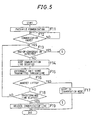
- FIG. 5 is a flowchart showing another example of operation control during facsimile communication at the facsimile machine
- FIGS. 6 to 9 are control sequence charts showing other examples of operation control during facsimile communication at the facsimile machine
- FIG. 10 is a flowchart showing still another example of operation control during facsimile communication at the facsimile machine
- FIGS. 11 and 12 are control sequence charts showing still another examples of operation control during facsimile communication at the facsimile machine.
- FIG. 13 is a schematic function block diagram showing an electric configuration of a facsimile machine in accordance with a second embodiment of the present invention
- FIG. 14 is a flowchart showing an example of operation control during facsimile communication at the facsimile machine
- FIGS. 15 and 16 are control sequence charts showing examples of operation control during facsimile communication at the facsimile machine
- FIG. 17 is a flowchart showing another example of operation control during facsimile communication at the facsimile machine
- FIGS. 18 and 19 are control sequence charts showing other examples of operation control during facsimile communication at the facsimile machine.
- FIGS. 1 to 12 A first embodiment of the present invention is described below referring to FIGS. 1 to 12.
- numeral 1 represents a communication line connected to a receiving party side facsimile machine via an exchanger (not shown).
- Numeral 2 represents a line controller for occupying/releasing the communication line 1 and for forming a communication path to the receiving party side facsimile machine via the occupied communication line 1 and an exchanger (not shown).
- Numeral 3 represents a handset for performing a call to the receiving side facsimile machine via the communication path formed by the line controller 2.
- Numeral 4 is a hook switch for detecting the on-hook/off-hook condition of the handset 3.
- Numeral 5 represents an end-of-conversation detector for detecting the end of conversation on the receiving party side facsimile machine on the basis of a signal transmitted from the communication line 1 via the line controller 2.
- Numeral 6 represents a modem for demodulating signals transmitted from the communication line 1 via the line controller 2 and for modulating signals to be transmitted to the communication line 1 via the line controller 2.
- Numeral 7 is an image reader for reading pictures and characters drawn on paper and for transmitting them as image data.
- Numeral 8 represents a printer for printing pictures and characters on predetermined paper on the basis of image data demodulated by the modem 6.
- Numeral 9 represents an operation input device comprising function keys for instructing the start of facsimile reception and transmission, and numeric keys for entering telephone numbers of receiving party sides.
- Numeral 10 represents a memory for storing telephone numbers of receiving party sides, various setting conditions and predetermined program data.
- Numeral 11 represents a speaker for externally emitting sound by converting signals transmitted from the communication line 1 via the line controller 2.
- Numeral 12 represents a main controller for performing line occupying/releasing control at the line controller 2, for performing reading control at the image reader 7, for performing printing control at the printer 8, for performing data reading/writing control at the memory 10 and for performing driving control at the speaker 11 on the basis of the detection results from the hook switch 4, the detection results from the end-of-conversation detector 5, signals demodulated by the modem 6, operation instructions from the operation input device 9 and data stored in the memory 10.
- the main controller 12 controls the line control circuit 2 to occupy the communication line 1.
- the main controller 12 When the calling party then enters the telephone number of a receiving party side by operating the operation input device 9, the main controller 12 generates dial pulses or a DTMF signal corresponding to the signal from the operation input device 9, and transmits the dial pulses or the DTMF signal to the communication line 1 occupied by the line controller 2.
- the receiving party side facsimile machine occupies the communication line 1 in response to the call by the calling party side facsimile machine.
- the calling party side facsimile machine is connected to the receiving party side facsimile machine.
- predetermined signals are transmitted between the calling party side facsimile machine and the receiving party side facsimile machine, and facsimile communication starts.
- the main controller 12 controls the line controller 2 to occupy the communication line 1. Consequently, the calling party side facsimile machine is connected to the receiving party side facsimile machine.
- predetermined signals are transmitted between the calling party side facsimile machine and the receiving party side facsimile machine, and facsimile communication starts.
- Facsimile communication is started at step F1 by the above-mentioned operation control.
- image data to be transmitted is completely transmitted or when a communication error occurs because of paper jamming at step F2
- facsimile communication is judged to have been stopped or not through the transmission of predetermined signals between the calling party side facsimile machine and the receiving party side facsimile machine.
- the sequence proceeds to step F3, and the main controller 12 keeps occupying the communication line 1 occupied by the line controller 2.
- the signal sound on the communication line 1 having been kept occupied is externally emitted from the speaker 11.
- the calling party can recognize whether the receiving party requests a call or not. In other words, when a sound indicating the end of conversation is emitted from the speaker 11, the calling party can recognize that the receiving party does not request any call.
- a calling sound for example, other than the sound indicating the end of the conversation on the receiving party side is emitted or when no sound is emitted, the calling party can recognize that the receiving party requests a call.
- step F5 when the calling party recognizes that the receiving party requests a call and lifts the handset 3, the lifting of the handset 3 is detected by the hook switch 4, and the sequence proceeds to step F6.
- the main controller 12 controls the line controller 2 to enable conversation with the receiving party side facsimile machine whose handset 3 has been lifted and to stop communication operation.
- step F5 in the condition that the signal sound on the communication line 1 is externally emitted by the speaker 11, when the calling party does not lift the handset and a predetermined time elapses at step F7, the sequence proceeds to step F8.
- step F8 the main controller 12 controls the line controller 2 to release the communication line 1 and to stop communication operation. If the predetermined time does not elapse at step F7, the sequence returns to F3.
- step F11 wherein facsimile communication is started
- step F12 when facsimile communication is stopped through the transmission of predetermined signals between the calling party side facsimile machine and the receiving party side facsimile machine in case image data to be transmitted is completely transmitted or when a communication error occurs because of paper jamming at step F12, the sequence proceeds to step F13.
- the main controller 12 judges whether a signal indicating the end of conversation on the receiving party side and transmitted from the communication line 1 occupied by the line controller 2 is detected by the end-of-conversation detector 5.
- the sequence proceeds to step F19.
- the main controller 12 controls the line controller 2 to release the communication line 1 and to stop communication operation.
- the sequence proceeds to step F14.
- the line controller 2 keeps occupying the occupied communication line 1.
- the signal sound on the occupied communication line 1 is externally emitted by the speaker 11.
- the calling party can recognize whether the receiving party requests a call or not depending on whether the signal sound on the communication line 1 is externally emitted by the speaker 11 or not.
- the communication line 1 is released by the end-of-conversation signal transmitted from the communication line 1. Only when the receiving party does not end conversation, a calling sound, for example, other than the sound indicating the end of the conversation on the receiving party side is emitted from the speaker 11.
- step F16 in accordance with the signal sound on the communication line 1 emitted by the speaker 11, the calling party recognizes that the receiving party requests a call, and lifts the handset.
- the sequence proceeds to step F17.
- the main controller 12 controls the line controller 2 to enable the conversation with the receiving party side facsimile machine via the handset 3 and to stop communication operation.
- step F16 in the condition that the signal sound on the communication line 1 is externally emitted by the speaker 11, when the calling party does not lift the handset and a predetermined time elapses at step F18, the sequence proceeds to step F19.
- the main controller 12 controls the line controller 2 to release the communication line 1 and to stop communication operation. If the predetermined time does not elapse at step F18, the sequence returns to F13.
- step F21 wherein facsimile communication is started
- step F22 when facsimile communication is stopped through the transmission of predetermined signals between the calling party side facsimile machine and the receiving party side facsimile machine in case image data to be transmitted is completely transmitted or when a communication error occurs because of paper jamming at step F22, the sequence proceeds to step F23.
- the main controller 12 judges whether a signal indicating the end of conversation on the receiving party side and transmitted from the communication line 1 occupied by the line controller 2 is detected by the end-of-conversation detector 5.
- the sequence proceeds to step F32.
- the main controller 12 controls the line controller 2 to release the communication line 1 and to stop communication operation.
- the sequence proceeds to step F24.
- the line controller 2 keeps occupying the occupied communication line 1.
- a calling sound is generated and supplied to the occupied communication line 1 and the speaker 11, and transmitted to the receiving party side facsimile machine via the communication line 1.
- the calling sound is externally emitted by the speaker 11.
- the calling party can recognize whether the receiving party requests a call or not, and the receiving party can recognize whether calling is carried out or not depending on the calling sound transmitted from the communication line 1.
- the sound transmitted to the receiving side facsimile machine via the communication line 1 is not limited to the calling sound. It is possible to use a message, such as "Now, calling,” may be transmitted. In addition, after transmitting such a message, a calling sound may be transmitted.
- step F27 when the calling party recognizes that the receiving party requests a call depending on the calling sound emitted by the speaker 11 and lifts the handset 3, the lifting of the handset 3 is detected by the hook switch 4, and the sequence proceeds to step F28.
- the main controller 12 stops generating the calling sound, and at step F29 controls the line controller 2 to enable conversation with the receiving party side facsimile machine via the handset 3 and to stop communication operation.
- step F27 in the condition that the calling sound is externally emitted by the speaker 11, when the calling party does not lift the handset and a predetermined time elapses at step F30, the sequence proceeds to step F31.
- step F31 the main controller 12 stops generating the calling sound.
- step F32 the main controller 12 controls the line controller 2 to release the communication line 1 and to stop communication operation. If the predetermined time does not elapse at step F30, the sequence returns to F23.
- the calling party when facsimile communication between the calling party side facsimile machine and the receiving party side facsimile machine is stopped in case image data to be transmitted is completely transmitted or when a communication error occurs because of paper jamming, the calling party can recognize whether the receiving party requests a call, and on the basis of this recognition the calling party can carry out conversation with the receiving party by performing simple operation. In addition, the calling party can recognize that calling is performed on the receiving party side.
- FIGS. 13 to 19 A second embodiment of the present invention is described below referring to FIGS. 13 to 19.
- FIG. 13 The components shown in FIG. 13 and corresponding to those shown in FIG. 1 are represented by the same reference codes, and not described below.
- numeral 21 represents a recording/reproducing device which records signals transmitted from the communication line 1 via the line controller 2 on the basis of operation control by the main controller 12, and reproduces the signals having been recorded or prerecorded.
- step F41 wherein facsimile communication is started
- step F42 when facsimile communication is stopped through the transmission of predetermined signals between the calling party side facsimile machine and the receiving party side facsimile machine in case image data to be transmitted is completely transmitted or when a communication error occurs because of paper jamming at step F42, the sequence proceeds to step F43.
- the main controller 12 judges whether a signal indicating the end of conversation on the receiving party side and transmitted from the communication line 1 occupied by the line controller 2 is detected by the end-of-conversation detector 5.
- the sequence proceeds to step F57.
- the main controller 12 controls the line controller 2 to release the communication line 1 and to stop communication operation.
- the sequence proceeds to step F44.
- the line controller 2 keeps occupying the occupied communication line 1, and the sequence proceeds to step F45.
- a calling sound is generated and supplied to the occupied communication line 1 and the speaker 11, and transmitted to the receiving party side facsimile machine via the communication line 1.
- the sequence proceeds to step F46.
- the calling sound is externally emitted by the speaker 11.
- the calling party can recognize whether the receiving party requests a call or not, and the receiving party can recognize whether calling is carried out or not depending on the calling sound transmitted from the communication line 1.
- the sound transmitted to the receiving side facsimile machine via the communication line 1 is not limited to the calling sound. It is possible to use a message, such as "Now, calling,” may be transmitted. In addition, after transmitting such a message, a calling sound may be transmitted.
- step F47 when the calling party recognizes that the receiving party requests a call depending on the calling sound emitted by the speaker 11 and lifts the handset 3, the lifting of the handset 3 is detected by the hook switch 4, and the sequence proceeds to step F48 .
- step F48 the main controller 12 stops generating the calling sound.
- step F49 the main controller 12 controls the line controller 2 to enable conversation with the receiving party side facsimile machine via the handset 3 and to stop communication operation.
- step F47 in the condition that the calling sound is externally emitted by the speaker 11, when the calling party does not lift the handset and a predetermined time elapses at step F50, the sequence proceeds to step F51.
- the main controller 12 stops generating the calling sound.
- the main controller 12 controls the recording/reproducing device 21 so that a message, such as "Nobody is around here. Please leave your message.” indicating the start of message recording and having been recorded in the recording/reproducing device 21 is emitted and transmitted to the communication line 1 having been kept occupied.
- step F53 the recording/reproducing device 21 starts recording a message transmitted from the communication line 1. If the predetermined time does not elapse at step F50, the sequence returns to F43.
- step F56 the main controller 12 controls the recording/reproducing device 21 to stop recording the message.
- step 57 the main controller 12 controls the line controller 2 to release the communication line 1 and to stop communication operation. If the predetermined time does not elapse at step F55, the sequence returns to F54.
- the calling party when facsimile communication between the calling party side facsimile machine and the receiving party side facsimile machine is stopped in case image data to be transmitted is completely transmitted or when a communication error occurs because of paper jamming, the calling party can recognize whether the receiving party requests a call. Even when the receiving party requests a call, and if the calling party does not respond to the call, the calling party notifies the receiving party that the calling party does not respond. After this, a message from the receiving party can be recorded.
- step F61 wherein facsimile communication is started
- step F62 when facsimile communication is stopped through the transmission of predetermined signals between the calling party side facsimile machine and the receiving party side facsimile machine in case image data to be transmitted is completely transmitted or when a communication error occurs because of paper jamming at step F62, the sequence proceeds to step F63.
- the main controller 12 judges whether a signal indicating the end of conversation on the receiving party side is detected by the end-of-conversation detector 5 from the communication line 1 occupied by the line controller 2.
- the main controller 12 judges that the receiving party has ended conversation on the basis of the detection signal from the end-of-conversation detector 5, the sequence proceeds to step F70.
- the main controller 12 controls the line controller 2 to release the communication line 1 and to stop communication operation.
- the sequence proceeds to step F64.
- the line controller 2 keeps occupying the occupied communication line 1.
- the main controller 12 controls the recording/reproducing device 21 so that a message, such as "Please leave your message.” indicating the start of recording a message and prerecorded in the recording/reproducing device 21 is generated and transmitted to the communication line 1 having been kept occupied.
- the recording/reproducing device 21 starts recording a message transmitted from the communication line 1.
- step F69 the main controller 12 controls the recording/reproducing device 21 to stop recording the message.
- step 70 the main controller 12 controls the line controller 2 to release the communication line 1 and to stop communication operation. If the predetermined time does not elapse at step F68, the sequence returns to F67.
Landscapes
- Engineering & Computer Science (AREA)
- Multimedia (AREA)
- Signal Processing (AREA)
- Facsimile Transmission Control (AREA)
- Facsimiles In General (AREA)
- Telephonic Communication Services (AREA)
Claims (8)
- Télécopieur ayant une fonction de conversation téléphonique, comprenant :un moyen d'émission de son (11) destiné à émettre à l'extérieur un signal sonore transmis par une ligne de communication (1), etun moyen de commande (12) destiné à maintenir (F3) l'occupation de la ligne de communication (1) pendant une période prédéterminée une fois qu'une communication de télécopie a pris fin à un côté d'appel et destiné à commander le moyen d'émission de son (11) pour émettre à l'extérieur, pendant ladite période prédéterminée, un signal sonore transmis par l'intermédiaire de la ligne de communication (1).
- Télécopieur selon la revendication 1, dans lequel ledit télécopieur comprend en outre :un moyen de détection (5) destiné à détecter lorsqu'un poste d'un correspondant récepteur met fin à la communication, et dans lequel ledit moyen de commande (12) maintient ladite occupation de la ligne de communication (1) jusqu'à ce que le moyen de détection (5) détecte que le correspondant récepteur a mis fin à la communication après la communication de télécopie.
- Télécopieur selon la revendication 2 comprenant en outre :un moyen d'appel destiné à transmettre un son d'appel par la ligne de communication, et dans lequel ledit moyen de commande (12) est agencé pour commander le moyen d'émission de son (11) pour émettre à l'extérieur le son d'appel si la période prédéterminée ne s'est pas écoulée ou si le moyen de détection (5) n'a pas détecté la fin de la communication au niveau du poste du correspondant récepteur avant que la période prédéterminée ne se soit écoulée.
- Télécopieur selon la revendication 3, dans lequel, lorsque la fonction de conversation téléphonique n'est pas activée jusqu'à ce que le moyen de détection (5) détecte la fin de la communication sur le poste du côté du correspondant récepteur après la communication de télécopie, le moyen de commande (12) libère la ligne de communication (1) après l'écoulement de la période prédéterminée, et commande le moyen d'appel (11) pour qu'il arrête la génération du son d'appel.
- Télécopieur selon la revendication 3, dans lequel, lorsque la fonction de conversation téléphonique n'est pas activée jusqu'à ce que le moyen de détection (5) détecte la fin de la communication sur le poste du côté du correspondant récepteur après la communication de télécopie, le moyen de commande (12) libère la ligne de communication (1) après l'écoulement de la période prédéterminée, et commande le moyen d'émission de son pour qu'il arrête la sortie du son.
- Télécopieur selon la revendication 3, comprenant en outre :un moyen de répondeur téléphonique (21) destiné à enregistrer des sons de signal transmis par l'intermédiaire de la ligne de communication,dans lequel, lorsque la fonction de conversation téléphonique n'est pas activée jusqu'à ce que le moyen de détection (5) détecte la fin de la communication sur le poste du côté du correspondant récepteur après la communication de télécopie, le moyen de commande (12) commande le moyen d'appel (11) pour arrêter la génération de l'appel sonore, et commande également le moyen de répondeur téléphonique (21) pour enregistrer les sons de signal transmis par la ligne de communication.
- Télécopieur selon la revendication 3, comprenant en outre un moyen de répondeur téléphonique (21) destiné à enregistrer des sons de signal transmis par la ligne de communication, dans lequel, lorsque la fonction de conversation téléphonique n'est pas activée jusqu'à ce que le moyen de détection (5) détecte la fin de la communication sur le poste du côté du correspondant récepteur après la communication de télécopie, le moyen de commande (12) commande le moyen d'émission de son pour arrêter la sortie du son, et commande également le moyen de répondeur téléphonique (21) pour enregistrer les sons de signal transmis par la ligne de communication.
- Télécopieur selon la revendication 6 ou 7, dans lequel le moyen de répondeur téléphonique (21) envoie un message prédéterminé à la ligne de communication (1) avant d'enregistrer les sons de signal par la ligne de communication.
Applications Claiming Priority (2)
| Application Number | Priority Date | Filing Date | Title |
|---|---|---|---|
| JP8224699A JPH1070618A (ja) | 1996-08-27 | 1996-08-27 | ファクシミリ装置 |
| JP224699/96 | 1996-08-27 |
Publications (3)
| Publication Number | Publication Date |
|---|---|
| EP0827331A2 EP0827331A2 (fr) | 1998-03-04 |
| EP0827331A3 EP0827331A3 (fr) | 1999-03-17 |
| EP0827331B1 true EP0827331B1 (fr) | 2006-10-18 |
Family
ID=16817864
Family Applications (1)
| Application Number | Title | Priority Date | Filing Date |
|---|---|---|---|
| EP19970114383 Expired - Lifetime EP0827331B1 (fr) | 1996-08-27 | 1997-08-20 | Appareil de facsimile |
Country Status (3)
| Country | Link |
|---|---|
| EP (1) | EP0827331B1 (fr) |
| JP (1) | JPH1070618A (fr) |
| DE (1) | DE69736824T2 (fr) |
Families Citing this family (1)
| Publication number | Priority date | Publication date | Assignee | Title |
|---|---|---|---|---|
| US20020098865A1 (en) * | 2000-12-04 | 2002-07-25 | Nortel Networks Limited | Method and system to transition from a facsimile communications session to a voice communications session |
Family Cites Families (6)
| Publication number | Priority date | Publication date | Assignee | Title |
|---|---|---|---|---|
| US4353097A (en) * | 1979-10-29 | 1982-10-05 | Canon Kabushiki Kaisha | Facsimile apparatus |
| US4995073A (en) * | 1987-10-10 | 1991-02-19 | Canon Kabushiki Kaisha | Communication apparatus and communication system having automatic attribution switching |
| US5315643A (en) * | 1987-11-30 | 1994-05-24 | Canon Kabushiki Kaisha | Communication system and data communication method |
| EP0396105A3 (fr) * | 1989-05-02 | 1992-01-29 | Minolta Camera Kabushiki Kaisha | Système de terminal de communication de données qui peut être commuté entre un récepteur téléphonique et une unité de terminal de données |
| JP2750206B2 (ja) * | 1990-04-27 | 1998-05-13 | キヤノン株式会社 | データ通信装置 |
| JPH05219342A (ja) * | 1992-02-05 | 1993-08-27 | Canon Inc | ファクシミリ装置 |
-
1996
- 1996-08-27 JP JP8224699A patent/JPH1070618A/ja active Pending
-
1997
- 1997-08-20 DE DE69736824T patent/DE69736824T2/de not_active Expired - Fee Related
- 1997-08-20 EP EP19970114383 patent/EP0827331B1/fr not_active Expired - Lifetime
Also Published As
| Publication number | Publication date |
|---|---|
| EP0827331A2 (fr) | 1998-03-04 |
| DE69736824D1 (de) | 2006-11-30 |
| JPH1070618A (ja) | 1998-03-10 |
| DE69736824T2 (de) | 2007-08-23 |
| EP0827331A3 (fr) | 1999-03-17 |
Similar Documents
| Publication | Publication Date | Title |
|---|---|---|
| US4974253A (en) | System and method for controlling facsimile apparatus in response to a computer generated signal or a CNG signal | |
| EP0310001B1 (fr) | Appareil de communication facsimilé | |
| GB2183427A (en) | Control system for use with telephone terminal equipment | |
| US5020096A (en) | Image communication system having improved line control | |
| US5027385A (en) | Facsimile apparatus for communicating on external and internal telephone sets | |
| US5077786A (en) | System and method for controlling facsimile apparatus in response to a computer generated signal or a cng signal | |
| JPS63256047A (ja) | フアクシミリ装置 | |
| US6002752A (en) | Method and apparatus for changing operational mode of a facsimile system | |
| EP0827331B1 (fr) | Appareil de facsimile | |
| US5481373A (en) | Facsimile apparatus and telephone terminal apparatus having voice and image communication functions | |
| US6191869B1 (en) | Facsimile machine | |
| US5526420A (en) | Communication apparatus | |
| US4914687A (en) | Voice information transmission system | |
| JP2680885B2 (ja) | データ通信装置 | |
| JP3158764B2 (ja) | ファクシミリ装置 | |
| JP3108139B2 (ja) | ファクシミリ装置 | |
| JP2602985B2 (ja) | ファクシミリ装置 | |
| JP3326312B2 (ja) | 留守番電話機 | |
| JP2549641B2 (ja) | 留守番電話機能付きフアクシミリ装置 | |
| US5428672A (en) | Communication apparatus | |
| JPS63256046A (ja) | フアクシミリ装置 | |
| JP3567850B2 (ja) | ファクシミリ装置 | |
| JPH055221B2 (fr) | ||
| JPH0685948A (ja) | データ通信方法及びそれを利用した留守録音機能付きファクシミリ装置 | |
| JP3049422B2 (ja) | 通信装置 |
Legal Events
| Date | Code | Title | Description |
|---|---|---|---|
| PUAI | Public reference made under article 153(3) epc to a published international application that has entered the european phase |
Free format text: ORIGINAL CODE: 0009012 |
|
| AK | Designated contracting states |
Kind code of ref document: A2 Designated state(s): DE FR GB |
|
| PUAL | Search report despatched |
Free format text: ORIGINAL CODE: 0009013 |
|
| AK | Designated contracting states |
Kind code of ref document: A3 Designated state(s): AT BE CH DE DK ES FI FR GB GR IE IT LI LU MC NL PT SE |
|
| 17P | Request for examination filed |
Effective date: 19990727 |
|
| AKX | Designation fees paid |
Free format text: DE FR GB |
|
| 17Q | First examination report despatched |
Effective date: 20040224 |
|
| GRAP | Despatch of communication of intention to grant a patent |
Free format text: ORIGINAL CODE: EPIDOSNIGR1 |
|
| GRAS | Grant fee paid |
Free format text: ORIGINAL CODE: EPIDOSNIGR3 |
|
| GRAA | (expected) grant |
Free format text: ORIGINAL CODE: 0009210 |
|
| AK | Designated contracting states |
Kind code of ref document: B1 Designated state(s): DE FR GB |
|
| REG | Reference to a national code |
Ref country code: GB Ref legal event code: FG4D |
|
| REF | Corresponds to: |
Ref document number: 69736824 Country of ref document: DE Date of ref document: 20061130 Kind code of ref document: P |
|
| ET | Fr: translation filed | ||
| PLBE | No opposition filed within time limit |
Free format text: ORIGINAL CODE: 0009261 |
|
| STAA | Information on the status of an ep patent application or granted ep patent |
Free format text: STATUS: NO OPPOSITION FILED WITHIN TIME LIMIT |
|
| PGFP | Annual fee paid to national office [announced via postgrant information from national office to epo] |
Ref country code: DE Payment date: 20070829 Year of fee payment: 11 |
|
| 26N | No opposition filed |
Effective date: 20070719 |
|
| PGFP | Annual fee paid to national office [announced via postgrant information from national office to epo] |
Ref country code: GB Payment date: 20070828 Year of fee payment: 11 |
|
| PGFP | Annual fee paid to national office [announced via postgrant information from national office to epo] |
Ref country code: FR Payment date: 20070821 Year of fee payment: 11 |
|
| GBPC | Gb: european patent ceased through non-payment of renewal fee |
Effective date: 20080820 |
|
| REG | Reference to a national code |
Ref country code: FR Ref legal event code: ST Effective date: 20090430 |
|
| PG25 | Lapsed in a contracting state [announced via postgrant information from national office to epo] |
Ref country code: FR Free format text: LAPSE BECAUSE OF NON-PAYMENT OF DUE FEES Effective date: 20080901 Ref country code: DE Free format text: LAPSE BECAUSE OF NON-PAYMENT OF DUE FEES Effective date: 20090303 |
|
| PG25 | Lapsed in a contracting state [announced via postgrant information from national office to epo] |
Ref country code: GB Free format text: LAPSE BECAUSE OF NON-PAYMENT OF DUE FEES Effective date: 20080820 |