EP0827759A2 - Katheter und Einführnadel mit einziehbarer Nadel - Google Patents
Katheter und Einführnadel mit einziehbarer Nadel Download PDFInfo
- Publication number
- EP0827759A2 EP0827759A2 EP97306801A EP97306801A EP0827759A2 EP 0827759 A2 EP0827759 A2 EP 0827759A2 EP 97306801 A EP97306801 A EP 97306801A EP 97306801 A EP97306801 A EP 97306801A EP 0827759 A2 EP0827759 A2 EP 0827759A2
- Authority
- EP
- European Patent Office
- Prior art keywords
- needle
- catheter
- latch
- proximal end
- cavity
- Prior art date
- Legal status (The legal status is an assumption and is not a legal conclusion. Google has not performed a legal analysis and makes no representation as to the accuracy of the status listed.)
- Withdrawn
Links
- 239000012530 fluid Substances 0.000 claims description 12
- 230000005540 biological transmission Effects 0.000 claims description 3
- 230000006835 compression Effects 0.000 claims description 2
- 238000007906 compression Methods 0.000 claims description 2
- 210000004204 blood vessel Anatomy 0.000 description 19
- 239000008280 blood Substances 0.000 description 11
- 210000004369 blood Anatomy 0.000 description 11
- 239000000463 material Substances 0.000 description 7
- 238000000034 method Methods 0.000 description 6
- 238000003780 insertion Methods 0.000 description 5
- 230000037431 insertion Effects 0.000 description 5
- 244000005700 microbiome Species 0.000 description 3
- 229920001169 thermoplastic Polymers 0.000 description 3
- 239000004416 thermosoftening plastic Substances 0.000 description 3
- MHAJPDPJQMAIIY-UHFFFAOYSA-N Hydrogen peroxide Chemical compound OO MHAJPDPJQMAIIY-UHFFFAOYSA-N 0.000 description 2
- 230000000712 assembly Effects 0.000 description 2
- 238000000429 assembly Methods 0.000 description 2
- 230000017531 blood circulation Effects 0.000 description 2
- 238000004519 manufacturing process Methods 0.000 description 2
- -1 polypropylene Polymers 0.000 description 2
- 229920001343 polytetrafluoroethylene Polymers 0.000 description 2
- 239000004810 polytetrafluoroethylene Substances 0.000 description 2
- 229920002635 polyurethane Polymers 0.000 description 2
- 239000004814 polyurethane Substances 0.000 description 2
- 239000012858 resilient material Substances 0.000 description 2
- 229910001256 stainless steel alloy Inorganic materials 0.000 description 2
- 235000001674 Agaricus brunnescens Nutrition 0.000 description 1
- IAYPIBMASNFSPL-UHFFFAOYSA-N Ethylene oxide Chemical compound C1CO1 IAYPIBMASNFSPL-UHFFFAOYSA-N 0.000 description 1
- 239000004831 Hot glue Substances 0.000 description 1
- 208000012266 Needlestick injury Diseases 0.000 description 1
- 241000405070 Percophidae Species 0.000 description 1
- 239000004743 Polypropylene Substances 0.000 description 1
- 239000004793 Polystyrene Substances 0.000 description 1
- 230000036772 blood pressure Effects 0.000 description 1
- 230000007812 deficiency Effects 0.000 description 1
- 230000000881 depressing effect Effects 0.000 description 1
- 230000001506 immunosuppresive effect Effects 0.000 description 1
- 230000005865 ionizing radiation Effects 0.000 description 1
- 239000002245 particle Substances 0.000 description 1
- 230000004962 physiological condition Effects 0.000 description 1
- 229920000515 polycarbonate Polymers 0.000 description 1
- 239000004417 polycarbonate Substances 0.000 description 1
- 239000002952 polymeric resin Substances 0.000 description 1
- 229920001155 polypropylene Polymers 0.000 description 1
- 229920002223 polystyrene Polymers 0.000 description 1
- 230000005855 radiation Effects 0.000 description 1
- 238000009877 rendering Methods 0.000 description 1
- 229920002379 silicone rubber Polymers 0.000 description 1
- 230000001954 sterilising effect Effects 0.000 description 1
- 238000004659 sterilization and disinfection Methods 0.000 description 1
- 239000000126 substance Substances 0.000 description 1
- 208000011580 syndromic disease Diseases 0.000 description 1
- 229920003002 synthetic resin Polymers 0.000 description 1
- 229920005992 thermoplastic resin Polymers 0.000 description 1
- 239000012780 transparent material Substances 0.000 description 1
- 230000002792 vascular Effects 0.000 description 1
- 238000012800 visualization Methods 0.000 description 1
Images



Classifications
-
- A—HUMAN NECESSITIES
- A61—MEDICAL OR VETERINARY SCIENCE; HYGIENE
- A61M—DEVICES FOR INTRODUCING MEDIA INTO, OR ONTO, THE BODY; DEVICES FOR TRANSDUCING BODY MEDIA OR FOR TAKING MEDIA FROM THE BODY; DEVICES FOR PRODUCING OR ENDING SLEEP OR STUPOR
- A61M25/00—Catheters; Hollow probes
- A61M25/01—Introducing, guiding, advancing, emplacing or holding catheters
- A61M25/06—Body-piercing guide needles or the like
- A61M25/0612—Devices for protecting the needle; Devices to help insertion of the needle, e.g. wings or holders
- A61M25/0631—Devices for protecting the needle; Devices to help insertion of the needle, e.g. wings or holders having means for fully covering the needle after its withdrawal, e.g. needle being withdrawn inside the handle or a cover being advanced over the needle
-
- A—HUMAN NECESSITIES
- A61—MEDICAL OR VETERINARY SCIENCE; HYGIENE
- A61M—DEVICES FOR INTRODUCING MEDIA INTO, OR ONTO, THE BODY; DEVICES FOR TRANSDUCING BODY MEDIA OR FOR TAKING MEDIA FROM THE BODY; DEVICES FOR PRODUCING OR ENDING SLEEP OR STUPOR
- A61M5/00—Devices for bringing media into the body in a subcutaneous, intra-vascular or intramuscular way; Accessories therefor, e.g. filling or cleaning devices, arm-rests
- A61M5/178—Syringes
- A61M5/31—Details
- A61M5/32—Needles; Details of needles pertaining to their connection with syringe or hub; Accessories for bringing the needle into, or holding the needle on, the body; Devices for protection of needles
- A61M5/3205—Apparatus for removing or disposing of used needles or syringes, e.g. containers; Means for protection against accidental injuries from used needles
- A61M5/321—Means for protection against accidental injuries by used needles
- A61M5/322—Retractable needles, i.e. disconnected from and withdrawn into the syringe barrel by the piston
- A61M5/3232—Semi-automatic needle retraction, i.e. in which triggering of the needle retraction requires a deliberate action by the user, e.g. manual release of spring-biased retraction means
Definitions
- This invention is generally related to intravascular catheters and devices for placing a catheter and more particularly to a catheter needle placement assembly with a protected needle retraction system.
- An intravascular catheter is generally a flexible small diameter tube inserted into a patient's blood vessel to allow withdrawal or addition of fluid.
- a practitioner places the catheter by locating a target blood vessel for the placement, then pierces the patient's skin and the blood vessel wall with an inserter needle, uses the needle to lead the catheter into the vessel and then removes the needle, leaving the catheter in the vessel.
- Catheters may be inserted into blood vessels either through the bore of the needle or over-the-needle. In this disclosure, catheters that are inserted over-the-needle are described. Additionally, a convention is followed in this disclosure using the term "proximal" to refer to the portion of the device closest to the practitioner and the term “distal" for the portion of the device toward the patient or away from the practitioner.
- Over-the-needle catheters are generally supplied already mounted on an inserter needle in a sterile, ready-to-use, unit package.
- the over-the-needle catheter generally resembles one tube slidably fit within another tube, the flexible catheter being outermost with a sharp beveled point inserter needle slidably fit within the catheter bore so that the sharp distal inserter needle point projects beyond a gently tapered distal end of the catheter.
- the needle with the catheter outside, is held by the practitioner, generally with the point bevel face up, longitudinally aligned with the target blood vessel. The needle is then inserted at a shallow angle through the patient's skin into the blood vessel.
- the practitioner then often determines that the needle is properly positioned within the blood vessel by allowing a small quantity of the patient's blood to flow through the hollow needle, impelled by the patient's blood pressure, so that the small quantity of blood can be seen at the rear of the needle.
- This practice of using the patient's blood to signal proper placement of needle within the target vessel is termed "flashing.”
- flashing has the purpose of confirming that the catheter is properly inserted into the blood vessel Once the proper placement is confirmed, the practitioner applies finger pressure to the vessel over the distal tip of the needle and the catheter to occlude further blood flow, withdraws the needle and attaches a fluid handling device to the catheter hub.
- the inserter needle Once the inserter needle is removed, it is a "blood-contaminated sharp" and must be properly handled.
- devices such as disclosed in United States Patent No. 4,747,831 were developed.
- the patent discloses a cannula insertion set with safety retracting needle.
- the device disclosed in the patent provides a cannula insertion needle projecting from a hollow handle into which the needle is withdrawn after the placement is completed.
- Sandra handling the device following the withdrawal is thus substantially protected from the contaminated needle because it is contained within the inserter handle.
- the device includes a separate needle hub that is proximally displaced to withdraw the needle into the hollow handle.
- An improvement to retractable-needle cannula insertion devices is disclosed in United States Application No. 08/422,662.
- the disclosed improvement includes provisions for containing and controlling the flashing by providing a chamber within a needle hub contained in the handle that is fluidly connected to the needle to allow visualization of the blood and substantially retain the blood within the chamber when the needle is withdrawn into the handle and the device is in the disposal process.
- a catheter and needle assembly of the present invention includes a hollow handle with a longitudinal axis defining a cavity.
- the handle has a proximal end and a distal end, with the distal end defining a wall with an inside surface and an outside surface.
- the outside surface has an axial protuberance thereon, and an axial opening through the wall into the cavity.
- the assembly also includes a catheter with a proximal end, a distal end and an open passageway therethrough.
- the catheter has a hub affixed to the catheter proximal end, the catheter hub is releasably mounted on the protuberance so that the catheter projects axially from the distal end of the handle.
- the assembly also has an elongate needle with an open bore therethrough with a sharp distal point and a proximal end.
- the needle has a first position where the needle is disposed within the cavity and through the opening into the catheter passageway so that the sharp distal point of the needle projects axially beyond the distal end of the catheter.
- the assembly also has a releasable latch associated with the handle to retain the needle in the first position. The latch is movable to a release position wherein the latch no longer retains the needle in the first position.
- the catheter and needle assembly of the invention is simple to manufacture, and has fewer parts than the cited available retractable needle assemblies.
- the assembly of the invention is intuitive for a practitioner to use to place the catheter and to withdraw the needle into the handle for disposal.
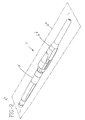
- a preferred catheter and needle assembly 10 of the present invention includes a hollow handle 12 with a longitudinal axis "A" defining an elongate cavity 14.
- Handle 12 has a proximal end 16 and a distal end 18.
- proximal end 16 includes an axial opening 70 that includes a vent 72.
- Vent 72 preferably selectively allows air transmission into and out of cavity 14 and substantially prevents fluid flow into or out of cavity 14.
- Distal end 18 defines a wall 20 with an inside surface 22 and an outside surface 24 having an axial protuberance 26 thereon.
- Protuberance 26 has an axial opening 30 through wall 20 into cavity 14.
- Assembly 10 includes a catheter 32 that has a proximal end 34, a distal end 36 and an open passageway 38 therethrough.
- Catheter 32 has a catheter hub 40 affixed to catheter proximal end 34, that is releasably mounted on protuberance 26 so that catheter 32 projects axially from the distal end 14 of the handle.
- Preferred assembly 10 also includes an elongate needle 42 with an open bore 44 therethrough and has a sharp distal point 46.
- Needle 42 has a proximal end 48 having an outwardly extending flange 50.
- Needle 42 has a first position, best seen in Figs. 1 and 3, with needle 42 disposed within handle 12 and through opening 30 into catheter passageway 38 so that sharp distal point 46 projects axially beyond distal end 36 of the catheter.
- Assembly 10 preferably has a spring 52, preferably a coil spring, directly acting on needle 42 to urge the needle to a second position, best seen in Fig. 4, where needle 42 is substantially within handle 12, spring 52 preferably being disposed coaxially about needle 42 and in compression between flange 50 and inside surface 22 of the distal end of handle 12 when needle 42 is in first position.
- flange 50 preferably includes a one-way valve 51, that opens to allow a blood flash to enter handle 12 when needle distal point 46 enters a patient's blood vessel so that a practitioner can confirm placement of the needle in the target blood vessel.
- One-way valve 51 substantially prevents flow of blood present in cavity 14 out of needle bore 44 when needle 42 is moved from the first position to the second position.
- valve 51 is preferably a "duckbill type” valve formed from a resilient material such as a low durometer silicone elastomer and the like, but other one-way valves such as a "trap-door” and the like are also suitable and considered within the scope of the invention.
- assembly 10 has a releasable latch 54 associated with handle 12 to retain needle 42 in the first position, as seen in Figs. 1, 3, 5 and 6.
- Latch 54 is movable to a release position, best seen in Fig. 7, wherein latch 54 no longer retains needle 42 in first position.
- Latch 54 preferably has a trigger 56 located distally on handle 12 to selectively move latch 54 with respect to needle 42 from the latch position to the release position
- latch 54 includes an elongate slot 58 that has a latching region 60 with a width "x" less than an outside diameter "y” of needle 42 and a release region 62 with a width "z” greater than outside diameter "x” of needle 42.
- Latch 54 is disposed about and substantially normal to the axis of needle 42 so that the needle is positioned in slot 58 and interferes with latch 54 in latching region 60 to retain needle 42 is in the first position.
- Latch 54 is movable with respect to needle 42 so that the needle is positioned in release region 62 and substantially does not contact latch 54, thereby allowing spring 52 to urge needle 42 to the second position.
- latching region 60 of latch 54 includes a sharpened edge 64 for engaging and releasably retaining needle 42 in the first position.
- Opening 30 in distal end wall 20 preferably forms a substantially fluid resistant seal 31 with an outside surface 43 of needle 42.
- Fluid tight seal 31 may be formed by careful matching of the size of opening 30 to the outside diameter "x" of needle 42.
- fluid resistant seal 31 is formed by including a resilient gasket 33 at opening 30.
- Resilient gasket 33 may be an "O" ring as shown in Fig. 5, or a layer of resilient material and the like that forms a substantially fluid tight seal with surface 43 of the needle.
- assembly 10 is preferably supplied with a shield 66, sized and shaped to fit onto hollow handle 12 to obstruct inadvertent access to needle 42 and trigger 56 for releasing latch 54.
- assembly 10 with shield 66 positioned thereon is placed within a sealed package 68, as indicated in phantom in Fig. 2, that is formed from materials substantially resistant to the passage of microorganisms.
- Suitable package materials include, but are not limited to, paper, thermoplastic film, non-woven materials, combinations thereof and the like Suitable conditions for rendering microorganisms non-viable include, but are not limited to, chemical sterilants such as ethylene oxide, hydrogen peroxide vapor and the like; and exposure to ionizing radiation such as gamma radiation, beta particles and the like.
- chemical sterilants such as ethylene oxide, hydrogen peroxide vapor and the like
- ionizing radiation such as gamma radiation, beta particles and the like.
- Suitable materials for forming hollow handle 12 and catheter hub 40 include, but are not limited to, thermoplastic polymeric resins such as polycarbonate, polystyrene, polypropylene and the like.
- Handle 12 is preferably formed from a substantially transparent material.
- Suitable materials for forming catheter 32 include thermoplastic resins such as polytetrafluoroethylene (PTFE), polyurethane and the like.
- catheter 32 is formed from a thermoplastic hydrophilic polyurethane that softens with exposure to physiological conditions present in the patient's body.
- Needle 42 and coil spring 52 are preferably formed from a stainless steel alloy or the like.
- Latch 54 and trigger 56 preferably are formed as a unitary structure from a stainless steel alloy or the like.
- Catheter hub 40 preferably includes an outwardly extending tab 41 that is preferably substantially longitudinally aligned with a bevel surface 47 of sharp distal point 46 and with trigger 56 of latch 54. Tab 41 is useful for advancing catheter 32 over needle 42 into the patient's blood vessel when the needle is being withdrawn after placement of the needle in the patient's blood vessel.
- a preferred method for a practitioner to place a catheter into a patient's target blood includes opening package 68, removing the shielded assembly 10, then dismounting shield 66 and exposing catheter 32 with projecting needle point 46.
- the method includes positioning assembly 10 substantially longitudinally aligned with the target blood vessel with bevel 47 facing substantially away from the skin surface and inserting needle 42 at a shallow angle, preferably less than about 35 degrees, into the skin, so that needle point 46 enters the target blood vessel.
- the practitioner then preferably observes a blood flashback in cavity 14
- the method includes the practitioner advancing catheter 32 distally axially along needle 42 into position in the blood vessel, preferably using upwardly extending tab 41
- the method includes the practitioner placing a finger from his other hand on the patient's skin over the blood vessel approximately over distal end 36 of the catheter. By placing his finger on the patient's skin and applying sufficient pressure on the skin, the practitioner thereby substantially occludes blood flow through the catheter.
- the method then includes the practitioner withdrawing the needle from bore 14 of the catheter by depressing trigger 56 and releasing latch 54 so that spring 52 urges needle 42 into the proximal position within hollow handle 12.
- the practitioner may then attach any desired fluid handling device to catheter hub 20 and commence the planned treatment. Hollow handle 12 with needle 42 substantially within it may then be disposed of according to the facility's disposal protocol.
- needle 42 is rotationally oriented in the hollow handle and engaged with latch 54 so beveled surface 47 is substantially aligned with trigger 56.
- the alignment of the needle bevel and trigger substantially directs the practitioner's grasp of the hollow handle to an intuitively proper position for insertion into the patient with needle point bevel surface 47 facing upward.
- the practitioner is readily able to confirm the proper placement in the patient's blood vessel by observation of the blood flashback in cavity 14.
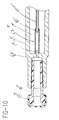
- FIGs. 8, 9 and 10 an alternate embodiment of the catheter and needle assembly of the invention is illustrated.
- this embodiment there are elements similar in structure and function to the catheter and needle assembly of Fig. 1-7. Accordingly, substantially similar components that perform substantially similar functions are numbered identically to those of Figs 1-7 except that the suffix "a" is used to identify those components in Figs. 8-10.
- catheter and needle assembly 10a includes hollow handle 12a with longitudinal axis "A" defining cavity 14a.
- Handle 12a has proximal end 16a and distal end 18a.
- Distal end 18 defines wall 20a with inside surface 22a and outside surface 24a having axial protuberance 26a thereon.
- Protuberance 26a has axial opening 30a through wall 20a into cavity 14a.
- Assembly 10a includes catheter 32a that has proximal end 34a, distal end 36a and open passageway.38a therethrough.
- Catheter 32a has catheter hub 40a affixed to catheter proximal end 34a, that is releasably mounted on protuberance 26a so that catheter 32a projects axially from the distal end 14a of the handle.
- Assembly 10a also includes elongate needle 42a with open bore 44a therethrough and has sharp distal point 46a. Needle 42a has proximal end 48a having outwardly extending flange 50a. Needle 42a has a first position, best seen in Fig. 8, with needle 42a disposed within handle 12a and through opening 30a into catheter passageway 38a so that sharp distal point 46a projects axially beyond distal end 36a of the catheter.
- Assembly 10a preferably has coil spring 52a cooperating with needle 42a to urge the needle to a second position, best seen in Figs. 9 and 10, where needle 42a is substantially within handle 12a, spring 52a is disposed between proximal end 16a of handle 12a and flange 52 and in tension between flange 50a and an attachment 17 at proximal end 16a of handle 12a when needle 42a is in first position.
- Attachment 17 may be a hollow mushroom shaped flange as is shown in Figs. 8, 9 and 10, or alternatively, spring 52a may be attached to proximal end 16a by a hot melt adhesive, snap ring or other mechanical attachments and the like.
- assembly 10a has releasable latch 54a associated with handle 12a to retain needle 42a in the first position.
- Latch 54a is movable to a release position, best seen in Fig. 9, wherein latch 54a no longer retains needle 42a in first position.
- Latch 54a preferably has trigger 56a located distally on handle 12a to selectively move latch 54a with respect to needle 42a from the latch position to the release position.
- the catheter needle assembly of the invention has fewer parts than most other available retractable catheter needle assemblies Additionally. during manufacturing, since needle 42 does not have a separate hub, alignment of needle bevel surface 47 with trigger 56 and tab 41 is possible by simply rotating needle 42 in opening 30 and rotating catheter hub 40 about protuberance 26 until the trigger, bevel surface and tab are longitudinally aligned.
- the catheter needle assembly of the invention provides the practitioner with a larger available volume than most prior devices for observing flashback by utilizing the cavity to receive the flash.
- the assembly of the invention is intuitive for a practitioner to use, performs all of the functions of the other devices in a efficient manner and thus provides an advance to the art of vascular catheter placement.
Landscapes
- Health & Medical Sciences (AREA)
- Life Sciences & Earth Sciences (AREA)
- Biophysics (AREA)
- Pulmonology (AREA)
- Engineering & Computer Science (AREA)
- Anesthesiology (AREA)
- Biomedical Technology (AREA)
- Heart & Thoracic Surgery (AREA)
- Hematology (AREA)
- Animal Behavior & Ethology (AREA)
- General Health & Medical Sciences (AREA)
- Public Health (AREA)
- Veterinary Medicine (AREA)
- Media Introduction/Drainage Providing Device (AREA)
Applications Claiming Priority (2)
| Application Number | Priority Date | Filing Date | Title |
|---|---|---|---|
| US706578 | 1985-02-28 | ||
| US08/706,578 US5797880A (en) | 1996-09-05 | 1996-09-05 | Catheter and placement needle assembly with retractable needle |
Publications (2)
| Publication Number | Publication Date |
|---|---|
| EP0827759A2 true EP0827759A2 (de) | 1998-03-11 |
| EP0827759A3 EP0827759A3 (de) | 1998-06-17 |
Family
ID=24838200
Family Applications (1)
| Application Number | Title | Priority Date | Filing Date |
|---|---|---|---|
| EP97306801A Withdrawn EP0827759A3 (de) | 1996-09-05 | 1997-09-01 | Katheter und Einführnadel mit einziehbarer Nadel |
Country Status (4)
| Country | Link |
|---|---|
| US (1) | US5797880A (de) |
| EP (1) | EP0827759A3 (de) |
| JP (1) | JPH10137342A (de) |
| CA (1) | CA2213942A1 (de) |
Cited By (5)
| Publication number | Priority date | Publication date | Assignee | Title |
|---|---|---|---|---|
| EP0963765A3 (de) * | 1998-06-11 | 2000-06-28 | Angiodynamics, Inc. | Katheter mit Okklusionsdraht |
| WO2000054831A1 (en) * | 1999-03-17 | 2000-09-21 | Designodev Ltd | A safety assembly for a hypodermic applicator set |
| EP1159979A3 (de) * | 2000-05-31 | 2003-03-26 | Becton, Dickinson and Company | Nadelschutzvorrichtung |
| WO2006032995A3 (en) * | 2004-09-24 | 2006-10-05 | Tecnomedica S R L | Cannula device |
| CN110446520A (zh) * | 2017-03-17 | 2019-11-12 | 贝克顿·迪金森公司 | 中线导管放置装置 |
Families Citing this family (49)
| Publication number | Priority date | Publication date | Assignee | Title |
|---|---|---|---|---|
| US6090078A (en) * | 1997-09-30 | 2000-07-18 | Becton, Dickinson And Company | Dampening devices and methods for needle retracting safety vascular access devices |
| ES2284218T3 (es) * | 1997-11-12 | 2007-11-01 | Mdc Investment Holdings, Inc. | Dispositivo para la recogida de fluidos con aguja retractil capturada. |
| US5989220A (en) * | 1998-05-26 | 1999-11-23 | Retractable Technologies Inc. | Self-retracting IV catheter introducer |
| US6540732B1 (en) * | 1998-12-15 | 2003-04-01 | Mdc Investment Holdings, Inc. | Fluid collection device with captured retractable needle |
| US6530903B2 (en) | 2000-02-24 | 2003-03-11 | Xiping Wang | Safety syringe |
| US6558354B1 (en) * | 2000-08-04 | 2003-05-06 | Becton Dickinson And Company | Adapter for connecting an introducer needle assembly to a catheter introducer |
| US6641564B1 (en) * | 2000-11-06 | 2003-11-04 | Medamicus, Inc. | Safety introducer apparatus and method therefor |
| US7001396B2 (en) * | 2003-03-26 | 2006-02-21 | Enpath Medical, Inc. | Safety introducer assembly and method |
| US20040092879A1 (en) * | 2000-11-06 | 2004-05-13 | Medamicus, Inc. | Safety introducer apparatus and method therefor |
| US8114114B2 (en) | 2002-08-27 | 2012-02-14 | Emboline, Inc. | Embolic protection device |
| US20050216006A1 (en) * | 2004-03-23 | 2005-09-29 | Orbay Jorge L | Cap for cut metal orthopedic fastener |
| CA2578365C (en) * | 2004-08-13 | 2013-07-16 | Becton, Dickinson And Company | Retractable needle syringe assembly |
| BRPI0514909B8 (pt) | 2004-09-03 | 2021-06-22 | L O M Laboratories Inc | seringa de segurança do tipo para uso com uma agulha hipodérmica |
| US7736337B2 (en) * | 2006-02-16 | 2010-06-15 | Smiths Medical, Asd, Inc. | Sealing catheter hub attachment |
| JP2007275191A (ja) * | 2006-04-04 | 2007-10-25 | Nemoto Kyorindo:Kk | カテーテル導入用具およびそれを使用する薬液注入装置 |
| WO2008066881A1 (en) | 2006-11-29 | 2008-06-05 | Amir Belson | Embolic protection device |
| JP5139518B2 (ja) | 2007-05-07 | 2013-02-06 | バスキュラー・パスウェイズ・インコーポレイテッド | 静脈カテーテル挿入装置 |
| JP2011045544A (ja) * | 2009-08-27 | 2011-03-10 | Terumo Corp | 留置針組立体 |
| US9550030B2 (en) | 2010-07-22 | 2017-01-24 | Becton, Dickinson And Company | Dual chamber syringe with retractable needle |
| US8556855B2 (en) | 2010-07-22 | 2013-10-15 | Becton, Dickinson And Company | Dual chamber syringe with retractable needle |
| US8721599B2 (en) | 2010-07-22 | 2014-05-13 | Becton, Dickinson And Company | Dual chamber passive retraction needle syringe |
| US8556854B2 (en) | 2010-07-22 | 2013-10-15 | Becton, Dickinson And Company | Dual chamber syringe with retractable needle |
| EP2417996A1 (de) | 2010-08-13 | 2012-02-15 | Just Innovative Layouts Pty Ltd. | Medizinische Einsatzeinführungsvorrichtung |
| WO2012023938A1 (en) | 2010-08-19 | 2012-02-23 | West Pharmaceutical Services, Inc. | Rigid needle shield |
| US9238104B2 (en) | 2011-02-28 | 2016-01-19 | Injectimed, Inc. | Needle guard |
| US8764711B2 (en) | 2011-02-28 | 2014-07-01 | Injectimed, Inc. | Needle guard |
| USD903101S1 (en) | 2011-05-13 | 2020-11-24 | C. R. Bard, Inc. | Catheter |
| JP6272781B2 (ja) | 2012-01-06 | 2018-01-31 | エンボライン, インコーポレイテッド | 統合された塞栓保護デバイス |
| US9586027B2 (en) | 2013-05-07 | 2017-03-07 | Medline Industries, Inc. | Retractable needle catheter insertion device |
| JP6319560B2 (ja) * | 2014-03-11 | 2018-05-09 | ニプロ株式会社 | 針組立体 |
| TWI681792B (zh) | 2014-10-31 | 2020-01-11 | 加拿大商L O M 實驗股份有限公司 | 可伸縮針式注射器 |
| WO2016115628A1 (en) | 2015-01-20 | 2016-07-28 | L.O.M. Laboratories Inc. | Retractable needle syringe with unitary propellant release module |
| EP3337549B1 (de) | 2015-08-18 | 2019-06-19 | B. Braun Melsungen AG | Kathetervorrichtung mit ventilen und zugehörige verfahren |
| US10617509B2 (en) | 2015-12-29 | 2020-04-14 | Emboline, Inc. | Multi-access intraprocedural embolic protection device |
| JP7093497B2 (ja) * | 2017-09-19 | 2022-06-30 | ニプロ株式会社 | 留置針組立体 |
| US10828467B2 (en) | 2017-11-30 | 2020-11-10 | Becton, Dickinson And Company | Catheter assembly |
| WO2019148201A1 (en) | 2018-01-29 | 2019-08-01 | Bard Access Systems, Inc. | Connection system for establishing an electrical connection through a drape and methods thereof |
| CN112135577B (zh) | 2018-05-18 | 2024-10-15 | 巴德阿克塞斯系统股份有限公司 | 用于建立通过盖布的电连接的连接系统及其方法 |
| USD921884S1 (en) | 2018-07-27 | 2021-06-08 | Bard Access Systems, Inc. | Catheter insertion device |
| EP3888722A4 (de) * | 2018-11-29 | 2022-08-17 | Nipro Corporation | Dauernadelanordnung |
| WO2020127328A1 (en) | 2018-12-17 | 2020-06-25 | B. Braun Melsungen Ag | Over-the-needle catheter assemblies and related manufacturing method |
| JP7557475B2 (ja) | 2019-02-13 | 2024-09-27 | エンボライン, インコーポレイテッド | 統合された塞栓保護デバイスを伴うカテーテル |
| US11737848B2 (en) | 2019-07-29 | 2023-08-29 | Bard Access Systems, Inc. | Connection systems and methods for establishing optical and electrical connections through a drape |
| CA3150924A1 (en) | 2019-08-08 | 2021-02-11 | Bard Access Systems, Inc. | Optical-fiber connector modules including shape-sensing systems and methods thereof |
| JP7721504B2 (ja) * | 2019-08-19 | 2025-08-12 | ベクトン・ディキンソン・アンド・カンパニー | 正中線カテーテル配置デバイス |
| EP4025288A1 (de) * | 2019-09-20 | 2022-07-13 | Bard Peripheral Vascular, Inc. | Vorrichtung zum legen eines intravenösen katheters |
| US11197980B2 (en) | 2019-11-27 | 2021-12-14 | Skydance Vascular, Inc. | Retractable needle catheter delivery apparatus |
| US12596232B2 (en) | 2020-10-28 | 2026-04-07 | Bard Access Systems, Inc. | Systems and methods including procedural barrier-breaching connectors and connection-establishing devices |
| JP2024505074A (ja) * | 2021-02-01 | 2024-02-02 | スカイダンス バスキュラー, インコーポレイテッド | 後退可能針カテーテル送達装置 |
Citations (1)
| Publication number | Priority date | Publication date | Assignee | Title |
|---|---|---|---|---|
| US4747831A (en) | 1987-04-29 | 1988-05-31 | Phase Medical, Inc. | Cannula insertion set with safety retracting needle |
Family Cites Families (10)
| Publication number | Priority date | Publication date | Assignee | Title |
|---|---|---|---|---|
| US4108175A (en) * | 1977-01-28 | 1978-08-22 | Orton Dale W | Catheter insertion apparatus |
| US4207870A (en) * | 1978-06-15 | 1980-06-17 | Becton, Dickinson And Company | Blood sampling assembly having porous vent means vein entry indicator |
| US4307731A (en) * | 1978-06-15 | 1981-12-29 | Becton, Dickinson And Company | Multiple sampling needle having one-way valve |
| US4512766A (en) * | 1982-12-08 | 1985-04-23 | Whitman Medical Corporation | Catheter valve |
| US4917671A (en) * | 1988-07-20 | 1990-04-17 | Critikon, Inc. | Flash plug for I.V. catheters |
| US5129884A (en) * | 1990-01-16 | 1992-07-14 | Dysarz Edward D | Trap in barrel one handed retracted intervenous catheter device |
| US5125414A (en) * | 1990-01-16 | 1992-06-30 | Dysarz Edward D | Trap in barrel one handed retracted blood sampling device |
| CA2135706C (en) * | 1993-11-15 | 1999-06-15 | Walter E. Cover | Retractable-needle cannula insertion set with refinements to better control leakage, retraction speed, and reuse |
| US5573510A (en) * | 1994-02-28 | 1996-11-12 | Isaacson; Dennis R. | Safety intravenous catheter assembly with automatically retractable needle |
| US5501675A (en) * | 1994-12-27 | 1996-03-26 | Becton, Dickinson And Company | Safety catheter assembly having safety stop push button |
-
1996
- 1996-09-05 US US08/706,578 patent/US5797880A/en not_active Expired - Fee Related
-
1997
- 1997-08-26 CA CA002213942A patent/CA2213942A1/en not_active Abandoned
- 1997-09-01 EP EP97306801A patent/EP0827759A3/de not_active Withdrawn
- 1997-09-05 JP JP9241464A patent/JPH10137342A/ja active Pending
Patent Citations (1)
| Publication number | Priority date | Publication date | Assignee | Title |
|---|---|---|---|---|
| US4747831A (en) | 1987-04-29 | 1988-05-31 | Phase Medical, Inc. | Cannula insertion set with safety retracting needle |
Cited By (9)
| Publication number | Priority date | Publication date | Assignee | Title |
|---|---|---|---|---|
| EP0963765A3 (de) * | 1998-06-11 | 2000-06-28 | Angiodynamics, Inc. | Katheter mit Okklusionsdraht |
| US6283950B1 (en) | 1998-06-11 | 2001-09-04 | Angiodynamics, Inc. | Occluding wire assembly |
| WO2000054831A1 (en) * | 1999-03-17 | 2000-09-21 | Designodev Ltd | A safety assembly for a hypodermic applicator set |
| EP1159979A3 (de) * | 2000-05-31 | 2003-03-26 | Becton, Dickinson and Company | Nadelschutzvorrichtung |
| WO2006032995A3 (en) * | 2004-09-24 | 2006-10-05 | Tecnomedica S R L | Cannula device |
| CN110446520A (zh) * | 2017-03-17 | 2019-11-12 | 贝克顿·迪金森公司 | 中线导管放置装置 |
| US11285298B2 (en) | 2017-03-17 | 2022-03-29 | Becton, Dickinson And Company | Midline catheter placement device |
| CN110446520B (zh) * | 2017-03-17 | 2022-05-27 | 贝克顿·迪金森公司 | 中线导管放置装置 |
| US12427288B2 (en) | 2017-03-17 | 2025-09-30 | Becton, Dickinson And Company | Midline catheter placement device |
Also Published As
| Publication number | Publication date |
|---|---|
| US5797880A (en) | 1998-08-25 |
| CA2213942A1 (en) | 1998-03-05 |
| EP0827759A3 (de) | 1998-06-17 |
| JPH10137342A (ja) | 1998-05-26 |
Similar Documents
| Publication | Publication Date | Title |
|---|---|---|
| US5797880A (en) | Catheter and placement needle assembly with retractable needle | |
| EP0820783B1 (de) | Vorrichtung zum Setzen eines Katheters mit geschützter Nadel, Einrichtung zur Abnahme | |
| US5830190A (en) | Protected needle catheter placement device having needle placement visualization features and method for its use | |
| US6224569B1 (en) | Compact needle point shield | |
| JP2962268B2 (ja) | 単一動作によるカテーテル進入及び針自動後退装置を備えたカテーテル及び針導入器アセンブリ | |
| US6652490B2 (en) | Catheter and introducer needle assembly with compact needle shield | |
| US6425884B1 (en) | Compact needle shielding device | |
| US7291130B2 (en) | Safety needle and catheter assembly | |
| US6585703B1 (en) | Dividable introducer catheter and positive-lock needle guard combination | |
| EP0812601A2 (de) | Radialbelüftete Rückflusskammer und Stopfenanordnung | |
| CN110621372A (zh) | 具有集成延伸套件和弹簧驱动的针安全件的iv导管 | |
| AU2001229706B2 (en) | Catheter and introducer needle assembly with compact needle shield | |
| CA2520353C (en) | Safety needle and catheter assembly | |
| AU2001229706A1 (en) | Catheter and introducer needle assembly with compact needle shield | |
| MXPA00012958A (es) | Cateter de seguridad con trayectoria de fluido sinuosa. | |
| MXPA97005013A (en) | Needle probe placement device protected with sampling provisions and metodopara su |
Legal Events
| Date | Code | Title | Description |
|---|---|---|---|
| PUAI | Public reference made under article 153(3) epc to a published international application that has entered the european phase |
Free format text: ORIGINAL CODE: 0009012 |
|
| AK | Designated contracting states |
Kind code of ref document: A2 Designated state(s): DE ES FR GB IT |
|
| PUAL | Search report despatched |
Free format text: ORIGINAL CODE: 0009013 |
|
| AK | Designated contracting states |
Kind code of ref document: A3 Designated state(s): AT BE CH DE DK ES FI FR GB GR IE IT LI LU MC NL PT SE |
|
| 17P | Request for examination filed |
Effective date: 19981202 |
|
| AKX | Designation fees paid | ||
| RBV | Designated contracting states (corrected) | ||
| RBV | Designated contracting states (corrected) |
Designated state(s): DE ES FR GB IT |
|
| 17Q | First examination report despatched |
Effective date: 20020220 |
|
| GRAH | Despatch of communication of intention to grant a patent |
Free format text: ORIGINAL CODE: EPIDOS IGRA |
|
| STAA | Information on the status of an ep patent application or granted ep patent |
Free format text: STATUS: THE APPLICATION IS DEEMED TO BE WITHDRAWN |
|
| 18D | Application deemed to be withdrawn |
Effective date: 20030909 |