EP0829563A2 - Textiler Haftverschlussstoff vom Schlingen-Type, Verfahren zu dessen Herstellung und Verfahren zu dessen Behandlung - Google Patents
Textiler Haftverschlussstoff vom Schlingen-Type, Verfahren zu dessen Herstellung und Verfahren zu dessen Behandlung Download PDFInfo
- Publication number
- EP0829563A2 EP0829563A2 EP97118572A EP97118572A EP0829563A2 EP 0829563 A2 EP0829563 A2 EP 0829563A2 EP 97118572 A EP97118572 A EP 97118572A EP 97118572 A EP97118572 A EP 97118572A EP 0829563 A2 EP0829563 A2 EP 0829563A2
- Authority
- EP
- European Patent Office
- Prior art keywords
- fabric
- loop
- loops
- foam
- yarns
- Prior art date
- Legal status (The legal status is an assumption and is not a legal conclusion. Google has not performed a legal analysis and makes no representation as to the accuracy of the status listed.)
- Granted
Links
Images

Classifications
-
- D—TEXTILES; PAPER
- D04—BRAIDING; LACE-MAKING; KNITTING; TRIMMINGS; NON-WOVEN FABRICS
- D04B—KNITTING
- D04B21/00—Warp knitting processes for the production of fabrics or articles not dependent on the use of particular machines; Fabrics or articles defined by such processes
- D04B21/02—Pile fabrics or articles having similar surface features
- D04B21/04—Pile fabrics or articles having similar surface features characterised by thread material
-
- A—HUMAN NECESSITIES
- A44—HABERDASHERY; JEWELLERY
- A44B—BUTTONS, PINS, BUCKLES, SLIDE FASTENERS, OR THE LIKE
- A44B18/00—Fasteners of the touch-and-close type; Making such fasteners
- A44B18/0023—Woven or knitted fasteners
- A44B18/0034—Female or loop elements
-
- D—TEXTILES; PAPER
- D10—INDEXING SCHEME ASSOCIATED WITH SUBLASSES OF SECTION D, RELATING TO TEXTILES
- D10B—INDEXING SCHEME ASSOCIATED WITH SUBLASSES OF SECTION D, RELATING TO TEXTILES
- D10B2403/00—Details of fabric structure established in the fabric forming process
- D10B2403/01—Surface features
- D10B2403/011—Dissimilar front and back faces
- D10B2403/0112—One smooth surface, e.g. laminated or coated
-
- D—TEXTILES; PAPER
- D10—INDEXING SCHEME ASSOCIATED WITH SUBLASSES OF SECTION D, RELATING TO TEXTILES
- D10B—INDEXING SCHEME ASSOCIATED WITH SUBLASSES OF SECTION D, RELATING TO TEXTILES
- D10B2501/00—Wearing apparel
- D10B2501/06—Details of garments
- D10B2501/063—Fasteners
- D10B2501/0632—Fasteners of the touch-and-close type
-
- D—TEXTILES; PAPER
- D10—INDEXING SCHEME ASSOCIATED WITH SUBLASSES OF SECTION D, RELATING TO TEXTILES
- D10B—INDEXING SCHEME ASSOCIATED WITH SUBLASSES OF SECTION D, RELATING TO TEXTILES
- D10B2503/00—Domestic or personal
- D10B2503/04—Floor or wall coverings; Carpets
- D10B2503/041—Carpet backings
-
- Y—GENERAL TAGGING OF NEW TECHNOLOGICAL DEVELOPMENTS; GENERAL TAGGING OF CROSS-SECTIONAL TECHNOLOGIES SPANNING OVER SEVERAL SECTIONS OF THE IPC; TECHNICAL SUBJECTS COVERED BY FORMER USPC CROSS-REFERENCE ART COLLECTIONS [XRACs] AND DIGESTS
- Y10—TECHNICAL SUBJECTS COVERED BY FORMER USPC
- Y10T—TECHNICAL SUBJECTS COVERED BY FORMER US CLASSIFICATION
- Y10T24/00—Buckles, buttons, clasps, etc.
- Y10T24/27—Buckles, buttons, clasps, etc. including readily dissociable fastener having numerous, protruding, unitary filaments randomly interlocking with, and simultaneously moving towards, mating structure [e.g., hook-loop type fastener]
- Y10T24/2733—Buckles, buttons, clasps, etc. including readily dissociable fastener having numerous, protruding, unitary filaments randomly interlocking with, and simultaneously moving towards, mating structure [e.g., hook-loop type fastener] having filaments formed from continuous element interwoven or knitted into distinct, mounting surface fabric
-
- Y—GENERAL TAGGING OF NEW TECHNOLOGICAL DEVELOPMENTS; GENERAL TAGGING OF CROSS-SECTIONAL TECHNOLOGIES SPANNING OVER SEVERAL SECTIONS OF THE IPC; TECHNICAL SUBJECTS COVERED BY FORMER USPC CROSS-REFERENCE ART COLLECTIONS [XRACs] AND DIGESTS
- Y10—TECHNICAL SUBJECTS COVERED BY FORMER USPC
- Y10T—TECHNICAL SUBJECTS COVERED BY FORMER US CLASSIFICATION
- Y10T428/00—Stock material or miscellaneous articles
- Y10T428/23907—Pile or nap type surface or component
- Y10T428/23929—Edge feature or configured or discontinuous surface
-
- Y—GENERAL TAGGING OF NEW TECHNOLOGICAL DEVELOPMENTS; GENERAL TAGGING OF CROSS-SECTIONAL TECHNOLOGIES SPANNING OVER SEVERAL SECTIONS OF THE IPC; TECHNICAL SUBJECTS COVERED BY FORMER USPC CROSS-REFERENCE ART COLLECTIONS [XRACs] AND DIGESTS
- Y10—TECHNICAL SUBJECTS COVERED BY FORMER USPC
- Y10T—TECHNICAL SUBJECTS COVERED BY FORMER US CLASSIFICATION
- Y10T428/00—Stock material or miscellaneous articles
- Y10T428/23907—Pile or nap type surface or component
- Y10T428/23957—Particular shape or structure of pile
-
- Y—GENERAL TAGGING OF NEW TECHNOLOGICAL DEVELOPMENTS; GENERAL TAGGING OF CROSS-SECTIONAL TECHNOLOGIES SPANNING OVER SEVERAL SECTIONS OF THE IPC; TECHNICAL SUBJECTS COVERED BY FORMER USPC CROSS-REFERENCE ART COLLECTIONS [XRACs] AND DIGESTS
- Y10—TECHNICAL SUBJECTS COVERED BY FORMER USPC
- Y10T—TECHNICAL SUBJECTS COVERED BY FORMER US CLASSIFICATION
- Y10T428/00—Stock material or miscellaneous articles
- Y10T428/23907—Pile or nap type surface or component
- Y10T428/23979—Particular backing structure or composition
-
- Y—GENERAL TAGGING OF NEW TECHNOLOGICAL DEVELOPMENTS; GENERAL TAGGING OF CROSS-SECTIONAL TECHNOLOGIES SPANNING OVER SEVERAL SECTIONS OF THE IPC; TECHNICAL SUBJECTS COVERED BY FORMER USPC CROSS-REFERENCE ART COLLECTIONS [XRACs] AND DIGESTS
- Y10—TECHNICAL SUBJECTS COVERED BY FORMER USPC
- Y10T—TECHNICAL SUBJECTS COVERED BY FORMER US CLASSIFICATION
- Y10T428/00—Stock material or miscellaneous articles
- Y10T428/23907—Pile or nap type surface or component
- Y10T428/23986—With coating, impregnation, or bond
-
- Y—GENERAL TAGGING OF NEW TECHNOLOGICAL DEVELOPMENTS; GENERAL TAGGING OF CROSS-SECTIONAL TECHNOLOGIES SPANNING OVER SEVERAL SECTIONS OF THE IPC; TECHNICAL SUBJECTS COVERED BY FORMER USPC CROSS-REFERENCE ART COLLECTIONS [XRACs] AND DIGESTS
- Y10—TECHNICAL SUBJECTS COVERED BY FORMER USPC
- Y10T—TECHNICAL SUBJECTS COVERED BY FORMER US CLASSIFICATION
- Y10T428/00—Stock material or miscellaneous articles
- Y10T428/24—Structurally defined web or sheet [e.g., overall dimension, etc.]
- Y10T428/24008—Structurally defined web or sheet [e.g., overall dimension, etc.] including fastener for attaching to external surface
- Y10T428/24017—Hook or barb
-
- Y—GENERAL TAGGING OF NEW TECHNOLOGICAL DEVELOPMENTS; GENERAL TAGGING OF CROSS-SECTIONAL TECHNOLOGIES SPANNING OVER SEVERAL SECTIONS OF THE IPC; TECHNICAL SUBJECTS COVERED BY FORMER USPC CROSS-REFERENCE ART COLLECTIONS [XRACs] AND DIGESTS
- Y10—TECHNICAL SUBJECTS COVERED BY FORMER USPC
- Y10T—TECHNICAL SUBJECTS COVERED BY FORMER US CLASSIFICATION
- Y10T442/00—Fabric [woven, knitted, or nonwoven textile or cloth, etc.]
- Y10T442/40—Knit fabric [i.e., knit strand or strip material]
- Y10T442/45—Knit fabric is characterized by a particular or differential knit pattern other than open knit fabric or a fabric in which the strand denier is specified
- Y10T442/456—Including additional strand inserted within knit fabric
- Y10T442/463—Warp knit insert strand
Definitions
- the present invention relates generally to fabric fasteners of the type commonly referred to as hook-and-loop fasteners. More particularly, the present invention relates to a novel warp-knitted loop-type textile fastener fabric and a method of producing such a fastener fabric on a warp knitting machine. A method of preparatory treatment of the fabric is also disclosed.
- each fastener component is of a textile fabric construction, the hook or "male” component having a fabric ground layer with a plurality of relatively stiff hook-shaped elements extending in upstanding relation from one face of the ground layer and the loop or "female” component similarly having a fabric ground layer with a plurality of relatively flexible pile-type loops extending outwardly from one face of the ground layer.
- the hook and loop faces of the fastener components grippingly engage one another when pressed together in face abutting relation by penetration of the hook-shaped elements of the hook component into the loops at the opposing face of the loop component.
- the engagement between the hook and loop faces of the two components resists separation thereof until a threshold force is exerted on one component in a peeling-like fashion.
- both components of conventional hook-and-loop fasteners have been of relatively heavyweight constructions.
- many hook components utilize hook elements formed of relatively heavy denier inflexible synthetic monofilament yarns firmly secured in a similarly stiff inflexible ground fabric, to withstand repeated attachment and detachment to and from a mating loop component without excessive breakage of the hook elements or tearing of the ground fabric.
- loop components commonly have a relatively stiff inflexible ground layer supporting elongated loops of multifilament synthetic yarns, which normally are brushed or napped to produce a plush-like loop surface wherein the individual filaments are mainly separated from one another, in order to maximize the available loops for engagement with the mating hook-like elements of the other fastener component.
- the large number of available loops owing to the use of napped or brushed multifilament yarns enables the loop component to be repeatedly attached and detached to and from its mating hook component so that the fastener generally has a reasonably extended useful life.
- hook-and-loop fasteners are fabricated with each fastener component in the form of a relatively narrow width tape of indeterminate length.
- hook-and-loop fasteners are susceptible to a wide variety of end uses, most often as a fastener or closure in various apparel items wherein the capability of the fastener components for repetitive attachment and detachment to and from one another is a virtual necessity.
- U.S. Patent No. 4,822,658 discloses a carpet construction with a backing layer having plural downwardly projecting loops serving the dual purpose of providing resiliency to the underside of the carpet in the nature of underpadding while also being adapted for engagement with a hook-type fastener tape affixed to a floor surface for purposes of securing the carpeting in place on the floor.
- a loop-type fastener component for use as the backing layer must be fabricated in the same widths is carpeting is typically fabricated, e.g., twelve-foot widths or greater.
- hook-and-loop fasteners include the formation of closures in disposable or one-time use products, such as diapers and incontinence garments, for which the above-described conventional hook-and-loop fasteners would also be generally inappropriate.
- a particular object of the present invention is to provide such a loop component which is specifically suitable for use as a backing in a carpet construction such as disclosed in the aforementioned U.S. Patent No. 4,822,658, closures for disposable articles, and in other one-time and light-duty uses.
- a more specific object is to provide such a loop component utilizing a relatively fine denier synthetic yarn for formation of the surface loops on one face of the fastener component.
- An additional object of the present invention is to provide a novel warp knitting method for fabricating the loop fastener component of the present invention. Another object is to provide a process for preparatory treatment of the fabric to improve its handleability and performance during subsequent processing operations.
- the present invention provides a textile fabric having one face adapted to be adhered to a backing material (e.g., the backing surface of a carpet) and a set of pile-like loops at the other face adapted for mated engagement with hooking elements of another fabric for use in a two-component fabric fastener of the hook-and-loop type.
- the fabric fastener component of the present invention includes a ground layer formed of a ground yarn and a loop-forming yarn forming the set of loops and extending outwardly from the aforesaid other face of the ground layer.
- the fastener fabric is formed of a warp knitted construction with the pile-like loops appearing at either the technical face of the fabric or the technical back of the fabric or at both fabric sides.
- the warp knitted fastener component includes yarns formed in needle loops arranged in longitudinally extending wales and transversely extending courses including a set of ground yarns formed in a stitch pattern of needle loops which is relatively stretchable in the warpwise extent of the fabric and a set of loop-forming yarns knitted with the ground yarns in needle loops in spaced courses and spaced wales wherein the ground yarn needle loops are formed and in pile-like loops extending outwardly from the aforesaid other face of the fabric between the needle loops of the loop-forming yarns.
- each loop-forming yarn is formed in needle loops aligned with one another in spaced courses of a common wale.
- the loop-forming yarns may be warp knitted in a 1-0, 3-4, 6-7, 3-4 stitch pattern or in a 1-0, 3-4 stitch pattern.
- the ground yarns are formed in a 2-3, 1-0 stitch pattern or in a 1-0, 2-3 stitch pattern.
- a weft inserted filling yarn may be formed to extend coursewise in at least some of the fabric courses, preferably in substantially every course.
- a second set of loop-forming yarns may be knitted with the ground yarns of the fabric in needle loops in spaced courses and spaced wales wherein the ground yarn needle loops are formed and in pile-like loops extending outwardly from the first aforesaid one face of the fabric between the needle loops of the second loop-forming yarns.
- the present invention also contemplates a method of producing a warp knitted textile fabric suitable for use as the loop component of a hook-and-loop type fastener.
- the present method includes the steps of warp knitting a set of ground yarns on one guide bar of a warp knitting machine having at least two guide bars to form a ground layer of the fabric in a relatively stretchable construction while simultaneously warp knitting a set of loop-forming yarns on the other guide bar of the knitting machine to form raised pile-like loops at one surface of the fabric.
- the loop-forming yarns are knitted by alternately forming needle loops of the loop-forming yarns on selected needles of the knitting machine's needle bar and interveningly holding the loop-forming yarns in a non-knitting manner on, and then releasing the loop-forming yarns without stitch formation from, other needles spaced from the selected needles to form the respective outwardly-extending loops between the respective needle loops of the loop-forming yarns.
- the ground yarns are warp knitted in a 2-3, 1-0 stitch pattern or in a 1-0, 2-3 stitch pattern and the loop-forming yarns are warp knitted in a 1-0, 3-4, 6-7, 3-4 stitch pattern or in a 1-0, 3-4 stitch pattern.
- a filling yarn may be inserted weftwise in at least some or, more preferably, substantially all of the courses of the fabric.
- Another aspect of the present invention provides a process for treating the aforedescribed stretchable loop-type textile fastener fabrics to prepare the fabrics for subsequent processing, including adhesion of the fabric to a foam backing layer, e.g., the foam backing of a carpet.
- the treating process comprises the steps of applying a stiffening agent to the fabric to temporarily improve its handleability, the stiffening agent being readily broken and releasable from the fabric during subsequent processing as a result of manipulation, bending and like handling of the fabric so that the lengthwise stretchability of the fabric is not permanently impaired.
- the stiffening agent may be a starch.
- a foam resistent agent is also applied to the fabric for the purpose of partially resisting adhesion of the foam to the fabric thereby to restrict foam penetration into the fabric structure so that the fabric retains a desirable degree of its lengthwise stretchability after adhesion to the foam backing layer.
- the foam resistent agent may be a fluorocarbon composition, preferably having both water resistant and oil resistent properties, e.g., a mixture of a water-resistant fluorocarbon and an oil resistant fluorocarbon.
- Preferred fluorocarbons for this purpose are the FC 247 fluorocarbon manufactured and sold by 3-M Company (Minnesota Mining and Manufacturing Company) of St. Paul, Minnesota, and the ZONAL 8070 fluorocarbon manufactured and sold by CIBA Company of Greensboro, North Carolina.
- the stiffening agent is contained in a bath wherein the content of the stiffening agent is in the range of approximately 10 percent to 40 percent of the weight of the bath.
- the stiffening agent is applied to the fabric either by spraying the bath onto the face of the fabric to be subsequently adhered to the foam backing layer, in which case a higher percentage stiffening agent content is preferred, or by passing the fabric through the bath, e.g., in a padding process, in which case the bath may have a stiffening agent content at the lower end of the aforementioned range.
- the fluorocarbon composition, or other foam resistant agent is also prepared in the form of a bath preferably having a content of the foam resistant agent in the range of approximately 0.25 percent to 8 percent of the weight of the bath.
- the preferred embodiments of the fabric of the present invention are produced, and the method of the present invention is carried out, on a warp knitting machine which may be of any conventional type of an at least two-bar construction having two or more yarn guide bars and a needle bar, e.g., a conventional tricot warp knitting machine.
- a warp knitting machine which may be of any conventional type of an at least two-bar construction having two or more yarn guide bars and a needle bar, e.g., a conventional tricot warp knitting machine.
- the construction and operation of such machines are well known in the warp knitting art and need not herein be specifically described and illustrated.
- the yarn guide bars of a two-bar knitting machine are identified as “top” and “bottom” guide bars and the yarn guide bars of a three-bar knitting machine are identified as “top,” “middle” and “bottom” guide bars for references purposes only and not by way of limitation.
- the needle bar of the warp knitting machine carries a series of aligned knitting needles, while each guide bar of the machine carries a series of guide eyes, the needle and guide bars preferably having the same gauge, i.e., the same number of needles and guide eyes per inch.
- the top guide bar of the machine is threaded on alternating guide members with a first set of loop-forming yarns 14 delivered from a warp beam (not shown)
- the middle guide bar is threaded on alternating guide members with a set of ground yarns 12 delivered from another warp beam (also not shown)
- the bottom guide bar is similarly threaded on alternating guide members with a second set of loop-forming yarns 10 supplied from a third warp beam (also not shown).
- each of the bottom, middle and top yarn guide bars has every alternate guide eye empty and every intervening guide eye threaded with a respective ground or loop-forming yarn 10, 12 or 14, commonly referred to as a "one out, one in" threading arrangement.
- the threading arrangement of the three guide bars is set up in conjunction with the stitch patterns of the three sets of yarn to deliver the ground and loop-forming yarns 10,12,14 to every alternate needle of the needle bar during the formation of alternate fabric courses and, then, to deliver the ground yarn 12 to every alternate needle of the needle bar while delivering the loop-forming yarns 10,14 to every intervening needle during the formation of intervening fabric courses.
- Texturized yarns offer the additional advantage of enhancing the desired stretchability of the fabric.
- the denier of the yarns may vary depending upon the desired weight of the fabric per unit fabric dimension (ounces per square yard).
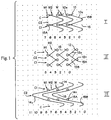
- the bottom (or back) guide bar of the warp knitting machine manipulates the second set of loop-forming yarns 10 as they are fed from their respective warp beam to traverse laterally back and forth relative to the needle bar of the machine alternately to stitch the loop-forming yarns 10 on alternate needles 15A and then to lay the yarns 10 without stitch formation about the intervening needles 15B in a repeating 1-0, 3-4 stitch pattern, as indicated at I of Figure 1.
- top (or front) guide bar simultaneously manipulates the first set of loop-forming yarns 14 as they are fed from their respective warp beam to traverse relative to the needle bar alternately to stitch the loop-forming yarns 14 on the same alternating needles 15A and then to lay the yarns 14 without stitch formation about spaced intervening needles 15B in a repeating 1-0, 3-4, 6-7, 3-4 stitch pattern, as indicated at III of Figure 1.
- the middle guide bar of the knitting machine manipulates the set of ground yarns 12 as they are fed from their respective warp beam to traverse relative to the needle bar in opposition to the top and bottom guide bars to stitch the ground yarns 12 on the same alternating needles 15A in a repeating 2-3, 1-0 stitch pattern, as indicated at II in Figure 1.
- the respective simultaneous stitch patterns of the ground and loop-forming yarns 10,12,14 are shown in a composite dot diagram in Figure 2.
- the ground and loop-forming yarns 10,12,14 are interknitted with one another by formation of respective needle loops 10n,12n,14n of the yarns in alternating wales W1 and alternating courses C1 of the resultant fabric, without any needle loops of any of the yarns being formed in the intervening wales W2 and only needle loops 12n of the ground yarns 12 being formed in the alternating wales W1 of the intervening courses C2.
- the stitch construction of the first loop-forming yarns 10 forms needle loops 10n thereof only in alternating wales W1 of alternating courses C1, each individual loop-forming yarn 10 having its respective needle loops 10n formed in alternating courses C1 and in a single common wale W1 with connecting underlap extents 10u extending between the successive needle loops 10n generally in the intervening courses C2.
- the ground yarns 12 are formed only in the alternating wales W1, each individual ground yarn 12 having its respective needle loops 12n alternating every course C between adjacent alternate wales W1 across the one intervening wale W2 across which underlaps 12u of the ground yarn extend diagonally back and forth in a substantially coursewise direction between the successive needle loops 12n.
- each individual loop-forming yarn 14 having its respective needle loops 14n formed in the alternating courses C1 in a single common wale W1 with connecting underlap extents 14u extending between the successive needle loops 14n generally in the intervening courses C2.
- the respective stitch patterns followed by the loop-forming yarns 10,14 cause each such yarn to be traversed during the formation of each intervening course C2 across a three-needle spacing from the needle 15A on which was formed a needle loop 10n,14n in the formation of the preceding course C1 to cause the yarns 10,14 to extend in a non-knitting manner about the spaced needle 15B.
- Such needles 15B hold the loop-forming yarns 10,14 during the formation of the intervening courses C2 and then subsequently shed the yarns 10,14 without formation of needle loops thereof upon formation of the next succeeding alternate course C1 and, since such needles are not involved in the formation of needle loops of the ground yarns 12 during the formation of any of the courses C1,C2, the held extents of the loop-forming yarns 10,14 do not become anchored in the fabric.
- the underlap extents 14u of the second loop-forming yarns 14 are substantially elongated and are free to extend outwardly as pile-like loops from the corresponding face of the fabric, i.e. the technical back thereof.
- the underlap extents 10u of the first loop-forming yarns 10 are elongated and free to extend outwardly from the corresponding face of the fabric, i.e., the technical face, as more fully explained below.
- the ground yarns 12 form a base or ground fabric structure which integrates the yarns 10,12,14 into the fabric, the coursewise alternating stitch construction of the ground yarns 12 permitting a corresponding degree of walewise stretchability of the fabric.
- the formation of the loop-forming yarns 14 on the top (front) guide bar of the knitting machine forms such yarns predominantly at the technical back of the fabric whereat the extended underlaps 14u extend generally outwardly of the fabric surface in the nature of elongated terry pile loops. Because of the particular stitch construction of the loop-forming yarns 14, the successive underlap loops 14u of each yarn 14 are formed during opposing lateral movements of the top guide bar and therefore the underlap loops 14u in the resultant fabric tend to lean coursewise alternately in opposite directions relative to the needle loops 14n, as depicted in Figures 1 and 2.
- the underlap loops 14u produced by the present fabric construction make the fabric well suited for use as the loop component of a hook-and-loop fastener, the outwardly extending disposition of the underlap loops 14u orienting them optimally for engagement with the hook elements of a mating fastener hook component, which could be of a variety of conventional constructions.
- the elongated nature of the underlap loops 14u provides sufficient loop elevation from the fabric surface that napping, brushing or other mechanical raising of the loops, which is conventionally necessary in other fastener loop fabric constructions, can be avoided altogether.
- the formation of the loop-forming yarns 10 on the bottom (back) guide bar of the knitting machine forms such yarns predominantly at the technical face of the fabric.
- the underlaps 10u would normally tend to appear at the technical back of the fabric, because of the presence of the ground structure formed by the ground yarns 12, the underlaps 10u are caused to project from the technical face of the fabric, but to a lesser projecting elevation than the loops 14u of the first loop-forming yarns 14 at the technical back.
- the underlaps 10u of the second loop-forming yarns 10 are always formed during lateral movements of the bottom guide in the same direction, then in contrast to the loops 14u of the yarns 14, the underlap loops 10u in the resultant fabric tend to project in the same direction as each other, thereby forming a walewise ribbed effect at the technical face of the fabric.
- the projecting loops 10u facilitate adhesion of the technical face of the fabric to a substrate or backing material, leaving the technical back exposed to serve a fastening function, as more fully explained below.
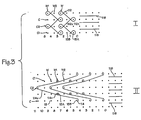
- Figure 3 illustrates an alternative embodiment of the present textile fabric which is warp knitted of a two-bar construction on a two-bar weft insertion warp knitting machine according to the present method.
- the top guide bar of the machine is threaded on alternating guide members in a "one out, one in” threading arrangement with a set of loop-forming yarns 114, while the bottom guide bar is threaded on alternating guide members in a "one in, one out” threading arrangement with a set of ground yarns 112.
- the top guide bar manipulates the set of loop-forming yarns 114 as they are fed from their respective warp beam to traverse relative to the needle bar alternately to stitch the loop-forming yarns 114 on alternating needles 15A and then to lay the yarns 114 without stitch formation about spaced intervening needles 15B in a repeating 1-0, 3-4, 6-7, 3-4 stitch pattern as indicated at II of Figure 3.
- the bottom guide bar of the knitting machine manipulates the set of ground yarns 112 as they are fed from their respective warp beam to traverse relative to the needle bar to stitch the ground yarns 112 on the same alternating needles 15A in a repeating 1-0, 2-3, stitch pattern, as indicated at I in Figure 3.
- the warp knitting machine includes a weft insertion device supplied with the filling yarn 116.
- the weft insertion device is activated during the formation of each alternating course C1 to insert the filling yarn 116 weftwise through the needle loops 112n,114n of the ground and loop-forming yarns 112,114 and during the formation of the intervening courses C2 to insert the filling yarn 116 weftwise through the needle loops 112n of the ground yarn 112.
- the ground and loop-forming yarns 112,114 are inter-knitted with one another by formation of respective needle loops 112n,114n of the yarns in alternating wales W1 and alternating courses C1 of the resultant fabric, without any needle loops of either of the yarns being formed in the intervening wales W2 and only needle loops 112n of the ground yarns 112 being formed in the alternating wales W1 of the intervening courses C2.
- the ground yarns 112 are formed only in the alternating wales W1, each individual ground yarn 112 having its respective needle loops 112n alternating every course C between adjacent alternate wales W1 across the one intervening wale W2 across which underlaps 112u of the ground yarn extend diagonally back and forth in a substantially coursewise direction between the successive needle loops 112n.
- the stitch construction of the loop-forming yarns 114 form them in needle loops 114n appearing only in the alternating courses C1 and in the alternating wales W1, each individual loop-forming yarn 114 having its respective needle loops 114n formed in the alternating courses C1 in a single common wale W1 with connecting underlap extents 114u extending between the successive needle loops 114n generally in the intervening courses C2.
- the weftwise insertion of the filling yarns 116 cause them to extend coursewise back and forth across the fabric in parallel extents through the needle loops 112n,114n in each succeeding fabric course C1,C2.
- the loop-forming yarns 114 appear predominantly at the technical back of the fabric whereat the elongated underlaps 114u are free to extend generally outwardly of the fabric surface in the nature of elongated terry pile loops, with the successive underlap loops 114u of each loop-forming yarn 114 tending to lean coursewise alternately in opposite directions relative to the needle loops 114n, making the fabric of Figure 3 equally well suited for use as the loop component of a hook-and-loop fastener.
- the fabrics of the present invention provide several distinct advantages over conventional fastener loop fabric construction.
- the ground and loop-forming yarns to be of relatively fine denier
- the present fastener loop fabric constructions can be made significantly lighter in weight per unit fabric dimension than corresponding conventional fastener loop fabric constructions.
- manufacture of the present fabric constructions is expedited and simplified by avoiding the necessity of brushing, napping or otherwise raising the fastener loops 14u,114u. As a result, the manufacturing cost of the present fabrics can be relatively reduced in comparison to conventional fastener loop fabrics.
- the elongated upstanding nature of the loops 14u,114u formed by the present constructions together with the opposing coursewise leaning of the loops provides optimal interengagement between the loops and the hook elements of a mating hook-type fastener component so that the peel force value, i.e., the force required to peel a hook fabric component from the present loop fabric, and the shear force value, i.e., the force required to pull a hook fabric component from the present loop fabric component in a direction parallel to the loop fabric component, compare favorably with conventional fastener loop fabric constructions.
- fastener loop fabric constructions of the present invention owing to their provision of suitable functional characteristics at relatively lower cost and lighter weight than conventional fastener loop fabric constructions, are believed to be highly suitable for various forms of one-time and disposable uses such as, for example, use as a carpet backing of the type contemplated in aforementioned U.S. Patent No. 4,822,658.
- the ribbed formation of the projecting loops 10u at the technical face of the fabric enable the fabric to be adhesively anchored by such loops in the foamed baking material of conventional carpets without necessarily adhering the ground structure of the present fabric in the carpet backing, whereby the natural walewise stretchability of the present fabric is not inhibited thus permitting the fabric to stretch and move relative to the carpet and its backing so that the adherence of the present fabric to the carpet does not affect the normal performance characteristics of the carpet.
- the present fabric may be of a two-bar construction with pile-like loops appearing at only one face of the fabric, e.g., the loops 114u at the technical back of the fabric.
- the opposite face of the fabric i.e., the technical face
- the foamed backing material of a carpet in the absence of anchoring loops such as the loops 10u in the fabric of Figures 1 and 2
- the fastener fabrics of the present invention are inherently lighter in weight and more stretchable than conventional fastener fabrics, it has been found that the present fabrics are somewhat more difficult to handle during fabric finishing processes. Accordingly, the present invention also provides a method of treating the present fastener fabric preparatory to the performance of conventional fabric finishing processes to improve the fabric's handleability and to enable the fabric to sufficiently restrict foam penetration.
- the process of the present invention provides for application of a stiffening agent to the fabric to temporarily improve the handleability of the fabric, but it is contemplated that the stiffening agent should be readily broken and releasable from the fabric as a result of manipulation, bending and like handling of the fabric so that the stiffening agent does not remain as a permanent additive to the fabric and, in turn, the lengthwise stretchability of the fabric is not permanently impaired.
- a starch material performs suitably for this purpose, preferably a polyvinyl acetate (PVA) starch such as the Resin 5904 manufactured and sold by Cybron, Inc. of Wellman, South Carolina, formerly National Starch Corp.
- PVA polyvinyl acetate
- the starch is prepared in the form of a bath wherein the starch content is between approximately 10 percent and 40 percent of the total weight of the bath, the particular percentage being varied in relation to the method by which the starch is applied to the fabric and the resultant degree of starch take-up by the fabric accomplished by the application method.
- the starch bath may be sprayed onto the technical face of the fabric, which advantageously minimizes the application of the starch to the fastener loops at the technical back of the fabric.
- a higher starch content in the bath near the upper end of the aforesaid range is preferable.
- the fabric may be passed through the bath in a conventional padding operation wherein the entire fabric is submerged in the bath, in which case a lower starch content near the lower end of the aforementioned range can be utilized.
- a foam resistant agent is also applied to the fabric to enable it to partially resist adhesion of the foam to the fabric and thereby to restrict foam penetration into the fabric structure so that the fabric retains a desirable degree of its lengthwise stretchability after adhesion to the foam backing layer of a carpet.
- urethane foam is predominantly used to produce the foam backing on conventional carpeting materials and, accordingly, the present invention contemplates that a preferable foam resistant agent is a fluorocarbon surface finish.
- the fluorocarbon composition should exhibit both water resistant and oil resistant properties, preferably accomplished by mixing a water-resistant fluorocarbon with an oil resistant fluorocarbon to produce the present fluorocarbon composition.
- the fluorocarbon composition is also produced in the form of a bath and, as will be understood, the fluorocarbon content of the bath should be carefully regulated so that the amount of fluorocarbon applied to the fabric will not be so great as to prevent any adherence of the fabric to the foam but at the same time it is not so small than the foam will still readily penetrate the interstices of the fabric's knit structure.
- the foam may be cast directly onto the technical face of the traveling fastener fabric and the carpet later adhered to the foam or, alternatively, the foam could be applied to the back of the traveling carpet and then the technical face of the fastener fabric laid onto the foam layer) and also the distance the fastener fabric must travel from the point at which the foam is applied to the point at which the foam cures.
- the fluorocarbon composition should have a total fluorocarbon content varying between approximately 0.25 percent and 8 percent of the total weight of the bath.
- the particular yarns and yarn sizes (denier), as well as the particular stitch patterns followed by the constituent yarns may be selectively varied, as desired, to modify the properties and characteristics of the resultant fabric to achieve differing embodiments of the fabric suited to differing uses, so long as the stitch construction of the several yarns in selected to achieve elongated underlaps of the loop-forming yarns which are not anchored into the fabric structure so as to permit the underlaps to extend outwardly from the resultant fabric in the nature of pile loops.
- the fastener loop fabric of the present invention could be of a four bar construction rather than a three bar construction, if desirable to achieve additional or different fabric properties. All such modifications and variations on the present invention are intended to be within the scope of the present invention.
Landscapes
- Engineering & Computer Science (AREA)
- Textile Engineering (AREA)
- Knitting Of Fabric (AREA)
- Slide Fasteners, Snap Fasteners, And Hook Fasteners (AREA)
- Chemical Or Physical Treatment Of Fibers (AREA)
Applications Claiming Priority (5)
| Application Number | Priority Date | Filing Date | Title |
|---|---|---|---|
| US08/034,088 US5267453A (en) | 1991-06-06 | 1993-03-22 | Loop-type textile fastener fabric and method of producing same |
| US34088 | 1993-03-22 | ||
| US08/138,335 US5407722A (en) | 1991-06-06 | 1993-10-18 | Loop-type textile fastener fabric, method of producing same and process of treating same |
| EP19940104033 EP0618320B1 (de) | 1993-03-22 | 1994-03-16 | Textiler Verschlussstoff des Schlingentyps, Verfahren zu dessen Herstellung und Verfahren zu dessen Behandlung |
| US138335 | 1998-08-21 |
Related Parent Applications (2)
| Application Number | Title | Priority Date | Filing Date |
|---|---|---|---|
| EP94104033.9 Division | 1994-03-16 | ||
| EP19940104033 Division EP0618320B1 (de) | 1993-03-22 | 1994-03-16 | Textiler Verschlussstoff des Schlingentyps, Verfahren zu dessen Herstellung und Verfahren zu dessen Behandlung |
Publications (3)
| Publication Number | Publication Date |
|---|---|
| EP0829563A2 true EP0829563A2 (de) | 1998-03-18 |
| EP0829563A3 EP0829563A3 (de) | 1998-10-21 |
| EP0829563B1 EP0829563B1 (de) | 2001-09-12 |
Family
ID=26710534
Family Applications (2)
| Application Number | Title | Priority Date | Filing Date |
|---|---|---|---|
| EP97118572A Expired - Lifetime EP0829563B1 (de) | 1993-03-22 | 1994-03-16 | Textiler Haftverschlussstoff vom Schlingen-Type, Verfahren zu dessen Herstellung und Verfahren zu dessen Behandlung |
| EP19940104033 Expired - Lifetime EP0618320B1 (de) | 1993-03-22 | 1994-03-16 | Textiler Verschlussstoff des Schlingentyps, Verfahren zu dessen Herstellung und Verfahren zu dessen Behandlung |
Family Applications After (1)
| Application Number | Title | Priority Date | Filing Date |
|---|---|---|---|
| EP19940104033 Expired - Lifetime EP0618320B1 (de) | 1993-03-22 | 1994-03-16 | Textiler Verschlussstoff des Schlingentyps, Verfahren zu dessen Herstellung und Verfahren zu dessen Behandlung |
Country Status (5)
| Country | Link |
|---|---|
| US (3) | US5267453A (de) |
| EP (2) | EP0829563B1 (de) |
| AT (2) | ATE205560T1 (de) |
| DE (2) | DE69428294T2 (de) |
| ES (2) | ES2164288T3 (de) |
Cited By (2)
| Publication number | Priority date | Publication date | Assignee | Title |
|---|---|---|---|---|
| WO1999060880A1 (de) * | 1998-05-22 | 1999-12-02 | Gottlieb Binder Gmbh & Co. | Verfahren zum herstellen von haftverschlussteilen |
| EP0978583A1 (de) * | 1998-08-07 | 2000-02-09 | Milliken Fabrics SA | Schlingenstoff mit verflochtenen Kettenmaschen |
Families Citing this family (48)
| Publication number | Priority date | Publication date | Assignee | Title |
|---|---|---|---|---|
| JP2857058B2 (ja) * | 1993-08-05 | 1999-02-10 | ワイケイケイ株式会社 | カーテン用芯地と同芯地を使用するカーテン吊下構造 |
| US6096667A (en) * | 1994-07-25 | 2000-08-01 | Milliken & Company | Hook and loop fastener |
| US5557950A (en) * | 1995-06-02 | 1996-09-24 | Guilford Mills, Inc. | Warp knitted plush fabric resistant to pile pull-through |
| CN1149033C (zh) * | 1995-07-26 | 2004-05-12 | 可乐丽股份有限公司 | 搭扣式紧固物的母搭接件 |
| US5658430A (en) * | 1995-11-17 | 1997-08-19 | Burlington Industries, Inc. | Carpet over carpet installation adhesive |
| US5692949A (en) * | 1995-11-17 | 1997-12-02 | Minnesota Mining And Manufacturing Company | Back-up pad for use with abrasive articles |
| FR2741636B1 (fr) † | 1995-11-29 | 1998-02-06 | Aplix Sa | Ensemble lamine constitue par un tissu tricote chaine ou trame a boucles contrecolle sur un support, et son procede de fabrication |
| US5891547A (en) * | 1997-02-04 | 1999-04-06 | Precision Fabrics Group, Inc. | Needle punch nonwoven component for refastenable fastening device |
| US6342285B1 (en) | 1997-09-03 | 2002-01-29 | Velcro Industries B.V. | Fastener loop material, its manufacture, and products incorporating the material |
| US6329016B1 (en) | 1997-09-03 | 2001-12-11 | Velcro Industries B.V. | Loop material for touch fastening |
| US6869659B2 (en) | 1997-09-03 | 2005-03-22 | Velcro Industries B.V. | Fastener loop material, its manufacture, and products incorporating the material |
| US6099932A (en) * | 1997-12-31 | 2000-08-08 | Gehring Textiles, Inc. | Loop fabric for hook and-loop type fastener and method of making the same |
| US6216496B1 (en) * | 1998-09-04 | 2001-04-17 | Gehring Textiles, Inc. | High performance hook and loop closure system |
| FR2791707B1 (fr) * | 1999-03-30 | 2001-05-25 | Aplix Sa | Tissu tricote a boucles de faible grammage |
| US6484325B1 (en) | 1999-12-23 | 2002-11-26 | Liberty Fabrics, Inc. | Athletic garment and equipment system |
| ES2299479T3 (es) | 2000-03-14 | 2008-06-01 | Velcro Industries B.V. | Cierre de gancho y presilla. |
| US20030021944A1 (en) * | 2000-12-29 | 2003-01-30 | Morin Brian G. | Combination loop textile |
| BE1014191A3 (nl) † | 2001-05-21 | 2003-06-03 | Picanol Nv | Draadklem voor een weefmachine en weefmachine die dergelijke draadklem bevat. |
| US6939372B2 (en) | 2001-07-03 | 2005-09-06 | Scimed Life Systems, Inc. | Low profile, high stretch, low dilation knit prosthetic device |
| US6554855B1 (en) * | 2001-07-03 | 2003-04-29 | Scimed Life Systems, Inc. | Low profile, high stretch, low dilation knit prosthetic device |
| US20100299880A1 (en) * | 2002-05-31 | 2010-12-02 | Sitip S.p.A., | Polypropylene Fabric and Its Use in the "Personal Care" Field |
| US7465366B2 (en) * | 2002-12-03 | 2008-12-16 | Velero Industries B.V. | Needling loops into carrier sheets |
| US20050217092A1 (en) * | 2002-12-03 | 2005-10-06 | Barker James R | Anchoring loops of fibers needled into a carrier sheet |
| US7547469B2 (en) | 2002-12-03 | 2009-06-16 | Velcro Industries B.V. | Forming loop materials |
| US8753459B2 (en) * | 2002-12-03 | 2014-06-17 | Velcro Industries B.V. | Needling loops into carrier sheets |
| US20050196583A1 (en) * | 2002-12-03 | 2005-09-08 | Provost George A. | Embossing loop materials |
| US20050196580A1 (en) * | 2002-12-03 | 2005-09-08 | Provost George A. | Loop materials |
| ES2302974T3 (es) | 2002-12-03 | 2008-08-01 | Velcro Industries B.V. | Perforacion con aguja a traves de laminas de soporte para formar bucles. |
| JP3895272B2 (ja) * | 2002-12-24 | 2007-03-22 | Ykk株式会社 | 繊維製面ファスナー |
| US6705132B1 (en) * | 2003-04-30 | 2004-03-16 | Gfd Fabrics, Inc. | Loop-type textile fastener fabric with diagonally extending pile loops and method of producing same |
| JP3886944B2 (ja) * | 2003-07-15 | 2007-02-28 | Ykk株式会社 | 編込み面ファスナー |
| US20050067041A1 (en) * | 2003-08-28 | 2005-03-31 | Taiwan Paiho Limited | Velcro fastener belt |
| DE10354149A1 (de) * | 2003-11-19 | 2005-07-07 | Gebrüder Aurich GmbH | Klettverschluss sowie textiles Gewirk |
| US8562580B2 (en) * | 2004-04-30 | 2013-10-22 | Kimberly-Clark Worldwide, Inc. | Selective modification of a nonwoven surface |
| JP4076525B2 (ja) * | 2004-08-06 | 2008-04-16 | Ykk株式会社 | 編成面ファスナー |
| US7562426B2 (en) * | 2005-04-08 | 2009-07-21 | Velcro Industries B.V. | Needling loops into carrier sheets |
| US20070178273A1 (en) * | 2006-02-01 | 2007-08-02 | Provost George A | Embossing loop materials |
| US20080113152A1 (en) * | 2006-11-14 | 2008-05-15 | Velcro Industries B.V. | Loop Materials |
| US8673097B2 (en) * | 2007-06-07 | 2014-03-18 | Velcro Industries B.V. | Anchoring loops of fibers needled into a carrier sheet |
| DE102009022107A1 (de) * | 2009-05-20 | 2010-11-25 | Ksb Ag | Verfahren und Vorrichtung zur Betriebspunktbestimmung einer Arbeitsmaschine |
| FR2954723B1 (fr) * | 2009-12-29 | 2012-04-20 | Saint Gobain Abrasives Inc | Article abrasif comprenant un espace creux entre ses faces avant et arriere, et procede de fabrication |
| JP4861503B1 (ja) * | 2010-08-06 | 2012-01-25 | 丸紅インテックス株式会社 | 面ファスナ用編地 |
| CN103124506B (zh) * | 2010-09-29 | 2015-08-19 | Ykk株式会社 | 具有织物制的带的拉链牙链 |
| WO2013028250A1 (en) | 2011-08-25 | 2013-02-28 | Velcro Industries B.V | Loop-engageable fasteners and related systems and methods |
| WO2013028251A1 (en) | 2011-08-25 | 2013-02-28 | Velcro Industries B.V | Hook-engageable loop fasteners and related systems and methods |
| JP6774738B2 (ja) * | 2015-04-15 | 2020-10-28 | スリーエム イノベイティブ プロパティズ カンパニー | 面ファスナ雌材、面ファスナ、及び吸収性物品 |
| US10400105B2 (en) | 2015-06-19 | 2019-09-03 | The Research Foundation For The State University Of New York | Extruded starch-lignin foams |
| CN115652519A (zh) * | 2022-09-13 | 2023-01-31 | 浙江德俊新材料有限公司 | 一种经编毛圈魔术贴面料及生产方法 |
Family Cites Families (35)
| Publication number | Priority date | Publication date | Assignee | Title |
|---|---|---|---|---|
| US3391434A (en) * | 1966-10-07 | 1968-07-09 | American Velcro Inc | Fastening device |
| GB1259014A (de) * | 1968-04-22 | 1972-01-05 | ||
| AT301007B (de) * | 1968-09-20 | 1972-08-25 | Elitex Zavody Textilniho | Doppelseitiges Durchwirkgebilde |
| BE727352A (de) * | 1969-01-24 | 1969-07-24 | ||
| US3594873A (en) * | 1969-03-10 | 1971-07-27 | American Velcro Inc | Fire-resistant fastening device and method of manufacture |
| CH515699A (fr) * | 1970-04-29 | 1971-11-30 | Velcro Sa Soulie | Article en forme de nappe à éléments d'accrochage multiples |
| DE7030645U (de) * | 1970-08-14 | 1970-11-12 | Gerrit Van Delden & Co | Rutschfeste belaege fuer textile bodenflaechen. |
| US3694815A (en) * | 1970-09-25 | 1972-10-03 | Kimberly Clark Co | Method for applying elastic ribbon to fabrics |
| BE787643A (fr) * | 1971-08-18 | 1973-02-19 | Bigelow Sanford Inc | Dalles de moquette amovibles |
| DE2201231A1 (de) * | 1972-01-12 | 1973-07-26 | Girmes Werke Ag | Bodenbelag |
| IT1070269B (it) * | 1975-10-21 | 1985-03-29 | Allied Chem | Moduli di tappeto staccabili |
| DE2646917A1 (de) * | 1975-11-21 | 1977-06-02 | Reichhold Chemicals Inc | Textillaminat, verfahren und vorrichtung zu dessen herstellung |
| US4114346A (en) * | 1977-09-28 | 1978-09-19 | Gaf Corporation | Method and product for installation of sheet flooring |
| DE2803006A1 (de) * | 1978-01-20 | 1979-08-02 | Veh Geb Guenther Wilburga | Haftnahtband fuer lose liegende bodenbelaege |
| JPS6027281B2 (ja) * | 1979-05-09 | 1985-06-28 | ワイケイケイ株式会社 | ベルベツト式フアスナ−用テ−プの製造方法 |
| US4562097A (en) * | 1980-05-09 | 1985-12-31 | Union Carbide Corporation | Process of treating fabrics with foam |
| DE3113637A1 (de) * | 1981-04-04 | 1982-10-21 | J.F. Adolff Ag, 7150 Backnang | Bodenbelag-warenbahn sowie verfarhen zu ihrer herstellung und verfarhen zum verlegen derartiger warenbahnen |
| US4567075A (en) * | 1983-05-20 | 1986-01-28 | Fab Industries, Inc. | Double faced knit fabric and method |
| US4467625A (en) * | 1983-11-02 | 1984-08-28 | Milton Kurz | Two bar warp-knitted loop fabric |
| US4624116A (en) * | 1983-12-09 | 1986-11-25 | Milliken Research Corporation | Loop pile warp knit, weft inserted fabric |
| JPS60126377A (ja) * | 1983-12-13 | 1985-07-05 | 日本化薬株式会社 | 布帛の一時硬化法 |
| JPS60194174A (ja) * | 1984-03-12 | 1985-10-02 | 工業技術院長 | 柔軟布一時硬化処理方法 |
| US4557774B2 (en) * | 1984-09-04 | 1995-02-14 | Step Loc Corp | System for holding carpet in place without stretching |
| NZ214244A (en) * | 1984-11-20 | 1988-11-29 | Velcro Usa | Separable fastener and method of attachment thereof to a foam plastics article |
| IT207664Z2 (it) * | 1985-02-06 | 1988-02-08 | Costamasnaga Spa | Carro ferroviario a piano superiore verticalmente posizionabile,per il trasporto di autovetture e simili |
| JPH0235207Y2 (de) * | 1985-10-23 | 1990-09-25 | ||
| JPS6285113U (de) * | 1985-11-15 | 1987-05-30 | ||
| US4714096A (en) * | 1985-12-03 | 1987-12-22 | George C. Moore Co. | Elastic fabric provided with a looped gripping surface |
| KR890003510Y1 (ko) * | 1986-10-08 | 1989-05-27 | 요시다 고오교오 가부시키가이샤 | 경편성 테이프 |
| JPH0437453Y2 (de) * | 1987-03-24 | 1992-09-03 | ||
| US4822658B1 (en) * | 1987-12-23 | 1997-06-10 | Joseph R Pacione | Carpet backing and installation system |
| FR2632830A1 (fr) * | 1988-06-16 | 1989-12-22 | Aplix Sa | Support en feuille portant des boucles, notamment pour la confection de l'un des deux elements d'une fermeture auto-agrippante, et procede et machine pour sa fabrication |
| US4881383A (en) * | 1988-07-05 | 1989-11-21 | Guilford Mills, Inc. | Warp knitted fabric with satin-like back and brushable face and method of knitting same |
| US5065600A (en) * | 1989-11-30 | 1991-11-19 | Guilford Mills, Inc. | Textile fabric with opposed absorbent and non-absorbent layers and method of fabricating same |
| US5214942A (en) * | 1991-06-06 | 1993-06-01 | Guilford Mills, Inc. | Loop-type textile fastener fabric and method of producing same |
-
1993
- 1993-03-22 US US08/034,088 patent/US5267453A/en not_active Expired - Lifetime
- 1993-10-18 US US08/138,335 patent/US5407722A/en not_active Expired - Lifetime
-
1994
- 1994-03-16 ES ES97118572T patent/ES2164288T3/es not_active Expired - Lifetime
- 1994-03-16 AT AT97118572T patent/ATE205560T1/de not_active IP Right Cessation
- 1994-03-16 DE DE69428294T patent/DE69428294T2/de not_active Expired - Lifetime
- 1994-03-16 EP EP97118572A patent/EP0829563B1/de not_active Expired - Lifetime
- 1994-03-16 EP EP19940104033 patent/EP0618320B1/de not_active Expired - Lifetime
- 1994-03-16 AT AT94104033T patent/ATE169971T1/de not_active IP Right Cessation
- 1994-03-16 ES ES94104033T patent/ES2122060T3/es not_active Expired - Lifetime
- 1994-03-16 DE DE69412525T patent/DE69412525T2/de not_active Expired - Lifetime
- 1994-04-15 US US08/228,294 patent/US5449530A/en not_active Expired - Lifetime
Cited By (3)
| Publication number | Priority date | Publication date | Assignee | Title |
|---|---|---|---|---|
| WO1999060880A1 (de) * | 1998-05-22 | 1999-12-02 | Gottlieb Binder Gmbh & Co. | Verfahren zum herstellen von haftverschlussteilen |
| US6572727B1 (en) | 1998-05-22 | 2003-06-03 | Gottlieb Binder Gmbh & Co. | Method for producing adhesive closing parts |
| EP0978583A1 (de) * | 1998-08-07 | 2000-02-09 | Milliken Fabrics SA | Schlingenstoff mit verflochtenen Kettenmaschen |
Also Published As
| Publication number | Publication date |
|---|---|
| ES2164288T3 (es) | 2002-02-16 |
| DE69412525D1 (de) | 1998-09-24 |
| DE69428294T2 (de) | 2002-10-24 |
| US5267453A (en) | 1993-12-07 |
| EP0618320A3 (de) | 1995-05-10 |
| EP0829563B1 (de) | 2001-09-12 |
| US5407722A (en) | 1995-04-18 |
| EP0618320B1 (de) | 1998-08-19 |
| EP0618320A2 (de) | 1994-10-05 |
| EP0829563A3 (de) | 1998-10-21 |
| ATE169971T1 (de) | 1998-09-15 |
| DE69412525T2 (de) | 1999-04-01 |
| ES2122060T3 (es) | 1998-12-16 |
| DE69428294D1 (de) | 2001-10-18 |
| US5449530A (en) | 1995-09-12 |
| ATE205560T1 (de) | 2001-09-15 |
Similar Documents
| Publication | Publication Date | Title |
|---|---|---|
| EP0829563B1 (de) | Textiler Haftverschlussstoff vom Schlingen-Type, Verfahren zu dessen Herstellung und Verfahren zu dessen Behandlung | |
| US5214942A (en) | Loop-type textile fastener fabric and method of producing same | |
| EP0223075B1 (de) | Kettengestricktes Haftverschlusstragband | |
| KR880002468Y1 (ko) | 후크-루우프 파스너용 지지 테이프 | |
| EP0694642B1 (de) | Haftverschluss | |
| EP0284020B1 (de) | Kettengestricktes Band für Haftverschlüsse | |
| EP0223024B1 (de) | Kettengestricktes Haftverschlusstragband | |
| US4624116A (en) | Loop pile warp knit, weft inserted fabric | |
| EP0265739B1 (de) | Kettengestricktes Haftverschlusstragband | |
| EP1350879A1 (de) | Dehnbares kettengewirktes Klettverschlusstextil und Herstellungsmethode | |
| JP2584013Y2 (ja) | 面ファスナー用基布 | |
| KR100693636B1 (ko) | 루프에 손상이 적은 후크 패스너 부재 | |
| US3996773A (en) | Warp-knitted tape for slide fasteners | |
| US6705132B1 (en) | Loop-type textile fastener fabric with diagonally extending pile loops and method of producing same | |
| US4376146A (en) | Weft insertion knitted secondary carpet backing | |
| TWM676069U (zh) | 具有面扣結件之物品 |
Legal Events
| Date | Code | Title | Description |
|---|---|---|---|
| PUAI | Public reference made under article 153(3) epc to a published international application that has entered the european phase |
Free format text: ORIGINAL CODE: 0009012 |
|
| AC | Divisional application: reference to earlier application |
Ref document number: 618320 Country of ref document: EP |
|
| AK | Designated contracting states |
Kind code of ref document: A2 Designated state(s): AT BE CH DE DK ES FR GB GR IE IT LI LU MC NL PT SE |
|
| PUAL | Search report despatched |
Free format text: ORIGINAL CODE: 0009013 |
|
| AK | Designated contracting states |
Kind code of ref document: A3 Designated state(s): AT BE CH DE DK ES FR GB GR IE IT LI LU MC NL PT SE |
|
| RHK1 | Main classification (correction) |
Ipc: D06N 7/00 |
|
| 17P | Request for examination filed |
Effective date: 19990414 |
|
| 17Q | First examination report despatched |
Effective date: 20000202 |
|
| GRAG | Despatch of communication of intention to grant |
Free format text: ORIGINAL CODE: EPIDOS AGRA |
|
| GRAG | Despatch of communication of intention to grant |
Free format text: ORIGINAL CODE: EPIDOS AGRA |
|
| GRAH | Despatch of communication of intention to grant a patent |
Free format text: ORIGINAL CODE: EPIDOS IGRA |
|
| GRAH | Despatch of communication of intention to grant a patent |
Free format text: ORIGINAL CODE: EPIDOS IGRA |
|
| GRAA | (expected) grant |
Free format text: ORIGINAL CODE: 0009210 |
|
| AC | Divisional application: reference to earlier application |
Ref document number: 618320 Country of ref document: EP |
|
| AK | Designated contracting states |
Kind code of ref document: B1 Designated state(s): AT BE CH DE DK ES FR GB GR IE IT LI LU MC NL PT SE |
|
| PG25 | Lapsed in a contracting state [announced via postgrant information from national office to epo] |
Ref country code: NL Free format text: LAPSE BECAUSE OF FAILURE TO SUBMIT A TRANSLATION OF THE DESCRIPTION OR TO PAY THE FEE WITHIN THE PRESCRIBED TIME-LIMIT Effective date: 20010912 Ref country code: LI Free format text: LAPSE BECAUSE OF FAILURE TO SUBMIT A TRANSLATION OF THE DESCRIPTION OR TO PAY THE FEE WITHIN THE PRESCRIBED TIME-LIMIT Effective date: 20010912 Ref country code: CH Free format text: LAPSE BECAUSE OF FAILURE TO SUBMIT A TRANSLATION OF THE DESCRIPTION OR TO PAY THE FEE WITHIN THE PRESCRIBED TIME-LIMIT Effective date: 20010912 Ref country code: AT Free format text: LAPSE BECAUSE OF FAILURE TO SUBMIT A TRANSLATION OF THE DESCRIPTION OR TO PAY THE FEE WITHIN THE PRESCRIBED TIME-LIMIT Effective date: 20010912 |
|
| REF | Corresponds to: |
Ref document number: 205560 Country of ref document: AT Date of ref document: 20010915 Kind code of ref document: T |
|
| REG | Reference to a national code |
Ref country code: CH Ref legal event code: EP |
|
| REG | Reference to a national code |
Ref country code: IE Ref legal event code: FG4D |
|
| REF | Corresponds to: |
Ref document number: 69428294 Country of ref document: DE Date of ref document: 20011018 |
|
| PG25 | Lapsed in a contracting state [announced via postgrant information from national office to epo] |
Ref country code: PT Free format text: LAPSE BECAUSE OF FAILURE TO SUBMIT A TRANSLATION OF THE DESCRIPTION OR TO PAY THE FEE WITHIN THE PRESCRIBED TIME-LIMIT Effective date: 20011212 Ref country code: DK Free format text: LAPSE BECAUSE OF FAILURE TO SUBMIT A TRANSLATION OF THE DESCRIPTION OR TO PAY THE FEE WITHIN THE PRESCRIBED TIME-LIMIT Effective date: 20011212 |
|
| PG25 | Lapsed in a contracting state [announced via postgrant information from national office to epo] |
Ref country code: GR Free format text: LAPSE BECAUSE OF FAILURE TO SUBMIT A TRANSLATION OF THE DESCRIPTION OR TO PAY THE FEE WITHIN THE PRESCRIBED TIME-LIMIT Effective date: 20011214 |
|
| REG | Reference to a national code |
Ref country code: GB Ref legal event code: IF02 |
|
| ET | Fr: translation filed | ||
| REG | Reference to a national code |
Ref country code: ES Ref legal event code: FG2A Ref document number: 2164288 Country of ref document: ES Kind code of ref document: T3 |
|
| NLV1 | Nl: lapsed or annulled due to failure to fulfill the requirements of art. 29p and 29m of the patents act | ||
| REG | Reference to a national code |
Ref country code: CH Ref legal event code: PL |
|
| PG25 | Lapsed in a contracting state [announced via postgrant information from national office to epo] |
Ref country code: MC Free format text: LAPSE BECAUSE OF NON-PAYMENT OF DUE FEES Effective date: 20020316 Ref country code: LU Free format text: LAPSE BECAUSE OF NON-PAYMENT OF DUE FEES Effective date: 20020316 |
|
| PG25 | Lapsed in a contracting state [announced via postgrant information from national office to epo] |
Ref country code: IE Free format text: LAPSE BECAUSE OF NON-PAYMENT OF DUE FEES Effective date: 20020318 |
|
| PLBE | No opposition filed within time limit |
Free format text: ORIGINAL CODE: 0009261 |
|
| STAA | Information on the status of an ep patent application or granted ep patent |
Free format text: STATUS: NO OPPOSITION FILED WITHIN TIME LIMIT |
|
| 26N | No opposition filed | ||
| REG | Reference to a national code |
Ref country code: IE Ref legal event code: MM4A |
|
| REG | Reference to a national code |
Ref country code: FR Ref legal event code: TP |
|
| REG | Reference to a national code |
Ref country code: GB Ref legal event code: 732E |
|
| PGFP | Annual fee paid to national office [announced via postgrant information from national office to epo] |
Ref country code: FR Payment date: 20110401 Year of fee payment: 18 Ref country code: SE Payment date: 20110325 Year of fee payment: 18 |
|
| PGFP | Annual fee paid to national office [announced via postgrant information from national office to epo] |
Ref country code: ES Payment date: 20110324 Year of fee payment: 18 Ref country code: GB Payment date: 20110324 Year of fee payment: 18 Ref country code: BE Payment date: 20110328 Year of fee payment: 18 Ref country code: DE Payment date: 20110322 Year of fee payment: 18 |
|
| PGFP | Annual fee paid to national office [announced via postgrant information from national office to epo] |
Ref country code: IT Payment date: 20110329 Year of fee payment: 18 |
|
| BERE | Be: lapsed |
Owner name: *GFD FABRICS INC. Effective date: 20120331 |
|
| REG | Reference to a national code |
Ref country code: SE Ref legal event code: EUG |
|
| PG25 | Lapsed in a contracting state [announced via postgrant information from national office to epo] |
Ref country code: SE Free format text: LAPSE BECAUSE OF NON-PAYMENT OF DUE FEES Effective date: 20120317 |
|
| GBPC | Gb: european patent ceased through non-payment of renewal fee |
Effective date: 20120316 |
|
| REG | Reference to a national code |
Ref country code: FR Ref legal event code: ST Effective date: 20121130 |
|
| REG | Reference to a national code |
Ref country code: DE Ref legal event code: R119 Ref document number: 69428294 Country of ref document: DE Effective date: 20121002 |
|
| PG25 | Lapsed in a contracting state [announced via postgrant information from national office to epo] |
Ref country code: FR Free format text: LAPSE BECAUSE OF NON-PAYMENT OF DUE FEES Effective date: 20120402 Ref country code: GB Free format text: LAPSE BECAUSE OF NON-PAYMENT OF DUE FEES Effective date: 20120316 Ref country code: BE Free format text: LAPSE BECAUSE OF NON-PAYMENT OF DUE FEES Effective date: 20120331 |
|
| PG25 | Lapsed in a contracting state [announced via postgrant information from national office to epo] |
Ref country code: IT Free format text: LAPSE BECAUSE OF NON-PAYMENT OF DUE FEES Effective date: 20120316 |
|
| REG | Reference to a national code |
Ref country code: ES Ref legal event code: FD2A Effective date: 20130710 |
|
| PG25 | Lapsed in a contracting state [announced via postgrant information from national office to epo] |
Ref country code: ES Free format text: LAPSE BECAUSE OF NON-PAYMENT OF DUE FEES Effective date: 20120317 |
|
| PG25 | Lapsed in a contracting state [announced via postgrant information from national office to epo] |
Ref country code: DE Free format text: LAPSE BECAUSE OF NON-PAYMENT OF DUE FEES Effective date: 20121002 |