EP0830337B1 - Verfahren zur hydrierung von iminen - Google Patents
Verfahren zur hydrierung von iminen Download PDFInfo
- Publication number
- EP0830337B1 EP0830337B1 EP96920786A EP96920786A EP0830337B1 EP 0830337 B1 EP0830337 B1 EP 0830337B1 EP 96920786 A EP96920786 A EP 96920786A EP 96920786 A EP96920786 A EP 96920786A EP 0830337 B1 EP0830337 B1 EP 0830337B1
- Authority
- EP
- European Patent Office
- Prior art keywords
- alkyl
- process according
- phenyl
- benzyl
- substituted
- Prior art date
- Legal status (The legal status is an assumption and is not a legal conclusion. Google has not performed a legal analysis and makes no representation as to the accuracy of the status listed.)
- Expired - Lifetime
Links
- 0 CC(C)CC(CC1)*C1C(C)C Chemical compound CC(C)CC(CC1)*C1C(C)C 0.000 description 4
- CTQNGGLPUBDAKN-UHFFFAOYSA-N Cc1c(C)cccc1 Chemical compound Cc1c(C)cccc1 CTQNGGLPUBDAKN-UHFFFAOYSA-N 0.000 description 2
- WULZMAWITCAHDR-QBFSEMIESA-N C/C(/COC)=N/c1c(C)cccc1C Chemical compound C/C(/COC)=N/c1c(C)cccc1C WULZMAWITCAHDR-QBFSEMIESA-N 0.000 description 1
- NMEHPKOPJITPAU-DHZHZOJOSA-N C/C(/COC)=N\c1c(C)[s]cc1C Chemical compound C/C(/COC)=N\c1c(C)[s]cc1C NMEHPKOPJITPAU-DHZHZOJOSA-N 0.000 description 1
- YQZBFMJOASEONC-UHFFFAOYSA-N CCCc1c(C)cccc1 Chemical compound CCCc1c(C)cccc1 YQZBFMJOASEONC-UHFFFAOYSA-N 0.000 description 1
- JWMKUKRBNODZFA-UHFFFAOYSA-N CCOc1ccccc1C Chemical compound CCOc1ccccc1C JWMKUKRBNODZFA-UHFFFAOYSA-N 0.000 description 1
- KFPMHOVKEZMQKA-UHFFFAOYSA-N CCSc1ccccc1C Chemical compound CCSc1ccccc1C KFPMHOVKEZMQKA-UHFFFAOYSA-N 0.000 description 1
- BNIRKCPJDNIMQL-UHFFFAOYSA-N CCc1c(C)cc[o]1 Chemical compound CCc1c(C)cc[o]1 BNIRKCPJDNIMQL-UHFFFAOYSA-N 0.000 description 1
- ZZKDGABMFBCSRP-UHFFFAOYSA-N CCc1cccnc1C Chemical compound CCc1cccnc1C ZZKDGABMFBCSRP-UHFFFAOYSA-N 0.000 description 1
Classifications
-
- C—CHEMISTRY; METALLURGY
- C07—ORGANIC CHEMISTRY
- C07C—ACYCLIC OR CARBOCYCLIC COMPOUNDS
- C07C209/00—Preparation of compounds containing amino groups bound to a carbon skeleton
- C07C209/44—Preparation of compounds containing amino groups bound to a carbon skeleton by reduction of carboxylic acids or esters thereof in presence of ammonia or amines, or by reduction of nitriles, carboxylic acid amides, imines or imino-ethers
- C07C209/52—Preparation of compounds containing amino groups bound to a carbon skeleton by reduction of carboxylic acids or esters thereof in presence of ammonia or amines, or by reduction of nitriles, carboxylic acid amides, imines or imino-ethers by reduction of imines or imino-ethers
-
- C—CHEMISTRY; METALLURGY
- C07—ORGANIC CHEMISTRY
- C07C—ACYCLIC OR CARBOCYCLIC COMPOUNDS
- C07C213/00—Preparation of compounds containing amino and hydroxy, amino and etherified hydroxy or amino and esterified hydroxy groups bound to the same carbon skeleton
- C07C213/02—Preparation of compounds containing amino and hydroxy, amino and etherified hydroxy or amino and esterified hydroxy groups bound to the same carbon skeleton by reactions involving the formation of amino groups from compounds containing hydroxy groups or etherified or esterified hydroxy groups
-
- C—CHEMISTRY; METALLURGY
- C07—ORGANIC CHEMISTRY
- C07C—ACYCLIC OR CARBOCYCLIC COMPOUNDS
- C07C217/00—Compounds containing amino and etherified hydroxy groups bound to the same carbon skeleton
- C07C217/02—Compounds containing amino and etherified hydroxy groups bound to the same carbon skeleton having etherified hydroxy groups and amino groups bound to acyclic carbon atoms of the same carbon skeleton
- C07C217/04—Compounds containing amino and etherified hydroxy groups bound to the same carbon skeleton having etherified hydroxy groups and amino groups bound to acyclic carbon atoms of the same carbon skeleton the carbon skeleton being acyclic and saturated
- C07C217/06—Compounds containing amino and etherified hydroxy groups bound to the same carbon skeleton having etherified hydroxy groups and amino groups bound to acyclic carbon atoms of the same carbon skeleton the carbon skeleton being acyclic and saturated having only one etherified hydroxy group and one amino group bound to the carbon skeleton, which is not further substituted
- C07C217/08—Compounds containing amino and etherified hydroxy groups bound to the same carbon skeleton having etherified hydroxy groups and amino groups bound to acyclic carbon atoms of the same carbon skeleton the carbon skeleton being acyclic and saturated having only one etherified hydroxy group and one amino group bound to the carbon skeleton, which is not further substituted the oxygen atom of the etherified hydroxy group being further bound to an acyclic carbon atom
-
- C—CHEMISTRY; METALLURGY
- C07—ORGANIC CHEMISTRY
- C07C—ACYCLIC OR CARBOCYCLIC COMPOUNDS
- C07C233/00—Carboxylic acid amides
- C07C233/88—Carboxylic acid amides having nitrogen atoms of carboxamide groups bound to an acyclic carbon atom and to a carbon atom of a six-membered aromatic ring wherein at least one ortho-hydrogen atom has been replaced
-
- C—CHEMISTRY; METALLURGY
- C07—ORGANIC CHEMISTRY
- C07D—HETEROCYCLIC COMPOUNDS
- C07D333/00—Heterocyclic compounds containing five-membered rings having one sulfur atom as the only ring hetero atom
- C07D333/02—Heterocyclic compounds containing five-membered rings having one sulfur atom as the only ring hetero atom not condensed with other rings
- C07D333/04—Heterocyclic compounds containing five-membered rings having one sulfur atom as the only ring hetero atom not condensed with other rings not substituted on the ring sulphur atom
- C07D333/26—Heterocyclic compounds containing five-membered rings having one sulfur atom as the only ring hetero atom not condensed with other rings not substituted on the ring sulphur atom with hetero atoms or with carbon atoms having three bonds to hetero atoms with at the most one bond to halogen, e.g. ester or nitrile radicals, directly attached to ring carbon atoms
- C07D333/30—Hetero atoms other than halogen
- C07D333/36—Nitrogen atoms
Definitions
- the present invention relates to a process for the hydrogenation of imines with hydrogen under elevated pressure in the presence of hydrogen iodide.
- US-A-4 994 615 describes a process for the asymmetric hydrogenation of prochiral N-arylketimines wherein iridium catalysts having chiral diphosphine ligands are used.
- US-A-5 011 995 describes a process for the asymmetric hydrogenation of prochiral N-alkylketimines using the same catalysts.
- US-A-5 112 999 discloses polynuclear iridium compounds and a complex salt of iridium, which contain diphosphine ligands, as catalysts for the hydrogenation of imines. In Angewandte Chemie International Edition, Vol. 29, p.
- the catalyst activity can be increased by a factor of 10 or more if the reaction mixture contains hydrogen iodide. It has also unexpectedly been found that at the same time the deactivation of the catalysts can be considerably reduced or completely eliminated. It has also been found, surprisingly, that when asymmetric catalysts are used the enantioselectivity is high, and high optical yields of up to 80 % can be achieved, even at reaction temperatures of more than 50°C.
- the invention relates to a process for the hydrogenation of imines with hydrogen under elevated pressure in the presence of homogeneous iridium catalysts and with or without an inert solvent, wherein the reaction mixture contains hydrogen iodide, with the proviso that catalysts are excluded, which are obtainable by the reaction of iridium (III) or iridium (IV) salt or a hydrate thereof and a diphosphine having secondary phosphine groups in the presence of a metal or ammonium chloride, bromide or iodide.
- the imines may contain further chiral carbon atoms.
- the free bonds in the above formulae may be saturated with hydrogen or organic radicals having from 1 to 22 carbon atoms or organic hetero radicals having from 1 to 20 carbon atoms and at least one hetero atom from the group O, S, N and P.
- the organic radicals may be substituted, for example, by F, Cl, Br, C 1 -C 4 haloalkyl wherein halogen is preferably F or Cl, -CN, -NO 2 , -CO 2 H, -CONH 2 , -SO 3 H, -PO 3 H 2 , or C 1 -C 12 alkyl esters or amides, or by phenyl esters or benzyl esters of the groups -CO 2 H, -SO 3 H and -PO 3 H 2 .
- the process according to the invention is suitable especially for the hydrogenation of aldimines, ketimines and hydrazones with the formation of corresponding amines and hydrazines, respectively.
- the ketimines are preferably N-substituted. It is preferable to use chiral iridium catalysts and to hydrogenate enantiomerically pure, chiral or prochiral ketimines to prepare optical isomers, the optical yields ( e nantiomeric e xcess, ee) being, for example, higher than 30 %, especially higher than 50 %, and yields of more than 90 % being achievable.
- the optical yield indicates the ratio of the two stereoisomers formed, which ratio may be, for example, greater than 2:1 and preferably greater than 4:1.
- the imines are preferably imines of formula I which are hydrogenated to form amines of formula II wherein
- the radicals R 1 , R 2 and R 3 may contain one or more chirality centres.
- R 1 , R 2 and R 3 can be substituted in any desired positions by identical or different radicals, for example by from 1 to 5, preferably from 1 to 3, substituents.
- Suitable substituents for R 1 and R 2 and R 3 are: C 1 -C 12 -, preferably C 1 -C 6 -, and especially C 1 -C 4 -alkyl, -alkoxy or -alkylthio, e.g. methyl, ethyl, propyl, n-, iso- and tert-butyl, the isomers of pentyl, hexyl, octyl, nonyl, decyl, undecyl and dodecyl, and corresponding alkoxy and alkylthio radicals;
- a further preferred group is formed by prochiral imines in which in formula I R 1 , R 2 and R 3 are each different from the others and are not hydrogen.
- R 3 is 2,6-di-C 1 -C 4 alkylphen-1-yl and especially 2,6-dimethylphen-1-yl or 2-methyl-6-ethylphen-1-yl
- R 1 is C 1 -C 4 alkyl and especially ethyl or methyl
- R 2 is C 1 -C 4 alkyl, C 1 -C 4 alkoxymethyl or C 1 -C 4 alkoxyethyl, and especially methoxymethyl.
- imines of formulae are especially important, as is the imine of the formula Imines of formula I are known or they can be prepared in accordance with known processes from aldehydes or ketones and primary amines.
- the iridium catalysts are preferably homogeneous catalysts that are substantially soluble in the reaction medium.
- the term "catalyst” also includes catalyst precursors that are converted into an active catalyst species at the beginning of a hydrogenation.
- the catalysts preferably correspond to formulae III, IIIa, IIIb, IIIc and IIId, [XIrYZ] [XIrY] ⁇ A ⁇ [YIrZ 4 ] ⁇ M ⁇ [YIrHZ 2 ] 2 and [YIrZ 3 ] 2 wherein X is two olefin ligands or a diene ligand, Y is a ditertiary diphosphine
- the diphosphine Y contains preferably at least one chiral group and the diphosphine is especially an optically pure stereoisomer, or a pair of diastereoisomers, since the use of catalysts containing chiral ligands leads to optical induction in asymmetric hydrogenation.
- X as an olefin ligand may be a branched or, preferably, linear C 2 -C 12 alkylene, especially C 2 -C 6 alkylene. Some examples are dodecylene, decylene, octylene, 1-, 2- or 3-hexene, 1-, 2- or 3-pentene, 1- or 2-butene, propene and ethene.
- X as a diene ligand may be an open-chain or cyclic diene having from 4 to 12, preferably from 5 to 8, carbon atoms, the diene groups preferably being separated by one or two saturated carbon atoms.
- Some examples are butadiene, pentadiene, hexadiene, heptadiene, octadiene, decadiene, dodecadiene, cyclopentadiene, cyclohexadiene, cycloheptadiene, cyclooctadiene and bridged cyclodienes such as norbornadiene and bicyclo-2,2,2-octadiene. Hexadiene, cyclooctadiene and norbornadiene are preferred.
- the phosphine groups contain preferably two identical or different, preferably identical, unsubstituted or substituted hydrocarbon radicals having from 1 to 20, especially from 1 to 12 carbon atoms.
- the secondary phosphine groups contain two identical or different radicals from the following group: linear or branched C 1 -C 12 alkyl; unsubstituted or C 1 -C 6 alkyl- or C 1 -C 6 alkoxy-substituted C 5 -C 12 -cycloalkyl, C 5 -C 12 cycloalkyl-CH 2 -, phenyl or benzyl; and phenyl or benzyl substituted by halogen (e.g.
- C 1 -C 6 haloalkyl (C 1 -C 12 alkyl) 3 Si, (C 6 H 5 ) 3 Si, C 1 -C 6 haloalkoxy (e.g. trifluoromethoxy), -NH 2 , phenyl 2 N-, benzyl 2 N-, morpholinyl, piperidinyl, pyrrolidinyl, (C 1 -C 12 alkyl) 2 N-, -ammonium-X 1 ⁇ , -SO 3 M 1 , -CO 2 M 1 , -PO 3 M 1 or by -COO-C 1 -C 6 -alkyl (e.g.
- M 1 is an alkali metal or hydrogen and X 1 ⁇ is the anion the anion of a monobasic acid.
- M 1 is preferably hydrogen, Li, Na or K.
- a 1 ⁇ as the anion of a monobasic acid, is preferably Cl ⁇ , Br ⁇ or the anion of a carboxylic acid, for example formate, acetate, trichloroacetate or trifluoroacetate.
- a secondary phosphine group may also be a radical of the formula wherein m and n are each independently of the other an integer from 2 to 10, and the sum of m+n is from 4 to 12, especially from 5 to 8. Examples thereof are [3.3.1]- and [4.2.1]-phobyl of the formulae
- a secondary phosphine group may also be a radical of the formula wherein R 103 is C 1 -C 4 alkylene, preferably C 2 - or C 3 -alkylene, and R 104 and R 105 are each independently of the other hydrogen, C 1 -C 6 alkyl, C 1 -C 6 alkoxy, C 1 -C 6 haloalkyl, C 5 - or C 6 -cycloalkyl, unsubstituted or C 1 -C 4 alkyl-, C 1 -C 4 alkoxy-, C 1 -C 4 haloalkyl- or halo-substituted phenyl, or unsubstituted or C 1 -C 4 alkyl-, C 1 -C 4 alkoxy-, C 1 -C 4 haloalkyl- or halo-substituted benzyl.
- R 104 and R 105 may be, for example, methyl, ethyl, n- or isopropyl, n-, iso- or tert-butyl, cyclohexyl, phenyl or benzyl.
- Halogen is preferably F or Cl.
- Such phosphine groups have further chiral carbon atoms and can be used in the form of racemates or diastereoisomers. Of such phosphine ligands, those of the formula wherein R 103 and R 104 are C 1 -C 4 alkyl or phenyl, are especially preferred.
- alkyl that preferably contains from 1 to 6 carbon atoms are methyl, ethyl, n-propyl, isopropyl, n-, iso- and tert-butyl and the isomers of pentyl and hexyl.
- alkyl-substituted cycloalkyl examples include cyclopentyl, cyclohexyl, methyl- or ethyl-cyclohexyl and dimethylcyclohexyl.
- alkyl-, alkoxy- or haloalkoxysubstituted phenyl and benzyl are methylphenyl, dimethylphenyl, trimethylphenyl, ethylphenyl, methylbenzyl, methoxyphenyl, dimethoxyphenyl, trifluoromethylphenyl, bis-trifluoromethylphenyl, tris-trifluoromethylphenyl, trifluoromethoxyphenyl and his-trifluoromethoxyphenyl.
- Preferred phosphine groups are those having identical or different, preferably identical, radicals from the group C 1 -C 6 alkyl; cyclopentyl and cyclohexyl that are unsubstituted or have from 1 to 3 C 1 -C 4 alkyl or C 1 -C 4 alkoxy substituents, and benzyl and, especially, phenyl that is unsubstituted or has from 1 to 3 C 1 -C 4 alkyl, C 1 -C 4 alkoxy, F, Cl, C 1 -C 4 fluoroalkyl or C 1 -C 4 fluoroalkoxy substituents.
- Y as a diphosphine preferably corresponds to formula IV, IVa, IVb, IVc or IVd, R 7 R 8 P-R 9 -PR 10 R 11 R 7 R 8 P-O-R 12 -PR 10 R 11 R 7 R 8 P-NR c -R 12 -PR 10 R 11 R 7 R 8 P-O-R 13 -O-PR 10 R 11 R 7 R 8 P-NR c -R 13 -NR c -PR 10 R 11 wherein
- diphosphines Y are formed by those of the formulae and wherein
- diphosphines Y are as follows (Ph is phenyl): wherein R 14 is C 1 -C 4 alkyl, especially methyl and R g is phenyl or cyclohexyl that is unsubstituted or has from one to three methyl, disubstituted amino, -CF 3 or methoxy substituents.
- diphosphine ligands Y are those wherein the secondary phosphine groups are either bonded directly or via a bridge group -CR a R b - in the ortho positions of a cyclopentadienyl ring or are each bonded to a cyclopentadienyl ring of a ferrocenyl, more especially those of formula X wherein R 14 is hydrogen, C 1 -C 4 alkyl, phenyl, benzyl, or phenyl or benzyl substituted by from one to three C 1 -C 4 alkyl or C 1 -C 4 alkoxy substituents, A represents identical or different groups -P(R) 2 wherein R is C 1 -C 6 alkyl, cyclohexyl, phenyl, benzyl, or phenyl or benzyl substituted by from one to three C 1 -C 4 alkyl, disubstituted amino, C 1 -C 4 alk
- A represents identical or different groups -P(R) 2 wherein R is C 1 -C 6 alkyl, cyclohexyl, phenyl, benzyl, or phenyl or benzyl substituted by from one to three C 1 -C 4 alkyl, disubstituted amino, C 1 -C 4 alkoxy, -CF 3 or partially or fully fluorinated C 1 -C 4 alkoxy substituents.
- Suitable diphosphines and diphosphinites have been described, for example, by H.B. Kagan in Chiral Ligands for Asymmetric Catalysis, Asymmetric Synthesis, Volume 5, pp. 13-23, Academic Press Inc., N.Y. (1985).
- the preparation of ferrocenyl diphosphine ligands is described, for example, in EP-A-0 564 406 and by T. Hayashi et al. in Bull. Chem. Soc. Jpn., 53, pages 1136-1151.
- a ⁇ in formula IIIa can be derived from inorganic or organic oxy acids.
- examples of such acids are H 2 SO 4 , HClO 4 , HClO 3 , HBrO 4 , HIO 4 , HNO 3 , H 3 PO 3 , H 3 PO 4 , CF 3 SO 3 H, C 6 H 5 SO 3 H, CF 3 COOH and CCl 3 COOH.
- Complex acids from which A ⁇ can be derived are, for example, the halo complex acids of the elements B, P, As, Sb and Bi.
- a ⁇ in formula IIIa are ClO 4 ⁇ , CF 3 SO 3 ⁇ , BF 4 ⁇ , B(phenyl) 4 ⁇ , PF 6 ⁇ , SbCl 6 ⁇ , ASF 6 ⁇ and SbF 6 ⁇ .
- M ⁇ in formula IIIb is an alkali metal cation, it may be, for example, a Li, Na, K, Rb or Cs cation.
- M ⁇ is quaternary ammonium, it may contain a total of from 4 to 40, preferably from 4 to 24, carbon atoms.
- M ⁇ may correspond to the formula phenyl-N ⁇ (C 1 -C 6 alkyl) 3 , benzylN ⁇ (C 1 -C 6 alkyl) 3 or (C 1 -C 6 alkyl) 4 N ⁇ .
- M ⁇ in formula IIIb is preferably Li ⁇ , Na ⁇ or K ⁇ or (C 1 -C 6 alkyl) 4 N ⁇ .
- Z in formula III is preferably Br or Cl and especially Cl.
- Z in formula IIIb is preferably Br or I and Z in formulae IIIc and IIId is preferably I.
- the preparation of the catalysts is known per se and is described, for example, in US-A-4 994 615, US-A-5 011 995, US-A-5 112 999 and EP-A-0 564 406.
- the preparation of the catalysts of formula III can be carried out, for example, by reacting a diiridium complex of the formula [IrXZ] 2 with a diphosphine Y.
- the iridium catalysts can be added to the reaction mixture as isolated compounds. It has proved advantageous, however, to produce the catalysts in situ with or without a solvent prior to the reaction and to add optionally a portion or all of the acid and of an ammonium or alkali metal halide.
- the molar ratio of imine to iridium catalyst may be, for example, from 5 000 000 to 10, especially from 2 000 000 to 20, more preferably from 1 000 000 to 100, and more especially from 1 000 000 to 1000.
- the molar ratio of imine to hydrogen iodide is, for example, from 1 000 000 to 100, preferably from 500 000 to 500, more especially from 10 000 to 1000.
- the ratio of hydrogen iodide to iridium is from 200 to 1.
- the process is carried out preferably at a temperature of from -20 to 100°C, especially from 0 to 80°C and more especially from 10 to 70°C, and preferably at a hydrogen pressure of 2 x 10 5 to 1.5 x 10 7 Pa (5 to 150 bar), especially 10 6 to 10 7 Pa (10 to 100 bar).
- the reaction can be carried out in the absence or in the presence of solvents.
- suitable solvents which can be used alone or as a mixture of solvents, are: aliphatic and aromatic hydrocarbons, such as pentane, hexane, cyclohexane, methylcyclohexane, benzene, toluene and xylene; ethers, such as diethyl ether, diethylene glycol dimethyl ether, tetrahydrofuran and dioxane; halogenated hydrocarbons, such as methylene chloride, chloroform, 1,1,2,2-tetrachloroethane and chlorobenzene; esters and lactones, such as ethyl acetate, butyrolactone and valerolactone; acid amides and lactams, such as dimethylformamide, dimethylacetamide and N-methylpyrrolidone, and ketones, such as acetone, dibutyl ketone, methyl is
- Hydrogen iodide can be added in gaseous form or in the form of an aqueous solution or in the form of any solution. In some cases it may be advantageous to operate under anhydrous conditions.
- the process according to the invention can be carried out by first preparing the catalyst by dissolving, for example, (Ir-dieneCl) 2 and a diphosphine in a solvent or a portion of the substance to be hydrogenated; then hydrogen iodide (in gaseous form or in the form of an aqueous solution) and imine (optionally in the form of a solution) are added.
- the mixture is hydrogenated in an autoclave and the reaction mixture is isolated and purified in a manner known per se, for example by precipitation, extraction or distillation.
- Prior to the hydrogenation it is expedient to operate under an inert gas. It is advantageous to ensure that the catalyst solution stands for only a short time, and to carry out the hydrogenation of the imines as soon as possible after the preparation of the catalyst solution.
- the aldimines and ketimines can also be formed in situ before or during the hydrogenation.
- an amine and an aldehyde or a ketone are mixed together and added to the catalyst solution and the aldimine or ketimine formed in situ is hydrogenated. It is also possible, however, to use an amine, a ketone or an aldehyde together with the catalyst as the initial batch and to add the ketone or the aldehyde or the amine thereto, either all at once or in metered amounts.
- the hydrogenation can be carried out continuously or batchwise in various types of reactor. Preference is given to those reactors which allow comparatively good intermixing and good removal of heat, such as, for example, loop reactors. That type of reactor has proved to be especially satisfactory when small amounts of catalyst are used.
- the process according to the invention yields the corresponding amines in short reaction times while having chemically a high degree of conversion, with surprisingly good optical yields (ee) of 70 % or more being obtained even at relatively high temperatures of more than 50°C, and even with high molar ratios of imine to catalyst.
- the hydrogenated organic compounds that can be prepared in accordance with the invention are biologically active substances or are intermediates for the preparation of such substances, especially in the field of the preparation of pharmaceuticals and agrochemicals.
- o,o-dialkylarylketamine derivatives especially those having alkyl and/or alkoxyalkyl groups, are effective as fungicides, especially as herbicides.
- the derivatives may be amine salts, acid amides, for example of chloroacetic acid, tertiary amines and ammonium salts (see, for example, EP-A-0 077 755 and EP-A-0 115 470).
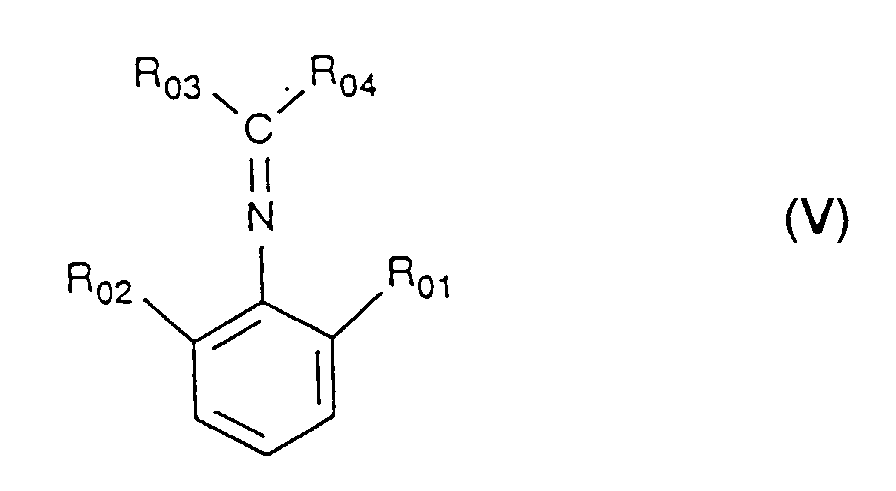
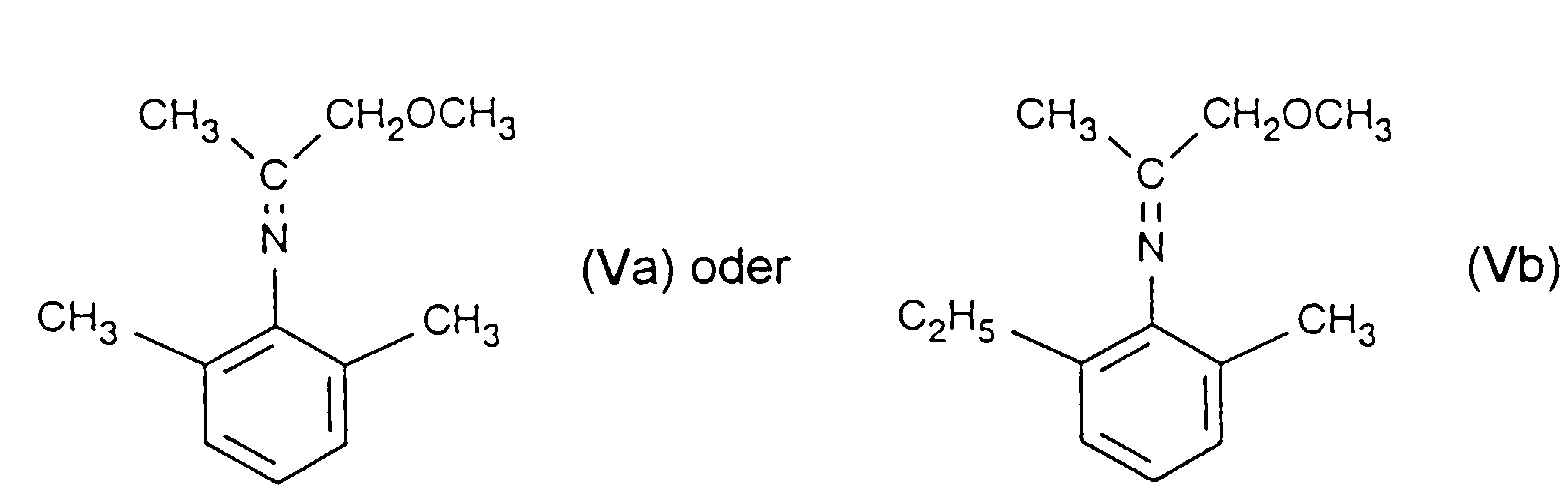
- optically active amines of formula which can be prepared from the imines of formula (V) in the presence of asymmetric iridium catalysts using the processes according to the invention, wherein R 01 , R 02 and R 03 are each independently of the others C 1 -C 4 alkyl, and R 04 is C 1 -C 4 alkyl or C 1 -C 4 alkoxymethyl or C 1 -C 4 alkoxyethyl, and especially the amines of formulae which can be prepared from the imines of formulae (Va) and (Vb) and which can be converted in accordance with methods that are customary per se with chloroacetic acid into the desired herbicides of the chloroacetanilide type; of those compounds, special preference is given to those having the S-configuration at the asymmetric C* atom.
- the chemical conversion is determined by gas chromatography [DB 17/30 W column (15 m), manufacturer: JCW Scientific Inc. USA, temperature programme: from 60°C/1 min to 220°C, ⁇ T: 10° ⁇ min -1 ].
- Example 1 Preparation of (S)-N-(2'-methyl-6'-ethyl-phen-1'-yl)-N-(1-methoxymethyl)ethylamine.
- Example 2 Preparation of (S)-N-(2',6'-dimethyIphen-1'-yl )-N-(1-methoxymethyl)ethylamine.
Landscapes
- Chemical & Material Sciences (AREA)
- Organic Chemistry (AREA)
- Chemical Kinetics & Catalysis (AREA)
- Organic Low-Molecular-Weight Compounds And Preparation Thereof (AREA)
- Low-Molecular Organic Synthesis Reactions Using Catalysts (AREA)
- Catalysts (AREA)
Claims (41)
- Verfahren zur Hydrierung eines Imins mit Wasserstoff bei erhöhtem Druck in der Gegenwart eines homogenen Iridiumkatalysators und mit oder ohne ein inertes Lösungsmittel, worin das Reaktionsgemisch Iodwasserstoff enthält, unter der Maßgabe, daß die Katalysatoren ausgeschlossen sind, die durch die Reaktion von Iridium(lll)- oder iridium(IV)-salz oder einem Hydrat davon und einem Diphosphin mit sekundären Phosphingruppen in der Gegenwart eines Metall- oder Ammoniumchlorids, -bromids oder -iodids erhältlich sind.
- Verfahren gemäss Anspruch 1, worin das Imin wenigstens eine Gruppe C=N- enthält.
- Verfahren gemäss Anspruch 1, worin das Imin wenigstens eine der Gruppen C=N- und C=N-N- und zusätzlich ungesättigte Gruppen C=C und C=O enthält.
- Verfahren gemäss Anspruch 3, worin die freien Bindungen mit Wasserstoff oder organischen Resten mit 1 bis 22 Kohlenstoffatomen oder organischen Heteroresten mit 1 bis 20 Kohlenstoffatomen und wenigstens einem Heteroatom aus der Gruppe O, S, N und P gesättigt sind, oder das Stickstoffatom der Gruppe C=N- mit NH2 oder einer primären Aminogruppe mit 1 bis 22 Kohlenstoffatomen oder einer sekundären Aminogruppe mit 2 bis 40 Kohlenstoffatomen gesättigt ist.
- Verfahren gemäss Anspruch 1, worin ein Aldimin, Ketimin oder Hydrazon hydriert wird.
- Verfahren gemäss Anspruch 5, worin das Imin ein Imin der Formel Iist, das hydriert wird, um ein Amin der Formel II
 zu bilden, worin
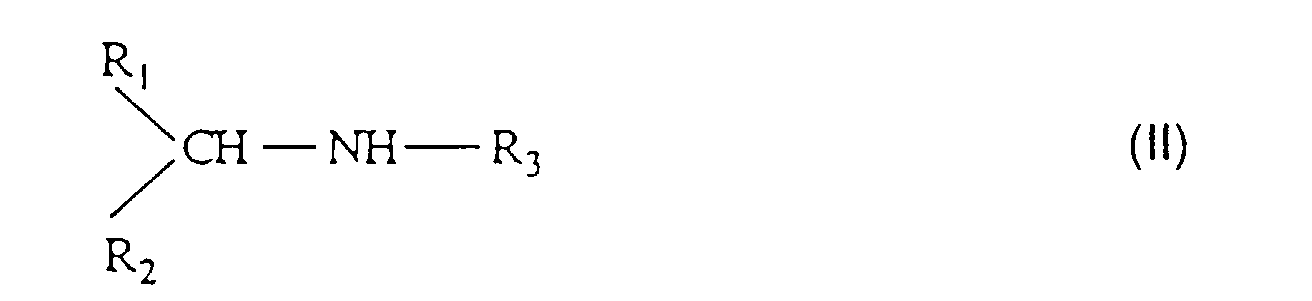 R3 lineares oder verzweigtes C1-C12-Alkyl, Cycloalkyl mit 3 bis 8 Ringkohlenstoffatomen; über ein Kohlenstoffatom gebundenes Heterocycloalkyl mit 3 bis 8 Ringatomen und 1 oder 2 Heteroatomen aus der Gruppe O, S und NR6; ein über ein Alkylkohlenstoffatom gebundenes C7-C16-Aralkyl oder mit dem genannten Cycloalkyl oder Heterocycloalkyl oder Heteroaryl substituiertes C1-C12-Alkyl ist oder worinR3 C6-C12-Aryl oder über ein Ringkohlenstoffatom gebundenes C4-C11-Heteroaryl mit 1 oder 2 Heteroatomen im Ring ist, wobei R3 unsubstituiert oder mit -CN, -NO2, F, Cl, C1-C12-Alkyl, C1-C12-Alkoxy, C1-C12-Alkylthio, C1-C6-Haloalkyl, -OH, C6-C12-Aryl oder -Aryloxy oder -Arylthio, C7-C16-Aralkyl oder -Aralkoxy oder -Aralkylthio, sekundärem Amino mit 2 bis 24 Kohlenstoffatomen, -CONR4R5 oder mit -COOR4 substituiert ist, und wobei die Arylreste und die Arylgruppen im Aralkyl, Aralkoxy und Aralkylthio ihrerseits unsubstituiert oder mit -CN, -NO2, F, Cl, C1-C4-Alkyl, -Alkoxy oder -Alkylthio, -OH, -CONR4R5 oder mit -COOR4 substituiert sind,R4 und R5 unabhängig voneinander Wasserstoff, C1-C12-Alkyl, Phenyl oder Benzyl sind, oderR4 und R5 zusammen Tetra- oder Pentamethylen oder 3-Oxapentylen sind, R6 unabhängig die gleiche Bedeutung wie R4 hat,R1 und R2 unabhängig voneinander ein Wasserstoffatom, C1-C12-Alkyl oder Cycloalkyl mit 3 bis 8 Ringkohlenstoffatomen, wobei jedes unsubstituiert oder mit -OH, C1-C12-Alkoxy, Phenoxy, Benzyloxy, sekundärem Amino mit 2 bis 24 Kohlenstoffatomen, -CONR4R5 oder mit -COOR4 substituiert ist, unsubstituiertes oder wie R3 substituiertes C6-C12-Aryl oder C7-C16-Aralkyl, oder -CONR4R5 oder -COOR4, worin R4 und R5 wie vorstehend definiert sind, sind; oderR3 wie vorstehend definiert ist und R1 und R2 zusammen gegebenenfalls mit 1 oder 2 -O-, -S- oder NR6-Resten unterbrochenes, und/oder unsubstituiertes oder mit =O oder wie zuvor für R1 und R2 in der Bedeutung von Alkyl substituiertes, und/oder mit Benzol, Pyridin, Pyrimidin, Furan, Thiophen oder Pyrrol kondensiertes Alkylen mit 2 bis 5 Kohlenstoffatomen sind; oderR2 wie vorstehend definiert ist und R1 und R3 zusammen gegebenenfalls mit 1 oder 2 -O-, -S- oder -NR6-Resten unterbrochenes, und/oder unsubstituiertes oder mit =O oder wie zuvor für R1 und R2 in der Bedeutung von Alkyl substituiertes, und/oder mit Benzol, Pyridin, Pyrimidin, Furan, Thiophen oder Pyrrol kondensiertes Alkylen mit 2 bis 5 Kohlenstoffatomen sind.
 - Verfahren gemäss Anspruch 5, worin R1 und R2 als Heteroaryl einen 5-oder 6-gliedrigen Ring mit 1 oder 2 gleichen oder verschiedenen Heteroatomen bilden.
- Verfahren gemäss Anspruch 5, worin R1 und R2 als mit Heteroaryl substituiertes Alkyl von einem 5- oder 6-gliedrigen Ring mit 1 oder 2 gleichen oder verschiedenen Heteroatomen abgeleitet sind.
- Verfahren gemäss Anspruch 5, worin R1 und R2 als Heterocycloalkyl oder als mit Heterocycloalkyl substituiertes Alkyl 4 bis 6 Ringatome und 1 oder 2 gleiche oder verschiedene Heteroatome aus der Gruppe O, S und NR6 enthalten, worin R6 Wasserstoff, C1-C12-Alkyl, Phenyl oder Benzyl ist.
- Verfahren gemäss Anspruch 5, worin R1, R2 und R3 als Alkyl unsubstituiertes oder substituiertes C1-C6-Alkyl sind.
- Verfahren gemäss Anspruch 5, worin R1, R2 und R3 als unsubstituiertes oder substituiertes Cycloalkyl 3 bis 6 Ring-Kohlenstoffatome enthalten.
- Verfahren gemäss Anspruch 5, worin R1, R2 und R3 als Aryl unsubstituiertes oder substituiertes Naphthyl oder Phenyl sind, und R1, R2 und R3 als Aralkyl unsubstituiertes oder substituiertes Phenylalkyl mit 1 bis 10 Kohlenstoffatomen im Alkylen sind.
- Verfahren gemäss Anspruch 5, worin R1 und R2 zusammen oder R1 und R3 zusammen mit dem Kohlenstoffatom oder mit der -N=C-Gruppe, an die sie gebunden sind, jeweils einen 5-oder 6-gliedrigen Ring bilden.
- Verfahren gemäss Anspruch 5, worin in der Formel I R3 2,6-Di-C1-C4-Alkylphen-1-yl ist, R1 C1-C4-Alkyl ist und R2 C1-C4-Alkyl, C1-C4-Alkoxymethyl oder C1-C4-Alkoxyethyl ist.
- Verfahren gemäss Anspruch 14, worin R3 2,6-Dimethylphen-1-yl oder 2-Methyl-6-ethylphen-1-yl ist, R1 Ethyl oder Methyl ist und R2 Methoxymethyl ist.
- Verfahren gemäß Anspruch 6, worin das Imin der Formeloder
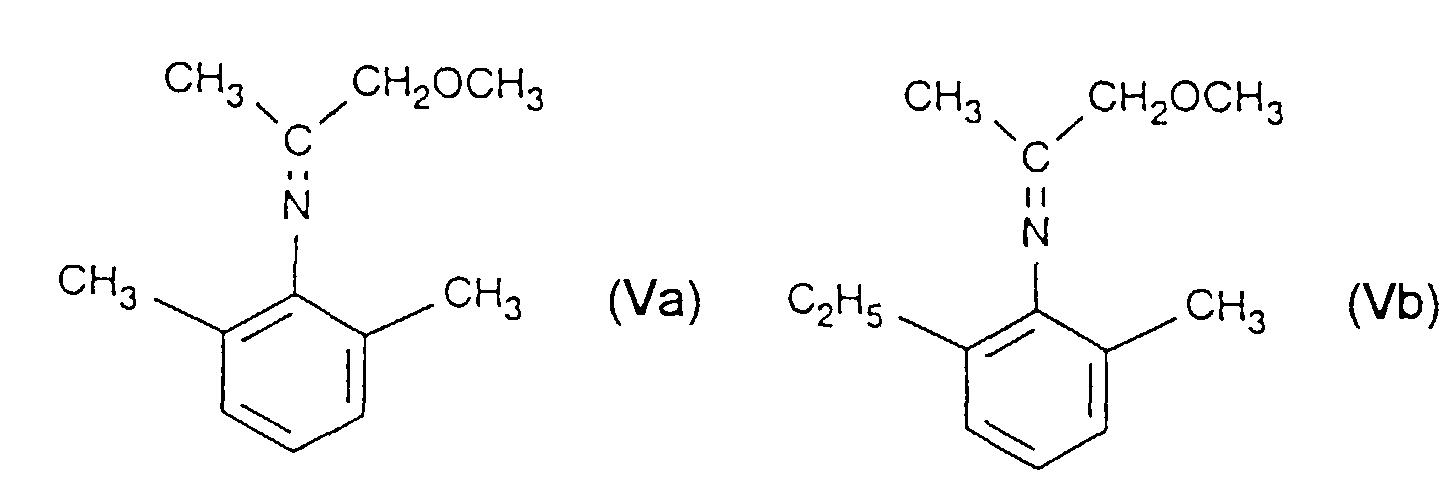 entspricht.
- Verfahren gemäss Anspruch 1, worin der Iridiumkatalysator ein homogener, im Reaktionsmedium im wesentlichen löslicher Katalysator ist.
- Verfahren gemäss Anspruch 1, worin der Katalysator der Formel III, IIIa, IIIb, IIIc oder IIId entspricht,so dass in den Fällen (a), (b), (c) und (d) mit dem Ir-Atom ein 5-, 6- oder 7-gliedriger Ring gebildet wird, die Reste Z unabhängig voneinander Cl, Br oder l sind, A- das Anion einer Sauerstoff- oder Komplexsäure ist, und M+ ein Alkalimetallkation oder quaternäres Ammonium ist, und Ra und Rb unabhängig voneinander Wasserstoff, C1-C8-Alkyl, C1-C4-Fluoralkyl, Phenyl oder Benzyl sind, oder Phenyl oder Benzyl mit ein bis drei C1-C4-Alkyl- oder C1-C4-Alkoxysubstituenten sind.(a) dessen Phosphingruppen an eine Kohlenstoffkette mit 2 bis 4 Kohlenstoffatomen gebunden sind, oder(b) dessen Phosphingruppen entweder direkt oder über eine Brückengruppe -CRaRb- in den Orthostellungen eines Cyclopentadienylrings gebunden sind oder jede an einen Cyclopentadienylring eines Ferrocenyls gebunden ist, oder(c) dessen eine Phosphingruppe an eine Kohlenstoffkette mit 2 oder 3 Kohlenstoffatomen gebunden ist und dessen andere Phosphingruppe an ein endständig an diese Kohlenstoffkette gebundenes Sauerstoffatom oder Stickstoffatom gebunden ist, oder(d) dessen Phosphingruppen an die zwei endständig an eine C2-Kohlenstoffkette gebundenen Sauerstoffatome oder Stickstoffatome gebunden sind,
- Verfahren gemäss Anspruch 18, worin das Diphosphin Y wenigstens eine chirale Gruppe enthält.
- Verfahren gemäss Anspruch 18, worin X als ein Olefinligand verzweigtes oder lineares C2-C12-Alkylen ist, und X als ein Dienligand ein offenkettiges oder cyclisches Dien mit 4 bis 12 Kohlenstoffatomen ist.
- Verfahren gemäss Anspruch 18, worin die sekundären Phosphingruppen zwei gleiche oder verschiedene Reste aus der folgenden Gruppe enthalten: lineares oder verzweigtes C1-C12-Alkyl; unsubstituiertes oder mit C1-C6-Alkyl oder C1-C6-Alkoxy substituiertes C5-C12-Cydoalkyl, C5-C12-Cycloalkyl-CH2-, Phenyl oder Benzyl; oder mit Halogen (z.B. F, Cl und Br), C1-C6-Haloalkyl, (C1-C12-Alkyl)3Si, (C6H5)3Si, C1-C6-Haloalkoxy (z.B. Trifluormethoxy), -NH2, Phenyl2N-, Benzyl2N-, Morpholinyl, Piperidinyl, Pyrrolidinyl, (C1-C12-Alkyl)2N-, -Ammonium-X1 -, -SO3M1, -CO2M1, -PO3M1 oder mit -COO-C1-C6-Alkyl (z.B. -COOCH3) substituiertes Phenyl oder Benzyl, worin M1 ein Alkalimetall oder Wasserstoff ist und X1 - das Anion einer einbasischen Säure ist.
- Verfahren gemäss Anspruch 18, worin das Diphosphin Y von der Formel

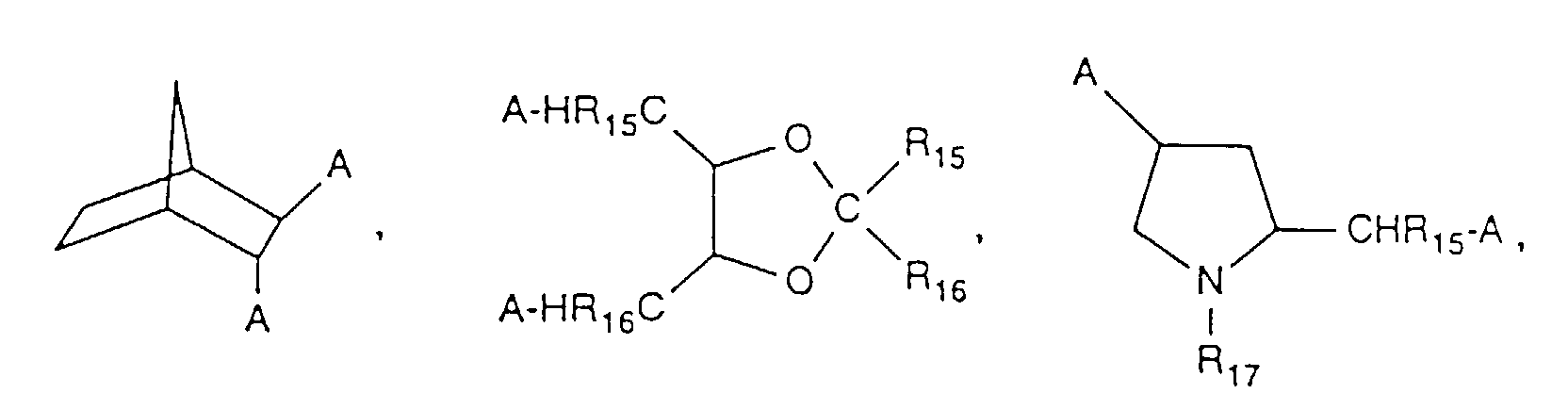
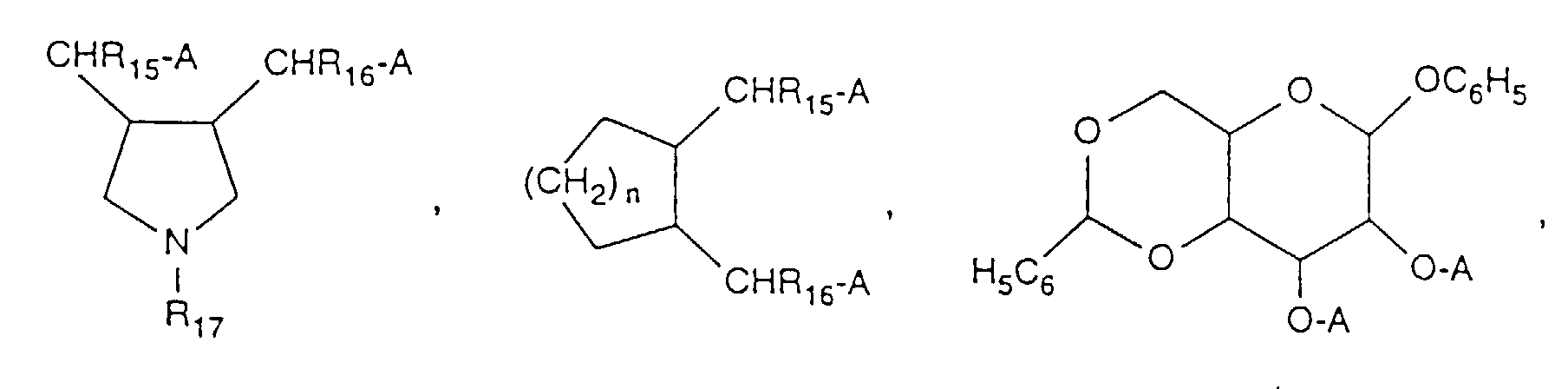 oder
oder ist, worin
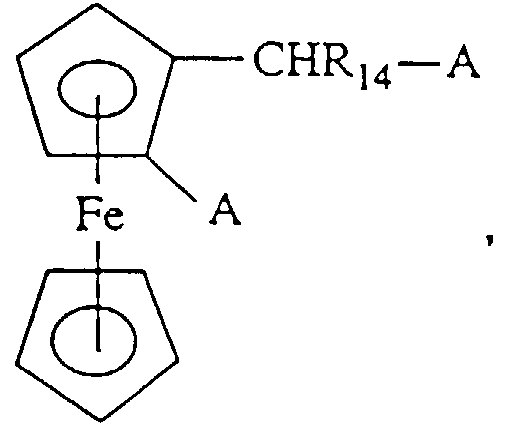 R15 und R16, unabhängig voneinander Wasserstoff, C1-C4-Alkyl, Phenyl, Benzyl, oder Phenyl oder Benzyl mit ein bis drei C1-C4-Alkyl- oder C1-C4-Alkoxysubstituenten sind, R14 Wasserstoff, C1-C4-Alkyl, Phenyl, Benzyl, oder Phenyl oder Benzyl mit ein bis drei C1-C4-Alkyl- oder C1-C4-Alkoxysubstituenten ist,R17 Wasserstoff, C1-C4-Alkyl, Phenyl, Benzyl, C1-C6-Alkoxy-CO-, C1-C6-Alkyl-CO-, Phenyl-CO-, Naphthyl-CO- oder C1-C4-Alkyl-NH-CO- ist,A gleiche oder verschiedene Gruppen -P(R)2 darstellt, worin R C1-C6-Alkyl, Cyclohexyl, Phenyl, Benzyl, oder Phenyl oder Benzyl mit ein bis drei C1-C4-Alkyldisubstituierten Amino-, C1-C4-Alkoxy-, -CF3- oder teilweise oder vollständig fluorierten C1-C4-Alkoxy-Substituenten ist, und n 0, 1 oder 2 ist.
 - Verfahren gemäss Anspruch 18, worin die sekundären Phosphingruppen der Diphosphine Y entweder direkt oder über eine Brückengruppe -CRaRb- in den Orthostellungen eines Cyclopentadienylrings gebunden sind oder jede an einen Cyclopentadienylring eines Ferrocenyls gebunden ist.
- Verfahren gemäss Anspruch 23, worin das Diphosphin der Formel Xentspricht, worin R14 Wasserstoff, C1-C4-Alkyl, Phenyl, Benzyl oder mit ein bis drei C1-C4-Alkyl- oder C1-C4-Alkoxysubstituenten substituiertes Phenyl oder Benzyl ist, A gleiche oder verschiedene Gruppen -P(R)2 darstellt, worin R C1-C6-Alkyl, Cyclohexyl, Phenyl, Benzyl oder mit ein bis drei C1-C4-Alkyl-, disubstituierten Amino-, C1-C4-Alkoxy-, -CF3- oder teilweise oder vollständig fluorierten C1-C4-Alkoxy-Substituenten substituiertes Phenyl oder Benzyl ist.

- Verfahren gemäss Anspruch 24, worin das Diphosphin der Formel X chiral ist und R14 C1-C4-Alkyl ist oder mit ein bis drei C1-C4-Alkyl- oder C1-C4-Alkoxysubstituenten substituiertes Phenyl oder Benzyl ist, A gleiche oder verschiedene Gruppen -P(R)2 darstellt, worin R C1-C6-Alkyl, Cyclohexyl, Phenyl, Benzyl oder mit ein bis drei C1-C4-Alkyl-, disubstituierten Amino-, C1-C4-Alkoxy-, -CF3- oder teilweise oder vollständig fluorierten C1-C4-Alkoxy-Substituenten substituiertes Phenyl oder Benzyl ist.
- Verfahren gemäss Anspruch 18, worin das Diphosphin Y{(R)-1-[(S)-2-Diphenylphosphino)ferrocenyl]}ethyl-di(3,5-dimethyl-phenyl)phosphin,{(R)-1-[(S)-2-Diphenylphosphino)ferrocenyl]}ethyl-di(3,5-dimethyl-4-N,N-dipropylaminophenyl)phosphin,{(R)-1-[(S)-2-Diphenylphosphino)ferrocenyl]}ethyl-di(3,5-di-iso-propyl4-N,N-dimethylaminophenyl)phosphin,{(R)-1-[(S)-2-Diphenylphosphino)ferrocenyll}ethyl-di(3,5-di-iso-propyl4-N,N-dibenzylylaminophenyl)phosphin,{(R)-1 -[(S)-2-Diphenylphosphino)ferrocenyl]}ethyl-di(3,5-dimethyl-4-N,N-dibenzylylaminophenyl)phosphin,{(R)-1[(S)-2-Diphenylphosphino)ferrocenyl]}ethyl-di(3,5-dimethyl-4-(1'-pyrrolo)phenyl)phosphin,{(R)-1-[(S)-2-Diphenylphosphino)ferrocenyl]}ethyl-di(3,5-dimethyl-4-N,N-dipentylaminophenyl)phosphin,{(R)-1-[(S)-2-Diphenylphosphino)ferrocenyl]}ethyl-di(3,5-dimethyl-4-N,N-dimethylaminophenyl)phosphin,
1 ,4-Bis(diphenylphosphino)butan oder{(R)-1-[(S)-2-Di(4-methoxyphenyl)phosphino)ferrocenyl]}ethyl-di(3,5-dimethyl4-N,N-dimethylaminophenyl)phosphin ist. - Verfahren gemäss Anspruch 1, worin Iodwasserstoff in der Form einer wässrigen Lösung verwendet wird.
- Verfahren gemäß Anspruch 27, worin Iodwasserstoff gasförmig verwendet wird.
- Verfahren gemäß Anspruch 1, worin das Molverhältnis von Imin zu Iridiumkatalysator 5 000 000 bis 10 beträgt.
- Verfahren gemäß Anspruch 29, worin das Molverhältnis von Imin zu Iridiumkatalysator 1 000 000 bis 1000 beträgt.
- Verfahren gemäß Anspruch 1, worin das Molverhältnis Imin zu Iodwasserstoff 1 000 000 bis 100 beträgt.
- Verfahren gemäß Anspruch 31, worin das Molverhältnis Imin zu Iodwasserstoff 10 000 bis 1000 beträgt.
- Verfahren gemäss Anspruch 1, worin die Reaktionstemperatur -20 bis 100 °C beträgt.
- Verfahren gemäss Anspruch 1, worin der Wasserstoffdruck 5 bis 150 bar beträgt.
- Verfahren gemäss Anspruch 1, worin die Hydrierung in einem Schlaufenreaktor durchgeführt wird.
- Verfahren gemäss Anspruch 1, worin ein Aldimin oder Ketimin hydriert wird, das in situ vor oder während der Hydrierung gebildet wird.
- Verfahren zur Herstellung von Verbindungen der Formelworin R01, R02 und R03 unabhängig voneinander C1-C4-Alkyl sind und R04 C1-C4-Alkyl oder C1-C4-Alkoxymethyl oder C1-C4-Alkoxyethyl ist, durch (1) Hydrierung eines Imins der Formel
 mit Wasserstoff in der Gegenwart eines Iridiumkatalysators und mit oder ohne ein inertes Lösungsmittel, zu einem Amin der Formel
 und (2) ihre Umsetzung mit der Verbindung der Formel
- Verfahren gemäss Anspruch 37, worin die Hydrierung in der Gegenwart von asymmetrischen Iridiumkatalysatoren asymmetrisch verläuft.
- Verfahren gemäss Anspruch 37, worin das hydrierte Imin eine Verbindung der Formelist.
- Verfahren gemäss Anspruch 39, worin die Verbindungen in der Gegenwart von asymmetrischen Iridiumkatalysatoren asymmetrisch hydriert werden.
- Verfahren gemäss Anspruch 40, worin die hydrierten Verbindungen am asymmetrischen Kohlenstoffatom die S-Konfiguration haben.
Applications Claiming Priority (4)
| Application Number | Priority Date | Filing Date | Title |
|---|---|---|---|
| CH168595 | 1995-06-08 | ||
| CH168595 | 1995-06-08 | ||
| CH1685/95 | 1995-06-08 | ||
| PCT/EP1996/002419 WO1996041793A1 (en) | 1995-06-08 | 1996-06-04 | Process for the hydrogenation of imines |
Publications (2)
| Publication Number | Publication Date |
|---|---|
| EP0830337A1 EP0830337A1 (de) | 1998-03-25 |
| EP0830337B1 true EP0830337B1 (de) | 1999-12-22 |
Family
ID=4216210
Family Applications (1)
| Application Number | Title | Priority Date | Filing Date |
|---|---|---|---|
| EP96920786A Expired - Lifetime EP0830337B1 (de) | 1995-06-08 | 1996-06-04 | Verfahren zur hydrierung von iminen |
Country Status (26)
| Country | Link |
|---|---|
| US (1) | US5886225A (de) |
| EP (1) | EP0830337B1 (de) |
| JP (1) | JP4128623B2 (de) |
| KR (1) | KR100470884B1 (de) |
| CN (1) | CN1176900C (de) |
| AR (1) | AR002359A1 (de) |
| AT (1) | ATE187957T1 (de) |
| AU (1) | AU710870B2 (de) |
| BR (1) | BR9609159A (de) |
| CA (1) | CA2220999C (de) |
| CZ (1) | CZ287315B6 (de) |
| DE (1) | DE69605794T2 (de) |
| DK (1) | DK0830337T3 (de) |
| EA (1) | EA000498B1 (de) |
| ES (1) | ES2141512T3 (de) |
| GR (1) | GR3032521T3 (de) |
| HR (1) | HRP960253B1 (de) |
| HU (1) | HU229337B1 (de) |
| IL (1) | IL122184A (de) |
| PL (1) | PL183317B1 (de) |
| PT (1) | PT830337E (de) |
| SK (1) | SK281568B6 (de) |
| TW (1) | TW346482B (de) |
| UA (1) | UA51652C2 (de) |
| WO (1) | WO1996041793A1 (de) |
| ZA (1) | ZA964832B (de) |
Families Citing this family (18)
| Publication number | Priority date | Publication date | Assignee | Title |
|---|---|---|---|---|
| ES2123953T3 (es) * | 1994-02-02 | 1999-01-16 | Novartis Ag | Proceso para la hidrogenacion de iminas. |
| US6228971B1 (en) * | 1999-06-21 | 2001-05-08 | Ppg Industries Ohio, Inc. | Polymeric imine functional compositions and their use in film-forming compositions |
| US20070213540A1 (en) * | 2006-03-09 | 2007-09-13 | Degussa Ag | Process for the hydrogenation of imines |
| US8268872B2 (en) | 2008-02-22 | 2012-09-18 | Radius Health, Inc. | Selective androgen receptor modulators |
| MX2010009162A (es) | 2008-02-22 | 2010-12-21 | Radius Health Inc | Moduladores selectivos del receptor de androgeno. |
| CA2788907A1 (en) | 2010-02-04 | 2011-08-11 | Radius Health, Inc. | Selective androgen receptor modulators |
| PT2568806T (pt) | 2010-05-12 | 2016-08-05 | Radius Health Inc | Regimes terapêuticos |
| US8642632B2 (en) | 2010-07-02 | 2014-02-04 | Radius Health, Inc. | Selective androgen receptor modulators |
| ES2550319T3 (es) | 2010-09-28 | 2015-11-06 | Radius Health, Inc | Moduladores selectivos del receptor de andrógenos |
| CN102153589B (zh) | 2011-02-28 | 2013-01-02 | 大连多相触媒有限公司 | 一种亚胺的不对称加氢催化剂及其合成方法和应用 |
| EP2892877B1 (de) | 2012-09-06 | 2017-06-21 | Council of Scientific and Industrial Research | Verfahren zur herstellung von (s)-2-ethyl-n-(1-methoxypropan-2-yl)-6-methylanilin |
| RS67458B1 (sr) | 2014-03-28 | 2025-12-31 | Univ Duke | Lečenje kancera dojke pozitivnog na receptor estrogena upotrebom selektivnih modulatora receptora estrogena |
| US9421264B2 (en) | 2014-03-28 | 2016-08-23 | Duke University | Method of treating cancer using selective estrogen receptor modulators |
| RS63311B1 (sr) | 2016-06-22 | 2022-07-29 | Ellipses Pharma Ltd | Ar+ metode lečenja raka dojke |
| KR102881465B1 (ko) | 2017-01-05 | 2025-11-04 | 래디어스 파마슈티컬스, 인코포레이티드 | Rad1901-2hcl의 다형 형태 |
| CN112423844B (zh) | 2018-07-04 | 2024-08-13 | 雷迪厄斯制药公司 | Rad1901-2hcl的多晶型形式 |
| JOP20210218A1 (ar) | 2019-02-12 | 2023-01-30 | Radius Pharmaceuticals Inc | عمليات ومركبات |
| CN110305025B (zh) * | 2019-07-23 | 2022-05-06 | 衢州学院 | 一种由亚胺催化氢化合成苄胺类化合物的方法 |
Family Cites Families (5)
| Publication number | Priority date | Publication date | Assignee | Title |
|---|---|---|---|---|
| EP0256982B1 (de) * | 1986-08-04 | 1991-08-28 | Ciba-Geigy Ag | Verfahren zur Herstellung von optisch aktiven sekundären Arylaminen |
| US5011995A (en) * | 1987-07-28 | 1991-04-30 | Ciba-Geigy Corporation | Process for the preparation of optically active secondary amines |
| DE59009835D1 (de) * | 1989-09-18 | 1995-12-07 | Ciba Geigy Ag | Iridiumkomplexe, Verfahren zu deren Herstellung und deren Verwendung. |
| DE59309554D1 (de) * | 1992-04-02 | 1999-06-10 | Novartis Ag | Ferrocenyldiphosphine als Liganden für homogene Katalysatoren |
| ATE185570T1 (de) * | 1994-02-02 | 1999-10-15 | Novartis Erfind Verwalt Gmbh | Hydrierungskatalysator, verfahren zu seiner herstellung und hydrierungsverfahren |
-
1996
- 1996-04-06 UA UA97125857A patent/UA51652C2/uk unknown
- 1996-05-22 TW TW085106030A patent/TW346482B/zh not_active IP Right Cessation
- 1996-06-04 ES ES96920786T patent/ES2141512T3/es not_active Expired - Lifetime
- 1996-06-04 DE DE69605794T patent/DE69605794T2/de not_active Expired - Lifetime
- 1996-06-04 AU AU62218/96A patent/AU710870B2/en not_active Expired
- 1996-06-04 CZ CZ19973919A patent/CZ287315B6/cs not_active IP Right Cessation
- 1996-06-04 WO PCT/EP1996/002419 patent/WO1996041793A1/en not_active Ceased
- 1996-06-04 JP JP50257997A patent/JP4128623B2/ja not_active Expired - Lifetime
- 1996-06-04 CA CA002220999A patent/CA2220999C/en not_active Expired - Lifetime
- 1996-06-04 EP EP96920786A patent/EP0830337B1/de not_active Expired - Lifetime
- 1996-06-04 BR BR9609159A patent/BR9609159A/pt active IP Right Grant
- 1996-06-04 HU HU9802307A patent/HU229337B1/hu unknown
- 1996-06-04 SK SK1681-97A patent/SK281568B6/sk not_active IP Right Cessation
- 1996-06-04 PT PT96920786T patent/PT830337E/pt unknown
- 1996-06-04 DK DK96920786T patent/DK0830337T3/da active
- 1996-06-04 KR KR1019970708383A patent/KR100470884B1/ko not_active Expired - Lifetime
- 1996-06-04 IL IL12218496A patent/IL122184A/xx not_active IP Right Cessation
- 1996-06-04 PL PL96323946A patent/PL183317B1/pl unknown
- 1996-06-04 CN CNB96194661XA patent/CN1176900C/zh not_active Expired - Lifetime
- 1996-06-04 EA EA199700424A patent/EA000498B1/ru not_active IP Right Cessation
- 1996-06-04 US US08/973,575 patent/US5886225A/en not_active Expired - Lifetime
- 1996-06-04 AT AT96920786T patent/ATE187957T1/de active
- 1996-06-05 HR HR960253A patent/HRP960253B1/xx not_active IP Right Cessation
- 1996-06-06 AR ARP960102994A patent/AR002359A1/es active IP Right Grant
- 1996-06-07 ZA ZA964832A patent/ZA964832B/xx unknown
-
2000
- 2000-01-31 GR GR20000400217T patent/GR3032521T3/el unknown
Also Published As
Similar Documents
| Publication | Publication Date | Title |
|---|---|---|
| EP0691949B1 (de) | Verfahren zur hydrierung von iminen | |
| US5886225A (en) | Process for the hydrogenation of imines | |
| US20090036713A1 (en) | Process for the hydrogenation of imines | |
| EP0741738B1 (de) | Hydrierungskatalysator, verfahren zu seiner herstellung und hydrierungsverfahren | |
| EP0850241B1 (de) | Iridium-diphosphin-komplexe und verfahren zur hydrierung von iminen | |
| EP0848697B1 (de) | Verfahren zur hydrierung von iminen | |
| EP0842140B1 (de) | Verfahren zur hydrierung von iminen | |
| CA2157191C (en) | Process for the hydrogenation of imines |
Legal Events
| Date | Code | Title | Description |
|---|---|---|---|
| PUAI | Public reference made under article 153(3) epc to a published international application that has entered the european phase |
Free format text: ORIGINAL CODE: 0009012 |
|
| 17P | Request for examination filed |
Effective date: 19971111 |
|
| AK | Designated contracting states |
Kind code of ref document: A1 Designated state(s): AT BE CH DE DK ES FR GB GR IE IT LI LU NL PT SE |
|
| 17Q | First examination report despatched |
Effective date: 19981111 |
|
| RAP1 | Party data changed (applicant data changed or rights of an application transferred) |
Owner name: NOVARTIS-ERFINDUNGEN VERWALTUNGSGESELLSCHAFT M.B.H |
|
| RAP1 | Party data changed (applicant data changed or rights of an application transferred) |
Owner name: NOVARTIS-ERFINDUNGEN VERWALTUNGSGESELLSCHAFT M.B. Owner name: NOVARTIS AG |
|
| GRAG | Despatch of communication of intention to grant |
Free format text: ORIGINAL CODE: EPIDOS AGRA |
|
| GRAG | Despatch of communication of intention to grant |
Free format text: ORIGINAL CODE: EPIDOS AGRA |
|
| GRAH | Despatch of communication of intention to grant a patent |
Free format text: ORIGINAL CODE: EPIDOS IGRA |
|
| GRAH | Despatch of communication of intention to grant a patent |
Free format text: ORIGINAL CODE: EPIDOS IGRA |
|
| GRAA | (expected) grant |
Free format text: ORIGINAL CODE: 0009210 |
|
| AK | Designated contracting states |
Kind code of ref document: B1 Designated state(s): AT BE CH DE DK ES FR GB GR IE IT LI LU NL PT SE |
|
| REF | Corresponds to: |
Ref document number: 187957 Country of ref document: AT Date of ref document: 20000115 Kind code of ref document: T |
|
| REG | Reference to a national code |
Ref country code: CH Ref legal event code: EP |
|
| REF | Corresponds to: |
Ref document number: 69605794 Country of ref document: DE Date of ref document: 20000127 |
|
| ET | Fr: translation filed | ||
| REG | Reference to a national code |
Ref country code: IE Ref legal event code: FG4D |
|
| ITF | It: translation for a ep patent filed | ||
| REG | Reference to a national code |
Ref country code: ES Ref legal event code: FG2A Ref document number: 2141512 Country of ref document: ES Kind code of ref document: T3 |
|
| REG | Reference to a national code |
Ref country code: PT Ref legal event code: SC4A Free format text: AVAILABILITY OF NATIONAL TRANSLATION Effective date: 20000302 |
|
| REG | Reference to a national code |
Ref country code: DK Ref legal event code: T3 |
|
| PLBE | No opposition filed within time limit |
Free format text: ORIGINAL CODE: 0009261 |
|
| STAA | Information on the status of an ep patent application or granted ep patent |
Free format text: STATUS: NO OPPOSITION FILED WITHIN TIME LIMIT |
|
| 26N | No opposition filed | ||
| REG | Reference to a national code |
Ref country code: GB Ref legal event code: IF02 |
|
| REG | Reference to a national code |
Ref country code: GB Ref legal event code: 732E |
|
| REG | Reference to a national code |
Ref country code: CH Ref legal event code: PUE Owner name: SYNGENTA PARTICIPATIONS AG Free format text: NOVARTIS AG#SCHWARZWALDALLEE 215#4058 BASEL (CH) -TRANSFER TO- SYNGENTA PARTICIPATIONS AG#SCHWARZWALDALLEE 215#4058 BASEL (CH) |
|
| REG | Reference to a national code |
Ref country code: PT Ref legal event code: PC4A Free format text: SYNGENTA PARTICIPATIONS AG CH Effective date: 20030722 |
|
| NLS | Nl: assignments of ep-patents |
Owner name: SYNGENTA PARTICIPATIONS AG |
|
| REG | Reference to a national code |
Ref country code: FR Ref legal event code: TP |
|
| PGFP | Annual fee paid to national office [announced via postgrant information from national office to epo] |
Ref country code: LU Payment date: 20130625 Year of fee payment: 18 |
|
| PG25 | Lapsed in a contracting state [announced via postgrant information from national office to epo] |
Ref country code: LU Free format text: LAPSE BECAUSE OF NON-PAYMENT OF DUE FEES Effective date: 20140604 |
|
| REG | Reference to a national code |
Ref country code: FR Ref legal event code: PLFP Year of fee payment: 20 |
|
| PGFP | Annual fee paid to national office [announced via postgrant information from national office to epo] |
Ref country code: DK Payment date: 20150527 Year of fee payment: 20 Ref country code: SE Payment date: 20150605 Year of fee payment: 20 Ref country code: GB Payment date: 20150526 Year of fee payment: 20 Ref country code: PT Payment date: 20150527 Year of fee payment: 20 Ref country code: CH Payment date: 20150528 Year of fee payment: 20 Ref country code: ES Payment date: 20150618 Year of fee payment: 20 |
|
| PGFP | Annual fee paid to national office [announced via postgrant information from national office to epo] |
Ref country code: AT Payment date: 20150527 Year of fee payment: 20 Ref country code: IE Payment date: 20150609 Year of fee payment: 20 Ref country code: FR Payment date: 20150528 Year of fee payment: 20 Ref country code: IT Payment date: 20150611 Year of fee payment: 20 Ref country code: GR Payment date: 20150529 Year of fee payment: 20 Ref country code: NL Payment date: 20150616 Year of fee payment: 20 Ref country code: BE Payment date: 20150605 Year of fee payment: 20 |
|
| PGFP | Annual fee paid to national office [announced via postgrant information from national office to epo] |
Ref country code: DE Payment date: 20150630 Year of fee payment: 20 |
|
| REG | Reference to a national code |
Ref country code: DE Ref legal event code: R071 Ref document number: 69605794 Country of ref document: DE |
|
| REG | Reference to a national code |
Ref country code: NL Ref legal event code: MK Effective date: 20160603 |
|
| REG | Reference to a national code |
Ref country code: DK Ref legal event code: EUP Effective date: 20160604 |
|
| REG | Reference to a national code |
Ref country code: PT Ref legal event code: MM4A Free format text: MAXIMUM VALIDITY LIMIT REACHED Effective date: 20160604 |
|
| REG | Reference to a national code |
Ref country code: CH Ref legal event code: PL |
|
| REG | Reference to a national code |
Ref country code: GB Ref legal event code: PE20 Expiry date: 20160603 |
|
| REG | Reference to a national code |
Ref country code: AT Ref legal event code: MK07 Ref document number: 187957 Country of ref document: AT Kind code of ref document: T Effective date: 20160604 |
|
| REG | Reference to a national code |
Ref country code: IE Ref legal event code: MK9A |
|
| PG25 | Lapsed in a contracting state [announced via postgrant information from national office to epo] |
Ref country code: GB Free format text: LAPSE BECAUSE OF EXPIRATION OF PROTECTION Effective date: 20160603 |
|
| REG | Reference to a national code |
Ref country code: SE Ref legal event code: EUG |
|
| PG25 | Lapsed in a contracting state [announced via postgrant information from national office to epo] |
Ref country code: PT Free format text: LAPSE BECAUSE OF EXPIRATION OF PROTECTION Effective date: 20160614 |
|
| REG | Reference to a national code |
Ref country code: ES Ref legal event code: FD2A Effective date: 20160926 |
|
| REG | Reference to a national code |
Ref country code: GR Ref legal event code: MA Ref document number: 20000400217 Country of ref document: GR Effective date: 20160605 |
|
| PG25 | Lapsed in a contracting state [announced via postgrant information from national office to epo] |
Ref country code: IE Free format text: LAPSE BECAUSE OF EXPIRATION OF PROTECTION Effective date: 20160604 |
|
| PG25 | Lapsed in a contracting state [announced via postgrant information from national office to epo] |
Ref country code: ES Free format text: LAPSE BECAUSE OF EXPIRATION OF PROTECTION Effective date: 20160605 |