EP0831386B1 - Autorisation d'écriture déconnectée dans un système d'ordinateur client/serveur - Google Patents
Autorisation d'écriture déconnectée dans un système d'ordinateur client/serveur Download PDFInfo
- Publication number
- EP0831386B1 EP0831386B1 EP97202804A EP97202804A EP0831386B1 EP 0831386 B1 EP0831386 B1 EP 0831386B1 EP 97202804 A EP97202804 A EP 97202804A EP 97202804 A EP97202804 A EP 97202804A EP 0831386 B1 EP0831386 B1 EP 0831386B1
- Authority
- EP
- European Patent Office
- Prior art keywords
- credentials
- client
- server
- write
- request
- Prior art date
- Legal status (The legal status is an assumption and is not a legal conclusion. Google has not performed a legal analysis and makes no representation as to the accuracy of the status listed.)
- Expired - Lifetime
Links
Images
Classifications
-
- G—PHYSICS
- G06—COMPUTING OR CALCULATING; COUNTING
- G06F—ELECTRIC DIGITAL DATA PROCESSING
- G06F21/00—Security arrangements for protecting computers, components thereof, programs or data against unauthorised activity
- G06F21/60—Protecting data
- G06F21/62—Protecting access to data via a platform, e.g. using keys or access control rules
- G06F21/6218—Protecting access to data via a platform, e.g. using keys or access control rules to a system of files or objects, e.g. local or distributed file system or database
-
- G—PHYSICS
- G06—COMPUTING OR CALCULATING; COUNTING
- G06F—ELECTRIC DIGITAL DATA PROCESSING
- G06F11/00—Error detection; Error correction; Monitoring
- G06F11/07—Responding to the occurrence of a fault, e.g. fault tolerance
- G06F11/14—Error detection or correction of the data by redundancy in operations
- G06F11/1402—Saving, restoring, recovering or retrying
- G06F11/1415—Saving, restoring, recovering or retrying at system level
- G06F11/1435—Saving, restoring, recovering or retrying at system level using file system or storage system metadata
-
- Y—GENERAL TAGGING OF NEW TECHNOLOGICAL DEVELOPMENTS; GENERAL TAGGING OF CROSS-SECTIONAL TECHNOLOGIES SPANNING OVER SEVERAL SECTIONS OF THE IPC; TECHNICAL SUBJECTS COVERED BY FORMER USPC CROSS-REFERENCE ART COLLECTIONS [XRACs] AND DIGESTS
- Y10—TECHNICAL SUBJECTS COVERED BY FORMER USPC
- Y10S—TECHNICAL SUBJECTS COVERED BY FORMER USPC CROSS-REFERENCE ART COLLECTIONS [XRACs] AND DIGESTS
- Y10S707/00—Data processing: database and file management or data structures
- Y10S707/99951—File or database maintenance
- Y10S707/99952—Coherency, e.g. same view to multiple users
- Y10S707/99953—Recoverability
Definitions
- the present invention relates to write operations performed by a client computing station in a client/server computing system while the server or network is inoperative. More particularly, the present invention relates to management of write authorization to copy client disconnected write files to the server, when the server again becomes available, where the copying of files to the server is based upon optimized log files maintained in the client while the server was unavailable.
- file system architectures are employed in which the server stores all files created at the client in the computing system.
- the server when an application program, operating on the client, needs to write data to a file, the file data is transferred over the network to the server for storage in the file maintained by the server.
- the client is equipped with a local disk cache, the data is also optionally written to the local disk cache of the client. Under normal operating conditions, such a computing system can operate smoothly.
- a log file can be created and maintained in the client for collecting a list of operations performed by the client during the period of unavailability of the server.
- the log file generally includes the type of operation performed and the data associated with the operation, along with an identification of the file upon which the operation was performed.
- the client utilizes the log file to "replay” or “roll” the operations performed during the unavailability of the server, thereby attempting to insure the consistency between the server's version of the file and the client's version of the file.
- Such a log file may be optimized to reduce the size of the log file in the client.
- An example of an optimized log file operation is described in our European patent application No. 97201338.7 entitled "Log File Optimization In A Client/Server Computing System.”
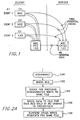
- FIG. 1 the data flow for a normal write to file "A1" is illustrated.
- Event 1 and event 3 are write operations by a user with credentials "C1.”
- Event 2 is a write operation by a user with credentials "C2.”
- the server checks the credentials of the user before authorizing the write operation at the server and affirming or granting permission for the corresponding write operation at the client cache. Accordingly for each event, each of the data flow lines to the server show a credential check.
- file A1 will contain data -- ABC and 123 --; file A1 will not contain data -- XYZ -- from event 2.
- file A1 in the client cache will contain data: ABC, XYZ and 123.
- file A1 will be transferred in a single write operation to the server. During this single write, the server will do one credential check for the entire file (i.e. one credential check per write operation). Since the first write carried credentials C1, which are authorized, the server will see credentials C1, and authorize the writing of ABC, XYZ and 123 to file A1 in the server.
- the unauthorized data XYZ has slipped through the security check at the server because the optimized log file has simplified the writing of file A1 to a single write operation of the entire file to the server. Accordingly, there is a need to insure that only authorized data for disconnected write operations is copied to a server when using an optimized log file operation.
- WO-A-9524685 discloses a cache manager supporting both connected and disconnected client operation.
- a single integrated cache is maintained for file system data, status and pathname information.
- File system requests are satisfied by the cache if possible and passed to a remote file system for servicing if necessary.
- the cache manager is independent of operating system file syntax and distributed file system protocol.
- Disconnected operation is supported by logging of file system modifications. Modification logs are created when the client is disconnected by logging objects that optimize the log as it is created.
- Cache file system objects can have multiple parents each with different naming syntax because the object name is not cached.
- there is no disclosure of a credentials matching operation allowing a write to proceed, or suspending a write operation.
- EP-A-0,456,920 discloses a method for authorising a process running at a client to have access to a service at a server.
- a set of credentials for the process is created at the server in response to a message from the client requesting a service.
- the server returns a credentials id identifying the created set of credentials to the client process.
- the client uses this returned id in subsequent requests and is authorised access as controlled by the set of credentials identified by the returned id in the subsequent request.
- the server can deny access to the service by the process if the id returned in a subsequent request is determined by the server not to identify the set of credentials.
- the server denies the access if the server requires an authentication of the process.
- this system does not deal with client writes to its own cache during a period of time in which the client is disconnected from the server, nor to an arrangement which presents unauthorised data from migrating back to the server once the client is reconnected.
- the above problems have been solved in a client/server computing system having an optimized log file system for replaying client disconnect write operations to a server when the server becomes available to the client by a method for preventing data in unauthorized disconnect write operations to a target file at the client from being copied to the server when the server becomes available.
- the process begins by detecting at the client whether or not the target file has already been written.
- the write request contains data and request credentials; the request credentials are the authorization credentials for the write operation which will ultimately be tested for acceptability at the server.
- the request credentials are placed in a credentials table as stored credentials indexed by a target file identifier. Also the data from the write request is written to the target file at the client.
- the request credentials are compared to the stored credentials in the credentials table. If the request credentials are the same as the stored credentials, data from the write request is written to the target file effectively adding more data to the target file. If the request credentials are not the same as the stored credentials, the write request is suspended at the client.
- the client detects that the server is available, the stored credentials of the target file are retrieved from the credentials table, and the target file is sent along with the stored credentials to the server.
- the stored credentials and the target file are received by the server from the client and the stored credentials are tested to indicate if the stored credentials are acceptable or unacceptable. If the stored credentials are acceptable, the entire target file is written to the server. If the stored credentials are unacceptable, an error message is sent to the client.
- a computer storage medium refers to any type of storage element used in a computing system.
- a transmission medium refers to elements in a communication network which store computer program instructions being downloaded from a source to a destination across the communication network. Either medium stores a computer program of instructions for a computer enabling the computer to perform a computer process including the above described steps.
- an apparatus in a client/server computing system for preventing unauthorized data written during disconnected writes at the client from being copied to the server when the server becomes available.
- the apparatus has a check module, a client write module, and a suspend module.
- the check module at the client responds to a write to file request for a predetermined file and checks for a previous disconnected write to said predetermined file.
- the client write module writes data contained in the write to file request to the predetermined file at the client if there is no difference or change in credentials between credentials accompanying the write to file request and previous credentials for a previous disconnected write to the predetermined file.
- the suspend module at the client suspends the write to file operation if there is a change in credentials between credentials accompanying the write to file request and the previous credentials.
- a storage module at the client stores credentials accompanying a write to file request if the write to file request is the first such request for said predetermined file whereby the credentials so stored are thereafter the previous credentials.
- the client writing module also writes data contained in the write to file request to the predetermined file if the write to file request is the first such request for the predetermined file.
- a send module at the client in response to the server becoming available after disconnected write to file operations, sends the predetermined file along with the previous credentials to the server.
- a server write module receives the predetermined file and writes the predetermined file at the server if the previous credentials are accepted by the server.
- an awaken module at the client in response to the server becoming available after disconnected write to file operations, awakens the write to file operations suspended by the suspend module.
- the great utility of the present invention is that unauthorized data from disconnected write operations at the client can not circumvent the security of the server even though an optimized log file system is being used during disconnect.
- Fig. 1 illustrates data flow for three write to file events when the server is connected (solid lines) during the write events and when the server is disconnected (dashed lines) during the events.
- Fig. 2A and Fig. 2B illustrate the logical operations of a preferred embodiment of the invention as those operations are performed at a client and a server to insure that disconnected writes at the client do not circumvent the security of the server.
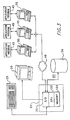
- Fig. 3 illustrates a distributed processing computer system with a server and multiple clients connected in a communications network to perform the logical operations of the invention.
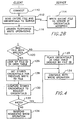
- Fig. 4 shows the flow of logical operations at the client when performing disconnected write operations to client.
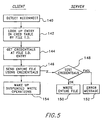
- Fig. 5 shows the flow of logical operations at the client and server when the server is again available and the client file is to be copied to the server.
- the disconnected write operation to client cache is conditioned by the credentials of the user requesting the write operation.
- Fig. 2B the logical operations for copying a file of disconnected writes from client to server are illustrated.
- the embodiments of the invention described herein are implemented as logical operations in a computing system.
- the logical operations of the present invention are implemented (1) as a sequence of computer implemented steps running on the computing system and (2) as interconnected machine modules within the computing system.
- the implementation is a matter of choice dependent on the performance requirements of the computing system implementing the invention. Accordingly, the logical operations making up the embodiments of the invention described herein are referred to variously as operations, steps, or modules.
- Figure 2A illustrates the logical operations in accordance with a preferred embodiment of the invention performed at the client when disconnected write operations occur.
- the disconnect condition 100 exists or is detected when the write request is detected at operation 102.
- the write request contains data to be written to a file and authorization credentials for the write operation.
- the client in module 104 checks whether there is a previous disconnected write request for the same file. In response to an indication of a previous disconnected write for the same file, operation 106 proceeds to write the date in the request to the file only if there is no change in credentials between the previously write to the file and the present write request for the same file.
- FIG 2B the preferred embodiment for copying a file containing disconnected writes from the client to the server is illustrated.
- the connect condition 110 is the triggering event for copying a disconnected write cache file from the client to the server.
- operation 112 sends the file and the credentials for that file to the server.
- Operation 114 at the server will write the entire file to the server only if the credentials are accepted by the server. Thus, any number of writings to the file at the client are transferred in a single write for the entire file from the client to the server. However, the file is not written to the server unless the credentials received for the file from the client are acceptable to the server.
- operation 116 awakens the write operations previously suspended by operation 108 in Figure 2A. These awakened write operations will proceed and have their credentials checked by the server in the normal, connected write operation.
- the disconnect writes to the client cache are restricted to writes with one set of credentials. All other writes with other credentials are suspended. Subsequently, when the server again becomes available, the disconnected written file is sent to the server, but will be written in the server file only if the credentials are acceptable. Since all disconnected writes for the written client file have the same credentials, no illegal writes with unauthorized credentials may slip through and be written inadvertently at the server.
- the operating environment in which the present invention is used, encompasses a stand-alone computing system as well as the general distributed computing system.
- general purpose computers, work-stations, or personal computers are connected in a client-server arrangement via communication links of various types, wherein programs and data, many in the form of objects, are made available by various members of the system.
- FIG. 3 Some of the elements of a stand-alone computer or a general purpose work-station computer are shown in FIG. 3.
- Users at remote work-stations in a network such as client processors 35, communicate through the network to a computer server 20.
- Server 20 includes processor 21 having an input/output section 22, a central processing unit 23, and a memory section 24.
- the input/output section 22 is optionally connected to a keyboard 25, a display or monitor 26, and a disk storage unit 29.
- the input/output unit 22 includes a communications adaptor (not shown) for communicating on the network 46 to the remote client stations 35.
- Application programs 45 operate on client station 35 which may access or modify files maintained by server 20.
- the computer program products to effectuate the apparatus and methods of the present invention may reside in the memory section 24, or on the disk storage unit 29 or similar storage media (not shown), or reside on storage mediums used by clients 35.
- Examples of computing systems that may be used as either a server 20 or a client 35 include the SPARC 1 TM systems offered by Sun MicrosystemsTM, Incorporated, personal computers offered by IBM Corporation and by other manufacturers of IBM compatible personal computers and systems running the ONIX 2 , OS/2 3 , HP-UX, AIX, DOS, etc. operating systems.
- client 35 and server 20 communicate over network 46 which provides client 35 with access to the files maintained on disk 29 of the server. Conversely, client 35 also transfers file data over network 46 for files maintained on the server.
- the client generally creates file data in response to a request by an application program 45 (Fig. 3), running on the client 35, to store or write data associated with a file. If server 20 is unavailable either because the network connection 46 is inoperative, server 20 has crashed, or otherwise, then the client 35 cannot transfer the file data to the server. Instead client 35 writes data to a file at the client and creates an optimized log file of the disconnected writes.
- Figure 4 illustrates logical operations that would be used with a log file optimization write operation such as that described in the cross-referenced application entitled "Log File Optimization in a Client/Server Computing System.”
- decision operation 120 in Figure 4 tests whether the file requested for the disconnected write operation has already been written. If the file has not been previously written during a disconnected operation, the operation flow branches now to store module 122.
- Store module 122 places in a "CRED" (credentials) table the credentials for the present disconnected write file request. These credentials are indexed in the table by the file identification for the target file of the write request. After the credentials have been placed in the CRED table, operation 124 continues the write operation as for example described in the above cross-referenced application.
- CRED credentials
- decision operation 120 detects that the file has already been written during a disconnected write operation, the operation flow branches "Yes" from the decision operation 120 to look-up operation 126.
- Look-up operation 126 finds the file identification for the target file of the write operation.
- operation 128 gets the stored credentials at that file identification in the CRED table. These stored credentials represent the credentials for the first disconnected write to the target file.
- Compare operation 130 now compares the stored credentials retrieved in get operation 128 with the request credentials, i.e. the credentials accompanying the write request.
- Decision operation 132 detects if the stored credentials match the request credentials. If there is a match, the logical operation flow branches yes to operation 124 to continue the write operation. In this case, the data in the present write request is added to the file. On the other hand, if the stored credentials do not match the request credentials, the logical operation flow branches "No" to suspend operation 134. Suspend operation 134 suspends the requested write operation.
- the client at operation 140 detects a reconnect condition between client and server.
- the reconnect condition may represent that the network is backup and connects the client and server, or it may represent that the server has come back up. In any event, the server is again available to the client.
- the client begins a copy-file-to-server routine by looking up in operation 142 an entry in the CRED table based on the file i.d. (identification) of the file to be copied to the server. After look-up operation 142 finds the file i.d., get operation 144 retrieves the credentials at that file i.d. entry in the CRED table. Send operation 146 then sends the entire file along with the credentials for the file as retrieved from the CRED table.
- decision operation 148 tests the credentials for the file being received from the client. This test operation detects whether or not the write operation to the server is authorized. If the write operation is authorized, i.e. the credentials for the write operation indicate an authorized write operation, the operation flow branches "OK" from test operation 148 to write module 150. Write module 150 then proceeds to write the entire file to the server thereby copying the file written to the client during the disconnect period of time. If the credentials are not the credentials of an authorized user, test operation 148 fails and the logical operation branches to error message module 152. Error message module 152 will send an error message back to the client indicating the writes to that file during disconnect were not authorized and displaying an error message to the user.
- wake-up operation 154 wakes up the suspended write operations.
- the suspended write operations are those write request whose request credentials did not match the stored credentials. Therefore, the write operations for these write requests were suspended by suspend operation 134 (Fig. 4). The suspended operations are now awakened and processed in the normal write operation with the server available to the client.
Landscapes
- Engineering & Computer Science (AREA)
- Theoretical Computer Science (AREA)
- General Physics & Mathematics (AREA)
- Physics & Mathematics (AREA)
- General Engineering & Computer Science (AREA)
- Health & Medical Sciences (AREA)
- Quality & Reliability (AREA)
- Databases & Information Systems (AREA)
- Library & Information Science (AREA)
- Bioethics (AREA)
- General Health & Medical Sciences (AREA)
- Computer Hardware Design (AREA)
- Computer Security & Cryptography (AREA)
- Software Systems (AREA)
- Information Retrieval, Db Structures And Fs Structures Therefor (AREA)
- Information Transfer Between Computers (AREA)
- Techniques For Improving Reliability Of Storages (AREA)
Claims (18)
- Dispositif destiné à empêcher que des données non autorisées écrites au cours d'opérations d'écriture déconnectées chez le client (35) d'un système informatique client/serveur ne soient copiées sur le serveur (20) lorsque le serveur devient disponible, ledit dispositif comprenant:un module de contrôle (104) chez le client qui, en réponse à une demande d'écriture de fichier (102) pour un fichier prédéterminé, est destiné à contrôler l'existence d'une précédente écriture déconnectée sur ledit fichier prédéterminé ;un module d'écriture de client (106) destiné à écrire des données contenues dans la demande d'écriture de fichier sur ledit fichier prédéterminé chez le client s'il n'existe pas de différence ou de modification sur les fiches d'identification d'habilitation entre les fiches d'identification d'habilitation accompagnant la demande d'écriture de fichier et les fiches d'identification d'habilitation associées à une précédente écriture déconnectée sur ledit fichier prédéterminé dans lequel l'acceptabilité desdites fiches d'identification d'habilitation est finalement contrôlée sur le serveur ;un module de suspension (108) chez le client, destiné à suspendre l'opération d'écriture de fichier s'il existe une différence ou une modification sur les fiches d'identification d'habilitation entre les fiches d'identification d'habilitation accompagnant la demande d'écriture de fichier et lesdites fiches d'identification d'habilitation associées à une précédente écriture déconnectée sur ledit fichier prédéterminé ; etune table de fiches d'identification destinée à mémoriser (122) des fiches d'identification d'habilitation indexées par un identificateur de fichier cible.
- Dispositif selon la revendication 1, comprenant, en outre:
un module de mémorisation chez le client destiné à mémoriser la table de fiches d'identification des fiches d'identification d'habilitation accompagnant une demande d'écriture de fichier (102) si la demande d'écriture de fichier est la première d'une telle demande pour ledit fichier prédéterminé de telle sorte que les fiches d'identification d'habilitation ainsi mémorisées deviennent ensuite lesdites fiches d'identification d'habilitation associées à une précédente écriture déconnectée. - Dispositif selon la revendication 2, dans lequel ledit module d'écriture de client (106) écrit aussi des données contenues dans la demande d'écriture de fichier sur ledit fichier prédéterminé si la demande d'écriture de fichier est la première d'une telle demande pour ledit fichier prédéterminé.
- Dispositif selon la revendication 1 comprenant, en outre:un module d'envoi (112) chez le client, qui lorsque le serveur devient disponible après des opérations d'écriture de fichier déconnectées, est destiné à envoyer ledit fichier prédéterminé simultanément avec lesdites fiches d'identification d'habilitation associées à une précédente écriture déconnectée au serveur ;un module d'écriture de serveur (114) destiné à recevoir ledit fichier prédéterminé et à écrire ledit fichier prédéterminé sur le serveur si lesdites fiches d'identification d'habilitation associées à une précédente écriture déconnectée sont acceptées par le serveur.
- Dispositif selon la revendication 4 comprenant, en outre:
un module de réactivation (116) chez le client, qui lorsque le serveur devient disponible après des opérations d'écriture de fichier déconnectées, est destiné à réactiver les opérations d'écriture de fichier suspendues par ledit module de suspension (108). - Procédé destiné à empêcher que des données, dans des opérations d'écriture déconnectées non autorisées sur un fichier cible chez le client d'un système informatique client/serveur comprenant un système de fichier à historique optimisé destiné à réviser des opérations d'écriture déconnectées de client sur un serveur (20) lorsque le serveur devient disponible chez le client (35), ne soient copiées sur le serveur lorsque le serveur devient disponible, ledit procédé comprenant les étapes de:en réponse à une demande d'écriture (102) d'un fichier cible, ladite demande d'écriture contenant des données et des fiches d'identification de demande, dans lesquelles lesdites fiches d'identification de demande sont les fiches d'identification d'habilitation associées à l'opération d'écriture dont l'acceptabilité est finalement contrôlée sur le serveur, détection (120) chez le client du fait que le fichier cible a déjà été écrit ou non ;si ladite étape de détection détecte que le fichier cible n'a pas encore été écrit, introduction (122) des fiches d'identification de demande de la demande d'écriture dans une table de fiches d'identification sous forme de fiches d'identification d'habilitation mémorisées indexées par un identificateur de fichier cible, et écriture (124) des données de la demande d'écriture sur le fichier cible ;si ladite étape de détection détecte que le fichier cible a déjà été écrit, mise en correspondance (132) des fiches d'identification de demande et des fiches d'identification d'habilitation mémorisées ;si les fiches d'identification de demande sont identiques aux fiches d'identification d'habilitation mémorisées, écriture (124) des données de la demande d'écriture sur le fichier cible ; etsi les fiches d'identification de demande ne sont pas identiques aux fiches d'identification d'habilitation mémorisées, suspension (134) de la demande d'écriture chez le client.
- Procédé selon la revendication 6, dans lequel ladite étape de mise en correspondance (132) comprend les étapes de:obtention (128) à partir de la table de fiches d'identification des fiches d'identification d'habilitation mémorisées pour le fichier cible ; etcomparaison (130) des fiches d'identification d'habilitation mémorisées et des fiches d'identification de demande et indication du fait que les fiches d'identification de demande correspondent aux fiches d'identification d'habilitation mémorisées ou non.
- Procédé selon la revendication 6, comprenant, en outre, les étapes de:détection (140) chez le client du fait que le serveur est disponible ;recherche (144) des fiches d'identification d'habilitation mémorisées du fichier cible à partir de la table de fiches d'identification ; etenvoi (146) du fichier cible ainsi que des fiches d'identification d'habilitation mémorisées au serveur.
- Procédé selon la revendication 8, comprenant, en outre, les étapes de:sur le serveur, contrôle (148) des fiches d'identification d'habilitation mémorisées reçues avec le fichier cible en provenance du client et indication du fait que les fiches d'identification d'habilitation mémorisées sont acceptables ou inacceptables ;si les fiches d'identification d'habilitation mémorisées sont acceptables, écriture (150) du fichier cible sur le serveur ;si les fiches d'identification d'habilitation mémorisées sont inacceptables, envoi (152) d'un message d'erreur au client.
- procédé selon l'une quelconque des revendications 6 à 9, comprenant, en outre, les étapes de:détection (140) chez le client du fait que le serveur est toujours disponible ; etréactivation (154) chez le client des opérations d'écriture suspendues par ladite étape de suspension.
- Support de mémorisation de programme informatique pouvant être lu par un système informatique client/serveur comprenant un système de fichier à historique optimisé destiné à réviser les opérations d'écriture déconnectées de client sur un serveur lorsque le serveur (20) devient disponible chez le client (35), ledit support de mémorisation de programme informatique contenant le code d'un programme informatique d'instructions d'exécution d'un procédé informatique destiné à empêcher que des données issues d'opérations d'écriture déconnectées non autorisées sur un fichier cible chez le client ne soient copiées sur le serveur lorsque le serveur devient disponible, ledit procédé informatique comprenant les étapes de:en réponse à une demande d'écriture (102) chez le client d'un fichier cible, ladite demande d'écriture contenant des données et des fiches d'identification de demande, dans lesquelles lesdites fiches d'identification de demande sont les fiches d'identification d'habilitation associées à l'opération d'écriture dont l'acceptabilité est finalement contrôlée sur le serveur, détection (120) chez le client du fait que le fichier cible a déjà été écrit ou non ;si ladite étape de détection détecte que le fichier cible n'a pas encore été écrit, introduction (122) des fiches d'identification de demande de la demande d'écriture dans une table de fiches d'identification sous forme de fiches d'identification d'habilitation mémorisées indexées par un identificateur de fichier cible, et écriture (124) des données de la demande d'écriture sur le fichier cible ;si ladite étape de détection détecte que le fichier cible a déjà été écrit, mise en correspondance (132) des fiches d'identification de demande et des fiches d'identification d'habilitation mémorisées ;si les fiches d'identification de demande sont identiques aux fiches d'identification d'habilitation mémorisées, écriture (124) des données de la demande d'écriture sur le fichier cible ; etsi les fiches d'identification de demande ne sont pas identiques aux fiches d'identification d'habilitation mémorisées, suspension (134) de la demande d'écriture chez le client.
- Support de mémorisation de programme informatique selon la revendication 11, dans lequel, dans le programme informatique, l'étape de procédé informatique de mise en correspondance (132) comprend les étapes de:obtention (128), à partir de la table de fiches d'identification, des fiches d'identification d'habilitation mémorisées pour le fichier cible ; etcomparaison (130) des fiches d'identification d'habilitation mémorisées et des fiches d'identification de demande, et indication du fait que les fiches d'identification de demande correspondent aux fiches d'identification d'habilitation mémorisées ou non.
- Support de mémorisation de programme informatique selon la revendication 12, dans lequel, ledit procédé informatique dans le programme informatique comprend, en outre, les étapes de:détection (140) chez le client du fait que le serveur est disponible ;recherche (144) des fiches d'identification d'habilitation mémorisées du fichier cible à partir de la table de fiches d'identification ; etenvoi (146) du fichier cible ainsi que des fiches d'identification d'habilitation mémorisées au serveur.
- Support de mémorisation de programme informatique selon la revendication 13, dans lequel, ledit procédé informatique dans le programme informatique comprend, en outre, les étapes de:sur le serveur, contrôle (148) des fiches d'identification d'habilitation mémorisées reçues avec le fichier cible provenant du client, etindication du fait que les fiches d'identification d'habilitation mémorisées sont acceptables ou inacceptables ;si les fiches d'identification d'habilitation mémorisées sont acceptables, écriture (150) du fichier cible sur le serveur ;si les fiches d'identification d'habilitation mémorisées sont inacceptables, envoi (152) d'un message d'erreur au client.
- Support de transmission de programme informatique contenant un programme informatique à télécharger vers un système informatique client/serveur, ledit système informatique client/serveur comprenant un système de fichier à historique optimisé destiné à réviser des opérations d'écriture déconnectées de client sur un serveur (20) lorsque le serveur devient disponible pour le client (35), ledit support de transmission de programme informatique contenant le code d'un programme informatique d'instructions d'exécution d'un procédé informatique destiné à empêcher que des données issues d'opérations d'écriture déconnectées non autorisées sur un fichier cible chez le client ne soient copiées à partir du fichier cible sur le serveur lorsque le serveur devient disponible, ledit procédé informatique comprenant les étapes de:en réponse à une demande d'écriture (102) chez le client d'un fichier cible, ladite demande d'écriture contenant des données et des fiches d'identification de demande, dans lesquelles lesdites fiches d'identification de demande sont les fiches d'identification d'habilitation associées à l'opération d'écriture dont l'acceptabilité est finalement contrôlée sur le serveur, détection (120) chez le client du fait que le fichier cible a déjà été écrit ou non ;si ladite étape de détection détecte que le fichier cible n'a pas encore été écrit, introduction (122) des fiches d'identification de demande de la demande d'écriture dans une table de fiches d'identification sous forme de fiches d'identification d'habilitation mémorisées indexées par un identificateur de fichier cible, et écriture (124) des données de la demande d'écriture sur le fichier cible ;si ladite étape de détection détecte que le fichier cible a déjà été écrit, mise en correspondance (132) des fiches d'identification de demande et des fiches d'identification d'habilitation mémorisées ;si les fiches d'identification de demande sont identiques aux fiches d'identification d'habilitation mémorisées, écriture (124) des données de la demande d'écriture sur le fichier cible ; etsi les fiches d'identification de demande ne sont pas identiques aux fiches d'identification d'habilitation mémorisées, suspension (134) de la demande d'écriture chez le client.
- Support de transmission de programme informatique selon la revendication 15, dans lequel, dans le programme informatique, l'étape de procédé informatique de mise en correspondance (132) comprend les étapes de:obtention (128) à partir de la table de fiches d'identification des fiches d'identification d'habilitation mémorisées pour le fichier cible ; etcomparaison (130) des fiches d'identification mémorisées et des fiches d'identification de demande et indication du fait que les fiches d'identification de demande correspondent aux fiches d'identification d'habilitation mémorisées ou non.
- Support de transmission de programme informatique selon la revendication 16, dans lequel, ledit procédé informatique dans le programme informatique comprend, en outre, les étapes de:détection (140) chez le client du fait que le serveur est disponible ;recherche (144) des fiches d'identification d'habilitation mémorisées du fichier cible à partir de la table de fiches d'identification ; etenvoi (146) du fichier cible ainsi que des fiches d'identification d'habilitation mémorisées au serveur.
- Support de transmission de programme informatique selon la revendication 17, dans lequel, ledit procédé informatique dans le programme informatique comprend, en outre, les étapes de:sur le serveur, contrôle (148) des fiches d'identification d'habilitation mémorisées reçues avec le fichier cible en provenance du client et indication du fait que les fiches d'identification d'habilitation mémorisées sont acceptables ou inacceptables ;si les fiches d'identification d'habilitation mémorisées sont acceptables, écriture (150) du fichier cible sur le serveur ;si les fiches d'identification d'habilitation mémorisées sont inacceptables, envoi (152) d'un message d'erreur au client.
Applications Claiming Priority (2)
| Application Number | Priority Date | Filing Date | Title |
|---|---|---|---|
| US715183 | 1991-06-11 | ||
| US08/715,183 US5826021A (en) | 1996-09-17 | 1996-09-17 | Disconnected write authorization in a client/server computing system |
Publications (2)
| Publication Number | Publication Date |
|---|---|
| EP0831386A1 EP0831386A1 (fr) | 1998-03-25 |
| EP0831386B1 true EP0831386B1 (fr) | 2000-05-31 |
Family
ID=24872996
Family Applications (1)
| Application Number | Title | Priority Date | Filing Date |
|---|---|---|---|
| EP97202804A Expired - Lifetime EP0831386B1 (fr) | 1996-09-17 | 1997-09-12 | Autorisation d'écriture déconnectée dans un système d'ordinateur client/serveur |
Country Status (4)
| Country | Link |
|---|---|
| US (1) | US5826021A (fr) |
| EP (1) | EP0831386B1 (fr) |
| JP (1) | JPH10232810A (fr) |
| DE (1) | DE69702169T2 (fr) |
Families Citing this family (50)
| Publication number | Priority date | Publication date | Assignee | Title |
|---|---|---|---|---|
| US5978475A (en) * | 1997-07-18 | 1999-11-02 | Counterpane Internet Security, Inc. | Event auditing system |
| US6606663B1 (en) * | 1998-09-29 | 2003-08-12 | Openwave Systems Inc. | Method and apparatus for caching credentials in proxy servers for wireless user agents |
| US6349338B1 (en) * | 1999-03-02 | 2002-02-19 | International Business Machines Corporation | Trust negotiation in a client/server data processing network using automatic incremental credential disclosure |
| US7200666B1 (en) | 2000-07-07 | 2007-04-03 | International Business Machines Corporation | Live connection enhancement for data source interface |
| US6985915B2 (en) | 2001-02-28 | 2006-01-10 | Kiran Somalwar | Application independent write monitoring method for fast backup and synchronization of files |
| US6847983B2 (en) | 2001-02-28 | 2005-01-25 | Kiran Somalwar | Application independent write monitoring method for fast backup and synchronization of open files |
| US7428751B2 (en) * | 2002-12-05 | 2008-09-23 | Microsoft Corporation | Secure recovery in a serverless distributed file system |
| US7441011B2 (en) * | 2003-10-23 | 2008-10-21 | Microsoft Corporation | Truth on client persistent caching |
| US7363631B1 (en) * | 2003-12-23 | 2008-04-22 | Unisys Corporation | Interface for accessing an open distributed transaction processing system log file |
| US7461071B2 (en) * | 2005-04-04 | 2008-12-02 | Younite, Inc. | Distributed management framework for personal attributes |
| US8688749B1 (en) | 2011-03-31 | 2014-04-01 | Palantir Technologies, Inc. | Cross-ontology multi-master replication |
| US8554719B2 (en) | 2007-10-18 | 2013-10-08 | Palantir Technologies, Inc. | Resolving database entity information |
| US10747952B2 (en) | 2008-09-15 | 2020-08-18 | Palantir Technologies, Inc. | Automatic creation and server push of multiple distinct drafts |
| US8364642B1 (en) | 2010-07-07 | 2013-01-29 | Palantir Technologies, Inc. | Managing disconnected investigations |
| US8732574B2 (en) | 2011-08-25 | 2014-05-20 | Palantir Technologies, Inc. | System and method for parameterizing documents for automatic workflow generation |
| US8782004B2 (en) | 2012-01-23 | 2014-07-15 | Palantir Technologies, Inc. | Cross-ACL multi-master replication |
| US9348677B2 (en) | 2012-10-22 | 2016-05-24 | Palantir Technologies Inc. | System and method for batch evaluation programs |
| US10140664B2 (en) | 2013-03-14 | 2018-11-27 | Palantir Technologies Inc. | Resolving similar entities from a transaction database |
| US8930897B2 (en) | 2013-03-15 | 2015-01-06 | Palantir Technologies Inc. | Data integration tool |
| US8868486B2 (en) | 2013-03-15 | 2014-10-21 | Palantir Technologies Inc. | Time-sensitive cube |
| US8855999B1 (en) | 2013-03-15 | 2014-10-07 | Palantir Technologies Inc. | Method and system for generating a parser and parsing complex data |
| US8924388B2 (en) | 2013-03-15 | 2014-12-30 | Palantir Technologies Inc. | Computer-implemented systems and methods for comparing and associating objects |
| US8903717B2 (en) | 2013-03-15 | 2014-12-02 | Palantir Technologies Inc. | Method and system for generating a parser and parsing complex data |
| US8909656B2 (en) | 2013-03-15 | 2014-12-09 | Palantir Technologies Inc. | Filter chains with associated multipath views for exploring large data sets |
| US8886601B1 (en) | 2013-06-20 | 2014-11-11 | Palantir Technologies, Inc. | System and method for incrementally replicating investigative analysis data |
| US8601326B1 (en) | 2013-07-05 | 2013-12-03 | Palantir Technologies, Inc. | Data quality monitors |
| US8938686B1 (en) | 2013-10-03 | 2015-01-20 | Palantir Technologies Inc. | Systems and methods for analyzing performance of an entity |
| US9105000B1 (en) | 2013-12-10 | 2015-08-11 | Palantir Technologies Inc. | Aggregating data from a plurality of data sources |
| US10579647B1 (en) | 2013-12-16 | 2020-03-03 | Palantir Technologies Inc. | Methods and systems for analyzing entity performance |
| US9043696B1 (en) | 2014-01-03 | 2015-05-26 | Palantir Technologies Inc. | Systems and methods for visual definition of data associations |
| US8935201B1 (en) | 2014-03-18 | 2015-01-13 | Palantir Technologies Inc. | Determining and extracting changed data from a data source |
| US9836580B2 (en) | 2014-03-21 | 2017-12-05 | Palantir Technologies Inc. | Provider portal |
| US9483546B2 (en) | 2014-12-15 | 2016-11-01 | Palantir Technologies Inc. | System and method for associating related records to common entities across multiple lists |
| US11302426B1 (en) | 2015-01-02 | 2022-04-12 | Palantir Technologies Inc. | Unified data interface and system |
| US10103953B1 (en) | 2015-05-12 | 2018-10-16 | Palantir Technologies Inc. | Methods and systems for analyzing entity performance |
| US10628834B1 (en) | 2015-06-16 | 2020-04-21 | Palantir Technologies Inc. | Fraud lead detection system for efficiently processing database-stored data and automatically generating natural language explanatory information of system results for display in interactive user interfaces |
| US9418337B1 (en) | 2015-07-21 | 2016-08-16 | Palantir Technologies Inc. | Systems and models for data analytics |
| US9392008B1 (en) | 2015-07-23 | 2016-07-12 | Palantir Technologies Inc. | Systems and methods for identifying information related to payment card breaches |
| US10127289B2 (en) | 2015-08-19 | 2018-11-13 | Palantir Technologies Inc. | Systems and methods for automatic clustering and canonical designation of related data in various data structures |
| US9984428B2 (en) | 2015-09-04 | 2018-05-29 | Palantir Technologies Inc. | Systems and methods for structuring data from unstructured electronic data files |
| US9514414B1 (en) | 2015-12-11 | 2016-12-06 | Palantir Technologies Inc. | Systems and methods for identifying and categorizing electronic documents through machine learning |
| US9760556B1 (en) | 2015-12-11 | 2017-09-12 | Palantir Technologies Inc. | Systems and methods for annotating and linking electronic documents |
| US11106692B1 (en) | 2016-08-04 | 2021-08-31 | Palantir Technologies Inc. | Data record resolution and correlation system |
| US10133588B1 (en) | 2016-10-20 | 2018-11-20 | Palantir Technologies Inc. | Transforming instructions for collaborative updates |
| US11074277B1 (en) | 2017-05-01 | 2021-07-27 | Palantir Technologies Inc. | Secure resolution of canonical entities |
| US10235533B1 (en) | 2017-12-01 | 2019-03-19 | Palantir Technologies Inc. | Multi-user access controls in electronic simultaneously editable document editor |
| US11061874B1 (en) | 2017-12-14 | 2021-07-13 | Palantir Technologies Inc. | Systems and methods for resolving entity data across various data structures |
| US10838987B1 (en) | 2017-12-20 | 2020-11-17 | Palantir Technologies Inc. | Adaptive and transparent entity screening |
| US11061542B1 (en) | 2018-06-01 | 2021-07-13 | Palantir Technologies Inc. | Systems and methods for determining and displaying optimal associations of data items |
| US10795909B1 (en) | 2018-06-14 | 2020-10-06 | Palantir Technologies Inc. | Minimized and collapsed resource dependency path |
Family Cites Families (9)
| Publication number | Priority date | Publication date | Assignee | Title |
|---|---|---|---|---|
| US4864616A (en) * | 1987-10-15 | 1989-09-05 | Micronyx, Inc. | Cryptographic labeling of electronically stored data |
| US5113519A (en) * | 1989-05-15 | 1992-05-12 | International Business Machines Corporation | Maintenance of file attributes in a distributed data processing system |
| US5560008A (en) * | 1989-05-15 | 1996-09-24 | International Business Machines Corporation | Remote authentication and authorization in a distributed data processing system |
| US5052040A (en) * | 1990-05-25 | 1991-09-24 | Micronyx, Inc. | Multiple user stored data cryptographic labeling system and method |
| JPH04130950A (ja) * | 1990-09-21 | 1992-05-01 | Toshiba Corp | ネットワークシステム |
| US5274824A (en) * | 1991-03-01 | 1993-12-28 | Bull Hn Information Systems Inc. | Keyring metaphor for user's security keys on a distributed multiprocess data system |
| US5235642A (en) * | 1992-07-21 | 1993-08-10 | Digital Equipment Corporation | Access control subsystem and method for distributed computer system using locally cached authentication credentials |
| US6119151A (en) * | 1994-03-07 | 2000-09-12 | International Business Machines Corp. | System and method for efficient cache management in a distributed file system |
| US6128648A (en) * | 1994-11-23 | 2000-10-03 | International Business Machines Corporation | Information handling system and method for maintaining coherency between network servers and mobile terminals |
-
1996
- 1996-09-17 US US08/715,183 patent/US5826021A/en not_active Expired - Lifetime
-
1997
- 1997-09-12 EP EP97202804A patent/EP0831386B1/fr not_active Expired - Lifetime
- 1997-09-12 DE DE69702169T patent/DE69702169T2/de not_active Expired - Fee Related
- 1997-09-16 JP JP9250762A patent/JPH10232810A/ja active Pending
Also Published As
| Publication number | Publication date |
|---|---|
| EP0831386A1 (fr) | 1998-03-25 |
| DE69702169T2 (de) | 2001-03-08 |
| JPH10232810A (ja) | 1998-09-02 |
| DE69702169D1 (de) | 2000-07-06 |
| US5826021A (en) | 1998-10-20 |
Similar Documents
| Publication | Publication Date | Title |
|---|---|---|
| US5826021A (en) | Disconnected write authorization in a client/server computing system | |
| US6260069B1 (en) | Direct data retrieval in a distributed computing system | |
| US9654417B2 (en) | Methods and systems for managing bandwidth usage among a plurality of client devices | |
| US5689638A (en) | Method for providing access to independent network resources by establishing connection using an application programming interface function call without prompting the user for authentication data | |
| US5852724A (en) | System and method for "N" primary servers to fail over to "1" secondary server | |
| US5913227A (en) | Agent-implemented locking mechanism | |
| US6026414A (en) | System including a proxy client to backup files in a distributed computing environment | |
| US5659682A (en) | Scheme to determine completion of directory operations for server recovery | |
| US8495131B2 (en) | Method, system, and program for managing locks enabling access to a shared resource | |
| US7925751B1 (en) | Mechanism for controlled sharing of files in a clustered application environment | |
| US9442952B2 (en) | Metadata structures and related locking techniques to improve performance and scalability in a cluster file system | |
| EP1315074A2 (fr) | Système de stockage et méthode de commande associée | |
| US20060095470A1 (en) | Managing a file in a network environment | |
| US20030221124A1 (en) | File level security for a metadata controller in a storage area network | |
| US20090222505A1 (en) | Peer to peer software license management system for temporarily relocating available software licenses | |
| US20040006578A1 (en) | System and method for distributed concurrent version management | |
| CN101493869A (zh) | 用于文件备份的密码保护 | |
| US11784905B2 (en) | Method and apparatus for ensuring continued device operational reliability in cloud-degraded mode | |
| US8140622B2 (en) | Parallel metadata service in storage area network environment | |
| US9977912B1 (en) | Processing backup data based on file system authentication | |
| US5550973A (en) | System and method for failure recovery in a shared resource system having a moving write lock | |
| EP2989744B1 (fr) | Solution de chiffrement pour protéger des systèmes de fichiers dans des groupes de multiples hôtes | |
| US20040267697A1 (en) | File storage network | |
| JPH11134237A (ja) | ネットワークファイル複製方法 | |
| JPH086839A (ja) | 分散ファイルシステム |
Legal Events
| Date | Code | Title | Description |
|---|---|---|---|
| PUAI | Public reference made under article 153(3) epc to a published international application that has entered the european phase |
Free format text: ORIGINAL CODE: 0009012 |
|
| AK | Designated contracting states |
Kind code of ref document: A1 Designated state(s): DE FR GB NL SE |
|
| AX | Request for extension of the european patent |
Free format text: AL;LT;LV;RO;SI |
|
| 17P | Request for examination filed |
Effective date: 19980727 |
|
| 17Q | First examination report despatched |
Effective date: 19980914 |
|
| AKX | Designation fees paid |
Free format text: DE FR GB NL SE |
|
| RBV | Designated contracting states (corrected) |
Designated state(s): DE FR GB NL SE |
|
| RAP1 | Party data changed (applicant data changed or rights of an application transferred) |
Owner name: SUN MICROSYSTEMS, INC. |
|
| GRAG | Despatch of communication of intention to grant |
Free format text: ORIGINAL CODE: EPIDOS AGRA |
|
| GRAG | Despatch of communication of intention to grant |
Free format text: ORIGINAL CODE: EPIDOS AGRA |
|
| GRAG | Despatch of communication of intention to grant |
Free format text: ORIGINAL CODE: EPIDOS AGRA |
|
| GRAH | Despatch of communication of intention to grant a patent |
Free format text: ORIGINAL CODE: EPIDOS IGRA |
|
| GRAH | Despatch of communication of intention to grant a patent |
Free format text: ORIGINAL CODE: EPIDOS IGRA |
|
| GRAA | (expected) grant |
Free format text: ORIGINAL CODE: 0009210 |
|
| AK | Designated contracting states |
Kind code of ref document: B1 Designated state(s): DE FR GB NL SE |
|
| PG25 | Lapsed in a contracting state [announced via postgrant information from national office to epo] |
Ref country code: NL Free format text: LAPSE BECAUSE OF FAILURE TO SUBMIT A TRANSLATION OF THE DESCRIPTION OR TO PAY THE FEE WITHIN THE PRESCRIBED TIME-LIMIT Effective date: 20000531 |
|
| RBV | Designated contracting states (corrected) |
Designated state(s): DE FR GB NL SE |
|
| REF | Corresponds to: |
Ref document number: 69702169 Country of ref document: DE Date of ref document: 20000706 |
|
| ET | Fr: translation filed | ||
| PGFP | Annual fee paid to national office [announced via postgrant information from national office to epo] |
Ref country code: SE Payment date: 20000823 Year of fee payment: 4 |
|
| PG25 | Lapsed in a contracting state [announced via postgrant information from national office to epo] |
Ref country code: SE Free format text: LAPSE BECAUSE OF FAILURE TO SUBMIT A TRANSLATION OF THE DESCRIPTION OR TO PAY THE FEE WITHIN THE PRESCRIBED TIME-LIMIT Effective date: 20000831 |
|
| NLV1 | Nl: lapsed or annulled due to failure to fulfill the requirements of art. 29p and 29m of the patents act | ||
| PLBE | No opposition filed within time limit |
Free format text: ORIGINAL CODE: 0009261 |
|
| STAA | Information on the status of an ep patent application or granted ep patent |
Free format text: STATUS: NO OPPOSITION FILED WITHIN TIME LIMIT |
|
| 26N | No opposition filed | ||
| REG | Reference to a national code |
Ref country code: GB Ref legal event code: IF02 |
|
| PGFP | Annual fee paid to national office [announced via postgrant information from national office to epo] |
Ref country code: GB Payment date: 20030910 Year of fee payment: 7 |
|
| PGFP | Annual fee paid to national office [announced via postgrant information from national office to epo] |
Ref country code: FR Payment date: 20030925 Year of fee payment: 7 Ref country code: DE Payment date: 20030925 Year of fee payment: 7 |
|
| PG25 | Lapsed in a contracting state [announced via postgrant information from national office to epo] |
Ref country code: GB Free format text: LAPSE BECAUSE OF NON-PAYMENT OF DUE FEES Effective date: 20040912 |
|
| PG25 | Lapsed in a contracting state [announced via postgrant information from national office to epo] |
Ref country code: DE Free format text: LAPSE BECAUSE OF NON-PAYMENT OF DUE FEES Effective date: 20050401 |
|
| GBPC | Gb: european patent ceased through non-payment of renewal fee |
Effective date: 20040912 |
|
| PG25 | Lapsed in a contracting state [announced via postgrant information from national office to epo] |
Ref country code: FR Free format text: LAPSE BECAUSE OF NON-PAYMENT OF DUE FEES Effective date: 20050531 |
|
| REG | Reference to a national code |
Ref country code: FR Ref legal event code: ST |