EP0831407A2 - Méthode de simulation d'implantation d'iones - Google Patents
Méthode de simulation d'implantation d'iones Download PDFInfo
- Publication number
- EP0831407A2 EP0831407A2 EP97116229A EP97116229A EP0831407A2 EP 0831407 A2 EP0831407 A2 EP 0831407A2 EP 97116229 A EP97116229 A EP 97116229A EP 97116229 A EP97116229 A EP 97116229A EP 0831407 A2 EP0831407 A2 EP 0831407A2
- Authority
- EP
- European Patent Office
- Prior art keywords
- particle
- energy
- division
- scattering
- calculation
- Prior art date
- Legal status (The legal status is an assumption and is not a legal conclusion. Google has not performed a legal analysis and makes no representation as to the accuracy of the status listed.)
- Granted
Links
Images

Classifications
-
- H—ELECTRICITY
- H10—SEMICONDUCTOR DEVICES; ELECTRIC SOLID-STATE DEVICES NOT OTHERWISE PROVIDED FOR
- H10P—GENERIC PROCESSES OR APPARATUS FOR THE MANUFACTURE OR TREATMENT OF DEVICES COVERED BY CLASS H10
- H10P30/00—Ion implantation into wafers, substrates or parts of devices
- H10P30/20—Ion implantation into wafers, substrates or parts of devices into semiconductor materials, e.g. for doping
-
- G—PHYSICS
- G06—COMPUTING OR CALCULATING; COUNTING
- G06F—ELECTRIC DIGITAL DATA PROCESSING
- G06F30/00—Computer-aided design [CAD]
- G06F30/20—Design optimisation, verification or simulation
- G06F30/23—Design optimisation, verification or simulation using finite element methods [FEM] or finite difference methods [FDM]
-
- G—PHYSICS
- G06—COMPUTING OR CALCULATING; COUNTING
- G06F—ELECTRIC DIGITAL DATA PROCESSING
- G06F2111/00—Details relating to CAD techniques
- G06F2111/08—Probabilistic or stochastic CAD
Definitions
- the present invention relates to ion implantation for impurity doping in a semiconductor manufacturing process and, more particularly, to an ion implantation simulation method or calculating a distribution of impurity particles which are ion-implanted into a substrate and stop at certain positions because of the energy loss after repetitive collision against the substrate.
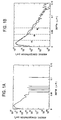
- Monte Carlo ion implantation simulation is performed first using a certain number of sample particles to obtain an impurity profile as shown in Fig. 1A.
- positions in the depth direction where the sample particles are divided are determined. These positions are represented by d 1 , d 2 , and d 3 in Fig. 1B.
- Sample particles which have reached the depths d 1 , d 2 , and d 3 are divided, and the Monte Carlo ion implantation simulation is performed again. With this process, a profile whose tail portion has minimum noise can be obtained, as shown in Fig. 1B.
- simulation can hardly be extended to two or three dimensions.
- the reason for this is as follows. To extend simulation to two or three dimensions, a function of determining a two- or three-dimensional line segment sequence or plane is required to divide sample particles.
- an ion implantation simulation method comprising calculating a particle scattering process of each of sample particles as a simulation target using a Monte Carlo method, determining that the particle has stopped when scattering calculation yields zero energy of the particle, continuously performing the scattering calculation when the energy is not 0, when the scattering calculation yields an energy of the particle that has decreased to ⁇ (0 ⁇ ⁇ ⁇ 1) times the energy value at the time of implantation, dividing the particle divided into a predetermined number N (N is an integer) such that a weight of the particle after division becomes 1/N that before division, further calculating the scattering process for the particle after division, determining that the particle has stopped when the energy becomes 0, when the energy is not 0 and decreases to ⁇ (0 ⁇ ⁇ ⁇ 1) times the energy value in the previous division, the particle is further divided into a predetermined number N (N is an integer) such that the weight of the particle after division becomes 1/N that before division, further calculating the scattering process for
- the simulation method of the present invention can be easily applied to simulation for a two- or three-dimensional structure.
- the scattering process of each sample particle as a simulation target is calculated using a Monte Carlo method.
- the scattering calculation gives zero energy of the particle, it is determined that the particle has stopped. Otherwise, the scattering calculation is continued.
- the scattering calculation yields an energy of the particle that has decreased to ⁇ (0 ⁇ ⁇ ⁇ 1) times the energy value at the time of implantation the particle is divided into a predetermined number N (N is an integer) such that the weight of the particle after division becomes 1/N that before division.
- N is an integer
- the particle is further divided into a predetermined number N (N is an integer) such that the weight of the particle after division becomes 1/N that before division.
- N is an integer
- the scattering process is further calculated for the particle after division. In this way, the scattering calculation and the particle division process are repeated until particles having non-zero energy values are divided a predetermined number of times M (M is an integer) counting from the first division operation, and consequently, the weight of the particle becomes 1/N M that of an initially implanted particle. For particles which have been divided the predetermined number of times M, the scattering calculation is performed until the energy value becomes 0.
- the positions where the energy values of all implanted particles become 0 are regarded as stop positions in the substrate, thereby calculating the impurity distribution.
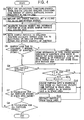
- simulation setting conditions are input. More specifically, the ion implantation energy, the dose, and the like are input as ion implantation conditions.
- step P 2 scattering calculation is started (step P 2 ).
- the number of times of division execution is represented by m (0 ⁇ m ⁇ M).
- the energy of a particle whose division frequency is m is represented by E m
- an initial energy E 0 of a particle whose division frequency is 0 is set as an implantation energy.
- the energy of a particle at an arbitrary position is represented by ⁇ .
- step P 3 A random number is generated, and the position of an atom where the implanted particle will collide next is calculated using the Monte Carlo method (step P 3 ).
- the energy loss due to the electronic or nuclear stopping power when the implanted sample particle moves to the position where it collides against the atom is calculated on the basis of the calculation in step P 3 , and the energy ⁇ of the particle is updated on the basis of the calculation (step P 4 ).
- step P 5 it is determined whether the energy ⁇ of the particle, which is updated in step P 4 , has become 0 (step P 5 ). If YES in step P 5 , it is determined that the particle has stopped, and the flow advances to step P 6 . If NO in step P 5 , the flow advances to step P 8 to continuously calculate the trajectory of the particle.
- step P 8 it is determined whether the number of times of executed division has reached the predetermined frequency M and whether the energy ⁇ of the particle is ⁇ times the energy E m (or the initial energy E 0 ) in the previous division. More specifically, if inequalities (1) below do not hold, the flow returns to step P 3 to continue particle scattering calculation on the basis of the Monte Carlo method: m ⁇ M, and ⁇ ⁇ ⁇ E m This routine is repeated until the energy ⁇ of the particle becomes 0, or inequalities (1) above are satisfied.
- the particle is divided into the predetermined number N (N is an integer) such that the weight of the particle after division becomes 1/N that before division.
- the flow returns to step P 3 to continue the scattering calculation for one of the divided particles.
- data of the position, the division frequency M, the energy value E m , the direction, and the weight of each of the N divided particles, except the particle for which calculation is continued, are stored in a predetermined stack area (step P 10 ).
- step P 5 A case wherein it is determined in step P 5 that the energy ⁇ of the particle is 0 will be described.
- the scattering calculation (or the scattering calculation and particle division process) yields zero energy ⁇ of the sample particle as the calculation target, the stack area where data of the divided particles are stored in step P 10 is accessed to determine whether scattering calculation for all particles divided in step P 10 is ended (step P 6 ). If NO in step P 6 , one of the particles stored in the stack area, for which calculation is not ended, is extracted. The flow returns to step P 3 to start the scattering calculation on the basis of stored data.
- step P 7 it is determined whether calculation for all sample particles is ended. If NO in step P 7 , the flow returns to step P 2 to start calculation for a particle extracted from the particles for which calculation is not ended.
- the scattering calculation is performed for all the divided particles.
- the scattering calculation and particle division process are repeated until particles having non-zero energy values are divided the predetermined number of times M (M is an integer) counting from the first division, and consequently, the weight of the particle becomes 1/N M that of an initially implanted particle.
- M is an integer
- scattering calculation is performed until the energy value becomes 0.
- the positions where the energy values of all sample particles become 0 are regarded as stop positions in the substrate, thereby obtaining an impurity distribution.
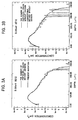
- Figs. 3A and 3B show actual calculation examples.
- the dotted line indicates a result obtained by performing the calculation according to the method of the present invention for 1,000 implanted sample particles.
- the division frequency M is 4, the number N of particles obtained by one division is 2, and the division reference multiplier ⁇ is 0.5.
- the solid line in Fig. 3A indicates a calculation result obtained by performing the conventional Monte Carlo ion implantation simulation without division for 100,000 implanted particles.
- the dotted line indicates a calculation result obtained by performing the conventional Monte Carlo ion implantation simulation without division for 2,500 implanted sample particles.
- the solid line in Fig. 3B indicates a calculation result obtained by performing the conventional Monte Carlo ion implantation simulation without division for 100,000 implanted sample particles.
- the time required to perform calculation for 1,000 particles using of the method of the present invention is almost the same as that required to perform calculation for 2,500 sample particles using the conventional method without division, so the two results are compared with the result of calculation for 100,000 particles.
- ions are implanted into a silicon substrate through, e.g., an oxide film, and when the distribution of oxygen atoms which are forced from the oxide film into the silicon substrate by the implanted particles is to be calculated, the calculation accuracy is increased using the method of the present invention.
- simulation setting conditions are input. More specifically, the ion implantation energy, the dose, and the like are input as ion implantation conditions.
- step Q 2 scattering calculation is started (step Q 2 ).
- the number of times of division execution is represented by m (0 ⁇ m ⁇ M).
- the energy of a particle whose division frequency is m is represented by E m
- an initial energy E 0 of a particle whose division frequency is 0 is set as an implantation energy.
- the energy of a particle at an arbitrary position is represented by ⁇ .
- step Q 3 A random number is generated, and the position of an atom where the implanted particle will collide next is calculated using the Monte Carlo method (step Q 3 ).
- the energy loss due to the electronic or nuclear stopping power when the implanted sample particle moves to the position where it collides against the atom is calculated on the basis of the calculation in step Q 3 , and the energy ⁇ of the particle is updated on the basis of the calculation (step Q 4 ).
- step Q 5 it is determined whether the energy loss due to collision is larger than the binding energy of substrate atoms. More specifically, it is determined whether substrate atoms are forced out upon collision. If YES in step Q 5 , data of the type, energy, and moving direction of atoms forced out upon collision are stored in the stack area in step Q 9 . The energy of the atom at the division frequency m is represented by e m , and an energy e 0 that the atom forced out by the particle whose division frequency is 0 has acquired in step Q 2 is represented by E 0 . These data are also stored in the stack area, and the flow advances to step Q 6 . In step Q 6 and following steps, the atomforced out upon collision is also included in the particle refered in step Q 6 and scattering calculation is performed for the particle included the atom.
- step Q 5 If NO in step Q 5 , the flow directly advances to step Q 6 .
- step Q 6 it is determined whether the energy ⁇ of the particle, which is updated in step Q 4 , has become 0 (step Q 6 ). If YES in step Q 6 , it is determined that the particle has stopped, and the flow advances to step Q 7 . If NO in step Q 6 , the flow advances to step Q 10 to continuously calculate the trajectory of the particle.
- step Q 10 it is determined whether the number of times of executed division has reached the predetermined frequency M and whether the energy ⁇ of the particle is ⁇ times the energy E m (or the initial energy E 0 ) in the previous division (step Q 10 ). More specifically, if inequalities (2) below do not hold, the flow returns to step Q 3 to continue particle scattering calculation on the basis of the Monte Carlo method: m ⁇ M, and ⁇ ⁇ ⁇ E m This routine is repeated until the energy ⁇ of the particle becomes 0, or inequalities (2) above are satisfied.
- the particle is divided into the predetermined number N (N is an integer) such that the weight of the particle after division becomes 1/N that before division.
- the flow returns to step Q 3 to continue the scattering calculation for one of the divided particles.
- data of the position, the division frequency M, the energy value E m , the direction, and the weight of each of the N divided particles, except the particle for which calculation is continued, are stored in a predetermined stack area (step Q 12 ).
- step Q 6 A case wherein it is determined in step Q 6 that the energy ⁇ of the particle is 0 will be described.
- the scattering calculation (or the scattering calculation and particle division process) yields zero energy ⁇ of the sample particle as the calculation target, the stack area where data of the divided particles are stored in step Q 12 is accessed to determine whether scattering calculation for all particles divided in step Q 12 is ended (step Q 7 ). If NO in step Q 7 , one of the particles stored in the stack area, for which calculation is not ended, is extracted. The flow returns to step Q 3 to start the scattering calculation on the basis of stored data.
- step Q 8 it is determined whether calculation for all sample particles is ended. If NO in step Q 8 , the flow returns to step Q 2 to start calculation for a particle extracted from the particles for which calculation is not ended.
- the scattering calculation is performed for all the divided particles.
- the scattering calculation and particle division process are repeated until particles having non-zero energy values are divided the predetermined number of times M (M is an integer) counting from the first division, and consequently, the weight of the particle becomes 1/N M that of an initially implanted particle.
- M is an integer
- scattering calculation is performed until the energy value becomes 0.
- the positions where the energy values of all sample particles become 0 are regarded as stop positions in the substrate, thereby obtaining an impurity distribution.
Landscapes
- Engineering & Computer Science (AREA)
- Physics & Mathematics (AREA)
- Theoretical Computer Science (AREA)
- Computer Hardware Design (AREA)
- Evolutionary Computation (AREA)
- Geometry (AREA)
- General Engineering & Computer Science (AREA)
- General Physics & Mathematics (AREA)
- Management, Administration, Business Operations System, And Electronic Commerce (AREA)
- Testing Or Measuring Of Semiconductors Or The Like (AREA)
Applications Claiming Priority (3)
| Application Number | Priority Date | Filing Date | Title |
|---|---|---|---|
| JP246129/96 | 1996-09-18 | ||
| JP24612996 | 1996-09-18 | ||
| JP24612996A JP3003588B2 (ja) | 1996-09-18 | 1996-09-18 | イオン注入シミュレーション方法 |
Publications (3)
| Publication Number | Publication Date |
|---|---|
| EP0831407A2 true EP0831407A2 (fr) | 1998-03-25 |
| EP0831407A3 EP0831407A3 (fr) | 1999-10-20 |
| EP0831407B1 EP0831407B1 (fr) | 2002-11-27 |
Family
ID=17143918
Family Applications (1)
| Application Number | Title | Priority Date | Filing Date |
|---|---|---|---|
| EP97116229A Expired - Lifetime EP0831407B1 (fr) | 1996-09-18 | 1997-09-18 | Méthode de simulation d'implantation d'iones |
Country Status (5)
| Country | Link |
|---|---|
| US (1) | US5912824A (fr) |
| EP (1) | EP0831407B1 (fr) |
| JP (1) | JP3003588B2 (fr) |
| KR (1) | KR100262103B1 (fr) |
| DE (1) | DE69717382T2 (fr) |
Cited By (2)
| Publication number | Priority date | Publication date | Assignee | Title |
|---|---|---|---|---|
| EP0997832A3 (fr) * | 1998-10-27 | 2002-01-30 | Nec Corporation | Méthode pour simuler un procédé d'implantation d'ions dans lequel le nombre de particules peut être reduit |
| CN1322552C (zh) * | 2003-08-19 | 2007-06-20 | 北京大学 | 离子注入涨落的模拟方法 |
Families Citing this family (8)
| Publication number | Priority date | Publication date | Assignee | Title |
|---|---|---|---|---|
| JP2000332264A (ja) * | 1999-05-25 | 2000-11-30 | Nec Corp | ブレークダウンのシミュレーション方法 |
| JP3787060B2 (ja) * | 2000-09-11 | 2006-06-21 | 株式会社東芝 | モンテカルロイオン注入シミュレーション方法、モンテカルロイオン注入シミュレータ、モンテカルロイオン注入シミュレーションプログラムを格納した記録媒体、及び半導体装置の製造方法 |
| KR100448105B1 (ko) * | 2001-04-11 | 2004-09-10 | 한국과학기술원 | 경로를 알지 못하는 많은 구들간의 효율적인 충돌 검색방법 |
| US6735556B2 (en) | 2001-06-15 | 2004-05-11 | International Business Machines Corporation | Real-time model evaluation |
| US7302376B2 (en) * | 2002-08-15 | 2007-11-27 | International Business Machines Corporation | Device modeling for proximity effects |
| JP4504027B2 (ja) * | 2004-01-09 | 2010-07-14 | 株式会社東芝 | イオン注入シミュレーション装置、イオン注入シミュレーション方法及びイオン注入シミュレーションプログラム |
| JP2012043996A (ja) * | 2010-08-19 | 2012-03-01 | Toshiba Corp | イオン注入シミュレーションプログラム |
| KR102525873B1 (ko) | 2015-10-16 | 2023-04-27 | 삼성전자주식회사 | 반도체 공정 시뮬레이션 장치 및 그것의 시뮬레이션 방법 |
Family Cites Families (6)
| Publication number | Priority date | Publication date | Assignee | Title |
|---|---|---|---|---|
| US4371406A (en) * | 1965-09-28 | 1983-02-01 | Li Chou H | Solid-state device |
| US3765956A (en) * | 1965-09-28 | 1973-10-16 | C Li | Solid-state device |
| US4136435A (en) * | 1973-10-10 | 1979-01-30 | Li Chou H | Method for making solid-state device |
| US5420049A (en) * | 1993-09-09 | 1995-05-30 | The United States Of America As Represented By The Secretary Of The Navy | Method of controlling photoemission from porous silicon using ion implantation |
| JP3402412B2 (ja) * | 1994-09-20 | 2003-05-06 | 株式会社リコー | プロセスシミュレーション入力データ設定装置 |
| JP2783168B2 (ja) * | 1994-10-14 | 1998-08-06 | 日本電気株式会社 | イオン注入シミュレーション方法 |
-
1996
- 1996-09-18 JP JP24612996A patent/JP3003588B2/ja not_active Expired - Fee Related
-
1997
- 1997-09-17 US US08/932,642 patent/US5912824A/en not_active Expired - Fee Related
- 1997-09-18 EP EP97116229A patent/EP0831407B1/fr not_active Expired - Lifetime
- 1997-09-18 DE DE69717382T patent/DE69717382T2/de not_active Expired - Fee Related
- 1997-09-18 KR KR1019970047569A patent/KR100262103B1/ko not_active Expired - Fee Related
Non-Patent Citations (2)
| Title |
|---|
| HYUN-YONG LEE ET AL: "Three-dimensional Monte Carlo calculation of Ga/sup +/ ion penetration in an a-Se/sub 75/Ge/sub 25/ thin film" JOURNAL OF APPLIED PHYSICS, 15 NOV. 1995, USA, vol. 78, no. 10, pages 5975-5980, XP002112982 ISSN: 0021-8979 * |
| TASCH A F ET AL: "Modeling of ion implantation in single-crystal silicon" SECOND INTERNATIONAL CONFERENCE ON COMPUTER SIMULATION OF RADIATION EFFECTS IN SOLIDS, SANTA BARBARA, CA, USA, 24-29 JULY 1994, vol. B102, no. 1-4, pages 173-179, XP004002325 Nuclear Instruments & Methods in Physics Research, Section B (Beam Interactions with Materials and Atoms), Aug. 1995, Netherlands ISSN: 0168-583X * |
Cited By (2)
| Publication number | Priority date | Publication date | Assignee | Title |
|---|---|---|---|---|
| EP0997832A3 (fr) * | 1998-10-27 | 2002-01-30 | Nec Corporation | Méthode pour simuler un procédé d'implantation d'ions dans lequel le nombre de particules peut être reduit |
| CN1322552C (zh) * | 2003-08-19 | 2007-06-20 | 北京大学 | 离子注入涨落的模拟方法 |
Also Published As
| Publication number | Publication date |
|---|---|
| JPH1092762A (ja) | 1998-04-10 |
| JP3003588B2 (ja) | 2000-01-31 |
| EP0831407B1 (fr) | 2002-11-27 |
| DE69717382T2 (de) | 2003-10-23 |
| KR19980024715A (ko) | 1998-07-06 |
| US5912824A (en) | 1999-06-15 |
| DE69717382D1 (de) | 2003-01-09 |
| KR100262103B1 (ko) | 2000-08-01 |
| EP0831407A3 (fr) | 1999-10-20 |
Similar Documents
| Publication | Publication Date | Title |
|---|---|---|
| Huang et al. | Plasma etching of high aspect ratio features in SiO2 using Ar/C4F8/O2 mixtures: A computational investigation | |
| Vahedi et al. | Capacitive RF discharges modelled by particle-in-cell Monte Carlo simulation. I. Analysis of numerical techniques | |
| US5912824A (en) | Ion implantation simulation method | |
| Weng et al. | Method for including electron-electron collisions in Monte Carlo simulations of electron swarms in partially ionized gases | |
| Economou et al. | Quantitative results near the band edges of disordered systems | |
| Töglhofer et al. | Ion-induced electron emission from metal surfaces—Insights from the emission statistics | |
| Werner | Trajectory reversal approach for electron backscattering from solid surfaces | |
| Chen et al. | The floating potential of cylindrical Langmuir probes | |
| JP2783174B2 (ja) | イオン注入不純物分布のシミュレーション方法 | |
| Benka et al. | Electron-emission yield of Al, Cu, and Au for the impact of swift bare light ions | |
| Wu et al. | Velocity dependence of one-and two-electron processes in intermediate-velocity Ar 1 6++ He collisions | |
| US20030191899A1 (en) | Method for measurement of beam emittance in a charged particle transport system | |
| Giles et al. | Calculation of channeling effects during ion implantation using the Boltzmann transport equation | |
| Tasch et al. | Modeling of ion implantation in single-crystal silicon | |
| US7213223B2 (en) | Method of estimating a total path delay in an integrated circuit design with stochastically weighted conservatism | |
| Overbury et al. | Energy and angular distribution of low energy H+ and D+ backscattered from polycrystalline carbon | |
| EP0701269B1 (fr) | Appareil d'implantation ionique | |
| Tolar Jr et al. | A transport condensed history algorithm for electron monte carlo simulations | |
| JP2701791B2 (ja) | イオン注入プロセスのシミュレーション方法 | |
| Takeda et al. | Precise ion-implantation analysis including channeling effects | |
| Miyashita et al. | Experimental evaluation of depth-dependent lateral standard deviation for various ions in a-Si from one-dimensional tilted implantation profiles | |
| JP2871588B2 (ja) | イオン注入プロセスのシミュレーション方法 | |
| van Schie et al. | Two methods to improve the performance of Monte Carlo simulations of ion implantation in amorphous targets | |
| Allen | The quantification of SIMS depth profiles by maximum entropy reconstruction | |
| Salzborn et al. | Transfer ionization in collisions between multiply charged ions and atoms at keV energies |
Legal Events
| Date | Code | Title | Description |
|---|---|---|---|
| PUAI | Public reference made under article 153(3) epc to a published international application that has entered the european phase |
Free format text: ORIGINAL CODE: 0009012 |
|
| AK | Designated contracting states |
Kind code of ref document: A2 Designated state(s): CH DE GB LI |
|
| AX | Request for extension of the european patent |
Free format text: AL;LT;LV;RO;SI |
|
| PUAL | Search report despatched |
Free format text: ORIGINAL CODE: 0009013 |
|
| AK | Designated contracting states |
Kind code of ref document: A3 Designated state(s): AT BE CH DE DK ES FI FR GB GR IE IT LI LU MC NL PT SE |
|
| AX | Request for extension of the european patent |
Free format text: AL;LT;LV;RO;SI |
|
| 17P | Request for examination filed |
Effective date: 19990910 |
|
| 17Q | First examination report despatched |
Effective date: 20000105 |
|
| AKX | Designation fees paid |
Free format text: CH DE GB LI |
|
| GRAG | Despatch of communication of intention to grant |
Free format text: ORIGINAL CODE: EPIDOS AGRA |
|
| GRAG | Despatch of communication of intention to grant |
Free format text: ORIGINAL CODE: EPIDOS AGRA |
|
| GRAG | Despatch of communication of intention to grant |
Free format text: ORIGINAL CODE: EPIDOS AGRA |
|
| GRAH | Despatch of communication of intention to grant a patent |
Free format text: ORIGINAL CODE: EPIDOS IGRA |
|
| GRAH | Despatch of communication of intention to grant a patent |
Free format text: ORIGINAL CODE: EPIDOS IGRA |
|
| GRAA | (expected) grant |
Free format text: ORIGINAL CODE: 0009210 |
|
| AK | Designated contracting states |
Kind code of ref document: B1 Designated state(s): CH DE GB LI |
|
| REG | Reference to a national code |
Ref country code: GB Ref legal event code: FG4D |
|
| REG | Reference to a national code |
Ref country code: CH Ref legal event code: NV Representative=s name: E. BLUM & CO. PATENTANWAELTE Ref country code: CH Ref legal event code: EP |
|
| REF | Corresponds to: |
Ref document number: 69717382 Country of ref document: DE Date of ref document: 20030109 |
|
| RIN2 | Information on inventor provided after grant (corrected) |
Inventor name: SAWAHATA, KOICHI |
|
| REG | Reference to a national code |
Ref country code: CH Ref legal event code: PUE Owner name: NEC ELECTRONICS CORPORATION Free format text: NEC CORPORATION#7-1, SHIBA 5-CHOME, MINATO-KU#TOKYO (JP) -TRANSFER TO- NEC ELECTRONICS CORPORATION#1753 SHIMONUMABE, NAKAHARA-KU#KAWASAKI, KANAGAWA 211-8668 (JP) |
|
| RAP2 | Party data changed (patent owner data changed or rights of a patent transferred) |
Owner name: NEC ELECTRONICS CORPORATION |
|
| REG | Reference to a national code |
Ref country code: GB Ref legal event code: 732E |
|
| PLBE | No opposition filed within time limit |
Free format text: ORIGINAL CODE: 0009261 |
|
| STAA | Information on the status of an ep patent application or granted ep patent |
Free format text: STATUS: NO OPPOSITION FILED WITHIN TIME LIMIT |
|
| 26N | No opposition filed |
Effective date: 20030828 |
|
| PGFP | Annual fee paid to national office [announced via postgrant information from national office to epo] |
Ref country code: GB Payment date: 20040915 Year of fee payment: 8 Ref country code: CH Payment date: 20040915 Year of fee payment: 8 |
|
| PGFP | Annual fee paid to national office [announced via postgrant information from national office to epo] |
Ref country code: DE Payment date: 20040916 Year of fee payment: 8 |
|
| PG25 | Lapsed in a contracting state [announced via postgrant information from national office to epo] |
Ref country code: GB Free format text: LAPSE BECAUSE OF NON-PAYMENT OF DUE FEES Effective date: 20050918 |
|
| PG25 | Lapsed in a contracting state [announced via postgrant information from national office to epo] |
Ref country code: LI Free format text: LAPSE BECAUSE OF NON-PAYMENT OF DUE FEES Effective date: 20050930 Ref country code: CH Free format text: LAPSE BECAUSE OF NON-PAYMENT OF DUE FEES Effective date: 20050930 |
|
| PG25 | Lapsed in a contracting state [announced via postgrant information from national office to epo] |
Ref country code: DE Free format text: LAPSE BECAUSE OF NON-PAYMENT OF DUE FEES Effective date: 20060401 |
|
| REG | Reference to a national code |
Ref country code: CH Ref legal event code: PL |
|
| GBPC | Gb: european patent ceased through non-payment of renewal fee |
Effective date: 20050918 |