EP0831459B1 - Verfahren zur Änderung der Grundfrequenz einer V(okal)-K(onsonant)-V(okal) Phonemketten-Wellenform und Vorrichtung zur Klangsynthese aus einer Folge von VKV Phonemketten-Wellenformen - Google Patents
Verfahren zur Änderung der Grundfrequenz einer V(okal)-K(onsonant)-V(okal) Phonemketten-Wellenform und Vorrichtung zur Klangsynthese aus einer Folge von VKV Phonemketten-Wellenformen Download PDFInfo
- Publication number
- EP0831459B1 EP0831459B1 EP97116375A EP97116375A EP0831459B1 EP 0831459 B1 EP0831459 B1 EP 0831459B1 EP 97116375 A EP97116375 A EP 97116375A EP 97116375 A EP97116375 A EP 97116375A EP 0831459 B1 EP0831459 B1 EP 0831459B1
- Authority
- EP
- European Patent Office
- Prior art keywords
- chain
- vcv phoneme
- pitch
- waveform
- vcv
- Prior art date
- Legal status (The legal status is an assumption and is not a legal conclusion. Google has not performed a legal analysis and makes no representation as to the accuracy of the status listed.)
- Expired - Lifetime
Links
Images



Classifications
-
- G—PHYSICS
- G10—MUSICAL INSTRUMENTS; ACOUSTICS
- G10L—SPEECH ANALYSIS TECHNIQUES OR SPEECH SYNTHESIS; SPEECH RECOGNITION; SPEECH OR VOICE PROCESSING TECHNIQUES; SPEECH OR AUDIO CODING OR DECODING
- G10L13/00—Speech synthesis; Text to speech systems
- G10L13/08—Text analysis or generation of parameters for speech synthesis out of text, e.g. grapheme to phoneme translation, prosody generation or stress or intonation determination
-
- G—PHYSICS
- G10—MUSICAL INSTRUMENTS; ACOUSTICS
- G10L—SPEECH ANALYSIS TECHNIQUES OR SPEECH SYNTHESIS; SPEECH RECOGNITION; SPEECH OR VOICE PROCESSING TECHNIQUES; SPEECH OR AUDIO CODING OR DECODING
- G10L21/00—Speech or voice signal processing techniques to produce another audible or non-audible signal, e.g. visual or tactile, in order to modify its quality or its intelligibility
- G10L21/04—Time compression or expansion
-
- G—PHYSICS
- G10—MUSICAL INSTRUMENTS; ACOUSTICS
- G10L—SPEECH ANALYSIS TECHNIQUES OR SPEECH SYNTHESIS; SPEECH RECOGNITION; SPEECH OR VOICE PROCESSING TECHNIQUES; SPEECH OR AUDIO CODING OR DECODING
- G10L13/00—Speech synthesis; Text to speech systems
- G10L13/02—Methods for producing synthetic speech; Speech synthesisers
- G10L13/04—Details of speech synthesis systems, e.g. synthesiser structure or memory management
-
- G—PHYSICS
- G10—MUSICAL INSTRUMENTS; ACOUSTICS
- G10L—SPEECH ANALYSIS TECHNIQUES OR SPEECH SYNTHESIS; SPEECH RECOGNITION; SPEECH OR VOICE PROCESSING TECHNIQUES; SPEECH OR AUDIO CODING OR DECODING
- G10L21/00—Speech or voice signal processing techniques to produce another audible or non-audible signal, e.g. visual or tactile, in order to modify its quality or its intelligibility
- G10L21/003—Changing voice quality, e.g. pitch or formants
- G10L21/007—Changing voice quality, e.g. pitch or formants characterised by the process used
- G10L21/013—Adapting to target pitch
Definitions
- the present invention relates generally to a method of changing a pitch of a VCV (vowel-consonant-vowel) phoneme-chain waveform and an apparatus of synthesizing a sound by changing pitches of a plurality of VCV phoneme-chain waveforms and connecting the VCV phoneme-chain waveforms with each other, and more particularly to a pitch changing method in which a pitch of a VCV phoneme-chain waveform is changed while the VCV phoneme-chain waveform maintains a pitch fluctuation and a pitch fine structure and a sound synthesizing apparatus in which a sound is synthesized from a series of VCV phoneme-chain waveforms while the VCV phoneme-chain waveforms of the sound maintain a pitch fluctuation and a pitch fine structure.
- a pitch changing method in which a pitch of a VCV phoneme-chain waveform is changed while the VCV phoneme-chain waveform maintains a pitch fluctuation and a pitch fine structure
- a sound synthesizing apparatus in which a sound
- Fig. 1 shows a composite pitch pattern P1 of a waveform of a phrase "Yokohama city” pronounced as “yo-ko-ha-ma-shi” in Japan
- Figs. 2A to 2D show pitch patterns P2 to P5 of waveforms of a plurality of VCV (vowel-consonant-vowel) phoneme chains "(y)-o-k-o", “o-h-a”, “a-m-a” and “a-sh-i” obtained by dividing a series of phonemes of the pronounced voice "yo-ko-ha-ma-shi".
- VCV vowel-consonant-vowel
- VCV phoneme-chain waveforms respectively extracted from an actual voice are stored in advance in a VCV phoneme-chain waveform storing unit of the conventional voice synthesizing apparatus, and waveforms inherent in a plurality of VCV phoneme chains "(y)-o-k-o", “o-h-a”, “a-m-a” and “a-sh-i” corresponding to the input characters "yokohamashi" are read out from the storing unit.
- a pitch frequency of one pitch pattern denotes a fundamental frequency of a sound including a voice.
- the pitch frequency is high (or low)
- the sound is classified as a high-pitched (or low-pitched) sound.
- a portion of the pitch pattern indicated by a dotted line in each of the pitched patterns P2, P3 and P5 indicates a waveform of a voiceless consonant such as "k" or "h".
- a first portion P6 of the first phoneme “o” in the VCV phoneme-chain waveform "(y)-o-k-o” indicates a vowel transitional portion of the first phoneme "o”
- a second portion P7 of the second phoneme “o” in the VCV phoneme-chain waveforms "(y)-o-k-o” and "o-h-a” indicates a vowel transitional portion of the second phoneme "o”
- a portion P8 of the phoneme “a” in the VCV phoneme-chain waveforms "o-h-a” and "a-m-a” indicates a vowel transitional portion of the phoneme "a”
- a portion P9 of the phoneme “a” common in the VCV phoneme-chain waveforms "a-m-a” and "a-sh-i” indicates a vowel transitional portion of the phoneme "a”.
- each pair of VCV phoneme-chain waveforms adjacent to each other are connected with each other at vowel transitional portions of a common vowel on condition that the common vowel is not either a vowel placed at the top of a word or a voiceless vowel, and a synthesized pitch pattern almost agreeing with the composite pitch pattern P1 is formed by connecting the pitch patterns P2 to P5 with each other while adjusting the pitch frequency of each pitch pattern P2 to P5.
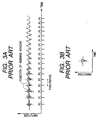
- Fig. 3A representatively shows a VCV phoneme-chain waveform placed in a plurality of time-periods.
- a plurality of impulse actuating time-points Pt are determined at a plurality of local peak points of one VCV phoneme-chain waveform for each of the VCV phoneme-chain waveforms "(y)-o-k-o", “o-h-a”, “a-m-a” and "a-sh-i", a pair of time-periods adjacent to each other is determined for each impulse actuating time-point Pt, a pitch waveform is extracted from a waveform portion at one pair of time-periods around one impulse actuating time-point Pt for each impulse actuating time-point Pt by setting a hunning window to the waveform portion to decompose each VCV phoneme-chain waveform to a series of pitch waveforms (called a pitch waveform string).
- a representative pitch waveform is shown in Fig. 3B. Thereafter, the pitch waveform string of the VCV phoneme-chain waveform "(y)-o-k-o", the pitch waveform string of the VCV phoneme-chain waveform "o-h-a”, the pitch waveform string of the VCV phoneme-chain waveform "a-m-a” and the pitch waveform string of the VCV phoneme-chain waveform "a-sh-i” are connected with each other in that order to arrange the pitch waveforms of the VCV phoneme-chain waveforms along the composite pitch pattern P1 while the vowel transitional portions P7 of the waveforms "(y)-o-k-o" and "o-h-a", the vowel transitional portions P8 of the waveforms "o-h-a” and “a-m-a” and the vowel transitional portions P9 of the waveforms "a-m-a” and "a-sh-i” are respectively overlapped.
- the arrangement of the pitch waveforms of the VCV phoneme-chain waveforms along the composite pitch pattern P1 denotes that the time intervals of the pitch waveforms of the VCV phoneme-chain waveforms are adjusted to the pitch frequency of the composite pitch pattern P1. That is, a pitch of each VCV phoneme-chain waveform is changed to adjust a pitch frequency of each VCV phoneme-chain waveform to a pitch frequency of the composite pitch pattern P1.
- each VCV phoneme-chain waveform is decomposed to a plurality of pitch waveforms and the pitch waveforms are rearranged along the composite pitch pattern P1
- a pitch fluctuation peculiar to a natural voice is disappeared.
- the pitch fluctuation denotes a minute time fluctuation in a pitch frequency of a pitch pattern.
- a time interval of two impulse actuation time-points adjacent to each other slightly changes with time in each VCV phoneme-chain waveform, and the slight change of the time interval between the impulse actuation time-points is lost by rearranging the pitch waveforms. Therefore, there is a drawback that the natural quality of a synthesized voice obtained in the conventional voice synthesizing apparatus is degraded.
- a pitch frequency of a voiced consonant portion becomes slightly lower than that of a vowel portion in a VCV phoneme chain.
- a pitch frequency of the voiced consonant "m" in the pitch patter P4 is lower than that of the vowel "a”.
- This pitch frequency change in a structure of a voice waveform is called a pitch fine structure.
- the composite pitch pattern 1 is artificially generated, any pitch fine structure does not exist in the composite pitch pattern 1. Therefore, the composite pitch pattern 1 is called a general whole pitch pattern having no pitch fluctuation or no pitch fine structure.
- a pitch frequency of the voiced consonant "m” is not lower than that of the vowel "a” in the composite pitch patter P1. Therefore, even though a pitch pattern of each VCV phoneme-chain waveform has a pitch fine structure, because each VCV phoneme-chain waveform is decomposed to a plurality of pitch waveforms and the pitch waveforms are rearranged along the composite pitch pattern P1, there is a drawback that the pitch fine structure is disappeared.
- the tone quality of a sound depends on a distribution of a plurality of higher harmonic waves included in the sound.
- the pitch frequency of a VCV phoneme-chain waveform is greatly changed to arrange the VCV phoneme-chain waveform along the composite pitch pattern P1
- a pitch changing degree indicating a ratio of the pitch frequency of the composite pitch pattern P1 to the pitch frequency of the VCV phoneme-chain waveform is high
- a balance between a wave of the fundamental frequency and the group of higher harmonic waves is greatly changed. Therefore, there is a drawback that the natural quality of a synthesized voice is lost and the tone quality of the synthesized voice is degraded.
- document JP-A-8-234793 discloses a voice synthesis method connecting VCV chain waveforms and a device therefore, wherein according to the abstract thereof, a candidate retrieval part cuts out candidates of VCV chain waveforms needed for syntheses by retrieving in what part of a text data base in which the character displays of a natural voice data base are preformed character strings divided in a character string dividing and processing part are present and a waveform selection part determines an optimum connection combination from the cut out VCV chain waveforms.
- a waveform disassembling part disassembles the voical sound parts of respective VCV chain waveforms of the combination into pitch wave strings and then a waveform integrating part rearranges the disassembled VCV chain waveforms of the combination successively along pitch patterns to connect all VCV chain waveforms. Then, a power matching part matches powers at connection points of connected VCV waveformes each other and then a rhythm correcting part finely adjusts the rhythm of a voice obtained by the combination.
- a first object of the present invention is to provide, with due consideration to the drawbacks of such a conventional pitch changing method and a sound synthesizing apparatus, a pitch changing method of a VCV phoneme-chain waveform in which a pitch frequency of the VCV phoneme-chain waveform is changed while maintaining a pitch fluctuation of the VCV phoneme-chain waveform and a pitch fine structure of the VCV phoneme-chain waveform even though a pitch changing degree for the VCV phoneme-chain waveform is high.
- a second object of the present invention is to provide a sound synthesizing apparatus in which a sound having the natural quality and a high tone quality is synthesized from a plurality of VCV phoneme-chain waveforms by changing pitch frequencies of the VCV phoneme-chain waveforms and connecting the VCV phoneme-chain waveforms with each other while the sound maintains a pitch fluctuation and a pitch fine structure even though a pitch changing degree for each VCV phoneme-chain waveform is high.
- the first object is achieved by the provision of a pitch changing method of a VCV phoneme-chain waveform as defined in claim 1.
- An advantageous further development is set out in dependent claim 2.
- a composite pitch pattern of an artificial waveform of a composite sound indicating the characters is produced, and a VCV phoneme-chain portion of the composite pitch pattern corresponding to a VCV phoneme chain is specified.
- the waveform of the composite sound is artificially formed, so that the composite sound lacks a pitch fine structure and a pitch fluctuation.
- VCV phoneme-chain waveform corresponding to the same VCV phoneme chain is produced from an actual voice sample. Therefore, a pitch fine structure and a pitch fluctuation exist in the VCV phoneme-chain waveform.
- a pitch of the VCV phoneme-chain waveform is changed to overlap a transitional portion of a preceding vowel in a pitch pattern of the VCV phoneme-chain waveform with that in the VCV phoneme-chain portion of the composite pitch pattern while making an overall inclination of the pitch pattern of the VCV phoneme-chain waveform agree with an overall inclination of the VCV phoneme-chain portion of the composite pitch pattern. Therefore, a changed pitch pattern of the VCV phoneme-chain waveform is obtained. Thereafter, the changed pitch pattern of the VCV phoneme-chain waveform is adopted as a pitch pattern of a waveform corresponding to the VCV phoneme chain.
- VCV phoneme-chain waveform corresponding to the VCV phoneme chain can be obtained while the VCV phoneme-chain waveform maintains a pitch fluctuation and a pitch fine structure.
- the synthesized sound having the superior natural quality can be obtained.
- the second object is achieved by the provision of a sound synthesizing apparatus as defined in claim 3.
- a string of particular VCV phoneme-chains corresponding to characters written in a text is determined, and a composite pitch pattern of an artificial waveform of a composite sound corresponding to the characters is produced according to the string of particular VCV phoneme-chains by the composite pitch pattern producing means.
- the composite pitch pattern is artificially produced, the composite sound lacks a pitch fine structure and a pitch fluctuation.
- VCV phoneme-chain waveform selecting means selects a series of particular VCV phoneme-chain waveforms corresponding to the string of particular VCV phoneme-chains from the VCV phoneme-chain waveforms by the VCV phoneme-chain waveform selecting means. Because each particular VCV phoneme-chain waveform is produced from an actual voice sample, the particular VCV phoneme-chain waveform has a pitch fine structure and a pitch fluctuation.
- each particular VCV phoneme-chain waveform is changed according to the pitch changing method by the pitch changing means. Therefore, each particular VCV phoneme-chain waveform roughly overlapping with a corresponding portion of the composite pitch pattern of the composite sound while the particular VCV phoneme-chain waveform maintains the pitch fine structure and the pitch fluctuation.
- the changed pitch patterns of the particular VCV phoneme-chain waveforms are connected with each other by the VCV phoneme-chain waveform connecting means to produce a synthesized pitch pattern of a synthesized waveform of a synthesized sound, and the synthesized sound is output.
- a pitch changing method of a VCV phoneme-chain waveform is described with reference to Figs. 4 and 5.
- Fig. 4 shows a VCV phoneme-chain portion of a composite pitch pattern P11 of a composite sound used as a standard of a pitch pattern of a synthesized sound and a pitch pattern P12 inherent in a VCV phoneme-chain waveform.
- a composite pitch pattern P11 of an artificial waveform of a composite sound indicating the digital characters is artificially produced according to a well-known pitch pattern producing model of a regular voice synthesis.
- a pitch pattern producing model because the composite pitch pattern P11 is artificially produced, any pitch fluctuation or any pitch fine structure does not exist in the composite pitch pattern P11.
- an accent falling on the digital characters is considered in the composite pitch pattern P11, so that an accent component is included in the composite pitch pattern P11.
- a pitch frequency of a phoneme “yo” in the word “yokohama” is lower than that of a phoneme “yo” generally pronounced by a speaker, and a pitch frequency of each of the phonemes “ko", “ha” and “ma” in the word “yokohama” is higher than that in a general pronunciation.
- a difference between a pitch frequency of a phoneme in a phrase and a pitch frequency of a phoneme generally pronounced by a speaker is considered in the well known pitch pattern producing model, so that a phrase component is included in the composite pitch pattern P11.
- a pitch pattern P12 of a VCV (preceding vowel-consonant-succeeding vowel) phoneme-chain waveform corresponding to a VCV phoneme-chain portion of the composite pitch pattern P11 shown in Fig. 4 is produced from an actual voice sample. Because the pitch pattern P12 is produced from an actual voice sample, not only an accent component and a phrase component are included in the pitch pattern P12, but also a pitch fine structure and a pitch fluctuation exists in the pitch pattern P12.
- a pitch pattern is formed in a plane coordinate of a pitch frequency and a time, a transitional portion Vt1 of the preceding vowel is placed at a first time-point T1, and a transitional portion Vt2 of the succeeding vowel is placed at a second time-point T2.
- a pitch frequency of the pitch pattern P12 of the VCV phoneme-chain waveform at the first time-point T1 is F1
- a pitch frequency of the composite pitch pattern P11 used as a target of a pitch change is Fc1 at the first time-point T1.
- a pitch frequency of the pitch pattern P12 at the second time-point T2 is F2
- a pitch frequency of the composite pitch pattern P11 at the first time-point T1 is Fc2.
- the pitch pattern P12 corresponding to the VCV phoneme-chain portion of the composite pitch pattern P11 is selected from among five types.
- a low-high type VCV phoneme-chain waveform, a high-high type VCV phoneme-chain waveform, a high-low type VCV phoneme-chain waveform, a low-low type VCV phoneme-chain waveform and an exceptional type VCV phoneme-chain waveform are prepared for each VCV phoneme-chain portion of the composite pitch pattern P11.
- a pitch frequency at the transitional portion Vt1 of the preceding vowel is lower than that at a transitional portion of the same vowel generally pronounced by a speaker, and a pitch frequency at the transitional portion Vt2 of the succeeding vowel is higher than that at a transitional portion of the same vowel generally pronounced by a speaker.
- a pitch frequency at the transitional portion Vt1 of the preceding vowel is higher than that at a transitional portion of the same vowel generally pronounced by a speaker
- a pitch frequency at the transitional portion Vt2 of the succeeding vowel is higher than that at a transitional portion of the same vowel generally pronounced by a speaker
- a pitch frequency at the transitional portion Vt1 of the preceding vowel is higher than that at a transitional portion of the same vowel generally pronounced by a speaker, and a pitch frequency at the transitional portion Vt2 of the succeeding vowel is lower than that at a transitional portion of the same vowel generally pronounced by a speaker.
- a pitch frequency at the transitional portion of the Vt1 of the preceding vowel is lower than that at a transitional portion of the same vowel generally pronounced by a speaker
- a pitch frequency at the transitional portion Vt2 of the succeeding vowel is lower than that at a transitional portion of the same vowel generally pronounced by a speaker.
- a pitch pattern of the exceptional type VCV phoneme-chain waveform is selected when the VCV phoneme-chain portion of the composite pitch pattern P11 is placed at the top of a word or includes a voiceless vowel.
- a pitch pattern of the low-high type VCV phoneme-chain waveform is selected as the pitch pattern P12 because a difference between a pitch frequency of the low-high type VCV phoneme-chain waveform and a pitch frequency of the composite pitch pattern P11 is smaller than any difference between a pitch frequency of another type VCV phoneme-chain waveform and the pitch frequency of the composite pitch pattern P11.
- a pitch changing coefficient C1 at the first time-point T1 is set to Fc1/F1 (Fc1>F1 for convenience) to change the pitch frequency F1 of the pitch pattern P12 to the pitch frequency Fc1 of the composite pitch pattern P11
- a pitch changing coefficient C2 at the second time-point T2 is set to Fc2/F2 (Fc2>F2 for convenience) to change the pitch frequency F2 of the pitch pattern P12 to the pitch frequency Fc2 of the composite pitch pattern P11.
- a pitch changing coefficient Cx (Cx ⁇ 1 for convenience) of the pitch pattern P12 to the composite pitch pattern P11 at an arbitrary time-point Tx placed between the first and second time-points T1 and T2 is set as follows.
- Cx C1 + (C2 - C1)/(T2 - T1)*(Tx - T1)
- a pitch frequency Fx of the pitch pattern P12 at the arbitrary time-point Tx is changed to a pitch frequency of Cx*Fx. Therefore, in case where an inclination of a straight line connecting the transitional portion Vt1 of the preceding vowel and the transitional portion Vt2 of the succeeding vowel is defined as an overall inclination of a pitch pattern, as shown in Fig. 5, an overall inclination of the pitch pattern P12 is changed to that of the composite pitch pattern P11, and a changed pitch pattern P13 having the pitch frequency of Cx*Fx is adopted as a pitch pattern of a changed VCV phoneme-chain waveform corresponding to the VCV phoneme-chain portion of the composite pitch pattern P11.
- a changed pitch pattern having a changed pitch frequency of Cx*Fx is prepared from each of pitch patterns of the VCV phoneme-chain waveforms, and the changed pitch patterns of the VCV phoneme-chain waveforms are connected with each other to overlap a transitional portion Vt1 of a succeeding vowel of one particular VCV phoneme-chain waveform with a transitional portion Vt1 of a preceding vowel of a VCV phoneme-chain waveform following the particular VCV phoneme-chain waveform for each VCV phoneme-chain waveform, and a synthesized waveform of a synthesized sound having a synthesized pitch pattern obtained by connecting the changed pitch patterns of the VCV phoneme-chain waveforms with each other is obtained.
- a pitch frequency of a VCV phoneme-chain waveform can be changed while maintaining a pitch fluctuation of the VCV phoneme-chain waveform and a pitch fine structure of the VCV phoneme-chain waveform even though a pitch changing degree for the VCV phoneme-chain waveform is high.
- Fig. 6 is a block diagram of a sound synthesizing apparatus according to an embodiment of the present invention.
- a sound synthesizing apparatus 11 comprises
- Fig. 7 is a block diagram of a computer system used to perform an operation of the sound synthesizing apparatus 11.
- a computer system 31 comprises a scanner or keyboard 32, an external ROM apparatus 33, a central processing unit (CPU) 34 and a speaker 35.
- the operation of the character receiving unit 12 is realized by the scanner or keyboard 32.
- characters written in a text are recognized and converted into a character signal.
- keyboard 32 is used, a user inputs characters written in a text to the keyboard 32, and the input characters are converted into a character signal.
- the external ROM apparatus 33 functions as the data bases 15 to 19.
- the operation in the VCV phoneme symbol string producing unit 13, the composite pitch pattern producing unit 14, the VCV phoneme-chain waveform selecting unit 20, the pitch frequency changing unit 21 and the VCV phoneme-chain waveform connecting unit 22 is performed by the CPU 35.
- the operation of the synthesized sound outputting unit 23 is performed by the speaker 35. Therefore, a user can hear the synthesized sound.
- VCV phoneme-chain waveforms corresponding to the same VCV phoneme chain are produced from actual voice samples for each VCV phoneme chain, and a large number of VCV phoneme-chain waveforms are stored in advance in each of the data bases 15 to 16.
- VCV phoneme symbol string producing unit 13 When a user inputs characters "yokohamashi" written in a text to the character receiving unit 12, a string of VCV phoneme-chain symbols “yo”, “oko”, “oha”, “ama” and “ashi” corresponding to the characters is produced in the VCV phoneme symbol string producing unit 13. In the string of VCV phoneme-chain symbols, a CV phoneme-chain symbol "yo" is included. Thereafter, a composite pitch pattern of a composite sound corresponding to the characters is produced from the string of VCV phoneme-chain symbols according to a general pitch pattern producing model in the composite pitch pattern producing unit 14. In this case, each VCV phoneme-chain symbol corresponds to one VCV phoneme-chain portion of the composite pitch pattern.
- the composite pitch pattern is used as a rough standard of a desired pitch pattern of a sound corresponding to the characters.
- one low-high type VCV phoneme-chain waveform, one high-high type VCV phoneme-chain waveform, one high-low type VCV phoneme-chain waveform, one low-low type VCV phoneme-chain waveform and one exceptional type VCV phoneme-chain waveform corresponding to one VCV phoneme-chain symbol are extracted as candidates for a desired VCV phoneme-chain waveform from the VCV phoneme-chain waveform data bases 15 to 19, and a particular VCV phoneme-chain waveform is selected from among the candidates on condition that a particular pitch changing coefficient Cx determined to arrange a pitch pattern of the particular VCV phoneme-chain waveform along a VCV phoneme-chain portion of the composite pitch pattern corresponding to the VCV phoneme-chain symbol is smallest (or nearest to 1) among pitch changing coefficients for pitch patterns of the candidates.
- the selection of the particular VCV phoneme-chain waveform is performed for each VCV phoneme-chain symbol. For example, a particular CV phoneme-chain waveform for the CV phoneme-chain symbol "yo" is selected from the exceptional type VCV phoneme-chain waveform data base.
- the particular pitch changing coefficient Cx for one particular VCV phoneme-chain waveform corresponding to one VCV phoneme-chain symbol is calculated according to the equation (1) of the pitch changing method, and a pitch frequency of the particular VCV phoneme-chain waveform is multiplied by the particular pitch changing coefficient Cx to produce a changed pitch frequency. Therefore, an overall inclination of the changed pitch pattern of the particular VCV phoneme-chain waveform agrees with an overall inclination of a VCV phoneme-chain portion of the composite pitch pattern corresponding to the VCV phoneme-chain symbol.
- the changed pitch frequency of the particular VCV phoneme-chain waveform is produced for each VCV phoneme-chain symbol.
- the changed pitch patterns of the particular VCV phoneme-chain waveforms corresponding to the string of VCV phoneme-chain symbols are connected with each other in that order.
- a transitional portion Vt2 of a succeeding vowel of a first particular VCV phoneme-chain waveform overlaps with a transitional portion Vt1 of a preceding vowel of a second particular VCV phoneme-chain waveform following the first particular VCV phoneme-chain waveform for each particular VCV phoneme-chain waveform. Therefore, a synthesized pitch pattern of a synthesized waveform of a synthesized sound is produced. Thereafter, the synthesized sound is output.
- a particular pitch changing coefficient Cx for one particular VCV phoneme-chain waveform corresponding to one VCV phoneme-chain symbol is calculated according to the equation (1) of the pitch changing method and a pitch frequency of the particular VCV phoneme-chain waveform is changed to make an overall inclination of the pitch frequency of the particular VCV phoneme-chain waveform agree with an overall inclination of a VCV phoneme-chain portion of the composite pitch pattern corresponding to the VCV phoneme-chain symbol
- a synthesized sound of the input characters can be obtained while maintaining a pitch fluctuation and a pitch fine structure in a synthesized waveform of the synthesized sound, even though a pitch changing degree for each VCV phoneme-chain waveform is high.
- each particular VCV phoneme-chain waveform is selected from among five types of VCV phoneme-chain waveforms on condition that a particular pitch changing coefficient Cx for the particular VCV phoneme-chain waveform is smallest (or nearest to 1)
- the pitch changing degree for each VCV phoneme-chain waveform can be minimized, and the pitch fluctuation and the pitch fine structure in the synthesized waveform of the synthesized sound can be moreover maintained. That is, the synthesized sound superior to the natural quality can be obtained.
Landscapes
- Engineering & Computer Science (AREA)
- Multimedia (AREA)
- Health & Medical Sciences (AREA)
- Audiology, Speech & Language Pathology (AREA)
- Human Computer Interaction (AREA)
- Physics & Mathematics (AREA)
- Acoustics & Sound (AREA)
- Computational Linguistics (AREA)
- Quality & Reliability (AREA)
- Signal Processing (AREA)
- Electrophonic Musical Instruments (AREA)
- Stereophonic System (AREA)
- Document Processing Apparatus (AREA)
Claims (4)
- Verfahren zur Änderung einer V(okal)-K(onsonant)-V(okal)-Phonemkettenwellenform, mit den Verfahrensschritten:Erzeugen (14) eines zusammengesetzten Tonhöhenmusters einer künstlichen Wellenform eines zusammengesetzten Klanges, der geschriebene Zeichen in einem Text aufzeigt, wobei das zusammengesetzte Tonhöhenmuster dargestellt ist als Tonhöhenfrequenz als Funktion der Zeit in Ebenenkoordinaten;Spezifizieren (20) eines VKV-Phonemkettenabschnitts des zusammengesetzten Tonhöhenmusters gemäß einer VKV-Phonemkette, zusammengesetzt aus einem vorangehenden Vokal, einem Konsonanten und einem nachfolgenden Vokal;Erzeugen (13) eines Tonhöhenmusters einer VKV-Phonemkettenwellenform der VKV-Phonemkette aus einer aktuellen Klangprobe;Festlegen einer Neigung einer geraden Linie, die einen Übergangsabschnitt des vorhergehenden Vokals und einen Übergangsabschnitt des nachfolgenden Vokals in den Ebenenkoordinaten als eine Gesamtneigung eines Tonhöhenmusters einer Wellenform gemäß der VKV-Phonemkette verbindet;Ändern (21) einer Tonhöhe der VKV-Phonemkettenwellenform zum Bilden eines geänderten Tonhöhenmusters der VKV-Phonemkettenwellenform, während die Gesamtneigung des geänderten Tonhöhenmusters der VKV-Phonemkettenwellenform zur Gesamtneigung des VKV-Phonemkettenabschnitts vom zusammengesetzten Tonhöhenmuster eingestellt wird, und Überlappen des Übergangsabschnitts vom vorhergehenden Vokal im geänderten Tonhöhenmuster der VKV-Phonemkettenwellenform mit derjenigen des VKV-Phonemkettenabschnitts vom zusammengesetzten Tonhöhenmuster; undÜbernehmen des geänderten Tonhöhenmusters der VKV-Phonemkettenwellenform als Tonhöhenmuster einer Wellenform gemäß der VKV-Phonemkette, wobei der Verfahrensschritt des Erzeugens eines Tonhöhenmusters einer VKV-Phonemkettenwellenform die Verfahrensschritte umfaßt:Erzeugen eines Tonhöhenmusters einer VKV-Phonemkettenwellenform des Tief-Hoch-Typs der VKV-Phonemkette, in der eine Tonhöhenfrequenz bei einem Übergangsabschnitt des vorangehenden Vokals tief und eine Tonhöhenfrequenz eines Übergangsabschnitts des nachfolgenden Vokals hoch ist, aus einer aktuellen Klangprobe;Erzeugen eines Tonhöhenmusters einer VKV-Phonemkettenwellenform des Hoch-Hoch-Typs der VKV-Phonemkette, in der eine Tonhöhenfrequenz bei einem Übergangsabschnitt des vorangehenden Vokals hoch und eine Tonhöhenfrequenz eines Übergangsabschnitts des nachfolgenden Vokals hoch ist, aus einer aktuellen Klangprobe;Erzeugen eines Tonhöhenmusters einer VKV-Phonemkettenwellenform des Hoch-Tief-Typs der VKV-Phonemkette, in der eine Tonhöhenfrequenz bei einem Übergangsabschnitt des vorangehenden Vokals hoch und eine Tonhöhenfrequenz eines Übergangsabschnitts des nachfolgenden Vokals tief ist, aus einer aktuellen Klangprobe;Erzeugen eines Tonhöhenmusters einer VKV-Phonemkettenwellenform des Tief-Tief-Typs der VKV-Phonemkette, in der eine Tonhöhenfrequenz bei einem Übergangsabschnitt des vorangehenden Vokals tief und eine Tonhöhenfrequenz eines Übergangsabschnitts des nachfolgenden Vokals tief ist, aus einer aktuellen Klangprobe;Erzeugen eines Tonhöhenmusters einer VKV-Phonemkettenwellenform des exzeptionellen Typs der VKV-Phonemkette, die oben bei einem Wort plaziert ist oder einen stimmlosen Vokal enthält, aus einer aktuellen Klangprobe; undAuswählen (20) eines speziellen Tonhöhenmusters einer VKV-Phonemkettenwellenform einer Art als Tonhöhenmuster der VKV-Phonemkettenwellenform der VKV-Phonemkette aus den Tonhöhenmustern der VKV-Phonemkettenwellenform des Tief-Hoch-Typs, der VKV-Phonemkettenwellenform des Hoch-Hoch-Typs,-der VKV-Phonemkettenwellenform des Hoch-Tief-Typs, der VKV-Phonemkettenwellenform des Tief-Tief-Typs und der VKV-Phonemkettenwellenform des exzeptionellen Typs unter der Bedingung, daß eine Differenz in der Tonhöhenfrequenz zwischen dem speziellen Tonhöhenmuster und dem VKV-Phonemkettenabschnitt des zusammengesetzten Tonhöhenmusters am kleinsten ist.
- Verfahren zur Änderung der Tonhöhe nach Anspruch 1, bei dem der Verfahrensschritt des Änderns einer Tonhöhe der VKV-Phonemkettenwellenform die Verfahrensschritte umfaßt:Errechnen eines ersten Verhältnisses einer Tonhöhenfrequenz Fc1 des zusammengesetzten Tonhöhenmusters zu einer Tonhöhenfrequenz F1 des Tonhöhenmusters der VKV-Phonemkettenwellenform bei einem ersten Zeitpunkt T1;Errechnen eines zweiten Verhältnisses einer Tonhöhenfrequenz Fc2 des zusammengesetzten Tonhöhenmusters zu einer Tonhöhenfrequenz F2 des Tonhöhenmusters der VKV-Phonemkettenwellenform bei einem zweiten Zeitpunkt T2;Einstellen des ersten Verhältnisses Fc1/F1 auf einen Tonhöhenänderungskoeffizienten C1 bei einem ersten Zeitpunkt T1;Einstellen des zweiten Verhältnisses Fc2/F2 auf einen Tonhöhenänderungskoeffizienten C2 bei einem zweiten Zeitpunkt T2;Errechnen eines Tonhöhenänderungskoeffizienten Cx bei einem beliebigen Zeitpunkt Tx nach folgender Gleichung:Multiplizieren einer Tonhöhenfrequenz des Tonhöhenmusters der VKV-Phonemkettenwellenform durch einen Tonhöhenänderungskoeffizienten Cx, um das geänderte Tonhöhenmuster der VKV-Phonemkettenwellenform zu bilden.
- Vorrichtung zur Klangsynthese, mit:wobei das Speichermittel (15 - 19) ausgestattet ist mit:einem Speichermittel (15 - 19), das eine große Anzahl von VKV-Phonemkettenwellenformen von aus aktuellen Klangproben erzeugten VKV-Phonemketten speichert, wobei jede VKV-Phonemkette zusammengesetzt ist aus einem vorangehenden Vokal, einem Konsonanten und einem nachfolgenden Vokal;einem Empfangsmittel (12), das in einem Text geschriebene Zeichen empfängt;einem VKV-Phonemkettenbestimmungsmittel (13), das eine Kette spezieller VKV-Phonemketten gemäß dem vom Empfangsmittel empfangenen Zeichen bestimmt;einem Erzeugungsmittel (14) für ein zusammengesetztes Tonmuster zum Erzeugen eines zusammengesetzten Tonhöhenmusters einer künstlichen Wellenform eines zusammengesetzten Klanges gemäß den Zeichen entsprechend der Kette spezieller vom VKV-Phonemkettenbestimmungsmittel bestimmter VKV-Phonemketten,;einem VKV-Phonemkettenwellenform-Auswahlmittel (20), das eine Serie spezieller VKV-Phonemkettenwellenformen gemäß der Kette spezieller VKV-Phonemketten auswählt, bestimmt vom VKV-Phonemkettenbestimmungsmittel aus den im Speichermittel gespeicherten VKV-Phonemkettenwellenformen;einem Tonhöhenänderungsmittel (21), das eine Tonhöhe einer jeden speziellen vom VKV-Phonemkettenwellenform-Auswahlmittel ausgewählten VKV-Phonemkettenwellenform ändert, um ein geändertes Tonhöhenmuster der speziellen VKV-Phonemkettenwellenform zu bilden, während eine Gesamtneigung des geänderten Tonhöhenmusters der speziellen VKV-Phonemkettenwellenform zu einer Gesamtneigung eines Abschnitts des vom Erzeugungsmittel für zusammengesetztes Tonhöhenmuster zusammengesetzten Tonhöhenmusters eingestellt wird, und um einen Übergangsabschnitt des vorangehenden Vokals im geänderten Tonhöhenmuster von der speziellen VKV-Phonemkettenwellenform mit derjenigen im Abschnitt des zusammengesetzten Tonhöhenmusters zu überlappen;einem VKV-Phonemkettenwellenform-Verbindungsmittel (22), das die geänderten Tonhöhenmuster vom Tonhöhenänderungsmittel gewonnener spezieller VKV-Phonemkettenwellenformen miteinander verbindet, während ein Übergangsabschnitt des nachfolgenden Vokals von einer ersten speziellen VKV-Phonemkettenwellenform sich mit einem Übergangsabschnitt eines vorangehenden Vokals einer zweiten speziellen VKV-Phonemkettenwellenform überlappt, die der ersten speziellen VKV-Phonemkettenwellenform für jede spezielle VKV-Phonemkettenwellenform folgt, um ein synthetisiertes Tonhöhenmuster einer synthetisierten Wellenform eines synthetisierten Klanges zu erzeugen; und miteinem Ausgabemittel (23) für synthetisierten Klang zur Ausgabe des synthetisierten Klanges, erzeugt vom VKV-Phonemkettenwellenform-Verbindungsmittel,einer Datenbank (15) für VKV-Phonemkettenwellenformdaten des Tief-Hoch-Typs zum Speichern einer großen Anzahl von VKV-Phonemkettenwellenformen des Tief-Hoch-Typs, wobei eine Tonhöhenfrequenz bei einem Übergangsabschnitt des vorangehenden Vokals in jeder VKV-Phonemkettenwellenform des Tief-Hoch-Typs tief ist und eine Tonhöhenfrequenz bei einem Übergangsabschnitt des nachfolgenden Vokals in jeder VKV-Phonemkettenwellenform des Tief-Hoch-Typs hoch ist, aus aktuellen Klangproben;einer Datenbank (16) für VKV-Phonemkettenwellenformdaten des Hoch-Hoch-Typs zum Speichern einer großen Anzahl von VKV-Phonemkettenwellenformen des Hoch-Hoch-Typs, wobei eine Tonhöhenfrequenz bei einem Übergangsabschnitt des vorangehenden Vokals in jeder VKV-Phonemkettenwellenform des Hoch-Hoch-Typs hoch ist und eine Tonhöhenfrequenz bei einem Übergangsabschnitt des nachfolgenden Vokals in jeder VKV-Phonemkettenwellenform des Hoch-Hoch-Typs hoch ist, aus aktuellen Klangproben;einer Datenbank (17) für VKV-Phonemkettenwellenformdaten des Hoch-Tief-Typs zum Speichern einer großen Anzahl von VKV-Phonemkettenwellenformen des Hoch-Tief-Typs, wobei eine Tonhöhenfrequenz bei einem Übergangsabschnitt des vorangehenden Vokals in jeder VKV-Phonemkettenwellenform des Hoch-Tief-Typs hoch ist und eine Tonhöhenfrequenz bei einem Übergangsabschnitt des nachfolgenden Vokals in jeder VKV-Phonemkettenwellenform des Hoch-Tief-Typs tief ist, aus aktuellen Klangproben;einer Datenbank (18) für VKV-Phonemkettenwellenformdaten des Tief-Tief-Typs zum Speichern einer großen Anzahl von VKV-Phonemkettenwellenformen des Tief-Tief-Typs, wobei eine Tonhöhenfrequenz bei einem Übergangsabschnitt des vorangehenden Vokals in jeder VKV-Phonemkettenwellenform des Tief-Tief-Typs tief ist und eine Tonhöhenfrequenz bei einem Übergangsabschnitt des nachfolgenden Vokals in jeder VKV-Phonemkettenwellenform des Tief-Tief-Typs tief ist, aus aktuellen Klangproben; und miteiner Datenbank (19) für VKV-Phonemkettenwellenformdaten exzeptionellen Typs zum Speichern einer großen Anzahl exzeptioneller VKV-Phonemkettenwellenformen der VKV-Phonemketten, die entweder oben an einem Wort plaziert sind oder einen sprachlosen Vokal enthalten, aus aktuellen Klangproben,einer speziellen VKV-Phonemkettenwellenform des Tief-Hoch-Typs, einer speziellen VKV-Phonemkettenwellenform des Hoch-Hoch-Typs, einer speziellen VKV-Phonemkettenwellenform des Hoch-Tief-Typs, einer speziellen VKV-Phonemkettenwellenform des Tief-Tief-Typs, und einer speziellen VKV-Phonemkettenwellenform des exzeptionellen Typs gemäß einer jeden speziellen VKV-Phonemkette, die ausgelesen werden durch das VKV-Phonemkettenwellenform-Auswahlmittel (20) aus der Datenbank für VKV-Phonemkettenwellenformen des Tief-Hoch-Typs, der Datenbank für VKV-Phonemkettenwellenformen des Hoch-Hoch-Typs, der Datenbank für VKV-Phonemkettenwellenformen des Hoch-Tief-Typs, der Datenbank für VKV-Phonemkettenwellenformen des Tief-Tief-Typs und der Datenbank für VKV-Phonemkettenwellenformen des exzeptionellen Typ, und eine spezielle VKV-Phonemkettenwellenform wird ausgewählt vom VKV-Phonemkettenwellenform-Auswahlmittel als spezielle VKV-Phonemkettenwellenform gemäß einer jeden speziellen VKV-Phonemkette aus der speziellen VKV-Phonemkettenwellenform des Tief-Hoch-Typs, der speziellen VKV-Phonemkettenwellenform des Hoch-Hoch-Typs, der speziellen VKV-Phonemkettenwellenform des Hoch-Tief-Typs, der speziellen VKV-Phonemkettenwellenform des Tief-Tief-Typs und der speziellen VKV-Phonemkettenwellenform des exzeptionellen Typs unter der Bedingung, daß eine Differenz in der Tonhöhenfrequenz zwischen der speziellen VKV-Phonemkettenwellenform und einem zugehörigen Abschnitt des zusammengesetzten Tonfrequenzmusters am geringsten ist.
- Vorrichtung zur Klangsynthese nach Anspruch 3, bei der das Tonhöhenänderungsmittel (21) ausgestattet ist mit:einem Tonhöhenänderungs-Koeffizientenerrechnungsmittel zum Errechnen eines ersten Verhältnisses einer Tonhöhenfrequenz Fc1 des zusammengesetzten Tonhöhenmusters zu einer Tonhöhenfrequenz F1 des Tonhöhenmusters der VKV-Phonemkettenwellenform bei einem ersten Zeitpunkt T1, Errechnen eines zweiten Verhältnisses einer Tonhöhenfrequenz Fc2 des zusammengesetzten Tonhöhenmusters zu einer Tonhöhenfrequenz F2 des Tonhöhenmusters der VKV-Phonemkettenwellenform bei einem zweiten Zeitpunkt T2,Einstellen des ersten Verhältnisses Fc1/F1 auf einen Tonhöhenänderungskoeffizienten C1 bei einem ersten Zeitpunkt T1, Einstellen des zweiten Verhältnisses Fc2/F2 auf einen Tonhöhenänderungskoeffizienten C2 bei einem zweiten Zeitpunkt T2 und zum Errechnen eines Tonhöhenänderungskoeffizienten Cx bei einem beliebigen Zeitpunkt Tx nach folgender Gleichung:einem Erzeugungsmittel für ein geändertes Tonhöhenmuster zum Multiplizieren einer Tonhöhenfrequenz des Tonhöhenmusters der VKV-Phonemkettenwellenform mit dem vom Tonhöhenänderungs-Koeffizientenerrechnungsmittel errechneten Tonhöhenänderungskoeffizienten Cx, um ein geändertes Tonhöhenmuster der VKV-Phonemkettenwellenform zu erzeugen.
Applications Claiming Priority (3)
| Application Number | Priority Date | Filing Date | Title |
|---|---|---|---|
| JP26914696A JP3242331B2 (ja) | 1996-09-20 | 1996-09-20 | Vcv波形接続音声のピッチ変換方法及び音声合成装置 |
| JP26914696 | 1996-09-20 | ||
| JP269146/96 | 1996-09-20 |
Publications (3)
| Publication Number | Publication Date |
|---|---|
| EP0831459A2 EP0831459A2 (de) | 1998-03-25 |
| EP0831459A3 EP0831459A3 (de) | 1998-11-18 |
| EP0831459B1 true EP0831459B1 (de) | 2002-12-18 |
Family
ID=17468329
Family Applications (1)
| Application Number | Title | Priority Date | Filing Date |
|---|---|---|---|
| EP97116375A Expired - Lifetime EP0831459B1 (de) | 1996-09-20 | 1997-09-19 | Verfahren zur Änderung der Grundfrequenz einer V(okal)-K(onsonant)-V(okal) Phonemketten-Wellenform und Vorrichtung zur Klangsynthese aus einer Folge von VKV Phonemketten-Wellenformen |
Country Status (5)
| Country | Link |
|---|---|
| US (1) | US5950152A (de) |
| EP (1) | EP0831459B1 (de) |
| JP (1) | JP3242331B2 (de) |
| DE (1) | DE69717933T2 (de) |
| ES (1) | ES2188839T3 (de) |
Families Citing this family (13)
| Publication number | Priority date | Publication date | Assignee | Title |
|---|---|---|---|---|
| AU7429591A (en) * | 1990-04-18 | 1991-10-24 | Gene-Trak Systems | Nucleic acid probes for the detection of giardia lamblia |
| DE69736279T2 (de) * | 1996-11-11 | 2006-12-07 | Matsushita Electric Industrial Co., Ltd., Kadoma | Tonwiedergabe-geschwindigkeitsumwandler |
| JP3361066B2 (ja) * | 1998-11-30 | 2003-01-07 | 松下電器産業株式会社 | 音声合成方法および装置 |
| JP2000305585A (ja) * | 1999-04-23 | 2000-11-02 | Oki Electric Ind Co Ltd | 音声合成装置 |
| JP3361291B2 (ja) | 1999-07-23 | 2003-01-07 | コナミ株式会社 | 音声合成方法、音声合成装置及び音声合成プログラムを記録したコンピュータ読み取り可能な媒体 |
| JP2001100776A (ja) * | 1999-09-30 | 2001-04-13 | Arcadia:Kk | 音声合成装置 |
| JP3515039B2 (ja) * | 2000-03-03 | 2004-04-05 | 沖電気工業株式会社 | テキスト音声変換装置におけるピッチパタン制御方法 |
| JP2002091475A (ja) * | 2000-09-18 | 2002-03-27 | Matsushita Electric Ind Co Ltd | 音声合成方法 |
| JP2003108178A (ja) * | 2001-09-27 | 2003-04-11 | Nec Corp | 音声合成装置及び音声合成用素片作成装置 |
| TWI250509B (en) * | 2004-10-05 | 2006-03-01 | Inventec Corp | Speech-synthesizing system and method thereof |
| JP4533255B2 (ja) * | 2005-06-27 | 2010-09-01 | 日本電信電話株式会社 | 音声合成装置、音声合成方法、音声合成プログラムおよびその記録媒体 |
| JP5479823B2 (ja) * | 2009-08-31 | 2014-04-23 | ローランド株式会社 | 効果装置 |
| JP5723568B2 (ja) * | 2010-10-15 | 2015-05-27 | 日本放送協会 | 話速変換装置及びプログラム |
Family Cites Families (8)
| Publication number | Priority date | Publication date | Assignee | Title |
|---|---|---|---|---|
| JP2761552B2 (ja) * | 1988-05-11 | 1998-06-04 | 日本電信電話株式会社 | 音声合成方法 |
| JP3059751B2 (ja) * | 1990-09-18 | 2000-07-04 | 三洋電機株式会社 | 残差駆動型音声合成装置 |
| KR940002854B1 (ko) * | 1991-11-06 | 1994-04-04 | 한국전기통신공사 | 음성 합성시스팀의 음성단편 코딩 및 그의 피치조절 방법과 그의 유성음 합성장치 |
| JPH06250691A (ja) * | 1993-02-25 | 1994-09-09 | N T T Data Tsushin Kk | 音声合成装置 |
| JPH07319497A (ja) * | 1994-05-23 | 1995-12-08 | N T T Data Tsushin Kk | 音声合成装置 |
| JP3563772B2 (ja) * | 1994-06-16 | 2004-09-08 | キヤノン株式会社 | 音声合成方法及び装置並びに音声合成制御方法及び装置 |
| JP3085631B2 (ja) * | 1994-10-19 | 2000-09-11 | 日本アイ・ビー・エム株式会社 | 音声合成方法及びシステム |
| JP3233544B2 (ja) * | 1995-02-28 | 2001-11-26 | 松下電器産業株式会社 | Vcv連鎖波形を接続する音声合成方法およびその装置 |
-
1996
- 1996-09-20 JP JP26914696A patent/JP3242331B2/ja not_active Expired - Fee Related
-
1997
- 1997-09-19 DE DE69717933T patent/DE69717933T2/de not_active Expired - Fee Related
- 1997-09-19 ES ES97116375T patent/ES2188839T3/es not_active Expired - Lifetime
- 1997-09-19 US US08/933,993 patent/US5950152A/en not_active Expired - Fee Related
- 1997-09-19 EP EP97116375A patent/EP0831459B1/de not_active Expired - Lifetime
Also Published As
| Publication number | Publication date |
|---|---|
| JP3242331B2 (ja) | 2001-12-25 |
| EP0831459A3 (de) | 1998-11-18 |
| JPH1097291A (ja) | 1998-04-14 |
| EP0831459A2 (de) | 1998-03-25 |
| ES2188839T3 (es) | 2003-07-01 |
| DE69717933T2 (de) | 2003-06-05 |
| US5950152A (en) | 1999-09-07 |
| DE69717933D1 (de) | 2003-01-30 |
Similar Documents
| Publication | Publication Date | Title |
|---|---|---|
| US6101470A (en) | Methods for generating pitch and duration contours in a text to speech system | |
| US7856357B2 (en) | Speech synthesis method, speech synthesis system, and speech synthesis program | |
| US8942983B2 (en) | Method of speech synthesis | |
| US7454343B2 (en) | Speech synthesizer, speech synthesizing method, and program | |
| EP1239457B1 (de) | Vorrichtung zur Sprachsynthese | |
| EP1170724A2 (de) | Vorwahl von günstigen Sprachsegmenten zur Konkatenationssynthese | |
| US5950152A (en) | Method of changing a pitch of a VCV phoneme-chain waveform and apparatus of synthesizing a sound from a series of VCV phoneme-chain waveforms | |
| US6477495B1 (en) | Speech synthesis system and prosodic control method in the speech synthesis system | |
| CA2222582C (en) | Speech synthesizer having an acoustic element database | |
| EP0942409B1 (de) | Phonembasierte Sprachsynthese | |
| US20020184006A1 (en) | Voice analyzing and synthesizing apparatus and method, and program | |
| US7596497B2 (en) | Speech synthesis apparatus and speech synthesis method | |
| JP2761552B2 (ja) | 音声合成方法 | |
| JP4454780B2 (ja) | 音声情報処理装置とその方法と記憶媒体 | |
| JP3233544B2 (ja) | Vcv連鎖波形を接続する音声合成方法およびその装置 | |
| JP5393546B2 (ja) | 韻律作成装置及び韻律作成方法 | |
| JP3310217B2 (ja) | 音声合成方法とその装置 | |
| JP2009025328A (ja) | 音声合成装置 | |
| JP2586040B2 (ja) | 音声編集合成装置 | |
| JP2000122683A (ja) | 音声合成方法および装置 | |
| JP2000194390A (ja) | 音声合成方法とその装置 | |
| JP2000066695A (ja) | 素片辞書、音声合成方法及び装置 | |
| JP4207237B2 (ja) | 音声合成装置およびその合成方法 | |
| JP2001312290A (ja) | 音声合成装置 | |
| JPH0679231B2 (ja) | 音声合成装置 |
Legal Events
| Date | Code | Title | Description |
|---|---|---|---|
| PUAI | Public reference made under article 153(3) epc to a published international application that has entered the european phase |
Free format text: ORIGINAL CODE: 0009012 |
|
| 17P | Request for examination filed |
Effective date: 19970919 |
|
| AK | Designated contracting states |
Kind code of ref document: A2 Designated state(s): BE DE ES FR GB NL |
|
| AX | Request for extension of the european patent |
Free format text: AL;LT;LV;RO;SI |
|
| PUAL | Search report despatched |
Free format text: ORIGINAL CODE: 0009013 |
|
| AK | Designated contracting states |
Kind code of ref document: A3 Designated state(s): AT BE CH DE DK ES FI FR GB GR IE IT LI LU MC NL PT SE |
|
| AX | Request for extension of the european patent |
Free format text: AL;LT;LV;RO;SI |
|
| AKX | Designation fees paid |
Free format text: BE DE ES FR GB NL |
|
| 17Q | First examination report despatched |
Effective date: 20010709 |
|
| GRAG | Despatch of communication of intention to grant |
Free format text: ORIGINAL CODE: EPIDOS AGRA |
|
| RIC1 | Information provided on ipc code assigned before grant |
Free format text: 7G 10L 13/08 A |
|
| GRAG | Despatch of communication of intention to grant |
Free format text: ORIGINAL CODE: EPIDOS AGRA |
|
| GRAH | Despatch of communication of intention to grant a patent |
Free format text: ORIGINAL CODE: EPIDOS IGRA |
|
| GRAH | Despatch of communication of intention to grant a patent |
Free format text: ORIGINAL CODE: EPIDOS IGRA |
|
| GRAA | (expected) grant |
Free format text: ORIGINAL CODE: 0009210 |
|
| AK | Designated contracting states |
Kind code of ref document: B1 Designated state(s): BE DE ES FR GB NL |
|
| REG | Reference to a national code |
Ref country code: GB Ref legal event code: FG4D |
|
| REF | Corresponds to: |
Ref document number: 69717933 Country of ref document: DE Date of ref document: 20030130 Kind code of ref document: P Ref document number: 69717933 Country of ref document: DE Date of ref document: 20030130 |
|
| ET | Fr: translation filed | ||
| REG | Reference to a national code |
Ref country code: ES Ref legal event code: FG2A Ref document number: 2188839 Country of ref document: ES Kind code of ref document: T3 |
|
| PLBE | No opposition filed within time limit |
Free format text: ORIGINAL CODE: 0009261 |
|
| STAA | Information on the status of an ep patent application or granted ep patent |
Free format text: STATUS: NO OPPOSITION FILED WITHIN TIME LIMIT |
|
| 26N | No opposition filed |
Effective date: 20030919 |
|
| PGFP | Annual fee paid to national office [announced via postgrant information from national office to epo] |
Ref country code: FR Payment date: 20060908 Year of fee payment: 10 |
|
| PGFP | Annual fee paid to national office [announced via postgrant information from national office to epo] |
Ref country code: GB Payment date: 20060913 Year of fee payment: 10 |
|
| PGFP | Annual fee paid to national office [announced via postgrant information from national office to epo] |
Ref country code: DE Payment date: 20060914 Year of fee payment: 10 |
|
| PGFP | Annual fee paid to national office [announced via postgrant information from national office to epo] |
Ref country code: ES Payment date: 20061003 Year of fee payment: 10 |
|
| PGFP | Annual fee paid to national office [announced via postgrant information from national office to epo] |
Ref country code: BE Payment date: 20061113 Year of fee payment: 10 |
|
| BERE | Be: lapsed |
Owner name: *MATSUSHITA ELECTRIC INDUSTRIAL CO. LTD Effective date: 20070930 |
|
| GBPC | Gb: european patent ceased through non-payment of renewal fee |
Effective date: 20070919 |
|
| PG25 | Lapsed in a contracting state [announced via postgrant information from national office to epo] |
Ref country code: DE Free format text: LAPSE BECAUSE OF NON-PAYMENT OF DUE FEES Effective date: 20080401 |
|
| PG25 | Lapsed in a contracting state [announced via postgrant information from national office to epo] |
Ref country code: BE Free format text: LAPSE BECAUSE OF NON-PAYMENT OF DUE FEES Effective date: 20070930 |
|
| REG | Reference to a national code |
Ref country code: FR Ref legal event code: ST Effective date: 20080531 |
|
| PG25 | Lapsed in a contracting state [announced via postgrant information from national office to epo] |
Ref country code: FR Free format text: LAPSE BECAUSE OF NON-PAYMENT OF DUE FEES Effective date: 20071001 |
|
| PG25 | Lapsed in a contracting state [announced via postgrant information from national office to epo] |
Ref country code: GB Free format text: LAPSE BECAUSE OF NON-PAYMENT OF DUE FEES Effective date: 20070919 |
|
| PGFP | Annual fee paid to national office [announced via postgrant information from national office to epo] |
Ref country code: NL Payment date: 20080915 Year of fee payment: 12 |
|
| REG | Reference to a national code |
Ref country code: ES Ref legal event code: FD2A Effective date: 20070920 |
|
| PG25 | Lapsed in a contracting state [announced via postgrant information from national office to epo] |
Ref country code: ES Free format text: LAPSE BECAUSE OF NON-PAYMENT OF DUE FEES Effective date: 20070920 |
|
| REG | Reference to a national code |
Ref country code: NL Ref legal event code: V1 Effective date: 20100401 |
|
| PG25 | Lapsed in a contracting state [announced via postgrant information from national office to epo] |
Ref country code: NL Free format text: LAPSE BECAUSE OF NON-PAYMENT OF DUE FEES Effective date: 20100401 |