EP0832072B1 - Phenylpyridazinone - Google Patents
Phenylpyridazinone Download PDFInfo
- Publication number
- EP0832072B1 EP0832072B1 EP96917423A EP96917423A EP0832072B1 EP 0832072 B1 EP0832072 B1 EP 0832072B1 EP 96917423 A EP96917423 A EP 96917423A EP 96917423 A EP96917423 A EP 96917423A EP 0832072 B1 EP0832072 B1 EP 0832072B1
- Authority
- EP
- European Patent Office
- Prior art keywords
- chlorine
- fluorine
- phenyl
- cyano
- group
- Prior art date
- Legal status (The legal status is an assumption and is not a legal conclusion. Google has not performed a legal analysis and makes no representation as to the accuracy of the status listed.)
- Expired - Lifetime
Links
- 0 *C(C(*)=NN1)=C(*)C1=O Chemical compound *C(C(*)=NN1)=C(*)C1=O 0.000 description 1
- BQPFXZASCHPOBM-WVLJRORRSA-N C/C(/C(CN[AlH]C)=O)=C(/C=N)\OC Chemical compound C/C(/C(CN[AlH]C)=O)=C(/C=N)\OC BQPFXZASCHPOBM-WVLJRORRSA-N 0.000 description 1
- JKMAZXMEKLYEAD-UHFFFAOYSA-M CC(C(C)=NN(C1=O)[AlH2])=C1Cl Chemical compound CC(C(C)=NN(C1=O)[AlH2])=C1Cl JKMAZXMEKLYEAD-UHFFFAOYSA-M 0.000 description 1
- DBDBFMGDNQWGTK-UHFFFAOYSA-M CC(C(N(N=C1)[AlH2])=O)=C1Cl Chemical compound CC(C(N(N=C1)[AlH2])=O)=C1Cl DBDBFMGDNQWGTK-UHFFFAOYSA-M 0.000 description 1
- GQMDWMGLVQKGDW-UHFFFAOYSA-M CC(C=C(C1=O)Cl)=NN1[AlH2] Chemical compound CC(C=C(C1=O)Cl)=NN1[AlH2] GQMDWMGLVQKGDW-UHFFFAOYSA-M 0.000 description 1
- MUEUUOAJDGKTML-UHFFFAOYSA-N CC(C=NN(c1ccccc1)C1=O)=C1Br Chemical compound CC(C=NN(c1ccccc1)C1=O)=C1Br MUEUUOAJDGKTML-UHFFFAOYSA-N 0.000 description 1
- GTKXRSUURCFMEE-UHFFFAOYSA-M CCC(C(Br)=CC1=O)=NN1[AlH2] Chemical compound CCC(C(Br)=CC1=O)=NN1[AlH2] GTKXRSUURCFMEE-UHFFFAOYSA-M 0.000 description 1
- UYDQTAYGZFPZDO-UHFFFAOYSA-N COC(c(c(Br)c1)cc(N(C2=O)N=CC(Cl)=C2Cl)c1F)=O Chemical compound COC(c(c(Br)c1)cc(N(C2=O)N=CC(Cl)=C2Cl)c1F)=O UYDQTAYGZFPZDO-UHFFFAOYSA-N 0.000 description 1
- HDDTZMFLLUVKGO-UHFFFAOYSA-M O=C(C(Cl)=C(C=N1)F)N1[AlH2] Chemical compound O=C(C(Cl)=C(C=N1)F)N1[AlH2] HDDTZMFLLUVKGO-UHFFFAOYSA-M 0.000 description 1
Classifications
-
- C—CHEMISTRY; METALLURGY
- C07—ORGANIC CHEMISTRY
- C07D—HETEROCYCLIC COMPOUNDS
- C07D237/00—Heterocyclic compounds containing 1,2-diazine or hydrogenated 1,2-diazine rings
- C07D237/02—Heterocyclic compounds containing 1,2-diazine or hydrogenated 1,2-diazine rings not condensed with other rings
- C07D237/06—Heterocyclic compounds containing 1,2-diazine or hydrogenated 1,2-diazine rings not condensed with other rings having three double bonds between ring members or between ring members and non-ring members
- C07D237/10—Heterocyclic compounds containing 1,2-diazine or hydrogenated 1,2-diazine rings not condensed with other rings having three double bonds between ring members or between ring members and non-ring members with hetero atoms or with carbon atoms having three bonds to hetero atoms with at the most one bond to halogen, e.g. ester or nitrile radicals, directly attached to ring carbon atoms
- C07D237/14—Oxygen atoms
-
- C—CHEMISTRY; METALLURGY
- C07—ORGANIC CHEMISTRY
- C07C—ACYCLIC OR CARBOCYCLIC COMPOUNDS
- C07C251/00—Compounds containing nitrogen atoms doubly-bound to a carbon skeleton
- C07C251/72—Hydrazones
- C07C251/74—Hydrazones having doubly-bound carbon atoms of hydrazone groups bound to hydrogen atoms or to acyclic carbon atoms
- C07C251/78—Hydrazones having doubly-bound carbon atoms of hydrazone groups bound to hydrogen atoms or to acyclic carbon atoms to carbon atoms of an unsaturated carbon skeleton
-
- A—HUMAN NECESSITIES
- A01—AGRICULTURE; FORESTRY; ANIMAL HUSBANDRY; HUNTING; TRAPPING; FISHING
- A01N—PRESERVATION OF BODIES OF HUMANS OR ANIMALS OR PLANTS OR PARTS THEREOF; BIOCIDES, e.g. AS DISINFECTANTS, AS PESTICIDES OR AS HERBICIDES; PEST REPELLANTS OR ATTRACTANTS; PLANT GROWTH REGULATORS
- A01N43/00—Biocides, pest repellants or attractants, or plant growth regulators containing heterocyclic compounds
- A01N43/48—Biocides, pest repellants or attractants, or plant growth regulators containing heterocyclic compounds having rings with two nitrogen atoms as the only ring hetero atoms
- A01N43/58—1,2-Diazines; Hydrogenated 1,2-diazines
-
- C—CHEMISTRY; METALLURGY
- C07—ORGANIC CHEMISTRY
- C07C—ACYCLIC OR CARBOCYCLIC COMPOUNDS
- C07C255/00—Carboxylic acid nitriles
- C07C255/63—Carboxylic acid nitriles containing cyano groups and nitrogen atoms further bound to other hetero atoms, other than oxygen atoms of nitro or nitroso groups, bound to the same carbon skeleton
- C07C255/65—Carboxylic acid nitriles containing cyano groups and nitrogen atoms further bound to other hetero atoms, other than oxygen atoms of nitro or nitroso groups, bound to the same carbon skeleton with the nitrogen atoms further bound to nitrogen atoms
- C07C255/66—Carboxylic acid nitriles containing cyano groups and nitrogen atoms further bound to other hetero atoms, other than oxygen atoms of nitro or nitroso groups, bound to the same carbon skeleton with the nitrogen atoms further bound to nitrogen atoms having cyano groups and nitrogen atoms being part of hydrazine or hydrazone groups bound to the same carbon skeleton
-
- C—CHEMISTRY; METALLURGY
- C07—ORGANIC CHEMISTRY
- C07D—HETEROCYCLIC COMPOUNDS
- C07D237/00—Heterocyclic compounds containing 1,2-diazine or hydrogenated 1,2-diazine rings
- C07D237/02—Heterocyclic compounds containing 1,2-diazine or hydrogenated 1,2-diazine rings not condensed with other rings
- C07D237/06—Heterocyclic compounds containing 1,2-diazine or hydrogenated 1,2-diazine rings not condensed with other rings having three double bonds between ring members or between ring members and non-ring members
- C07D237/10—Heterocyclic compounds containing 1,2-diazine or hydrogenated 1,2-diazine rings not condensed with other rings having three double bonds between ring members or between ring members and non-ring members with hetero atoms or with carbon atoms having three bonds to hetero atoms with at the most one bond to halogen, e.g. ester or nitrile radicals, directly attached to ring carbon atoms
- C07D237/14—Oxygen atoms
- C07D237/16—Two oxygen atoms
-
- C—CHEMISTRY; METALLURGY
- C07—ORGANIC CHEMISTRY
- C07D—HETEROCYCLIC COMPOUNDS
- C07D237/00—Heterocyclic compounds containing 1,2-diazine or hydrogenated 1,2-diazine rings
- C07D237/02—Heterocyclic compounds containing 1,2-diazine or hydrogenated 1,2-diazine rings not condensed with other rings
- C07D237/06—Heterocyclic compounds containing 1,2-diazine or hydrogenated 1,2-diazine rings not condensed with other rings having three double bonds between ring members or between ring members and non-ring members
- C07D237/10—Heterocyclic compounds containing 1,2-diazine or hydrogenated 1,2-diazine rings not condensed with other rings having three double bonds between ring members or between ring members and non-ring members with hetero atoms or with carbon atoms having three bonds to hetero atoms with at the most one bond to halogen, e.g. ester or nitrile radicals, directly attached to ring carbon atoms
- C07D237/22—Nitrogen and oxygen atoms
Definitions
- the invention relates to new phenylpyridazinones, processes for their preparation, their Use as herbicides and new intermediates and their manufacturing processes.
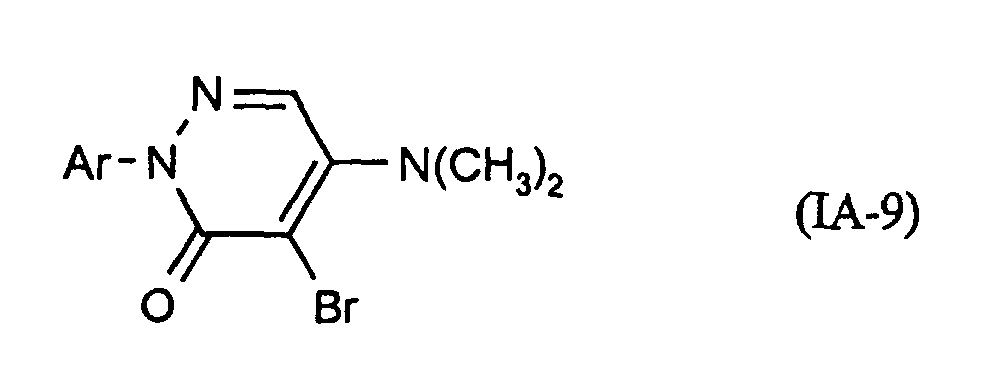
- the compounds of the general formula (I) can also be converted into other compounds of the general formula (I) according to the above definition by further customary methods, for example by nucleophilic substitution (for example R 3 : F ⁇ OH, SH, NH 2 , OCH3, NHSO 2 CH 3 ; R5: Cl ⁇ N (CH 3 ) 2 ) or by further conversions of functional groups (e.g. R 2 : CONH 2 ⁇ CN, CN ⁇ CSNH 2 ; R 3 : NO 2 ⁇ NH 2 , NH 2 ⁇ F, Cl, Br, CN, NHSO 2 CH 3 , SO 2 Cl) - cf. also the manufacturing examples.
- nucleophilic substitution for example R 3 : F ⁇ OH, SH, NH 2 , OCH3, NHSO 2 CH 3 ; R5: Cl ⁇ N (CH 3 ) 2
- functional groups e.g. R 2 : CONH 2 ⁇ CN, CN ⁇ CSNH 2 ; R 3
- the new substituted phenylpyridazinones of the general formula (I) stand out from strong herbicidal activity.
- saturated or unsaturated hydrocarbon chains such as alkyl, alkenyl or alkynyl each straight-chain or branched.
- Halogen generally represents fluorine, chlorine, bromine or iodine, preferably Fluorine, chlorine or bromine, especially for fluorine or chlorine.
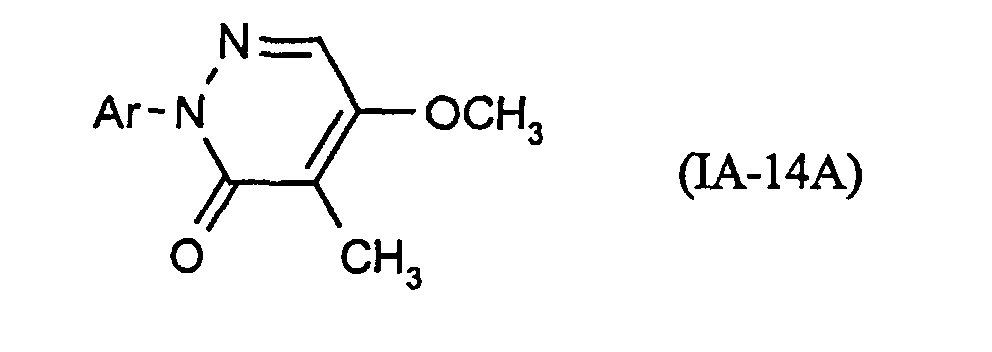
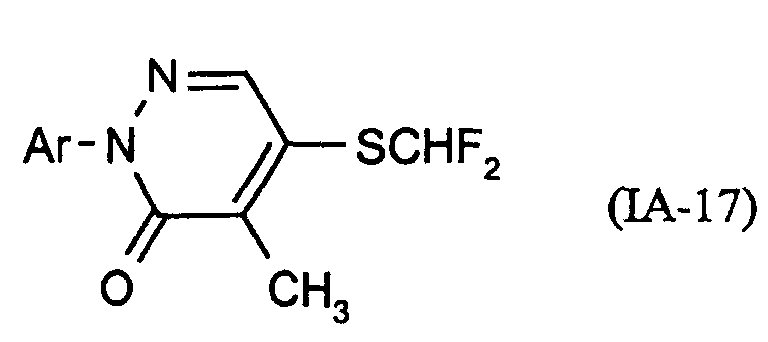
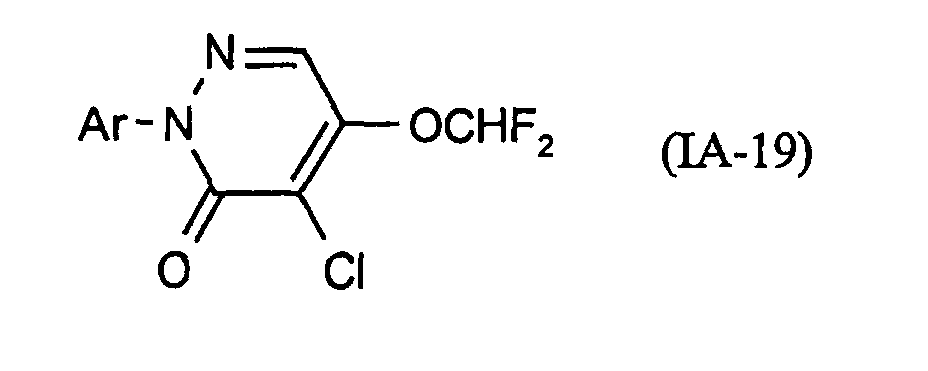
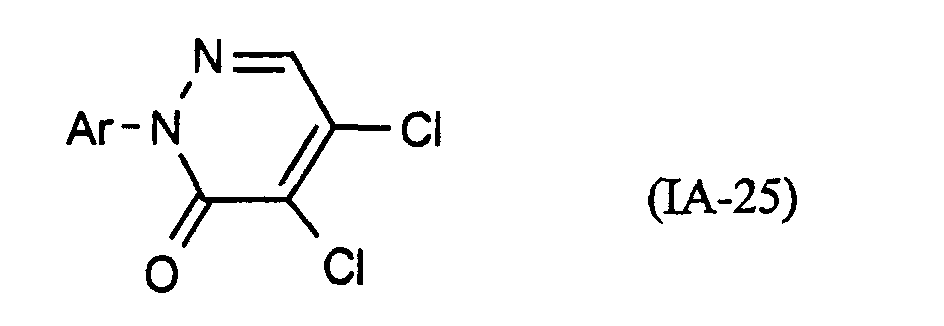
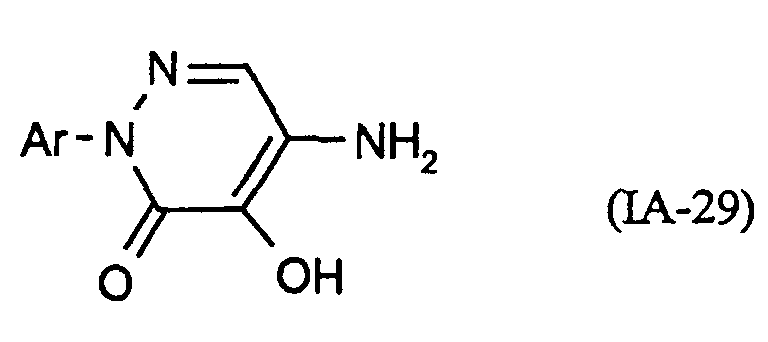
- Ar has, for example, the meanings listed below: 2,4,5-trichlorophenyl, 2,4-dichloro-5-fluorophenyl, 2-chloro-4,5-difluorophenyl, 4-chloro-2,5-difluorophenyl, 5-chloro 2,4-difluorophenyl, 2-fluoro-5-chloro-4-cyano-phenyl, 2,4,5-trifluorophenyl, 2,5-dichloro-4-cyano-phenyl, 2-chloro-5- fluoro-4-cyano-phenyl, 2,5-difluoro-4-cyano-phenyl, 2-chloro-4-cyano-5-methyl-phenyl, 2,4-dichloro-5-methoxy-phenyl, 2,4- Dichloro-5-ethoxy-phenyl, 2,4-dichloro-5-n-propoxy-phenyl, 2,4-dichloro-5-i-propoxy-phenyl, 4-
- Ar has, for example, the meanings listed above in Group 1.
- Ar has, for example, the meanings listed above in Group 1.
- Ar has, for example, the meanings listed above in Group 1.
- Ar has, for example, the meanings listed above in Group 1.
- Ar has, for example, the meanings listed above in Group 1.
- Ar has, for example, the meanings listed above in Group 1.
- Ar has, for example, the meanings listed above in Group 1.
- Ar has, for example, the meanings listed above in Group 1.
- Ar has, for example, the meanings listed above in Group 1.
- Ar has, for example, the meanings listed above in Group 1.
- Ar has, for example, the meanings listed above in Group 1.
- Ar has, for example, the meanings listed above in Group 1.
- Ar has, for example, the meanings listed above in Group 1.
- Ar has, for example, the meanings listed above in Group 1
- Ar has, for example, the meanings listed above in Group 1.
- Ar has, for example, the meanings listed above in Group 1.
- Ar has, for example, the meanings listed above in Group 1.
- Ar has, for example, the meanings listed above in Group 1.
- Ar has, for example, the meanings listed above in Group 1.
- Ar has, for example, the meanings listed above in Group 1.
- Ar has, for example, the meanings listed above in Group 1.
- Ar has, for example, the meanings listed above in Group 1.
- Ar has, for example, the meanings listed above in Group 1.
- Ar has, for example, the meanings listed above in Group 1.
- Ar has, for example, the meanings listed above in Group 1.
- Ar has, for example, the meanings listed above in Group 1.
- Ar has, for example, the meanings listed above in Group 1.
- Ar has, for example, the meanings listed above in Group 1.
- Ar has, for example, the meanings listed above in Group 1.
- Ar has, for example, the meanings listed above in Group 1.
- Ar has, for example, the meanings listed above in Group 1.
- Ar has, for example, the meanings listed above in Group 1.
- Ar has, for example, the meanings listed above in Group 1.
- Ar has, for example, the meanings listed above in Group 1.
- Ar has, for example, the meanings listed above in Group 1.
- Ar has, for example, the meanings listed above in Group 1.
- Ar has, for example, the meanings listed above in Group 1.
- Ar has, for example, the meanings listed above in Group 1.
- Ar has, for example, the meanings listed above in Group 1.
- Ar has, for example, the meanings listed above in Group 1.
- Ar has, for example, the meanings listed above in Group 1.
- Formula (II) provides a general definition of the haloarenes to be used as starting materials in process (a) according to the invention for the preparation of the compounds of the formula (I).
- R 1 , R 2 and R 3 preferably or in particular have those meanings which have already been described above in the description of the compounds of the formula (I) to be prepared according to the invention preferably or as particularly preferred for R 1 , R 2 and R 3 have been given;
- X 1 preferably represents fluorine, chlorine or bromine, in particular fluorine.
- the starting materials of the formula (II) are known and / or can be prepared by known processes are produced (cf. EP 191 181, EP 370 332, EP 431 373, EP 441 004).
- Formula (III) provides a general definition of the pyridazinones to be used further as starting materials in process (a) according to the invention.
- R 4 , R 5 and R 6 preferably or in particular have those meanings which have already been described above in the description of the compounds of the formula (I) to be prepared according to the invention preferably or as particularly preferred for R 4 , R 5 and R 6 were given.
- Formula (IV) provides a general definition of the arylhydrazines to be used as starting materials in process (b) according to the invention for the preparation of the compounds of the formula (I).
- R 1 , R 2 and R 3 preferably or in particular have those meanings which have already been described above in the description of the compounds of the formula (I) to be prepared according to the invention preferably or as particularly preferred for R 1 , R 2 and R 3 were specified.
- Formula (V) provides a general definition of the ⁇ -trihalomethyl-enones to be used as starting materials in process (b) according to the invention.
- R 4 , R 5 and R 6 preferably or in particular have those meanings which have already been described above in the description of the compounds of the formula (I) to be prepared according to the invention preferably or as particularly preferred for R 4 , R 5 and R 6 have been given;
- X 2 preferably represents fluorine, chlorine or bromine, in particular chlorine.
- the starting materials of the formula (V) are known and / or can be prepared by known processes are produced (cf. DE 2 706 700).
- Formula (VI) provides a general definition of the hydrazone carboxylic acids to be used as starting materials in process (c) according to the invention for the preparation of the compounds of the formula (I).
- R 1 , R 2 , R 3 , R 4 , R 5 and R 6 preferably or in particular have those meanings which are preferred or as already described above in the description of the compounds of formula (I) to be prepared according to the invention were particularly preferably given for R 1 , R 2 , R 3 , R 4 , R 5 and R 6 .
- the new hydrazone carboxylic acids of the general formula (VI) are obtained if arylhydrazines of the general formula (IV) in which R 1 , R 2 and R 3 have the meanings given above, with ⁇ -carboxy-enones of the general formula (VII) in which R 4 , R 5 and R 6 have the meanings given above, if appropriate in the presence of a diluent, such as ethanol, and if appropriate in the presence of a reaction auxiliary, such as p-toluenesulfonic acid, at temperatures between 0 ° C. and 100 ° C. (cf. the preparation examples).
- a diluent such as ethanol
- reaction auxiliary such as p-toluenesulfonic acid
- Formula (Ia) generally defines the 2,4-disubstituted phenylpyridazinones to be used as starting materials in process (d) according to the invention for the preparation of the compounds of the formula (I).
- R 1 , R 2 , R 4 , R 5 and R 6 preferably or in particular have those meanings which are preferred or particularly preferred for the description of the compounds of the formula (I) to be prepared according to the invention R 1 , R 2 , R 4 , R 5 and R 6 were given.
- Processes (a), (b), (c) and (d) according to the invention for the preparation of the compounds of formula (I) are preferably in the presence of a diluent carried out.
- a diluent carried out.
- the usual diluents are generally used organic solvents. These preferably include aliphatic, alicyclic and aromatic, optionally halogenated hydrocarbons, such as Pentane, hexane, heptane, petroleum ether, ligroin, gasoline, benzene, toluene, Xylene, chlorobenzene, dichlorobenzene, cyclohexane, methylcyclohexane, dichloromethane (Methylene chloride), trichloromethane (chloroform) or carbon tetrachloride, dialkyl ether, such as, for example, diethyl ether, diisopropyl ether, methyl t-butyl ether,
- the processes (a) and (b) according to the invention for the preparation of the compounds of Formula (I) are preferably in the presence of a suitable reaction auxiliary carried out.
- the usual inorganic ones generally come as reaction aids or organic bases or acid acceptors.
- Process (c) according to the invention for the preparation of the compounds of the formula (I) is carried out in the presence of a dehydrating agent. It comes here the usual dehydrating agents, e.g. Sulfuric acid, methanesulfonic acid, Benzenesulfonic acid, p-toluenesulfonic acid, acetic anhydride and phosphorus (V) oxide in Consideration.
- a dehydrating agent e.g. Sulfuric acid, methanesulfonic acid, Benzenesulfonic acid, p-toluenesulfonic acid, acetic anhydride and phosphorus (V) oxide in Consideration.
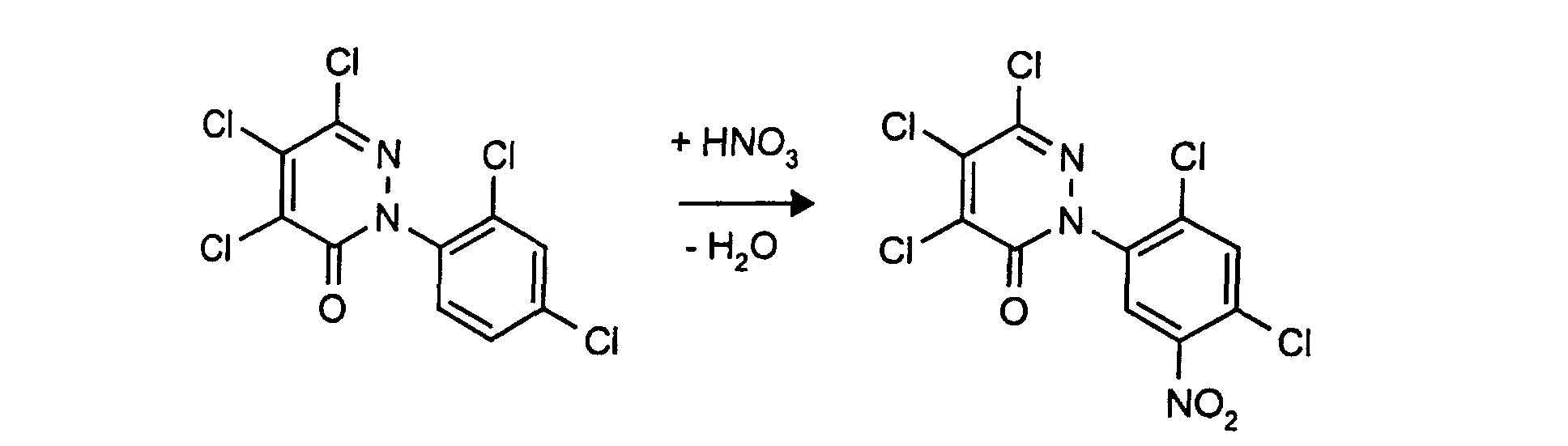
- Process (d) according to the invention for the preparation of the compounds of the formula (I) is carried out using a nitrating agent.
- a nitrating agent e.g. Nitric acid and its mixtures with nitration aids, such as. Sulfuric acid.
- reaction temperatures can be carried out when carrying out the process according to the invention (a), (b), (c) and (d) can be varied over a wide range. In general one works at temperatures between -20 ° C and + 200 ° C, preferably between 0 ° C and 150 ° C, especially between 10 ° C and 120 ° C.
- the process according to the invention is generally carried out under normal pressure. However, it is also possible to increase the process according to the invention or reduced pressure - generally between 0.1 bar and 10 bar.
- the Starting materials are generally used in approximately equimolar amounts. It is however, it is also possible to use one of the components in a larger excess.
- the reaction is generally carried out in a suitable diluent optionally carried out in the presence of a reaction auxiliary and the reaction mixture will generally take several hours at the required temperature touched.
- the processing is carried out according to customary methods (cf. the Preparation Examples).
- the active compounds according to the invention can be used as defoliants, desiccants, and herbicides and especially used as a weed killer. Under weeds in the broadest sense, all plants that grow in places where are to be understood they are undesirable. Whether the substances according to the invention as total or selective Herbicides act essentially depends on the amount applied.
- the use of the active compounds according to the invention is by no means limited to them Limited genera, but extends in the same way to other plants.
- the compounds are suitable for combating total weeds e.g. on industrial and track systems and on paths and squares with and without tree cover.
- the weed control compounds in permanent crops e.g. Forest, ornamental wood, fruit, wine, citrus, nut, Banana, coffee, tea, gum, oil palm, cocoa, berry fruit and hop plants, on ornamental and sports turf and pastures and for selective weed control be used in annual crops.
- the compounds of formula (I) according to the invention are particularly suitable for selective control of dicotyledon weeds in monocotyledons and dicotyledons Cultures both pre-emergence and post-emergence.
- the active ingredients can be converted into the usual formulations, such as Solutions, emulsions, wettable powders, suspensions, powders, dusts, pastes, soluble powders, granules, suspension emulsion concentrates, impregnated with active ingredients Natural and synthetic substances as well as very fine encapsulation in polymers Substances.
- formulations are prepared in a known manner, e.g. B. by mixing of the active ingredients with extenders, i.e. liquid solvents and / or solid Carriers, if appropriate using surface-active agents, that is Emulsifiers and / or dispersants and / or foaming agents.
- extenders i.e. liquid solvents and / or solid Carriers, if appropriate using surface-active agents, that is Emulsifiers and / or dispersants and / or foaming agents.
- organic Solvents are used as auxiliary solvents.
- aromatics such as xylene, toluene, or alkylnaphthalenes
- chlorinated aromatics and chlorinated aliphatic hydrocarbons such as Chlorobenzenes, chlorethylenes or methylene chloride
- aliphatic hydrocarbons such as cyclohexane or paraffins, e.g.
- Petroleum fractions mineral and vegetable oils, Alcohols, such as butanol or glycol, and their ethers and esters, ketones, such as acetone, Methyl ethyl ketone, methyl isobutyl ketone or cyclohexanone, strongly polar solvents, such as dimethylformamide and dimethyl sulfoxide, and water.
- Alcohols such as butanol or glycol
- ketones such as acetone, Methyl ethyl ketone, methyl isobutyl ketone or cyclohexanone
- strongly polar solvents such as dimethylformamide and dimethyl sulfoxide
- solid carriers e.g. ammonium salts and natural rock powders, such as kaolins, clays, talc, chalk, quartz, attapulgite, montmorillonite or diatomaceous earth and synthetic rock powders, such as highly disperse silica, aluminum oxide and silicates, as solid carriers for granulates are possible: e.g.
- suitable emulsifiers and / or foam-generating agents are: for example nonionic and anionic emulsifiers, such as polyoxyethylene fatty acid esters, polyoxyethylene fatty alcohol ethers, for example alkylaryl polyglycol ethers, alkyl sulfonates, alkyl sulfates, aryl sulfonates and protein hydrolyzates;
- suitable emulsifiers and / or foam-generating agents are: for example nonionic and anionic emulsifiers, such as polyoxyethylene fatty acid esters, polyoxyethylene fatty alcohol ethers, for example alkylaryl polyglycol ethers, alkyl sulfonates, alkyl sulfates, aryl sulfonates and protein hydrolyzates;
- dispersants for example lignin sulfite waste liquor and methyl cellulose.
- adhesives such as carboxymethyl cellulose, natural and synthetic powdery, granular or latex-shaped polymers can be used, such as Gum arabic, polyvinyl alcohol, polyvinyl acetate, and natural phospholipids, such as cephalins and lecithins and synthetic phospholipids.
- Other additives can mineral and vegetable oils.
- Dyes such as inorganic pigments, e.g. Iron oxide, titanium oxide, ferrocyan blue and organic dyes such as alizarin, azo and metal phthalocyanine dyes and trace nutrients such as salts of iron, manganese, boron, copper, cobalt, Molybdenum and zinc can be used.
- the formulations generally contain between 0.1 and 95 percent by weight Active ingredient, preferably between 0.5 and 90%.
- the active compounds according to the invention can be used as such or in their formulations also used in a mixture with known herbicides for weed control find, where ready formulations or tank mixes are possible.
- herbicides are suitable for the mixtures, for example anilides, such as e.g. Diflufenican and Propanil; Aryl carboxylic acids, e.g. Dichloropicolinic acid, dicamba and picloram; Aryloxyalkanoic acids, e.g. 2.4 D, 2.4 DB, 2.4 DP, fluroxypyr, MCPA, MCPP and triclopyr; Aryloxy-phenoxy-alkanoic acid esters, e.g. diclofop, Fenoxaprop-ethyl, fluazifop-butyl, haloxyfop-methyl and quizalofop-ethyl; Azinones, e.g.
- Chloridazon and norflurazon Carbamates, e.g. chlorpropham, Desmedipham, Phenmedipham and Propham; Chloroacetanilides, e.g. alachlor, Acetochlor, butachlor, metazachlor, metolachlor, pretilachlor and propachlor; Dinitroanilines, e.g. Oryzalin, pendimethalin and trifluralin; Diphenyl ether, such as e.g. Acifluorfen, Bifenox, Fluoroglycofen, Fomesafen, Halosafen, Lactofen and Oxyfluorfen; Ureas, e.g.
- amidosulfuron Bensulfuron-methyl, chlorimuron-ethyl, chlorosulfuron, cinosulfuron, metsulfuron-methyl, Nicosulfuron, primisulfuron, pyrazosulfuron-ethyl, thifensulfuronmethyl, Triasulfuron and tribenuron-methyl; Thiocarbamates, e.g. butylate, Cycloate, Diallate, EPTC, Esprocarb, Molinate, Prosulfocarb, Thiobencarb and Triallate; Triazines, e.g.
- Atrazin cyanazin, simazin, simetryne, terbutryne and terbutylazin; Triazinones, e.g. Hexazinone, metamitron and metribuzin; Other like e.g. Aminotriazole, benfuresate, bentazone, cinmethylin, clomazone, clopyralid, difenzoquat, Dithiopyr, ethofumesate, fluorochloridone, glufosinate, glyphosate, isoxaben, Pyridate, Quinchlorac, Quinmerac, Sulphosate and Tridiphane.
- Triazinones e.g. Hexazinone, metamitron and metribuzin
- Triazinones e.g. Hexazinone, metamitron and metribuzin
- Other like e.g. Aminotriazole, benfuresate, bentazone, cinmethylin
- the active ingredients can be used as such, in the form of their formulations or from them further dilution prepared application forms, such as ready-to-use solutions, Suspensions, emulsions, powders, pastes and granules can be used.
- the application happens in the usual way, e.g. by pouring, spraying, spraying, sprinkling.
- the active compounds according to the invention can be used both before and after emergence of the plants are applied. They can also be worked into the soil before sowing become.
- the amount of active ingredient used can vary over a wide range. she depends essentially on the type of effect desired. In general the application rates are between 1 g and 10 kg of active ingredient per hectare of soil, preferably between 5 g and 5 kg per ha.
- Seeds of the test plants are sown in normal soil. After 24 hours poured or sprayed the soil with the active ingredient preparation. You keep the The amount of water per unit area expediently constant. The drug concentration in the preparation is irrelevant, only the application rate is decisive of the active ingredient per unit area.
- the degree of damage to the plants is rated in% damage compared to the development of the untreated control.
- the compounds according to Preparation Example 3 show 7, 8, 15, 16, 25, 29, 31, 34, 35, 36 and 41 with good tolerance to crops, such as. Sunflowers (0-20%) and corn (0-10%) and one Application rate between 125 and 500 g / ha, strong action against weeds such as Abutilon (100%), Chenopodium (90-100%), Galinsoga (80-100%) and Solanum (60-100 %).
- Test plants with a height of 5-15 cm are sprayed with the active ingredient preparation have so that the desired amounts of active ingredient per unit area are applied become.
- the degree of damage to the plants is rated in% damage compared to the development of the untreated control.
- the compounds according to Preparation Examples 8 show 15, 16, 31, 35, 37 and 41 with largely good tolerance to Crops, e.g. Wheat (0-20%) and a quantity between 60 and 250 g / ha, strong action against weeds such as amaranthus (60-100%), polygonum (80-100%) and Veronica (90-100%).
Landscapes
- Chemical & Material Sciences (AREA)
- Organic Chemistry (AREA)
- Life Sciences & Earth Sciences (AREA)
- Agronomy & Crop Science (AREA)
- Pest Control & Pesticides (AREA)
- Plant Pathology (AREA)
- Health & Medical Sciences (AREA)
- Engineering & Computer Science (AREA)
- Dentistry (AREA)
- General Health & Medical Sciences (AREA)
- Wood Science & Technology (AREA)
- Zoology (AREA)
- Environmental Sciences (AREA)
- Plural Heterocyclic Compounds (AREA)
- Agricultural Chemicals And Associated Chemicals (AREA)
Abstract
Description

- R1
- für Fluor, Chlor oder Brom steht,
- R2
- für Cyano, Carbamoyl, Thiocarbamoyl, Fluor, Chlor, Brom, oder für jeweils gegebenenfalls durch Fluor und/oder Chlor substituiertes Alkyl, Alkoxy oder Alkylthio mit jeweils 1 oder 2 Kohlenstoffatomen steht,
- R3
- für die Gruppierung -A1-A2-A3 steht,
in welcher- A1
- für eine Einfachbindung, für Sauerstoff oder die Gruppierung -N-A4-steht, worin A4 für Wasserstoff, Hydroxy, C1-C4-Alkyl, C3-C4-Alkenyl, C3-C4-Alkinyl, C1-C4-Alkoxy, Phenyl, C1-C4-Alkylsulfonyl oder Phenylsulfonyl steht,
- A2
- für eine Einfachbindung oder für gegebenenfalls durch Fluor, Chlor oder Brom substituiertes C1-C6-Alkandiyl steht,
- A3
- für Fluor, Chlor, Brom steht,
- A3
- weiterhin für jeweils gegebenenfalls durch Fluor, Chlor oder C1-C4-Alkoxy substituiertes Alkyl, Alkoxy, Alkylthio, Alkylsulfinyl, Alkylsulfonyl, Alkylamino, Dialkylamino, Alkoxycarbonyl oder Dialkoxy-(thio)phosphoryl mit jeweils 1 bis 6 Kohlenstoffatomen in den Alkyl-gruppen steht,
- A3
- weiterhin für jeweils gegebenenfalls durch Fluor oder Chlor substituiertes Alkenyl, Alkenyloxy, Alkenylamino, Alkylidenamino, Alkenyloxycarbonyl, Alkinyl, Alkinyloxy, Alkinylamino oder Alkinyloxycarbonyl mit jeweils 2 bis 6 Kohlenstoffatomen in den Alkenyl-, Alkyliden- oder Alkinylgruppen steht, und
- R4, R5 und R6
- gleich oder verschieden sind und für Wasserstoff, Cyano, Thiocarbamoyl, Nitro, Hydroxy, Mercapto, Amino, Fluor, Chlor, Brom, oder für jeweils gegebenenfalls durch Fluor und/oder Chlor substituiertes Alkyl, Alkoxy, Alkylthio, Alkylamino oder Dialkylamino mit jeweils 1 bis 4 Kohlenstoffatomen in den Alkylgruppen stehen,
- R1
- für Fluor oder Chlor steht,
- R2
- für Cyano, Thiocarbamoyl, Fluor, Chlor, Brom, Methyl oder Trifluormethyl steht,
- R3
- für die Gruppierung -A1-A2-A3 steht,
in welcher- A1
- für eine Einfachbindung, für Sauerstoff oder die Gruppierung -N-A4-steht, worin A4 für Wasserstoff, Hydroxy, Methyl, Ethyl, n- oder i-Propyl, Methoxy, Ethoxy, n- oder i-Propoxy, Methylsulfonyl oder Ethylsulfonyl steht,
- A2
- für eine Einfachbindung oder für Methylen, Ethan-1,1-diyl, Ethan-1,2-diyl, Fropan-1,1-diyl, Propan-1,2-diyl oder Propan-1,3-diyl steht,
- A3
- für Fluor, Chlor, Brom steht,
- A3
- weiterhin für jeweils gegebenenfalls durch Fluor, Chlor, Methoxy oder Ethoxy substituiertes Methyl, Ethyl, n- oder i-Propyl, n-, i-, s- oder t-Butyl, n-, i-, s- oder t-Pentyl, Methoxy, Ethoxy, n- oder i-Propoxy, n-, i-, s- oder t-Butoxy, n-, i-, s- oder t-Pentyloxy, Methylthio, Ethylthio, n- oder i-Propylthio, n-, i-, s- oder t-Butylthio, Methylsulfinyl, Ethylsulfinyl, n- oder i-Propylsulfinyl, Methylsulfonyl, Ethylsulfonyl, n- oder i-Propylsulfonyl, Methylamino, Ethylamino, n- oder i-Propylamino, n-, i-, s- oder t-Butylamino, Dimethylamino, Diethylamino, Methoxycarbonyl, Ethoxycarbonyl, n- oder i-Propoxycarbonyl, Dimethoxyphosphoryl, Diethoxyphosphoryl oder Dipropoxyphosphoryl, Diisopropoxyphosphoryl steht,
- A3
- weiterhin für jeweils gegebenenfalls durch Fluor oder Chlor substituiertes Propenyl, Butenyl, Propenyloxy, Butenyloxy, Propenylamino, Butenylamino, Propylidenamino, Butylidenamino, Propenyloxycarbonyl, Butenyloxycarbonyl, Propinyl, Butinyl, Propinyloxy, Butinyloxy, Propinylamino, Butinylamino, Propinyloxycarbonyl oder Butinyloxycarbonyl steht, und
- R4, R5 und R6
- gleich oder verschieden sind und für Wasserstoff, Cyano, Thiocarbamoyl, Nitro, Hydroxy, Mercapto, Amino, Fluor, Chlor, Brom, oder für jeweils gegebenenfalls durch Fluor und/oder Chlor substituiertes Methyl, Ethyl, n- oder i-Propyl, n-, i-, s- oder t-Butyl, Methoxy, Ethoxy, Methylthio, Ethylthio, Methylamino, Ethylamino oder Dimethylamino stehen,

- R1, R2 und R3
- die oben angegebenen Bedeutungen haben und
- X1
- für Halogen steht,

R4, R5 und R6 die oben angegebenen Bedeutungen haben,
- oder mit Säureaddukten oder Alkalimetallsalzen von Verbindungen der Formel (III) -
gegebenenfalls in Gegenwart eines Reaktionshufsmittels und gegebenenfalls in Gegenwart eines Verdünnungsmittels umsetzt,
oder wenn man

R1, R2 und R3 die oben angegebenen Bedeutungen haben,
mit β-Trihalomethyl-enonen der allgemeinen Formel (V)

- R4, R5 und R6
- die oben angegebenen Bedeutungen haben und
- X2
- für Halogen steht,
oder wenn man
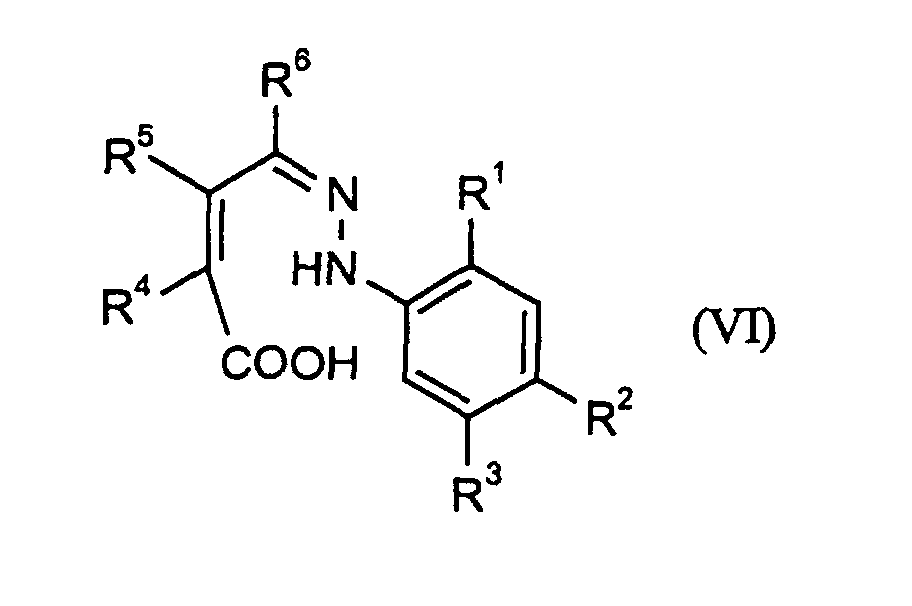
R1, R2, R3, R4, R5 und R6 die oben angegebenen Bedeutungen haben, cyclisierend kondensiert, d.h. mit einem wasser-entziehenden Mittel umsetzt,
oder wenn man

R1, R2, R4, R5 und R6 die oben angegebenen Bedeutungen haben,
nitriert, d.h. mit einem Nitrierungsmittel umsetzt.

2,4,5-Trichlor-phenyl, 2,4-Dichlor-5-fluor-phenyl, 2-Chlor-4,5-difluor-phenyl, 4-Chlor-2,5-difluor-phenyl, 5-Chlor-2,4-difluor-phenyl, 2-Fluor-5-chlor-4-cyano-phenyl, 2,4,5-Trifluor-phenyl, 2,5-Dichlor-4-cyano-phenyl, 2-Chlor-5-fluor-4-cyano-phenyl, 2,5-Difluor-4-cyano-phenyl, 2-Chlor-4-cyano-5-methyl-phenyl, 2,4-Dichlor-5-methoxy-phenyl, 2,4-Dichlor-5-ethoxy-phenyl, 2,4-Dichlor-5-n-propoxy-phenyl, 2,4-Dichlor-5-i-propoxy-phenyl, 4-Chlor-2-fluor-5-methoxy-phenyl, 4-Chlor-2-fluor-5-ethoxy-phenyl, 4-Chlor-2-fluor-5-n-propoxy-phenyl, 4-Chlor-2-fluor-5-i-propoxyphenyl, 2-Fluor-4-cyano-5-methyl-phenyl, 2,4-Dichlor-5-methyl-phenyl, 2-Chlor-4-cyano-5-trifluormethyl-phenyl, 2-Fluor-4-cyano-5-trifluormethyl-phenyl, 2-Chlor-4-methyl-5-trifluormethyl-phenyl, 2-Chlor-5-fluor-4-methoxy-phenyl, 2-Fluor-4-methoxy-5-methyl-phenyl, 2,5-Difluor-4-thiocarbamoyl-phenyl, 2-Chlor-4-fluor-5-ipropoxy-phenyl, 2-Fluor-4-cyano-5-methoxy-phenyl, 2-Fluor-4-cyano-5-i-propoxyphenyl, 2-Chlor-4-cyano-5-(2-propinyloxy)-phenyl, 2-Fluor-4-cyano-5-(1-methyl-2-propinyloxy)-phenyl, 2-Chlor-4-thiocarbamoyl-5-i-propoxy-phenyl, 2-Fluor-4-cyano-5-(2-propenyloxy)-phenyl, 2-Fluor-4-chlor-5-(2-propenyloxy)-phenyl, 2-Chlor-4-cyano-5-methylsulfonylamino-phenyl, 2-Fluor-4-cyano-5-ethylsulfonylamino-phenyl, 2-Fluor-4-thiocarbamoyl-5-methylsulfonyl-phenyl, 2-Chlor-4-cyano-5-ethylsulfonylamino-phenyl, 2-Fluor-4-cyano-5-i-propylsulfonylamino-phenyl, 2-Chlor-4-thiocarbamoyl-5-ethylsulfonylamino-phenyl, 2-Fluor-4-cyano-5-trifluormethylsulfonylamino-phenyl, 2-Fluor-4-cyano-5-(2,2-difluorethylsulfonylamino)-phenyl, 2-Fluor-4-cyano-5-phenylsulfonylamino-phenyl, 2-Fluor-4-cyano-5-t-butylsulfonylamino-phenyl, 2-Chlor-4-cyano-5-methoxycarbonyl-phenyl, 2-Fluor-4-cyano-5-ethoxycarbonylphenyl, 2-Fluor-4-thiocarbamoyl-5-methoxycarbonyl-phenyl, 2-Fluor-4-cyano-5-methylamino-phenyl, 2-Chlor-4-cyano-5-(N-methyl-ethylsulfonylamino)-phenyl, 2-Chlor-4-cyano-5-i-propoxycarbonyl-phenyl, 2-Fluor-4-cyano-5-(bis-ethylsulfonylamino)-phenyl, 2-Fluor-4-cyano-5-(N-methylsulfonyl-ethylsulfonylamino)-phenyl, 2-Chlor-4-cyano-5-dimethylamino-phenyl, 2-Fluor-4-cyano-5-methylsulfonyloxyphenyl, 2-Chlor-4-cyano-5-difluormethoxy-phenyl, 2-Fluor-4-cyano-5-(2-chlor-2-propenyloxy)-phenyl, 2-Fluor-4-cyano-5-diethoxyphosphorylamino-phenyl, 2-Chlor-4-cyano-5-ethoxycarbonyloxy-phenyl, 2-Fluor-4-cyano-5-diethoxyphosphorylmethoxyphenyl, 2-Fluor-4-cyano-5-diethylaminooxy-phenyl, 2-Fluor-4-cyano-5-dimethoxymethylenamino-phenyl, 2-Chlor-4-cyano-5-ethoxymethylenanimo-phenyl, 2-Fluor-4-cyano-5-(2-chlor-ethoxycarbonyloxy)-phenyl, 2-Chlor-4-cyano-5-dimethylaminomethylenamino-phenyl, 2-Chlor-4-cyano-5-(2-carboxy-2-chlor-ethyl)-phenyl, 2-Fluor-4-cyano-5-(2-carboxy-2-chlor-ethyl)-phenyl, 2-Fluor-4-cyano-5-i-butoxy-phenyl, 2-Chlor-4-cyano-5-i-butoxy-phenyl, 2-Chlor-4-cyano-5-(2-methoxy-ethoxy)-phenyl, 2-Fluor-4-Chlor-5-(2-methoxy-ethoxy)-phenyl, 2-Fluor-4-Chlor-5-i-butoxy-phenyl.














R1, R2 und R3 die oben angegebenen Bedeutungen haben,
mit β-Carboxy-enonen der allgemeinen Formel (VII)

R4, R5 und R6 die oben angegebenen Bedeutungen haben,
gegebenenfalls in Gegenwart eines Verdünnungsmittels, wie z.B. Ethanol, und gegebenenfalls in Gegenwart eines Reaktionshilfsmittels, wie z.B. p-Toluolsulfonsäure, bei Temperaturen zwischen 0°C und 100°C umsetzt (vgl. die Herstellungsbeispiele).
z.B. Ammoniumsalze und natürliche Gesteinsmehle, wie Kaoline, Tonerden, Talkum, Kreide, Quarz, Attapulgit, Montmorillonit oder Diatomeenerde und synthetische Gesteinsmehle, wie hochdisperse Kieselsäure, Aluminiumoxid und Silikate, als feste Trägerstoffe für Granulate kommen in Frage: z.B. gebrochene und fraktionierte natürliche Gesteine wie Calcit, Marmor, Bims, Sepiolith, Dolomit sowie synthetische Granulate aus anorganischen und organischen Mehlen sowie Granulate aus organischem Material wie Sägemehl, Kokosnußschalen, Maiskolben und Tabakstengeln; als Emulgier- und/oder schaumerzeugende Mittel kommen in Frage: z.B. nichtionogene und anionische Emulgatoren, wie Polyoxyethylen-Fettsäure-Ester, Polyoxyethylen-Fettalkohol-Ether, z.B. Alkylarylpolyglykolether, Alkylsulfonate, Alkylsulfate, Arylsulfonate sowie Eiweißhydrolysate; als Dispergiermittel kommen in Frage: z.B. Lignin-Sulfitablaugen und Methylcellulose.




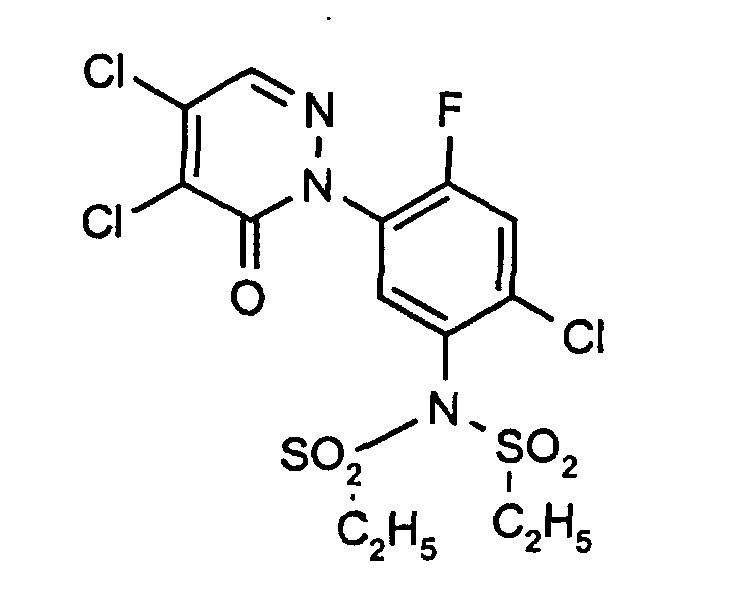

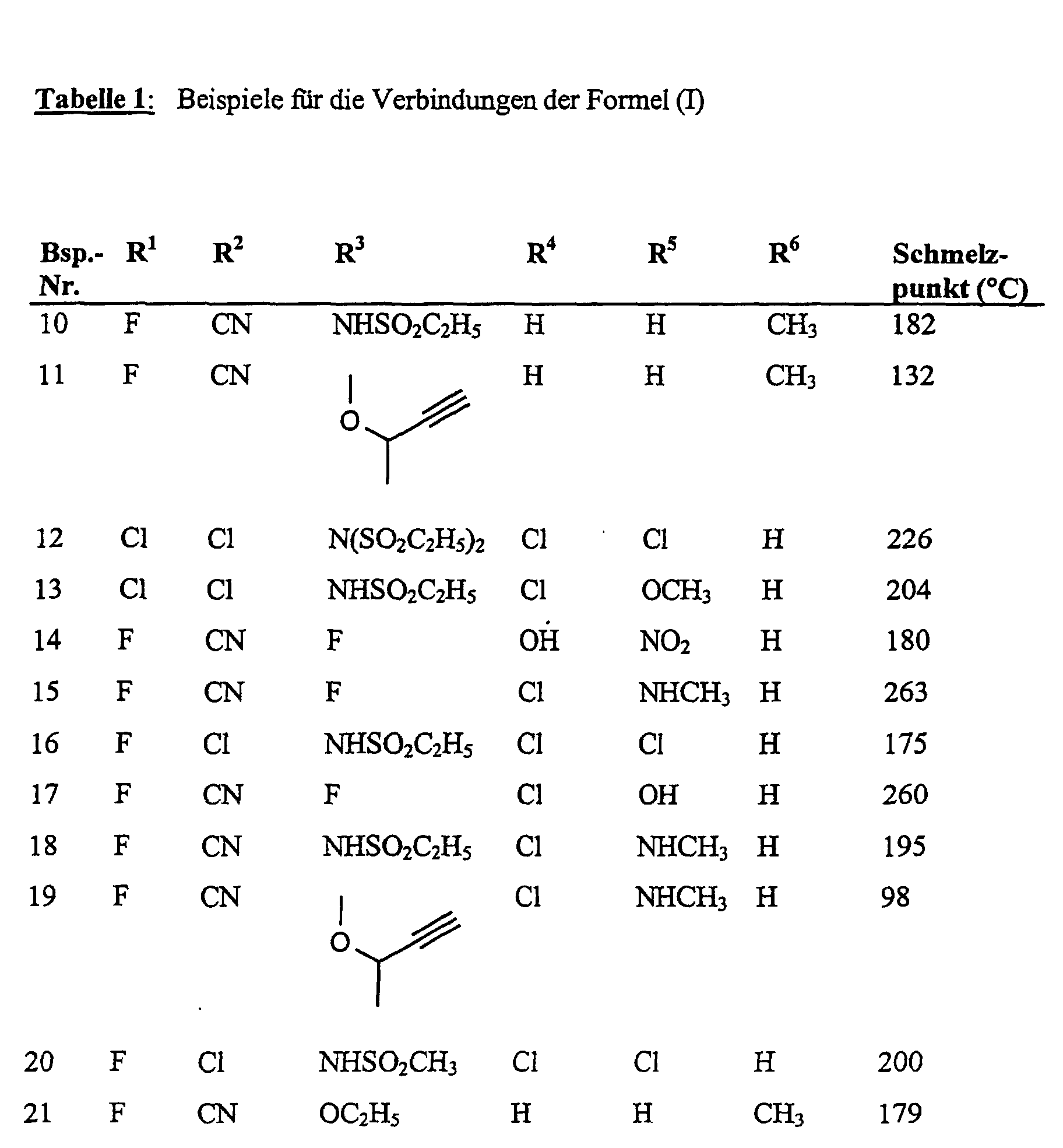


| Lösungsmittel | 5 Gewichtsteile Aceton |
| Emulgator | 1 Gewichtsteil Alkylarylpolyglykolether |
| 0 % = | keine Wirkung (wie unbehandelte Kontrolle) |
| 100 % = | totale Vernichtung |
| Lösungsmittel | 5 Gewichtsteile Aceton |
| Emulgator | 1 Gewichtsteil Alkylarylpolyglykolether |
| 0 % = | keine Wirkung (wie unbehandelte Kontrolle) |
| 100 % = | totale Vernichtung |
Claims (8)
- Phenylpyridazinone der allgemeinen Formel (I)in welcher
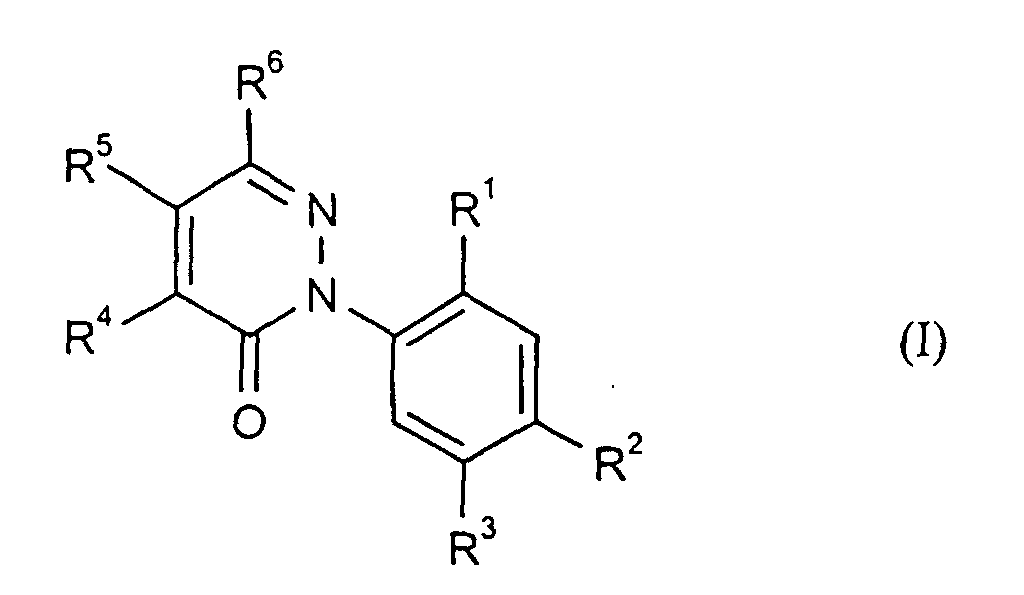
- R1
- für Fluor, Chlor oder Brom steht,
- R2
- für Cyano, Carbamoyl, Thiocarbamoyl, Fluor, Chlor, Brom, oder für jeweils gegebenenfalls durch Fluor und/oder Chlor substituiertes Alkyl, Alkoxy oder Alkylthio mit jeweils 1 oder 2 Kohlenstoffatomen steht,
- R3
- für die Gruppierung -A1-A2-A3 steht,
in welcher- A1
- für eine Einfachbindung, für Sauerstoff oder die Gruppierung -N-A4- steht, worin A4 für Wasserstoff, Hydroxy, C1-C4-Alkyl, C3-C4-Alkenyl, C3-C4-Alkinyl, C1-C4-Alkoxy, Phenyl, C1-C4-Alkylsulfonyl oder Phenylsulfonyl steht,
- A2
- für eine Einfachbindung oder für gegebenenfalls durch Fluor, Chlor oder Brom substituiertes C1-C6-Alkandiyl steht,
- A3
- für Fluor, Chlor, Brom steht,
- A3
- weiterhin für jeweils gegebenenfalls durch Fluor, Chlor oder C1-C4-Alkoxy substituiertes Alkyl, Alkoxy, Alkylthio, Alkylsulfinyl, Alkylsulfonyl, Alkylamino, Dialkylamino, Alkoxycarbonyl oder Dialkoxy(thio)phosphoryl mit jeweils 1 bis 6 Kohlenstoffatomen in den Alkylgruppen steht,
- A3
- weiterhin für jeweils gegebenenfalls durch Fluor oder Chlor substituiertes Alkenyl, Alkenyloxy, Alkenylamino, Alkylidenamino, Alkenyloxycarbonyl, Alkinyl, Alkinyloxy, Alkinylamino oder Alkinyloxycarbonyl mit jeweils 2 bis 6 Kohlenstoffatomen in den Alkenyl-, Alkyliden- oder Alkinylgruppen steht, und
- R4, R5 und R6
- gleich oder verschieden sind und für Wasserstoff, Cyano, Thiocarbamoyl, Nitro, Hydroxy, Mercapto, Amino, Fluor, Chlor, Brom, oder für jeweils gegebenenfalls durch Fluor und/oder Chlor substituiertes Alkyl, Alkoxy, Alkylthio, Alkylamino oder Dialkylamino mit jeweils 1 bis 4 Kohlenstoffatomen in den Alkylgruppen stehen,
- Phenylpyridazinone gemäß Anspruch 1, dadurch gekennzeichnet, daß
- R1
- für Fluor oder Chlor steht,
- R2
- für Cyano, Thiocarbamoyl, Fluor, Chlor, Brom, Methyl oder Trifluormethyl steht,
- R3
- für die Gruppierung -A1-A2-A3 steht,
in welcher- A1
- für eine Einfachbindung, für Sauerstoff oder die Gruppierung -N-A4- steht, worin A4 für Wasserstoff, Hydroxy, Methyl, Ethyl, n- oder i-Propyl, Methoxy, Ethoxy, n- oder i-Propoxy, Methylsulfonyl oder Ethylsulfonyl steht,
- A2
- für eine Einfachbindung oder für Methylen, Ethan-1,1-diyl, Ethan-1,2-diyl, Propan-1,1-diyl, Propan-1,2-diyl oder Propan-1,3-diyl steht,
- A3
- für Fluor, Chlor, Brom steht,
- A3
- weiterhin für jeweils gegebenenfalls durch Fluor, Chlor, Methoxy oder Ethoxy substituiertes Methyl, Ethyl, n- oder i-Propyl, n-, i-, s- oder t-Butyl, n-, i-, s- oder t-Pentyl, Methoxy, Ethoxy, n- oder i-Propoxy, n-, i-, s- oder t-Butoxy, n-, i-, s- oder t-Pentyloxy, Methylthio, Ethylthio, n- oder i-Propylthio, n-, i-, s- oder t-Butylthio, Methylsulfinyl, Ethylsulfinyl, n- oder i-Propylsulfinyl, Methylsulfonyl, Ethylsulfonyl, n- oder i-Propylsulfonyl, Methylamino, Ethylamino, n- oder i-Propylamino, n-, i-, s- oder t-Butylamino, Dimethylamino, Diethylamino, Methoxycarbonyl, Ethoxycarbonyl, n- oder i-Propoxycarbonyl, Dimethoxyphosphoryl, Diethoxyphosphoryl, Dipropoxyphosphoryl oder Diisopropoxyphosphoryl steht, und
- A3
- weiterhin für jeweils gegebenenfalls durch Fluor oder Chlor substituiertes Propenyl, Butenyl, Propenyloxy, Butenyloxy, Propenylamino, Butenylamino, Propylidenamino, Butylidenamino, Propenyloxycarbonyl, Butenyloxycarbonyl, Propinyl, Butinyl, Propinyloxy, Butinyloxy, Propinylamino, Butinylamino, Propinyloxycarbonyl oder Butinyloxycarbonyl steht, und
- R4, R5 und R6
- gleich oder verschieden sind und für Wasserstoff, Cyano, Thiocarbamoyl, Nitro, Hydroxy, Mercapto, Amino, Fluor, Chlor, Brom, oder für jeweils gegebenenfalls durch Fluor und/oder Chlor substituiertes Methyl, Ethyl, n- oder i-Propyl, n-, i-, s- oder t-Butyl, Methoxy, Ethoxy, Methylthio, Ethylthio, Methylamino, Ethylamino oder Dimethylamino stehen.
- Verfahren zur Herstellung der Phenylpyridazinone gemäß Anspruch 1 oder 2,
dadurch gekennzeichnet, daß manin welcher(a) Halogenarene der allgemeinen Formel (II)in welcher
- R1, R2 und R3
- die in Anspruch 1 oder 2 angegebenen Bedeutungen haben und
- X1
- für Halogen steht,
in welcher
R4, R5 und R6 die in Anspruch 1 oder 2 angegebenen Bedeutungen haben,
- oder mit Säureaddukten oder Alkalimetallsalzen von Verbindungen der Formel (III) -
gegebenenfalls in Gegenwart eines Reaktionshilfsmittels und gegebenenfalls in Gegenwart eines Verdünnungsmittels umsetzt,
oder daß man(b) Arylhydrazine der allgemeinen Formel (IV)in welcher
R1, R2 und R3 die oben angegebenen Bedeutungen haben,
mit β-Trihalomethyl-enonen der allgemeinen Formel (V)in welcher
- R4, R5 und R6
- die oben angegebenen Bedeutungen haben und
- X2
- für Halogen steht,
oder daß man(c) Hydrazoncarbonsäuren der allgemeinen Formel (VI)in welcher
R1, R2, R3, R4, R5 und R6 die oben angegebenen Bedeutungen haben, cyclisierend kondensiert, d.h. mit einem wasser-entziehenden Mittel umsetzt, oder daß man(d) 2,4-disubstituierte Phenylpyridazinone der allgemeinen Formel (Ia)
R1, R2, R4, R5 und R6 die oben angegebenen Bedeutungen haben,
nitriert, d.h. mit einem Nitrierungsmittel umsetzt. - Herbizide Mittel, gekennzeichnet durch einen Gehalt an mindestens einem Phenylpyridazinon gemäß Anspruch 1 oder 2.
- Verfahren zur Bekämpfung von unerwünschten Pflanzen, dadurch gekennzeichnet, daß man Phenylpyridazinone gemäß Anspruch 1 oder 2 auf unerwünschte Pflanzen und/oder ihren Lebensraum einwirken läßt.
- Verwendung von Phenylpyridazinonen gemäß Anspruch 1 oder 2 zur Bekämpfung von unerwünschten Pflanzen.
- Verfahren zur Herstellung von herbiziden Mitteln, dadurch gekennzeichnet, daß man Phenylpyridazinone gemäß Anspruch 1 oder 2 mit Streckmitteln und/oder oberflächenaktiven Substanzen vermischt.
- Hydrazoncarbonsäuren der allgemeinen Formel (VI)in welcher
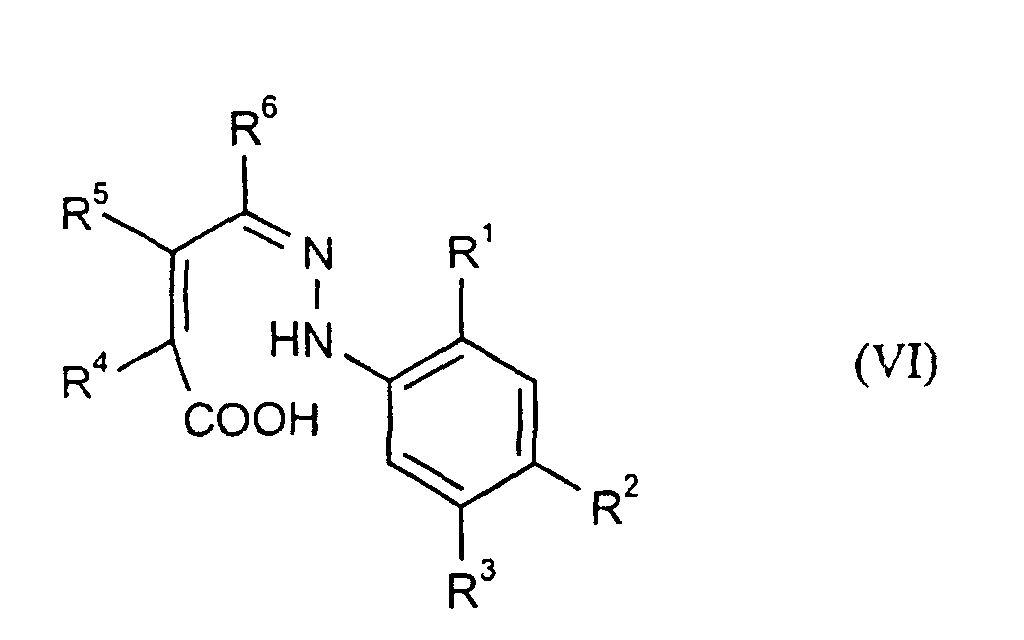
R1, R2, R3, R4, R5 und R6 die in Anspruch 1 oder 2 angegebenen Bedeutungen haben.
Applications Claiming Priority (3)
| Application Number | Priority Date | Filing Date | Title |
|---|---|---|---|
| DE19520613A DE19520613A1 (de) | 1995-06-06 | 1995-06-06 | Phenylpyridazinone |
| DE19520613 | 1995-06-06 | ||
| PCT/EP1996/002246 WO1996039392A1 (de) | 1995-06-06 | 1996-05-24 | Phenylpyridazinone |
Publications (2)
| Publication Number | Publication Date |
|---|---|
| EP0832072A1 EP0832072A1 (de) | 1998-04-01 |
| EP0832072B1 true EP0832072B1 (de) | 2003-09-24 |
Family
ID=7763732
Family Applications (1)
| Application Number | Title | Priority Date | Filing Date |
|---|---|---|---|
| EP96917423A Expired - Lifetime EP0832072B1 (de) | 1995-06-06 | 1996-05-24 | Phenylpyridazinone |
Country Status (13)
| Country | Link |
|---|---|
| US (2) | US6551963B1 (de) |
| EP (1) | EP0832072B1 (de) |
| JP (1) | JP3963477B2 (de) |
| KR (1) | KR100441108B1 (de) |
| CN (1) | CN1138762C (de) |
| AU (1) | AU707342B2 (de) |
| BR (1) | BR9609171A (de) |
| CA (1) | CA2223094C (de) |
| DE (2) | DE19520613A1 (de) |
| ES (1) | ES2202444T3 (de) |
| HU (1) | HU224045B1 (de) |
| MX (1) | MX213417B (de) |
| WO (1) | WO1996039392A1 (de) |
Families Citing this family (36)
| Publication number | Priority date | Publication date | Assignee | Title |
|---|---|---|---|---|
| US6869913B1 (en) | 1995-08-21 | 2005-03-22 | Sumitomo Chemical Company, Limited | Pyridazin-3-one derivatives, their use and intermediates for their production |
| SK22198A3 (en) | 1995-08-21 | 1999-04-13 | Sumitomo Chemical Co | Pyridazin-3-one derivatives, their use, and intermediates for their production |
| US6040270A (en) * | 1997-02-17 | 2000-03-21 | Sumitomo Chemical Company, Limited | Herbicidal composition |
| CN1165230C (zh) * | 1997-02-17 | 2004-09-08 | 住友化学工业株式会社 | 除草组合物 |
| US6121194A (en) * | 1997-02-17 | 2000-09-19 | Sumitomo Chemical Company, Limited | Herbicidal composition |
| EP0967870A1 (de) * | 1997-02-17 | 2000-01-05 | Sumitomo Chemical Company Limited | Herbizide zusammensetzung |
| IL123339A0 (en) * | 1997-02-19 | 1998-09-24 | Sumitomo Chemical Co | Pyridazin-3-one derivatives and their use |
| WO1998036642A1 (en) | 1997-02-19 | 1998-08-27 | Sumitomo Chemical Company, Limited | Herbicide compositions |
| IL123340A0 (en) * | 1997-02-20 | 1998-09-24 | Sumitomo Chemical Co | Pyridazin-3-one derivatives and their use |
| AU9266398A (en) * | 1997-09-17 | 1999-04-05 | Basf Aktiengesellschaft | Substituted 2-phenyl-3(2h)-pyridazinones |
| JP4211081B2 (ja) * | 1998-03-19 | 2009-01-21 | 住友化学株式会社 | 4−シアノピリダジン−3−オン誘導体 |
| WO1999052878A1 (de) * | 1998-04-09 | 1999-10-21 | Bayer Aktiengesellschaft | Substituierte phenylpyridazinone |
| DE19901846A1 (de) * | 1999-01-19 | 2000-07-20 | Bayer Ag | Substituierte Arylheterocyclen |
| DE19936360A1 (de) * | 1999-08-03 | 2001-02-08 | Bayer Ag | Substituierte Arylhydrazoncarbonsäurederivate |
| WO2001079182A1 (de) * | 2000-04-14 | 2001-10-25 | Basf Aktiengesellschaft | 2-phenyl-2h-pyridazin-3-one |
| US6645917B2 (en) * | 2002-03-28 | 2003-11-11 | Council Of Scientific And Industrial Research | Composition for hybrid seed production, process for the preparation of such composition and use thereof |
| MX2007014114A (es) | 2005-05-10 | 2008-03-14 | Intermune Inc | Derivados de piridona para modular el sistema de proteina cinasa activada por estres. |
| JP5627574B2 (ja) * | 2008-06-03 | 2014-11-19 | インターミューン, インコーポレイテッド | 炎症性および線維性疾患を治療するための化合物および方法 |
| PL3050874T3 (pl) | 2008-11-14 | 2019-07-31 | Merial Inc. | Wzbogacone enancjomerycznie aryloazol-2-ilocyjanoetyloaminowe związki pasożytobójcze |
| AR074482A1 (es) | 2008-12-04 | 2011-01-19 | Merial Ltd | Derivados dimericos de avermectina y milbemicina |
| WO2011028492A2 (en) * | 2009-08-24 | 2011-03-10 | The Regents Of The University Of California | Sortase a inhibitors |
| ME02432B (de) | 2009-12-17 | 2016-09-20 | Merial Inc | Antiparasitäre dihydroazolverbindungen und zusammensetzungen damit |
| JP2013518907A (ja) * | 2010-02-08 | 2013-05-23 | アラーガン インコーポレイテッド | カンナビノイド−2作動薬として有用なピリダジン誘導体 |
| US8946270B2 (en) | 2011-06-27 | 2015-02-03 | Merial Limited | Amido-pyridyl ether compounds and compositions and their use against parasites |
| GB201121317D0 (en) * | 2011-12-09 | 2012-01-25 | Syngenta Ltd | Herbicidal compounds |
| ES2716008T3 (es) | 2012-07-18 | 2019-06-07 | Sunshine Lake Pharma Co Ltd | Derivados heterocíclicos nitrogenados y su aplicación en fármacos |
| AR092742A1 (es) | 2012-10-02 | 2015-04-29 | Intermune Inc | Piridinonas antifibroticas |
| CN105873925B (zh) | 2013-11-01 | 2019-09-10 | 勃林格殷格翰动物保健美国公司 | 抗寄生物的和杀虫的异噁唑啉化合物 |
| US9902712B2 (en) | 2013-12-19 | 2018-02-27 | Sunshine Lake Pharma Co., Ltd. | Nitrogenous heterocyclic derivatives and their application in drugs |
| US10233195B2 (en) | 2014-04-02 | 2019-03-19 | Intermune, Inc. | Anti-fibrotic pyridinones |
| CN106316962B (zh) * | 2015-07-01 | 2020-03-10 | 中国科学院上海有机化学研究所 | 3-芳基哒嗪酮类化合物、制备方法、农药组合物及用途 |
| CN105560064B (zh) * | 2016-03-22 | 2017-07-07 | 浙江睿码科技有限公司 | 一种采用热凝胶性能材料硬空心胶囊的制造生产线 |
| WO2017178582A1 (en) * | 2016-04-15 | 2017-10-19 | Syngenta Participations Ag | Herbicidal pyridazinone compounds |
| CN110381738B (zh) | 2016-10-14 | 2021-07-16 | 勃林格殷格翰动物保健美国公司 | 农药的和杀寄生物的乙烯基异噁唑啉化合物 |
| ES2944616T3 (es) | 2017-08-14 | 2023-06-22 | Boehringer Ingelheim Animal Health Usa Inc | Compuestos de pirazol-isoxazolina plaguicidas y parasiticidas |
| US12435044B2 (en) | 2018-09-27 | 2025-10-07 | Fmc Corporation | Pyridazinone herbicides and pyridazinone intermediates used to prepare a herbicide |
Family Cites Families (25)
| Publication number | Priority date | Publication date | Assignee | Title |
|---|---|---|---|---|
| DE950287C (de) | 1952-06-20 | 1956-10-04 | Ciba Geigy | Verfahren zur Herstellung von 6-Halogen-2-aryl-3-oxo-2, 3-dihydro-pyridazinen |
| CH373919A (de) * | 1959-02-02 | 1963-12-15 | Ciba Geigy | Verfahren zum Bekämpfen von Unkräutern |
| DE2706700A1 (de) * | 1977-02-17 | 1978-08-24 | Consortium Elektrochem Ind | Verfahren zur herstellung von pyridazin-3-on-verbindungen, neue pyridazin-3-one und deren verwendung |
| DE2808193A1 (de) * | 1978-02-25 | 1979-09-06 | Basf Ag | Pyridazon-verbindungen |
| YU134686A (en) * | 1985-07-30 | 1988-02-29 | Nissan Chemical Ind Ltd | Process for preparing new derivatives 3-(2h)-pyridazinone |
| DE3540839A1 (de) * | 1985-11-18 | 1987-05-27 | Bayer Ag | 1-aryl-pyrazole |
| ZA875466B (en) * | 1986-07-31 | 1988-02-02 | F. Hoffmann-La Roche & Co. Aktiengesellschaft | Heterocyclic compounds |
| US5298502A (en) * | 1988-12-12 | 1994-03-29 | Fmc Corporation | Method and composition for photodynamic treatment and detection of tumors |
| DE3903799A1 (de) * | 1989-02-09 | 1990-08-16 | Bayer Ag | N-aryl-stickstoffheterocyclen |
| DE4035437A1 (de) * | 1990-11-08 | 1992-05-14 | Bayer Ag | Arylsubstituierte alkylidenstickstoffheterocyclen |
| JP3055268B2 (ja) * | 1990-12-05 | 2000-06-26 | 日産化学工業株式会社 | ウラシル誘導体および除草剤 |
| SK22198A3 (en) * | 1995-08-21 | 1999-04-13 | Sumitomo Chemical Co | Pyridazin-3-one derivatives, their use, and intermediates for their production |
| CN1165230C (zh) | 1997-02-17 | 2004-09-08 | 住友化学工业株式会社 | 除草组合物 |
| EP0967870A1 (de) | 1997-02-17 | 2000-01-05 | Sumitomo Chemical Company Limited | Herbizide zusammensetzung |
| US6121194A (en) | 1997-02-17 | 2000-09-19 | Sumitomo Chemical Company, Limited | Herbicidal composition |
| US6040270A (en) | 1997-02-17 | 2000-03-21 | Sumitomo Chemical Company, Limited | Herbicidal composition |
| BR9807396A (pt) | 1997-02-18 | 2000-03-14 | Sumitomo Chemical Co | Composição herbicida |
| WO1998036642A1 (en) * | 1997-02-19 | 1998-08-27 | Sumitomo Chemical Company, Limited | Herbicide compositions |
| IL123340A0 (en) | 1997-02-20 | 1998-09-24 | Sumitomo Chemical Co | Pyridazin-3-one derivatives and their use |
| AU9266398A (en) * | 1997-09-17 | 1999-04-05 | Basf Aktiengesellschaft | Substituted 2-phenyl-3(2h)-pyridazinones |
| WO1999021837A1 (en) | 1997-10-27 | 1999-05-06 | Isk Americas Incorporated | Substituted benzene compounds, process for their preparation, and herbicidal and defoliant compositions containing them |
| JP4211081B2 (ja) * | 1998-03-19 | 2009-01-21 | 住友化学株式会社 | 4−シアノピリダジン−3−オン誘導体 |
| US6077953A (en) | 1998-06-11 | 2000-06-20 | Sumitomo Chemical Co., Ltd. | 6-alkoxycarbonylpyridazin-3-one compounds |
| JP2000063216A (ja) * | 1998-08-12 | 2000-02-29 | Sumitomo Chem Co Ltd | 除草剤組成物 |
| NZ517562A (en) | 2000-05-04 | 2004-09-24 | Basf Ag | Uracil substituted phenyl sulfamoyl carboxamides |
-
1995
- 1995-06-06 DE DE19520613A patent/DE19520613A1/de not_active Withdrawn
-
1996
- 1996-05-24 AU AU60004/96A patent/AU707342B2/en not_active Ceased
- 1996-05-24 HU HU9801556A patent/HU224045B1/hu not_active IP Right Cessation
- 1996-05-24 WO PCT/EP1996/002246 patent/WO1996039392A1/de not_active Ceased
- 1996-05-24 US US08/952,817 patent/US6551963B1/en not_active Expired - Fee Related
- 1996-05-24 BR BR9609171A patent/BR9609171A/pt not_active IP Right Cessation
- 1996-05-24 EP EP96917423A patent/EP0832072B1/de not_active Expired - Lifetime
- 1996-05-24 KR KR1019970708671A patent/KR100441108B1/ko not_active Expired - Fee Related
- 1996-05-24 ES ES96917423T patent/ES2202444T3/es not_active Expired - Lifetime
- 1996-05-24 JP JP50011797A patent/JP3963477B2/ja not_active Expired - Fee Related
- 1996-05-24 MX MX9709240A patent/MX213417B/es not_active IP Right Cessation
- 1996-05-24 DE DE59610740T patent/DE59610740D1/de not_active Expired - Lifetime
- 1996-05-24 CA CA002223094A patent/CA2223094C/en not_active Expired - Fee Related
- 1996-05-24 CN CNB961958944A patent/CN1138762C/zh not_active Expired - Fee Related
-
2002
- 2002-09-30 US US10/261,206 patent/US7012041B2/en not_active Expired - Fee Related
Also Published As
| Publication number | Publication date |
|---|---|
| HU224045B1 (hu) | 2005-05-30 |
| CA2223094A1 (en) | 1996-12-12 |
| KR100441108B1 (ko) | 2004-10-12 |
| DE59610740D1 (de) | 2003-10-30 |
| CA2223094C (en) | 2006-10-24 |
| HUP9801556A3 (en) | 1998-11-30 |
| KR19990022192A (ko) | 1999-03-25 |
| ES2202444T3 (es) | 2004-04-01 |
| US7012041B2 (en) | 2006-03-14 |
| CN1192208A (zh) | 1998-09-02 |
| DE19520613A1 (de) | 1996-12-12 |
| MX9709240A (es) | 1998-03-31 |
| HUP9801556A2 (hu) | 1998-09-28 |
| JP3963477B2 (ja) | 2007-08-22 |
| AU707342B2 (en) | 1999-07-08 |
| MX213417B (es) | 2003-03-27 |
| CN1138762C (zh) | 2004-02-18 |
| US6551963B1 (en) | 2003-04-22 |
| JPH11506112A (ja) | 1999-06-02 |
| AU6000496A (en) | 1996-12-24 |
| WO1996039392A1 (de) | 1996-12-12 |
| US20030119673A1 (en) | 2003-06-26 |
| EP0832072A1 (de) | 1998-04-01 |
| BR9609171A (pt) | 1999-05-18 |
Similar Documents
| Publication | Publication Date | Title |
|---|---|---|
| EP0648749B1 (de) | N-Cyanoaryl-Stickstoffheterocyclen | |
| EP0758324B1 (de) | Substituierte aromatische thiocarbonsäureamide und ihre verwendung als herbizide | |
| US6551963B1 (en) | Phenylpyridazinones | |
| EP0757680B1 (de) | N-cyanoaryl-stickstoffheterocyclen | |
| EP1120411B1 (de) | 4-Aryl-1,2,4-Triazolidindionderivate und ihre Verwendung als Herbizide | |
| DE4329096A1 (de) | Heterocyclylbenzoheterocyclen | |
| WO1997005117A1 (de) | Substituierte 1-phenyluracil derivate, deren herstellung und deren verwendung als herbizide | |
| EP0882027B1 (de) | Substituierte 2-aryl-1,2,4-triazin-3,5-di(thi)one als herbizide | |
| EP0842155B1 (de) | Substituierte aminouracile | |
| EP0835247A1 (de) | Substituierte carbonylaminophenyluracile | |
| DE4431218A1 (de) | Substituierte Pyrimidin(thi)one | |
| DE4424787A1 (de) | Substituierte Aryliminoheterocyclen | |
| US6025498A (en) | 4-thiocarbamoyl-1-(3-pyrazolyl)-pyrazoles and their use as herbicides | |
| DE19517505A1 (de) | Sulfonylamino(thio)carbonyltriazolin(thi)one mit Aryloxy- oder Arylthio-Substituenten | |
| EP0906291B1 (de) | Substituierte phenyluracile | |
| DE4412079A1 (de) | N-Cyanoaryl-Stickstoffheterocyclen | |
| EP0843667B1 (de) | Substituierte phenyluracile | |
| DE19617532A1 (de) | Substituierte Phenyluracile | |
| DE4306962A1 (de) | Oxadiazolcarbonsäurederivate | |
| WO1995032193A1 (de) | Herbizide substituierte thiadiazoline | |
| WO1997007105A1 (de) | Substituierte chinazolin(thi)one | |
| WO1996036614A1 (de) | Aminouracilderivate |
Legal Events
| Date | Code | Title | Description |
|---|---|---|---|
| PUAI | Public reference made under article 153(3) epc to a published international application that has entered the european phase |
Free format text: ORIGINAL CODE: 0009012 |
|
| 17P | Request for examination filed |
Effective date: 19980107 |
|
| AK | Designated contracting states |
Kind code of ref document: A1 Designated state(s): BE CH DE ES FR GB IT LI NL |
|
| 17Q | First examination report despatched |
Effective date: 19991201 |
|
| RAP1 | Party data changed (applicant data changed or rights of an application transferred) |
Owner name: BAYER CROPSCIENCE AG |
|
| GRAH | Despatch of communication of intention to grant a patent |
Free format text: ORIGINAL CODE: EPIDOS IGRA |
|
| GRAS | Grant fee paid |
Free format text: ORIGINAL CODE: EPIDOSNIGR3 |
|
| GRAA | (expected) grant |
Free format text: ORIGINAL CODE: 0009210 |
|
| AK | Designated contracting states |
Kind code of ref document: B1 Designated state(s): BE CH DE ES FR GB IT LI NL |
|
| REG | Reference to a national code |
Ref country code: GB Ref legal event code: FG4D Free format text: NOT ENGLISH |
|
| REG | Reference to a national code |
Ref country code: CH Ref legal event code: EP |
|
| REG | Reference to a national code |
Ref country code: CH Ref legal event code: NV Representative=s name: DR. LUSUARDI AG |
|
| REF | Corresponds to: |
Ref document number: 59610740 Country of ref document: DE Date of ref document: 20031030 Kind code of ref document: P |
|
| GBT | Gb: translation of ep patent filed (gb section 77(6)(a)/1977) |
Effective date: 20031023 |
|
| REG | Reference to a national code |
Ref country code: ES Ref legal event code: FG2A Ref document number: 2202444 Country of ref document: ES Kind code of ref document: T3 |
|
| ET | Fr: translation filed | ||
| PLBE | No opposition filed within time limit |
Free format text: ORIGINAL CODE: 0009261 |
|
| 26N | No opposition filed |
Effective date: 20040625 |
|
| REG | Reference to a national code |
Ref country code: CH Ref legal event code: PFA Owner name: BAYER CROPSCIENCE AG Free format text: BAYER CROPSCIENCE AG#ALFRED-NOBEL-STRASSE 50#40789 MONHEIM (DE) -TRANSFER TO- BAYER CROPSCIENCE AG#ALFRED-NOBEL-STRASSE 50#40789 MONHEIM (DE) |
|
| PGFP | Annual fee paid to national office [announced via postgrant information from national office to epo] |
Ref country code: CH Payment date: 20120514 Year of fee payment: 17 Ref country code: DE Payment date: 20120516 Year of fee payment: 17 Ref country code: NL Payment date: 20120523 Year of fee payment: 17 |
|
| PGFP | Annual fee paid to national office [announced via postgrant information from national office to epo] |
Ref country code: BE Payment date: 20120514 Year of fee payment: 17 Ref country code: FR Payment date: 20120608 Year of fee payment: 17 Ref country code: GB Payment date: 20120523 Year of fee payment: 17 |
|
| PGFP | Annual fee paid to national office [announced via postgrant information from national office to epo] |
Ref country code: IT Payment date: 20120428 Year of fee payment: 17 |
|
| PGFP | Annual fee paid to national office [announced via postgrant information from national office to epo] |
Ref country code: ES Payment date: 20120518 Year of fee payment: 17 |
|
| BERE | Be: lapsed |
Owner name: *BAYER CROPSCIENCE A.G. Effective date: 20130531 |
|
| REG | Reference to a national code |
Ref country code: NL Ref legal event code: V1 Effective date: 20131201 |
|
| REG | Reference to a national code |
Ref country code: CH Ref legal event code: PL |
|
| GBPC | Gb: european patent ceased through non-payment of renewal fee |
Effective date: 20130524 |
|
| PG25 | Lapsed in a contracting state [announced via postgrant information from national office to epo] |
Ref country code: LI Free format text: LAPSE BECAUSE OF NON-PAYMENT OF DUE FEES Effective date: 20130531 Ref country code: DE Free format text: LAPSE BECAUSE OF NON-PAYMENT OF DUE FEES Effective date: 20131203 Ref country code: CH Free format text: LAPSE BECAUSE OF NON-PAYMENT OF DUE FEES Effective date: 20130531 |
|
| REG | Reference to a national code |
Ref country code: DE Ref legal event code: R119 Ref document number: 59610740 Country of ref document: DE Effective date: 20131203 |
|
| PG25 | Lapsed in a contracting state [announced via postgrant information from national office to epo] |
Ref country code: IT Free format text: LAPSE BECAUSE OF NON-PAYMENT OF DUE FEES Effective date: 20130524 Ref country code: NL Free format text: LAPSE BECAUSE OF NON-PAYMENT OF DUE FEES Effective date: 20131201 Ref country code: BE Free format text: LAPSE BECAUSE OF NON-PAYMENT OF DUE FEES Effective date: 20130531 |
|
| REG | Reference to a national code |
Ref country code: FR Ref legal event code: ST Effective date: 20140131 |
|
| PG25 | Lapsed in a contracting state [announced via postgrant information from national office to epo] |
Ref country code: GB Free format text: LAPSE BECAUSE OF NON-PAYMENT OF DUE FEES Effective date: 20130524 |
|
| PG25 | Lapsed in a contracting state [announced via postgrant information from national office to epo] |
Ref country code: FR Free format text: LAPSE BECAUSE OF NON-PAYMENT OF DUE FEES Effective date: 20130531 |
|
| REG | Reference to a national code |
Ref country code: ES Ref legal event code: FD2A Effective date: 20140606 |
|
| PG25 | Lapsed in a contracting state [announced via postgrant information from national office to epo] |
Ref country code: ES Free format text: LAPSE BECAUSE OF NON-PAYMENT OF DUE FEES Effective date: 20130525 |