EP0832095B1 - Procede de reticulation de polymeres contenant des acides amines au moyen de reticulants chimiques photosensibles - Google Patents
Procede de reticulation de polymeres contenant des acides amines au moyen de reticulants chimiques photosensibles Download PDFInfo
- Publication number
- EP0832095B1 EP0832095B1 EP96915553A EP96915553A EP0832095B1 EP 0832095 B1 EP0832095 B1 EP 0832095B1 EP 96915553 A EP96915553 A EP 96915553A EP 96915553 A EP96915553 A EP 96915553A EP 0832095 B1 EP0832095 B1 EP 0832095B1
- Authority
- EP
- European Patent Office
- Prior art keywords
- collagen
- type
- polymer
- amino acid
- photoactivatable
- Prior art date
- Legal status (The legal status is an assumption and is not a legal conclusion. Google has not performed a legal analysis and makes no representation as to the accuracy of the status listed.)
- Expired - Lifetime
Links
- 238000000034 method Methods 0.000 title claims abstract description 76
- 229920000642 polymer Polymers 0.000 title claims abstract description 61
- 150000001413 amino acids Chemical class 0.000 title claims abstract description 26
- 239000004971 Cross linker Substances 0.000 title abstract description 54
- 239000000126 substance Substances 0.000 title abstract description 35
- 238000004132 cross linking Methods 0.000 title abstract description 27
- 102000008186 Collagen Human genes 0.000 claims abstract description 233
- 108010035532 Collagen Proteins 0.000 claims abstract description 233
- 229920001436 collagen Polymers 0.000 claims abstract description 233
- 229920000159 gelatin Polymers 0.000 claims description 67
- 235000019322 gelatine Nutrition 0.000 claims description 67
- 108010010803 Gelatin Proteins 0.000 claims description 66
- 235000011852 gelatine desserts Nutrition 0.000 claims description 66
- 239000008273 gelatin Substances 0.000 claims description 62
- 102000012422 Collagen Type I Human genes 0.000 claims description 36
- 108010022452 Collagen Type I Proteins 0.000 claims description 36
- 239000000203 mixture Substances 0.000 claims description 35
- 102000012432 Collagen Type V Human genes 0.000 claims description 29
- 108010022514 Collagen Type V Proteins 0.000 claims description 29
- 239000003431 cross linking reagent Substances 0.000 claims description 24
- 241000251468 Actinopterygii Species 0.000 claims description 22
- 229940096422 collagen type i Drugs 0.000 claims description 20
- 230000008569 process Effects 0.000 claims description 14
- 244000309466 calf Species 0.000 claims description 10
- -1 aryl azide compounds Chemical class 0.000 claims description 8
- 230000003169 placental effect Effects 0.000 claims description 8
- 229940096423 bovine collagen type i Drugs 0.000 claims description 5
- 230000008878 coupling Effects 0.000 claims description 3
- 238000010168 coupling process Methods 0.000 claims description 3
- 238000005859 coupling reaction Methods 0.000 claims description 3
- 150000008049 diazo compounds Chemical class 0.000 claims description 3
- 102000004266 Collagen Type IV Human genes 0.000 claims description 2
- 108010042086 Collagen Type IV Proteins 0.000 claims description 2
- 102000004427 Collagen Type IX Human genes 0.000 claims 1
- 108010042106 Collagen Type IX Proteins 0.000 claims 1
- 239000000463 material Substances 0.000 abstract description 39
- 239000000227 bioadhesive Substances 0.000 abstract description 9
- 239000007943 implant Substances 0.000 abstract description 9
- 230000007246 mechanism Effects 0.000 abstract description 4
- 238000012377 drug delivery Methods 0.000 abstract description 3
- 210000001519 tissue Anatomy 0.000 description 36
- IAZDPXIOMUYVGZ-UHFFFAOYSA-N Dimethylsulphoxide Chemical compound CS(C)=O IAZDPXIOMUYVGZ-UHFFFAOYSA-N 0.000 description 30
- XLYOFNOQVPJJNP-UHFFFAOYSA-N water Substances O XLYOFNOQVPJJNP-UHFFFAOYSA-N 0.000 description 28
- LWAVGNJLLQSNNN-UHFFFAOYSA-N (2,5-dioxopyrrolidin-1-yl) 4-azidobenzoate Chemical compound C1=CC(N=[N+]=[N-])=CC=C1C(=O)ON1C(=O)CCC1=O LWAVGNJLLQSNNN-UHFFFAOYSA-N 0.000 description 25
- SXRSQZLOMIGNAQ-UHFFFAOYSA-N Glutaraldehyde Chemical compound O=CCCCC=O SXRSQZLOMIGNAQ-UHFFFAOYSA-N 0.000 description 22
- 210000003491 skin Anatomy 0.000 description 21
- 239000003153 chemical reaction reagent Substances 0.000 description 20
- 239000000243 solution Substances 0.000 description 20
- 230000018044 dehydration Effects 0.000 description 19
- 238000006297 dehydration reaction Methods 0.000 description 19
- 239000000499 gel Substances 0.000 description 19
- 238000006243 chemical reaction Methods 0.000 description 16
- 239000000047 product Substances 0.000 description 16
- 230000015572 biosynthetic process Effects 0.000 description 15
- 230000002186 photoactivation Effects 0.000 description 13
- 210000004087 cornea Anatomy 0.000 description 12
- 241000283690 Bos taurus Species 0.000 description 11
- 206010052428 Wound Diseases 0.000 description 11
- 208000027418 Wounds and injury Diseases 0.000 description 11
- 230000001070 adhesive effect Effects 0.000 description 11
- 125000003277 amino group Chemical group 0.000 description 11
- 102000016611 Proteoglycans Human genes 0.000 description 10
- 108010067787 Proteoglycans Proteins 0.000 description 10
- 235000001014 amino acid Nutrition 0.000 description 10
- 229940024606 amino acid Drugs 0.000 description 10
- 238000006386 neutralization reaction Methods 0.000 description 10
- 238000006116 polymerization reaction Methods 0.000 description 10
- 238000002360 preparation method Methods 0.000 description 10
- 238000007792 addition Methods 0.000 description 9
- 239000000853 adhesive Substances 0.000 description 9
- 238000002474 experimental method Methods 0.000 description 9
- 239000010408 film Substances 0.000 description 9
- 239000003106 tissue adhesive Substances 0.000 description 9
- SQDAZGGFXASXDW-UHFFFAOYSA-N 5-bromo-2-(trifluoromethoxy)pyridine Chemical compound FC(F)(F)OC1=CC=C(Br)C=N1 SQDAZGGFXASXDW-UHFFFAOYSA-N 0.000 description 8
- 229920001287 Chondroitin sulfate Polymers 0.000 description 8
- 229940059329 chondroitin sulfate Drugs 0.000 description 8
- 239000000835 fiber Substances 0.000 description 8
- 239000002904 solvent Substances 0.000 description 8
- 238000001356 surgical procedure Methods 0.000 description 8
- 229920001651 Cyanoacrylate Polymers 0.000 description 7
- KDXKERNSBIXSRK-YFKPBYRVSA-N L-lysine Chemical compound NCCCC[C@H](N)C(O)=O KDXKERNSBIXSRK-YFKPBYRVSA-N 0.000 description 7
- 210000004027 cell Anatomy 0.000 description 7
- 229940075469 tissue adhesives Drugs 0.000 description 7
- IJGRMHOSHXDMSA-UHFFFAOYSA-N Atomic nitrogen Chemical compound N#N IJGRMHOSHXDMSA-UHFFFAOYSA-N 0.000 description 6
- 108010080379 Fibrin Tissue Adhesive Proteins 0.000 description 6
- 229920002683 Glycosaminoglycan Polymers 0.000 description 6
- 241001465754 Metazoa Species 0.000 description 6
- FAPWRFPIFSIZLT-UHFFFAOYSA-M Sodium chloride Chemical compound [Na+].[Cl-] FAPWRFPIFSIZLT-UHFFFAOYSA-M 0.000 description 6
- 108010006886 Vitrogen Proteins 0.000 description 6
- 239000002585 base Substances 0.000 description 6
- 230000008901 benefit Effects 0.000 description 6
- 230000015556 catabolic process Effects 0.000 description 6
- 102000029816 Collagenase Human genes 0.000 description 5
- 108060005980 Collagenase Proteins 0.000 description 5
- VEXZGXHMUGYJMC-UHFFFAOYSA-N Hydrochloric acid Chemical compound Cl VEXZGXHMUGYJMC-UHFFFAOYSA-N 0.000 description 5
- 241000699670 Mus sp. Species 0.000 description 5
- 108090000631 Trypsin Proteins 0.000 description 5
- 102000004142 Trypsin Human genes 0.000 description 5
- 125000003275 alpha amino acid group Chemical group 0.000 description 5
- 239000000512 collagen gel Substances 0.000 description 5
- 229960002424 collagenase Drugs 0.000 description 5
- NLCKLZIHJQEMCU-UHFFFAOYSA-N cyano prop-2-enoate Chemical class C=CC(=O)OC#N NLCKLZIHJQEMCU-UHFFFAOYSA-N 0.000 description 5
- 238000011161 development Methods 0.000 description 5
- 239000003814 drug Substances 0.000 description 5
- 239000012467 final product Substances 0.000 description 5
- 230000035876 healing Effects 0.000 description 5
- 238000002513 implantation Methods 0.000 description 5
- 230000003993 interaction Effects 0.000 description 5
- 235000018977 lysine Nutrition 0.000 description 5
- 239000012528 membrane Substances 0.000 description 5
- 238000002156 mixing Methods 0.000 description 5
- 238000001556 precipitation Methods 0.000 description 5
- 108090000765 processed proteins & peptides Proteins 0.000 description 5
- 230000008961 swelling Effects 0.000 description 5
- 239000012588 trypsin Substances 0.000 description 5
- 102000004190 Enzymes Human genes 0.000 description 4
- 108090000790 Enzymes Proteins 0.000 description 4
- WZUVPPKBWHMQCE-UHFFFAOYSA-N Haematoxylin Chemical compound C12=CC(O)=C(O)C=C2CC2(O)C1C1=CC=C(O)C(O)=C1OC2 WZUVPPKBWHMQCE-UHFFFAOYSA-N 0.000 description 4
- 239000004472 Lysine Substances 0.000 description 4
- KDXKERNSBIXSRK-UHFFFAOYSA-N Lysine Natural products NCCCCC(N)C(O)=O KDXKERNSBIXSRK-UHFFFAOYSA-N 0.000 description 4
- 102000003992 Peroxidases Human genes 0.000 description 4
- 108090000190 Thrombin Proteins 0.000 description 4
- 150000001299 aldehydes Chemical class 0.000 description 4
- 125000000539 amino acid group Chemical group 0.000 description 4
- 230000001413 cellular effect Effects 0.000 description 4
- 210000002808 connective tissue Anatomy 0.000 description 4
- 229940079593 drug Drugs 0.000 description 4
- 229940088598 enzyme Drugs 0.000 description 4
- 210000002950 fibroblast Anatomy 0.000 description 4
- 239000012634 fragment Substances 0.000 description 4
- 238000010438 heat treatment Methods 0.000 description 4
- 239000007788 liquid Substances 0.000 description 4
- 239000000178 monomer Substances 0.000 description 4
- 210000000056 organ Anatomy 0.000 description 4
- 230000008520 organization Effects 0.000 description 4
- 108040007629 peroxidase activity proteins Proteins 0.000 description 4
- 229920003229 poly(methyl methacrylate) Polymers 0.000 description 4
- 239000004926 polymethyl methacrylate Substances 0.000 description 4
- 230000008439 repair process Effects 0.000 description 4
- 210000002966 serum Anatomy 0.000 description 4
- 238000012360 testing method Methods 0.000 description 4
- 229960004072 thrombin Drugs 0.000 description 4
- 231100000331 toxic Toxicity 0.000 description 4
- 230000002588 toxic effect Effects 0.000 description 4
- 102000009027 Albumins Human genes 0.000 description 3
- 108010088751 Albumins Proteins 0.000 description 3
- VHUUQVKOLVNVRT-UHFFFAOYSA-N Ammonium hydroxide Chemical compound [NH4+].[OH-] VHUUQVKOLVNVRT-UHFFFAOYSA-N 0.000 description 3
- 241000894006 Bacteria Species 0.000 description 3
- 108010054218 Factor VIII Proteins 0.000 description 3
- 102000001690 Factor VIII Human genes 0.000 description 3
- 108010073385 Fibrin Proteins 0.000 description 3
- 102000009123 Fibrin Human genes 0.000 description 3
- BWGVNKXGVNDBDI-UHFFFAOYSA-N Fibrin monomer Chemical compound CNC(=O)CNC(=O)CN BWGVNKXGVNDBDI-UHFFFAOYSA-N 0.000 description 3
- WSFSSNUMVMOOMR-UHFFFAOYSA-N Formaldehyde Chemical compound O=C WSFSSNUMVMOOMR-UHFFFAOYSA-N 0.000 description 3
- PMMYEEVYMWASQN-DMTCNVIQSA-N Hydroxyproline Chemical group O[C@H]1CN[C@H](C(O)=O)C1 PMMYEEVYMWASQN-DMTCNVIQSA-N 0.000 description 3
- ONIBWKKTOPOVIA-BYPYZUCNSA-N L-Proline Chemical compound OC(=O)[C@@H]1CCCN1 ONIBWKKTOPOVIA-BYPYZUCNSA-N 0.000 description 3
- MWCLLHOVUTZFKS-UHFFFAOYSA-N Methyl cyanoacrylate Chemical compound COC(=O)C(=C)C#N MWCLLHOVUTZFKS-UHFFFAOYSA-N 0.000 description 3
- ONIBWKKTOPOVIA-UHFFFAOYSA-N Proline Natural products OC(=O)C1CCCN1 ONIBWKKTOPOVIA-UHFFFAOYSA-N 0.000 description 3
- HEMHJVSKTPXQMS-UHFFFAOYSA-M Sodium hydroxide Chemical compound [OH-].[Na+] HEMHJVSKTPXQMS-UHFFFAOYSA-M 0.000 description 3
- 239000004830 Super Glue Substances 0.000 description 3
- 239000002253 acid Substances 0.000 description 3
- 230000002378 acidificating effect Effects 0.000 description 3
- 230000009471 action Effects 0.000 description 3
- 230000009286 beneficial effect Effects 0.000 description 3
- 230000027455 binding Effects 0.000 description 3
- 230000005540 biological transmission Effects 0.000 description 3
- 238000003776 cleavage reaction Methods 0.000 description 3
- 150000001875 compounds Chemical class 0.000 description 3
- 238000002316 cosmetic surgery Methods 0.000 description 3
- 230000007423 decrease Effects 0.000 description 3
- 238000010586 diagram Methods 0.000 description 3
- 238000000502 dialysis Methods 0.000 description 3
- 230000029087 digestion Effects 0.000 description 3
- 239000012153 distilled water Substances 0.000 description 3
- 230000000694 effects Effects 0.000 description 3
- YSMODUONRAFBET-UHNVWZDZSA-N erythro-5-hydroxy-L-lysine Chemical group NC[C@H](O)CC[C@H](N)C(O)=O YSMODUONRAFBET-UHNVWZDZSA-N 0.000 description 3
- 229960000301 factor viii Drugs 0.000 description 3
- 229950003499 fibrin Drugs 0.000 description 3
- 239000012530 fluid Substances 0.000 description 3
- 230000002962 histologic effect Effects 0.000 description 3
- 230000003308 immunostimulating effect Effects 0.000 description 3
- 230000001965 increasing effect Effects 0.000 description 3
- 150000002500 ions Chemical class 0.000 description 3
- 239000011159 matrix material Substances 0.000 description 3
- 238000000386 microscopy Methods 0.000 description 3
- 229910052757 nitrogen Inorganic materials 0.000 description 3
- 239000002245 particle Substances 0.000 description 3
- 239000012071 phase Substances 0.000 description 3
- 238000006303 photolysis reaction Methods 0.000 description 3
- 230000015843 photosynthesis, light reaction Effects 0.000 description 3
- 239000004033 plastic Substances 0.000 description 3
- 229920003023 plastic Polymers 0.000 description 3
- 238000006068 polycondensation reaction Methods 0.000 description 3
- 239000002244 precipitate Substances 0.000 description 3
- 235000018102 proteins Nutrition 0.000 description 3
- 102000004169 proteins and genes Human genes 0.000 description 3
- 108090000623 proteins and genes Proteins 0.000 description 3
- 230000000717 retained effect Effects 0.000 description 3
- 230000007017 scission Effects 0.000 description 3
- 239000011780 sodium chloride Substances 0.000 description 3
- 238000005507 spraying Methods 0.000 description 3
- 238000005199 ultracentrifugation Methods 0.000 description 3
- 230000000007 visual effect Effects 0.000 description 3
- 238000010792 warming Methods 0.000 description 3
- QTBSBXVTEAMEQO-UHFFFAOYSA-N Acetic acid Chemical compound CC(O)=O QTBSBXVTEAMEQO-UHFFFAOYSA-N 0.000 description 2
- UXVMQQNJUSDDNG-UHFFFAOYSA-L Calcium chloride Chemical compound [Cl-].[Cl-].[Ca+2] UXVMQQNJUSDDNG-UHFFFAOYSA-L 0.000 description 2
- 241000282472 Canis lupus familiaris Species 0.000 description 2
- OKTJSMMVPCPJKN-UHFFFAOYSA-N Carbon Chemical compound [C] OKTJSMMVPCPJKN-UHFFFAOYSA-N 0.000 description 2
- 208000002177 Cataract Diseases 0.000 description 2
- PIICEJLVQHRZGT-UHFFFAOYSA-N Ethylenediamine Chemical compound NCCN PIICEJLVQHRZGT-UHFFFAOYSA-N 0.000 description 2
- 108010049003 Fibrinogen Proteins 0.000 description 2
- 102000008946 Fibrinogen Human genes 0.000 description 2
- 102000006395 Globulins Human genes 0.000 description 2
- 108010044091 Globulins Proteins 0.000 description 2
- DHMQDGOQFOQNFH-UHFFFAOYSA-N Glycine Chemical compound NCC(O)=O DHMQDGOQFOQNFH-UHFFFAOYSA-N 0.000 description 2
- YQEZLKZALYSWHR-UHFFFAOYSA-N Ketamine Chemical compound C=1C=CC=C(Cl)C=1C1(NC)CCCCC1=O YQEZLKZALYSWHR-UHFFFAOYSA-N 0.000 description 2
- 241000446313 Lamella Species 0.000 description 2
- 241000289581 Macropus sp. Species 0.000 description 2
- 239000002262 Schiff base Substances 0.000 description 2
- 150000004753 Schiff bases Chemical class 0.000 description 2
- 229920005654 Sephadex Polymers 0.000 description 2
- 239000012507 Sephadex™ Substances 0.000 description 2
- QAOWNCQODCNURD-UHFFFAOYSA-L Sulfate Chemical compound [O-]S([O-])(=O)=O QAOWNCQODCNURD-UHFFFAOYSA-L 0.000 description 2
- 239000011543 agarose gel Substances 0.000 description 2
- 239000000908 ammonium hydroxide Substances 0.000 description 2
- 238000004458 analytical method Methods 0.000 description 2
- 235000021120 animal protein Nutrition 0.000 description 2
- 150000001540 azides Chemical class 0.000 description 2
- 230000001588 bifunctional effect Effects 0.000 description 2
- 210000000988 bone and bone Anatomy 0.000 description 2
- 239000007853 buffer solution Substances 0.000 description 2
- 239000001110 calcium chloride Substances 0.000 description 2
- 229910001628 calcium chloride Inorganic materials 0.000 description 2
- 229910052799 carbon Inorganic materials 0.000 description 2
- 125000003178 carboxy group Chemical group [H]OC(*)=O 0.000 description 2
- 239000002800 charge carrier Substances 0.000 description 2
- 238000010382 chemical cross-linking Methods 0.000 description 2
- 239000003795 chemical substances by application Substances 0.000 description 2
- 239000000084 colloidal system Substances 0.000 description 2
- 229940089482 combination collagen Drugs 0.000 description 2
- 230000001276 controlling effect Effects 0.000 description 2
- 210000003683 corneal stroma Anatomy 0.000 description 2
- 239000013078 crystal Substances 0.000 description 2
- 230000003247 decreasing effect Effects 0.000 description 2
- 238000006731 degradation reaction Methods 0.000 description 2
- 230000001419 dependent effect Effects 0.000 description 2
- 125000000664 diazo group Chemical group [N-]=[N+]=[*] 0.000 description 2
- PMMYEEVYMWASQN-UHFFFAOYSA-N dl-hydroxyproline Natural products OC1C[NH2+]C(C([O-])=O)C1 PMMYEEVYMWASQN-UHFFFAOYSA-N 0.000 description 2
- YQGOJNYOYNNSMM-UHFFFAOYSA-N eosin Chemical compound [Na+].OC(=O)C1=CC=CC=C1C1=C2C=C(Br)C(=O)C(Br)=C2OC2=C(Br)C(O)=C(Br)C=C21 YQGOJNYOYNNSMM-UHFFFAOYSA-N 0.000 description 2
- 229940012952 fibrinogen Drugs 0.000 description 2
- 239000007789 gas Substances 0.000 description 2
- 239000011521 glass Substances 0.000 description 2
- 230000013632 homeostatic process Effects 0.000 description 2
- 229960002591 hydroxyproline Drugs 0.000 description 2
- 238000005213 imbibition Methods 0.000 description 2
- 230000028709 inflammatory response Effects 0.000 description 2
- 239000004615 ingredient Substances 0.000 description 2
- 229910052500 inorganic mineral Inorganic materials 0.000 description 2
- 230000009545 invasion Effects 0.000 description 2
- 229910052740 iodine Inorganic materials 0.000 description 2
- 229960003299 ketamine Drugs 0.000 description 2
- 231100000053 low toxicity Toxicity 0.000 description 2
- 125000003588 lysine group Chemical class [H]N([H])C([H])([H])C([H])([H])C([H])([H])C([H])([H])C([H])(N([H])[H])C(*)=O 0.000 description 2
- 229920002521 macromolecule Polymers 0.000 description 2
- 239000002609 medium Substances 0.000 description 2
- 238000002844 melting Methods 0.000 description 2
- 230000008018 melting Effects 0.000 description 2
- 210000003632 microfilament Anatomy 0.000 description 2
- 239000011707 mineral Substances 0.000 description 2
- 230000004048 modification Effects 0.000 description 2
- 238000012986 modification Methods 0.000 description 2
- 230000007935 neutral effect Effects 0.000 description 2
- 230000003472 neutralizing effect Effects 0.000 description 2
- 231100000252 nontoxic Toxicity 0.000 description 2
- 230000003000 nontoxic effect Effects 0.000 description 2
- 230000003287 optical effect Effects 0.000 description 2
- 239000012285 osmium tetroxide Substances 0.000 description 2
- 229910000489 osmium tetroxide Inorganic materials 0.000 description 2
- 206010033675 panniculitis Diseases 0.000 description 2
- 230000000737 periodic effect Effects 0.000 description 2
- 210000002826 placenta Anatomy 0.000 description 2
- 229920001184 polypeptide Polymers 0.000 description 2
- 229920001296 polysiloxane Polymers 0.000 description 2
- 125000002924 primary amino group Chemical group [H]N([H])* 0.000 description 2
- 102000004196 processed proteins & peptides Human genes 0.000 description 2
- 230000009257 reactivity Effects 0.000 description 2
- 230000002829 reductive effect Effects 0.000 description 2
- 230000001105 regulatory effect Effects 0.000 description 2
- 230000002787 reinforcement Effects 0.000 description 2
- 238000011160 research Methods 0.000 description 2
- 241000894007 species Species 0.000 description 2
- 239000007921 spray Substances 0.000 description 2
- 230000000087 stabilizing effect Effects 0.000 description 2
- 238000003860 storage Methods 0.000 description 2
- 238000007920 subcutaneous administration Methods 0.000 description 2
- 210000004304 subcutaneous tissue Anatomy 0.000 description 2
- 238000003786 synthesis reaction Methods 0.000 description 2
- 231100000419 toxicity Toxicity 0.000 description 2
- 230000001988 toxicity Effects 0.000 description 2
- FGMPLJWBKKVCDB-UHFFFAOYSA-N trans-L-hydroxy-proline Natural products ON1CCCC1C(O)=O FGMPLJWBKKVCDB-UHFFFAOYSA-N 0.000 description 2
- 238000002054 transplantation Methods 0.000 description 2
- 230000000472 traumatic effect Effects 0.000 description 2
- 238000005406 washing Methods 0.000 description 2
- 230000029663 wound healing Effects 0.000 description 2
- BPICBUSOMSTKRF-UHFFFAOYSA-N xylazine Chemical compound CC1=CC=CC(C)=C1NC1=NCCCS1 BPICBUSOMSTKRF-UHFFFAOYSA-N 0.000 description 2
- 229960001600 xylazine Drugs 0.000 description 2
- BQWBEDSJTMWJAE-UHFFFAOYSA-N (2,5-dioxopyrrolidin-1-yl) 4-[(2-iodoacetyl)amino]benzoate Chemical compound C1=CC(NC(=O)CI)=CC=C1C(=O)ON1C(=O)CCC1=O BQWBEDSJTMWJAE-UHFFFAOYSA-N 0.000 description 1
- NGXDNMNOQDVTRL-UHFFFAOYSA-N (2,5-dioxopyrrolidin-1-yl) 6-(4-azido-2-nitroanilino)hexanoate Chemical compound [O-][N+](=O)C1=CC(N=[N+]=[N-])=CC=C1NCCCCCC(=O)ON1C(=O)CCC1=O NGXDNMNOQDVTRL-UHFFFAOYSA-N 0.000 description 1
- KIUKXJAPPMFGSW-DNGZLQJQSA-N (2S,3S,4S,5R,6R)-6-[(2S,3R,4R,5S,6R)-3-Acetamido-2-[(2S,3S,4R,5R,6R)-6-[(2R,3R,4R,5S,6R)-3-acetamido-2,5-dihydroxy-6-(hydroxymethyl)oxan-4-yl]oxy-2-carboxy-4,5-dihydroxyoxan-3-yl]oxy-5-hydroxy-6-(hydroxymethyl)oxan-4-yl]oxy-3,4,5-trihydroxyoxane-2-carboxylic acid Chemical compound CC(=O)N[C@H]1[C@H](O)O[C@H](CO)[C@@H](O)[C@@H]1O[C@H]1[C@H](O)[C@@H](O)[C@H](O[C@H]2[C@@H]([C@@H](O[C@H]3[C@@H]([C@@H](O)[C@H](O)[C@H](O3)C(O)=O)O)[C@H](O)[C@@H](CO)O2)NC(C)=O)[C@@H](C(O)=O)O1 KIUKXJAPPMFGSW-DNGZLQJQSA-N 0.000 description 1
- CULQNACJHGHAER-UHFFFAOYSA-N 1-[4-[(2-iodoacetyl)amino]benzoyl]oxy-2,5-dioxopyrrolidine-3-sulfonic acid Chemical compound O=C1C(S(=O)(=O)O)CC(=O)N1OC(=O)C1=CC=C(NC(=O)CI)C=C1 CULQNACJHGHAER-UHFFFAOYSA-N 0.000 description 1
- ROFCEKALFOKSNJ-UHFFFAOYSA-N 4-azidobenzoic acid;1-hydroxypyrrolidine-2,5-dione Chemical compound ON1C(=O)CCC1=O.OC(=O)C1=CC=C(N=[N+]=[N-])C=C1 ROFCEKALFOKSNJ-UHFFFAOYSA-N 0.000 description 1
- ZCYVEMRRCGMTRW-UHFFFAOYSA-N 7553-56-2 Chemical compound [I] ZCYVEMRRCGMTRW-UHFFFAOYSA-N 0.000 description 1
- 208000030507 AIDS Diseases 0.000 description 1
- 102000004400 Aminopeptidases Human genes 0.000 description 1
- 108090000915 Aminopeptidases Proteins 0.000 description 1
- 206010002329 Aneurysm Diseases 0.000 description 1
- 229920003319 Araldite® Polymers 0.000 description 1
- 239000004475 Arginine Substances 0.000 description 1
- DCXYFEDJOCDNAF-UHFFFAOYSA-N Asparagine Natural products OC(=O)C(N)CC(N)=O DCXYFEDJOCDNAF-UHFFFAOYSA-N 0.000 description 1
- 238000011725 BALB/c mouse Methods 0.000 description 1
- 102000004506 Blood Proteins Human genes 0.000 description 1
- 108010017384 Blood Proteins Proteins 0.000 description 1
- 102000005367 Carboxypeptidases Human genes 0.000 description 1
- 108010006303 Carboxypeptidases Proteins 0.000 description 1
- 229920003043 Cellulose fiber Polymers 0.000 description 1
- RYGMFSIKBFXOCR-UHFFFAOYSA-N Copper Chemical compound [Cu] RYGMFSIKBFXOCR-UHFFFAOYSA-N 0.000 description 1
- 229920000742 Cotton Polymers 0.000 description 1
- 229920002307 Dextran Polymers 0.000 description 1
- 238000002965 ELISA Methods 0.000 description 1
- 238000012286 ELISA Assay Methods 0.000 description 1
- 208000005422 Foreign-Body reaction Diseases 0.000 description 1
- 239000001828 Gelatine Substances 0.000 description 1
- CEAZRRDELHUEMR-URQXQFDESA-N Gentamicin Chemical compound O1[C@H](C(C)NC)CC[C@@H](N)[C@H]1O[C@H]1[C@H](O)[C@@H](O[C@@H]2[C@@H]([C@@H](NC)[C@@](C)(O)CO2)O)[C@H](N)C[C@@H]1N CEAZRRDELHUEMR-URQXQFDESA-N 0.000 description 1
- 229930182566 Gentamicin Natural products 0.000 description 1
- 208000010412 Glaucoma Diseases 0.000 description 1
- WQZGKKKJIJFFOK-GASJEMHNSA-N Glucose Natural products OC[C@H]1OC(O)[C@H](O)[C@@H](O)[C@@H]1O WQZGKKKJIJFFOK-GASJEMHNSA-N 0.000 description 1
- 239000004471 Glycine Substances 0.000 description 1
- 102000003886 Glycoproteins Human genes 0.000 description 1
- 108090000288 Glycoproteins Proteins 0.000 description 1
- 208000032843 Hemorrhage Diseases 0.000 description 1
- 206010061218 Inflammation Diseases 0.000 description 1
- QNAYBMKLOCPYGJ-REOHCLBHSA-N L-alanine Chemical compound C[C@H](N)C(O)=O QNAYBMKLOCPYGJ-REOHCLBHSA-N 0.000 description 1
- ODKSFYDXXFIFQN-BYPYZUCNSA-P L-argininium(2+) Chemical compound NC(=[NH2+])NCCC[C@H]([NH3+])C(O)=O ODKSFYDXXFIFQN-BYPYZUCNSA-P 0.000 description 1
- DCXYFEDJOCDNAF-REOHCLBHSA-N L-asparagine Chemical compound OC(=O)[C@@H](N)CC(N)=O DCXYFEDJOCDNAF-REOHCLBHSA-N 0.000 description 1
- 241000699666 Mus <mouse, genus> Species 0.000 description 1
- 101710131871 Neuropathy target esterase sws Proteins 0.000 description 1
- 229930040373 Paraformaldehyde Natural products 0.000 description 1
- 102000057297 Pepsin A Human genes 0.000 description 1
- 108090000284 Pepsin A Proteins 0.000 description 1
- BELBBZDIHDAJOR-UHFFFAOYSA-N Phenolsulfonephthalein Chemical compound C1=CC(O)=CC=C1C1(C=2C=CC(O)=CC=2)C2=CC=CC=C2S(=O)(=O)O1 BELBBZDIHDAJOR-UHFFFAOYSA-N 0.000 description 1
- 239000004372 Polyvinyl alcohol Substances 0.000 description 1
- 108010050808 Procollagen Proteins 0.000 description 1
- 239000004792 Prolene Substances 0.000 description 1
- 102000004669 Protein-Lysine 6-Oxidase Human genes 0.000 description 1
- 108010003894 Protein-Lysine 6-Oxidase Proteins 0.000 description 1
- 229920000297 Rayon Polymers 0.000 description 1
- 229920002472 Starch Polymers 0.000 description 1
- 239000004826 Synthetic adhesive Substances 0.000 description 1
- 241000700605 Viruses Species 0.000 description 1
- 230000002159 abnormal effect Effects 0.000 description 1
- 238000010521 absorption reaction Methods 0.000 description 1
- 239000008351 acetate buffer Substances 0.000 description 1
- 239000003929 acidic solution Substances 0.000 description 1
- 150000007513 acids Chemical class 0.000 description 1
- 230000004913 activation Effects 0.000 description 1
- 230000001154 acute effect Effects 0.000 description 1
- 238000007259 addition reaction Methods 0.000 description 1
- 230000001464 adherent effect Effects 0.000 description 1
- 210000001789 adipocyte Anatomy 0.000 description 1
- 235000004279 alanine Nutrition 0.000 description 1
- 238000005882 aldol condensation reaction Methods 0.000 description 1
- 150000001408 amides Chemical class 0.000 description 1
- 230000003872 anastomosis Effects 0.000 description 1
- 239000003242 anti bacterial agent Substances 0.000 description 1
- 229940088710 antibiotic agent Drugs 0.000 description 1
- 239000012736 aqueous medium Substances 0.000 description 1
- ODKSFYDXXFIFQN-UHFFFAOYSA-N arginine Natural products OC(=O)C(N)CCCNC(N)=N ODKSFYDXXFIFQN-UHFFFAOYSA-N 0.000 description 1
- 235000009697 arginine Nutrition 0.000 description 1
- 230000003881 arterial anastomosis Effects 0.000 description 1
- 210000001367 artery Anatomy 0.000 description 1
- 235000009582 asparagine Nutrition 0.000 description 1
- 229960001230 asparagine Drugs 0.000 description 1
- 108010045569 atelocollagen Proteins 0.000 description 1
- 230000003385 bacteriostatic effect Effects 0.000 description 1
- 239000003855 balanced salt solution Substances 0.000 description 1
- 210000004369 blood Anatomy 0.000 description 1
- 239000008280 blood Substances 0.000 description 1
- 210000004204 blood vessel Anatomy 0.000 description 1
- 238000006664 bond formation reaction Methods 0.000 description 1
- 239000000872 buffer Substances 0.000 description 1
- 244000309464 bull Species 0.000 description 1
- 239000006227 byproduct Substances 0.000 description 1
- 238000004364 calculation method Methods 0.000 description 1
- 230000000711 cancerogenic effect Effects 0.000 description 1
- 150000001718 carbodiimides Chemical class 0.000 description 1
- 231100000315 carcinogenic Toxicity 0.000 description 1
- 210000000845 cartilage Anatomy 0.000 description 1
- 239000005018 casein Substances 0.000 description 1
- BECPQYXYKAMYBN-UHFFFAOYSA-N casein, tech. Chemical compound NCCCCC(C(O)=O)N=C(O)C(CC(O)=O)N=C(O)C(CCC(O)=N)N=C(O)C(CC(C)C)N=C(O)C(CCC(O)=O)N=C(O)C(CC(O)=O)N=C(O)C(CCC(O)=O)N=C(O)C(C(C)O)N=C(O)C(CCC(O)=N)N=C(O)C(CCC(O)=N)N=C(O)C(CCC(O)=N)N=C(O)C(CCC(O)=O)N=C(O)C(CCC(O)=O)N=C(O)C(COP(O)(O)=O)N=C(O)C(CCC(O)=N)N=C(O)C(N)CC1=CC=CC=C1 BECPQYXYKAMYBN-UHFFFAOYSA-N 0.000 description 1
- 235000021240 caseins Nutrition 0.000 description 1
- 230000003197 catalytic effect Effects 0.000 description 1
- 239000003518 caustics Substances 0.000 description 1
- 210000000170 cell membrane Anatomy 0.000 description 1
- 239000001913 cellulose Substances 0.000 description 1
- 238000005119 centrifugation Methods 0.000 description 1
- 230000008859 change Effects 0.000 description 1
- 239000013043 chemical agent Substances 0.000 description 1
- 230000001684 chronic effect Effects 0.000 description 1
- 238000005352 clarification Methods 0.000 description 1
- 230000004456 color vision Effects 0.000 description 1
- 230000009137 competitive binding Effects 0.000 description 1
- 230000001010 compromised effect Effects 0.000 description 1
- 239000012141 concentrate Substances 0.000 description 1
- 238000009833 condensation Methods 0.000 description 1
- 230000005494 condensation Effects 0.000 description 1
- 210000001608 connective tissue cell Anatomy 0.000 description 1
- 238000001816 cooling Methods 0.000 description 1
- 229910052802 copper Inorganic materials 0.000 description 1
- 239000010949 copper Substances 0.000 description 1
- 230000004453 corneal transparency Effects 0.000 description 1
- 238000012937 correction Methods 0.000 description 1
- 239000002537 cosmetic Substances 0.000 description 1
- 230000007547 defect Effects 0.000 description 1
- 230000001934 delay Effects 0.000 description 1
- 210000004207 dermis Anatomy 0.000 description 1
- 238000009792 diffusion process Methods 0.000 description 1
- 230000001079 digestive effect Effects 0.000 description 1
- MKRTXPORKIRPDG-UHFFFAOYSA-N diphenylphosphoryl azide Chemical compound C=1C=CC=CC=1P(=O)(N=[N+]=[N-])C1=CC=CC=C1 MKRTXPORKIRPDG-UHFFFAOYSA-N 0.000 description 1
- BNIILDVGGAEEIG-UHFFFAOYSA-L disodium hydrogen phosphate Chemical compound [Na+].[Na+].OP([O-])([O-])=O BNIILDVGGAEEIG-UHFFFAOYSA-L 0.000 description 1
- 229910000397 disodium phosphate Inorganic materials 0.000 description 1
- 239000006185 dispersion Substances 0.000 description 1
- 238000004090 dissolution Methods 0.000 description 1
- 238000009826 distribution Methods 0.000 description 1
- 238000001035 drying Methods 0.000 description 1
- 239000000428 dust Substances 0.000 description 1
- 230000002500 effect on skin Effects 0.000 description 1
- 239000003792 electrolyte Substances 0.000 description 1
- 230000005672 electromagnetic field Effects 0.000 description 1
- 239000000839 emulsion Substances 0.000 description 1
- 230000007515 enzymatic degradation Effects 0.000 description 1
- 238000006911 enzymatic reaction Methods 0.000 description 1
- 238000001704 evaporation Methods 0.000 description 1
- 230000008020 evaporation Effects 0.000 description 1
- 230000002349 favourable effect Effects 0.000 description 1
- 230000019305 fibroblast migration Effects 0.000 description 1
- 230000003176 fibrotic effect Effects 0.000 description 1
- 238000001914 filtration Methods 0.000 description 1
- 238000003473 flash photolysis reaction Methods 0.000 description 1
- 238000013467 fragmentation Methods 0.000 description 1
- 238000006062 fragmentation reaction Methods 0.000 description 1
- 230000006870 function Effects 0.000 description 1
- 230000004927 fusion Effects 0.000 description 1
- 238000001502 gel electrophoresis Methods 0.000 description 1
- 108010025899 gelatin film Proteins 0.000 description 1
- 238000002523 gelfiltration Methods 0.000 description 1
- 102000034356 gene-regulatory proteins Human genes 0.000 description 1
- 108091006104 gene-regulatory proteins Proteins 0.000 description 1
- 229960002518 gentamicin Drugs 0.000 description 1
- 239000008103 glucose Substances 0.000 description 1
- 239000003292 glue Substances 0.000 description 1
- 108010020199 glutaraldehyde-cross-linked collagen Proteins 0.000 description 1
- 230000013595 glycosylation Effects 0.000 description 1
- 238000006206 glycosylation reaction Methods 0.000 description 1
- 125000003630 glycyl group Chemical group [H]N([H])C([H])([H])C(*)=O 0.000 description 1
- 239000003102 growth factor Substances 0.000 description 1
- 210000003709 heart valve Anatomy 0.000 description 1
- 208000006454 hepatitis Diseases 0.000 description 1
- 231100000283 hepatitis Toxicity 0.000 description 1
- 230000001744 histochemical effect Effects 0.000 description 1
- 229920002674 hyaluronan Polymers 0.000 description 1
- 229960003160 hyaluronic acid Drugs 0.000 description 1
- 239000000017 hydrogel Substances 0.000 description 1
- 239000001257 hydrogen Substances 0.000 description 1
- 229910052739 hydrogen Inorganic materials 0.000 description 1
- 230000002209 hydrophobic effect Effects 0.000 description 1
- 125000002887 hydroxy group Chemical group [H]O* 0.000 description 1
- 230000033444 hydroxylation Effects 0.000 description 1
- 238000005805 hydroxylation reaction Methods 0.000 description 1
- 238000010166 immunofluorescence Methods 0.000 description 1
- 230000002163 immunogen Effects 0.000 description 1
- 238000001727 in vivo Methods 0.000 description 1
- 230000001939 inductive effect Effects 0.000 description 1
- 230000008595 infiltration Effects 0.000 description 1
- 238000001764 infiltration Methods 0.000 description 1
- 230000004054 inflammatory process Effects 0.000 description 1
- 230000004941 influx Effects 0.000 description 1
- 239000003999 initiator Substances 0.000 description 1
- 230000000977 initiatory effect Effects 0.000 description 1
- 239000007924 injection Substances 0.000 description 1
- 238000002347 injection Methods 0.000 description 1
- 208000014674 injury Diseases 0.000 description 1
- 229910010272 inorganic material Inorganic materials 0.000 description 1
- 239000011147 inorganic material Substances 0.000 description 1
- 239000007928 intraperitoneal injection Substances 0.000 description 1
- 238000011835 investigation Methods 0.000 description 1
- 239000011630 iodine Substances 0.000 description 1
- 238000005342 ion exchange Methods 0.000 description 1
- 238000005184 irreversible process Methods 0.000 description 1
- 230000002262 irrigation Effects 0.000 description 1
- 238000003973 irrigation Methods 0.000 description 1
- 230000000622 irritating effect Effects 0.000 description 1
- 235000015110 jellies Nutrition 0.000 description 1
- 239000008274 jelly Substances 0.000 description 1
- 210000003734 kidney Anatomy 0.000 description 1
- 231100001231 less toxic Toxicity 0.000 description 1
- 231100000518 lethal Toxicity 0.000 description 1
- 230000001665 lethal effect Effects 0.000 description 1
- 239000007791 liquid phase Substances 0.000 description 1
- 239000006193 liquid solution Substances 0.000 description 1
- 210000004185 liver Anatomy 0.000 description 1
- 238000004516 long-range potential Methods 0.000 description 1
- 230000007774 longterm Effects 0.000 description 1
- 230000000527 lymphocytic effect Effects 0.000 description 1
- 238000012423 maintenance Methods 0.000 description 1
- 230000002503 metabolic effect Effects 0.000 description 1
- 230000037353 metabolic pathway Effects 0.000 description 1
- HZVOZRGWRWCICA-UHFFFAOYSA-N methanediyl Chemical compound [CH2] HZVOZRGWRWCICA-UHFFFAOYSA-N 0.000 description 1
- 238000001000 micrograph Methods 0.000 description 1
- 238000003541 multi-stage reaction Methods 0.000 description 1
- 210000003205 muscle Anatomy 0.000 description 1
- 125000000449 nitro group Chemical group [O-][N+](*)=O 0.000 description 1
- 239000007800 oxidant agent Substances 0.000 description 1
- 230000001590 oxidative effect Effects 0.000 description 1
- 239000012188 paraffin wax Substances 0.000 description 1
- 229920002866 paraformaldehyde Polymers 0.000 description 1
- 230000036961 partial effect Effects 0.000 description 1
- 230000001575 pathological effect Effects 0.000 description 1
- 229940111202 pepsin Drugs 0.000 description 1
- 230000002093 peripheral effect Effects 0.000 description 1
- 230000000505 pernicious effect Effects 0.000 description 1
- 239000007793 ph indicator Substances 0.000 description 1
- CTRLRINCMYICJO-UHFFFAOYSA-N phenyl azide Chemical compound [N-]=[N+]=NC1=CC=CC=C1 CTRLRINCMYICJO-UHFFFAOYSA-N 0.000 description 1
- 239000008363 phosphate buffer Substances 0.000 description 1
- 229940012957 plasmin Drugs 0.000 description 1
- 229920002721 polycyanoacrylate Polymers 0.000 description 1
- 229920002451 polyvinyl alcohol Polymers 0.000 description 1
- 230000002980 postoperative effect Effects 0.000 description 1
- 239000000843 powder Substances 0.000 description 1
- 230000035755 proliferation Effects 0.000 description 1
- 230000001737 promoting effect Effects 0.000 description 1
- 230000005855 radiation Effects 0.000 description 1
- 230000035484 reaction time Effects 0.000 description 1
- 230000008707 rearrangement Effects 0.000 description 1
- 238000002278 reconstructive surgery Methods 0.000 description 1
- 238000002271 resection Methods 0.000 description 1
- 229920005989 resin Polymers 0.000 description 1
- 239000011347 resin Substances 0.000 description 1
- 230000002441 reversible effect Effects 0.000 description 1
- 210000003786 sclera Anatomy 0.000 description 1
- 238000007789 sealing Methods 0.000 description 1
- 238000009958 sewing Methods 0.000 description 1
- 238000001179 sorption measurement Methods 0.000 description 1
- 230000002269 spontaneous effect Effects 0.000 description 1
- 230000007480 spreading Effects 0.000 description 1
- 238000003892 spreading Methods 0.000 description 1
- 239000008107 starch Substances 0.000 description 1
- 235000019698 starch Nutrition 0.000 description 1
- 239000000758 substrate Substances 0.000 description 1
- 239000006228 supernatant Substances 0.000 description 1
- 239000003356 suture material Substances 0.000 description 1
- 229920001059 synthetic polymer Polymers 0.000 description 1
- 210000002435 tendon Anatomy 0.000 description 1
- 239000010409 thin film Substances 0.000 description 1
- 238000004448 titration Methods 0.000 description 1
- 125000003508 trans-4-hydroxy-L-proline group Chemical group 0.000 description 1
- 230000007704 transition Effects 0.000 description 1
- 238000004627 transmission electron microscopy Methods 0.000 description 1
- 230000008733 trauma Effects 0.000 description 1
- 238000000108 ultra-filtration Methods 0.000 description 1
- 238000002525 ultrasonication Methods 0.000 description 1
- 238000007631 vascular surgery Methods 0.000 description 1
- 239000011800 void material Substances 0.000 description 1
- 230000037303 wrinkles Effects 0.000 description 1
Images




Classifications
-
- A—HUMAN NECESSITIES
- A61—MEDICAL OR VETERINARY SCIENCE; HYGIENE
- A61L—METHODS OR APPARATUS FOR STERILISING MATERIALS OR OBJECTS IN GENERAL; DISINFECTION, STERILISATION OR DEODORISATION OF AIR; CHEMICAL ASPECTS OF BANDAGES, DRESSINGS, ABSORBENT PADS OR SURGICAL ARTICLES; MATERIALS FOR BANDAGES, DRESSINGS, ABSORBENT PADS OR SURGICAL ARTICLES
- A61L24/00—Surgical adhesives or cements; Adhesives for colostomy devices
- A61L24/04—Surgical adhesives or cements; Adhesives for colostomy devices containing macromolecular materials
- A61L24/10—Polypeptides; Proteins
- A61L24/102—Collagen
-
- A—HUMAN NECESSITIES
- A61—MEDICAL OR VETERINARY SCIENCE; HYGIENE
- A61L—METHODS OR APPARATUS FOR STERILISING MATERIALS OR OBJECTS IN GENERAL; DISINFECTION, STERILISATION OR DEODORISATION OF AIR; CHEMICAL ASPECTS OF BANDAGES, DRESSINGS, ABSORBENT PADS OR SURGICAL ARTICLES; MATERIALS FOR BANDAGES, DRESSINGS, ABSORBENT PADS OR SURGICAL ARTICLES
- A61L27/00—Materials for grafts or prostheses or for coating grafts or prostheses
- A61L27/14—Macromolecular materials
- A61L27/22—Polypeptides or derivatives thereof, e.g. degradation products
- A61L27/24—Collagen
-
- C—CHEMISTRY; METALLURGY
- C07—ORGANIC CHEMISTRY
- C07K—PEPTIDES
- C07K14/00—Peptides having more than 20 amino acids; Gastrins; Somatostatins; Melanotropins; Derivatives thereof
- C07K14/435—Peptides having more than 20 amino acids; Gastrins; Somatostatins; Melanotropins; Derivatives thereof from animals; from humans
- C07K14/78—Connective tissue peptides, e.g. collagen, elastin, laminin, fibronectin, vitronectin or cold insoluble globulin [CIG]
-
- C—CHEMISTRY; METALLURGY
- C08—ORGANIC MACROMOLECULAR COMPOUNDS; THEIR PREPARATION OR CHEMICAL WORKING-UP; COMPOSITIONS BASED THEREON
- C08H—DERIVATIVES OF NATURAL MACROMOLECULAR COMPOUNDS
- C08H1/00—Macromolecular products derived from proteins
- C08H1/06—Macromolecular products derived from proteins derived from horn, hoofs, hair, skin or leather
-
- G—PHYSICS
- G03—PHOTOGRAPHY; CINEMATOGRAPHY; ANALOGOUS TECHNIQUES USING WAVES OTHER THAN OPTICAL WAVES; ELECTROGRAPHY; HOLOGRAPHY
- G03F—PHOTOMECHANICAL PRODUCTION OF TEXTURED OR PATTERNED SURFACES, e.g. FOR PRINTING, FOR PROCESSING OF SEMICONDUCTOR DEVICES; MATERIALS THEREFOR; ORIGINALS THEREFOR; APPARATUS SPECIALLY ADAPTED THEREFOR
- G03F7/00—Photomechanical, e.g. photolithographic, production of textured or patterned surfaces, e.g. printing surfaces; Materials therefor, e.g. comprising photoresists; Apparatus specially adapted therefor
- G03F7/004—Photosensitive materials
- G03F7/038—Macromolecular compounds which are rendered insoluble or differentially wettable
-
- A—HUMAN NECESSITIES
- A61—MEDICAL OR VETERINARY SCIENCE; HYGIENE
- A61F—FILTERS IMPLANTABLE INTO BLOOD VESSELS; PROSTHESES; DEVICES PROVIDING PATENCY TO, OR PREVENTING COLLAPSING OF, TUBULAR STRUCTURES OF THE BODY, e.g. STENTS; ORTHOPAEDIC, NURSING OR CONTRACEPTIVE DEVICES; FOMENTATION; TREATMENT OR PROTECTION OF EYES OR EARS; BANDAGES, DRESSINGS OR ABSORBENT PADS; FIRST-AID KITS
- A61F2310/00—Prostheses classified in A61F2/28 or A61F2/30 - A61F2/44 being constructed from or coated with a particular material
- A61F2310/00005—The prosthesis being constructed from a particular material
- A61F2310/00365—Proteins; Polypeptides; Degradation products thereof
-
- A—HUMAN NECESSITIES
- A61—MEDICAL OR VETERINARY SCIENCE; HYGIENE
- A61K—PREPARATIONS FOR MEDICAL, DENTAL OR TOILETRY PURPOSES
- A61K38/00—Medicinal preparations containing peptides
Definitions
- This invention relates to methods for molecularly crosslinking amino acid-containing polymers by photoactivating chemical crosslinking reagents which have been combined with the polymers. More particularly, the invention relates to methods for molecularly crosslinking collagen by photoactivating heterobifunctional crosslinking reagents which have been combined with collagen. Upon photoactivation, reactive groups on these bifunctional reagents crosslink the collagen by forming bridges between amino acid side chains on the collagen molecule.
- crosslinkers have been used to artificially crosslink and stabilize tissue (Nimni, M., Biorheology, 17 :51-82 (1980)).
- Crosslinking techniques for the membrane system studies discussed above have made use of bifunctional reagents, which are classified as either homo- or heterobifunctional.
- Homobifunctional reagents have two identical reactive sites.
- Heterobifunctional reagents carry two dissimilar binding sites, one photosensitive and one conventional site.
- both types of bifunctional reagents act to form chemical crosslinks by introducing bridges between amino acid chains.
- crosslinking with photosensitive heterobifunctional reagents can be easily, rapidly and sequentially controlled.
- Crosslinking with heterobifunctional reagents is accomplished by binding the conventional site on the reagent to one amino group via an amide bound, leaving the second photoactivatable site unbound.
- the photoactivatable site Upon photoactivation by the use of ultraviolet or visible irradiation, the photoactivatable site is converted to a species of very high chemical reactivity, which then forms a covalent linkage with another amino group.
- the absorption of ultraviolet or visible radiation by the bifunctional reagent can give rise to two general classes of species produced by cleavage of chemical bonds.
- Fragmentation can be either at a single bond, resulting in the formation of two free radicals, or at a double bond to carbon or nitrogen.
- Two types of photosensitive groups are known that result from cleavage at a double bound to carbon or nitrogen: an azide derivative and a diazo derivative.
- Nitrenes are generated from azides, and carbenes are generated upon photolysis of diazo derivatives. Both nitrenes and carbenes are compounds of very high chemical reactivity.
- a common method used for photoactivation of heterobifunctional compounds is irradiation with a short wave ultraviolet lamp, for example, mineral light USV-11.
- the half time of photolysis with this lamp varies depending on the reagents and is in the order of 10 to 50 seconds.
- An alternative method, which has several advantages, is flash photolysis for an extremely short period, normally on the order of milliseconds.
- Collagen is the single most abundant animal protein. It is the main structural component of mammalian tissues and accounts for about 30% of all mammalian proteins (Nimni, M., Biorheology, 17 :51-82 (1980)).
- the molecular structure of collagen consists of three intertwining helical polypeptide chains about 1,050 residues long, wound around each other to form a triple helix.
- Glycine forms about 33 percent and proline and hydroxyproline form about 25 percent of the total amount of residues in the polypeptide chains.
- Proline and hydroxyproline contribute to the rigidity of the molecule in that the beta C is linked to the peptide nitrogen by the side chain, forming a five membered ring thus allowing relatively little freedom of rotation. It is this locking effect by proline and hydroxyproline residues, and the hydrogen bond formation by the hydroxyl group of hydroxyproline, which gives collagen its great stability.
- the other amino acid residues in the structure include 10 percent alanine and 20 percent polar side chains of arginine, lysine, asparagine and glycine. These do not play a particularly important role in the triple helix but nevertheless are important in the intermolecular linkages which lead to fiber formation.
- Crosslinking of the collagen molecules occurs extracellularly and leads to formation of the collagen fiber.
- This characteristic fiber organization is responsible for the functional integrity of tissues such as bone, cartilage, skin and tendon, and for the structural integrity of blood vessels and most organs.
- Intramolecular crosslinks in collagens are derived from lysine and hydroxylysine residues.
- Intramolecular crosslinks are formed when specific lysine and hydroxylysine residues in collagen are oxidatively deaminated to peptide bound aldehydes. Copper, a cofactor with the enzyme lysyl oxidase, causes this modification to take place. The actual formation of the crosslinks takes place via aldol condensation, a spontaneous non-enzymatic reaction where the lysines which are located near the end-terminal region are converted to aldehydes.
- Intermolecular crosslinks are formed between peptide bound aldehydes and unmodified amino groups of other lysine and hydroxylysine residues. These are the Schiff base type crosslinks, otherwise known as aldamine crosslinks (aldehyde and amino group). This type of crosslink is also considered to be the most physiologically important.
- Crosslinking of collagen is a prerequisite for the collagen fibers to withstand the physical stresses to which they are exposed.
- chemical agents in particular glutaraldehyde, were found to have application for biosynthesis of intramolecular and intermolecular crosslinks.
- Artificial crosslinking of collagen with glutaraldehyde has been used commercially to stabilize pig heart valves which are then used in artificial valve replacements (Nimni, M., Biorheology, 17 :51-82 (1980)).
- the collagen is crosslinked in this technique with 25 percent glutaraldehyde (commercial) at a neutral pH.
- the exact glutaraldehyde chemistry of the crosslinking is not clear but Schiff base linkages of glutaraldehyde with two lysine residues are formed.
- MCA Methyl-alphacyanoacrylate
- tissue adhesives In order to accommodate these surgical requirements, application techniques of tissue adhesives have been investigated (Matsumoto, T., Tissue Adhesives Insurgent, Med Exam. Pub. Co., N.Y. (1972)). Tissue adhesives were applied using a spray gun or by a drop method. Polymerization of the adhesive occurred more rapidly when it was applied by spraying. The difference in rates of polymerization was explained by the fact that on spraying, the monomers formed a spreading film, making more surface available to the initiator and thereby a more rapid polymerization rate.
- Crosslinked gelatins are a leading contender with the cyanoacrylates for the attention and interest of investigators working on tissue bioadhesives.
- Gelatin is a naturally occurring animal protein with innate adhesive properties. Molecular weights of gelatins range between 30,000 and 120,000 and chemically it is somewhat similar to connective tissue.
- Braunwald and Tatooles reported the successful use of crosslinked gelatin to control hemorrhage from wounds of the liver and the kidney in dogs.
- Bonchek and Braunwald also describe the use of crosslinked gelatin to repair incisions in dogs.
- the main problem with gelatin as a bioadhesive is that it is highly susceptible to enzymatic degradation.
- FS fibrinseal
- fibrinseal is a natural adhesive material composed of fibrinogen, factor VIII, platelet growth factor, anti-plasmin thrombin, and calcium chloride.
- FS has been utilized in vascular surgery to limit blood loss and minimize the amount of vessel trauma and foreign-body reaction by decreasing the number of sutures necessary to achieve a technically satisfactory arterial anastomosis.
- FS causes an increase in the amount of lymphocytic infiltrate in specimens early in the post operative period.
- detailed studies to define its role and drawbacks are in order (Ikeossi-O'Connor, M. G., Journal of Surgical Oncology, 23 :151-152 (1983)).
- a human fibrin glue has been used in oral surgery (Bull. Group. int. Rech. sc. Stomat. et Odont., 27 :171-180 (1984)).
- the substance is made up of two components.
- One is highly concentrated fibrinogen and factor VIII together with other plasma proteins, such as albumin and globulin.
- the second component is a solution of thrombin and calcium chloride, a catalytic agent.
- the Factor VIII induces the collagen present in the connective tissue to polymerize with the fibrin, forming a bridge between collagen and fibrin.
- WO-A-93 027108 published February 18, 1993, relates to the utilization of cross-linked collagen and disclose collagen and proteoglycans (glycosaminoglycane) crosslinked by using diphenylphosphorylazide.
- WO-A-90 12055 published October 18, 1990
- US patents US-A-5 294 314, published March 15, 1994, and US-A-4 433 043, published February 21, 1984 relate to collagen cross-linked by photoactivatable chemical crosslinkers.
- JP-A-06 306095 discloses cross-linked collagen, wherein the cross-linking is obtained by photoreaction, for example with phenylazide.
- US patent US-A-5 292 362, published March 8, 1994 discloses a composition for bonding separated tissues together comprising collagen (optionally cross-linked), proteoglycans and optionally a chromophore.
- tissue adhesives which are simple and practical in application, which is not toxic, which does not retard wound healing, which is readily and harmlessly absorbed and eliminated to normal metabolic pathways once it is served its purpose, and which is without carcinogenic or any other harmful long range potential problems.
- this method is equally applicable to binding amino acid-containing polymers to other polymers or inorganic materials. Potential clinical applications of this technique would include cementing prosthetic devices securely into place and incorporating collagen centers into contact lenses.
- a preferred use of the method is to crosslink biocompatible (meaning that said polymers are not highly immunogenic, do not provoke an inflammatory response, and do not promote excessive fibrotic growth) amino acid-containing polymers, more preferably amino acid-containing polymers which are of animal origin, more preferably still amino acid-containing polymers which occur naturally as extracellular polymers or proteins, and most preferably collagen, combinations of different types of collagen, and combinations of collagen with proteoglycans (glucosaminoglycans, GAGs).
- the following description therefore, is mainly directed to the crosslinking of collagen, combinations of different types of collagen, and combinations of collagen with proteoglycans, but the invention is not intended to be restricted to this use.
- crosslinked collagen is produced which is useful as a bioadhesive.
- Tissue adhesives have been used in the past, but they suffer from several problems including toxicity and poor biocompatibility.
- Our adhesive on the other hand, is non-toxic and biocompatible since it is made of collagen, the main structural component of mammalian tissues.
- the material satisfies all the desirable criteria for bioadhesives listed above, including ease of application, ability to control polymerization, flexibility of application, ability to control polymerization, flexibility of the resulting bond, high bond strength, transparency, low toxicity and biodegradability.
- processed purified collagen is mixed with photoactivatable heterobifunctional crosslinking reagents.
- the conventional site on the crosslinker binds to the amino acid groups on the collagen molecules, leaving the other photoactivatable site unbound.
- This mixture is then applied to the tissue.
- the photoactivated sites on the crosslinking reagents bind to the amino acid groups of collagen in the mixture and the collagen in the cornea, skin and other organs.
- a sutureless wound closure material is thus produced.
- controlling the polymerization rate of previously-known bioadhesives has been difficult.
- Rapid polymerization creates problems for the surgeon who must work quickly before the adhesive "sets.”
- Our adhesive materials can be applied to the cornea or other parts of the body and once the tissues are in the appropriate position, specific wavelengths of light may be used for final activation, thereby crosslinking, or setting the adhesive.
- Other materials which are useful in accordance with all embodiments of the present invention are combinations of different types of collagen and combinations of collagen with proteoglycans.
- Certain combinations of collagen exhibit advantageous properties for biological implantation in vivo, e.g., have greater structural rigidity, show resistance to degradation, are readily manipulable, have greater biotolerability, and have lower immunostimulatory properties.
- Certain combinations of collagen with proteoglycans exhibit the beneficial property that they promote fibroblast cell migration to the site of implantation, and thereby promote the healing process.
- an unexpected superhydrated form of collagen is produced which has application in many areas of medicine.
- Collagen and other hydrated substances tend to dry out very quickly due to evaporation. This desiccation changes the characteristics of the collagen material.
- the molecular crosslinks of collagen molecules are an ideal water entrapment matrix, making it possible to have and retain an extremely high water content.
- Superhydrated collagen produced by the method of our invention would be an extremely important contact lens material.
- Soft contact lenses presently dehydrate while on the human eye. They become uncomfortable and change their fit because of this dehydration.
- Our material used as a soft contact lens would provide an extremely comfortable lens which would not dehydrate.
- the intraocular lens will not adsorb medication to the extent of the hydrogel intraocular lens currently in use. This property of low adsorption is an important advantage of our material.
- Our highly crosslinked collagen is also of great use to plastic surgeons who at present use silicone for implant surgery and inject collagen, which is not highly crosslinked, underneath the skin to eliminate wrinkles.
- the poorly crosslinked collagen presently used in these techniques must be periodically reinjected because it is subject to breakdown.
- the highly crosslinked collagen of our invention resists breakdown and is useful as a semi-permanent or permanent implant or injection material for plastic surgeons to use in reconstructive and cosmetic surgery.
- the superhydrated collagen gel produced by the method of our invention can have incorporated within it a low melting agarose gel containing drug mixture.
- the collagen may then be placed upon the tissue, where the low melting agarose gel dissolves, thus releasing the bound drug into a specific target area of the body.
- Fig. 12 shows a process for neutralization by using a potential difference (on modified collagen and + gel-acceptor).
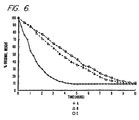
- Fig. 13 is a graph of percent original weight versus time for the dehydration of crosslinked collagen lenticles and noncrosslinked collagen lenticles.
- Fig. 14 is a graph of percent original weight versus time for the dehydration of crosslinked collagen lenticles and noncrosslinked collagen lenticles for gelatin.
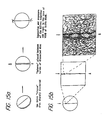
- Fig. 15A shows a diagramatic representation of the "suturing" of tissue materials as represented by a “dissected disc.”
- Fig. 15B shows a microscopic view of the suture formed in Fig. 15A.
- Type I collagen is the most abundant in the cornea and has the lowest incidence of antigenicity.
- Vitrogen 100 is a purified pepsin-solubilized bovine dermal collagen made by Collagen Corp. In this collagen, the telopeptide responsible for the collagen molecule's antigenicity has been enzymatically cleaved.
- Rat Tail Type I is a non-pepsin treated collagen made by Collaborative Research, Inc.
- one embodiment makes use of a mixture of collagen type I and collagen type V, more preferably bovine collagen type I and human collagen type V, a human placental collagen type I and type V, or bovine collagen type I and human placental collagen type V, more preferably still collagen type I and collagen type V in a ratio of 1:1, 2:1, 3:1, 4:1, 5:1, 6:1, 7:1, 8:1, 9:1, or 10:1, most preferably a ratio of 3:1.
- Still other materials include combinations of human placental collagen types I, IV, V, and/or IX and nonhuman collagen types I, IV, V and IX, such as kangaroo tail collagen type I, and/or rat tail collagen type I.
- An alternative embodiment makes use of cold fish skin gelatin, calf skin gelatin, and the like as materials having reduced immunostimulatory properties.
- a still further embodiment makes use of proteoglycans and/or combinations of collagen and proteoglycans which have the properties described in Stryer, Biochemistry, 3rd Edition, pp. 275-276. Proteoglycans exhibit the advantageous property of promoting influx of fibroblast cells to the area of implantation, and thereby promote the healing process.
- the concentration of collagen in the method of the invention varies depending upon the intended use of the cross-linked product. The range may vary from 2.5 mg/ml to 10 mg/ml. These collagen preparation concentrations can be achieved by two well known methods: by dialyzing the collagen against acetate buffer at pH 5, or by lyophilizing known quantities of collagen and then resuspending the collagen in weak acids such as .012 N HCL or CH 3 COOH.
- the pH of the collagen preparation can exist in a prowess range of pH 2.0 to the buffered preparation as established by Harry S. Geggel et al. ("Collagen Gel for Ocular Surface,” Investigative Ophthalmology & Visual Sciences (1984)) at a physiological pH of 7.4.
- Crosslinking reagents are then added to the collagen preparation.
- Crosslinking techniques of our invention make use of heterobifunctional reagents which contain reactive groups that form a bridge between amino acid side chains on the collagen molecule.
- Bifunctional crosslinkers that may be used in the method of the invention are selected from the group consisting of diazo compounds, aryl azide compounds and alkyl azide compounds and include but are not limited to 4-azidobenzoic acid N-hydroxysuccinimide ester (HSAB) and 5-(4-azido-2-nitrophenyl-amino) hexanoic acid N-hydroxysuccinimide ester (SANAH). These crosslinkers are available from Sigma, Corp.
- concentrations of the crosslinking reagent mixtures used in the invention may vary between 5 mM and 25 mM dissolved in a biologically compatible solvent such as DMSO.
- concentration of the solvent cannot be less than 50% or the reagents will begin to precipitate.
- Optimum concentration of the crosslinking reagent is 10mM established by collagen-reagent (photoactivated) mixture run on Tris-Borate Gels.
- Photoactivation of the reagents can be achieved within a wavelength range of 220 nanometers (nm) to 310 nm.
- the optimum absorbing wavelength is approximately 265 nm with photoactivation time not to exceed 20 minutes.
- the duration of photoactivation will vary depending on the type of crosslinker used.
- crosslinking efficiency of our reagent is highly dependent on the number of amino acid side chains it has available.
- excess crosslinker may hinder the crosslinking process due to potential competitive binding and internal rearrangement. This means that the active sites of the reagent bound to amino acid side chains via a peptide-like bonding process will be competed for by free reagent.
- the pre-photo-activated mixture of collagen and cross-linking reagent should be run through a Sephadex G-25 column. Fractions can be collected and run through a Spectrophotometer 260-320 nm for determination of peak collagen reagent fractions. The collected fractions can then be pooled and are ready for photoactivation.
- the collagen concentration in the final preparation cannot be less than 1.45 mg/ml.
- mice Male, 6-8 weeks, 30 grams were anaesthetized with Ketamine (50 mg/kg) and Xylazine (50 mg/kg) intraperitoneally.
- Collagen lenticles were made by combining bovine collagen type I and human collagen type V (ratio 3:1) and HSAB crosslinker. The lenticles were dialyzed in sterile distilled water until all excessive HSAB was removed. They were soaked in gentamicin antibiotics for 4 hours. The non-crosslinked collagen lenticles were treated as described above.
- the fur was shaven from the mid-scapular region of the mouse.
- the skin cleaned with iodine and a disposable size 10 scalpel to make a 2 cm incision through the skin into the subcutaneous region, sterile blunt scissors were used to tissue dissect through the subcutaneous tissue until a small pocket was formed.
- Lenticles of either HSAB crosslinked collagens or non-crosslinked collagen were placed into the subcutaneous pocket.
- the skin was closed with interrupted 6.0 prolene sutures. The sutures were removed at one week.
- Ketamine(150 mg/kg) and Xylazine (150 mg/kg) were sacrificed with lethal intraperitoneal injections of Ketamine(150 mg/kg) and Xylazine (150 mg/kg) at 2 weeks, 1 month, 2 months and 3 months.
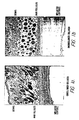
- the skin and subcutaneous tissues from the mid-scapular region were isolated and processed into paraffin blocks and sectioned for light microscopy. Sections were stained with either hematoxylin/eosin or Masson's Trichrome.
- the lenticles appeared homogenous and devoid of cells.
- Lenticles were made of either (a) Human placental collagen type I and type V (ratio 3:1) crosslinked with HSAB and UV light (b) Bovine type I collagen and human placental type V collagen (ratio 3:1) crosslinked with HSAB and UV light, (c) Bovine type I collagen and human placental type V collagen (ratio 3:1) crosslinked with 0.25% glutaraldehyde, (d), which are outside the scope of the present invention, Bovine type I collagen crosslinked with 0.25% glutaraldehyde. All lenticles were rinsed in a series of distilled water and then cut to identical size and thickness. Wet weights were measured at 0 hour and then hourly until the lenticles were completely dried as reflected by a constant weight. Data was calculated as % original weight.
- bovine type I collagen and bovine type V collagen crosslinked with HSAB had the slowest dehydration rate, with 50% dehydration at a little over 2 hours.
- the bovine lenticles were approximately 90% water.
- the combination of two collagen extended the dehydration time even without any crosslinker (data not shown). Dehydration rates were longer if chondroitin sulfate (2.3%) was added to the lenticle (data not shown). Rehydration of the lyophilized lenticle was 5-10 times faster (depending on the composition) in the crosslinked samples compared to the noncrosslinked ones.
- HSAB crosslinker made a more hydrophilic lenticle than glutaraldehyde crosslinked collagen. Also the addition of a second collagen extended the dehydration time both with and without the addition of crosslinker. The crosslinked collagen lenticle traps water and slowly releases it.
- Example 7 Transmission Electron Microscopy of Lenticles of Bovine Type I Collagen and Human Type V Collagen Crosslinked with HSAB and UV Light
- Lenticles made of bovine type I collagen and human type V collagen were crosslinked with HSAB and UV light. Samples were rinsed thoroughly with water until excessive crosslinker was removed. Lenticles were fixed in 4% glutaraldehyde/paraformaldehyde, post-fixed in osmium tetroxide and embedded in Epon-Araldite resin. Sections were cut with a glass knife, stained and viewed with a transmission electron microscope.
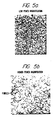
- the lenticles appeared as homogeneous fibrils randomly arranged with central pockets of "clear space" (see Figure 5). Higher magnification showed the fibrils to be similar in width and lacking any striations.
- the dehydration rate for the glutaraldehyde crosslinked fish gelatin was approximately 50% dehydration at 11 ⁇ 4 hours. This was increased to 31 ⁇ 2 hours when chondroitin sulfate was added to the crosslinked fish gelatin.
- a lenticle of HSAB crosslinked fish gelatin was placed into the mid-scapular region of mice.
- the animals were sacrificed at 2 weeks, 1 month, 2 months and 3 months, and the tissues prepared for light microscopy. Some sections were stained with hematoxylin/eosin and others with Mason's Trichrome. When viewed by light microscopy, the lenticle was dense and did not section well because it was too firm. There was minimal tissue reaction surrounding the lenticles and by 3 months there were a few cells which infiltrated the peripheral portion of the lenticles. At the time of sacrifice, serum was collected and the ELISA method was used to measure the antibodies to gelatins. There were no antibodies measured in any of the times examined (see Figure 6).
- mice serum An ELISA assay with the mice serum was performed according to standard methodology well known in the art in order to assess the properties of various collagen and gelatin implant materials. The results are summarized in Fig. 5.
- collagen a large molecular amino acid polymer, an abundant structural component of corneal tissues.
- collagen synthesis involves the following reactions:
- the normal structure of the cornea requires the presence not only of type I collagen - basic building material- but also regulatory collagens (types II and V) and stabilizing collagens (types IV and IX), the presence and ratio of which diversify with transition from primary to secondary corneal stroma.
- the list of important corneal non-cellular components also includes glycosaminoglycans (GAGs) - cornerstone of the ground substance (on 66%-keratin sulfate), glycoproteins, albumins, globulins, glucose, cristalloids, and water.
- GAGs glycosaminoglycans
- the acidic collagen solution became a gel that was susceptible to drying and was unstable in different enzymes because of a loose structure which is lacking in intra- and interfilamentous connections.
- Candidates for the artificial crosslinkers include crosslinkers that are homo- and heterobifunctional, photoactive, and those that do not require heat for photolysis of nitro-groups.
- Our final choice was the HSAB photoreactive crosslinker (Fig. 8) for each of the following reasons:
- Water soluble solfo-HSAB is the most preferred because it is soluble in DMSO, and because it displays the best physical characteristics of the final product.
- the number of moles of crosslinker required for the crosslinking of the 1 mole of collagen was calculated on the sum of lysin residues in different chains of different types of the collagen molecules (Fig. 9).
- the ratio of crosslinker dry weight to the collagen dry weight is about 1:10 (taking into account slight excess of crosslinker).
- Type V collagen has been found to have an influence on structural organization of collagen type I filaments. Type V first appear sin the cornea during the swelling of the primary stroma and persist constantly in mature (secondary) stroma which is extremely rich in this type of collagen.
- type V determines the diameter (inverse proportion) and visible striation (direct proportion) of type I collage fibrils (Linsenmayer et al., Ann. of the New York Academy of Sciences, 580 :143- 159 (1990) and Adachi et al., Connect. Tissue Res. 14 :257-2665 (1986)).
- the most important role of type V collagen in the cornea is that it acts as a regulatory protein in fibril segment fusion by altering the fibrillar surface and therefore inhibits or promotes lateral association (like a zipper). (Birk et al., Ann. N.Y. Acad. Sci. 580 :143-159 (1990)). After noting this information, we describe below the sequence physico-chemical procedures and quantitative compositions of all reagents in final (optimal) experiment:
- Rehydration of lyophilized materials is 5-10 faster (demanding on composition) if they were pretreated with crosslinker.
- Our attempt to improve the characteristics of the final product with other homobifunctional amino specific crosslinkers, such as glutaraldehyde indicates that it does not make collagen clear, but increases its fragility and yellow color even in concentrations as low as 0.03%. Reaction with glutaraldehyde shows the presence of additional available amino groups, which have not reacted with HSAB (regardless of its excess).
- EDS H 2 N - CH 2 - CH 2 - NH 2
- UV light activated begins, and we observe the following reactions: To obtain as a product:
- gelatin in this embodiment, we used not only different types of collagen, but also gelatin from cold water fish skin (48% liquid) and calf skin (powder). Interacting with water, gelatin forms lyophilic colloids-emulsions (like albumin or starch) and can be transformed into the semisolid gel (sol-gel reversible conversion with warming-cooling). Unlike homogeneous crystalloid solutions, all colloids are heterogeneous. They consist of two phases: particles (dispersed phase) and medium (dispersion Phase) (II). The important feature of gelatin is imbibition, that is, the taking up of fluid by a colloidal system resulting in swelling. The imbibition is affected by pH, temperature and concentration of electrolytes.
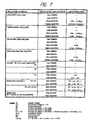
- Table 3 shows that the final products of crosslinking, having equal tensile strength, contain different quantities of water: calf gelatin - 93% and fish gelatin - 90%.
- Calf gelatin is more transparent and has a less intensive yellow coloration.
- Gelatin that had been pre-treated with ultrafiltration (M.W. > 100,000 dalton) has much better qualities.
- Chondroitin sulfate makes gelatin more hydrophilic and extends the half-time of the dehydration as much as 3-4 times in a room environment. (Fig. 14).
- Rehydration of the dried crosslinked gelatin that contains GAG should be carried out under a temperature near +20°C.
- low temperature near 0°C
- gelatin that contains GAG swells very much and the final volume of it turns out to be more than 10 times of its expected volume.
- Rehydrated gelatin films contain up to 98.5% of H 2 O. They are fragile and slightly yellow, but very clear. They can be used for attachment to the cornea without sutures or intrastromally. They are also good as wet bandages for the burned surfaces and as a long-term drug delivery system. (In room environment, a film 1mm thick retains the water about 10 hours!
- Dried uncrosslinked gelatin-GAG films (70% gelatin, 30% chondroitin sulfate) are extremely adhesive substances that are almost neutral optically. They stick tightly to any wet surface and probably could be used in superficial sutureless keratoplastics or epikeratophakis, with restricted water contact to prevent excessive swelling.
- the lenticle was completely degraded in Osmium tetroxide solvent, the strong oxidizer.
- a liquid carrier of the crosslinking agent which changes aggregate state in the process of reaction.
- Tissues As was shown above.
- Type I collagen (vitrogen) reacts with 0.25% glutaraldehyde in the course of 15-20 minutes.
- the final product is very clear and strong enough for the intralamellar implantation or simple superficial attachment, but considerable fragility of it makes impossible any manipulations with the sutures.
Landscapes
- Health & Medical Sciences (AREA)
- Chemical & Material Sciences (AREA)
- Life Sciences & Earth Sciences (AREA)
- General Health & Medical Sciences (AREA)
- Organic Chemistry (AREA)
- Medicinal Chemistry (AREA)
- Biophysics (AREA)
- Physics & Mathematics (AREA)
- Biochemistry (AREA)
- Veterinary Medicine (AREA)
- Public Health (AREA)
- Animal Behavior & Ethology (AREA)
- Epidemiology (AREA)
- Surgery (AREA)
- Engineering & Computer Science (AREA)
- Gastroenterology & Hepatology (AREA)
- Toxicology (AREA)
- Spectroscopy & Molecular Physics (AREA)
- Genetics & Genomics (AREA)
- Molecular Biology (AREA)
- Proteomics, Peptides & Aminoacids (AREA)
- Materials Engineering (AREA)
- General Physics & Mathematics (AREA)
- Polymers & Plastics (AREA)
- Zoology (AREA)
- Chemical Kinetics & Catalysis (AREA)
- Dermatology (AREA)
- Oral & Maxillofacial Surgery (AREA)
- Transplantation (AREA)
- Materials For Medical Uses (AREA)
- Medicines That Contain Protein Lipid Enzymes And Other Medicines (AREA)
- Acyclic And Carbocyclic Compounds In Medicinal Compositions (AREA)
- Medicines Containing Material From Animals Or Micro-Organisms (AREA)
- Addition Polymer Or Copolymer, Post-Treatments, Or Chemical Modifications (AREA)
- Polyamides (AREA)
Claims (26)
- Un procédé de couplage de polymères contenant des acides aminés, ex-vivo, ledit procédé comprenant les étapes dans lesquelles :on prend un polymère de collagène de premier type et un polymère de collagène de second type, lesquels polymère de collagène de premier type et polymère de collagène de second type sont des collagènes de types différents;on combine le polymère de collagène de premier type, le polymère de collagène de second type et un agent de réticulation hétéro-bifonctionnel et photoactivable, comportant au moins un site photoactivable et au moins un site classique, ce dernier étant couplé à au moins un des polymères de collagène de premier et de second type, eton photoactive l'agent de réticulation, au moins ledit site photoactivable étant couplé à un desdits polymères de collagène dudit premier et dudit second types autres dans la combinaison.
- Le procédé selon la revendication 1, dans lequel ledit polymère de collagène de premier type est du collagène de type I.
- Le procédé selon la revendication 2, dans lequel ledit collagène de type I est choisi dans le groupe comprenant le collagène bovin de type I et le collagène placentaire humain de type I.
- Le procédé selon la revendication 1, dans lequel ledit polymère de collagène de second type est le collagène de type V.
- Le procédé selon la revendication 4, dans lequel ledit collagène de type V est du collagène humain de type V.
- Le procédé selon la revendication 2, dans lequel ledit polymère de collagène de second type est du collagène de type V et dans lequel le rapport collagène de type I/collagène de type V est de 10/1 ou moins.
- Le procédé selon la revendication 1, dans lequel l'agent de réticulation hétérobifonctionnel et photoactivable est choisi dans le groupe comprenant les composés diazo, composés aryl azide et composés alkyl azide.
- Le procédé selon la revendication 1, dans lequel ledit polymère de collagène de premier type est choisi dans le groupe comprenant du collagène humain des types I, IV, V et IX et dans lequel ledit polymère de collagène de second type est choisi dans le groupe comprenant du collagène non humain des types I, IV, V et IX.
- Le procédé selon la revendication 1, dans lequel les polymères de collagène desdits premier et second types sont en outre, avant la photoactivation de l'agent de réticulation, combinés avec une gélatine laquelle gélatine est choisie dans le groupe comprenant gélatine de peau de poisson et gélatine de peau de veau.
- Un polymère contenant des acides aminés couplés obtenus par le procédé défini selon la revendication 1.
- Une composition de polymères contenant des acides aminés couplés, qui a été obtenue ex-vivo, comprenant :un polymère de collagène d'un premier type,un polymère de collagène d'un second type ; etun agent de réticulation hétérobifonctionnel et photoactivable comportant au moins un site photoactivable et au moins un site classique, dans lequel au moins un desdits sites photoactivables est couplé à au moins un desdits polymères de collagène de premier type et polymères de collagène de second type et dans lesquels au moins un desdits sites classiques est couplé à l'autre desdits polymères de premier ou de second type dans la combinaison, avec cette condition que le polymère de collagène de premier type et le polymère de collagène de second type sont des collagène de types différents.
- La composition selon la revendication 11, dans laquelle ledit polymère de collagène de premier type est le collagène de type I.
- La composition selon la revendication 12, dans laquelle ledit collagène de type I est choisi dans le groupe comprenant le collagène bovin de type I et le collagène placentaire humain de type I.
- La composition selon la revendication 11, dans laquelle ledit collagène de second type est le collagène de type V.
- La composition selon la revendication 14, dans laquelle ledit collagène de type V est le collagène humain de type V.
- La composition selon la revendication 12, dans laquelle ledit polymère de collagène de second type est le collagène de type V et dans lequel le rapport collagène de type I/collagène de type V est de 10/1 ou moins.
- La composition selon la revendication 11, dans laquelle l'agent de réticulation hétérobifonctionnel et photoactivable est choisi dans le groupe comprenant les composés diazo, composés aryl azide et composés alkyl azide.
- La composition selon la revendication 11, dans laquelle le polymère de collagène de premier type est choisi dans le groupe comprenant du collagène humain des types I, IV, V et IX et dans lequel ledit polymère de collagène de second type est choisi dans le groupe comprenant du collagène non humain des types I, IV, V et IX de.
- La composition selon la revendication 11, dans laquelle ledit polymère de collagène desdits premier et second types sont en outre, avant photoactivation de l'agent de réticulation, combinés avec une gélatine, laquelle gélatine est choisie dans le groupe comprenant gélatine de peau de poisson et gélatine de peau de veau.
- Une méthode de couplage de polymère contenant des acides aminés, ladite méthode comprenant les étapes dans lesquelles :on combine un polymère contenant de l'acide aminé, un protéoglycane et un agent de réticulation hétérobifonctionnel et photoactivable, comportant au moins un site photoactivable et au moins un site classique, dans lequel au moins le site classique est couplé à au moins un desdits polymères contenant des acides aminés et ledit protéoglycane ; eton photoactive l'agent de réticulation, au moins un site photoactivable étant couplé à l'autre desdits polymères contenant des acides aminés et ledit protéoglycane.
- Le procédé selon la revendication 20, dans lequel ledit polymère contenant des acides aminés est le collagène.
- Le procédé selon la revendication 21, dans lequel ledit collagène est choisi dans le groupe comprenant les collagènes de types I, IV, V et IX.
- Un polymère contenant des acides aminés couplés obtenus par le procédé défini selon la revendication 22.
- Une composition de polymères contenant des acides aminés couplés comprenant :un polymère contenant des acides aminés ;un protéoglycane ; etun agent de réticulation hétérobifonctionnel et photoactivable comportant au moins un site photoactivable et au moins un site classique, au moins l'un desdits sites photoactivables étant couplé à au moins un desdits polymères contenant de l'acide aminé et ledit protéoglycane, et au moins un site classique étant couplé à l'autre desdits polymères contenant des acides aminés et ledit protéoglycane.
- La composition selon la revendication 24, dans laquelle ledit polymère contenant des acides aminés est le collagène.
- La composition selon la revendication 25, dans laquelle ledit collagène est choisi dans le groupe comprenant les collagènes de types I, IV, V et IX.
Applications Claiming Priority (3)
| Application Number | Priority Date | Filing Date | Title |
|---|---|---|---|
| US482104 | 1995-06-07 | ||
| US08/482,104 US5660692A (en) | 1988-02-24 | 1995-06-07 | Method of crosslinking amino acid-containing polymers using photoactivatable chemical crosslinkers |
| PCT/US1996/006418 WO1996040729A1 (fr) | 1995-06-07 | 1996-05-07 | Procede de reticulation de polymeres contenant des acides amines au moyen de reticulants chimiques photosensibles |
Publications (3)
| Publication Number | Publication Date |
|---|---|
| EP0832095A1 EP0832095A1 (fr) | 1998-04-01 |
| EP0832095A4 EP0832095A4 (fr) | 1999-07-21 |
| EP0832095B1 true EP0832095B1 (fr) | 2003-12-03 |
Family
ID=23914678
Family Applications (1)
| Application Number | Title | Priority Date | Filing Date |
|---|---|---|---|
| EP96915553A Expired - Lifetime EP0832095B1 (fr) | 1995-06-07 | 1996-05-07 | Procede de reticulation de polymeres contenant des acides amines au moyen de reticulants chimiques photosensibles |
Country Status (7)
| Country | Link |
|---|---|
| US (1) | US5660692A (fr) |
| EP (1) | EP0832095B1 (fr) |
| AT (1) | ATE255591T1 (fr) |
| CA (1) | CA2222239A1 (fr) |
| DE (1) | DE69630954T2 (fr) |
| ES (1) | ES2210369T3 (fr) |
| WO (1) | WO1996040729A1 (fr) |
Families Citing this family (50)
| Publication number | Priority date | Publication date | Assignee | Title |
|---|---|---|---|---|
| US6685965B1 (en) * | 1997-10-22 | 2004-02-03 | Industria E Comercio De Cosmeticos Natura Ltda. | Process for stabilizing levogyre ascorbic acid (laa), a stable aqueous laa composition, a process for preparing a stable topical solution, an emulsion, a vitamin product, and a method for cosmetic, pharmaceutical or nutritional treatment |
| US20020188037A1 (en) * | 1999-04-15 | 2002-12-12 | Chudzik Stephen J. | Method and system for providing bioactive agent release coating |
| WO1999055396A1 (fr) | 1998-04-27 | 1999-11-04 | Surmodics, Inc. | Revetement destine a liberer des agents bioactifs |
| US6197934B1 (en) | 1998-05-22 | 2001-03-06 | Collagenesis, Inc. | Compound delivery using rapidly dissolving collagen film |
| US6165140A (en) | 1998-12-28 | 2000-12-26 | Micrus Corporation | Composite guidewire |
| AU3856400A (en) * | 1999-02-12 | 2000-08-29 | Collagenesis, Inc. | Injectable collagen-based system for delivery of cells or therapeutic agents |
| US6887235B2 (en) | 1999-03-24 | 2005-05-03 | Micrus Corporation | Variable stiffness heating catheter |
| US6352531B1 (en) | 1999-03-24 | 2002-03-05 | Micrus Corporation | Variable stiffness optical fiber shaft |
| WO2000064371A1 (fr) * | 1999-04-27 | 2000-11-02 | The Children's Hospital Of Philadelphia | Stabilisation de dispositifs a bioprothese implantables |
| DE10196235B4 (de) * | 2000-05-26 | 2007-12-27 | Engelhard Lyon S.A. | Verwendung von Fischkollagen zur Herstellung von Trägern für die Gewebebildung sowie diese Träger |
| US6335004B1 (en) | 2000-05-31 | 2002-01-01 | Ecolab Inc. | Odorless phenolic compositions |
| US6838104B2 (en) * | 2000-12-20 | 2005-01-04 | Archer Daniels Midland Company | Process for the production of tocotrienols |
| US20020177223A1 (en) * | 2001-03-12 | 2002-11-28 | Ogle Mathew F. | Methods and compositions for crosslinking tissue |
| CA2454249A1 (fr) * | 2001-08-06 | 2003-02-20 | Southwest Research Institute | Procede et dispositif servant a controler la potentialite de la duree d'un convertisseur catalytique |
| WO2003046144A2 (fr) * | 2001-11-26 | 2003-06-05 | Molecular Reflections, Inc. | Immobilisation de molecules a petite echelle au moyen d'un hydrogel et procedes d'utilisation associes |
| JPWO2003094985A1 (ja) * | 2002-05-14 | 2005-09-08 | 北海道ティー・エル・オー株式会社 | 人工細胞外マトリックス及びその製造方法 |
| US7097850B2 (en) | 2002-06-18 | 2006-08-29 | Surmodics, Inc. | Bioactive agent release coating and controlled humidity method |
| JP2007532187A (ja) | 2004-04-06 | 2007-11-15 | サーモディクス,インコーポレイティド | 生物活性物質のためのコーティング組成物 |
| WO2006029571A1 (fr) * | 2004-09-14 | 2006-03-23 | The University Of Hong Kong | Echafaudages de collagene a reticulation photochimique et procedes de preparation associes |
| US7857849B2 (en) * | 2004-10-05 | 2010-12-28 | The Board Of Trustees Of The Leland Stanford Junior Iniversity | Artificial corneal implant |
| US20090088846A1 (en) | 2007-04-17 | 2009-04-02 | David Myung | Hydrogel arthroplasty device |
| WO2007012050A2 (fr) * | 2005-07-20 | 2007-01-25 | Surmodics, Inc. | Structures nanofibrilaires revetues de polymere et procedes de maintenance et de differenciation cellulaire |
| US7415991B2 (en) | 2005-12-20 | 2008-08-26 | Masco Corporation Of Indiana | Faucet spout with water isolating couplings |
| EP1998742A2 (fr) * | 2006-03-08 | 2008-12-10 | Nuviance, INC. | Composition de médicament à libération transdermique et compositions topiques pour application cutanée |
| WO2007109134A2 (fr) * | 2006-03-17 | 2007-09-27 | The Board Of Trustees Of The Leland Stanford Junior University | Cristallin artificiel |
| US7766043B2 (en) | 2006-05-26 | 2010-08-03 | Masco Corporation Of Indiana | Faucet including a molded waterway assembly |
| US8991425B2 (en) | 2006-05-26 | 2015-03-31 | Delta Faucet Company | Waterway assembly including an overmolded support plate |
| KR20230146124A (ko) | 2006-10-06 | 2023-10-18 | 셀룰래리티 인코포레이티드 | 천연(텔로펩티드) 태반 콜라겐 조성물 |
| US7717133B2 (en) * | 2007-01-31 | 2010-05-18 | Masco Corporation Of Indiana | Spout tip attachment |
| US7748409B2 (en) | 2007-01-31 | 2010-07-06 | Masco Corporation Of Indiana | Overmold interface for fluid carrying system |
| US7806141B2 (en) | 2007-01-31 | 2010-10-05 | Masco Corporation Of Indiana | Mixing valve including a molded waterway assembly |
| WO2009097508A2 (fr) | 2008-01-30 | 2009-08-06 | Mcanulty, Jonathan | Procédés et compositions pour la cicatrisation |
| US9151397B2 (en) | 2008-04-10 | 2015-10-06 | Delta Faucet Company | Molded waterway for a two handle faucet |
| WO2009158497A1 (fr) | 2008-06-25 | 2009-12-30 | Masco Corporation Of Indiana | Robinet central à bec montable |
| US20120209396A1 (en) | 2008-07-07 | 2012-08-16 | David Myung | Orthopedic implants having gradient polymer alloys |
| KR20110040969A (ko) | 2008-08-05 | 2011-04-20 | 바이오미메디카, 인코포레이티드 | 폴리우레탄-그라프트된 하이드로겔 |
| US8104512B2 (en) | 2008-09-25 | 2012-01-31 | Masco Corporation Of Indiana | Spout tip retention method |
| EP2533772B1 (fr) * | 2010-02-10 | 2021-09-08 | Imbed Biosciences, Inc. | Procédés et compositions destinés à la cicatrisation des plaies |
| AU2011293169A1 (en) | 2010-08-27 | 2013-03-21 | Biomimedica, Inc. | Hydrophobic and hydrophilic interpenetrating polymer networks derived from hydrophobic polymers and methods of preparing the same |
| US8739826B2 (en) | 2011-03-11 | 2014-06-03 | Masco Corporation Of Indiana | Centerset faucet body and method of making same |
| EP3357518B1 (fr) | 2011-10-03 | 2020-12-02 | Hyalex Orthopaedics, Inc. | Adhésif polymère pour ancrage de matériaux conformes à une autre surface |
| WO2013078284A1 (fr) | 2011-11-21 | 2013-05-30 | Biomimedica, Inc. | Systèmes, dispositifs et procédés pour ancrer des implants orthopédiques à l'os |
| US8931500B2 (en) | 2012-02-17 | 2015-01-13 | Masco Corporation Of Indiana | Two handle centerset faucet |
| US9974646B2 (en) | 2012-09-05 | 2018-05-22 | University Of Miami | Keratoprosthesis, and system and method of corneal repair using same |
| EP3838280A1 (fr) | 2012-12-07 | 2021-06-23 | Celularity Inc. | Traitement des lésions buccales au moyen de matrice extracellulaire placentaire |
| NO2975611T3 (fr) | 2013-03-15 | 2018-06-09 | ||
| JP2016526387A (ja) | 2013-06-24 | 2016-09-05 | アントフロゲネシス コーポレーション | 細胞培養のための細胞外マトリクス組成物ビーズ |
| US11077228B2 (en) | 2015-08-10 | 2021-08-03 | Hyalex Orthopaedics, Inc. | Interpenetrating polymer networks |
| KR102637746B1 (ko) | 2016-07-29 | 2024-02-16 | 임베드 바이오사이언시스 아이엔씨. | 상처 치유를 위한 방법 및 조성물 |
| US10869950B2 (en) | 2018-07-17 | 2020-12-22 | Hyalex Orthopaedics, Inc. | Ionic polymer compositions |
Family Cites Families (15)
| Publication number | Priority date | Publication date | Assignee | Title |
|---|---|---|---|---|
| US3152976A (en) * | 1961-09-21 | 1964-10-13 | Ethicon Inc | Preparation of collagenous materials |
| JPS5785051A (en) * | 1980-11-18 | 1982-05-27 | Toppan Printing Co Ltd | Water-soluble photosensitive material |
| US4973493A (en) * | 1982-09-29 | 1990-11-27 | Bio-Metric Systems, Inc. | Method of improving the biocompatibility of solid surfaces |
| US4505855A (en) * | 1982-09-30 | 1985-03-19 | Massachusetts General Hospital | Transparent non-fibrilized collagen material by ultracentrifugation |
| DE3248188A1 (de) * | 1982-12-27 | 1984-06-28 | Behringwerke Ag, 3550 Marburg | Verfahren zur herstellung eines kollagen-vlieses |
| US4511478A (en) * | 1983-11-10 | 1985-04-16 | Genetic Systems Corporation | Polymerizable compounds and methods for preparing synthetic polymers that integrally contain polypeptides |
| MX163953B (es) * | 1984-03-27 | 1992-07-03 | Univ New Jersey Med | Procedimiento para preparar una matriz biodegradable a base de colageno |
| US4597999A (en) * | 1984-10-04 | 1986-07-01 | The Hospital For Sick Children | Method for coupling a hydrocarbon containing molecular species |
| JPS62246371A (ja) * | 1986-04-19 | 1987-10-27 | 株式会社 高研 | 人工皮膚及びその製造方法 |
| JPS62266064A (ja) * | 1986-05-14 | 1987-11-18 | 株式会社 高研 | コラ−ゲン膜の製造方法 |
| US5024742A (en) * | 1988-02-24 | 1991-06-18 | Cedars-Sinai Medical Center | Method of crosslinking amino acid containing polymers using photoactivatable chemical crosslinkers |
| FR2645870B1 (fr) * | 1989-04-12 | 1993-01-22 | Bioetica Sa | Procede de reticulation du collagene par le diphenylphosphorylazide, collagene reticule ainsi obtenu et biomateriaux a base de collagene ainsi reticules |
| US5292362A (en) * | 1990-07-27 | 1994-03-08 | The Trustees Of Columbia University In The City Of New York | Tissue bonding and sealing composition and method of using the same |
| FR2679778B1 (fr) * | 1991-08-02 | 1995-07-07 | Coletica | Utilisation de collagene reticule par un agent de reticulation pour la fabrication d'une membrane suturable, biocompatible, a resorption lente, ainsi qu'une telle membrane. |
| JP3532587B2 (ja) * | 1993-04-23 | 2004-05-31 | 株式会社高研 | 架橋化タンパク質、その製造方法及びこれを用いた医用材料 |
-
1995
- 1995-06-07 US US08/482,104 patent/US5660692A/en not_active Expired - Fee Related
-
1996
- 1996-05-07 CA CA002222239A patent/CA2222239A1/fr not_active Abandoned
- 1996-05-07 WO PCT/US1996/006418 patent/WO1996040729A1/fr not_active Ceased
- 1996-05-07 DE DE69630954T patent/DE69630954T2/de not_active Expired - Fee Related
- 1996-05-07 AT AT96915553T patent/ATE255591T1/de not_active IP Right Cessation
- 1996-05-07 EP EP96915553A patent/EP0832095B1/fr not_active Expired - Lifetime
- 1996-05-07 ES ES96915553T patent/ES2210369T3/es not_active Expired - Lifetime
Also Published As
| Publication number | Publication date |
|---|---|
| EP0832095A1 (fr) | 1998-04-01 |
| DE69630954T2 (de) | 2004-10-21 |
| WO1996040729A1 (fr) | 1996-12-19 |
| DE69630954D1 (de) | 2004-01-15 |
| CA2222239A1 (fr) | 1996-12-19 |
| US5660692A (en) | 1997-08-26 |
| ATE255591T1 (de) | 2003-12-15 |
| EP0832095A4 (fr) | 1999-07-21 |
| ES2210369T3 (es) | 2004-07-01 |
Similar Documents
| Publication | Publication Date | Title |
|---|---|---|
| EP0832095B1 (fr) | Procede de reticulation de polymeres contenant des acides amines au moyen de reticulants chimiques photosensibles | |
| EP0330344B1 (fr) | Procédé de réticulation du collagène avec des agents chimiques photo-activables. Utilisations de ce collagène ou de polymères contenant des acides aminés ainsi réticulés. | |
| US5565519A (en) | Clear, chemically modified collagen-synthetic polymer conjugates for ophthalmic applications | |
| US6165488A (en) | Adhesive composition with macromolecular polyaldehyde base and method for cross-linking collagen | |
| US5354336A (en) | Method for bonding soft tissue with collagen-based adhesives and sealants | |
| US8236344B2 (en) | Engineered proteins, and methods of making and using | |
| EP0330389B1 (fr) | Traitement du collagène humain et son application comme auto-implant | |
| US5067961A (en) | Non-biodegradable two phase corneal implant and method for preparing same | |
| US5201764A (en) | Biologically compatible collagenous reaction product and articles useful as medical implants produced therefrom | |
| DE68914559T2 (de) | Synthetische Aminsäure und/oder Peptide enthaltende Pfropfcopolymere. | |
| JP2007296401A (ja) | 生体適合性の粘着剤組成物 | |
| US20100261652A1 (en) | Tissue Adhesive Using Engineered Proteins | |
| US20090035356A1 (en) | Modified biodegradable polymers, preparation and use thereof for making biomaterials and dressings | |
| EP1589088B1 (fr) | Nouvelle composition bioadhésive comprenant une protéine polyphénolique bioadhésive, un polymère avec des groupes carbohydrates, des filaments minces pharmaceutiquement acceptables et sa utilisation | |
| FREDERICK | 17. COLLAGEN: CHARACTERIZATION, PROCESSING |
Legal Events
| Date | Code | Title | Description |
|---|---|---|---|
| PUAI | Public reference made under article 153(3) epc to a published international application that has entered the european phase |
Free format text: ORIGINAL CODE: 0009012 |
|
| 17P | Request for examination filed |
Effective date: 19980105 |
|
| AK | Designated contracting states |
Kind code of ref document: A1 Designated state(s): AT BE CH DE DK ES FI FR GB GR IE IT LI LU MC NL PT SE |
|
| A4 | Supplementary search report drawn up and despatched |
Effective date: 19990607 |
|
| AK | Designated contracting states |
Kind code of ref document: A4 Designated state(s): AT BE CH DE DK ES FI FR GB GR IE IT LI LU MC NL PT SE |
|
| RIC1 | Information provided on ipc code assigned before grant |
Free format text: 6C 07K 1/00 A, 6C 07K 14/78 B, 6A 61L 27/00 B, 6A 61L 25/00 B, 6A 61L 17/00 B |
|
| 17Q | First examination report despatched |
Effective date: 20010205 |
|
| GRAH | Despatch of communication of intention to grant a patent |
Free format text: ORIGINAL CODE: EPIDOS IGRA |
|
| GRAS | Grant fee paid |
Free format text: ORIGINAL CODE: EPIDOSNIGR3 |
|
| GRAA | (expected) grant |
Free format text: ORIGINAL CODE: 0009210 |
|
| AK | Designated contracting states |
Kind code of ref document: B1 Designated state(s): AT BE CH DE DK ES FI FR GB GR IE IT LI LU MC NL PT SE |
|
| PG25 | Lapsed in a contracting state [announced via postgrant information from national office to epo] |
Ref country code: NL Free format text: LAPSE BECAUSE OF FAILURE TO SUBMIT A TRANSLATION OF THE DESCRIPTION OR TO PAY THE FEE WITHIN THE PRESCRIBED TIME-LIMIT Effective date: 20031203 Ref country code: LI Free format text: LAPSE BECAUSE OF FAILURE TO SUBMIT A TRANSLATION OF THE DESCRIPTION OR TO PAY THE FEE WITHIN THE PRESCRIBED TIME-LIMIT Effective date: 20031203 Ref country code: FI Free format text: LAPSE BECAUSE OF FAILURE TO SUBMIT A TRANSLATION OF THE DESCRIPTION OR TO PAY THE FEE WITHIN THE PRESCRIBED TIME-LIMIT Effective date: 20031203 Ref country code: CH Free format text: LAPSE BECAUSE OF FAILURE TO SUBMIT A TRANSLATION OF THE DESCRIPTION OR TO PAY THE FEE WITHIN THE PRESCRIBED TIME-LIMIT Effective date: 20031203 Ref country code: BE Free format text: LAPSE BECAUSE OF FAILURE TO SUBMIT A TRANSLATION OF THE DESCRIPTION OR TO PAY THE FEE WITHIN THE PRESCRIBED TIME-LIMIT Effective date: 20031203 Ref country code: AT Free format text: LAPSE BECAUSE OF FAILURE TO SUBMIT A TRANSLATION OF THE DESCRIPTION OR TO PAY THE FEE WITHIN THE PRESCRIBED TIME-LIMIT Effective date: 20031203 |
|
| REG | Reference to a national code |
Ref country code: GB Ref legal event code: FG4D |
|
| RIC1 | Information provided on ipc code assigned before grant |
Ipc: 7A 61L 17/00 B Ipc: 7A 61L 26/00 B Ipc: 7A 61L 27/00 B Ipc: 7C 07K 14/78 B Ipc: 7C 07K 1/00 A |
|
| REG | Reference to a national code |
Ref country code: CH Ref legal event code: EP |
|
| REG | Reference to a national code |
Ref country code: IE Ref legal event code: FG4D |
|
| RIC2 | Information provided on ipc code assigned after grant |
Ipc: 7A 61L 17/00 B Ipc: 7A 61L 27/00 B Ipc: 7C 07K 14/78 B Ipc: 7C 07K 1/00 A |
|
| REF | Corresponds to: |
Ref document number: 69630954 Country of ref document: DE Date of ref document: 20040115 Kind code of ref document: P |
|
| PG25 | Lapsed in a contracting state [announced via postgrant information from national office to epo] |
Ref country code: SE Free format text: LAPSE BECAUSE OF FAILURE TO SUBMIT A TRANSLATION OF THE DESCRIPTION OR TO PAY THE FEE WITHIN THE PRESCRIBED TIME-LIMIT Effective date: 20040303 Ref country code: GR Free format text: LAPSE BECAUSE OF FAILURE TO SUBMIT A TRANSLATION OF THE DESCRIPTION OR TO PAY THE FEE WITHIN THE PRESCRIBED TIME-LIMIT Effective date: 20040303 Ref country code: DK Free format text: LAPSE BECAUSE OF FAILURE TO SUBMIT A TRANSLATION OF THE DESCRIPTION OR TO PAY THE FEE WITHIN THE PRESCRIBED TIME-LIMIT Effective date: 20040303 |
|
| NLV1 | Nl: lapsed or annulled due to failure to fulfill the requirements of art. 29p and 29m of the patents act | ||
| PG25 | Lapsed in a contracting state [announced via postgrant information from national office to epo] |
Ref country code: LU Free format text: LAPSE BECAUSE OF NON-PAYMENT OF DUE FEES Effective date: 20040507 |
|
| PGFP | Annual fee paid to national office [announced via postgrant information from national office to epo] |
Ref country code: ES Payment date: 20040518 Year of fee payment: 9 |
|
| PG25 | Lapsed in a contracting state [announced via postgrant information from national office to epo] |
Ref country code: MC Free format text: LAPSE BECAUSE OF NON-PAYMENT OF DUE FEES Effective date: 20040531 |
|
| REG | Reference to a national code |
Ref country code: CH Ref legal event code: PL |
|
| REG | Reference to a national code |
Ref country code: ES Ref legal event code: FG2A Ref document number: 2210369 Country of ref document: ES Kind code of ref document: T3 |
|
| ET | Fr: translation filed | ||
| PLBE | No opposition filed within time limit |
Free format text: ORIGINAL CODE: 0009261 |
|
| STAA | Information on the status of an ep patent application or granted ep patent |
Free format text: STATUS: NO OPPOSITION FILED WITHIN TIME LIMIT |
|
| 26N | No opposition filed |
Effective date: 20040906 |
|
| PG25 | Lapsed in a contracting state [announced via postgrant information from national office to epo] |
Ref country code: ES Free format text: LAPSE BECAUSE OF NON-PAYMENT OF DUE FEES Effective date: 20050509 |
|
| PGFP | Annual fee paid to national office [announced via postgrant information from national office to epo] |
Ref country code: IE Payment date: 20050511 Year of fee payment: 10 |
|
| PGFP | Annual fee paid to national office [announced via postgrant information from national office to epo] |
Ref country code: GB Payment date: 20060503 Year of fee payment: 11 |
|
| PG25 | Lapsed in a contracting state [announced via postgrant information from national office to epo] |
Ref country code: IE Free format text: LAPSE BECAUSE OF NON-PAYMENT OF DUE FEES Effective date: 20060508 |
|
| PGFP | Annual fee paid to national office [announced via postgrant information from national office to epo] |
Ref country code: DE Payment date: 20060508 Year of fee payment: 11 |
|
| PGFP | Annual fee paid to national office [announced via postgrant information from national office to epo] |
Ref country code: FR Payment date: 20060515 Year of fee payment: 11 |
|
| PGFP | Annual fee paid to national office [announced via postgrant information from national office to epo] |
Ref country code: IT Payment date: 20060531 Year of fee payment: 11 |
|
| REG | Reference to a national code |
Ref country code: ES Ref legal event code: FD2A Effective date: 20050509 |
|
| REG | Reference to a national code |
Ref country code: IE Ref legal event code: MM4A |
|
| PG25 | Lapsed in a contracting state [announced via postgrant information from national office to epo] |
Ref country code: PT Free format text: LAPSE BECAUSE OF NON-PAYMENT OF DUE FEES Effective date: 20040503 |
|
| GBPC | Gb: european patent ceased through non-payment of renewal fee |
Effective date: 20070507 |
|
| REG | Reference to a national code |
Ref country code: FR Ref legal event code: ST Effective date: 20080131 |
|
| PG25 | Lapsed in a contracting state [announced via postgrant information from national office to epo] |
Ref country code: DE Free format text: LAPSE BECAUSE OF NON-PAYMENT OF DUE FEES Effective date: 20071201 |
|
| PG25 | Lapsed in a contracting state [announced via postgrant information from national office to epo] |
Ref country code: GB Free format text: LAPSE BECAUSE OF NON-PAYMENT OF DUE FEES Effective date: 20070507 |
|
| PG25 | Lapsed in a contracting state [announced via postgrant information from national office to epo] |
Ref country code: FR Free format text: LAPSE BECAUSE OF NON-PAYMENT OF DUE FEES Effective date: 20070531 |
|
| PG25 | Lapsed in a contracting state [announced via postgrant information from national office to epo] |
Ref country code: IT Free format text: LAPSE BECAUSE OF NON-PAYMENT OF DUE FEES Effective date: 20070507 |