EP0832576B1 - Boítier, du type boítier de maquillage - Google Patents
Boítier, du type boítier de maquillage Download PDFInfo
- Publication number
- EP0832576B1 EP0832576B1 EP19970401631 EP97401631A EP0832576B1 EP 0832576 B1 EP0832576 B1 EP 0832576B1 EP 19970401631 EP19970401631 EP 19970401631 EP 97401631 A EP97401631 A EP 97401631A EP 0832576 B1 EP0832576 B1 EP 0832576B1
- Authority
- EP
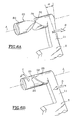
- European Patent Office
- Prior art keywords
- ramp
- case
- axis
- crests
- articulation
- Prior art date
- Legal status (The legal status is an assumption and is not a legal conclusion. Google has not performed a legal analysis and makes no representation as to the accuracy of the status listed.)
- Expired - Lifetime
Links
Images


Classifications
-
- A—HUMAN NECESSITIES
- A45—HAND OR TRAVELLING ARTICLES
- A45D—HAIRDRESSING OR SHAVING EQUIPMENT; EQUIPMENT FOR COSMETICS OR COSMETIC TREATMENTS, e.g. FOR MANICURING OR PEDICURING
- A45D40/00—Casings or accessories specially adapted for storing or handling solid or pasty toiletry or cosmetic substances, e.g. shaving soaps or lipsticks
- A45D40/22—Casings characterised by a hinged cover
-
- A—HUMAN NECESSITIES
- A45—HAND OR TRAVELLING ARTICLES
- A45C—PURSES; LUGGAGE; HAND CARRIED BAGS
- A45C13/00—Details; Accessories
- A45C13/34—Stays or supports for holding lids or covers open
Definitions
- the invention relates to a case, of the make-up case type comprising at least two parts articulated one on the other around a pivot axis.
- the invention relates in particular to a housing comprising a bottom defining a receptacle for the product and a hinged cover on the bottom.
- the invention also relates to housings of the type comprising a bottom in which a plate is arranged intermediate defining a receptacle for the product, the cover being hinged either on the bottom or on the intermediate plate.
- housings of the type comprising a bottom in which a plate is arranged intermediate defining a receptacle for the product, the cover being hinged either on the bottom or on the intermediate plate.
- a first articulation system commonly used is described for example in the patent French 2,676,626 in which the housing consists of a bottom, a partition intermediate, and of a cover manufactured respectively by injection of a thermoplastic material and hinged together by a metal hinge reported.
- Such an embodiment has the drawbacks of requiring a mounting operation of this axis, therefore increasing the time and cost of manufacturing, and detract from the aesthetic appearance of the finished product, due to the passage of the axis which can be visible from the outside.
- the make-up boxes sold in large retail chains distribution are less elaborate and generally have a hinge integrated into the housing components.
- the English patent 2,140,392 describes a case comprising a bottom, a cover and a flexible plate, having the form of a frame which is assembled by elastic snap-fastening in the background.
- the frame In its rear part, the frame has a clearance defined between two bosses projecting towards the rear, each of these bosses being shaped in a hinge bearing for an axis.
- Each landing has substantially the shape of a U opening downwards through a passage of width less than the diameter of a axis, and delimited between the two flexible wings of the bearing, this passage emerging in a housing in which an axis is intended to be pivoted.
- Such housings with integrated hinges have the advantage of being simple and not very expensive to make.
- the articulation of the cover on the bottom is however generally rudimentary, and does not present as only function the rotation of the cover on the bottom. Furthermore, the operating clearances of these joints are more important over use.
- Document DE 128515 describes a structure with two articulated parts, one on the other, and whose opening and closing are assisted by means of a structure with ramps, made up of added elements.
- One of the major drawbacks of a such a structure is due in particular to the complexity of its assembly, and in particular to the presence of a coil spring to be mounted in an appropriate housing. The same problems arise with a structure as described in the Patent application EP 0 535 912.
- the ramps have a symmetrical profile with respect to the axis of articulation, each of the profiles having a succession of hollows and ridges alternately. So, in at least two angular positions of the first part with respect to the second, the crests of one of the profiles are opposite the troughs of the other profile.
- the two angular positions include a closed position and an open or semi-open position.
- the housing comprises two arrangements with identical ramps, located on either side of the housing along the axis of articulation.
- the ramps can be kept centered on the axis by means of a centering member male located in the center of the surface of the first ramp and intended to cooperate with a female organ located in the center of the surface of the second ramp.
- the invention also relates to a joint which, in the closed position of the case, is such that the ridges of the first ramp are substantially opposite ridges of the second ramp, elastic means being in this position, maintained under stress, control means, actuable from the outside, allowing the crests of the first ramp to be crossed by the crests of the second, the elastic means then exerting a force of reminder to cause the first ramp to move in rotation on the second ramp, thus inducing an opening movement of the housing until that the crests of the first ramp are substantially opposite the troughs of the second ramp.
- the elastic means comprise two parallel slots formed in the bottom of the housing, each of the slots being provided at vicinity of the corresponding side edge of the housing so as to form two elastic tabs substantially perpendicular to the axis and the free end of which carries said female organ.
- the housing 1 comprises a bottom 2 defining a receptacle for a product such as a makeup product.
- the bottom defines a first recess 3 intended to receive a powder, or a foundation.
- the background also defines a another recess 4 of elongated shape capable of containing an applicator of the type brush or other.
- the makeup product and the applicator may be contained in recesses in a intermediate plate.
- a cover 5 is articulated on the bottom around an axis of pivot A.
- the cover defines a frame 6 inside which is mounted a mirror 8.
- the cover also comprises closing means 9 able to cooperate with a corresponding member 13 provided on the bottom, so to keep the cover in the closed position. None of these elements constitute the subject of the invention and, therefore, they do not require a description additional detail.
- FIGS 3 to 5 which are now referred to, illustrate schematic different embodiments of a joint 50 according to the present invention.
- the housing has two joints 50 according to the invention, located on each side of the housing along the axis A.
- such a housing may include on one side, a hinge conforming to the invention, and on the other side an articulation of the type with integrated hinge such as discussed in the preamble to this description.
- each of the joints comprises a first male member 20 carried by a boss 12, integral with the cover in the vicinity of the edge opposite the edge carrying the closure element 9, and projecting from the plane of the cover.
- the boss carries a pin cylindrical 20 located in the axis A and one end of which is integral with the boss. The other free end has on its cross section a surface forming a ramp 22.
- the ramp has two portions in bevel (projecting) symmetrical with respect to a plane passing through the axis, of so that the surface of the ramp defines two ridges 23, 24 separated by recessed portions 25, 26.
- an element is moving on the surface of the ramp 22, at a given distance from the edge, follows a trajectory forming an alternation of hollows and bumps.
- the pin 20 is extended by a centering member 27, in the form of a stud, protruding from the tops of the ramp.
- the joint comprises a female member 28, in the form of a recess formed on a side edge of the bottom of the housing in alignment with the hinge pin (A).
- the lateral edge of the bottom of the case forms in the vicinity of the joint, a step whose width is substantially equal to that of the boss 12.
- the bottom of the recess has a surface forming a ramp 33 whose profile is complementary to the profile of the first ramp.
- the ramp 33 has two beveled (re-entrant) portions, symmetrical with respect to to a plane passing through axis A, so that the surface of the ramp defines two ridges 29, 30 separated by hollow portions 31, 32.
- the recess extends in the direction opposite to the vertices 29 and 30 by a hole 34 aligned with axis A and intended to receive the centering element 27 of the male organ.
- the elastic means comprise two substantially parallel slots 13, 14 formed in the bottom of the housing, each slots being provided in the vicinity of the corresponding edge of the housing so as to form two elastic tabs 11 substantially perpendicular to the axis and whose free end carries said female member 28.
- the means elastic bands are carried by the cover.
- each of the ramps 22, 33 has 3 vertices separated by about 120 °, oriented so as to allow indexing in the closed position, and a in semi open position (120 ° from the bottom of the housing).
- Others configurations can also be envisaged, by changing the position angular crests, or by changing the number.
- the profile of the surface of the ramp may be of the type of that of the end section of a Phillips screwdriver. According to another alternative, an operation is obtained softer housing by giving the ramps a sinusoidal shape.
- the ramps 22, 33 have a profile helical.
- the opening angle of the cover is limited by one part by the edge 35 between two adjacent turns of the helical thread, and secondly by the stop effect of the cover on the bottom.
- the ridges of the first ramp are substantially opposite the second ramp ridges.
- the angular offset between the vertices may be of the order of a few degrees, depending on the sensitivity wanted at the opening.
- the means elastics are kept under stress. Control means, actuable from the outside, allow the crossing of ridges of the first ramp by the ridges of the second, the elastic means then exerting a restoring force to cause the rotational displacement of the first ramp on the second ramp, thus inducing movement opening the housing until the crests of the first ramp are substantially opposite the hollows of the second ramp.
- actuation of the elastic means causes the lid to open by relative to the housing at an angle of up to 90 ° or more.
- the closure of case will require pressure on the cover to tension the elastic means, bringing the ridges of the cover ramp substantially opposite the ridges of the bottom ramp.
- the clasp 9 is used as a control means to cause the crossing the ridges. Such an embodiment is illustrated in FIGS. 6A and 6B.
- the ramp of the male member 20 is offset angularly relative to the ramp of the female member 28 so that the ridges of the male organ are almost opposite the ridges of the organ female.
- the bottom 2 is moved along the axis A relative to the cover 5, which causes a constraint (arrow B) of the tab elastic 11, illustrated by the angle ⁇ .
- this angle can be of the order 80 °.
Landscapes
- Closures For Containers (AREA)
- Brushes (AREA)
- Toilet Supplies (AREA)
- Non-Flushing Toilets (AREA)
Description
a) au moins deux parties dont une première partie est articulée par rapport à une seconde de manière à pivoter autour d'un axe d'articulation pour sélectivement ouvrir ou fermer le boítier;
ledit boítier présentant au moins un agencement à rampes comprenant:
- la figure 1 représente un premier mode de réalisation du boítier selon la présente invention en position fermée;
- la figure 2 représente une vue du boítier de la figure 1 en position ouverte à 180°;
- la figure 3 représente le détail d'une première articulation utilisable dans un boítier selon l'invention;
- la figure 4 représente le détail d'une seconde articulation utilisable dans un boítier selon l'invention;
- la figure 5 représente le détail d'une troisième articulation utilisable dans un boítier selon l'invention;
- les figures 6A-6B illustrent schématiquement le fonctionnement de l'articulation d'un autre mode de réalisation du boítier selon l'invention, et selon lequel l'ouverture est commandée automatiquement.
Claims (16)
- Boítier (1) comportant:
a) au moins deux parties (2, 5) dont une première partie (5) est articulée par rapport à une seconde (2) de manière à pivoter autour d'un axe d'articulation (A) pour sélectivement ouvrir ou fermer le boítier;
ledit boítier présentant au moins un agencement à rampes comprenant:caractérisé en ce que lesdits moyens élastiques (11) sont constitués d'au moins une patte élastiquement déformable (11) formée par l'une ou l'autre desdites première (5) et seconde (2) parties.b) une première rampe (22) portée par la première partie (5), et formée par une surface centrée sur l'axe d'articulation (A);c) une seconde rampe (33) portée par la seconde partie (2) et formée par une surface centrée sur l'axe d'articulation (A), la seconde rampe ayant un profil complémentaire du profil de la première et étant disposée de manière à coopérer avec la première rampe (22) pour, lors du pivotement de la première partie du boítier (5) par rapport à la seconde (2), se déplacer en rotation sur la première rampe (22) et produire un déplacement relatif le long de l'axe de la première partie par rapport à la seconde; etd) des moyens élastiques (11) pour contraindre la première rampe en appui sur la seconde suivant l'axe d'articulation (A), sur au moins une portion angulaire du mouvement de pivotement de la première partie (5) du boítier par rapport à la seconde (2), - Boítier selon la revendication 1 caractérisé en ce que les rampes (22, 33) présentent un profil symétrique par rapport à l'axe d'articulation, chacun des profils présentant une succession de creux (25, 26, 31, 32) et de crêtes (23, 24, 29, 30) en alternance.
- Boítier selon la revendication 2 caractérisé en ce que, en au moins deux positions angulaires de la première partie par rapport à la seconde, les crêtes (23, 24) d'un des profils sont en regard des creux (31, 32) de l'autre profil.
- Boítier selon la revendication 3 caractérisé en ce que les deux positions angulaires comprennent une position fermée et une position ouverte ou semi-ouverte du boítier.
- Boítier selon l'une quelconque des revendications 1 à 4 caractérisé en ce qu'il comprend deux agencements à rampes identiques, situés de part et d'autre du boítier le long de l'axe d'articulation (A).
- Boítier selon l'une quelconque des revendications 1 à 5 caractérisé en ce que dans chacun des agencements, les rampes sont maintenues centrées sur l'axe au moyen d'un organe de centrage mâle (27) situé au centre de la surface de la première rampe (22) et destiné à coopérer avec un organe femelle (34) situé au centre de la surface de la seconde rampe (33).
- Boítier selon la revendication 2 caractérisé en ce qu'en position fermée, les crêtes (23, 24) de la première rampe sont sensiblement en regard des crêtes (29, 30) de la seconde rampe, les moyens élastiques (11) étant dans cette position, maintenus en contrainte, des moyens de commande (9), actionnables depuis l'extérieur, permettant le franchissement des crêtes de la première rampe par les crêtes de la seconde, les moyens élastiques (11) exerçant alors une force de rappel pour provoquer le déplacement en rotation de la première rampe (22) sur la seconde rampe (33), induisant ainsi un mouvement d'ouverture du boítier jusqu'à ce que les crêtes (23, 24) de la première rampe soient sensiblement en regard des creux (31, 32) de la seconde rampe.
- Boítier selon la revendication 1 caractérisé en ce que lesdites première (22) et seconde (33) rampes présentent un profil hélicoïdal.
- Boítier selon l'une quelconque des revendications 1 à 8 caractérisé en ce qu'il comprend:a) un fond (2) définissant un réceptacle pour recevoir un produit tel qu'un produit de maquillage;b) un couvercle (5) monté de manière articulée sur le fond autour d'un axe (A);c) des moyens d'articulation (50) situés de part et d'autre du boítier le long de l'axe d'articulation (A), chacun des moyens d'articulation comportant:d) un organe mâle (20) de forme cylindrique dont la surface d'extrémité définit une première rampe (22), ledit organe mâle étant porté par le couvercle;e) un organe femelle (28) de forme cylindrique porté par le fond du boítier et dont la surface d'extrémité définit une seconde rampe (33) dont le profil est complémentaire du profil de l'organe mâle, l'organe femelle étant disposé de manière à recevoir l'organe mâle, le mouvement de pivot du couvercle (5) par rapport au fond (2) provoquant une rotation de la première rampe (22) sur la seconde (33) et un déplacement relatif le long de l'axe (A) du fond par rapport au couvercle; etf) des moyens élastiques (11) permettant de maintenir en appui la première rampe contre la seconde suivant l'axe d'articulation (A), sur au moins une portion angulaire du mouvement de pivot.
- Boítier selon la revendication 9 caractérisé en ce que les moyens élastiques comportent deux fentes parallèles (13, 14) ménagées dans le fond (2) du boítier, chacune des fentes étant ménagée au voisinage du bord latéral correspondant du boítier de manière à former deux pattes élastiques (11) sensiblement perpendiculaires à l'axe et dont l'extrémité libre porte ledit organe femelle (28).
- Boítier selon la revendication 9 ou 10 caractérisé en ce que les rampes présentent un profil symétrique par rapport à l'axe d'articulation, chacun des profils présentant une succession de creux (25, 26, 31, 32) et de crêtes (23, 24, 29, 30) en alternance.
- Boítier selon la revendication 11 caractérisé en ce que, en au moins deux positions angulaires de la première partie par rapport à la seconde, les crêtes d'un des profils sont en regard des creux de l'autre profil, une première position angulaire dans laquelle le boítier est fermé, une seconde position angulaire dans laquelle le boítier est ouvert ou semi-ouvert.
- Boítier selon la revendication 12 caractérisé en ce que chacun des profils présente deux crêtes espacées de 180°.
- Boítier selon la revendication 12 caractérisé en ce que chacun des profils présente trois sommets espacés de 120°.
- Boítier selon la revendication 11 caractérisé en ce qu'en position fermée, les crêtes de la première rampe (22) sont sensiblement en regard des crêtes de la seconde rampe (33), les moyens élastiques (11) étant dans cette position, maintenus en contrainte, des moyens de commande (9), actionnables depuis l'extérieur, permettant le franchissement des crêtes de la première rampe (22) par les crêtes de la seconde (33), les moyens élastiques (11) exerçant alors une force de rappel pour provoquer le déplacement en rotation de la première rampe sur la seconde rampe, induisant ainsi un mouvement d'ouverture du boítier (1) jusqu'à ce que les crêtes de la première rampe soient sensiblement en regard des creux de la seconde rampe.
- Boítier selon l'une quelconque des revendications 10 à 15 caractérisé en ce que l'organe mâle (20) comporte en son centre un téton (27) destiné à s'engager dans un évidement cylindrique ménagé au centre de l'organe femelle, assurant ainsi le centrage de la première rampe sur la seconde.
Applications Claiming Priority (2)
| Application Number | Priority Date | Filing Date | Title |
|---|---|---|---|
| FR9610726A FR2752699B1 (fr) | 1996-09-03 | 1996-09-03 | Boitier, du type boitier de maquillage |
| FR9610726 | 1996-09-03 |
Publications (2)
| Publication Number | Publication Date |
|---|---|
| EP0832576A1 EP0832576A1 (fr) | 1998-04-01 |
| EP0832576B1 true EP0832576B1 (fr) | 2000-02-16 |
Family
ID=9495390
Family Applications (1)
| Application Number | Title | Priority Date | Filing Date |
|---|---|---|---|
| EP19970401631 Expired - Lifetime EP0832576B1 (fr) | 1996-09-03 | 1997-07-08 | Boítier, du type boítier de maquillage |
Country Status (4)
| Country | Link |
|---|---|
| EP (1) | EP0832576B1 (fr) |
| DE (1) | DE69701305T2 (fr) |
| ES (1) | ES2144299T3 (fr) |
| FR (1) | FR2752699B1 (fr) |
Families Citing this family (2)
| Publication number | Priority date | Publication date | Assignee | Title |
|---|---|---|---|---|
| WO2005117637A1 (fr) * | 2004-06-01 | 2005-12-15 | Louis Vuitton Malletier | Bagage avec charniere a verrouillage automatique |
| FR2957588B1 (fr) * | 2010-03-16 | 2012-06-15 | Qualipac Sa | Boitier avec position(s) d'ouverture stable(s) |
Family Cites Families (3)
| Publication number | Priority date | Publication date | Assignee | Title |
|---|---|---|---|---|
| DE128515C (fr) * | ||||
| JPS5825936Y2 (ja) * | 1981-03-16 | 1983-06-04 | 吉田工業株式会社 | コンパクト容器 |
| JP2534114Y2 (ja) * | 1991-09-30 | 1997-04-30 | 日本電気株式会社 | 折畳型電子機器の構造 |
-
1996
- 1996-09-03 FR FR9610726A patent/FR2752699B1/fr not_active Expired - Fee Related
-
1997
- 1997-07-08 EP EP19970401631 patent/EP0832576B1/fr not_active Expired - Lifetime
- 1997-07-08 ES ES97401631T patent/ES2144299T3/es not_active Expired - Lifetime
- 1997-07-08 DE DE1997601305 patent/DE69701305T2/de not_active Expired - Fee Related
Also Published As
| Publication number | Publication date |
|---|---|
| FR2752699B1 (fr) | 1998-10-16 |
| EP0832576A1 (fr) | 1998-04-01 |
| ES2144299T3 (es) | 2000-06-01 |
| DE69701305D1 (de) | 2000-03-23 |
| FR2752699A1 (fr) | 1998-03-06 |
| DE69701305T2 (de) | 2000-06-21 |
Similar Documents
| Publication | Publication Date | Title |
|---|---|---|
| EP0910969B1 (fr) | Boítier, du type boítier de maquillage | |
| EP1177742B1 (fr) | Boítier à moyens d'articulation invisibles | |
| EP1278437B1 (fr) | Boitier du type boitier de maquillage comportant un couvercle articule | |
| CA2300581C (fr) | Ensemble articule monopiece | |
| EP0972222B1 (fr) | Charniere extensible extra-plate | |
| EP0914049B1 (fr) | Fermoir a bras depliants | |
| FR2542099A1 (fr) | Monture de lunettes a charnieres elastiques | |
| EP0661938A1 (fr) | Fermoir du type a boucle deployante pour bracelet | |
| EP0832576B1 (fr) | Boítier, du type boítier de maquillage | |
| EP0855866B1 (fr) | Fermoir a bouton | |
| EP1077657B1 (fr) | Dispositif de pliage de lentille intraoculaire | |
| EP0780742A2 (fr) | Dispositif de store mobile pour pièce d'horlogerie | |
| WO2004063019A2 (fr) | Boite de montre | |
| FR2584583A1 (fr) | Boitier moule rigide, du type boitier de maquillage, a platine interne souple | |
| EP3437512A1 (fr) | Boîtier pour produit cosmétique | |
| FR2852794A1 (fr) | Boitier comportant un systeme de fermeture magnetique | |
| FR2651975A1 (fr) | Boite poudrier. | |
| CH684151A5 (fr) | Fermoir de bracelet. | |
| FR3004626A1 (fr) | Boitier, notamment pour produit cosmetique | |
| FR2787686A1 (fr) | Boitier avec miroir et son volet protecteur | |
| FR2584582A1 (fr) | Boitier moule rigide, du type boitier de maquillage, a platine interne souple | |
| FR2572267A1 (fr) | Etui distributeur, notamment pour cosmetiques. | |
| FR2815609A1 (fr) | Recipient a couvercle | |
| FR2710902A1 (fr) | Récipient perfectionné pour contenir un produit. | |
| FR2628951A1 (fr) | Element decoratif miniature, en particulier pour produits alimentaires tels que glaces ou patisseries |
Legal Events
| Date | Code | Title | Description |
|---|---|---|---|
| PUAI | Public reference made under article 153(3) epc to a published international application that has entered the european phase |
Free format text: ORIGINAL CODE: 0009012 |
|
| 17P | Request for examination filed |
Effective date: 19971219 |
|
| AK | Designated contracting states |
Kind code of ref document: A1 Designated state(s): DE ES FR GB IT |
|
| 17Q | First examination report despatched |
Effective date: 19980716 |
|
| AKX | Designation fees paid |
Free format text: DE ES FR GB IT |
|
| RBV | Designated contracting states (corrected) |
Designated state(s): DE ES FR GB IT |
|
| GRAG | Despatch of communication of intention to grant |
Free format text: ORIGINAL CODE: EPIDOS AGRA |
|
| GRAG | Despatch of communication of intention to grant |
Free format text: ORIGINAL CODE: EPIDOS AGRA |
|
| GRAH | Despatch of communication of intention to grant a patent |
Free format text: ORIGINAL CODE: EPIDOS IGRA |
|
| GRAH | Despatch of communication of intention to grant a patent |
Free format text: ORIGINAL CODE: EPIDOS IGRA |
|
| GRAA | (expected) grant |
Free format text: ORIGINAL CODE: 0009210 |
|
| AK | Designated contracting states |
Kind code of ref document: B1 Designated state(s): DE ES FR GB IT |
|
| ITF | It: translation for a ep patent filed | ||
| REF | Corresponds to: |
Ref document number: 69701305 Country of ref document: DE Date of ref document: 20000323 |
|
| GBT | Gb: translation of ep patent filed (gb section 77(6)(a)/1977) |
Effective date: 20000324 |
|
| REG | Reference to a national code |
Ref country code: ES Ref legal event code: FG2A Ref document number: 2144299 Country of ref document: ES Kind code of ref document: T3 |
|
| EN | Fr: translation not filed | ||
| PG25 | Lapsed in a contracting state [announced via postgrant information from national office to epo] |
Ref country code: FR Free format text: LAPSE BECAUSE OF FAILURE TO SUBMIT A TRANSLATION OF THE DESCRIPTION OR TO PAY THE FEE WITHIN THE PRESCRIBED TIME-LIMIT Effective date: 20000713 |
|
| EN4 | Fr: notification of non filing translation in an earlier bopi is erroneous | ||
| PLBE | No opposition filed within time limit |
Free format text: ORIGINAL CODE: 0009261 |
|
| STAA | Information on the status of an ep patent application or granted ep patent |
Free format text: STATUS: NO OPPOSITION FILED WITHIN TIME LIMIT |
|
| 26N | No opposition filed | ||
| REG | Reference to a national code |
Ref country code: GB Ref legal event code: IF02 |
|
| PGFP | Annual fee paid to national office [announced via postgrant information from national office to epo] |
Ref country code: GB Payment date: 20030702 Year of fee payment: 7 |
|
| PGFP | Annual fee paid to national office [announced via postgrant information from national office to epo] |
Ref country code: FR Payment date: 20030711 Year of fee payment: 7 |
|
| PGFP | Annual fee paid to national office [announced via postgrant information from national office to epo] |
Ref country code: DE Payment date: 20030717 Year of fee payment: 7 |
|
| PGFP | Annual fee paid to national office [announced via postgrant information from national office to epo] |
Ref country code: ES Payment date: 20030813 Year of fee payment: 7 |
|
| PG25 | Lapsed in a contracting state [announced via postgrant information from national office to epo] |
Ref country code: GB Free format text: LAPSE BECAUSE OF NON-PAYMENT OF DUE FEES Effective date: 20040708 |
|
| PG25 | Lapsed in a contracting state [announced via postgrant information from national office to epo] |
Ref country code: ES Free format text: LAPSE BECAUSE OF NON-PAYMENT OF DUE FEES Effective date: 20040709 |
|
| PG25 | Lapsed in a contracting state [announced via postgrant information from national office to epo] |
Ref country code: DE Free format text: LAPSE BECAUSE OF NON-PAYMENT OF DUE FEES Effective date: 20050201 |
|
| GBPC | Gb: european patent ceased through non-payment of renewal fee |
Effective date: 20040708 |
|
| REG | Reference to a national code |
Ref country code: FR Ref legal event code: ST |
|
| PG25 | Lapsed in a contracting state [announced via postgrant information from national office to epo] |
Ref country code: IT Free format text: LAPSE BECAUSE OF NON-PAYMENT OF DUE FEES Effective date: 20050708 |
|
| REG | Reference to a national code |
Ref country code: ES Ref legal event code: FD2A Effective date: 20040709 |