EP0832988A1 - Procédé pour le traitement de matières contenant du zinc et installation pour sa mise en oeuvre - Google Patents
Procédé pour le traitement de matières contenant du zinc et installation pour sa mise en oeuvre Download PDFInfo
- Publication number
- EP0832988A1 EP0832988A1 EP96307160A EP96307160A EP0832988A1 EP 0832988 A1 EP0832988 A1 EP 0832988A1 EP 96307160 A EP96307160 A EP 96307160A EP 96307160 A EP96307160 A EP 96307160A EP 0832988 A1 EP0832988 A1 EP 0832988A1
- Authority
- EP
- European Patent Office
- Prior art keywords
- zinc
- furnace
- slurry
- dust
- waste gas
- Prior art date
- Legal status (The legal status is an assumption and is not a legal conclusion. Google has not performed a legal analysis and makes no representation as to the accuracy of the status listed.)
- Granted
Links
- 239000011701 zinc Substances 0.000 title claims abstract description 93
- HCHKCACWOHOZIP-UHFFFAOYSA-N Zinc Chemical compound [Zn] HCHKCACWOHOZIP-UHFFFAOYSA-N 0.000 title claims abstract description 72
- 229910052725 zinc Inorganic materials 0.000 title claims abstract description 70
- 239000000126 substance Substances 0.000 title claims abstract description 30
- 238000000034 method Methods 0.000 title claims abstract description 19
- 239000000428 dust Substances 0.000 claims abstract description 62
- 239000002002 slurry Substances 0.000 claims abstract description 40
- 239000007788 liquid Substances 0.000 claims abstract description 18
- 230000009467 reduction Effects 0.000 claims abstract description 17
- 239000007787 solid Substances 0.000 claims abstract description 17
- 238000003723 Smelting Methods 0.000 claims abstract description 16
- 239000003638 chemical reducing agent Substances 0.000 claims abstract description 15
- 239000002826 coolant Substances 0.000 claims abstract description 12
- 239000002912 waste gas Substances 0.000 claims description 62
- 238000001816 cooling Methods 0.000 claims description 51
- 239000007789 gas Substances 0.000 claims description 35
- 238000002485 combustion reaction Methods 0.000 claims description 32
- 229910052799 carbon Inorganic materials 0.000 claims description 15
- OKTJSMMVPCPJKN-UHFFFAOYSA-N Carbon Chemical compound [C] OKTJSMMVPCPJKN-UHFFFAOYSA-N 0.000 claims description 12
- 230000004907 flux Effects 0.000 claims description 7
- 230000003647 oxidation Effects 0.000 claims description 7
- 238000007254 oxidation reaction Methods 0.000 claims description 7
- 239000000843 powder Substances 0.000 claims description 5
- 230000018044 dehydration Effects 0.000 claims description 4
- 238000006297 dehydration reaction Methods 0.000 claims description 4
- 239000000725 suspension Substances 0.000 claims description 4
- 238000012545 processing Methods 0.000 claims description 3
- 230000004044 response Effects 0.000 claims description 3
- 238000007599 discharging Methods 0.000 claims description 2
- 238000012546 transfer Methods 0.000 claims description 2
- 238000011144 upstream manufacturing Methods 0.000 claims 3
- 238000009530 blood pressure measurement Methods 0.000 claims 1
- 230000000087 stabilizing effect Effects 0.000 claims 1
- 238000009834 vaporization Methods 0.000 claims 1
- 230000008016 vaporization Effects 0.000 claims 1
- XLOMVQKBTHCTTD-UHFFFAOYSA-N Zinc monoxide Chemical compound [Zn]=O XLOMVQKBTHCTTD-UHFFFAOYSA-N 0.000 description 16
- XEEYBQQBJWHFJM-UHFFFAOYSA-N Iron Chemical compound [Fe] XEEYBQQBJWHFJM-UHFFFAOYSA-N 0.000 description 12
- VYPSYNLAJGMNEJ-UHFFFAOYSA-N Silicium dioxide Chemical compound O=[Si]=O VYPSYNLAJGMNEJ-UHFFFAOYSA-N 0.000 description 12
- 239000003575 carbonaceous material Substances 0.000 description 9
- 229910052751 metal Inorganic materials 0.000 description 9
- 239000002184 metal Substances 0.000 description 9
- 239000011787 zinc oxide Substances 0.000 description 8
- 229910052804 chromium Inorganic materials 0.000 description 7
- 239000011651 chromium Substances 0.000 description 7
- 229910052742 iron Inorganic materials 0.000 description 7
- 239000000203 mixture Substances 0.000 description 7
- 239000000498 cooling water Substances 0.000 description 6
- 239000000377 silicon dioxide Substances 0.000 description 6
- 238000012360 testing method Methods 0.000 description 6
- 229910000831 Steel Inorganic materials 0.000 description 5
- 230000001771 impaired effect Effects 0.000 description 5
- 239000002893 slag Substances 0.000 description 5
- 239000010959 steel Substances 0.000 description 5
- VYZAMTAEIAYCRO-UHFFFAOYSA-N Chromium Chemical compound [Cr] VYZAMTAEIAYCRO-UHFFFAOYSA-N 0.000 description 4
- QVGXLLKOCUKJST-UHFFFAOYSA-N atomic oxygen Chemical compound [O] QVGXLLKOCUKJST-UHFFFAOYSA-N 0.000 description 4
- 229910052760 oxygen Inorganic materials 0.000 description 4
- 239000001301 oxygen Substances 0.000 description 4
- 238000009423 ventilation Methods 0.000 description 4
- 239000002699 waste material Substances 0.000 description 4
- 235000019738 Limestone Nutrition 0.000 description 3
- PNEYBMLMFCGWSK-UHFFFAOYSA-N aluminium oxide Inorganic materials [O-2].[O-2].[O-2].[Al+3].[Al+3] PNEYBMLMFCGWSK-UHFFFAOYSA-N 0.000 description 3
- 229910052793 cadmium Inorganic materials 0.000 description 3
- 229910052681 coesite Inorganic materials 0.000 description 3
- 229910052593 corundum Inorganic materials 0.000 description 3
- 229910052906 cristobalite Inorganic materials 0.000 description 3
- 239000006028 limestone Substances 0.000 description 3
- 238000004519 manufacturing process Methods 0.000 description 3
- 238000005259 measurement Methods 0.000 description 3
- 239000000155 melt Substances 0.000 description 3
- 230000008569 process Effects 0.000 description 3
- 229910052682 stishovite Inorganic materials 0.000 description 3
- 229910052905 tridymite Inorganic materials 0.000 description 3
- 229910001845 yogo sapphire Inorganic materials 0.000 description 3
- UQSXHKLRYXJYBZ-UHFFFAOYSA-N Iron oxide Chemical compound [Fe]=O UQSXHKLRYXJYBZ-UHFFFAOYSA-N 0.000 description 2
- 229910000805 Pig iron Inorganic materials 0.000 description 2
- BDOSMKKIYDKNTQ-UHFFFAOYSA-N cadmium atom Chemical compound [Cd] BDOSMKKIYDKNTQ-UHFFFAOYSA-N 0.000 description 2
- 230000008859 change Effects 0.000 description 2
- 230000000052 comparative effect Effects 0.000 description 2
- 230000008021 deposition Effects 0.000 description 2
- 230000001627 detrimental effect Effects 0.000 description 2
- 238000002347 injection Methods 0.000 description 2
- 239000007924 injection Substances 0.000 description 2
- 229910052748 manganese Inorganic materials 0.000 description 2
- 239000000463 material Substances 0.000 description 2
- 150000002739 metals Chemical class 0.000 description 2
- 239000010802 sludge Substances 0.000 description 2
- 239000007921 spray Substances 0.000 description 2
- KKCBUQHMOMHUOY-UHFFFAOYSA-N Na2O Inorganic materials [O-2].[Na+].[Na+] KKCBUQHMOMHUOY-UHFFFAOYSA-N 0.000 description 1
- 238000007664 blowing Methods 0.000 description 1
- 239000003818 cinder Substances 0.000 description 1
- 230000001419 dependent effect Effects 0.000 description 1
- 238000001514 detection method Methods 0.000 description 1
- 238000004090 dissolution Methods 0.000 description 1
- 238000003912 environmental pollution Methods 0.000 description 1
- 238000011156 evaluation Methods 0.000 description 1
- 230000002349 favourable effect Effects 0.000 description 1
- 239000012530 fluid Substances 0.000 description 1
- 238000009854 hydrometallurgy Methods 0.000 description 1
- 239000012535 impurity Substances 0.000 description 1
- 229910052745 lead Inorganic materials 0.000 description 1
- 238000002844 melting Methods 0.000 description 1
- 230000008018 melting Effects 0.000 description 1
- 238000007747 plating Methods 0.000 description 1
- 238000004064 recycling Methods 0.000 description 1
- 230000001105 regulatory effect Effects 0.000 description 1
- 238000006467 substitution reaction Methods 0.000 description 1
- XLYOFNOQVPJJNP-UHFFFAOYSA-N water Substances O XLYOFNOQVPJJNP-UHFFFAOYSA-N 0.000 description 1
Images


Classifications
-
- C—CHEMISTRY; METALLURGY
- C22—METALLURGY; FERROUS OR NON-FERROUS ALLOYS; TREATMENT OF ALLOYS OR NON-FERROUS METALS
- C22B—PRODUCTION AND REFINING OF METALS; PRETREATMENT OF RAW MATERIALS
- C22B7/00—Working up raw materials other than ores, e.g. scrap, to produce non-ferrous metals and compounds thereof; Methods of a general interest or applied to the winning of more than two metals
- C22B7/02—Working-up flue dust
-
- C—CHEMISTRY; METALLURGY
- C22—METALLURGY; FERROUS OR NON-FERROUS ALLOYS; TREATMENT OF ALLOYS OR NON-FERROUS METALS
- C22B—PRODUCTION AND REFINING OF METALS; PRETREATMENT OF RAW MATERIALS
- C22B19/00—Obtaining zinc or zinc oxide
- C22B19/30—Obtaining zinc or zinc oxide from metallic residues or scraps
-
- Y—GENERAL TAGGING OF NEW TECHNOLOGICAL DEVELOPMENTS; GENERAL TAGGING OF CROSS-SECTIONAL TECHNOLOGIES SPANNING OVER SEVERAL SECTIONS OF THE IPC; TECHNICAL SUBJECTS COVERED BY FORMER USPC CROSS-REFERENCE ART COLLECTIONS [XRACs] AND DIGESTS
- Y02—TECHNOLOGIES OR APPLICATIONS FOR MITIGATION OR ADAPTATION AGAINST CLIMATE CHANGE
- Y02P—CLIMATE CHANGE MITIGATION TECHNOLOGIES IN THE PRODUCTION OR PROCESSING OF GOODS
- Y02P10/00—Technologies related to metal processing
- Y02P10/20—Recycling
Definitions
- the present invention relates to a method of collecting valuable materials, particularly zinc, from a zinc-containing substance treated in a shaft type smelting reduction furnace provided with a packed bed of a carbonaceous solid reducing agent and having upper and lower tuyeres.
- home scrap is iron scrap that is generated in the manufacture of iron and steel. It is mostly consumed within the plant itself, because its quality and origin are known and the impurities are kept at a low level.
- Fig. 5 illustrates such an apparatus.
- the number 1 represents a shaft type smelting reduction furnace.
- Furnace gas comprising a dust mainly consisting of carbon and ash, and waste gas, containing Zn vapor, generated by combustion of a carbonaceous solid reducing agent is sent out of the upper part of the furnace 1 through a waste gas duct 51 to a cyclone 52.
- Most of carbon and a small quantity of zinc are separated from the furnace gas in the cyclone 52.
- Part of the separated carbon is sent through a hopper 53 into the furnace 1, and the rest of carbon and zinc are discharged through a valve 54, a dust discharge hopper 55, and another valve 56 outside of the system.
- the rest of the furnace gas passed the cyclone 52 is sent through a waste gas duct 57, to a cooling tank 58 which cools the furnace gas to remove some of the coarse dust and a part of zinc.
- the furnace gas comprising the remaining waste gas and fine dust are sent to a bag filter 59 where most of the dust and zinc is collected.
- Zinc-containing dust is collected in the cooling tank 58 and in the bag filter 59 is discharged through valves 60 and 61 by a transport unit 62 outside the system.
- the zinc-vapor-removed waste gas is discharged outside the system from the bag filter 59.
- the zinc-containing substance When treating a zinc-containing substance such as electric furnace dust by the method described above, the zinc-containing substance is injected through upper tuyeres 2. Zinc oxide contained in the zinc-containing substance is reduced to metallic Zn which is vaporized and passes through the packed bad 5 of carbonaceous material as a vapor through a waste gas duct 57 arranged at the upper portion of the furnace 1.
- a dust collector such as a cyclone or a bag filter or a cooling tank of the indirect cooling type, in which the material to be cooled and cooling water do not come into direct contact.
- An object of the present invention is therefore to treat a zinc-containing substance such as electric furnace dust without causing the foregoing problems.
- the present invention provides a shaft type smelting reduction furnace having an inlet area and an exit area and provided with a packed bed of a carbonaceous solid reducing agent and having upper and lower tuyeres, which comprises the steps of:
- the present invention also provides a shaft type smelting reduction furnace provided with a packed bed of a carbonaceous solid reducing agent, said furnace having upper and lower tuyeres, which apparatus comprises:
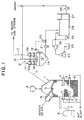
- Fig. 1 illustrates a shaft type smelting reduction furnace 1 supplied by a hopper 4 with carbonaceous material, providing a packed bed 5 at the furnace top.
- a zinc-containing substance together with a flux comprising a limestone and a silica is injected into the furnace 1 by a powder injector 6 through a pipe 7 and the upper tuyeres 2 of the furnace 1. Note, when a zinc-containing substance is not in a powder form, the zinc-containing substance has to be prepared in a powder form before its injection into the furnace.
- the flux is added to adjust slag viscosity and melting point.
- An air blast is heated to about 800 to 1,000°C and blown into the furnace 1 through the upper tuyeres 2 and the lower tuyeres 3. At this point, oxygen is supplied in an appropriate amount into the hot blast as required for combustion of the carbonaceous material in the furnace 1. Combustion heat and reducing gas melt the zinc-containing substance injected by the upper tuyeres 2.
- Zinc oxide contained in the zinc-containing substance is reduced to metallic Zn which is vaporized and passes through the hot packed bed 5 of carbonaceous material and is discharged as a vapor through a waste gas duct 11 located at the upper portion of the furnace 1.
- a secondary combustion burner 8 arranged at or near the top of the furnace 1 burns waste gas in an amount to keep the temperature of the upper part of the packed bed 5 at about 600 to 1,000°C, at which temperature the Zn vapor is stabilized, as a vapor.
- Molten metal eventually accumulating on the hearth is discharged from a taphole 9, and slag is discharged from a cinder notch 10. At this point, chromium and the like are fixed in the molten metal and are, accordingly, not detrimental.
- furnace gas comprising dust mainly consisting of carbon and ash, and waste gas containing Zn vapor generated by combustion of a carbonaceous solid reducing agent, is discharged through the waste gas duct 11 at the top of the furnace 1 to the cooling unit 12.
- the cooling unit 12 is composed of a cooling tank 14 provided with cooling cylinders 13a and 13b, and cooling means 15 are provided which supply liquid coolant such as cooling water via a spray 16 to the cooling cylinders 13a and 13b and the cooling tank 14.
- Cooling cylinder 13a is connected to the waste gas duct 11, and the other cooling cylinder 13b is connected to an exit duct 17.
- Furnace gas emanating from the waste gas duct 11 is introduced into the cooling tank 14 and is cooled by cooling means 15 for removal of dust, which forms a suspension with the liquid coolant at the bottom of the cooling tank 14, thus becoming a slurry 18.
- the treated and cooled waste gas is discharged from the system through the exit duct 17 at a waste gas temperature of up to 200°C.
- the slurry 18 accumulating on the bottom of the cooling tank is transported by a slurry pump 21 to a settling tank 26. Its liquid level is adjusted by a level gauge 19 and a flow regulating valve 20.
- the slurry 18 is then pumped from the bottom of the settling tank 26 by means of another slurry pump 22 to a dehydrating machine 23, in which the slurry 18 is dehydrated to a concentration within a range of from about 40 to 80%, or preferably, of from about 50 to 70%, and then discharged through a slurry transport unit 24 to a container 25 in the form of a thickened slurry.
- Waste liquid from the dehydrating machine 23 is sent to the settling tank 26, and dust and other solids contained in waste liquid are caused to settle, and treated liquid from which solids have been almost eliminated is circulated by means of a treated liquid pump 28 through cooling means 15 to the cooling tank 14.
- the slurry dust collected in the dehydrating machine 23 should have a concentration within a range of from about 40 to 80% by weight. With a slurry dust concentration of under about 40%, the amount of the waste liquid increases, and this requires a larger capacity settling tank 26. With a slurry dust concentration of over about 80%, a larger load is imposed on the slurry transport unit 24, endangering clogging of the transport pipe.
- a cyclone 29 is provided between the shaft type smelting reduction furnace 1 and the cooling unit 12, and the furnace gas from the waste gas duct 11 is introduced into the cyclone 29.
- the collected coarse dust mainly comprising carbon separated in the cyclone 29 passes through the hopper 30. Part of it is returned through a dust transport unit 31 and through the upper tuyere 2 into the furnace. The balance is discharged through a valve 32, a dust discharge hopper 33 and another valve 34 and out of the system.
- the zinc contained in the furnace gas is collected as a slurry in the cooling unit 12, it is possible to inhibit dust adhesion and occurrence of lumps in the cooling tank 14 and to avoid damage and other problems in the bag filter and in the discharge unit.
- the waste gas may be subjected to secondary combustion in a stage precedent to the water spray.
- the waste gas contains a large quantity of Zn vapor.
- dust comprising mainly zinc and zinc oxide tends to adhere in large quantities to the inner wall, causing impaired ventilation, leading to unstable operation.
- secondary combustion burner 8 In the operation of the apparatus shown in Fig. 1 or Fig. 2, use of a secondary combustion burner 8 alone may lead to a lower temperature in the initial stage of operation even when attempting to keep the waste gas temperature at the furnace top at a level sufficient to ensure the presence of stable Zn vapor.
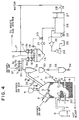
- secondary combustion burners 36 and 37 for the duct are arranged in at least one of the waste gas ducts 11 and 35 of Fig. 2 to cause combustion of waste gas.
- Adherence of dust in the waste gas ducts 11 and 35 can be detected based upon pressure loss in the ducts, from a change of temperature indicated by a thermometer installed in the duct, or from a change of temperature derived from measurement of the outer surface temperature of the duct.
- measurement is made of the internal pressure at a plurality of manometers or differential pressure gauges P 1 to P 3 (Fig. 4) installed longitudinally along the ducts, or a plurality of thermometers t 1 to t 4 . This permits determination of the status of generation and positioning of deposits onto the duct.
- Adherence of zinc oxide in the duct is avoided by adjusting, upon secondary combustion of waste gas in the waste gas ducts 11 and/or 35, the amount of oxygen or air to be blown into the ducts 11 and/or 35, and by appropriately maintaining the waste gas temperature and the degree of oxidation of waste gas.
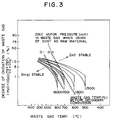
- the waste gas temperature to be achieved by secondary combustion should comply with conditions as shown in Fig. 3, dependent upon the waste gas temperature and degree of oxidation of waste gas attained before secondary combustion and the partial pressure of Zn vapor in the waste gas.
- Fig. 4 illustrates a single secondary combustion burner in each of the ducts 11 and 35
- the number of secondary combustion burners may be increased or reduced in response to the operating conditions (status of deposition of zinc and zinc oxide). No special limitation is imposed on the number of installed burners.
- the waste gas temperature after secondary combustion would be at least 1,000°C when considering the increased degree of oxidation and the waste gas temperature increase brought about by secondary combustion, as is clear from Fig. 3.
- zinc contained in waste gas is collected in the form of slurry in the cooling tank 14. It is thus possible to inhibit adherence in the cooling tank 14 or the resultant production of lumps, and further to avoid difficulty or damage to the bag filter or the discharge unit.
- secondary combustion of waste gas in the waste gas duct makes it possible to inhibit deposition of dust in the waste gas duct and to avoid operational problems or damage to the furnace refractory. In any of these cases, zinc in the dust can be collected stably at a high concentration, and this is very favorable for reusing zinc resources.
- an electric furnace dust (T.Fe: 28.4%, Zn: 29.9%, Cr: 0.27%, Pb: 2.05%, Cd: 0.04%, SiO 2 : 2.91%, Al 2 O 3 : 1.55%, CaO: 1.23%, MgO: 0.38%, MnO: 2.36%, Na 2 O: 1.53% and K 2 O: 0.81%) was treated under conditions including a hot blast of 1,650 Nm 3 /hr, a blast temperature of 900°C, an oxygen enrichment of from 50 to 200 Nm 3 /hr, a quantity of injected dust of from 600 to 900 kg/hr (the blend ratio of which was 85% electric furnace dust and 15% flux (limestone + silica)).
- Example 2 Test conditions Injected EF dust (kg/hr) 700 700 700 Injected flux (kg/hr) 140 140 140 Waste gas temperature (°C) 812 785 800 Dust collected in cyclone (kg/hr) 105 - 101 Cyclone dust recycle (kg/hr) 70 - 67 Dust discharged outside (kg/hr) 35 - 34 Dust on cyclone exit side (kg/hr) 228 - 220 Cooling method Indirect Direct Direct Liquid coolant (l/hr) 50 30 30 30 Comparative Example Example 1 Example 2 Test results Waste gas temperature after cooling (°C) 168 - 245 95 90 Dust discharged from cooling tank (kg/hr) 143 - - Dust discharged from bag filter (kg/hr) 85 - - Slurry concentration in cooling tank (%) - 35 30 Slurry concentration after dehydration (%) - 65 65 Dust in slurry after dehydr
- the metal obtained in the shaft type smelting reduction furnace in this test operation was a pig iron comprising from 90 to 93% Fe, from 1 to 2% Si, from 4.0 to 4.3% C, from 0.8 to 1.2% Mn, and from 0.6 to 0.9% Cr.
- the slag had a chemical composition comprising from 24 to 27% SiO 2 , from 16 to 24% Al 2 O 3 , from 22 to 25% CaO, from 2.3 to 2.6% MgO and from 5.7 to 6.8% MnO.
- the metal obtained in the shaft type smelting reduction furnace in this Example was a pig iron comprising from 90 to 93% Fe, from 1 to 2% Si, from 4.0 to 4.3% C, from 0.8 to 1.2% Mn and from 0.6 to 0.9% Cr.
- the slag had a chemical composition comprising from 24 to 27% SiO 2 , from 16 to 24% Al 2 O 3 , from 22 to 25% CaO, from 2.3 to 2.6% MgO and from 5.7 to 6.8% MnO.
Landscapes
- Engineering & Computer Science (AREA)
- Chemical & Material Sciences (AREA)
- Manufacturing & Machinery (AREA)
- Materials Engineering (AREA)
- Mechanical Engineering (AREA)
- Metallurgy (AREA)
- Organic Chemistry (AREA)
- Life Sciences & Earth Sciences (AREA)
- Environmental & Geological Engineering (AREA)
- General Life Sciences & Earth Sciences (AREA)
- Geology (AREA)
- Manufacture And Refinement Of Metals (AREA)
Priority Applications (5)
| Application Number | Priority Date | Filing Date | Title |
|---|---|---|---|
| DE69600229T DE69600229T2 (de) | 1996-09-30 | 1996-09-30 | Verfahren zur Aufarbeitung von Zink enthaltenden Reststoffen und Vorrichtung dafür |
| CA 2186826 CA2186826C (fr) | 1996-09-30 | 1996-09-30 | Methode et appareil de traitement de substances zinciferes |
| US08/723,026 US5766307A (en) | 1996-09-30 | 1996-09-30 | Method of treating zinc-containing substance |
| EP19960307160 EP0832988B1 (fr) | 1996-09-30 | 1996-09-30 | Procédé pour le traitement de matières contenant du zinc et installation pour sa mise en oeuvre |
| BR9605749A BR9605749A (pt) | 1996-09-30 | 1996-11-29 | Processo e aparelho para tratamento de substância que contém zinco |
Applications Claiming Priority (4)
| Application Number | Priority Date | Filing Date | Title |
|---|---|---|---|
| CA 2186826 CA2186826C (fr) | 1996-09-30 | 1996-09-30 | Methode et appareil de traitement de substances zinciferes |
| US08/723,026 US5766307A (en) | 1996-09-30 | 1996-09-30 | Method of treating zinc-containing substance |
| EP19960307160 EP0832988B1 (fr) | 1996-09-30 | 1996-09-30 | Procédé pour le traitement de matières contenant du zinc et installation pour sa mise en oeuvre |
| BR9605749A BR9605749A (pt) | 1996-09-30 | 1996-11-29 | Processo e aparelho para tratamento de substância que contém zinco |
Publications (2)
| Publication Number | Publication Date |
|---|---|
| EP0832988A1 true EP0832988A1 (fr) | 1998-04-01 |
| EP0832988B1 EP0832988B1 (fr) | 1998-04-08 |
Family
ID=27425261
Family Applications (1)
| Application Number | Title | Priority Date | Filing Date |
|---|---|---|---|
| EP19960307160 Expired - Lifetime EP0832988B1 (fr) | 1996-09-30 | 1996-09-30 | Procédé pour le traitement de matières contenant du zinc et installation pour sa mise en oeuvre |
Country Status (5)
| Country | Link |
|---|---|
| US (1) | US5766307A (fr) |
| EP (1) | EP0832988B1 (fr) |
| BR (1) | BR9605749A (fr) |
| CA (1) | CA2186826C (fr) |
| DE (1) | DE69600229T2 (fr) |
Cited By (1)
| Publication number | Priority date | Publication date | Assignee | Title |
|---|---|---|---|---|
| CN110893284A (zh) * | 2019-12-04 | 2020-03-20 | 荣海生物科技有限公司 | 一种大豆肽粉细粉回收方法 |
Families Citing this family (2)
| Publication number | Priority date | Publication date | Assignee | Title |
|---|---|---|---|---|
| US6932853B2 (en) * | 2003-06-27 | 2005-08-23 | Heritage Environmental Services Llc | Mechanical separation of volatile metals at high temperatures |
| US20050247162A1 (en) * | 2004-05-05 | 2005-11-10 | Bratina James E | Precious metals recovery from waste materials using an induction furnace |
Citations (5)
| Publication number | Priority date | Publication date | Assignee | Title |
|---|---|---|---|---|
| JPS58147528A (ja) * | 1982-02-24 | 1983-09-02 | Sumitomo Metal Ind Ltd | キルンダスト中の亜鉛分回収方法 |
| EP0551992A1 (fr) * | 1992-01-17 | 1993-07-21 | Kaneko, Misa | Procédé de récupération de métaux de valeur à partir de poussières de fer |
| EP0626457A1 (fr) * | 1993-05-27 | 1994-11-30 | Metallgesellschaft Aktiengesellschaft | Procédé de traitement des matières résiduelles ridérurgiques contenant du zinc et du plomb |
| JPH07173548A (ja) * | 1993-10-27 | 1995-07-11 | Kawasaki Steel Corp | 亜鉛含有ダストからの亜鉛回収方法 |
| EP0686703A1 (fr) * | 1994-06-09 | 1995-12-13 | Hoogovens Staal B.V. | Procédé de traitement de poussières zincifères |
Family Cites Families (2)
| Publication number | Priority date | Publication date | Assignee | Title |
|---|---|---|---|---|
| GB1212523A (en) * | 1967-04-25 | 1970-11-18 | Imp Smelting Corp Ltd | Method and apparatus for treating gases leaving a zinc blast furnace |
| JPH06502220A (ja) * | 1990-11-14 | 1994-03-10 | ミンプロック テクノロジー プロプライエタリー リミテッド | 亜鉛の直接的硫化発煙 |
-
1996
- 1996-09-30 US US08/723,026 patent/US5766307A/en not_active Expired - Fee Related
- 1996-09-30 EP EP19960307160 patent/EP0832988B1/fr not_active Expired - Lifetime
- 1996-09-30 DE DE69600229T patent/DE69600229T2/de not_active Expired - Fee Related
- 1996-09-30 CA CA 2186826 patent/CA2186826C/fr not_active Expired - Fee Related
- 1996-11-29 BR BR9605749A patent/BR9605749A/pt not_active IP Right Cessation
Patent Citations (5)
| Publication number | Priority date | Publication date | Assignee | Title |
|---|---|---|---|---|
| JPS58147528A (ja) * | 1982-02-24 | 1983-09-02 | Sumitomo Metal Ind Ltd | キルンダスト中の亜鉛分回収方法 |
| EP0551992A1 (fr) * | 1992-01-17 | 1993-07-21 | Kaneko, Misa | Procédé de récupération de métaux de valeur à partir de poussières de fer |
| EP0626457A1 (fr) * | 1993-05-27 | 1994-11-30 | Metallgesellschaft Aktiengesellschaft | Procédé de traitement des matières résiduelles ridérurgiques contenant du zinc et du plomb |
| JPH07173548A (ja) * | 1993-10-27 | 1995-07-11 | Kawasaki Steel Corp | 亜鉛含有ダストからの亜鉛回収方法 |
| EP0686703A1 (fr) * | 1994-06-09 | 1995-12-13 | Hoogovens Staal B.V. | Procédé de traitement de poussières zincifères |
Non-Patent Citations (2)
| Title |
|---|
| PATENT ABSTRACTS OF JAPAN vol. 007, no. 268 (C - 197) 30 November 1983 (1983-11-30) * |
| PATENT ABSTRACTS OF JAPAN vol. 95, no. 10 30 November 1995 (1995-11-30) * |
Cited By (1)
| Publication number | Priority date | Publication date | Assignee | Title |
|---|---|---|---|---|
| CN110893284A (zh) * | 2019-12-04 | 2020-03-20 | 荣海生物科技有限公司 | 一种大豆肽粉细粉回收方法 |
Also Published As
| Publication number | Publication date |
|---|---|
| EP0832988B1 (fr) | 1998-04-08 |
| BR9605749A (pt) | 1998-08-25 |
| CA2186826C (fr) | 2000-11-07 |
| CA2186826A1 (fr) | 1998-03-31 |
| DE69600229T2 (de) | 1998-09-03 |
| DE69600229D1 (de) | 1998-06-10 |
| US5766307A (en) | 1998-06-16 |
Similar Documents
| Publication | Publication Date | Title |
|---|---|---|
| US4045214A (en) | Method for producing steel | |
| KR100584745B1 (ko) | 일반탄 및 분철광석을 이용한 용철제조공정에 있어서함철더스트 및 슬러지 재활용 장치 및 방법 | |
| CN1061380C (zh) | 生产合成炉渣及生铁合金的方法及装置 | |
| US4396424A (en) | Method for recovering useful metals from dust discharged from metal refining metallurgical furnace | |
| CA1147558A (fr) | Methode de recuperation de metaux volatils contenus dans des oxydes metalliques | |
| EP0657552A1 (fr) | Procédé de récupération de zinc à partir de poussières zincifères | |
| HU184306B (en) | Process and equipment for reducing granular iron oxide and for producing iron melt | |
| EP0686703B1 (fr) | Procédé de traitement de poussières zincifères | |
| CN1462312A (zh) | 煤基炼铁工艺回收废料的方法 | |
| US6136066A (en) | Method of recycling iron-bearing waste material back into a basic oxygen furnace | |
| US4200454A (en) | Process for the volatilization of zinc and/or lead from metallurgical material | |
| AU602471B2 (en) | Process of making binderless briquets from steelworks dusts | |
| US5766307A (en) | Method of treating zinc-containing substance | |
| JP3336167B2 (ja) | 電気炉ダストの処理方法 | |
| US5178667A (en) | Dry process for refining zinc sulfide concentrates | |
| KR100205090B1 (ko) | 아연함유 조성물의 처리방법 및 그 장치 | |
| AU2023257052B2 (en) | Method for melting direct reduced iron, solid iron and method for producing the same, material for civil engineering and construction and method for producing the same, and system for melting direct reduced iron | |
| US5885322A (en) | Method for reducing iron losses in an iron smelting process | |
| US4378241A (en) | Method for achieving low sulfur levels in the DRI product from iron oxide reducing kilns | |
| JP3336131B2 (ja) | 亜鉛含有ダストからの亜鉛回収方法 | |
| AU2023255850B2 (en) | Method for producing grained iron, and grained iron | |
| JP2023087777A (ja) | 製錬炉の操業方法 | |
| Fleischanderl et al. | Converting residues into profit | |
| JPH07207313A (ja) | 錫めっき鋼板スクラップの溶解方法 | |
| JPH08209261A (ja) | 銅の乾式製錬法 |
Legal Events
| Date | Code | Title | Description |
|---|---|---|---|
| GRAG | Despatch of communication of intention to grant |
Free format text: ORIGINAL CODE: EPIDOS AGRA |
|
| GRAG | Despatch of communication of intention to grant |
Free format text: ORIGINAL CODE: EPIDOS AGRA |
|
| GRAH | Despatch of communication of intention to grant a patent |
Free format text: ORIGINAL CODE: EPIDOS IGRA |
|
| GRAH | Despatch of communication of intention to grant a patent |
Free format text: ORIGINAL CODE: EPIDOS IGRA |
|
| PUAI | Public reference made under article 153(3) epc to a published international application that has entered the european phase |
Free format text: ORIGINAL CODE: 0009012 |
|
| GRAA | (expected) grant |
Free format text: ORIGINAL CODE: 0009210 |
|
| 17P | Request for examination filed |
Effective date: 19970404 |
|
| AK | Designated contracting states |
Kind code of ref document: A1 Designated state(s): BE DE FR GB NL SE |
|
| AK | Designated contracting states |
Kind code of ref document: B1 Designated state(s): BE DE FR GB NL SE |
|
| ET | Fr: translation filed | ||
| REF | Corresponds to: |
Ref document number: 69600229 Country of ref document: DE Date of ref document: 19980610 |
|
| AKX | Designation fees paid |
Free format text: BE DE FR GB NL SE |
|
| RBV | Designated contracting states (corrected) |
Designated state(s): BE DE FR GB NL SE |
|
| PLBE | No opposition filed within time limit |
Free format text: ORIGINAL CODE: 0009261 |
|
| STAA | Information on the status of an ep patent application or granted ep patent |
Free format text: STATUS: NO OPPOSITION FILED WITHIN TIME LIMIT |
|
| 26N | No opposition filed | ||
| REG | Reference to a national code |
Ref country code: GB Ref legal event code: IF02 |
|
| PGFP | Annual fee paid to national office [announced via postgrant information from national office to epo] |
Ref country code: NL Payment date: 20080915 Year of fee payment: 13 Ref country code: FR Payment date: 20080915 Year of fee payment: 13 |
|
| PGFP | Annual fee paid to national office [announced via postgrant information from national office to epo] |
Ref country code: DE Payment date: 20081014 Year of fee payment: 13 |
|
| PGFP | Annual fee paid to national office [announced via postgrant information from national office to epo] |
Ref country code: SE Payment date: 20080908 Year of fee payment: 13 Ref country code: BE Payment date: 20080922 Year of fee payment: 13 |
|
| PGFP | Annual fee paid to national office [announced via postgrant information from national office to epo] |
Ref country code: GB Payment date: 20081001 Year of fee payment: 13 |
|
| BERE | Be: lapsed |
Owner name: *KAWASAKI STEEL CORP. Effective date: 20090930 |
|
| REG | Reference to a national code |
Ref country code: NL Ref legal event code: V1 Effective date: 20100401 |
|
| GBPC | Gb: european patent ceased through non-payment of renewal fee |
Effective date: 20090930 |
|
| EUG | Se: european patent has lapsed | ||
| REG | Reference to a national code |
Ref country code: FR Ref legal event code: ST Effective date: 20100531 |
|
| PG25 | Lapsed in a contracting state [announced via postgrant information from national office to epo] |
Ref country code: NL Free format text: LAPSE BECAUSE OF NON-PAYMENT OF DUE FEES Effective date: 20100401 Ref country code: FR Free format text: LAPSE BECAUSE OF NON-PAYMENT OF DUE FEES Effective date: 20090930 Ref country code: DE Free format text: LAPSE BECAUSE OF NON-PAYMENT OF DUE FEES Effective date: 20100401 |
|
| PG25 | Lapsed in a contracting state [announced via postgrant information from national office to epo] |
Ref country code: BE Free format text: LAPSE BECAUSE OF NON-PAYMENT OF DUE FEES Effective date: 20090930 |
|
| PG25 | Lapsed in a contracting state [announced via postgrant information from national office to epo] |
Ref country code: GB Free format text: LAPSE BECAUSE OF NON-PAYMENT OF DUE FEES Effective date: 20090930 |
|
| PG25 | Lapsed in a contracting state [announced via postgrant information from national office to epo] |
Ref country code: SE Free format text: LAPSE BECAUSE OF NON-PAYMENT OF DUE FEES Effective date: 20091001 |